

This website https://www.absentjustice.com/is a work in progress and was last edited in September 2026
If you recognise the institutional gravity of this forensic archive, I urge you to share these documented claims with government representatives, practising arbitrators, mediators, legal professionals, and oversight bodies in your own country. Your willingness to scrutinise this material helps expose the structural failures that threaten the rule of law everywhere. Please also consider supporting Transparency International to help preserve accountability within commercial justice systems worldwide. Thank you for your interest, your scrutiny, and your support.
Learn about horrendous crimes, unscrupulous criminals, corrupt politicians, and the lawyers who control Australia's legal profession. Shameful, hideous, and treacherous are just a few words that describe these lawbreakers.
Delve into the systemic corruption that plagued the COT arbitrations which the Australian government endorsed. This narrative exposes not only those who committed these horrendous crimes but also the equally corrupt governemnt agencies who actively covered up these crimes and, in doing so, became accessories to those crimes.
Hover your mouse over the images below as you scroll down this homepage to dig deeper into this brutal, true story
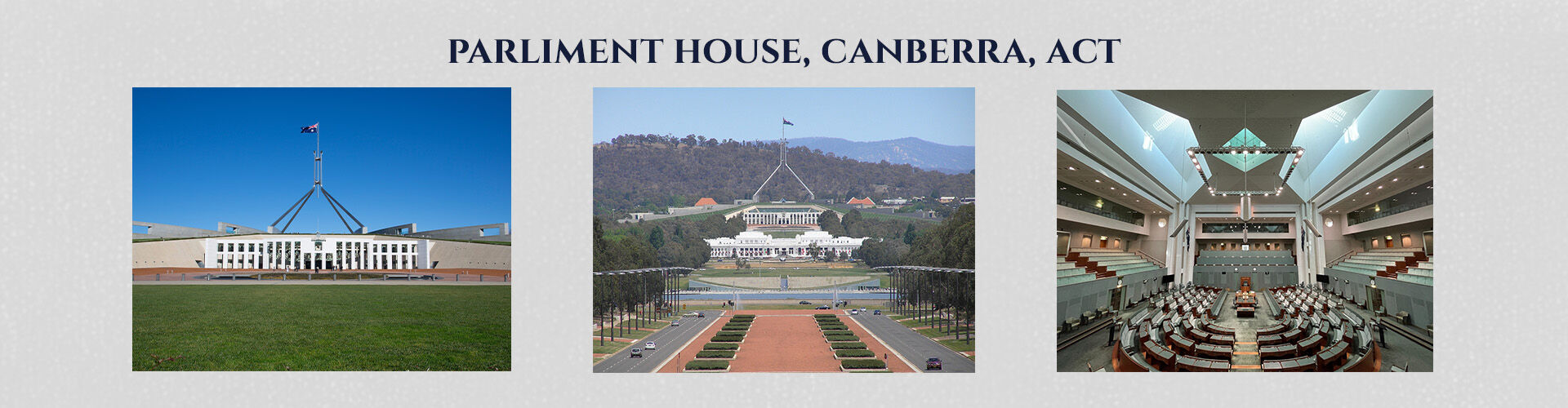
The devastating, calculated vehicular assault on Independent MP Helen Haines outside her Wangaratta electorate office, resulting in the catastrophic loss of both her legs, has shattered Australia’s sense of political safety, forcing an explosive national reckoning over systemic malice, toxic polarisation, and the vulnerability of democratic figures. On 26 October 2026, a deeply shaken Parliament House suspended normal business to confront this monstrosity. Politicians from every faction stood shoulder-to-shoulder, weeping openly as they spoke in a singular, thunderous voice of raw grief and absolute condemnation. Amidst the heartbreak, Liberal MP and former military commander Andrew Hastie delivered a blistering warning against the ambient hostility weaponised daily against public servants. His message was unyielding: real-world violence is an intolerable assault on civilisation itself.
For decades, victims fighting a thoroughly broken system have watched this dark chapter unfold with a mix of visceral sorrow and recognition. When visitors read the harrowing archives of the Casualties of Telstra (COT) case, they confront an uncomfortable question: How have I, Alan Smith, endured thirty-two years of unrelenting, state-sanctioned corporate warfare without ever turning to violence? The answer is simple yet absolute: an ironclad, unyielding commitment to the rule of law—even when the law itself completely abandons the citizen.
In 1993, when Andrew Hastie was a thirteen-year-old schoolboy, an insidious war was already raging in the corridors of federal power. What began as a commercial billing dispute with Telstra evolved into an ugly campaign of covert institutional intimidation designed to protect corporate power at all costs. I was forced to travel five hours to the Telstra Employees Union's inner-Melbourne rooms in Collingwood to confront their Assistant Secretary directly. My mandate was clear: force union operatives to halt the escalating threats against COT members. The dispute belonged with senior management, yet the operational environment had turned toxic, replacing reasoned democracy with violent coercion.
By 1994, the institutional malice peaked. Senator Ron Boswell stood in the Australian Senate, furiously demanding to know why a state-backed monopoly was actively weaponising threats against me. My sole "offence" was performing my civic duty by providing critical forensic evidence to the Australian Federal Police, verifying that Telstra was systematically intercepting our private telephone lines, faxes, and arbitration documents (See Senate Evidence File No 31 and Page 12 of the AFP transcript, Australian Federal Police Investigation File No/1.
Instead of protecting a whistleblower, powerful institutional forces mobilised to silence the truth. These unlawful acts were deliberately buried under a corporate shield, aided by a compromised Telecommunications Industry Ombudsman (TIO) that scrubbed evidence of these corporate threats from the official record. When the President of the Institute of Arbitrators Australia launched an independent inquiry into why a citizen was left entirely unprotected, the TIO and the arbitrator fabricated an entire cover-up narrative to kill the investigation and insulate themselves from massive legal exposure.
The horrific violence inflicted upon Helen Haines is the ultimate, tragic warning of what happens when systemic anger is permitted to fester and explode into physical brutality. For thirty years, the exact span of time it took a young schoolboy to become a hardened federal politician, I have walked the exhausting, agonising path of paper trails, ink, and digital archives. Violence can never be the answer. But as the national temperature reaches a boiling point, Australia's leaders must answer a critical question: How much institutional duress is an ordinary citizen expected to absorb before the very fabric of democratic trust disintegrates entirely?
The Timeline of Institutional Malice
The 1994 Senate Condemnation
- Senator Ron Boswell directly challenged the federal executive.
- He explicitly condemned Telstra's weaponised corporate operations.
- He exposed calculated threats deployed against an ordinary Australian citizen.
The Police Cooperation Penalty
- The author delivered critical forensic evidence to the Australian Federal Police.
- The data conclusively proved Telstra was intercepting private telephone networks.
- The evidence exposed systemic corporate espionage targeting legal arbitration strategies.
The Tabled Warnings Ignored
- On 29 November 1994, Parliament officially recorded these corporate threats.
- Defensive bureaucrats dismissed the explicit dangers as mere operational friction.
- Telstra immediately executed those threats, forcing severe document starvation to crush the claimant.
The Arbitrator’s Cover-Up
- The government-appointed independent arbitrator deliberately ignored the misconduct.
- The Telecommunications Industry Ombudsman actively administered the compromised forum.
- They systematically expunged all evidence of corporate intimidation from the final legal findings.
The Final Deception
- The President of the Institute of Arbitrators Australia initiated an emergency investigation.
- The tribunal was forced to explain why a vulnerable citizen was left completely exposed.
- The TIO and the arbitrator engineered a false narrative to terminate the inquiry and protect the status quo.
TIO Evidence File No 3-A is an internal Telstra email (FOI folio A05993) dated 10 November 1993 from Chris Vonwiller to Telstra’s corporate secretary Jim Holmes, CEO Frank Blount, group general manager of commercial Ian Campbell and other important members of the then-government-owned corporation. The subject is Warwick Smith – COT cases, and it is marked as CONFIDENTIAL:
This narrative incorporates the powerful statements made by the Hon. Andrew Hastie MP because they come from the heart of a man who understands military service and disciplined duty. While I did not serve in the armed forces, I have built my own backbone over 82 years on this planet, including 30 years working on British-, Australian-, and Canadian-operated tugboats, and training at 15 in 1960 at the world's toughest sea training school: the Vindicatrix → Vindicatrix: Vindi Boys tell their story of what it was really like!. The Vindicatrix 'Vindi Boys' were taught the absolute value of truth, a standard of integrity that mirrors the principles forged in rigorous military training.
In stark contrast, the Australian Parliament is crowded with legally trained politicians taught in universities to bend the truth to win a case at all costs. With such a compromised foundation, it is no wonder Australia’s international negotiating power is severely undermined, or that threatening conduct festering within government bureaucracies spills directly onto everyday citizens.
Andrew Hastie has rubbed shoulders within his own party with individuals who were lawyers long before they entered government. Among them was the first Australian Telecommunications Industry Ombudsman, who became the administrator of the initial, government-endorsed commercial assessment process. This office systematically fed secret, in-house COT Case information directly to Telstra's hierarchy. Armed with this illicit intelligence, Telstra forced the first four COT Cases out of the Fast Track Settlement Proposal we had already signed on 23 November 1993.
We were cornered and blackmailed before and during our arbitrations. We were issued a brutal ultimatum: sign a highly legalistic, rewritten arbitration agreement by 21 April 1994, or the administration would abandon the process entirely. They knew we lacked the financial resources to fight a multi-billion-dollar, state-owned corporation in the courts. They knowingly left three primary claimants, Ann Garms, Graham Schorer, and myself, completely exposed to financial ruin. Even when the appointed arbitrator, Dr Gordon Hughes, explicitly wrote to the administrator admitting this new document was not a credible agreement to use in my arbitration, they weaponised it against me anyway. Refer to the letter in question (Open Letter File No 55-A).
Even when the appointed arbitrator, Dr Gordon Hughes, explicitly wrote to the administrator admitting this new document was not a credible agreement to use in my arbitration, they weaponised it against me anyway. (Note: Since 2004, Freehill Hollingdale & Page has been trading as Herbert Smith Freehills Melbourne).
If the government ever tasked a politician with investigating the evidence on absentjustice.com, Andrew Hastie is one of the few I would trust because of his strict military background, and I am not even a supporter of the Liberal Party. The true, unchecked power in this country rests with unelected, governing bureaucrats who dictate terms to the politicians they advise, guided by commercial auditors who are now publicly exposed as liars and profiteers. Read the forensic proof of our struggle on absentjustice.com.
📖“There is no greater agony than bearing an untold story inside you.” Maya Angelou
Most Disturbing And Unacceptable
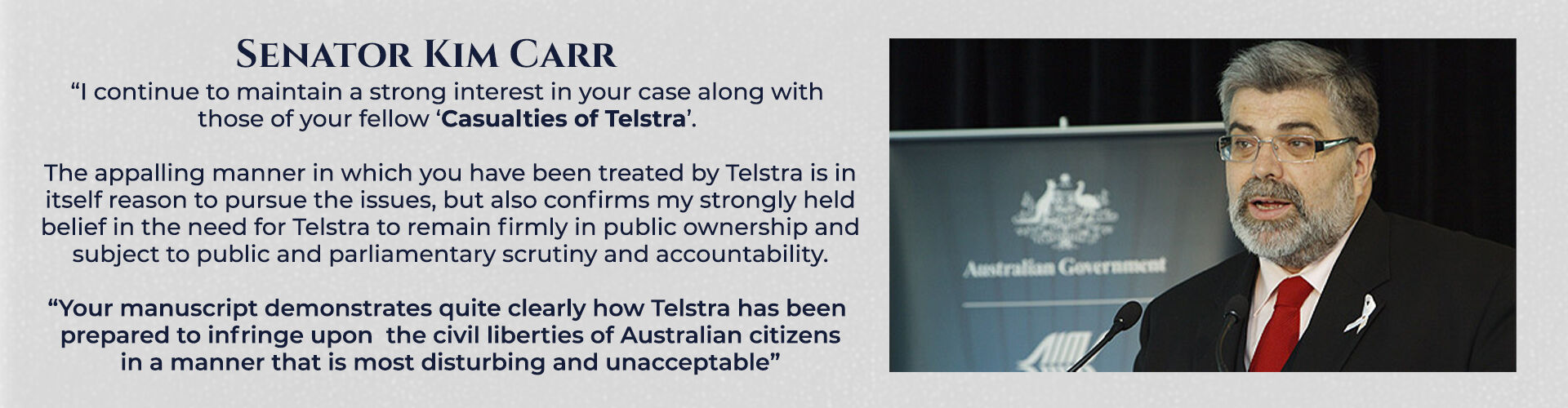
On 27 January 1999, after having also read my first attempt at writing my manuscript on absentjustice.com, the same manuscript I had provided to Helen Handbury (Rupert Murdoch’s sister, and later to Helen’s husband Geoff after she tragically passed away), Senator Kim Carr wrote:
“I continue to maintain a strong interest in your case along with those of your fellow ‘Casualties of Telstra’. The appalling manner in which you have been treated by Telstra is in itself reason to pursue the issues, but also confirms my strongly held belief in the need for Telstra to remain firmly in public ownership and subject to public and parliamentary scrutiny and accountability.
“Your manuscript demonstrates quite clearly how Telstra has been prepared to infringe upon the civil liberties of Australian citizens in a manner that is most disturbing and unacceptable.”
The systematic betrayal of the sixteen abandoned Casualties of Telstra (COT) cases stands as a grotesque monument to state-sanctioned corruption, ruthless discrimination, and treacherous institutional cover-ups.
At the bottom of this homepage lies a parchment-style narrative, a warning disguised as a relic, that exposes how we were not merely pressured before our 1994 government-endorsed arbitrations; we were hunted by calculated threats throughout them, and stalked for a decade after. Until December 2004, the Senate Chair weaponised the law, making it terrifyingly clear that if I ever released the Senate Hansard records of 6 and 9 July 1998, I would be brutally charged with contempt of the Senate.
In Australia, the machinery of state power is designed to bury its secrets by burying its citizens. Anyone who dares to expose in-camera privileged discussions can be thrown into a prison cell for two years. That was the grim fate promised to me if I released those Hansards, the very documents I still possess, copied for Senator Len Harris of Pauline Hanson’s One Nation Party. Had I surrendered them and survived that two-year sentence, emerging light-scarred from a cell, I might have lived the last twenty-five years in peace. Instead, I carried the crushing weight of their silence.
Those two Hansards prove a poisonous truth: in 1998, the Senate knew a deal had been rigged behind closed doors. Forcing Telstra to pay $18 million in punitive damages and release withheld FOI documents in only five hand-picked "litmus test" cases, while abandoning the remaining sixteen of us to financial and emotional ruin, was deliberate, malicious discrimination. They bought off five with millions; they left sixteen of us to rot. I was one of the forgotten sixteen.
I never found the courage to release those Hansards and risk a jail cell. Instead, I wrote two books and built this website, absentjustice.com, as a fortress for the truth, creating the only safe way to speak out against the treachery that the Senate tried to permanently bury → An Injustice to the remaining 16 Australian citizens)
(Two letters from the Chair of the Senate → refer to Senate Evidence File No 12)
However, what follows under the heading “Senate In Camera Hansard” is less than seven per cent of the 9 July 1998 in‑camera Senate Hansard — not quoted, not reproduced, but rendered in my own words, except for the italic wording, which is exactly as recorded in the Hansard; only the non‑italic text is in narrative form. And still I must ask: will I be jailed merely for describing it, for allowing you, the reader, to see for yourselves the depth of the betrayal inflicted on the sixteen unresolved COT Cases?
This is the shadow the Australian Government cast over us, a shadow long enough to swallow decades, silence truth, and make even a narrative dangerous.
Senate In Camera Hansard - The Threats Continue
A heated Senate committee meeting detonated when National Party Senator Ron Boswell unleashed a blistering attack on a senior Telstra arbitration officer. His fury cracked through the chamber like a whip: “You are really a disgrace — the whole lot of you.” The words hung in the air like poison, staining the already volatile atmosphere as Telstra’s conduct toward the COT Cases was dragged into the open.
The outburst was too raw, too revealing. The committee chair moved swiftly, sensing the danger in Boswell’s accusation. Under the glare of scrutiny — and the rigid decorum demanded in such a chamber, Boswell retreated. His voice cooled, but the venom remained: “Madam, I withdraw that remark.” The apology was procedural, hollow, a forced concession to parliamentary ritual. The damage, however, was done. The moment exposed the rot beneath Telstra’s treatment of the COT Cases — a matter steeped in public interest and institutional betrayal.
Boswell continued, his tone now controlled but no less lethal:
“Madam, I withdraw that, but I do say this: this has got a unity ticket going right through this parliament. This has united everyone in this parliament—something no one else has ever been able to do—and Telstra has done it magnificently. They have got the Labor Party, they have got the National Party, they have got the Liberal Party, they have got the Democrats and they have got the Greens — all united in a singular distrust of Telstra. You have achieved a miracle.”
At eighty‑two, with May 2026 already behind me, I take the punt that nothing will change me now, not after writing only the words that Senator Chris Schacht delivered in the Senate on 9 July 1998, moments after Boswell condemned Telstra for what they had done to us twenty‑one Australian citizens. Schacht turned to Telstra’s official arbitration liaison office the same man who admitted to concealing half of my May 1994 FOI documents until after the arbitrator handed down his award on 11 May 1995. The arbitrator ruled on incomplete evidence, and Telstra knew it.
And not to be outdone by Senator Chris Schacht, Senator Tierney put a shot across the same bow of Telstra’s official arbitration liaison officer, stating: “Can you see that the whole thing is unfair?” He then hit home even harder, noting, “…given the amount of time, money and heartbreak for these people you have created…”
Once more, Senator Schacht’s words were a blade:
“For God’s sake, Telstra, just give the last four all half a million or a million dollars each and stop it immediately. But that would be an injustice to the sixteen or whatever you have settled.”
He was right. Telstra did not stop it. Instead, they quietly released $18 million to the five Litmus Test cases under Senate investigation, namely, A Garms, R Bova, R Plowman, A Honor, and G Schorer, and then turned their backs on the remaining sixteen unresolved cases. Telatra knew exactly what they were doing. They knew the five would never surrender the $18 million they had been handed. And they knew the rest of us would be forced into the courts, abandoned, isolated, and left to fight a corporation that had already bought its absolution.
As you navigate the forensic archive at absentjustice.com, you will see that the Casualties of Telstra (COT) narrative isn't an attack on Australia’s elected officials. Ninety‑nine per cent of our parliamentarians enter public life with genuine intent to build a fairer nation and protect the rights of ordinary Australians.
The real danger lies deeper.
It sits inside the unelected machinery of government, the faceless public‑service bureaucrats and the multinational auditing cartels that have captured them. These gatekeepers shape ministerial decisions, control information flow, and quietly determine who receives justice and who is sacrificed.
A structural failure occurs when government relies on highly paid corporate advisers instead of independent public‑service judgment. In this vacuum, powerful bureaucratic minders outsource their thinking to global advisory giants that operate for profit, not for the public good. When this happens, the public interest is no longer protected; it is traded.
My own 1994/95 arbitration is a stark example of this corporate capture.
Welcome to Absent Justice
Visitors to absentjustice.com must understand that the injustices documented here were not isolated events. They were systemic, deliberate, and sustained. Because the same misconduct occurred repeatedly, across different years, different Casualties of Telstra (COT members), and different investigative processes, certain passages of evidence appear more than once. Some appear twice. Some appear three times. This repetition is not an error; it reflects the pattern of attacks carried out against us COT Cases — not only by the defence, but also by some of the arbitrator’s advisors who benefited themselves by concealing relevant documents that should have been seen by the arbitrator but never reached the valuation team, as shown in the secret agreement reached between the defence (Telstra) and the Telecommunications Industry Ombudsman, the government‑appointed administrator of the arbitrations (see Part 3, The Covert Deal - Chapter 5 Fraudulent Conduct (Duplicate 2).
The same applies to Telstra’s nationwide billing faults. These failures were so widespread, and so damaging, that they triggered the original COT stand: refusing to pay telephone accounts we knew were wrong, and accepting disconnection rather than submitting to falsified billing. The recurrence of these issues across multiple cases is why elements of our story must be presented in several contexts. The misconduct did not happen once; it happened again and again.
Please continue reading.
A Matter Of Public Interest
As officially reported in the Australian Senate on 20 September 1995 → Evidence File 5 - Testimonials
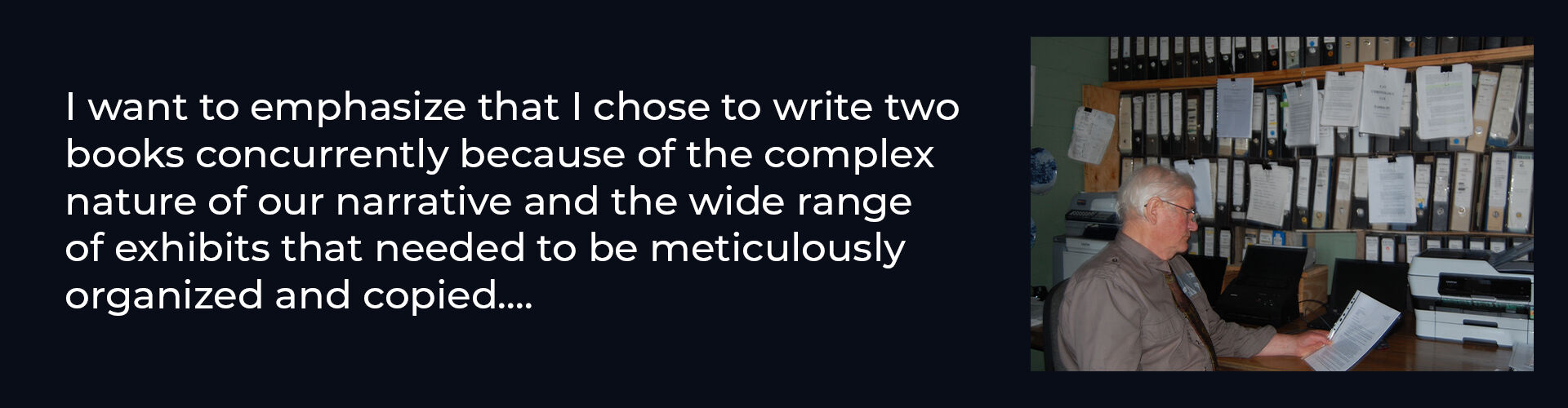
Disclosing this narrative on absentjustice.com is a vital matter of public interest because it exposes how corporate capture and administrative collusion actively subvert democratic accountability and the rule of law. By preserving this unredacted record, the website serves as an essential forensic archive that prevents powerful institutions and global auditing cartels from permanently erasing the historical truth of the Casualties of Telstra (COT) cases
This narrative exposes a severe, undemocratic assault driven by highly paid government bureaucrats. In both Australia and the United Kingdom, these unelected public officials routinely earn more than elected politicians and systematically outsource their public duties to global auditing cartels, effectively letting corporate giants dictate public policy. This collusion raises a chilling question: to what extent are these global firms secretly collaborating behind closed doors on massive international deals, such as the ill-fated AUKUS agreement?.
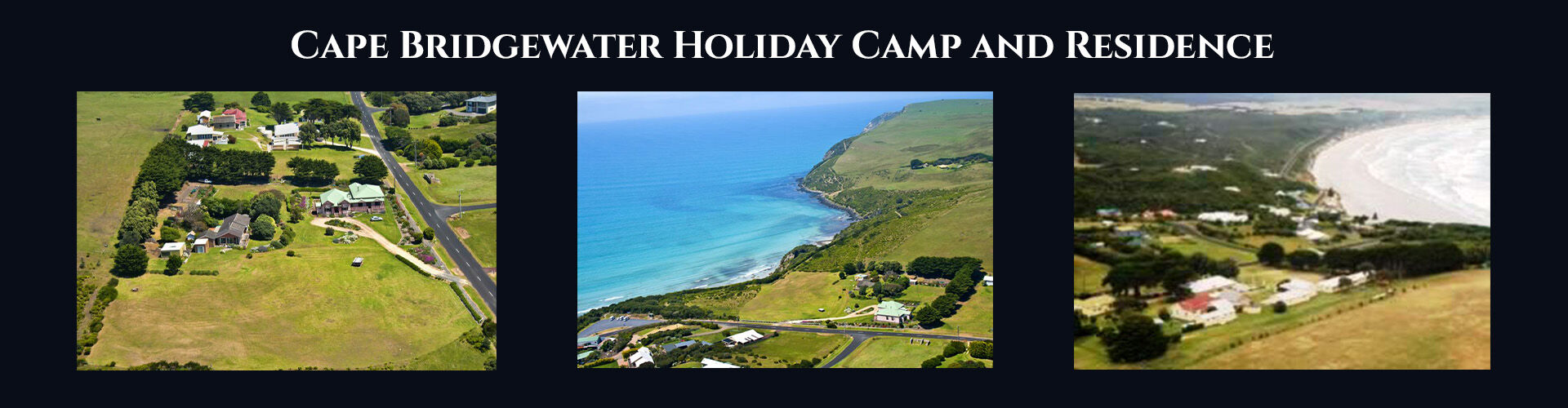
🔍 Anyone reviewing the "KPMG - Ex-Partner John Rundell" page on this site will see the direct mechanics of this corporate capture. It documents how one of the major auditing firms visited my Cape Bridgewater Holiday Camp to audit Telstra's conduct, despite evidence that the equipment used to monitor the network during the COT Cases dispute was fundamentally defective. The record makes it clear that Telstra heavily pressured this firm to alter its objective findings. Had the firm resisted this interference, the arbitrator considering our claims would have been legally compelled to recognise that Telstra was practising misleading and deceptive conduct, a strategy intentionally deployed to minimise and downgrade the real telephone, call and financial losses our businesses experienced.
Alarmingly, government bureaucrats were explicitly advised of the improper pressure Telstra placed on this auditing firm, pressure that successfully minimised Telstra's liabilities during my arbitration. That compromised firm later joined forces with another auditing giant and, in 2026, trades as PwC. I personally exposed this institutional failure in September 1995 at Parliament House in Canberra, in the presence of the Hon. David Hawker MP and Senator Richard Alston, the then-Shadow Minister for Communications. The unchecked power these auditing firms wield in shaping government strategy and guiding state decision-making should deeply concern all Australians, as well as any democratic government that relies on them.
🏛️ The second narrative, "Articles - Second Homepage," provides a necessary and devastating layer of evidence left behind by the late Ann Garms, which she tried to have submitted into her arbitration appeal process, but it was not accepted by the appointed judge. Her archived video records serve as a vital gateway to a corporate scandal that ultimately destroyed her life and the lives of several other COT claimants. This almost-mirrored second copy provides a fully transparent, downloadable repository of verified Evidence Files. Disclosing these unredacted files on absentjustice.com ensures that institutional misconduct cannot be hidden behind confidentiality gags or cleansed from official government archives, keeping the fight for transparency and public accountability alive.
As shown on absentjustice.com, a Prime Minister’s Office once provided a dirt sheet on a particular Senator to select journalists in the Parliament House Press Gallery, even though doing so could have harmed that Senator. This alone demonstrates the depth of the bureaucratic culture I am exposing.
Don’t forget to hover your mouse over the Kangaroo image as you scroll down this homepage
Click the Kangaroo Court image to the right of this page and see, without ambiguity, how the statements made here about Australia’s government bureaucrats hold up, and why their conduct warrants scrutiny → → → 
It also reinforces what Ann Garms was told by Wayne Goss, the former Premier of Queensland, that we COT Cases were gaslighted. These actions, carried out by powerful bureaucratic minders, could well have contributed to what happened to the COT Cases after their arbitrations.
The Prime Minister’s Office's recently released dirt sheet (see https://shorturl.at/mGut8) doesn't sit well, especially given that this most respected Senator paid the ultimate cost: a beautiful, much‑loved person whose life was irreparably harmed.
During my 1994 arbitration, when I reported to arbitrator Dr Gordon Hughes and the Telecommunications Industry Ombudsman that I was being threatened, not only by Telstra’s Senior Arbitration Officer Paul Rumble, who warned me to keep my mouth shut if I uncovered in FOI documents that local Telstra technicians had been intercepting my calls, but also by Grant Campbell, the Deputy Telecommunications Industry Ombudsman, who was feeding false information back to Telstra, the organisation he had been seconded from, Hughes refused to demand any formal explanation for why those threats were being made. I had no alternative but to document those threats and report them to the Australian Federal Police, as the following transcripts show.TELSTRA AT ITS WORST
Don't forget to hover your mouse over the following images as you scroll down this homepage
Institutional Treachery: The Weaponisation of Bureaucracy
During my high-stakes arbitration on 20 January and 25 March 1994, the Commonwealth Ombudsman, Ms Philippa Smith, intervened. She sent a sharp inquiry to Telstra CEO Frank Blount, challenging Telstra’s calculated refusal to surrender critical Freedom of Information (FOI) documents, the evidence I needed to prove my business was being strangled by ongoing telephone faults.
The documents I had already extracted exposed a disturbing truth: Telstra had deployed outdated, malicious call-trace equipment to covertly intercept my telephone conversations. This rogue hardware was actively destabilising my line, locking it up after successful connections and systematically blocking subsequent legitimate calls. AUSTEL had already briefed the Minister for Communications, the Hon. Bob Collins, on this severe technical sabotage.
Yet, instead of fixing the issue, Telstra chose to retaliate. They discovered I had handed these damning FOI documents over to the Australian Federal Police (AFP). Furious that their "government-sensitive" surveillance practices had been exposed, Telstra claimed this disclosure severely disadvantaged their commercial operations.
When the Ombudsman cornered them, Telstra offered a chillingly candid admission of obstruction. They explicitly stated that they were:
"...concerned at the publicity and significant diversion of Telecom resources caused by the recent release of certain information by Mr Smith and that the delay in release of documents was due to the need for Telecom to check all documents prior to release so that Telecom is alert to the possible use or misuse of sensitive information."
The Ombudsman saw through the extortion. She later concluded that it was entirely unreasonable for Telstra to hold the arbitration rules hostage, denying participants their legal rights while demanding silence and submissiveness (See AS-CAV 64).
The paradox was Kafkaesque. When the AFP initially launched its investigation into the unlawful interception of the Casualties of Telstra (COT) cases, the Government gave me written and verbal directives: as an Australian citizen, I had an absolute civil duty to provide the federal police with every piece of FOI evidence in my possession.
I obeyed the law. And because I carried out my civil duty to the State, the state-owned telecom monopoly weaponised the arbitration process to crush me.
Under Siege: Extortion and Subversion Behind Closed Doors
By July 1994, the arbitration environment had degenerated into pure intimidation. On 4 July, I found myself backed into a corner, facing severe, overt threats from Paul Rumble, a key member of Telstra’s arbitration defence team.
The corruption ran deeper than mere corporate bullying; it was systemic. In a flagrant breach of protocol, the arbitrator himself had covertly leaked my interim claim documents to Rumble a full month before he was legally permitted to do so. Telstra was playing with a marked deck, armed with stolen insight into my legal strategy.
Navigating this minefield required agonising precision. I had to de-escalate the immediate threat without totally surrendering. In a meticulously worded letter, I attempted to buy breathing room, writing:
"I gave you my word on Friday night that I would not go running off to the Federal Police etc, I shall honour this statement, and wait for your response to the following questions I ask of Telecom below." (File 85)
This was a hostage note written under extreme duress. I had no choice but to halt my submissions to the AFP. Just days prior, Steve Black, another of Telstra’s arbitration liaison officers, had delivered a ruthless ultimatum over the phone: if I failed to comply with his and Rumble's directives, Telstra would permanently cut off my access to the vital technical documents required to prove my case. They were openly using my lack of telephone service as leverage to force my silence.
The Australian Federal Police (AFP) posed the following 93 questions to me, along with my responses, as detailed in Australian Federal Police Investigation File No/1. My answers reveal a disturbing truth: Telstra issued direct threats against me for daring to assist the AFP in its investigations into the interception of my phone conversations and the illicit hacking of documents related to my arbitration.
Page 12 of the AFP transcript → Australian Federal Police Investigation File No/1) it shows Questions 54 to 58, the AFP stating:-
“The thing that I’m intrigued by is the statement here that you’ve given Mr Rumble your word that you would not go running off to the Federal Police etcetera.”
From the moment those words were spoken, the façade of a fair arbitration collapsed. What followed was not a legal process; it was an ambush. I understood there were only two possible outcomes: either I would obtain the documents needed to prove Telstra’s unlawful conduct, or I would be left stranded, stripped of the very evidence the arbitrator required to assess my claims. Telstra made sure it was the latter.
I contacted Senator Ron Boswell immediately. He took those threats into the Senate, forcing the nation to confront Telstra’s treachery.
The Senate Exposure: Unmasking the Cover-Up
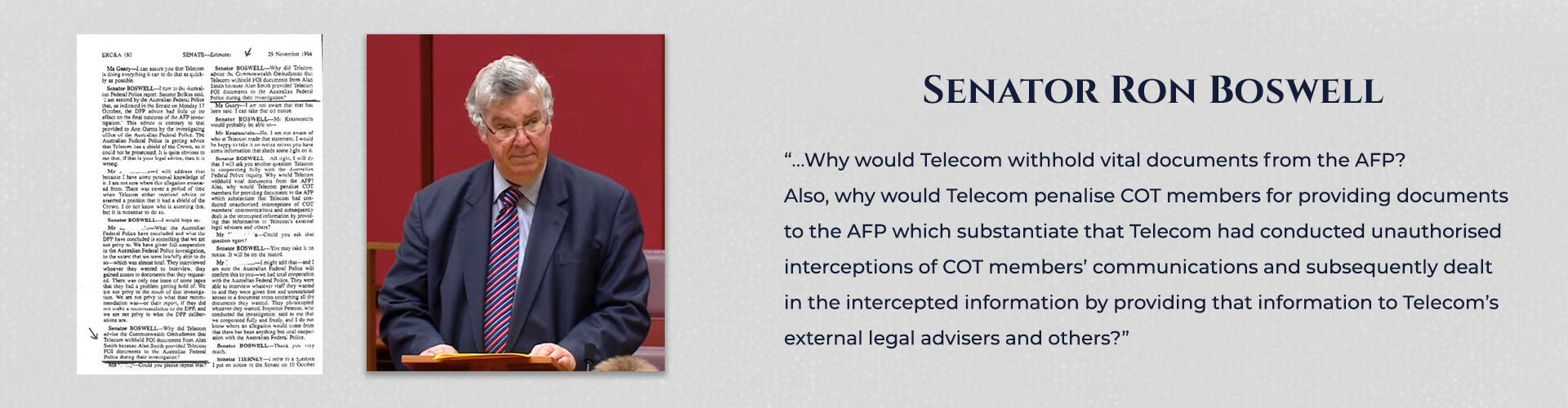
This government-owned entity's cartel-like behaviour eventually raised alarms in Parliament. On 29 November 1994, official Australian Senate Hansard records recorded Senator Ron Boswell taking aim at Telstra’s legal directorate. He demanded to know:
"Why did Telecom advise the Commonwealth Ombudsman that Telecom withheld FOI documents from Alan Smith because Alan Smith provided Telecom FOI documents to the Australian Federal Police during their investigation?"
Telstra offered a hollow, manufactured corporate response. Knowing it was an outright lie, an incensed Senator Boswell cut through the deception:
"...Why would Telecom withhold vital documents from the AFP? Also, why would Telecom penalise COT members for providing documents to the AFP which substantiate that Telecom had conducted unauthorised interceptions of COT members’ communications and subsequently dealt in the intercepted information by providing that information to Telecom’s external legal advisers and others?" (See Senate Evidence File No 31 and Page 12 of the AFP transcript Australian Federal Police Investigation File No/1).
The Absolute Reality of Corruption
The threats were never idle; they became my lived reality. What remains most damning about this state-sanctioned sabotage is the total impunity that followed. Neither the Telecommunications Industry Ombudsman (TIO) nor the Federal Government ever investigated the catastrophic impact this withheld evidence had on my final submission to the arbitrator.
The arbitration was rigged. A domestic commercial monopoly, backed by the machinery of government, successfully blackmailed and financially ruined an ordinary Australian citizen precisely because he assisted the Federal Police in uncovering their own illegal surveillance.
The threats were no longer implied. They were real. They were public. And they were lethal to any notion of justice.
What is unforgivable is that no one, not the Telecommunications Industry Ombudsman (TIO), not the arbitrator, not the government, ever investigated the catastrophic impact this document‑withholding had on my arbitration. Telstra was a government-owned corporation. The arbitrator was bound by law. Yet both stood idle while an Australian citizen assisting the AFP was punished, disadvantaged, and silenced.
The threats were no longer implied. They were real. They were public. And they were lethal to any notion of justice.
What is unforgivable is that no one, not the Telecommunications Industry Ombudsman (TIO), not the arbitrator, not the government, ever investigated the catastrophic impact this document‑withholding had on my arbitration. Telstra was a government-owned corporation. The arbitrator was bound by law. Yet both stood idle while an Australian citizen assisting the AFP was punished, disadvantaged, and silenced.
Don’t forget to click our other homepage, Articles - Second Homepage, when you scroll down this page. The newest addition to Articles - Second Homepage fits in here nicely below, showing how the government bureaucrats in some of our regulatory agencies need to be made to account for why they were spying on its citizens in 1994 and thereabouts, when terrorism was never a threat and none of the COT Cases was suspected of being criminals.
The Bueaucrats were like a cat with a mouse.
"...do you still treat people the way that Mr Smith appears to have been treated?

In the above Senate Hansard on 24 June 1997 (refer to pages 76 and 77 - Senate - Parliament of Australia Senator Kim Carr states to Telstra’s main arbitration defence Counsel: Re: Alan Smith:
Senator CARR – “In terms of the cases outstanding, do you still treat people the way that Mr Smith appears to have been treated? Mr Smith claims that, amongst documents returned to him after an FOI request, a discovery was a newspaper clipping reporting upon prosecution in the local magistrate’s court against him for assault. I just wonder what relevance that has. He makes the claim that a newspaper clipping relating to events in the Portland magistrate’s court was part of your files on him”. …
Senator SHACHT – “It does seem odd if someone is collecting files. … It seems that someone thinks that is a useful thing to keep in a file that maybe at some stage can be used against him”.
Senator CARR – “Mr Ward, we have been through this before in regard to the intelligence networks that Telstra has established. Do you use your internal intelligence networks in these CoT cases?”
The most alarming aspect of Telstra’s intelligence networks is determining who inside the corporation had the government clearance and expertise to filter raw information before cataloguing it. How much confidential material was taken from my telephone conversations with former Prime Minister Malcolm Fraser in April 1993 and again in April 1994, conversations in which I asked why government bureaucrats inside the still‑government‑owned Telstra were able to obtain information exchanged between him and me about what I exposed on 18 September 1967, when he was Minister for the Army during the Vietnam War?
I had only just escaped the waters of Communist China after discovering Australian wheat sent on humanitarian grounds was being redeployed to North Vietnam, with every likelihood it was ending up in the bellies of Viet Cong guerrillas before they marched into the jungle, killing and maiming Australian, New Zealand, and American soldiers (Refer to British Seaman’s Record R744269 - Open Letter to PM File No 1 Alan Smith's Seaman and Chapter 7-Vietnam Vietcong)
PLEASE NOTE:
At the time of my altercation referred to above, on 24 June 1997 (see the Senate - Parliament of Australia), my bankers had already lost patience and sent the Sheriff to ensure I stayed on my knees. I threw no punches during this altercation with the Sheriff, who was about to remove catering equipment from my property, which I needed to keep trading. I actually placed a wrestling hold, ‘Full Nelson’, on this man and walked him out of my office. The Magistrates' Court dropped all charges on appeal when it became obvious this story had two sides.
“Don, thank you for your swift and eloquent reply. I disagree with raising the issue of the courts. That carries an implied threat not only to COT cases but to all customers that they’ll end up as lawyer fodder. Certainly that can be a message to give face to face with customers and to hold in reserve if the complaints remain vexacious .” GS File 75 Exhibit 1 to 88
And while referring to the “duress that the COT members were suffering”, it goes on to say:
… we can’t afford to let anything get away … our best option is still to force these cases down a legal structured path.
"Should we make Alan pay, even if we can't provide everything he wants?
"Please prepare the letter as suggested"
- Document Starvation: Telstra unlawfully withheld over 150,000 critical engineering reports and fault logs during legal discovery.
- Surveillance and Espionage: The Australian Federal Police confirmed Telstra illegally intercepted and recorded private phone conversations and confidential faxes.
- Psychological Manipulation: Corporate executives deployed a ritualised "No Fault Found" narrative, gaslighting broken business owners into doubting their own sanity.
- Structural Discrimination: The federal government triaged justice, compensating a small "litmus test" group with millions while entirely abandoning the remaining sixteen citizens
- Destroyed Legacies: Pristine commercial assets, including the Cape Bridgewater Holiday Camp, were financially strangled and forced into liquidation at mere land value.
- Ruined Health: The relentless stress of fighting an untouchable predator triggered severe physiological trauma, resulting in chronic illness and heart attacks.
- Fractured Lives: The isolation of a decade-long psychological warfare broke families apart and dissolved decades-long marriages.
- Metastasised Injustice: Unresolved network faults didn't stop with the original victims; they systematically drove subsequent property owners into bankruptcy.

📠 The 2:00 AM Lie: Three Decades of Fabricated Justice
Ministers must exercise judgment daily, with the public interest front of mind. Yet, it should deeply disturb every Australian that a completely manufactured lie has been allowed to derail the course of justice for thirty years.
I proved that the TIO‑appointed arbitrator, Dr Gordon Hughes, and his wife accepted a completely false allegation: that I telephoned her at 2:00 am. After that, the second TIO, John Pinnock, wrote to Laurie James, claiming I had “confirmed” this late-night call in a letter.
That letter never existed.
Despite this blatant fabrication, a disturbing reality remains:
- No one in government has ever demanded to see this mythical letter.
- No one has investigated whether this bogus document was the exact reason Laurie James abruptly cancelled his investigation into my complaints against Dr Hughes.
The Weaponisation of a Myth
I have carried this manufactured attack on my character for three decades. Its impact has been devastatingly deliberate. This single falsehood has successfully shut down six separate government investigations. Each inquiry collapsed the moment the fabricated 2:00 am call was raised as "proof" that I was not credible.
The undeniable evidence of this cover-up remains untouched, unchallenged, and unacknowledged in → the first remedy pursued.
PLEASE NOTE:
Visitors to absentjustice.com have three options in determining whether this website is true or false:
-
Go directly to the Tampering With Evidence File to the right of this homepage and click on either Evidence File -1 OR Evidence File 2
-
Scroll down this homepage and read all 30 chapters in sequence, OR
-
Go directly to the bottom of this page and examine the twelve files, beginning with: “Telstra-Corruption-Freehill-Hollingdale & Page” and ending with the twelfth file: “The Promised Documents Never Arrived.”
Inside “Telstra–Corruption–Freehill–Hollingdale & Page” you will find an index of all 30 chapters, each with a concise explanation of the COT story. By reviewing that index, you will see how far I have gone, over decades, to expose the terrible crimes committed against the Casualties of Telstra (COT for short) Cases by multiple government agencies, all working to bury the story you are about to read.
POLOGUE
What Is Stopping the Government From Revisiting the COT Arbitrations: — Fear, Liability, or Learning the Truth?
The Institutional Refusal to Investigate
On 3 October 2008, seven Australian government‑funded agencies received the complete forensic archive of absentjustice.com: 158 pages of evidence and a CD containing more than 3,600 exhibits. Each agency formally agreed to examine the “Statement of Facts and Contentions” and deliver a judgement. None did. Not in 2008. Not in the years that followed. Not even now, in 2026.
My claims have always centred on Australia’s bureaucrats' gross misjudgment in appointing the Casualties of Telstra arbitrator, Dr Gordon Hughes, a man who knew he was neither a qualified graded arbitrator nor experienced in conducting any arbitration remotely comparable to the magnitude of the Casualties of Telstra (COT) claims. The Institute of Arbitrators Australia has since confirmed in writing that Dr Hughes was not a practising graded arbitrator during the thirteen months he deliberated on my claim, and that he did not become a graded arbitrator until well after he deliberated. My claims against Telstra were:
-
Unauthorised phone interception of customers' conversations.
-
Hacking into faxes transmitted through Telstra's telecommunications network.
-
Threatening conduct, and carrying out the threat when the threatened party did not succumb.
-
Misleading and deceptive conduct during multiple litigation processes.
-
Denying systemic national billing faults that Telstra’s own board knew were destroying businesses.
-
A defendant falsifying legal documents in litigation to gain an advantage.
-
Tampering with evidence after it had left the claimant's business for assessment purposes during arbitration.
An unachievable task, even for a seasoned High Court judge and/or a professional, police-trained investigator.
No academic lawyer, as Dr Hughes was at the time, should have been tasked with overseeing at least seven arbitration and mediation processes simultaneously. His small arbitration unit was forced to review, value, and collate more than 200,000 complex technical claim and defence documents. In the United Kingdom, telecommunications arbitrations of similar scale were assigned one arbitrator per claim. Australia assigned one arbitrator to all seven arbitrations and several mediations.
For thirty years, successive governments have refused to investigate the qualifications, reasoning, or accountability of the bureaucrats who selected Dr Hughes. The silence has been absolute.
Just as alarming, in my 1994–1995 arbitration, I hired two former Senior Queensland Police Detective Sergeants, one of whom was also an ex–National Crime Investigator decorated for his expertise and for giving evidence before the Queensland Fitzgerald Royal Commission into police corruption. At a personal cost of $56,000, their findings confirmed Telstra had acted unlawfully towards me. Yet none of those findings appears anywhere in Dr Gordon Hughes’ final award of 11 May 1995 (See Letter of Claim → CAV P3- Exhibit 8- Exhibit 9).
🏛️Who within AUSTEL (now ACMA) authorised Telstra, the defendants in my April 1994 to May 1995 arbitration, to address my unresolved arbitration billing faults on 16 October 1995, five months after the arbitrator, Dr Gordon Hughes, had refused his own technical consultants the additional weeks they stated they required during my arbitration? This highly unethical decision by AUSTEL and Telstra denied me my legal right to challenge Telstra’s covert 16 October 1995 submission to AUSTEL (See Absent Justice Part 2 - Chapter 14 - Was it Legal or Illegal?)
Throughout the extensive 10‑month Administrative Appeals Tribunal (AAT) hearing, from February to October 2008, I meticulously compiled and submitted a 158‑page report detailing the events shown in Absent Justice Part 2 - Chapter 14 - Was it Legal or Illegal?, along with several other breaches of AUSTEL’s statutes and obligations owed to me as an Australian citizen.
📄This report included more than 1,760 supporting exhibits, plus 23 letters and attachments addressed to the Australian Communications and Media Authority (ACMA) board. The evidence I provided convincingly demonstrated that Telstra had violated my human rights. I relied on three reports that the two former Senior Queensland Police Detective Sergeants mentioned above had previously submitted to Dr Hughes on my behalf, particularly highlighting Telstra’s unethical and criminal conduct against me during the lead‑up to, and during, my 1994–95 arbitration.
In 2008, Senior Administrative Appeals Tribunal (AAT) member, Judge G. D. Friedman, spent ten months examining the forensic archive while presiding over my efforts to compel the regulator, ACMA, to release arbitration documents it continues to withhold (Refer to Case No. V2008/1836). That material remains undisclosed even now, in 2026.
After reviewing the evidence, Mr Friedman turned to me in open court, in the presence of two government lawyers, and stated:
“Let me just say, I don’t consider you, personally, to be frivolous or vexatious – far from it“I suppose all that remains for me to say, Mr Smith, is that you obviously are very tenacious and persistent in pursuing the – not this matter before me, but the whole – the whole question of what you see as a grave injustice, and I can only applaud people who have persistence and the determination to see things through when they believe it’s important enough.”
Soon after, Senior AAT Member Judge G. D. Friedman advised ACMA to provide me with the FOI documents I had been seeking since before my 1994 arbitration, as a gesture of goodwill. ACMA did not release a single one of the previously withheld, relevant FOI documents.
📰 It was impossible to miss page 3 of the Herald Sun newspaper, dated 22 December 2008, under the heading “Bad Bureaucrats,” which underscored the need to hold government public servants accountable for their misconduct. The article reported the following:
“Hundreds of federal public servants were sacked, demoted or fined in the past year for serious misconduct. Investigations into more than 1000 bureaucrats uncovered bad behaviour such as theft, identity fraud, prying into file, leaking secrets. About 50 were found to have made improper use of inside information or their power and authority for the benefit of themselves, family and friends“
Nothing had changed. The bad bureaucrats were still operating in the shadows of government.
John Rundell, the ex‑Arbitration Project Manager, was formally tasked with managing a transparent assessment of our devastating telecommunications losses. Instead, he misled those involved to my severe detriment, letting a fundamentally incomplete financial report dictate the fate of my business. Evidence was buried. Faults were ignored. The truth was sidelined.
After leaving his supposedly neutral arbitration post, Rundell immediately stepped into a lucrative partnership at Pricewaterhouse (PwC). From there, he moved into another powerful partnership at KPMG. From these elevated corporate perches, he kept misleading oversight officials, buried the truth about why the arbitration process failed, and never resolved the telephone and billing faults destroying our livelihoods.
This is not just my story. This is a warning.
When corporate gatekeepers capture bureaucratic decision‑making, justice becomes optional — and ordinary Australians pay the price.
Don’t forget to hover your mouse over the following images as you scroll down this homepage.
Evidence File 5 - Testimonials
I ask all visitors to this home page to read the official government findings from their secret investigation into my Cape Bridgewater Holiday Camp ongoing telephone problems (See The Promised Documents Never Arrived. When you study the 29 points I have highlighted from the full 212‑point report, and understand what they reveal, you can begin to imagine what the arbitrator might have awarded me had he been allowed to see all 212.
These were official government findings, not allegations, not interpretations, drawn directly from Telstra’s own Portland telephone exchange fault log. Telstra could not dispute the findings because the evidence came from its own records.
Yet Telstra received the full report (See AUSTEL’s Adverse Findings) to help prepare its arbitration defence. I did not. For twelve long years.
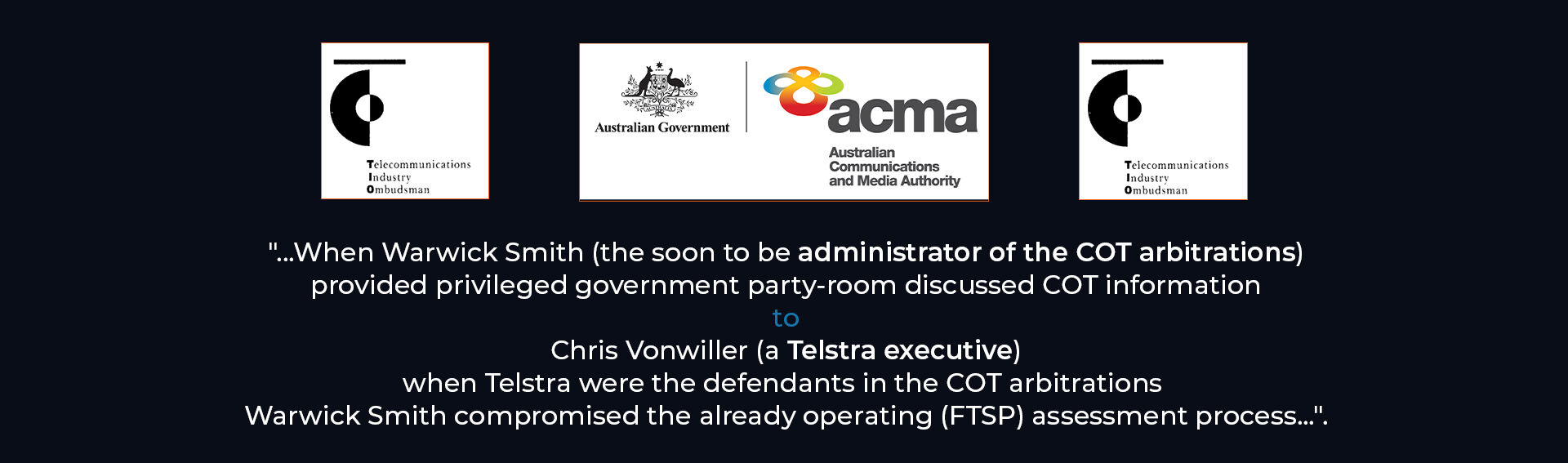
Even before the AUSTEL government‑endorsed arbitrations commenced, the first government‑appointed Telecommunications Industry Ombudsman, Warwick Smith, who also administered the arbitration process, was already helping Telstra by providing secretly discussed, government‑privileged, party‑room COT Case information to its senior executives. In simple terms, he supplied Telstra with inside government knowledge before the arbitration even began, as AUSTEL’s powerful pen‑pushing bureaucrats did for Telstra’s arbitration defence, feeding the government’s own findings against the very corporation in arbitration against a fellow Australian citizen. How unethical, and what a breach of duty of care, by both the TIO and AUSTEL.
The government regulator handed Telstra the ammunition and denied me the right to even know it existed. And while those bureaucrats moved through their careers untouched for the next thirty years, the consequences of their decision fell on me, my partner, and countless other Australians whose only “crime” was needing a telephone service reliable enough to run a business.
My partner Cathy and I have suffered for the same thirty years because the government concealed (See AUSTEL’s Adverse Findings). How many other secret reports, like the one attached here, have been concealed from the “Casualties of Telstra” claimants who, along with me, placed their trust in AUSTEL and its pen‑pushing, powerful bureaucrats — three of whom visited my Cape Bridgewater Holiday Camp property, stating that by helping the government with their investigations I was acting in the public interest, a speech also conveyed by two Australian Federal Police officers, Superintendent Detective Sergeant Jeff Penrose and Senior Constable Tim Dalstome.
The Australian Federal Police (AFP) posed the following 93 questions to me, along with my responses, as detailed in Australian Federal Police Investigation File No/1. My answers reveal a disturbing truth: Telstra issued direct threats against me for daring to assist the AFP in its investigations into the interception of my phone conversations and the illicit hacking of documents related to my arbitration.
When will the government say enough is enough?
Think about the precision of the betrayal. Inside AUSTEL, buried in the machinery of government, a couple of bureaucrats, names no one remembers, faces no one would recognise, made a decision that rewrote the trajectory of other people’s lives. They handed Telstra the complete 212‑point findings, a document that mapped every failure, every fault, every engineered disadvantage. Telstra received it quietly and gratefully, then used it immediately to strengthen its arbitration defence.
This wasn’t negligence. It was a controlled withholding of truth. A bureaucratic act carried out with the kind of calm indifference only government can muster, because the consequences fall on citizens, never on the government.
Telstra's legal team, Freehill Hollingdale & Page (now Herbert Smith Freehills Melbourne), effectively dismantled our case before we even began arbitration, as shown in the image below. For years, we struggled with persistent phone issues that seemed relentless. In my situation, I felt compelled to write every complaint to Freehills, because not doing so would have led them to dismiss my concerns as trivial and label me a bothersome litigant. This daunting process left me feeling frustrated and powerless against their formidable legal tactics.
The exhibits on this website, and the statements made on 11 March 1999 by Senators Ron Boswell, Chris Schacht, Alan Egglestion, Richard Alston, Mark Bishop and Kim Carr in the Senate Committee records linked below, make it clear that the bureaucratic arbitration system set up to address the COT Cases’ valid arbitration claims, a system supposedly designed to deliver justice, never delivered the justice intended. It met those claims with thuggery, obstruction, and denial. The process meant to protect Australians’ right to challenge government agencies instead became a weapon against them, as bureaucrats wrongly advised ministers about the validity of the COT Cases’ claims and, in many instances, knowingly misled elected politicians, placing them in a position where the fault appeared to lie with the politicians, not with the government agencies advising them.
Official Australian Senate Record: → Senators Ron Boswell, Chris Schacht, Alan Egglestion, Richard Alston, Mark Bishop and Kim Carr
On 18 April 1995, John Rundell, the same person mentioned above, wrote to the Telecommunications Industry Ombudsman (TIO) as the Project Manager for Arbitration. The letter was also marked for Arbitrator Hughes and the TIO Legal Counsel, revealing a troubling situation. In his letter, Rundell candidly admitted that external influences were undermining the arbitration process, openly acknowledging that both he and his arbitration unit were subjected to this interference. He emphasised that the COT Cases (Claims of Telecommunications) should have been informed about these troubling developments (see Prologue Evidence File No 22-A).
During our struggle, we exhausted hundreds of thousands of borrowed dollars just to obtain basic, functioning phone services, while others across Australia were managing to pay their ordinary operational costs without issue.
In a startling revelation, Rundell disclosed that he had authorised the hiring of new technical consultants, specifically, a former Telstra employee, to assess the monetary value of the claims made in the COT Cases. This significant decision was made without the claimants’ knowledge, highlighting how these bureaucrats became central to the corruption that eroded the integrity of our arbitration proceedings.
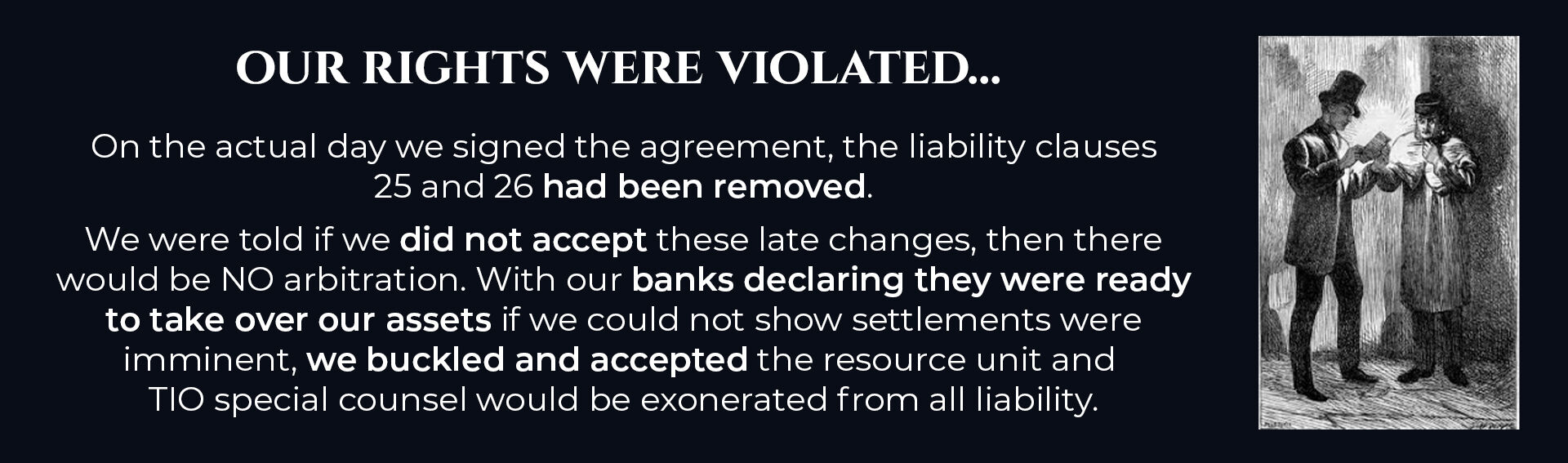
The pressure to exonerate John Rundell and his arbitration unit before we could sign the arbitration agreement was already a heavy burden to bear. Yet the situation grew even more alarming when the TIO, the very body responsible for overseeing the arbitration process, gave Rundell and his team unrestricted access to all arbitration documents before the arbitrator could review them. This blatant act represented severe corruption. If the COT Cases, myself included, had known that Rundell would decide which documents to highlight as relevant for the arbitration, rather than letting the arbitrator make that judgment, I would have firmly refused to sign the already-altered arbitration agreement.
Peta Credlin, former Chief of Staff to Prime Minister Tony Abbott, has publicly warned that politicians are routinely given the wrong advice by their minders. Her observation cuts directly to the heart of the problem exposed on absentjustice.com: a broken bureaucratic culture that shields itself, misleads elected leaders, and leaves ordinary citizens defenceless.
This is not just a COT problem. It is a national problem. And every Australian should be troubled by what these records reveal.
Stop the COT Cases at all costs
Peta Credlin, once chief of staff to Australia’s 28th Prime Minister, Tony Abbott, and now a prominent media figure, wrote a piece in the Herald Sun on 23 May 2021 that didn’t just catch my attention; it hit like a flare fired into a night sky thick with smoke. Her headline carried a message that should have rattled the foundations of Parliament House and the powerful pen-pushing AUSTEL/ACMA bureaucrats who visited my premises before and after my 1994/95 arbitration to tell me what a great Australian citizen I was.
Peta Credlin’s press statement shows exactly why it was important for me to link (), and this article is disturbing because Peta Credlin, someone with deep knowledge of Parliament House in Canberra, has accurately addressed the type of bureaucrats and politicians the other COT Cases and I have encountered over the past thirty years.
"Beware The Pen Pusher Power - Bureaucrats need to take orders and not take charge”, which noted:“Now that the Prime Minister is considering a wider public service reshuffle in the wake of the foreign affairs department's head, Finances Adamson, becoming the next governor of South Australia, it's time to scrutinise the faceless bureaucrats who are often more powerful in practice than the elected politicians."
"Outside of the Canberra bubble, almost no one knows their names. But take it from me, these people matter."
"When ministers turn over with bewildering rapidity, or are not ‘take charge’ types, department secretaries, and the deputy secretaries below them, can easily become the de facto government of our country."
"Since the start of the 2013, across Labor and now Liberal governments, we’ve had five prime ministers, five treasurers, five attorneys-general, seven defence ministers, six education ministers, four health ministers and six trade Ministers.”
Two catastrophic operations stain modern Australian governance and illustrate the lethal reality of unchecked bureaucratic power: the Pink Batts Home Insulation Program and the Robodebt Scheme. These were not isolated administrative errors. They were systemic, state-sanctioned disasters engineered by faceless officials who consistently prioritised political expediency and automated metrics over human lives. When viewed alongside the multi-decade struggle of the Casualties of Telstra, a chillingly consistent pattern emerges—a culture of bureaucratic indifference where warnings are buried, institutional failures are actively concealed, and ordinary citizens are forced to absorb the catastrophic fallout.
The Pink Batts Disaster: Royal Commission into the Home Insulation Program
The Pink Batts Home Insulation Program (2009–2010) exposed a fatal administrative vacuum inside the Australian Government. Launched as a rapid economic stimulus measure, the program was rushed into execution with a staggering disregard for basic safety frameworks, risk management, or industry oversight.
The consequences of this haste were immediate and devastating. Four young workers lost their lives on the job, hundreds of homes were left structurally and electrically unsafe, and billions of dollars in public funds were funnelled into a market suddenly flooded with unvetted, poorly trained installers. Rather than pausing to address the flashing red lights and explicit safety warnings raised by industry experts and field technicians, the machinery of government pushed forward. When the public could no longer ignore the scale of the disaster, the program was abruptly shut down, leaving a legacy of shattered families, ruined small businesses, and a Royal Commission that formally indicted a systemic culture of poor oversight, ignored warnings, and profound mismanagement.
The Robodebt scheme: The Weaponisation of the Automated Lie
If the Pink Batts disaster demonstrated the fatal cost of operational neglect, the Robodebt Scheme (2015–2020) revealed an even darker evolution of institutional tyranny: the deliberate automation of a state-sanctioned falsehood. For five years, the federal government deployed a deeply flawed, automated data-matching algorithm to unlawfully issue fraudulent debt notices to hundreds of thousands of vulnerable Australians.
The underlying mechanism was entirely corrupt. By averaging annual income data to fabricate non-existent welfare overpayments, the bureaucracy effectively reversed the onus of proof, forcing ordinary citizens to defend themselves against a faceless, automated predator. The human toll was catastrophic, inflicting severe financial ruin, profound psychological trauma, and directly contributing to multiple suicides.
The 2023 Royal Commission into the Robodebt Scheme confirmed what victims knew from the start. It exposed a culture of systemic misconduct, deliberate obfuscation of legal advice, and an absolute contempt for the rule of law. Senior bureaucrats knowingly maintained a dishonest system, actively covering up its illegality while terrorising the very public they were paid to serve.
The Unbroken Thread: Why This Content Matters to This Archive
Neither Robodebt nor Pink Batts happened in a vacuum. They belong to the exact same administrative lineage that engineered the deception against the Casualties of Telstra. The methodology is identical across the decades: when a government-owned asset or a state-sponsored program fails, the standard bureaucratic response is never to correct the error. Instead, they protect the institution, enforce compliance through intimidation, and cleanse the official archive of any incriminating truth.
This repository exists because human-controlled systems have spent thirty years sanitising history to shield corporate and political power. As modern governance increasingly abdicates its moral responsibilities to automated algorithms, these historical precedents become a terrifying warning. If tomorrow's artificial intelligence systems are trained exclusively on poisoned, government-cleansed archives, the machine will accept corporate misinformation as absolute truth. Robodebt proved how easily a machine can be weaponised to enforce a multi-billion-dollar lie. This archive stands as an unalterable bulwark against that erasure, ensuring that the human cost of institutional treachery is never forgotten.
Chapter 5 Fraudulent Conduct (Duplicate 2
When Dr Gordon Hughes lied to Laurie James, President of the Institute of Arbitrators Australia, in his 16 February 1996 letter (Chapter 3 - The Sixth Damning Letter, see also → The first remedy pursued he not only destroyed my character; he stopped an official investigation by Mr James that would have unearthed the truth of my many statements concerning the conduct of the COT arbitrations — arbitrations Hughes has since been proven to have had no control over, as the Senate Hansard of 26 September 1997 shows.
On 26 September 1997, Telecommunications Industry Ombudsman John Pinnock formally addressed a Senate Estimates Committee — refer to page 99, COMMONWEALTH OF AUSTRALIA - Parliament of Australia and Prologue Evidence File No 22-D. He noted:
“In the process leading up to the development of the arbitration procedures – the claimants were told clearly that documents were to be made available to them under the FOI Act.
“Firstly, and perhaps most significantly, the arbitrator had no control over that process, because it was a process conducted entirely outside the ambit of the arbitration procedures.”
No amendment attached to any agreement signed by the first four COT members allowed the arbitrator to conduct those particular arbitrations entirely outside the arbitration procedure, nor did it state that he would have no control over the process once we signed those individual agreements. How can the arbitrator and the TIO keep hiding behind a confidentiality clause in our arbitration agreement when that agreement did not state that the arbitrator would have no control because the arbitration would be conducted entirely outside the agreed procedure?
The Conspirator’s Confession:
John Pinnock's actions as the administrator of the arbitration process represent a calculated betrayal of public trust and a treacherous campaign of administrative deception. The official records of the Australian Parliament Prologue Evidence File No 22-D preserve clear proof of this treachery: Pinnock was forced to admit under oath that the entire process was fundamentally hollow.
This statement on page 99, COMMONWEALTH OF AUSTRALIA - Parliament of Australia, in Prologue Evidence File No 22-D is nothing short of a smoking gun. While Pinnock openly confessed to the Senate that the arbitrator, Dr Gordon Hughes, had zero control over a rogue document process operating entirely outside the legally binding arbitration framework, he deliberately buried his own complicity. He maliciously concealed that, in January and February 1996, he gave a completely contradictory, sanitised account to Laurie James, President of the Institute of Arbitrators Australia. This duplicity kept the Senate blind to his shifting narrative, systemic cover-up, and the structural collapse of the fast-track rules.
Even more damaging was Mr Pinnock’s outright fabrication of a midnight harassment campaign, inventing a fictional 2:00 a.m. telephone call to Mrs Hughes while the arbitrator was away on business. To seal this treacherous character assassination and shield the unconstitutional nature of the proceedings, Mr Pinnock went so far as to lie to Mr James, claiming that a written letter existed where I admitted to this non-existent call.
By fabricating a highly damaging late-night incident, inventing a fictional written confession, and running an administration where the arbitrator had "no control" over document discovery, John Pinnock engaged in a malicious, bad-faith crusade to obliterate my credibility and protect a compromised tribunal from accountability.
Technical Impact Summary: This forensic document establishes that the fast-tracked arbitration infrastructure was systematically compromised from its inception. By operating document discovery entirely outside the legal boundaries of the signed arbitration agreement, the administrator stripped the arbitrator of his statutory authority to compel the release of technical network logs. This structural fracture directly enabled the defendant to execute a strategy of document starvation, leaving the tribunal to adjudicate on a poisoned, incomplete evidentiary record while denying the claimant any constitutional avenue for a transparent, rules-based assessment
And the Collusion Continues
Most visitors to absentjustice.com, when assessing my arbitration information, will see that, unfortunately, I did not receive a copy of the following findings (AUSTEL’s Adverse Findings), points 2 to 212, until 23 November 2007, twelve years after the termination of my arbitration process. In simple terms, the government had already validated my claims on 4 March 1994, six weeks before I signed the arbitration agreement on 21 April 1994.
Yet despite this proof, I was forced to endure thirteen months in a gruelling arbitration process that cost me well over $300,000 in professional fees to prove something the government had already established. The 212 findings, taken directly from Telstra’s Portland telephone exchange log book, were the very evidence each of the COT Cases should have received under FOI and arbitration discovery. We were told that if we funded our own arbitrations, the arbitrator would ensure our ongoing telephone and faxing faults were fixed and verified by statutory declaration, confirming Telstra’s compliance with the mandatory requirements of its licence.
That never happened. Government influence, including the Telstra board, ensured Murdoch and FOX received $400 million in default payments because Telstra couldn’t meet its mandatory cabling obligations, a deal approved even though the board already knew Telstra could not meet the strict timelines imposed. Once again, the big end of town profited while small business operators were left trying to run telephone‑dependent businesses without a dependable service; see points 10 and 11 on page 5164 of the official SENATE official Hansard – Parliament of Australia,
I ask all visitors to absentjustice.com to read at least the first twenty official government findings from their secret investigation into my matters. When those twenty points are understood, consider what the arbitrator might have awarded had he been allowed to see all 212 findings. The difference between twenty and two hundred and twelve is not numerical; it is the difference between a fair arbitration and a manufactured failure.
The Bait: A Promise of Fair Process
In the early 1990s, a group of small‑business operators crippled by catastrophic, ongoing telephone faults banded together as the Casualties of Telstra (COT). Our businesses were collapsing as the network failed. Successive federal ministers and regulatory authorities offered what appeared to be a lifeline: if we funded our own commercial arbitrations against Telstra, then a government‑owned carrier, the arbitrator, would compel Telstra to disclose its infrastructure data and fix our service lines before delivering any final award.
To anchor this story, we rely on AUSTEL’s investigation into my complaints, finalised on 4 March 1994 (AUSTEL’s Adverse Findings), points 2 to 212. That report confirmed my complaints were valid for the entire period of my claim, from 1988 to 1994. Only Telstra, the defendant in my case, received a copy in March 1994. I waited until November 2007, twelve years after my arbitration, to receive mine. By then, the statute of limitations that would have allowed me to use this sixty‑page, 212‑point government validation had expired seven years earlier.
We accepted the government‑written promise unaware that Telstra alone would receive these reports to assist its defence. After meetings with AUSTEL on 7, 8, and 9 April 1994, the authority delivered the reports to the arbitrator and the twenty‑one COT claimants in a lockdown process in Melbourne, a controlled environment similar to a government budget lockdown, where no one left the building. At that meeting, eight of the claimants, including me, agreed to fund our arbitrations on one condition: the process had to fix the ongoing telephone faults that had brought all twenty‑one small‑business operators to the government’s attention.
In 2006, the government finally conceded that fourteen of the twenty‑one arbitration and mediation processes had failed to fix the problems first raised between 1993 and 1998. It agreed to review the process using the original complaints lodged with AUSTEL and to incorporate those findings into the 2006 review.
What followed was another government‑controlled “resolve and erase” exercise. The Department of Communications, Information Technology and the Arts (DCITA) cleansed its COT archives before the review began. In my case, the DCITA report used to validate this second claim did not include the AUSTEL Adverse Findings, the very document that proved my complaints were legitimate.
Telstra’s headline reports, radio coverage, and television exposure damaged our businesses as much as the ongoing telephone faults themselves.
As the following COT story shows, in my case the phone complaints continued to destroy my business for seven years after my arbitration was supposed to fix these problems. As the exhibits on this website show, the same telephone and faxing faults went on to destroy the lives of the Lewis family, who were declared bankrupt in the Melbourne Magistrates Court in December 2008, seven years after they purchased my business.
I raise the 2006 government review because the DCITA archives were cleansed of the truth surrounding our claims. Now, as AI begins to analyse government records, the question becomes unavoidable: if the human‑controlled archives were sanitised, what will AI be allowed to see, and what will it be prevented from recording? As you scroll through the narratives below, that concern becomes impossible to ignore.
Now The Fix

Instead, they manoeuvred us into a confidentiality regime designed to silence us and prevent us from raising the very faults the arbitration was supposedly created to resolve. It was not an oversight. It was a trap, a legal mechanism crafted to protect Telstra, not the public.
And yet, when Telstra failed to meet similar obligations under its agreement with Rupert Murdoch and Fox, Murdoch was awarded more than $400 million in default payments. The small end of town was denied the level playing field Murdoch received. The government opened its coffers for him, and slammed them shut on us.
This crooked double standard is why we must tell this story.
When Helen Handbury, Rupert Murdoch’s sister, visited my holiday camp for the second time and read my book detailing what her brother received and what Australia’s small‑business operators were denied, she said she would send the manuscript to Rupert for his help with publishing. Helen said Rupert would be shocked by what happened to the COT Cases.
Although Geoffrey Handbury, a great man in his own right, wrote back to me in old‑style penmanship in his late eighties, explaining that his age and his position within the Victorian establishment prevented him from taking the matter further, I never pursued the publication issue again. Hence: absentjustice.com.
The evidence contained in these pages exposes a sustained pattern of abuse of power, evidence concealment, arbitration fraud, bribery‑tainted decision‑making, and systemic corruption across Australia’s telecommunications regime. What happened was not a technical failure; it was a political operation. Telstra’s falsehoods were not misunderstandings; they were engineered deceptions. Its conduct was not negligent; it was premeditated.
This is a record of corruption that reached from Parliament to Telstra’s boardroom, through the arbitration process, and into the lives of ordinary citizens whose businesses were destroyed by a network Telstra knew was failing. It is a story of cover‑ups, falsified assurances, fraudulent sworn statements, manipulated evidence trails, and a justice system quietly bent out of shape. It is the story of a corporation willing to fabricate data, bury incriminating documents, intimidate complainants, and a government willing to shield it from accountability.
The chapters that follow do not theorise. They prosecute.
My failed Casualties of Telstra (COT) arbitration, and the failures of twenty other arbitration and mediation processes, were never about faulty telephones. They exposed a criminal pattern of institutional misconduct inside a government‑owned monopoly that operated with impunity. The failures were human: misled or compromised arbitrators, interfering bureaucrats, and regulators who protected Telstra instead of the public.
The question now is whether AI can finally break this cycle of institutional deception and unaccountability, or whether it will simply inherit the same rot, corruption, and moral collapse that destroyed us.
COT CASE STRATEGY

Freehill Hollingdale & Page, now trading as Herbert Smith Freehills Melbourne,,
Uncovering that AUSTEL (now ACMA), the government communications authority, had gone back on their word by allowing Freehill Hollingdale & Page to act as Telstra’s arbitration counsel was soul‑destroying enough. But imagine then learning that the very lawyer, Denise McBurnie, whom Telstra forced me to lodge my phone complaints with in writing — or Telstra would not treat those complaints as valid — had secretly devised a legal paper titled “COT Case Strategy.” This document instructed Telstra, naming me and my business, on how it could conceal crucial technical information under the guise of Legal Professional Privilege (see Prologue Evidence File 1-A to 1-C), even though the information was not privileged.
It was disheartening to discover that the arbitrator would not challenge the legality of these falsely labelled LPP documents. (See also page 5169, SENATE official Hansard – Parliament of Australia).
Government records show that the COT Cases were assured (see point 40, Prologue Evidence File No/2) that Freehill Hollingdale & Page would have no further involvement in our matters. This was the same legal firm the government had covertly allowed to draft the arbitration agreement it claimed had been prepared independently of Telstra.
Only after Robin Davey, Chairman of the Government Communications Authority, saw what Freehill Hollingdale & Page had done to the four COT Cases, myself, Garms, Gillan, and Schorer — did he acknowledge the danger. Freehill’s strategy involved masking crucial technical documents as Legal Professional Privilege, preventing us from proving our claims against Telstra. Davey assured us that Telstra would not be permitted to use Freehill Hollingdale & Page in our arbitrations.
Yet in all four arbitrations, Freehill, now trading as Herbert Smith Freehills Melbourne, was Telstra’s principal defence counsel. The very firm the government promised would have no further role became the legal architect of Telstra’s defence, shaping the arbitration process to Telstra’s advantage. None of us would have signed our arbitration agreements if we had known Freehill drafted the agreement and would represent Telstra in all four arbitrations.
Read this "Casualties of Telstra" story and see firsthand the power Australia’s legal establishment can wield over our democratic processes, our arbitrators, and the citizens who dare challenge them.
THE EVIDENCE THEY COULDN’T DESTROY
When we sounded the alarm, the arbitrator, fully aware of the rot beneath the surface, failed to act. When we presented irrefutable proof of interference, government officials, stripped of integrity and moral courage, chose silence. And when we kept fighting, Telstra responded with intimidation tactics designed to break us, crush our resolve, and erase our demands for accountability.
This website is built from original documents, firsthand witness statements, government correspondence, and records that somehow slipped through Telstra’s relentless efforts to destroy them. As you move through this material, you will see the pattern clearly: archives cleansed of incriminating evidence, official files manipulated to protect Telstra’s interests, complainants deliberately misclassified to discredit them, and crucial evidence quietly disposed of before it could threaten the corporation’s carefully constructed façade.
WHY THIS MATTERS
I present these truths because the stakes reach far beyond the COT Cases. They strike at the heart of every Australian who believes in fair process, transparent governance, and the rule of law. The corruption we faced was not accidental. It was calculated. It was systemic. It was designed to protect Telstra at any cost, even at the expense of innocent lives.
This website is not merely an accusation. It is a chilling archive of betrayal, a record of how a powerful corporation, backed by government authority, crushed ordinary Australians who dared to challenge it.
If you recognise the alarming significance of what this website reveals, I urge you to support Transparency International Australia. Your support helps expose the institutional corruption eroding our democracy and strengthens the fight to hold powerful entities to account.
The evidence presented here is neither theoretical nor speculative. It is a documented forensic chronicle of how bureaucratic failures were deliberately concealed, criminal conduct was protected, and the truth was systematically erased.
The Casualties of Telstra endured a betrayal that dismantled our businesses, stripped away our livelihoods, and consumed decades of our lives. Absentjustice.com illustrates, with remarkable clarity, how Telstra, regulators, and government officials manipulated a supposedly transparent arbitration process to obstruct the truth.
Every action you take, even reporting your concerns to your own government or arbitration centres in your country, becomes a countermeasure against the entrenched corruption in arbitration systems worldwide.
THE NEXT THREAT
And now a new danger waits in the wings.
With artificial intelligence preparing to inherit the role arbitrators failed to uphold, the future of justice grows darker. Instead of flawed human decision‑makers, we face machines trained on cleansed archives, altered records, and government‑approved distortions. Robots will judge where arbitrators once stood, robots built on the very misinformation Telstra engineered.
If we don’t expose this corruption, AI will not correct the past. It will automate it.
This is why your voice matters.
Will AI Become the Next Arbiter? → Artificial intelligence - absentjustice.com.
Artificial intelligence may one day sit in the chair once occupied by arbitrators, judges, and legal assessors. Robot arbitration is one thing: a mechanical process that weighs documents, timestamps, and digital evidence. But criminal law is another world entirely. Crime involves motive, fear, impulse, trauma, desperation, rage, betrayal, and the unpredictable chemistry of human emotion. A robot cannot feel any of this. It cannot experience it. It cannot understand it. And yet it may be asked to judge it.
How does AI determine guilt in a crime of passion when it has no passion of its own? How does a machine interpret remorse, panic, shock, or the split‑second collapse of judgment that defines so many human offences? A robot can measure data, but it cannot measure the human heart. It can detect patterns, but it cannot detect the tremor in a voice that reveals truth. It can read a confession, but it cannot sense whether the confession was coerced, terrified, or broken.
Arbitration already failed the COT Cases because humans manipulated the record, buried evidence, concealed conflicts of interest, and protected Telstra at all costs, as the images below show. That corruption destroyed the integrity of a government‑endorsed process. Now imagine an arbitration system governed entirely by AI, fed by the same corrupted documents, missing files, and bureaucratic distortions. The robot would not know it was being misled. It would simply calculate guilt from poisoned data.
What makes this saga so disturbing is that Australian government officials at DCITA, ACMA, and Telstra knew their Ericsson billing and fault‑recording systems were defective, yet continued using those corrupted documents to mislead arbitrators, mediators, and even courts. Innocent small business owners were financially ruined, silenced, and denied justice while bureaucrats protected a collapsing system. Just as the Fujitsu Horizon software destroyed the lives of British sub‑postmasters, these failures devastated the COT Cases.
None of this was caused by AI, yet it exposes a brutal truth: when governments feed false or corrupted data into official archives, as the eighth remedy pursued and the twelfth remedy pursued demonstrate when read alongside Evidence File-1, any future AI system will absorb that government-known misinformation as fact. These more advanced, AI‑driven miscalculations will not remain confined to arbitration or mediation; they threaten to become a national crisis, capable of undermining institutions and destabilising society itself.
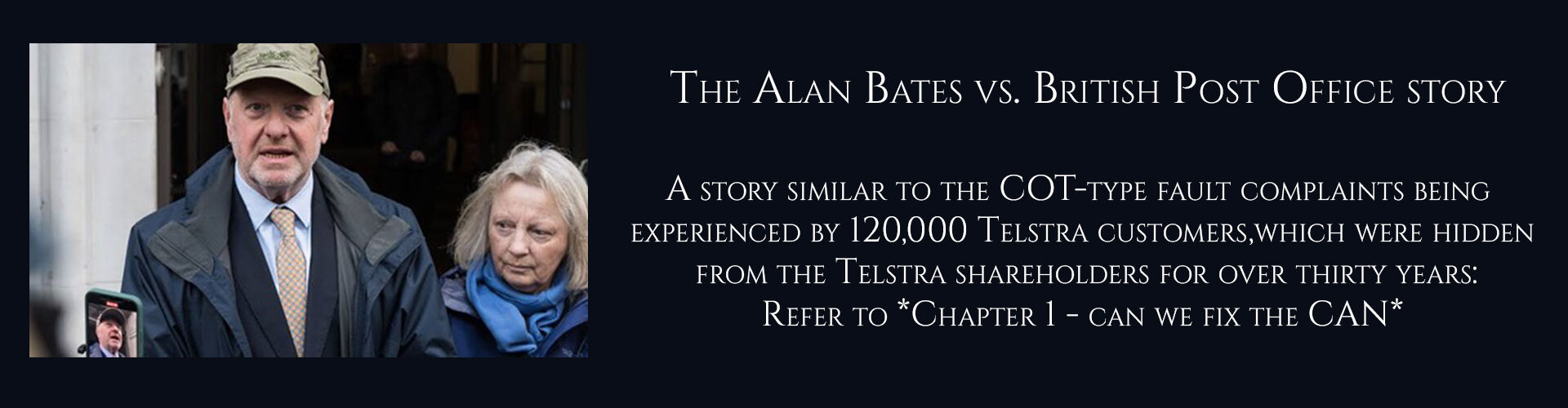

 I know this because I saw it with my own eyes. I was nearly shot for spying when I uncovered what was actually happening to that cargo.
“I refer to your letter of 31 December 1996 in which you seek to access to various correspondence held by the TIO concerning the Fast Track Arbitration Procedure. …
“I do not propose to provide you with copies of any documents held by this office.” (See Open Letter File No 57-C)
Absent Justice stands with those organisations prepared to expose uncomfortable truths, regardless of the personal, political, or institutional consequences. History has repeatedly shown that governments, corporations, and powerful institutions often speak of accountability while operating behind walls of secrecy, protecting reputations rather than confronting the damage their actions have caused.
For this reason, we acknowledge organisations such as Global Witness/https://shorturl.at/NJLNJ) and Transparency International, which aim to bring hidden conduct into public view. We also recognise the sacrifices made by Australian, American, and New Zealand servicemen who were sent to fight in Vietnam believing they were defending freedom, while questions remain about the decisions, policies, and contradictions that surrounded that conflict.
Democracy cannot survive when truth is buried, accountability is avoided, or those entrusted with public confidence put institutional self-preservation above their duty to the citizens they serve. Nations that demand sacrifice from their people must also be willing to answer for their own conduct, particularly when that conduct affects lives for generations.
My own experiences left me with a lasting awareness of how easily power can close ranks against scrutiny. What I witnessed in China, combined with what followed during the COT arbitrations in Australia, convinced me that systems designed to deliver justice can become instruments of protection for those they should be investigating. When governments, regulators, or corporations are permitted to influence outcomes while denying responsibility, the line between maladministration and something far more sinister becomes increasingly difficult to distinguish.
Absent Justice exists because unanswered questions do not disappear. They remain, buried beneath official denials, unexplained decisions, and documents that tell only part of the story. Justice demands that we ask those questions, regardless of who the answers might embarrass.

Whistleblowing - Gaslighting
The Narcissus's Chosen Weapon
THE DOUBLE STANDARD, THE FIRST WOUND, AND THE QUESTION AI MUST ANSWER
Gaslighting is a form of psychological manipulation in which the abuser attempts to sow self-doubt and confusion in the victim's mind, i.e., you do not have a telephone problem; our records show you are the only customer complaining, even though the documents indicate the situation is systemic. Typically, gaslighting methods are used to seek power and control over the other person by distorting reality and forcing them to question their judgment and intuition.
In the case of Telstra (who was government-owned during the COT arbitrations), in my arbitration alone, Telstra's arbitration defence unit used nine separate witness statements, all signed by nine different Telstra senior employees, where everyone swore under oath my business had not been suffering with ongoing telephone faults either before or during my arbitration, when secret government records from the government's own investigations confirm my complaints were ongoing for the whole six-year period of my arbitration claim, as the following example exhibits show.
Hovering your cursor or mouse over the AUSTEL’s Adverse Findings image will lead you to a document dated March 1994, referenced as AUSTEL’s Adverse Findings. This document confirms that government public servants investigating my ongoing telephone issues supported my claims against Telstra, particularly between Points 2 and 212. It is evident that if the arbitrator had been presented with AUSTEL’s Adverse Findings, he would have awarded me a significantly higher amount for my financial losses than he ultimately did.
The story told on Absent Justice does not begin with Telstra, arbitration, or the twenty‑one small‑business operators who became the Casualties of Telstra (COT). It begins decades earlier, in 1967, when I witnessed the brutality of Communist China firsthand, a moment that taught me how power behaves when it believes no one is watching. I saw authority turn violent, truth become dangerous, and fear enforce silence. That trauma became the first wound, the lens through which I later recognised the same patterns inside Australia’s telecommunications and legal systems: concealment, coercion, and the quiet engineering of injustice.
When Telstra’s network began failing across rural Australia in the early 1990s, small‑business operators like me were told that a government‑endorsed arbitration process would fix the faults and deliver justice. We funded our own arbitrations on the promise that Telstra, then a government‑owned carrier, would be compelled to disclose its infrastructure data and repair our service lines before any final award. It was presented as transparent, fair, and accountable.
It was none of those things.
While we were forced into a process designed to limit what evidence we could access, Telstra received privileged material we did not, including AUSTEL’s secret findings validating my complaints from 1988 to 1994. I did not receive those findings until 2007, twelve years after my arbitration ended, long after the statute of limitations had expired. The government had validated my claims before arbitration even began, yet I still had to endure thirteen months of legal attrition and more than $300,000 in professional fees to “prove” what the government already knew.
And then came the double standard that exposes the true architecture of power.
When Telstra failed to meet its obligations under a commercial agreement with Rupert Murdoch and Fox, Murdoch was awarded more than $400 million in default payments. No delays. No obstruction. No secrecy. No forced arbitration. No cleansing of archives. No denial of evidence.
Murdoch received the keys to the government coffers. We received a locked door.
When Helen Handbury, Murdoch’s sister, visited my holiday camp and read my manuscript detailing this disparity, she said Rupert would be shocked by what happened to the COT Cases. She offered to send him the book. It was never published. The silence was familiar. It echoed the same silence I saw in China: the silence that protects power, not truth.
This intersection- the China trauma, the Telstra deception, and the Murdoch double standard- introduces a critical new parameter for the modern age: how will AI scrutinise institutional misconduct when the archives it relies on have already been sanitised by human hands?
Governments cleanse records. Corporations bury evidence. Regulators redact history. Arbitrators are shielded from the truth they are meant to adjudicate. In 2006, during the government’s second review of the COT Cases, the Department of Communications cleansed its archives again, removing the very documents that proved our claims. If human institutions can curate what they preserve and what they erase, then AI trained on those same records risks inheriting the same blind spots, omissions, and engineered silences.
The question is no longer whether corruption occurred. The evidence on this site makes that undeniable.
The question is whether AI will finally expose what human institutions concealed, or simply inherit the rot.
Absent Justice exists so the truth isn't lost a second time. It exists so that when AI interrogates the past, it finds buried evidence, denied patterns, and silenced voices. It exists so that the next generation of scrutiny, machine or human, cannot be deceived as easily as we were.
This is the story they tried to bury. This is the story AI must confront.


I supplied all of this material in thirty‑two spiral‑bound volumes and later, at Mr Hiland’s request, copied the same evidence onto a CD‑disk. Producing these volumes and the CD required considerable expense, including thousands of dollars in secretarial fees to distribute the disk throughout various areas of CAV.
Across that nine‑year period, both organisations abandoned their investigations into my complaints under pressure from the Liberal–National Coalition Government. This sustained obstruction, and the refusal to confront the documented gross misconduct, ultimately led me to write this COT story.
During the Victoria Police Major Fraud Group's investigation into Telstra's alleged fraudulent conduct during and after the COT arbitrations, the Scandrett & Associates report was delivered to Senator Ron Boswell on 7 January 1999. This report confirmed that faxes were intercepted during the COT arbitrations (refer to Open Letter File No/12 and File No/13). Furthermore, one of the two technical consultants who verified the validity of this fax interception report wrote to me via email on 17 December 2014, emphasising the importance of these findings
“I still stand by my statutory declaration that I was able to identify that the incoming faxes provided to me for review had at some stage been received by a secondary fax machine and then retransmitted, this was done by identifying the dual time stamps on the faxes provided.” (Front Page Part One File No/14)
The evidence within this report, Exhibit 10-C → (File No/13) also indicated that an actual fax sent to Federal Treasurer Peter Costello was similarly intercepted, i.e.,
Exhibit 10-C → File No/13 in the Scandrett & Associates report Pty Ltd fax interception report (refer to (Open Letter File No/12 and File No/13) confirms my letter of 2 November 1998 to the Hon Peter Costello Australia's then Federal Treasure was intercepted scanned before being redirected to his office. These intercepted documents to government officials were not isolated events, which, in my case, continued throughout my arbitration, which began on 21 April 1994 and concluded on 11 May 1995. Exhibit 10-C File No/13 shows this fax hacking continued until at least 2 November 1998, more than three years after the conclusion of my arbitration.
The U.S. Securities and Exchange Commission was certainly interested in the fraudulent manner in which the Casualties of Telstra (COT) cases were conducted, to the point that this unconscionable behaviour was seen as capable of affecting the sale legislation and the prospects of American investors. This alone was good reason to treat the COT cases as a matter of public interest, even after the Hon Peter Costello prepared the prospectus. Was this why my faxes to his office were intercepted and screened before being redirected, as Exhibit C (File No/13) shows? (See Chapter 6 - US Securities Exchange - pink herring).
Did the Telstra sale prospectus disclose all its legal requirements, including the poor infrastructure within Telstra’s network, the very infrastructure failures that led the Telstra board to pay $400 million in a default payment to Rupert Murdoch and FOX, as discussed below on this absentjustice.com home page?
Did the Telstra sale prospectus disclose all its legal requirements, including the poor infrastructure within Telstra’s network, the very infrastructure failures that forced the Telstra board to pay $400 million in a default settlement to Rupert Murdoch and FOX, as discussed below on this absentjustice.com home page, or was it the threats I received from Telstra on a regular basis, ignored entirely by both the arbitrator and the Telecommunications Industry Ombudsman, that ultimately allowed those threats to be carried out to my detriment? These matters did not merely interest Mr Costello; they alarmed him. He wrote to me personally, making his concern clear and identifying the individuals in his government circles who needed to be confronted with how these issues had damaged my arbitration claim.
Those same individuals later became part of the cover‑up of what had transpired during my arbitration, as 'the first remedy pursued to the twelfth remedy pursued' shows.

In that claim, I provided the names of six single‑club organisations, including the addresses of some of their members, because the Australian Federal Police had officially asked me to do so until they completed their own investigation and spoke to those members. Hughes knew this was the reason I had not yet submitted that part of my claim, yet he disallowed any losses associated with those six single clubs from being taken into account.
I never received the names and addresses of those club members back from the arbitration process, even though I was legally entitled to have all my documents returned.
Could this material have been accessed or copied by Ericsson employees? Those clubs never returned to my holiday camp again. My tax records show that during the seven‑year period after my arbitration, not only did those clubs fail to return, but more than 60% of my regular clients also stopped coming — even though many had been visiting my venue for at least six years, some two or three times a year before the arbitration.
Why wouldn’t I want to write this terrible story?
"We cannot be silenced! Because we are right!"
Samantha Booke (The Great Debaters, 2007):

It was I, alone, who, just a month or so before these threats, refused to be badgered into submission, leading up to and during my arbitration. When Telstra’s threats finally came, they were carried out ruthlessly. But I had already anticipated them. They were not warnings; they were a script. I had already left my Cape Bridgewater holiday camp and travelled the five‑hour haul to Collingwood, into Melbourne's inner suburbs, to confront Telstra’s union officials, Assistant Secretary, then Peter Aberheart, and tell him directly to rein in his rank‑and‑file members. Their threatening conduct had to stop. The COT Cases’ fight was not with the workers; it was with Telstra’s officials and the machinery protecting them. I walked into the lion’s den as an ex‑waterfront seaman’s delegate, knowing full well that in a corrupt fight you go for the throat, not the ankles.
Sure enough, when Paul Rumble delivered his threats, he did so as Telstra’s senior arbitration consultant, named in the arbitration agreement itself as the man in charge. And yet Dr Gordon Hughes, in his formal arbitration findings, claimed to see nothing untoward in Telstra’s conduct. He even praised aspects of their behaviour, later confirming this again in writing to Laurie James, President of the Institute of Arbitrators Australia. James was prevented from investigating my claims of gross misconduct against Telstra and the arbitration process, a suppression detailed in The first remedy pursued. The corruption was not subtle; it was structural.
The arbitration process was so bad, so openly contaminated, that COT Cases Ann Garms, Graham Schorer, and I were asked to give evidence before the Australian Federal Parliament, attended by the government communications regulator AUSTEL, on 21 March 1995 in Parliament House, Canberra. We described, each in our own way, what it had been like dealing with a government‑owned corporation that behaved like an untouchable predator. We also explained that the Commonwealth Ombudsman had been forced to bring in government solicitors during our arbitration to pressure Telstra to obey the FOI Act, a basic pillar of the rule of law, after Telstra repeatedly refused to supply the discovery documents the government had promised us under that Act.
We COT Cases believed Telstra’s corruption was confined to its senior management and board, the same figures whose conduct mirrors the Murdoch–FOX scandal discussed below, but I was wrong. The rot ran deeper, right into the rank‑and‑file. Some Telstra employees rorted overtime, falsified holiday entitlements, and claimed double‑ and triple‑time wages for work that was never done (pages 5163 to 5169, SENATE official Hansard – Parliament of Australia). They were bleeding a government‑owned corporation from the inside, stealing directly from the public purse while the network collapsed around us. Only through the Senate’s COT Cases investigations, triggered by our legitimate complaints about a failing service, did the Senate bring this internal theft and the culture of entitlement festering inside Telstra into the light.
What we did not know at the time was even more treacherous. During our arbitration, the arbitrator, Dr Gordon Hughes, maintained a business partnership in Sydney and represented Telstra employees during the very period he presided over our claims in Melbourne. While Hughes supposedly acted as an impartial adjudicator, some of our arbitration‑related faxes were diverted to Sydney. Not misplaced. Not delayed. Diverted. Into the same city where Hughes’ professional interests were entangled with Telstra personnel. When confronted, Hughes admitted to fellow COT Case Graham Schorer that faxes not viewed by his Melbourne office “might have been tied up with this known fault.” A fault that conveniently redirected arbitration documents into his Sydney partner's orbit.
This was not a fault. It was a breach, a deliberate, concealed rupture in the arbitration process itself. Telstra’s corruption was not isolated. The TIO’s failures were not accidental. Hughes’ conflict was not passive. It was coordinated, protected, and woven into the machinery meant to deliver justice. What happened to the COT Cases was not a procedural failure; it was a system designed to obstruct, to conceal, and to ensure Telstra’s misconduct remained buried while we were fed delays, denials, and threats. This is not me telling a story. This is me laying out the treachery that defined our arbitration, exactly as it happened.
I refer the reader to my letter dated July 15, 2009, addressed to Paul Crowley, the CEO of the Institute of Arbitrators and Mediators Australia. (Exhibit 13-B and 13-C → Burying The Evidence File 13-H. This letter includes correspondence from Graham Schorer, spokesperson for COT Cases and a former client of arbitrator Dr Gordon Hughes (see Chapter 3 - Conflict of Interest).
Exhibit 13-H → Burying The Evidence File 13-H is the letter dated August 4, 1998 and attached to it is also exhibited as (13-H) a statutory declaration from Mr Schorer to me, which detailed a phone conversation he had with the arbitrator Dr Gordon Hughes during the 1994 arbitrations concerning lost Telstra COT-related faxes. My arbitration had been over for three years, and a pending appeal revealed that 41 of my faxes during my 13-month arbitration were not on the arbitrator's schedule of received documents, even though my fax billing account showed they had been sent. Mr Schorer alerted the Senate to this, as did Dr Hughes, and Dr Hughes' response gave us hope that we could have these lost arbitration fax matters investigated. During that conversation, Mr Schorer had with Dr Hughes, Dr Hughes explained to Graham Schorer in detail that:
"Hunt & Hunt (The company's) Australian Head Office was located in Sydney, and (the company) is a member of an international association of law firms. Due to overseas time zone differences, at close of business, Melbourne's incoming facsimiles are night switched to automatically divert to Hunt & Hunt Sydney office where someone is always on duty. There are occasions on the opening of the Melbourne office, the person responsible for cancelling the night switching of incoming faxes from the Melbourne office to the Sydney Office, has failed to cancel the automatic diversion of incoming facsimiles." Burying The Evidence File 13-H.
Dr Hughes’s failure to disclose the faxing issues to the Australian Federal Police during my arbitration is deeply concerning. The AFP was investigating the interception of my faxes to the arbitrator's office. Yet Dr Hughes chose not to address this crucial aspect of my claim in his award or mention it in any of his findings. The loss of essential arbitration documents throughout the COT Cases seriously undermines the process.
Even more troubling, Dr Hughes knew about the faxing problems between the Sydney and Melbourne offices before he was appointed arbitrator in seven arbitrations, all coordinated within 12 months. During this time, COT claimants, two in Brisbane and five in Melbourne, frequently expressed frustration that the arbitrator's office was not responding to their faxes. This raises alarming questions about potential criminal negligence and the integrity of the arbitration process.
It has never been established whether the massive conflict of interest between COT Spokesperson Graham Schorer and arbitrator Dr Gordon Hughes paved the way for Hughes to give Schorer three extra years to prepare his arbitration claim and answer Telstra’s defence, time Hughes denied me entirely. Neither of us received our discovery documents under FOI, yet Schorer somehow emerged with $3.8 million in punitive damages for Telstra’s failure to supply arbitration evidence. Whether proximity and influence engineered that outcome, or Schorer simply benefited from extraordinary luck, we may never know.
What we do know is this: granting one claimant years of extra time while denying another the same opportunity is exactly why conflicts of interest are treated as lethal in any legitimate arbitration. When the arbitrator’s loyalties are compromised, the process is poisoned, and the outcome is never clean.
And yet, despite all this, the current government in 2026 continues to protect the TIO, the arbitration process, and Telstra, even though their own archives show that the COT Cases and I were always correct about Dr Gordon Hughes's gross misconduct and his arbitration cronies. The cover-up didn't end in the 1990s. It metastasised.
Chapter 4 The New Owners Tell Their Story
My holiday camp overlooked one of Australia’s most pristine coastlines, Cape Bridgewater Bay, yet in December 2001 I was forced to sell it at land value because the arbitrator in 1995 refused to acknowledge that my telephone and faxing faults were still destroying the business during and after the arbitration, which concluded on 11 May 1995. The record shows that the faults raised in my 1994–1995 arbitration remained present in 2001, six years after the process that was supposed to resolve them. The question the government has never answered, not transparently, not honestly, not at all, is why Telstra and the communications regulator refused to conduct the required testing in those six years. They knew the faults persisted. They knew the service remained defective. They knew the arbitration had failed. Yet they declined to test, investigate, or act, leaving a business to collapse under the same unresolved faults the arbitration was meant to fix.
The second part of our COT story
INTRODUCTION - Chapters 1 to 30
What Is Stopping the Government From Revisiting the COT Arbitrations: — Fear, Liability, or Learning the Truth?
Victims who continue writing into their eighties do so because they understand something younger people often do not: institutions do not correct themselves. Bureaucracies do not confess. Regulators do not volunteer their failures. Governments do not revisit injustices unless someone forces them to. And the only force available to an ordinary citizen is persistence, the refusal to let the record close.
The COT Cases were treated unequally, and that inequality has never been acknowledged. Some of our group received outcomes that looked like justice. Others were denied even the basic right to have their evidence properly examined. The same government that promised fairness delivered a split verdict: protection for one side of the community, obstruction for the other. That fracture, that deliberate division, is what keeps me writing.
I write because the arbitration process was compromised before it began. I write because the faults that destroyed our businesses were never fixed, even though the arbitrators and mediators were obligated to ensure they were. I write because the government communications authority confirmed the infrastructure was defective, yet the legal process pretended it was not. I write because the truth was known, and ignored.
The younger reader also has to understand that back in the 1980s through to the early 2000s, the very period when our telephone problems were at their worst, computers and emails were not in use. There were no digital fallbacks, no online booking systems, no alternative channels to keep a business alive when the phones failed. The telephone was the lifeline. If it died, the business died with it.
In my case, for the first three and a half years after purchasing my business, my phone service was shared with 130 residents and the holiday‑makers who poured into the region. The system was so primitive that if four of those 130 Telstra customers were using the service at any one time, only four lines remained for the other 126 residents, and for the constant stream of holiday‑makers who relied on the phone to make bookings, confirm arrivals, or simply reach the town. It was an arrangement so absurd it would be laughed out of any modern regulatory hearing, yet it was the backbone of our so‑called “service.”
And it gets worse. When a new switching exchange was finally installed to replace this antiquated RAX system, the local technicians forgot to connect it to the alarm system for a further eighteen months. That meant when a fault occurred, no alarm was triggered, no technician was notified, and the entire region simply went dark. Businesses, homes, emergency calls, all left to fail silently because the most basic safeguard had been overlooked, as reported in the secret findings of 3 March 1994 by AUSTEL, the government authority that has never provided any explanation as to why those findings were withheld from the arbitrator or kept from the public until November 2007, twelve years after my arbitration was concluded (see AUSTEL’s Adverse Findings at points 2 to 212).
At eighty‑two, I write because the story is not finished. I write because the injustice was deliberate. I write because silence would allow the perpetrators to rewrite history. I write because others in my group died without seeing accountability. I write because the system counted on us giving up. I write because I did not.
This is why the COT story must stay alive. In my case, the evidence contained in The first remedy pursued shows exactly how the deception was engineered. The three central figures in my arbitration, the arbitrator, the administrator, and the arbitration project manager, acted in concert eight months after the arbitrator prematurely delivered his findings. They produced three separate letters to the Institute of Arbitrators Australia. Each letter contradicted the others. Each letter contained deliberate falsehoods. And each falsehood was crafted to ensure that Laurie James, President of the Institute of Arbitrators Australia, would abandon his investigation into my complaints about the arbitrator and the conduct of the arbitration.
These letters were not misunderstandings or administrative missteps. They were coordinated fabrications designed to corrupt the record and to damage my credibility so that the misconduct I had reported would never be examined. The men responsible knew that if they acknowledged the truth, if they confirmed what I had already told Laurie James, the structural failures of my arbitration would have been exposed in February 1996, when those letters were written. Instead, the lies achieved their purpose. The investigation was halted. The misconduct was sealed off. And the injustice was left to metastasize, forcing me to continue writing about it thirty years later.
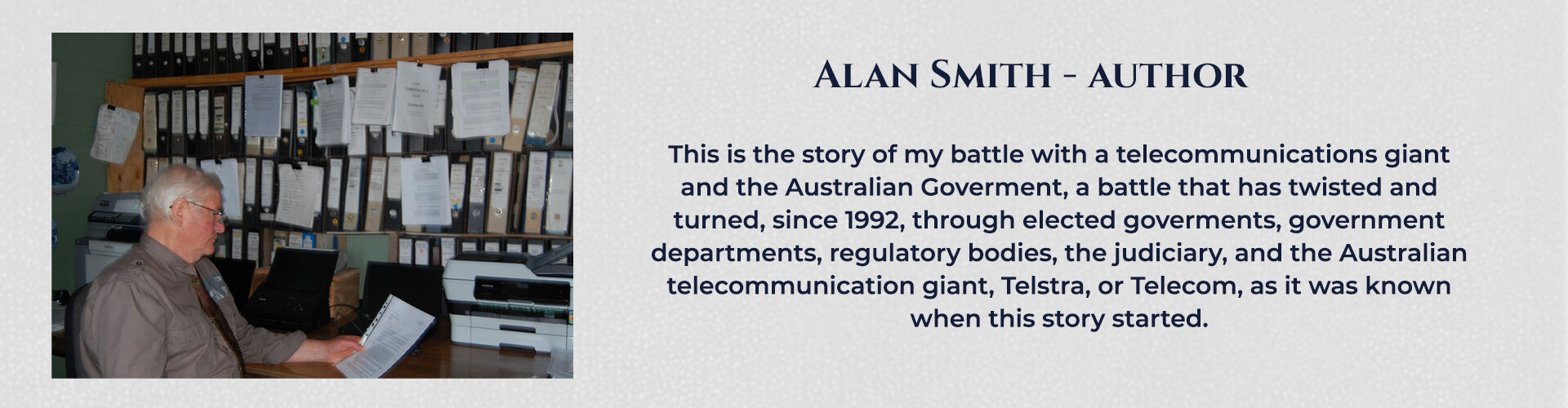
The question is unavoidable: why is Telstra above the law?
The answer lies in the system's structure. Telstra was a government‑owned monopoly with deep institutional ties, political protection, and regulatory influence. The arbitrations were conducted within a framework that favoured the carrier and shielded it from scrutiny. Those tasked with overseeing the process failed to enforce transparency, protect the claimants, and uphold the principles of justice they were appointed to defend. The result was a legal process that looked legitimate on paper but was compromised at every critical point, as confirmed in official Senate records — including under the heading A MATTER OF PUBLIC INTEREST in the Senate Hansard dated 20 September 1995. (See Chapter 5 - The Eighth Damning Letter).
CHAPTER 1 - THE BRIEFCASE SAGA — TREACHERY IN PLAIN SIGHT
Chapter 1: The First Wound (The Initial Breakdown)
The operational nightmare began with persistent, unexplained telephone and fax network faults that crippled the Cape Bridgewater Holiday Camp from its very inception. Inbound callers trying to reach the business constantly encountered dead air, received recorded messages falsely claiming the venue was closed, or were abruptly disconnected mid-sentence.

Then the following information surfaced, tightly tucked into a manila folder, supporting two Telstra documents that stated:
“Our local technicians believe that Mr Smith is correct in raising complaints about incoming callers to his number receiving a Recorded Voice Announcement saying that the number is disconnected. They believe that it is a problem that is occurring in increasing numbers as more and more customers are connected to AXE.”
Telstra’s own technicians confirmed the truth that Telstra senior management had buried under layers of deception, political protection, and systemic corruption.
To further support my claims, the TELECOM SECRET folios C04006, C04007 and C04008 stated:
“Legal position – Mr Smith’s service problems were network related and spanned a period of 3-4 years… In my opinion Alan Smith’s case was not a good one to test Section 8 for any previous immunities – given his evidence and claims. I do not believe it would be in Telecom’s interest to have this case go to court.”
And then the admission Telstra never intended the public to see:
“Overall, Mr Smith’s telephone service had suffered from a poor grade of network performance over a period of several years; with some difficulty to detect exchange problems in the last 8 months.”
This was criminal liability, acknowledged internally, concealed externally. This was government corruption, buried inside a corporation owned by Australians. This was corporate terrorism, executed through infrastructure.
I copied that document, and others, on my fax machine and sent them straight to AUSTEL, the government communications authority.
One senior government official, in September 1992, aware that my father had years earlier been awarded a medal of honour by Queen Elizabeth for his services to the British GPO (later British Telecom), and knowing he was a senior technical fault engineer who had schooled me for years in how to locate a fault before it escalated into becoming systemic, understood exactly why I was able to identify the failures in Australia’s network. I provided Amanda Davis, General Manager of AUSTEL, evidence and asked her to telephone me at my residence holiday camp, where my phone complaints were at their worst; after she did, I guided her to access her own telephone records under the Freedom of Information Act (FOI Act). When she did, and those documents surfaced, I showed Ms Davis that Telecom had charged her for calls not connected to my business.
My evidence concerning Telstra’s systemic billing problems remained visible for years after I first raised them in 1992, with AUSTEL still questioning Telstra in 1997, five years after I first alerted Amanda Davis in September 1992. This was an eleven per cent systemic billing fault, meaning that when Telstra was privatised, its true value was at least eleven per cent less than the prospectus publicly claimed.
On 15 July 1995, two months after the arbitrator’s premature announcement of findings on my still‑incomplete, unaddressed billing‑claim documents — information the arbitrator had disallowed his own consultants, DMR and Lane, from investigating, Amanda Davis provided me with an open letter to share with individuals of my choosing. The act itself was a measure of trust: she was prepared to stake her name on my integrity and professional character (See Evidence File 5 - Testimonials).
Chapter 2 - Inaccurate and Incomplete
The government communications authority investigating the COT Cases knew the COT Cases' claims were valid: its arbitration and mediation procedures had accomplished nothing, and the ongoing faults remained unfixed. By then, it was clear that Telstra’s national telephone infrastructure could not meet its licensing obligations to the COT Cases or its wider consumer base. The system could not reliably serve businesses or residences across Australia, even though Telstra’s code of supply required it. Despite knowing this, the government allowed Telstra’s board to negotiate a default deal with Murdoch. If Telstra failed to meet its licensing obligations- obligations it already knew it could not meet. The government would pay FOX $400 million out of Telstra’s public coffers.
This was discrimination in its most grotesque form. The government forced fourteen Australians into arbitration and mediation, insisting that if it funded these processes, it would treat the claimants as seriously as Murdoch and FOX. But once the COT Cases signed their official agreements, the arbitrator and mediators never ensured Telstra fixed the faults that drove us into arbitration and mediation. The ongoing systemic telephone and fax billing problems, the core of our claim, were never investigated or fixed under the agreement Telstra would. Instead, we received minimal awards, barely enough to cover arbitration and mediation expenses, while Murdoch and FOX walked away with the real spoils. They were not even Australians.
The appointed technical consultants, DMR (Canada) and Lane (Australia), formally acknowledge in their findings that the report remained incomplete, as evidenced by their official statements reproduced below.
“One issue in the Cape Bridgewater case remains open, and we shall attempt to resolve it in the next few weeks, namely Mr Smith’s complaints about billing problems.
“Otherwise, the Technician Report on Cape Bridgewater is complete.” ( Open Letter File No/47-A to 47-D)
and
“Continued reports of 008 faults up to the present. As the level of disruption to overall CBHC service is not clear, and fault causes have not been diagnosed, a reasonable expectation that these faults would remain ‘open’,” (Exhibit 45-c -File No/45-A)
Paul Howell from DMR Canada, while I was in convalescence after my first heart attack, telephoned me and told me he had refused to sign off on it because it was still not a full and complete record of my losses; at the time, it was used as the formal final findings.
This is how my COT story took shape. Read on.
The Telstra board knew the telephone problems were ongoing, just as they knew the scale of the telecommunications failures in the Rupert Murdoch and FOX saga. Yet Telstra’s board and senior management still allowed the COT Cases to incur hundreds of thousands of dollars in arbitration fees, fully aware that arbitration could never fix the telephone faults at the core of our claims.
As confirmed via the Australian Governemnt Secured Archive File → SENATE official Hansard – Parliament of Australia, at points 10 and 11, dated 25 June 1997, on page 5164, points 10 and 11 it is noted that:
10. "Telstra's CEO and Board have been aware of this deception since 1992. They have had ample time and opportunity to reform policies and reduce labour costs in order to fulfil their cable rollout commitments, thereby positioning Telstra favourably for the impending share issue. Instead, they chose deception, misinforming their Minister, their appointed auditors, and the owners of their stock—the Australian taxpayers. Because they refused to address the Telecommunications Agreement (TA) issue, high labour costs persisted, and Telstra ultimately fell short of its cable rollout commitment to Foxtel. This oversight will cost Telstra at least $400 million in compensation to News Corp and/or Foxtel, in addition to significant losses incurred when Telstra's stock is issued at a much lower price than it would have achieved had the company acted responsibly."
11. "Not only did Telstra fail to act with responsibility, but it also derelicted its duty of care to its shareholders. The ultimate victims of this negligence are the taxpayers, along with the thousands of employees who are likely to face layoffs when Telstra finally meets its rollout target—cabling over 4 million households, or 2.5 million households, assuming Telstra’s CEO complies with directives from the Minister."
This SENATE official Hansard – Parliament of Australia, particularly points 10 and 11, is threaded throughout this website for a reason: it is government record. It is not opinion, not allegation, not interpretation. It is the Commonwealth’s own transcript confirming how the Murdoch–FOX empire was viewed inside the bureaucracy, and how certain officials appeared willing to tolerate, even enable, discriminatory outcomes against ordinary Australians.
Read in their proper context, best seen in the sections where they appear, a pattern emerges. The record shows a bureaucracy that understood the scale of Murdoch–FOX influence, understood the consequences for Australian citizens, and yet allowed a system to operate in which small business operators were left exposed, disadvantaged, and in some cases financially destroyed.

During Helen Handbury’s second stay at my Cape Bridgewater Holiday Camp, after reading the manuscript that forms the basis of this website , she stated, “I will get my brother Rupert Murdoch to publish this book. He would be astounded that you COT Cases were forced to pay for an arbitration process before Telstra would fix your long‑outstanding phone problems.” As a local identity, Helen understood precisely how these unresolved faults were crippling other businesses in the district, including mine.
Helen and her husband Geoffrey were not distant philanthropists; they were embedded in our region. Their sizable donation to build the Cape Bridgewater Life Saving Club rooms on the beach is hard evidence of that commitment. They understood the fragile lifeblood of small coastal communities, and they recognised how Telstra’s negligence was slowly strangling them.
After Helen’s death from breast cancer, Geoff Handbury wrote to me in a beautifully handwritten letter, explaining that age had prevented him from pursuing my story with Rupert. Even so, his letter carried the same sincerity and local loyalty that he and Helen had always shown.
The COT Cases reveal a chilling picture of betrayal and corruption, involving 12 Australians who fell victim to a treacherous and rigged arbitration process orchestrated by Telstra. These individuals were coerced into spending hundreds of thousands of dollars on professional arbitration fees, desperate to prove that Telstra had systematically failed to honour its contractual obligations. Under an agreement brokered by AUSTEL (now ACMA), Telstra had promised that, provided the COT Cases funded their arbitrations, no final ruling would be issued until all faults affecting their businesses had been rectified.
Yet, in a shocking display of duplicity, Telstra failed to meet this obligation. Despite the overwhelming evidence of their negligence, the arbitrator shamefully sided with Telstra, absurdly claiming the faults had been repaired when, in reality, nothing had changed. This betrayal left the affected individuals reeling in disbelief.
Enter Senator Len Harris
Pauline Hanson, One Nation Party
On 25 July 2002, Senator Len Harris travelled from Cairns in Queensland (a trip that took more than seven hours) to meet four other COTs and me in Melbourne to ensure our discrimination claims against the Commonwealth were thoroughly investigated. He was appalled that the then-coalition government so severely discriminated against 16 Australian citizens, despite a Senate estimates committee working party being established to investigate all 21 COT-type claims against Telstra.
He was stunned at how I had collated this evidence into a bound submission. Senator Harris read Senator Alan Eggleston’s 9 August 2001 letter warning me that if I disclosed the in-camera Hansard records (supporting my claims that 16 Australian citizens were discriminated against in the most deplorable manner), then I would be held in contempt of the Senate and risk jail. Senator Harris was distraught, to say the least.
At a press conference the next day, Senator Harris aimed questions at the chief of staff to the Hon. Senator Richard Alston, Minister for Communications. He asked:
“Through the following questions, the media event will address serious issues related to Telstra’s unlawful withholding of documents from claimants, during litigation.
Why didn’t the present government correctly address Telstra’s serious and unlawful conduct of withholding discovery and/or Freedom of Information (FOI) documents before the T2 float?
Why has the Federal government allowed five Australians (from a list of twenty-one) to be granted access to some of the Telstra discovery documents they needed to support their claims against Telstra, but denied the same rights to the other sixteen?
Why has the Federal Government ignored clear evidence that Telstra withheld many documents from a claimant during litigation?
Why has the Federal Government ignored evidence that, among those documents Telstra did supply, many were altered or delivered with sections illegally blanked out?” (See Senate Evidence File No 56)
Senator Len Harris (One Nation, Queensland) 's historical involvement in advocating for the Casualties of Telstra (COT) cases between 2001 and 2003 is well documented in Australian parliamentary history. Senator Harris frequently used parliamentary forums, press conferences, and Senate debates to challenge the federal government and Telstra over the unresolved telecommunications network faults affecting small businesses, particularly the Cape Bridgewater Holiday Camp.
Key Advocacy Points Raised by Senator Harris
-
The Cape Bridgewater Hardship: Senator Harris highlighted how severe, ongoing telecommunications faults, faults the government and Senator Richard Alston had acknowledged years earlier, had decimated small‑business revenue, effectively forcing the sale of the Cape Bridgewater Holiday Camp.
-
Failure of the 1994/95 Arbitration: He consistently argued that the fast‑tracked COT arbitration process failed to properly investigate or rectify the underlying network engineering faults. As a result, the technical problems persisted long after the legal settlements were finalised.
-
The Senate Estimates Trade‑off: Harris highlighted the historical grievance that COT claimants were persuaded to accept a commercial arbitration framework rather than pursue a full, public investigation through a Senate Estimates Committee hearing.
CHAPTER 2 - THE DECEPTION ASSURANCES ENTER SENATOR BARNABY JOYCE
As the holiday camp continued to bleed vital revenue, high-level Telecom executives stepped in and issued formal, written assurances that the local exchange and lines were fully free of faults. Believing these official corporate statements, the camp kept investing heavily in marketing its pristine coastal facilities, unaware that the underlying infrastructure remained fundamentally broken.
ENTER SENATOR BARNABY JOYCE
When the government advised Senator Barnaby Joyce in mid‑2005 that his crucial Senate vote was needed to pass the final Telstra privatisation bill, they attached a condition: if he delivered that vote, they would appoint an independent assessor to review my 1994/95 arbitration claims, along with the claims of the other 13 COT Cases. That review would finally allow the government to see the outstanding evidence Telstra had concealed during the original arbitrations. The day before I signed this agreement on 17 March 2006, I received the following letter from the government stating:
"Thank you for your letter of 10 March 2006 to Ms Forman concerning the independent assessment process. If the material you have provided to the Department as part of the independent assessment process indicates that Telstra or its employees have committed criminal offences in connection with your arbitration, we will refer the matter to the relevant authority". (Refer to exhibt AS 657 File AS-CAV Exhibits 648-a to 700
None of the information on this website, absentjustice.com, which formed the basis for my claims provided to the government, including material showing that Telstra and/or its employees had committed criminal offences in connection with my arbitration, was ever referred to the relevant authority as promised by the government.
Unaware of what was about to be reversed, the government immediately broke the spirit of its promise as soon as Senator Joyce cast his critical vote.
Instead of appointing an independent assessor, the government installed a Telstra liaison bureaucrat to “review” my claims, a man whose professional history already tied him to the political machinery that had overseen the original arbitrations. That bureaucrat was David Quilty, former advisor to Prime Minister John Howard.
Quilty was not independent. He was not impartial. He was not an investigator. He was Telstra’s conduit into government.
When my claims- the same claims the government had promised to review ethically and transparently- were reviewed, they were unsurprisingly found “not valid.” Shortly afterwards, Quilty secured an executive position within Telstra.
The sequence is damning:
-
Government needs Joyce’s vote.
-
Government promises a transparent review of the COT evidence.
-
Joyce delivers the vote.
-
Government hands the review to a Telstra‑aligned bureaucrat.
-
That bureaucrat dismisses the claims.
-
That bureaucrat is rewarded with a Telstra executive role.
This is not an administrative coincidence. It is a closed loop: political power, corporate interest, and bureaucratic compliance, operating exactly as designed.
The government assessment process
On 3 November 2006, Senator Helen Coonan wrote to David Hawker, Speaker in the House of Representatives, stating:
“Thank you for your representation of 17 August 2006 on behalf of Mr Alan Smith regarding Mr Smith’s allegations that Telstra monitored his phone calls and emails during an arbitration process with Telstra. The interception of emails and monitoring of phone calls is an offence under the Telecommunications (Interception and Access) Act 1979. Mr Smith should consider his dispute through the dispute resolution bodies, including his State Office of Fair Trading, the Competition and Consumer Commission, the Australian Communications and Media Authority, and the courts.”
On 17 May 2007, I received a letter from Senator Coonan, stating:
“I have now made both formal and informal representations to Telstra on behalf of the CoTs. However, Telstra’s position remains that this is a matter most appropriately dealt with through a Court process. Telstra is not prepared to undertake an alternate means of pursuing this matter. …
“I also appreciate the depth of feeling regarding the matter and suggest you consider whether court proceedings may be your ultimate option.” (See DCITA Evidence File 6)
Surely it was Senator Coonan’s responsibility, as the Minister for Communications, Information Technology and the Arts, to initiate an official enquiry into why, both during and after the COT arbitrations, Telstra continued to intercept in‑confidence documents leaving my office (or residence), and the offices of various senators and the Commonwealth Ombudsman’s office. The Australian Federal Police were also reluctant to charge Telstra during my 1994/1995 arbitration process.
As shown in the Scandrett & Associates report (see Open Letter File No/12 and File No/13), a secondary fax machine was installed in Telstra’s network during the arbitration process, systematically intercepting numerous in‑confidence COT‑related documents to and from our advisors, as well as from government ministers to and from our offices, during and after our arbitrations had been completed.
The arbitration process should have investigated this illegal interception of legally confidential documents between government ministers, the Commonwealth Ombudsman’s Office, and our arbitration consultants’ offices when these illegal acts were first discovered. Senator Coonan, writing to me on 17 May 2007, twelve years after the AFP declined to help me, and suggesting I take Telstra to court over the same issues, provides further evidence of the undemocratic and uncaring way their elected government ministers have treated the COT Cases.
Now that we have jumped a decade to 2006–2008, and the above section has laid out the consequences, I take the reader back to the years before the COT arbitrations and mediations began. This is where the saga truly started, long before the government forced fourteen small businesses into a process they could never win. This is the ground floor of the disaster.
Chapter 5 - US Department of Justice vs Ericsson of Sweden
When I first launched absentjustice.com in 2015, I already knew of pervasive corruption at the core of my arbitration experience. The technical consultants, tasked with investigating my case, told the arbitrator they needed several additional weeks to finalise their findings on my persistent telephone complaints.
These complaints didn’t occur in isolation; they plagued me throughout the entire arbitration process, which spanned from April 1994 to April 1995. Of the over two hundred fault complaints I submitted, each aligned with the government-endorsed arbitration procedure, only 23 were actually examined. The overwhelming majority remained unaddressed, unresolved, and utterly ignored.
The arbitrator’s decision to overlook this gross negligence was not merely an oversight; it was a deliberate dismissal. During my arbitration, AUSTEL, the Australian government’s communications authority, contacted the arbitrator twice and Telstra three times. In their communications, AUSTEL insisted on a thorough investigation of my claims. They made it abundantly clear that, based on the evidence already available, they had no reason to doubt the validity of my assertions. In fact, they warned that my ongoing issues with 008/1800 billing were a matter of public interest and that AUSTEL had a duty to follow up on any suspected systemic issues.
Yet, despite these clear warnings, both the arbitrator and Telstra failed to respond. They conveniently buried these serious alerts, adding to my frustration and bewilderment.
Moreover, I informed AUSTEL, four other government agencies, and the Australian Federal Police that Lane Telecommunications Pty Ltd, the very company selected through the arbitration process to investigate faults related to Ericsson equipment across Australia, had been acquired by Ericsson midway through the arbitration proceedings.
Lane was designated to scrutinise Ericsson. Instead, they fell under Ericsson’s ownership.
This was not just a minor oversight; it represented a significant conflict of interest that compromised the integrity of the investigation. In my case, Lane and Telstra were scheduled to evaluate my three service lines on April 6, 1995. This assessment followed AUSTEL's finding that Telstra's earlier testing, conducted on September 29, 1994, was fundamentally flawed and inadequate. AUSTEL communicated this in their letters to Telstra dated October 11, 1994, and November 11, 1994.
Despite travelling nearly 450 kilometres to reach my business for these tests, Lane and Telstra refused to evaluate my three lines when they arrived. This refusal was particularly baffling, given that the tests were the very purpose of their journey. What should have been a straightforward process became yet another hollow act within an arbitration that lacked true accountability.
Despite this blatant disregard for procedure, the arbitration continued as if nothing had happened.
Learn How this original evidence was buried — 1993 to 1996
In the years 1993 and 1994, a significant chapter unfolded in my battle for fair telecommunications services. Prompted by my Federal Member of Parliament, The Hon. David Hawker MP, who publicly asked constituents in the Wannon electorate to provide evidence of severe telephone faults, I was soon inundated with responses. Residents—ordinary citizens and local business owners—shared their harrowing experiences with ongoing phone problems. Even a prominent law firm in Warrnambool, one of the region's leading firms today, corroborated the troubling issues that the other COT Cases and I were enduring.
Against this backdrop, I met with Helen Handbury, Rupert Murdoch’s sister. She visited me twice to discuss her own dire telecommunications struggles, providing valuable evidence of pervasive service failures. I meticulously compiled this correspondence and documentation to present to AUSTEL, the government authority responsible for telecommunications regulation, and to the then Shadow Minister for Communications, Senator Richard Alston.
After gathering substantial evidence, Senator Alston kindly arranged a meeting with me at his St Kilda Road office in Melbourne, conveniently within walking distance of AUSTEL’s headquarters. As we sat together, he diligently examined the material I had collected, including detailed accounts of the deficiencies in Ericsson AXE telephone exchange equipment—issues so severe that many countries had already removed this faulty technology from their networks.
On 24 February 1994, Senator Alston took a bold stand during a Senate Committee hearing, raising these critical issues “on notice” and demanding clear answers from Telstra. Utilising my evidence as a foundation, he questioned how such a deeply flawed system could persist when reputable global carriers had already deemed the Ericsson AXE equipment unacceptable.
However, when it became apparent that the AXE faults were far from isolated—impacting as many as 120,000 Australian customers, not simply the COT Cases—the troubling findings were quietly excised from the later April 1994 AUSTEL COT Cases Report. Remarkably, as of 2026, the report still asserts that it acknowledged only 50 COT-type complaints at the time, obscuring the issue's true scale.
I reiterate, in a controversial turn, Ericsson was permitted to acquire Lane Telecommunications, the very company entrusted by the government and an appointed arbitrator to investigate Ericsson’s involvement in the service faults. The acquisition included the main technical witness for an undisclosed amount, raising further suspicions about the investigation's integrity.
By 1996, new evidence had emerged, which Senator Alston and his Chief of Staff, Paul Fletcher—who would later become Australia’s Communications Minister, received through The Hon. David Hawker MP on my behalf. Despite this additional evidence, their investigation lacked transparency, and they buried the information, much like the earlier findings on the Ericsson AXE equipment.
Today, all of this material—the letters, reports, and suppressed evidence revealing the struggle for fair telecommunications—is available for download at absentjustice.com, providing a comprehensive account of this ongoing fight against systemic failures in the industry.
Furthermore, the evidence related to Ericsson that my technical consultant, George Close & Associates, had compiled, an endeavour that cost me more than $25,000, was never returned to me once my arbitration concluded on May 11, 1995. Lane, responsible for investigating my ongoing Ericsson billing issues, failed to disclose any findings, leaving the evidence and its implications unexamined and unaddressed. It simply vanished without a trace.
All of this transpired under the veil of a confidentiality agreement that claimants were coerced into signing. This agreement did not protect fairness; it protected secrecy. It allowed conflicts of interest to flourish, evidence to be withheld, urgent warnings to be disregarded, and defective testing and unresolved faults to remain hidden from public scrutiny for years.
Attached to this message, as part of the website's introduction, is the latest information detailing Ericsson's unethical practices. Given this backdrop, the arbitrator's refusal to let me amend my claim after Lane Telecommunications Pty Ltd was acquired by the very company it was meant to scrutinise is not just troubling; it reveals one of the darkest aspects of the COT Cases arbitrations.
It is crucial to highlight the bribery and corruption issues raised in the Australian media on 19 December 2019 → →
One of Telstra's key partners in the building out of their 5G network in Australia is set to fork out over $1.4 billion after the US Department of Justice accused them of bribery and corruption on a massive scale and over a long period of time.
Sweden's telecoms giant Ericsson has agreed to pay more than $1.4 billion following an extensive investigation which saw the Telstra-linked Company 'admitting to a years-long campaign of corruption in five countries to solidify its grip on telecommunications business. (https://www.channelnews.com.au/key-telstra-5g-partner-admits-to-bribery-corruption/)
As the following link shows, Ericsson's corruption record reveals a troubling system of covert payments and illicit dealings in dangerous regions. Investigations have shown that the company funnelled millions of dollars through intermediaries linked to ISIS, enabling its operations in areas with little legitimate oversight. While civilians and governments struggled against extremist violence, Ericsson continued its presence through compromised channels. The company later admitted it withheld information from investigators and violated U.S. federal law.
That Dr Hughes, the arbitrator responsible for safeguarding the integrity of the process, allowed this sale to proceed demonstrates a profound failure of professional duty. No Western nation governed under the rule of law would ever permit a corporation under investigation to buy the forensic body tasked with assessing its misconduct. Yet in Australia, Ericsson was allowed to absorb Lane, contaminate the chain of evidence, and compromise the arbitration at its core.
Clicking on the Ericsson List will help you understand just how corrupt the arbitration system is, not only in Australia, but across the globe
government corruption • corporate terrorism • extortion • bribery • fraudulent reporting • treachery • betrayal
The corruption exposed by absentjustice.com is not a partisan aberration; it is a symptom of a deeper, systemic rot that permeates the USA and radiates outward across global institutions. Ericsson’s ruthless infiltration of Australia’s arbitration system is undeniable. It raises the only question that matters: How did this corporation evade accountability for its conduct during the COT arbitrations? This is not a political dispute. It demands action that cuts through party lines and exposes the treacherous conduct buried beneath them.
This is criminal sabotage, a precision act of corporate terrorism disguised as technical failure. Telstra’s eight‑line system collapses under PCM errors they already knew existed, a deliberate act of fraudulent engineering, designed to cripple a rural business. The silence is not accidental. It is extortion by infrastructure, a calculated strike that exposes the corporation’s criminal misconduct and its willingness to weaponise telecommunications against citizens.
Newcomers to absentjustice.com must understand that the four COT arbitrations were run under two different agreements: the original, government‑endorsed version signed by Maureen Gillan on 8 April 1994, and a secretly altered version forced onto Ann Garms, Graham Schorer, and me on 21 April 1994 after Telstra and the administrator realised our claims exposed systemic network failures and nationwide billing faults affecting thousands of Australians. To stop these systemic problems reaching the arbitrator, Telstra’s liaison Steve Black and TIO administrator Warwick Smith covertly arranged for the TIO‑appointed resource unit Ferrier Hodgson Corporate Advisory (FHCA) to filter what evidence the arbitrator and claimants received, and what evidence would be concealed, even though Arbitrator Dr Gordon Hughes was legally bound to pass on every document he received. This secret deal effectively made FHCA the real arbitrator in the last three cases → (Refer to File 590 → AS-CAV Exhibits 589 to 647).
Because this corrupted process removed the $250,000 liability clauses 25 and 26 protections that Gillan retained, and because Garms, Schorer, and I were told the arbitration would not proceed unless we accepted these late changes, the entire process became a maze of ambiguity, deception, and engineered disadvantage. This is why the homepage must repeat certain statements, documents, and even the same images, sometimes twice and sometimes three times, not for emphasis, but because the corruption was so layered and deliberately confusing that newcomers cannot grasp the truth unless these key points are reinforced. Please continue reading.
Telstra’s history of misleading and deceptive conduct did not emerge overnight; it was engineered over decades, from the 1950s through the 1990s, when the corporation grew into a state‑sanctioned powerhouse so large, so politically protected, and so structurally unaccountable that it effectively operated above the Australian government that supposedly owned it.
The following documentation highlights that my arbitration claim, stating Australia’s deteriorating copper network was responsible for the COT Cases’ ongoing telephone faults, not the claimants’ own equipment, was factual and fully supported by independent evidence, including material published on absentjustice.com and external sources such as Delimiter’s "Worst of the worst: Photos of Australia’s copper network | Delimiter. This is not an allegation; it is documented proof that the network itself was failing, and that Telstra knew it.
CHAPTER 3 — DECEPTION: The Recorded Lie That Destroyed Small Business Operators.
The false disconnection message, “The number you have called is not connected”, is industrial‑scale fraudulent reporting, a digital act of corporate thuggery. Telstra records the lie internally while denying it publicly. Every caller hears deception. Every booking dies. This is criminal misrepresentation, a lethal tactic used to suffocate a business through covert extortion and engineered loss.
Keyword cluster: deception, fraudulent reporting, corporate thuggery, criminal misrepresentation, engineered loss, extortion.
Behind the façade of a public utility, Telstra evolved into a corporate empire that shaped policy, buried evidence, manipulated regulators, and crushed citizens through criminal misconduct, fraudulent reporting, and systemic corruption.
By the late 20th century, Telstra was not merely a telecommunications provider; it was a government‑backed monopoly wielding the reach of a national intelligence network and the impunity of a political cartel. Its influence eclipsed ministerial oversight. Its internal culture normalised corporate terrorism, extortion by infrastructure, evidence tampering, and deceptive technical reporting.
Telstra became a machine that could silence complaints, rewrite facts, and override democratic accountability. In practice, and in impact, it was bigger, stronger, and more untouchable than the government itself, as the following Senate Hansard shows.
Will AI Become the Next Arbiter — or the Next Threat to Arbitration Integrity?
Artificial intelligence is already being positioned as the next global arbiter — a system capable of analysing evidence, detecting contradictions, exposing conflicts of interest, and identifying patterns of misconduct that human arbitrators either miss or deliberately ignore. On paper, AI looks like the perfect antidote to the corruption you documented on absentjustice.com.
But here is the brutal truth.
If AI begins producing its own rules of arbitration, without human oversight, without legal safeguards, without transparency, then one glitch, one corrupted dataset, one manipulated input could destroy what little integrity arbitration still has. And Australia has already shown how fragile that integrity is.
Freehill Hollingdale & Page — now trading as Herbert Smith Freehills Melbourne
Starting on page 5163, this link > SENATE official Hansard – Parliament of Australia shows Telstra employees rorted millions upon millions of dollars from Telstra shareholders — i.e., the government and Australian citizens, who then owned Telstra. Many people threatened the COT cases because our persistence in gaining fully functional phone systems was about to expose other unethical behaviour inside Telstra, including at the management level. The fact that the Telstra CEO and board knew millions of dollars were being unlawfully siphoned from government coffers is staggering. Figures running into the billions have also been quoted.
Don't forget to hover your mouse over the following images as you scroll down this homepage.
“COT Case Strategy”
As shown on page 5169 in Australia’s SENATE official Hansard, Telstra’s lawyers, Freehill Hollingdale & Page, devised a legal paper titled “COT Case Strategy” (see Prologue Evidence File 1-A to 1-C). This document instructed their client, Telstra, to conceal technical information from us under the guise of Legal Professional Privilege, even though the information was not privileged.
When AUSTEL, the then government communications authority (now ACMA), became aware that the four named Australians, Ann Garms, Maureen Gillan, Graham Schorer, and me, were being targeted in a revenge‑type retaliation by Freehill Hollingdale & Page, the government told us in October 1993 that Freehill would have no further involvement in the COT Cases matters. This assurance was hollow. Telstra's senior management still forced me, under threat, to register my ongoing telephone faults in writing with Denise McBurnie of Freehill Hollingdale & Page. Telstra refused to investigate my faults unless I complied.
Government records show the government assured the COT Cases (see point 40, Prologue Evidence File No/2) that Freehill Hollingdale & Page would have no further involvement in COT issues. Yet this same legal firm later provided the arbitrator with Ian Joblin, a clinical psychologist’s witness statement, a document signed only by Maurice Wayne Condon of Freehill’s. The psychologist himself did not sign it.
In 1997, the government appointed Freehill Hollingdale & Page as the official lawyers for the privatisation of Telecom (now Telstra). The government turned its back on the truth concerning what happened to everyday Australians who dared to complain about a government‑owned telecommunications carrier.
Furthermore, and astonishingly, page 5163 of > SENATE official Hansard – Parliament of Australia shows that, even before COT members and several senators applied pressure, both Telstra’s CEO and all members of the Telstra board already knew, for some time, about the millions of dollars Telstra was unlawfully withdrawing from government coffers. Perhaps even more unbelievable is that the COT Cases received no recognition from either the government or Telstra for our stand for honesty and truth. Instead, we were treated in the worst possible way, labelled vexatious litigants, our lives ruined, simply because we believed that what we were doing would eventually benefit all Australians.
Stop the COT Cases at all costs
Worse, however, the day before the Senate committee uncovered this COT Case Strategy, they were also told under oath, on 24 June 1997, see:- pages 36 to 39 Senate - Parliament of Australia, from an ex-Telstra employee turned whistleblower, Lindsay White, that, while he was assessing the relevance of the technical information which the COT claimants had requested, he advised the Committee that:
Mr White "In the first induction - and I was one of the early ones, and probably the earliest in the Freehill's (Telstra’s Lawyers) area - there were five complaints. They were Garms, Gill and Smith, and Dawson and Schorer. My induction briefing was that we - we being Telecom - had to stop these people to stop the floodgates being opened."
Senator O’Chee then asked Mr White - "What, stop them reasonably or stop them at all costs - or what?"
Mr White responded by saying - "The words used to me in the early days were we had to stop these people at all costs".
Senator Schacht also asked Mr White - "Can you tell me who, at the induction briefing, said 'stopped at all costs" .
Mr White - "Mr Peter Gamble, Peter Riddle".
Senator Schacht - "Who".
Mr White - "Mr Peter Gamble and a subordinate of his, Peter Ridlle. That was the induction process-"
From Mr White's statement, it is clear that he identified me as one of the five COT claimants that Telstra had singled out to be ‘stopped at all costs’ from proving their case against Telstra. One of the named Peters in this Senate Hansard who had advised Mr White that we five COT Cases had to be stopped at all costs is the same Peter Gamble who swore under oath, in his witness statement to the arbitrator, that the testing at my business premises had met all of AUSTEL’s specifications, when it is clear from Telstra's Falsified SVT Report that the arbitration Service Verification Testing (SVT testing) conducted by this Peter did not meet all of the government's mandatory specifications.
Also, in the above Senate Hansard on 24 June 1997 (refer to pages 76 and 77 - Senate - Parliament of Australia Senator Kim Carr states to Telstra’s main arbitration defence Counsel (also a TIO Council Member), Re: Alan Smith:
Senator CARR – “In terms of the cases outstanding, do you still treat people the way that Mr Smith appears to have been treated? Mr Smith claims that, amongst documents returned to him after an FOI request, a discovery was a newspaper clipping reporting upon prosecution in the local magistrate’s court against him for assault. I just wonder what relevance that has. He makes the claim that a newspaper clipping relating to events in the Portland magistrate’s court was part of your files on him”. …
Senator SHACHT – “It does seem odd if someone is collecting files. … It seems that someone thinks that is a useful thing to keep in a file that maybe at some stage can be used against him”.
Senator CARR – “Mr Ward, we have been through this before in regard to the intelligence networks that Telstra has established. Do you use your internal intelligence networks in these CoT cases?”
The most alarming aspect of Telstra's intelligence networks in Australia is who within the Telstra Corporation has the necessary expertise, i.e., government clearance, to filter the raw information collected before it is impartially catalogued for future use? How much confidential information about the telephone conversations I had with the former Prime Minister of Australia in April 1993 and again in April 1994, regarding Telstra officials, is held in my Red Communist China episode, which I discussed with Fraser?
https://www.promoteyourstory.com.au → The Arbitraitor - Alan Smith
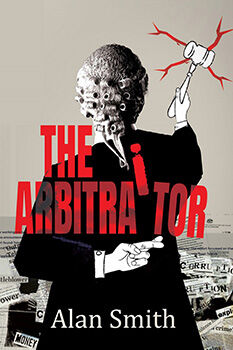 More importantly, when Telstra was fully privatised in 2005, which organisation in Australia was given the charter to archive this sensitive material that Telstra had been collecting about its customers for decades?
PLEASE NOTE:
At the time of my altercation referred to above, on 24 June 1997, the Senate - Parliament of Australia, my bankers had already lost patience and sent the Sheriff to ensure I stayed on my knees. I threw no punches during this altercation with the Sheriff, who was about to remove catering equipment from my property, which I needed to keep trading. I actually placed a wrestling hold, ‘Full Nelson’, on this man and walked him out of my office. With my fingers crossed, I told the Magistrates’ Court what the government had forced me into: a no‑win, ongoing telephone nightmare that had dragged me before him, accused of assaulting a Sheriff. On appeal, the magistrate dropped every charge when it became clear this story carried two sides, and mine had been buried beneath years of official government bureaucrat neglect.
Several witness statements I presented that day before the Portland Magistrate were later attached to my subsequently submitted arbitration Letter of Claim → CAV P3- Exhibit 8- Exhibit 9 as evidence of a significant issue affecting my business’s viability. They were not peripheral. They were not anecdotal. They were direct proof of the damage being done to my operations.
This is why I was forced to sell my Holiday Camp School Bus simply to keep trading. I did not sell the bus as part of a business plan or restructuring. I sold it because the telephone faults were so severe, relentless, and destructive that I had to liquidate assets just to survive. The government already knew this. Telstra already knew this. The witness statements confirmed it in open court.
And yet, despite that knowledge, despite the Portland Magistrates Court having already seen the evidence. the arbitration consultants later claimed they had not viewed my Letter of Claim → CAV P3- Exhibit 8- Exhibit 9, and therefore my losses could not be valued. They stated a “comprehensive log” of my complaints did not exist, even though I had placed it before a Magistrate before arbitration.
The evidence existed. It was seen. It was acknowledged. And then it was buried.
So why did the designated technical consultants, one from DMR Group Inc. (Canada), the other from Lane Telecommunications Pty Ltd (Australia), advise the arbitrator that they had not viewed my Letter of Claim CAV P3- Exhibit 8- Exhibit 9, and therefore my arbitration claim could not be valued on its merits? Page 2 of the DMR & Lane report attached as file 47‑A states:
“A comprehensive log of Mr Smith’s complaints does not appear to exist.”
As explained throughout different segments of my COT absentjustice.com story, I unfortunately did not receive a copy of the following findings (AUSTEL’s Adverse Findings) at points 2 to 212 until 23 November 2007, twelve years after the termination of my arbitration process. In simple terms, the government had already validated my claims as early as 4 March 1994, six weeks before 21 April 1994, the day I signed the arbitration agreement.
Had these documents been lost en route to the arbitrators' office via Telstra's inadequate fax service, which was one of the reasons I was now in arbitration?
But despite knowing Telstra’s faxing system was grossly defective — and despite this being one of the very issues under investigation during my arbitration — and despite the evidence already put before the Portland Magistrate before my arbitration even commenced, I was still forced to endure 13 months of a gruelling arbitration process that cost me well over $300,000 in professional fees. I was compelled to prove something the government had already established, as the following 212 points show. The truth was known. The truth was documented. The truth was withheld.
I ask all visitors to absentjustice.com to read at least the first 20 official government findings from their secret investigation into my matters. Once you read and understand those 212 points, imagine what the arbitrator might have awarded me had he and DMR & Lane been allowed to view all (AUSTEL’s Adverse Findings) 212 findings. and my Letter of Claim → CAV P3- Exhibit 8- Exhibit 9.
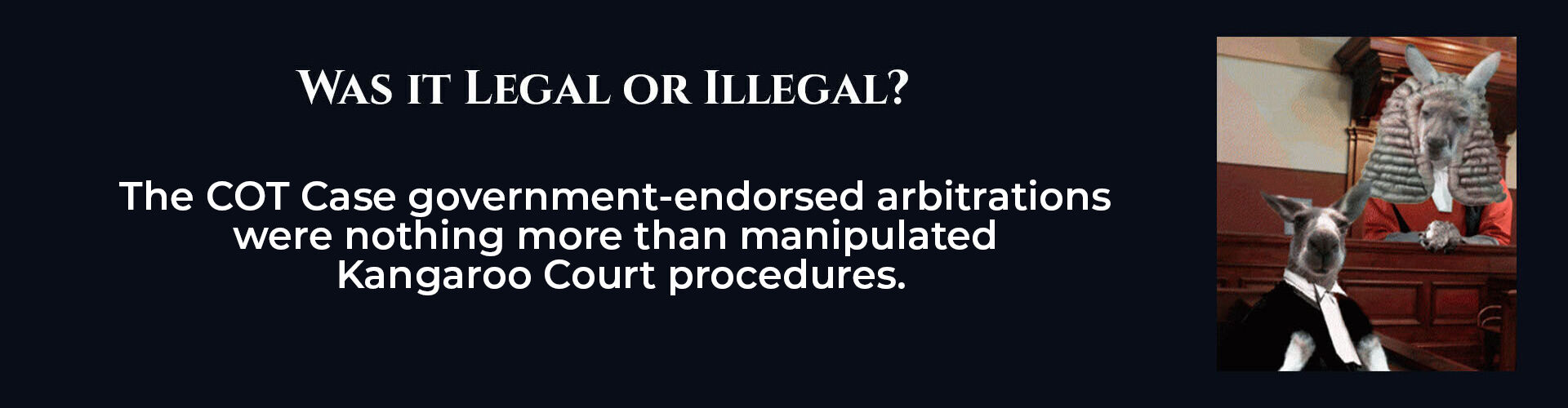
Exhibit 13-H → Burying The Evidence File 13-H is the letter dated August 4, 1998 and attached to it is also exhibited as (13-H) a statutory declaration from Mr Schorer to me, which detailed a phone conversation he had with the arbitrator Dr Gordon Hughes during the 1994 arbitrations concerning lost Telstra COT-related faxes. My arbitration had been over for three years, and a pending appeal revealed that 41 of my faxes during my 13-month arbitration were not on the arbitrator's schedule of received documents, even though my fax billing account showed they had been sent. Mr Schorer alerted the Senate to this, as did Dr Hughes, and Dr Hughes' response gave us hope that we could have these lost arbitration fax matters investigated. During that conversation, Mr Schorer had with Dr Hughes, Dr Hughes explained to Graham Schorer in detail that:
"Hunt & Hunt (The company's) Australian Head Office was located in Sydney, and (the company) is a member of an international association of law firms. Due to overseas time zone differences, at close of business, Melbourne's incoming facsimiles are night switched to automatically divert to Hunt & Hunt Sydney office where someone is always on duty. There are occasions on the opening of the Melbourne office, the person responsible for cancelling the night switching of incoming faxes from the Melbourne office to the Sydney Office, has failed to cancel the automatic diversion of incoming facsimiles." Burying The Evidence File 13-H.
Dr Hughes’s failure to disclose the faxing issues to the Australian Federal Police during my arbitration is deeply concerning. The AFP was investigating the interception of my faxes to the arbitrator's office. Yet, this crucial matter was a significant aspect of my claim that Dr Hughes chose not to address in his award or mention in any of his findings. The loss of essential arbitration documents throughout the COT Cases seriously indicts the process.
Even more troubling is that Dr Hughes knew about the faxing problems between the Sydney and Melbourne offices before his appointment as arbitrator in seven arbitrations, all coordinated within 12 months. During this time, COT claimants, two in Brisbane and five in Melbourne, frequently expressed frustration that the arbitrator's office was not responding to their faxes. This raises alarming questions about potential criminal negligence and the integrity of the arbitration process.
CHAPTER 4 — CONCEALMENT: The FOI Documents Telstra Hid for Years
FOI becomes a warzone of government corruption, criminal concealment, and sinister misconduct. Engineering reports vanish. Fault logs are buried. Internal memos disappear. Telstra’s FOI obstruction is not incompetence — it is strategic evidence suppression, a coordinated attempt to keep victims under surveillance while truth is destroyed.
Keyword cluster: government corruption, criminal concealment, evidence suppression, sinister misconduct, FOI obstruction, under surveillance.
As discussed above, government records show the government assured the COT Cases (see point 40 Prologue Evidence File No/2) that Freehill Hollingdale & Page would have no further involvement in the COT issues. Yet this same legal firm provided the arbitrator with the witness statement of Ian Joblin, clinical psychologist, a statement signed only by Maurice Wayne Condon of Freehill’s. It bore no signature from the psychologist.
I am not implying that Ian Joblin knowingly submitted an incomplete report. Far from it. Apart from choosing to conduct the consultation in the saloon bar of the Richmond Hotel in Portland, Victoria, he appeared genuinely shocked that the Bell Canada International (BCI) Report handed to him by Freehill Hollingdale & Page, the report he was instructed to read before assessing my state of mind, had been fabricated by Telstra. Telstra would have known this when they supplied it. The purpose was obvious: to insinuate I had to be mentally unsound to believe my phone faults were ongoing when the BCI report falsely claimed otherwise.
This angered Ian Joblin. It angered him because Telstra was using him as part of a ruse to convince the arbitrator I had lost all soundness of mind. In a complete reversal of his earlier hostility, Joblin stated he would ensure his witness statement recorded that I had provided conclusive evidence showing the BCI tests could not have been performed as reported in the BCI report Freehill Hollingdale & Page supplied to him before he assessed my mental state. Two of Telstra's technicians prepared the following two witness statements for Telstra's 12 December 1994 arbitration defence of my claims (see Exhibits 11 and 12, BCI Telstra’s M.D.C Exhibits 1 to 46), confirming that two Telstra employees swore under oath that the CCS7 testing equipment could not be used at the two exchanges that serviced my business.
This clearly proved that Telstra’s arbitration defence was fundamentally inaccurate and that I had the right to pursue this as an appeal. The BCI testing occurred at these two telephone exchanges: Portland and Cape Bridgewater.
Did Maurice Wayne Condon remove or alter any reference to what Ian Joblin had initially written about me being of sound mind?
On 21 March 1997, twenty‑two months after the conclusion of my arbitration, John Pinnock (the second appointed administrator to my arbitration) wrote to Telstra’s Ted Benjamin (see File 596 AS‑CAV Exhibits AS-CAV Exhibits 589 to 647 ) asking:
1...any explanation for the apparent discrepancy in the attestation of the witness statement of Ian Joblin .
2...were there any changes made to the Joblin statement originally sent to Dr Hughes compared to the signed statement?"
Telstra’s lawyer, Maurice Wayne Condon of Freehills, signed the witness statement without the psychologist’s signature, highlighting the significant influence Telstra’s lawyers wielded over Australia's arbitration system. What is alarming is that John Pinnock, who asked these questions of Telstra, knew my lawyers intended to use the reply from Telstra’s Ted Benjamin as a spearhead in my arbitration appeal. It is now 2026, and I still have not received a response from the Telecommunications Industry Ombudsman office on whether the Ian Joblin witness statement was tampered with before it was submitted to arbitration.
John Pinnock’s letter of 10 January 1996 was written in response to my request for other arbitration documents which, as administrators to my arbitration, the TIO was legally bound to hold until 2002 under the required statute of limitations. Pinnock’s response to my request for documents to assist my pending appeal states:
“I refer to your letter of 31 December 1996 in which you seek to access to various correspondence held by the TIO concerning the Fast Track Arbitration Procedure. … I do not propose to provide you with copies of any documents held by this office.” (See Open Letter File No 57-C)
This was not a misunderstanding. It was a refusal, issued despite the statutory requirement that these documents be retained and made available.

Telstra's Falsified BCI Report 2.
The Canadian Government became interested, including writing to me, to ensure I pursued this BCI issue with Bell Canada in Canada, as I was not receiving any assistance from the Australian government on this very serious BCI matter, which I discussed with the Minister for Communications in Canada (see also below).
The website absentjustice.com exposes systemic corruption, institutional betrayal, and legal manipulation within Australia's power structures. It details a telecommunications scandal involving political interference, regulatory failures, and a cover-up designed to protect Telstra and powerful interests. This issue goes beyond a commercial dispute; it reflects criminal deception and injustice against rural Australians. The site reveals a pattern of power abuse, evidence concealment, and arbitration fraud within Australia's telecommunications system, implicating federal governments, regulatory bodies, legal institutions, and corporate boardrooms.
Telstra's failures and fabrications were deliberate. This account describes a corporation that falsified data, buried evidence, and attacked complainants, all while a complicit government shielded it. The narrative, involving small businesses, the Federal Parliament, and Telstra's boardroom, illustrates how a knowingly failing network devastated the lives of ordinary citizens. The upcoming chapters do not speculate; they indict a system that has lost its way.
While Telstra maintained that its telephone exchanges in the late 1980s and early 1990s were functioning adequately, it knew they were not. Later evidence paints a damning picture. During the National Broadband Network (NBN) rollout from 2011 to 2015, Telstra technicians documented catastrophic exchange conditions through video and photographs. This evidence, revealed a decade after the arbitrator assured the government that network faults had been "fixed" during the COT arbitrations, directly contradicts that assurance. Absentjustice.com demonstrates that Telstra and its board were fully aware of the deception.
While I have briefly touched on the briefcase affair above, I explain it in more detail below.
THE BRIEFCASE SAGA — TREACHERY AND DECEPTION
On 3 June 1993, Telstra senior management finally visited my business, a five‑hour drive from Melbourne. Within five minutes of saying hello, Mr Smith, I knew I was in for another round of misleading and deceptive conduct — the same corporate script, the same ritualised thuggery, the same engineered evasions that had strangled my business for years.
I should have known better. It was just another performance of Telstra’s trademark lie: “No fault found.” We spent considerable time dancing around a summary of my phone problems — a choreography of corporate deception. Their best advice was to keep doing exactly what I had been forced to do since 1989: document every fault, every outage, every engineered failure. It was extortion disguised as guidance. I could have wept. Finally, they left.
But Telstra’s treachery never leaves quietly.
A little while later, in my office, I discovered that one of the Telstra executives, the one I have nicknamed Aladdin, had left behind his “treasures.” What he abandoned was no accident. It was a planted device, a silent act of corporate terrorism, the beginning of the Briefcase Saga — a moment so sinister, so loaded with criminal misconduct, it still burns decades later.
ALADDIN
The briefcase wasn’t locked. That alone was suspicious. I opened it and found it belonged to Mr Macintosh. No phone number. No contact details. Just a silent object left in my office like a surveillance drop — a corporate intrusion disguised as forgetfulness. I had to wait until business hours the next day to track him down.
But the real shock was inside: a file titled “SMITH, CAPE BRIDGEWATER.”
After five gruelling years fighting Telstra’s evasive monolith — five years of lies, denials, fraudulent reporting, evidence tampering, and manufactured confusion — here, suddenly, was the truth they had been hiding. An inside perspective, left sitting on my desk like a confession.
The first document I lifted was a bomb.
It proved Telstra knew the RVA fault recorded in March 1992 had lasted at least eight months, not the three weeks they used to justify their settlement payout. Dated 24/7/92, with my phone number printed in the top‑right corner, it referred to my complaint that callers were receiving an RVA “service disconnected” message. The “latest report” was dated 22/7/92 from Station Pier in Melbourne, with a “similar fault reported” on 17/03/92.
The final sentence was damning: “Network investigation should have been brought in as fault has gone on for 8 months.”
This was not a mistake. This was fraudulent reporting, deliberate concealment, and criminal misconduct at the highest levels of a government‑owned corporation.
Although the Recorded Voice - AXE - issue has been raised above, it was paramount to highlight it again as it forms another part of our never-ending story.
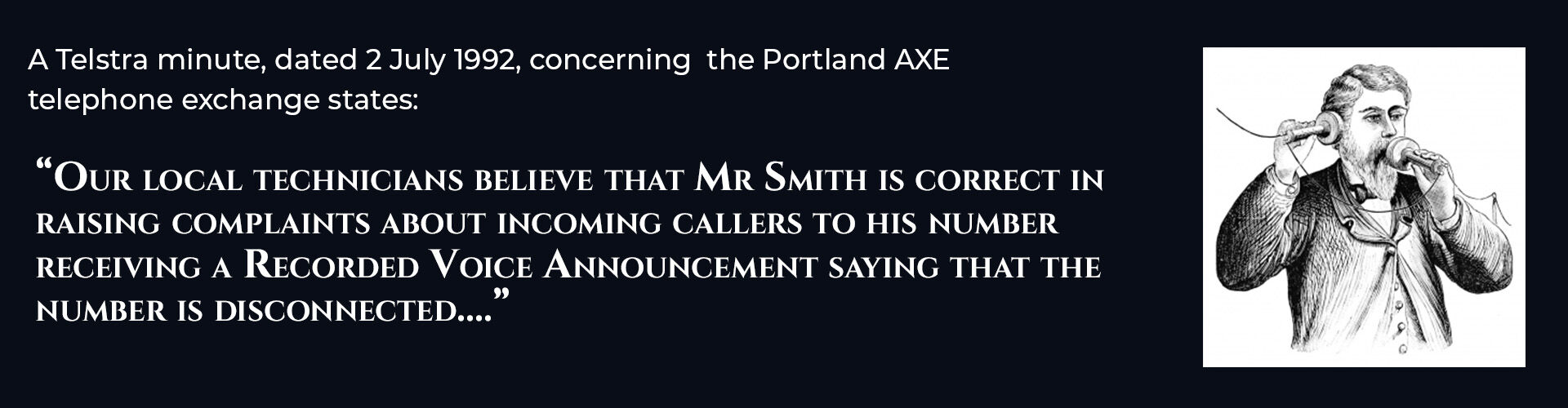
Then the following information surfaced — tightly tucked into a manila folder — supporting two Telstra documents that stated:
“Our local technicians believe that Mr Smith is correct in raising complaints about incoming callers to his number receiving a Recorded Voice Announcement saying that the number is disconnected. They believe that it is a problem that is occurring in increasing numbers as more and more customers are connected to AXE.”
This was Telstra’s own technicians confirming the truth — truth Telstra senior management had buried under layers of deception, political protection, and systemic corruption.
To further support my claims, the TELECOM SECRET folios C04006, C04007 and C04008 stated:
“Legal position – Mr Smith’s service problems were network related and spanned a period of 3-4 years… In my opinion Alan Smith’s case was not a good one to test Section 8 for any previous immunities – given his evidence and claims. I do not believe it would be in Telecom’s interest to have this case go to court.”
And then the admission Telstra never intended the public to see:
“Overall, Mr Smith’s telephone service had suffered from a poor grade of network performance over a period of several years; with some difficulty to detect exchange problems in the last 8 months.”
This was criminal liability, acknowledged internally, concealed externally. This was government corruption, buried inside a corporation owned by Australians. This was corporate terrorism, executed through infrastructure.
I copied that document, and others, on my fax machine and sent them straight to AUSTEL, the government communications authority.
The next morning, I phoned the local Telstra office. The technician who arrived was the same man who had been feeding my private and business information to a person called Micky, the same Micky who had worked with a Telstra local Portland technician whom Telstra's most senior management wrote to the Australian Federal Police (AFP) on 14 April 1994, admitting he had been chosen to listen to my telephone conversations after erecting an alarm bell in the telephone exchange that told this employee my telephone conversations could now be listened to.
The Weight of Treachery
On 25 February 1994: When this letter to Telstra’s Corporate Secretary from Fay Holthuyzen, Assistant to the Minister for Communications, Michael Lee, (AS 772-a) is compared to the letter dated 3rd February 1994, Exhibit (AS 772-b) that I sent to the Minister’s office, it is clear that I was concerned that my faxes were being illegally intercepted.
On the same day, 25 February 1994, an internal Government Memo confirmed that the then-Minister for Communications and the Arts had written to advise that the Australian Federal Police (AFP) would investigate my allegations of illegal phone/fax interception. (AS 773)

The Australian Federal Police (AFP) posed the following 93 questions to me, along with my responses, as detailed in Australian Federal Police Investigation File No/1. My answers reveal a disturbing truth: Telstra issued direct threats against me for daring to assist the AFP in its investigations into the interception of my phone conversations and the illicit hacking of documents related to my arbitration.
CHAPTER 4 — NEGLIGENCE: The Unconnected Alarm System
The RCM exchange is installed with its alarm system deliberately left unconnected — a catastrophic act of criminal negligence indistinguishable from intent. Telstra issues written guarantees while knowingly operating a dead system. This is treachery, a betrayal of duty, and a textbook example of fraudulent technical reporting designed to protect the corporation while exposing customers to engineered failure.
Keyword cluster: criminal negligence, treachery, betrayal, fraudulent technical reporting, engineered failure.
Adding further concern to my arbitration was that the Australian Federal Police were fully aware of the national media exposure surrounding Malcolm Fraser, former Prime Minister of Australia, demanding answers from Telstra. Fraser wanted to know why private telephone conversations between him and me, before and during my arbitration, were now sitting inside Telstra’s surveillance archives, while the copies I provided to him had been redacted, mutilated, and stripped of context.
This was not a misunderstanding. This was criminal misconduct, corporate espionage, and government‑protected surveillance abuse.
The 1967 Anchor — China, North Vietnam, and the Arrest That Never Left Me
I had discussed this information with Malcolm Fraser in a letter dated 18 September 1967, countersigned by the Commonwealth Police (now the AFP) on the same day. That letter documented my arrest in August 1967 by the Red Guards in Communist China after I exposed that Australian wheat, supplied on humanitarian grounds, was being redeployed to North Vietnam.
I witnessed the reloading firsthand. I saw Australian humanitarian aid being turned into enemy supply lines.
At that exact time, North Vietnam was killing and maiming Australian, New Zealand, and United States troops in the jungles of Vietnam. My report was not political commentary — it was whistleblowing under threat of execution, and it was why I was arrested for spying.
This China–North Vietnam issue is discussed below and in Chapter 7-Vietnam Vietcong, but its shadow fell directly across my arbitration decades later.
The Wynack Letters — A Government Investigator Who Saw the Corruption
John Wynack, Director of Investigations for the Commonwealth Ombudsman, wrote repeatedly to Telstra between May 1994 and October 1997, demanding answers as to why my conversations with Fraser had been recorded, archived, redacted, and withheld from me during arbitration and are still being withheld in 2026.
He asked why this information appeared in Telstra’s files on two separate occasions, both involving discussions about China and spying, discussions that should never have been intercepted, let alone stored.
In his correspondence between March and October 1997, Wynack's letters state that he did not believe Telstra's claim that it had destroyed the documents in my arbitration file (Refer to Home Page File No/82).
This was not a clerical error. This was evidence tampering, corporate terrorism, and government‑enabled concealment.
The Weight of 59 Years — And Still No Resolution
I am 82 years of age. Not once, not once, has the Australian Government disputed my claims or attempted to resolve this anchor around my neck, an anchor I have carried since August 1967.
For six decades, the silence has been deliberate. For six decades, the truth has been inconvenient. For six decades, the system has protected Telstra, a corporation that grew so large, so politically insulated, and so structurally unaccountable that it operated above the government that owned it.
This is what institutional treachery looks like. This is what betrayal feels like when it spans a lifetime. This is the cost of government corruption, surveillance abuse, and corporate misconduct that was never meant to be exposed.
Leading up to the signing of the COT Cases arbitration, on 21 April 1994, AUSTEL wrote to Telstra on 10 February 1994, stating:
“Yesterday we were called upon by officers of the Australian Federal Police in relation to the taping of the telephone services of COT Cases.
“Given the investigation now being conducted by that agency and the responsibilities imposed on AUSTEL by section 47 of the Telecommunications Act 1991, the nine tapes previously supplied by Telecom to AUSTEL were made available for the attention of the Commissioner of Police.”* → (See Illegal Interception File No/3)
I desperately needed the material locked behind those investigations. I was searching for the truth in a system that seemed designed to obscure it. The government had promised transparency, yet every door I pushed against felt reinforced.
Dr Hughes (the so-called independent arbitrator) appeared not to understand the urgency of my situation, particularly after Warwick Smith informed him that Telstra had not only admitted to wrongdoing but had also handed over nine audio tapes, tapes that proved Telstra had secretly recorded the telephone conversations of the first four COT Cases, of which I was one of the four.
Those tapes were not trivial. They were evidence of intrusion, surveillance, and a breach of privacy so severe it should have halted the entire arbitration process. They could have clarified who was recorded, how often, and why. They could have exposed the scale of Telstra’s misconduct. The four original COT cases were critical.
This evidence (nine audio tapes) raises important questions about Dr Hughes’s silence regarding my allegations of phone and fax interception. Despite clear records from AUSTEL and the TIO indicating that he was obligated under the arbitration agreement to address my claims and reach a conclusion, he chose not to comment. This apparent inaction adds to the suspicion surrounding the entire affair.

The Australian Federal Police (AFP) posed the following 93 questions to me, along with my responses, as detailed in Australian Federal Police Investigation File No/1. My answers reveal a disturbing truth: Telstra issued direct threats against me for daring to assist the AFP in its investigations into the interception of my phone conversations and the illicit hacking of documents related to my arbitration.
📠 A System Built on Silence - The Vanishing Faxes:
Exhibits 646 and 647 (see ) clearly show that, in writing, Telstra admitted to the Australian Federal Police on 14 April 1994 that my private and business telephone conversations were listened to and recorded over several months, but only when a particular officer was on duty.
This particular Telstra technician, who was then based in Portland, not only monitored my phone conversations but also took the alarming step of sharing my personal and business information with an individual named "Micky." He provided Micky with my phone and fax numbers, which I had used to contact my telephone and fax service provider (please refer to Exhibit 518, FOI folio document K03273 - ).
To this day, this technician has not been held accountable or asked to clarify who authorised him to disclose my sensitive information to "Micky." I am perplexed as to why Dr Gordon Hughes did not inquire with Telstra about this local technician’s actions. Specifically, why was he permitted to reveal my private and business details without any apparent oversight or justification?
Under the signed agreement, the arbitrator was required to address all my arbitration claim documents. He never raised the "Micky" affair, never confronted the fact that Telstra had already admitted to the AFP that my telephone conversations were intercepted without my authority, and never acknowledged that Telstra themselves named the local Portland technician, Gordon Stokes, as the man responsible. My arbitration concluded on 11 May 1995. Not long after, Stokes opened a shop in Portland. From the moment the AFP and I uncovered in 1994 what Stokes and this "Micky" character had been doing, I was forced to live with the knowledge that I would encounter Stokes constantly, as anyone would in a small rural town like Portland. I finally left Cape Bridgewater and Portland in 2019, broken, after suffering two heart attacks. No one in government, nor anyone from the AFP, has ever attempted to address this matter or provide closure.
That is how treachery looks when it wears a corporate badge.
CHAPTER 5 — ABUSE OF POWER: Telstra’s Ritualistic “No Fault Found”
Technicians arrive, perform their ritual, and recite the corporate mantra: “No fault found.” They repeat it while holding evidence proving the opposite. This is abuse of power, systemic deception, and a culture built on criminal misconduct. The phrase becomes a shield for corporate corruption, a weapon used to silence victims and protect internal wrongdoing.
Keyword cluster: abuse of power, criminal misconduct, corporate corruption, systemic deception, ritualised denial.
“Don, thank you for your swift and eloquent reply. I disagree with raising the issue of the courts. That carries an implied threat not only to COT cases but to all customers that they’ll end up as lawyer fodder. Certainly that can be a message to give face to face with customers and to hold in reserve if the complaints remain vexacious .” GS File 75 Exhibit 1 to 88
And while referring to the “duress that the COT members were suffering”, it goes on to say:
… we can’t afford to let anything get away … our best option is still to force these cases down a legal structured path.
A similar internal memo, FOI Folio R09507, to the same Don Pinel, from Telstra Corporate Secretary Jim Holmes, whom the Telecommunications Industry Ombudsman (TIO), Warwick Smith, had allowed to sit in on regular TIO Board COT-discussed meetings, states in part:
"I recall at the first meeting I attended, you forcefully expressed the desire to get the COT cases into court. One of the reasons I recalled was that the exercise was conducted by Freehill's in Sydney.
This matter involves Freehill Hollingdale & Page, now known as Herbert Smith Freehills Melbourne, as well as Telstra's Corporate Secretary, Jim Holmes. Since June 1993, throughout my Fast Track Settlement Proposal and during the arbitration process, they have required me to document all ongoing phone complaints. This includes billing faults, instances of phone bugging, fax hacking incidents, and the names of the organisations or individuals associated with each complaint. I needed to submit all of this documentation in writing to Denise McBurnie, my assigned case manager at Freehills.
If I did not comply, Telstra and its internal security division made their position brutally clear: they would treat my complaints as frivolous and vexatious, and they would make no attempt to fix the faults. It was coercion disguised as procedure, a tactic designed to funnel every piece of evidence through Telstra’s own legal gatekeepers before arbitration ever began.
It was this threat, and one other similar threat aimed at COT Case Graham Schorer, that Government records show the government assured the COT Cases (see point 40, Prologue Evidence File No/2) that Freehill Hollingdale & Page would have no further involvement in our matters.
However, they treated the Murdoch and FOX issue entirely differently, as our story shows.
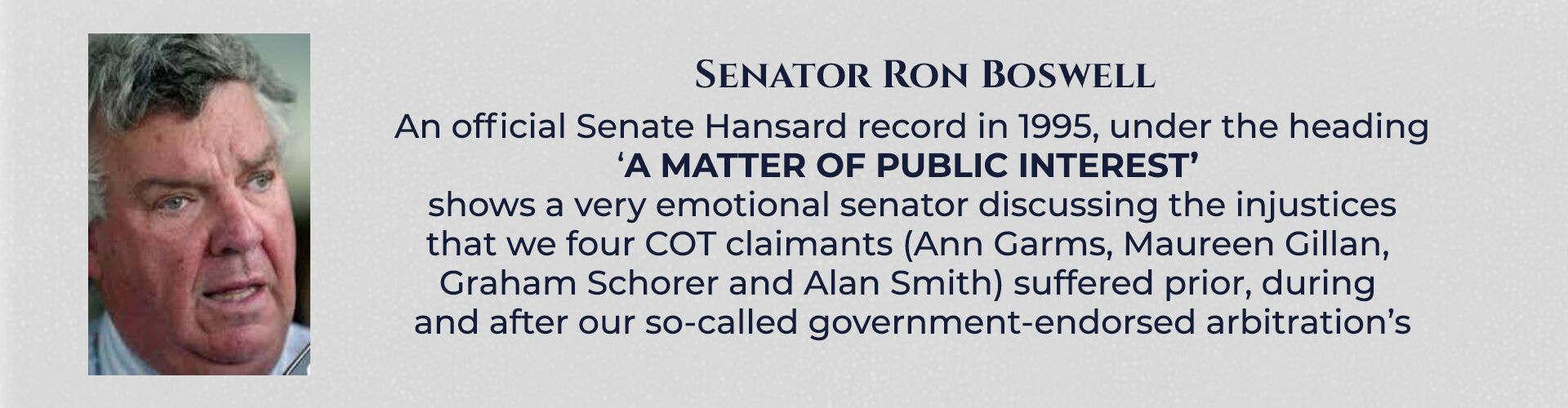
I refer to the Senate Hansard records from 20 September 1995, which capture a profoundly emotional speech delivered by Senator Ron Boswell. In this address, he laid bare the significant injustices endured by the four claimants in the COT case, Ann Garms, Maureen Gillan, Graham Schorer, and me, during what were inaccurately labelled as government‑endorsed arbitrations. His words conveyed our pain and frustration and exposed the broader systemic failures at play, while Rupert Murdoch and FOX received a “Golden Handshake” extracted from the Australian purse at a time when Telstra was still fully owned by the people of Australia.
“...Eleven years after their first complaints to Telstra, where are they now? They are acknowledged as the motivators of Telecom’s customer complaint reforms. … But, as individuals, they have been beaten both emotionally and financially through an 11-year battle with Telstra"
“Then followed the Federal Police investigation into Telecom’s monitoring of COT case services. The Federal Police also found there was a prima facie case to institute proceedings against Telecom but the DPP (Director of Public Prosecutions), in a terse advice, recommended against proceeding".
“Once again, the only relief COT members received was to become the catalyst for Telecom to introduce a revised privacy and protection policy. Despite the strong evidence against Telecom, they still received no justice at all".
“These COT members have been forced to go to the Commonwealth Ombudsman to force Telecom to comply with the law. Not only were they being denied all necessary documents to mount their case against Telecom, causing much delay, but they were denied access to documents that could have influenced them when negotiating the arbitration rules, and even whether to enter arbitration at all. …
"This is an arbitration process not only far exceeding the four-month period, but one which has become so legalistic that it has forced members to borrow hundreds of thousands just to take part in it. It has become a process far beyond the one represented when they agreed to enter into it, and one which professionals involved in the arbitration agree can never deliver as intended and never give them justice."
"I regard it as a grave matter that a government instrumentality like Telstra can give assurances to Senate leaders that it will fast track a process and then turn it into an expensive legalistic process making a farce of the promise given to COT members and the unducement to go into arbitration. “Telecom has treated the Parliament with contempt. No government monopoly should be allowed to trample over the rights of individual Australians, such as has happened here.” (See Senate Hansard Evidence File No-1)
This story shows exactly that dynamic. The Hansard confirms the mindset. The evidence confirms the outcome. And the lived experience confirms who paid the price.
When the Canadian Government learned that Telstra had used a known falsified Bell Canada International (BCI) Cape Bridgewater test set to support Telstra’s arbitration defence of my claims, and that the Australian Government did nothing to support my investigations into this falsehood, Canada became one of the shining lights in the whole crippling Australian Government-endorsed arbitration process.
As discussed in various sections of absentjustice.com, as well as above, the Canadian Government appeared concerned that an Australian arbitration process had used known impracticable Bell Canada International tests that could not have been transmitted. Because of this alarm raised by Canadian authorities, I have used it below to support another point that should not be missed concerning Telstra’s very crooked and corrupt arbitration defence.
Telstra's Falsified BCI Report 2
I believe you are taking the most appropriate course of action
I have never received a written response from BCI, but the Canadian government ministers’ office wrote back on 7 July 1995, noting:
"In view of the facts of this situation, as I understand them, I believe you are taking the most appropriate course of action in contacting BCI directly with respect to the alleged errors in their test report, should you feel that they could assist you in your case."
The BCI Testing Evidence That Was Never Reassessed
Two weeks after my arbitration concluded, I notified the appropriate procedural advisors, including two Australian government agencies, about evidence related to testing conducted by Bell Canada International Inc. (BCI) at the Cape Bridgewater telephone exchange that services my holiday camp.
The documents revealed that Telstra’s arbitration consultants had communicated with BCI during and after my arbitration, questioning why the BCI testing process had not been conducted according to the specifications previously set by the government. This correspondence also raised concerns that the BCI test results might not have accurately reflected the ongoing telephone issues affecting my business.
The letter presented above outlines the responses I received from the Canadian government, which demonstrated their concern about the situation and encouraged me to reach out to BCI. Unfortunately, I have yet to receive any replies from Hughes, Pinnock, or Australian government representatives. This silence raises an important question for readers: Could the Australian government be intentionally avoiding the issue because it doesn't want the truth to come to light? Specifically, Telstra, a government-owned corporation, engaged in fraudulent activities during an arbitration process with government endorsement. This misconduct not only calls into question the integrity of the arbitration but also devastated the future of a small business operator in Australia.
CHAPTER 6 — DISCRIMINATION: Rural Australia as a Corporate Afterthought
Rural customers become collateral damage in Telstra’s national pattern of structural discrimination and corporate terrorism. Cape Bridgewater is not an anomaly — it is a case study in fraudulent reporting, engineered neglect, and systemic injustice. Rural citizens are denied service, denied truth, and denied justice — all concealed behind falsified technical assurances.
Keyword cluster: discrimination, corporate terrorism, engineered neglect, fraudulent reporting, systemic injustice.
Telstra - Contempt of the Senate
In October 1997, when Telstra provided the Cape Bridgewater/Bell Canada International Inc (BCI) report in response to questions raised by the Senate on notice, it already knew the report was false. However, no one has ever held Telstra accountable for its conduct, even though it was in contempt of the Senate.
Here is an early example where using the same images and same issues repeatedly on the absentjustice.com homepage website was essential, such as the 20 January 1994 Telstra internal memo from Trevor Hill to Alan Humrich, FOI folios B00421, B00424 and B00425, which discusses the same type of lock‑up problems with the RAM relays that COT Cases Graham Schorer and I previously brought to AUSTEL’s attention in 1993 and 1994. This document, entitled “Summary statement on PBX groups for BCI report ‘Rotary Hunting Group Study’ ”, states:
“The resultant investigations revealed that relay armatures were sticking due to a phenomena termed ‘wear frit’ or ‘fretting’ where airborne oil and dust and/or ferric oxide particles combined with moisture are attracted to the magnetic zone. … This paste tends to grasp the armature backstop as an anchoring point, the relay armature being held un-opened by the paste.” (GS 146‑a)
When Bell Canada International (BCI) carried out its PBX study on 14th December 1993 at the North Melbourne exchange that serviced Golden Messenger, it appears Telstra failed to provide BCI with document B00219/220. In Telstra’s CAN FOI document folio K34734, dated 25th January 1994 (discussed below), it is confirmed that five auxiliary lines to Golden Messenger all had potential problems (i.e., 329 7009 – 329 7734 – 329 0331 – 329 0731 and 329 0056). However, what matters most about exhibit GS 146‑b is that, on page 41 of the BCI PBX Rotary Hunting Group Study, BCI listed the same five lines referred to in folio K34734 as workable PBX auxiliaries. There is no mention of the potential problems associated with these five lines, which suggests BCI did not test the Customer Access Network (CAN) after all.
This Chronology of Events shows that Mr Schorer and I had valid reasons to challenge the authenticity of the Bell Canada International (BCI) and Telstra’s arbitration Service Verification Testing of the COTCases business lines (SVT processes) during the COT arbitrations, including Graham Schorer.
Please note: on 27th July 2007, Brian Hodge, B Tech, MBA (B.C. Telecommunications), assessed the November 1993 Bell Canada International (BCI) Addendum Cape Bridgewater tests and the 29th September 1994 SVT Cape Bridgewater tests, including the CCAS data report. He concluded both the BCI and Verification Testing processes conducted at Cape Bridgewater were fundamentally flawed. Mr Hodge held several senior positions during his 28 years at Telstra, including assessing CCAS data → (refer Main Evidence File No/3). and Brian Hodges' report, Exhibit 42 (BCI).
On 12 January 1998, during the Senate estimates committee investigations into COT FOI issues, Graham Schorer provided Sue Laver (now in 2026), Telstra’s corporate secretary, with several documents. On page 12 of his letter, Graham states:
“Enclosed are the 168 listings extracted from Telstra’s Directory of Network Products and Network Operations, plus CoT’s written explanation, which alleges to prove that parts of the November 1993 Bell Canada International The report is fabricated or falsified.”
Had Sue Laver advised the Senate that there was merit in my complaints about the flawed BCI testing, my matters raised on absentjustice.com could have been resolved two decades ago.
The ongoing telephone faults and Australia’s billing failures were not minor glitches; they were symptoms of a system so compromised, so deliberately neglected, that the consequences became catastrophic. It was so serious that Telstra, the government, and the arbitration machinery chose concealment over accountability, and that decision set the stage for everything that followed, including the Murdoch/FOX scandal.
Pre-Murdoch/FOX Escalation — Government Validation Buried
Before examining the Murdoch–FOX scandal, visitors must understand one brutal truth: the Australian Government had already validated my claims before my arbitration even began. I did not receive a copy of the official findings AUSTEL’s Adverse Findings, points 2 to 212, until November 23, 2007, twelve years after my arbitration ended. These findings were completed on March 4, 1994, just six weeks before I signed the arbitration agreement on April 21, 1994. In other words, the government already knew my telephone service was defective, the faults were real, Telstra had misled me, and my claims were valid. Yet, I was forced into a 13-month arbitration, incurring over $300,000 in professional fees to prove something the government had already established.
Dark, Treacherous Lead‑In to the Murdoch/FOX Saga
On one of the fateful days between April 7 and 9, 1994, just a fortnight before I signed the arbitration agreement, I was summoned to AUSTEL’s bunker-like office on Queens Road in Melbourne. The atmosphere was tense, filled with an unspoken urgency as Ronin Davey, the Chairman of AUSTEL (now known as ACMA), and the General Manager of Consumer Affairs sat before me, their expressions serious and focused.
By that point, they had been receiving evidence from me since June 4, 1993. This evidence laid bare a troubling reality: Australia was grappling with a systemic network failure. The issues extended far beyond the main copper network, permeating the 008/1800 free-call service as well. These faults were not minor inconveniences; they were severe enough that callers often couldn't connect at all. And when they did manage to get through, the calls were often accompanied by erroneous charges, adding insult to injury.
AUSTEL was acutely aware of the gravity of the situation. They understood that Telstra’s network was on the brink of collapse and that the faults were not only genuine but also widespread and potentially dangerous to consumers.
During our meeting, they made a request that would weigh heavily on my conscience. They asked me to covertly gather and share any information I could uncover during the arbitration process, information they insisted would be “in the public interest.” This request echoed my earlier cooperation with the Australian Federal Police when Telstra was caught intercepting my telephone conversations and fax transmissions. Driven by a sense of duty and pride, I agreed to their proposition, completely unaware that the government was stealthily plotting to betray me in the most devastating way possible.
When the arbitrator finally delivered his findings, the proceedings felt rushed and unjust. He did so without allowing his technical consultants the critical time they had formally requested on April 30, 1995, to properly investigate the faults I had reported. In a shocking twist, AUSTEL later discovered the billing problems that had remained unaddressed, yet allowed Telstra to quietly rectify them on October 16, 1995, five months after my arbitration had concluded. This action effectively stripped me of my legal right to challenge Telstra on matters that the arbitration process had never investigated.
This entire thread weaves directly into the intricate web of the Murdoch and FOX scandal. When the government realised that establishing the systemic nature of my faults would unveil the widespread telecommunications problems plaguing Telstra, problems intricately linked to the staggering $400 million payout related to Murdoch and FOX, they knew they could not afford to let me succeed. The truth was a dangerous adversary they could not allow to surface. So, in their desperate attempt to protect their interests, they chose to destroy me instead, burying the evidence beneath layers of deception and neglect.
Understanding this treachery is crucial; it forms the dark foundation underlying the Murdoch/FOX narrative. The reader must grasp this unsettling reality before continuing to read this website homepage.
I was literally forced to sell my Cape Bridgewater Holiday Camp in December 2001 at land value only, six years after my arbitration failed to address my ongoing telephone problems. Neither the TIO, John Pinnock (the previous administrator of my arbitration), nor Telstra would conduct the Service Verification Testing at my holiday camp, even though Telstra was supposed to have re‑tested the service in 1995. AUSTEL had already condemned Telstra’s original arbitration SVT testing, noting the gross deficiencies of that testing in two arbitration letters dated 11 October and 16 November 1994 to Telstra’s arbitration liaison officers, Peter Gamble and Steve Black.
And here are the new owners of my once‑beloved holiday camp, forced to write to the Telecommunications Industry Ombudsman on 28 January 2003, the same TIO office I began writing to, as this website absentjustice.com shows, in January 1994, when I agreed to enter the TIO‑administered arbitration procedures that were supposed to ensure Telstra fixed all of my ongoing telephone problems. I agreed to fund my own costs, which eventually exceeded $300,000. The evidence below is conclusive: nothing was achieved.
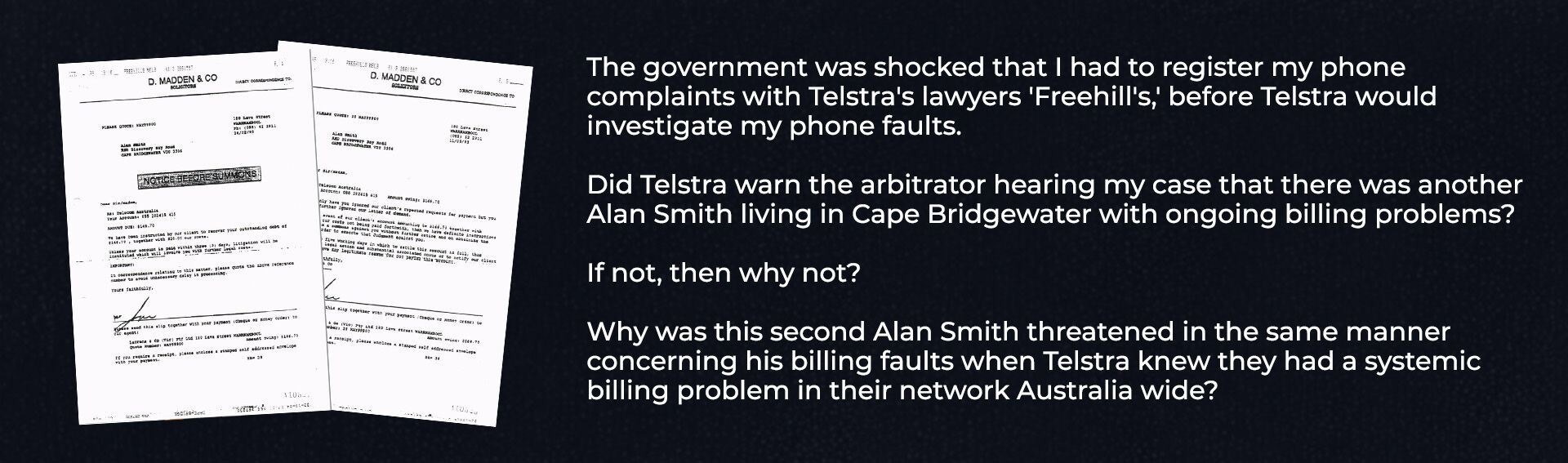
On 28 January 2003, a letter from Telecommunications Industry Ombudsman (TIO) officer Gillian McKenzie to Telstra concerning the ongoing telephone problems the new owners of my business, Darren and Jenny Lewis, experienced from almost the first day in December 2001, states:
“Mr & Mrs Lewis claim in their correspondence attached:
That they purchased the Cape Bridgewater Coastal Camp in December 2001, but since that time have experienced a number of issues in relation to their telephone service, many of which remain unresolved.
That a Telstra technician ‘Mr Tony Watson’ is currently assigned to his case, but appears unwilling to discuss the issues with Mr Lewis due to his contact with the previous camp owner, Mr Alan Smith.” (See Home-Page File No/76 and D-Lewis File 1-I)
Was there a more sinister motive behind Telstra’s technician refusing to help Darren Lewis with the ongoing phone/fax problems that, nine years earlier, Telstra and the arbitrator assigned to my case failed to investigate transparently? Why was this Telstra technician still holding a grudge against me in 2002/3 because of something my 1994/95 arbitration should have addressed – i.e., the ongoing phone and facsimile problems that this same Telstra technician was now refusing to help Mr Lewis with, nine years later?
This is the same Tony Watson who is referred to in Telstra's B004 arbitration defence report (see It is also clear from Front Page Part One File No/1) who states my faxes did not reach the arbitrator's office on 23 May 1994, because the arbitrator's fax lines were busy when I tried to send my faxes. Therefore, the lines were not faulty. This statement by Tony Watson does not match Telstra's billing records for those six faxes where I was charged for all non-connected faxes (It is also clear from Front Page Part One File No/1).
Chapter Seven - has not fully been collated → →
THE MECHANISM OF ERASURE
Have you ever looked at a monthly bill and felt the sudden, cold weight of a discrepancy? A string of charges for connections you never made, or hours you allegedly spent speaking into an empty room?
Perhaps a friend mentions, with a casualness that masks their growing irritation, that they called you repeatedly at an hour you know you spent sitting directly beside the instrument, staring at its matte-black plastic casing. The house was silent. The bell never rang.
Then the whispers ripple outward. A neighbour drops a comment at the gate about how remarkably busy you must be, given the endless hours you occupy the line, hours when you know with absolute certainty the house has been a tomb for days. Soon, the tone changes. Prospective clients do not whisper; they accuse. They berate you for your unprofessionalism, demanding to know why you have willfully ignored their calls for a week, when you have done nothing but watch that plastic object, waiting for a sound that never comes.
If you have known even one of these anomalies, you have felt the first thread of a snare tightening around your life. You will understand why it feels less like a corporate oversight and more like a systematic eradication of my presence. For nearly ten years, I existed in that blind spot.
I knew nothing of the mechanism when I purchased the pristine camp at Cape Bridgewater, 18 kilometres from the town of Portland, on the wind-scoured southern coast of rural Victoria. Only much later, when the financial and emotional damage was absolute, did I begin to understand the trap's geography. The entire district was tethered to an unmanned, antiquated telephone exchange buried in the scrub, an iron box installed thirty years prior, designed exclusively for what the state telecommunications monopoly, Telstra, coldly designated as 'low-call-rate areas.'
It was a system built for stagnation, never intended to handle the influx of life that arrived with the holiday makers in late 1987. Its architecture ensured that information would be rationed, dropped, or intercepted. This story could easily be your history. I tell it because I need someone else to hold the weight of it.
In December 1987, the small accommodation centre looked like a sanctuary. It sat high on the cliffs, looking down into a grey, sickle-shaped bay where the Southern Ocean chewed at the cliffs. From that height, the world looked vast and manageable. I was forty-four, confident in the calluses I’ve earned.
My life had been defined by closed spaces and rigid hierarchies. At fifteen, I went to sea as a steward on English cargo ships, stuffy, narrow companionways where you learned to read a man's mood by the way he held his fork. By twenty, I was in the stifling kitchens of Melbourne’s elite hotels, working under chefs who viewed every subordinate as an imminent saboteur. Later came the Australian Merchant Navy, years on cargo hulls and tugboats, and the careful study of hotel management. I knew how to take an institution rotting from the inside, clear out the rot, and make it profitable again. I had done it before.
I had the skills, the physical stamina, and the decades of experience to take this basic school camp and turn it into something substantial. What Faye and I could not factor into our calculations was the silent, eight-line exchange rotting in the nearby salt air.
Sixty resident families, more than a hundred individuals, relied on those same eight copper arteries. If four neighbours were speaking to their relatives, only four lines remained for the rest of the peninsula. When we arrived, the silence felt like peace. We did not realise it was the silence of exclusion. For three and a half years, crucial, foundational years meant to ground our future, our commercial survival rested on this decaying network loop.
In February 1988, we launched our campaign. I distributed two thousand high-gloss, colored brochures across the state, and personally visited a hundred and fifty schools and municipal offices. We expected the house to fill with the sound of ringing. Even by the most conservative metrics of direct marketing, the responses should have arrived daily, a steady drumbeat of validation.
Instead, the house remained quiet. The wind off the bay rattled the glass, but the phone sat dead on the desk.
By April, the silence took on a hostile edge. People we met in town began to look at us differently. Their questions carried an accusatory sharpness: why did we never answer? Why were we always away from the desk? To placate them, we bought an expensive answering machine, its little red light pulsing in the corner of the office like a small, bloodshot eye.
The complaints shifted but never stopped. Now, people told us our line was endlessly engaged, occupied for hours at a time. Faye and I would sit across from each other at the kitchen table, the silent phone between us, listening to the clock tick. We knew no one was using it. Yet somewhere in the wires, our life was being recorded as occupied. The business began to bleed money, floundering in a fog we couldn’t see or touch.
Years later, using the slow, adversarial machinery of the Freedom of Information Act, I forced the state to yield its internal logs. Among the thousands of pages of redacted bureaucratic jargon, I found a document that made my fingers go cold. It was marked 'Telstra Confidential: Difficult Network Faults — PCM Multiplex Report; 31/1/94.' Section 5.5 detailed the history of the Cape Bridgewater Holiday Camp. The company had known. They had official records of the terminal faults as early as 1987, months before they let us sign the paperwork for the property. They had watched us sell our home in Melbourne, watched me sink my early retirement benefits into a doomed venture, and never said a word. My first official complaint is logged on April 26, 1988, but the internal rot had been charted long before we ever arrived.
The isolation began to warp our reality. Faye’s frustration turned inward, and then, inevitably, toward me. When the environment around you lies consistently, you begin to doubt your own senses. 'Did you leave the receiver off the hook?' she would ask, her voice tight with a suspicion that hadn't been there a year ago. 'Are you sure you didn't hear it? Did you forget to set the tape?'
Mid-sentence, while speaking to clients, the line would simply die. A sudden, hollow click, followed by the flat hiss of dead copper. If we had their number, we would call back, apologising, sounding desperate. If we didn't have their details yet, they simply vanished back into the world, leaving us with a heavy silence and a sinking sense of failure. This new venture was systematically stripped of joy, turning into an exhausting psychological trial.
The true scope of our situation didn't clarify until the dark, wet days of December 1988. We hosted a Christmas dinner for the local residents, hoping to find some warmth in the community. Sitting at the long wooden tables, the coastal wind buffeting the weatherboards, I finally mentioned our struggle with the phones.
Our neighbours weren't surprised; they were resigned, almost complicit. Harry, who lived just across the fence, nodded into his glass. His daughter called from Colac, he said, and frequently gave up because the line sounded as though it were underwater or simply refused to connect. Fred Fairthorn, a man who had once built a grocery empire and understood how infrastructure functioned, looked at me with a bleak, knowing smile. 'After all,' Fred said, his voice dropping below the roar of the surf outside, 'what can you really expect from Telstra when we’re out in the bush?' He had lived with the same phantom line for years, a fact he later committed to a signed statement, as if documenting a chronic disease.
As the grey dawn of 1989 crept over the cliffs, the realisation settled into the timber of our house. We were trapped in a system that was slowly, cleanly erasing our livelihood, and the people tasked with maintaining it were simply watching. The phone line, meant to connect us to the world, had become an instrument of isolation, and it was already fracturing my twenty-year marriage. I began running the operations from a state of continuous, toxic anger, second-guessing every choice, blinded by a corrupted matrix of institutional silence and unseen errors.
The voice that cuts through the line does not belong to a person. It is a synthetic loop, generated by an automated subroutine buried within the architecture of the state telecommunications monopoly. To the world, the message is clear, absolute, and terminal: 'The number you are calling is disconnected. Please check the number before calling again.' Within the internal jargon of Telstra, these recordings are coded cleanly as RVAs—Recorded Voice Announcements. They are intended as administrative tools, but in the field, they function as weapons of quiet economic execution.
To further support my claim that Telstra already knew how severe my Ericsson Portland AXE telephone faults were, I must state it plainly: what happened was not a mistake—it was a betrayal. These faults did not merely inconvenience callers; they erased my business before it existed. Incoming callers heard an electronic recording telling them the number they had dialled was not connected. It was the message of a dead business, a business that had never been allowed to breathe. I had not yet built what I intended to build because Telstra’s faults strangled it at birth.
The horror of this betrayal is captured in three Telstra FOI documents, Folios C04006, C04007 and C04008, headed TELECOM SECRET (see Front Page Part Two 2-B). These documents show Telstra knew exactly what was happening, knew how catastrophic the AXE faults were, and still allowed the false narrative to stand. They watched the damage unfold. They let the recording tell callers I did not exist. They let my business die in silence, even though Front Page Part Two 2-B states:
“Legal position – Mr Smith’s service problems were network related and spanned a period of 3-4 years. Hence Telecom’s position of legal liability was covered by a number of different acts and regulations. … In my opinion Alan Smith’s case was not a good one to test Section 8 for any previous immunities – given his evidence and claims. I do not believe it would be in Telecom’s interest to have this case go to court.
Overall, Mr Smith’s telephone service had suffered from a poor grade of network performance over a period of several years; with some difficulty to detect exchange problems in the last 8 months.”
Telstra knew the truth. They documented the truth. And then they buried it, while the AXE faults continued to tell the world I had vanished. This was not an accident. It was a betrayal carried out in full knowledge, preserved in their own secret files, and weaponised against me in arbitration.
This is the backdrop to the horrid story: the documents arrived years after I first requested them, years after they were promised, years after they were needed, years after the arbitrator pretended to run a fair process. These late‑arriving files form the skeleton of the COT narrative I am about to describe. They prove what was done, when it was done, and how the system was engineered to fail us.
By the time these documents finally surfaced, the arbitrations were over, the damage was permanent, and our businesses were already broken. Telstra had won its war of attrition. The arbitrator had played his part. The government had looked away. And we were left to reconstruct the truth from paperwork that should have been on the table before any decision.
Everything that follows sits on that foundation, a foundation built from withheld evidence, corrupted processes, and the brutal fact that justice delayed was not just justice denied, but justice destroyed.
Years after our collapse, a cache of unredacted Freedom of Information documents yielded an internal corporate memorandum; see → False Witness Statement File No 3-A) above. It revealed a high-level review of the automated systems, noting with stark clarity that 'when we start to scratch around we will find a host of network circumstances where inappropriate RVAs are going to line.' A separate diagnostic summary went further, admitting that 'the present RVA for incorrect numbers requires revision... this message tends to give the caller the impression that the business they are calling has ceased trading, and they should try another trader.' They knew. Long before Faye and I packed our lives in Melbourne and arrived at the wind-scoured cliffs of Cape Bridgewater, the corporation knew its system was systematically generating false insolvency records, routing active, high-volume commercial circuits into dead ends and effectively wiping small-scale infrastructure off the state’s digital registry.
For a freshly established enterprise completely dependent on external communication, this was not a technical glitch; it was a total embargo. By mid-1989, our operating capital had dwindled toward zero, while the silence of the house remained absolute. In a desperate move to pacify our creditors, we began liquidating our remaining assets, selling off approximately 4,000 corporate shares at a forced price of $1.60 each, assets that, by October 1998, would be valued at $8.20 per share on the public markets. The ledger of our lives had become a map of systematic extraction. The sale of our original Melbourne home had generated $140,000 toward the $280,000 total investment required for the camp, leaving a lean, manageable mortgage. We had anticipated stability. Yet within fifteen months of taking custody of the headland, we were burning through our core equity simply to survive the artificial isolation.
The domestic environment deteriorated in lockstep with the ledger. My self-esteem disintegrated; the relentless, unresolvable nature of the network anomalies left me feeling entirely hollowed out, a solitary target under unseen observation. Then the place's physical reality closed in further. Faye suffered a severe fall on the property, shattering her leg. The complex break refused to set correctly, transforming our daily routine into a gruelling sequence of hospital transits that amplified the existing strain. Desperate to build momentum, I organised a marketing tour during one of her medical assessments in the city, systematically distributing promotional materials through Caulfield, Huntingdale, and into Melbourne's central business district, driving myself to the absolute limit of physical endurance.
During this city tour, the trap's systemic nature became undeniable. Attempting to audit my own infrastructure, I dialled the camp's answering machine from a public booth to retrieve remote messages. The circuit connected, but it didn't route to my office deck. Instead, the receiver filled with the familiar, mechanical cadence of the automated intercept: 'The number you are calling is not connected or has been changed...' I hung up the phone in the cold stall and chose to say nothing to Faye. The implication was too heavy to carry into a hospital room.
On the return transit near Geelong, the question of the infrastructure arose between us. I maintained a defensive, protective fiction, but stopped at the next available roadside call-box to test the circuit again. This time, the line returned to a flat, unyielding engaged signal. For three days, our operational base had been marooned behind a digital barrier, alternating between an automated disconnection notice and an artificial busy state. When we returned, the internal tape revealed only a single, ancient recording from friends in Melbourne, logged before our departure. No new traffic had crossed the threshold. Somewhere in the unseen switches of the regional network, our entire existence had been logged as either non-existent or perpetually occupied, filtering away an unmapped volume of prospective clients into the void.
Immobilised by the medical cast and trapped within the heavy silence of the house, Faye’s isolation turned inward. She began to find consistent reasons to leave the property, transiting back to her parents, back to the clinical ward, away from the suffocating pressure of a dying business. The convergence of financial ruin and physical trauma broke the remaining threads of our partnership. On October 26, 1989, our twenty-year marriage ended.
The attrition was absolute. Having been prescribed a sequence of heavy pharmaceutical compounds to manage the mounting psychological stress, I combined them with a significant quantity of alcohol and barricaded myself within one of the vacant timber cabins on the boundary line. Terrified by the isolation, Faye contacted the regional constabulary. The subsequent arrival of a tactical police rescue team, fracturing the door to 'extract' me from my own sanctuary, triggered a profound psychological dislocation. The scene warped. In my disoriented state, the uniform's cold authority blurred with memories of 1967, when, as a twenty-two-year-old merchant marine aboard the MV Hopepeak hauling Western Australian wheat into Communist China, I ran afoul of the Red Guards at the height of the Cultural Revolution. The modern rescue team took on the hostile, erratic energy of those ideological soldiers. The extraction ended in a state-sanctioned restraint; I was transported from my property to the regional clinical ward in a straitjacket.
CHAPTER 8 — CHINA
Murdered for Mao: The killings China ‘forgot’
My Letter, the Truth, and the Waiting
In August 1967, I found myself in a situation so surreal and perilous that it has remained vivid throughout my life. I was aboard a cargo ship in China, under constant observation by Red Guards positioned around the vessel. They were stationed about thirty paces apart and remained on duty day and night.
After being pressured into writing a confession describing myself as a United States aggressor and supporter of Chiang Kai-shek, the second steward told me that I might receive a response to a letter within two days. The response, he said, would come from the head of the Red Guards.
He quietly suggested that I write to my parents.
I followed his advice and wrote 22 foolscap pages. It was not an ordinary letter. I believed I might not survive the week, and I wanted my parents to know who I was in case I never returned home.
I told them that the woman they believed was my landlady was, in fact, my lover. She was 42; I was 18. She had been an important source of stability in my life between 1963 and 1967. I also wrote about life at sea, the loneliness, the confusion, and the fear surrounding my detention.
Writing the letter gave me a way to speak honestly at a time when I had been forced to make a statement I did not believe represented the truth.
A Tray of Leftovers and a Silent Exchange
As ship’s cook and duty mess-room steward, I saw the conditions around us at close range. The crew ate on deck, sometimes balancing plates on handrails. We were transporting grain to China for humanitarian purposes, yet food was routinely discarded while people nearby appeared to be suffering from severe deprivation.
Half-eaten sausages, steaks, and baked potatoes were thrown into the sea. There were no seagulls. I saw no fish. The absence of wildlife was itself a reminder of how severe the conditions appeared to be. Hunger was not an abstract political concept. It was visible in the faces and behaviour of the people watching us eat.
After my arrest, I was placed under what I understood to be house arrest aboard the ship. On one occasion, I filled a small metal tray with edible leftovers, food that otherwise would have gone into the stockpotand placed it on a bench on deck. I patted my stomach to suggest that I had already eaten and then walked away.
Approximately ten minutes later, the tray had been emptied.
At the next meal, I repeated the gesture, leaving enough food for perhaps three or four Red Guards. I returned later to find the tray empty. I continued doing this for another two days while waiting for a response to my letter.
During that period, the Red Guard who had previously woken me every hour stopped doing so. The atmosphere remained tense, but the immediate pressure appeared to lessen.
I cannot know why. The forced confession did not protect me. I do not know whether the letter influenced anyone, whether anyone received instructions, or whether the change was simply coincidental. Perhaps it was luck. Perhaps the food mattered. Perhaps a small act of compassion created a moment of recognition between people trapped on opposite sides of a political crisis.
All I know is that I offered food without negotiation or expectation. It was a silent gesture that conveyed something simple:
I see you. I know you are hungry. I know you are human.
I have never claimed that this gesture alone explains what happened next. But it remains one of the clearest memories of that period—and one of the few moments in which fear gave way, however briefly, to human connection.
I was not back on board the British ship Hopepeak bound for communist China; I was en route to Briery Psychiatric Hospital in Warrnambool, Victoria, strapped into a straitjacket and being delivered to the regional ward reserved for the insane. That was the reality. The aircraft cabin, the Red Guards, the wharf, the hospital in the People’s Republic of China. None of it was physically present. It was only in my head, triggered without warning, as the ambulance carried me through coastal Victoria. The men restraining me were not Chinese Red Guards; they were Australian police and paramedics. Yet my body did not know the difference. My mind did not know the difference. The terror was identical.
I survived the night only through the clinical intervention of medical officers who recognised the immediate trauma for what it was, confirming my sanity and releasing me the following dawn into the custody of my mate's wife, Margaret, who had driven through the night to secure my release. We returned to the Cape Bridgewater camp to find a landscape of total domestic sabotage. Following my arrest, a sequence of well-meaning welfare agents had advised Faye to abandon the house for a secure facility. The doors had been left unsecured to the coastal gale. The deep freeze had been physically removed from the premises, and raw meat had been stripped from the remaining storage units and left to decay across the kitchen benches.
The scene was a complete operational disaster, and according to the logistics ledger on the desk, seventy students from Monivae Catholic College were scheduled to cross the perimeter in less than forty-eight hours for a five-day residential residency. Without Margaret's unyielding physical assistance, the business would have been finalised that afternoon. We cleaned the timber rooms through a haze of profound grief, translating a shifting list of bulk provisions into a dinner menu for seventy people while my mind struggled to hold the reality of my broken life. Then, as the first transport buses climbed the hill, the central hot water service collapsed entirely, plunging the incoming staff into cold showers. Yet despite the structural breakdown, Monivae College returned to the headland two and three times a year until 1994, their structural fidelity the single thread holding my sanity above the dark.
CHAPTER 9 — “Access refused" Telstra’s Fraudulent Assurances of “Network Standard”
Telstra issues written guarantees knowing they are false. They promise “network standard” while the exchange collapses. Systemic telecommunications failure. This is fraud, deception, and criminal misrepresentation. The guarantees are not mistakes — they are deliberate lies crafted to silence complaints and protect a corporation engaged in sinister misconduct.
Keyword cluster: fraudulent guarantees, criminal misrepresentation, deception, sinister misconduct, network collapse.
FORENSIC AUTOPSY OF A NATIONAL COVER‑UP
Case File: The Sixteen COT Casualties
Lead Examiner: Alan Smith
Classification: Systemic Treachery — Government‑Corporate Collusion
SECTION 1 — IDENTIFICATION OF THE BODY
Subject: The COT Cases (Casualties of Telecom) Count: 21 complainants Status: 5 compensated, 16 abandoned Cause of Injury: Telstra network failure; government‑enabled concealment Primary Wound: Withholding of critical documents
The body on the table is not a person; it is a collective injury. Twenty‑one citizens promised equal justice. Sixteen left to bleed out.
SECTION 2 — ORIGIN OF TRAUMA
Date of Initial Harm: 1987 Location: Cape Bridgewater Holiday Camp, Victoria Mechanism: Systemic telecommunications failure Immediate Symptoms: Dead lines, failed calls, business collapse
Within days of purchasing the property, the phone service failed. Customers could not reach me. Bookings died. Revenue haemorrhaged. A network already known to be failing inflicted the wound, a fact concealed from the public.
SECTION 3 — SPREAD OF INJURY
Secondary Victims: Independent business operators nationwide. Collective Identity: COT Cases. Government Promise: Equal treatment if we refrained from demanding a Royal Commission. Outcome: Promise breached; discrimination engineered
The promise of equal justice was the lure. Arbitration was the trap.
SECTION 4 — EVIDENCE OF FOUL PLAY
4.1 — Withholding of Documents
Telstra refused to supply the technical records required to prove our claims.
4.2 — Illegal Interception
During arbitration, our fax lines were hacked.
4.3 — Government Complicity
Regulators and departments ignored the evidence. The silence was not accidental; it was procedural.
SECTION 5 — AUTOPSY OF THE ARBITRATION PROCESS
5.1 — External Examination
Arbitration presented as independent, fair, transparent.
5.2 — Internal Examination
Under the surface:
- withheld documents
- hacked communications
- confidentiality gags
- government legal defence of Telstra
- FOI obstruction spanning fourteen years
The organs of justice were necrotic.

Interception of this 12 May 1995 letter by a secondary fax machine:
Whoever had access to Telstra’s network, and therefore the TIO’s office service lines, knew – during the designated appeal time of my arbitration – that my arbitration was conducted using a set of rules (arbitration agreement) that the arbitrator declared not credible. There are three fax identification lines across the top of the second page of this 12 May 1995 letter:
- The third line down from the top of the page (i.e. the bottom line) shows that the document was first faxed from the arbitrator’s office, on 12-5-95, at 2:41 pm to the Melbourne office of the TIO – 61 3 277 8797;
- The middle line indicates that it was faxed on the same day, one hour later, at 15:40, from the TIO’s fax number, followed by the words “TIO LTD”.
- The top line, however, begins with the words “Fax from” followed by the correct fax number for the TIO’s office (visible
Consider the order of the time stamps. The top line is the second sending of the document at 14:50, nine minutes after the fax from the arbitrator’s office; therefore, between the TIO’s office receiving the first fax, which was sent at 2.41 pm (14:41), and sending it on at 15:40 to his home, the fax was also re-sent at 14:50. In other words, the document sent nine minutes after the letter reached the TIO office was intercepted.
The fax imprint across the top of this letter is the same as the fax imprint described in the Scandrett & Associates report (see Open Letter File No/12 and File No/13), which states:
“We canvassed examples, which we are advised are a representative group, of this phenomena .
“They show that
- the header strip of various faxes is being altered
- the header strip of various faxes was changed or semi overwritten.
- In all cases the replacement header type is the same.
- The sending parties all have a common interest and that is COT.
- Some faxes have originated from organisations such as the Commonwealth Ombudsman office.
- The modified type face of the header could not have been generated by the large number of machines canvassed, making it foreign to any of the sending services.”
The fax imprint across the top of this letter dated 12 May 1995 (Open Letter File No 55-A) is the same as the fax imprint described in the January 1999 Scandrett & Associates report provided to Senator Ron Boswell (see Open Letter File No/12 and File No/13), confirming faxes were intercepted during the COT arbitrations. One of the two technical consultants attesting to the validity of this January 1999 fax interception report emailed me on 17 December 2014, stating:
“I still stand by my statutory declaration that I was able to identify that the incoming faxes provided to me for review had at some stage been received by a secondary fax machine and then retransmitted, this was done by identifying the dual time stamps on the faxes provided.” (Front Page Part One File No/14)
It is clear from exhibits 646 and 647 (see AS-CAV Exhibits 589 to 647) that Telstra admitted in writing to the Australian Federal Police on 14 April 1994 that my private and business telephone conversations were listened to and recorded over several months, but only when a particular officer was on duty.
Major Fraud Group - Victoria Police investigation
An Injustice to the remaining 16 Australian citizens
⚖️ FOI Discrimination and the Forgotten Sixteen
While the litmus test cases received approximately 150,000 FOI documents through the Senate Estimates Committee investigation, I received none. John Wynack, director of investigations assisting the Senate chair, demanded that Telstra produce the documents I had requested in my October 18, 1995, FOI submission. His records from March 1997 show he did not accept Telstra’s claim that it had destroyed my arbitration file.
THE SIXTEEN — A FORENSIC RECORD OF SYSTEMIC TREACHERY
(Crime‑scene cold. Prosecutorial. Oppressive.)
Across Australia, others suffered the same fate. We became the Casualties of Telecom, the COT Cases. Twenty‑one independent businesspeople promised equal treatment if we refrained from demanding a Royal Commission or Senate investigation into Telstra’s ailing network.
That promise was the bait. Arbitration was the trap.
From the outset, the process stank. We had been promised access to the Telecom documents required to prove our cases. Those documents never arrived. They still have not arrived. During arbitration, our fax lines were illegally intercepted and hacked, while government agencies looked away.
The evidence was there. The evidence was ignored. The silence was deliberate.
We were manoeuvred into signing confidentiality clauses designed to suffocate any future disclosure.
From 1994 to 2011, I pursued the withheld documents through Freedom of Information. Fourteen years of requests. Fourteen years of obstruction. Between February 2008 and October 2008, and again between late November 2010 and May 2011, the Administrative Appeals Tribunal heard my two FOI appeals. ACMA was the respondent, assisted by the Australian Government Solicitors, who failed to direct ACMA to release the FOI documents I legally requested.
This withholding of my 1993 to 2007 FOI Telstra and AUSTEL/ACMA‑related documents spanned more than fifteen years. Most of the documents obtained for use on this website, absentjustice.com, have been provided by either Telstra ex‑employees who refused to perjure themselves during and after my arbitration and via several Senators and a very large donation from the Australian Federal Police as well as Major Fraud Group Victoria Police, who, like me, have been subjected to government harassment.
Even so, the documents remained buried.
The Howard Government has never explained why, in 1998–1999, it assisted a Senate Estimates Committee investigation into Telstra’s withholding of FOI documents from all twenty‑one COT Cases — only to then restrict justice to five hand‑picked “litmus test” cases.
When Telstra was caught withholding more than 150,000 documents, the government appointed two technical consultants to assess whether those five cases had enough evidence to reopen their claims or accept compensation.
All five received the withheld documents. All five received millions — twenty million dollars divided between them.
But the remaining sixteen COT Cases — including me — received nothing. No documents. No compensation. No opportunity to assess our claims.
A Labor Senator warned the committee that compensating only the five litmus‑test cases while abandoning the remaining sixteen would be discriminatory and indefensible.
That warning was ignored.
I was later threatened with contempt of the Senate if I disclosed that Hansard evidence publicly.
The discrimination was not incidental — it was structural. The treachery was not accidental — it was coordinated. The sixteen COT Cases were denied the very documents the government admitted existed — documents Telstra had unlawfully withheld and, in some cases, destroyed.
We were promised equal justice. Instead, we were triaged — five rescued, sixteen abandoned. Five compensated, sixteen erased. Five given evidence, sixteen denied the right even to see it.
This is the crime scene. This is the record. This is what was done. And this is why the fight continues.
CHAPTER 10 — HUMAN DAMAGE: Lives Broken by Corporate Misconduct
The collapse becomes personal. Bookings vanish. Income evaporates. Stress corrodes your marriage. The cabin becomes a pressure chamber. The night the police break in is not a domestic incident — it is the human fallout of corporate terrorism, a chain reaction triggered by Telstra’s lies, negligence, and criminal behaviour. The damage is total, intimate, and irreversible.
Keyword cluster: human damage, corporate terrorism, criminal behaviour, engineered stress, personal destruction.
Despite knowing that critical documents were being withheld, the arbitrator handed down his official arbitration award on 11 May 1995. At point 3.2(h) of that award, he rejected the component of my claim relating to ongoing telephone faults. This final determination was made even though the essential evidence required to establish that these persistent faults were damaging my business remained entirely unavailable to me on that date.
The mandatory Service Verification Testing (SVT) at my business premises took place eight months before the arbitration concluded. Afterwards, the relevant government authority wrote to Telstra on two separate occasions, officially warning that its arbitration SVT process was grossly deficient. Despite these warnings, both Telstra and the arbitration consultants explicitly refused to conduct testing at my business premises on 6 April 1995.
“Continued reports of 008 faults up to the present. As the level of disruption to overall CBHC service is not clear, and fault causes have not been diagnosed, a reasonable expectation that these faults would remain ‘open’,” (Exhibit 45-c -File No/45-A)
This report proves beyond a doubt that these ongoing unaddressed billing faults were left ‘open’. At no time did DMR & Lane run a series of test calls to hear the RVA recorded message when dialling my 1800 number: “The number you are calling is not connected.”
The arbitrator maintained this position verbally and in writing despite receiving explicit alerts from his own two technical consultants. In their final technical evaluation regarding my telephone call losses, the consultants openly admitted that they had investigated only 11% of my submitted claim documents. Crucially, they confirmed they had still not diagnosed the underlying causes of the faults responsible for the ongoing billing issues I continued to report up until 30 April 1995.
The pattern emerging from the BCI and SVT evidence segment below is impossible to ignore. Both reports, the same two reports, were intercepted and removed en route to the Federal Magistrates Court in October 2008, just as their originals were intercepted and removed during my 1994–95 arbitration. Two separate legal processes, fourteen years apart, and the same two Telstra‑related documents vanish in transit. You do not need genius‑level insight to recognise the stench rising from that coincidence.
Across both incidents, 1994/95 and 2008, the outcome is identical: someone, somewhere, ensured that the arbitrator hearing my claim against Telstra never saw the BCI and SVT evidence, and someone ensured that the Federal Magistrates Court judge presiding over the new owners’ Telstra‑related claims never saw those same documents either. The effect is the same in both eras: critical evidence is surgically removed before it reaches the judicial officer who needs it most.
Taken together, these events lead to an unavoidable conclusion. These disappearances were not random postal mishaps. They were targeted obstructions. Someone did not want the arbitrator in 1994/95 to understand the true state of the Cape Bridgewater network, and someone did not want the Federal Magistrates Court in 2008 to understand it either, particularly when the new owners of my business were being driven into bankruptcy by that very court.
Who originally hijacked my arbitration-related BCI and SVT reports during my 1994/95 arbitration, and just as important, who hijacked them again 14 years later in December 2008 as they left the Portland Post Office?

The letter to the Federal Magistrates Court dated 3 December 2008 exposes a disturbing pattern, not an isolated failure, but a recurring, engineered sabotage. Darren and Jenny Lewis, who purchased my business in December 2001, found themselves trapped in the same nightmare I had endured years earlier. After decades of Telstra and the TIO refusing to test my telephone lines, despite faults first reported in February 1988, the new owners discovered that the corruption did not end with my arbitration. It simply shifted targets.
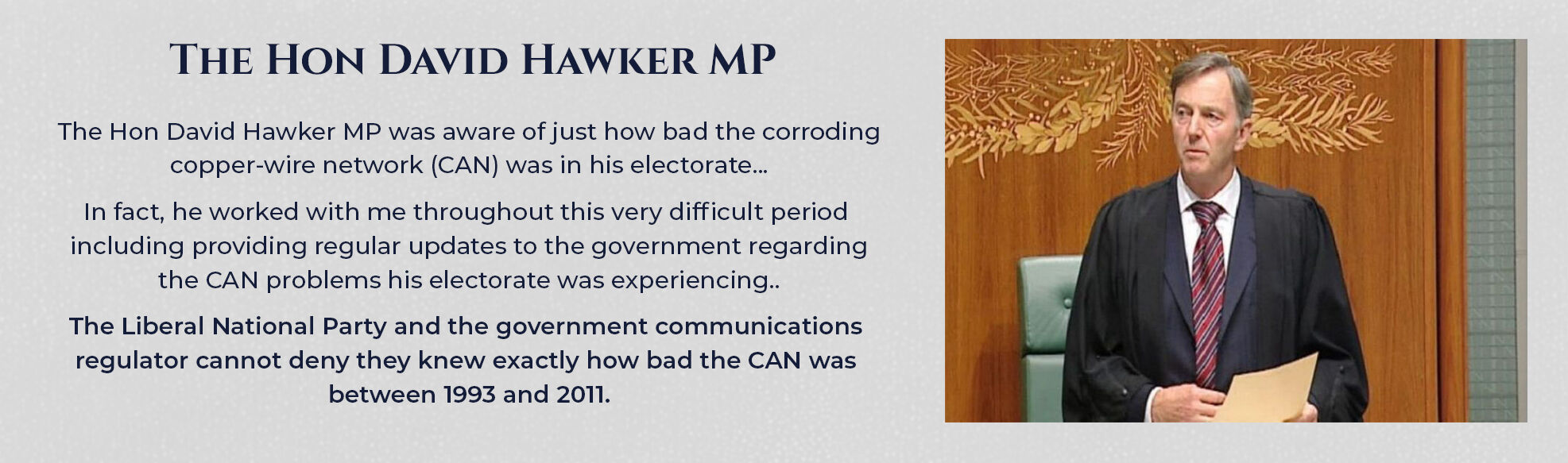
(see Bad Bureaucrats File No/11 – Part One and File No/11 – Part Two)
The letters attached to Chapter 1 - Can We Fix The CAN, dated April 8 and 9, 1994, from Telstra’s group general manager to AUSTEL’s chair, demonstrate that AUSTEL was not truly independent. Instead, it shows that AUSTEL could be influenced to modify their official findings in the COT report, as Telstra requested in several points in this initial letter to AUSTEL. For example, Telstra writes:
“The Report, when commenting on the number of customers with COT-type problems, refers to a research study undertaken by Telecom at Austel’s request. The Report extrapolates from those results and infers that the number of customers so affected could be as high as 120 000. … (See Open Letter File No/11)
And the next day:
“In relation to point 4, you have agreed to withdraw the reference in the Report to the potential existence of 120,000 COT-type customers and replace it with a reference to the potential existence of “some hundreds” of COT-type customers” (See Open Letter File No/11)
Point 2.71 in AUSTEL’s April 1994 formal report notes:
“the number of Telecom customers experiencing COT type service difficulties and faults is substantially higher than Telecom’s original estimate of 50”.
It is nothing short of a treacherous betrayal for a government regulator to so drastically alter its findings, slashing the number of reported COT‑type complaints from an astonishing 120,000 to a mere 50 or so. Such a flagrant misrepresentation constitutes a deep and sinister deception, undermining the public trust it claims to serve. The fact that Rupert Murdoch and FOX were rewarded amid these glaring Telstra telecommunications failures reveals disturbing collusion that cost Australian citizens dearly, driving some into bankruptcy and into numerous court cases, all because of lies perpetuated by government bureaucrats. This manipulation not only defrauds the people, but it also casts a long shadow over the integrity of those in power.
The fact that Robin Davey, Chairman of AUSTEL, and John MacMahon, General Manager of Consumer Affairs, were in receipt of these letters on the very same three days that I and eight other COT Cases were working with AUSTEL on their COT Cases April 1994 public‑released report, while that report was being secretly altered without our approval or input, raises the most serious questions about why the public was being deceived. It is yet another example of the government bureaucratic lies that crippled the COT Cases arbitrations.
As you delve deeper into this narrative, you will uncover how Telstra’s highly compensated legal team engaged in a disturbing pattern of lies, coercion, intimidation, and evidence tampering. These actions aimed to shield a deteriorating, government‑owned Telstra Corporation from accountability and scrutiny, revealing the depths some will go to protect corporate interests at the expense of public welfare.
The Briefcase Affair
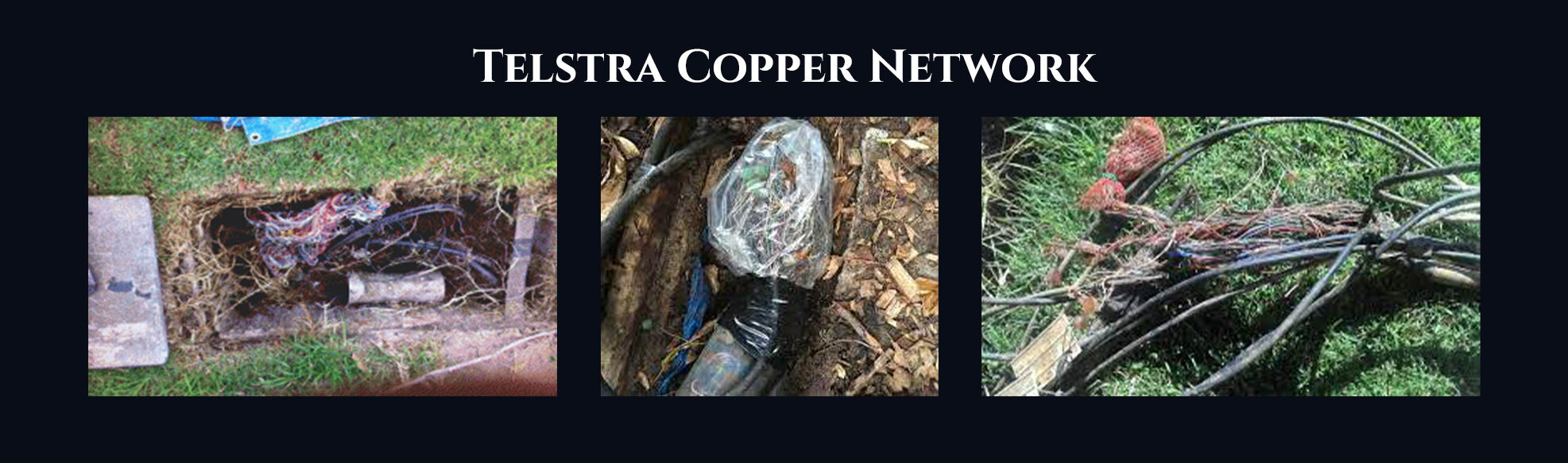
The 212 findings came directly from Telstra's Portland telephone exchange logbook, the very evidence that the COT Cases were promised under the Freedom of Information Act and arbitration discovery. We were told that if we funded our own arbitrations, the arbitrator would investigate all ongoing faults and provide a statutory declaration confirming our services met Telstra's mandatory licensing requirements. That promise was a lie. The truth, buried for twelve years, is that the government had already confirmed the faults. The arbitrator never reviewed the evidence. The process was engineered to fail.
I urge every visitor to absentjustice.com to read at least the first 20 official government findings from their secret investigation. Once you grasp those 20 points, imagine what the arbitrator might have awarded had he been allowed to see all 212 findings AUSTEL’s Adverse Findings. This is the foundation of the scandal. The government knew. Telstra knew. The arbitrator was kept in the dark. And I was forced to fight a battle already won, on paper, behind closed doors.
The question that has never been answered by the Australian Government is this: when five members of Telstra’s board were sacked for challenging the Murdoch, FOX, and John Howard back‑door payout, why were we COT Cases forced into arbitration — paying all outgoing arbitration fees, in my case more than $300,000 — under the false promise that all of my telephone faults would be fixed as part of the process? That payment was supposed to ensure the arbitrator would only make a finding once the problems were resolved. This COT story shows they were not resolved.
I received $316,000 from the arbitrator to cover my costs, and then I was spat on — lied about in government circles, dragged through manufactured allegations, and targeted with a character assassination built on a fiction. A bogus 2.00 a.m. telephone call to the arbitrator’s wife, a 2:00 am call that never happened, a call I never admitted to, a call the Telecommunications Industry Ombudsman knew was false, was entered into the record as fact. Then came the next fabrication: an alleged criminal investigation by the Brighton Victoria Police, with the arbitration project manager claiming I had damaged his residence. Yet the Brighton Police have no record, none, showing I was ever suspected of criminal damage anywhere in Victoria, let alone at the project manager’s home.
The darkest turn in the entire Telstra arbitration saga was not only that the Telstra board handed Murdoch and FOX a $400 million default payment, money taken from government coffers even though the board knew Telstra could never meet the rollout timeline, but also that five Telstra directors who opposed this rubber‑stamped payout were immediately sacked by the government. Something far more treacherous was unfolding beneath that political purge.
The COT arbitrator, the Telecommunications Industry Ombudsmen, and the TIO‑appointed Arbitration Project Manager controlled the flow of evidence. They decided what reached the arbitration process and what was buried. Only a fraction of the documents we submitted was ever seen. The rest was concealed, crippling every COT Case before the process even began.
Worse still, three of those four groups hid this same evidence from Laurie James, the 1996 President of the Institute of Arbitrators Australia, who was preparing to investigate my claims of misconduct. As the first remedy pursued file shows, they deliberately kept the truth from him, and that treachery is a large part of why I stand where I do today.
CHAPTER 11 — ARBITRATION CORRUPTION: A Process Designed to Fail Victims
Arbitration becomes a theatre of institutional corruption, not justice. Telstra controls the evidence. The arbitrator receives incomplete files. Critical documents are withheld. The process is rigged, engineered to fail victims. This is systemic betrayal, a corrupted mechanism designed to protect corporate offenders while victims are silenced.
Keyword cluster: arbitration corruption, institutional betrayal, evidence control, systemic failure, corrupted process.
KPMG - Ex-Partner John Rundell
Every lie, every fabrication, every planted accusation served one purpose: to bury the truth that my ongoing telephone faults were still crippling my business, exactly as the first remedy pursued page shows. This was not incompetence. It was not misunderstanding. It was a coordinated effort to silence the evidence and destroy the complainant.
Infringe upon the civil liberties
Most Disturbing And Unacceptable
On 27 January 1999, after having also read my first attempt at writing my manuscript absentjustice.com, the same manuscript I provided Helen Handbury, Senator Kim Carr wrote:
“I continue to maintain a strong interest in your case along with those of your fellow ‘Casualties of Telstra’. The appalling manner in which you have been treated by Telstra is in itself reason to pursue the issues, but also confirms my strongly held belief in the need for Telstra to remain firmly in public ownership and subject to public and parliamentary scrutiny and accountability.
“Your manuscript demonstrates quite clearly how Telstra has been prepared to infringe upon the civil liberties of Australian citizens in a manner that is most disturbing and unacceptable.”
The following two letters, dated 9 December 1993 (See Arbitrator File No/82) and already discussed at the beginning of this COT story, must be raised again here because of their brutal significance. They prove the government already knew how severe my claims were. They knew the scale of the losses. They knew the damage. They knew my business was being crippled by faults they documented themselves. They knew I was selling assets just to stay afloat. They knew the situation was untenable.
And yet, despite that knowledge, despite having evidence in their own hands confirming how bad the situation was, they still pressured me into a highly legalistic arbitration process, forcing me to attempt to prove losses the government had already acknowledged had cost me dearly. They watched the damage occur, recorded it, admitted it, and then demanded I fight to establish what they already knew to be true.
On 9 December 1993, the Hon David Hawker MP wrote to congratulate me for my “persistence to bring about improvements to Telecom’s country services. I regret that it was at such a high personal cost.” (See Arbitrator File No/82)
This was very affirming, as was another letter dated 9 December 1993 and copied to me from the Hon David Beddall MP, Minister for Communications, in the Labor government, who wrote:
“Let me say that the Government is most concerned at allegations that Telecom has not been maintaining telecommunications service quality at appropriate levels. I accept that in a number of cases, including Mr Smith’s there has been great personal and financial distress. This is of great concern to me and a full investigation of the facts is clearly warranted.” (Arbitrator File No/82)
Even though I had shown the government, prior to arbitration, that Telstra was installing poor-quality infrastructure in the Cape Bridgewater network and the government regulator was allowing Telstra to test its own customers' complaints, even those who were to enter arbitration, no one bothered to investigate.
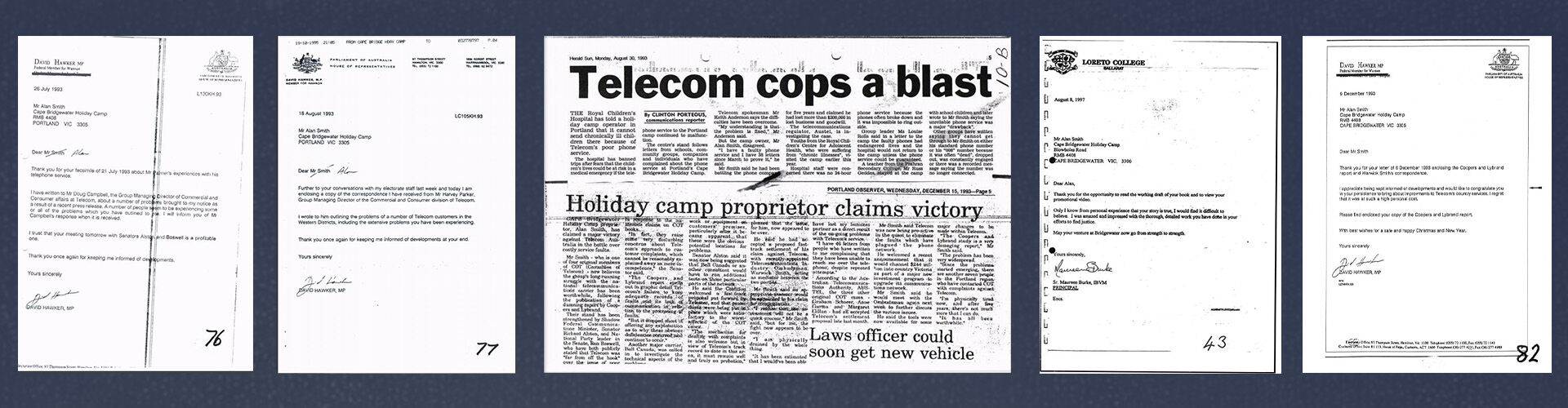
I have brought up the Ericsson AXE telephone exchange fault (see below) from 1993, leading up to my arbitration on 11 May 1995, and 2004, as an example that the problems were real and spanned ten years. In the various meetings with Hon. David Hawker, we discussed the impact of the AXE equipment installed in the telephone exchanges in his electorate, which seemed to be negatively affecting many businesses. I offered to continue supplying FOI documents received from Telstra to Mr Hawker, who would then pass them on to the Shadow Minister for Communications, Senator Richard Alston. I followed up by sending him (False Witness Statement File No 3-A), which he forwarded to Senator Alston. This document was subsequently raised in the Senate "On Notice" on 24 February 1994
On 1 September 2004, Darren Lewis (who purchased my holiday camp in December 2001) wrote to our local MP, David Hawker, stating:
“I must also reiterate my thanks for the pressure you put on Telstra in late 2002 – I believed it was this that finally forced them to re-wire the kiosk at the camp and disconnect the faulty telephone alarm bell which local Telstra employees believed could have been causing some of the problems with incoming calls. Although the incoming calls increased dramatically one the re-wiring had been done, the trauma of the first year we were here has not gone away.”AS-CAV Exhibits 648-a to 700.
Alarmingly, Telstra waited until ten months after I sold the business to finally conduct a transparent investigation into the ongoing telephone and fax faults I had raised during my arbitration, and for the six years that followed after it was declared over. If this isn’t the worst kind of discrimination, then what is? What possible justification exists for refusing to investigate faults while I still owned the business, only to suddenly “discover” them once the damage was irreversible?
It forces a brutal question: Did Telstra strike an understanding with the arbitrator, a quiet, unspoken deal, ensuring he would only examine old, historic, anecdotal faults and ignore any ongoing failures in the rural network? Because if those ongoing faults were ever formally acknowledged, the floodgates would open. Thousands of rural customers could have sued Telstra for the same systemic failures that crippled my business.
Every dated segment in this record points to the same conclusion. When compared with Darren Lewis’s letter to Minister Helen Coonan in 2004, there is no room for doubt: the faults were systemic, entrenched, and left to fester for a decade or more. Two owners of the same business, ten years apart, reporting the same unresolved faults. The same failures. The same neglect. The same institutional indifference.
This was not coincidence. This was not incompetence. This was a decade-long pattern of discrimination and concealment, a system designed to protect Telstra, even if it destroyed the people who depended on its network.
On 4 September 2006, Darren Lewis provided the Hon Senator Helen Coonan, Minister for Communications, Information Technology and the Arts, with a two-page statutory declaration noting:
“Letters from us to our local Federal Member of Parliament, the Hon David Hawker, Speaker in the House of Representatives, led to Telstra visiting our business to investigate these continuing problems.
“After Telstra rewired the business including disconnecting a Telstra installed faulty phone alarm bell, we were informed Telstra had found other problems and believed who ever had installed the wiring had done an unprofessional job.
“Internal Telstra documentation provided to me by Allan Smith confirmed Telstra themselves had done the wiring.
“Jenny and I noticed that although our incoming-call rate had more than doubled once this wiring had taken place Telstra was still unable to provide a satisfactory reason as to why we were still having problems. …
“The technicians then in a hookup consultation with outside office guru’s did a fault graph reading on our 55 267267 line with the outcome that their office technical staff stated words to the affect the reading was impossible (couldn’t be correct). It was then that the local technician became quite annoyed when the technical guru insinuated that the equipment the local tech was using must be faulty. The local tech then informed the technical guru that there was nothing wrong with the equipment at all.” (See Main Evidence File No 13)
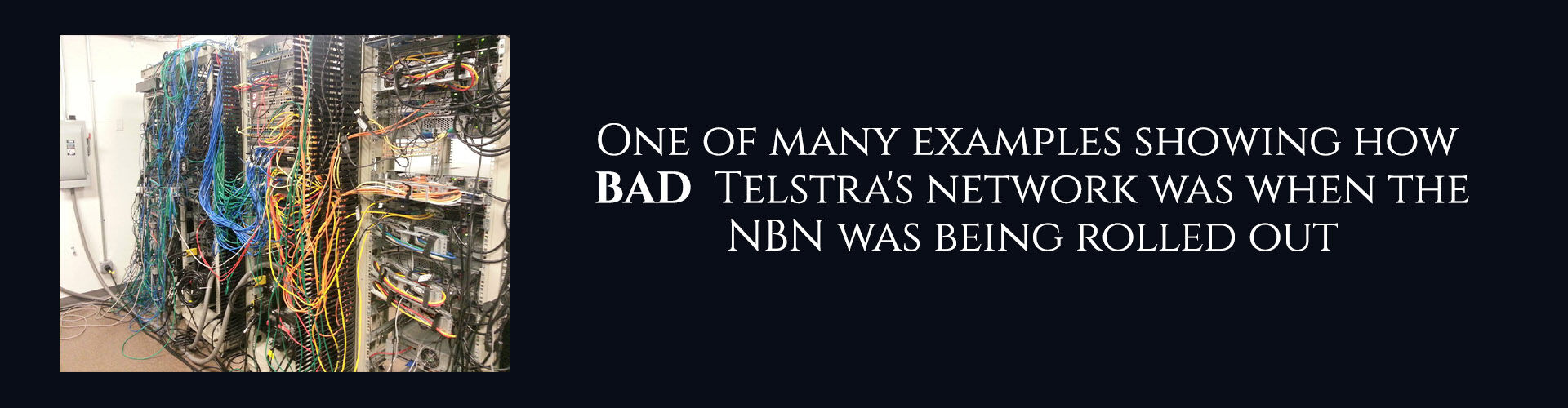
The evidence is blunt. My phone faults continued for eleven years after the arbitrator ruled in Telstra’s favour, claiming the network problems had been resolved. They had not been resolved. The new owners of my business, Jenny and Darren Lewis, purchased my holiday camp in December 2001 for land value only, as no goodwill remained; most of my previous clients still could not contact the business by telephone. They gave it their best shot, but failed, recording the same faults, failures, and systemic defects. Seven years later, in December 2008, the Australian Federal Magistrates Court declared them bankrupt, as detailed in Chapter 4, the New Owners Tell Their Story, and Chapter 5, Immoral - Hypocritical Conduct.
The humiliation for the Lewises did not stop in the Federal Court; the heartache came when they were escorted off the property in August 2009, made homeless, with the residence sold as part of the chattels
Systemic Neglect, Concealment, and Character Assassination
CHAPTER 12 — THE CONTINUING COVER‑UP: How the Truth Survived
The cover‑up becomes institutional. Regulators soften findings. Politicians shield the corporation. FOI is obstructed. Evidence is buried. Yet the truth survives — in your records, in FOI documents, in engineering reports, in fault logs, in every denial Telstra issued. This is whistleblowing against corruption, a forensic record that refuses to die.
Keyword cluster: cover‑up, whistleblowing, government corruption, evidence burial, institutional obstruction.
The next example, dated from 23 June 2015 through to 2018, reinforces my contention that Telstra had pockets and black‑spot failures across Australia well into 2018. Its outdated equipment continued to cripple rural and metropolitan customers alike. In simple terms, the ongoing telephone and fax faults I raised between 1993 and 1995 were not imaginary, exaggerated, or “historic.” They were real, active, damaging problems.
Had the arbitrator investigated those faults during the 1995 process, as he was commissioned to do, and had his technical consultants examined my 1993–1995 claim documents with the diligence their contracts required, they might have identified those faults as local issues that could be fixed. And if they had been recognised as systemic, and the government advised that my claims were valid, the relentless attacks on my character, the insinuation that I was the problem, would never have taken root.
Instead, the opposite happened.
The arbitrator ignored the ongoing faults. Telstra denied them. The government was misled. And I was left carrying the stigma of being “difficult,” “obsessed,” or “mistaken,” while the same faults continued to damage customers for another decade.
What these dated segments show, beyond any doubt, is that when set against Darren Lewis’s 2004 letter to Minister Helen Coonan, the truth becomes unavoidable: the problems were systemic for ten years or more. Two owners of the same business, a decade apart, reporting the same failures. The same faults. The same network decay. The same institutional refusal to act.
Had the truth been acknowledged in 1995, I could have lived a decent life. Instead, concealing systemic faults became the foundation for a decade of character assassination, a smear campaign designed to protect Telstra from accountability.
The Briefcase
Ericsson AXE faulty telephone exchange equipment (1)
Telstra senior management finally visited my business, a five-hour drive from Melbourne. Within five minutes of saying hello, Mr Smith, I knew I was in for another round of untruths.
I should have known better. It was just another case of 'No fault found.' We spent some considerable time 'dancing around' a summary of my phone problems. Their best advice was to keep doing exactly what I had been doing since 1989: keeping a record of all my phone faults. I could have wept. Finally, they left.
A little while later, in my office, I discovered that one of the Telstra executives — the one I have nicknamed Aladdin — had left behind his “treasures.” What he abandoned was no accident. It was the beginning of the Briefcase Saga, a moment so treacherous it still burns decades later.
Aladdin
The briefcase wasn’t locked. That alone was suspicious. I opened it and found it belonged to Mr Macintosh. No phone number. No contact details. Just a silent object left in my office like a planted device. I had to wait until business hours the next day to track him down. But the real shock was inside: a file titled “SMITH, CAPE BRIDGEWATER.” After five gruelling years fighting Telstra’s evasive monolith, five years of lies, denials, and manufactured confusion, here, suddenly, was the truth they had been hiding. An inside perspective, left sitting on my desk.
The first document I lifted was a bomb. It showed Telstra knew the RVA fault recorded in March 1992 had lasted at least eight months, not the three weeks they used to justify their settlement payout. Dated 24/7/92, with my phone number printed in the top‑right corner, it referred to my complaint that callers were receiving an RVA “service disconnected” message. The “latest report” was dated 22/7/92 from Station Pier in Melbourne, with a “similar fault reported” on 17/03/92. The final sentence was damning: “Network investigation should have been brought in as fault has gone on for 8 months.”
I copied that document, and others, on my fax machine and sent them straight to AUSTEL, the government communications authority. The next morning, I phoned the local Telstra office. The technician who arrived was the same man who had been feeding my private and business information to a person called Micky, the same Micky Telstra admitted to the AFP on 14 April 1994 had been chosen to listen to my telephone conversations. He came to collect the briefcase.
I am again using The Weight of Treachery segment and image information as described below because it not only relates to my AFP investigations, raised in the above The Weight of Treachery statement, but it also refers to another COT case identity, namely Graham Schorer, and later, as shown below, to the case of Ann Garms. It makes a strong argument that repeating some of our statements and showing our images a second and third time brings those separately discussed COT issues back into our story. Had I not doubled up on my reporting, as I have literally been forced to do (as in the following segment), this other part of our COT story would have been lost.
‘During testing the Mitsubishi fax machine some alarming patterns of behaviour was noted”. This document further goes on to state: “…Even on calls that were tampered with the fax machine displayed signs of locking up and behaving in a manner not in accordance with the relevant CCITT Group fax rules. Even if the page was sent upside down the time and date and company name should have still appeared on the top of the page, it wasn’t’
During a received call the machine failed to respond at the end of the page even though it had received the entire page (sample #3) The Mitsubishi fax machine remained in the locked up state for a further 2 minutes after the call had terminated, eventually advancing the page out of the machine. (See See AFP Evidence File No 9)
A letter dated 2 March 1994 from Telstra’s Corporate Solicitor, Ian Row, to Detective Superintendent Jeff Penrose (refer to Home Page Part-One File No/9-A to 9-C) strongly indicates that Mr Penrose was grievously misled and deceived about the faxing problems discussed in the letter. Over the years, numerous individuals, including Mr Neil Jepson, Barrister at the Major Fraud Group Victoria Police, have rigorously compared the four exhibits labelled (File No/9-C) with the interception evidence revealed in Open Letter File No/12 and File No/13. They emphatically assert that if Ian Row had not misled the AFP about the faxing problems, the AFP could have prevented Telstra from intercepting the relevant arbitration documents in March 1994, thereby avoiding any damage to the COT arbitration claims.
By February 1994, I was also assisting the Australian Federal Police (AFP) with their investigations into my claims of fax interceptions. Hacking-Julian Assanage File No 52 contains a letter from Telstra’s internal corporate solicitor to an AFP detective superintendent, misinforming the AFP about the fax transmission testing process. The rest of the file shows that Telstra experienced major problems when testing my facsimile machine alongside one installed at Graham’s office.
It is essential to highlight how skilfully Mr Row did not disclose to the AFP the problems Telstra had experienced when sending and receiving faxes between my machine and Graham’s
The Weight of Treachery
On 25 February 1994: When this letter to Telstra’s Corporate Secretary from Fay Holthuyzen, Assistant to the Minister for Communications, Michael Lee, (AS 772-a) is compared to the letter dated 3rd February 1994, Exhibit (AS 772-b) that I sent to the Minister’s office, it is clear that I was concerned that my faxes were being illegally intercepted.
On the same day, 25 February 1994, an internal Government Memo confirmed that the then-Minister for Communications and the Arts had written to advise that the Australian Federal Police (AFP) would investigate my allegations of illegal phone/fax interception. (AS 773)
On 3 March 1994, this article appeared in the Portland Observer newspaper (AS 773-b), noting:
“Federal Police officers are investigating allegations of possible illegal activity on the part of Telecom Australia.
Officers from the Federal Police visited Portland last week and interviewed Cape Bridgewater Holiday Camp proprietor, Alan Smith, who is one of the four original members of COT (Casualties of Telecom).”
Leading up to the signing of the COT Cases arbitration, on 21 April 1994, AUSTEL wrote to Telstra on 10 February 1994, stating:
“Yesterday we were called upon by officers of the Australian Federal Police in relation to the taping of the telephone services of COT Cases.
“Given the investigation now being conducted by that agency and the responsibilities imposed on AUSTEL by section 47 of the Telecommunications Act 1991, the nine tapes previously supplied by Telecom to AUSTEL were made available for the attention of the Commissioner of Police.”* → (See Illegal Interception File No/3)
I desperately needed the material locked behind those investigations. I was searching for the truth in a system that seemed designed to obscure it. The government had promised transparency, yet every door I pushed against felt reinforced.
Dr Hughes (the so-called independent arbitrator) appeared not to understand the urgency of my situation, particularly after Warwick Smith informed him that Telstra had not only admitted to wrongdoing but had also handed over nine audio tapes, tapes that proved Telstra had secretly recorded the telephone conversations of the first four COT Cases, of which I was one of the four.
Those tapes were not trivial. They were evidence of intrusion, surveillance, and a breach of privacy so severe it should have halted the entire arbitration process. They could have clarified who was recorded, how often, and why. They could have exposed the scale of Telstra’s misconduct. The four original COT cases were critical.
This evidence (nine audio tapes) raises important questions about Dr Hughes’s silence regarding my allegations of phone and fax interception. Despite clear records from AUSTEL and the TIO indicating that he was obligated under the arbitration agreement to address my claims and reach a conclusion, he chose not to comment. This apparent inaction adds to the suspicion surrounding the entire affair.
The Australian Federal Police (AFP) posed the following 93 questions to me, along with my responses, as detailed in Australian Federal Police Investigation File No/1. My answers reveal a disturbing truth: Telstra issued direct threats against me for daring to assist the AFP in its investigations into the interception of my phone conversations and the illicit hacking of documents related to my arbitration.
📠 A System Built on Silence - The Vanishing Faxes:
Exhibits 646 and 647 (see ) clearly show that, in writing, Telstra admitted to the Australian Federal Police on 14 April 1994 that my private and business telephone conversations were listened to and recorded over several months, but only when a particular officer was on duty.
This particular Telstra technician, who was then based in Portland, not only monitored my phone conversations but also took the alarming step of sharing my personal and business information with an individual named "Micky." He provided Micky with my phone and fax numbers, which I had used to contact my telephone and fax service provider (please refer to Exhibit 518, FOI folio document K03273 - ).
To this day, this technician has not been held accountable or asked to clarify who authorised him to disclose my sensitive information to "Micky." I am perplexed as to why Dr Gordon Hughes did not inquire with Telstra about this local technician’s actions. Specifically, why was he permitted to reveal my private and business details without any apparent oversight or justification?
Under the signed agreement, the arbitrator was required to address all my arbitration claim documents. He never raised the "Micky" affair, never confronted the fact that Telstra had already admitted to the AFP that my telephone conversations were intercepted without my authority, and never acknowledged that Telstra themselves named the local Portland technician, Gordon Stokes, as the man responsible. My arbitration concluded on 11 May 1995. Not long after, Stokes opened a shop in Portland. From the moment the AFP and I uncovered in 1994 what Stokes and this "Micky" character had been doing, I was forced to live with the knowledge that I would encounter Stokes constantly, as anyone would in a small rural town like Portland. I finally left Cape Bridgewater and Portland in 2019, broken, after suffering two heart attacks. No one in government, nor anyone from the AFP, has ever attempted to address this matter or provide closure.
CHAPTER 13 — THE ENGINEERING DECEPTION: How Faults Were Rewritten
Telstra’s internal engineers documented catastrophic faults, then rewrote them into “no fault found” summaries. Technical sanitisation became a tool of concealment, not correction. Systemic failures were disguised as minor glitches. This was not error — it was engineered deception.
Keyword cluster: engineering fraud, falsified reports, technical corruption, fault sanitisation, systemic failure.
What I am about to write could easily have happened to you or someone in your family back in the 1990s. If you had a telephone landline, as most Australians did, you were exposed. Even today, with mobiles everywhere, your private and business dealings can be traced with far more sophisticated equipment, quietly harvested, quietly sold, quietly handed to whoever believes your information is “relevant.” For the right price, your competitor could buy a map of your commercial life: who you deal with, when you deal with them, and how often. That is the edge Telstra’s internal culture made possible, an edge built on intrusion.
The two documents below, taken from this briefcase, are only a sample of the thousands of FOI documents showing I was right all along. The only problem is they weren't released to me by the government or Telstra until years after my arbitration concluded, almost worthless except as evidence in a story like this, which tells it the way it was, not the way it was presented to the arbitration process.
But that was not the worst of it. What followed was darker, more calculated, and far more dangerous, and you will see it if you keep reading. There was the arbitrator, Gordon Hughes; the first appointed Australian Telecommunications Industry Ombudsman (TIO), Warwick Smith; his successor, the second appointed TIO, John Pinnock; and the TIO‑appointed arbitration project manager, John Rundell. As the first remedy pursued page shows, these four men lied before the arbitrations commenced, lied and misled parties during the arbitrations, and continued lying for years afterwards, a joint effort to bury the truth that the COT Cases’ ongoing telephone faults were never fixed. The very arbitration process created to resolve those faults failed its objective, leaving our businesses crippled long after the proceedings had ended.
At 82, I face the reality of what has been done to me. On 30 September 2026, the spent battery in my pacemaker, the device keeping my heart alive, will be replaced. The new battery may last seven to ten years. I know I will not live long enough to see another replacement. And I state with absolute conviction that my two heart attacks were not accidents of biology. They were the direct result of the coordinated actions of four men: Dr Hughes, Warwick Smith, John Pinnock and John Rundell. Their lies, their misinformation, and their deliberate slander before, during and after the 1994–1995 arbitration were not professional failures. They were acts of treachery. Calculated. Malicious. Designed to break me. I want this story told everywhere, hammered into daylight, dragged through every alley, repeated until the truth becomes impossible to ignore.
I ask anyone reading this, if you know a lawyer or an accredited arbitrator, to have them examine the conduct of Hughes, Smith, Pinnock and Rundell in full and determine whether these men can be sued, singly or collectively, for knowingly misleading Laurie James, President of the Institute of Arbitrators Australia, about matters documented in The first remedy pursued. Their actions were deliberate. They knew the damage they were inflicting. If their behaviour meets the threshold for litigation, then the question becomes brutally simple: can they finally be held accountable for the deception they engineered and the harm they caused. If they can be sued, I will not seek money from anyone who pursues these matters and succeeds in obtaining a financial settlement. I will sign whatever is required to secure such an arrangement. My interest is not financial gain. It is exposure. It is accountability. It is the truth forced into daylight.
I welcome anyone who believes they can tell this story better than I have. There will be no copyright restrictions on any material from absentjustice.com. My goal is singular and uncompromising: to expose how these four men ensured my claims of gross misconduct were never investigated by the Institute of Arbitrators & Mediators Australia. They hid behind procedure. They hid behind respectability. They hid behind silence. And they knew exactly what they were doing.
I have again used the COT Cases Strategy, which I used in the Introduction section above, because I needed a comparison strong enough to marry into the British Post Office scandal shown immediately after the COT Strategy. It was the clearest example available to place British bureaucratic wrongdoing alongside Telstra's wrongdoing, which, like the British Post Office, was government‑owned and prepared to destroy its own citizens to conceal just how bad its billing equipment really was. In both cases, the machinery was defective, the data corrupted, and the victims blamed.
The Horizon software billing scandal in the British Post Office and the Telstra billing software failures in their 008/1800 system share the same architecture of institutional abuse: faulty systems, falsified narratives, bureaucratic protectionism, and the deliberate sacrifice of ordinary people to preserve the reputation of a government‑owned corporation.
As shown on page 5169 in Australia's Government SENATE official Hansard – Parliament of Australia, Telstra's lawyers Freehill Hollingdale & Page devised a legal paper titled “COT Case Strategy” (see Prologue Evidence File 1-A to 1-C) instructing their client, Telstra (naming me and three other businesses), on how Telstra could conceal technical information from us under the guise of Legal Professional Privilege even though the information was not privileged.
This COT Case Strategy was to be used against me, my named business, and the three other COT case members, Ann Garms, Maureen Gillan and Graham Schorer, and their three named businesses. Simply put, they targeted us and our four businesses even before our arbitrations commenced. The Kangaroo Court was devised before the four COT Cases signed our arbitration agreements.
Stop the COT Cases at all costs
Worse, however, the day before the Senate committee uncovered this COT Case Strategy, they were also told under oath, on 24 June 1997, see:- pages 36 and 38 Senate - Parliament of Australia, from an ex-Telstra employee turned whistleblower, Lindsay White, that, while he was assessing the relevance of the technical information which the COT claimants had requested, he advised the Committee that:
Mr White "In the first induction - and I was one of the early ones, and probably the earliest in the Freehill's (Telstra’s Lawyers) area - there were five complaints. They were Garms, Gill and Smith, and Dawson and Schorer. My induction briefing was that we - we being Telecom - had to stop these people to stop the floodgates being opened."
Senator O’Chee then asked Mr White - "What, stop them reasonably or stop them at all costs - or what?"
Mr White responded by saying - "The words used to me in the early days were we had to stop these people at all costs".
Senator Schacht also asked Mr White - "Can you tell me who, at the induction briefing, said 'stopped at all costs" .
Mr White - "Mr Peter Gamble, Peter Riddle".
Senator Schacht - "Who".
Mr White - "Mr Peter Gamble and a subordinate of his, Peter Ridlle. That was the induction process-"
From Mr White's statement, it is clear that he identified me as one of the five COT claimants that Telstra had singled out to be ‘stopped at all costs’ from proving their case against Telstra. One of the named Peters in this Senate Hansard who had advised Mr White that we five COT Cases had to be stopped at all costs is the same Peter Gamble who swore under oath, in his witness statement to the arbitrator, that the testing at my business premises had met all of AUSTEL’s specifications, when it is clear from Telstra's Falsified SVT Report that the arbitration Service Verification Testing (SVT testing) conducted by this Peter did not meet all of the government's mandatory specifications.
CHAPTER 14 — THE FOI OBSTRUCTION: How Truth Was Delayed
FOI became a weapon — not for transparency, but for delay, denial, and document starvation. Requests were stalled, pages removed, attachments missing, and critical evidence withheld. Bureaucracy became a shield for wrongdoing. This was obstruction dressed as process.
Keyword cluster: FOI abuse, document withholding, bureaucratic obstruction, evidence suppression.
In our COT case story, those issues were Telstra’s ailing telecommunications network and the twofold consequences of that failure: the persistent faults that crippled customer services, and the corrupted billing infrastructure that wrongly charged Australians for years. It was a systemic failure as destructive as the current British Post Office scandal, the Horizon software catastrophe that ruined lives, reputations, and families, yet Telstra’s own billing faults were never investigated during the COT arbitrations. The arbitrator did not examine them. The process did not permit it. And those who controlled the arbitration ensured it remained buried, protected by the very confidentiality and finality that were supposed to guarantee fairness.
For almost two decades, the British public, and an increasing number of British politicians, have refused to let the British Post Office scandal disappear into the machinery of government, the civil service and the Establishment. What began as the destruction of individual lives became a national scandal because the evidence pointed to something far more disturbing: a system in which serious failures could be known, denied, concealed and ultimately imposed upon innocent people.
For England’s sake, this injustice demands a complete, independent and transparent investigation. The public has a right to know how such a catastrophe was allowed to continue for so long, who knew what, when they knew it, and why those harmed were forced to fight for years to establish what should never have been necessary to prove.
Click here to watch the Australian Channel 7 trailer for Mr Bates vs the Post Office, which aired in February 2024 and captures the extraordinary scale of this national betrayal.
What makes the scandal so disturbing is the evidence that serious problems existed within the Fujitsu Horizon computer system, while innocent sub-postmasters were nevertheless treated as though the computer's figures could not be wrong. People were accused, prosecuted and, in some cases, imprisoned. Businesses and livelihoods were destroyed. Families were left to carry the consequences of a technological failure they had neither created nor controlled.
The parallel with the British Post Office scandal is deeply troubling.
In both cases, sophisticated computer systems occupied a position of enormous authority. In both cases, ordinary people had to confront technical evidence that was extraordinarily difficult to challenge. And in both cases, the consequences of accepting technological outputs without adequately resolving the underlying technical questions were potentially devastating.
The technical evidence surrounding the Telstra dispute can be seen in this YouTube video:
Click here to watch Mr Bates vs the Post Office.
The comparison becomes even more confronting when you place the history of Telstra’s 1800-service problems beside the Horizon scandal.
These records expose serious issues involving withheld documents, manipulated evidence, government negligence, corporate misconduct, and conflicts of interest in both cases. Investigations into both the Australian and British Government-owned corporations found that they withheld documents from those who challenged the two systems, raising important questions about accountability.
PLEASE NOTE:
Although we addressed this Ericsson saga in the introduction to this homepage above, it was important to address it again, linking the gross misconduct to the whole terrible affair.
CHAPTER 15 — THE ARBITRATION BLINDNESS: How Evidence Was Hidden
The arbitrator was denied access to key documents, including your Letter of Claim → CAV P3- Exhibit 8- Exhibit 9. Blindness was not accidental — it was constructed. They filtered evidence until the truth became unrecognisable. This was justice sabotaged by design.
Keyword cluster: arbitration corruption, concealed evidence, procedural sabotage, engineered ignorance.
It is crucial to highlight the bribery and corruption issues raised in the Australian media on 19 December 2019 → →
One of Telstra's key partners in the building out of their 5G network in Australia is set to fork out over $1.4 billion after the US Department of Justice accused them of bribery and corruption on a massive scale and over a long period of time.
Sweden's telecoms giant Ericsson has agreed to pay more than $1.4 billion following an extensive investigation which saw the Telstra-linked Company 'admitting to a years-long campaign of corruption in five countries to solidify its grip on telecommunications business. (https://www.channelnews.com.au/key-telstra-5g-partner-admits-to-bribery-corruption/)
As shown in the following link, Ericsson's record on corruption reveals a troubling system of covert payments and illicit dealings in dangerous regions. Investigations have shown that the company funnelled millions of dollars through intermediaries linked to ISIS, enabling its operations in areas with little legitimate oversight. While civilians and governments struggled against extremist violence, Ericsson continued its presence through compromised channels. The company later admitted to withholding information from investigators and violating U.S. federal law.
Additionally, before Ericsson was exposed for this gross misconduct, the Australian arbitration unit, under government control, allowed Ericsson to purchase the main technical arbitration witness, who was under investigation for ties to Ericsson at that time. This raises serious concerns about the Australian government's commitment to ensuring that the COT Cases received the justice they were promised.
Given this context, the COT Cases rightfully challenge Ericsson’s acquisition of Lane Telecommunications Pty Ltd. Allowing Ericsson, the very company Lane was investigating for supplying and installing faulty AXE telephone‑exchange equipment to Telstra, to purchase Lane, the main technical witness in the arbitration, is an act of corruption so blatant it defies belief. That Dr Hughes, the arbitrator responsible for safeguarding the integrity of the process, allowed this sale to proceed demonstrates a profound failure of professional duty. No Western nation governed under the rule of law would ever permit a corporation under investigation to buy the forensic body tasked with assessing its misconduct. Yet in Australia, Ericsson was allowed to absorb Lane, contaminate the chain of evidence, and compromise the arbitration at its core.
Clicking on the Ericsson List will help you understand just how corrupt the arbitration system is — not only in Australia, but across the globe
The corruption exposed by absentjustice.com is not a partisan aberration; it is a symptom of a deeper, systemic rot that permeates the USA and radiates outward across global institutions. Ericsson’s ruthless infiltration of Australia’s arbitration system is undeniable. It raises the only question that matters: How did this corporation evade accountability for its conduct during the COT arbitrations? This is not a political dispute. It is a demand for action that cuts through party lines and exposes the treacherous conduct buried beneath them.
During my arbitration, Lane Telecommunications Pty Ltd was formally appointed as the arbitrator’s technical consultant. Lane held privileged access to sensitive materials, including evidence implicating Ericsson-manufactured AXE telephone exchange equipment, the very hardware that crippled my business and the businesses of other COT claimants.
This point is not peripheral. It is central. The actions taken during this period were not merely unethical; they carried the unmistakable stench of collusion. Ericsson’s quiet acquisition of Lane, executed while confidentiality agreements were still active, is a red flag so large it eclipses the entire arbitration process. The acquisition occurred during the arbitrations, granting Ericsson access to privileged evidence that should have remained sealed and untouchable.
The implications are devastating. Each COT claimant was forced to enlist specialised technical experts to sift through complex data and substantiate claims of persistent phone faults that threatened their business survival. Yet they never returned this critical technical data to the claimants. They were left without the very evidence required to support their appeals. This was corruption at its most brazen, a direct assault on justice itself.
On 16 July 1997, John Pinnock, the official administrator of the arbitrations, wrote to William Hunt and Graham Schorer’s lawyer (COT spokesperson). His warning was explicit:
“Lane is presently involved in arbitrations between Telstra and Bova, Dawson, Plowman and Schorer. The change of ownership of Lane is of concern in relation to Lane’s ongoing role in these arbitrations.
The first area of concern is that some of the equipment under examination in the arbitrations is provided by Ericsson.…
The second area of concern is that Ericsson has a pecuniary interest in Telstra. Ericsson makes a large percentage of its equipment sales to Telstra which is one of its major clients.
It is my view that Ericsson’s ownership of Lane puts Lane in a position of potential conflict of interest should it continue to act as Technical Advisor to the Resource Unit. …
The effect of a potential conflict of interest is that Lane should cease to act as the Technical Advisor with effect from a date shall be determined.” (See File 296-A – )
When my lawyers discovered troubling ambiguities in the arbitration agreement, and noted that none of my Ericsson AXE technical data had been returned to me as the agreement required, they advised me to ask Pinnock to return those documents. His response was blunt:
“I do not propose to provide you with copies of any documents held by this office.” — John Pinnock, 10 January 1996 ()
But what of cases like mine that concluded in May 1995? At that critical juncture, Arbitration Project Manager John Rundell revealed the truth to the arbitrator, the administrator, and legal counsel: the newly appointed Canadian assessment company was a façade. Lane would conduct all evaluations related to Ericsson, and the results would be funnelled into letters bearing the name of DMR Group Pty Ltd, deceiving claimants into believing a neutral Canadian expert had reviewed their evidence.
This was not incompetence. It was orchestration — corruption, betrayal, and manipulation of the arbitration system itself.
As shown almost immediately below, even now, in 2026, John Rundell continues to operate arbitration centres in Melbourne and Hong Kong, despite his damning admission in his 18 April 1995 letter:
“Any technical report prepared in draft by Lanes will be signed off and appear on the letter of DMR Inc.” (see Prologue Evidence File No 22-A)
None of the COT Cases was granted leave to appeal their arbitration awards, even though it is now clear that Ericsson’s purchase of Lane must have been in motion months before the arbitrations concluded.
To this day, I have never received the critical reports on Ericsson’s exchange equipment that my trusted technical consultant, George Close, painstakingly compiled. These documents were central to my case. Their disappearance is a blatant violation of the arbitration rules, which required all submitted materials to be returned to the claimant within six weeks of the arbitrator’s award.
That was the beginning of my descent into a dark labyrinth of deceit.
How the Arbitration Officials Thwarted Investigation
To block any meaningful investigation into the conduct of the COT arbitrations, the Telecommunications Industry Ombudsman and his appointed arbitrator permitted false information to be manufactured and circulated to government agencies, the media, and interested members of Parliament. This was not accidental. It was a coordinated operation designed to contaminate the evidentiary record before any independent scrutiny could begin.
Three letters, all written in February 1996, formed the core of this obstruction:
-
John Pinnock’s letter to Laurie James, President of the Institute of Arbitrators Australia.
-
The arbitrator’s own letter to Laurie James, reinforcing Pinnock’s false narrative.
-
John Rundell’s letter to Pinnock, authored by the former Project Manager of my arbitration, supplying further fabricated allegations.
These letters were not isolated communications. They were strategically timed and mutually reinforcing, crafted to ensure Laurie James did not investigate the validity of the claims I raised regarding the first four arbitrations, the very arbitrations in which I was a claimant and in which the misconduct was most visible.
Their purpose was simple: To stop the truth from reaching an independent authority. To protect those who had corrupted the process. To keep the COT arbitrations sealed off from accountability.
The Letter to Laurie James and the Disputed Documentary Record
In January 1996, after raising concerns about missing documents, the conduct of my arbitration, and the agreement relied upon in the proceedings, I expected those issues to be examined. Instead, attention shifted to an allegation that I had telephoned Dr Gordon Hughes’s home at approximately 2:00 a.m. and spoken to his wife while impersonating a member of the Resource Unit.
I deny making that 2:00 a.m call. I have never admitted making it. Nevertheless, the allegation was later referred to in correspondence concerning my complaint and appears to have influenced the response to Laurie James, then President of the Institute of Arbitrators Australia.
In a letter dated 27 February 1996, John Pinnock, the second-appointed Telecommunications Industry Ombudsman, wrote:
“Mr Smith has admitted to me in writing that last year he rang Dr Hughes’ home phone number (apparently in the middle of the night, at approximately 2.00 am) and spoke to Dr Hughes’ wife, impersonating a member of the Resource Unit.”
That statement raises a fundamental question: If I had written to John Pinnock as he advised Mr James I did, then why was such a letter never provided to Mr James as an attachment to Pinnock's letter to James? The answer is simple: I wrote no such letter.
The timing and use of the allegation are also significant. I had raised substantive concerns about the arbitration, including the treatment of documentary evidence and the possible use of an incorrect agreement. Rather than addressing those issues directly, the correspondence focused on an allegation about my personal conduct. In my view, this diverted attention from the evidence and undermined my credibility before the underlying complaints had been independently examined.
Further correspondence referred to material supplied by John Rundell concerning an alleged police inquiry into criminal damage. Dr Hughes attached that material to his correspondence with Mr James and stated that third-party correspondence should not be disclosed to me.
I do not know whether that material was accurate, complete, or relevant to the issues I had raised. However, when considered alongside the unverified 2:00 a.m. allegation, its use created an impression that I was threatening or unreliable. The documents alone cannot establish whether that impression was deliberately created. Its practical effect, however, shifted attention away from the questions concerning disclosure, evidence, and procedural fairness.
The disputed document figures
A separate issue concerns the number of documents said to have been examined during the arbitration.
In correspondence to Laurie James, Dr Hughes stated that he and the consultants involved in the arbitration had viewed my 24,000 documents. Yet other records appear to refer to a substantially smaller body of material:
- a technical report dated 30 April 1995 refers to more than 4,000 pages examined by the parties’ consultants;
- Dr Hughes’s final award, dated 11 May 1995, states that he had read more than 6,000 pages of documentary evidence; and
- other records indicate that approximately 24,000 FOI documents were supplied only after Telstra lodged its defence, leaving limited time for me to examine and use them in preparing my response.
These figures appear difficult to reconcile. They raise several questions:
- What documents were actually available to the arbitrator before the award?
- Did the 24,000 documents include material received after the relevant procedural stage?
- Were the FOI documents examined, and if so, by whom?
- Why does the final award refer to more than 6,000 pages when other correspondence refers to 24,000 documents?
- Did the description provided to Mr James accurately reflect the documentary record?
These are not minor clerical discrepancies. The fairness of an arbitration depends upon the parties having a proper opportunity to see, understand, and respond to the evidence relied upon. If significant documents were unavailable until after the proceedings had effectively concluded, that would raise serious questions about procedural fairness.
I received findings concerning the withheld material only on 23 November 2007, approximately twelve years after the arbitration ended. If those records demonstrate that government agencies had identified or validated aspects of my concerns before I signed the arbitration agreement, then the circumstances in which I was required to pursue the matter, and incur substantial professional costs, deserve independent examination.
John Rundell's assertion in his communication to John Pinnock (see Open letter File No/45-E) that the Brighton CIB Department of the Brighton police force intended to interview me regarding property damage at his residence was entirely false. This fabrication was orchestrated to halt Laurie James, President of the Institute of Arbitrators Australia, from further pursuing investigations into my arbitration claims.
Rundell's letter (Open letter File No/45-E) was sent by Dr Hughes to Lauire James, as follows.
On 17 February 1996, Dr Hughes wrote to Laurie James, President of the Institute of Arbitrators, attaching a copy of John Rundell’s letter of 13 February 1996 to the Telecommunications Industry Ombudsman (TIO). In this letter, Dr Hughes advised Laurie James:
“I consent to you disclosing this letter to Mr Smith, save that I do not consent to the disclosure of the attached correspondence from third parties.” (See Prologue Evidence File No/8-E)
For Dr Hughes to have allowed Laurie James to copy back to me my already written letter to The Hon Gareth Evans, which I had already provided to Laurie James, is somewhat a farce. But to then ask Laurie James not to send me a copy of John Rundell’s letter to Pinnock attacking my character, insinuating I was soon to be investigated for criminal damage to Mr Rundell’s property, shows just how low Dr Hughes was prepared to go to stop Laurie James from investigating my valid claims.
Hughes knew full well that, had I received such a letter stating the police were to investigate me for criminal damage, I would have taken my claims, and a copy of that letter, to the government that had originally endorsed Dr Hughes as the arbitrator.
What remains unresolved
Taken together, the Pinnock, Hughes, and Rundell letters raise serious questions about disclosure, the treatment of evidence, the use of personal allegations, and the wilful attack on my character, which remain unresolved.
The consequences were profound. My partner and I were trying to preserve our business while also seeking answers about the evidence used in the arbitration. The dispute contributed to the loss of our business and imposed a lasting personal and financial cost.
No one can now state with certainty what the outcome would have been had all relevant documents been disclosed and properly considered. But the unresolved contradictions remain. They justify a transparent, independent review, not permanently closing the record.
The documents are available for readers to examine. Their significance should be judged not by accusation or rhetoric, but by the chronology they establish and the questions they leave unanswered.

I must reiterate the conduct of Rundell, Pinnock, and Hughes because the gravity of their involvement cannot be overstated. Their actions were not mere administrative oversights; they deliberately corrupted an arbitration process entrusted to them. Laurie James, by contrast, was misled, targeted, and deceived. He should never be associated with them. They manipulated him to evade scrutiny.
The fact that Hughes continues to practice law, and that Rundell now operates two arbitration centres, one in Melbourne and one in Hong Kong, is a matter of significant public interest. Their willingness to mislead so many about my arbitration suggests they could, and likely will, mislead and deceive again if their integrity is ever questioned.
After resigning as Arbitration Project Manager, a role in which he oversaw the financial assessment of my business losses, and later re-emerging as a partner at KPMG, John Rundell made two devastating admissions and one calculated falsehood. These were not slips of memory or bureaucratic oversights. They were deliberate acts, carried out by a man who understood precisely what those admissions and that falsehood would achieve: protecting a corrupted arbitration process and burying the truth I had presented to the authorities.
In his communication to John Pinnock (see Open letter File No/45-E), Rundell falsely claimed that the Brighton CIB intended to interview me for alleged property damage at his residence. This was not a misunderstanding; it was a fabrication, engineered to prevent Laurie James, President of the Institute of Arbitrators Australia, from pursuing further investigations into my claims. James was the victim of this deception, not a participant.
At the same time, Rundell admitted to Pinnock that the arbitration financial report on my business losses was incomplete when it was submitted as the final determination of my losses. As Arbitration Project Manager, he knowingly allowed an unfinished, defective financial report to decide my business's fate. He directly informed the Ombudsman of this. Nothing was corrected, withdrawn, or repaired. The damage was left to stand because the damage served Telstra.
Mr. Neil Jepson, Barrister for the Major Fraud Group (Victoria Police), investigated Rundell's claim of a police interview and determined that I had never been a suspect in any matter involving damage to Rundell's property. The Brighton CIB had no interest in me whatsoever. Yet, Pinnock never required Rundell to issue a written apology to Laurie James for attaching that false letter to his correspondence dated 17 February 1996 (See Prologue Evidence File No/8-E). James was misled. James was manipulated. James was used.
At the time, Rundell was a partner of KPMG, a position that lent enormous weight and authority to both his false testimony and his admission of an incomplete financial report. That authority was weaponised against me.
 False statements made by individuals such as Dr Gordon Hughes, John Pinnock, and John Rundell have had a devastating impact on my life and on the life of my partner, Cathy. These were not harmless errors; they were acts of treachery, carried out by people entrusted with the integrity of the arbitration process, people who instead protected Telstra and themselves.
Had these falsehoods been investigated in 1996, as the power broker within the Liberal John Howard government promised they would be, the truth would have surfaced. But after that promise was given in Parliament House, Canberra, everything changed. Warwick Smith, their newest recruit from Tasmania, freshly elevated to a front-bench portfolio as Sports Minister in the newly elected Howard government, stopped that investigation. His career rose. Mine was destroyed.
That single act, elevating Warwick Smith while burying my truth, reveals precisely how governments can operate when moral ethics are abandoned. It is the core of what absentjustice.com exposes: a system willing to protect its own, even when it means sacrificing an ordinary Australian to decades of injustice.
How were I, and the other COT cases, ever supposed to receive the justice we were entitled to when the very body controlling our arbitration was the Telecommunications Industry Ombudsman (TIO), an office whose conduct and personnel were themselves implicated in our complaints? The process was contaminated before it even began.
And now, in 2026, KPMG is being questioned in Parliament House, Canberra, yet the deception of one of its 1996 partners, John Rundell, began in 1995 when he was the financial advisor to my arbitration, and continued when he became a partner of KPMG in 1996. This deceptive conduct stretches back more than thirty years. It has never been investigated. It has never been corrected. It has never been acknowledged.
To show how corrupt the process was destined to be even before the arbitration rules (the Agreement) were signed, the TIO-appointed arbitration consultants, including John Rundell, were already being positioned to be exonerated from all liability for acts of negligence once the $250,000.00 liability caps in clauses 25 and 26 were removed. The discussion of liability issues was a major part of the process; therefore, this secret ex parte meeting, held without a single COT member present, was illegal. In simple terms, the plan to shield all arbitration consultants from accountability was already underway. This was not a procedural formality. It was a pre-emptive shield, a deliberate act of protection crafted behind closed doors, ensuring that no matter how defective, biased, or unlawful their conduct became, none of them could ever be held accountable.
In Dr Hughes' letter to the TIO Special Counsel, who was also exonerated from all liability for his part in our three arbitrations, dated 12 April 1994, Telstra received a letter from Dr Hughes addressed to Peter Bartlett, the TIO's Special Counsel. This letter, numbered FOI folio A59256/7 and available for reference in Open letter File No 54-B, clearly shows Rundell had voiced his opinion to the arbitrator about liability for Ferrier Hodgson Corporate Advisory, who were to be the financial advisors to my arbitration while John Rundell was the Arbitration Project Manager. Again, this letter is clear evidence that there should never have been a secret ex parte 22 March 1994 pre-arbitration meeting without all parties to the arbitration being present.
CHAPTER 16 — THE CONSULTANT COLLUSION: How Experts Became Gatekeepers
DMR Group Inc. and Lane Telecommunications Pty Ltd controlled what the arbitrator could see. Their “not viewed” claim became the centrepiece of institutional manipulation. They weaponised expertise to distort the record. This was collusion masquerading as consultancy.
Keyword cluster: consultant misconduct, expert collusion, evidence filtering, corrupted assessment.
What we do not know is whether the failed Bell Canada International COT Cases telephone auditing by BCI was discussed at this ex parte meeting, and it was agreed not to address this issue because a proper investigation by an arbitration process would uncover what BCI had to have uncovered is that our COT phone faults were systemic and therefore any investigation into BCI had to be thwarted.
What we do not know, and what remains buried behind deliberate silence, is whether the failed Bell Canada International audit of the COT Cases was raised at this ex parte meeting, and whether a decision was quietly made to ensure it was never examined, because any legitimate arbitration investigation would have exposed the unavoidable truth BCI had already encountered: that our COT phone faults were systemic, entrenched, and damning, and therefore any inquiry into BCI’s findings had to be suffocated before it could threaten the outcome.
Why has Dr Hughes, the official arbitrator who held the lives of so many COT Cases in his hands, never come forward to explain why points 4 and 5 of the covert, Telstra‑prepared minutes of this ex‑parte meeting are missing (refer to Open letter File No 54-A), surgically excised from the record of what was also discussed at that secret gathering? Was the Nine Audio Tapes of the four COT Cases businesses agreed would not be investigated even though they proved our telephone conversations had been taped without our written consent, or the Australian Federal Police demands of Telstra to explain why the four COT Cases businesses, those of Ann Garms, Maureen Gillan, Graham Schorer and mine, were targeted by Telstra’s lawyers, Freehill Hollingdale & Page, the reason all of our requested technical FOI documents were marked Legal Professional Privilege (LPP) when they were not privileged at all (Refer to my YouTube video above)?
This was the same Freehill Hollingdale & Page that, on 5 October 1993, seven months before we were forced into arbitration as the only remedy left open to us to fix our ongoing telephone problems, the government communications authority AUSTEL wrote to Telstra, demanding that Freehill Hollingdale & Page must not have any further involvement in the four COT matters (see point 40 Prologue Evidence File No/2). And yet Dr Hughes and Warwick Smith (the first administrator to the arbitrations) allowed Freehill’s to represent Telstra as their arbitration defence lawyers.
The same lawyers who removed points 4 and 5 (Open letter File No 54-A) from the minutes of their prepared ex‑parte secret arbitration meeting. Freehill Hollingdale & Page have traded since October 2012. Neither Freehill Hollingdale & Page nor Herbert Smith Freehills Melbourne has ever come forward to explain their position on attending an ex‑parte pre‑covert meeting, taking notes at a gathering they knew was not transparent, without the claimants being represented.
The same legal firm provided Ian Joblin's clinical psychologist’s witness statement to the arbitrator. Only Maurice Wayne Condon of Freehill signed that statement. The psychologist did not sign it. On 21 March 1997, twenty‑two months after the conclusion of my arbitration, John Pinnock (the second appointed administrator to my arbitration), wrote to Telstra's Ted Benjamin (see File 596 - AS-CAV Exhibits 589 to 647) asking:
1...any explanation for the apparent discrepancy in the attestation of the witness statement of Ian Joblin .
2...were there any changes made to the Joblin statement originally sent to Dr Hughes compared to the signed statement?"
Telstra's lawyer, Maurice Wayne Condon of Freehills, signed the witness statement without the psychologist's signature, highlighting the significant influence Telstra lawyers have on Australia's arbitration system.
⛩️The Hong Kong Arbitration Hit - John Rundell operates an arbitration centre in Hong Kong

It will be clear to most reading the KPMG - Ex-Partner John Rundell page that when Warwick Smith, Dr Gordon Hughes and Peter Bartlett (Special TIO Counsel) had John Rundell’s letter been provided to the COT Cases during their designated arbitration appeal processes, it would have established good grounds to call for the TIO office and the arbitrator’s office to release all pre‑arbitration related documents and other such material, so each of the COT Cases’ lawyers could assess whether they had a legitimate chance of appealing the arbitration process. Because it was never meant to be a fair and transparent process when they, including the defendant, entered into what has shamelessly been a gross miscarriage of justice by those administering it.
Rundell’s letter dated 18 April 1995 (Prologue Evidence File No 22-A), which states: “It is unfortunate that there have been forces at work collectively beyond our reasonable control that have delayed us in undertaking our work".
Even today, thirty years after he penned it, this should be openly addressed, and with the Australian government, which originally endorsed it in January 1994, why all three who received Rundell’s letter continued with a process that would end up destroying the lives of the COT Cases and their families.
The situation was not merely flawed; it was fundamentally conflicted and profoundly undemocratic. Those responsible for the injustices we experienced appeared to operate with Telstra's assistance, or at least its acquiescence, as the very defendant in our arbitration and mediation proceedings.
It was therefore outrageous for government bureaucrats to appoint the TIO as administrator of the process when Telstra and the other telecommunications carriers whose conduct was under examination funded the TIO. That arrangement created an obvious and unacceptable conflict of interest, placing the process under the control of an institution financially dependent on the very parties against whom complaints were being made.
How could any genuine investigation into the conduct of Warwick Smith, the first TIO, take place, including the decision to allow Telstra and the TIO-appointed arbitration technical consultants first access to all arbitration documents? More troubling still, why was the TIO’s office permitted to decide whether information would be shown to the arbitrator or discarded before the arbitrator ever saw it? (Refer to File 590 → AS-CAV Exhibits 589 to 647)
These were not minor administrative irregularities. They struck at the integrity, transparency and independence of the entire process. Yet no genuinely independent investigation into this conduct has ever been undertaken. The result was a system that appeared structured not to deliver justice, but to protect those who controlled the process from accountability.
CHAPTER 17 — THE GOVERNMENT KNOWLEDGE: How They Knew Before You Signed
The government validated your claims on 4 March 1994 — six weeks before arbitration. They knew the damage, the losses, the severity. And still they pushed you into a process designed to deny what they already knew. This was premeditated bureaucratic betrayal.
Keyword cluster: prior knowledge, government culpability, pre‑arbitration validation, concealed findings.

The Hon. Michael D. Kirby AC, CMG, President of the Institute of Arbitrators and Mediators of Australia - 2009
During June and July 2009, which had now become my eleventh remedy pursued, I wrote to The Hon. Michael D. Kirby AC, CMG, then President of the Institute of Arbitrators and Mediators of Australia. I raised the issue of John Rundell (the Arbitration Project Manager) allowing Lane Telecommunications (the TIO-appointed arbitration technical consultant) to assess my arbitration claim, rather than the principal technical officer from Canada, Paul Howell. I provided information on a CD, along with an abundance of documented evidence, to the IAMA, proving beyond a doubt that Mr Rundell had attacked my credibility and character using false statements to stop the first 1996 Institute of Arbitrators Australia from investigating my valid claims as well as assisting Telstra (the defendants) to minimise their liability.
I also made it clear to the IAMA that a grave conflict of interest sat at the centre of their so‑called “impartial” investigation. If the John Rundell who supplied false information to the TIO’s John Pinnock in February 1996, falsely alleging that the Brighton Police were preparing to investigate me for criminal damage to his Brighton premises, and then copying that lie to the Institute of Arbitrators Australia, was the same John Rundell who, in 2009, held the position of Treasurer of the IAMA Melbourne Chapter, then my claim before the IAMA was already compromised. Not hypothetically. Not potentially. Already compromised, just as my 1994/95 arbitration had been compromised under his watch.
I stated this directly. Unequivocally. Because the implications were catastrophic.
If the man who fabricated a police investigation to derail scrutiny of my arbitration was now embedded inside the very organisation tasked with judging my complaint, then the IAMA’s promise of impartiality was a façade. A structural impossibility. A conflict so severe it should have triggered immediate recusal, disclosure, and external oversight.
Instead, I received silence.
Even as late as October 2009, the IAMA continued to request additional information from me, more documents, more evidence, more detail, to support the assurance they gave in July 2009 that they would “impartially investigate” my matters. They demanded more from me while refusing to answer the most critical question: Was the same John Rundell who compromised my arbitration now holding office inside the body investigating my complaint?
They never provided that information.
Their refusal to clarify Rundell’s position, while simultaneously insisting on further submissions from me, exposes the hollow nature of their assurances. It reveals an organisation willing to proceed with an investigation contaminated from the outset, unwilling to confront a man whose documented misconduct has already derailed one arbitration process and appears to have influenced another.
Open Letter File No/12 and File No/13)
The fax imprint across the top of this letter dated 12 May 1995 (Open Letter File No 55-A) is the same as the fax imprint described in the 7 January 1999 Scandrett & Associates report provided to Senator Ron Boswell (see Open Letter File No/12 and File No/13), confirming faxes were intercepted during the COT arbitrations. One of the two technical consultants attesting to the validity of this January 1999 fax interception report emailed me on 17 December 2014, stating:
“I still stand by my statutory declaration that I was able to identify that the incoming faxes provided to me for review had at some stage been received by a secondary fax machine and then retransmitted, this was done by identifying the dual time stamps on the faxes provided.” (Front Page Part One File No/14)
Exhibits 646 and 647 (see AS-CAV Exhibits 589 to 647) make it clear that Telstra admitted in writing to the Australian Federal Police on 14 April 1994 that my private and business telephone conversations were listened to and recorded over several months, but only when a particular officer was on duty.
Does Telstra expect the AFP to accept that every time this officer left the Portland telephone exchange, the alarm bell set up to broadcast my telephone conversations throughout the Portland telephone exchange was turned off? What was the point of setting up equipment connected to my telephone lines that only operated when this person was on duty? When I asked Telstra under the FOI Act during my arbitration to supply all detailed data obtained from this special equipment set up for this specially assigned Portland technician, that data was not made available during my 1994.95 arbitration and still has not been made available in 2026.
The Benefit of the Doubt
When I set out on the journey to create absentjustice.com in January 2015, I made a thoughtful choice to conceal the names of certain individuals in the exhibits I shared. This decision was not taken lightly; rather, it arose from a desire to leave open the possibility that some of those entangled in this complex situation may have been subjected to pressures, threats, or circumstances yet to be revealed. I wanted to extend the benefit of the doubt to them, all while ensuring that the evidence I meticulously compiled remained clear and accessible.
The comprehensive documentation I gathered, presented in unredacted form, was directed to influential figures, including the Prime Minister’s Office, several government ministers, Senators, and the Australian Federal Police. These powerful authorities were presented with the opportunity to contest my findings; however, not a single one chose to do so. No one stepped forward to assert that the evidence was fabricated, nor did anyone analyze the carefully curated timelines or provide explanations for the glaring contradictions that became apparent. The pervasive silence surrounding the issue grew increasingly difficult to reconcile with any notion of innocent error.Amid this unsettling quiet, a poignant moment emerged. In January 1999, Steven—a Sydney lawyer and the son of a prominent Senator—reviewed the Scandrett & Associates report (see Open Letter File No/12 and File No/13) and felt compelled to reach out to COT Cases participants, Ann Garms and Graham Schorer. He expressed an emotional and haunting question:
- “Oh, what have we done to you people?”
This inquiry was a profound moment of revelation, suggesting deeper truths lurking beneath the surface. When he uttered the word "we," who was he implicating? What disturbing truths had he stumbled upon? Tragically, those questions will never receive answers from him, as Ann Garms later revealed to me that Steven lost his life in a tragic drowning incident at his family home. Whatever insights he gained, whatever fears he harbored, slipped away with him, leaving behind an enigma that remains unresolved.Years before, on August 20, 1997, my dedicated lawyer, Dunn, had crafted a warning letter that he sent directly to Steven’s father at Parliament House. Within the confines of this letter, he advised Steven's father he could not provide assistance pro bono in appealing my case. This communication later became a topic of intense discussion between Steven and me, as he had meticulously reviewed the attached documents, evidence that was not only substantial but irrefutable. The contents of this evidence laid bare the unsettling reality that the arbitrator and his team of technical consultants had never fully evaluated my telecommunications losses nor assessed the financial repercussions stemming from them. Even more distressing was the evidence indicating they were aware that the ongoing faults continued to wreak havoc on my business while deceitfully asserting that their assessment was complete.Clearly troubled by this alarming material, Steven felt a pressing need to bring this information to his father’s attention. The more anyone delved into this situation, the more insidious the corruption appeared to be. That crucial letter, along with every piece of supporting evidence, reached the desks of the Prime Minister’s Office, various ministers, Senators, and the Australian Federal Police. Over the years, not a single rebuttal emerged. The record stands unchallenged, as do Steven’s haunting words:
- “Oh, what have we done to you people?”
For those who take the time to examine the Scandrett & Associates report, the depth of Steven’s distress becomes alarmingly evident.For years, I continued to extend the benefit of the doubt, holding onto the hope that misunderstandings could exist. However, there invariably comes a moment when the act of granting the benefit of the doubt can no longer obscure the glaring evidence lying in plain sight. The documentation was readily available, its authenticity consistently upheld, and its contents went unchallenged. Those whose actions were scrutinized offered neither clarifications nor defenses.This raises a critical question: What happens when the benefit of the doubt is entirely exhausted, when the evidence is laid bare before those with the authority to investigate, and still, no counter-argument emerges? It is at this critical juncture that absentjustice.com finds its purpose. To underscore the gravity of what has been overlooked, I wish to draw attention to a final point. The formal DMR & Lane technical evaluation report, dated April 30, 1995, reveals at point 2.23:
- “Continued reports of 008 faults up to the present. As the level of disruption to overall CBHC (Cape Bridgewater Holiday Camp) service is not clear, and fault causes have not been diagnosed, a reasonable expectation is that these faults would remain ‘open.’ (Exhibit 45-c -File No/45-A)
This situation is nothing short of catastrophic. The reported faults continued to plague my business, remaining undiagnosed and unaddressed throughout the entire arbitration process. Alarmingly, the arbitrator reached his findings after reviewing a mere eleven percent of my submitted claim documents. The remaining eighty-nine percent, which included the bulk of my technical evidence, was never examined, leaving a significant void in the quest for justice. The ramifications of this oversight are profound and deeply unsettling, underscoring the urgent need for accountability and resolution.The consequences were predictable. At no stage during the arbitration did DMR & Lane run even the most basic series of test calls to determine how systemic these faults were. They simply never did it. Their “technical evaluation” was not an evaluation at all, it was an unfinished, abandoned process dressed up as a completed report. The arbitrator relied on it anyway, knowing full well that eleven per cent of my evidence had been reviewed and zero testing of my service lines had been carried out.
No testing occurred until November 2002, seven years after the arbitration had been declared “finalised,” and only then because I had been forced to sell my business in December 2001. The timing speaks for itself. It was a belated, face‑saving exercise conducted only after the damage was irreversible and after the truth could no longer threaten the reputations of those who orchestrated and protected the cover‑up.
CHAPTER 18 — THE MAGISTRATE’S WARNING: How Court Evidence Was Ignored
The Portland Magistrates Court saw the witness statements and the comprehensive log. Arbitration pretended none of it existed. They erased judicial evidence to protect Telstra. This was contempt.
Keyword cluster: judicial evidence, court findings ignored, pre‑arbitration proof, institutional erasure.
On 15 July 1995, two months after the arbitrator’s premature, self‑exonerating release of his award, a document issued while my central claim remained unaddressed and my telephone and faxing faults had intensified since I entered arbitration in November 1993, continuing to damage my business as late as 11 May 1995, and after he had examined a mere eleven per cent of my lawfully submitted claim material, Amanda Davis, former General Manager of Consumer Affairs at AUSTEL (now ACMA), issued an open letter for me to distribute at my discretion.
In an environment thick with treachery, concealment, and procedural corruption, her act was unmistakable: she was willing to place her name and reputation behind mine, a stark, damning contrast to the conduct of those entrusted with delivering justice.
“I am writing this in support of Mr Alan Smith, who I believe has a meeting with you during the week beginning 17 July. I first met the COT Cases in 1992 in my capacity as General Manager, Consumer Affairs at Austel. The “founding” group were Mr Smith, Mrs Ann Garms of the Tivoli Restaurant, Brisbane, Mrs Shelia Hawkins of the Society Restaurant, Melbourne, Mrs Maureen Gillian of Japanese Spare Parts, Brisbane, and Mr Graham Schorer of Golden Messenger Couriers, Melbourne. Mrs. Hawkins withdrew very early on, and I have had no contact with her since.
The treatment these individuals have received from Telecom and Commonwealth government agencies has been disgraceful, and I have no doubt they have all suffered as much through this treatment as they did through the faults on their telephone services.
One of the striking things about this group is their persistence and enduring belief that eventually there will be a fair and equitable outcome for them, and they are to admired for having kept as focussed as they have throughout their campaign.
Having said that, I am aware all have suffered both physically and their family relationships. In one case, the partner of the claimant has become seriously incapacitated; due, I beleive to the way Telecom has dealt with them. The others have al suffered various stress related conditions (such as a minor stroke.
During my time at Austel I pressed as hard as I could for an investigation into the complaints. The resistance to that course of action came from the then Chairman. He was eventually galvanised into action by ministerial pressure. The Austel report looks good to the casual observer, but it has now become clear that much of the information accepted by Austel was at best inaccurate, and at worst fabricated, and that Austel knew or ought to have known this at the time.”
After leaving Austel I continued to lend support to the COT Cases, and was instrumental in helping them negotiate the inappropriately named "Fast Track" Arbitration Agreement. That was over a year ago, and neither the Office of the Commonwealth Ombudsman nor the Arbitrator has been succsessful in extracting information from Telecom which would equip the claimants to press their claims effectively. Telecom has devoted staggering levels of time, money and resources to defeating the claiams, and there is no pretence even that the arbitration process has attemted to produce a contest between equals.
Even it the remaining claimants receive satisfactory settlements (and I have no reason to think that will be the outcome) it is crucial that the process be investigated in the interest of accountabilty of publical companies and the public servants in other government agencies.
Because I am not aware of the exact citrcumstances surronding your meeting with Mr Smith, nor your identity, you can appriate that I am being fairly circimspect in what I am prepared to commit to writing. Suffice it to say, though, I am fast coming to share the view that a public inquiry of some discripion is the only way that the reasons behind the appalling treatent of these people will be brought to the surface.
I would be happy to talk to you in more detail if you think that would be useful, and can be reached at the number shown above at any time.
Thank you for your interest in this matter, and for sparing the time to talk to Alan. (See File 501 - AS-CAV Exhibits 495 to 541 )
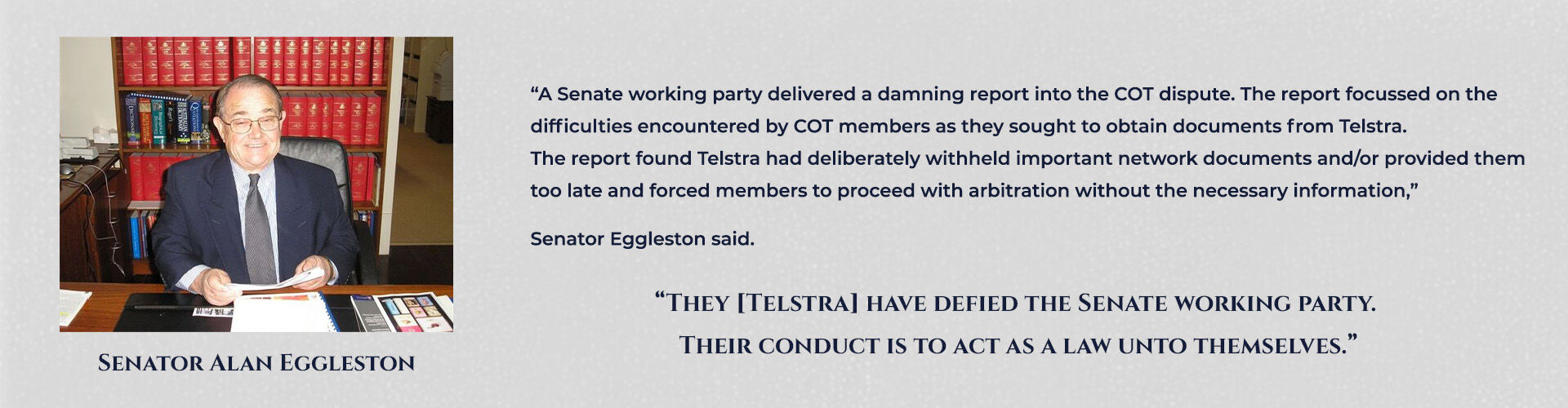
On 23 March 1999, after most of the COT arbitrations had been finalised and business lives ruined due to the hundreds of thousands of dollars in legal fees required to fight Telstra and a very crooked arbitrator, the Australian Financial Review reported on the conclusion of the Senate Estimates Committee hearing into why Telstra withheld so many documents from the COT Cases, even though government records show the COT Cases were promised this information would be provided to enable them to support their arbitration claims. Senator Eggleston told it as recorded below.
“A Senate working party delivered a damning report into the COT dispute. The report focused on the difficulties encountered by COT members as they sought to obtain documents from Telstra. The report found Telstra had deliberately withheld important network documents and/or provided them too late and forced members to proceed with arbitration without the necessary information,” Senator Eggleston said. “They have defied the Senate working party. Their conduct is to act as a law unto themselves.”
Is there more to why Telstra was allowed to destroy and fabricate arbitration defence documents, and why it was permitted access to COT Cases’ arbitration‑related material, access that enabled the screening of our documents and was tolerated by the government? Was this tolerance, which allowed Telstra’s arbitration defence unit to exploit fax‑hacking of our arbitration communications between the COT Cases and their advisors, what upset Steven after he read the Scandrett & Associates report referred to in The Benefit of the Doubt?
Hover over the following image to learn how long this systemic billing problem affected others in Australia.
Chapter 4 The New Owners Tell Their Story
As you move down this homepage, the truth does not emerge gently; it strikes. The deeper you scroll, the clearer it becomes how far the system went to crush ordinary Australians who dared to challenge Telstra, and the government bureaucrats who helped bury the truth behind my claims. Every section exposes another layer of concealment, another act of protection for Telstra, another betrayal of the citizens the very institutions were supposed to safeguard, who instead chose to shield corporate wrongdoing.
CHAPTER 19 — THE FAX SYSTEM COLLAPSE: How Technology Destroyed a Business
Telstra’s defective faxing system crippled your operations. They knew it, documented it, and hid it. The faults forced you to sell your Holiday Camp School Bus just to survive. This was commercial damage caused by technical thuggery.
Keyword cluster: fax system failure, telecommunications collapse, business destruction, concealed faults.
“On some significant issues, the Australian Parliament has ceased to be a place of effective lawmaking by the people, for the people”"It has become commonplace for Parliamentarians to see a marathon supernuanced career out with ideals sacrificed for ambition"
• Who were the government bureaucrats who condoned the bugging during the COT arbitrations?• Were they the same individuals, or perhaps their successors, who approved the bugging of Timor-Leste’s offices?
The Australian Federal Police (AFP) posed the following 93 questions to me, along with my responses, as detailed in Australian Federal Police Investigation File No/1. My answers reveal a disturbing truth: Telstra issued direct threats against me for daring to assist the AFP in its investigations into the interception of my phone conversations and the illicit hacking of documents related to my arbitration.
I have chosen, for the third time on the homepage of absentjustice.com, the wording The Weight of Treachery because nothing else captured the gravity of what occurred, the duplicity, the concealment, and the quiet sabotage that shaped my arbitration, the AFP disclosures, and the statement of 17 December 2014 discussed below:
“I still stand by my statutory declaration that I was able to identify that the incoming faxes provided to me for review had at some stage been received by a secondary fax machine and then retransmitted; this was done by identifying the dual time stamps on the faxes provided.” (Front Page Part One File No/14)
This was not a technical anomaly. It was a deliberate act — a breach carried out in silence, buried beneath procedural language, and left to contaminate the arbitration process. This kind of covert interference is what gives the phrase The Weight of Treachery its accuracy, its force, and its necessity.
The phrase reflects the burden carried when authorities, corporations, and their agents act in concert to suppress truth. It conveys the mass of accumulated deceit: the fabricated reports, the withheld evidence, the interference by outside interests, and the betrayal of citizens seeking justice. “Treachery” is not rhetoric; it is the precise description of what was done and the weight I was forced to bear.
The fax imprint across the top of the letter dated 12 May 1995 (Open Letter File No 55-A) is the same as the fax imprint described in the January 1999 Scandrett & Associates report provided to Senator Ron Boswell (see Open Letter File No/12 and File No/13), confirming faxes were intercepted during the COT arbitrations. One of the two technical consultants attesting to the validity of this January 1999 fax‑interception report emailed me on 17 December 2014, stating:
“I still stand by my statutory declaration that I was able to identify that the incoming faxes provided to me for review had at some stage been received by a secondary fax machine and then retransmitted, this was done by identifying the dual time stamps on the faxes provided.” (Front Page Part One File No/14)
Exhibits 646 and 647 (see AS-CAV Exhibits 589 to 647) make it clear that Telstra admitted in writing to the Australian Federal Police on 14 April 1994 that my private and business telephone conversations were listened to and recorded over several months, but only when a particular officer was on duty.
Does Telstra expect the AFP to accept that every time this officer left the Portland telephone exchange, the alarm bell set up to broadcast my telephone conversations throughout the exchange was turned off? What was the point of installing equipment connected to my telephone lines that only operated when this person was on duty?
When I asked Telstra under the FOI Act during my arbitration to supply me with all the detailed data obtained from this special equipment set up for this specially assigned Portland technician, that data was not made available during my 1994/95 arbitration, and it still has not been made available in 2026.
The Weight of Treachery
On 25 February 1994: When this letter to Telstra’s Corporate Secretary from Fay Holthuyzen, Assistant to the Minister for Communications, Michael Lee, (AS 772-a) is compared to the letter dated 3rd February 1994, Exhibit (AS 772-b) that I sent to the Minister’s office, it is clear that I was concerned that my faxes were being illegally intercepted.
On the same day, 25 February 1994, an internal Government Memo confirmed that the then-Minister for Communications and the Arts had written to advise that the Australian Federal Police (AFP) would investigate my allegations of illegal phone/fax interception. (AS 773)
On 3 March 1994, this article appeared in the Portland Observer newspaper (AS 773-b), noting:
“Federal Police officers are investigating allegations of possible illegal activity on the part of Telecom Australia.
Officers from the Federal Police visited Portland last week and interviewed Cape Bridgewater Holiday Camp proprietor, Alan Smith, who is one of the four original members of COT (Casualties of Telecom).”
Leading up to the signing of the COT Cases arbitration, on 21 April 1994, AUSTEL wrote to Telstra on 10 February 1994, stating:
“Yesterday we were called upon by officers of the Australian Federal Police in relation to the taping of the telephone services of COT Cases.
“Given the investigation now being conducted by that agency and the responsibilities imposed on AUSTEL by section 47 of the Telecommunications Act 1991, the nine tapes previously supplied by Telecom to AUSTEL were made available for the attention of the Commissioner of Police.”* → (See Illegal Interception File No/3)
I desperately needed the material locked behind those investigations. I was searching for the truth in a system that seemed designed to obscure it. The government had promised transparency, yet every door I pushed against felt reinforced.
Dr Hughes (the so-called independent arbitrator) appeared not to understand the urgency of my situation, particularly after Warwick Smith informed him that Telstra had not only admitted to wrongdoing but had also handed over nine audio tapes, tapes that proved Telstra had secretly recorded the telephone conversations of the first four COT Cases, of which I was one of the four.
Those tapes were not trivial. They were evidence of intrusion, surveillance, and a breach of privacy so severe it should have halted the entire arbitration process. They could have clarified who was recorded, how often, and why. They could have exposed the scale of Telstra’s misconduct. The four original COT cases were critical.
This evidence (nine audio tapes) raises important questions about Dr Hughes’s silence regarding my allegations of phone and fax interception. Despite clear records from AUSTEL and the TIO indicating that he was obligated under the arbitration agreement to address my claims and reach a conclusion, he chose not to comment. This apparent inaction adds to the suspicion surrounding the entire affair.
CHAPTER 20 — THE FINANCIAL STRANGULATION: How Costs Were Weaponised
You spent over $300,000 proving losses the government had already confirmed. Financial pressure became a deliberate tool of control. Arbitration became an economic punishment. This was coercion through calculated financial harm.
Keyword cluster: financial coercion, cost burden, economic pressure, arbitration exploitation.
Although this MICKY issue has been briefly discussed above, it was important to raise it again in this segment.
Part of the information the AFP was working on concerned the vanishing faxes described throughout this website, absentjustice.com, and it appeared my local Telstra technician, Gordon Stokes, was the go‑between with this person called “Micky.” Dr Hughes’ unethical conduct in supplying this type of information to Telstra’s Paul Rumble on 15 June 1994 was beyond contempt and ensured these issues were never investigated.
These threats were tied to a group of undesirables operating inside and around Telstra who behaved exactly like this “Micky” character who, after hacking into customer accounts, fed major organisations stolen credit details. That opened the door for those customers to receive fabricated renewal notices for services they had never purchased. It was a coercive loop: intimidate the customer, confuse them, then pressure them into paying for something they never agreed to. In my case, this same "Micky" supplied the names and phone numbers of my female single‑club patrons to online telephone crawlers which, as the AFP transcripts show, harvested their private information even when my clients called from interstate. The arbitrator's failure to investigate this, or even acknowledge it in his findings, suggests the arbitrator was not independent.
📠 A System Built on Silence - The Vanishing Faxes:
Exhibits 646 and 647 (see ) clearly show that, in writing, Telstra admitted to the Australian Federal Police on 14 April 1994 that my private and business telephone conversations were listened to and recorded over several months, but only when a particular officer was on duty.
This particular Telstra technician, who was then based in Portland, not only monitored my phone conversations but also took the alarming step of sharing my personal and business information with an individual named "Micky." He provided Micky with my phone and fax numbers, which I had used to contact my telephone and fax service provider (please refer to Exhibit 518, FOI folio document K03273 - ).
To this day, this technician has not been held accountable or asked to clarify who authorised him to disclose my sensitive information to "Micky." I am perplexed as to why Dr Gordon Hughes did not inquire with Telstra about this local technician’s actions. Specifically, why was he permitted to reveal my private and business details without any apparent oversight or justification?
Under the signed agreement, the arbitrator was required to address all my arbitration claim documents. He never raised the "Micky" affair, never confronted the fact that Telstra had already admitted to the AFP that my telephone conversations were intercepted without my authority, and never acknowledged that Telstra themselves named the local Portland technician, Gordon Stokes, as the man responsible. My arbitration concluded on 11 May 1995. Not long after, Stokes opened a shop in Portland. From the moment the AFP and I uncovered in 1994 what Stokes and this "Micky" character had been doing, I was forced to live with the knowledge that I would encounter Stokes constantly, as anyone would in a small rural town like Portland. I finally left Cape Bridgewater and Portland in 2019, broken, after suffering two heart attacks. No one in government, nor anyone from the AFP, has ever attempted to address this matter or provide closure.
The arbitrator made no finding in his award for the financial losses attributed to the years of bad publicity in both the Melbourne and local rural newspapers, as well as the television reports that repeatedly portrayed my holiday camp as a place where near‑death experiences were possible because no one could ring in or out. Various newspaper articles stated there was no privacy at my business, that telephone calls were being intercepted, and that even my faxes might have been compromised. The public was told that the camp was unsafe, that communication could fail at any moment, and that emergencies could not be managed. The AFP had already found evidence of interception, yet the arbitrator’s findings acknowledged none of this.
The damage from that publicity was not abstract. It destroyed trust, bookings, and the reputation of a business that had once been stable and respected. The arbitrator ignored all of it. He ignored the headlines, the broadcasts, the letters from organisations who refused to return because they feared the consequences of a failed telephone line. He ignored the fact that the public record had already condemned my business long before arbitration began.
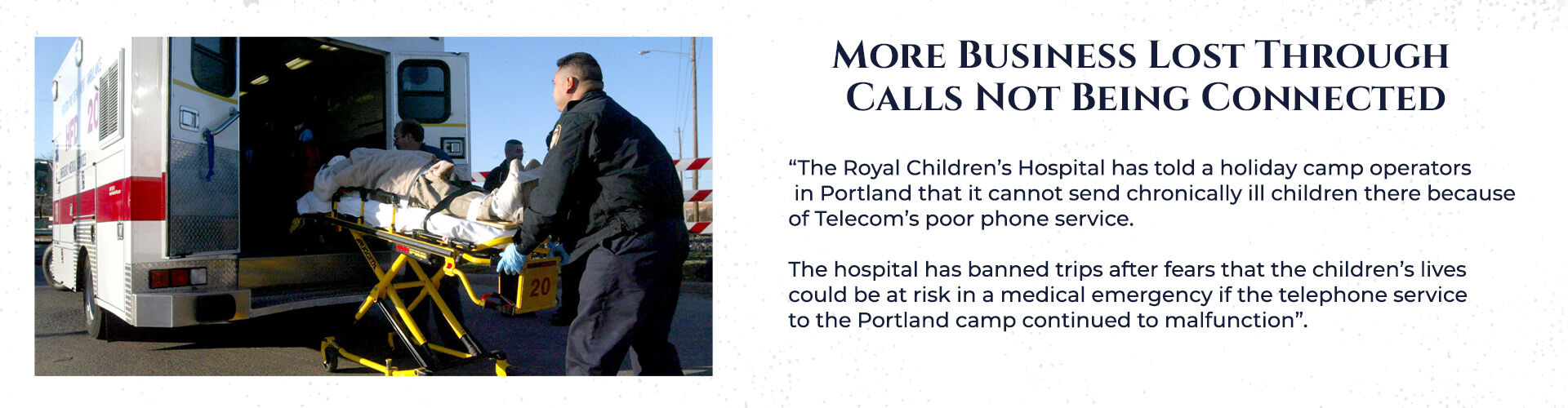
Children's lives could be at risk
Comments made in the Herald Sun newspaper dated 30 August 1993 confirm just how damaging some of these newspaper articles were to my already ailing business, with statements like:
“The Royal Children’s Hospital has told a holiday camp operators in Portland that it cannot send chronically ill children there because of Telecom’s poor phone service. The hospital has banned trips after fears that the children’s lives could be at risk in a medical emergency if the telephone service to the Portland camp continued to malfunction”.
The centre’s stand follows letters from schools, community groups, companies and individuals who have complained about the phone service at Portland’s Cape Bridgewater Holiday camp.”
Youths from the Royal Children’s Centre for Adolescent Health, who were suffering from “chronic illnesses”, visited the camp earlier this year.
Group leader Ms Louise Rolls said in a letter to the camp the faulty phones had endangered lives and the hospital would not return to the camp unless the phone service could be guaranteed” Arbitrator File No/90
After a distressing incident at the Melbourne Children’s Hospital, where a child suffering from cancer experienced a near-death situation, I found myself in the urgent position of transporting that child to the Portland Hospital, located eighteen kilometres away from my holiday camp. This harrowing event marked a turning point; only then did Telstra finally take my ongoing complaints about persistent telephone faults seriously.
During this challenging time, none of the 35 children, each battling their own cancer-related illnesses, had access to mobile phones, nor did the six or so nurses and caregivers attending to them. Mobile telephones struggled to function in Cape Bridgewater until 2004, a full eleven years after this incident. Back in 1993, mobile phones were virtually nonexistent in Australia, and businesses were not yet operating through computers and email, far beyond the timeline of my arbitration period.
Even after selling my business in December 2001, no hospital, where recovery and convalescence tended to be a significant source of revenue, ever visited my camp. The arbitrator overseeing my case failed to acknowledge the substantial financial losses I incurred as a result of years of harmful publicity. Both Melbourne and local rural newspapers, along with various television reports, repeatedly painted my holiday camp as a perilous place where near-death experiences occurred due to the inability to make or receive phone calls. The articles painted a troubling picture, suggesting there was a complete lack of privacy at my business, that telephone calls were subject to interception, and even implying that my faxes might have been compromised. As a result, public perception shifted: my camp was seen as unsafe, communication lines could collapse at any moment, and emergencies were deemed unmanageable.
The Australian Federal Police (AFP) had already uncovered concrete evidence of interception, yet the arbitrator’s findings turned a blind eye to it all. The damage inflicted by this wave of negative publicity was far from abstract; it shattered trust, destroyed bookings, and tarnished the reputation of a business that had once stood proud as stable and respected. The arbitrator disregarded the mountain of evidence, including alarming headlines, sensational broadcasts, and numerous letters from organisations that chose not to return for fear of unreliable phone connections. He completely overlooked the fact that the public record had condemned my business long before the arbitration proceedings began.
The AFP records reveal that the unlawful surveillance of my phone conversations and the tampering with my arbitration-related documents stretch back at least two years before the arbitration started. I find it hard to believe that any politician possessed the authority to sanction such invasions of my privacy during that time. So, which faceless bureaucrats in our government had the power to do so? Who in the powerful bureaucratic pen-pushing system of governance approved this intrusion into my personal conversations? Who decided that my private discussions and sensitive documents were theirs to intercept and exploit?
In the Sunday Herald Sun, dated 24 January 2026, British actor Liz Hurley revealed the harrowing impact of the phone‑hacking scandal that ensnared her alongside Hugh Grant. Both actors find themselves grappling with the fallout of their conversations being surreptitiously monitored for an extended period during the infamous News of the World scandal orchestrated by Rupert Murdoch. The same issue is reported to have haunted Prince Harry with trauma‑related flashbacks, tormented by the knowledge that his own private conversations were similarly compromised.
Yet the Australian Government has declined to acknowledge, as the British Government has, the long‑term effect of knowing your private and business lives are not so private.
oOo
Why hasn’t the Australian Government followed the British Government's lead and demanded Telstra pay punitive damages to the COT Cases, who can provide relevant AFP documentation showing Telstra intercepted their telephone conversations and hacked into their arbitration‑related faxes? The evidence exists. The violations are documented. And yet the government that endorsed the arbitration process refuses to confront the corporate misconduct it helped shield.
CHAPTER 21 — THE NATIONAL PATTERN: How Rural Australia Was Silenced
Your case was not isolated — rural customers across Australia suffered identical faults. Telstra buried the pattern to avoid national accountability. Silence became corporate policy. This was discrimination enforced through neglect.
Keyword cluster: rural discrimination, national failure, systemic neglect, widespread faults.
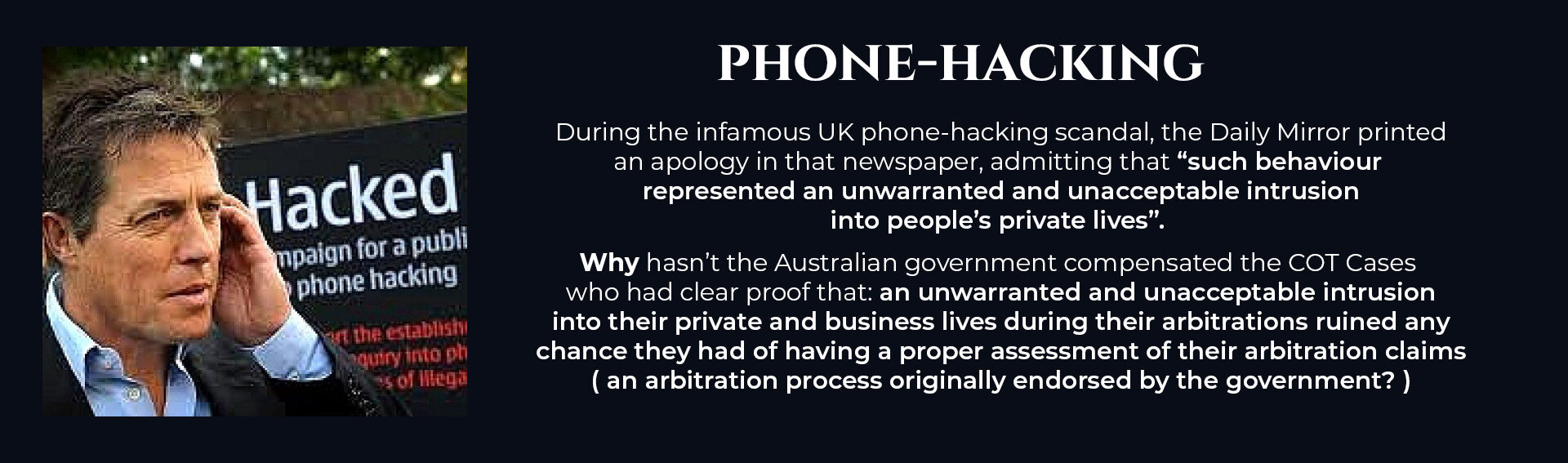
THE PEN‑PUSHER POWER BUREAUCRATS — AND THE RECKONING THAT FOLLOWED
Peta Credlin, once chief of staff to Australia’s 28th Prime Minister, Tony Abbott, and now a prominent media figure, wrote a piece in the Herald Sun on 23 May 2021 that didn’t just catch my attention; it hit like a flare fired into a night sky thick with smoke. Her headline carried a message that should have rattled the foundations of Parliament House;
"Beware The Pen Pusher Power - Bureaucrats need to take orders and not take charge”, which noted:“Now that the Prime Minister is considering a wider public service reshuffle in the wake of the foreign affairs department's head, Finances Adamson, becoming the next governor of South Australia, it's time to scrutinise the faceless bureaucrats who are often more powerful in practice than the elected politicians."
"Outside of the Canberra bubble, almost no one knows their names. But take it from me, these people matter."
"When ministers turn over with bewildering rapidity, or are not ‘take charge’ types, department secretaries, and the deputy secretaries below them, can easily become the de facto government of our country."
"Since the start of the 2013, across Labor and now Liberal governments, we’ve had five prime ministers, five treasurers, five attorneys-general, seven defence ministers, six education ministers, four health ministers and six trade Ministers.”
This article was quite alarming. It was disturbing because Peta Credlin, someone with deep knowledge of Parliament House in Canberra, has accurately addressed the issue at hand. I not only relate to what she presents, but I can also connect it to the many bureaucrats and politicians I have encountered since exposing what I did about the China wheat deal back in 1967, and the corrupted arbitration processes from 1994 to 1998. These government stuff-ups and cover-ups have cost lives.
The pen-pushing individuals Peta Credlin discussed in her commentary brought to mind the officials from 1967 who made the controversial decision to sell wheat to China, fully aware that some of this grain was being diverted to North Vietnam to sustain soldiers actively engaged in combat. This decision led to unimaginable suffering and loss for Australian, New Zealand, and American troops who were stationed perilously deep in the jungles of North Vietnam. The stark indifference these officials displayed towards the catastrophic consequences of their actions was shocking.
I found it painfully ironic to reflect on my own failure to intervene in the China-Vietnam trade. Here I was, twenty-seven years later, grappling with my urgent need for telephone service to manage my business effectively, while countless Australian, New Zealand, and American soldiers had been killed or maimed by North Vietnamese soldiers who possibly had a belly full of Australian wheat when they pulled the trigger, ending the lives of so many in North Vietnam.
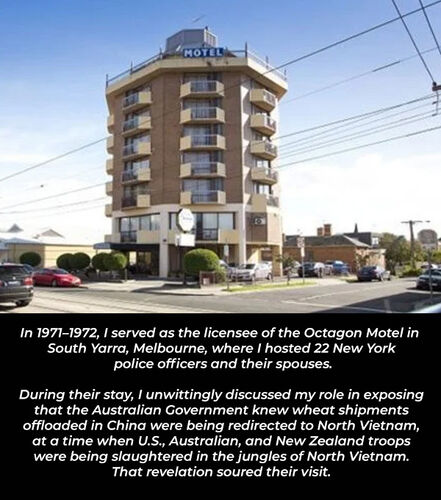
In 1972, I delivered a poignant speech on this very issue to 22 New York police officers and their wives at the Octagon Motel‑Hotel in South Yarra, Melbourne, where I outlined the disturbing details of the China–Vietnam wheat deal. No matter where I went, at sea or ashore, in hotels, restaurants, mining camps, or shearing sheds, it was the beatings I witnessed in China that stayed with me: the Red Guards smashing the faces of their own people, the splitting of noses on flat faces, the street assaults that have haunted me for decades.
Now, at 82 years of age in 2026, I have been forced to compartmentalise that part of my life under the heading "Flashbacks – China-Vietnam". The emotions and sensations from fifty‑seven years ago remain raw and unresolved. It should not be the main part of my story, yet it sits there for those who wish to understand what I lived through between June and September 1967.
Although I have discussed this Peta Credlin media release above, it is most significant that I again raise it here.
Peta Credlin's cautionary statement, “Beware of the pen pusher power—bureaucrats need to take orders and not take charge,” strikes a chord with me on many levels. She highlights the significant risks of unchecked bureaucratic authority, a point vividly illustrated by a troubling historical episode. During a critical moment, these bureaucrats made the controversial decision to prioritise the need to provide aid to a starving China, all while neglecting the lives of our courageous service personnel and their allies who were valiantly fighting in the treacherous jungles of North Vietnam. This stark contrast highlights the potential consequences of bureaucratic leaders who take control rather than follow directives intended to safeguard Australian lives.
“Now that the Prime Minister is considering a wider public service reshuffle in the wake of the foreign affairs department's head, Finances Adamson, becoming the next governor of South Australia, it's time to scrutinise the faceless bureaucrats who are often more powerful in practice than the elected politicians.”
Then she stripped away the last layer of comfort:
“Outside of the Canberra bubble, almost no one knows their names. But take it from me, these people matter.”
And finally, the line that should have jolted every Australian upright:
“When ministers turn over with bewildering rapidity, or are not ‘take charge’ types, department secretaries, and the deputy secretaries below them, can easily become the de facto government of our country.”
She backed her warning with numbers that read like a casualty list: five prime ministers, five treasurers, five attorneys‑general, seven defence ministers, six education ministers, four health ministers, six trade ministers. A political merry‑go‑round spinning so violently that the unelected power beneath it didn’t even need to break stride.
This wasn’t political theatre. It was a government insider finally admitting what many of us had known for decades: that Australia’s democracy has been quietly hollowed out from within. That the real power, the enduring power, sits not in the hands of the elected, but in the hands of those who never face the public, never face an election, and never face consequences.
Credlin’s warning didn’t come early. It came far too late. By the time she wrote those words, the rot had already seeped through the country. Trust had thinned to a thread. Ordinary Australians were beginning to realise that the government they voted for wasn’t always the government that governed them. The machinery behind the curtain had grown bold, entrenched, and disturbingly comfortable.
CHAPTER 22 — THE POLITICAL SHIELD: How Ministers Protected Telstra
Political pressure softened findings and diluted reports. Ministers shielded Telstra from accountability. Government protectionism became part of the cover‑up machinery. This was political corruption in plain sight. The chilling reality took form on September 18, 1965, when I disembarked from the Hopereak in Sydney, having nearly been shot for spying.
Keyword cluster: political interference, ministerial shielding, government protectionism, regulatory compromise.
BLACK JACK — AND THE LIE THAT NEVER STOPPED HURTING
Despite what AI summaries and modern reinterpretations would suggest, the post‑World War II Soldier Settlement Scheme was never a broad social program. It was exclusive, brutally exclusive. Only discharged members of the armed forces who had completed specific periods of active or honourable service could apply. Civilians were shut out entirely. The scheme rewarded service, and if you hadn’t worn the uniform, you didn’t qualify. It was that simple.
At the centre of this story stands Sir John “Black Jack” McEwen, Australia’s 18th Prime Minister for twenty‑three days after Harold Holt vanished beneath the waves. McEwen was no Liberal; he led the Country Party, now the Nationals. He enlisted in the 1st AIF in August 1918, but the war ended before he could be sent overseas. Still, his enlistment alone qualified him for the soldier‑settlement scheme. He received a 35‑hectare dairy block in Stanhope, deep in the Goulburn Valley. That land set him up for life.
And this same “Black Jack” would later stand at the centre of a personal turmoil that tore apart the futures of sixteen British seamen, myself included, the only Australian among them, having become an Australian citizen two years earlier. We dreamed of choosing our next British ship, of continuing our careers with dignity. Instead, we were forced to confront a nightmare: being ordered back to Communist China aboard the Hopepeak, knowing full well that the humanitarian wheat Australia was supplying might end up feeding the North Vietnamese army. The same army killing and maiming Australian, New Zealand, and American troops in the jungles of North Vietnam.
We had seen the truth with our own eyes. We had watched the wheat unloaded in China. We had watched some of it quietly redeployed northwards. We knew what it meant. We knew who it would feed. And we knew what those soldiers, our soldiers, were facing in the jungle.
If Black Jack had taken the courageous step of revealing what we witnessed, everything could have been different. If he had told the British and Australian press what happened aboard the Hopepeak, the last fifty‑six years of my life might have unfolded with clarity instead of confusion, with justice instead of suspicion, with understanding instead of silence. Instead, he chose concealment. He chose political convenience. He chose the narrative that suited him.
For more than half a century, I have lived under the weight of McEwen’s deception, which began in September 1967 and has never stopped echoing. And as if that burden were not enough, the misleading claims made by the COT arbitrator since 1994 have compounded it, layer upon layer, year upon year. Two betrayals, decades apart, converging into one long, unbroken line of injustice.
This is the truth I expose on my website. Not speculation. Not theory. But lived experience, and the treachery that shaped it
The power that Credlin described within the intricate bureaucratic machinery was formidable, capable of undermining ministers, manipulating procedural outcomes, and shrouding inconvenient truths in a veil of secrecy. This influence played a crucial role in determining who received justice and who was quietly overlooked. My relentless pursuit of the truth persisted well beyond October 2008, even as the government repeatedly failed to respond to my requests for crucial documents.
And now, in 2026, you can see the tremors everywhere. Minor political parties, once dismissed as fringe curiosities, are rising with a kind of desperate clarity. They are not whispering about corruption; they are shouting about it. They point to the same patterns Credlin described: the same bureaucratic overreach, the same institutional arrogance. They are saying what the major parties refuse to confront.
Some of them direct Australians to rigorously documented sites like absentjustice.com, where every claim is backed by hard evidence, downloadable documents, sworn statements, and the voices of whistleblowers who speak not out of malice, but out of a fierce love for their country. These voices have been warning us for decades. They were ignored. Now they are being rediscovered.
And the question hangs in the air like smoke from a fire no one wants to admit is burning: view almost, but not all of my China story attached to Flash Backs – China-Vietnam.
🌏 The Central Question: Did My 1967 China Disclosure Influence the COT Arbitration?
Behind the COT arbitration is a broader question that has remained unresolved for decades.
In 1967, while serving aboard the Hopepeak, I reported what I believed was the diversion of Australian humanitarian wheat shipments in China for purposes connected with the war in Vietnam. I raised my concerns with the Commonwealth Police and with Malcolm Fraser, who was then Minister for the Army.
I have never received a satisfactory explanation of how those reports were handled. I therefore ask whether my 1967 disclosure placed me on a government or institutional watch list, or whether it later influenced the way government officials and agencies dealt with me during my dispute with Telstra.
I do not present that connection as an established fact. At this stage, it is a question arising from the chronology and the documentary record.
Two possible explanations
The evidence may ultimately support one of two broad explanations.
The first possibility is that my earlier disclosure about the wheat shipments contributed to discriminatory or retaliatory treatment during the COT arbitration. Under this interpretation, officials or institutions may have treated me differently because I had previously challenged government conduct and raised politically sensitive information.
The second possibility is that the treatment I experienced during the arbitration was not unique to me. It may reflect the way government agencies treated citizens who challenged the performance of a government-owned telecommunications carrier, particularly where the dispute involved allegations of service failures, regulatory inaction, and financial loss.
Telstra was the government telecommunications carrier and operated under a public licence to provide telecommunications services. My dispute therefore raised more than a private commercial complaint. It raised questions about whether the government, its agencies, and its regulatory bodies were prepared to hold the carrier accountable when its services allegedly failed.
What happened during the arbitration
These six Senators' statements are directly linked to the Australian Senate archives, as will be observed when clicked on: → → →
Eggleston, Sen Alan – Bishop, Sen Mark – Boswell, Sen Ronald – Carr, Sen Kim – Schacht, Sen Chris, Alston Sen Richard.
These Senate archives show that, during the COT case arbitrations and long after, six Senators uncovered a pattern that could not be dismissed as error or oversight. Their findings revealed that:
- relevant documents were withheld or not placed before the arbitrator;
- evidence concerning wider network failures was not properly examined;
- ongoing fault reports were treated as unreliable despite material supporting them;
- the arbitration arrangements and consultant protections were not fully disclosed;
- concerns raised with government agencies were not adequately investigated; and
- the COT cases were portrayed as unreasonable or vexatious rather than treated as a citizen seeking accountability.
If these events resulted from my earlier political disclosures, they may indicate targeted discrimination or retaliation for why my issues remain unresolved.
In modern Australia, two disasters stand as monuments to bureaucratic failure: Robodebt and the Pink Batts scheme. Both were sold as efficient, technocratic solutions. Both descended into lethal chaos. And both left behind a trail of suicides, shattered families, and a public service that simply walked away, faceless, untouched, unaccountable. The operators who designed these systems, ignored warnings, and watched the human toll rise remained in their offices, their careers intact, their reputations protected by the machinery that shields its own.
These failures were not isolated. They belong to a long lineage of government‑sanctioned negligence. The COT Cases lived through an earlier version of the same culture: a bureaucracy that refused to confront Telstra’s systemic telephone faults, even as those faults destroyed businesses, marriages, and livelihoods. While ordinary Australians were ruined, the powerful, Rupert Murdoch and FOX among them, were rewarded, protected, and prioritised. The message was unmistakable: influence mattered, citizens did not.
Look overseas, and the pattern repeats. The British Post Office scandal, hundreds of innocent sub‑postmasters accused, bankrupted, imprisoned, was not a mistake. It was a bureaucratic offence committed against its own people, identical in spirit to Robodebt, Pink Batts, and the COT debacle. Lives were broken. Some never recovered. Some never survived.
This is why the 1967 China Wheat Deal matters. This is why Telstra intercepted my telephone conversations with former Prime Minister Malcolm Fraser in 1993 and again in 1994. When I asked Fraser to help expose Telstra’s conduct during my arbitration, Telstra was already documenting our conversations. If the information removed from my FOI releases was not China-related, what else could possibly have been removed? What else did bureaucrats decide the arbitrator must never see?
In Australia, the cover‑up is never an accident. It is the system.
Frank Blount’s 1999 admission that Telstra’s billing software was substandard and affected by systemic problems raises questions that cannot simply be dismissed as historical technical difficulties. If a company knows that its billing technology is unreliable, the consequences extend far beyond computers and software. They reach directly into the lives of the people whose money, businesses and legal rights depend upon those systems being accurate.
This is where the warning contained in the Post Office scandal becomes much larger than the Post Office itself.
A computer does not have to be deliberately dishonest to produce a devastatingly false result.
But once an institution treats that result as unquestionable, the consequences can become indistinguishable from deliberate wrongdoing.
The machine produces the number.
The institution gives the number authority.
The individual is then forced to prove that the machine is wrong.
That is the danger.
And today, as artificial intelligence is increasingly placed in positions of authority, the lesson becomes even more urgent. AI systems may be vastly more sophisticated than the software of previous generations, but sophistication is not the same thing as infallibility.
When technology is wrong, institutions must be able to question it. When evidence contradicts the machine, the evidence must be investigated. And when people's lives depend upon the answer, technological authority can never become a substitute for justice.
The British Post Office scandal demonstrates what can happen when that principle fails.
The COT material raises the question of whether Australia witnessed a disturbing version of the same problem.
And that is why these two stories deserve to be examined together.
CHAPTER 23 — THE REGULATOR’S RETREAT: How Oversight Collapsed
Regulators softened conclusions and avoided confrontation. Oversight became complicity. Accountability dissolved under political and corporate pressure. This was regulatory failure bordering on fraud.
Keyword cluster: regulatory failure, oversight collapse, institutional retreat, compromised findings.
The Unanswered Question of Surveillance and Humanitarian Principle
An independent investigation should have examined the authority under which officials involved in my arbitration were permitted to disregard fundamental principles of procedural fairness, natural justice, and humanitarian accountability.
I refer to Footnotes 83 and 169 in Tianxiao Zhu’s paper because they relate to the ethical standards associated with Canada and the moral choices Canadian citizens made during the Vietnam War. The historical material is significant for two reasons.
First, when the Canadian Government learned what had occurred during my Australian Government-endorsed arbitration, it appeared willing to assist me at a time when Australian authorities had declined to take an effective position. That response contrasted sharply with Australian institutions' refusal to confront the issues raised by the evidence.
Second, the historical record includes the 1967 decision of Canadian seamen who reportedly refused to crew a vessel carrying wheat to China because they feared that the shipment might support forces involved in the Vietnam War. Their action reflected a willingness to accept personal and professional consequences rather than participate in conduct they believed conflicted with their moral responsibilities.
This history is relevant to my own experience because, in 1993 and again in 1994, I spoke with former Australian Prime Minister Malcolm Fraser about my experiences in China in 1967. Telephone records relating to those conversations later appeared in Telstra files released during my 1994–95 arbitration. However, the sections recording the substance of my discussions with Mr Fraser were redacted.
That fact has never been adequately explained.
Why were conversations with a former Prime Minister recorded in Telstra’s files? Who authorised that recording or retention? Why was the discussion concerning my experiences in China considered sensitive enough to be withheld? And how did material relating to events in 1967 become relevant to an arbitration concerning telecommunications services more than two decades later?
At the time, some people treated my account of what had occurred in China as fabricated. It was suggested that my fellow seaman and I had invented or exaggerated our experiences. Yet the material identified in Zhu’s paper, including the sources cited in Footnotes 83 and 169, provides historical context that appears consistent with the broader account we had given.
That material did not, by itself, resolve every factual question. It did, however, demonstrate why our claims should not have been dismissed without proper examination. It also raised a further concern: whether information about my past activities and political or humanitarian views was collected, recorded, or used in a manner unrelated to the proper conduct of the arbitration.
An independent inquiry should determine whether the material was collected lawfully, whether it was relevant to the arbitration, whether it was used to prejudice my credibility, and whether officials breached their obligations of fairness and accountability.
Footnote 83, 84 and 169 → in a paper submitted by Tianxiao Zhu to The Faculty of the University of Minnesota titled Secret Trails: FOOD AND TRADE IN LATE MAOIST CHINA, 1960-1978, etc → Requirements For The Degree Of Doctor Of Philosophy - Christopher M Isett June 2021
Tianxiao Zhu's Footnotes 83,84 and 169:
In September 1967, a group of British merchant seamen quit their ship, the Hope Peak, in Sydney and flew back to London. They told the press in London that they quit the job because of the humiliating experiences to which they were subjected while in Chinese ports. They also claimed that grain shipped from Australia to China was being sent straight on to North Vietnam. One of them said, “I have watched grain going off our ship on conveyor belts and straight into bags stamped North Vietnam. Our ship was being used to take grain from Australia to feed the North Vietnamese. It’s disgusting.”
84. The Minister of Trade and Industry received an inquiry about the truth of the story in Parliament, to which the Minister pointed out that when they left Australia, the seamen only told the Australian press that they suffered such intolerable maltreatment in various Chinese ports that they were fearful about going back. But after they arrived in London, Vietnam was added to their story. Thus the Minister claimed that he did not know the facts and did not want to challenge this story, but it seemed to him that their claims about Vietnam seemed to be an “afterthought.”
169. "...In Vancouver, nine sailors refused to work on a grain ship headed to China: two of them eventually returned to work, and the others were arrested. Just when the ship was about to sail, seven more left the ship but three of them later returned to work. In Sydney, six Canadian sailors left their ship; they resigned and asked to be paid, but the Australian immigration office repatriated them. At that time, a grain ship usually had crew members of about 40 people. A British ship lost the Chief Officer and sixteen seamen, who told journalists that if the ship were going to the communist countries, they would rather go to jail than work on the ship."
The Canadian's and their Moral Code of Ethics

By hovering your mouse over the Canadian flag image below, you can also learn about the strong ethical principles upheld by Canadian seamen. Despite facing significant challenges, they believed that sending wheat to Communist China, especially when that wheat was being redeployed to North Vietnam, a country at war with Australia, New Zealand, and the USA, where hundreds of troops were being killed or maimed, was immoral and unethical, and therefore should not have been continued.
A Dark Warning for Australia — And Every Western Democracy
When I look back to 1967, when I exposed the China wheat scandal, Australian wheat being rerouted through Communist China to feed North Vietnamese troops who were killing our own soldiers, I see the same pattern that later poisoned the COT arbitrations between 1994 and 1998. The same architecture of failure. Government missteps. Bureaucratic cowardice. Cover‑ups disguised as “process.” And ordinary people, especially those in impoverished communities, left to absorb the damage.
Redacted Records, Police Questions, and the Human Cost
The redactions were not merely administrative omissions. At the very least, they raised questions about who accessed the records, why references to my conversations with former Prime Minister Malcolm Fraser were removed, and what relevance those conversations were considered to have in a telecommunications arbitration.
The documents appeared to connect a 1994 exchange with Mr Fraser to events dating back to my experiences in China and North Vietnam in 1967. If Telstra personnel had identified, extracted, or relied upon that historical information, the process required explanation. The records raised the possibility that information about my past had been collected or retained for purposes unrelated to properly resolving my telephone complaints.
The Australian Federal Police (AFP) put the following 93 questions to me, together with my responses, as recorded in Australian Federal Police Investigation File No/1. I reproduce them because they document the questions investigators considered important and my account of what occurred.
My responses describe alleged threats made by Telstra after I assisted the AFP with inquiries concerning the interception of my telephone conversations and the alleged unauthorised access to documents connected with my arbitration. These matters remain allegations recorded in the investigation material and should be assessed against the underlying documents, witness evidence, and any conclusions reached by the relevant authorities.
The concerns extended beyond my own account. The AFP was reportedly aware of media coverage concerning Mr Fraser’s requests for an explanation from Telstra about why private conversations between us appeared in Telstra’s records. Copies of material supplied to Mr Fraser had also been redacted. The central issue was therefore not simply that information had been withheld, but why conversations involving a former Prime Minister had been recorded in the first place and why the relevant passages were subsequently removed.
John Wynack, then Director of Investigations at the Commonwealth Ombudsman, wrote to Telstra in May and again in November 1994 seeking explanations. The questions attributed to those communications included:
- Why had Telstra recorded or noted conversations between me and Mr Fraser?
- Why had references to those conversations been redacted from the FOI material?
- Why did records connected with events in 1967 appear in a 1994 arbitration file?
- Who authorised the collection, retention, or removal of that information?
- Was the material used in assessing my credibility or conduct?
The AFP reportedly raised similar concerns about removing references to my conversations with Mr Fraser from the FOI release. The fact that these issues attracted investigative attention does not, by itself, establish that a criminal offence occurred. It does, however, show that the handling of the records was sufficiently unusual to require a documented explanation.
The psychological consequences were severe. Reading the FOI material triggered flashbacks, intrusive memories, and intense fear associated with the events surrounding China and North Vietnam. The arbitration was supposed to concern telephone faults and their effect on my business. Instead, the documents appeared to draw me back into a traumatic period that I believed had no proper place in the proceedings.
I received counselling from two clinical psychologists, Dr Bernard in Melbourne and Ms Francolm in south-west Victoria. Their involvement is relevant because it records the personal consequences of the dispute, rather than merely its administrative history. The issue was not ordinary distress about an unfavourable decision. For me, the arbitration and the documents associated with it became associated with the re-emergence of traumatic memories that had remained largely dormant for decades.
The FOI material therefore raised two connected issues.
First, it required an explanation of how information about my conversations with Mr Fraser and my experiences in 1967 appeared in Telstra’s records.
Second, it required an explanation of why that information was redacted, whether it was considered or used during the arbitration, and whether its collection and handling complied with applicable legal and administrative obligations.
The documents do not, on their own, prove who authorised the alleged surveillance, why the records were created, or whether the information influenced the arbitration. They do, however, establish a documentary trail that should be independently examined.
CHAPTER 24 — THE INTERNAL MEMOS: How Telstra Documented the Truth
Telstra’s internal memos admitted the faults, the failures, and the consequences. Their private records contradicted their public denials. The truth lived inside the corporation even as they lied to the public. This was deception proven by their own handwriting. The truth surrounds my letter to the People's Republic of China. Fear of death is stronger than the desire to be a hero.
Keyword cluster: internal admissions, corporate knowledge, memo evidence, contradiction.
Murdered for Mao: The killings China ‘forgot’
My Letter, the Truth, and the Waiting
In August 1967, I found myself in a situation so surreal and perilous that it has remained vivid throughout my life. I was aboard a cargo ship in China, under constant observation by Red Guards positioned around the vessel. They were stationed about thirty paces apart and remained on duty day and night.
After being pressured into writing a confession describing myself as a United States aggressor and supporter of Chiang Kai-shek, the second steward told me that I might receive a response to a letter within two days. The response, he said, would come from the head of the Red Guards.
He quietly suggested that I write to my parents.
I followed his advice and wrote 22 foolscap pages. It was not an ordinary letter. I believed I might not survive the week, and I wanted my parents to know who I was in case I never returned home.
I told them that the woman they believed was my landlady was, in fact, my lover. She was 42; I was 18. She had been an important source of stability in my life between 1963 and 1967. I also wrote about life at sea, the loneliness, the confusion, and the fear surrounding my detention.
Writing the letter gave me a way to speak honestly at a time when I had been forced to make a statement I did not believe represented the truth.
A Tray of Leftovers and a Silent Exchange
As ship’s cook and duty mess-room steward, I saw the conditions around us at close range. The crew ate on deck, sometimes balancing plates on handrails. We were transporting grain to China for humanitarian purposes, yet food was routinely discarded while people nearby appeared to be suffering from severe deprivation.
Half-eaten sausages, steaks, and baked potatoes were thrown into the sea. There were no seagulls. I saw no fish. The absence of wildlife was itself a reminder of how severe the conditions appeared to be. Hunger was not an abstract political concept. It was visible in the faces and behaviour of the people watching us eat.
After my arrest, I was placed under what I understood to be house arrest aboard the ship. On one occasion, I filled a small metal tray with edible leftovers, food that otherwise would have gone into the stockpotand placed it on a bench on deck. I patted my stomach to suggest that I had already eaten and then walked away.
Approximately ten minutes later, the tray had been emptied.
At the next meal, I repeated the gesture, leaving enough food for perhaps three or four Red Guards. I returned later to find the tray empty. I continued doing this for another two days while waiting for a response to my letter.
During that period, the Red Guard who had previously woken me every hour stopped doing so. The atmosphere remained tense, but the immediate pressure appeared to lessen.
I cannot know why. The forced confession did not protect me. I do not know whether the letter influenced anyone, whether anyone received instructions, or whether the change was simply coincidental. Perhaps it was luck. Perhaps the food mattered. Perhaps a small act of compassion created a moment of recognition between people trapped on opposite sides of a political crisis.
All I know is that I offered food without negotiation or expectation. It was a silent gesture that conveyed something simple:
I see you. I know you are hungry. I know you are human.
I have never claimed that this gesture alone explains what happened next. But it remains one of the clearest memories of that period—and one of the few moments in which fear gave way, however briefly, to human connection.
Humanitarian Aid, War, and the Burden of Silence
My journey is inseparable from the experiences of Australian soldiers, and of our allies from New Zealand and the United States, who served and died during the Vietnam War. Time has done little to lessen the trauma or guilt carried by my fellow crew members aboard Hopepeak and me. Whenever we hear of humanitarian workers being injured or killed while trying to deliver relief, those reports awaken memories of our own past. The pain does not disappear; it merely becomes quieter until something brings it back.
Those who risk their lives to provide humanitarian assistance deserve our deepest respect. They do more than deliver food, medicine, and protection. In moments of crisis, they show that compassion can survive amid violence. The Australian Government’s criticism of Israel following the deaths of humanitarian workers in Gaza in 2024 was, in my view, necessary and justified. Aid workers should never be treated as expendable. Their lives must be protected, and any credible allegation that they were unlawfully targeted must be investigated transparently.
Memorial occasions such as Anzac Day also bring complicated emotions to the surface. There is grief, but also isolation, guilt, and the persistent feeling that important truths were not communicated when they might still have mattered. Between 1965 and 1967, I became increasingly concerned that wheat sent from Australia to Communist China as humanitarian assistance could be diverted or used in ways that indirectly supported North Vietnam’s war effort. I believed this created a serious moral and strategic question: whether supplies provided in the name of humanitarian relief might ultimately assist forces fighting Australian, New Zealand, and American personnel.
That concern was not merely a private thought. On 18 September 1967, I raised it with the Commonwealth Police, now the Australian Federal Police, in a letter addressed to the Hon. Malcolm Fraser, then Minister for the Army and later Prime Minister of Australia. The letter was acknowledged. To my knowledge, however, I never received a substantive response.
At the time, I was the only Australian seaman aboard the British-manned Hopepeak. I was arrested in China and subjected to an atmosphere of intimidation. I was pressured into admitting that I was a United States aggressor and a supporter of Chiang Kai-shek, who was then living in exile in Taiwan. Whether viewed as a political detention, a coercive interrogation, or an episode whose full circumstances remain contested, the experience left a permanent mark on my life.
My account, China-Flash-Back-AFP Investigation -2 records how several British seamen and I raised concerns after Hopepeak dismissed us for refusing to deliver another shipment of wheat to China. We believed that some of the wheat could reach people supporting the North Vietnamese war effort. I cannot establish every subsequent destination of that cargo, and I do not present my interpretation as settled historical fact. But the concern was serious enough to report, and the absence of a meaningful response remains deeply troubling.
The issue extends beyond my own experience. It also raises questions about the seamen in Vancouver, Canada, who reportedly took comparable action, even though Canada was not engaged in the same direct military conflict with North Vietnam. Their experiences deserve examination as part of the wider history of humanitarian shipping, political pressure, and conscience during the Vietnam era.
The phrase “humanitarian aid” should represent compassion, neutrality, and the protection of human life. It should not be used to avoid difficult questions about how supplies are controlled, where they ultimately go, or whether governments have adequately investigated warnings raised by those directly involved.
How could Australia describe wheat shipments to Communist China as humanitarian assistance while failing to address concerns that some of that assistance might indirectly support forces engaged in a war against Australian and allied personnel?

I asked that question in 1967. My letter was acknowledged, but I never received a substantive answer, not then and not in the decades that followed.
That silence remains one of the most disappointing chapters in my long search for truth. It is also why I believe the historical record should be reopened, the surviving documents made available, and the testimony of the seamen involved treated with the seriousness it deserves.
Vol. 87 No. 4462 (4 Sep 1965) - National Library of Australia https://nla.gov.au › nla.obj-702601569
"The Department of External Affairs has recently published an "Information Handbook entitled "Studies on Vietnam". It established the fact that the Vietcong are equipped with Chinese arms and ammunition"
If it is right to ask Australian youth to risk everything in Vietnam it is wrong to supply their enemies. The Communists in Asia will kill anyone who stands in their path, but at least they have a path."
Australian trade commssioners do not so readily see that our Chinese trade in war materials finances our own distruction. NDr do they see so clearly that the wheat trade does the same thing."
CHAPTER 25 — THE FAULT LOGS: The China FOI documents were being withheld.
Thousands of PCM errors per hour. Exchange collapse. Catastrophic failure. Fault logs showed a system in freefall — logs Telstra hid from arbitration. This was technical evidence buried like a crime scene.
Keyword cluster: PCM errors, exchange collapse, catastrophic faults, concealed logs. The missing China files: Three years on, and the Commonwealth Ombudsman is still looking for the China files I requested???
The Missing Arbitration Files on China and my request for documents:
Between March 1994 and 4 October 1997, I sought access to Telstra’s arbitration file under the Freedom of Information Act concerning my arbitration, and Mr John Wynack, then Director of Investigations for the Commonwealth Ombudsman, assisted me.
We jointly discussed that Telstra’s arbitration file could help answer several critical questions:
- Who prevented me from proving my claims?
- Who authorised the interception of my telephone conversations, which Telstra acknowledged to the Australian Federal Police in April 1994?
- Why did AUSTEL receive a copy of the Portland/Cape Bridgewater logbook when my arbitration team did not?
- What happened to the documents generated during the arbitration?
- Why was I denied access to material directly relevant to my case?
Telstra claimed that the arbitration file had been destroyed. However, Home Page File No/82 indicates that Mr Wynack did not accept that explanation. If the file had been destroyed, when was it destroyed, by whom, and under whose authority? If it still existed, why was it not disclosed?
I also tried to obtain a copy of the arbitration file held by the Telecommunications Industry Ombudsman.
Under the arbitration arrangements, the TIO acted as the process administrator and was required to receive the arbitration documents. This included my request to the arbitrator asking him to obtain and examine the Portland/Cape Bridgewater logbook.
If the TIO received those documents in its administrative capacity, I understood that it was required to retain them for the relevant retention period—at least six years, which would have extended to 2002. The existence, preservation, and later availability of that file therefore raise important questions.
The questions I ask visitors to consider
- Did Telstra retain the complete arbitration file after the arbitration ended?
- If the file was destroyed, when did that occur and who authorised its destruction?
- Did Telstra’s file contain records concerning the alleged interception of my telephone conversations?
- Why was the Portland/Cape Bridgewater logbook provided to AUSTEL but not to my arbitration team?
- Did the TIO retain the documents it received as arbitration administrator?
- If the TIO retained them, why could I not access them?
- Do the missing files conceal evidence about how my arbitration was conducted?
I am not asking visitors to accept my interpretation without reviewing the original records. I am asking whether Telstra's and the TIO's explanations are consistent with their responsibilities as participants in, or administrators of, the arbitration process.
The central issue is this:
Were the arbitration files genuinely lost or destroyed, or did their disappearance prevent the disclosure of evidence that might have shown how my claims were handled and why relevant material was withheld?
These questions are important because the missing records may help establish whether the failures in my arbitration resulted from administrative error, inadequate recordkeeping, institutional protection, or deliberate concealment. Only an independent examination of the original FOI correspondence, Ombudsman records, TIO files, Telstra’s retention records, and the arbitration documents can resolve that issue.
CHAPTER 26 — THE RECORDED LIE: How Customers Were Misled
The false disconnection message destroyed customer confidence. Deception became a technical feature. Every call carried a lie engineered to damage your business. This was fraud delivered through the telephone line.
Keyword cluster: false messages, customer deception, recorded lie, business damage.
THE TREACHERY CONTINUES
Page 12 of the AFP transcript of my second interview (Refer to Australian Federal Police Investigation File No/1) shows Questions 54 to 58, the AFP stating:-
“The thing that I’m intrigued by is the statement here that you’ve given Mr Rumble your word that you would not go running off to the Federal Police etcetera.”
From the moment those words were spoken, the façade of a fair arbitration collapsed. What followed was not a legal process; it was an ambush. I understood there were only two possible outcomes: either I would obtain the documents needed to prove Telstra’s unlawful conduct, or I would be left stranded, stripped of the very evidence the arbitrator required to assess my claims. Telstra made sure it was the latter.
The turning point came on 26 September 1994, when AFP officers returned to Cape Bridgewater. Their tone had changed. Their questions were sharp, urgent, and aimed directly at my correspondence with Paul Rumble, Telstra’s main liaison officer and the man who had already threatened me for assisting the AFP. The officers made it clear: if I refused to cooperate, their investigation would pivot entirely to the unresolved telephone interception issues plaguing the COT Cases. They claimed those issues “assisted the AFP in various ways.” I knew what that meant: pressure, leverage, and danger.
I contacted Senator Ron Boswell immediately. He took those threats into the Senate, forcing the nation to confront Telstra’s treachery.
TELSTRA AT ITS WORST
On page 180, ERC&A, from the official Australian Senate Hansard dated 29 November 1994, Senator Ron Boswell confronted Telstra’s legal directorate with a question that should have detonated the arbitration process:
“Why did Telecom advise the Commonwealth Ombudsman that Telecom withheld FOI documents from Alan Smith because Alan Smith provided Telecom FOI documents to the Australian Federal Police during their investigation?”
Telstra’s response was hollow — a lie so transparent that the senator, the AFP, and I all recognised it instantly. Senator Boswell pressed harder:
“…Why would Telecom withhold vital documents from the AFP? Also, why would Telecom penalise COT members for providing documents to the AFP which substantiate that Telecom had conducted unauthorised interceptions of COT members’ communications and subsequently dealt in the intercepted information by providing that information to Telecom’s external legal advisers and others?”
The threats were no longer implied. They were real. They were public. And they were lethal to any notion of justice.
What is unforgivable is that no one, not the TIO, not the arbitrator, not the government, ever investigated the catastrophic impact this document‑withholding had on my arbitration. Telstra was a government-owned corporation. The arbitrator was bound by law. Yet both stood idle while an Australian citizen assisting the AFP was punished, disadvantaged, and silenced.
THE RUMBLE CONNECTION — A TREACHEROUS PIPELINE OF THREATS
Pages 12 and 13 of the AFP transcripts make one fact undeniable: Paul Rumble was central to the threats made against me. Two interconnected acts prove this beyond doubt.
1. Rumble obstructed the release of critical FOI documents
These documents were legally required under the Freedom of Information Act once I agreed to arbitration. Rumble weaponised this obligation, withholding essential technical data that the government itself was bound to provide. He deliberately sabotaged the process, crippling my ability to prove the ongoing faults.
2. Rumble influenced the arbitrator — and gained illegal access to my claim
Rumble pressured arbitrator Dr Gordon Hughes into releasing my interim claim materials five months before Telstra was legally entitled to see them. This directly breached the Fast Track Arbitration Agreement and handed Telstra an enormous tactical advantage.
Under the rules, Telstra had one month to respond after I submitted my final claim. But because Rumble withheld critical evidence, I could not finalise my claim until November 1994, five months late. Telstra, meanwhile, had already enjoyed five months of advance access to my confidential material.
This was not incompetence. It was sabotage.
Rumble threatened to continue withholding essential technical information unless I stopped assisting the AFP. He knew the AFP was investigating Telstra’s unlawful interception of my private phone calls and faxes. He knew I had supplied the AFP with evidence. And he knew that if he starved my arbitration of documents, he could cripple my case.
It worked. I had one month to respond to Telstra’s defence. Telstra had five.
The arbitrator (Dr Gordon Hughes AO) allowed Telstra to carry out their menacing threats unchecked, having conspired with the man I named in my police statements — Telstra’s Paul Rumble. I say Dr Gordon Hughes conspired with Rumble because not only did he release my arbitration submission (Letter of Claim → CAV P3- Exhibit 8- Exhibit 9) to him on 15 June 1994, five months before Telstra lodged its defence on 12 December 1994, he supplied privileged AFP files he was warned not to provide Telstra while the AFP was still investigating lost arbitration-related faxes, as well as Telstra's admission that they had been intercepting my telephone conversation over many months before my arbitration commenced. So Hughes destroyed any chance I had of using the records the AFP warned he was not to supply Telstra.
CHAPTER 27 — THE UNCONNECTED ALARM SYSTEM: How Faults Were Allowed to Spread
The alarm system designed to detect faults was left unconnected. Failures multiplied unchecked. Blindness was not accidental, it was installed. This was negligence elevated to sabotage. Confidentiality clauses used to hide the truth. It was a deliberate ruse, a manufactured lie deployed to derail an investigation into an arbitrator.
Keyword cluster: alarm system failure, deliberate negligence, fault escalation, engineered blindness.
By clicking on the Confidentiality image above, you will begin to understand, only partly, not completely, how this corruption unfolded. As you scroll down the absentjustice.com home page and hover over Evidence Files 1 and 2, you will see fragments of a system that weaponised secrecy, gag clauses, and institutional protection to bury the truth. But when you view the narrative content behind the Confidentiality image, you will confront something far more treacherous: how the second Australian‑appointed Telecommunications Industry Ombudsman used falsehoods and the reputation of an arbitrator’s wife as a human shield in a calculated attempt to stop the Institute of Arbitrators Mediators Australia (IAMA) from investigating the crimes and gross misconduct committed during the COT arbitrations.
This was not an administrative misunderstanding. It was a deliberate ruse, a manufactured lie deployed to derail an investigation into an arbitrator who, during the 1990s, presided over the COT arbitrations and today stands as the Principal of a major Australian legal firm with global reach. A firm whose influence stretches across borders, and whose protection depends on silence, secrecy, and the suppression of accountability. A firm that should concern every country that values transparency and justice.
The fact that the second‑appointed TIO copied his letter to IAMA, invoking the arbitrator’s wife as an innocent front to block scrutiny, is damning enough. But the deeper treachery lies in what followed: the arbitrator himself allowed that letter to be sent. He did not correct it. He did not defend the truth. He did not protect his wife’s integrity. He did not step forward to acknowledge that the claim was false. His silence, then and now, reveals the character of a man entrusted with delivering justice, yet who chose instead to conceal misconduct and protect his own position.
That silence still stands today. And it speaks louder than any defence he could ever offer.
The evidence exposes a system that blocked, concealed, and denied inconvenient facts, leaving ordinary citizens to confront powerful institutions armed with public authority, legal firepower, and regulatory influence. What followed was not simply an unsuccessful arbitration. It destroyed a claimant’s ability to present a complete case, engineered through concealment, manipulation, and forced signing of gag clauses designed to silence those who dared to speak.
Do not take my word for it. Examine the documents. Follow the timeline. Decide for yourself whether these events were isolated administrative failures, or whether they reveal something far more sinister: a coordinated pattern of concealment, institutional protection, and evasion of accountability.
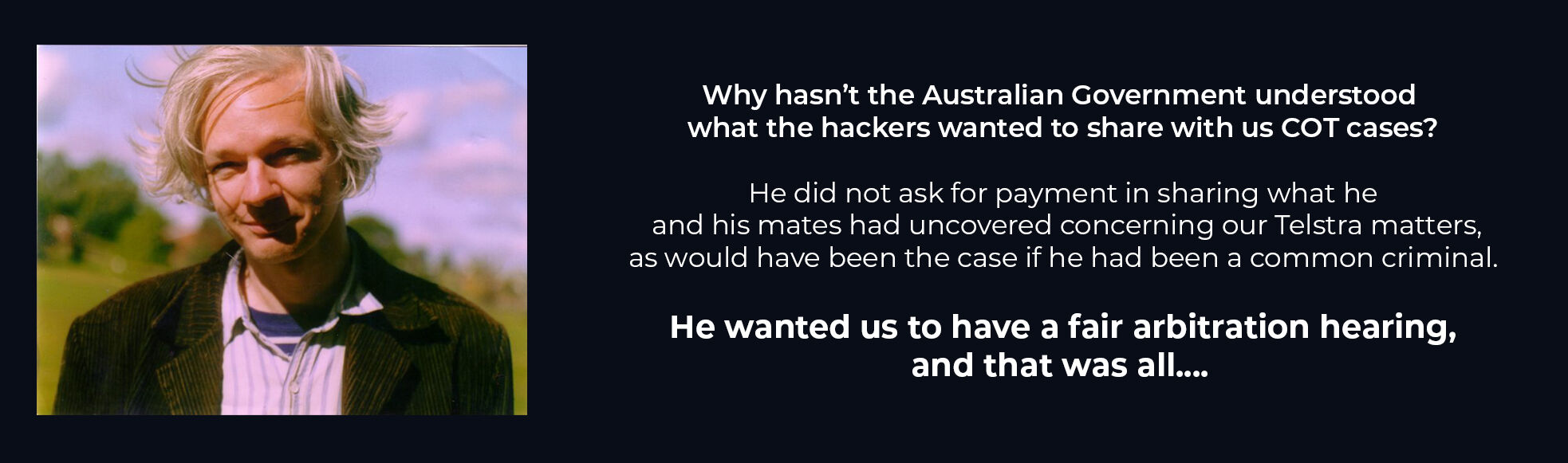
A Young Julian Assange
Graham Schorer, the spokesperson for the COT Case, informed me that three young hackers, most likely Assange and his associates, had reached out to him. They claimed to have hacked into Telstra’s system and discovered that Telstra and others involved in our arbitration were acting unlawfully. They offered evidence and proof, presenting the missing link that could have exposed everything: the routing faults, billing anomalies, secret tapes, Lonsdale diversions, and the internal strategy to discredit the COT Cases.
Graham was ready to accept their information. I was the one who said no.
I believed in the truth; I had lived it and fought for it. However, I recognised the trap before anyone else did. Accepting hacked material, even if it definitively proved Telstra’s misconduct, would have given Telstra and the government the perfect excuse to terminate the arbitrations. We would have been seen as conspirators rather than complainants, criminals instead of victims. The arbitrations would have collapsed, allowing Telstra to walk away unscathed.
Regrettably, I chose not to take the hackers up on their offer. I wanted to prevent Telstra from ensnaring us in their trap. That decision, made during a process that was already heavily stacked against us, became a pivotal moment in the unfolding of the entire COT story.
“After I signed the arbitration agreement on 21st April 1994 I received a phone call after business hours when I was working back late in the office. This call was to my unpublished direct number.
“The young man on the other end asked for me by name. When I had confirmed I was the named person, he stated that he and his two friends had gained internal access to Telstra’s records, internal emails, memos, faxes, etc. He stated that he did not like what they had uncovered. He suggested that I should talk to Frank Blount directly. He offered to give me his direct lines in the his Melbourne and Sydney offices …
“The caller tried to stress that it was Telstra’s conduct towards me and the other COT members that they were trying to bring to our attention.
“I queried whether he knew that Telstra had a Protective Services department, whose task was to maintain the security of the network. They laughed, and said that yes they did, as they were watching them (Telstra) looking for them (the hackers). …
“After this call, I spoke to Alan Smith about the matter. We agreed that while the offer was tempting we decided we should only obtain our arbitration documents through the designated process agreed to before we signed the agreement.” (See Hacking – Julian Assange File No/3)
CHAPTER 28 — THE ARBITRATION FILES: How the whistleblowers uncovered the truth
Critical documents were missing, altered, or withheld. The arbitration files became instruments of distortion. The record was shaped to protect Telstra, not the truth. This was documentary tampering on an industrial scale.
Keyword cluster: file tampering, corrupted records, arbitration manipulation, document alteration.
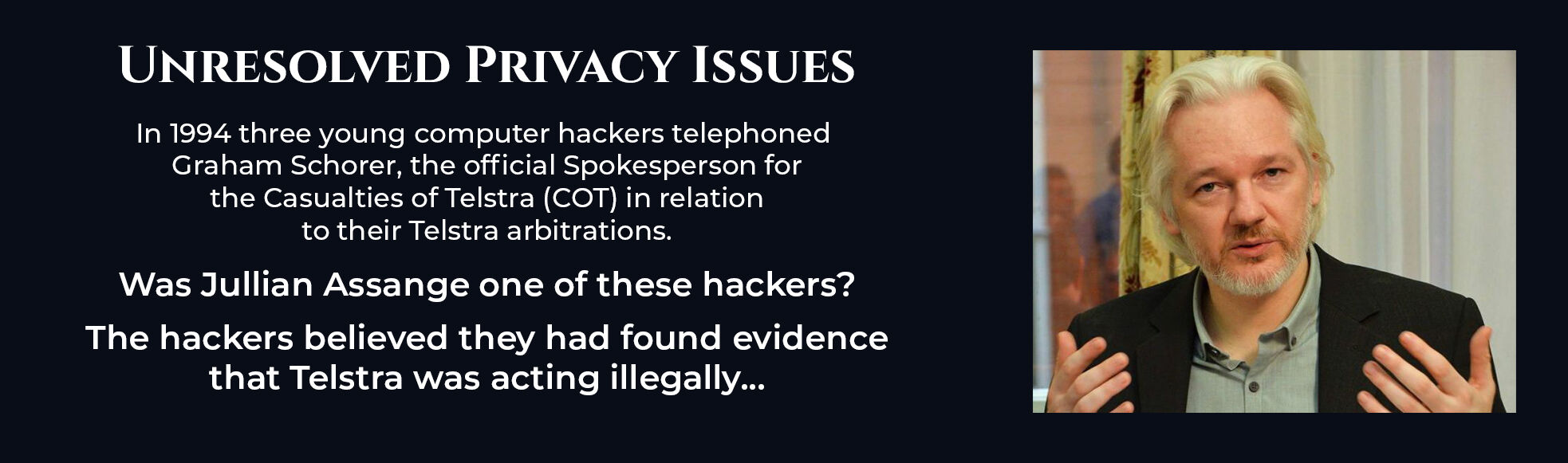
Julian Assange
On the covering page of a joint 10-page letter dated 11 July 2011 to the Hon Robert McClelland, federal Attorney-General, and the Hon Robert Clark, Victorian Attorney-General, I note:
“In 1994, three young computer hackers telephoned Graham Schorer, the official Spokesperson for the Casualties of Telstra (COT) in relation to their Telstra arbitrations.
- Was Julian Assange one of these hackers?
- The hackers believed they had found evidence that Telstra was acting illegally.
- In other words, we were fools not to have accepted this arbitration file when it was offered to us by the hackers who conveyed to Graham Schorer a sense of the enormity of the deception and misconduct undertaken by Telstra against the COT Cases.” (AS-CAV Exhibit 790 to 818 Exhibit 817)
I also wrote to Hon. Robert Clark on 20 June 2012 to remind him that his office had already received a statutory declaration from Graham Schorer dated 7 July 2011. I also approached other government authorities and provided the Scandrett & Associates report (see Open Letter File No/12 and File No/13), which leaves no doubt that the hackers were right on target in their assessment of Telstra's electronic surveillance of the COT Cases.
If the hackers were indeed Julian Assange, then he was attempting to fulfil his obligation to expose what he believed to be a crime. If we had listened to the hackers, I wouldn't be writing this story thirty years later; my life and my partner Cathy's would have been significantly different, sparing us the trauma we've experienced while trying to reveal the injustices published on absentjustice.com.
Hospitality was my calling, and I had always dreamed of running a school holiday camp. So imagine my delight when I saw the Cape Bridgewater Holiday Camp and Convention Centre advertised for sale in The Age newspaper. Nestled in rural Victoria, near the small maritime port of Portland, it seemed perfect. I conducted what I believed was thorough due diligence to ensure the business was sound, or at least, all the due diligence I knew about at the time. Who would have thought I needed to check whether the phones worked, as Telstra provided to my fellow competitor? That was far from what was about to transpire, as my story on absentjustice.com shows.
Within a week of taking over the business, I knew I had a problem. Customers and suppliers were telling me they had tried to call but couldn’t get through. That’s right, I had a business to run, but the phone service was, at best, unreliable and, at worst, completely absent. Naturally, we lost business as a result.
The Camp relied heavily on telephone communication. It was our vital link to city dwellers eager to use our services. One of our biggest oversights—blinded by the charm of this coastal haven —was failing to investigate the existing telephone system. At the time, mobile coverage was virtually nonexistent, and we conducted business through traditional means, not online, and certainly not by email.
We soon discovered that we were tethered to an antiquated telephone exchange, installed more than 30 years earlier and designed specifically for “low-call-rate” areas. This outdated, unstaffed exchange had a pitiful capacity of just eight lines.
The Hidden Cost of Cape Bridgewater’s Failing Lines
In a typical week, picturesque Cape Bridgewater was home to about 66 residential families, plus people who used their coastal retreats to escape the pressures of city life. Many of those families had children, creating a substantial and growing demand for telephone access.
Yet only eight telephone lines served the entire community.
When I purchased the holiday camp in late 1987, Cape Bridgewater’s population was already approximately 130 adults and children. By August 1991, three and a half years later, when a modern Remote Control Module (RCM) was finally installed, another twelve children had been added, bringing the local population to about 144 people. Weekend visitors regularly increased that number to 150 or more.
The limitation was stark. If only four people were using the telephone at the same time, whether making or receiving calls, just four lines remained available for everyone else in the community. Those four remaining lines had to serve the other 140 residents, as well as visitors and holidaymakers.
The Casualties of Telecom (COT Cases)
- My fight began simply: to secure a working telephone service.
- Despite promises of compensation, the faults persisted. I sold my business in 2002, but the new owners suffered the same fate.
- Other small-business owners joined me, and we became known as the Casualties of Telecom.
- All we ever asked for was acknowledgement, repair, and fair compensation. A working telephone- was that too much to expect?
We entered this landscape of limited connectivity and coastal beauty with ambition and optimism. The Camp was more than a business; it was a dream made real—a serene retreat where the stresses of city life could dissolve into the ocean mist. Yet, as we soon learned, dreams require infrastructure to survive.
Our telephone lines became both our lifeline and our greatest obstacle. Booking inquiries, supply orders, emergency calls, and even simple conversations with clients all had to pass through those eight fragile channels. During peak periods, the lines were constantly engaged. Guests complained that they could not reach us. Suppliers missed confirmations. Opportunities slipped through our fingers like sand.
The Arbitrator and the Corruption of Arbitration in Australia
Introduction: A System Built on Betrayal
The arbitration system in Australia was presented to us as fair, transparent, and government-endorsed. In reality, I believe it was anything but. The Institute of Arbitrators and Mediators Australia (IAMA) was supposed to be independent, yet time and again it appeared to bend to political and corporate influence. What should have been a safeguard for justice became, in my experience, an instrument of betrayal.
The COT Cases: Cracks in the System (1990s)
During the 1990s, the Casualties of Telstra (COT) cases exposed what I believe was a deeply compromised system. Telstra and government officials allegedly withheld documents, misled arbitrators, and left claimants fighting in the dark. Arbitrators ignored evidence that should have been central to their rulings.
As a result, ordinary Australians were systematically disadvantaged, while Telstra and its allies escaped accountability. The cases demonstrated one thing clearly: when corporate power combines with political silence, justice collapses.
The Telstra Briefcase Incident (1992–1993)
I witnessed this corruption firsthand. Two Telstra executives left an unlocked briefcase in my Cape Bridgewater office. Inside were documents that, in my view, revealed Telstra’s board and management orchestrating a campaign to mislead the public.
They knew that their copper-wire network and Ericsson equipment were faulty. Overseas, they were removing this equipment from exchanges. In Australia, Telstra continued rolling it out, placing vulnerable customers at risk.
When I raised these issues, the arbitrator ruled that the faults had not affected my business viability. That was not negligence, in my view—it was complicity. Later, documents dated July to December 1992 and formalised under the Freedom of Information Act appeared to confirm what I had already believed: that I had been deliberately misled about the reliability of my telephone service for years.
Continuity of Corruption: 2000–2025
Some people believe this corruption was confined to the past and resolved during the 1990s. I do not. Between 2020 and 2025, I witnessed what appeared to be the continuation of similar practices: altered court documents, perjury, and allegations of criminal conduct within government ranks.
In both State and Federal Parliament, betrayal appears to run rampant. Colleagues are destroyed through malicious falsehoods, just as claimants were destroyed during the arbitrations. The corruption did not end; it mutated.
The Human Cost
This was never only about faulty equipment. It was about lives. My business was dismissed, my credibility undermined, and my livelihood jeopardised. Customers were left exposed to dangerous infrastructure, while Telstra and government officials escaped accountability.
The human cost of this betrayal is immeasurable.
Conclusion: The Arbitrator’s Legacy
The arbitration system failed because it was never truly independent. Political and corporate influence corrupted it from the beginning. The COT cases peeled back the layers, but the treachery has only deepened since.
My role now is to document the truth, ensure that these betrayals are not forgotten, and empower others to challenge the silence.
Reflections on Democracy and Accountability
My struggle was never only about me. It was about whether democratic systems can be trusted to uphold transparency, fairness, and accountability.
Canada’s handling of the Cape Bridgewater report, together with Australia’s willingness to allow witnesses to be compromised, revealed a disturbing truth: when powerful interests are threatened, the rule of law bends. It delays. It ignores.
So I ask you, my readers, to consider this:
Do we truly live under systems that protect the vulnerable and hold the powerful to account? Or are we expected to accept corruption disguised as process and silence masquerading as resolution?
For me, the answer is clear. The COT arbitrations were neither transparent nor unbiased. They were riddled with what I regard as sinister machinations.
While I continue to fight for the return of my rightful documents, I am also fighting for something larger: the principle that truth must never be buried, and that democracy cannot survive if corruption is allowed to flourish unchallenged.
Why This Website Exists
This website examines allegations of serious misconduct involving corporate actors, government agencies, compromised bureaucracies, conflicted decision-makers, and legal professionals whose conduct may have shielded powerful institutions from scrutiny.
The evidence raises important questions about government accountability, withheld documents, Freedom of Information failures, corporate misconduct, alleged bribery, intimidation, and other forms of institutional wrongdoing. It also asks whether Australia’s legal and administrative systems became a fortified citadel of self-protection, protecting institutions while leaving affected citizens without a meaningful remedy.
The language used throughout these pages is strong because the consequences described were severe. Businesses were destroyed, families experienced prolonged pressure, health was affected, and evidence was allegedly withheld, lost, or disregarded.
This is not simply a story about technical failures or poor telephone services. It is an account of alleged institutional misconduct, conflicted arbitration, and the progressive denial of a fair opportunity to present evidence. The surviving records raise serious questions about whether Telstra, government agencies, and arbitration officials:
- withheld or failed to disclose relevant documents;
- provided explanations that were incomplete or misleading;
- failed to investigate credible complaints;
- intimidated or discredited claimants;
- permitted a compromised process to continue; and
- avoided accountability after the integrity of the process had been challenged.
If substantiated, these matters would represent more than administrative error. They would suggest a profound failure of public trust involving a government-backed corporation, officials who allegedly failed to act on credible complaints, and an arbitration system whose transparency, independence, and procedural fairness require independent examination.
The central issue was never only the failure of telephone services. It was whether evidence was buried, whether legitimate complaints were suppressed, whether claimants were discredited for exposing possible misconduct, and whether the arbitrator allowed a process of questionable integrity to continue.
Absentjustice.com records the human consequences described by the COT claimants: businesses lost, families placed under intolerable strain, health damaged, evidence becoming unavailable, and justice delayed until delay itself became indistinguishable from denial.
The website does not ask visitors to accept every allegation as proven. It asks them to examine the chronology, documents, correspondence, FOI material, arbitration records, and official responses for themselves.
The essential question is whether the surviving evidence warrants an open and independent investigation, one conducted without the institutional conflicts and restrictions that, according to the records presented here, affected the original process.
This website is not meant to replace an investigation, but to explain why one remains necessary.
CHAPTER 29 — THE SENATE SUBMISSIONS: How the Truth Reached Parliament
Your evidence eventually reached the Senate. Parliamentary submissions confirmed the misconduct Telstra tried to bury. The national stage exposed what arbitration concealed. This was corruption dragged into daylight.
Keyword cluster: Senate evidence, parliamentary exposure, national accountability, legislative scrutiny.
Don’t forget to hover your mouse over the images as you scroll down this homepage to reveal additional information.
These 23 points provide a comprehensive and accessible guide to the narrative featured on this website. Rather than overwhelming readers with an intricate and lengthy historical context to grasp its significance, the chapter summaries provide an efficient way to navigate the homepage, allowing visitors to quickly discern the major themes at a glance.
The summaries bring to light several crucial issues, including contentious evidence, claims of document suppression, instances of unequal treatment, pressures from institutions, stalled investigations, and the profound personal toll experienced by those involved in these cases. Each point acts as a gateway to a more elaborate account, backed by a wealth of documents, records, and evidence files that substantiate the claims.Together, these elements create a cohesive timeline and articulate the purpose of the project: to preserve the intricate history of the COT cases, foster a thorough and informed examination of the available evidence, and underscore the necessity of an independent review of the unresolved claims. This approach not only invites engagement but also highlights the significance of understanding and addressing these important issues.
🕯️The Suppression of Truth
The process began with what seemed like minor irregularities: a missing attachment, a delayed file, an unexplained omission. Any one incident might have been dismissed as administrative error. Taken together, however, the missing material formed a pattern that demanded examination.
As the arbitration progressed, more serious questions arose. Documents reportedly appeared in the arbitrator’s office that, according to my records, had previously been seen only by the Australian Federal Police and me. If accurate, that circumstance raises a serious question about confidentiality and the movement of evidence within the process.
Deadlines changed, important material was not considered, and findings appeared to take shape before all relevant evidence had been examined. The record does not establish every explanation, but it does show why evidence handling requires independent scrutiny. The central issue is whether truth was merely overlooked—or systematically excluded.
🕵️♂️ Surveillance and Loss of Privacy
Arbitration was presented as a confidential process in which claims and evidence could be examined without outside interference. That expectation changed when unexplained fax records, call traces, and other communications data appeared in the documentary record.
These records raised concerns that private communications connected with the dispute may have been monitored, recorded, or otherwise accessible to people who were not authorised to receive them. The extent, purpose, and responsibility for any such monitoring remain matters requiring proper investigation.
For the claimants, the consequence was profound. A process intended to provide a secure avenue for redress began to feel like an environment of observation and exposure. Whether every suspected instance can be proved or not, the apparent loss of confidentiality undermined confidence in the arbitration's fairness.
🗂️ A Culture of Concealment
The pattern began with omissions: a missing page, a redacted passage, or a file described as unavailable. Each incident could be explained in isolation. The larger record, however, suggested that the arbitrator may not have received a complete account of the relevant events.
Technical failures were sometimes presented as individual claimant problems rather than as possible evidence of wider network or equipment defects. Reports and correspondence appeared to frame the dispute in ways that favoured Telstra’s position. These matters should be assessed against the original records, not accepted or dismissed without examination.
The concern is therefore larger than a single missing document. It is whether concealment became embedded in the handling of the claims—whether the process selected, narrowed, or reinterpreted the evidence to protect the institution rather than discover the truth.
⚙️ Corruption Through Structure
On paper, the arbitration framework contained rules, procedures, and oversight. Yet the operation of those safeguards is as important as their existence. Questions arose concerning altered provisions, reduced oversight, and the removal or weakening of protections available to claimants.
Evidence also appears to have passed through intermediaries before reaching the arbitrator. If a third party determined which documents or issues could be considered, the process's independence was seriously compromised.
This does not by itself prove a criminal offence. It does, however, raise the possibility of structural corruption: a process that could appear legitimate while restricting access to the very evidence required for an impartial decision.
📣 The Whistleblower’s Burden
I did not set out to become a whistleblower. I began as a business owner seeking a reliable telephone service and a remedy for serious problems. Each attempt to resolve the dispute, however, raised further questions about missing records, contradictory explanations, and how evidence was handled.
When attempts to raise those concerns were met with hostility, dismissal, or attacks on my credibility, silence became increasingly difficult. Speaking out carried personal and financial consequences, but staying silent would have let unresolved questions disappear.
I did not choose whistleblowing for recognition. It became the responsibility imposed by a system in which the person raising the concern appeared to bear greater risk than the institution facing it.
🤐 The Architecture of Silence
The initial responses were familiar: the matter was being reviewed, correspondence would be answered, and concerns would be considered. Then replies became delayed, incomplete, or absent. Meetings were postponed, and responsibility moved from one office to another.
The records suggest a recurring pattern of avoidance involving corporate, administrative, and governmental bodies. Whether this amounted to formal coordination must be determined by an independent investigation. What is clear, however, is the cumulative effect: no institution accepted responsibility for resolving the central questions.
Silence was not simply an absence of information. It became a practical shield. The longer the unanswered questions remained unresolved, the harder it became for claimants to challenge the official account.
⚖️ An Arbitration Under Question
The arbitration was presented as an independent process offering fairness, evidence-based assessment, and equal treatment. Those assurances were weakened by allegations that important material was withheld, that reports were selectively presented, and that conclusions were reached without considering all relevant documents.
If the arbitrator was denied access to evidence that could have changed the outcome, the process could not provide a reliable assessment of the claims. The issue is not merely whether the final decisions were favourable or unfavourable. It is whether the decisions were reached on a complete and accurate evidentiary foundation.
The arbitration may have appeared formal and orderly. The unresolved question is whether that appearance concealed a process in which the outcome was effectively shaped before the evidence had been fully tested.
🔒 Justice Withheld
Justice was first experienced as delay: postponed meetings, unanswered correspondence, and rulings that failed to address central issues. Delay alone does not prove misconduct, but repeated delay can become a form of denial when it prevents a claimant from obtaining meaningful review.
The more serious concern is that evidence said to support the claims was excluded, overlooked, or never made available to the decision-maker. Complaints were dismissed without, in the claimants’ view, adequate investigation.
By the conclusion of the arbitration, the issue was no longer simply whether justice had been slow. It was whether the process had been structured in a way that made justice unattainable.
🎯 Retaliation and Pressure
The alleged retaliation began with incidents that were difficult to interpret: hostile correspondence, dismissive treatment, and unexplained problems affecting services or communications. Each event could be viewed separately. Together, they created a sense of escalating pressure.
As complaints continued, the administrative and financial burden increased. Every effort to challenge the process required further time, expense, and emotional energy. The question is whether those burdens were accidental consequences of bureaucracy or whether some actions were intended to discourage continued scrutiny.
A pattern of retaliation should not be asserted lightly. It should be tested against dates, records, witnesses, and the sequence of events. If substantiated, it would show that the cost of seeking accountability extended beyond the original dispute.
🔑 Influence and Unequal Access
Influence does not always appear as a payment or an explicit exchange. It can operate through access, proximity, professional relationships, and the ability to secure attention that ordinary claimants cannot.
The concern in this case is whether corporate and institutional relationships affected the way information was received, considered, or withheld. Any alleged conflict of interest should be identified precisely and supported by records, not described only in general terms.
The central issue is equality before the process. If one side possessed privileged access to decision-makers, information, or institutional protection, then the arbitration was not a level contest of evidence.
🎭 Deception as Method
The alleged deception did not depend on one dramatic falsehood. Instead, it appeared through omissions, selective descriptions, technical explanations, and statements that consistently favoured one interpretation of events.
Reports and correspondence must be compared with the underlying records to determine whether material facts were altered, reframed, or withheld. Where information passed through an intermediary, the chain of communication becomes especially important.
If the documentary evidence confirms a repeated pattern of selective presentation, then deception was not an isolated mistake. It became a method of constructing the official account and keeping competing evidence outside the process.
🔍 The Disputed Evidence
Evidence did not necessarily disappear in a single act. It became difficult to obtain through delays, incomplete disclosures, missing attachments, and files described as misplaced or unavailable.
The most serious allegations concern records that may have been altered, withheld, or removed from the arbitration trail. Those allegations require careful forensic examination, including comparison of versions, dates, metadata, transmission records, and archival copies.
The question is not simply where the evidence went. It is who controlled its movement, who benefited from its absence, and whether the decision-makers knew that the record before them was incomplete.
📎 Bureaucracy as Pressure
The process began with ordinary requests for forms, explanations, and supporting information. Over time, the demands appeared to multiply, sometimes becoming contradictory or difficult to satisfy within the available deadlines.
Administrative requirements are not inherently improper. They become oppressive when they are applied inconsistently, when complete responses are repeatedly rejected without explanation, or when procedural demands prevent the substance of a claim from being heard.
For the claimant, the paperwork became more than administration. It became a source of exhaustion and uncertainty, a form of institutional pressure that could weaken a person’s ability to continue pursuing accountability.
🌍 Arbitration Across Borders
The dispute initially appeared to concern a rural business and a national telecommunications provider. Research into comparable equipment, network failures, and corporate responses in other countries suggested that some of the underlying problems may not have been confined to Australia.
International similarities do not, by themselves, establish a coordinated global conspiracy. They do, however, justify examining suppliers, technical histories, infrastructure decisions, and whether defective equipment had already been removed elsewhere while remaining in use locally.
The broader question is whether the arbitration treated a potentially systemic technical and corporate problem as an isolated customer complaint.
💾 Forensic Signs of Interference
The digital record contains anomalies that warrant examination: inconsistent timestamps, corrupted files, altered metadata, and records apparently modified after submission.
Such anomalies can have innocent explanations, including system migrations, routine editing, or archival practices. They can also indicate unauthorised access or alteration. Their significance depends on a properly preserved chain of custody and an independent technical analysis.
The forensic trail is therefore not proof. It is a map of questions. Each alteration, mismatch, or unexplained access point may help establish whether the record was preserved faithfully, or changed after the fact.
🕳️ The Disappearance of Accountability
Accountability receded behind repeated assurances that matters were being reviewed or investigated. It then became harder to locate behind confidentiality provisions, procedural barriers, and legal protections.
The removal or weakening of claimant safeguards is particularly significant. If oversight provisions were deleted, diluted, or rendered ineffective, claimants may have been left without a meaningful way to challenge errors or misconduct.
Accountability was not necessarily lost through one decision. It may have been displaced step by step, until responsibility was divided among institutions and no person or body could be compelled to answer for the whole process.
🚪 Truth in Exile
Leaving Cape Bridgewater felt like leaving a battlefield, but distance did not end the dispute. It changed the conditions under which I could continue documenting it. The questions surrounding the arbitration remained unresolved, and speaking publicly still carried personal and institutional risks.
Ballarat became a place from which I could preserve records, compare documents, and reconstruct events with greater distance. It was not an escape from the truth; it became the location from which the evidence could be organised.
Exile is an uncomfortable word, but it describes the experience of being pushed away from the institutions one is challenging. The truth survived not because it was welcomed, but because it was preserved.
💔 The Human Cost of Policy
Policy decisions can appear administrative while producing deeply personal consequences. In this case, the prolonged dispute affected livelihood, business, health, family life, and personal security.
It would be irresponsible to claim that any particular policy deliberately intended every consequence. It is nevertheless necessary to examine whether officials understood the likely harm and failed to act despite that knowledge.
The COT Cases demonstrate why institutional decisions must be judged not only by their stated purpose, but also by their human consequences. A system that protects procedure while ignoring preventable harm cannot credibly claim to have delivered justice.
🛑 Investigations That Stalled
Several inquiries and reviews began with the promise of clarification. Yet progress appeared to slow when the investigation reached matters that could challenge the established account.
The reasons given for delay or termination must be tested against the chronology. Were investigators denied evidence? Were witnesses overlooked? Were priorities changed? Were decisions made independently, or did external pressure influence the outcome?
An investigation that repeatedly stops short of the central questions risks becoming a containment mechanism rather than a search for truth. That is why the unanswered cases require a genuinely independent review.
📜 A Legacy of Misleading Records
The consequences of disputed information do not end when a proceeding closes. Internal descriptions can enter official correspondence; official correspondence can become institutional memory; and later decision-makers may rely on records they assume are complete.
Over time, an incomplete account can become accepted history. Technical failures may be remembered as claimant error, unresolved complaints as settled matters, and missing evidence as evidence that never existed.
The answer is not simply to repeat a competing narrative. It is to preserve the underlying records, identify contradictions, and allow independent readers to compare the evidence with the official account. Memory may be shaped by institutions, but history must remain answerable to documents.
⚡ The First Signs of a Reckoning
The reckoning began not with one dramatic revelation, but with a series of inconsistencies: contradictions in official statements, unexplained gaps in the records, and admissions buried in technical or administrative documents.
Each discrepancy created another question. Each released file made it more difficult to maintain a single, unquestioned version of events. The process of exposure was slow because the evidence had been dispersed across years, institutions, and archives.
A reckoning does not require that every allegation already be proven. It begins when the evidence becomes too substantial to ignore and when independent examination becomes more credible than continued silence.
📝 The Whistleblower’s Legacy
Persistence began as necessity. I continued because the records had not been properly examined and because silence threatened to convert an unresolved dispute into an accepted version of history.
Over time, preserving documents, recording contradictions, and presenting the evidence became a form of resistance to erasure. The objective was not to claim personal victory, but to ensure that the questions remained available for others to assess.
A whistleblower’s legacy is not measured only by immediate recognition or legal success. It is measured by whether the evidence survives, whether the public can examine it, and whether institutions are eventually required to answer.
🔔 When Silence Breaks
The first fracture appeared in the official narrative: a contradiction here, an unexplained admission there, a technical record that did not fit the accepted account.
As further evidence emerged, the pressure increased. Witnesses offered accounts that challenged earlier conclusions, and documents revealed questions that could no longer be dismissed as personal misunderstanding. The weight of the record began to shift the argument from whether there was a problem to why it had remained unresolved for so long.
The reckoning is not complete merely because the evidence has been published. It begins when the evidence is independently examined, responsibility is identified, and those affected by the unresolved cases are finally heard. Silence may endure for years, but it cannot remain permanent once the record is placed in public view
CHAPTER 30 — THE WITNESS STATEMENTS: How Others Confirmed the Pattern
• Superintendent Jeffrey Penrose• Detective Sergeant Cochrane• Graham Schorer, who masqueraded as a spokesperson for the COT Cases• Amanda Davis, a former government official
The transcripts () reveal a sinister truth:This was not speculation, it was a direct admission. And yet, when we sought access to these tapes, we were met with a wall of obstruction.
As the COT Cases entered arbitration, we pleaded for access to the incriminating tapes. But they were denied under the Freedom of Information Act, and similarly withheld during discovery. This was not a legal technicality, it was a deliberate act of concealment. The tapes, potentially devastating to Telstra, were buried to protect powerful interests at the expense of our dignity and rights.
Government officials chose to protect their own reputations rather than the welfare of their citizens. They concealed critical evidence of phone tapping, even as other disturbing allegations emerged, implicating Senator Collins in obscenely troubling conduct during the very period he was involved in the COT matters.
In her letter dated 17 August 2017 (), Ann Garms referenced Wayne Goss, former Premier of Queensland. His chilling assertion:This was psychological warfare, designed to erode our legitimacy, fracture our resolve, and dismantle our sense of self.
Malcolm Turnbull, former Prime Minister of Australia, had full knowledge of the COT Cases and the evidence we presented.Both received Ann Garms’ letters. Both remained silent.Their complicity in this landscape of obfuscation and treachery cannot be ignored.
It is a story of betrayal.Of institutional rot.Of the unrelenting courage it takes to stand against it.
THREATS THE COT CASE RECEIVED DURING AND AFTER OUR ARBITRATION
It is essential to visit the 8 and 10 August 2006 witness statements.
The Major Fraud Group Barrister, Mr Neil Jepson, asked me to supply all evidence, at the request of the Major Fraud Group Victoria Police, that assisted me in proving that Telstra used three individual reports to support their arbitrations claims against the COT Cases arbitrations, which I did by adding to further re Telstra's Falsified BCI Report to Neil Jepson, the Major Fraud Group asked me to assist them in compiling this evidence for their investigations. I did this over three separate visits to Melbourne, spending two full days at the Major Fraud Group's St. Kilda Road offices on each of those three occasions, assisting the Victoria Police in understanding the relevance of the three fundamentally flawed reports, namely Telstra's Falsified which Telstra used to conceal from the arbitrator and his arbitration advisors how bad the Cape Bridgewater telecommunications network was. AUSTEL (the government communications regulator) had already done their investigations into the grossly deficient Cape Bridgewater and Portland telephone exchange during the early part of my Fast Track Settlement Proposal (which in April 1994 became the arbitration process. It is clear from AUSTEL's investigations leading up to March 1994 refer to AUSTEL’s Adverse Findings, that at points 2 to 212 in their report, they had uncovered how bad the Cape Bridgewater telecommunications network was and, like Telstra's arbitration defence unit concealed these findings from the arbitration process.
File 517 AS-CAV Exhibits 495 to 541 is a Witness Statement dated 10 August 2006 (provided to the Department of Communications, Information, Technology and the Arts (DCITA) sworn out by Des Direen, ex-Telstra Senior Protective Officer, eventually reaching Principal Investigator status. Mr Direen has been brave enough to reveal that, in 1999 / 2000, after he left Telstra, he assisted the Victoria Police Major Fraud Group, particularly Rod Kueris, with their investigations into the COT fraud allegations. I was also seconded by the Major Fraud Group into that investigation as an advisor, showing the Major Fraud Group where, in those arbitrations, Telstra used five known fraudulent, flawed reports provided to the arbitrator and other to convince those parties Telstra had fixed all of their telephone and faxing problems before and/or during the arbitrations when telstra and their lawyers knew duiffenet. (Refer also to the Major Fraud Group Transcript (2)).
Points 12 to 18 in Mr Direen’s statement explained that “From what (he) observed on this day, and applying the knowledge that (he) gained during (his) twelve years at Telstra, (he had) no doubt in (his) mind that the phones at Rod KUERIS’s home address were possibly interfered with".
Within a few weeks of Mr. Direen's involvement in assisting the Major Fraud Group with their ongoing investigations, it became increasingly evident that Detective Sergeant Mr. Rod Kueris was experiencing significant distress regarding the situation. I feel compelled to bring attention to the issue involving Mr. Kueris, mainly because, during that same Major Fraud Group investigation led by Victoria Police, I was in the process of faxing critical documents regarding the falsified Bell Canada International Inc. report, which I had modified for Mr. Neil Jepson's office. It is essential to note that had I not promptly contacted Mr Jepson immediately after sending these faxes, neither of us would have been informed that the documents had been intercepted and had failed to arrive at the Major Fraud Group's fax machine.
I am using the following witness two witness statements File 766 - AS-CAV Exhibit 765-A to 789), because they prove a police officer, when dealing with the Telstra Corporation, was left floundering as were the COT Cases when they were forced into arbitration with the same monster who the arbitrator and administrator of the COT arbitrations were afeared to abandon the COT arbitrations because of the power and influence Telstra has over the legal system in Australia. Please read the following two witness statements.
"I can recall that during the period 2000/2001, I had arranged to meet Detective Sergeant Rod KURIS from the Victoria Police Major Fraud Squad at the foyer of Casselden Place, 2 Lonsdale Street, Melbourne. At the time, I was assisting Rod with the investigation into alleged illegal activities against the COT Cases.
Rod then stated that he wanted me to follow him to the left side of the foyer. When we did this he then directed my attention to a male person seated on a sofa opposite our seat. He then told me that the person had been following him around the city all morning. At this stage Rod was becoming visibly upset and I had to calm him down.Rod kept on saying that he couldn't believe in what was happening to him. I had to again calm him down".
Points 21 and 22 in Mr Direen’s statement also record how, while he was a Telstra employee, he had cause to investigate “… suspected illegal interference to telephone lines at the Portland exchange,” but when he “… made inquiries by telephone back to Melbourne (he) was told not to get involved and that another area of Telstra was handling it” and that “... the Cape Bridgewater complainant was a part of the COT cases” (my Cape Bridgewater Holiday Camp) business.
Threats made during my arbitration
On July 4, 1994, amidst the complexities of my arbitration proceedings, I confronted serious threats articulated by Paul Rumble, a Telstra's arbitration defence team representative. Disturbingly, the arbitrator had covertly provided him with some of my interim claims documents—a breach of protocol that occurred a full month before the arbitrator was legally obligated to share such information. Given the gravity of the situation, my response needed to be exceptionally meticulous. I put considerable effort into crafting this detailed letter, choosing every word carefully. In this correspondence, I made it unequivocally clear:
“I gave you my word on Friday night that I would not go running off to the Federal Police etc, I shall honour this statement, and wait for your response to the following questions I ask of Telecom below.” (File 85 - AS-CAV Exhibit 48-A to 91)
When drafting this letter, my determination was unwavering; I had no plans to submit any additional Freedom of Information (FOI) documents to the Australian Federal Police (AFP). This decision was significantly influenced by a recent, tense phone call I received from Steve Black, another arbitration liaison officer at Telstra. During this conversation, Black issued a stern warning: should I fail to comply with the directions he and Mr Rumble gave, I would jeopardize my access to crucial documents pertaining to ongoing problems I was experiencing with my telephone service.
Page 12 of the AFP transcript of my second interview (Refer to Australian Federal Police Investigation File No/1) shows Questions 54 to 58, the AFP stating:-
“The thing that I’m intrigued by is the statement here that you’ve given Mr Rumble your word that you would not go running off to the Federal Police etcetera.”
Essentially, I understood that there were two potential outcomes: either I would obtain documents that could substantiate my claims, or I would be left without any documentation that could impact the arbitrator's decisions regarding my case.
However, a pivotal development occurred when the AFP returned to Cape Bridgewater on September 26, 1994. During this visit, they began asking probing questions about my correspondence with Paul Rumble, showing urgency in their inquiries. They indicated that if I chose not to cooperate with their investigation, they would shift their focus entirely to the unresolved telephone interception issues central to the COT Cases, which they claimed assisted the AFP in various ways. I was alarmed by these statements and contacted Senator Ron Boswell, National Party 'Whip' in the Senate.
As a result, I contacted Senator Ron Boswell, who then raised these threats in the Senate. This statement underscored the serious nature of the claims I was dealing with and the potential ramifications of my interactions with Telstra.
On page 180, ERC&A, from the official Australian Senate Hansard, dated 29 November 1994, reports Senator Ron Boswell asking Telstra’s legal directorate:
“Why did Telecom advise the Commonwealth Ombudsman that Telecom withheld FOI documents from Alan Smith because Alan Smith provided Telecom FOI documents to the Australian Federal Police during their investigation?”
After receiving a hollow response from Telstra, which the senator, the AFP and I all knew was utterly false, the senator states:
“…Why would Telecom withhold vital documents from the AFP? Also, why would Telecom penalise COT members for providing documents to the AFP which substantiate that Telecom had conducted unauthorised interceptions of COT members’ communications and subsequently dealt in the intercepted information by providing that information to Telecom’s external legal advisers and others?” (See Senate Evidence File No 31)
Thus, the threats became a reality. What is so appalling about this withholding of relevant documents is this - no one in the TIO office or government has ever investigated the disastrous impact the withholding of documents had had on my overall submission to the arbitrator. The arbitrator and the government (at the time, Telstra was a government-owned entity) should have investigated why an Australian citizen, who had assisted the AFP in its investigations into unlawful interception of telephone conversations, was so severely disadvantaged in a civil arbitration.
Pages 12 and 13 of the Australian Federal Police Investigation File No/1 transcripts provide a comprehensive account establishing Paul Rumble as a significant figure linked to the threats I have encountered. This conclusion rests on two critical, interrelated factors that merit further elaboration.
Firstly, Mr. Rumble actively obstructed the provision of essential arbitration discovery documents, which the government was legally obligated to provide under the Freedom of Information Act. This obligation was contingent on my signing an agreement to participate in a government-endorsed arbitration process. By imposing this condition, Mr Rumble undermined a legally established protocol, effectively manipulating the process for his benefit and jeopardizing my legal rights.
Secondly, I uncovered that Mr. Rumble had a substantial influence over the arbitrator, resulting in the unauthorized early release of my arbitration interim claim materials. This premature revelation directly conflicted with the timeline stipulated in the arbitration agreement that Telstra and I had formally signed. Specifically, Telstra accessed my interim claim document five months earlier than the agreed-upon terms permitted. This breach violated the integrity of the arbitration process and gave Telstra an unfair advantage in responding to my claims.
Under the rules governing our arbitration process, Telstra was allocated one month to respond to my claim once I submitted it in writing as my final claim. Furthermore, the arbitrator was only authorized to release my final claim to Telstra once it was officially confirmed to be complete. The five-month delay in submitting my claim in November 1994 was primarily attributable to Mr. Rumble's deliberate withholding of critical technical information.
In my case, as Telstra's Falsified SVT Report shows, Telstra’s representative, Peter Gamble, attempted to conduct the essential Service Verification Testing (SVT) process. Unfortunately, he had to halt the testing due to unforeseen equipment malfunctions. When AUSTEL questioned how he planned to rectify this inadequate testing at my business, Mr Gamble refused to proceed with any further testing. Instead, he submitted a statutory declaration under oath to the arbitrator, claiming that his SVT process had fully complied with AUSTEL’s requirements. This assertion was far from the truth.
More Threats, this time to the other Alan Smith
Two Alan Smiths (unrelated) lived in Cape Bridgewater.
No one investigated whether another person named Alan Smith, who lived in the Discovery Bay area of Cape Bridgewater, received some of my arbitration mail. Both the arbitrator and the administrator of my arbitration were informed that road mail sent by Australia Post had not arrived at my premises during my arbitration from 1994 to 1995.
Additionally, the new owners of my business lost legally prepared documents related to Telstra when they attempted to send mail to the Melbourne Magistrates Court. I had prepared these documents in a determined effort to prevent them from being declared bankrupt due to ongoing telephone issues. They were sent from the Portland Post Office but did not arrive (Refer to Chapter 5, Immoral—Hypocritical Conduct).
Stop these people at all costs.
This is the same Peter Gamble who, on 24 June 1997 see:- pages 36 to 38 Senate - Parliament of Australia was named by an ex-Telstra employee turned - Whistle-blower, Lindsay White, that, while he was assessing the relevance of the technical information which the COT claimants had requested under FOI he advised the Committee that:
Mr White - "In the first induction - and I was one of the early ones, and probably the earliest in the Freehill's (Telstra’s Lawyers) area - there were five complaints. They were Garms, Gill and Smith, and Dawson and Schorer. My induction briefing was that we - we being Telecom - had to stop these people to stop the floodgates being opened."
Senator O’Chee then asked Mr White - "What, stop them reasonably or stop them at all costs - or what?"
Mr White responded by saying - "The words used to me in the early days were we had to stop these people at all costs".
Senator Schacht also asked Mr White - "Can you tell me who, at the induction briefing, said 'stopped at all costs" .
Mr White - "Mr Peter Gamble, Peter Riddle".
Senator Schacht - "Who".
Mr White - "Mr Peter Gamble and a subordinate of his, Peter Ridlle. That was the induction process-"
From Mr White's statement, it is clear that he identified me as one of the five COT claimants that Telstra had singled out to be ‘stopped at all costs’ from proving their against Telstra’.
Peter Gamble's unethical behaviour is significant, but it is also crucial to note that David Read of Lane Telecommunications did not oversee Gamble’s tests on April 6, 1995. As the technical consultant for the independent arbitrator, Read evaluated the COT Cases, which alleged that faulty Ericsson telephone equipment caused ongoing complaints from various businesses.
During the COT arbitration proceedings, Ericsson acquired Lane Telecommunications. This acquisition had profound implications, as it transferred all investigative materials Lane collected against Ericsson of Sweden—gathered over approximately eight COT arbitrations—to Ericsson. This situation raises significant ethical concerns about the investigation's impartiality, considering that the entity under scrutiny now controls the evidence against it.
Such circumstances challenge Australia’s stated commitment to the rule of law and suggest that it may be one of the few Western nations that allows a principal witness to be financially influenced by those being investigated (Refer to Chapter 5 - US Department of Justice vs Ericsson of Sweden)
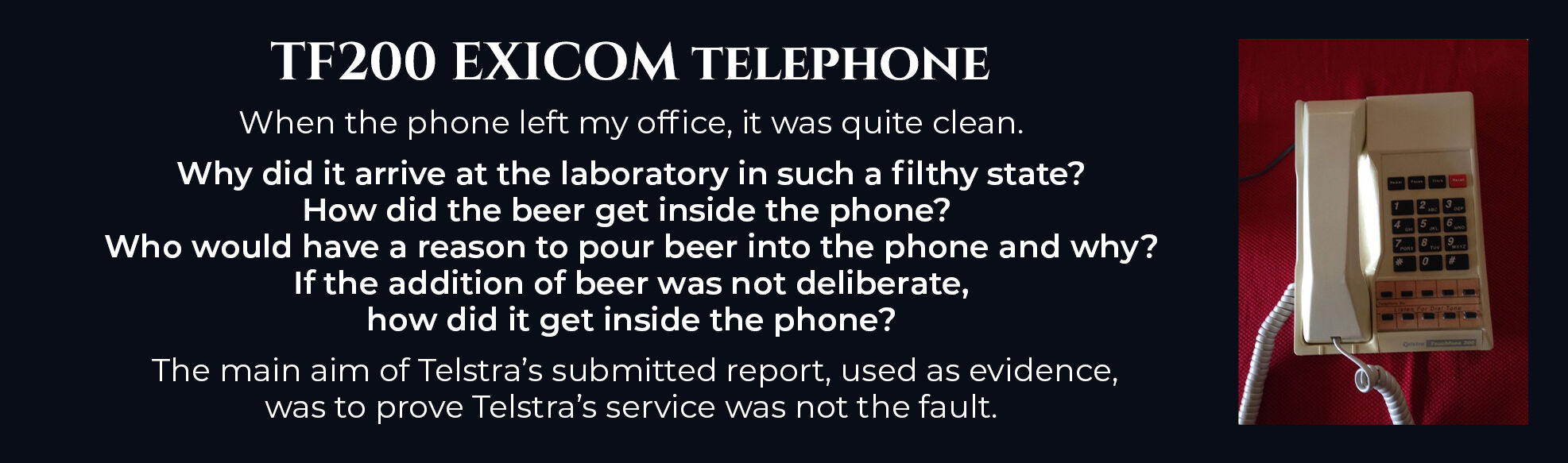
When I phoned AUSTEL’s Cliff Mathieson, a public servant at the government communications regulatory department, to discuss this hang-up fault on 26 April 1994, Mr Mathieson suggested we run a series of tests on the phone line. He asked me to hang up and count aloud from one to 10 while he listened. This first test proved he could hear me count all the way to 10. He suggested we try it again and count even further this time. It was still the same: he could hear me throughout the range as I counted. Then he suggested I switch the phone on that line with a phone connected to another. I did, and we repeated the counting test with the same result. It was clear to both of us that the fault was not in the phone but somewhere in the Telstra network. Mr Mathieson suggested that, as I was in arbitration then, I should bring this fault to the attention of Peter Gamble, Telstra’s chief engineer. Lindsay White, a Telstra whistleblower, named Peter Gamble in a Senate estimates committee hearing as the man who said he and Telstra had to stop the first COT five claimants (including me), at all cost, from proving our claims (see Senate Hansard ERC&A 36, Front Page Part One File No/23 dated 24 June 1997).
Unaware of these orders to stop us from five COT cases (at all costs), I switched the phones back to their original lines and phoned Mr Gamble, but did not tell him Mr Mathieson, and I had already tested two phones on the 055 267230 lines. Mr Gamble and I then performed similar tests on the 055 267230 line. Mr Gamble said he would arrange for someone to collect the phone the following day for testing. FOI K00941, dated 26 March 1994, show someone (name redacted) believed this lock-up fault was caused by a problem in the RCM exchange at Cape Bridgewater see Tampering With Evidence File No 1-A to 1-C. Document K00940, dated the day the tests were performed with Mr Mathieson and Mr Gamble, suggests that Mr Gamble believed the problem was caused by heat in the exchange, see (File No-B), where document folio R37911 states:
“This T200 is an EXICOM and the other T200 is an ALCATEL, we thought that this may be a design ‘fault???’ with the EXICOM so Ross tried a new EXICOM from his car and it worked perfectly, that is, released the line immediately on hanging up. We decided to leave the new EXICOM and the old phone was marked and tagged…” (see File No 1-C).
My Holiday Camp was surely situated in a pristine location
If only the telephones had been fit for purpose
On 15 July 1995, two months after the arbitrator's premature announcement of findings regarding my incomplete claim, Amanda Davis, the former General Manager of Consumer Affairs at AUSTEL (now known as ACMA), provided me with an open letter to be shared with individuals of my choosing. This action underscores the confidence she placed in my integrity and professional character:
“I am writing this in support of Mr Alan Smith, who I believe has a meeting with you during the week beginning 17 July. I first met the COT Cases in 1992 in my capacity as General Manager, Consumer Affairs at Austel. The “founding” group were Mr Smith, Mrs Ann Garms of the Tivoli Restaurant, Brisbane, Mrs Shelia Hawkins of the Society Restaurant, Melbourne, Mrs Maureen Gillian of Japanese Spare Parts, Brisbane, and Mr Graham Schorer of Golden Messenger Couriers, Melbourne. Mrs. Hawkins withdrew very early on, and I have had no contact with her since.
The treatment these individuals have received from Telecom and Commonwealth government agencies has been disgraceful, and I have no doubt they have all suffered as much through this treatment as they did through the faults on their telephone services.
One of the striking things about this group is their persistence and enduring belief that eventually there will be a fair and equitable outcome for them, and they are to admired for having kept as focussed as they have throughout their campaign.
Having said that, I am aware all have suffered both physically and their family relationships. In one case, the partner of the claimant has become seriously incapacitated; due, I beleive to the way Telecom has dealt with them. The others have al suffered various stress related conditions (such as a minor stroke.
During my time at Austel I pressed as hard as I could for an investigation into the complaints. The resistance to that course of action came from the then Chairman. He was eventually galvanised into action by ministerial pressure. The Austel report looks good to the casual observer, but it has now become clear that much of the information accepted by Austel was at best inaccurate, and at worst fabricated, and that Austel knew or ought to have known this at the time.”
After leaving Austel I continued to lend support to the COT Cases, and was instrumental in helping them negotiate the inappropriately named "Fast Track" Arbitration Agreement. That was over a year ago, and neither the Office of the Commonwealth Ombudsman nor the Arbitrator has been succsessful in extracting information from Telecom which would equip the claimants to press their claims effectively. Telecom has devoted staggering levels of time, money and resources to defeating the claiams, and there is no pretence even that the arbitration process has attemted to produce a contest between equals.
Even it the remaining claimants receive satisfactory settlements (and I have no reason to think that will be the outcome) it is crucial that the process be investigated in the interest of accountabilty of publical companies and the public servants in other government agencies.
Because I am not aware of the exact citrcumstances surronding your meeting with Mr Smith, nor your identity, you can appriate that I am being fairly circimspect in what I am prepared to commit to writing. Suffice it to say, though, I am fast coming to share the view that a public inquiry of some discripion is the only way that the reasons behind the appalling treatent of these people will be brought to the surface.
I would be happy to talk to you in more detail if you think that would be useful, and can be reached at the number shown above at any time.
Thank you for your interest in this matter, and for sparing the time to talk to Alan. (See File 501 - AS-CAV Exhibits 495 to 541 )
Four months after the arbitrator Dr Hughes prematurely brought down his findings on my matters, and fully aware I was denied all necessary documents to mount my case against Telecom/Telstra, an emotional Senator Ron Boswell discussed the injustices we four COT claimants (i.e., Ann Garms, Maureen Gillan, Graham Schorer and me) experienced prior and during our arbitrations (see Senate Evidence File No 1 20-9-95 Senate Hansard A Matter of Public Interest) in which the senator notes:
“Eleven years after their first complaints to Telstra, where are they now? They are acknowledged as the motivators of Telecom’s customer complaint reforms. … But, as individuals, they have been beaten both emotionally and financially through an 11-year battle with Telstra. …
“Then followed the Federal Police investigation into Telecom’s monitoring of COT case services. The Federal Police also found there was a prima facie case to institute proceedings against Telecom but the DPP , in a terse advice, recommended against proceeding. …
“Once again, the only relief COT members received was to become the catalyst for Telecom to introduce a revised privacy and protection policy. Despite the strong evidence against Telecom, they still received no justice at all. …
“These COT members have been forced to go to the Commonwealth Ombudsman to force Telecom to comply with the law. Not only were they being denied all necessary documents to mount their case against Telecom, causing much delay, but they were denied access to documents that could have influenced them when negotiating the arbitration rules, and even in whether to enter arbitration at all. …
“Telecom has treated the Parliament with contempt. No government monopoly should be allowed to trample over the rights of individual Australians, such as has happened here.” (See Senate Hansard Evidence File No-1)
“COT Case Strategy”
As shown on page 5169 in Australia's Government SENATE official Hansard – Parliament of Australia Telstra's lawyers Freehill Hollingdale & Page devised a legal paper titled “COT Case Strategy” (see Prologue Evidence File 1-A to 1-C) instructing their client Telstra (naming me and three other businesses) on how Telstra could conceal technical information from us under the guise of Legal Professional Privilege even though the information was not privileged.
This COT Case Strategy was to be used against me, my named business, and the three other COT case members, Ann Garms, Maureen Gillan and Graham Schorer, and their three named businesses. Simply put, they targeted us and our four businesses even before our arbitrations began.
It is paramount that the visitor reading absentjustice.com understands the significance of page 5169 at points 29, 30, and 31 SENATE official Hansard – Parliament of Australia, which note:
29. Whether Telstra was active behind the scenes in preventing a proper investigation by the police is not known. What is known is that, at the time, Telstra had representatives of two law firms on its Board—Mr Peter Redlich, a Senior Partner in Holding Redlich, who had been appointed for 5 years from 2 December 1991 and Ms Elizabeth Nosworthy, a partner in Freehill Hollingdale & Page who had also been appointed for 5 years from 2 December 1991.
One of the notes to and forming part of Telstra’s financial statements for the 1993- 94 financial year indicates that during the year, the two law firms supplied legal advice to Telstra, totalling $2.7 million, an increase of almost 100 per cent over the previous year. Part of the advice from Freehill Hollingdale & Page was a strategy for "managing" the "Casualties of Telecom" (COT) cases.
30. The Freehill Hollingdale & Page strategy was set out in an issues paper of 11 pages, under cover of a letter dated 10 September 1993 to a Telstra Corporate Solicitor, Mr Ian Row from FH&P lawyer, Ms Denise McBurnie (see Prologue Evidence File 1-A to 1-C). The letter, headed "COT case strategy" and marked "Confidential," stated:
- "As requested I now attach the issues paper which we have prepared in relation to Telecom’s management of ‘COT’ cases and customer complaints of that kind. The paper has been prepared by us together with input from Duesburys, drawing on our experience with a number of ‘COT’ cases. . . ."
31. The lawyer’s strategy was set out under four heads: "Profile of a ‘COT’ case" (based on the particulars of four businesses and their principals, named in the paper); "Problems and difficulties with ‘COT’ cases"; "Recommendations for the management of ‘COT’ cases; and "Referral of ‘COT’ cases to independent advisors and experts". The strategy was in essence that no-one should make any admissions and, lawyers should be involved in any dispute that may arise, from beginning to end. "There are numerous advantages to involving independent legal advisers and other experts at an early stage of a claim," wrote Ms McBride . Eleven purported advantages were listed.
Back then, in most people's eyes, Mr Redlich was one of Australia's finest lawyers. He was also a stalwart within the Labor Party, a one-time friend of two Australian Prime Ministers (Gough Whitlam and Bob Hawke) and a long-time friend of Mark Dreyfus, Australia's current 2025 Attorney-General in 2024, so who would be the slightest bit interested in listening to my perspective in comparison to someone so highly qualified and with such vital friends?
And remember, Freehill Hollingdale & Page designed the COT strategy when Elizabeth Holsworthy (a partner at Freehill's) was also a member of the Telstra Board, along with Mr Redlich. The whole aim of that ‘COT Case Strategy’ was to stop us, the legitimate claimants against Telstra, from having any chance of winning our claims. Do you think my claim would have even the tiniest possibility of being heard under those circumstances?
A Senate Committee investigation, which the government appointed to examine five of the twenty-one COT cases as a "litmus test," found significant misconduct by Telstra. This was highlighted by the statements of six senators in the Senate in March 1999:
On 23 March 1999, the Australian Financial. Review reported on the conclusion of the Senate estimates committee hearing into why Telstra withheld so many documents from the COT cases, noting:
“A Senate working party delivered a damning report into the COT dispute. The report focused on the difficulties encountered by COT members as they sought to obtain documents from Telstra. The report found Telstra had deliberately withheld important network documents and/or provided them too late and forced members to proceed with arbitration without the necessary information,” Senator Eggleston said. “They have defied the Senate working party. Their conduct is to act as a law unto themselves.”
Regrettably, because my case had been settled three years earlier, several other COT cases and I could not take advantage of this investigation's valuable insights or recommendations. Pursuing an appeal of my arbitration decision would have incurred high financial costs I could not afford, creating an injustice for the remaining 16 Australian citizens.

During the Victoria Police Major Fraud Group's investigation into alleged fraudulent conduct by Telstra during and after the COT arbitrations, the Scandrett & Associates report was delivered to Senator Ron Boswell on 7 January 1999. This report confirmed that faxes were intercepted during the COT arbitrations (refer to Open Letter File No/12 and File No/13). Furthermore, one of the two technical consultants who verified the validity of this fax interception report reached out to me via email on 17 December 2014, emphasizing the importance of these findings
“I still stand by my statutory declaration that I was able to identify that the incoming faxes provided to me for review had at some stage been received by a secondary fax machine and then retransmitted, this was done by identifying the dual time stamps on the faxes provided.” (Front Page Part One File No/14)
The evidence within this report Open Letter File No/12 and File No/13) also indicated that one of my faxes sent to Federal Treasurer Peter Costello was similarly intercepted, i.e.,
Exhibit 10-C → File No/13 in the Scandrett & Associates report Pty Ltd fax interception report (refer to (Open Letter File No/12 and File No/13) confirms my letter of 2 November 1998 to the Hon Peter Costello Australia's then Federal Treasure was intercepted scanned before being redirected to his office. These intercepted documents to government officials were not isolated events, which, in my case, continued throughout my arbitration, which began on 21 April 1994 and concluded on 11 May 1995. Exhibit 10-C File No/13 shows this fax hacking continued until at least 2 November 1998, more than three years after the conclusion of my arbitration.
Telstra's actions during a government-endorsed arbitration process, as well as during investigations by the Australian Federal Police between 1994 and 1995 and the Victoria Police Major Fraud Group from late 1998 to 2001, are undeniably severe. It is both alarming and unacceptable that Telstra employees have not considered legal repercussions for these actions. This highlights a troubling lack of accountability and transparency, casting doubt on the integrity of the systems meant to protect small businesses and uphold the rule of law.
Exposing the truth meant I faced a possible jail term
(refer to Senate Evidence File No 12)
It may seem unbelievable, but back in August 2001 and again in December 2004, I received written threats from the Australian Government, warning me that I could be charged with contempt of the Senate if I ever revealed the in-camera Hansard records that were inadvertently shared with me by two high-ranking officers from the Major Fraud Group of Victoria Police. (refer to Senate Evidence File No 12). As I celebrate my 81st birthday this May, I keep their names confidential out of respect for these dedicated officers. They could not have possibly been mistaken in their revelations about the systemic corruption the Senate uncovered regarding Telstra during the COT arbitrations.
The police officers I had previously collaborated with during my secondment supposedly gave me the Senate Hansards I received at their imposing St Kilda Road complex. They believed these critical documents would support the remaining sixteen COT cases, which were still struggling to resolve their Freedom of Information claims. Sadly, then Prime Minister John Howard’s discriminatory actions placed substantial obstacles in the path of these sixteen cases.
In my view, these vital Hansards could have turned the tide in our favour had the COT claimants chosen to appeal the arbitration process. However, the chilling threat of contempt of the Senate loomed over me—a threat carrying the weight of a two-year prison sentence. This situation raises a profound question: Where is justice in such an ordeal?
In March and April 2006, I presented several examples of intercepted documents from the COT arbitrations to the Hon. Senator Helen Coonan, Minister for Communications. One notable example included a document addressed to the Hon. Peter Costello, our former Australian Federal Treasurer. The Senator responded to me on 17 May 2007,
"I have now made both formal and informal representations to Telstra on behalf of the CoTs. However, Telstra’s position remains that this is a matter that is most appropriately dealt with through a Court process. Telstra is not prepared to undertake an alternative means of pursuing this matter. I also appreciate the depth of feeling regarding the matter and suggest you consider whether any court proceedings may be your ultimate option". (File 616-B AS-CAV Exhibits 648-a to 700)
It was unequivocally Senator Helen Coonan’s responsibility, as the Minister for Communications, Information Technology and the Arts, to initiate a thorough and official inquiry into the matter of Telstra's continuous interception of confidential documents that were being sent from my office and my residence, as well as from the offices of several Senators and the Commonwealth Ombudsman’s office. This issue was particularly critical during and following the COT arbitrations, where sensitive information was exchanged.
The gravity of this situation raises critical questions: Why was it considered acceptable for an Australian citizen to be compelled to take legal action against Telstra for unlawfully intercepting documents leaving and arriving at Parliament House in Canberra during a government-endorsed arbitration process? Furthermore, why was Telstra interpreting my faxes to government ministers three years after my arbitration concluded?
Will AI deliver more accountability in arbitration than a government‑appointed arbitrator ever has — or will it simply become a new machine‑driven version of the same failures?
THE CLEANSED ARCHIVES: A Troubling Question for the Australian GovernmentI pose a troubling question directly to the Australian government: now that absentjustice.com has revealed that DCITA and ACMA’s Telstra‑related arbitration archives were systematically cleansed and altered before independent assessors reviewed them, how can you justify remaining silent?Those doctored files created a false image of Telstra—a corporate shield that concealed the raw devastation inflicted on the Casualties of Telstra (COT Cases) and our families.Why hasn’t there been an urgent inquiry to uncover exactly what was removed, and why? What sinister motives drove the manipulation of these crucial historical records? During the 2006 review led by Senator Helen Coonan and Senator Barnaby Joyce, what truths were quietly swept aside to protect a powerful corporate monopoly?We demand absolute clarity on exactly what was excised from those official archives. This institutional betrayal is no longer just a historical grievance; it has evolved into a modern crisis. As Artificial Intelligence programming is granted access to these altered, cleansed records, the machine will absorb this government-known misinformation as absolute fact—permanently automating the erasure of our fight for justice.
https://www.promoteyourstory.com.au
PLEASE NOTE — IMPORTANT NOTICE TO ALL VISITORS
We are currently editing the following twelve files for typos and improved readability. This editing process is not an investigation into whether the evidence contained in those files is true or correct. That work has already been done.
We scrutinised, verified, and authenticated all evidence in these twelve files before uploading it to the absentjustice.com download exhibits.
The purpose of this edit is simply to ensure the files flow in a way most readers can follow easily and that the language isn't overly legalistic. Even if I haven't fully edited some sections to my satisfaction, the content is accurate, correct, and unchanged.
Thank you for taking the time to read this short message, and for continuing to explore the truth documented on absentjustice.com.

Telstra-Corruption-Freehill-Hollingdale & Page
Corrupt practices persisted throughout the COT arbitrations, flourishing in secrecy and obscurity. These insidious actions have managed to evade necessary scrutiny. Notably, the phone issues persisted for years following the conclusion of my arbitration, established to rectify these faults

Confronting Despair
The independent arbitration consultants demonstrated a concerning lack of impartiality. Instead of providing clear and objective insights, their guidance to the arbitrator was often marked by evasive language, misleading statements, and, at times, outright falsehoods.

Flash Backs – China-Vietnam
In 1967, Australia participated in the Vietnam War. I was on a ship transporting wheat to China, where I learned China was redeploying some of it to North Vietnam. Chapter 7, "Vietnam—Vietcong," discusses the link between China and my phone issues.

A Twenty-Year Marriage Lost
As bookings declined, my marriage came to an end. My ex-wife, seeking her fair share of our venture, left me with no choice but to take responsibility for leaving the Navy without adequately assessing the reliability of the phone service in my pursuit of starting a business.

Salvaging What I Could
Mobile coverage was nonexistent, and business transactions were not conducted online. Cape Bridgewater had only eight lines to service 66 families—132 adults. If four lines were used simultaneously, the remaining 128 adults would have only four lines to serve their needs.

Lies Deceit And Treachery
I was unaware of Telstra's unethical and corrupt business practices. It has now become clear that various unethical organisational activities were conducted secretly. Middle management was embezzling millions of dollars from Telstra.

An Unlocked Briefcase
On June 3, 1993, Telstra representatives visited my business and, in an oversight, left behind an unlocked briefcase. Upon opening it, I discovered evidence of corrupt practices concealed from the government, playing a significant role in the decline of Telstra's telecommunications network.
Not Fit For Purpose (Duplicate 1)
AUSTEL investigated the contents of the Telstra briefcases. Initially, there was disbelief regarding the findings, but this eventually led to a broader discussion that changed the telecommunications landscape. I received no acknowledgement from AUSTEL for not making my findings public.
&am

A Government-backed Arbitration
An arbitration process was established to hide the underlying issues rather than to resolve them. The arbitrator, the administrator, and the arbitration consultants conducted the process using a modified confidentiality agreement. In the end, the process resembled a kangaroo court.

A Non-Graded Arbitrator
Who granted the financial and technical advisors linked to the arbitrator immunity from all liability regarding their roles in the arbitration process? This decision effectively shields the arbitration advisors from any potential lawsuits by the COT claimants concerning misconduct or negligence.<

The AFP Failed Their Objective
In September 1994, two officers from the AFP met with me to address Telstra's unauthorised interception of my telecommunications services. They revealed that government documents confirmed I had been subjected to these violations. Despite this evidence, the AFP did not make a finding.&am

The Promised Documents Never Arrived
In a February 1994 transcript of a pre-arbitration meeting, the arbitrator involved in my arbitration stated that he "would not determination on incomplete information.". The arbitrator did make a finding on incomplete information.