Legal Bullying In Arbitration
The Covert Deal
11th July 1994: Steve Black (Telstra's arbitration liaison officer) writes to Warwick Smith (the arbitration administrator), stating:-
“Telecom will also make available to the arbitrator a summarised list of information which is available, some of which may be relevant to the arbitration. This information will be available for the resource unit to peruse. If the resource unit forms the view that this information should be provided to the arbitrator, then Telecom would accede to this request.”
The statement in Mr Black’s letter:-
“If the resource unit forms the view that this information should be provided to the arbitrator”,
confirms both Warwick Smith and Mr Black were fully aware that the TIO-appointed Resource Unit, Ferrier Hodgson Corporate Advisory, were secretly assigned to vet most, if not all, the arbitration procedural documents en route to Dr Hughes. If FHCA determined that a particular document was not relevant to the arbitration process, it would not be forwarded to Dr Gordon Hughes or the other parties. (Refer to File 590 → AS-CAV Exhibits 589 to 647)
Page 5 of the Commercial Arbitration Act 1984, under Part 11 – Appointment of Arbitrators and Umpires states:-
(6) Presumption of single arbitrator
“An arbitration agreement shall be taken to provide for the appointment of a single arbitrator unless –
(a) the agreement otherwise provides; or
(b) the parties otherwise agree in writing.” ( Refer to File 193-B GS-CAV Exhibit 155 to 215)
The FTAP agreement, signed by Ann Garms, Maureen Gillan, Graham Schorer, and me, was signed between 8 and 21 April 1994 and mentions only one arbitrator. We have never seen any written agreement that allows a second arbitrator to determine what information the first arbitrator will see.
Legal bullying, also known as legal abuse or litigation abuse, occurs when the law, the courts, or legal threats are weaponised to intimidate, control, or financially exhaust a person. It appears in family, employment, and civil disputes, but it also thrives in high‑level commercial and government processes where power is uneven, and accountability is weak.
I witnessed this firsthand.
In the lead‑up to the signing of our 21 April 1994 arbitrations, and on the very day Ann Garms, Graham Schorer, and I were forced to sign, Dr Gordon Hughes, together with Warwick Smith, the first Australian Telecommunications Industry Ombudsman (TIO), used direct threats against us COT Cases. They made it clear that unless we accepted the late alterations to the arbitration agreement and signed by close of business, they would abandon their role as assessors and administrators of our government‑endorsed Fast Track Settlement Proposal, which we had signed on 23 November 1993.
This was not negotiation. It was coercion.
And when Telstra began threatening me during the arbitration because I continued assisting the Australian Federal Police, I sought help from the very people who should have intervened: Dr Hughes and Warwick Smith. Both refused. They would not officially assist me in asking the Supreme Court to intervene or even demand an explanation for Telstra’s conduct.
Their refusal was not neutral. It was a calculated betrayal, another form of legal abuse executed inside a process that was supposed to be independent, fair, and shielded from intimidation. At the time I made that request, I had no access to the evidence now published on absentjustice.com. I did not yet know that both Dr Gordon Hughes and Warwick Smith had covertly authorised the TIO’s legal counsel to use Telstra’s drafted arbitration agreement and make whatever changes he saw fit. This was done behind our backs, even though that same TIO legal counsel had been exonerated from all liability for co‑drafting the agreement, a document Telstra’s lawyers had faxed to the TIO on 10 January 1994 while telling the government, which had endorsed our arbitrations, that the agreement had been drafted totally independently of Telstra’s influence.
That lie was not accidental. It was structural. It was deliberate. And it was used to trap us.
What happened to the three COT Cases, Ann Garms, Graham Schorer, and me, was not an administrative oversight or a misunderstanding. It was part of a pattern: pressure, threats, silence, and the weaponisation of legal authority to control the outcome. The betrayal was baked into the process long before we signed anything. We were never meant to win. We were meant to be managed, contained, and neutralised.
On 4 July 1994, in the thick of my arbitration proceedings, I was confronted with a threat that cut straight through the process. Paul Rumble, a Telstra representative embedded in the arbitration defence team, delivered warnings that were as serious as they were sinister. What made his words even more treacherous was the discovery that he had been covertly furnished with sections of my interim claim documents by the arbitrator himself. This was not a minor breach. It was a violation of protocol carried out an entire month before the arbitrator was legally obligated to release any material to Telstra.
The implications were devastating. Telstra had been given a head start, privileged access to my evidence, my arguments, my vulnerabilities, while I was still operating under the belief that the process was fair, balanced, and bound by its own rules.
Given the gravity of the situation, my response had to be exact. Every word mattered. Every sentence had to carry weight. I spent hours crafting a letter that left no room for misinterpretation, no space for retreat, no ambiguity about the seriousness of what had occurred.
In that correspondence, I made it unequivocally clear:
“I gave you my word on Friday night that I would not go running off to the Federal Police etc, I shall honour this statement, and wait for your response to the following questions I ask of Telecom below.” (File 85 - AS-CAV Exhibit 48-A to 91)
When drafting this letter, my determination was unwavering; I had no intention of submitting any additional Freedom of Information (FOI) documents to the Australian Federal Police (AFP). This decision was significantly influenced by a recent, tense phone call I received from Steve Black, another arbitration liaison officer at Telstra. During this conversation, Black issued a stern warning: should I fail to comply with the directions he and Mr Rumble gave, I would jeopardise my access to crucial documents pertaining to ongoing problems I was experiencing with my telephone service.
Page 12 of the AFP transcript of my second interview (Refer to Australian Federal Police Investigation File No/1) shows Questions 54 to 58, the AFP stating:-
“The thing that I’m intrigued by is the statement here that you’ve given Mr Rumble your word that you would not go running off to the Federal Police etcetera.”
Essentially, I understood there were only two possible outcomes. Either I would obtain the documents capable of substantiating my claims, or I would be left with nothing, no evidence, no records, nothing that could influence the arbitrator’s decisions in my case. That was the brutal reality I faced.
Then came the turning point.
On 26 September 1994, the AFP returned to Cape Bridgewater. Their tone had shifted. Their questions were sharper, urgent, and aimed directly at my correspondence with Paul Rumble. They made it clear that my cooperation was no longer optional. If I chose not to assist their investigation, they said their focus would shift entirely to the unresolved telephone‑interception issues central to the COT Cases, issues they claimed had already assisted the AFP in various ways.
Their words were not casual. They were a warning. And they alarmed me.
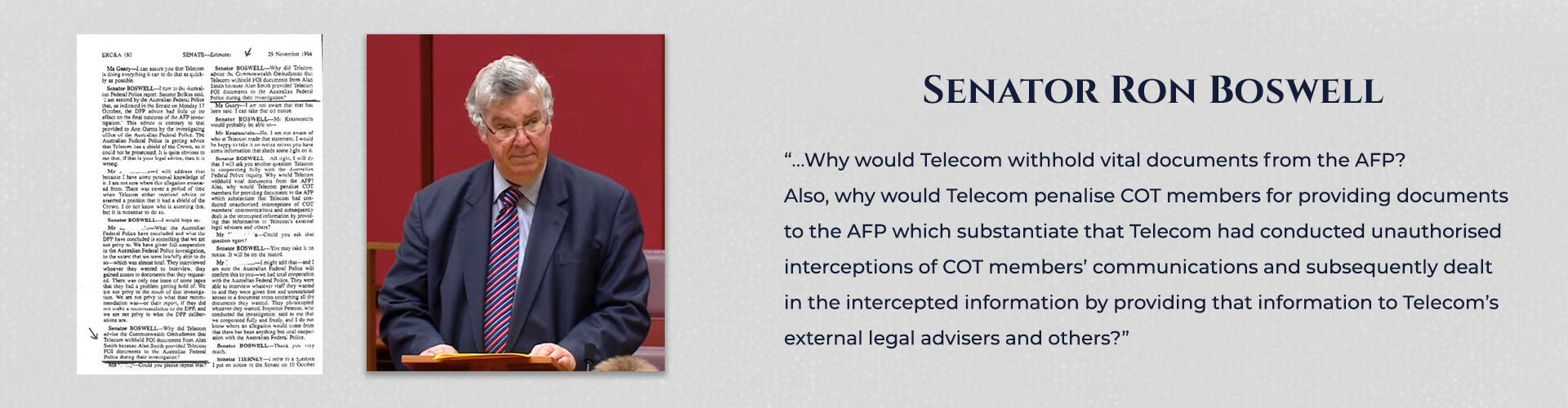
I immediately contacted Senator Ron Boswell, the National Party Whip in the Senate. What I told him, and what the AFP had implied, was serious enough that he took the matter straight into Parliament. He raised the threats publicly, placing them on the official record. His intervention underscored the gravity of what I was dealing with: a federal agency applying pressure, Telstra’s conduct under scrutiny, and my arbitration hanging in the balance.
The official Australian Senate Hansard captures the seriousness of the moment. On page 180, ERC&A, dated 29 November 1994, Senator Ron Boswell directly confronted Telstra’s legal directorate, asking:
“Why did Telecom advise the Commonwealth Ombudsman that Telecom withheld FOI documents from Alan Smith because Alan Smith provided Telecom FOI documents to the Australian Federal Police during their investigation?”
After receiving a hollow response from Telstra, which the senator, the AFP and I all knew was utterly false, the senator states:
“…Why would Telecom withhold vital documents from the AFP? Also, why would Telecom penalise COT members for providing documents to the AFP which substantiate that Telecom had conducted unauthorised interceptions of COT members’ communications and subsequently dealt in the intercepted information by providing that information to Telecom’s external legal advisers and others?” (See Senate Evidence File No 31)
Thus, the Threats Became a Reality
What is so appalling about this withholding of relevant documents is simple: no one in the Telecommunications Industry Ombudsman (TIO) office — and no one in the government — has ever investigated the catastrophic impact this concealment had on my arbitration. Not one official asked how an Australian citizen, who had assisted the AFP in its investigation into unlawful telephone interception, could be so severely disadvantaged in a civil arbitration overseen by a government‑owned corporation.
The arbitrator should have demanded answers. The government should have intervened. Neither did.
Then, on 21 November 2007, a thick envelope arrived under the Freedom of Information Act. Inside was something I had never seen before: AUSTEL’s original draft findings, dated 2–3 March 1994, covering the telephone faults at the Cape Bridgewater Holiday Camp from 1988 to 1994.
Opening those pages was like cracking open a sealed vault. What I found inside was damning. It revealed just how fiercely the government regulator had struggled — and failed — to extract critical information from Telstra, a corporation the government itself owned at the time. The draft made one thing brutally clear: the arbitration process I had been forced into should never have gone ahead.
AUSTEL’s own words told the story. Over and over, they admitted Telstra had refused to supply the documents needed to assess my claims. Their admissions were not vague. They were precise, repeated, and devastating:
These were not minor gaps. They were structural failures, failures that crippled the regulator’s ability to assess my case and destroyed any possibility of a fair arbitration.
And yet, despite knowing Telstra was refusing to supply essential documents, the government allowed the arbitration to proceed. They allowed me to walk into a legal process blindfolded, while Telstra held every advantage.
This was not incompetence. It was betrayal, systemic, deliberate, and devastating, as the following five points show
-
Point 43 (p.20): “As no fault report records remain in existence from Cape Bridgewater residents prior to this period, or these records have not been provided to AUSTEL, it is difficult to gauge the level of problems in the area.”
-
Point 48 (p.22): “AUSTEL has been hampered in assessing Telecom’s dealings with Mr Smith by Telecom’s failure to provide files relating to Mr Smith’s complaints.”
-
Point 71 (pp.28–29): “AUSTEL has not been provided with the documents on which the conclusion in this briefing summary were reached… It can only be assumed that they are contained within the documentation not provided to AUSTEL.”
-
Point 140 (p.49): “AUSTEL’s investigation… has been hampered by Telecom’s failure to make available… the file specifically relating to the Pairs Gains Support investigation of the RCM.”
-
Point 160 (p.55): “It is hoped that a number of issues in regard to the Cape Bridgewater RCM will be clarified when Telecom provides the documentation requested by AUSTEL.”
Those five points alone told me everything I had suspected for years: the government could not obtain the evidence needed to assess my case, yet they still allowed the arbitration to proceed.
And then came the confirmation that Telstra had been given the draft report in 1994, while I had been kept in the dark.
A transcript dated 22 September 1994, recorded an interview at the Commonwealth Ombudsman’s Office. On page 7, senior investigator John Wynack asked AUSTEL’s Bruce Matthews:
“What was the date the report was issued, the AUSTEL report?”
Matthews replied:
“The final report was April… The draft report was produced in March 1994, and Telecom received their copy then.”
Telstra received their copy. I did not.
That single fact changed the meaning of everything that followed.
Because the draft — — supported my claims. It showed the regulator knew Telstra was withholding evidence. It showed the regulator could not complete its investigation. It showed the regulator knew the Cape Bridgewater exchange was failing.
Yet I was pushed into arbitration without it.
Worse still, when the government reviewed my case again in 2006, they relied on the sanitised AUSTEL report — not the draft that Telstra had been given in 1994. The truth had been sitting in a filing cabinet for thirteen years while I spent more than $300,000 trying to prove faults the government had already established.
Allowing me to enter arbitration without the necessary documents was one breach of duty. Allowing me to spend hundreds of thousands of dollars trying to prove what they already knew was another.
AUSTEL had a statutory obligation to ensure the process was fair. Instead, they allowed an arbitration to proceed when they themselves could not obtain the evidence required for justice.
That is not oversight. It is an abuse of process.
Unfortunately, I did not receive a copy of the following findings AUSTEL’s Adverse Findings at points 2 to 212 until November 23, 2007, 12 years after the termination of my arbitration process. In simple words, the government had already validated my claims as early as March 4, 1994, six weeks before April 21, 1994, when I signed the arbitration agreement.
But despite this proof, I still had to endure 13 months of a gruelling arbitration process that cost me well over $300,000 in professional fees to prove something the government had already established.
Chapter 1 Irregular and untrustworthy
Tampering with evidence can be any action that destroys, alters, conceals, of falsifies any type of evidence needed in a legal process of evaluation. This act is fraudulent conduct.
Chapter 2 Defective administration
Tampering with evidence can be any action that destroys, alters, conceals, of falsifies any type of evidence needed in a legal process of evaluation. This act is fraudulent conduct.
Chapter 3 Dishonestly using corrupt government influence
This tampering with evidence is corruption and devious. Corrupt practices mixed with bribery and criminal exploitation causes fraud and crookedness which demoralize society. Misrepresentation coupled with jobbery is extortion payola.

Chapter 4 Distorted and unlawful.
Corrupt practices mixed with bribery and criminal exploitation causes fraud and crookedness which demoralize society. Misrepresentation coupled with jobbery is extortion payola. This is fraud, subterfuge and swindling.