Mr. Bates vs the Post Office,
Visitors to this website have drawn parallels between its content and a comprehensive portrayal of criminal activities encompassing fraud.
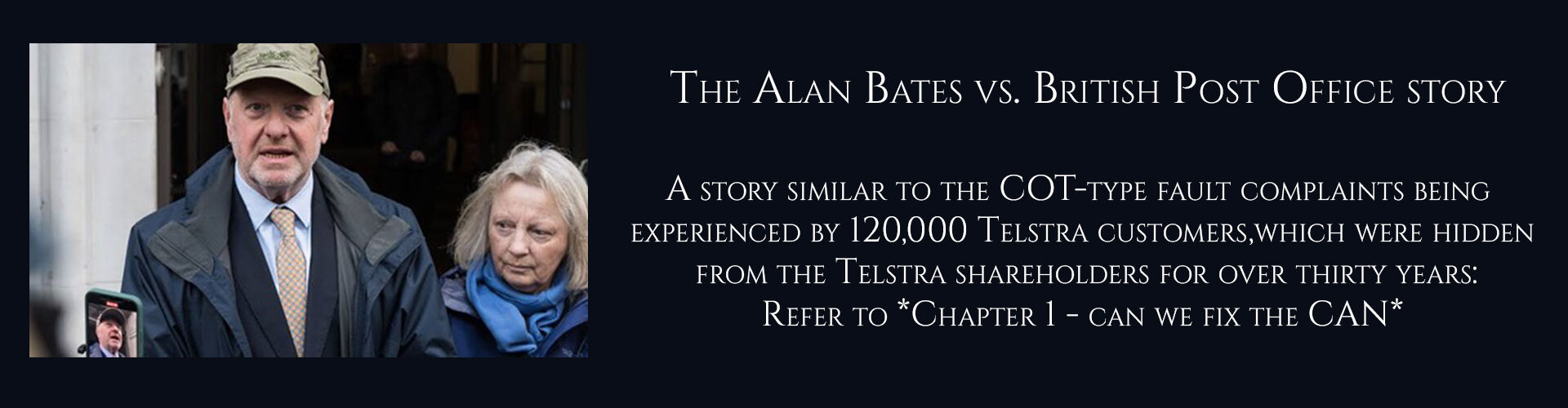
After almost two decades, the British public and a growing number of British politicians have insisted that the British Post Office scandal is a matter of profound public interest and must no longer be concealed by the government, the civil service, or the Establishment. For England’s sake, this injustice demands a complete and transparent investigation. Click here to watch the Australian Channel 7 trailer for Mr Bates vs the Post Office, which aired in February 2024 and captures the scale of this national betrayal.
What makes the scandal so disturbing is that public servants inside the British Post Office knew the Fujitsu Horizon computer software was responsible for the catastrophic accounting and billing errors. Yet they continued to blame innocent sub‑postmasters, many of whom were financially ruined, prosecuted, or imprisoned.
This pattern is painfully familiar to those of us who lived through the Australian COT arbitrations. Dr Gordon Hughes, the arbitrator appointed to oversee our cases, refused to allow his own technical consultants the additional time they needed to diagnose the ongoing faults in Telstra’s Ericsson billing software. The parallels between the British Post Office scandal and the Australian Telstra scandal are unmistakable. In both cases, faulty technical equipment was at the heart of the problem, as demonstrated in this YouTube video: https://youtu.be/
Click here to watch Mr Bates vs the Post Office
The symmetry between Telstra’s concealed 1800‑service faults and the British Post Office’s Horizon catastrophe is now impossible to ignore, especially in an age when AI systems are being granted the same blind authority once afforded to flawed human‑written code. Frank Blount’s 1999 admission that Telstra’s billing software was substandard, systemic, and long denied mirrors Fujitsu’s quiet knowledge of Horizon’s failures. In both nations, executives knew their systems were broken, yet ordinary citizens were forced to fight impossible legal battles against machines presented as infallible. AI only sharpens the warning: when technology lies, institutions follow, and the public pays.
Corporate crime does not usually involve a bag of money.
On 26 September 1997, Telecommunications Industry Ombudsman John Pinnock formally addressed a Senate estimates committee, refer to page 99 COMMONWEALTH OF AUSTRALIA - Parliament of Australia and Prologue Evidence File No 22-D. He noted:
“In the process leading up to the development of the arbitration procedures – the claimants were told clearly that documents were to be made available to them under the FOI Act.
“Firstly, and perhaps most significantly, the arbitrator had no control over that process, because it was a process conducted entirely outside the ambit of the arbitration procedures.”
There is no amendment attached to any agreement signed by the first four COT members that allows the arbitrator to conduct those particular arbitrations entirely outside the ambit of the arbitration procedure – nor was it stated that he would have no control over the process once we had signed those individual agreements. How can the arbitrator and TIO continue to hide behind a confidentiality clause in our arbitration agreement when that agreement did not state that the arbitrator would have no control, as the arbitration would be conducted entirely outside the agreed procedure?
|
||
|
||
|
||
|

 The chair of the Horizon Compensation Advisory Board, Professor Chris Hodges, has written to Darren Jones, the current Chancellor of the Duchy of Lancaster and Chief Secretary to the outgoing Prime Minister, urging action to deal with several outstanding problems related to the Post Office scandal. On behalf of the HCAB, Professor Hodges has set out a series of issues, the most pressing of which pertain to Postmasters and Post Office workers who still have criminal convictions. These people fall broadly into three groups: Capture Convictions Hodges notes the first two Capture appeals will not be heard before 2027. He believes...
The awarding of advancement in the Establishment is worth millions
Corporate crime does not usually involve a bag of money.
On 26 September 1997, Telecommunications Industry Ombudsman John Pinnock formally addressed a Senate estimates committee refer to page 99 COMMONWEALTH OF AUSTRALIA - Parliament of Australia and Prologue Evidence File No 22-D). He noted:
“In the process leading up to the development of the arbitration procedures – the claimants were told clearly that documents were to be made available to them under the FOI Act.
“Firstly, and perhaps most significantly, the arbitrator had no control over that process, because it was a process conducted entirely outside the ambit of the arbitration procedures.”
There is no amendment attached to any agreement, signed by the first four COT members, allowing the arbitrator to conduct those particular arbitrations entirely outside the ambit of the arbitration procedure – and neither was it stated that he would have no control over the process once we had signed those individual agreements. How can the arbitrator and TIO continue to hide under a confidentiality clause in our arbitration agreement when that agreement did not mention that the arbitrator would have no control because the arbitration would be conducted entirely outside the agreed procedure?
Questions on Notice (1)
The second-appointed TIO continued where the first left off
Although we address this 24 October 1997 letter from the TIO to Ms Pauline Moore, (secretary to the Senate Environment, Recreation, Communications and the Arts legislation committee) elsewhere on absentjustice.com, we can link in another sinister set of ill deeds committed against the COT claimants. This letter, stamped CONFIDENTIAL, includes the following statement:
“The COT Arbitration Procedures contain provisions relating to the confidentiality of the proceedings, which bind the parties. Those provisions also bind the Arbitrators, the Resource Unit, the Special Council and the TIO in my role as Administrator. …
“Accordingly, I ask that the answers given below to the questions on notice be treated as confidential by the Committee and not be published. …
“9. Yes, from time to time I have received complaints from foundation COT members, concerning a range of matters, including alleged non-compliance with the rules of the Fast Track Arbitration Procedures by Telstra and/or the Arbitrator and/or the Technical and Accounting Resource Unit. …
“10. Yes, I have refused to provide COT members with a copy of Telstra’s Preferred Rules of Arbitration. A copy of this document was not provided because it was of historical interest only, and the COT members did not advance any argument as to why it was relevant to their arbitration.” (See Senate Evidence File No 14)
The TIO’s insistence that the agreement was not provided to the COT claimants because: “it was of historical interest only, and the COT members did not advance any argument as to why it was relevant to their arbitration”, is a misrepresentation of the truth – to hide the fact that it was Telstra’s arbitration agreement that was used and to protect Telstra, to the detriment of the claimants.
Graham Schorer, as COT spokesperson, first asked for a copy of the Fast Track Proposed Rules of Arbitration sometime before 17 February 1994, so the decision to keep it from the claimants was made at least two months before we signed the final version of the arbitration agreement. It was, therefore, entirely “relevant to their arbitration.” The COT claimants were legally entitled to know whether the arbitration agreement was drafted independently or if the defence crafted it in their favour.
The claimants should have been provided with that original version of the agreement before we signed for arbitration; it should have also been provided during the arbitrations and the arbitration appeal periods. At an official arbitration meeting on 17 February 1994, Mr Schorer said he wanted assurances from the TIO and the arbitrator that the agreement he and the other COT claimants were pressured to sign was not Telstra’s Proposed Rules of Arbitration. Telstra’s own transcript of this meeting (see Senate Evidence File No/48 ) confirms the arbitrator and the TIO special counsel “both stated they had not received this document and had not read it and that it was irrelevant”. Documents (see Senate Evidence File No 6 and File No/49) confirm the arbitrator was provided with (and read) a document called “Telstra Corporation Limited – ‘Fast Track’ Proposed Rules of Arbitration” sometime before 18 January 1994, a whole month before this pre-arbitration hearing on 17 February 1994.
Telstra’s Fast Track Proposed Rules of Arbitration, which the TIO was still refusing to supply us in October 1997, was the same arbitration file that John Wynack, director of investigations in the Commonwealth Ombudsman’s Office, was trying to access from Telstra on my behalf during 1995 to 1997 (discussed above). Powerful people amongst those administering the COT arbitrations wielded power within the establishment to conceal this very important pre-arbitration document.
How can the government, who originally endorsed the first four arbitrations, ignore that we were entitled to receive Telstra’s arbitration rules before we signed our arbitration agreement? Do not forget the TIO’s letter to me, dated 10 January 1996, stating, “I do not propose to provide you with copies of any documents held by this office,” (see Senate Evidence File No/50) – echoing the responses that Graham Schorer and I had received since February 1994, from the previous TIO, when requesting copies of Telstra’s proposed rules of arbitration.
John Pinnock also advised Ms Pauline Moore, Secretary of the Senate Environment, Recreation, Communications and the Arts Legislation Committee, that:
“I refer to previous correspondence and discussions with the Committee’s Research Officer, Ms Ducker, concerning a series of questions put on notice by Senator Boswell and arising out of the Committee’s proceedings of 26 September 1997…(GS 318-b)
“The COT Arbitration Procedures contain provisions relating to the confidentiality of the proceedings, which bind the parties. Those provisions also bind the Arbitrators, the Resource Unit, the Special Council and the TIO in my role as Administrator.”
Please note: only Telstra and the COT claimants signed the confidentiality agreement.
Mr Pinnock also notes:
“Accordingly, I ask that the answers given below to the questions on notice be treated as confidential by the Committee and not published:
In November 1995 I received correspondence from a COT member expressing concern about the Technical Resource Unit. The COT member:
expressed concern that the purchase by Pacific Star of Lane Telecommunications compromised the independence of the Technical Resource Unit;
stated that there were inaccuracies and biases evident in the Lane Telecommunications/DMR Technical Evaluation Report;
requested the Telecommunications Industry Ombudsman to dismiss the Resource Unit.On 6 November 1995 I was advised by Steve Black of Telstra that Lane Telecommunications and Pacific Star had already worked together on several Pacific Star contracts in Queensland and Western Australia and for the Federal Government.”
“Apart from the evidence I gave to the Committee on 26 September 1997 concerning the purchase of Lane Telecommunications by Ericsson Australia. I have recently been advised by one of the Arbitrators (Dr Hughes) that he will be transferring his legal practice to Blake Dawson, Waldron, Solicitors. I am aware that that form is currently acting for Telstra in relation to a number of matters. Arrangements are being made to discuss with Blake. Dawson, Waldron any possible conflicts of interest. …
Perhaps even worse, before Dr Gordon Hughes (the arbitrator) became a partner in the very same legal firm that was defending Telstra concerning their 008/1800 billing problems, the government officially advised the arbitrator that if he was not going to make a finding on my 008/1800 billing faults, then the government would investigate as a matter of public interest.
AUSTEL (now ACMA) advised me in writing years after the conclusion of my arbitration that Dr Hughes ignored this 16 December 1994 letter and on 30 April 1995 disallowed his technical consultants DMR (Canada) and Lane (Australia) the extra weeks they stated were needed to investigate these 008/1800. Five months after the conclusion of my arbitration, the government allowed Telstra to address these prior 008/1800 problems in secret, outside the legal arena of the arbitration, without affording me my legal right to challenge Telstra's defence of my 008/1800 arbitration billing faults.
24th October 1997: John Pinnock writes to Ms Pauline Moore, Secretary of the Senate Environment, Recreation, Communications and the Arts Legislation Committee, noting:
“I refer to previous correspondence and discussions with the Committee’s Research Officer, Ms Ducker, concerning a series of questions put on notice by Senator Boswell and arising out of the Committee’s proceedings of 26 September 1997…” AS-CAV Exhibit 234 to 281 - GS-CAV 318-B
“The COT Arbitration Procedures contain provisions relating to the confidentiality of the proceedings, which bind the parties. Those provisions also bind the Arbitrators, the Resource Unit, the Special Council and the TIO in my role as Administrator.
Please note: only Telstra and the COT claimants signed the Confidentiality Agreement.
Mr Pinnock also notes:-
“Accordingly, I ask that the answers given below to the questions on notice be treated as confidential by the Committee and not published:
- In November 1995 I received correspondence from a COT member expressing concern about the Technical Resource Unit. The COT member:
- expressed concern that the purchase by Pacific Star of Lane Telecommunications compromised the independence of the Technical Resource Unit;
- stated that there were inaccuracies and biases evident in the Lane Telecommunications/DMR Technical Evaluation Report;
- requested the Telecommunications Industry Ombudsman to dismiss the Resource Unit.
- On 6 November 1995, Steve Black of Telstra advised me that Lane Telecommunications and Pacific Star had already worked together on several Pacific Star contracts in Queensland and Western Australia and for the Federal Government.
and at points 6, 8, 9 and 10
6. Apart from the evidence I gave to the Committee on 26 September 1997 concerning the purchase of Lane Telecommunications by Ericsson Australia. I have recently been advised by one of the Arbitrators (Dr Hughes) that he will be transferring his legal practice to Blake Dawson, Waldron, Solicitors. I am aware that that form is currently acting for Telstra in relation to a number of matters. Arrangements are being made to discuss with Blake. Dawson, Waldron any possible conflicts of interest. …
Part 2 → Chapter 1- Prior to Arbitration, we question the role of Grant Campbell when he was Manager of the TIO Complaints Department during the early period of 1994 when I was having my Fast Track Settlement Proposal claim documents assessed under that 23 November 1993 agreement
Interestingly, the 1993/94 TIO Annual Report does not list Mr Campbell as having worked for the TIO office, even though Mr Campbell held a Senior Managerial position with Telstra.
- TIO documents dated 9 February 1994 confirm Grant Campbell signing letters on behalf of Warwick Smith, particularly regarding the fax billing and lock-up complaints included in my arbitration claims.
- Telstra FOI documents H36271, H36281 and H000027 confirm Grant Campbell addressed the same billing issues on behalf of Telstra’s Customer Response Unit in January and February 1995. This unit wrote to Dr Hughes on 16th December 1994 to confirm that Telstra advised AUSTEL that they would address Alan Smith’s billing issues as part of their defence of his claim, as per the arbitration agreement. Alan Smith has always been concerned about Grant Campbell’s handling of Alan’s arbitration material that went through the TIO’s office in 1994/95.
- During the early stages of the COT arbitration process, the COT claimants were told that Pia Di Mattina had been seconded from Minter Ellison by the TIO to assist him with the COT arbitration process. Ms Mattina’s name is not in the TIO 1993/94 employee list included in the 1993/94 Annual Report. Grant Campbell’s name is not included on the employee list either, even though he dealt with several billing issues that Alan Smith raised during his arbitration.
I received GS-CAV Exhibit 448 to 458 - See GS-CAV 448 to 456 on 4th March 2008.
GS-CAV Exhibit 448 to 458 - See 448: around 6th December 1994, Steven Mead, Telstra’s General Counsel, investigated Ken Ivory’s 1800 problems (Ken Ivory was a COT claimant). At approx. At the same time, Telstra and AUSTEL passed information regarding Alan Smith’s 008/1800 billing problems to Dr Hughes. Page 8 of this Mails Details Report refers to a separate 164-page report in relation to Solar-Mesh (Ken Ivory’s business) confirming law firm Blank was involved in this matter with Telstra, together with the TIO’s office.
GS-CAV Exhibit 448 to 458 - See 449: another Mails Details Report dated 17th February 1997 also relates to Ken Ivory of Solar-Mesh and confirms (Blank) had an interest in the Ken Ivory/1800 issue. This document further confirms Telstra’s Ted Benjamin and Graeme Ward were both involved in this particular COT-related 1800 billing problem while, at the same time, Graeme Ward was a member of the TIO Board and Ted Benjamin was a member of the TIO Council (the administrative arm of the COT arbitrations).
GS-CAV Exhibit 448 to 458 - See 450: letter dated 10th July 1995 from Wally Rothwell (Deputy TIO) to Grant Campbell (Telstra), discussing Ken Ivory’s 1800 billing problems.
GS-CAV Exhibit 448 to 458 —See 451: A letter dated 15 December 1995 from Ted Benjamin to John Pinnock confirms they were both aware of the 1800 problems Ken Ivory was experiencing.
GS-CAV Exhibit 448 to 458 - See 452: letter dated 1st April 1996 from Grant Campbell (Telstra) to Wally Rothwell (Deputy TIO), discusses Ken Ivory’s 1800 billing problems.
GS-CAV Exhibit 448 to 458 - See 453: an internal Telstra email (FOI folio 000973) dated 5th February 1997 from Philippi Hore to Carmel Parish, discusses Ken Ivory and ex-Telstra employee, Grant Campbell, noting:-
“Quinton advised me that there was an employee who was the main case officer for Ivory in the early stages. The ex-employee’s name is Grant Campbell. Grant then worked as the Deputy Telecommunication Industry Ombudsman and then on a senior management review team.”
This suggests that, after first working for Telstra, Grant Campbell became the Deputy TIO before returning to Telstra.
GS-CAV Exhibit 448 to 458 - See 454: facsimile cover-dated 10th January 1994 from Grant Campbell to Warwick Smith TIO, notes:-
“Warwick – Two COT-related faxes follow:
- Allan Smith – Cape Bridgewater Holiday Camp
- Expression of Interest by Ferrier Hodgson in conjunction with DMR Australia & Dr Gordon Hughes.
GS-CAV Exhibit 448 to 458 - See 455: letter from Grant Campbell dated 9th February 1994 written on behalf of Warwick Smith to Fiona Hills, Telstra’s Manager – Serious Disputes, discusses faxing problems still being experienced by me during his FTSP.
GS-CAV Exhibit 448 to 458 —See 456: A letter from Grant Campbell, dated 13th February 1994, to Fiona Hills, in his capacity as TIO Manager, Enquiries and Complaints, discusses a number of complaints I raised regarding his phone and faxing problems.
GS-CAV Exhibit 448 to 458 - See 454 to 456: relate to Grant Campbell’s handling of COT case matters while he was TIO Manager of Enquiries and Complaints.
IMPORTANT Food For Thought
During my 23 November 1993 to April 1994 FTSP Commercial Assessment process and then during my April 1994 to May 1995 FTAP arbitration procedure, I was never informed that Grant Campbell defected to Telstra’s Customer Response Unit.
As discussed for the date of 29th December 1997, Dr Hughes wrote to William Hunt on not named legal firm letterhead noting:-
- “due to a perceived conflict of interest arising from my commencement at
- Not named legal firm, I shall forthwith cease to act as arbitrator.”
“I noted the following reservations and qualifications expressed by the parties:
- Mr Schorer has reservations as to whether the arbitration should continue;
- Mr Benjamin has some reservations as to whether a mediation should be commenced;
- Mr Schorer’s objects to the involvement of Mr Howell as a technical expert (although this is an issue which has previously been addressed by me).”
(GS-CAV Exhibit 324 to 367 - See GS CAV 344)
Question:
Was Dr Hughes aware, at the time he wrote this letter, that:-
- Not named legal firm and Telstra’s Ted Benjamin were also investigating another COT case 1800 billing issue along with the TIO of?
- These were the same type of 1800-billing complaints that Ted Benjamin told Dr Hughes on 8th December 1994 he would address in my arbitration.
- Should Warwick Smith, as the administrator of Graham and Alan’s arbitration, have advised them not to forward arbitration material through Grant Campbell because he had defected from Telstra?
- In 1994, Alan supplied the TIO office with FTSP material regarding the 008/1800 and fax problems as part of his claim material (which he later received back from the TIO in 2001 under the Privacy Policy Act). Was some of this material removed by Grant Campbell when he defected to Ted Benjamin’s Customer Response Unit before the TIO-appointed technical consultants assessed it?
- Because Alan provided his 008/1800 claim documents to the TIO in a detailed manner, was some of this material used by Grant Campbell after he left the TIO office in his effort to further investigate this known systemic billing problem?
How could Warwick Smith (administrator to the arbitration procedure) his media release on 12 May 1995 declaring I (without naming me) received Natural Justice) when on 18 April 1995, he received a letter from his own appointed arbitration project Manager, John Rundell, telling him:
“Any technical report prepared in draft by Lanes will be signed off and appear on the letter of DMR Inc.” Prologue Evidence File No 22-A
The first four COT claimants, Ann Garms, Maureen Gillan, Graham Schorer and I, were never told about these "forces at work" during our designated appeal processes. We should have been warned that ex-Telstra employee Lanes would prepare the technical reports against Telstra (as the following evidence shows what took place: 6-4-95 Lane Draft Report (4-A). DMR Group Inc. was covertly flown out of Canada solely to sign off on Lane's findings.
If signing off a report as your own report or allowing someone to do this by removing their letterhead and placing their concocted report on the letterhead of another company letterhead before it is submitted to an arbitrator as the final report, as was in the case when John Rundell (who operates two arbitration centres, one in Melbourne (Australia) and the other in Hong Kong (China) see Prologue Evidence File No 22-A isn't Misleading and Deceptive Conduct of the worst possible kind, then what is?
Section 52 of the Australian Trade Practices Act (Refer to https://shorturl.at/dz156) prohibits corporations from engaging in misleading or deceptive conduct in trade or commerce.