Absent Justice Contact
On July 4, 1994, amidst the complexities of my arbitration proceedings, I confronted serious threats articulated by Paul Rumble, a Telstra representative on the arbitration defence team. Disturbingly, he had been covertly furnished with some of my interim claims documents by the arbitrator—a breach of protocol that occurred an entire month before the arbitrator was legally obligated to share such information. Given the gravity of the situation, my response needed to be exceptionally meticulous. I invested considerable effort in crafting this detailed letter, carefully selecting every word. In this correspondence, I made it unequivocally clear:
“I gave you my word on Friday night that I would not go running off to the Federal Police etc, I shall honour this statement, and wait for your response to the following questions I ask of Telecom below.” (File 85 - AS-CAV Exhibit 48-A to 91)
When drafting this letter, my determination was unwavering; I had no intention of submitting any additional Freedom of Information (FOI) documents to the Australian Federal Police (AFP). This decision was significantly influenced by a recent, tense phone call I received from Steve Black, another arbitration liaison officer at Telstra. During this conversation, Black issued a stern warning: should I fail to comply with the directions he and Mr Rumble gave, I would jeopardise my access to crucial documents pertaining to ongoing problems I was experiencing with my telephone service.
Page 12 of the AFP transcript of my second interview (Refer to Australian Federal Police Investigation File No/1) shows Questions 54 to 58, the AFP stating:-
“The thing that I’m intrigued by is the statement here that you’ve given Mr Rumble your word that you would not go running off to the Federal Police etcetera.”
Essentially, I understood there were two potential outcomes: either I would obtain documents that could substantiate my claims, or I would be left without any documentation that could affect the arbitrator's decisions in my case.
However, a pivotal development occurred when the AFP returned to Cape Bridgewater on 26 September 1994. During this visit, they began asking probing questions about my correspondence with Paul Rumble, demonstrating a sense of urgency in their inquiries. They indicated that if I chose not to cooperate with their investigation, their focus would shift entirely to the unresolved telephone interception issues central to the COT Cases, which they claimed assisted the AFP in various ways. I was alarmed by these statements and contacted Senator Ron Boswell, National Party 'Whip' in the Senate.
As a result of this situation, I contacted Senator Ron Boswell, who subsequently brought these threats to the Senate's attention. This statement underscored the serious nature of the claims I was dealing with and the potential ramifications of my interactions with Telstra.
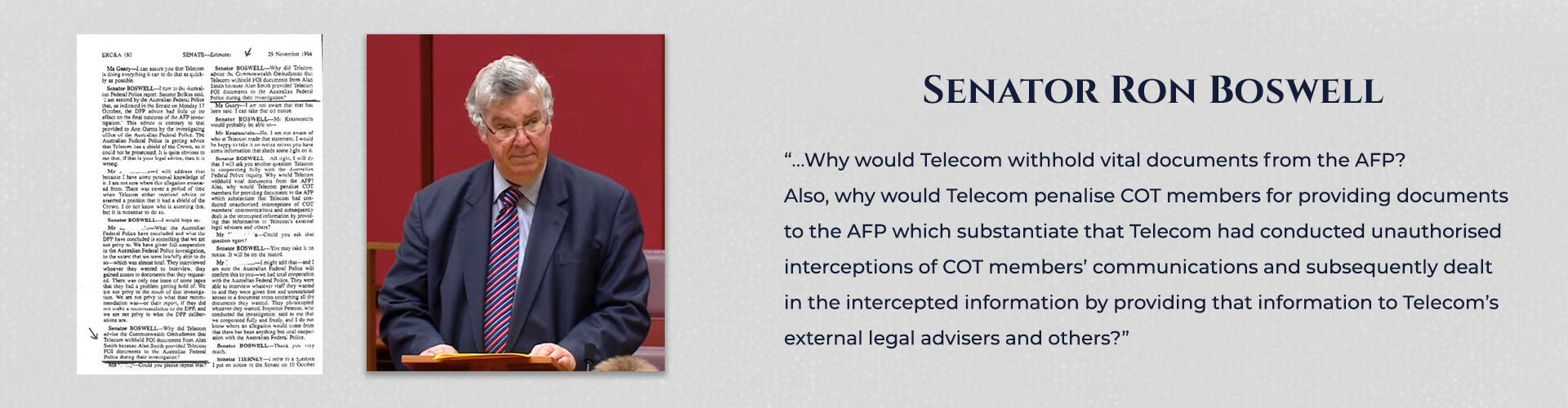
On page 180, ERC&A, from the official Australian Senate Hansard, dated 29 November 1994, reports Senator Ron Boswell asking Telstra’s legal directorate:
“Why did Telecom advise the Commonwealth Ombudsman that Telecom withheld FOI documents from Alan Smith because Alan Smith provided Telecom FOI documents to the Australian Federal Police during their investigation?”
After receiving a hollow response from Telstra, which the senator, the AFP and I all knew was utterly false, the senator states:
“…Why would Telecom withhold vital documents from the AFP? Also, why would Telecom penalise COT members for providing documents to the AFP which substantiate that Telecom had conducted unauthorised interceptions of COT members’ communications and subsequently dealt in the intercepted information by providing that information to Telecom’s external legal advisers and others?” (See Senate Evidence File No 31)
Thus, the Threats Became a Reality
What is so appalling about this withholding of relevant documents is this: no one in the Telecommunication Industry Ombudsman (TIO) office or the government has ever investigated the disastrous impact of this withholding on my overall submission to the arbitrator. The arbitrator and the government (at the time, Telstra was a government-owned entity) should have initiated an investigation into why an Australian citizen who had assisted the AFP in its investigations into unlawful interception of telephone conversations was so severely disadvantaged in a civil arbitration.
Please email me for further information → absentjustice@gmail.com