INTRODUCTION
We have lived with this for so long that it has settled into us the way weather settles into old timber. The lies, the corruption, the threats, the slow erosion of trust became the background hum of our lives, a constant vibration beneath everything we did. Thirty years. A generation. Long enough for children to grow into adults, for marriages to rise and fall, for bodies to weaken, for friends to die. Long enough for the world to change around us while we remained trapped in the same unresolved story.
We speak now as we because the experience was never singular. It was never just one of us standing alone against a faceless institution. It was all of us, scattered across Australia, each living our own version of the same nightmare. We were small business owners, farmers, operators, workers, people who believed in the basic decency of the system. People who believed that when something went wrong, there were mechanisms to fix it. People who believed arbitration meant fairness, that government meant oversight, that truth meant something.
We were naïve. We can admit that now. But at the time, we walked into the process with the kind of trust that only ordinary citizens possess — the trust that comes from never having had reason to doubt the machinery of the state.
The first cracks appeared quietly. A fault here, a dropped call there, a complaint lodged, a technician dispatched, a promise made. We thought it would be simple. We thought it would be resolved. But the faults were only the doorway. What lay behind them was a labyrinth of concealment, denial, and institutional rot so deep that even now, after all these years, we struggle to articulate the scale of it without feeling the old anger rise in our throats.
When arbitration was offered, we believed it was the path to truth. We believed the arbitrator would be a neutral figure, a steady hand, a moral compass, a safeguard. We believed he would look at the evidence, see the inconsistencies, and demand answers. We believed he would protect the integrity of the process.
Instead, we found ourselves standing before a man who had the power to stop the harm and chose not to. A man who could have halted the lies, exposed the corruption, and insisted on transparency, but instead allowed the process to continue, knowing it was compromised. That choice changed the trajectory of our lives. It is one thing to be harmed by a corporation. It is another to be harmed by the very process designed to deliver justice.
That is a wound that never fully heals.
The Hidden Cost of Cape Bridgewater’s Failing Lines
No wonder I was financially broken by the end of 1988—barely a year after taking over the business in late 1987. The reality was brutal: Cape Bridgewater’s telecommunications setup was catastrophically inadequate.
In stark terms, if just four of the 144 residences were making or receiving calls, only four lines remained for the other 140 residents. That’s not just poor planning—it’s a systemic failure. My business was strangled by a network that couldn’t support even the most basic communication needs. Every missed call was a missed opportunity. Every dropped connection was another nail in the coffin of a venture I had poured everything into.
We stepped into this complex landscape of limited connectivity and coastal beauty with ambition and optimism. The Camp was more than a business—it was a dream made real. A serene retreat where the stress of city life could dissolve into the ocean mist. However, as we quickly learned, dreams require infrastructure to thrive.
Our phone lines became both our lifeline and our most significant obstacle. Booking inquiries, supply orders, emergency calls—even simple conversations with clients—all had to pass through those eight fragile channels. During peak times, the lines were constantly engaged. Guests complained they couldn’t reach us. Suppliers missed confirmations. Opportunities slipped through our fingers like sand.
A Conspiracy of Silence: The Betrayal Behind the Arbitration
The document from March 1994 (AUSTEL’s Adverse Findings) reveals a troubling reality: government officials tasked with investigating my ongoing telephone issues found my claims against Telstra to be valid. This was not merely an oversight; it indicates a deliberate pattern of misconduct that played out between Points 2 and 212.
It is chilling to consider that, had the arbitrator been furnished with this critical evidence, he would likely have awarded me far greater compensation for my substantial business losses. Instead, my claims were weakened because they lacked a proper log over the six-year period that AUSTEL deceptively used to formulate their findings, as outlined in AUSTEL’s Adverse Findings.
It is January 2026, and Telstra and the government have still not released the promised documents, he said. Telstra would provide them at the meeting discussed below.
Don't forget to hover your mouse over the following images as you scroll down this homepage.
The Arbitrator & the Corruption of Arbitration in Australia
Introduction: A System Built on Betrayal.
The arbitration system in Australia was sold to us as fair, transparent, and government-endorsed. In reality, it was anything but. The Institute of Arbitrators and Mediators Australia (IAMA) was supposed to be independent, yet time and again it bent to political and corporate influence. What should have been a safeguard for justice became a weapon of betrayal.
The COT Cases: Cracks in the System (1990s)
Back in the 1990s, the Casualties of Telstra (COT) cases exposed the rot. Telstra and government officials withheld documents, misled arbitrators, and left claimants fighting blind. Arbitrators ignored evidence that should have been central to their rulings. The result? Ordinary Australians were systematically disadvantaged while Telstra and its allies walked away untouched. Those cases proved one thing: when corporate power colludes with political silence, justice collapses.
The Telstra Briefcase Incident (1992–1993)
I saw this corruption firsthand. Two Telstra executives left an unlocked briefcase in my Cape Bridgewater office. Inside were documents that revealed Telstra’s board and management were orchestrating a campaign to mislead the public. They knew their copper wire network and Ericsson equipment were faulty. Overseas, this equipment was being ripped out of exchanges. Here in Australia, Telstra kept rolling it out, putting vulnerable customers at risk.
When I raised these issues, the arbitrator ruled that the faults had no impact on my business viability. That wasn’t negligence—it was complicity. Later, documents dated July–December 1992, formalised under the Freedom of Information Act, confirmed what I already knew: I had been deliberately misled about the reliability of my service for years.
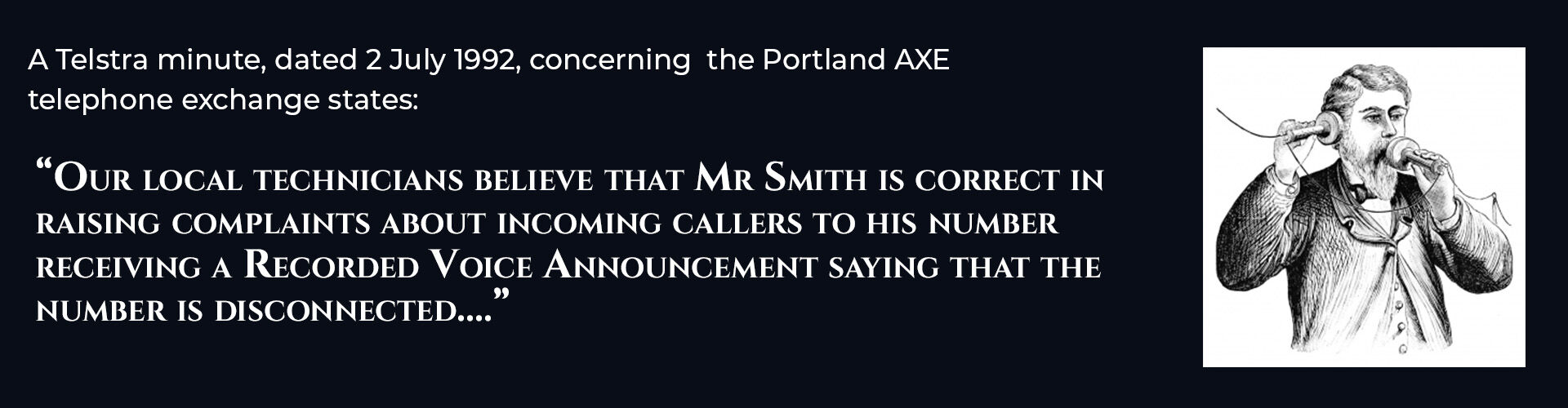
“Our local technicians believe that Mr Smith is correct in raising complaints about incoming callers to his number receiving a Recorded Voice Announcement saying that the number is disconnected.
“They believe that it is a problem that is occurring in increasing numbers as more and more customers are connected to AXE.” (See False Witness Statement File No 3-A)
To further support my claims that Telstra already knew how severe my Ericsson Portland AXE telephone faults were, it can best be viewed by reading Folios C04006, C04007 and C04008, headed TELECOM SECRET (see Front Page Part Two 2-B), which states:
“Legal position – Mr Smith’s service problems were network related and spanned a period of 3-4 years. Hence Telecom’s position of legal liability was covered by a number of different acts and regulations. … In my opinion Alan Smith’s case was not a good one to test Section 8 for any previous immunities – given his evidence and claims. I do not believe it would be in Telecom’s interest to have this case go to court.
“Overall, Mr Smith’s telephone service had suffered from a poor grade of network performance over a period of several years; with some difficulty to detect exchange problems in the last 8 months.”
Threats came in many forms. Some were spoken plainly, others wrapped in bureaucratic language, others implied through delays, obstructions, or the sudden appearance of obstacles that had no logical explanation. There were days when the phone would ring, and we would feel our stomachs tighten. There were nights when we lay awake wondering what would be taken from us next. There were moments when we questioned whether we were safe, whether our families were safe, whether the fight was worth the cost.
During this unlawful situation, I encountered significant challenges with the arbitrator, Dr Gordon Hughes AO. He made the troubling decision not to investigate the causes of several issues that had never been clarified to me during my government-endorsed arbitration in 1994. I was left wondering why he permitted Telstra to carry out these threatening actions without proper oversight or accountability. This apparent blindness on Dr Hughes’s part compelled me to seek assistance from Senator Ron Boswell.
Chapter 2 - Inaccurate and Incomplete
Threats made leading up to and during my arbitration
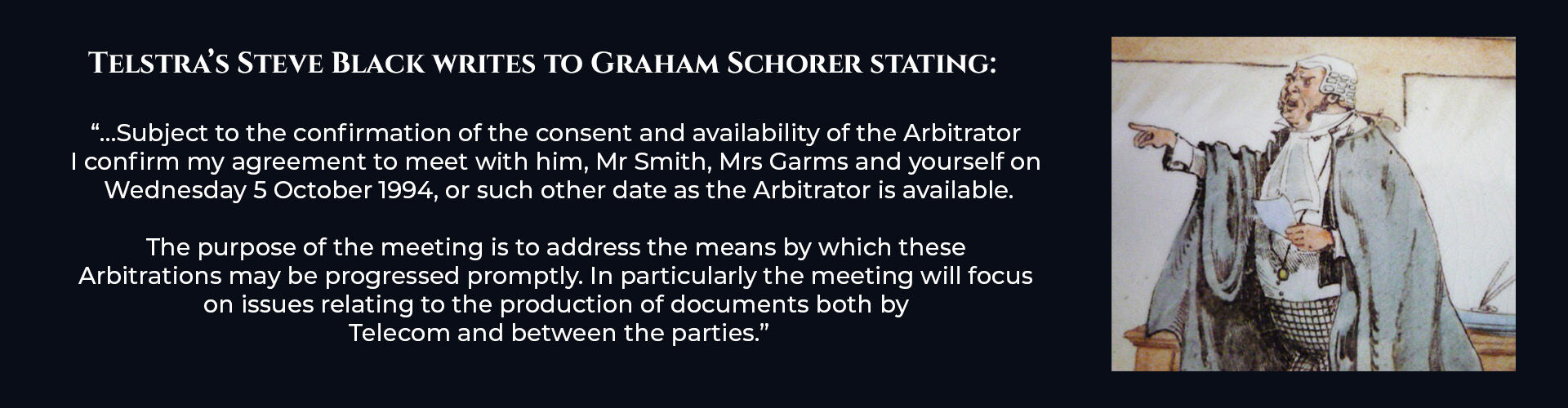
On July 4, 1994, amidst the complexities of my arbitration proceedings, I confronted serious threats articulated by Paul Rumble, a Telstra representative on the arbitration defence team. Disturbingly, he had been covertly furnished with some of my interim claims documents by the arbitrator—a breach of protocol that occurred an entire month before the arbitrator was legally obligated to share such information. Given the gravity of the situation, my response needed to be exceptionally meticulous. I invested considerable effort in crafting this detailed letter, carefully selecting every word. In this correspondence, I made it unequivocally clear:
“I gave you my word on Friday night that I would not go running off to the Federal Police etc, I shall honour this statement, and wait for your response to the following questions I ask of Telecom below.” (File 85 - AS-CAV Exhibit 48-A to 91)
When drafting this letter, my determination was unwavering; I had no intention of submitting any additional Freedom of Information (FOI) documents to the Australian Federal Police (AFP). This decision was significantly influenced by a recent, tense phone call I received from Steve Black, another arbitration liaison officer at Telstra. During this conversation, Black issued a stern warning: should I fail to comply with the directions he and Mr Rumble gave, I would jeopardise my access to crucial documents pertaining to ongoing problems I was experiencing with my telephone service.
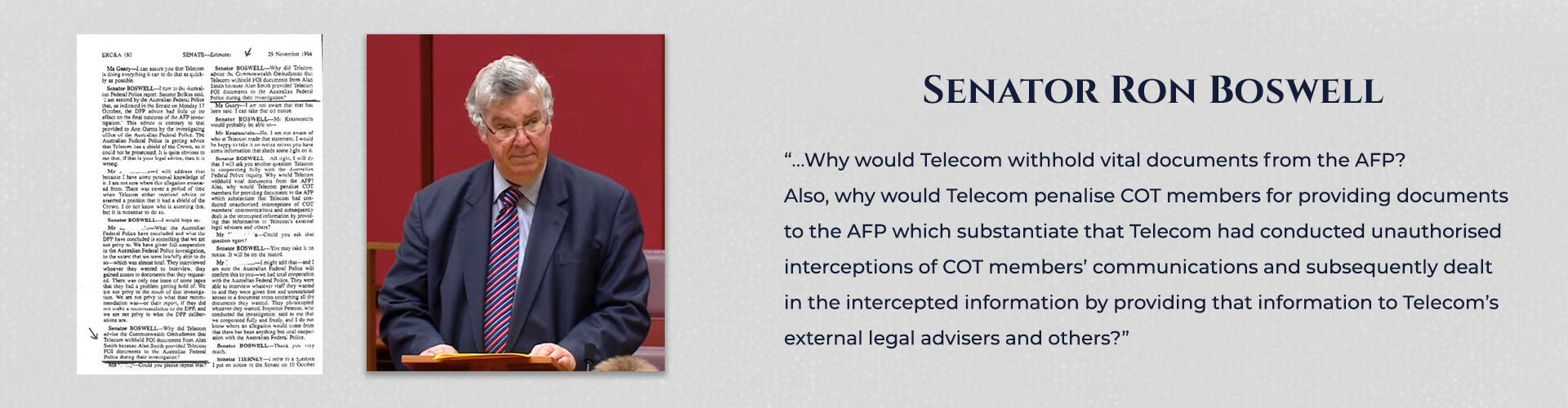
On page 180, ERC&A, from the official Australian Senate Hansard, dated 29 November 1994, reports Senator Ron Boswell asking Telstra’s legal directorate:
“Why did Telecom advise the Commonwealth Ombudsman that Telecom withheld FOI documents from Alan Smith because Alan Smith provided Telecom FOI documents to the Australian Federal Police during their investigation?”
After receiving a hollow response from Telstra, which the senator, the AFP and I all knew was utterly false, the senator states:
“…Why would Telecom withhold vital documents from the AFP? Also, why would Telecom penalise COT members for providing documents to the AFP which substantiate that Telecom had conducted unauthorised interceptions of COT members’ communications and subsequently dealt in the intercepted information by providing that information to Telecom’s external legal advisers and others?” (See Senate Evidence File No 31)
Thus, the Threats Became a Reality
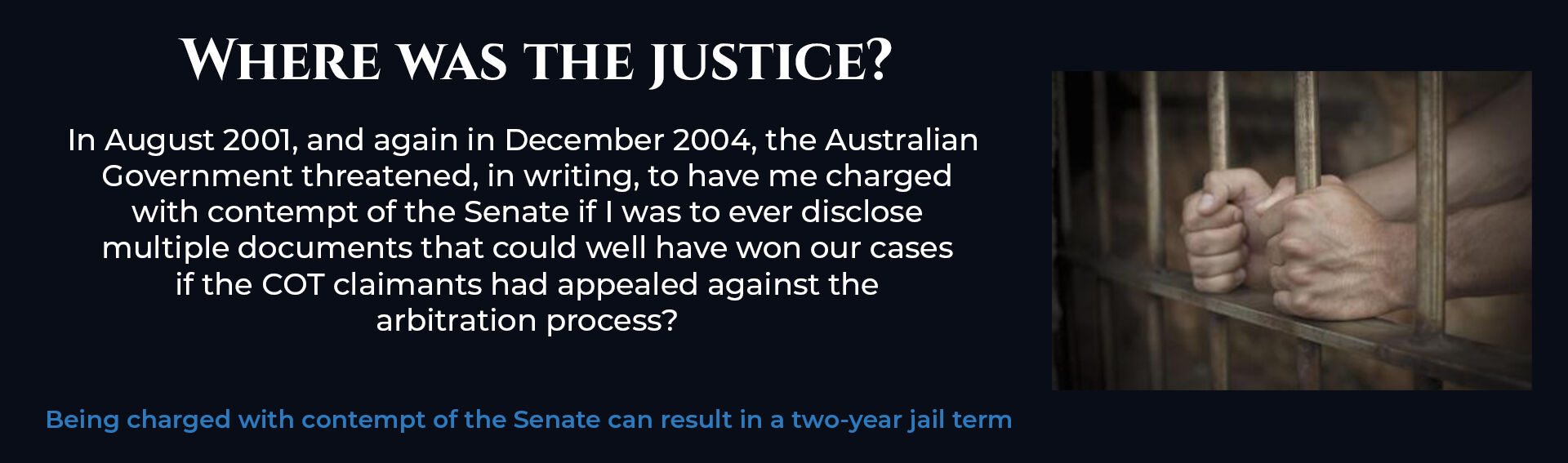
What is so appalling about this withholding of relevant documents is this: no one in the Telecommunication Industry Ombudsman (TIO) office or the government has ever investigated the disastrous impact of this withholding on my overall submission to the arbitrator. The arbitrator and the government (at the time, Telstra was a government-owned entity) should have initiated an investigation into why an Australian citizen who had assisted the AFP in its investigations into unlawful interception of telephone conversations was so severely disadvantaged in a civil arbitration.
An intense confrontation unfolded in a heated Senate committee meeting when National Party Senator Ron Boswell delivered a fiery critique to a senior officer involved in the Telstra arbitration process. With palpable frustration, he exclaimed, “You are really a disgrace, the whole lot of you,” his voice resonating throughout the chamber. The remarks cast a shadow over the already tense atmosphere as Telstra's conduct regarding the COT Cases took centre stage.
However, the gravity of his words quickly caught the committee chair's attention, prompting a swift intervention. Under scrutiny and recognising the need for decorum in such a serious forum, Senator Boswell was compelled to apologise. Turning to the chairperson more measuredly, he declared, “Madam, I withdraw that remark.” This moment of accountability underscored the importance of respectful dialogue in legislative discussions and illuminated the ongoing challenges surrounding Telstra’s treatment of COT Cases, a matter of significant public interest.
“Madam, I withdraw that, but I do say this: this has got a unity ticket going right through this parliament. This has united every person in this parliament – something that no-one else has ever had the ability to do – and Telstra has done it magnificently. They have got the Labor Party, they have got the National Party, they have got the Liberal Party, they have got the Democrats and they have got the Greens – all united in a singular distrust of Telstra. You have achieved a miracle.”
But we kept going. Not because we were fearless, though some of us were. Not because we were stubborn, though all of us were. But because the truth mattered. Because justice mattered. Because what was done to us was wrong, and silence would have been a second betrayal.
The arbitrator remains the central figure in our collective memory, not because he was the architect of the harm, but because he was the one person who could have stopped it. He could have said, “This cannot proceed until all documents are produced.” He could have said, “This cannot proceed while evidence is being withheld.” He could have said, “This cannot proceed while the government is cleansing its archives.” He could have said, “This cannot proceed while the truth is being buried.”
 He could have said all of that, and he said none of it.
Instead, he allowed the process to continue, knowing it was compromised. He allowed the lies to stand, knowing they were lies. He allowed the corruption to flourish, knowing it was corruption. He allowed the threats to persist, knowing we were vulnerable. He allowed the trauma to take root, and it has been growing in us ever since.
People think trauma is a moment. It isn’t. Trauma is a landscape, one you learn to navigate because you have no choice. For thirty years, we have lived with the exhaustion of fighting a system designed to outlast us. We have lived with the grief of watching fellow COT Cases die without seeing justice. We have lived with the guilt of surviving when others did not. We have lived with the frustration of knowing the truth and being unable to force institutions to acknowledge it. We have lived with the bitterness of watching officials retire with honours while we carried the scars. We have lived with the loneliness of being dismissed as troublemakers, complainers, relics of an old dispute. We have lived with the quiet, daily ache of knowing our families paid a price they never should have had to pay.
And we have lived with the knowledge that our story was not just mishandled, it was buried. The cleansing of government records was a second crime, one that cut deeper than the first. It is one thing to be wronged. It is another matter to have the evidence of that wrongdoing erased. We watched FOI documents arrive with pages missing. We watched timelines shift mysteriously. We watched records disappear. We watched officials claim that files “never existed”, files we had seen with our own eyes. We watched the truth being scrubbed clean, as though our suffering could be erased with it.
This was not incompetence. This was not an accident. This was preservation, not of justice, but of reputations. And the arbitrator knew. He knew the documents were incomplete. He knew the evidence was compromised. He knew the process was tainted. And still he proceeded.
That is the part that keeps us awake at night.
We lost businesses. We lost marriages. We lost health. We lost years — decades — that should have been spent building, living, loving, resting. We lost trust in institutions. We lost trust in processes. We lost trust in the idea that justice is accessible to ordinary people. Some of us lost homes. Some of us lost partners. Some of us lost the will to keep fighting. Some of us lost our lives before the truth could be told. And all of us lost something that cannot be measured, the sense of safety that comes from believing the system works.
We are older now. Some of us are frail. Some of us are sick. Some of us are grieving the loss of those who fought beside us. But we are still here. We are still speaking. We are still writing. We are still documenting. We are still refusing to let the truth be buried.
Absentjustice.com is not a website. It is a memorial. It is a record. It is a refusal. A refusal to let the lies stand unchallenged. A refusal to let the corruption be forgotten. A refusal to let the threats silence us. A refusal to let the arbitrator’s inaction define the narrative.
We speak now because we must. Because time is running out. Because history has a way of erasing those who do not speak loudly enough. We speak for ourselves. We speak for those who are gone. We speak for those who will come after us, so they will know what was done in the shadows.
We know the arbitration process was compromised. We know documents were withheld. We know archives were cleansed. We know officials lied. We know the arbitrator failed us. We know the trauma was preventable. We know the suffering was unnecessary. We know the truth was buried. We know justice was denied.
And we know this: we will not go quietly. Not after thirty years. Not after everything we endured. Not while any of us still draw breath.
We are the COT Cases. We survived what was done to us. We survived the lies. We survived the corruption. We survived the threats. We survived the silence.
And now, finally, we speak.
Chapter 1 — No Fault Found
I didn’t realise, in those early days, that a single recorded message could dismantle a life. It sounded harmless enough the first time I heard it — that flat, emotionless voice telling callers that my number was not connected or had been changed and that they hadn’t been charged for the call. A small inconvenience, I thought. A glitch. Something that would sort itself out once the dust settled and the camp found its rhythm.
But it didn’t sort itself out. It grew.
People trying to reach us kept hearing that same dead message, as if the phone system itself had decided we no longer existed. I didn’t know then that inside Telstra’s files — the ones I wouldn’t see until 1994 — someone had already written the truth in a single chilling sentence: this message tends to give the caller the impression that the business they are calling has ceased trading, and they should try another trader.
If I’d read that line in 1989, I think something inside me would have snapped clean through.
Back then, all I had were questions. Why were callers being told we were disconnected? Why did the faults always happen when we needed the phones most? Why did every technician who came out to the camp look at me with that same weary expression, as if I were the problem, not the line?
“No fault found.” I heard it so many times it became a kind of mantra — a chant used to keep me in my place.
Meanwhile, the business was slipping through my fingers. We were selling shares just to keep the lights on. Fifteen months after taking over, we were already liquidating assets. I felt like a man watching his own house burn down while the fire brigade stood on the lawn, insisting they couldn’t see any flames.
The pressure seeped into everything, the marriage, the finances, the way I slept, the way I breathed. When I drove to Melbourne for a marketing push, desperate to pull in bookings, I checked the camp’s messages from a payphone, hoping for a spark of good news. Instead, that same cold voice told me the number was not connected. On the way home, I tried again from a phone box outside Geelong. This time, the line was engaged. I clung to that tiny flicker of hope, maybe someone was leaving a message, only to find the answering machine empty when I walked through the door.
How many calls had we lost? How many chances to survive had been quietly erased by a machine?
The strain finally broke something in me. By late October 1989, my twenty-year marriage had ended. I was already on medication for stress, and that afternoon I added Scotch to the mix and retreated to a cabin, trying to shut out the world. Faye, frightened for me, called the police. They broke down the door and hauled me to the hospital. I’ll always be grateful to the doctors who looked me in the eye and told me I wasn’t losing my mind. They sent me home the next day, but the damage was done. Margaret and Jack, dear friends from Melbourne, stepped in, and Margaret came to stay with me. I didn’t know it then, but I was about to need her more than ever.
When we returned to the camp, the place felt abandoned. Doors left open. Food is thawing on the counters. Items missing. And the diary sitting on the desk, calmly informing me that seventy students from Monivae Catholic College were arriving in two days. I stood there, hollowed out, wondering how much more could possibly go wrong. If Margaret hadn’t been there, I would have collapsed under its weight.
The week that followed was a blur of exhaustion, broken hot water systems, frantic shopping, and the quiet terror of knowing I was barely holding myself together. Yet somehow, the Monivae group returned year after year, as if they sensed the battle I was fighting beneath the surface.
But the phones, always the phones, continued their quiet sabotage. I began keeping a log, writing down every fault, every complaint, every name and number. It was the only way to stay sane. One day, the office phone was dead, so I tested it from the coin phone in the dining room. The RVA electronic voice message played, "The number you are calling is not connected" The machine swallowed my coins. Five minutes later, I tried again. This time, the office phone was “engaged.” It wasn’t. I was standing right beside it.
It felt personal by then. As if the system itself were toying with me.
By 1990, I was paying staff with money I didn’t have, sinking deeper into debt, and fighting legal battles I couldn’t afford. When Karen entered my life, she brought a kind of light I hadn’t felt in years. She believed in me, believed in the camp, enough to mortgage her house to keep us afloat. For a moment, it felt like the tide might finally turn.
And then, in August 1991, a Telstra employee quietly admitted the truth: the faults were real. He wouldn’t give his name. Wouldn’t say more than a few sentences. But it was enough to keep me standing. The new exchange was coming. The nightmare might finally end.
Except it didn’t. The new exchange went in, and the faults got worse.
More RVAs. More deadlines. More customers are hearing that we didn’t exist.
And Telstra’s answer never changed: “No fault found.”
By 1992, even charity work was being strangled by the phone faults. Sister Maureen Burke tried for a week to reach us to organise a camp for underprivileged children. After seven days of deadlines and false signals, she drove 3½ hours to speak to us in person. When she arrived, Karen was in tears after yet another abusive call from someone who couldn’t get through.
The system wasn’t just failing us; it was turning people against us.
And that was when I understood, deep in my bones, that this wasn’t random. It wasn’t rural neglect. It wasn’t incompetence.
It was something far more deliberate, far more insidious, a slow erasure carried out by machines, protected by silence, and paid for with the pieces of my life.