Not Fit For Purpose
The Testimony That Exposes What the Government Still Refuses to Admit
The following testimony shows that Ann Garms’s (now deceased) statements in the YouTube video below reveal far more than her comments about PwC and Deloitte, two of the four major accountancy firms. Her video exposes a deeper, more uncomfortable truth: that the destruction of the COT Cases was not accidental, not administrative, and not the result of mere incompetence. It was engineered. It was deliberate. And a government‑owned corporation, Telstra, carried it out, working hand‑in‑glove with its lawyers at Freehill Hollingdale & Page.
Ann’s testimony aligns with what many of us already knew: as early as June 1993, Telstra and their legal advisers were actively ensuring that our evidence of ongoing telephone faults, faults that continued long after our first settlements with Telstra between 11 December 1992 and April 1993, would never surface in the arbitrations scheduled for 1994 to 1999. They were not preparing for arbitration; they were preparing to bury it.
The staging began in June 1993, when Telstra inadvertently left an open briefcase at my Cape Bridgewater Holiday Camp. Inside were highly sensitive Telstra documents — documents showing that Telstra’s board and senior management had been lying to judges, including Federal Court judges, and misleading Australia’s entire legal system. Telstra's lawyers had assured debt collectors, court officers, and judicial authorities that nothing was wrong with Telstra’s telecommunications network. Yet the briefcase's contents, combined with earlier Freedom of Information (FOI) material, proved the opposite. Taken together, the documents revealed a pattern of deception that stretched across multiple legal jurisdictions.
The Coercion of Ordinary Australians
The courts never saw, and the public never understood, that Australian citizens had been forced into these legal situations for decades. Telstra’s billing software was faulty, its network was failing, and its customers were suffering. But Telstra refused to acknowledge the faults. Instead, they issued threats:
“Pay what our billing system says you owe, or we will disconnect your service.” “If you dispute the bill, take us to court.” “If you cannot afford court, pay anyway.”
And once in court, the customer faced an impossible battle. Telstra arrived armed with falsified documents. The customer arrived with nothing, because Telstra withheld the evidence needed to prove the faults.
Telstra won 90% of the time.
The customer, already struggling with a failing phone service, was forced to pay the disputed account and Telstra’s court costs. Many paid even when they knew they were right, because losing their phone service meant losing their business. It was like cutting off both hands instead of one.
These threats worked for years. They worked because Telstra knew customers couldn't fight back. They worked because Telstra controlled the documents. They worked because Telstra controlled the narrative.
The Birth of the COT Cases
This cycle of coercion continued until four of us, Ann Garms, Maureen Gillan, Graham Schorer, and myself, formed the Casualties of Telstra (COT). Within a month, twenty‑one more joined. The numbers finally grew large enough for the Senate to pressure for arbitrations.
But the Senate never understood the trap.
They never understood that Telstra had already retained thirty‑seven of Australia’s major law firms. They never understood that arbitration would simply become another battlefield where Telstra’s legal muscle would crush small business owners. They never understood that the arbitrations were designed to fail.
Hence my story being exposed on absentjustice.com.
The Machinery Behind the Pressure
This discovery explains why Telstra’s Commercial Manager, Ian Campbell, and their lawyer, Denise McBurnie of Freehill Hollingdale & Page, pressured me relentlessly to lodge all my registered phone complaints in writing with Ms McBurnie. The threat was clear: if I didn't submit my complaints directly to her, Telstra wouldn't try to fix my telephone faults.
From June 1993 to January 1994, I wrote so many complaints and made so many calls to Ms McBurnie that I developed a fear of the pen. The toilet bowl became a place of relief. I lost two kilos. I saw my GP and two psychologists regularly.
I was not alone. Ann Garms, Maureen Gillan, and Graham Schorer, the other three COT Cases, also became ill. They had lawyers to buffer some of the pressure; I had none. My finances were gone. Their finances were collapsing. None of us had ever heard the term gaslighting, yet that is exactly what Telstra had been using on us, and on countless other customers who complained. Like us, they were single identities, isolated, easy to silence, and easy to bury, without the government ever realising how bad the telecommunications system was throughout the 1980s and into at least 1993, when the briefcase surfaced.
Ann Garms’s Final Testimony
Ann Garms prepared the YouTube video below about her arbitration and appeal process. Her testimony aligns precisely with the letters discussed below, and exposes the truth the government still refuses to confront.
Ann Garms prepared the YouTube video below about her arbitration and appeal process, which coincides with the letter discussed below.
This same letter is discussed in more detail on National Television, as shown in the YouTube video (Files 942 to 946 - AS-CAV 923 to 946).
I have raised here four letters, one dated 17 August 2017, 6 October 2017, 9 October 2017 and 10 October 2017, from COT Case Anne Garms, just before her death, to The Hon Malcolm Turnbull MP, Prime Minister of Australia and Senator the Hon Mathias Cormann (see See File Ann Garms 104 Document) where she exposes not only the raping of the first nation (aboriginal children) by Senator Collins in his parliament house Canberra office (rb.gy/dsvidd) Ann also discloses in her 6 October 2017 letter which is marked Doc B, to the Hon Malcolm Turnbull MP, Prime Minister of Australia, raises the fact that previous CEO during the COT arbitrations Frank Blount co-produced a book https://www.qbd.com.au › managing-in-australia › fran admitting Telstra did have significant problems in their network.
Had the arbitrator and administrator to the COT arbitrations been aware that Frank Blount would be making public statements about how deficient the network was less than two years after Telstra had sworn under oath in some thirty or more statutory declarations that Telstra's network was of world standard when pages 116, 132, 133, 136, and 137 in https://www.qbd.com.au › managing-in-australia › fran: the COT Cases would have been awarded a far greater compensation payout than they did.
It was also essential to raise Ann Garms's letter here because Wayne Goss (Chair of Deloitte), who Ann referred to, had also been Premier of Queensland. Therefore, Ann's statement that told her that during our arbitrations, Gaslighting methods were used against us fits in with the Gaslighting character assassination used against me in 1996, to stop Laurie James, the President of the Institute of Arbitrators Australia, from investigating my claims concerning the unethical way in which the four COT arbitrations had been conducted.
Not Fit For Purpose
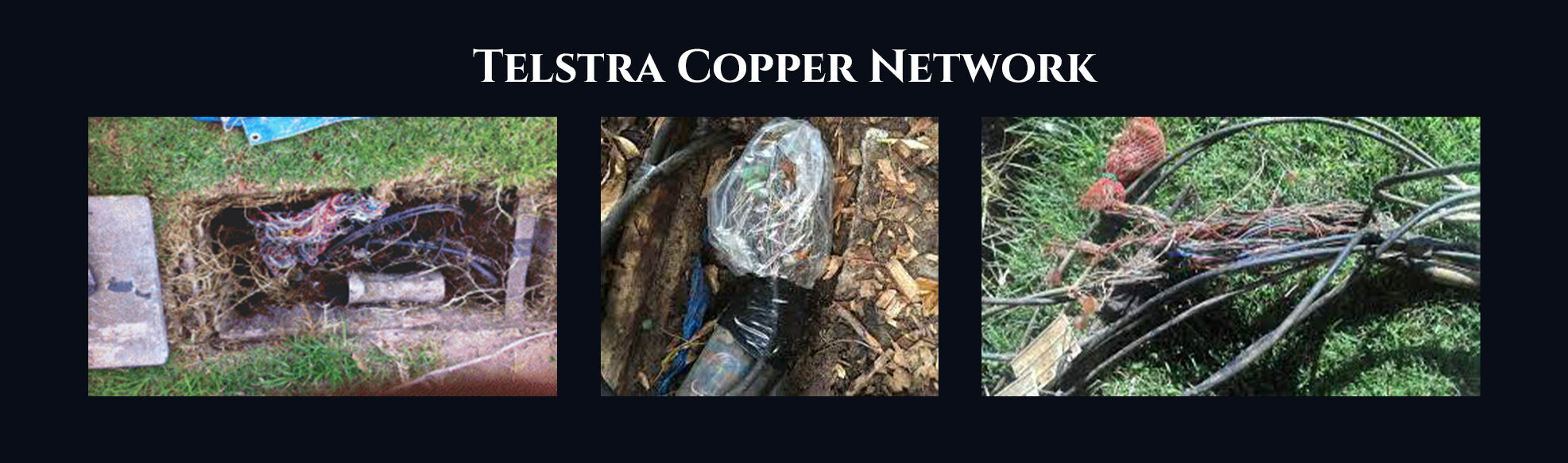
Ongoing telephone problems
In the world of political and media misinformation that is attached to the NBN, there is one important issue that hasn’t been fully addressed. Did Australia’s copper network meet the original mandatory government regulatory requirements when the government privatised Telstra? When the COT arbitrator was officially provided (in my case) nine separate sworn Telstra witness statements that my service was now up to network standard i.e.; no more ongoing telephone problems were these nine sworn statements made under oath true or false.
If this question is answered honestly, it would not only directly affect billions of dollars in Commonwealth spending but also mean the arbitrator hearing my cases was lied to so that Telstra could minimise their liability towards me. As seen from the following exhibit, my phone problems continued for eleven years after the arbitrator found in favour of Telstra, i.e. they had now fixed their network.
23 June 2015: Had the arbitrator appointed to assess my arbitration claims correctly investigated ALL of my submitted evidence he would have had to value my claim as an ongoing problem NOT a past problem as his final award shows. It is clear from the following link dated > Unions raise doubts over Telstra's copper network; workers using ... that when reading in conjunction with Can We Fix The Can which was released in March 1994, these faults copper-wire network faults have been in existence for more than 24-years.
9 November 2017: Sadly, many Australians in rural Australia can only access a second-rate NBN. This didn’t have to be the case: had the Australian government ensured the arbitration process it endorsed to investigate the COT cases’ claims of ongoing telephone problems was conducted transparently, it could have used our evidence to start fixing the problems we uncovered in 1993/94. This news article https://theconversation.com/the-accc-investigation-into-the-nbn-will-be-useful-but-its-too-little-too-late-87095 and absentjustice.com/Introduction again shows that the COT Cases claims of ailing copperwire network was more than valid.
Almost two decades after this cover-up had been executed, with the government spin doctors successfully branding my claims as frivolous and me as a vexatious litigant, I have been left the government stopped financing the roll-out of the National Broadband Network (NBN), which still utilises part of the existing, seriously degraded copper network. In fact, the “… state of the copper network is considerably worse than expected, leading to extensive work beyond the node,” say leaked documents.
28 April 2018: This ABC news article regarding the NBN see >NBN boss blames Government's reliance on copper for slow ... needs to be read in conjunction with my own story because had these lies told under oath by so many Telstra employees had not occurred then the government would have been in a better position to evaluate just how bad the copper-wire Customer Access Network (CAN) really was just 4-years ago.
Sadly, many Australians living in rural Australia can only access a second-rate NBN. This wouldn’t have been the case if the Australian Government had ensured the arbitration process they endorsed to investigate the COT cases’ claims of ongoing communication problems had been conducted lawfully.
The Pursuit of Justice: The COT Cases and the Battle with Telstra
Introduction
Please note: absentjustice.com is a work in progress, last edited in March 2021.
All principal events detailed on this website are substantiated by copies of original documents, referred to as confirmation data, which are linked throughout the text. For example, references such as FrontPage Part One File No/1, Main Evidence File No/3, or Prologue Evidence File 1-A to 1-C, when clicked, will automatically open a PDF of the corresponding exhibit. By following these linked file numbers across the site’s various pages—including the menu sections Absentjustice - Preface, Manipulating the Regulator, and Absentjustice Parts 1, 2, and 3—readers can independently verify the narrative. Without these primary documents, most people would find it difficult to believe the experiences endured by the Casualties of Telstra (COT) claimants.
The Struggle for Evidence and Justice
It is almost unimaginable—were it not for the supporting exhibits—that a group of small business owners could be compelled to enter arbitration, under government advice that they would receive all necessary documentation to support their claims, only to have these crucial documents withheld until years after their arbitrations concluded. This method of including exhibits is essential; otherwise, the story would seem impossible to believe.
On 23 March 1999, nearly five years after most of the arbitrations had ended, the Australian Financial Review reported on the conclusion of a Senate estimates committee hearing. The hearing investigated why COT Cases were forced into government-endorsed arbitration without the documentation needed to support their claims. Senator Eggleston stated: “A Senate working party delivered a damning report into the COT dispute. The report focussed on the difficulties encountered by COT members as they sought to obtain documents from Telstra. The report found Telstra had deliberately withheld important network documents and/or provided them too late, forcing members to proceed with arbitration without the necessary information. They have defied the Senate working party. Their conduct is to act as a law unto themselves.”
It is difficult to imagine any Western country governed by the rule of law, as Australia claims to be, permitting a scenario where small-business operators must enter government-endorsed arbitration while the government—owner of the corporation—conceals documents vital to their claims.
Alan Smith’s Story: The Beginning
Alan Smith Author
My name is Alan Smith. This is the account of my enduring battle with a telecommunications giant and the Australian Government—a saga that has spanned elected governments, departments, regulatory bodies, the judiciary, and Telstra (formerly Telecom). The quest for justice continues to this day.
My journey began in 1987, after spending the previous twenty or so years at sea. Seeking a land-based occupation for my retirement years, I chose Australia as my home. My passion was hospitality, and I aspired to run a school holiday camp. The Cape Bridgewater Holiday Camp and Convention Centre, listed for sale in The Age, caught my attention. Situated in rural Victoria, near Portland, it seemed ideal. I performed my due diligence, though it never occurred to me to check the reliability of the phone service. Within a week of taking over, I discovered a major issue: customers and suppliers could not reliably contact me.
The business depended on a phone service that was, at best, unreliable. Predictably, this led to lost business. Thus began my struggle—a quest to secure a working phone at the property. Over time, I received compensation for business losses and repeated assurances that the problem was fixed. Yet, to this day, the problem remains unresolved. I sold the business in 2002, and subsequent owners have faced the same difficulties.
The Casualties of Telecom (COT) Cases
Other independent business operators affected by poor telecommunications joined me, forming the Casualties of Telecom (COT) cases. Our aim was simple: for Telecom/Telstra to acknowledge our issues, fix them, and compensate us for our losses. A working phone—is that too much to ask?
Persistent complaints to AUSTEL and my Federal member, the Hon David Hawker MP, eventually led Telstra investigators to Cape Bridgewater on 3 June 1993. I was hopeful, but it was another instance of “No fault found.” Their advice was to continue recording phone faults, as I had done since 1989. Disheartened, I carried on.
The Briefcase Saga: Revealing the Truth
Soon after, I discovered that a Telstra investigator had inadvertently left behind his briefcase in my office. Inside, I found a document titled ‘SMITH, CAPE BRIDGEWATER’—a potential breakthrough after years of struggle. A Telstra document dated 2 July 1992 concerning the Portland Ericsson AXE exchange stated: “Our local technicians believe that Mr Smith is correct in raising complaints about incoming callers to his number receiving a Recorded Voice Announcement saying that the number is disconnected. They believe that it is a problem occurring in increasing numbers as more customers are connected to AXE.”
Another document showed Telstra knew that a major fault recorded in March 1992 had persisted for at least eight months, not merely the three weeks they later reported to the COT arbitrator. These revelations marked a turning point.
Folios C04006, C04007, and C04008 revealed Telstra already knew the validity of my complaints on 3 June 1993, when their briefcase was left behind. Marked “TELECOM SECRET,” these documents stated: “Legal position – Mr Smith’s service problems were network related and spanned a period of 3-4 years. Hence Telecom’s position of legal liability was covered by several acts and regulations. … In my opinion Alan Smith’s case was not a good one to test Section 8 for any previous immunities – given his evidence and claims. I do not believe it would be in Telecom’s interest to have this case go to court. Overall, Mr Smith’s telephone service had suffered from poor network performance over several years; with difficult-to-detect exchange problems in the last 8 months.”
Systemic Failures and the Breakdown of Justice
Thus, the story begins: a group of ordinary small-business owners fighting one of Australia’s largest corporations. For years, Telstra refused to address recurring phone problems that severely impacted the COT Four’s businesses, repeatedly claiming “No fault found,” while documents on this website and government records (see AUSTEL’s Adverse Findings, points 10 to 212) prove otherwise.
Telstra and its legal defence team obstructed justice by employing dubious tactics: intercepting relevant faxes (see Open Letter File No/12 and File No/13), failing to deliver crucial FOI documents (or delivering them months or years late, often heavily redacted), destroying evidence, and fabricating documents. Key arbitration claims were ignored, with no response to repeated efforts for resolution.
Regulatory bodies—Austel (government) and the TIO (carriers)—failed to control Telstra, sometimes appearing to act in concert. This collective failure represents a profound breakdown of justice, far exceeding the original issue: business owners seeking reliable phone services.
Unresolved Faults and Unlawful Conduct
Each COT member assumed, as most phone users would, that Telstra’s technicians could easily fix faults. Yet “No fault found” remained constant, and problems continued throughout and beyond arbitration, causing substantial business losses. The situation was incomprehensible: phones should work for everyone. Why didn’t they?
Why did so many appear to protect Telstra, ignoring unlawful behaviour? Withholding critical documents during arbitration is unlawful. Tampering with evidence is unlawful (see Tampering With Evidence - TF200). Relying on flawed defence documents is unlawful. Wiretapping without a warrant is unlawful. Someone in Telstra authorised this conduct. The TIO and Austel often refused to act; Members of Parliament offered support while in Opposition but abandoned it once in government. No-one held Telstra accountable. This behaviour could easily foster suspicion of conspiracies.
Telstra’s conduct reflected a lack of confidence in its own position. What was Telstra trying to hide? What would happen if the claims were vindicated?
Systemic Problems and Rural Businesses
Documents released years later showed Telstra was fully aware of systemic problems and knew how to address them in rural areas, where many COT businesses operated.
For rural Australian business operators, telephone-reliant businesses were the norm, but not as they are today. When this story started, rural businesses did not use the internet, email, or mobile phones. Checking emails and mobiles was not routine; mobile phones didn’t work in most rural areas, and black spots were common even in city outskirts. It wasn’t until the late 1990s that modern technology became standard for business. Concealed government records (see Manipulating the Regulator) show that, in 1994, AUSTEL estimated around 120,000 businesses were affected by COT-type faults. However, the public April 1994 AUSTEL COT Cases report reduced this number to just 50 or more businesses with similar complaints.
The Push for Privatisation and Deferred Solutions
Senator Len Harris - One Nation
Today’s younger generations may struggle to understand how, only twenty years ago, Telstra and its government overseers misled Australians into believing they were working to fix Australia’s network. In reality, they were applying temporary fixes to defer capital expenditure, with privatisation on the horizon. The prevailing attitude was to pass the cost onto shareholders, as Senator Len Harris noted in his media release on 14 November 2002 (see Home Evidence File No/16):
“The urgency of the Government to unload Telstra is the realisation that it needs a huge injection of capital expenditure just to remain operational. In other words, sell the whole shooting bag before it rains and let someone else worry about fixing it. … Faulty materials such as Hi Gel 3M 442 that has corroded copper joints; Contractors cutting corners with cable installation; … Failure by senior personnel to recognise the magnitude of the impending network implosion … The pair gain system forms much of Telstra’s existing network, making thousands of dead cable pairs to subscribers’ phones that ordinarily ought to be replaced.”
Worse still, as documented in the Misleading and Deceptive Conduct File 4-A to 4-L segment, Telstra continued to use known-deficient equipment in its exchanges—equipment that had long since been retired in other countries.