The eleventh remedy pursued
I was convinced then, and remain immovably convinced now, that the evidence of the Secret Deal—and the stark, undeniable fact that Dr Hughes deliberately sidestepped the agreed arbitration procedures (see page 99 COMMONWEALTH OF AUSTRALIA – Parliament of Australia)—was more than sufficient to force the IAMA to confront the truth. These were not minor irregularities. They were structural breaches, fatal to any legitimate arbitration process. Yet despite my repeated alerts in 1996, 2000, and again in 2009, the IAMA chose to avert its gaze, shamelessly ignoring the very evidence that should have compelled them to act.
In July and August 2009, at their insistence, I delivered 23 meticulously prepared spiral‑bound submissions, each one laying bare the depth and seriousness of my grievances. The IAMA accepted them. They acknowledged them. They promised scrutiny. And then—nothing. No findings. No written response. Not even the basic decency of returning the materials. Their refusal raises unavoidable questions about integrity, motive, and the unseen pressures operating behind the curtain.
The third investigation, supposedly overseen by the IAMA’s President, former High Court Judge The Hon D Kirby AC, CMG (Burying The Evidence File 13-A), was heralded as the moment justice would finally be dragged into the light. Instead, the IAMA retreated into silence. No findings. No accountability. No return of the documents. Their inaction reeks of collusion—an unethical cover‑up executed through omission, delay, and institutional cowardice.
In July 2009, the Institute of Arbitrators Mediators Australia publicly requested additional supporting evidence concerning the serious allegations of misconduct against John Rundell and Dr Gordon Hughes—allegations rooted in their conduct during my 1994–1995 arbitration, which concluded in 1996. I responded immediately. On 9 July 2009, I submitted two comprehensive bound volumes detailing the misconduct.
Shortly afterwards, the IAMA phoned me, confirming that the Ethics and Professional Affairs Committee would investigate. Over the following months—through November 2009—the attached emails show the IAMA actively reviewing the 23 additional bound documents they had requested. They even stated that no further material was required, signalling they had everything necessary to proceed.
Yet here I stand, still waiting.
I remain perplexed—and increasingly disturbed—by the IAMA’s refusal to return my 23 + 2 submissions, which cost approximately $23,000 in secretarial preparation and travel for hand‑delivery. Their continued silence, their refusal to issue any finding, and their withholding of my materials raise a single unavoidable question: What powerful interests are being protected?
Their behaviour is not administrative delay. It is not oversight. It is not incompetence.
It is concealment.
And after more than two decades, the stench of it is impossible to ignore.
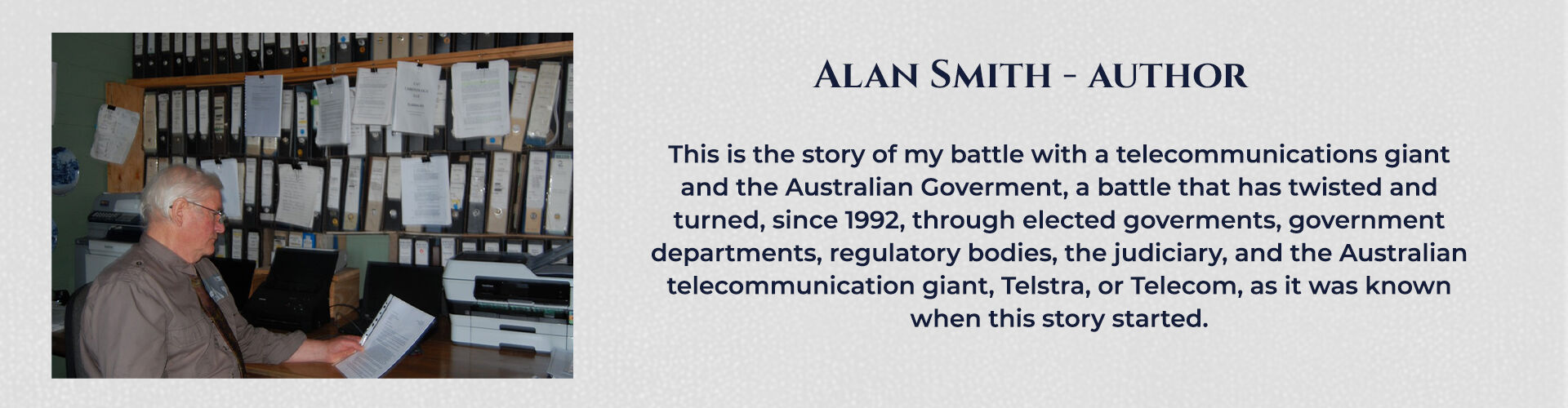
I invite every visitor to absentjustice.com to take a moment of reflection when they reach this section of my story. Consider the photo to the left of this narrative, taken in 2015 when seven members of our COT group asked me to record their stories. Now, in 2026, at 82 years of age, I may not complete that task. As you explore the homepage section titled "The first remedy pursued" I encourage you to ponder a profound question that has inspired me for the past 30 years, rooted in events that unfolded between 1994 and 1996.
During this turbulent time, key individuals, including Dr Gordon Hughes, Warwick Smith, John Rundell, and John Pinnock, along with the possibility of Dr Hughes' wife lending her support, became involved in actions that would have lasting consequences. If she agreed to assist her husband and John Pinnock—who served as the second-appointed Telecommunications Industry Ombudsman—they might have allowed her name to be falsely linked to an alleged phone conversation purportedly made to her at 2:00 AM. This call never actually took place. Their collaboration marked the beginning of a campaign to systematically undermine my credibility by spreading falsehoods and attacking my character. Their ultimate goal was to obstruct Laurie James, the President of the Institute of Arbitrators Australia, from thoroughly investigating my claims that Dr Hughes did not conduct my arbitration in accordance with the agreed-upon procedures that all parties had accepted.
The concerted efforts of Hughes, Smith, Pinnock, and Rundell not only stopped an official invesytigation into my valid claims it has affected my professional reputation where no one in Australia will consider my claims as valid.
I ask that you please continue to read this story. leaving a supportive comment, at Absent Justice Contact will assit me towards a resolution and reclaiming what years I have left after my coming 82 second birthday in May 2026.
THE ARBITRATION RULES
A key moment in the COT arbitration saga deserves highlighting. In a letter dated 24 January 1994, Mr Frank Shelton—then President of the Institute of Arbitrators Australia—wrote to Dr Gordon Hughes, the then-pending arbitrator to the four arbitrations, stating unequivocally:
“We discussed whether or not the procedure should come within the ambit of the Victorian Commercial Arbitration Act 1984. We decided that it should.” (File 622 AS-CAV Exhibits 589 to 647)
This decision was pivotal. Six weeks before the arbitrations began, at the pre-arbitration hearing held on 17 February 1994—attended by Dr Hughes, Telstra officials, their legal representatives, and COT Cases Ann Garms and Graham Schorer—Dr Hughes confirmed that if the four COT Cases signed the arbitration agreement, he would conduct the process under the Commercial Arbitration Act.
Acting on behalf of the group, Graham Schorer instructed his lawyer, William Hunt, to obtain a copy of the arbitration agreement and all correspondence between Dr Hughes and the Telecommunications Industry Ombudsman (TIO), as well as communications with legal counsel—including Mr Frank Shelton, who was also the President of the Institute of Arbitrators Australia.
Mr Shelton's explicit instruction to Dr Hughes that the four arbitrations must be conducted under the Victorian Commercial Arbitration Act 1984 was not trivial. This assurance formed the legal backbone of the process and gave the COT Cases a reasonable expectation of procedural fairness and judicial integrity.
Upon confirming this directive, William Hunt advised the COT Cases to proceed with signing the arbitration agreements.
In 2009, I provided new arbitration evidence to the IAMA, which had not been available during their first investigation in 1996 or their second investigation in 2001. On 5th July 2009, the President of the IAMA, the Hon. Michael Kirby (Retired Chief Justice), wrote to inform me that the IAMA's CEO would contact me. In July 2009, Paul Crowley, CEO of the IAMA Ethics and Affairs Committee, agreed to review the new evidence. Because of the large amount of evidence, I released it gradually at the IAMA's request between July and November 2009. However, fifteen months after submission, the IAMA Ethics and Affairs Committee did not take a position on the material presented. Furthermore, they have refused to issue a written decision in favour of or against the evidence provided. The IAMA has also declined to return 23 spiral-bound folders of evidence and 1,200 supporting exhibits.
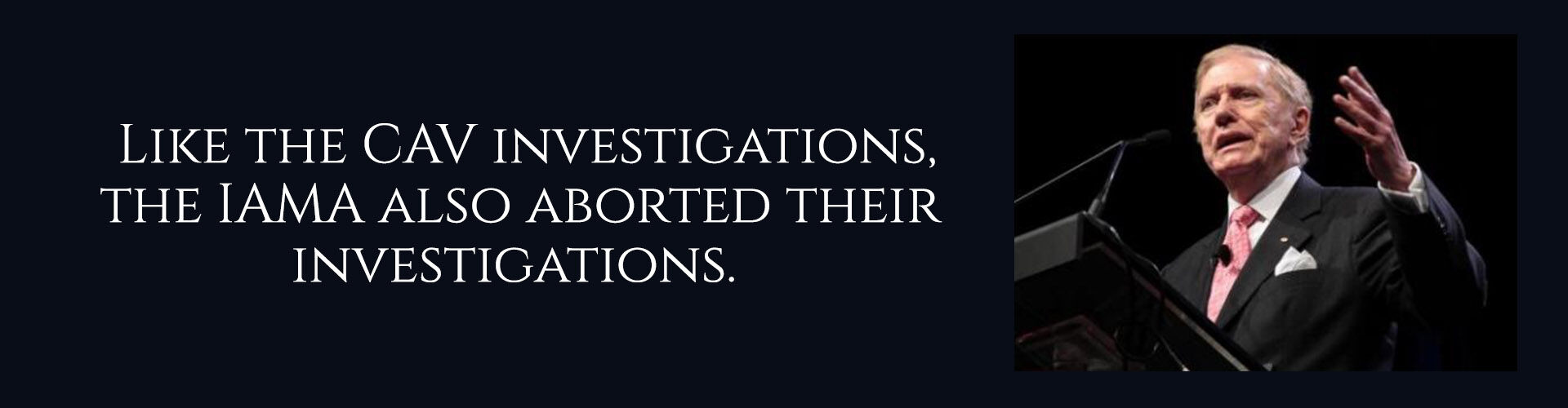
During June and July 2009, which had now become my eleventh remedy pursued, I wrote to The Hon. Michael D. Kirby AC, CMG, then President of the Institute of Arbitrators and Mediators of Australia. I raised the issue of John Rundell (the Arbitration Project Manager) allowing Lane Telecommunications (the TIO-appointed arbitration technical consultant) to assess my arbitration claim, rather than the principal technical officer, Paul Howell, from Canada. I provided information on a CD, along with an abundance of documented evidence, to the IAMA, proving beyond all doubt that Mr Rundell had attacked my credibility and character using false statements to stop the first 1996 Institute of Arbitrators Australia from investigating my valid claims as well as assisting Telstra (the defendants) to minimise their liability.
I also made it clear to the IAMA that a grave conflict of interest sat at the centre of their so‑called “impartial” investigation. If the John Rundell who supplied false information to the TIO’s John Pinnock in February 1996—falsely alleging that the Brighton Police were preparing to investigate me for criminal damage to his Brighton premises, and then copying that lie to the Institute of Arbitrators Australia—was the same John Rundell who, in 2009, held the position of Treasurer of the IAMA Melbourne Chapter, then my claim before the IAMA was already compromised. Not hypothetically. Not potentially. Already compromised, just as my 1994/95 arbitration had been compromised under his watch.
I stated this directly. Unequivocally. Because the implications were catastrophic.
If the man who fabricated a police investigation to derail scrutiny of my arbitration was now embedded inside the very organisation tasked with judging my complaint, then the IAMA’s promise of impartiality was a façade. A structural impossibility. A conflict so severe it should have triggered immediate recusal, disclosure, and external oversight.
Instead, I received silence.
Even as late as October 2009, the IAMA continued to request additional information from me—more documents, more evidence, more detail—to support the assurance they gave in July 2009 that they would “impartially investigate” my matters. They demanded more from me while refusing to answer the most critical question: Was the same John Rundell who compromised my arbitration now holding office inside the body investigating my complaint?
They never provided that information.
They never addressed the conflict.
They never acknowledged the danger.
Their refusal to clarify Rundell’s position, while simultaneously insisting on further submissions from me, exposes the hollow nature of their assurances. It reveals an organisation willing to proceed with an investigation contaminated from the outset, unwilling to confront a man whose documented misconduct had already derailed one arbitration process and has also derailed another.
This silence is not administrative oversight.
The Institute of Arbitrators & Mediators Australia (IAMA) appeared to be most concerned that Dr Hughes, while an arbitrator hearing the COT Cases arbitrations, and his partnership in the leading Sydney and Melbourne law firm might have had an extreme conflict of interest because the Sydney arm of the company was acting for Telstra employees during their conflict with Telstra during the period several Telstra employees were being questioned by both the New South Wales State Police as well as the Australian Federal Police for rorting millions upon millions of dollars from the Australian government purse. The IAMA agreed to investigate my conflict-of-interest claims. I believe both claims of rorting (stealing) were also linked to lost arbitration-related faxes that were mistakenly sent from Dr Hughes' office to his Sydney office.
John Rundell
I reiterate the following: the Institute of Arbitrators & Mediators Australia (IAMA) agreed to investigate (on 2 July 2009), with any fresh evidence I wish to send, confirming that the arbitrator did not conduct my arbitration within the agreed ambit of the Commercial Arbitration Act 1984. I also provided evidence showing that the previous Arbitration Project Manager, who appeared to be the current treasurer of the Melbourne Chapter of the IAMA, was involved in my arbitration. I alerted the IAMA because if it was the same person, the IAMA should know that this person knowingly misled and deceived a proposed investigation into several of my valid claims with the Telecommunications Industry Ombudsman. In his letter to me, the then president of the IAMA, The Hon. Michael D Kirby AC, CMG, advised:
“In accordance with established procedure, I have referred the complaint to the Ethics and Professional Affairs Committee of the Institute.
“In due course, you will be informed following this reference.” (See Burying The Evidence File 13-A)
Within two days of receiving this letter, I received a telephone call from the CEO of the IAMA, who explained that the IAMA Ethics and Professional Affairs Committee would investigate these fresh allegations and notify me of their findings. I advised the CEO that in 1996, and again in 2001 and 2002, the IAMA began investigating similar complaints concerning the same arbitrator, but returned my documents without making a finding. The CEO confirmed this would not be the case now. From the CEO’s tone, I deduced that he had read the damning evidence against the arbitrator that prompted the president of the IAMA to send the above letter of 9 July 2009.
I refer the reader to my letter dated July 15, 2009, addressed to Paul Crowley, the CEO of the Institute of Arbitrators and Mediators Australia. (Exhibit 13-B and 13-C → Burying The Evidence File 13-H. In this letter, I included a correspondence from Graham Schorer, who was the spokesperson for COT Cases and a former client of the arbitrator Dr Gordon Hughes (see Chapter 3 - Conflict of Interest).
Exhibit 13-H → Burying The Evidence File 13-H is the letter dated August 4, 1998 and attached to it is also exhibited as (13-H) a statutory declaration from Mr Schorer to me, which detailed a phone conversation he had with the arbitrator Dr Gordon Hughes during the 1994 arbitrations concerning lost Telstra COT-related faxes. My arbitration had been over for three years, and a pending appeal revealed that 41 of my faxes during my 13-month arbitration were not on the arbitrator's schedule of received documents, even though my fax billing account showed they had been sent. Mr Schorer alerted the Senate to this, as did Dr Hughes, and Dr Hughes' response gave us hope that we could have these lost arbitration fax matters investigated. During that conversation, Mr Schorer had with Dr Hughes, Dr Hughes explained to Graham Schorer in detail that:
"Hunt & Hunt (The company's) Australian Head Office was located in Sydney, and (the company) is a member of an international association of law firms. Due to overseas time zone differences, at close of business, Melbourne's incoming facsimiles are night switched to automatically divert to Hunt & Hunt Sydney office where someone is always on duty. There are occasions on the opening of the Melbourne office, the person responsible for cancelling the night switching of incoming faxes from the Melbourne office to the Sydney Office, has failed to cancel the automatic diversion of incoming facsimiles." Burying The Evidence File 13-H.
Dr Hughes’s failure to disclose the faxing issues to the Australian Federal Police during my arbitration is deeply concerning. The AFP was investigating the interception of my faxes to the arbitrator's office. Yet, this crucial matter was a significant aspect of my claim that Dr Hughes chose not to address in his award or mention in any of his findings. The loss of essential arbitration documents throughout the COT Cases seriously undermines the process.
Even more troubling, Dr Hughes knew about the faxing problems between the Sydney and Melbourne offices before his appointment as arbitrator in seven arbitrations, all coordinated within 12 months. During this time, COT claimants—two in Brisbane and five in Melbourne—frequently said the arbitrator's office was not responding to their faxes. This raises alarming questions about potential criminal negligence and the integrity of the arbitration process.
John Pinnock, the Telecommunications Industry Ombudsman and the second appointed administrator for my arbitration, acknowledged that Dr Hughes had not investigated 41 of my claim documents, which were also mini reports. Despite Dr Hughes admitting that these documents might have been lost by his Sydney office, I was still denied the opportunity to have the 41 claim documents evaluated on their merits.
Forces
Were these lost faxes intercepted by Telstra's secondary fax machine (see Open Letter File No/12 and File No/13 or the arbitrator's office negligence? Numerous faxes originally faxed to the arbitrator's office played a significant role in the COT arbitrations, as shown throughout this website. I later added a reference to these lost faxes as an amendment to the 23 claim documents I provided to the IAMA Ethics and Professional Affairs Committee. It is well documented that government bureaucrats before and during my arbitration alerted the Australian Federal Police to the significance of the faxes that were not arriving at their intended destination during the COT arbitrations (see Evidence - Australian Federal Police Investigations)
I have no record of any correspondence sent from Dr Hughes to the AFP during my arbitration alerting them to the possibility that some of my lost arbitration-related faxes to his office might have occurred due to the arrangement discussed in Graham Schorer's affirmation to the IAMA Ethics and Professional Affairs Committee.
Exhibit 2 shows that although Telstra charged my fax account for six faxes arriving at Dr Hughes' office, this official Telstra arbitration document, sworn under oath, states that no faxes arrived at Dr Hughes' office on this day. So, where are these six arbitration documents? Are they still in Hunt & Hunt's Sydney office?
Dr Gordon Hughes, the Australian Federal Police (AFP), the Commonwealth Ombudsman, various Senators, and the administrator of my arbitration are fully aware that during my arbitration, when the AFP was investigating these lost fax issues, I received threats from Telstra because I had raised the lost fax issues with the AFP as part of my arbitration claim (see Senate Evidence File No 31).
At the end of July 2009, I provided 21 claim documents to the assistant of the IAMA CEO and stated in my letter:
“My letter to you on 16th July advised that the following documents would be hand-delivered to you. These reports are now attached for your information.” (Burying The Evidence File 13-B to 13-C)
I forwarded many submissions to the IAMA ethics and professional affairs committee, which comprises either ex-judges or qualified lawyers who should have been concerned about the evidence I provided. It appears they were not interested in assessing evidence showing one of their own had breached more than only his duty of care of a claimant in an arbitration process. I showed that the administrator of the arbitration process alerted the government on 26 September 1997 that “most significantly, the arbitrator had no control over that process because it was a process conducted entirely outside the ambit of the arbitration procedures” (see page 99 COMMONWEALTH OF AUSTRALIA – Parliament of Australia). This initially worried the CEO, who telephoned me to confirm they would investigate my allegations against the arbitrator. However, the IAMA Ethics and Professional Affairs Committee still has not issued a finding on this information or my other 21 submissions, despite their advice in five different emails that they were investigating my matters. One of those five emails, sent at 12:50 pm on 21 October 2009, states:
“Presently, IAMA does not require this further documentation to be sent. However, the investigating persons will be notified of these documents and may request them at a later date.” (See Burying The Evidence File 13-B to 13-C)
On 27 November 2009, I sent a further email to the secretary of the IAMA’s CEO, advising him that I could provide solid evidence of the arbitrator’s previous role as Mr Schorer’s legal advisor during a previous Telstra Federal Court matter. The arbitrator clearly erred in not declaring this primary conflict of interest before accepting the position, particularly when the company he was a partner in had also been Mr Schorer’s business advisor.
At 2:00 p.m. the same day, I received an email from the IAMA secretary stating, “Your email has been forwarded to the CEO. Regards, Richard.”
On 29 November 2009, I wrote to the CEO of the IAMA regarding fresh evidence received from the office of the lawyer who represented COT spokesperson Graham Schorer in his earlier Federal court action against Telstra between 1990 and 1992.
This now-deceased lawyer replaced Graham’s initial lawyer, who was appointed as the arbitrator for the first four COT arbitrations, including Mr Schorer’s and my arbitration. The arbitrator, therefore, assessed the documents and complaints he had previously been privy to when acting as Mr Schorer’s legal counsel between 1990 and 1992.
This constitutes a clear case of conflict of interest. The IAMA investigated the same arbitrator in 2009.
The crux of the matter, discussed in my letter to the IAMA ethics and professional affairs committee, relates to the events of 12 May 1995, when the arbitrator wrote to the TIO warning him that the arbitration agreement he used throughout my arbitration was not credible and should, therefore, be revised for the remaining three claimants.
This vital letter from the arbitrator was another document the TIO and the arbitrator concealed from me during my pending appeal. My letter explained that two of the other three COTs were allowed an extra 13 months to prepare their claims than I was. The arbitrator, who, don’t forget, had previously been Mr Schorer’s business and legal advisor for many years, allowed Mr Schorer a full 36 months longer to prove his case against Telstra than I was allowed.
The five emails dated between 20 and 23 October 2009 from the IAMA Ethics and Professional Affairs Committee clearly show that they were certainly investigating my claims against Dr Hughes (See Burying The Evidence File 13-B to 13-C) Burying The Evidence File 13-E) and Burying The Evidence File 13-D, and they were still supplying my claim material to their investigators.
On 29 November 2009, I wrote to the CEO of the IAMA regarding fresh evidence received from the office of the lawyer who represented COT spokesperson Graham Schorer in his earlier Federal court action against Telstra between 1990 and 1992. This now-deceased lawyer replaced Graham’s initial lawyer, who was appointed as the arbitrator for the first four COT arbitrations, including Mr Schorer’s and my arbitration. The arbitrator therefore assessed the documents and complaints he had previously seen while acting as Mr Schorer’s legal counsel between 1990 and 1992. This is a clear conflict of interest. This is the same arbitrator the IAMA investigated in 2009.

During the first months of my arbitration, when the Australian Federal Police officially investigated the possibility COT Cases faxes were being intercepted, had Graham Schorer or Dr Gordon Hughes alerted the AFP of the problems being experienced at the arbitrator's office when documents were faxed to their Melbourne office after the close of business each day, any investigation into these lost faxes might well, have uncovered that the arbitrator's Melbourne office was not a haven for faxed arbitration documents because they ended up in the Sydney office.
This diversion of faxes to Dr Hughes's Sydney office was in operation while the Sydney office was acting on behalf of several Telstra employees, and it is possible that some of those Melbourne Telstra-titled documents were mistakenly treated as Sydney Telstra-related documents rather than documents diverted from Melbourne.
COT Case Ann Garms spent over $600,000.00 in her arbitration appeal in the Supreme Court of Victoria against Dr Hughes. Ann might have had a more favourable outcome of this appeal, which she lost, had she and her lawyers known of Dr Hughes's admission to Graham Schorer before the commencement of our four arbitrations.
Before the government communications regulator, AUSTEL (now AMA) endorsed Dr Gordon Hughes as the independent arbitrator, they had a duty of care to advise the COT Cases in writing that Dr Hughes was not an experienced arbitrator and had not been graded by the Institute of Arbitrators Australia to perform such complex arbitrations as the COT four processes. AUSTEL did not. Could you inform us of this fact?
Dr Hughes also failed his duty of care as a pending arbitrator to COT Cases Ann Garms, Maureen Gillan, and me in writing, as per the rules of the Victorian Arbitration Act, that he had a conflict of interest with the fourth claimant, Graham/Golden. And to add further salt to the COT Case's future wounds was that Graham Schorer, in his capacity as COT spokesperson, failed to disclose to us three other COT Cases that we should not send arbitration-related faxes to Dr Hughes’ Melbourne office after the closing of business each day; otherwise, they may not arrive at their intended destination.
This document Front Page Part One File No/1 shows the arbitrator’s secretary advised Tony Watson (of Telstra’s arbitration defence unit) that on 23 May 1994, six of my claim documents did not reach the arbitrator's fax machine. Yet, I was charged on my Telstra account for those six faxes. Why was this matter not investigated? No one from the arbitrator’s or TIO’s office allowed me to amend my claim so that the not-received claim documents could be valued as part of my arbitration process.
Why didn’t Dr Hughes (as the arbitrator to my case) also explain to me as he did to Graham Schorer Front Page Part One File No/1 that my 23 May 1994 faxed claim documents might be in his Sydney office? Did Dr Hughes believe that exposing this faxing problem with his Sydney office would halt the arbitration process in my favour? Was Dr Hughes worried that exposing to me the flaws in his own two offices, concerning the possibility that this is where my other lost faxes ended up, this admission would bring an end to his remaining as the arbitrator for the COT arbitrations?
A further international arbitrator (qualified lawyer) on LinkedIn has continued to show interest in this website, asking him to be updated. Our association on LinkedIn began in 2015, and as of late July 2021, we are still corresponding about how I can expose how many unlawful arbitrations are conducted in Australia. The Hon. Michael Kirby wanted to be investigated in 2009 by the IAMA Ethics and Professional Affairs Committee. That Committee chose NOT to disclose my claims publicly, as they are valid.
The reader can decide whether the IAMA should have found my claims by clicking on the following file, Discrimination, including the supporting exhibits IAMA Exhibits 1 to 39 and IAMA Exhibits 40 to 72.
After not hearing from the IAMA between 23 November 2009 and 17 February 2011, I wrote to the Hon. Michael D Kirby AC CMG, asking him to investigate why I had no proper advice on how the IAMA was progressing with its investigations into my matters. Submitting my claim to the IAMA costs close to $16,000.00 in secretarial and administrative fees.
On 21 February 2011, I received a letter from The Hon. Mr Kirby stating:
“Thank you for your letter of 17 February 2011, just received.
When I wrote to you in July 2009, I served as President of the Institute of Arbitrators & Mediators Australia. In June 2010, I stepped down from this position. Mr Warren Fisher was elected in my place.
A possible explanation for your not hearing from Mr Paul Crowley is that, not long after my retirement as President, he resigned and Chief Officer of IAMA.I will send your letter and the attachment to Mr Fischer and request that he respond to your enquiry.” (See Burying The Evidence File 13-F)
17 February 2011: I wrote to the Hon. Michael D Kirby AC CMG, stating:
“I am now writing to you because I have twice written to Mr Crowley in late 2010, asking if he could let me know when the IAMA Ethics and Professional Affairs Committee might hand down their findings in relation to my matters, or at least advise me whether or not the IAMA believe I should continue to provide them further material when it becomes available under FOI.” (AS 719)
6 March 2011: I wrote to Warren Fischer, president of the IAMA, noting:
“I decided to update my previous AAT Statement of Facts and Contentions which the Hon Michael Kirby provided to you therefore, I thought it appropriate you should also receive (see attached) the new updated version also dated 9th February 2011. I have supplied this document because it appears that the IAMA Ethics and Professional Affairs Committee have still not reached their findings on my matters and because of those matters will be shortly discussed in the public arena once I attend the AAT Conference hearing”. (Burying The Evidence File 13-A to 13-I)
21 March 2011: Warren Fischer wrote (IAMA) to me noting:
“I confirm receipt of your correspondence dated 22 February 2011 (forwarded to me by the Hon Michael Kirby AC CMG) dated 28 February 2011, 6 March 2011, and 9 March 2011. I advise that I have passed all that correspondence to our Ethics and Professional Affairs Committee for reply to you.” (Burying The Evidence File 13-A to 13-I)
9 May 2011: I received rather a strange letter from Warren Fischer (IAMA) noting:
“I have to hand your correspondence dated 2 May 2011. I observe that in that correspondence you state that you “have some concern that the IAMA Ethics and Professional Affairs Committee has not yet responded to my claims against , which was lodged in July 2009”.
“I advise that my receipt of your other recent correspondence, dated 17 April 2011 caused me to enquire of the IAMA CEO as to the status of this matter as I had understood that the IAMA Ethics and Professional Affairs Committee had concluded its deliberations and notified you accordingly.” (AS 723)
Mr Fischer’s letter is strange because, in the last week of February 2011, the Hon. Michael D Kirby AC CMG (AS 717) advised him that I was waiting for a response to the IAMA investigation into my previous arbitrator’s conduct. So why, six weeks later, did Mr Fischer write that my letter of 17 April 2011 caused him to enquire of the IAMA CEO as to the status of this matter because he understood that the IAMA Ethics and Professional Affairs Committee had concluded its deliberations?
Between May 2011 and November 2013, I tried all reasonable avenues to have the IAMA explain why it would not bring down a finding from its investigations into my valid claims.
On 11 November 2013, the IAMA CEO notified me in writing that I should:
“… not write to the IAMA, our President, or any person connected with IAMA again on this matter. Any future letters received will be returned to you.”
In the government regulatory communications authority - The COT Cases AUSTEL’s report of April 1994 at point 6.67 it states:
“the arbitrator is to be a person of clear impartiality, independence and integrity with expertise in relevant legal, technical and accounting issues to them and with experience in commercial assessment and arbitration.”
Letters I provided to the government in 2008 and again in 2011 show Dr Hughes (the arbitrator) did not have expertise in arbitration. In fact, in my case, the information I received from the Institute of Arbitrators Mediators Australia advises that Dr Hughes did not get his arbitration grading until well past the end of my arbitration. One letter I received from Mr J L Muirhead, President of the Institute of Arbitrators Australia, dated 10 September 1996, states:
"The Institute is a learned society whose principal functions is the training, examination and grading of arbitrators. It will also nominate suitable arbitrators from its list of graded, practising arbitrators if required to do so by the parties. It selects nominees of appropriate of technical expertise and grading (i.e. experience) from its published list.
I am advised by our Chief Administrative Officer that no reference was made to us in the appointment of the arbitrator in the matter in which you were involved and there is always a risk in these circumstances.”
11-B
Article 7
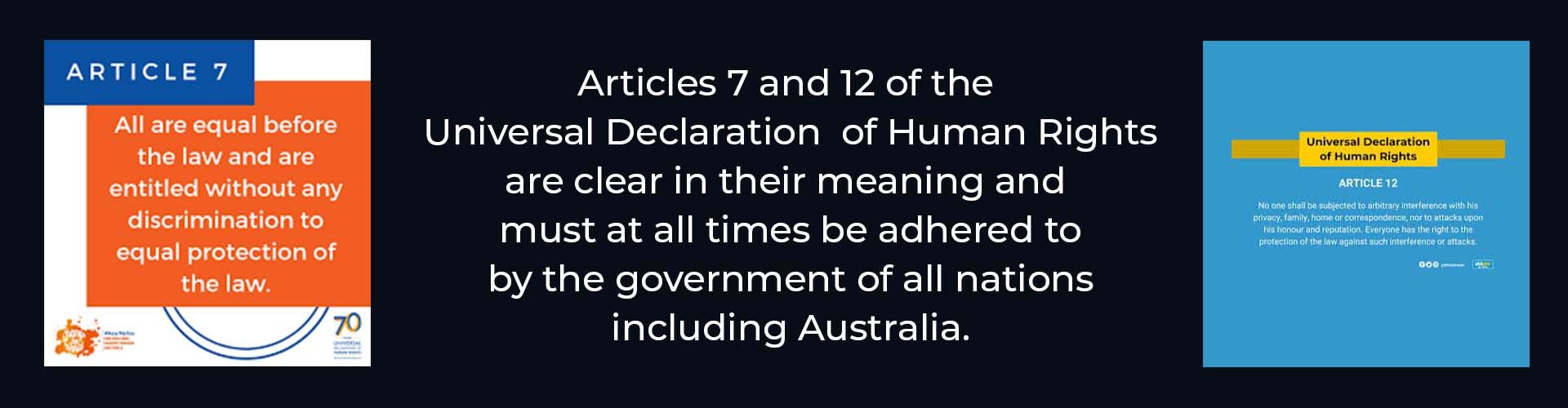
All are equal before the law and are entitled without any discrimination to equal protection of the law. All are entitled to equal protection against any discrimination in violation of this Declaration and against any incitement to such discrimination.
Article 12
No one shall be subjected to arbitrary interference with his privacy, family, home or correspondence, nor to attacks upon his honour and reputation. Everyone has the right to the protection of the law against such interference or attacks.
Chapter 3 - Conflict of Interest shows beyond all doubt when Dr Hughes (the arbitrator) allowed his previous client, COT Spokesperson Graham Schorer, three years longer than he allowed me to prepare by claim and answer Telstra's defence; he knowingly discriminated against me. The fact he also had a Conflict of Interest in Mr Schorer's previous Federal Court action against Telstra and did not disclose this to me before I accepted him as the COT arbitrator has still not been addressed by the government and Telecommunication Industry Ombudsman who endorsed Dr Hughes and being independent of Telstra when he was not.
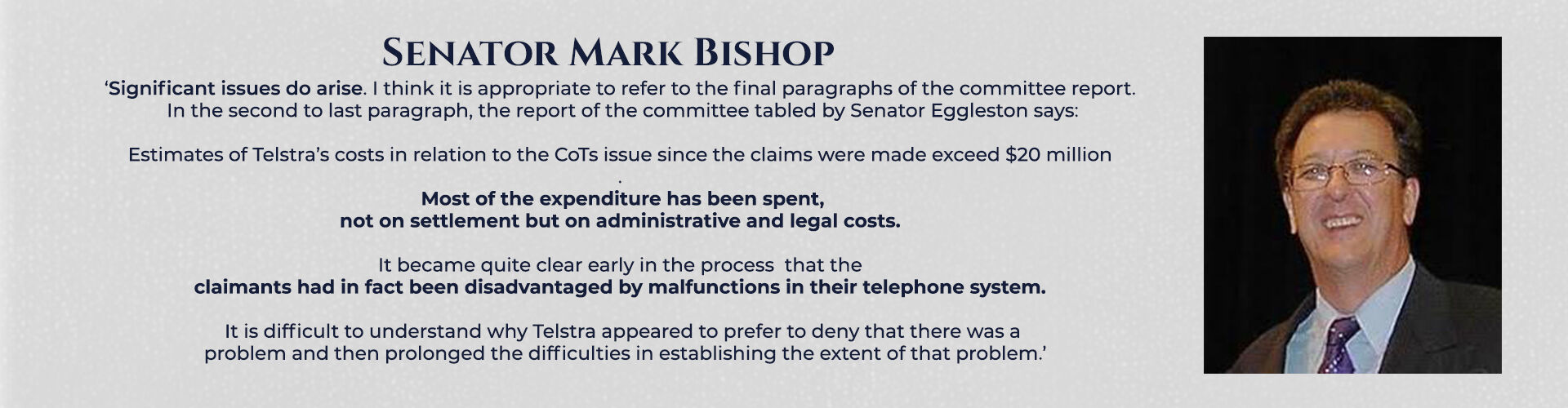
Between June and October 2009, I established, using evidence provided to The Hon. Michael D Kirby AC, CMG, President of the IAMA, Paul Crowley (CEO of the IAMA) and those in the IAMA Ethics and Professional Affairs Committee, that I had valid claims against the conduct of the arbitrator Dr Gordon Hughes and those assisting him before, during and after my arbitration. It should have been apparent, from the evidence submitted during the IAMA Ethics and Professional Affairs Committee investigations, that several parties involved in my 1994/95 arbitration did not conduct my arbitration according to the ambit of the Arbitration Act. It should have also been apparent – to those administering my arbitration – that Articles 7 and 12 were not adhered to, as the website absentjustice.com clearly shows.
I introduce below a report titled Discrimination IAMA Introduction 15 July 2009, with attached exhibits, as it was provided to Mr Crowley of the IAMA Melbourne chapter at the request of the IAMA Ethics and Professional Affairs Committee. These exhibits show that the IAMA should have provided a finding regarding the evidence I provided. Yet, it refused to do so.
Arbitration Legal Opinion AS 701 to 756
Discrimination IAMA Introduction 15 July 2009 - ID Discrimination IAMA Introduction 15 July 2009
Discrimination IAMA Exhibits 1 to 39 - ID Discrimination IAMA Exhibits 1 to 39
Discrimination IAMA Exhibits 40 to 72 - ID Discrimination IAMA Exhibits 40 to 72
I reiterate. as of 2024, I have still not received a finding from the IAMA concerning the information I requested and/or received back from the IAMA the 23 submissions they requested I provide.
The evidence I provided to the IAMA was gleaned from the attached CAV evidence files below. The highlighted exhibits in the text above support the statements being discussed. It is clear that the IAMA has not treated me fairly and justly.
Next Page ⟶