Evidence File 8
“There are regular reports from the TIO on the progress of the CoT claims.”
Senate Hansard information dated 26th September, 1997 (GS-CAV Exhibit 89 to 154(b) - See GS-CAV 124-B) confirms that:-
Ted Benjamin, Telstra’s main arbitration defence liaison officer in Graham and Alan’s arbitrations, was also a member of the TIO Council; and
During a Senate hearing into COT issues, the then-new TIO, John Pinnock, agreed that Mr Benjamin had not removed himself from council discussions of COT matters:-
Senator SCHACHT – “Mr Benjamin, you may think that you have drawn the short straw in Telstra, because you have been designated to handle the CoT cases and so on. Are you also a member of the TIO Board?”
Mr Benjamin – “I am a member of the TIO council.”
Senator SCHACHT – “Were any CoT complaints or issues discussed at the council while you were present?”
Mr Benjamin – “There are regular reports from the TIO on the progress of the CoT claims.”
Senator SCHACHT – “Did the council make any decision about CoT cases or express any opinion?”
Mr Benjamin – “I might be assisted by Mr Pinnock.”
Mr Pinnock – “Yes.”
Senator SCHACHT – “Did it? Mr Benjamin, did you declare your potential conflict of interest at the council meeting, given that as a Telstra employee you were dealing with CoT cases?”
Mr Benjamin – “My involvement in CoT cases, I believe, was known to the TIO council.”
Senator SCHACHT – “No, did you declare your interest?”
Mr Benjamin – “There was no formal declaration, but my involvement was known to the other members of the council.”
Senator SCHACHT – “You did not put it on the record at the council meeting that you were dealing specifically with CoT cases and trying to beat them down in their complaints, or reduce their position; is that correct?”
Mr Benjamin – “I did not make a formal declaration to the TIO.”
The fact that Ted Benjamin, as a TIO Council officer, would have a good idea from the TIO meetings on how far advanced each of the COT arbitrations was and what the arbitrator was discussing with the TIO (who was also the administrator to the arbitrations) on when each claimant my further advance his claim knowing this inside information assisted Mr Benjamin when to release requested FOI documents to each of the claimants and when to hold back any relevant document that could jeopardise Telstra's defence.
It was grossly unethical for Warwick Smith to allow this to happen, and it was just one more nail in each of the COT cases' coffins.
Criminal Conduct Example
Ex parte “Ex parte” is a Latin phrase meaning “on one side only; by or for one party”. An ex parte communication occurs when a party to a case, or involved with a party, talks or writes to or otherwise communicates directly with the judge about issues in the case without the other parties’ knowledge. Under the Judicial Code of Conduct, judges may not permit or consider “ex parte communications” in deciding a case unless expressly allowed by law. This ban helps judges decide cases fairly since their decisions are based only on the evidence and arguments presented to the court and the applicable law. It also preserves trust in the legal and court system.
The 22 March 1994 transcripts of a clandestine gathering, where the COT cases were not represented (see Open letter File No 54-A), show that Telstra’s Mr Chalmers, the author of the minutes, has omitted points 4 and 5. Point 6 follows point 3. Where are points 4 and 5?
This further proves that Dr Gordon Hughes (the arbitrator) should never have allowed this secret meeting to occur without the COT cases being represented. Most, if not all, Western democracies would expect the defendants and their lawyers to be present in the judge’s chambers. In this case, the defendants met in secret with the arbitrator, the TIO, and his special counsel. The missing discussion material or questions raised at points 4 and 5 may well be why the parties present agreed to Telstra lawyers drafting the agreement, instead of the independent arbitration agreement the government and claimants were assured would be used. It could also be where Telstra and the arbitrator, Dr Hughes, agreed that Telstra would first allow the arbitration resource unit access to all procedural material relating to the arbitration (AS-CAV Exhibits 589 to 647 - See AS-CAV 590, Chapter Seven). This permitted the arbitration resource unit to decide which documents Dr Hughes and the claimants would be allowed to see, and which would be discarded.
We will never know what was concealed from the COT cases during this clandestine gathering. However, in writing 18 months after the first arbitration was finalised (see Open letter File No/45-H), the arbitration resource unit admitted to Dr Hughes that they concealed at least four relevant billing claim documents from the arbitration process.
The missing questions raised at points 4 and 5 in the minutes of this clandestine meeting may be linked to the arbitrator and his arbitration resource unit allowing for the more adverse findings against Telstra to be covertly addressed outside the legal arena of the COT arbitration process
If addressing non-addressed arbitration issues had nothing to do with points 4 and 5, then what could have been so detrimental to the arbitration process that these points were excluded from these minutes?
Open letter File No 54-A shows those who attended this clandestine meeting were Telstra’s arbitration liaison officer, Steve Black, Telstra’s general counsel, David Krasnostein, Telstra’s lawyer from Freehill Hollingdale & Page, Simon Chalmers, TIO special counsel, Peter Bartlett, arbitrator, Gordon Hughes, TIO Warwick Smith and his secretary, Jenny Henright. Except for Jenny Henright, all were lawyers; therefore, all knew this was an illegal gathering. What was so important about this meeting that only the arbitrator and defence attended it?
Why weren’t the COT Cases and their lawyers advised of this meeting?
Upon reading this segment Open letter File No 54-A and the following Prologue page, you will come to the same conclusion many others have: arbitrator Dr Gordon Hughes should not have secretly met with Telstra (the defendants) before arbitration to discuss what rules in the arbitration agreement would be removed and which would remain. This clandestine meeting (without the claimants being represented) also covered how to protect – to forgive – the arbitrator’s consultants from incurring any liability for negligence and to exempt the unit from being sued. Of course, this was to the detriment of the COT cases and our legal right to seek recourse against the arbitration consultants if the resource unit was negligent in its duties. After reading Open letter File No 54-A), it is apparent that the arbitration resource unit was negligent during my arbitration process. I could not hold them to account for those actions because the negligent clauses were removed from my arbitration agreement.
Before COT Cases were forced into arbitration without the necessary documents, we needed to support our claims. The arbitration agreement was altered after the first claimant, Maureen Gillan, had signed the final copy and faxed it to our lawyers as the final agreement.
On the day we signed the arbitration agreement (see Open letter File No 54-B), clause 10.2.2 and the $250,000.00 liability caps in clauses 25 and 26 had been removed, and clause 24 had been modified. We were told there would be no arbitration if we did not accept these late changes.
I have always maintained our lawyers thought we were signing the arbitration agreement COT Case Maureen Gillan had signed two weeks before. I only agreed to the removal of clause 10.2.2. With banks declaring they were ready to take over our assets if we could not show imminent settlements, I buckled to removing only that clause.
No matter how much pressure was applied to them, no one in their right mind would have accepted a compromise of such magnitude. Modifying clause 24 and removing clauses 25 and 26 meant we could not sue anyone for acts of negligence. This meant the legal counsel to the arbitration and the professional consultants were now bulletproof. They could freely do whatever they liked when they liked, and there was nothing anyone could do. This website, absentjustice.com, shows this is exactly what happened.
The Secret Meeting tells it all the way it was:
Telstra's minutes from this clandestine meeting show no COT claimant or their representative was present at this critical meeting. At point six, it shows that:
“Mr Bartlett stated that he was unhappy that Telecom did not appear prepared to allow his firm an exclusion from liability. …
“Mr Smith stated that he thought it was reasonable for the advisers to incur some liability, and that the only matter left to be negotiated on this issue was the quantum of the liability caps.
“Mr Black said that he thought the liability caps proposed by Telecom in the amended rules were already reasonable.” (See Open letter File No 54-A)
Points 4 and 5
I reiterate the fact that Open letter File No 54-A shows the author of these minutes has left out points 4 and 5 i,e; point 6 follows point 3 is of great concern. Why would points 4 and 5 be removed if they were not damning evidence against the conduct of the arbitration process?
What information was exposed initially in those two points that prompted Telstra’s lawyers to remove them from the minutes the arbitrator would have received or composed his own? (see Open letter File No 54-A.
This further proves that Dr Gordon Hughes should have never allowed this secret meeting to occur without the COT cases being represented. Most, if not all, Western democracies would condone allowing the defendants and their lawyers to be present in the judge’s chambers (arbitrator’s office). The missing discussion material or questions raised at points 4 and 5 may well be why the parties present agreed to Telstra lawyers drafting the agreement, rather than the independent arbitration agreement the government and claimants were assured would be used. It could also be where Telstra and the arbitrator, Dr Hughes, agreed that Telstra would first allow the arbitration resource unit access to all procedural material relating to the arbitration (AS-CAV Exhibits 589 to 647 - See AS-CAV 590, Chapter Nine). This allowed them to decide which documents Dr Hughes would see and which would be discarded (see also page 4 here, which shows Telstra’s Steve Black wrote to Warwick Smith on 24 July, acknowledging that the resource unit would be allowed to vet which documents Dr Hughes would see and which he would not).
To date, the TIO has declined to explain what circumstances led to this change. Who pressured the TIO to allow the advisors to be exonerated from all liability about our arbitrations? Why would the TIO special counsel be:
“unhappy that Telecom did not appear prepared to allow his firm and exclusion from liability”?
Why did it not occur to either the TIO or the arbitrator that removing the directions regarding liability would allow complacency to creep into the arbitration process? This is exactly what our absentjustice.com pages show happened.
Had COT cases been represented at this hearing (as we were legally supposed to be), we would have been fully aware before 21 April 1994, the day we signed this document, that our rights to fair arbitrations would be violated.
Hiding behind a tainted confidentiality agreement - Section three
Although the 19th April 1994 Arbitration Agreement issue has been addressed elsewhere on absentjustice.com, it is important to link it here to the issue of the arbitrator's secretary faxing a copy of the FTAP Agreement to lawyers Mr Goldberg and William Hunt. Mr Hunt sought a legal opinion on the agreement before Graham Schorer and I signed it on 21st April 1994. The following three clauses are included on page 12 of the version of the agreement faxed by the arbitrator's secretary:-
Clause 24: Neither the Administrator nor the Arbitrator shall be liable to any party for any act or omission in connection with any arbitration conducted under these Rules save that the Arbitrator (but not the Administrator) shall be liable for any conscious or deliberate wrongdoing on the Arbitrator’s own part.
Clause 25: The liability of Ferrier Hodgson and the partners and employees of Ferrier Hodgson for any act or omission in connection with any arbitration conducted under these rules (other than in relation to a breach of their confidentiality obligations) shall be limited to $250,000 jointly.
Clause 26: The liability of DMR Group Australia Pty Ltd and the directors and employees of DMR Group Australia Pty Ltd for any act or omission in connection with any arbitration conducted under these rules, other than in relation to a breach of their confidentiality obligations) shall be limited to $250,000 jointly.
In the agreement presented to the COT claimants for signing two days later, on 21st April 1994, clauses 25 and 26 were removed and only some of the wording was added to clause 24
The final version of Clause 24 reads:
“Neither the Administrator, the Arbitrator, the Special Counsel, a partner or employee of the legal firm of which the Special Counsel is a partner, a member of the Resources Unit, Ferrier Hodgson or a partner or employee of Ferrier Hodgson, DMR Group Australia Pty Ltd shall be liable to any party…”
Clause 24 now had a different meaning than the original three separate clauses. It freed Peter Bartlett and Minter Ellison from any risk of being sued for misconduct in their role as Legal Advisors to the process, thereby providing no incentive for them to ensure that the COT claimants were involved in a fair and just process.
The altered clause 24 also removes the original $250,000 liability cap against FHCA and DMR from the Arbitration Agreement faxed to Mr Goldberg and William Hunt on April 19, 1994.
This letter in June 1994, from Telstra’s Arbitration Liaison Officer to the TIO Special Counsel, who had been exonerated from all liability for his part in the first four COT arbitrations, included the new version of the arbitration agreement that would be used for the following 12 COT claimants. Point 11.2 of this new agreement states that
“The liability of any independent expert resource unit used by the arbitrator, for any act or omission on their part in connection with the Arbitration, shall be limited to $250,000.00″.
Thus, two months after the $250,000 liability caps had been removed from my arbitration agreement, they were reinstated into the agreement for the remaining 12 COT claimants. Why were the claimants NOT advised of the reinstatement of the liability clauses? Why were we not offered the opportunity to go back to the original agreement that the arbitrator’s secretary had faxed to Alan Goldberg and William Hunt (our lawyers) as the approved final agreement? Why were the three claimants (including me) forced to continue with an arbitration agreement that allowed the Resource Unit to be safely exonerated from all liability, YET in the agreement used by 12 other COT claimants, they were mandated to conduct those arbitrations within the law? Three COT claimants, Graham Schorer, Ann Garms and I, were discriminated against, without question. Exhibit Hacking-Julian Assange File No/42 is from the TIO’s Standard Arbitration Rules used for other COT-type claims against the Telstra Corporation. Liability is covered in Rule 31, which states:
“The liability of any independent expert used by the Arbitrator is limited to $250,000 for any act or omission on their part in connection with the Arbitration”.
This means that any Australian citizen who enters into a TIO-administered arbitration could sue any independent expert used by the arbitrator to the limit of $250,000 “for any act or omission on their part in connection with the Arbitration”. Graham Schorer and I were not afforded these same entitlements. This was, in fact, illegal as well as discriminatory. That the defendants (Telstra) in arbitration were able to discuss with the official administrator of the process (in this case, the TIO) whether certain discovery documents or pieces of evidence should be released to the arbitrator and even whether they should be released at all, shows just how much control the defendants (Telstra) had over the administrator.
If this forced removal of the $250.000.00 liability caps for one section of the COT group and not all of the COT cases is not criminal discrimination by Australia's Establishment of the Worst Possible Kind, then what is
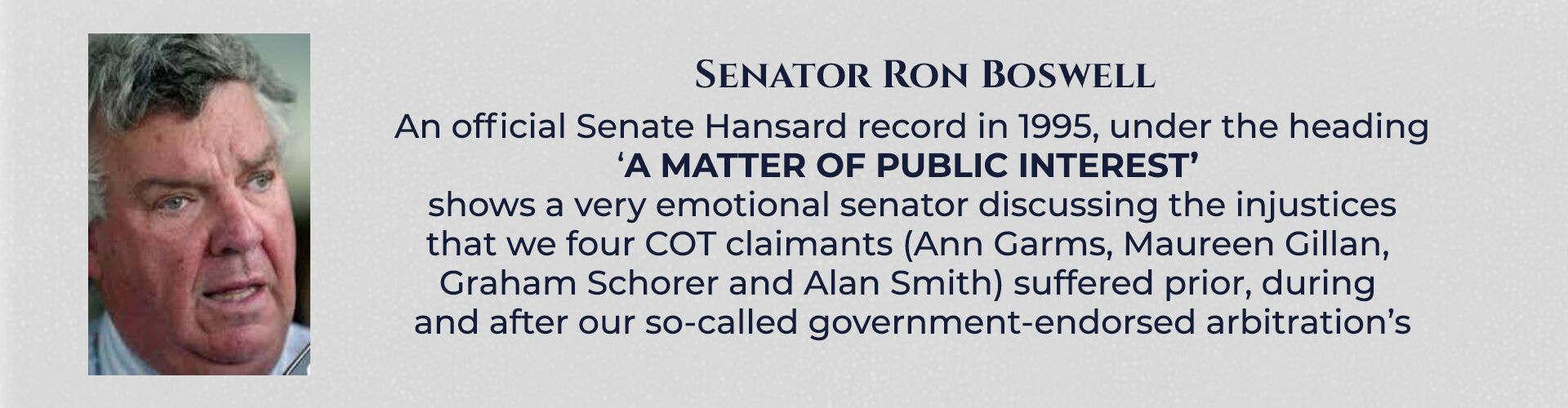
Senate Hansard - 20 September 1995
Senate Hansard records under the heading A MATTER OF PUBLIC INTEREST dated 20 September 1995, show a very emotional Senator Ron Boswell discussing the above type of injustices that we four COT claimants ( i.e. Ann Garms, Maureen Gillan, Graham Schorer and me) suffered prior to, during and after our 'so-called' government-endorsed arbitrations - (see Senate Evidence File No 1 20-9-95 Senate Hansard A Matter of Public Interest):
“...Eleven years after their first complaints to Telstra, where are they now? They are acknowledged as the motivators of Telecom’s customer complaint reforms. … But, as individuals, they have been beaten both emotionally and financially through an 11-year battle with Telstra.
“Then followed the Federal Police investigation into Telecom’s monitoring of COT case services. The Federal Police also found there was a prima facie case to institute proceedings against Telecom but the DPP , in a terse advice, recommended against proceeding.
“Once again, the only relief COT members received was to become the catalyst for Telecom to introduce a revised privacy and protection policy. Despite the strong evidence against Telecom, they still received no justice at all.
“These COT members have been forced to go to the Commonwealth Ombudsman to force Telecom to comply with the law. Not only were they being denied all necessary documents to mount their case against Telecom, causing much delay, but they were denied access to documents that could have influenced them when negotiating the arbitration rules, and even in whether to enter arbitration at all. …
"This is an arbitration process not only far exceeding the four-month period, but one which has become so legalistic that it has forced members to borrow hundreds of thousands just to take part in it. It has become a process far beyond the one represented when they agreed to enter into it, and one which professionals involved in the arbitration agree can never deliver as intended and never give them justice."
"I regard it as a grave matter that a government instrumentality like Telstra can give assurances to Senate leaders that it will fast track a process and then turn it into an expensive legalistic process making a farce of the promise given to COT members and the unducement to go into arbitration. “Telecom has treated the Parliament with contempt. No government monopoly should be allowed to trample over the rights of individual Australians, such as has happened here.”
After viewing the Cape Bridgewater Holiday Camp (SVT) CCAS data dated 29 September 1994 (see Arbitrator File No/110) Brian Hodge, B Tech, MBA (B.C. Telecommunications), on 27 July 2007, prepared a report and on page 23
- "It is my opinion that the reports submitted to Austel on this testing programme was flawed, erroneous, fictitious, fraudulent & fabricated, as it is clear that no such testing has taken place as Telstra’s own call charge system DOES NOT record any such activities. Therefore the results are flawed or did not occur"
Didn't the statements made under oath by Lindsay White to the Senate Estimates Committee on 24 June 1997 mean anything at all regarding the advice he received from this Peter that FIVE COT cases had to be stopped at all cost from proving issues such as the falsified arbitration SVT witness statements to the arbitrator (see Telstra's Falsified SVT Report)
On 26 September 1997, the new TIO advised a Senate Estimates Committee that:
"Firstly, and perhaps most significantly, the arbitrator had no control over that process, because it was a process conducted entirely outside the ambit of the arbitration procedures."
There is no amendment attached to any agreement, signed by the COT mentioned above members, allowing the arbitrator to conduct those particular arbitrations entirely outside the ambit of the arbitration procedure – and neither was it stated that he would have no control over the process once we had signed those individual agreements. How can the arbitrator and TIO continue to hide under a confidentiality clause in our arbitration agreement when that agreement did not mention that the arbitrator would have no control because the arbitration would be conducted entirely outside the agreed procedure?