Government Corruption - Gaslighting

Psychological manipulation
Gaslighting is a form of psychological manipulation in which the abuser attempts to sow self-doubt and confusion in the victim's mind, i.e., you do not have a telephone problem; our records show you are the only customer complaining, even though the documents indicate the situation is systemic. Typically, gaslighting methods are used to seek power and control over the other person by distorting reality and forcing them to question their judgment and intuition.
In the case of Telstra (who was government-owned during the COT arbitrations), in my arbitration alone, Telstra's arbitration defence unit used nine separate witness statements, all signed by nine different Telstra senior employees, where everyone swore under oath my business had not been suffering with ongoing telephone faults either before or during my arbitration, when secret government records from the government's own investigations confirm my complaints were ongoing for the whole six-year period of my arbitration claim, as the following example exhibits show.
Hovering your cursor or mouse over the AUSTEL’s Adverse Findings image will lead you to a document dated March 1994, referenced as AUSTEL’s Adverse Findings. This document confirms that government public servants investigating my ongoing telephone issues supported my claims against Telstra, particularly between Points 2 and 212. It is evident that if the arbitrator had been presented with AUSTEL’s Adverse Findings, he would have awarded me a significantly higher amount for my financial losses than he ultimately did.
Government records (see Absentjustice-Introduction File 495 to 551) show AUSTEL's adverse findings were provided to Telstra (the defendants) one month before Telstra and I signed our arbitration agreement. I did not receive a copy of these same findings until 23 November 2007, 12 years after the conclusion of my arbitration, which was outside the statute of limitations for me to use those government findings to appeal the arbitrator's award.
AUSTEL’s Adverse Findings, dated 4 March 1994, confirmed that my claims against Telstra were validated (see Points 2 to 212) before I was forced into arbitration under threat of the then Telecommunications Industry Ombudsman (TIO), Warwick Smith, and Telstra, that unless I signed for arbitration, then Telstra and the TIO would collectively decline to further investigate my telephone faults, which I alleged had been apparent since February 1988, when I purchased the business.
Unfortunately, I did not receive a copy of these findings AUSTEL’s Adverse Findings at Points 2 to 212 until 23 November 2007, 12 years after the termination of my arbitration process. In simple words, the government had already validated my claims as early as 4 March 1994, six weeks before 21 April 1994, when I signed the arbitration agreement.
But despite this proof, I was still required to endure 13 months in a gruelling arbitration process that cost me well over $300,000 in professional fees to prove something the government had already established.
Page 2 – "Mr Smith has had an ongoing complaint about the level of service for some time .....customer was originally connected to an old RAX exchange, which had limited junctions brtween Portland and Cape Bridgewater, Thus congestion was a problem for all customers on the Cape Bridgewater exchnage. The exchange was up graded to an RCM parented back to the Portland AXE 104".
Page 10 – “Whilst Network Investigation and Support advised that all faults were rectified, the above faults and record of degraded service minutes indicate a significant network problem from August 1991 to March 1993.”
Point 23 – “It is difficult to discern exactly who had responsibility for Mr Smith’s problems at the time, and how information on his problems was disseminated within Telecom. Information imparted by the Portland officer on 10 February 1993 of suspected problems in the RCM “caused by a lighting (sic) strike to a bearer in late November” led to a specialist examination of the RCM on March 1993. Serious problems were identified by this examination.”
Adequacy of Response
Point 25 – "It should also be noted that during the period of time covered by this chronology of significance events it is clear
- Telecom had conducted extensive testing
- Cape Bridgewater Holiday Camp frequestly reported problems with the quality of telephone service
- both the camp and Telecom were receiving confirmation of reported from other network users
- major faults were identified more through persitense reporting of probles by customer than through testing of the network
- customers in the Cape Bridgewater area also complaining of similar problems
Point 26 – "The chronology of significant events demonstrates that Telecom conducted estensive testing and Telecom rectified faults without delay when faults were identified. It is clear however, that
- Cape Bridgewater Holiday Camp was exposed to significant network problems over an extended period of time
- Telecom testing did not not detect all of the network problems affecting Mr Smith".
Telecom's Approach to reaching Settlement
Point 27 – "As is discussed under allegation in more detail throughout this document, Telecom's failure to adequately identify Mr Smith's network problems challenges the bases of Senior Telecom Management's approach to the resolution of Mr Smith's complaints and his claims for compensation etc, etc
Point 29 – "A fundamental issue underlying Telecom's settlement with Mr Smith was the question of whether Telecom had taken reasonable steps to comprehensively diagnose the standard of Mr Smith's telephone service. This is an important point as settlement took place on the bases that both parties agreed Mr Smith was receiving an acceptable standard of service at the time of settlement. Mr Smith maintains he was under considerable financial pressure to reach settlement, leading him to accept Telecom's assurances of his services at the time of settlement."
Point 32 – "Telecom's communications with Mr Smith in the months prior to settlement uniformaly argued that the Cape Bridgewater Holiday Camp was at an acceptable level and that Telecom was capable of rapidly rectifying faults as they occured."
Point 42 – “Some important questions are raised by the possible existence of a cable problem affecting the Cape Bridgewater Holiday Camp service. Foremost of these questions is why was the test call program conducted during July and August 1992 did not lead to the discovery of the cable problem. Another important question is exactly how the cable problem would have manifested in terms of service difficulties to the subscriber.”
Point 44 – “Given the range of faults being experienced by Mr Smith and other subscribers in Cape Bridgewater, it is clear that Telecom should have initiated more comprehensive action than the test call program. It appears that there was expensive reliance on the results of the test program and insufficient analysis of other data identifying problems. Again, this deficiency demonstrated Telecom’s lack of a comprehensive and co-ordinated approach to resolution of Mr Smith’s problems.”
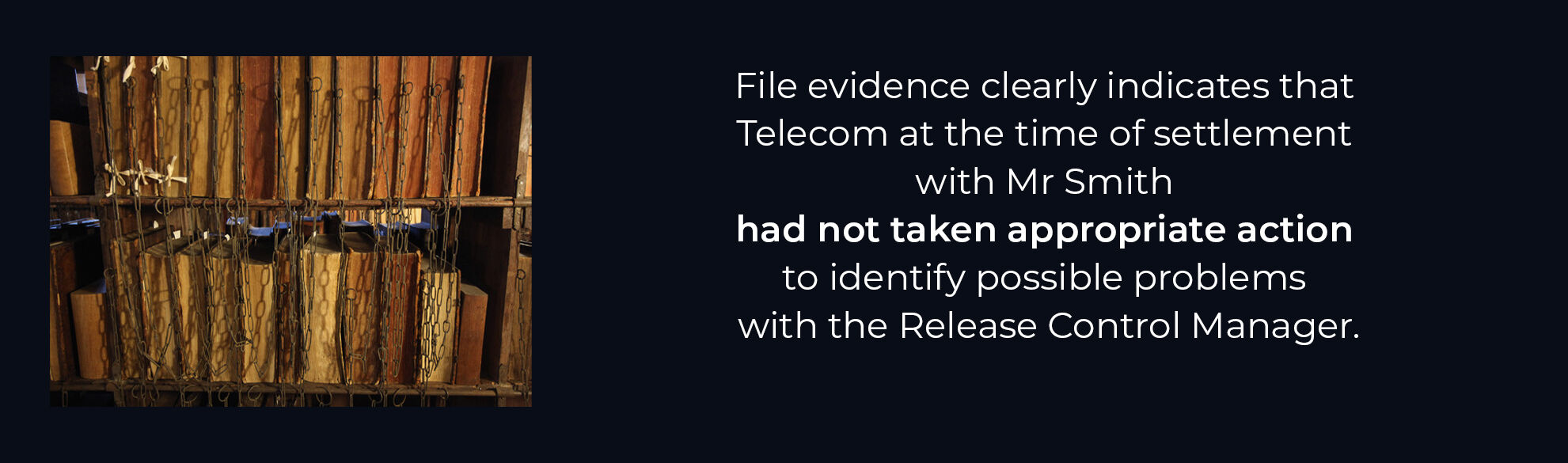
Point 46 –“File evidence clearly indicates that Telecom at the time of settlement with Mr Smith had not taken appropriate action to identify possible problems with the RCM . It was not until a resurgence of complaints from Mr Smith in early 1993 that appropriate investigative action was undertaken on this potential cause In March 1993 a major fault was discovered in the digital remote customer multiplexer (RCM) providing telephone service to Cape Bridgewater holiday camp. This fault may have been existence for approximately 18 months. The Fault would have affected approximately one third of subscribers receiving a service of this RCM. Given the nature of Mr Smith’s business in comparison with the essentially domestic services surrounding subscribers, Mr Smith would have been more affected by this problem due to the greater volume of incoming traffic than his neighbours.”
Point 47 –“Telecom's ignorance of the existence of the RCM fault raises a number of questions in regard to Telecom's settlement with Smith. For example, on what bases was settlement made by Telecom if this fault was not known to them at this time? Did Telecom settle with Mr Smith on the bases that his complaints , of faults were justified without a full investigation of the validity of these complaints, or did Telecom settle on the basis of faults substantiated to the time of settlement? Wither criteria for settlement would have been inadequate, with the later critera disadvantaging Mr Smith, as knowledge of the existence of more faults on his service may have led to an increase in the amount offered for settlement of his claims".
Point 48 – “AUSTEL has been hampered in assessing Telecom’s dealings with Mr Smith by Telecom’s failure to provide files relating to Mr Smith’s complaints.”
Point 49 –: "As a result of Telecom's failure to provide file documentation relating to Mr Smith some of the following conclusions are consequently based on insufficient information. The information which is avaialble however, demonstates that on a number of issues Telecom failed to keep Mr Smith informed on matters fundamental to the assessment of his complaints".
Point 71 –: “AUSTEL has not been provided with the documents on which the conclusion in this briefing summary were reached, such as fault reports from other Cape Bridgewater subscribers over this period or the details of the final selector fault. It would have been expected that these documents would have been retained on file as background to the summary. It can only be assumed that they are contained within the documentation not provided to AUSTEL.”
Point 76 – “One disturbing matter in relation to Mr Smith’s complaints of NRR is that information on other people in the Cape Bridgewater area experiencing the problem has been misrepresented from local Telecom regional manager to more senior manager.”
Point 86 – “From examination of Telecom’s documention concerning RVA messages on the Cape Bridgewater Holiday Camp there are a wide range of possible causes of this message.”
Point 109 – The view of the local Telecom technicians in relation to the RVA problem is conveyed in a 2 July 1992 Minute from Customer Service Manager – Hamilton to Managers in the Network Operations and Vic/Tas Fault Bureau:
- “Our local technicians believe that Mr Smith is correct in raising complaints about incoming callers to his number receiving a Recorded Voice Announcement saying that the number is disconnecte. They believe that it is a problem that is occurring in increasing numbers as more and more customers are connected to AXE. ”
Point 115 –“Some problems with incorrectly coded data seem to have existed for a considerable period of time. In July 1993 Mr Smith reported a problem with payphones dropping out on answer to calls made utilising his 008 number. Telecom diagnosed the problem as being to “Due to incorrect data in AXE 1004, CC-1. Fault repaired by Ballarat OSC 8/7/93, The original deadline for the data to be changed was June 14th 1991. Mr Smith’s complaint led to the identification of a problem which had existed for two years.”
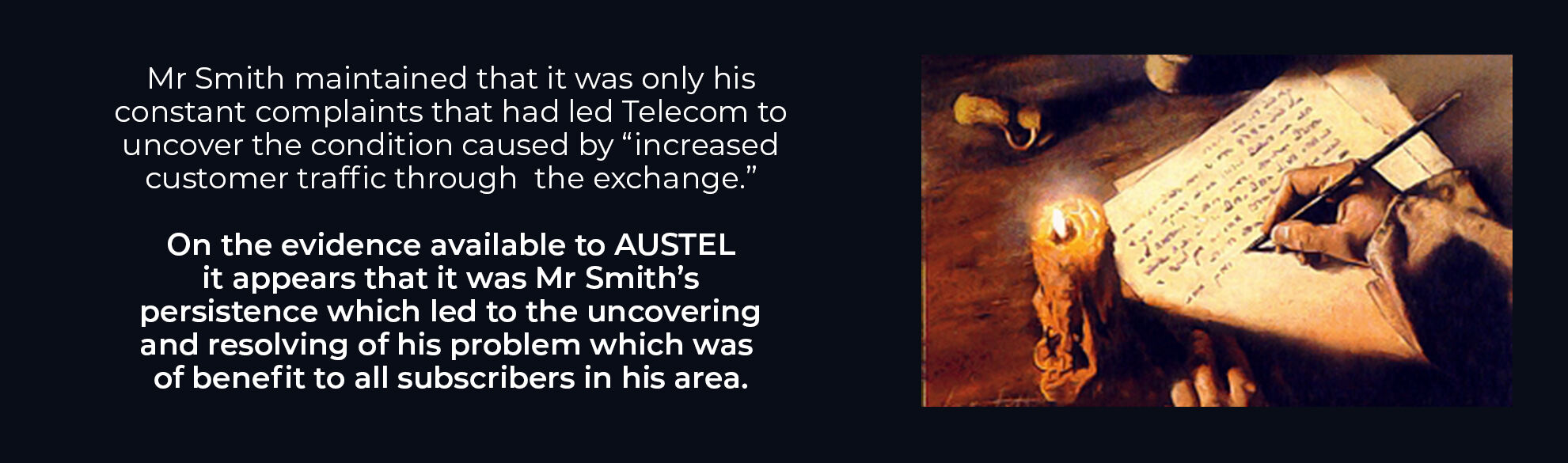
Point 130 – “On April 1993 Mr Smith wrote to AUSTEL and referred to the absent resolution of the Answer NO Voice problem on his service. Mr Smith maintained that it was only his constant complaints that had led Telecom to uncover this condition affecting his service, which he maintained he had been informed was caused by “increased customer traffic through the exchange.” On the evidence available to AUSTEL it appears that it was Mr Smith’s persistence which led to the uncovering and resolving of his problem – to the benefit of all subscribers in his area”.
Point 140 – “It should be noted that AUSTEL’s investigation of matters relating to the RCM problem has been hampered by Telecom’s failure to make available to AUSTEL a file specifically relating to the Pairs Gains Support investigation of the RCM. The file was requested by AUSTEL on 9 February 1994.”
Point 153 –“A feature of the RCM system is that when a system goes “down” the system is also capable of automatically returning back to service. As quoted above, normally when the system goes “down” an alarm would have been generated at the Portland exchange, alerting local staff to a problem in the network. This would not have occurred in the case of the Cape Bridgewater RCM however, as the alarms had not been programmed. It was some 18 months after the RCM was put into operation that the fact the alarms were not programmed was discovered. In normal circumstances the failure to program the alarms would have been deficient, but in the case of the ongoing complaints from Mr Smith and other subscribers in the area the failure to program these alarms or determine whether they were programmed is almost inconceivable.”
Point 158 – “The crucial issue in regard to the Cape Bridgewater RCM is that assuming the lightning strike did cause problems to the RCM om late November 1992 these problems were not resolved till the beginning of March 1993, over 3 months later. This was despite a number of indications of problems in the Cape Bridgewater area. Fault reports from September 1992 also indicate that the commencement of problems with the RCM may have occurred earlier than November 1992. A related issue is that Mr Smith’s persistent complaints were almost certainly responsible for an earlier identification of problems with the RCM than would otherwise have been the case.”
Point 160 – “It should be noted that it is hoped that a number of issues in regard to the Cape Bridgewater RCM will be clarified when Telecom provides the documentation requested by AUSTEL.”
Point 169 –" Documentation reviewed indicates that other network users attached to the Cape Bridgewater exchange did report problems similar to those experienced by Cape Bridgewater Holiday Camp. It is also clear that problems identified in the area would have impacted on other network users as well as Cape Bridgewater Holiday Camp."
Point 209 – “Cape Bridgewater Holiday Camp has a history of service difficulties dating back to 1988. Although most of the documentation dates from 1991 it is apparent that the camp has had ongoing service difficulties for the past six years which has impacted on its business operations causing losses and erosion of customer base.”
Point 210 – “Service faults of a recurrent nature were continually reported by Smith and Telecom was provided with supporting evidence in the form of testimonials from other network users who were unable to make telephone contact with the camp.”
Point 211 – “Telecom testing isolated and rectified faults as they were found however significant faults were identified not by routine testing but rather by the persistence-fault reporting of Smith”.
Point 212 – “In view of the continuing nature of the fault reports and the level of testing undertaken by Telecom doubts are raised on the capability of the testing regime to locate the causes of faults being reported.”
Who was the arbitrator going to believe, me or the nine witness statements, all sworn out under oath, stating that there were no ongoing problems?
These nine sworn testaments worked, and why wouldn't they work one statement from me against nine? Of course, the arbitrator made no written finding concerning my ongoing problems in his award.
Intimidating threats issued by Telstra
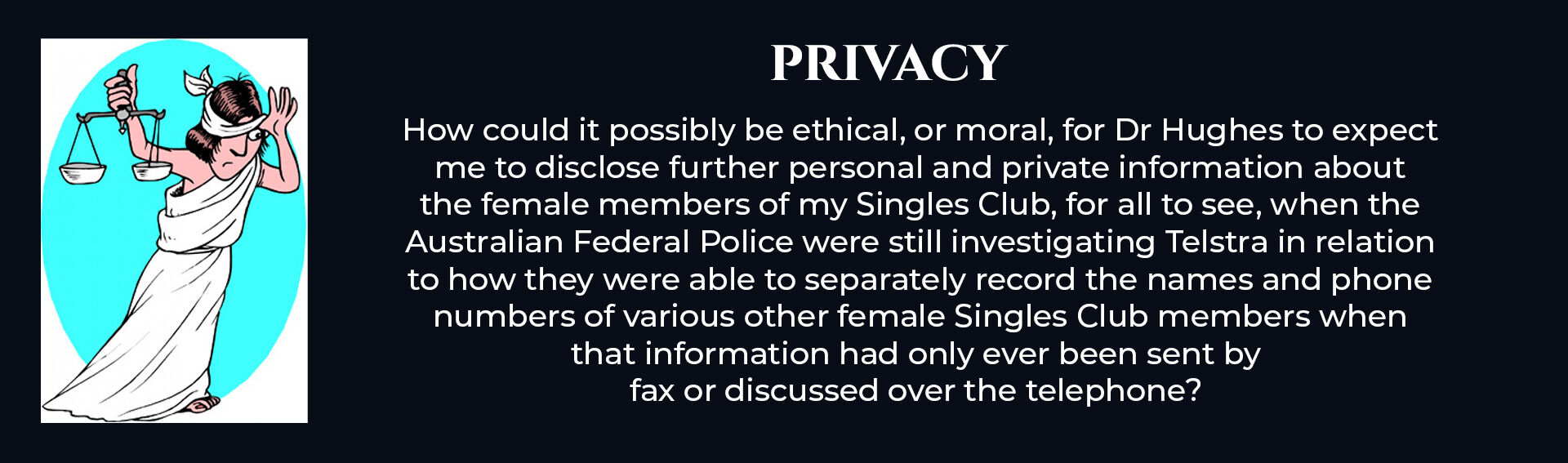
Do not disclose this sensitive information to Telstra.
During my first visit to the holiday camp in February 1994, AFP Senior Constable Melanie Cochrane gave me crucial advice. She recommended that from then on, I should refrain from supplying the arbitration process with any documented names, addresses, or telecommunications details of my single club patrons. This was to be done unless the arbitrator provided official written confirmation that my correspondence would be sent to Telstra after the AFP had concluded their investigation into Telstra's unauthorised interception of my telecommunication services. The AFP was still examining how Telstra had obtained sensitive private and business information related to this aspect of my operations.
My members from the single club—a significant revenue source for my holiday camp—have communicated their concerns about the reliability of my security protocols, specifically regarding the faxes sent and received. This concern has been heightened by recent media reports indicating the potential bugging of my business phone lines. Below are two of those media reports for your reference
While the intimidating threats issued by Telstra and the unsettling fact that these actions took place under the watchful eyes of the arbitrator and the Telecommunications Industry Ombudsman during the COT arbitrations have been extensively examined and brought to light throughout this website, what indeed weighs heavily on my mind—and the minds of many others involved in COT Cases—is the grim reality of serious threats that were never thoroughly investigated. This alarming neglect has left us grappling with the disheartening truth that a democratically elected government has, disturbingly, allowed these grave threats to go unaddressed. As a result, those who became targets of such intimidation have experienced profound and lasting impacts on their lives, leading to an enduring sense of injustice and despair that permeates our daily existence.
On July 4, 1994, amidst the complexities of my arbitration proceedings, I confronted serious threats articulated by Paul Rumble, a Telstra representative on the arbitration defence team. Disturbingly, he had been covertly furnished with some of my interim claims documents by the arbitrator—a breach of protocol that occurred an entire month before the arbitrator was legally obligated to share such information. Given the gravity of the situation, my response needed to be exceptionally meticulous. I poured considerable effort into crafting this detailed letter, carefully choosing every word. In this correspondence, I made it unequivocally clear:
“I gave you my word on Friday night that I would not go running off to the Federal Police etc, I shall honour this statement, and wait for your response to the following questions I ask of Telecom below.” (File 85 - AS-CAV Exhibit 48-A to 91)
When drafting this letter, my determination was unwavering; I had no intention of submitting any additional Freedom of Information (FOI) documents to the Australian Federal Police (AFP). This decision was significantly influenced by a recent, tense phone call I received from Steve Black, another arbitration liaison officer at Telstra. During this conversation, Black issued a stern warning: should I fail to comply with the directions he and Mr Rumble gave, I would jeopardise my access to crucial documents related to ongoing problems with my telephone service.
Page 12 of the AFP transcript of my second interview (Refer to Australian Federal Police Investigation File No/1) shows Questions 54 to 58, the AFP stating:-
“The thing that I’m intrigued by is the statement here that you’ve given Mr Rumble your word that you would not go running off to the Federal Police etcetera.”
Essentially, I understood that there were two potential outcomes: either I would obtain documents that could substantiate my claims, or I would be left without any documentation that could impact the arbitrator's decisions regarding my case.
However, a pivotal development occurred when the AFP returned to Cape Bridgewater on September 26, 1994. During this visit, they began to pose probing questions regarding my correspondence with Paul Rumble, demonstrating a sense of urgency in their inquiries. They indicated that if I chose not to cooperate with their investigation, their focus would shift entirely to the unresolved telephone interception issues central to the COT Cases, which they claimed assisted the AFP in various ways. I was alarmed by these statements and contacted Senator Ron Boswell, National Party 'Whip' in the Senate.
As a result of this situation, I contacted Senator Ron Boswell, who subsequently brought these threats to the Senate. This statement underscored the serious nature of the claims I was dealing with and the potential ramifications of my interactions with Telstra.
Threats made and carried out.
Telstra at its worst
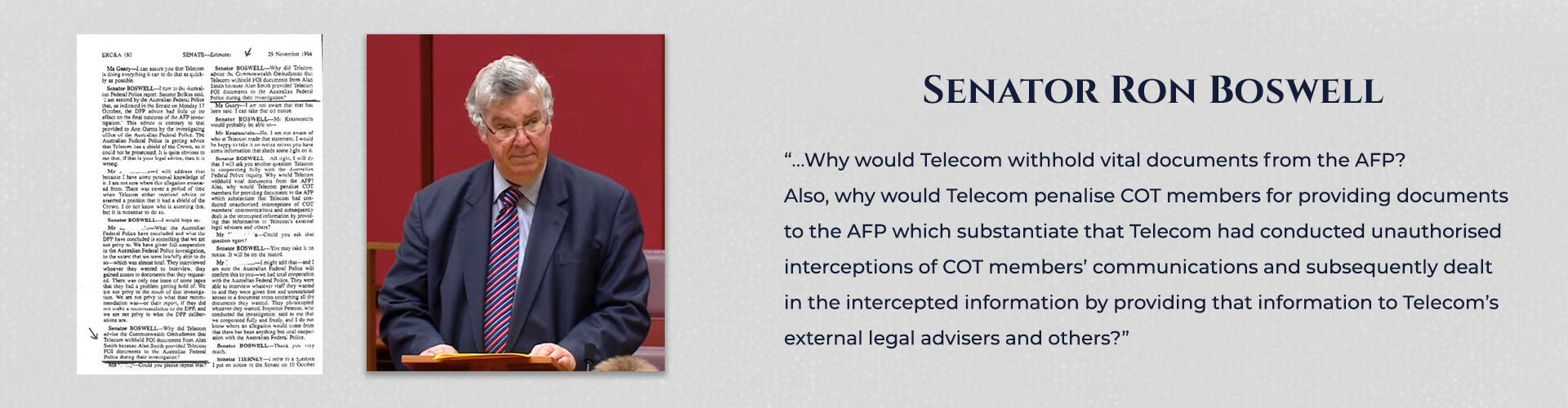
On page 180, ERC&A, from the official Australian Senate Hansard, dated 29 November 1994, reports Senator Ron Boswell asking Telstra’s legal directorate:
“Why did Telecom advise the Commonwealth Ombudsman that Telecom withheld FOI documents from Alan Smith because Alan Smith provided Telecom FOI documents to the Australian Federal Police during their investigation?”
After receiving a hollow response from Telstra, which the senator, the AFP and I all knew was utterly false, the senator states:
“…Why would Telecom withhold vital documents from the AFP? Also, why would Telecom penalise COT members for providing documents to the AFP which substantiate that Telecom had conducted unauthorised interceptions of COT members’ communications and subsequently dealt in the intercepted information by providing that information to Telecom’s external legal advisers and others?” (See Senate Evidence File No 31)
Thus, the threats became a reality. What is so appalling about this withholding of relevant documents is this - no one in the TIO office or government has ever investigated the disastrous impact the withholding of documents had had on my overall submission to the arbitrator. The arbitrator and the government (at the time, Telstra was a government-owned entity) should have initiated an investigation into why an Australian citizen, who had assisted the AFP in their investigations into unlawful interception of telephone conversations, was so severely disadvantaged during a civil arbitration.
Pages 12 and 13 of the Australian Federal Police Investigation File No/1 transcripts provide a comprehensive account establishing Paul Rumble as a significant figure linked to the threats I have encountered. This conclusion is based on two critical and interrelated factors that merit further elaboration.
Firstly, Mr. Rumble actively obstructed the provision of essential arbitration discovery documents, which the government was legally obligated to provide under the Freedom of Information Act. This obligation was contingent on my signing an agreement to participate in a government-endorsed arbitration process. By imposing this condition, Mr Rumble undermined a legally established protocol, effectively manipulating the process for his benefit and jeopardizing my legal rights.
Secondly, I discovered that Mr. Rumble had substantial influence over the arbitrator, resulting in the unauthorized early release of my arbitration interim claim materials. This premature revelation directly conflicted with the timeline stipulated in the arbitration agreement that both Telstra and I had formally signed. Specifically, Telstra gained access to my interim claim document five months earlier than permitted under the agreed-upon terms. This breach of protocol violated the integrity of the arbitration process and gave Telstra an unfair advantage in responding to my claims.
According to the rules governing our arbitration process, Telstra was allocated one month to respond to my claim once it had been submitted in writing as my final claim. Furthermore, the arbitrator was only authorized to release my final claim to Telstra once it was officially confirmed to be complete. The five-month delay in submitting my claim in November 1994 was primarily attributable to Mr. Rumble's deliberate withholding of critical technical information. This information was essential for my consultant, George Close, to effectively demonstrate that the issues with my phone remained unresolved. Mr Rumble threatened to withhold this information because I was actively assisting the Australian Federal Police in investigating Telstra’s unlawful interception of my private phone conversations and faxes without a legal warrant.
As a result of these actions, I found myself constrained to a mere one month to formulate a comprehensive response to Telstra's defence. At the same time, they benefited from an extensive five-month preparation period to address my claim. This imbalance undermined the arbitration process's fairness and significantly impacted my ability to advocate effectively for my rights.
Did Mr. Rumble inadvertently stumble upon sensitive information concerning my phone and interception issues documented in my interim claim, which I had previously provided to the AFP as they had requested? The Australian Federal Police (AFP) had exclusive jurisdiction over this information, and Mr. Rumble was not authorized to access it until my claim was officially certified. Essentially, when Dr. Gordon Hughes prematurely released this confidential material to Paul Rumble a full five months before he was legally obligated to do so under the Fast Track Arbitration Agreement, he not only violated the terms of that agreement but also significantly obstructed the investigations being conducted by the AFP during that crucial five-month period. Given these circumstances, why has the Australian government overlooked my legitimate claims against Dr. Hughes?
On 3 March 1994, this article appeared in the Portland Observer newspaper (AS 773-b), noting:
“Federal Police officers are investigating allegations of possible illegal activity on the part of Telecom Australia.
Officers from the Federal Police visited Portland last week and interviewed Cape Bridgewater Holiday Camp proprietor, Alan Smith, who is one of the four original members of COT (Casualties of Telecom).”
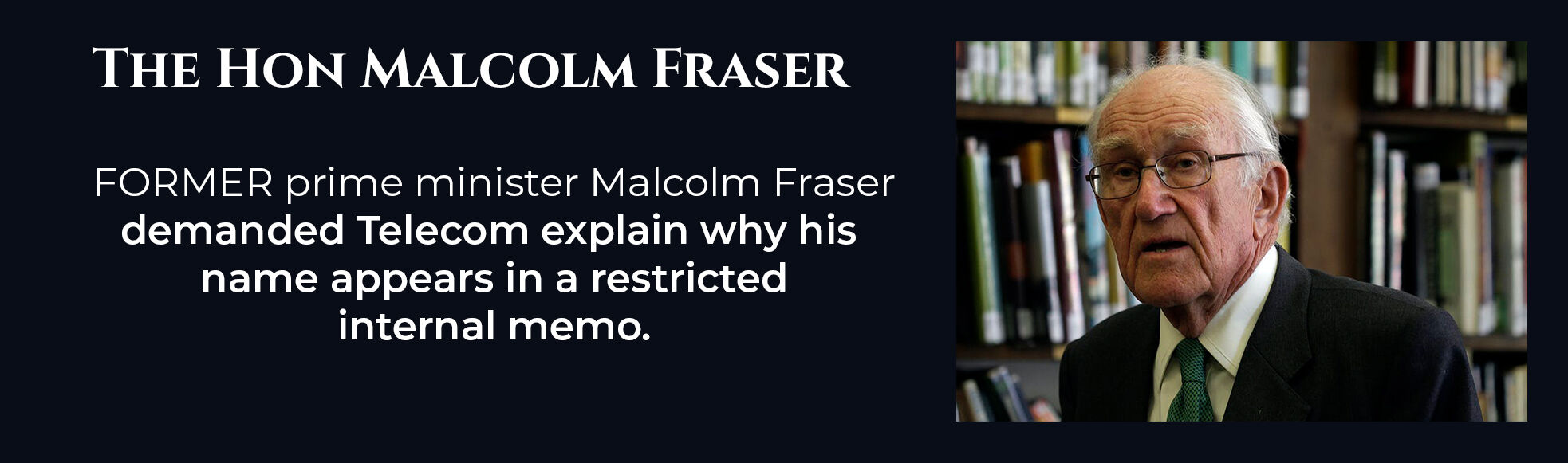
On 15 April 1994, 27 years later, the Herald Sun, an Australian newspaper, reported:
“FORMER prime minister Malcolm Fraser yesterday demanded Telecom explain why his name appears in a restricted internal memo.
“Mr Fraser’s request follows the release of a damning government report this week which criticised Telecom for recording conversations without customer permission.
“Mr Fraser said Mr Alan Smith, of the Cape Bridgewater Holiday Camp near Portland, phoned him early last year seeking advice on a long-running dispute with Telecom which Mr Fraser could not help.” (Senate Evidence File No/53)
George Close - COT Case Technical Consultant
Exhibit AS 492-A file AS-CAV 488-A to 494-E is a letter dated 26 August 1998 from George Close to the new Telecommunications Industry Ombudsman. The fax header records that the fax was sent from Mr Close’s residential fax number at 17:54. Our Main Evidence File (see Open Letter File No/12 and File No/13) contains the technical findings of both Scandrett & Associates and Peter Hancock, showing that they both agree that if the fax header does not include the correct business identification of the respective COT business, it indicates that a secondary fax machine intercepted those faxes and then redirected to the intended destination. This intercepted letter from Mr Close was copied to the offices of twelve different Government Ministers in Parliament House Canberra, raising several important questions. It is worth considering whether government offices in Parliament House are also routed through Telstra’s Fax Streaming centre, and if so, what could happen to the documents that go through that system without the government’s knowledge. This prompts the question of whether privileged, in-confidence material 'leaks' out of Parliament House through Telstra's Fax Streaming process, meaning that private information may not be as secret as assumed.
Just so you know, although the George Close exhibits are of poor quality (having been copied several times), their poor quality does not diminish the fact that, when viewed together, they still prove our claims.
Exhibit 492-B file AS-CAV 488-A to 494-E, a report faxed by Mr Close on 16 April 1998, has the correct identification across the top of the page (see 61-74-453198 — GEORGE CLOSE & ASSOC—17:34). In simple terms, those with access to Telstra’s network were able to use ‘keywords’, so only specific faxes leaving Mr Close’s residence were intercepted. I have used these two examples because they were sent at approximately the same time in the afternoon, although months apart.
When George Close, the arbitration technical advisor to the COT Cases, visited my home in Cape Bridgewater, he highlighted the role of his residence in Buderim, Queensland, and his office as key locations for providing valuable guidance to the COT Cases. This advice focused on the essential documents they needed to obtain from Telstra under the Freedom of Information (FOI) Act, which were crucial for supporting their arbitration claims.
During our meeting, I shared several vital documents with him, including Open Letter File No/12, File No/13, Front Page Part One File No/1, Front Page Part One File No/2-A to 2-E, Front Page Part One File No/4 and Front Page Part One File No/5. We engaged in a constructive discussion about the impact of intercepted or hacked faxes on the overall submissions made by the COT Cases to the arbitrator. Mr. Close’s reflections showed his commitment to better understanding the situation. He recognized the significance of the guidance he gave the COT Cases from his residence and office and its implications for the COT Cases. He understood the crucial role that his residence and office played in the COT Cases and the broader impact of that involvement. With a heavy heart, he recognized that it was precisely these locations that Telstra had exploited to conduct their surveillance on the COT Cases. My Close could not hide his hurt that his office and residence had inflicted so much damage and heartache on our families Front Page Part One File No/26).
Following our conversation on August 5, 2011, Mr Close emailed me to help disclose what the Telstra Corporation had been prepared to do at any costs, noting:
“I recall a discussion with Senator Ron Boswell during the late 90’s.
“He had been shown fax’s which had clear indication of change in the headers, indicating interruption in transmission by a third party or parties.
“He questioned whether it was possible that faxes to and from senators could be interrupted, read or copies.
“My response in the affirmative brought about an expression of extreme anger. Stating that if it could be proven that it occurred the offender(s) would be jailed.
“If required I am prepared to re-state this on an affidavit.”
So far, no one in Australia has even been brought to account, let alone jailed, for the terrible invasion of the COT cases’ private and business lives.
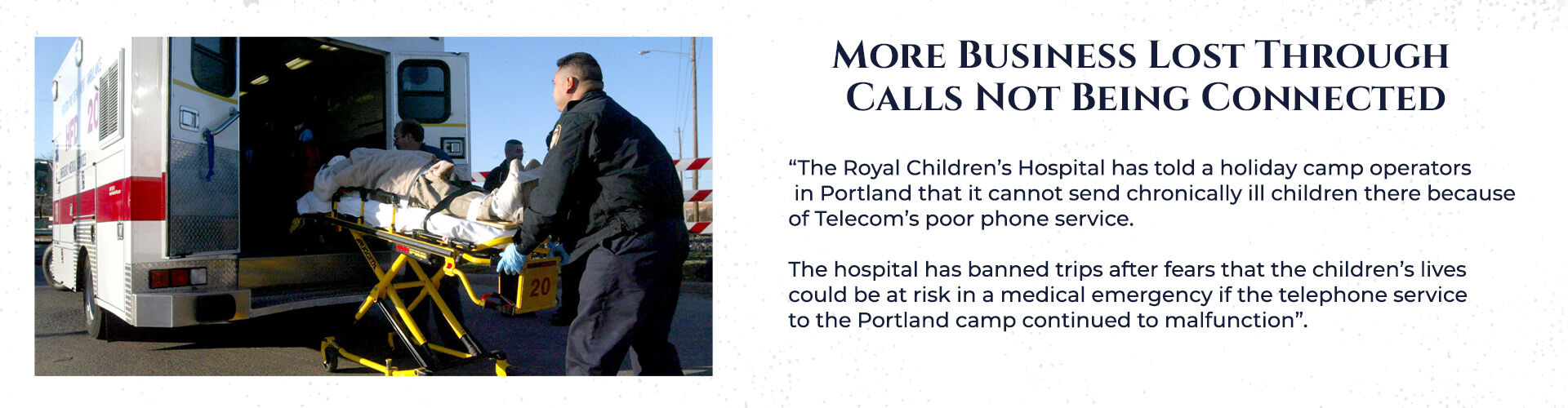
Children's lives could be at risk
Comments made from the Herald Sun newspaper dated 30 August 1993 confirm just how damaging some of these newspaper articles were to my already ailing business, with statements like:
“The Royal Children’s Hospital has told a holiday camp operators in Portland that it cannot send chronically ill children there because of Telecom’s poor phone service. The hospital has banned trips after fears that the children’s lives could be at risk in a medical emergency if the telephone service to the Portland camp continued to malfunction”.
The centre’s stand follows letters from schools, community groups, companies and individuals who have complained about the phone service at Portland’s Cape Bridgewater Holiday camp.”
Youths from the Royal Children’s Centre for Adolescent Health, who were suffering from “chronic illnesses”, visited the camp earlier this year.
Group leader Ms Louise Rolls said in a letter to the camp the faulty phones had endangered lives and the hospital would not return to the camp unless the phone service could be guaranteed” (Arbitrator File No/90)
After the Melbourne Children's Hospital recorded a near-death experience with me having to rush a sick child with cancer to the Portland Hospital 18 kilometres away from my holiday camp, Telstra finally decided to take my telephone faults seriously. None of the 35 children (all with cancer-related illnesses) had mobile phones, or the six or so nurses and carers. Mobile telephones could not operate successfully in Cape Bridgewater until 2004, eleven years after this event. My coin-operated gold phone was also plagued with phone problems, and it took several tries to ring out of the holiday camp. An ambulance arrived sixteen minutes after our first try to call the Hospital.
It took almost a tragedy for Telstra to send someone with real technical experience to my business. Telstra's visit occurred on 3 June 1993, six weeks after the Children's Hospital vowed never to revisit my Camp until I could prove my Camp was telephone-fault-free. No hospital where convalescent is a good revenue spinner has ever visited my business, even after I sold it in December 2001.

Testimonials
Between April 1990 and when I sold the holiday camp in December 2001, I continued to sponsor underprivileged groups to stay there during the weeks partly (that became years) when the phone problems continued to beset the holiday camp. At least some money was coming into the business. Those wanting a cheap holiday persisted in telephoning repeatedly, despite being told the Camp was no longer connected to Telstra's network. These groups wanted a holiday, and if they had to drive for hours to make a booking as Loreto College did (see below), then a drive they did.
The holiday Camp could sleep around 90 to 100 persons in fourteen cabins. I arranged for sponsored food purchases through the generosity of several commercial food outlets, and these groups then just used the camp facilities — it didn't cost me anything beyond a small amount of electricity and gas. Around May 1992, I organised a charity week for kids from Ballarat and the South West, including Warrnambool, Hamilton and Portland. This group was organised by Sister Maureen Burke IBVM, the Principal of Loreto College in Ballarat, and I am sure she would not be offended to know that I think of her as the 'mother' of the project.
Arrangements regarding food, transport, and any special needs the children might have had to be handled over the phone, and of course, Sister Burke had enormous problems making phone contact; calls were either ringing out, or she was getting a deadline or a message that the number she was ringing was not connected to the Telstra network. Sister Burke knew otherwise. On two occasions in 1992, after trying in vain for a week, she drove the 3½ hours to make the final arrangements for those camps.
Just as she arrived at the Camp, Karen took a phone call from a furious man who wanted information about a singles weekend we were trying to set up. This caller was quite abusive. He couldn't understand why we were advertising a business but never answered the phone. Karen burst into tears. She had reached the end of her tolerance, and nothing I could say was any help. When Sister Burke appeared in the office, I decided absence was the better part of valour and removed myself, leaving the two women together. Much later, Sister Burke came out and told me she thought it was probably best for both of us if Karen left Cape Bridgewater. I felt numb. It was all happening again.
But it wasn't the same as it had been with Faye. Karen and I sat and talked. True, we would separate, but I assured her that she would lose nothing because of her generosity and that I would do whatever was necessary to buy her out. We were both relieved at that. Karen rented a house in Portland, and we remained good friends. Without her day-to-day assistance at the Camp, which had given me space to travel, I had to drop my promotional tours.
Twelve months later, in March of 1993, Sister Karen Donnellon, also from Loreto College, tried to make contact via the Portland Ericsson telephone exchange to arrange an annual camp. Sister Donnellon later wrote:
“During a one week period in March of this year I attempted to contact Mr Alan Smith at Bridgewater Camp. In that time I tried many times to phone through.
Each time I dialled I was met with a line that was blank. Even after several re-dials there was no response. I then began to vary the times of calling but it made no difference.”
Some years later, I sent Sister Burke an early draft of my manuscript, Absent Justice My Story ', concerning my valiant attempt to run a telephone-dependent business without a dependable phone service. Sister Burke wrote back,
“Only I know from personal experience that your story is true, otherwise I would find it difficult to believe. I was amazed and impressed with the thorough, detailed work you have done in your efforts to find justice”
Of course, Sister Maureen Burke and Sister Karen Donnellon persisted with their continuing battle to find a way to get a proper telephone connection for the holiday camp, partly because it was a low-cost holiday for all concerned but also because these incredible women were well aware that my business was continuing to exist, albeit 'by the skin of its teeth, even though Telstra's automated voice messages kept on telling prospective customers that the business did not exist or the callers simply reached a dreaded silence that appeared to indicate that the number they had called was attached to a 'dead' line. Either way, I lost the business that may have followed if only the callers could have successfully connected to my office via this dreaded Ericsson AXE telephone exchange.
A letter dated 6 April 1993, from Cathy Lindsey, Coordinator of the Haddon & District Community House Ballarat (Victoria) to the Editor of Melbourne's Herald-Sun newspaper, read:
“I am writing in reference to your article in last Friday’s Herald-Sun (2nd April 1993) about phone difficulties experienced by businesses.
I wish to confirm that I have had problems trying to contact Cape Bridgewater Holiday Camp over the past 2 years.
I also experienced problems while trying to organise our family camp for September this year. On numerous occasions I have rung from both this business number 053 424 675 and also my home number and received no response – a dead line.
I rang around the end of February (1993) and twice was subjected to a piercing noise similar to a fax. I reported this incident to Telstra who got the same noise when testing.” Evidence File 10 B
During the same period, 1992 and 1993, Cathy Lindsey, a professional associate of mine, signed a Statutory Declaration dated 20 May 1994, explaining several sinister incidents that occurred when she attempted to collect mail on my behalf from the Ballarat Courier Newspaper office (File 22, Exhibits 1 to 47). This declaration leaves unanswered questions about who collected my mail and how they knew there was mail to collect from the Ballarat Courier mail office. On both occasions, when a third party collected this mail, I telephoned Cathy to inform her that the Ballarat Courier had notified me that mail was waiting to be picked up.
It was another fiasco that lasted until August 2009, when not-so-new owners of my business walked off the holiday camp premises, as bankrupts do in Chapter 4, The New Owners Tell Their Story.
 The following Kangaroo link, https://shorturl.at/wRT57, has
Ann's Garms was prepared to go live on her YouTube video below about her arbitration and appeal process, which coincides with her letter discussed below.
This same letter is discussed in more detail on National Television, as shown in the YouTube video (Files 942 to 946 - AS-CAV 923 to 946).
I have raised here four letters, one dated 17 August 2017, 6 October 2017, 9 October 2017 and 10 October 2017, from COT Case Anne Garms, just before her death, to The Hon Malcolm Turnbull MP, Prime Minister of Australia and Senator the Hon Mathias Cormann (see See File Ann Garms 104 Document) where she exposes not only the raping of the first nation (aboriginal children) by Senator Collins in his parliament house Canberra office (rb.gy/dsvidd) Ann also discloses in her 6 October 2017 letter which is marked Doc B, to the Hon Malcolm Turnbull MP, Prime Minister of Australia, raises the fact that previous CEO during the COT arbitrations Frank Blount co-produced a book https://www.qbd.com.au › managing-in-australia › fran admitting Telstra did have significant problems in their network.
Had the arbitrator and administrator to the COT arbitrations been aware that Frank Blount would be making public statements about how deficient the network was less than two years after Telstra had sworn under oath in some thirty or more statutory declarations that Telstra's network was of world standard when pages 116, 132, 133, 136, and 137 in https://www.qbd.com.au › managing-in-australia › fran: the COT Cases would have been awarded a far greater compensation payout than they did.
It was also essential to raise Ann Garms's letter here because Wayne Goss (Chair of Deloitte), who Ann referred to, had also been Premier of Queensland Therefore, Ann's statement that told her that during our arbitrations, Gaslighting methods were used against us fits in with the Gaslighting character assassination used against me in 1996, to stop Laurie James, the President of the Institute of Arbitrators Australia, from investigating my claims concerning the unethical way in which the four COT arbitrations had been conducted.
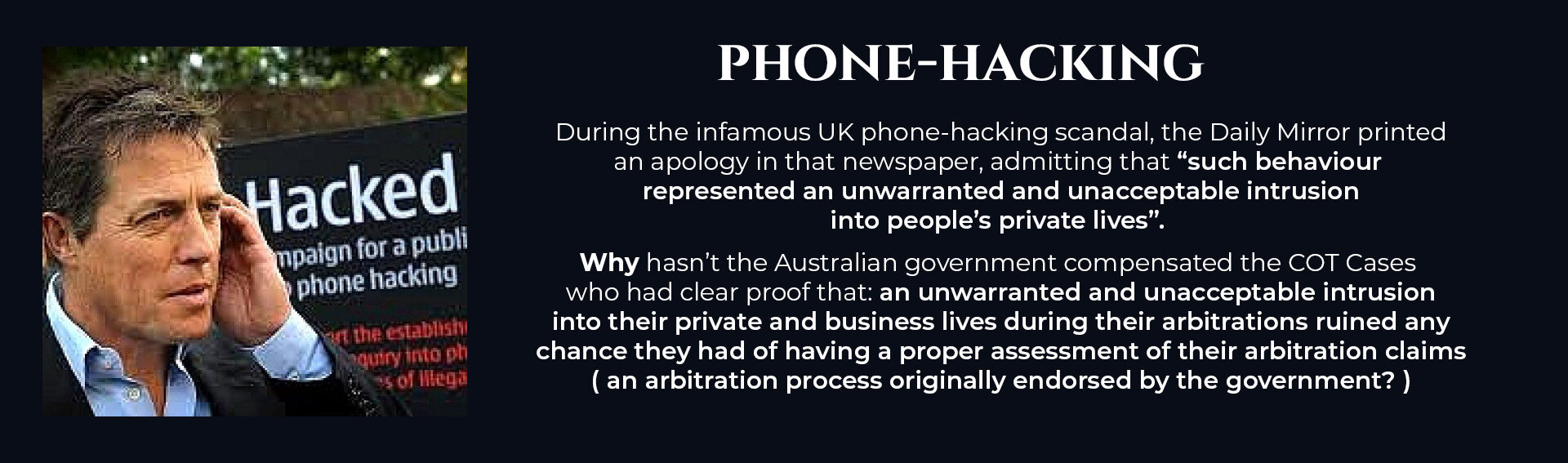
This is the same unethical conduct that three young hackers (later identified as Julian Assange) warned Graham Schorer, COT spokesperson, about very early in our arbitrations, as this part of our COT story shows.
Click on the Julian Assange caption below to learn more about the COT story.

Graham Schorer prepared a statutory declaration on 7 July 2011 to provide to the Victorian Attorney-General, the Hon Robert Clark. This statutory declaration discusses the hackers who phoned Graham to warn him. The hackers discovered that Telstra and others associated with our arbitrations were acting unlawfully towards the COT group. Graham's statutory declaration includes the following statements:
“After I signed the arbitration agreement on 21st April 1994 I received a phone call after business hours when I was working back late in the office. This call was to my unpublished direct number.
“The young man on the other end asked for me by name. When I had confirmed I was the named person, he stated that he and his two friends had gained internal access to Telstra’s records, internal emails, memos, faxes, etc. He stated that he did not like what they had uncovered. He suggested that I should talk to Frank Blount directly. He offered to give me his direct lines in the his Melbourne and Sydney offices
“The caller tried to stress that it was Telstra’s conduct towards me and the other COT members that they were trying to bring to our attention.
“I queried whether he knew that Telstra had a Protective Services department, whose task was to maintain the security of the network. They laughed, and said that yes they did, as they were watching them (Telstra) looking for them (the hackers). …
“After this call, I spoke to Alan Smith about the matter. We agreed that while the offer was tempting we decided we should only obtain our arbitration documents through the designated process agreed to before we signed the agreement.” Hacking – Julian Assange File No/3
On the covering page of a joint 10-page letter dated 11 July 2011 to the Hon Robert McClelland, federal attorney-general and the Hon Robert Clark, Victorian attorney-general, I note:
"In 1994, three young computer hackers telephoned Graham Schorer, the official Spokesperson for Telstra Casualties (COT), regarding their Telstra arbitrations.
- Was Julian Assange one of these hackers?
- The hackers believed they had found evidence that Telstra was acting illegally.
- In other words, we were fools not to have accepted this arbitration file when it was offered to us by the hackers who conveyed to Graham Schorer a sense of the enormity of the deception and misconduct undertaken by Telstra against the COT Cases." AS-CAV Exhibit 790 to 818 Exhibit 817
I also wrote to Hon. Robert Clark on 20 June 2012 to remind him that his office had already received Graham Schorer's 7 July 2011 statutory declaration. I also approached other government authorities and provided the Scandrett & Associates report (see Open Letter File No/12 and File No/13), which leaves no doubt that the hackers were absolutely correct concerning this electronic surveillance.
If the hackers included Julian Assange, he carried out a duty to expose what he thought was a crime. Significant law enforcement agencies and the media have been asking the Australian public to disclose incidents they believe constitute crimes, as doing so is in the public interest. When I exposed similar crimes to the Australian Federal Police – Australian Federal Police Investigation File No/1 – I was penalised, and Telstra carried out its threats.
On page 15 of a publication titled The Most Dangerous Man In The World, written in 2011 by the ABC TV Four Corners journalist Andrew Fowler, Mr Fowler notes that Julian Assange was one of those who hacked into Telstra's Lonsdale Street Telephone Exchange computer system in the centre of Melbourne. This is the same Lonsdale telephone exchange which had caused so many problems for my business, as reported in the government's report titled AUSTEL’s Adverse Findings, which notes at Point 209 –
“Cape Bridgewater Holiday Camp has a history of service difficulties dating back to 1988. Although most of the documentation dates from 1991 it is apparent that the camp has had ongoing service difficulties for the past six years which has impacted on its business operations causing losses and erosion of customer base.”
Page 21 in the 26 November 1996 Telstra Arbitration Briefing Document for Graham Schorer (COT spokesperson) also refers to problems at the Lonsdale Street Telephone Exchange, noting that the issues affected the service lines of Graham's courier business. So what did Julian Assange and his friends find at the Lonsdale Street Telephone Exchange that prompted them to telephone Graham Schorer?
My statement to Mr Pinnock, Telecommunications Industry Ombudsman (the second appointed administrator to my arbitration) in my 20 October 1995 letter that: "This phrase has now come home to roost" (refer to exhibit 537 - GS-CAV 522 to 580) was my way of saying that I believed that the advice Graham Schorer received from these hackers – that Telstra and others associated with the COT arbitrations were acting unlawfully towards the COT Cases – using the old Gaslighting attack on those in arbitration and mediation cases destroyed the very idea of a democratic process.
No one in the arbitration process came to my aid to assist me in stopping these threats from becoming a reality, not the arbitrator Dr Gordon Hughes, Warwick Smith, the first appointed administrator to my arbitration (who was also the first Telecommunication Industry Ombudsman or the arbitration Project Manager John Rundell who advised Dr Hughes and Warwick Smith on 18 April 1995 Chapter 1 - The conspiracy continues, i.e.;
“It is unfortunate that there have been forces at work collectively beyond our reasonable control that have delayed us in undertaking our work.
“Any technical report prepared in draft by Lanes will be signed off and appear on the letter of DMR Inc.” (see Prologue Evidence File No 22-A)
Why did John Rundell allow Lanes to do all of the technical assessments of the COT Cases claims and, once he had done that, place DMR Inc (Canada)? Was this allowing Lanes to assess the COT Cases claims instead of DMR Inc Canada having anything to do with Ericsson purchasing Lanes during the COT arbitrations?
These forces appeared to be the same at work that Julian Assange had warned Graham Schorer (COT Cases spokesperson) about when Mr Assange telephoned Mr Schorer.