The second remedy pursued
🌏 The Central Question: Did My 1967 China Disclosure Influence the COT Arbitration?
Behind the COT arbitration is a broader question that has remained unresolved for decades.
In 1967, while serving aboard the Hopepeak, I reported what I believed was the diversion of Australian humanitarian wheat shipments in China for purposes connected with the war in Vietnam. I raised my concerns with the Commonwealth Police and with Malcolm Fraser, who was then Minister for the Army.
I have never received a satisfactory explanation of how those reports were handled. I therefore ask whether my 1967 disclosure placed me on a government or institutional watch list, or whether it later influenced the way government officials and agencies dealt with me during my dispute with Telstra.
I do not present that connection as an established fact. At this stage, it is a question arising from the chronology and the documentary record.
Two possible explanations
The evidence may ultimately support one of two broad explanations.
The first possibility is that my earlier disclosure about the wheat shipments contributed to discriminatory or retaliatory treatment during the COT arbitration. Under this interpretation, officials or institutions may have treated me differently because I had previously challenged government conduct and raised politically sensitive information.
The second possibility is that the treatment I experienced during the arbitration was not unique to me. It may reflect the way government agencies treated citizens who challenged the performance of a government-owned telecommunications carrier—particularly where the dispute involved allegations of service failures, regulatory inaction, and financial loss.
Telstra was the government telecommunications carrier and operated under a public licence to provide telecommunications services. My dispute therefore raised more than a private commercial complaint. It raised questions about whether the government, its agencies, and its regulatory bodies were prepared to hold the carrier accountable when its services allegedly failed.
What happened during the arbitration
During the COT process, I allege that:
- relevant documents were withheld or not placed before the arbitrator;
- evidence concerning wider network failures was not properly examined;
- my fault reports were treated as unreliable despite material supporting them;
- the arbitration arrangements and consultant protections were not fully disclosed;
- concerns raised with government agencies were not adequately investigated; and
- I was portrayed as unreasonable or vexatious rather than treated as a citizen seeking accountability.
If these events resulted from my earlier political disclosures, they may indicate targeted discrimination or retaliation.
If they did not, they may nevertheless reveal a broader institutional pattern: government bodies protecting a government-owned carrier rather than fairly investigating a citizen’s complaint.
The question I want investigated
The central question is therefore not simply whether my arbitration was decided incorrectly. It is:
Did my 1967 disclosure about the diversion of Australian wheat influence the way government officials and institutions treated me during the COT arbitration, or does the arbitration reveal a wider policy of resisting citizens who challenge the government’s telecommunications carrier?
Answering that question requires an examination of the complete record, including:
- the original 1967 reports and related government correspondence;
- Commonwealth Police and AFP records;
- Telstra FOI material;
- AUSTEL and Ombudsman documents;
- arbitration correspondence, agreements, transcripts, and awards;
- records concerning alleged document withholding and surveillance; and
- communications between Telstra, government agencies, regulators, and arbitration participants.
I acknowledge that the documents may not establish a direct link between the 1967 disclosure and the later arbitration. However, they may show whether the same institutions, officials, or information systems connected the two periods.
Why this matters beyond my case
This issue is not only about my personal experience or the loss of my business. It concerns the relationship between citizens and government-backed corporations.
When a government-owned or government-licensed service provider allegedly fails to provide the service it is required to provide, citizens must have access to an impartial and effective remedy. They should not be disadvantaged for challenging the conduct of a powerful institution.
My experience raises a broader concern:
If a citizen challenges the government’s telecommunications carrier, can that citizen expect an independent investigation, or will government agencies protect the institution and discredit the complainant?
I invite visitors to examine the documents and chronology for themselves. The evidence may ultimately demonstrate a personal campaign against me, a broader institutional culture of protecting Telstra, or a combination of both.
Only an independent review can determine whether my treatment resulted from retaliation for my 1967 disclosure, the ordinary operation of a system resistant to criticism, or something more deliberate.
The Unanswered Question of Surveillance and Humanitarian Principle
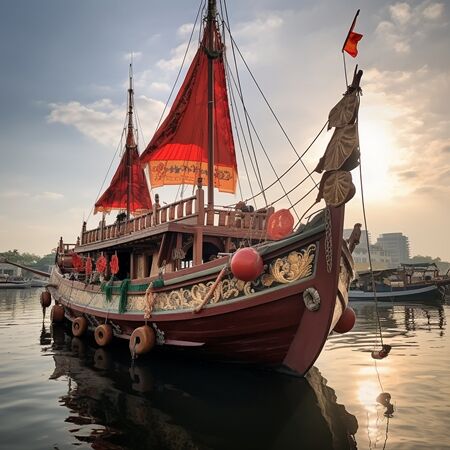
An independent investigation should have examined the authority under which officials involved in my arbitration were permitted to disregard fundamental principles of procedural fairness, natural justice, and humanitarian accountability.
I refer to Footnotes 83 and 169 in Tianxiao Zhu’s paper because they relate to the ethical standards associated with Canada and the moral choices made by Canadian citizens during the Vietnam War. The historical material is significant for two reasons.
First, when the Canadian Government became aware of what had occurred during my Australian Government-endorsed arbitration, it appeared willing to assist me at a time when Australian authorities had declined to take an effective position. That response contrasted sharply with Australian institutions' refusal to confront the issues raised by the evidence.
Second, the historical record includes the 1967 decision of Canadian seamen who reportedly refused to crew a vessel carrying wheat to China because they feared that the shipment might support forces involved in the Vietnam War. Their action reflected a willingness to accept personal and professional consequences rather than participate in conduct they believed conflicted with their moral responsibilities.
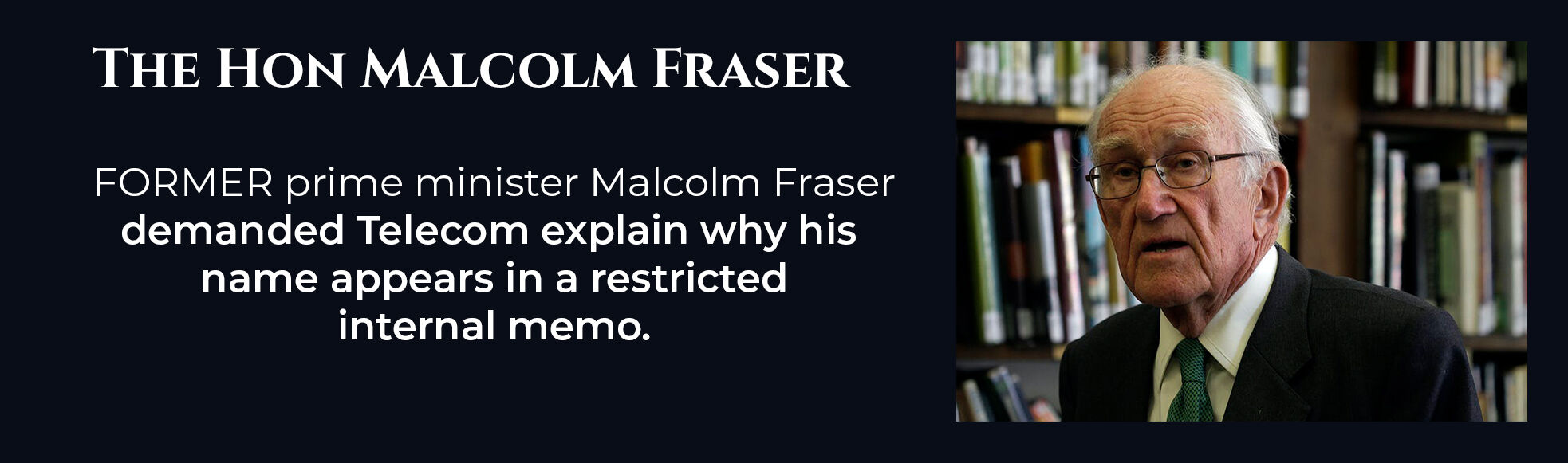
This history is relevant to my own experience because, in 1993 and again in 1994, I spoke with former Australian Prime Minister Malcolm Fraser about my experiences in China in 1967. Telephone records relating to those conversations later appeared in Telstra files released during my 1994–95 arbitration. However, the sections recording the substance of my discussions with Mr Fraser were redacted.
That fact has never been adequately explained.
Why were conversations with a former Prime Minister recorded in Telstra’s files? Who authorised that recording or retention? Why was the discussion concerning my experiences in China considered sensitive enough to be withheld? And how did material relating to events in 1967 become relevant to an arbitration concerning telecommunications services more than two decades later?
At the time, some people treated my account of what had occurred in China as fabricated. It was suggested that my fellow seaman and I had invented or exaggerated our experiences. Yet the material identified in Zhu’s paper, including the sources cited in Footnotes 83 and 169, provides historical context that appears consistent with the broader account we had given.
That material did not, by itself, resolve every factual question. It did, however, demonstrate why our claims should not have been dismissed without proper examination. It also raised a further concern: whether information about my past activities and political or humanitarian views was collected, recorded, or used in a manner unrelated to the proper conduct of the arbitration.
The central questions remain unanswered:
- Who authorised the recording or retention of these conversations?
- Why were the relevant passages withheld or redacted?
- Why was information about my experiences in China placed in Telstra’s arbitration files?
- Was the material used to assess my credibility or character?
- Were Australian officials, the arbitrator, or other participants aware of it?
- Why was the issue never independently investigated?
This evidence is important not because it proves every allegation on its own. Its importance is that it establishes a documentary trail requiring explanation. The records, the redactions, the historical references, and the responses, or lack of responses, from the institutions involved should be examined together.
An independent inquiry should determine whether the material was collected lawfully, whether it was relevant to the arbitration, whether it was used to prejudice my credibility, and whether officials breached their obligations of fairness and accountability.
Footnote 83, 84 and 169 → in a paper submitted by Tianxiao Zhu to The Faculty of the University of Minnesota titled Secret Trails: FOOD AND TRADE IN LATE MAOIST CHINA, 1960-1978, etc → Requirements For The Degree Of Doctor Of Philosophy - Christopher M Isett June 2021
Tianxiao Zhu's Footnotes 83,84 and 169:
In September 1967, a group of British merchant seamen quit their ship, the Hope Peak, in Sydney and flew back to London. They told the press in London that they quit the job because of the humiliating experiences to which they were subjected while in Chinese ports. They also claimed that grain shipped from Australia to China was being sent straight on to North Vietnam. One of them said, “I have watched grain going off our ship on conveyor belts and straight into bags stamped North Vietnam. Our ship was being used to take grain from Australia to feed the North Vietnamese. It’s disgusting.”
84. The Minister of Trade and Industry received an inquiry about the truth of the story in Parliament, to which the Minister pointed out that when they left Australia, the seamen only told the Australian press that they suffered such intolerable maltreatment in various Chinese ports that they were fearful about going back. But after they arrived in London, Vietnam was added to their story. Thus the Minister claimed that he did not know the facts and did not want to challenge this story, but it seemed to him that their claims about Vietnam seemed to be an “afterthought.”
169. "...In Vancouver, nine sailors refused to work on a grain ship headed to China: two of them eventually returned to work, and the others were arrested. Just when the ship was about to sail, seven more left the ship but three of them later returned to work. In Sydney, six Canadian sailors left their ship; they resigned and asked to be paid, but the Australian immigration office repatriated them. At that time, a grain ship usually had crew members of about 40 people. A British ship lost the Chief Officer and sixteen seamen, who told journalists that if the ship were going to the communist countries, they would rather go to jail than work on the ship."
The Canadian's and their Moral Code of Ethics
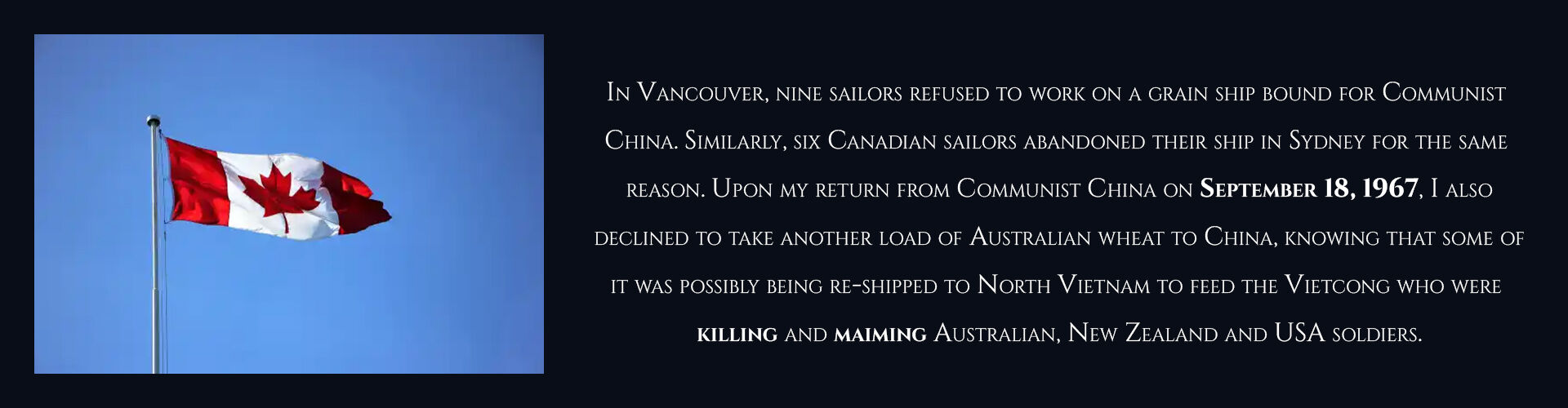
By hovering your mouse over the Canadian flag image below, you can also learn about the strong ethical principles upheld by Canadian seamen. Despite facing significant challenges, they believed that sending wheat to Communist China, especially when that wheat was being redeployed to North Vietnam, a country at war with Australia, New Zealand, and the USA, where hundreds of troops were being killed or maimed, was immoral and unethical, and therefore should not have been continued.
A Dark Warning for Australia — And Every Western Democracy
When I look back to 1967, when I exposed the China wheat scandal, Australian wheat being rerouted through Communist China to feed North Vietnamese troops who were killing our own soldiers, I see the same pattern that later poisoned the COT arbitrations between 1994 and 1998. The same architecture of failure. Government missteps. Bureaucratic cowardice. Cover‑ups disguised as “process.” And ordinary people, especially those in impoverished communities, left to absorb the damage.
Redacted Records, Police Questions, and the Human Cost
The redactions were not merely administrative omissions. At the very least, they raised questions about who accessed the records, why references to my conversations with former Prime Minister Malcolm Fraser were removed, and what relevance those conversations were considered to have in a telecommunications arbitration.
The documents appeared to connect a 1994 exchange with Mr Fraser to events dating back to my experiences in China and North Vietnam in 1967. If Telstra personnel had identified, extracted, or relied upon that historical information, the process required explanation. The records raised the possibility that information about my past had been collected or retained for purposes unrelated to properly resolving my telephone complaints.
The following 93 questions were put to me by the Australian Federal Police (AFP), together with my responses, as recorded in Australian Federal Police Investigation File No/1. I reproduce them because they document the questions investigators considered important and my account of what occurred.
My responses describe alleged threats made by Telstra after I assisted the AFP with inquiries concerning the interception of my telephone conversations and the alleged unauthorised access to documents connected with my arbitration. These matters remain allegations recorded in the investigation material and should be assessed against the underlying documents, witness evidence, and any conclusions reached by the relevant authorities.
The concerns extended beyond my own account. The AFP was reportedly aware of media coverage concerning Mr Fraser’s requests for an explanation from Telstra about why private conversations between us appeared in Telstra’s records. Copies of material supplied to Mr Fraser had also been redacted. The central issue was therefore not simply that information had been withheld, but why conversations involving a former Prime Minister had been recorded in the first place and why the relevant passages were subsequently removed.
John Wynack, then Director of Investigations at the Commonwealth Ombudsman, wrote to Telstra in May and again in November 1994 seeking explanations. The questions attributed to those communications included:
- Why had Telstra recorded or noted conversations between me and Mr Fraser?
- Why had references to those conversations been redacted from the FOI material?
- Why did records connected with events in 1967 appear in a 1994 arbitration file?
- Who authorised the collection, retention, or removal of that information?
- Was the material used in assessing my credibility or conduct?
The AFP reportedly raised similar concerns about the removal of references to my conversations with Mr Fraser from the FOI release. The fact that these issues attracted investigative attention does not, by itself, establish that a criminal offence occurred. It does demonstrate that the handling of the records was sufficiently unusual to require a documented explanation.
The psychological consequences were severe. Reading the FOI material triggered flashbacks, intrusive memories, and intense fear associated with the events surrounding China and North Vietnam. The arbitration was supposed to concern telephone faults and their effect on my business. Instead, the documents appeared to draw me back into a traumatic period that I believed had no proper place in the proceedings.
I received counselling from two clinical psychologists, Dr Bernard in Melbourne and Ms Francolm in south-west Victoria. Their involvement is relevant because it records the personal consequences of the dispute, rather than merely its administrative history. The issue was not ordinary distress about an unfavourable decision. For me, the arbitration and the documents associated with it became associated with the re-emergence of traumatic memories that had remained largely dormant for decades.
The FOI material therefore raised two connected issues.
First, it required an explanation of how information about my conversations with Mr Fraser and my experiences in 1967 came to appear in Telstra’s records.
Second, it required an explanation of why that information was redacted, whether it was considered or used during the arbitration, and whether its collection and handling complied with applicable legal and administrative obligations.
The documents do not, on their own, prove who authorised the alleged surveillance, why the records were created, or whether the information influenced the arbitration. They do, however, establish a documentary trail that should be independently examined.
Murdered for Mao: The killings China ‘forgot’
My Letter, the Truth, and the Waiting
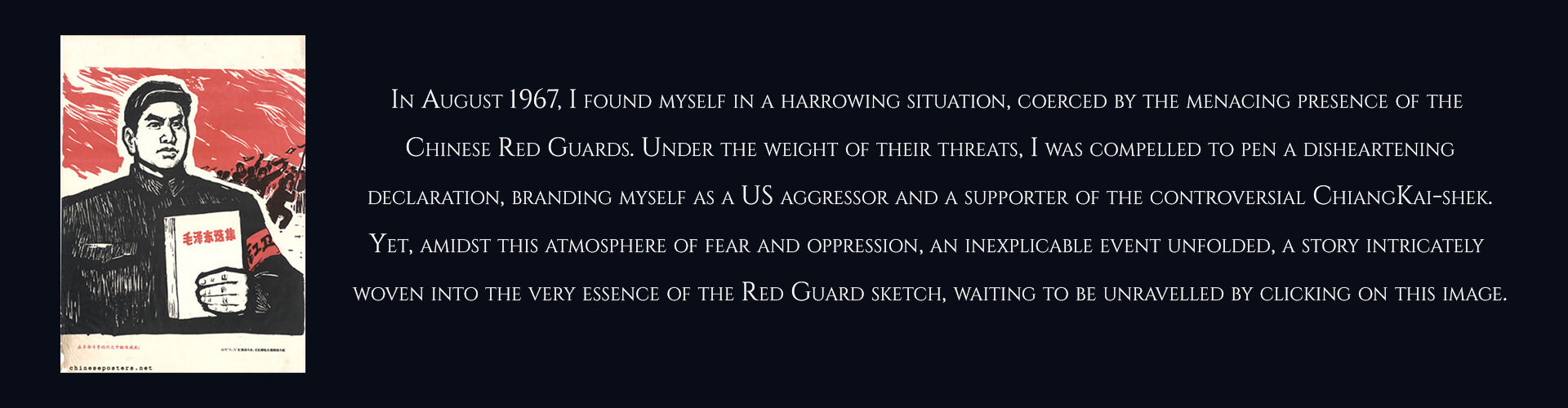
In August 1967, I found myself in a situation so surreal and perilous that it has remained vivid throughout my life. I was aboard a cargo ship in China, under constant observation by Red Guards positioned around the vessel. They were stationed about thirty paces apart and remained on duty day and night.
After being pressured into writing a confession describing myself as a United States aggressor and supporter of Chiang Kai-shek, the second steward told me that I might receive a response to a letter within two days. The response, he said, would come from the head of the Red Guards.
He quietly suggested that I write to my parents.
I followed his advice and wrote 22 foolscap pages. It was not an ordinary letter. I believed I might not survive the week, and I wanted my parents to know who I was in case I never returned home.
I told them that the woman they believed was my landlady was, in fact, my lover. She was 42; I was 18. She had been an important source of stability in my life between 1963 and 1967. I also wrote about life at sea, the loneliness, the confusion, and the fear surrounding my detention.
Writing the letter gave me a way to speak honestly at a time when I had been forced to make a statement I did not believe represented the truth.
A Tray of Leftovers and a Silent Exchange
As ship’s cook and duty mess-room steward, I saw the conditions around us at close range. The crew ate on deck, sometimes balancing plates on handrails. We were transporting grain to China for humanitarian purposes, yet food was routinely discarded while people nearby appeared to be suffering from severe deprivation.
Half-eaten sausages, steaks, and baked potatoes were thrown into the sea. There were no seagulls. I saw no fish. The absence of wildlife was itself a reminder of how severe the conditions appeared to be. Hunger was not an abstract political concept. It was visible in the faces and behaviour of the people watching us eat.
After my arrest, I was placed under what I understood to be house arrest aboard the ship. On one occasion, I filled a small metal tray with edible leftovers, food that otherwise would have gone into the stockpotand placed it on a bench on deck. I patted my stomach to suggest that I had already eaten and then walked away.
Approximately ten minutes later, the tray had been emptied.
At the next meal, I repeated the gesture, leaving enough food for perhaps three or four Red Guards. I returned later to find the tray empty. I continued doing this for another two days while waiting for a response to my letter.
During that period, the Red Guard who had previously woken me every hour stopped doing so. The atmosphere remained tense, but the immediate pressure appeared to lessen.
I cannot know why. The forced confession did not protect me. I do not know whether the letter influenced anyone, whether anyone received instructions, or whether the change was simply coincidental. Perhaps it was luck. Perhaps the food mattered. Perhaps a small act of compassion created a moment of recognition between people trapped on opposite sides of a political crisis.
All I know is that I offered food without negotiation or expectation. It was a silent gesture that conveyed something simple:
I see you. I know you are hungry. I know you are human.
I have never claimed that this gesture alone explains what happened next. But it remains one of the clearest memories of that period—and one of the few moments in which fear gave way, however briefly, to human connection.