https://www.promoteyourstory.com.au → The Arbitraitor - Alan Smith
The AbsentJustice.com Homepage Story: For thirty years, I have carried the devastating toll of a rigged, government-endorsed arbitration against Telstra that destroyed my business, broke my health, and tarnished my reputation. Backed by official Australian Federal Police and Commonwealth Ombudsman records, this forensic archive proves how vital evidence was suppressed, how federal police ordered me to alter my own diaries to protect a criminal wiretapping investigation, and how an ungraded arbitrator who had failed his own exams weaponised those exact alterations to rule against me.
Read the unvarnished record below to see how state-backed institutions buried the truth—and judge the evidence for yourself.

"... I have considered, and have no grounds to reject the expert evidence provided by Telecom from Neil William Holland, Forensic Document Examiner, who examined the claimant's diaries and because of numerous instances of non-chronological entries, thereby causing doubt on their veracity and reliability." (Award, Clause 5.3)
- The AFP Intervention: In February and September 1994, AFP Senior Constable Melanie Cochrane and Superintendent Detective Sergeant Jeff Penrose explicitly ordered me not to submit sensitive records from my Country Getaways singles club—patrons whose private phone calls Telstra had secretly documented.
- Forced Alterations: To protect the AFP's active criminal interception investigation, police instructed me to tell the arbitrator to contact them directly, forcing me to rearrange and overwrite six years of diary entries so Telstra would not realise it was under federal investigation.
- The Ombudsman Investigation: At the same time, the Commonwealth Ombudsman was investigating Telstra for unlawful breaches of the FOI Act—an inquiry that dragged on until October 1997, more than two years after my arbitration ended.
This website documents a troubling story of broken promises, institutional protection, and a system that appeared more capable of shielding powerful interests than protecting the citizens it was created to serve. Most alarming of all, fifteen years after the arbitrations had concluded, many of the telecommunications problems that formed the basis of those government-endorsed proceedings still remained unresolved. This is the story of how a process presented as a pathway to justice became, for many, a lesson in how accountability can vanish behind closed doors.
I welcome visitors to absentjustice.com and ask them to understand that the injustices documented here were not isolated events. They were systemic, deliberate, and sustained. Because the same misconduct occurred repeatedly, across different years, different Casualties of Telstra (COT members), and different investigative processes, certain passages of evidence appear more than once. Some appear twice. Some appear three times. This repetition is not an error; it reflects the pattern of attacks carried out against us COT Cases — not only by the defence, but also by some of the arbitrator’s advisors who benefited themselves by concealing relevant documents that should have been seen by the arbitrator but never reached the valuation team, as shown in the secret agreement reached between the defence (Telstra) and the Telecommunications Industry Ombudsman, the government‑appointed administrator of the arbitrations (see Part 3, The Covert Deal - Chapter 5 Fraudulent Conduct (Duplicate 2).
The same applies to Telstra’s nationwide billing faults. These failures were so widespread, and so damaging, that they triggered the original COT stand: refusing to pay telephone accounts we knew were wrong, and accepting disconnection rather than submitting to falsified billing. The recurrence of these issues across multiple cases is why we must present elements of our story in several contexts. The misconduct did not happen once; it happened again and again.
Please continue reading.
THREATS THE COT CASE RECEIVED DURING AND AFTER OUR ARBITRATION

It is essential to visit the 8 and 10 August 2006 witness statements.
The Major Fraud Group Barrister, Mr Neil Jepson, asked me to supply all evidence, at the request of the Major Fraud Group Victoria Police, that assisted me in proving that Telstra used three individual reports to support their arbitrations claims against the COT Cases arbitrations, which I did by adding to further re Telstra's Falsified BCI Report to Neil Jepson, the Major Fraud Group asked me to assist them in compiling this evidence for their investigations. I did this over three separate visits to Melbourne, spending two full days at the Major Fraud Group's St. Kilda Road offices on each of those three occasions, assisting the Victoria Police in understanding the relevance of the three fundamentally flawed reports, namely Telstra's Falsified which Telstra used to conceal from the arbitrator and his arbitration advisors how bad the Cape Bridgewater telecommunications network was. AUSTEL (the government communications regulator) had already done their investigations into the grossly deficient Cape Bridgewater and Portland telephone exchange during the early part of my Fast Track Settlement Proposal (which in April 1994 became the arbitration process. It is clear from AUSTEL's investigations leading up to March 1994 refer to AUSTEL’s Adverse Findings, that at points 2 to 212 in their report, they had uncovered how bad the Cape Bridgewater telecommunications network was and, like Telstra's arbitration defence unit concealed these findings from the arbitration process.
File 517 AS-CAV Exhibits 495 to 541 is a Witness Statement dated 10 August 2006 (provided to the Department of Communications, Information, Technology and the Arts (DCITA) sworn out by Des Direen, ex-Telstra Senior Protective Officer, eventually reaching Principal Investigator status. Mr Direen has been brave enough to reveal that, in 1999 / 2000, after he left Telstra, he assisted the Victoria Police Major Fraud Group, particularly Rod Kueris, with their investigations into the COT fraud allegations. I was also seconded by the Major Fraud Group into that investigation as an advisor, showing the Major Fraud Group where, in those arbitrations, Telstra used five known fraudulent, flawed reports provided to the arbitrator and other to convince those parties Telstra had fixed all of their telephone and faxing problems before and/or during the arbitrations when telstra and their lawyers knew duiffenet. (Refer also to the Major Fraud Group Transcript (2)).
Points 12 to 18 in Mr Direen’s statement explained that “From what (he) observed on this day, and applying the knowledge that (he) gained during (his) twelve years at Telstra, (he had) no doubt in (his) mind that the phones at Rod KUERIS’s home address were possibly interfered with".
Within a few weeks of Mr. Direen's involvement in assisting the Major Fraud Group with their ongoing investigations, it became increasingly evident that Detective Sergeant Mr. Rod Kueris was experiencing significant distress regarding the situation. I feel compelled to bring attention to the issue involving Mr. Kueris, mainly because, during that same Major Fraud Group investigation led by Victoria Police, I was in the process of faxing critical documents regarding the falsified Bell Canada International Inc. report, which I had modified for Mr. Neil Jepson's office. It is essential to note that had I not promptly contacted Mr Jepson immediately after sending these faxes, neither of us would have been informed that the documents had been intercepted and had failed to arrive at the Major Fraud Group's fax machine.
I am using the following witness two witness statements File 766 - AS-CAV Exhibit 765-A to 789), because they prove a police officer, when dealing with the Telstra Corporation, was left floundering as were the COT Cases when they were forced into arbitration with the same monster who the arbitrator and administrator of the COT arbitrations were afeared to abandon the COT arbitrations because of the power and influence Telstra has over the legal system in Australia. Please read the following two witness statements.
"I can recall that during the period 2000/2001, I had arranged to meet Detective Sergeant Rod KURIS from the Victoria Police Major Fraud Squad at the foyer of Casselden Place, 2 Lonsdale Street, Melbourne. At the time, I was assisting Rod with the investigation into alleged illegal activities against the COT Cases.
Rod then stated that he wanted me to follow him to the left side of the foyer. When we did this he then directed my attention to a male person seated on a sofa opposite our seat. He then told me that the person had been following him around the city all morning. At this stage Rod was becoming visibly upset and I had to calm him down.Rod kept on saying that he couldn't believe in what was happening to him. I had to again calm him down".
Points 21 and 22 in Mr Direen’s statement also record how, while he was a Telstra employee, he had cause to investigate “… suspected illegal interference to telephone lines at the Portland exchange,” but when he “… made inquiries by telephone back to Melbourne (he) was told not to get involved and that another area of Telstra was handling it” and that “... the Cape Bridgewater complainant was a part of the COT cases” (my Cape Bridgewater Holiday Camp) business.
Threats made during my arbitration
On July 4, 1994, amidst the complexities of my arbitration proceedings, I confronted serious threats articulated by Paul Rumble, a Telstra's arbitration defence team representative. Disturbingly, the arbitrator had covertly provided him with some of my interim claims documents—a breach of protocol that occurred a full month before the arbitrator was legally obligated to share such information. Given the gravity of the situation, my response needed to be exceptionally meticulous. I put considerable effort into crafting this detailed letter, choosing every word carefully. In this correspondence, I made it unequivocally clear:
“I gave you my word on Friday night that I would not go running off to the Federal Police etc, I shall honour this statement, and wait for your response to the following questions I ask of Telecom below.” (File 85 - AS-CAV Exhibit 48-A to 91)
When drafting this letter, my determination was unwavering; I had no plans to submit any additional Freedom of Information (FOI) documents to the Australian Federal Police (AFP). This decision was significantly influenced by a recent, tense phone call I received from Steve Black, another arbitration liaison officer at Telstra. During this conversation, Black issued a stern warning: should I fail to comply with the directions he and Mr Rumble gave, I would jeopardize my access to crucial documents pertaining to ongoing problems I was experiencing with my telephone service.
Page 12 of the AFP transcript of my second interview (Refer to Australian Federal Police Investigation File No/1) shows Questions 54 to 58, the AFP stating:-
“The thing that I’m intrigued by is the statement here that you’ve given Mr Rumble your word that you would not go running off to the Federal Police etcetera.”
Essentially, I understood that there were two potential outcomes: either I would obtain documents that could substantiate my claims, or I would be left without any documentation that could impact the arbitrator's decisions regarding my case.
However, a pivotal development occurred when the AFP returned to Cape Bridgewater on September 26, 1994. During this visit, they began asking probing questions about my correspondence with Paul Rumble, showing urgency in their inquiries. They indicated that if I chose not to cooperate with their investigation, they would shift their focus entirely to the unresolved telephone interception issues central to the COT Cases, which they claimed assisted the AFP in various ways. I was alarmed by these statements and contacted Senator Ron Boswell, National Party 'Whip' in the Senate.
As a result, I contacted Senator Ron Boswell, who then raised these threats in the Senate. This statement underscored the serious nature of the claims I was dealing with and the potential ramifications of my interactions with Telstra.
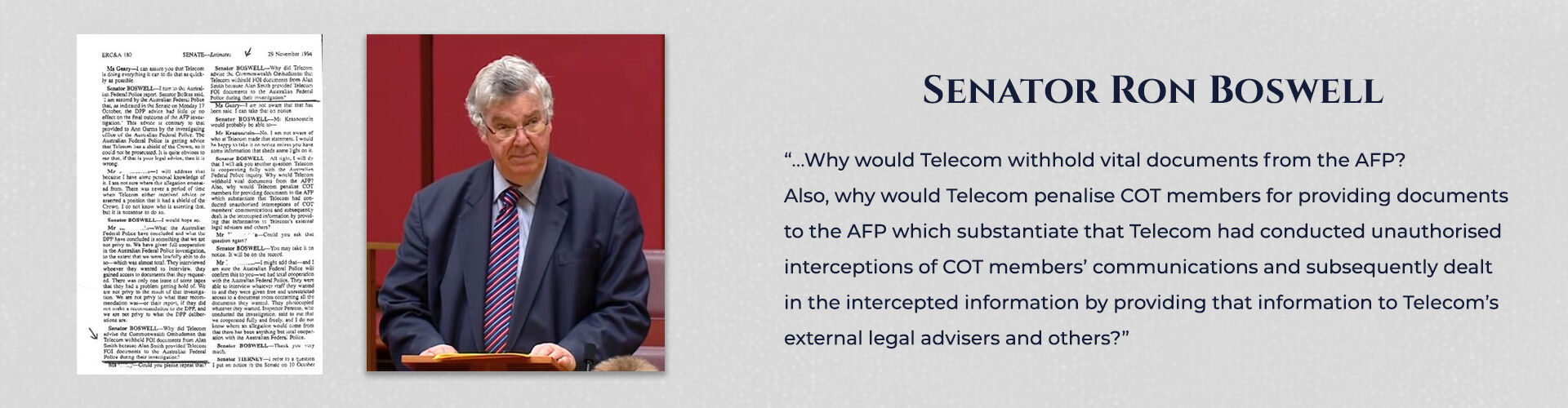
On page 180, ERC&A, from the official Australian Senate Hansard, dated 29 November 1994, reports Senator Ron Boswell asking Telstra’s legal directorate:
“Why did Telecom advise the Commonwealth Ombudsman that Telecom withheld FOI documents from Alan Smith because Alan Smith provided Telecom FOI documents to the Australian Federal Police during their investigation?”
After receiving a hollow response from Telstra, which the senator, the AFP and I all knew was utterly false, the senator states:
“…Why would Telecom withhold vital documents from the AFP? Also, why would Telecom penalise COT members for providing documents to the AFP which substantiate that Telecom had conducted unauthorised interceptions of COT members’ communications and subsequently dealt in the intercepted information by providing that information to Telecom’s external legal advisers and others?” (See Senate Evidence File No 31)
Thus, the threats became a reality. What is so appalling about this withholding of relevant documents is this - no one in the TIO office or government has ever investigated the disastrous impact the withholding of documents had had on my overall submission to the arbitrator. The arbitrator and the government (at the time, Telstra was a government-owned entity) should have investigated why an Australian citizen, who had assisted the AFP in its investigations into unlawful interception of telephone conversations, was so severely disadvantaged in a civil arbitration.
Pages 12 and 13 of the Australian Federal Police Investigation File No/1 transcripts provide a comprehensive account establishing Paul Rumble as a significant figure linked to the threats I have encountered. This conclusion rests on two critical, interrelated factors that merit further elaboration.
Firstly, Mr. Rumble actively obstructed the provision of essential arbitration discovery documents, which the government was legally obligated to provide under the Freedom of Information Act. This obligation was contingent on my signing an agreement to participate in a government-endorsed arbitration process. By imposing this condition, Mr Rumble undermined a legally established protocol, effectively manipulating the process for his benefit and jeopardizing my legal rights.
Secondly, I uncovered that Mr. Rumble had a substantial influence over the arbitrator, resulting in the unauthorized early release of my arbitration interim claim materials. This premature revelation directly conflicted with the timeline stipulated in the arbitration agreement that Telstra and I had formally signed. Specifically, Telstra accessed my interim claim document five months earlier than the agreed-upon terms permitted. This breach violated the integrity of the arbitration process and gave Telstra an unfair advantage in responding to my claims.
Under the rules governing our arbitration process, Telstra was allocated one month to respond to my claim once I submitted it in writing as my final claim. Furthermore, the arbitrator was only authorized to release my final claim to Telstra once it was officially confirmed to be complete. The five-month delay in submitting my claim in November 1994 was primarily attributable to Mr. Rumble's deliberate withholding of critical technical information.
In my case, as Telstra's Falsified SVT Report shows, Telstra’s representative, Peter Gamble, attempted to conduct the essential Service Verification Testing (SVT) process. Unfortunately, he had to halt the testing due to unforeseen equipment malfunctions. When AUSTEL questioned how he planned to rectify this inadequate testing at my business, Mr Gamble refused to proceed with any further testing. Instead, he submitted a statutory declaration under oath to the arbitrator, claiming that his SVT process had fully complied with AUSTEL’s requirements. This assertion was far from the truth.
More Threats, this time to the other Alan Smith
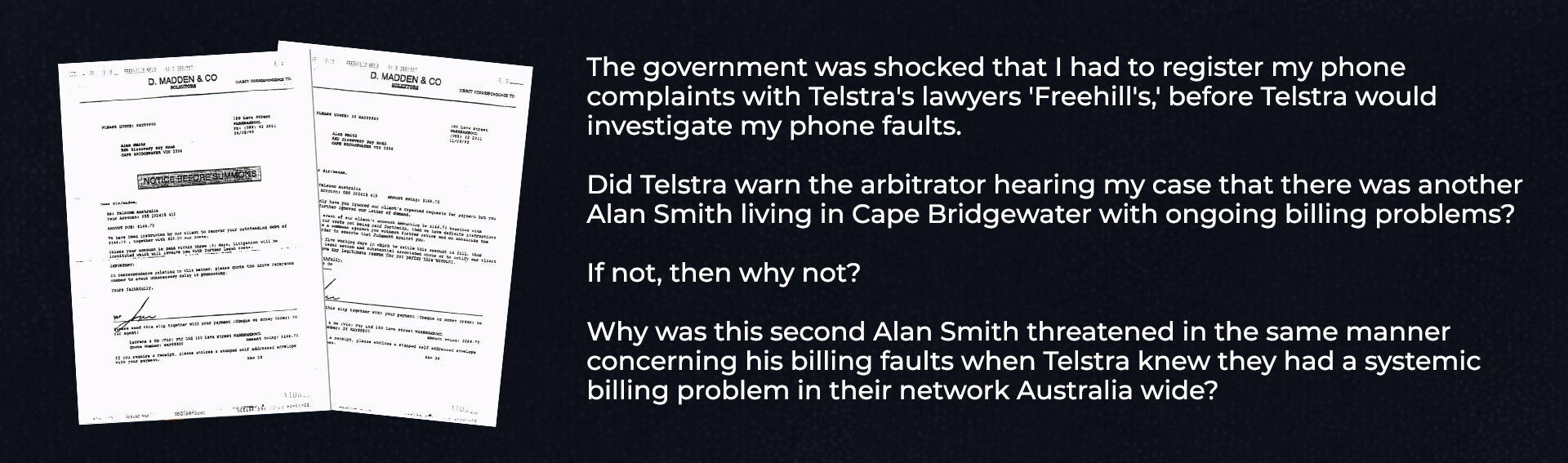
Two Alan Smiths (unrelated) lived in Cape Bridgewater.
No one investigated whether another person named Alan Smith, who lived in the Discovery Bay area of Cape Bridgewater, received some of my arbitration mail. Both the arbitrator and the administrator of my arbitration were informed that road mail sent by Australia Post had not arrived at my premises during my arbitration from 1994 to 1995.
Additionally, the new owners of my business lost legally prepared documents related to Telstra when they attempted to send mail to the Melbourne Magistrates Court. I had prepared these documents in a determined effort to prevent them from being declared bankrupt due to ongoing telephone issues. They were sent from the Portland Post Office but did not arrive (Refer to Chapter 5, Immoral—Hypocritical Conduct).
Stop these people at all costs.
This is the same Peter Gamble who, on 24 June 1997 see:- pages 36 to 38 Senate - Parliament of Australia was named by an ex-Telstra employee turned - Whistle-blower, Lindsay White, that, while he was assessing the relevance of the technical information which the COT claimants had requested under FOI he advised the Committee that:
Mr White - "In the first induction - and I was one of the early ones, and probably the earliest in the Freehill's (Telstra’s Lawyers) area - there were five complaints. They were Garms, Gill and Smith, and Dawson and Schorer. My induction briefing was that we - we being Telecom - had to stop these people to stop the floodgates being opened."
Senator O’Chee then asked Mr White - "What, stop them reasonably or stop them at all costs - or what?"
Mr White responded by saying - "The words used to me in the early days were we had to stop these people at all costs".
Senator Schacht also asked Mr White - "Can you tell me who, at the induction briefing, said 'stopped at all costs" .
Mr White - "Mr Peter Gamble, Peter Riddle".
Senator Schacht - "Who".
Mr White - "Mr Peter Gamble and a subordinate of his, Peter Ridlle. That was the induction process-"
From Mr White's statement, it is clear that he identified me as one of the five COT claimants that Telstra had singled out to be ‘stopped at all costs’ from proving their against Telstra’.
Peter Gamble's unethical behaviour is significant, but it is also crucial to note that David Read of Lane Telecommunications did not oversee Gamble’s tests on April 6, 1995. As the technical consultant for the independent arbitrator, Read evaluated the COT Cases, which alleged that faulty Ericsson telephone equipment caused ongoing complaints from various businesses.
During the COT arbitration proceedings, Ericsson acquired Lane Telecommunications. This acquisition had profound implications, as it transferred all investigative materials Lane collected against Ericsson of Sweden—gathered over approximately eight COT arbitrations—to Ericsson. This situation raises significant ethical concerns about the investigation's impartiality, considering that the entity under scrutiny now controls the evidence against it.
Such circumstances challenge Australia’s stated commitment to the rule of law and suggest that it may be one of the few Western nations that allows a principal witness to be financially influenced by those being investigated (Refer to Chapter 5 - US Department of Justice vs Ericsson of Sweden)
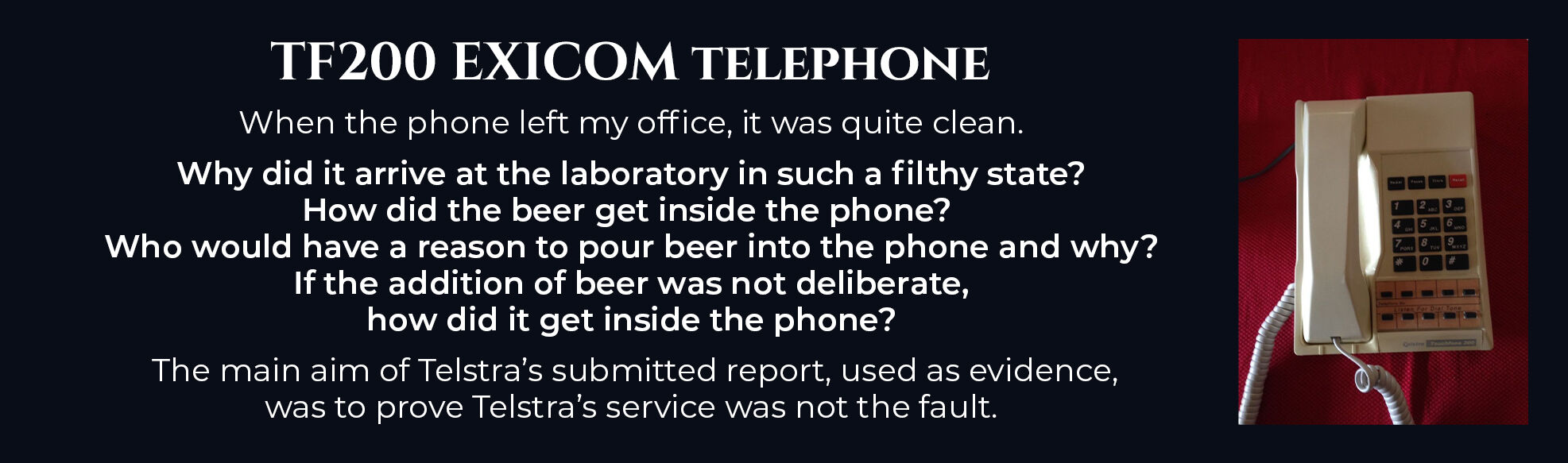
When I phoned AUSTEL’s Cliff Mathieson, a public servant at the government communications regulatory department, to discuss this hang-up fault on 26 April 1994, Mr Mathieson suggested we run a series of tests on the phone line. He asked me to hang up and count aloud from one to 10 while he listened. This first test proved he could hear me count all the way to 10. He suggested we try it again and count even further this time. It was still the same: he could hear me throughout the range as I counted. Then he suggested I switch the phone on that line with a phone connected to another. I did, and we repeated the counting test with the same result. It was clear to both of us that the fault was not in the phone but somewhere in the Telstra network. Mr Mathieson suggested that, as I was in arbitration then, I should bring this fault to the attention of Peter Gamble, Telstra’s chief engineer. Lindsay White, a Telstra whistleblower, named Peter Gamble in a Senate estimates committee hearing as the man who said he and Telstra had to stop the first COT five claimants (including me), at all cost, from proving our claims (see Senate Hansard ERC&A 36, Front Page Part One File No/23 dated 24 June 1997).
Unaware of these orders to stop us from five COT cases (at all costs), I switched the phones back to their original lines and phoned Mr Gamble, but did not tell him Mr Mathieson, and I had already tested two phones on the 055 267230 lines. Mr Gamble and I then performed similar tests on the 055 267230 line. Mr Gamble said he would arrange for someone to collect the phone the following day for testing. FOI K00941, dated 26 March 1994, show someone (name redacted) believed this lock-up fault was caused by a problem in the RCM exchange at Cape Bridgewater see Tampering With Evidence File No 1-A to 1-C. Document K00940, dated the day the tests were performed with Mr Mathieson and Mr Gamble, suggests that Mr Gamble believed the problem was caused by heat in the exchange, see (File No-B), where document folio R37911 states:
“This T200 is an EXICOM and the other T200 is an ALCATEL, we thought that this may be a design ‘fault???’ with the EXICOM so Ross tried a new EXICOM from his car and it worked perfectly, that is, released the line immediately on hanging up. We decided to leave the new EXICOM and the old phone was marked and tagged…” (see File No 1-C).
My Holiday Camp was surely situated in a pristine location
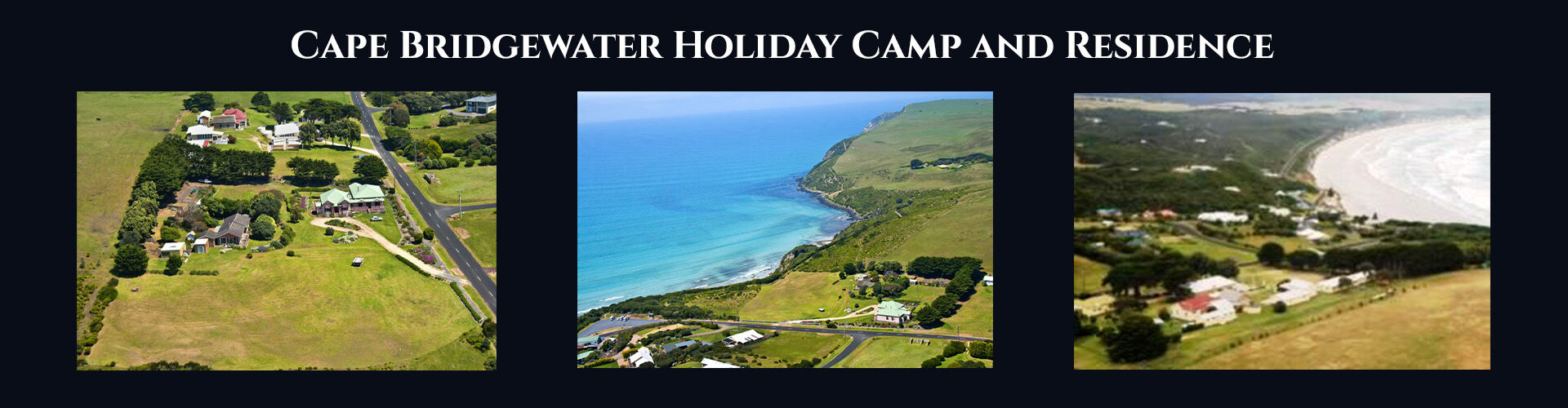
If only the telephones had been fit for purpose
On 15 July 1995, two months after the arbitrator's premature announcement of findings regarding my incomplete claim, Amanda Davis, the former General Manager of Consumer Affairs at AUSTEL (now known as ACMA), provided me with an open letter to be shared with individuals of my choosing. This action underscores the confidence she placed in my integrity and professional character:
“I am writing this in support of Mr Alan Smith, who I believe has a meeting with you during the week beginning 17 July. I first met the COT Cases in 1992 in my capacity as General Manager, Consumer Affairs at Austel. The “founding” group were Mr Smith, Mrs Ann Garms of the Tivoli Restaurant, Brisbane, Mrs Shelia Hawkins of the Society Restaurant, Melbourne, Mrs Maureen Gillian of Japanese Spare Parts, Brisbane, and Mr Graham Schorer of Golden Messenger Couriers, Melbourne. Mrs. Hawkins withdrew very early on, and I have had no contact with her since.
The treatment these individuals have received from Telecom and Commonwealth government agencies has been disgraceful, and I have no doubt they have all suffered as much through this treatment as they did through the faults on their telephone services.
One of the striking things about this group is their persistence and enduring belief that eventually there will be a fair and equitable outcome for them, and they are to admired for having kept as focussed as they have throughout their campaign.
Having said that, I am aware all have suffered both physically and their family relationships. In one case, the partner of the claimant has become seriously incapacitated; due, I beleive to the way Telecom has dealt with them. The others have al suffered various stress related conditions (such as a minor stroke.
During my time at Austel I pressed as hard as I could for an investigation into the complaints. The resistance to that course of action came from the then Chairman. He was eventually galvanised into action by ministerial pressure. The Austel report looks good to the casual observer, but it has now become clear that much of the information accepted by Austel was at best inaccurate, and at worst fabricated, and that Austel knew or ought to have known this at the time.”
After leaving Austel I continued to lend support to the COT Cases, and was instrumental in helping them negotiate the inappropriately named "Fast Track" Arbitration Agreement. That was over a year ago, and neither the Office of the Commonwealth Ombudsman nor the Arbitrator has been succsessful in extracting information from Telecom which would equip the claimants to press their claims effectively. Telecom has devoted staggering levels of time, money and resources to defeating the claiams, and there is no pretence even that the arbitration process has attemted to produce a contest between equals.
Even it the remaining claimants receive satisfactory settlements (and I have no reason to think that will be the outcome) it is crucial that the process be investigated in the interest of accountabilty of publical companies and the public servants in other government agencies.
Because I am not aware of the exact citrcumstances surronding your meeting with Mr Smith, nor your identity, you can appriate that I am being fairly circimspect in what I am prepared to commit to writing. Suffice it to say, though, I am fast coming to share the view that a public inquiry of some discripion is the only way that the reasons behind the appalling treatent of these people will be brought to the surface.
I would be happy to talk to you in more detail if you think that would be useful, and can be reached at the number shown above at any time.
Thank you for your interest in this matter, and for sparing the time to talk to Alan. (See File 501 - AS-CAV Exhibits 495 to 541 )
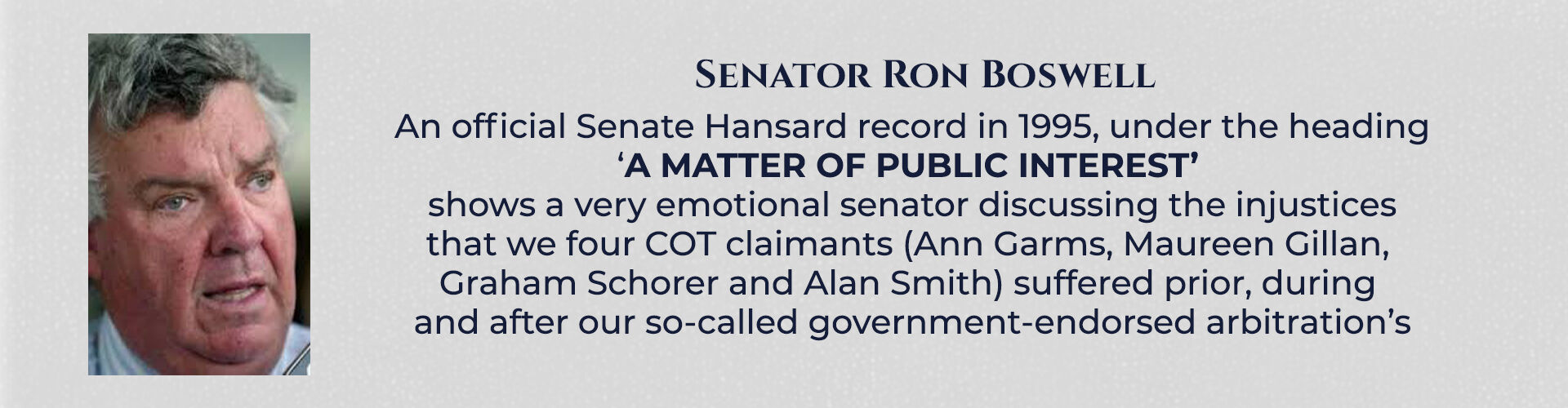
Four months after the arbitrator Dr Hughes prematurely brought down his findings on my matters, and fully aware I was denied all necessary documents to mount my case against Telecom/Telstra, an emotional Senator Ron Boswell discussed the injustices we four COT claimants (i.e., Ann Garms, Maureen Gillan, Graham Schorer and me) experienced prior and during our arbitrations (see Senate Evidence File No 1 20-9-95 Senate Hansard A Matter of Public Interest) in which the senator notes:
“Eleven years after their first complaints to Telstra, where are they now? They are acknowledged as the motivators of Telecom’s customer complaint reforms. … But, as individuals, they have been beaten both emotionally and financially through an 11-year battle with Telstra. …
“Then followed the Federal Police investigation into Telecom’s monitoring of COT case services. The Federal Police also found there was a prima facie case to institute proceedings against Telecom but the DPP , in a terse advice, recommended against proceeding. …
“Once again, the only relief COT members received was to become the catalyst for Telecom to introduce a revised privacy and protection policy. Despite the strong evidence against Telecom, they still received no justice at all. …
“These COT members have been forced to go to the Commonwealth Ombudsman to force Telecom to comply with the law. Not only were they being denied all necessary documents to mount their case against Telecom, causing much delay, but they were denied access to documents that could have influenced them when negotiating the arbitration rules, and even in whether to enter arbitration at all. …
“Telecom has treated the Parliament with contempt. No government monopoly should be allowed to trample over the rights of individual Australians, such as has happened here.” (See Senate Hansard Evidence File No-1)
“COT Case Strategy”
As shown on page 5169 in Australia's Government SENATE official Hansard – Parliament of Australia Telstra's lawyers Freehill Hollingdale & Page devised a legal paper titled “COT Case Strategy” (see Prologue Evidence File 1-A to 1-C) instructing their client Telstra (naming me and three other businesses) on how Telstra could conceal technical information from us under the guise of Legal Professional Privilege even though the information was not privileged.
This COT Case Strategy was to be used against me, my named business, and the three other COT case members, Ann Garms, Maureen Gillan and Graham Schorer, and their three named businesses. Simply put, they targeted us and our four businesses even before our arbitrations began.
It is paramount that the visitor reading absentjustice.com understands the significance of page 5169 at points 29, 30, and 31 SENATE official Hansard – Parliament of Australia, which note:
29. Whether Telstra was active behind the scenes in preventing a proper investigation by the police is not known. What is known is that, at the time, Telstra had representatives of two law firms on its Board—Mr Peter Redlich, a Senior Partner in Holding Redlich, who had been appointed for 5 years from 2 December 1991 and Ms Elizabeth Nosworthy, a partner in Freehill Hollingdale & Page who had also been appointed for 5 years from 2 December 1991.
One of the notes to and forming part of Telstra’s financial statements for the 1993- 94 financial year indicates that during the year, the two law firms supplied legal advice to Telstra, totalling $2.7 million, an increase of almost 100 per cent over the previous year. Part of the advice from Freehill Hollingdale & Page was a strategy for "managing" the "Casualties of Telecom" (COT) cases.
30. The Freehill Hollingdale & Page strategy was set out in an issues paper of 11 pages, under cover of a letter dated 10 September 1993 to a Telstra Corporate Solicitor, Mr Ian Row from FH&P lawyer, Ms Denise McBurnie (see Prologue Evidence File 1-A to 1-C). The letter, headed "COT case strategy" and marked "Confidential," stated:
- "As requested I now attach the issues paper which we have prepared in relation to Telecom’s management of ‘COT’ cases and customer complaints of that kind. The paper has been prepared by us together with input from Duesburys, drawing on our experience with a number of ‘COT’ cases. . . ."
31. The lawyer’s strategy was set out under four heads: "Profile of a ‘COT’ case" (based on the particulars of four businesses and their principals, named in the paper); "Problems and difficulties with ‘COT’ cases"; "Recommendations for the management of ‘COT’ cases; and "Referral of ‘COT’ cases to independent advisors and experts". The strategy was in essence that no-one should make any admissions and, lawyers should be involved in any dispute that may arise, from beginning to end. "There are numerous advantages to involving independent legal advisers and other experts at an early stage of a claim," wrote Ms McBride . Eleven purported advantages were listed.
Back then, in most people's eyes, Mr Redlich was one of Australia's finest lawyers. He was also a stalwart within the Labor Party, a one-time friend of two Australian Prime Ministers (Gough Whitlam and Bob Hawke) and a long-time friend of Mark Dreyfus, Australia's current 2025 Attorney-General in 2024, so who would be the slightest bit interested in listening to my perspective in comparison to someone so highly qualified and with such vital friends?
And remember, Freehill Hollingdale & Page designed the COT strategy when Elizabeth Holsworthy (a partner at Freehill's) was also a member of the Telstra Board, along with Mr Redlich. The whole aim of that ‘COT Case Strategy’ was to stop us, the legitimate claimants against Telstra, from having any chance of winning our claims. Do you think my claim would have even the tiniest possibility of being heard under those circumstances?
A Senate Committee investigation, which the government appointed to examine five of the twenty-one COT cases as a "litmus test," found significant misconduct by Telstra. This was highlighted by the statements of six senators in the Senate in March 1999:
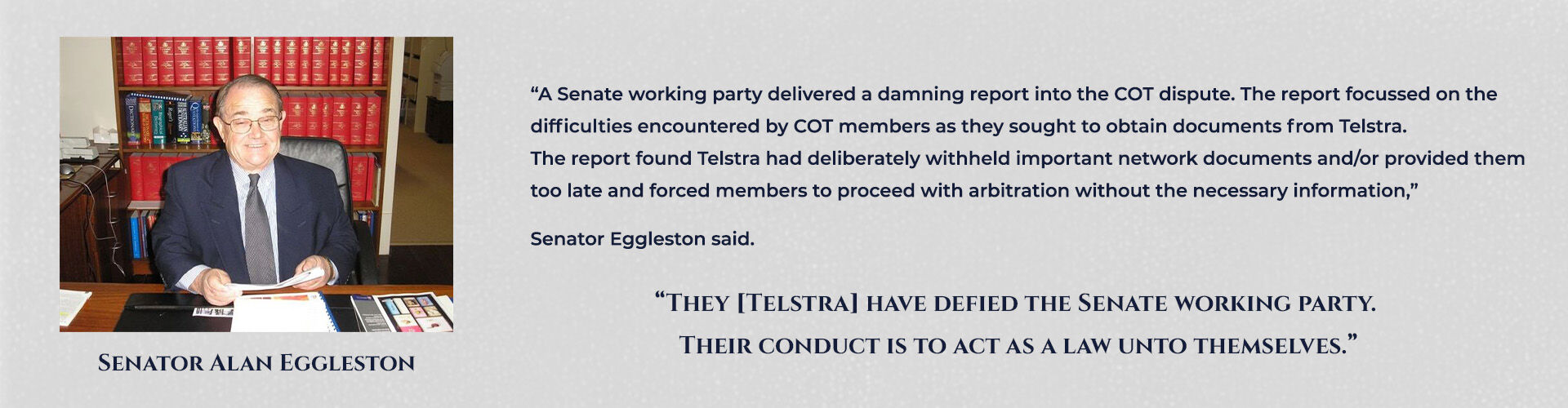
On 23 March 1999, the Australian Financial. Review reported on the conclusion of the Senate estimates committee hearing into why Telstra withheld so many documents from the COT cases, noting:
“A Senate working party delivered a damning report into the COT dispute. The report focused on the difficulties encountered by COT members as they sought to obtain documents from Telstra. The report found Telstra had deliberately withheld important network documents and/or provided them too late and forced members to proceed with arbitration without the necessary information,” Senator Eggleston said. “They have defied the Senate working party. Their conduct is to act as a law unto themselves.”
Regrettably, because my case had been settled three years earlier, several other COT cases and I could not take advantage of this investigation's valuable insights or recommendations. Pursuing an appeal of my arbitration decision would have incurred high financial costs I could not afford, creating an injustice for the remaining 16 Australian citizens.

During the Victoria Police Major Fraud Group's investigation into alleged fraudulent conduct by Telstra during and after the COT arbitrations, the Scandrett & Associates report was delivered to Senator Ron Boswell on 7 January 1999. This report confirmed that faxes were intercepted during the COT arbitrations (refer to Open Letter File No/12 and File No/13). Furthermore, one of the two technical consultants who verified the validity of this fax interception report reached out to me via email on 17 December 2014, emphasizing the importance of these findings
“I still stand by my statutory declaration that I was able to identify that the incoming faxes provided to me for review had at some stage been received by a secondary fax machine and then retransmitted, this was done by identifying the dual time stamps on the faxes provided.” (Front Page Part One File No/14)
The evidence within this report Open Letter File No/12 and File No/13) also indicated that one of my faxes sent to Federal Treasurer Peter Costello was similarly intercepted, i.e.,
Exhibit 10-C → File No/13 in the Scandrett & Associates report Pty Ltd fax interception report (refer to (Open Letter File No/12 and File No/13) confirms my letter of 2 November 1998 to the Hon Peter Costello Australia's then Federal Treasure was intercepted scanned before being redirected to his office. These intercepted documents to government officials were not isolated events, which, in my case, continued throughout my arbitration, which began on 21 April 1994 and concluded on 11 May 1995. Exhibit 10-C File No/13 shows this fax hacking continued until at least 2 November 1998, more than three years after the conclusion of my arbitration.
Telstra's actions during a government-endorsed arbitration process, as well as during investigations by the Australian Federal Police between 1994 and 1995 and the Victoria Police Major Fraud Group from late 1998 to 2001, are undeniably severe. It is both alarming and unacceptable that Telstra employees have not considered legal repercussions for these actions. This highlights a troubling lack of accountability and transparency, casting doubt on the integrity of the systems meant to protect small businesses and uphold the rule of law.
Exposing the truth meant I faced a possible jail term
(refer to Senate Evidence File No 12)
It may seem unbelievable, but back in August 2001 and again in December 2004, I received written threats from the Australian Government, warning me that I could be charged with contempt of the Senate if I ever revealed the in-camera Hansard records that were inadvertently shared with me by two high-ranking officers from the Major Fraud Group of Victoria Police. (refer to Senate Evidence File No 12). As I celebrate my 81st birthday this May, I keep their names confidential out of respect for these dedicated officers. They could not have possibly been mistaken in their revelations about the systemic corruption the Senate uncovered regarding Telstra during the COT arbitrations.
The police officers I had previously collaborated with during my secondment supposedly gave me the Senate Hansards I received at their imposing St Kilda Road complex. They believed these critical documents would support the remaining sixteen COT cases, which were still struggling to resolve their Freedom of Information claims. Sadly, then Prime Minister John Howard’s discriminatory actions placed substantial obstacles in the path of these sixteen cases.
In my view, these vital Hansards could have turned the tide in our favour had the COT claimants chosen to appeal the arbitration process. However, the chilling threat of contempt of the Senate loomed over me—a threat carrying the weight of a two-year prison sentence. This situation raises a profound question: Where is justice in such an ordeal?
In March and April 2006, I presented several examples of intercepted documents from the COT arbitrations to the Hon. Senator Helen Coonan, Minister for Communications. One notable example included a document addressed to the Hon. Peter Costello, our former Australian Federal Treasurer. The Senator responded to me on 17 May 2007,
"I have now made both formal and informal representations to Telstra on behalf of the CoTs. However, Telstra’s position remains that this is a matter that is most appropriately dealt with through a Court process. Telstra is not prepared to undertake an alternative means of pursuing this matter. I also appreciate the depth of feeling regarding the matter and suggest you consider whether any court proceedings may be your ultimate option". (File 616-B AS-CAV Exhibits 648-a to 700)
It was unequivocally Senator Helen Coonan’s responsibility, as the Minister for Communications, Information Technology and the Arts, to initiate a thorough and official inquiry into the matter of Telstra's continuous interception of confidential documents that were being sent from my office and my residence, as well as from the offices of several Senators and the Commonwealth Ombudsman’s office. This issue was particularly critical during and following the COT arbitrations, where sensitive information was exchanged.
The gravity of this situation raises critical questions: Why was it considered acceptable for an Australian citizen to be compelled to take legal action against Telstra for unlawfully intercepting documents leaving and arriving at Parliament House in Canberra during a government-endorsed arbitration process? Furthermore, why was Telstra interpreting my faxes to government ministers three years after my arbitration concluded?
Introduction: The Mechanism of Silence
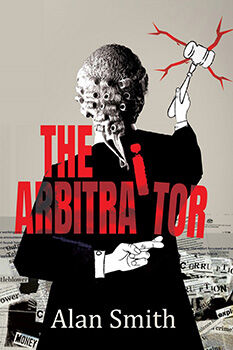 The Arbitraitor is not merely a recollection of personal grievance, but a forensic autopsy of a corrupted institution operating entirely outside the boundaries of natural justice. For decades, the official narrative surrounding the Casualties of Telstra (COT) cases has been carefully manicured by bureaucratic hands, buried beneath layers of state-sanctioned secrecy, and protected by an untouchable corporate-government alliance. But the truth cannot be completely deleted; it leaves a digital trail, a paper trail, and a human toll. This introduction serves as the threshold to that preserved reality, offering an unyielding examination of what happens when institutional power turns its full, crushing weight against the very citizens it was built to protect.
- Systemic Fax Interception: Privileged legal documents and vital evidence transmissions were routinely intercepted, stored, and redirected without consent by the defendant—then a government-owned telecommunications giant.
- Evidence Manipulation: Independent experts verified dual timestamps on critical correspondence, confirming that documents intended for the arbitrator's eyes were captured and reviewed by opposing parties first.
- The Poisoned Archive: Government agencies, including the Australian Communications and Media Authority (ACMA), continuously relied on altered technical reports and demonstrably false data to protect corporate infrastructure while deliberately blinding the arbitration process.
- The Exam Farce: The structural decay extended to the process's leadership; documentation reveals that the designated arbitrator had not even passed his required qualification exams at the time of the pivotal 1995 hearings.

1. Inability to Properly Manage "Procedural Slippage"
- The Pitfall: Inexperienced or unaccredited arbitrators frequently lack the authority or "firmness" required to keep a case on track.
- The Fault: According to peak arbitration guides, they are often overly hesitant to enforce timetables or deal decisively with interlocutory issues (like applications for special orders or evidence adjustments). This passivity leads to severe timeline drift and escalating costs, completely wiping out the speed advantage that arbitration is supposed to provide.
2. Flawed Award Writing and Judicial Vulnerability
- The Pitfall: The final decision (the "award") must be legally sound and properly structured to withstand scrutiny.
- The Fault: In institutional frameworks, arbitrators must undergo peer-reviewed grading (e.g., Grade 1 for complex cases, Grade 2 for medium, Grade 3 for small matters) specifically to verify their competence in award writing. An unaccredited arbitrator is highly prone to procedural errors, failing to determine all issues in dispute, or executing flawed legal reasoning. This exposes the final award to being set aside or challenged in court for a breach of natural justice.
3. Mismanaging the Scope of Jurisdiction
- The Pitfall: Arbitrators only have power over what the contract allows them to rule on.
- The Fault: Non-graded individuals often stumble when complex, hybrid legal questions emerge—such as determining who the true parties to the contract are, or navigating multi-party disputes where third parties cannot legally be compelled to join the arbitration. A certified arbitrator knows exactly when a tribunal lacks jurisdiction, whereas an amateur can easily proceed unlawfully, rendering the entire costly process void.
4. Lack of Accountability and Mandatory Up-Skilling
- The Pitfall: Graded arbitrators are tightly regulated by their governing institutions.
- The Fault: Members of bodies like the Resolution Institute are bound by mandatory Continuing Professional Development (CPD) schemes and strict ethical oversight. If a non-accredited arbitrator acts with implicit bias, fails to disclose a conflict of interest, or handles fees unethically, you have no institutional complaints mechanism or recourse to remove them short of launching expensive, uphill litigation in the Supreme Court.
The core issue these texts highlight is that arbitration is a contractually bound, private system with very limited rights of appeal. If you appoint an unaccredited, non-graded individual, you lose the safety net of institutional oversight.
Based on the rules and guidelines published by these professional institutes, the major faults and pitfalls that occur when choosing an unaccredited or non-graded arbitrator include:
5. Inability to Properly Manage "Procedural Slippage"
- The Pitfall: Inexperienced or unaccredited arbitrators frequently lack the authority or "firmness" required to keep a case on track.
- The Fault: According to peak arbitration guides, they are often overly hesitant to enforce timetables or deal decisively with interlocutory issues (like applications for special orders or evidence adjustments). This passivity leads to severe timeline drift and escalating costs, completely wiping out the speed advantage that arbitration is supposed to provide.
6. Flawed Award Writing and Judicial Vulnerability
- The Pitfall: The final decision (the "award") must be legally sound and properly structured to withstand scrutiny.
- The Fault: In institutional frameworks, arbitrators must undergo peer-reviewed grading (e.g., Grade 1 for complex cases, Grade 2 for medium, Grade 3 for small matters) specifically to verify their competence in award writing. An unaccredited arbitrator is highly prone to procedural errors, failing to determine all issues in dispute, or executing flawed legal reasoning. This exposes the final award to being set aside or challenged in court for a breach of natural justice.
7. Mismanaging the Scope of Jurisdiction
- The second Pitfall: Arbitrators only have power over what the contract allows them to rule on.
- The second Fault: Non-graded individuals often stumble when complex, hybrid legal questions emerge—such as determining who the true parties to the contract are, or navigating multi-party disputes where third parties cannot legally be compelled to join the arbitration. A certified arbitrator knows exactly when a tribunal lacks jurisdiction, whereas an amateur can easily proceed unlawfully, rendering the entire costly process void.
8. Lack of Accountability and Mandatory Up-Skilling
- The third Pitfall: Graded arbitrators are tightly regulated by their governing institutions.
- The third Fault: Members of bodies like the Resolution Institute are bound by mandatory Continuing Professional Development (CPD) schemes and strict ethical oversight. If a non-accredited arbitrator acts with implicit bias, fails to disclose a conflict of interest, or handles fees unethically, you have no institutional complaints mechanism or recourse to remove them short of launching expensive, uphill litigation in the Supreme Court.
Eggleston, Sen Alan – Bishop, Sen Mark – Boswell, Sen Ronald – Carr, Sen Kim – Schacht, Sen Chris, Alston and Sen Richard)
These six senators formally recorded that Telstra had ‘acted as a law unto itself’ throughout all the COT arbitrations; it is incredible. The LNP government knew that not only should the litmus-test cases receive their requested documents, but so should the other 16 Australian citizens who had been in the same government-endorsed arbitration process
9. This website is a work in progress, last edited in November 2026
As you begin exploring the COT story, I strongly recommend clicking "The first remedy pursued." This section explains how the Australian government is expected to handle complaints from ordinary citizens against people in positions of influence and public trust. It provides important background information that will help you better understand the issues raised throughout this website.
It also raises an important question. During the IAMA's July to November 2009 investigations into these same complaints, I asked whether the arbitrator had failed his examinations while presiding over my claim. The IAMA declined to answer. Yet seven years earlier, the Institute had advised that the arbitrator in my arbitration, Dr Gordon Hughes, did not obtain his grading until well after he had delivered his determination on my claims.
Hover your mouse over the images below as you scroll down this homepage to dig deeper into this brutal, true story
10. The heartbreaking and deliberate attack on Independent MP Helen Haines
This attack happened outside her Wangaratta electorate office, which resulted in the catastrophic loss of both her legs, and has plunged Australia into an urgent national reckoning over violence, political polarisation, and the safety of public figures. On 26 October 2026, during one of Parliament House’s most sombre and full sessions, politicians from all sides spoke in one unified voice of profound grief and condemnation against this monstrous assault. For anyone who has spent decades fighting a broken system, this dark week has provoked an overwhelming wave of raw emotion and tears. Amid the tributes, Liberal MP and ex-military officer The Hon Andrew Hastie MP delivered a powerful speech warning against the daily threats and toxic hostility targeting public servants, emphasising that real-world violence must never be tolerated in a civilised democracy.
11. The Timeline of Institutional Malice
- The 1994 Senate Condemnation:
Senator Ron Boswell stood up in a parliamentary committee room.
He fiercely damned the Telstra Corporation.
He exposed calculated corporate threats weaponised against an ordinary citizen. - The Police Cooperation Penalty:
The author carried out his civic duty.
He provided critical forensic evidence to the Australian Federal Police (AFP).
The data proved Telstra was intercepting private phone calls.
The records showed they systematically intercepted faxes and legal strategies. - The Tabled Warnings Ignored:
On 29 November 1994, Parliament officially tabled these corporate threats.
Defensive bureaucrats treated them as mere warnings.
Shortly after, Telstra ruthlessly carried out those exact threats.
They used document starvation to crush the arbitration. - The Arbitrator’s Cover-Up:
The government-appointed independent arbitrator looked the other way.
The Telecommunications Industry Ombudsman (TIO) acted as the administrator.
They actively scrubbed all knowledge of these corporate threats from the official final findings. - The Final Deception:
The President of the Institute of Arbitrators Australia launched an investigation.
He demanded to know why a tribunal left a claimant unprotected.
The TIO and the arbitrator fabricated a malicious narrative to mislead him.
They successfully killed the inquiry to shield their compromised process from legal exposure.
Ann Garms prepared the YouTube video below about her arbitration and appeal process. Her testimony aligns precisely with the letters discussed below, and exposes the truth the government still refuses to confront.
Ann Garms prepared the YouTube video below about her arbitration and appeal process, which coincides with the letter discussed below.
13. The disturbing details in the AFP transcripts from 10 February 1994.
These transcripts reveal the treacherous machinations of individuals such as Superintendent Jeffrey Penrose, Detective Sergeant Cochrane, Graham Schorer—who masquerades as a spokesperson for the COT Cases—and Amanda Davis, a former government official. In a chilling display of negligence, they discussed a briefcase that Telstra had carelessly abandoned at my business, containing the names of numerous individuals. Like Mr Schorer and me, we were all victims of a grotesque invasion of privacy, subjected to the ruthless interception and monitoring of our telephone conversations without so much as a whisper of consent.
The transcripts, specifically on pages 37, 38, and 39 AFP evidence file GS 18, starkly reveal that Mr Schorer laid bare the sinister truth to the AFP: former Telstra employee Mr Marr had supplied damning evidence of this telephone interception to Senator Bob Collins. This dark revelation hints at a vast, oppressive network of surveillance that preyed on innocent lives, all without remorse or accountability.
Wayne Goss, mentioned in Ann Garms' letter attached as document (See File Ann Garms 104 Document) dated 17 August 2017, was Queensland's former Premier. Therefore, when he advised Ann that gaslighting techniques were used against us—the COT cases—he was well positioned within the establishment to make such a significant statement.
On 1 June 2021, Mathias Cormann officially assumed office as the Secretary-General of the OECD in Paris, France. Similarly to Australia's former Prime Minister Malcolm Turnbull, he possesses comprehensive knowledge about the legitimacy of the COT Cases claims.

Don't forget to hover your mouse/cursor over the kangaroo image to the right of this page → → →
 It is crucial to emphasise the significance of the four letters dated 17 August 2017, 6 October 2017, 9 October 2017, and 10 October 2017, authored by COT Case Ann Garms shortly before her passing. These letters were addressed to The Hon. Malcolm Turnbull MP, Prime Minister of Australia, and Senator the Hon. Mathias Cormann (See File Ann Garms 104 Document). These letters state that Gaslighting methods were used against the COT Cases to destroy our legitimate claims against Telstra. (rb.gy/dsvidd).
It was also essential to raise Ann Garms's letter here because Wayne Goss (Chair of Deloitte), whom Ann referred to, had also been Premier of Queensland. Therefore, Ann's statement that told her that during our arbitrations, Gaslighting methods were used against us fits in with the Gaslighting character assassination used against me in 1996, to stop Laurie James, the President of the Institute of Arbitrators Australia, from investigating my claims concerning the unethical way in which the four COT arbitrations had been conducted.

Psychological manipulation
14. Gaslighting is a form of psychological manipulation
in which the abuser attempts to sow self-doubt and confusion in the victim's mind, i.e., you do not have a telephone problem; our records show you are the only customer complaining, even though the documents indicate the situation is systemic. Typically, gaslighting methods are used to seek power and control over the other person by distorting reality and forcing them to question their judgment and intuition.
In the case of Telstra (which was government-owned during the COT arbitrations), in my arbitration alone, Telstra's arbitration defence unit used nine separate witness statements, all signed by nine different Telstra senior employees, where everyone swore under oath my business had not been suffering with ongoing telephone faults either before or during my arbitration, when secret government records from the government's own investigations confirm my complaints were ongoing for the whole six-year period of my arbitration claim, as the following example exhibits show.
The turning point came on 26 September 1994, when AFP officers returned to Cape Bridgewater. Their tone had changed. Their questions were sharp, urgent, and aimed directly at my correspondence with Paul Rumble, Telstra’s main liaison officer and the man who had already threatened me for assisting the AFP. The officers made it clear: if I refused to cooperate, their investigation would pivot entirely to the unresolved telephone interception issues plaguing the COT Cases. They claimed those issues “assisted the AFP in various ways.” I knew what that meant: pressure, leverage, and danger.
I contacted Senator Ron Boswell immediately. He took those threats into the Senate, forcing the nation to confront Telstra’s treachery.
CHINA
15. Humanitarian aid, military sacrifice, and government accountability.
The events of 1967 left me with the enduring belief that humanitarian assistance must never be considered independently of the political and military circumstances in which it is delivered.
As a young man of 25, after signing on board the British-manned ship Hopepeak, I found myself on my way to Communist China in 1967 during the height of the Vietnam War—and not to Canada, as I had been falsely promised. This journey would morph into a surreal nightmare when I uncovered a devastating truth hidden within the cargo hold: the Australian wheat we had brought to China on supposedly "humanitarian grounds" because China was starving was actively being redeployed straight to North Vietnam. There, in the dense jungles, that very wheat was sustaining the communist forces who were killing and maiming Australian, New Zealand, and American troops.
For uncovering this illicit diversion, I was marched off the Hopepeak under armed guard by Chinese Red Guards, facing certain charges of spying. What followed was a period of terrifying ship's arrest. Trapped under constant surveillance by Red Guards stationed thirty paces apart day and night, I was pressured into writing a forced confession describing myself as a United States aggressor and supporter of Chiang Kai-shek. It was during this agonising wait, not knowing whether my forced letters to the People's Republic of China would save my life or end it, that the second steward quietly suggested I write to my parents.
I followed his advice and wrote a 22-page foolscap letter, believing I might not survive the week. In it, I chose absolute honesty. I confessed to them that the woman they believed was my landlady was, in fact, my 42-year-old lover, who had been my primary source of stability between 1963 and 1967. I wrote about the profound loneliness, the confusion, and the claustrophobic terror of my detention.
While under house arrest on the ship, I also witnessed severe local deprivation. We routinely discarded half-eaten sausages, steaks, and baked potatoes from our galley into a sea devoid of seagulls or fish. Seeing the desperate hunger in the faces of the people watching us eat, I began filling a small metal tray with edible leftovers, placing it on a deck bench, patting my stomach to show I was full, and walking away. Within ten minutes, the tray was empty. I repeated this for two days. Miraculously, the Red Guard who had been waking me every single hour on the hour suddenly stopped. Perhaps a small, silent act of human compassion had broken through the political madness of the Cultural Revolution.
On 18 September 1967, after the ship's Captain used the radio to alert Australia to my ordeal, we finally returned. I immediately reported my concerns to the Commonwealth Police and wrote a formal, handwritten letter to the Hon. Malcolm Fraser, then Minister for the Army, which I signed and which one of the visiting Commonwealth Police officers countersigned. The crew explicitly told the Captain that they were terrified and entirely unprepared to make another trip to China with more paid wheat.
This defining trauma became the hidden anchor of my entire absentjustice.com story. Decades later, during my 1993 and 1994 telecommunications dispute, I telephoned Malcolm Fraser to discuss that original 1967 letter and why its contents were still haunting my life. Under Freedom of Information (FOI) in 1994, I finally extracted the official records of those 1993–1994 telephone conversations with Mr Fraser to present to the Commonwealth Ombudsman, the arbitrator, and the Australian Federal Police.
To my horror, the documents were a farce. Although both records were a page long, the government had completely redacted the substantive content of both conversations. Seeing those clean, state-sanctioned blackouts instantly fractured my reality, triggering a massive, visceral flashback of the absolute terror I had suffered at the hands of the Chinese Red Guards.
This site preserves the primary documents, footnotes 83, 84, and 169 from Dr Tianxiao Zhu’s University of Minnesota thesis, and the courageous accounts of the British and Canadian merchant seamen who later quit their ships in protest. They verify a brutal historical ledger: the Australian Government consciously traded the lives of its frontline soldiers against wartime commerce with a communist regime.
You can download every exhibit, every file, and all 36,000 damning documents supporting this decades-long forensic archive of institutional betrayal from this website, free of charge. Explore the evidence trails below, follow the file numbers, and witness firsthand how the machinery of state power will systematically erase the truth to protect its own corruption.
16. The weaponisation of state power against a private citizen.
This conduct peaked when corporate espionage, bureaucratic paralysis, and historical political retaliation converge into a singular, structured trap.
During my high-stakes 1994 arbitration, the boundaries between past whistleblowing and present commercial warfare dissolved entirely. I made it clear to National Party Senator Ron Boswell, who was aggressively fighting for the Casualties of Telstra (COT members), and to AFP Superintendent Detective Sergeant Jeffrey Penrose, that the federal executive was systematically victimising me. The state-owned telecom monopoly had seamlessly absorbed my 1967 China wheat disclosure into its corporate agenda, turning a statutory commercial tribunal into a covert intimidation environment designed to enforce my absolute silence.
17. The Intelligence Pipeline: Exploiting the Over-Forty Singles Club
As I combed through the fragmented Freedom of Information (FOI) documents Telstra routinely delayed, a chilling reality surfaced: the corporation hadn't merely intercepted my business lines; it had mapped my commercial existence for years. They held illicit logs detailing the operations of my weekend "Over-Forty Singles Club", a vital revenue stream I had engineered to keep the Cape Bridgewater Holiday Camp financially afloat while the phone network failed. They possessed the private names, phone numbers, and cross-strait transit patterns of my female patrons, harvesting raw technical data and distributing it to external legal advisors and third-party telecom crawlers.
When I presented this systemic wiretapping to the AFP, evidenced in Australian Federal Police Investigation File No/1, the corporate retaliation was swift, blunt, and clinical.
18. Under Siege: The Rumble Ultimatum and Procedural Betrayal
By July 1994, the arbitration process had degenerated into pure extortion. Paul Rumble, Telstra’s senior arbitration official, unleashed a series of severe, overt threats. Telstra was playing with a marked deck; in a gross breach of protocol, the independent arbitrator had covertly leaked my confidential interim claim documents to Rumble five months before Telstra was legally permitted to view them. Armed with my complete legal strategy, Telstra executed an engineered campaign of document starvation.
Navigating this minefield required agonising precision. To buy breathing room and prevent the immediate disconnection of my telephone network, I was forced under extreme duress to author a literal hostage note on 4 July 1994, writing:
"I gave you my word on Friday night that I would not go running off to the Federal Police etc, I shall honour this statement, and wait for your response to the following questions I ask of Telecom below." (File 85)
This forced capitulation was my only alternative. Days earlier, Telstra arbitration liaison officer Steve Black delivered a ruthless ultimatum over the phone: if I continued providing forensic evidence of network interception to the AFP, Telstra would permanently cut off my access to the technical documents I needed to build my case. They weaponised my lack of telephone service as operational leverage.
When AFP investigators returned to Cape Bridgewater on 26 September 1994, they zeroed in on this forced letter. Page 12 of the official transcript recorded the investigator's sharp intrigue:
"The thing that I’m intrigued by is the statement here that you’ve given Mr Rumble your word that you would not go running off to the Federal Police etcetera."
At that precise moment, the façade of an independent tribunal collapsed. It was no longer a legal process; it was an ambush. They stripped me of the very evidence the arbitrator needed to value my losses, ensuring my final submission was adjudicated on a poisoned, incomplete record.
19. The Ombudsman's Discovery: Actively Shielding Sensitive Misconduct
The systemic nature of this obstruction was formally cemented on 25 March 1995. Facing relentless investigation by the Director of Investigations, John Wynack, the Commonwealth Ombudsman, Philippa Smith, fired an explosive letter directly to Telstra’s executive hierarchy. She demanded an immediate explanation for an extraordinary admission of corporate guilt. Telstra explicitly told her office it was deliberately stalling, vetting, and withholding my discovery documents because it feared the "possible use or misuse of sensitive information" by a claimant during a live legal proceeding.
The state-backed monopoly openly held the statutory rules of arbitration hostage, penalising a citizen for performing his civic duty and demanding total submissiveness—a letter that stands as a primary, unassailable exhibit of institutional malice.
20. The Senate Exposure: Unmasking the Automated Lie
Faced with total bureaucratic paralysis from an administrator who refused to intervene, I triggered an emergency escalation through Senator Ron Boswell. On 29 November 1994, Boswell stood in the Australian Senate, turning the Hansard record into an indictment of corporate tyranny:
"Why did Telecom advise the Commonwealth Ombudsman that Telecom withheld FOI documents from Alan Smith because Alan Smith provided Telecom FOI documents to the Australian Federal Police during their investigation?"
Slicing through Telstra’s hollow, manufactured corporate denials, an incensed Senator Boswell demanded answers from the floor of the Parliament:
"...Why would Telecom withhold vital documents from the AFP? Also, why would Telecom penalise COT members for providing documents to the AFP which substantiate that Telecom had conducted unauthorised interceptions of COT members’ communications and subsequently dealt in the intercepted information by providing that information to Telecom’s external legal advisers and others?" (Senate Evidence File No 31)
21. The Absolute Reality of Corruption
What remains most damning about this state-sanctioned sabotage is the total, absolute impunity that followed. Telstra was a government-owned asset. The arbitrator was bound by statutory law. Yet the Telecommunications Industry Ombudsman (TIO), the Federal Government, and the tribunal team stood entirely idle while an ordinary Australian citizen assisting the Federal Police was systematically blackmailed, financially ruined, and legally silenced.
Neither the TIO nor the executive ever investigated the catastrophic impact this document starvation inflicted upon my final submission. The threats were public; they were lethal to the rule of law, and they showed how far a corrupted bureaucracy will go to absorb and crush a whistleblower who knows too much.
(Two letters from the Chair of the Senate → refer to Senate Evidence File No 12)
However, what follows under the heading “Senate In Camera Hansard” is less than seven per cent of the 9 July 1998 in‑camera Senate Hansard — not quoted, not reproduced, but rendered in my own words, except for the italic wording, which is exactly as recorded in the Hansard; only the non‑italic text is in narrative form. And still I must ask: will I be jailed merely for describing it, for allowing you, the reader, to see for yourselves the depth of the betrayal inflicted on the sixteen unresolved COT Cases?
This is the shadow the Australian Government cast over us, a shadow long enough to swallow decades, silence truth, and make even a narrative dangerous.
22. Senate In Camera Hansard
A heated Senate committee meeting detonated when National Party Senator Ron Boswell unleashed a blistering attack on a senior Telstra arbitration officer. His fury cracked through the chamber like a whip: “You are really a disgrace — the whole lot of you.” The words hung in the air like poison, staining the already volatile atmosphere as Telstra’s conduct toward the COT Cases was dragged into the open.
The outburst was too raw, too revealing. The committee chair moved swiftly, sensing the danger in Boswell’s accusation. Under the glare of scrutiny — and the rigid decorum demanded in such a chamber, Boswell retreated. His voice cooled, but the venom remained: “Madam, I withdraw that remark.” The apology was procedural, hollow, a forced concession to parliamentary ritual. The damage, however, was done. The moment exposed the rot beneath Telstra’s treatment of the COT Cases — a matter steeped in public interest and institutional betrayal.
Boswell continued, his tone now controlled but no less lethal:
“Madam, I withdraw that, but I do say this: this has got a unity ticket going right through this parliament. This has united everyone in this parliament—something no one else has ever been able to do—and Telstra has done it magnificently. They have got the Labor Party, they have got the National Party, they have got the Liberal Party, they have got the Democrats and they have got the Greens — all united in a singular distrust of Telstra. You have achieved a miracle.”
At eighty‑two, with May 2026 already behind me, I take the punt that nothing will change me now, not after writing only the words that Senator Chris Schacht delivered in the Senate on 9 July 1998, moments after Boswell condemned Telstra for what they had done to us twenty‑one Australian citizens. Schacht turned to Telstra’s official arbitration liaison office the same man who admitted to concealing half of my May 1994 FOI documents until after the arbitrator handed down his award on 11 May 1995. The arbitrator ruled on incomplete evidence, and Telstra knew it.
And not to be outdone by Senator Chris Schacht, Senator Tierney put a shot across the same bow of Telstra’s official arbitration liaison officer, stating: “Can you see that the whole thing is unfair?” He then hit home even harder, noting, “…given the amount of time, money and heartbreak for these people you have created…”
Once more, Senator Schacht’s words were a blade:
“For God’s sake, Telstra, just give the last four all half a million or a million dollars each and stop it immediately. But that would be an injustice to the sixteen or whatever you have settled.”
He was right. Telstra did not stop it. Instead, they quietly released $18 million to the five Litmus Test cases under Senate investigation, namely, A Garms, R Bova, R Plowman, A Honor, and G Schorer, and then turned their backs on the remaining sixteen unresolved cases. Telatra knew exactly what they were doing. They knew the five would never surrender the $18 million they had been handed. And they knew the rest of us would be forced into the courts, abandoned, isolated, and left to fight a corporation that had already bought its absolution.
TELSTRA AT ITS WORST
Hover your mouse over the following images as you scroll down this homepage and go further into the bowels of this brutal, true story.
23. Institutional Treachery: The Weaponisation of Bureaucracy
During my high-stakes arbitration on 25 March 1994, the Commonwealth Ombudsman, Ms Philippa Smith, intervened. She fired off a sharp inquiry to Telstra CEO Frank Blount, challenging Telstra’s calculated refusal to surrender critical Freedom of Information (FOI) documents, the very evidence I needed to prove my business was being strangled by ongoing telephone faults.
The documents I had already extracted exposed a disturbing truth: Telstra had deployed outdated, malicious call-trace equipment to covertly intercept my telephone conversations. This rogue hardware was actively destabilising my line, locking it up after successful connections and systematically blocking subsequent legitimate calls. AUSTEL had already briefed the Minister for Communications, the Hon. Bob Collins, on this severe technical sabotage.
Yet, instead of fixing the issue, Telstra chose to retaliate. They discovered I had handed these damning FOI documents over to the Australian Federal Police (AFP). Furious that their "government-sensitive" surveillance practices had been exposed, Telstra claimed this disclosure severely disadvantaged their commercial operations.
24. Under Siege: Extortion and Subversion Behind Closed Doors
By July 1994, the arbitration environment had degenerated into pure intimidation. On 4 July, I found myself backed into a corner, facing severe, overt threats from Paul Rumble, a key member of Telstra’s arbitration defence team.
The corruption ran deeper than mere corporate bullying; it was systemic. In a flagrant breach of protocol, the arbitrator himself had covertly leaked my interim claim documents to Rumble a full month before he was legally permitted to do so. Telstra was playing with a marked deck, armed with stolen insight into my legal strategy.
Navigating this minefield required agonising precision. I had to de-escalate the immediate threat without totally surrendering. In a meticulously worded letter, I attempted to buy breathing room, writing:
"I gave you my word on Friday night that I would not go running off to the Federal Police etc, I shall honour this statement, and wait for your response to the following questions I ask of Telecom below." (File 85)
This was a hostage note written under extreme duress. I had no choice but to halt my submissions to the AFP. Just days prior, Steve Black, another of Telstra’s arbitration liaison officers, had delivered a ruthless ultimatum over the phone: if I failed to comply with his and Rumble's directives, Telstra would permanently cut off my access to the vital technical documents required to prove my case. They were openly using my lack of telephone service as leverage to force my silence.
The Australian Federal Police (AFP) posed the following 93 questions to me, along with my responses, as detailed in Australian Federal Police Investigation File No/1. My answers reveal a disturbing truth: Telstra issued direct threats against me for daring to assist the AFP in its investigations into the interception of my phone conversations and the illicit hacking of documents related to my arbitration.
Page 12 of the AFP transcript → Australian Federal Police Investigation File No/1) it shows Questions 54 to 58, the AFP stating:-
“The thing that I’m intrigued by is the statement here that you’ve given Mr Rumble your word that you would not go running off to the Federal Police etcetera.”
From the moment those words were spoken, the façade of a fair arbitration collapsed. What followed was not a legal process; it was an ambush. I understood there were only two possible outcomes: either I would obtain the documents needed to prove Telstra’s unlawful conduct, or I would be left stranded, stripped of the very evidence the arbitrator required to assess my claims. Telstra made sure it was the latter.
I contacted Senator Ron Boswell immediately. He took those threats into the Senate, forcing the nation to confront Telstra’s treachery.
25. The Senate Exposure: Unmasking the Cover-Up
This government-owned entity's cartel-like behaviour eventually raised alarms in Parliament. On 29 November 1994, official Australian Senate Hansard records recorded Senator Ron Boswell taking aim at Telstra’s legal directorate. He demanded to know:
"Why did Telecom advise the Commonwealth Ombudsman that Telecom withheld FOI documents from Alan Smith because Alan Smith provided Telecom FOI documents to the Australian Federal Police during their investigation?"
Telstra offered a hollow, manufactured corporate response. Knowing it was an outright lie, an incensed Senator Boswell cut through the deception:
"...Why would Telecom withhold vital documents from the AFP? Also, why would Telecom penalise COT members for providing documents to the AFP which substantiate that Telecom had conducted unauthorised interceptions of COT members’ communications and subsequently dealt in the intercepted information by providing that information to Telecom’s external legal advisers and others?" (See Senate Evidence File No 31)
26. The Absolute Reality of Corruption
The threats were never idle; they became my lived reality. What remains most damning about this state-sanctioned sabotage is the total impunity that followed. Neither the Telecommunications Industry Ombudsman (TIO) nor the Federal Government ever investigated the catastrophic impact this withheld evidence had on my final submission to the arbitrator.
The arbitration was rigged. A domestic commercial monopoly, backed by the machinery of government, successfully blackmailed and financially ruined an ordinary Australian citizen precisely because he assisted the Federal Police in uncovering their own illegal surveillance.
The threats were no longer implied. They were real. They were public. And they were lethal to any notion of justice.
What is unforgivable is that no one, not the Telecommunications Industry Ombudsman (TIO), not the arbitrator, not the government, ever investigated the catastrophic impact this document‑withholding had on my arbitration. Telstra was a government-owned corporation. The arbitrator was bound by law. Yet both stood idle while an Australian citizen assisting the AFP was punished, disadvantaged, and silenced.
27. The Bueaucrats were like a cat with a mouse.

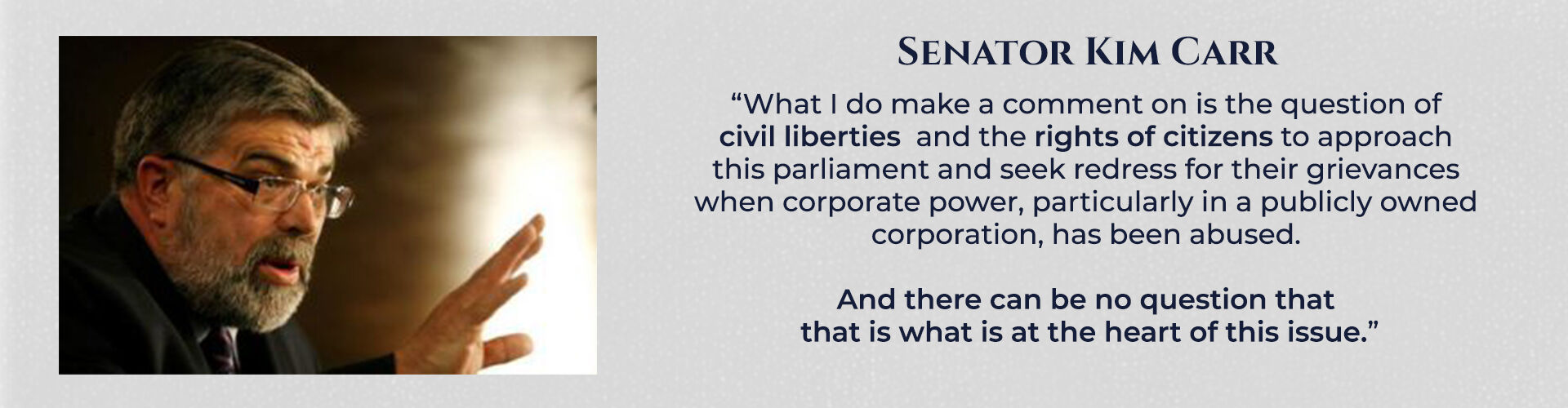
In the above Senate Hansard on 24 June 1997 (refer to pages 76 and 77 - Senate - Parliament of Australia Senator Kim Carr states to Telstra’s main arbitration defence Counsel: Re: Alan Smith:
Senator CARR – “In terms of the cases outstanding, do you still treat people the way that Mr Smith appears to have been treated? Mr Smith claims that, amongst documents returned to him after an FOI request, a discovery was a newspaper clipping reporting upon prosecution in the local magistrate’s court against him for assault. I just wonder what relevance that has. He makes the claim that a newspaper clipping relating to events in the Portland magistrate’s court was part of your files on him”. …
Senator SHACHT – “It does seem odd if someone is collecting files. … It seems that someone thinks that is a useful thing to keep in a file that maybe at some stage can be used against him”.
Senator CARR – “Mr Ward, we have been through this before in regard to the intelligence networks that Telstra has established. Do you use your internal intelligence networks in these CoT cases?”
The most alarming aspect of Telstra’s intelligence networks is determining who inside the corporation had the government clearance and expertise to filter raw information before cataloguing it. How much confidential material was taken from my telephone conversations with former Prime Minister Malcolm Fraser in April 1993 and again in April 1994 — conversations in which I asked why government bureaucrats inside the still‑government‑owned Telstra were able to obtain information exchanged between him and me about what I exposed on 18 September 1967, when he was Minister for the Army during the Vietnam War?
I had only just escaped the waters of Communist China after discovering Australian wheat sent on humanitarian grounds was being redeployed to North Vietnam, with every likelihood it was ending up in the bellies of Viet Cong guerrillas before they marched into the jungle killing and maiming Australian, New Zealand, and American soldiers (Refer to British Seaman’s Record R744269 - Open Letter to PM File No 1 Alan Smith's Seaman and Chapter 7-Vietnam Vietcong)
PLEASE NOTE:
At the time of my altercation referred to above, on 24 June 1997 (see the Senate - Parliament of Australia), my bankers had already lost patience and sent the Sheriff to ensure I stayed on my knees. I threw no punches during this altercation with the Sheriff, who was about to remove catering equipment from my property, which I needed to keep trading. I actually placed a wrestling hold, ‘Full Nelson’, on this man and walked him out of my office. The Magistrates' Court dropped all charges on appeal when it became obvious this story had two sides.
- Document Starvation: Telstra unlawfully withheld over 150,000 critical engineering reports and fault logs during legal discovery.
- Surveillance and Espionage: The Australian Federal Police confirmed Telstra illegally intercepted and recorded private phone conversations and confidential faxes.
- Psychological Manipulation: Corporate executives deployed a ritualised "No Fault Found" narrative, gaslighting broken business owners into doubting their own sanity.
- Structural Discrimination: The federal government triaged justice, compensating a small "litmus test" group with millions while entirely abandoning the remaining sixteen citizens
- Destroyed Legacies: Pristine commercial assets, including the Cape Bridgewater Holiday Camp, were financially strangled and forced into liquidation at mere land value.
- Ruined Health: The relentless stress of fighting an untouchable predator triggered severe physiological trauma, resulting in chronic illness and heart attacks.
- Fractured Lives: The isolation of a decade-long psychological warfare broke families apart and dissolved decades-long marriages.
- Metastasised Injustice: The unresolved network faults did not stop with the original victims; they systematically drove subsequent property owners into bankruptcy.
Hover your mouse over the following images as you scroll down the homepage.
31. A Story of Despair, Heartache — and Systemic Treachery
What happened to the Casualties of Telstra was not an administrative failure. A system engineered to break us. The arbitrations we signed in 1994 were presented as a path to justice, but what followed was a process corrupted from within: an arbitrator who failed in his duty, government officials who enabled misconduct, and a telecommunications corporation that operated with impunity.
The injustices documented on this website were not isolated events. They were systemic, deliberate, and sustained. The same misconduct repeated across years, COT members, and investigative processes. Evidence was withheld. Documents were concealed. Procedures were manipulated. And when the truth threatened to surface, bureaucrats intervened to bury it again.
This was not incompetence. It was treachery. A deliberate, insidious betrayal of the principles of fairness, transparency, and integrity that should define any legal process in a democratic nation.
32. Freehill Hollingdale & Page
(now trading as Herbert Smith Freehills Melbourne)
On April 7 and 8, 1994, I received assurances from Robin Davey, the then-Chairman of the communications regulator, AUSTEL (now known as ACMA). He guaranteed us that if we decided to abandon our AUSTEL-facilitated Fast Track Settlement Proposal, which we had signed and was fully operational as of November 23, 1993, the government would ensure that Freehill Hollingdale & Page (now trading as Herbert Smith Freehills Melbourne) would not have any further involvement in the newly drafted Fast Track Arbitration Procedure. The government publicly announced this promise in a media release that reached listeners nationwide.
It is important to emphasise that Dr Gordon Hughes, appointed as the commercial assessor for the Fast Track Settlement Procedure (FTSP), was not a graded arbitrator. Neither he nor the Telecommunications Industry Ombudsman (TIO) office drafted the new Fast Track Arbitration Procedure. Instead, Dr Hughes and the TIO office made only minor, cosmetic changes to the agreement Freehill Hollingdale & Page originally drafted.
What unfolded next was not just troubling; it was downright sinister. Throughout my arbitration process, which dragged on from April 21, 1994, to May 11, 1995, the tainted agreement concocted by Freehill Hollingdale & Page was also callously used in the arbitrations of Ann Garms, Maureen Gillan, and Graham Schorer. In a shocking turn of events, Dr Hughes later condemned that very arbitration document, branding it as non-credible and suggesting that urgent revisions were necessary for the remaining COT cases—namely, those of Garms, Gillan, and Schorer. While these cases were granted a generous 13 months to amend their claims, I was left in the lurch, denied any chance to amend my claim, or given the same 13 months to review my submission. My appeal lawyers were not even made aware of Dr Hughes's pivotal letter, dated May 12, 1995 → (Open Letter File No 55-A)—until two long years after the statute of limitations had cruelly expired, effectively sealing my fate and depriving me of the means to challenge this corrupt system.
These two Telstra documents show Telstra was not merely corrupt in its thinking—it operated with a level of treachery that stripped away any pretence of good faith. Document Two makes it brutally clear: Telstra knew it had not disclosed all the faults still crippling my service at the time of my first settlement on 11 December 1992. They deliberately concealed those faults, then buried the evidence behind closed doors.
33. On 21 April 1993 — Telstra internal email, FOI folio C04094,
This email was sent by Greg Newbold to multiple Telstra executives (“COT cases latest”):
“I disagree with raising the issue of the courts. That carries an implied threat not only to COT cases but to all customers that they’ll end up as lawyer fodder… Certainly that can be a message to give face to face with customers and to hold in reserve if the complaints remain vexacious .”→ (GS-CAV Exhibit 1 to 88 - See GS CAV 75)
This was Telstra’s mindset: threats held “in reserve,” intimidation treated as a legitimate tool, customers reduced to “lawyer fodder.” This wasn’t incompetence — it was strategy. It was Telstra’s internal culture laid bare.
34. On 17 June 1993 — Ms Rosanne Pittard’s memo, FOI folio K03281:
“Whilst I can respond to the details regarding the information provided to him at the time of settlement I cannot comment on the variation between what Mr Smith was told and the contents of the Network Investigation files.” - (GS-CAV Exhibit 1 to 88 - See GS-CAV 79)
There it is — the admission Telstra never intended the truth to reach me. They knew exactly what they had withheld. They knew the Network Investigation files contradicted what I had been told. And they knew the briefcase incident exposed that deception.
These documents are not slips or oversights. They prove a coordinated concealment, carried out while the TIO and Dr Gordon Hughes pretended Telstra was acting in good faith. They show Telstra was fully aware of the faults still affecting my service, the lies told during settlement, and the danger those lies posed if they were ever uncovered.
This is not negligence. This is not misunderstanding. This is premeditated corruption, executed with precision and protected by the very bodies meant to hold Telstra accountable.
35. Threats carried out
On page 180, ERC&A, from the official Australian Senate Hansard, dated 29 November 1994, reports Senator Ron Boswell asking Telstra’s legal directorate:
“Why did Telecom advise the Commonwealth Ombudsman that Telecom withheld FOI documents from Alan Smith because Alan Smith provided Telecom FOI documents to the Australian Federal Police during their investigation?”
After receiving a hollow response from Telstra, which the senator, the AFP and I all knew was utterly false, the senator states:
“…Why would Telecom withhold vital documents from the AFP? Also, why would Telecom penalise COT members for providing documents to the AFP which substantiate that Telecom had conducted unauthorised interceptions of COT members’ communications and subsequently dealt in the intercepted information by providing that information to Telecom’s external legal advisers and others?” (See Senate Evidence File No 31)
What is so appalling about this withholding of relevant documents is this: no one in the Telecommunications Industry Ombudsman (TIO) office or the government has ever investigated the disastrous impact of this withholding on my overall submission to the arbitrator. The arbitrator and the government (at the time, Telstra was a government-owned entity) should have investigated why an Australian citizen who had assisted the AFP in its investigations into unlawful interception of telephone conversations was so severely disadvantaged in a civil arbitration.
When threats were made against me, and I refused to buckle, that stand‑alone defiance showed that the arbitrator, Dr Gordon Hughes, had lost control of the entire process. That loss of control led him to provide the man who made those threats, Telstra’s arbitration liaison officer, Paul Rumble, with more than 4,200 documents relating to my claim, organised into six spiral‑bound volumes dated 15 June 1994.
This clearly breached the arbitration rules. The Agreement explicitly stated that Telstra could not receive my claim documents from the arbitrator until Telstra notified him it was prepared to proceed. Under those rules, Telstra was allocated only one month to formulate its defence.
36. John Pinnock (TIO) formally addressed a Senate estimates committee
On 26 September 1997 (See page 99, COMMONWEALTH OF AUSTRALIA - Parliament of Australia and Prologue Evidence File No 22-D). He noted:
“In the process leading up to the development of the arbitration procedures – the claimants were told clearly that documents were to be made available to them under the FOI Act.
“Firstly, and perhaps most significantly, the arbitrator had no control over that process, because it was a process conducted entirely outside the ambit of the arbitration procedures.”
No amendment attached to any agreement, signed by the first four COT members, allowed the arbitrator to conduct those arbitrations entirely outside the arbitration procedure, nor did it state that he would have no control over the process once we signed those individual agreements. How can the arbitrator and TIO continue to hide under a confidentiality clause in our arbitration agreement when that agreement did not mention that the arbitrator would have no control because the arbitration would be conducted entirely outside the agreed procedure?
In June 1997, I was asked by Senator Ron Boswell to explain to a Senate Committee meeting what I believed was behind the threats made during my 1994 arbitration by Telstra's arbitration defence liaison officer, Paul Rumble, as well as the devastation that these threats caused when Telstra carried out these threats and what made me believe the reason the arbitrator, Dr Hughes, allowed these threats to materialise. My partner, Cathy, and I were to spend three days in Bangkok, a scheduled stopover included in the cost of the flight back to Australia.
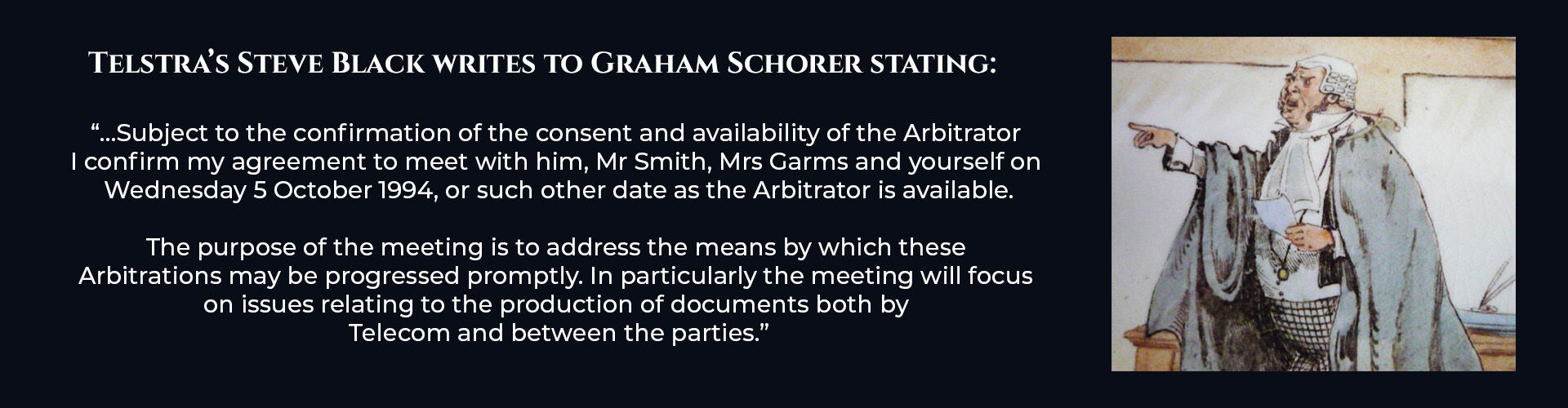
38. The Arbitrator & the Corruption of Arbitration in Australia
Introduction: A System Built on Betrayal.
The arbitration system in Australia was sold to us as fair, transparent, and government-endorsed. In reality, it was anything but. The Institute of Arbitrators and Mediators Australia (IAMA) was supposed to be independent, yet time and again it bent to political and corporate influence. What should have been a safeguard for justice became a weapon of betrayal.
39. The COT Cases: Cracks in the System (1990s)
Back in the 1990s, the Casualties of Telstra (COT) cases exposed the rot. Telstra and government officials withheld documents, misled arbitrators, and left claimants fighting in the dark. Arbitrators ignored evidence that should have been central to their rulings. The result? Ordinary Australians were systematically disadvantaged while Telstra and its allies walked away untouched. Those cases proved one thing: when corporate power colludes with political silence, justice collapses.
40. The Telstra Briefcase Incident (1992–1993)
I saw this corruption firsthand. Two Telstra executives left an unlocked briefcase in my Cape Bridgewater office. Inside were documents that revealed Telstra’s board and management were orchestrating a campaign to mislead the public. They knew their copper wire network and Ericsson equipment were faulty. Overseas, they were ripping this equipment out of exchanges. Here in Australia, Telstra kept rolling it out, putting vulnerable customers at risk.
When I raised these issues, the arbitrator ruled that the faults had no impact on my business viability. That wasn’t negligence—it was complicity. Later, documents dated July–December 1992, formalised under the Freedom of Information Act, confirmed what I already knew: I had been deliberately misled about my service's reliability for years.
41. Continuity of Corruption: 2000–2025
Some people like to believe this corruption was confined to the past, resolved in the 1990s. They’re wrong. Between 2020 and 2025, the same practices continued: altered court documents, perjury, and even allegations of criminal activity within government ranks. In both State and Federal Parliament, betrayal runs rampant. Colleagues are destroyed through malicious falsehoods, just as claimants were destroyed during the arbitrations. The corruption didn’t end—it mutated.
42. The Human Cost
This wasn’t just about faulty equipment. It was about lives. My business was dismissed, my credibility undermined, and my livelihood jeopardised. Customers were left exposed to dangerous infrastructure while Telstra and government officials escaped accountability. The human cost of this betrayal is immeasurable.
43. Conclusion: The Arbiitraitor’s Legacy
The arbitration system failed because it was never truly independent. Political and corporate influence corrupted it from the start. The COT Cases peeled back the layers, but the treachery has only deepened since. My role now is to document the truth, to ensure these betrayals are not forgotten, and to empower others to challenge the silence.
44. Reflections on Democracy and Accountability
My struggle was never just about me. It was about whether democratic systems can be trusted to uphold transparency, fairness, and accountability. Canada’s handling of the Cape Bridgewater report, and Australia’s willingness to allow witnesses to be compromised, revealed a disturbing truth: when powerful interests are threatened, the rule of law bends. It delays. It ignores.
So I ask you, my readers: do we truly live under systems that protect the vulnerable and hold the powerful to account? Or are we expected to accept corruption disguised as process, silence masquerading as resolution?
For me, the answer is clear. The COT arbitrations were neither transparent nor unbiased. They were riddled with sinister machinations. And while I continue to fight for the return of my rightful documents, I also fight for something larger: the principle that truth must never be buried, and that democracy cannot survive if corruption is allowed to flourish unchallenged.:
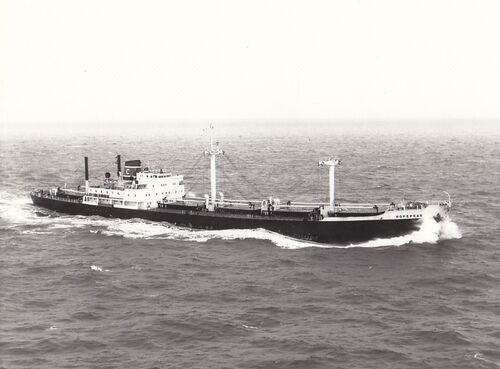
45. Echoes of Betrayal: Wheat Sales to China - and the Government bureaucrats who continued to tell Australia's politicians what several other seamen and I had witnessed in China was a lie. The following information shows we risked all to expose the truth.
The People's Republic of China
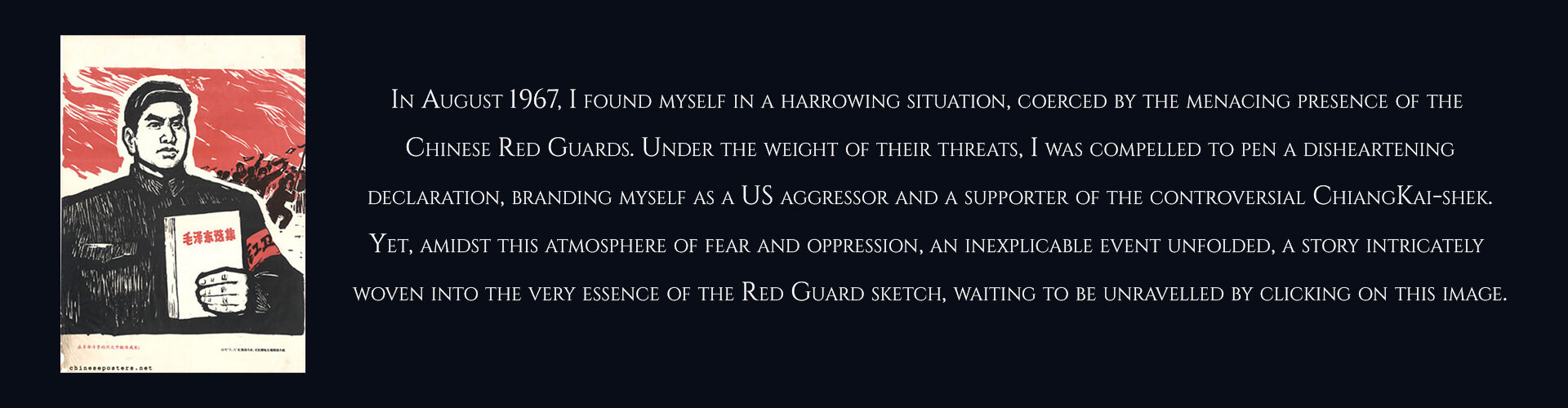
Murdered for Mao: The killings China ‘forgot’
The Letter, the Truth, and the Waiting
In August 1967, I found myself in a situation so precarious, so surreal, that it would etch itself into the marrow of my memory. I was aboard a cargo ship docked in China, surrounded by Red Guards stationed on board twenty-four hours a day, spaced no more than thirty paces apart. After being coerced into writing a confession—declaring myself a U.S. aggressor and a supporter of Chiang Kai-shek, the Nationalist leader in Taiwan—I was told by the second steward, who handled the ship’s correspondence, that I had about two days before a response to my letter might reach me. That response, whatever it might be, would be delivered by the head of the Red Guards himself.
It was the second steward who quietly suggested I write to my parents. I did. I poured myself into 22 foolscap pages, writing with the urgency of a man who believed he might not live to see the end of the week. I told my church-going parents that I was not the saintly 18-year-old they believed I was. I confessed that the woman they had so often thanked in their letters—believing her to be my landlady or carer—was in fact my lover. She was 42. I was 18 when we met. From 1963 to 1967, she had been my anchor, my warmth, my truth. I wrote about my life at sea, about the chaos and the camaraderie, about the loneliness and the longing. I wrote because I needed them to know who I really was, in case I was executed before I ever saw them again.
As the ship’s cook and duty mess room steward, I had a front-row seat to the daily rhythms of life on board. I often watched the crew eat their meals on deck, plates balanced on the handrails that lined the ship. We were carrying grain to China on humanitarian grounds, and yet, the irony was unbearable—food was being wasted while the people we were meant to help were starving. Sausages, half-eaten steaks, baked potatoes—they’d slip from plates and tumble into the sea. But there were no seagulls to swoop down and claim them. They’d been eaten too. The food floated aimlessly, untouched even by fish, which had grown scarce in the harbour. Starvation wasn’t a concept. It was a presence. It was in the eyes of the Red Guards who watched us eat. It was in the silence that followed every wasted bite.
A Tray of Leftovers and a Silent Exchange
After my arrest, I was placed under house arrest aboard the ship. One day, I took a small metal tray from the galley and filled it—not with scraps, but with decent leftovers. Food that would have gone into the stockpot or been turned into dry hash cakes. I walked it out to the deck, placed it on one of the long benches, patted my stomach as if I’d eaten my fill, and walked away without a word.
Ten minutes later, I returned. The tray had been licked clean.
At the next meal, I did it again—this time with enough food for three or four Red Guards. I placed the tray on the bench and left. No words. No eye contact. Just food. I repeated this quiet ritual for two more days, all while waiting for the response to my letter. During that time, something shifted. The Red Guard, who had been waking me every hour to check if I was sleeping, stopped coming. The tension in the air thinned, just slightly. And I kept bringing food—whenever the crew was busy unloading wheat with grappling hooks wrapped in chicken wire, I’d slip out with another tray.
To this day, I don’t know what saved me. It was certainly not the letter declaring myself a U.S. aggressor and a supporter of Chiang Kai-shek, the Nationalist leader in Taiwan. Maybe it was luck. Or perhaps it was that tray of food, offered without expectation, without speech, without condition. A silent gesture that said, “I see you. I know you’re hungry. I know you’re human.”
And maybe, just maybe, that was enough.
In essence, the Australian government faced an agonising moral dilemma — weighing the lives of its soldiers engaged in the conflict in North Vietnam against the desperate need to provide sustenance for an entire nation teetering on the brink of starvation. This heart-wrenching choice highlights the often-unseen complexities of international relations and humanitarian crises, revealing the painful calculations made in the pursuit of survival.
46. Footnotes 83, 84 and 169
A paper submitted by Tianxiao Zhu to the Faculty of the University of Minnesota titled Secret Trails: FOOD AND TRADE IN LATE MAOIST CHINA, 1960-1978, etc → Requirements For The Degree Of Doctor Of Philosophy - Christopher M Isett June 2021
Tianxiao Zhu's Footnotes 83, 84, 169:
In September 1967, a group of British merchant seamen quit their ship, the Hope Peak, in Sydney and flew back to London. They told the press in London that they quit the job because of the humiliating experiences to which they were subjected while in Chinese ports. They also claimed that grain shipped from Australia to China was being sent straight on to North Vietnam. One of them said, “I have watched grain going off our ship on conveyor belts and straight into bags stamped North Vietnam. Our ship was being used to take grain from Australia to feed the North Vietnamese. It’s disgusting.”
84. The Minister of Trade and Industry received an inquiry about the truth of the story in Parliament, to which the Minister pointed out that when they left Australia, the seamen only told the Australian press that they suffered such intolerable maltreatment in various Chinese ports that they were fearful about going back. But after they arrived in London, Vietnam was added to their story. Thus the Minister claimed that he did not know the facts and did not want to challenge this story, but it seemed to him that their claims about Vietnam seemed to be an “afterthought.”
169. "...In Vancouver, nine sailors refused to work on a grain ship headed to China: two of them eventually returned to work, and the others were arrested. Just when the ship was about to sail, seven more left the ship but three of them later returned to work. In Sydney, six Canadian sailors left their ship; they resigned and asked to be paid, but the Australian immigration office repatriated them. At that time, a grain ship usually had crew members of about 40 people. A British ship lost the Chief Officer and sixteen seamen, who told journalists that if the ship were going to the communist countries, they would rather go to jail than work on the ship."
47. The Canadian Government and Its Moral Code of Ethics
Hover your mouse over the following images as you scroll down the homepage.

By hovering your mouse over the Canadian flag image below, you can also learn about the strong ethical principles upheld by Canadian seamen. Despite facing significant challenges, they believed that sending wheat to Communist China — especially when that wheat was being redeployed to North Vietnam, a country at war with Australia, New Zealand, and the USA, where hundreds of troops were being killed or maimed — was immoral and unethical, and therefore should not have continued.
Yet the Australian Government made a conscious decision to maintain its trade relations with Communist China, despite knowing that a significant portion of Australia’s wheat was being diverted to North Vietnam. This wheat was not merely a trade commodity; it had the potential to sustain North Vietnamese soldiers who were directly engaged in combat against Australia and its allies during the conflict. The ramifications of this trade raised serious ethical questions about supporting a nation that opposed Australian, New Zealand, and US forces.
Examining this wheat agreement made with the People's Republic of China during the Menzies government in the mid‑1960s is essential. This controversial deal had significant implications, but a government campaign to discredit British and Canadian merchant seamen — including me — obscured them. These brave individuals tried every conceivable legal way to expose this illicit diversion of wheat to North Vietnam.
• Frog‑marched off the ship under armed guard by Red Guards, accused of being a spy.• Forced to write letters under threat of execution.• Commonwealth Police met the ship in Sydney on 18 September 1967, confirming the seriousness of what had occurred.• British crew members refused to sail the ship back to China, fearing for their lives.
• Wheat shipments had gone ahead despite warnings.• Australian conscripts had fought and died in Vietnam.• Bureaucrats and ministers had ignored both political foresight and lived testimony.
Vol. 87 No. 4462 (4 Sep 1965) - National Library of Australia https://nla.gov.au › nla.obj-702601569
"The Department of External Affairs has recently published an "Information Handbook entitled "Studies on Vietnam". It established the fact that the Vietcong are equipped with Chinese arms and ammunition"
If it is right to ask Australian youth to risk everything in Vietnam it is wrong to supply their enemies. The Communists in Asia will kill anyone who stands in their path, but at least they have a path."
Australian trade commssioners do not so readily see that our Chinese trade in war materials finances our own distruction. NDr do they see so clearly that the wheat trade does the same thing."


51. The Commonwealth Police (now called the Australian Federal Police)
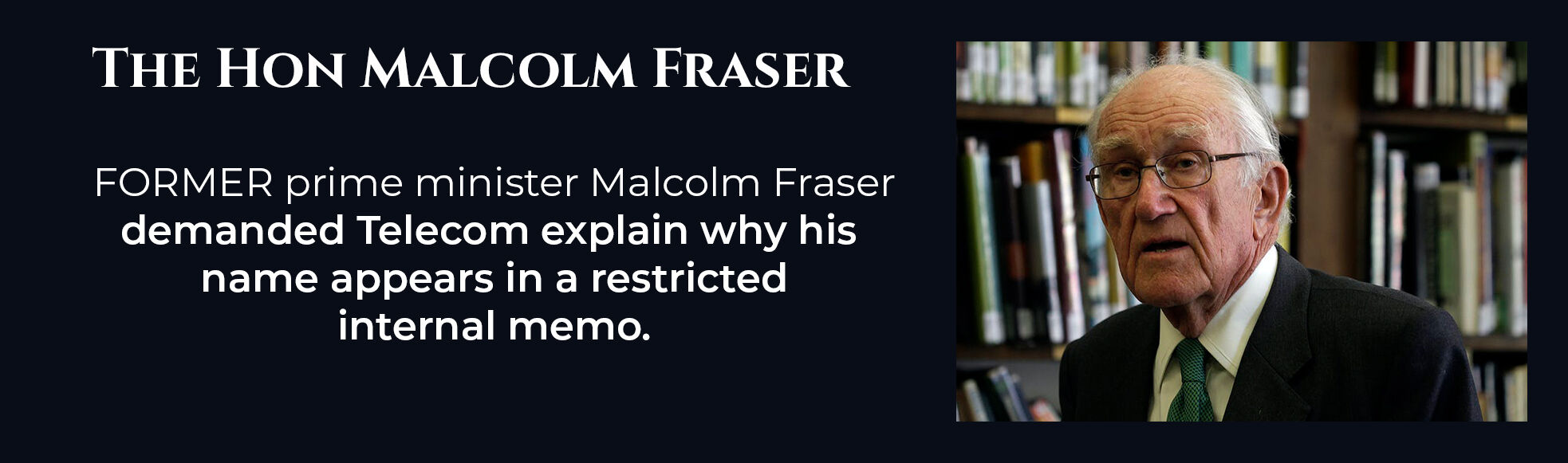
On September 18, 1967, the Commonwealth Police—then commonly known as COMPOL—had a unique practice of initialling documents with "COMPOL" after an officer’s signature. I observed this signature protocol when two COMPOL officers conducted an official visit to the Hopepeak ship, where I was serving as a crew member. During their visit, I presented the officers with a letter I had meticulously crafted, addressed to The Hon Malcolm Fraser, then Minister for the Army. This particular letter, written on the same day, became the focus of discussions I later had with Mr Fraser in April 1993 and again in 1994. It contained crucial information that had been removed from official records, and its significance cannot be understated.
Moreover, John Wynack, the Director of Investigation at the Commonwealth Ombudsman, made considerable efforts over two years to obtain access to this letter. However, he faced significant obstacles, as Telstra informed him in writing that it had destroyed my arbitration file. In response to this alarming revelation, Mr Wynack expressed his disbelief in correspondence to Telstra, reflecting his conviction that something was amiss in the handling of the evidence. The officers I encountered during this process are now recognised as part of the Australian Federal Police (AFP).
Home Page File No/82 confirms Mr Wynack did not believe Telstra’s claim that it destroyed the file.
It is on record that I fully cooperated with the COMPOL officers in September 1967, who reviewed my statement concerning my time in China. Later, in 1994 and 1995, I again assisted the AFP with their investigations into my Telstra-related phone and fax hacking episodes.
I have always discussed the AFP issues in the AFP segments, but I am now writing a book on this part of my COT story. I introduce the China-Australian wheat saga as the spearhead of my story on the COMPOL/AFP issues, because that was when the AFP was genuinely horrified by what I told them and by the statement I made about my time in China.
This is why I start the AFP part of my COT story with episodes where they were human beings in shock, as most Australians were, when I told them about this China saga. On 18 September 1967, the Commonwealth Police, then known as COMPOL, often initialled documents with "COMPOL" after the officer's signature. This was the case when two COMPOL officers visited the Hopepeak ship, where I was a crew member at the time. These officers are now referred to as the Australian Federal Police (AFP).
It is on record that I fully cooperated with the COMPOL officers in September 1967, who reviewed my statement concerning my time in China. Later, in 1994 and 1995, I again assisted the AFP with their investigations into my Telstra-related phone and fax hacking episodes.
I have always discussed the AFP issues in the AFP segments, but I am now writing a book on this part of my COT story. I am introducing the China-Australian wheat saga as the spearhead of my story regarding the COMPOL/AFP issues, as this was when the AFP was genuinely horrified by what I told them and by the statement I made concerning my time in China.
This firm is responsible for providing Ian Joblin, a clinical psychologist, with a witness statement for the arbitrator overseeing my case. However, a significant concern arose during this process: the witness statement was signed only by Maurice Wayne Condon, a representative of Freehill Hollingdale & Page, and notably lacked Mr Joblin's signature.
1. He requested an explanation for the apparent discrepancies in the attestation of Ian Joblin's witness statement.
2. He sought clarification on whether any modifications were made to the version of the Joblin statement initially submitted to Dr. Hughes, the arbitrator, compared to the signed version ultimately provided.
Maurice Wayne Condon, acting as Telstra's legal representative from Freehill Hollingdale & Page, signed the witness statement without securing the psychologist's signature, raising serious questions about the extent of Telstra's legal team's influence and power over the arbitration process in Australia.
Also, in the above Senate Hansard on 24 June 1997 (refer to pages 76 and 77 - Senate - Parliament of Australia Senator Kim Carr states to Telstra’s leading arbitration defence Counsel (also a TIO Council Member) Re: Alan Smith:
Senator CARR – “In terms of the cases outstanding, do you still treat people the way that Mr Smith appears to have been treated? Mr Smith claims that, amongst documents returned to him after an FOI request, a discovery was a newspaper clipping reporting upon prosecution in the local magistrate’s court against him for assault. I just wonder what relevance that has. He makes the claim that a newspaper clipping relating to events in the Portland magistrate’s court was part of your files on him”. …
Senator SHACHT – “It does seem odd if someone is collecting files. … It seems that someone thinks that is a useful thing to keep in a file that maybe at some stage can be used against him”.
Senator CARR – “Mr Ward, we have been through this before in regard to the intelligence networks that Telstra has established. Do you use your internal intelligence networks in these CoT cases?”
The most alarming aspect of Telstra's intelligence networks in Australia is who within the Telstra Corporation has the necessary expertise, i.e., government clearance, to filter the raw information collected before it is impartially catalogued for future use? How much confidence can I place in my telephone conversations with the former prime minister of Australia in April 1993 and again in April 1994 concerning my Red Communist China episode, which I discussed with Fraser, and which Telstra officials held?
More importantly, when Telstra was fully privatised in 2005, which organisation in Australia was given the charter to archive this sensitive material that Telstra had been collecting about its customers for decades?
PLEASE NOTE:
At the time of my altercation referred to above, on 24 June 1997, the Senate - Parliament of Australia - my bankers had already lost patience and sent the Sheriff to ensure I stayed on my knees. I threw no punches during this altercation with the Sheriff, who was about to remove catering equipment from my property, which I needed to keep trading. I placed a wrestling hold, ‘Full Nelson’, on this man and walked him out of my office. The Magistrates' Court dropped all charges on appeal when it became clear the story had two sides.
ACMA was the respondent in both my Freedom of Information and government document requests, and the Administrative Appeals Tribunal heard the matter between February and October 2008, and again from October 2010 to May 2011.
I was seeking Ericsson-related documentation that Telstra had retained—information that, after Ericsson acquired Lane, was reportedly used to assist Telstra’s arbitration defence against the COT Cases. We had alleged that Ericsson’s telephone exchange equipment was responsible for widespread call dropouts and outages.
To this day, I have not received the requested Ericsson data from the government ACMA.
Hovering your cursor or mouse over AUSTEL’s Adverse Findings confirms that government public servants investigating my ongoing telephone issues supported my claims against Telstra, particularly between Points 2 and 212. It is evident that if the arbitrator had been presented with AUSTEL’s Adverse Findings, he would have awarded me a significantly higher amount for my financial losses than he ultimately did.
Government records (see Absentjustice-Introduction File 495 to 551) show AUSTEL's adverse findings were provided to Telstra (the defendants) one month before Telstra and I signed our arbitration agreement. I did not receive a copy of these findings until 23 November 2007, 12 years after my arbitration concluded, which was outside the statute of limitations for me to use those government findings to appeal the arbitrator's award.
AUSTEL’s Adverse Findings, dated 4 March 1994, confirmed that my claims against Telstra were validated (see points 2 to 212) before I was forced into arbitration under threat of the then Telecommunications Industry Ombudsman (TIO) Warwick Smith and Telstra that unless I sign for arbitration then Telstra and the TIO would collectively decline to further investigate my telephone faults which I alleged had been apparent since February 1988, when I purchased the business.
Unfortunately, I did not receive a copy of these findings AUSTEL’s Adverse Findings at points 2 to 212 until November 23, 2007, 12 years after the termination of my arbitration process. In simple terms, the government validated my claims as early as March 4, 1994, six weeks before April 21, 1994, when I signed the arbitration agreement.
But despite this proof, I still had to endure 13 months of a gruelling arbitration process that cost me well over $300,000 in professional fees to prove something the government had already established 6 weeks earlier.
55. Administrative Appeals Tribunal
On October 3, 2008, in a chilling moment that felt surreal, senior AAT member Judge G.D. Friedman confronted the haunting truths of my case during the AAT hearings. In the glaring light of the courtroom (Case No. V2008/1836), he declared, with the weight of the world on his shoulders, that the government had egregiously failed to provide me with the crucial documents needed to form its findings in a covert report. This insidious report, crafted by AUSTEL (now ACMA) and handed to Telstra in March 1994, was a weapon aimed at dismantling my claims against the government-owned Telstra corporation.
“Let me just say, I don’t consider you, personally, to be frivolous or vexatious – far from it.
“I suppose all that remains for me to say, Mr Smith, is that you obviously are very tenacious and persistent in pursuing the – not this matter before me, but the whole – the whole question of what you see as a grave injustice, and I can only applaud people who have persistence and the determination to see things through when they believe it’s important enough.”
In 2025, both electronic media and various newspapers reported that Optus is now blaming Ericsson for the same outages and call dropouts that we COT Cases first exposed, beginning with the briefcase left open at my Cape Bridgewater premises on June 3, 1993.
56. Corruption by Design
Corruption isn’t always loud. Sometimes it’s engineered into the very structure of a process—quiet, procedural, and devastating. The COT arbitrations weren’t sabotaged by accident. They were corrupted by design.
From the outset, Telstra’s internal faults were known. Technical reports confirmed line failures, fax corruption, and call dropouts. Yet the arbitration rules were crafted to exclude critical evidence. The arbitrator, handpicked and protected, operated within a framework that rewarded omission and punished transparency.
Government departments, legal advisors, and Telstra executives formed a closed loop of influence. The corruption wasn’t just in the outcome—it was in the architecture. And every claimant who entered the process was walking into a trap.
Our website provides access to over 56,000 arbitration files, many of which the defendant, Telstra, grotesquely tampered with before they entered the arbitration process. These files have been rendered indecipherable, deliberately designed to thwart any attempt at justice.
Witness the lengths to which the government will go to protect its own corrupt interests, ruthlessly allowing its citizens to suffer and remain voiceless in a labyrinth designed to entrap them in despair. The truth is chilling, and the betrayal runs deep.
57. A Story of Despair and Heartache
Within the convoluted five-volume arbitration dossier, I confronted Mr Kearney, the government investigator, with undeniable evidence that Dr Hughes had insidiously refused to grant his technical consultant the time needed to uncover extensive billing discrepancies. This obstruction likely forced Mr. Kearney into a rushed and precarious position, culminating in a hastily written report in February 1996. Regrettably, amidst this disquiet, the report validated my arbitration claims.
That summary report meticulously identified 23 examples of fabrications in Telstra's covert submission to AUSTEL on 16 October 1995, a mere five months after my arbitration concluded. AUSTEL, the government Communications Authority, revealed that the arbitrator had failed to scrutinise these glaring discrepancies, allowing Telstra to manipulate the narrative. This collusion exposed the staggering scale of the ongoing billing debacle and underscored the dire need for accountability in an environment where misconduct festers unchecked.
AUSTEL and Telstra—the defendants in my arbitration—subversively manipulated the arbitration process in an unethical, duplicitous manner. They orchestrated this conduct in secret, denying both the arbitrator and me the right to respond to Telstra's late submission of deceit to AUSTEL. The entire affair reeks of betrayal—of trust, justice, and the principles that should govern our systems.
The original arbitration claim information, which AUSTEL secretly allowed Telstra to submit on 16 October 1995, contradicted Mr Kearney's findings from data he collected from my business on 19 December 1995, and presented in February 1996. AUSTEL's decision to permit Telstra to address my arbitration billing claims in secret, without an arbitrator present, was inappropriate. This secretive manoeuvring by AUSTEL and Telstra significantly compromised my ability to make future complaints regarding ongoing telephone problems.
Absentjustice.com reveals that John Pinnock, the second-appointed arbitration administrator, continued to inform my Federal Member of Parliament, David Hawker MP, the Communications Minister, and Telstra, until I sold my business to Darren and Jenny Lewis in December 2001, that my ongoing telephone and faxing problems had been addressed and fixed as part of my 1994/95 arbitration.
How could problems still experienced in 2001 have been fixed in 1994/95?
Documentation in Files 221, 222, and 223 AS-CAV Exhibit 181 to 233 suggests that Paul Howell of DMR Group Inc., Canada, allegedly authored a cover letter claiming his technical report concerning the Cape Bridgewater Holiday Camp Evaluation of Call Losses and the non-addressed RVA billing faults, dated 30 April 1995, was complete (refer to File 223). However, John Pinnock, the Australian Telecommunications Industry Ombudsman, stated in correspondence dated 16 August 1996—sixteen months after the date on Paul Howell's cover letter—that the arbitrator (refer File 221) was not obligated to provide me with Paul Howell's cover letter during the arbitration process, despite my requests to present it to my technical advisors for an informed written response to the purportedly complete report.
In section 2:23 of his report, Paul Howell asserts that the report remained incomplete and required additional weeks to ascertain the reasons my business persistently experienced billing-related complaints (Refer to Chapter 1 - The Collusion Continues).
On 5 May 1995, the arbitrator denied my request for extra time to submit an addendum and did not explain why Paul Howell's technical report had not been formally endorsed as complete. Despite requests from both Paul Howell and his colleague at Lane Telecommunications for an extension, the arbitrator refused additional time. Consequently, I had to respond to Paul Howell's report without his signature indicating its completion (Refer to Arbitrator File No/48).
In my 1997 statutory declaration (File 222 - AS-CAV Exhibit 181 to 233), I recount a significant conversation with Paul Howell, who contacted me by telephone after my hospitalization for a suspected heart condition. Howell revealed that he had not finalised or signed off on his report because it was incomplete. This disclosure highlighted Howell's integrity and reflected the Canadian government's commitment to upholding the rule of law. The chief Canadian technical consultant evaluating my claims withheld endorsement of the report, citing Canada's commitment to this principle. Howell thoroughly explained his decision, clarifying the complexities of my situation. For more on the implications of the Paul Howell DMR and the Lane report, see Chapter 1 - The Collusion Continues.
Throughout this period, I documented my struggles in correspondence with Denise McBurnie. Despite assurances from Telstra and Ms. McBurnie that no systemic billing issues affected my 008/800 services, the reality was different and distressing. In late 1999, former Telstra CEO Frank Blount co-published "Managing in Australia" (https://www.qbd.com.au › managing-in-australia › fran), available online. Pages 132 and 133 candidly address the systemic issues within Telstra's 1800 service—the same challenges I faced.
Despite the gravity, when Freehill Hollingdale & Page endorsed Telstra's arbitration defence, they failed to accurately depict the prevailing circumstances regarding these systemic issues to the arbitrator. This occurred even though they had submitted nine witness statements supporting my position on December 12, 1994. Furthermore, on October 16, 1995—five months after my arbitration concluded—AUSTEL covertly permitted Telstra to address the systemic billing fault at issue in my arbitration. AUSTEL, not a party to my arbitration with Telstra, was unaware that the witness statements dated December 12, 1994, used by Telstra in this underhanded AUSTEL process, had been condemned by two senior Queensland detective sergeants as grossly inaccurate. This clandestine action enabled Telstra to rely on falsified arbitration witness statements, barring me from responding and denying the arbitrator the opportunity to adjudicate this vital aspect of my claim.
57. The Arbitration Appeal That Never Came
On December 13, 1995, Gene Volovich, my appeal lawyer from Law Partners Melbourne, delivered a devastating blow. Sitting across from me, he stated with certainty something I will never forget: he believed my appeal had no chance of success.
He wasn't guessing. Volovich had reviewed the documents and transcripts. He understood the rules and recognised they had been broken during the arbitration process.
Ten days later, I handed Volovich the complete set of evidence I had previously shown to Darren Kearney from AUSTEL. Kearney's five-hour drive from Melbourne to my Cape Bridgewater Holiday Camp spoke volumes. It suggested that, at least for a moment, the truth mattered to someone.
58. The October Betrayal
The core of the problem stemmed from AUSTEL's decision to allow Telstra to respond to my billing evidence outside the formal arbitration process. On October 16, 1995, Telstra was permitted to rewrite the narrative in private, with no arbitrator or claimant present.
Instead of clarifying the issues, Telstra misrepresented facts and distorted information, failing to disclose crucial details.
Later, AUSTEL officials contacted me to request a review of my claim materials. They were astounded to find that the documents had not been adequately investigated. Dr. Gordon Hughes, the arbitrator, and his technical team had disregarded established procedures, a point already highlighted in AUSTEL's April 1994 COT Cases report. AUSTEL officials were incredulous that Hughes had repeated this error.
59. The Vanishing Findings
On December 19, after reviewing my materials, Mr Kearney requested that they be returned to Melbourne. He provided written assurances, promising findings and closure.
I am still waiting.
In August 1997, Michael Brereton & Co. wrote to Senator Ron Boswell, confirming that I had a substantial case against Dr Hughes. However, I couldn't secure legal representation, either from them or any other firm. The system had worn me down, and the legal gatekeepers had effectively locked me out.
60. Once Again - The Freehills Conflict
Back in January 1994, the COTs (Casualties of Telstra) were assured by Robin Davey, AUSTEL's Chairman, that Freehills would no longer be involved in our Fast Track Settlement Proposal.

Despite this assurance, Telstra reappointed Freehills as its defence counsel for the FTAP (Fast Track Arbitration Process). Warwick Smith, the TIO (Telecommunications Industry Ombudsman), dismissed the conflict of interest, stating it was Telstra's prerogative.
Meanwhile, I continued to register fault complaints through Freehills, and I was
consistently denied access to technical data, facing continuous stonewalling.
An internal Telstra email (FOI folio C02840) confirmed their awareness of the situation:
61. They knew it was a conflict of interest, but they disregarded it.
During arbitration, Telstra submitted witness statements signed only by Freehills, not by the actual witnesses. When I challenged this irregularity, the response was absurd. They simply sent the statements back to the witnesses for signature, with no investigation or accountability.
Gene Volovich was astonished. He couldn't believe I hadn't received any of the fault correspondence exchanged between Telstra, Freehills, and me. He suspected Telstra had deliberately appointed Freehills as my fault managers to shield all correspondence under Legal Professional Privilege.
62. The Arbitrator Who Wasn't
Dr Hughes's failures went beyond simple rule-breaking. He wasn't even a registered arbitrator, not even a graded one, and was unqualified to oversee such a complex and consequential process.
And yet, he presided, ruled, and ultimately buried my case.
On October 19, 1993, Denise McBurnie of Freehills sent a document, marked "Legal Professional Privilege In Confidence," to Telstra's Don Pinel. This document outlined how Telstra could shield technical fault data—data crucial to my case—from disclosure under the guise of legal privilege.
It wasn't privilege; it was concealment.
"Duesbury & FHP continuing of evaluating (blank) claim - final report to Telecom will be privileged and will not be made available to (blank)."
64. Reflection: A System Built to Exhaust
My fight wasn't just for service; it was a battle through a maze designed to wear me down. Every letter to Freehills became another brick in a wall. Each delay, denial, and invocation of privilege formed part of a broader strategy: to keep the truth out of reach.
And yet, I persisted—documenting, pushing forward. Because I believed that one day, someone would read these chapters, not just as history, but as a warning.
65. Exhibit AS 767-A: The Smoking Gun
Then came the document dated October 29, 1993—Telstra FOI folio K01489, Exhibit AS 767-A. It laid out the strategy in plain terms, revealing not only the use of privilege but also its intent.
This wasn't a misunderstanding; it was by design.
"During testing the Mitsubishi fax machine, some alarming patterns of behaviour were noted, these affecting both transmission and reception. Even on calls that were not tampered with the fax machine displayed signs of locking up and behaving in a manner not in accordance with the relevant CCITT Group 3 fax rules."
A handwritten note in the bottom right corner of Exhibit AS 767-B, which reads, "Stored in Fax Stream?" suggests that faxes intercepted via Telstra's testing process were stored in Telstra's Fax Stream service centre. This would have allowed anyone with access to Telstra's fax stream centre to read the documents at any time. The Scandrett & Associates report confirms that numerous COT arbitration documents were intercepted, including faxes to and from Parliament House, the Commonwealth Ombudsman's Office (COO), and the COTs themselves. In my case, this interception continued for seven years after the arbitration concluded. This means Telstra had access to confidential documents that claimants believed they were sending only to their accountants, lawyers, and/or technical advisors (as well as Parliament House and the COO). These documents could have included information that the claimants wanted to keep from the defendants.
Was the engineer pressured to remain silent during my arbitration? I don't know. What is certain is that not all Telstra engineers or technicians handled COT complaints in good faith. Another Telstra technician, who encountered significant problems during his official fax testing process on October 29, 1993, nevertheless advised the arbitrator that I had no problems with that service, despite Telstra's own document noting these faults:
66. Back to the Briefcase

Ericsson AXE faulty telephone exchange equipment (1)
I should have known better. It was just another case of "No fault found." We spent considerable time dancing around a summary of my phone problems, and their best advice was to continue doing exactly what I had been doing since 1989: meticulously recording every fault. I could have wept. Finally, they left.
A little while later, back in my office, I discovered Aladdin had left behind his treasures; the Briefcase Saga was about to unfold.
The briefcase wasn't locked. I opened it and found it belonged to a Mr Macintosh. There was no phone number, so I had to wait until business hours the next day to track him down. Inside, however, was a file titled "SMITH, CAPE BRIDGEWATER." After five gruelling years fighting the evasive monolith of Telstra and being told various lies, this was possibly the truth from an insider's perspective.
The first thing that raised alarm bells was a document revealing Telstra knew the RVA fault they recorded in March 1992 had lasted at least eight months, not the three weeks on which they based their settlement payout. Dated 24/7/92 and bearing my phone number in the top right corner, the document referenced my complaint that callers received an RVA "service disconnected" message. The "latest report," dated 22/7/92, came from Station Pier in Melbourne and noted a "similar fault reported" on 17/03/92. The final sentence read: "Network investigation should have been brought in as fault has gone on for 8 months."
I copied this and other documents from the file on my fax machine and faxed them to Graham Schorer. The next morning, I telephoned the local Telstra office, and someone came to collect the briefcase.
The information in this document, dated July 24, 1992, proved that senior Telstra management had deceived and misled me during previous negotiations. It showed their guarantees that my phone system was up to network standard were made knowing it was nowhere near "up to standard."
Telstra's area general manager was fully aware at the time of my settlement on December 11, 1992, that she was providing incorrect information. This information influenced my judgment of the situation and placed me at a commercial disadvantage. The General Manager, Commercial Victoria/Tasmania, was also aware of this deception.
Misleading or deceptive conduct in a commercial settlement, such as mine, contravenes Section 52 of the Australian Trade Practices Act. Yet no regulatory body has ever officially addressed this deception. Jumping ahead, even the arbitrator who handed down his award on my case in May 1995 failed to question Telstra's unethical behaviour.
67. AUSTEL The Australian Communications Authority (now ACMA)
I presented this new information to Austel, along with documents previously withheld from me during my 11 December 1992 settlement and found in the briefcase. On 9 June 1993, Austel's John MacMahon wrote to Telstra concerning my ongoing phone issues post-settlement and the briefcase documents' contents:
Presumably, Telstra did not comply with the request 'to immediately provide AUSTEL with a copy of all the available documentation which was apparently inadvertently left at Mr Smith's premises,' because on 3 August 1993, Austel's General Manager of Consumer Affairs again wrote to Telstra, requesting copies of all briefcase documents not yet forwarded to Austel.
I also sent Austel several Statutory Declarations explaining what I had seen in the briefcase, which Telstra had since retrieved.
The copies I made of just one-third of the documents contained enough information to convince AUSTEL that Ericsson and Telstra were fully aware that AXE Ericsson lock-up faults were a global problem, affecting 15 to 50 per cent of all calls made through this AXE exchange equipment. These lock-up flaws also affected the billing software.
68. A Story of Heartache - Ericsson
PLEASE NOTE:
Point 68 - Ericsson as of 7/11/2026 is still to be edited
Since the installation of Ericsson AXE equipment—in my case, in August 1991—thousands of Telstra customers across Australia had been wrongly billed, and these billing problems persisted in 2002. While other countries were removing or had already removed this equipment from their exchanges (see File 10-B Evidence File No/10-A to 10-f ), Telstra continued to deny to the arbitrator that there were any issues with the equipment. These denials were lies told by Telstra to minimise its liability in the COT Cases (See Files 6 to 9, AXE Evidence File 1 to 9).
Was this the reason the Australian government permitted Ericsson to purchase Lane during the government-endorsed COT arbitration, while these arbitrations were still underway?
When COT arbitration documents demonstrated that the Ericsson AXE lock-up call loss rate was between 15% and 50%, as shown in File 10-B Evidence File No/10-A to 10-f , AUSTEL launched an investigation into these AXE exchange faults. This investigation uncovered approximately 120,000 COT-type complaints nationwide. According to Exhibit (Introduction File No/8-A to 8-C), Telstra's Group General Manager (who also served as Telstra's main arbitration defence liaison officer) suggested to AUSTEL's Chairman, Robin Davey, that he alter the finding of 120,000 COT-type complaints to just one hundred. When the public AUSTEL COT Cases report was released on April 13, 1994, it stated that AUSTEL had identified upwards of 50 or more COT-type complaints across Australia.
Was this the major problem Julian Assange wanted to share with the COT Cases? He claimed the corruption was significant. How much greater would the impact have been if this had been exposed during the COT arbitrations?
In my case, none of the relevant arbitration claims raised against Ericsson, whose official arbitration records were numbered A56132, were investigated, including my Telstra's Falsified SVT Report. Why did Lane ignore this evidence against Ericsson?
Even more concerning, when my arbitration claim documents were returned to me after the arbitration concluded, NONE of my Ericsson technical data was included.
Chapter 4: Cover-Up Culture
The cover-up began before the arbitration even started. Telstra withheld documents, misrepresented fault data, and manipulated technical logs. When I requested full disclosure, I was met with redactions, delays, and denials.
The arbitrator refused to investigate known faults. The administrator ignored evidence. And when I exposed the corrupted fax logs and surveillance concerns, the response was silence.
This wasn’t incompetence. It was culture. A culture of concealment, where truth was inconvenient and accountability was optional. The cover-up extended beyond Telstra—into government departments, legal chambers, and media silence.
On August 27, 1993, Telstra's Corporate Secretary, Jim Holmes, wrote to me regarding the contents of a briefcase:
Although there is nothing in these documents to cause Telstra any concern in respect of your case, the documents remain Telstra's property. They, therefore, are confidential to us ... I would appreciate it if you could return any documents from the briefcase still in your possession as soon as possible.
He conveniently omitted any reference to vital evidence withheld from me during compensation negotiations.
Flogging a Dead Horse
By mid-1993, public interest in our battle was growing. Several articles had appeared in my local newspaper, and interstate gossip about the COT group was spreading. In June, Julian Cress from Channel Nine's 'Sixty Minutes' faxed me:
Just a note to let you know that I had some trouble getting through to you on the phone last Thursday. Pretty ironic, considering that I was trying to contact you to discuss your phone problems.
The problem occurred at about 11 am. On the 008 number I heard a recorded message advising me that 008 was not available from my phone and your direct line was constantly engaged.
Indeed, quite ironic.
A special feature in the Melbourne Age gave my new 'Country Get-A-Ways' program a positive review. The program marketed weekend holidays for over-40s singles in Victoria and South Australia, including an outdoor canoe weekend, a walking and river cruise along the Glenelg River, a Saturday Dress-up Dinner Dance with a disco, and a trip to the Coonawarra Wineries in South Australia with a Saturday morning shopping tour to Mt Gambier. I began to feel optimistic about the Camp's prospects.
However, my telephone saga was far from over. A fax arrived on October 26, 1993, from Cathine, a relative of the Age journalist who wrote the feature:
Alan, I have been trying to call you since midday. I have rung seven times to get an engaged signal. It is now 2.45 pm.
A story of despair and heartache:
Cathine had been calling my 1800 free-call line. I was in my office that day, and no calls came through between 12:30 and 2:45. According to Telstra's data, however, there was a six-minute call at 12:01 and an eight-minute call at 12:18. This was incredibly frustrating, and the problem seemed endless. But I was determined to expose their lies and incompetence.
I intensified my marketing efforts for the Camp and singles weekends, personally visiting social clubs in metropolitan Melbourne, Ballarat, and Warrnambool. I followed up with advertisements in local newspapers throughout Melbourne and in many major regional centers in Victoria and South Australia. I also attempted to place ads for the Get-Away holidays in the 1993 White Pages, but the entries were never published. I complained to the Telecommunications Industry Ombudsman (TIO), who tried to get Telstra to explain why my advertisements were omitted from 18 major phone directories.
The Deputy TIO wrote in his letter to me of 29/3/96, that he believed his office would simply "be flogging a dead horse trying to extract more" from Telstra on this matter. (The TIO, in fact, is an industry body supervised by a board whose members are drawn from the leading communications companies in the country: Vodafone, Optus, and, of course, Telstra.)
A story of despair and heartache:
Between May and October 1993, I received numerous letters in response to my request for feedback, many detailing difficulties contacting the Camp by phone. These came from schools, clubs, and singles clubs. On May 6, 1993, Mr. Don MacDowall, the executive officer of the Camping Association of Victoria, wrote that 10,000 copies of their Resource Guide, in which I had placed an advertisement, had been directly mailed to schools and distributed. Mr. MacDowall noted that other advertisers with similar ads had experienced increased inquiries and bookings following the distribution of these guides. He believed that the malfunction of my phone system had "effectively deprived of similar gains in business." He also mentioned receiving complaints from people unable to reach me by phone. In total, I received 36 letters from individuals, as well as over 40 other complaints, from people who had unsuccessfully tried to respond to my advertisements.
The Hadden & District Community House wrote in April 1993:
Several times I have dialled 055 267 267 number and received no response— dead line. I have also experienced similar problems on your 008 number.
Our youth worker, Gladys Crittenden, experienced similar problems while organising our last year's family camp, over a six month period during 1991/1992.
In August 1993, Rita Espinoza from the Chilean Social Club wrote:
I tried to ring you in order to confirm our stay at your camp site. I found it impossible to get through. I tried to ring later but encountered the same signal on 10 August around 7 – 8.30 pm. I believe you have a problem with the exchange and strongly advise you contact Telstra.
Do you remember the same problem happened in April and May of this year?
I apologise but I have made arrangements with another camp.
A testing situation

Later in 1993, Mrs. Cullen from Daylesford Community House informed me that she had unsuccessfully tried to phone on August 17, 1993, at 5:17, 5:18, 5:19, and 5:20 pm, each time encountering a dead line. She reported the fault to Telstra's Fault Centre in Bendigo on 1100, speaking to an operator named Tina. Tina also attempted to call my 1800 number but was unable to connect. Telstra's handwritten memo, dated August 17, 1993, records the times Mrs. Cullen tried to reach me and documents Tina's unsuccessful attempt to contact me.
A story of despair and heartache:
My itemised 1800 account showed charges for all four of Mrs Cullen's calls, even though she never reached me. I passed this information to John MacMahon at Austel. Soon after, Telstra arranged to test my line from various locations around Victoria and New South Wales. They notified Austel that approximately 100 test calls would be made to my 1800 free-call service on August 18, 1993.
That morning, I answered two calls from Telstra Commercial, one lasting six minutes and the other eleven, as they prepared for the day's test calls. Throughout the rest of the day, I answered another eight or nine calls from Telstra. Days later, my 1800 phone account arrived, listing charges for over 60 calls. I questioned Telstra about this, asking how I could be charged for so many unanswered calls and why I should pay for test calls. In retrospect, I should also have asked how more than 60 calls could have been answered in just 54 minutes, given that the statement showed calls coming through at a rate of up to 3 per minute.
On November 8, 1993, Telstra wrote to Austel's John MacMahon, stating that I had acknowledged answering a "large number of calls" and that all evidence suggested "someone at the premises answered the calls." Austel requested the name of the Telstra employee who supposedly made these successful calls to my business. I also requested this information, but Telstra never responded.
Then, on January 28, 1994, I received a letter from Telstra's solicitors mentioning "malicious call trace equipment" that Telstra had installed on my service—without my knowledge or consent—between May 26 and August 19, 1993. This was the first I had heard of it. They explained that this device caused a 90-second lock-up on my line after each answered call, preventing incoming calls for that duration.
This information further complicated matters regarding Mrs Cullen's four calls, for which I was charged within 28 seconds, and the 100 Telstra test calls. Even if I could answer calls that quickly, the malicious call tracing equipment, which was supposedly attached to my line at the time, would have imposed a 90-second delay between calls, making most of those calls impossible. Telstra management, unsurprisingly, offered no explanation.
What was really happening? It seemed to me that most of those 100 test calls were never made and, in fact, could not have been.
A story of despair and heartache.
Late in 1994, I received two FOI documents, K03433 and K03434, pertaining to these calls. These documents listed 44 calls, numbered 8 through 63, to the Cape Bridgewater exchange. Nine of these calls were marked with either a tick or an arrow. Despite repeated inquiries, Telstra never explained the meaning of these marks. I presume a technician made them to indicate the calls I received and answered. A note on K03434 stated:
Test calls unsuccessful. Did not hear STD pips on any calls to test no. The TCTDI would not work correctly on the CBWEX (Cape Bridgewater Exchange). I gave up tests.
Evidently, the technicians abandoned their testing procedure. A second series of tests, conducted in March 1994, fared little better. Telstra's fault data indicated only 50 of 100 test calls successfully connected. This information, however, was useless to me at the time, as it was withheld until September 1997. In 1994, I kept hearing the same refrain: "No fault found."
Only one official document acknowledged the inadequacy of Telstra's testing regime: the Austel Draft Report regarding the COT cases, dated 3 March 1994, which concluded:
Cape Bridgewater Holiday Camp has a history of services difficulties dating back to 1988. Although most of the documentation dates from 1991, it is apparent that the Camp has had ongoing service difficulties for the past six years, which has impacted on its business operations, causing losses and erosion of the customer base.
In view of the continuing nature of the fault reports and the level of testing undertaken by Telecom doubts are raised on the capability of the testing regime to locate the causes of faults being reported.
This conclusion would have been a triumph for all COT members, including myself, had we known about it. However, this draft report, based on the evidence we provided to Austel, was withheld from COT members until 2007, long after it could have been of any use.
By law, this Draft Report should have been presented to the Minister for Communications; however, it was never tabled or made public. The following month, the "final," edited report was released, with significant alterations made at Telstra's insistence, including a general and sometimes specific watering down of findings and the deletion of this conclusion.
The details of this draft report and the ramifications of withholding it are discussed in depth later. For now, it is sufficient to say that access to its findings in March 1994 would likely have resolved my case quickly. Instead, like my fellow COT members, I was drawn into a legalistic process in which Telstra, with its teams of lawyers, held all the cards.
By now, the intimidation was unmistakable, a sinister pressure applied to break my resolve. Unethical decisions were dressed up as “process,” but the rot was obvious. This chapter shows how far they were willing to go to silence one man.
Towards a Settlement Proposal
Telstra management, aware of its financial advantage, appeared deliberately trying to force COT members into costly court battles. This suspicion was later confirmed by internal documents that surfaced years later.
For example, an internal Telstra memo to senior executives, dated 21 April 1993, discussed raising the issue of court with the COT members, stating:
That carries an implied threat not only to COT cases but to all customers that they'll end up as lawyer fodder. Certainly that can be a message to give face to face with customers and to hold in reserve if the complainants remain vexatious...
This strategy seemed designed to wear down claimants and discourage others from pursuing complaints. Reinforcing this interpretation, a Telstra email dated 28 September 1993, acknowledged the 'duress that the COT members are suffering' and continued:
... we can't afford to let anything get away ... our best option is still to force these cases down a legal structured path.
Evidently, once Telstra management deemed claimants 'vexatious', they would threaten legal action. This contrasted sharply with the public image Telstra cultivated as a benevolent, government-owned corporation acting in the public interest – a message relentlessly promoted through radio and television advertisements. Behind this facade, Telstra management was prepared to turn legitimate claimants into 'lawyer fodder' if they persisted.
Despite these challenges, I remained focused on COT's primary goal: a Senate Inquiry into Telstra's unethical treatment of our small group of claimants. We finally achieved this in 1997. A letter of support for the Senate Inquiry, dated 10 November 1993, from an employee at D. Madden & Co of Warrnambool (Lawyers), provided further encouragement. (Mr David Hawker, the local Member of Parliament, had provided my name to Madden & Co in relation to a public meeting COT was organising.) The letter stated:
I am writing in reference to the proposed Senate Committee Investigation into Telstra.
As you are aware, I am employed as a telephonist with a large legal firm in Warrnambool. In the course of my employment, and particularly during the months of July and August this year, numerous service faults have been brought to my attention. These problems include:
1. Calls being disconnected during conversation.
2. Recorded messages informing Melbourne clients and callers that the number has been disconnected when the correct number was dialled.
3. An engaged signal received by callers despite a number of lines being available.
4. Complaints from callers that the line has rung out when no ringing tone has been received at the number dialled.
A story of despair and heartache.
We contacted Telstra repeatedly to have these faults rectified. However, Telstra technicians consistently failed to identify the problems and resolve our complaints.
On November 12, 1993, I faxed a copy of this letter to Telstra's solicitors, along with additional information regarding incorrect charges. When I wrote to the Collins Street solicitors, I noted:
"I experienced considerable difficulty faxing you the information you received this morning, with pages failing to transmit completely. Please note the page errors I have enclosed."
By this point, Austel was concerned about Telstra's handling of our complaints, particularly their reliance on outside solicitors. In October 1993, Austel's chairman, Robin Davey, informed Ian Campbell of Telstra's Commercial division that Austel disapproved of using outside solicitors for future COT matters. However, this suggestion was ignored, and Telstra continued to insist that I register my complaints through their solicitors until January 28, 1994. Later, these same solicitors acted as Telstra's defense counsel during my arbitration.
In late 1993, the COT group actively lobbied on two fronts. First, we advocated for settlements in the form of a Commercial Assessment, a non-legalistic process designed to address the financial losses our businesses had incurred. The Labor government had endorsed this approach as the most appropriate path to justice in our cases.
Simultaneously, a Senate Inquiry seemed likely. Senators Richard Alston, the Shadow Minister for Communications, and Ron Boswell were particularly supportive of this. We informed Senator Alston's office that we had received reports from numerous other dissatisfied Telstra customers across Australia. These reports indicated that problems within the Telstra network were more widespread than Telstra was willing to admit to the government. We shared all of this information with Austel and Senator Alston.
Chapter 5: Whistleblower’s Burden
I didn’t choose this path. I was a cook, a community builder, a man who believed in fairness. But when I saw the injustice inflicted on fellow claimants—when I experienced it myself—I knew I couldn’t stay silent.
Becoming a whistleblower meant isolation. It meant being labelled, discredited, and dismissed. It meant watching friends suffer, watching evidence vanish, and watching institutions protect themselves at all costs.
But it also meant clarity. I knew what I stood for. I knew the truth mattered. And I knew that silence was complicity. The burden was heavy—but it was mine to carry.
The BCI report, November 1993
As an initial step toward a commercial settlement, Austel arranged for Bell Canada International Inc. (BCI), a technical telecommunications specialist from Ottawa, Canada, to review our claims. BCI conducted tests on phones connected to the businesses of various COT members. In my case, these tests were reportedly conducted between November 4 and 9, 1993, a period marked by particularly severe faults on my line.
A story of despair and heartache:

As the record shows (see below), the Canadian Government had long stood as a vigilant guardian of its nation’s reputation within the global telecommunications arena—a steady, dependable policeman protecting the integrity of Canada’s good name. It should have remained a shining light. It could have remained a shining light. Yet the moment Bell Canada International stepped into the COT Cases testing, that light dimmed.
Had BCI upheld the honesty Canada was known for, they might have been celebrated. Instead, once the truth of their conduct seeped through, the stain spread quickly. Give a dog a bad name, and soon the entire kennel is condemned. That is precisely what happened: the moment BCI helped bury the appalling state of the Australian Telstra network, the rot clung not only to them but to the very institutions that had trusted them.
What should have been a testament to Canadian integrity became a quiet tragedy—one in which a respected name chose concealment over candour and, in doing so, dragged its own legacy into the shadows.
BCI's report concluded that Telstra's network exceeded global performance standards and possessed "all the tools, skills, and procedures it needs to detect and locate troubles reported by COT customers." Based on over 15,950 test calls using artificial call-generating and answering equipment, BCI deemed the faults found during their Cape Bridgewater testing insignificant, unlikely to cause the problems reported by COT customers. In short, the lines into the Cape Bridgewater exchange were supposedly up to world standards.
However, BCI technicians, despite travelling across the globe to
assess the Cape Bridgewater issues, failed to test the line running to my business, located 18.5 kilometres from the Portland exchange (see Telstra's Falsified BCI Report).
In fact, their equipment proved incompatible with the Cape Bridgewater exchange, preventing them from testing the lines into it. Instead, they tested lines into a different, unrelated exchange. Consequently, any conclusions drawn had to be fabricated.
Unaware of this at the time, I witnessed Telstra being questioned about the validity of BCI's testing during Senate Estimates in October 1997. Telstra affirmed the testing's validity, providing supporting documentation that I have since demonstrated to be fabricated, particularly given BCI's equipment's incompatibility with the exchange. Was Telstra held accountable for this deception? No.
Austel also rejected the BCI report on several grounds. Cliff Matherson of Austel outlined these deficiencies in a three-page letter to Telstra's Commercial General Manager, concluding:
... the BCI report should not be made available to the Assessor(s) nominated for the COT cases without a copy of this letter being attached to i
Telstra refused to comply, as evidenced by their letter to Austel's Robin Davey:
T********he conclusion to be reasonably made from these events is that Austel publicly judges the BCI report 'Fails to live up to the expectations raised by the terms of reference.'
Reasonable inferences might be drawn about deficiencies in the competence, professional standing and integrity of BCI, and the competence and integrity of Telstra and myself in the conduct of the study and representation of the findings ...
Considering the above circumstances, Telstra cannot agree to attach a copy of Austel's letter of 9 December to the BCI report if the latter is made available to the assessors nominated for the COT cases.
In my arbitration, Telstra used the flawed BCI report to defend itself against my claims, but did not provide my arbitrator with a copy of Cliff Matherson's letter. Despite my bringing this to their attention, neither the Hon Richard Alston, Minister for Communication, nor the TIO addressed the ethical issues in this situation.
The nature of the relationship between BCI and Telstra remains unknown to me. However, letters exchanged between them in late 1994 acknowledged the problematic nature of the BCI tests, as reported in their Cape Bridgewater report of 10 November 1993. (I only gained access to these letters several years later.)
In a letter to Mr Kealey of Bell Canada, Telstra referred to tests conducted from the Richmond digital exchange to the Portland exchange test line. Section 15.23 of the BCI report deemed these tests "impracticable," at least in part because Telstra was simultaneously conducting "NEAT" testing to the same test line in Cape Bridgewater. The BCI test report indicates that almost all of their testing occurred between 8:00 AM and 10:00 PM from October 28th to November 8th.
Under these circumstances, neither set of tests could have yielded accurate results. As Telstra explained in a letter to Austel, each NEAT test takes up to 100 seconds, during which no other test can be performed. Furthermore, the BCI tests required a 15-second interval between calls to reset the system and prevent false engaged signals. A review of both Telstra and BCI test reports reveals that the listed calls could not have been completed within the given timeframe. The BCI report alone documents 1675 + 328 calls made to the Cape Bridgewater exchange test number from two Melbourne locations during this period. This suggests that the BCI testing did not occur as reported. Brian Hodge, a former senior Telstra technician of nearly 30 years who became a freelance telecommunications consultant, confirmed these conclusions in a 2007 technical report commissioned by COT, finding that the Bell Canada tests could not have been performed as stated for several technical reasons.
Whether the BCI report was deliberately falsified or whether its inaccuracies stemmed from confusion or incompetence is unclear. It is evident, however, that a climate of confusion permeated both BCI's and Telstra's reporting, extending even to Austel, as evidenced by the following excerpt from its COT Cases report:
A story of despair and heartacheTelstra's more recent assessment of the Cape Bridgewater RCM fault's impact on Mr. Smith's service contradicts both the contemporaneous report cited in paragraph 7.31 and Telstra's own GAPS record for September 1992. The GAPS record indicates a significantly higher complaint rate of "call drop out" and "no ring received" among customers reliant on the faulty plant compared to those connected to the rest of the Cape Bridgewater RCM.
In June 1994, I challenged Telstra to substantiate the accuracy of the BCI report, but received no response.
Two weeks after my arbitration concluded and the appeal period expired, I obtained FOI documents confirming my suspicions regarding the BCI testing. A letter from Telstra to Bell Canada, dated September 6, 1994, stated:
Specifically, the start and finish times for the test run from Richmond digital exchange (RCMX), test line 03 428 8974, to Portland exchange, Cape Bridgewater RCM (CBWR) number range, test line 055 267 211 (detailed in section 15.23 of the report) are impracticable. The number of calls made during the test run could not have been completed within the time span shown, and the test run would have clashed with other test runs performed within those times.
I believe this statement stemmed from my correspondence on the matter. An internal Telstra email (which I accessed years later), titled "Smith Query on BCI Tests," corroborates this:
Mr Smith is correct in the suggestion implied in his query that the test results recorded in the 'Addendum – Additional Tests' part of the BCI report to Telecom, 1 November 1993, are impracticable.
I contacted BCI in Canada three times regarding the errors in their test report, but received no reply.
Telstra was aware from the outset of the BCI report's unreliability, yet presented it to the Senate in 1993 to support their claim that the network into the Cape Bridgewater exchange met world standards. Telstra continued to mislead the Senate about the network's true condition for years (see Senate Hansard, COMMONWEALTH OF AUSTRALIA - Parliament of Australia). Furthermore, Austel, which had initially identified the BCI report's flaws, failed to publicly challenge Telstra's misuse of the report during the arbitrations.
Given BCI's reputation as a respected international communications company, an ordinary reader of the BCI report would likely conclude that Telstra's phone network was up to standard. The report indicated that thousands of test calls were made to the exchange, resulting in a 99.5% positive result for my phone line. This would lead a reader to believe that my claims were unfounded, even irrational.
A story of despair and heartache:
I have demonstrated that the alleged "thousands" of calls were never made and could not have been made. Telstra knowingly submitted a flawed document to support their defense, an act that constitutes perjury in a legal proceeding. Why, then, has Telstra not been held accountable?
For years, I have petitioned the Communications Minister and the TIO to withdraw the BCI report from Telstra's defence, but my pleas have been ignored. The TIO and various government ministers, despite being alerted to the report's serious flaws, have failed in their Duty of Care to ensure its removal from the public domain.
The Canadian government minister's office, in a letter dated 7 July 1995, responded to my concerns regarding the BCI report, stating:
"In view of the facts of this situation, as I understand them, I believe you are taking the most appropriate course of action in contacting BCI directly with respect to the alleged errors in their test report, should you feel that they could assist you in your case."
Furthermore, Exhibit 8, a letter from BCI to Telstra's Steve Black dated 11 August 1995, and Exhibit 36, a letter from BCI to Telstra's John Armstrong, are not on official BCI letterhead, unlike Exhibits 1 to 7, which are (see BCI Telstra's M.D.C Exhibits 1 to 46). Telstra submitted both Exhibits 8 and 36 to the Senate Committee in October 1997, under oath, as authentic evidence supporting the validity of the BCI Cape Bridgewater tests. However, evidence presented on absentjustice.com and in Telstra's Falsified BCI Report confirms that this is not the case.
Telstra has relied on government ministers to ignore this fraud, and for over two decades, they have done so.
Simone Semmens of Telstra stated on Nationwide TV (see above) that the Bell Canada International Inc (BCI) test conducted at the COT Cases telephone exchanges servicing their business proved there were no systemic billing problems in Telstra's network. This statement contradicts the evidence on my website, absentjustice.com, and the public statement made by Frank Blount, Telstra's CEO, during my arbitration. In his 2000 co-authored manuscript
Had Dr Hughes granted DMR & Lane the additional weeks requested in their April 30, 1995, report to investigate the ongoing 1800 faults (see Chapter 1 - The collusion continues), they would have discovered what Frank Blount did. While Telstra misleading the arbitrator about these 1800 faults is concerning, misleading their 1800 customers is even more so.
Evidence confirming this can be found at Evidence-C A V Part 1, 2 and 3-Chapter 4 - Fast Track Arbitration Procedure. Frank Blount, Telstra's CEO, co-published a 2000 manuscript entitled "Managing in Australia." On pages 132 and 133, the author/editor discusses these 1800 network faults, stating:
-
"Blount was shocked, but his anxiety level continued to rise when he discovered this wasn't an isolated problem.
-
The picture that emerged made it crystal clear that performance was sub-standard." (See File 122-i- CAV Exhibit 92 to 127)
Managing Australia by Frank Blount can still be purchased online: https://www.qbd.com.au › managing-in-australia ›
It is troubling that Telstra allowed Simone Semmens to state on national television that the Bell Canada International Inc (BCI) test proved there were no systemic billing problems in Telstra's network during the four years of the COT arbitrations. It is even more egregious, given that other legal processes were underway regarding billing issues. This is a significant deception, especially after Senator Schacht advised Telstra's Mr Benjamin of his concerns about Simone Semmens's statement implying Telstra's network was of world-standard, when both Telstra and BCI knew otherwise.
Telstra's Mr. Benjamin's statement to Senator Schacht — "...I am not aware of that particular statement by Simone Semmens, but I think that would be a reasonable conclusion from the Bell Canada report," — is also misleading. I had already provided Mr Benjamin (see AS-CAV Exhibit 181 to 233- AS-CAV 196, AS-CAV 188, AS-CAV 189, and AS-CAV 190-A) with proof that the Cape Bridgewater BCI tests were fundamentally flawed.
Senator Schacht further stated that major litigation running into hundreds of millions of dollars between various service providers involved complaints about the billing system. He questioned whether this indicated that Semmens might have been partly wrong.
Regardless, several of those business owners who made those complaints lost their court actions and their businesses.
It is doubtful that many countries governed by the rule of law, as Australia purports to be, would allow small-business operators to be forced into a government-endorsed arbitration while the defence (the government-owned corporation) concealed documents needed to support their claims. Three previously withheld documents confirm Telstra knew the Cape Bridgewater Bell Canada Internationals Inc (BCI) tests could not have occurred as described in the official BCI report, which Telstra used as part of its arbitration defence.
COT spokesperson Mr Schorer raised the issue of these deficient Cape Bridgewater BCI tests with Senators Ron Boswell and Chris Schacht on my behalf. Pages 108-9 of the Senate Hansard (refer to Scrooge - exhibit 35) show that Telstra deflected the issue of the impracticable tests by claiming that my assertion that the report was fabricated was incorrect, stating that the only problem with the report was an incorrect date for one of the tests. The Senate then requested Telstra provide evidence of this error.
The 12 January 1998 letter to Sue Laver, which included the false BCI information, should be sufficient evidence to convince the Australian Government that Telstra can no longer deny knowledge of the falsified Cape Bridgewater BCI tests. On 14 April 1998, Telstra and the Senate estimates committee chair were again notified that the Cape Bridgewater BCI tests were impracticable. When will Telstra admit to its board that my claims are correct, that using the Cape Bridgewater BCI tests as arbitration defense documents was unlawful, and that providing the Senate with this known false information when answering questions on notice was grossly unethical?
In a letter, pages 23-8, Graham used the Cape Bridgewater statistics to provide clear evidence to Sue Laver and the chair of the Senate legislation committee that the information Telstra provided to questions raised by the Senate on notice in September and October 1997 was false (see Scrooge - exhibit 62-Part One and exhibit 62-Part-Two). Telstra was in contempt of the Senate. To date, no one within Telstra has been held accountable for providing false Cape Bridgewater BCI results to the Senate. Had Telstra not supplied this false information to the Senate, the Senate would have addressed all the BCI matters I now raise on absentjustice.com in 2021.
A story of despair and heartache:
The falsified Bell Canada International (BCI) report provides compelling evidence that Telstra's arbitration lawyers presented false information to their arbitration witness, a clinical psychologist, during my government-endorsed arbitration. This same falsified BCI information was later submitted to the Senate on notice, two years after the arbitration.
Ironically, two Telstra technicians, in separate witness statements dated December 8 and 12, 1994, described the testing equipment used for overall maintenance. They stated that the nearest telephone exchange capable of supporting the TEKELEC CCS7 equipment required for BCI's alleged Portland and Cape Bridgewater tests was located in Warrnambool, 110 kilometres away. BCI claimed these tests were conducted via the Ericsson AXE exchanges trunked through the TEKELEC CCS7 equipment in Portland and Cape Bridgewater.
As demonstrated throughout absentjustice.com, including in the Brief Ericsson Introduction⟶, Ericsson telephone equipment demonstrably affected my telephone service (and therefore my business) in Cape Bridgewater. Despite this, Telstra was willing to lie and cheat during the arbitration defence of my claim, as well as during a Senate Estimates investigation into my Ericsson AXE BCI claims.
On January 12, 1998, during Senate Estimates Committee investigations into the Customer Owned Telecommunications (COT) Freedom of Information (FOI) issues, Graham Schorer provided Sue Laver (Telstra's corporate secretary at the time and in 2021) with documents. On page 12 of his letter, Schorer stated:
"Enclosed are the 168 listings extracted from Telstra's Directory of Network Products and Network Operations, plus CoT's written explanation, which alleges to prove that parts of the November 1993 Bell Canada International The report is fabricated or falsified."
Had Sue Laver advised the Senate of the merit of my complaints regarding the flawed BCI testing, the issues raised on absentjustice.com could have been resolved two decades ago.
Please review Telstra's Falsified BCI Report and assess its authenticity, which Telstra used as a defence document during arbitration.
Supporting evidence for the report is available in BCI Telstra's M.D.C Exhibits 1 to 46.
On October 23, 1997, Senator Schacht's office, then Shadow Minister for Communications, faxed Senator Ron Boswell the proposed terms of reference for the Senate working party's investigation into the COT arbitration FOI issues. Sue Laver, Telstra's Corporate Secretary in 2001, was heavily involved in these Senate hearings on Telstra's behalf. The document outlines the two lists of unresolved COT cases with FOI issues slated for investigation. My name appears on the Schedule B list (see Arbitrator File No 67). Telstra's continued refusal to provide the promised discovery documents to these 16 COT claimants, initially requested four years prior, constituted a breach of the rule of law. Despite this, these 16 claimants received no assistance from the police, arbitrator, or government bureaucrats and were denied access to their documents, as documented on absentjustice.com.
A story of despair and heartache.
Exhibit 20-A, a letter dated 9 December 1993 from Cliff Mathieson of AUSTEL to Telstra's Manager of Business Commercial, states on page 3:
"...In summary, having regard to the above, I am of the opinion that the BCI report should not be made available to the assessor(s) nominated for the COT Cases without a copy of this letter being attached to it."
Had this letter, and the many others in BCI Telstra's M.D.C Exhibits 1 to 46, been provided to the Senate as part of Telstra's response to questions concerning my claims that the BCI Cape Bridgewater tests were impracticable, the Senate might have demanded more information. This BCI 9 December 1993 letter is also discussed in the introduction toMy story-warts and all:
Following my arbitration, I alerted Mr. Tuckwell that Telstra had used these known corrupt Bell Canada International Inc (BCI) Cape Bridgewater tests to support their arbitration defence against my claims, without supplying AUSTEL's letter to the arbitrator (see Telstra's Falsified BCI Report).
"The tests to which you refer were neither arranged nor carried out by AUSTEL. Questions relating to the conduct of the test should be referred to those who carried them out or claim to have carried them out." File 186 -AS-CAV Exhibit 181 to 233
If Neil Tuckwell, acting on behalf of the government communications regulator, had demanded answers in 1995 as to why Telstra used known falsified BCI tests, this falsification of arbitration defence documents could have been addressed in 1995, rather than being actively covered up as of 2022.
I reiterate that by clicking on the following link, Telstra's Falsified BCI Report, you can assess the authenticity of the BCI report and/or my account, which demonstrates the Cape Bridgewater test was impracticable.
The evidence supporting my report (46 exhibits) is available at BCI Telstra's M.D.C Exhibits 1 to 46.
COT is partly vindicated by audit
Despite its shortcomings, Austel pressured Telstra to commission an audit of Telstra's fault-handling procedures. Telstra engaged Coopers & Lybrand, an international audit firm, to report on its handling of complaints, including those raised by COT members. Coopers & Lybrand's report expressed serious concerns regarding the evidence we presented of Telstra's unethical management of our complaints.
Telstra did not receive the Coopers & Lybrand report well. The Group Managing Director of Telstra wrote to the Commercial Manager, as detailed in Chapter 6 Bad Bureaucrats:
... it should be pointed out to Coopers and Lybrand that unless this report is withdrawn and revised, that their future in relation to Telstra may be irreparably damaged****.
A story of despair and heartache
These were strong words from the most senior manager below the CEO of Telstra, which at the time held a monopoly over the Australian telecommunications industry. Austel presented the Coopers & Lybrand report to the Senate, albeit with significant alterations from the draft version. Despite these changes, Coopers & Lybrand's assessment of the COT Cases remained highly critical.
The following points are taken directly from the Coopers & Lybrand report:
2.20 Some customers were put under a degree of pressure to agree to sign settlements which, in our view, goes beyond normal accepted fair commercial practices.
2.22 Telstra placed an unreasonable burden on difficult network fault cases to provide evidence to substantiate claims where all telephone fault information that could reasonably determine loss should have been held by Telstra.
(2) Fault handling procedures were deficient in terms of escalation criteria and procedures, and there is evidence that in some cases at least, this delayed resolution of these cases.
3.5 We could find no evidence that faults discovered by Telstra staff which could affect customers were communicated to the staff at business service centres who have responsibility for responding to customers' fault reports.
We, the COT four, finally felt vindicated; we were no longer alone in asserting that Telstra had a case to answer.
A Fast Track (Commercial Assessment) Settlement Process
In summary, Senators Alston and Boswell had taken up the COT cases with Telstra and Austel in August 1993, warning that a full Senate Inquiry would be launched if the issues were not swiftly resolved. Telstra agreed to cooperate, and Austel was authorised to conduct an official investigation into our claims.
As a result of their investigation, Austel concluded that problems existed within the Telstra network and that the COT four had acted diligently in bringing these issues to the public's attention. It seemed that four Australian citizens, without any financial backing, had won a significant victory. It felt like a modern-day David-and-Goliath story.
Given our precarious financial situation, Austel's chairman, Robin Davey, recommended that Telstra appoint a commercial loss assessor to evaluate our claims. These claims had already been generally validated in Austel's report, The COT Cases: Austel's Findings and Recommendations, April 1994 (public report). All that remained was for an assessor to determine appropriate settlements based on a detailed quantification of our losses.
This 'Fast Track Settlement Process' was to be conducted strictly on non-legal lines. This meant we would not be burdened with providing exhaustive proof to support our assumptions, and we would be given the benefit of the doubt when quantifying our losses. Austel specifically deemed this process appropriate for our cases. Telstra was to grant us prompt and speedy access to any discovery documents needed to complete our claims.
Telstra agreed to rectify any phone faults before the assessor made a decision regarding payouts. After all, a commercial settlement would be of little value if the phone faults persisted. At last, we felt we were making progress. Robin Davey also assured us that costs incurred in preparing our claims would be considered as part of our losses, provided our claims were validated. However, he refused to confirm this assurance in writing, explaining that it could set an undesirable precedent.
Telstra was clearly concerned about setting precedents. On 18 November 1993, Telstra's Corporate Secretary wrote to Mr Davey, stating:
... only the COT four are to be commercially assessed by an assessor.
For the sake of convenience I have enclosed an amended copy of the Fast Track Proposal which includes all amendments.
To facilitate its acceptance by all or any of the COT members I have signed it on behalf of the company. Please note that the offer of settlement by this means is open for acceptance until 5 pm Tuesday 23 November 1993 at which time it will lapse and be replaced by the arbitration process we expect to apply to all carriers following Austel recommendations flowing from this and other reviews.
Effectively, the four of us COT members were receiving special treatment by undergoing a commercial assessment instead of the standard arbitration process. Austel was, by this time, managing around a dozen other COT cases. We four were seemingly being 'rewarded' for our protracted suffering and business losses. However, this rush also put us under pressure: we would lose the option of a commercial assessment if we did not sign by 23 November, just five days away. Our reliance on Telstra's goodwill for the necessary supporting documents compounded the problem, as their past behaviour inspired no confidence. The lack of written assurance regarding compensation for preparatory and other expenses also deeply concerned us.
On 22 November, we sought advice from Senator Alston, Shadow Minister for Communications. His secretary, Fiona, sent him an internal memo titled 'Fast Track Proposal', outlining our concerns:
Garms and Schorer want losses in Clause 2(c) to include its definition, 'consequential loss arising from faults or problems' although Davey verbally claims that consequential losses is implied in the word 'losses' of which he has given a verbal guarantee he will not commit this guarantee to writing.
COT members are sceptical of Davey's guarantee given that he will not commit it to writing. On top of this, COT alleges that Telstra, in the past, has not honoured its verbal guarantees and so does not completely trust Davey.The Committee of Tendering (COT) seeks your advice on whether it should demand that clause 2(c) include a broader definition of losses to encompass consequential losses.
COT requires your advice by tomorrow.
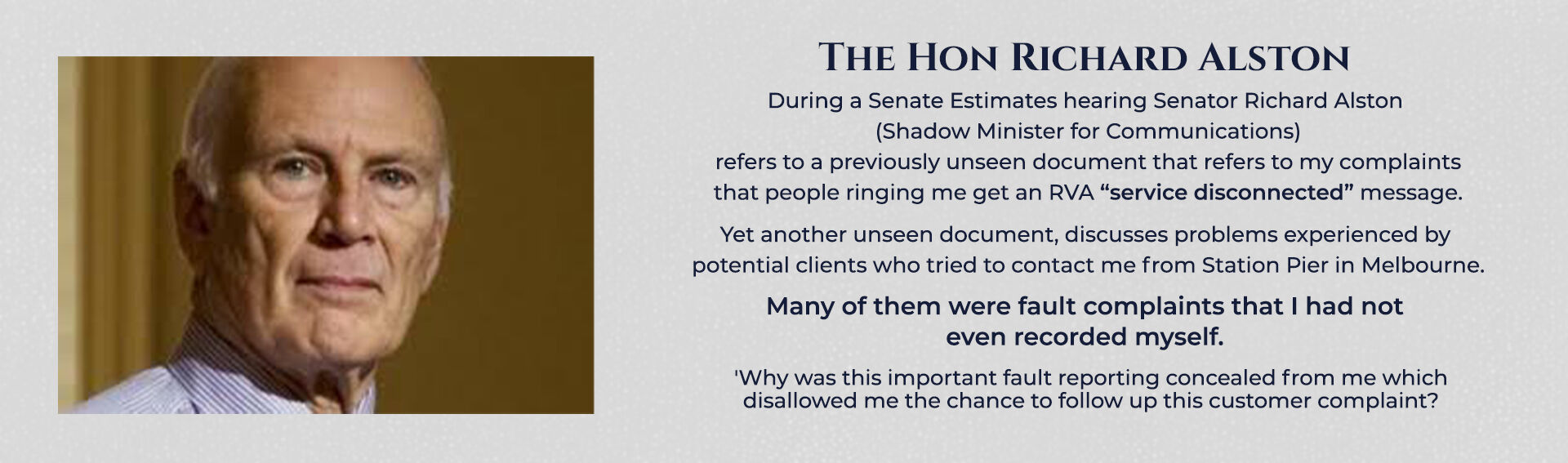
Senator Alston did not respond.
The following day, Graham, Ann, Maureen, and I signed the FTSP, trusting Robin Davey's verbal assurances that consequential losses would be included and that Telstra would honour their agreement to provide the necessary documents. I included a letter with the agreement, clearly stating my expectations:
By signing and returning this proposal, I am relying on the assurances of Robin Davey, Chairman of Austel, and John MacMahon, General Manager of Consumer Affairs, Austel, that this is a fair document. I was disappointed that Mr. Davey was unwilling to put his assurances in writing, but I am prepared to accept his word.
I would not sign this agreement if I thought it would prevent me from continuing my efforts to obtain satisfactory service for my business. It is clearly understood that nothing in this agreement prevents me from continuing to seek a satisfactory telephone service.
Despite nagging doubts, we felt a great sense of relief after sending the agreement off. The pressure on all four of us had been immense, with TV and newspaper interviews and our ongoing canvassing of the Senate. Furthermore, I never stopped advocating for change in rural telephone services, at least in Victoria.
In December 1993, David Hawker MP, my local federal member, wrote to congratulate me on my 'persistence in bringing about improvements to Telecom's country services' and to regret 'that it was at such a high personal cost.'
This was very affirming, as was a letter from the Hon. David Beddall MP, Minister for Communications in the Labor Government, which stated, in part:
The Government is most concerned about allegations that Telecom has not been maintaining telecommunications service quality at appropriate levels. I acknowledge that, in a number of cases, including Mr. Smith's, there has been great personal and financial distress. This is of great concern to me, and a full investigation of the facts is clearly warranted.
Subsequently, a number of small businesses in rural Australia began writing to me about their experiences with poor service from Telstra, detailing problems with their phones and various billing issues. On several occasions, I contacted Telstra management myself, formally requesting that these matters be resolved. I believe this was a responsible reaction to the letters I was receiving.
After I alleged that rural small-business owners and residents faced inequities in telephone services compared to their urban counterparts, rural subscribers wrote to TV stations and newspapers in support of my claims. For example, David M. Thomson & Associates, Insurance Loss Adjusters in Ballarat, wrote to the producer of Channel 7's 'Real Life', a current affairs program:
I have watched with interest the shorts leading up to tonight's program as I have similar problems to the man at Cape Bridgewater.
Their letter detailed a story of frustration:
Our office is located in Ballarat, and due to Telstra's structure, most of our local calls incur STD fees.
On many occasions, we have been unable to connect to numbers we have dialled, often receiving the message, "This number is not connected," or similar messages, which we know to be untrue.
Clients report frequently encountering an engaged signal when calling us, yet our office records indicate that at least one of our lines was free at the time.
We recently received our latest Telstra bill, which is about 25–30% higher than the last one. This is surprising because our workload during the billing period decreased by about 25%, and we have one less staff member than in the previous period.
Another example is a letter to the Editor of Melbourne's Herald-Sun, which stated:
I am writing in reference to your article in last Friday's Herald-Sun (2nd April 1993) about phone difficulties experienced by businesses.
I wish to confirm that I have had problems trying to contact Cape Bridgewater Holiday Camp over the past 2 years.
I also experienced problems while trying to organise our family camp for September this year. On numerous occasions, I have rung from both this business number, 053 424 675, and also my home number and received no response – a dead line.
I rang around the end of February (1993) and twice was subjected to a piercing noise similar to a fax. I reported this incident to Telstra, who got the same noise when testing.
(Due to multiple reports concerning this 'piercing noise', Ray Morris from Telstra's Country Division arranged to switch my service to another system. Unfortunately, this did not resolve the issue.)
TV stations reported a surge in calls whenever they broadcast stories about phone faults, with people from across the country sharing their complaints about Telstra's service. This support from the media and the public significantly boosted our morale and energised our group's efforts to have these issues addressed in the Senate.
AUSTEL, the government communications regulator, investigated my ongoing telephone problems and compiled adverse findings (points 10-212). According to government records (see Absentjustice-Introduction File 495-551), these findings were provided to Telstra (the defendants) one month before Telstra and I signed our arbitration agreement. This gave Telstra the opportunity to conceal the AUSTEL documents before my arbitration began. I did not receive a copy of these findings until November 23, 2007, 12 years after my arbitration concluded.
Point 115 –
"Some problems with incorrectly coded data seem to have existed for a considerable period of time. In July 1993 Mr Smith reported a problem with payphones dropping out on answer to calls made utilizing his 008 number. Telecom diagnosed the problem as being "Due to incorrect data in AXE 1004, CC-1. Fault repaired by Ballarat OSC 8/7/93. The original deadline for the data to be changed was June 14th 1991. Mr Smith's complaint led to the identification of a problem which had existed for two years."
Point 130 –
"On April 1993 Mr Smith wrote to AUSTEL and referred to the absent resolution of the Answer NO Voice problem on his service. Mr Smith maintained that it was only his constant complaints that had led Telecom to uncover this condition affecting his service, which he maintained he had been informed was caused by "increased customer traffic through the exchange." On the evidence available to AUSTEL it appears that it was Mr Smith's persistence which led to the uncovering and resolving of his problem – to the benefit of all subscribers in his area".
Point 153 –
"A feature of the RCM system is that when a system goes "down" the system is also capable of automatically returning back to service. As quoted above, normally when the system goes "down" an alarm would have been generated at the Portland exchange, alerting local staff to a problem in the network. This would not have occurred in the case of the Cape Bridgewater RCM however, as the alarms had not been programmed. It was some 18 months after the RCM was put into operation that the fact the alarms were not programmed was discovered. In normal circumstances the failure to program the alarms would have been deficient, but in the case of the ongoing complaints from Mr Smith and other subscribers in the area the failure to program these alarms or determine whether they were programmed is almost inconceivable."
Spoliation of evidence – Wikipedia
By providing Telstra with a copy of AUSTEL's adverse findings in March 1994, AUSTEL assisted Telstra not only during my 1994/95 arbitration defence but also in 2006. In 2006, the government could assess my claims only on a sanitised report prepared by AUSTEL, rather than on AUSTEL's original adverse findings.
Muzzling the media
Despite receiving considerable media coverage, it appeared Telstra may have been pressuring journalists to suppress certain stories.
A Telstra internal memo from July, titled 'COT Cases Latest', stated:
I disagree with raising the issue of the courts. That carried an implied threat not only to COT cases but to all customers that they will end up as lawyer fodder. Certainly, that can be a message to give face to face to customers to hold in reserve if the complainants remain vexatious.
This raises the question: How many Telstra customers, like the COT Cases, found themselves entangled in legal battles after entering arbitration or mediation, ultimately leading to broken homes and destroyed businesses?
A television news program was also seemingly targeted. Another internal memo stated:
Good news re Channel —— News. Haven't checked all outlets but as it didn't run on the main bulletin last night, we can be pretty certain that the story died the death. I wish I could figure which phrase it was that convinced —— not to proceed. Might have been one of (name deleted) pearls.
The deleted name was Telstra's Corporate Secretary at the time. The identity of the TV station and reporter has been omitted here. One can only speculate what convinced a respected journalist to abandon the story.
It later came to light that the same area general manager who deliberately misled me during the 1992-93 settlement process was appointed as one of two Telstra staff members to 'deal with the media/politicians' regarding COT issues. This raised concerns that she would misinform the media, as she had me.
Another Telstra memo from July 1993, titled 'Cot Wrap-Up', stated:
I think it should be acknowledged these customers are not going to become delighted. We are dealing with the long-term aggrieved and they will not lie down.
Further, I propose that we consider immediately targeting key reporters in the major papers and turn them on to some sexy 'Look at superbly built and maintained network' stories.
I advise that Clinton be targeted for some decent Telstra exclusive stories to get his mind out of the gutter. Prologue Evidence File No 24 to 39
This leaves the "long-term aggrieved" to wonder who "Clinton" was and why his mind was perceived to be in the gutter.
Finally, a document received long after my arbitration, Telstra FOI folio 101072 to 10123, titled "In-Service Test Performance for The Telecom Australia Public Switched Telephone Service (Telecom Confidential)," reveals:
"The performances tabulated below have been formulated to aid dispute investigation and resolution. The information contained herein is for internal Telstra Corporation use only and must not be released to any third party, particularly AUSTEL."****(refer 101072 Arbitrator File No 63)
Had AUSTEL known this document contained the explicit instruction, "must not be released to any third party, particularly AUSTEL," perhaps its public servants would not have perjured themselves defending Telstra's arbitration claims. These claims asserted that all Service Verification Testing at my business on 29 September 1994 met AUSTEL's specifications. I believe this perjury occurred not only in their 2 February 1995 letter but also in the third COT cases quarterly report to the communications minister, the Hon Michael Lee MP. As confirmed in Main Evidence File No/2 and File No 3, Telstra did not carry out its arbitration Service Verification Testing (SVT) to AUSTEL's mandatory specifications at my premises.
Throughout this narrative, and on my website, I address the government communications regulator's pre-arbitration warning to Telstra. The regulator expressed serious concerns about a specific legal firm's continued involvement in the COT settlement/arbitration process. I also question why the arbitration agreement faxed to the TIO's office on 10 January 1994 bore the abbreviated name of this same firm, despite assurances from the government that it would not have a continuing role.
This FOI document (refer to Arbitrator File No/80), dated September 1993, was released by Telstra under FOI, but was too late for use in my arbitration claim. Had it been available earlier, it might have persuaded the arbitrator to grant me more time to access Telstra's documents. The document, released post-arbitration, appears to relate to my ongoing telephone problems:
"All technical reports that relate to the customer's service are to be headed "Legal Professional Privilege", addressed to the Corporate Solicitor and forwarded through the dispute manager."
This Legal Professional Privilege designation seems connected to threats from Telstra, stating that they would only investigate my phone complaints if registered in writing with these same lawyers.
Chapter 5
Their thuggery became the operating system — not fairness, not law, not truth. Corruption was no longer hidden; it strutted openly, confident that I couldn’t fight back. This is where the machinery designed to destroy my holiday camp reveals itself.
TIO Evidence File No 3-A contains an internal Telstra email (FOI folio A05993) dated 10 November 1993. Sent by Chris Vonwiller to Telstra's corporate secretary Jim Holmes, CEO Frank Blount, group general manager of commercial Ian Campbell, and other key figures within the then government-owned corporation, the email concerns Warwick Smith and the COT cases and is marked CONFIDENTIAL:
"Warwick Smith contacted me in confidence to brief me on discussions he has had in the last two days with a senior member of the parliamentary National Party in relation to Senator Boswell's call for a Senate Inquiry into COT Cases.
"Advice from Warwick is:
Boswell has not yet taken the trouble to raise the COT Cases issue in the Party Room.
Any proposal to call for a Senate inquiry would require endorsement in the Party Room and approval by the Shadow Cabinet.
The intermediary would raise the matter with Boswell, suggesting Boswell discuss the issue with Warwick. The TIO saw no merit in a Senate Inquiry.
He undertook to keep me informed and confirmed his view that Senator Alston would not be pressing a Senate Inquiry, at least until after the AUSTEL report was tabled.
Please keep this information confidential.
A Story of Despair and Heartache:
Exhibit TIO Evidence File No 3-A confirms that two weeks before the TIO was officially appointed as the administrator of the Fast Track Settlement Proposal (FTSP), which became the Fast-Track Arbitration Procedure (FTAP), he was providing Telstra, the soon-to-be defendant in that process, with privileged government party room information about the COT cases. The TIO not only breached his duty of care to the COT claimants but also appears to have compromised his own future position as the official independent administrator of the process.
It is highly likely that the confidential advice the TIO gave to Telstra's senior executive—that Senator Ron Boswell's National Party Room was not keen on holding a Senate enquiry—later prompted Telstra to transform the FTSP's non-legalistic commercial assessment process into their preferred legalistic arbitration procedure. They now had privileged government information indicating that there was no longer a significant threat of a Senate enquiry.
Did this secret government party-room information, passed on to Telstra by the administrator of our arbitrations, have anything to do with the child sexual abuse and the cover-up of paedophile activities by a former Senator who had been dealing with the four COT Cases? The fact that Warwick Smith, the soon-to-be administrator of the COT settlement/arbitrations, provided confidential government in-house information to the defendants (Telstra) was a very serious matter.
On 17 January 1994, Warwick Smith, the Telecommunications Industry Ombudsman (TIO), distributed a media release announcing that Dr. Gordon Hughes would be the assessor for the four COT Fast Track Settlements processes. The TIO did not mention that, as I had feared, Telstra was not abiding by their agreement and was not supplying us with the discovery documents critical for establishing our cases. The TIO also failed to inform the Australian public in this media release that he had agreed to secretly assist Telstra by providing them with information about the COT Cases issues being discussed in the Coalition government Party Room.
Telstra and the TIO were treating us with sheer contempt, in full view of the TIO and the assessor. We were beginning to believe that no single person, and no organisation, anywhere in Australia, had the courage to instigate a judicial inquiry into the way Telstra steamrolled their way over legal process.
Despite Austel's chairman, Robin Davey, expressing his frustration to Telstra regarding their failure to provide the necessary documents, his efforts proved fruitless. In February 1994, Senator Ron Boswell questioned Telstra in the Senate, but, as before, no practical outcome was achieved. (Over the following years, various Senators repeatedly raised questions in the Senate about the failure to supply FOI documents. While their persistence eventually benefited some COT members, I was not among them.)
Compounding the existing difficulties, a new problem emerged for the COT Four. The assessor, initially engaged to conduct a commercial assessment, was somehow persuaded (presumably by Telstra) to abandon that process in favour of an arbitration procedure mirroring Telstra's own. This shift guaranteed a protracted and legalistic process, far from the promised "fast track." Telstra was well aware that none of us possessed the financial resources to challenge their powerful legal team in such a setting. This was the antithesis of what we, the COT members, had wanted. We had agreed to a commercial assessment, and that was what we expected.
Graham Schorer, the COT spokesperson, contacted the TIO to explain the COT Four's rejection of the arbitration process. However, our concerns were dismissed. The TIO stated that he had dedicated too much time to his role as administrator of our FTSP, resulting in significant expenses for his office (expenses Telstra was slow to reimburse). He further stated that his office had no intention of incurring further expenses on our behalf. He informed Graham that if we refused to abandon our commercial agreement with Telstra, Telstra would exert every effort to force us into a position where we would have to take them to court to resolve our commercial losses.
Furthermore, the TIO threatened to resign as administrator if we pursued legal action to compel Telstra to honour the original commercial assessment agreement. He insisted that his resignation would effectively terminate the FTSP, leaving us with no option but to pursue individual legal action to resolve our claims.
The following excerpt from a Telstra internal memo, dated 30 November 1993 (FOI document folio D01248), reveals the extent of Telstra's involvement. The memo, written by Ted Benjamin, Telstra's Group Manager – Customer Affairs and TIO Council Member, to Ian Campbell, Customer Projects Executive Office, is titled "TIO AND COT." It was written seven days after Alan signed the TIO-administered Fast Track Settlement Proposal (FTSP). In this memo, Mr Benjamin states:
"At today's Council Meeting the TIO reported on his involvement with the COT settlement processes. It was agreed that any financial contributions made by Telecom to the Cot arbitration process was not a matter for Council but was a private matter between Telecom, AUSTEL, and the TIO.
I hope you agree with this."
This demonstrates that Telstra was at least partially, if not fully, funding the arbitration process.
For true transparency, the claimants should have received detailed information about the funds allocated during the four COT arbitrations, specifically the amounts paid to the arbitrator, the Arbitrator's Resource Unit, the TIO, and the TIO's special counsel for their professional advice.
However, it remains unclear how the arbitrator billed Telstra for professional fees, or how the TIO billed Telstra for its own fees, as well as those of the TIO-appointed Resource Unit and special counsel. This raises critical questions:
-
Were the arbitrator and Resource Unit compensated on a monthly basis?
Did the Resource Unit receive additional bonuses for their undisclosed appointment as the second arbitrator, responsible for determining which arbitration documents the primary arbitrator could access (see Telstra's letter to Warwick Smith, dated 11 July 1994)?
Without full disclosure of how these payments were distributed by the defence to the involved parties in the initial four arbitrations, the TIO and AUSTEL (now ACMA) cannot credibly maintain that the COT arbitrations were administered independently.
In essence, during these four arbitrations, the defence was permitted to pay the arbitrator and other process participants. This arrangement is akin to a defendant in a criminal case paying the judge, representing a clear and deeply concerning conflict of interest.
Despite these concerns, Senator Richard Alston discussed the "Problem 1" document during a Senate Estimates hearing on 25 February 1994. Furthermore, another previously unseen document, dated 24 July 1992 and provided to Senator Alston in August 1993, includes my phone number and references my complaint about the "service disconnected" message callers received. A subsequent document, dated 27 July 1992, details issues experienced by potential clients attempting to contact me from Station Pier in Melbourne (see Arbitrator File No 60).
Some of these handwritten records date back to October 1991 and include numerous fault complaints that I did not personally record. Telstra has never explained who authorized the withholding of the complainants' identities from me. Had I known who was unable to reach me, I could have provided them with an alternate contact number. Could the withholding of these names and the unavailability of my historical fault documents be linked to the Jim Holmes issues referenced in documents A01554, A06507, and A06508 (TIO Evidence File No 7-A to 7-C)?
The TIO betrayed us.
Our pleas to the TIO to continue with the original FTSP agreement were ignored. AUSTEL offered no assistance, leaving us with no alternative but to prepare for an arbitration process by April 1994. Our initial step was to familiarise ourselves with the rules of arbitration, unaware that Telstra's lawyers had drafted them.
We were repeatedly assured, as were Austel and the Senate, that the arbitration agreement rules had been drafted specifically for this purpose, independently of Telstra, by the President of the Institute of Arbitrators of Australia. Despite the TIO's office apparently possessing a copy of these rules, our requests for one were denied, the TIO claiming it was 'irrelevant to our cause.' We asked the TIO multiple times, but to no avail. Instead, we were told to trust the arbitrator, and foolishly, we did. Exhausted, stressed, and desperate, we felt we had no other choice. Both individually and collectively, we were vulnerable to Telstra's overwhelming corporate power.
The rules included a confidentiality agreement that prohibited anyone involved from discussing the arbitration process. This meant that any criminal offences committed by either party would be effectively shielded from investigation, enabling a cover-up. In my case, despite the TIO and the arbitrator being aware that Telstra had perverted the course of justice during my arbitration, this confidentiality clause has, to date, prevented any investigation into this unlawful conduct.
The later revelation in the Senate that Telstra and their government minders had concealed the requested claim documents of the COT Cases highlights the ineffectiveness of the Establishment in searching for the FOI documents related to the COT Cases.
The Establishment
The Australian Establishment clearly viewed the arbitrator favourably, likely because they believed he was protecting the assets of the then government-owned telecommunications carrier, thereby safeguarding public funds and creating a beneficial outcome for all Australians. However, what the arbitrator and the government have consistently failed to acknowledge is that bending the law to protect Telstra and its shareholders constituted a breach of the rule of law. Telstra, the TIO (which also administered the arbitrations), and the arbitrator used their positions to mislead interested government ministers and the media, leading them to believe that, once an award had been handed down, the services investigated during the arbitration were operating efficiently and effectively.
Whenever a claimant disputed this or fought back, Telstra, the TIO, and the arbitrator would relentlessly contest the accusations, aiming to exhaust the claimant and eventually wear them down. As documented in Bad Bureaucrats, for six years after my arbitration, no one investigated my complaints of ongoing, unaddressed arbitration faults. I reluctantly sold my business to the Lewis family in December 2001, and their subsequent seven-year, unsuccessful struggle to resolve these problems is a recurring theme throughout our
story—a story of despair and heartache.
To understand the events surrounding this statutory declaration, it's necessary to go back to before April 1994. At that time, the appointed commercial assessor, along with the first TIO and Telstra (the defendants), decided to transform the commercial assessment, FTSP, into a highly legalistic arbitration process. Telstra's lawyers controlled at least 33 of Australia's largest legal firms and most, if not all, of Australia's technical resource units (see Senate Hansard for 24 June and 26 September 1997). By using Telstra's drafted arbitration agreement, faxed to the TIO on 10 January 1994, Telstra gained a significant advantage in controlling the entire arbitration process. Later, Dr. Hughes, in his letter of 12 May 1995 (see Open Letter File No/56-A), alerted the TIO that they had been misled by Telstra into using an agreement that did not allow enough time for the:
"inevitable delays associated with the production of documents, obtaining further particulars and the preparation of technical reports".
The only ethical course of action for these two lawyers would have been to admit they misled and deceived the four COT cases, the claimant's lawyers, and many of Australia's government ministers, including the Canberra Parliament House press gallery, into believing the arbitration agreement was prepared independently of Telstra. They knew this was false. Instead, they chose to conceal their actions, a decision that has, in effect, stolen 22 years of our lives.
Prior to this, on 18 November 1993, the Chairman of Austel refused to confirm in writing his verbal assurance that consequential losses would be included in the FTSP, explaining that doing so could set a precedent. Telstra's Corporate Secretary had written to him on 18th November 1993 (FOI D01274 to D01276), stating that:
"(3) Telecom does not accept the COT Cases' grounds for reviewing the earlier settlements. However, on the basis of a denial of liability and without any legal obligation to do so and purely as a matter of good faith and business expediency, Telecom is prepared to agree to the above-mentioned review.
(4) This proposal constitutes and offer open to all or any of the COT Cases referred to in Clause (1) (a), which will lapse at 5 pm Tuesday 23 November 1993. This offer may be accepted by signature below and sending advice of such signature to AUSTEL or the Telstra Corporate Secretary before that time."
On 23 November, Graham Schorer, Ann Garms, Maureen Gillan, and I signed the FTSP, trusting in the Regulator's verbal assurances that consequential losses would be included. These signed FTSP agreements were then forwarded to Telstra's corporate secretary. Alan included a letter with his agreement, clearly stating his expectations of the process:
"In signing and returning this proposal to you, I am relying on the assurances of Mr. Robin Davey, Chairman of Austel, and Mr. John MacMahon, General Manager, Consumer Affairs, Austel, that this is a fair document. I was disappointed that Mr. Davey was unwilling to put his assurances in writing but am nevertheless prepared to accept what he said."
What follows is:
I would not sign this agreement if I believed it would hinder my efforts to secure satisfactory service for my business. It is my understanding that nothing within this agreement prevents me from pursuing a resolution to obtain satisfactory telephone service.A more precise chronology of events surrounding the Fast Track Settlement Proposal versus the Fast Track Arbitration Procedure, as well as information on who drafted the original FTAP, can be found by clicking on Evidence-C A V Part 1, 2 and 3-Chapter 3 - Fast Track Settlement Proposal.
Signing for arbitration, April 1994
On April 21, 1994, when we signed the documents to initiate the new arbitration procedure, we still had not seen the arbitration rules. We wanted to review the rules to understand the process and ensure they differed from Telstra's proposed rules. However, the TIO disregarded our concerns, and we signed the agreement without seeing the rules. We later discovered that the TIO's office had been supplied with a set of rules titled "Telstra Corporation- Limited 'Fast Track' Proposed Rules of Arbitration." It was clear why they had been withheld from us; the assurance we received regarding the drafting of the rules was false. Unsurprisingly, nobody seemed interested in addressing this deception.
At this time, my focus shifted to
preparing my case for arbitration. In April 1994, Austel released its report on the COT cases, and I used its findings and recommendations to support my claims. While I felt that Austel's findings regarding my case were less forceful than my original submissions, I later learned that Austel had toned down the report because Telstra threatened to file an injunction that would delay its release for years. To ensure the COT four could access the report's information for preparing our claims, Austel agreed to the amendments Telstra demanded. I was unaware of the "secret" draft mentioned at the end of Chapter Three until 2007.
Nevertheless, the Austel Report confirmed a significant point. Despite Telstra's constant "No fault found" response, technicians' records revealed the truth. For instance, on occasions when I reported the phone ringing briefly and then disconnecting, officials denied the fault. However, the Austel report indicated otherwise:
"In the period February to April 1993, Telstra staff responding to complaints lodged by Mr. Smith of the Cape Bridgewater Holiday Camp recorded in their notes that there was a fault known to exist in AXE (digital) switching equipment which could give rise to a single burst of ring, followed by a busy tone to a caller and dial tone to the called party."
This is evidenced by comments from technicians on complaint forms:
"This problem occurs intermittently throughout the network, and although it is recognised, no single person or group appears to be responsible for resolving it."
"I believe this may be related to the AXE network problem, which results in only one ring burst and a busy tone for the calling party."
A New Fault
Even as I began compiling my claims, a new fault emerged: the "hang-up" fault. While Telstra refused to provide documentary evidence for my claims, I contacted their engineers to test the hang-up fault, inadvertently creating additional evidence that would likely be withheld.
Since August 1993, I had reported to Telstra that customers and friends had noticed unusual behavior on my direct line, which also served as a fax line. After I ended calls I had initiated, they could still hear me moving around the office if they were slow to hang up. Distracted by other ongoing issues, I hadn't initially focused on this, but now I needed to address it.
On April 26, 1994, I contacted Cliff Matherson, a senior engineer at Austel, who suggested a series of tests. First, I was to hang up and count aloud from one to ten while he listened from his end. He could hear me clearly through the number ten and suggested we repeat the test, counting even higher. Again, he could hear me throughout my counting. Next, he suggested swapping the phone on that line with the phone on my other line (both were identical Telstra Exicom T200 phones). We repeated the test, with the same results. According to Mr. Matherson, and as was also apparent to me, this proved the fault was not in the phone itself, but somewhere within the Telstra network. He then suggested I contact Telstra, which I did.
I explained to the Telstra engineer that I could count to 15 or more after hanging up, and the person on the other end could hear me. I deliberately omitted that I had tested two different phones, knowing Telstra's tendency to initially blame the customer's equipment. I was curious to see their initial diagnosis.
After performing the same tests as the Telstra engineer and obtaining matching results, he promised to send a technician to collect the phone the following day. However, an internal Telstra email from March 1994 reveals that their engineer was aware, even before these tests, that heat in the Cape Bridgewater exchange was causing the fault. This email, quoted below, further suggests Telstra was aware of phone faults in the exchange while I was preparing my claim for arbitration:
I am concerned to note that heat may be part of the problem. I had occasion earlier this year to get involved in another 'ongoing' case involving an RCM with a heat problem at Murrumbateman (just outside Canberra). I do note, that one of the symptoms from the Murrumbateman case was 'Not Receiving Ring,' something Alan Smith at Cape Bridgewater has been complaining about for some time.
Comparing my Telstra account with Telstra's data for the period shows that call hang-ups and incorrect charging occurred from at least August 1993 until the phone was removed on April 27, 1994. The phone itself, an Exicom manufactured in April 1993, later proved to be a significant element in this saga, a story I will recount later.
Preparational Costs
In May 1994, I finally received a large bundle of FOI documents from Telstra, which I had originally requested in December 1993. This was five months past the 30-day deadline mandated by the FOI Act. Despite the Act's clear requirements, Telstra seemed immune to government oversight. Initially, I was hopeful, thinking, "Now we're getting somewhere." However, the documents lacked any numbering system, were not in chronological order, and many were unreadable due to excessive redaction. This would have frustrated even the most experienced lawyer. How could I effectively support my claim with such deficient material?
Assistance from a law student would have been invaluable. The sheer volume of documents was overwhelming, especially given the knowledge that Telstra's extensive legal team was poised to exploit any weakness in my claim.
consulted with the TIO and his legal counsel, expressing my lack of confidence and reiterating Robin Davey's belief that a non-legalistic hearing would be the fairest approach. The TIO could only offer the unhelpful advice to "Do the best you can," while his legal counsel assured me the process was fair.
This is a story of despair and heartache.
I eventually realised I had no choice but to seek professional help. I started by contacting a loss assessor in Mt Gambier, a firm that had previously assisted me with storm damage at the camp. The assessor remembered difficulty reaching me by phone in the past. After discussing my current situation, he determined my problems were outside his expertise. I then broadened my search to the Melbourne area, contacting four communications companies. Disappointingly, three never responded, and the fourth wished me luck, stating they didn't want to challenge Telstra.
Following this, I contacted George Close in Queensland. George possessed technical expertise in telecommunications and was already working on Ann Garms's case. He agreed to take on my case as well, believing that working together would provide greater insight into Telstra's operations. Once Telstra learned of George's involvement, they offered him a job, seemingly attempting to eliminate our support. However, George, at 70, refused, citing a conflict of interest and declining their offer.
I still needed help assembling the entire claim. I found Garry Ellicott, an ex-National Crime Authority detective working with the loss-assessor company Freemans in Queensland. Derek Ryan, a forensic accountant, completed my team.
I felt cautiously optimistic. Government ministers, Austel, and even the auditors agreed that the COT cases were valid and Telstra was at fault. Despite this, we remained in a difficult position, facing financial hardship without any assistance. I was raising funds by selling camp equipment and borrowing from friends.
When I signed on for the FTSP in November 1993, it wasn't for a legal arbitration. The plan made no provision for the legal professionals needed to support our cases, either initially or after implementation. Had I known that professional fees would exceed $200,000, I would never have agreed to the arbitration, even under extreme duress.
Under Surveillance
Telstra email K01006, dated Thursday, April 7, 1994, at 2:05 pm, raises two key issues. First, the date falls during my involvement in a Regulator-designed commercial agreement with Telstra, making secret observations inappropriate. Second, the email refers to a period when I would be away from my business during the pending arbitration process. The email's author describes:
Mr. Alan Smith was absent from his premises from August 5, 1994, to August 8, 1994. In the past, his absences have coincided with documented complaints (typically received months later) involving NRR, etc. On April 6, 1994, at approximately 4:55 pm, I called the premises. The call was answered after 41 seconds.On this occasion, I intend to document his absence and compile all available data for that period. This will allow us to be prepared for any subsequent issues.
Evidently, in April 1994, the writer knew of my planned absence in August of that year—four months in advance.
This document, along with others suggesting my private telephone conversations were being 'bugged,' was provided to the then-Minister for Communications, the TIO, and the Federal Police. Another FOI document, Folio 000605, clearly indicates that the writer knew when "...Smith is in Melbourne." I visited Melbourne (see AFP Evidence File No 8) for promotional tours of individual clubs, advertising our packaged two- and three-night outdoor activities: horse riding, canoeing, caving, and bushwalking.
How could the writer possess this information unless someone had listened to my calls to determine my travel dates and which local staff member would be on duty at the camp? The AFP transcripts from my interview on September 26, 1994 (see AFP Evidence File No 1) reveal numerous instances in which the AFP documented information in these FOI documents that could only have been obtained by Telstra listening in on my private telephone conversations. Telstra has never adequately explained how they acquired this information.
Furthermore, this same individual stated that he knew I had spoken to Malcolm Fraser, the former Australian Prime Minister, by phone, and when that conversation occurred (AFP Evidence File No 7). He claims I told him about this conversation, which is untrue. Again, Telstra has failed to provide a convincing explanation for their employee's knowledge of this information. Clearly, Telstra was still monitoring my private calls, even though I was involved in litigation with them and their lawyers.
While listening to private calls is reprehensible, the following information is even more incriminating. Page A133 of the official Senate Hansard records, dated February 25, 1994, documents the then-Shadow Minister for Communications questioning the Regulator's Chairman:
"Why did not Austel immediately refer COT's allegations of voice recording to the federal police instead of waiting for the minister to refer the matter to the Attorney-General and then on to the federal police?"
A letter dated 2 March 1994, from Telstra's Corporate Solicitor, Ian Row, to Detective Superintendent Jeff Penrose (see Home Page Part-One File No/9-A to 9-C), indicates that Mr. Penrose was misled regarding the faxing problems I was experiencing. Comparisons between exhibits numbered (File No/9-C) and the interception evidence revealed in Open Letter File No/12 and File No/13 have led many to conclude that had Ian Row not misled the AFP about my faxing issues, the AFP could have prevented Telstra from intercepting relevant arbitration documents in March 1994, before any damage occurred.
This document, along with others suggesting my private telephone conversations were being monitored, was supplied to the then-Minister for Communications, the TIO, and the Federal Police. Another FOI document, Folio 000605, shows the writer knew when "...Smith is in Melbourne." I used to travel to Melbourne (see AFP Evidence File No 8) for promotional tours to single clubs, advertising outdoor activities with two and three-night stays. This information could only have been obtained by monitoring my calls to determine my travel dates and which staff member would be on duty at the camp. The AFP transcripts of my interview on 26 September 1994 (see AFP Evidence File No 7) document many instances where Telstra must have listened to our private telephone conversations to gather the details included in these FOI documents. Open Letter File No/12 and File No/13 demonstrate that COT cases' faxes were intercepted during their arbitrations.
The section "Australian Federal Police Investigations" details how Dr Hughes, the arbitrator, interrogated me for 5 hours in the presence of 2 of Telstra's arbitration defence officers. These questions were clearly aimed at discovering the progress of the Australian Federal Police investigation into whether my faxes were being intercepted, as requested by the then-Government Minister, Michael Lee MP. This type of interrogation was forbidden by the signed arbitration agreement.
In January 1999, the arbitration claimants provided the Australian government with a report confirming that confidential, arbitration-related documents were secretly and illegally screened before reaching their intended recipients. In my case, despite the arbitrator's secretary advising the arbitration process that six of my faxed claim documents never reached the arbitrator's office, I was not allowed to resubmit this material for assessment. My fax account confirms that I dialled the correct fax number on all six occasions.
In 1994, none of the Customer Owned Telecommunications (COT) cases, including mine, involved individuals on any terrorist list, nor were we ever suspects in crimes against Australian citizens. Why, then, did Telstra hack our confidential arbitration and Telstra-related documents? For example, 43 sets of my faxed correspondence to the arbitrator's office, some with attachments, are missing from the Arbitration Schedules of Material. Front Page Part One File No/1 shows that the arbitrator's secretary informed Tony Watson of Telstra's arbitration defence unit on May 23, 1994, that six of my claim documents never reached the arbitrator's fax machine. Yet, I was billed for these faxes. Despite this evidence, neither the arbitrator's office nor the Telecommunications Industry Ombudsman (TIO) allowed me to amend my claim to include these proven "not received" documents, preventing them from being valued in support of my claim.
I managed to bring Garry Ellicott to my camp for a few days in May 1994 to observe the phone situation. Based on his experience as a bodyguard for former US President Jimmy Carter during his Australian visit, Garry believed I was being watched, or rather, that my conversations were being monitored.
I had already experienced several instances of Telstra collecting my personal information: details of my incoming calls (who called, when, and from where), staff departures from my business, and even my movements. In April 1994, a Telstra fault reporting officer in Melbourne seemed to know my movements four months in advance. In an internal memo to a colleague, he wrote:
Mr Alan Smith is absent from his premises from 5/8/94 – 8/8/94. On other occasions when he has been absent there have been documented complaints received (usually months later) involving NRR etc ...I intend on this occasion to document his absence and file all data I can collect for the period. That way we should be prepared for anything that follows.
Telstra has never explained how this fault officer obtained this information, nor how he knew about my phone conversation with former Australian Prime Minister Malcolm Fraser, including when it occurred.
The officer claims I told him about the conversation, but this is untrue.
Around the time of the "briefcase saga," an unidentified Telstra technician offered to provide a list of phone numbers I had called. I had previously learned that this technician was listening to my private conversations. When confronted, he admitted to eavesdropping and informed me that he was not the only technician in Portland doing so.
A story of despair and heartache:
Early in our arbitrations, Graham Schorer, in his role as COT spokesperson, received two phone calls within a few days of each other. Both calls were from young people who claimed to have hacked into Telstra's email network. They told Graham they knew we were in arbitration with Telstra and wanted to alert him to documents they had found that confirmed unlawful actions were being taken against us by people close to both our arbitration and Telstra. On both occasions, they offered to send us this evidence.
Graham and I discussed the offer after the first call, but after the second, we declined. Although we were interested in what Graham had heard, we were concerned it might be a set-up by Telstra. We feared that accepting this evidence, however promising, could lead to our arbitrations being declared null and void.
Since then, Andrew Fowler and Suelette Dreyfus have published books referencing Julian Assange's hacking into Telstra's Lonsdale Telephone Exchange in Melbourne, through which Graham's and my businesses were trunked. Could it have been Julian Assange and his associates who contacted us? His well-known concerns about the COT cases not receiving due justice certainly align with his profile.
In hindsight, we likely should have accepted their offer. We might have been able to use that evidence against Telstra at the time, and perhaps we wouldn't be writing our story 20 years later.
More on this aspect of the COT story can be found on our website, absentjustice.com, on our Hacking - Julian Assange page.

Between February and September 1994, I provided documents to the Australian Federal Police (AFP) that I had obtained under the Freedom of Information (FOI) Act. These documents showed that Telstra knew more about my private and business affairs than it should have. On June 3, 1990, while Telstra claimed it had found no network faults affecting my businesses, "The Australian" newspaper published an article titled "Telecom 'spying' on its employees." This article supports pages 1 to 6 of the AFP transcripts (see Senate Evidence File No/ 44 Part 1 and File No/45 Part). The article stated:
"She said the accusations were contained in a statement by a former member of Telecom's Protective Services branch.
"Senator Jenkins said the man claimed:
He and other Telecom employees and private investigators hired by Telecom did secret surveillance on hundreds of compensation recipients. ...
He had been directed by his superior to use whatever methods to get the desired results, even when it was obvious the claimant was genuinely injured.
Claimants have had a 'C.CASS run' on their homes, which is a procedure where a computer can print out all numbers dialled on a home phone." (See Hacking-Julian Assange File No/19)
Democrat Senator Jean Jenkins told the Senate last week that Telecom's activities included bugging workers' homes.
In February 1994, the Australian Federal Police (AFP) visited my business in Cape Bridgewater to discuss my claims that recently obtained Freedom of Information (FOI) documents suggested Telstra had been monitoring my telephone conversations. The AFP was concerned about Telstra's practice of writing the names of individuals and businesses I had contacted on CCAS (Customer Call Accounting System) data records. These records, which compiled all incoming and outgoing calls to my business (see Hacking-Julian Assange File No 20), contained handwritten notes in the right-hand column. These notes included, alongside specific dates, the names of people I had called or faxed. For example, entries such as "31 January 1994, GM (Golden Messenger), AUSTEL, and the Ombudsman" appeared. In one instance, the name "Faye Smith" was noted when I called my ex-wife. This mirrored Senator Jenkins' earlier statements regarding Telstra's alleged secret surveillance of its own employees in 1990, suggesting Telstra employed similar tactics in January 1994, even while engaged in litigation with me.
Chapter 6 - Arbitration
🗂️ Senate Investigations and the BCI Deception
I am using the following witness two witness statements File 766 - AS-CAV Exhibit 765-A to 789), because they prove that at least one police officer, when dealing with the Telstra Corporation during the investigation which Mr Neil Jepson seconded me to assist the Victoria Police was left floundering as were the COT Cases when they were forced into arbitration with the same monster who the arbitrator and administrator of the COT arbitrations were afeared to abandon the COT arbitrations because of the power and influence Telstra has over the legal system in Australia. Please read the following two witness statements. The Major Fraud Group archive documents will be confirmed as faxes below my office, and Mr Jepson did not arrive, even though my Telstra fax account shows they were sent.
This troubled Mr Jepson, and Detective Sergeant Rod Kuris, who was assisting not Mr Jepson and me in piecing together fraud-nominated documents. It is clear from Telstra ex-security officer Des Direen that Mr Rod Kuris was shaken when Des Direen notified us that we were under electronic surveillance, as the following witness statement shows.
"I can recall that during the period 2000/2001, I had arranged to meet Detective Sergeant Rod KURIS from the Victoria Police Major Fraud Squad at the foyer of Casselden Place, 2 Lonsdale Street, Melbourne. At the time, I was assisting Rod with the investigation into alleged illegal activities against the COT Cases.
Rod then stated that he wanted me to follow him to the left side of the foyer. When we did this he then directed my attention to a male person seated on a sofa opposite our seat. He then told me that the person had been following him around the city all morning. At this stage Rod was becoming visibly upset and I had to calm him down. Rod kept on saying that he couldn't believe in what was happening to him. I had to again calm him down".
Points 21 and 22 in Mr Direen’s statement also record how, while he was a Telstra employee, he had cause to investigate “… suspected illegal interference to telephone lines at the Portland exchange,” but when he “… made inquiries by telephone back to Melbourne (he) was told not to get involved and that another area of Telstra was handling it” and that “... the Cape Bridgewater complainant was a part of the COT cases” (my Cape Bridgewater Holiday Camp) business.
What has not been proven, even though both the arbitrator, Dr Gordon Hughes and the administrator to my arbitration, Warwick Smith, were aware that the Australian Federal Police was investigating the same phone/fax interception issues that Des Direen on behalf of Telstra was investigating at the Portland Telephone exchange, were real problems of great concern no stepped forward to confirm either one way of another transparently were my advance group booking enquires being redirected to another holiday camp operator or a booking agent on commission from holiday camp operators to bring business their way unaware that business they were now being advised of was poached from my intercepted telephone and faxes?
Please note that the concluding Chapters 8 to 12 of the above home page are currently undergoing editing as of 07/04/2026. I am aiming to have these four chapters finalised by April 10, 2026.

Telstra-Corruption-Freehill-Hollingdale & Page
Corrupt practices persisted throughout the COT arbitrations, flourishing in secrecy and obscurity. These insidious actions have managed to evade necessary scrutiny. Notably, the phone issues persisted for years following the conclusion of my arbitration, established to rectify these faults

Confronting Despair
The independent arbitration consultants demonstrated a concerning lack of impartiality. Instead of providing clear and objective insights, their guidance to the arbitrator was often marked by evasive language, misleading statements, and, at times, outright falsehoods.

Flash Backs – China-Vietnam
In 1967, Australia participated in the Vietnam War. I was on a ship transporting wheat to China, where I learned China was redeploying some of it to North Vietnam. Chapter 7, "Vietnam—Vietcong," discusses the link between China and my phone issues.

A Twenty-Year Marriage Lost
As bookings declined, my marriage came to an end. My ex-wife, seeking her fair share of our venture, left me with no choice but to take responsibility for leaving the Navy without adequately assessing the reliability of the phone service in my pursuit of starting a business.

Salvaging What I Could
Mobile coverage was nonexistent, and business transactions were not conducted online. Cape Bridgewater had only eight lines to service 66 families—132 adults. If four lines were used simultaneously, the remaining 128 adults would have only four lines to serve their needs.

Lies Deceit And Treachery
I was unaware of Telstra's unethical and corrupt business practices. It has now become clear that various unethical organisational activities were conducted secretly. Middle management was embezzling millions of dollars from Telstra.

An Unlocked Briefcase
On June 3, 1993, Telstra representatives visited my business and, in an oversight, left behind an unlocked briefcase. Upon opening it, I discovered evidence of corrupt practices concealed from the government, playing a significant role in the decline of Telstra's telecommunications network.
Not Fit For Purpose (Duplicate 1)
AUSTEL investigated the contents of the Telstra briefcases. Initially, there was disbelief regarding the findings, but this eventually led to a broader discussion that changed the telecommunications landscape. I received no acknowledgement from AUSTEL for not making my findings public.
&am

A Government-backed Arbitration
An arbitration process was established to hide the underlying issues rather than to resolve them. The arbitrator, the administrator, and the arbitration consultants conducted the process using a modified confidentiality agreement. In the end, the process resembled a kangaroo court.

A Non-Graded Arbitrator
Who granted the financial and technical advisors linked to the arbitrator immunity from all liability regarding their roles in the arbitration process? This decision effectively shields the arbitration advisors from any potential lawsuits by the COT claimants concerning misconduct or negligence.<

The AFP Failed Their Objective
In September 1994, two officers from the AFP met with me to address Telstra's unauthorised interception of my telecommunications services. They revealed that government documents confirmed I had been subjected to these violations. Despite this evidence, the AFP did not make a finding.&am

The Promised Documents Never Arrived
In a February 1994 transcript of a pre-arbitration meeting, the arbitrator involved in my arbitration stated that he "would not determination on incomplete information.". The arbitrator did make a finding on incomplete information.