
Tampering with Evidence
For the Record
The TF200 EXICOM "Sticky Beer" Affair
The controversy surrounding Telstra's handling of my TF200 EXICOM telephone began shortly after the device was removed from my business on 27 April 1994, only one week after I had signed my arbitration agreement. What followed was not simply a technical dispute over a faulty telephone. It evolved into a campaign that questioned my credibility, damaged my reputation, and ultimately became one of the most disturbing examples of alleged evidence tampering in my entire arbitration battle.
At the centre of this controversy was an allegation that I had telephoned Mrs Hughes at approximately 2:00 a.m. while intoxicated. This allegation was later highlighted by John Pinnock, the second Telecommunications Industry Ombudsman, in correspondence to Laurie James, President of the Institute of Arbitrators Australia. The timing of that correspondence effectively undermined Mr James's investigation into Dr Hughes' conduct and helped Telstra maintain the TF200 telephone as a cornerstone of its arbitration defence.
According to Telstra's version of events, the lock-up faults affecting my telephone service were not the result of defects within the network or the TF200 itself. Instead, they suggested that beer had entered the telephone and caused the malfunction. This theory conveniently shifted responsibility from Telstra's network onto me personally.
The allegation was as insulting as it was implausible.
At the very time Telstra later claimed beer had been spilt into the telephone, I was serving with the Cape Bridgewater Country Fire Authority, helping fight an out-of-control bushfire. CFA records show that I spent approximately thirteen hours on active fire duty across the relevant period. As a CFA driver involved in dangerous backburning operations, I could not have been drinking alcohol while carrying out those responsibilities.
Readers seeking further background should refer to "The First Remedy Pursued" and the associated evidence records. Even more disturbing is that, despite repeated requests, neither Warwick Smith, the first TIO, nor Dr Hughes properly investigated the circumstances surrounding the TF200 evidence. Instead, the disputed telephone remained central to Telstra's defence throughout the arbitration.

ABSENT JUSTICE: Tampering with Evidence
My concerns regarding the TF200 fault first intensified on 26 April 1994 after a series of tests conducted with AUSTEL officer Cliff Mathieson. During those tests Mr Mathieson asked me to hang up the telephone and count aloud while he monitored the connection from the other end. On multiple occasions he could hear me counting long after the telephone should have released the line. We repeated the exercise with another telephone connected to a different service. The same fault occurred.
Those tests demonstrated that the problem was not confined to one handset. Both Mr Mathieson and I concluded that the fault appeared to exist somewhere within the Telstra network.
Mr Mathieson advised that I should immediately report this information to Telstra's chief engineer, Peter Gamble. Years later, Telstra whistleblower Lindsay White identified Mr Gamble during a Senate Estimates hearing as one of the individuals associated with Telstra's determination to stop the first COT claimants "at all costs" from proving their cases (Senate Hansard ERC&A 36, 24 June 1997, Front Page Part One File No/23).
When I subsequently contacted Mr Gamble, I deliberately did not disclose that AUSTEL and I had already tested multiple telephones. Mr Gamble then conducted similar tests and arranged collection of the TF200 telephone the following day.
Internal Telstra documents obtained under Freedom of Information reveal that Telstra's own personnel initially suspected exchange-related causes rather than customer misuse. FOI document K00941 noted that personnel believed the lock-up fault could be associated with the Cape Bridgewater RCM exchange (Tampering With Evidence File No 1-A to 1-C). Another document, K00940, suggested that heat within the exchange may have been contributing to the problem. Within the same file, Folio R37911 recorded that when technicians substituted another EXICOM telephone, the problem appeared to disappear. Significantly, the original telephone was simply marked and tagged for further examination rather than identified as being contaminated by liquid or alcohol (File No 1-C).
On 27 April 1994, the EXICOM TF200 was taken from my premises.
Years later, FOI records confirmed that Telstra already knew moisture-related lock-up faults affected many TF200 telephones, particularly those deployed in coastal and damp environments. Telstra was equally aware that heat-related issues had been identified in exchanges serving locations such as Cape Bridgewater. Nevertheless, when I eventually received Telstra's arbitration defence on 12 December 1994, it included a twenty-nine-page technical report claiming laboratory testing had determined that my TF200 was solely responsible for the faults.
The problem with that conclusion was that the evidence did not support it.
Six years after the arbitration concluded, further testing demonstrated that the same lock-up fault still existed on the 055 267230 service. The replacement TF200 installed after the original handset was removed continued exhibiting identical symptoms until August 2001. The network fault had never truly disappeared.
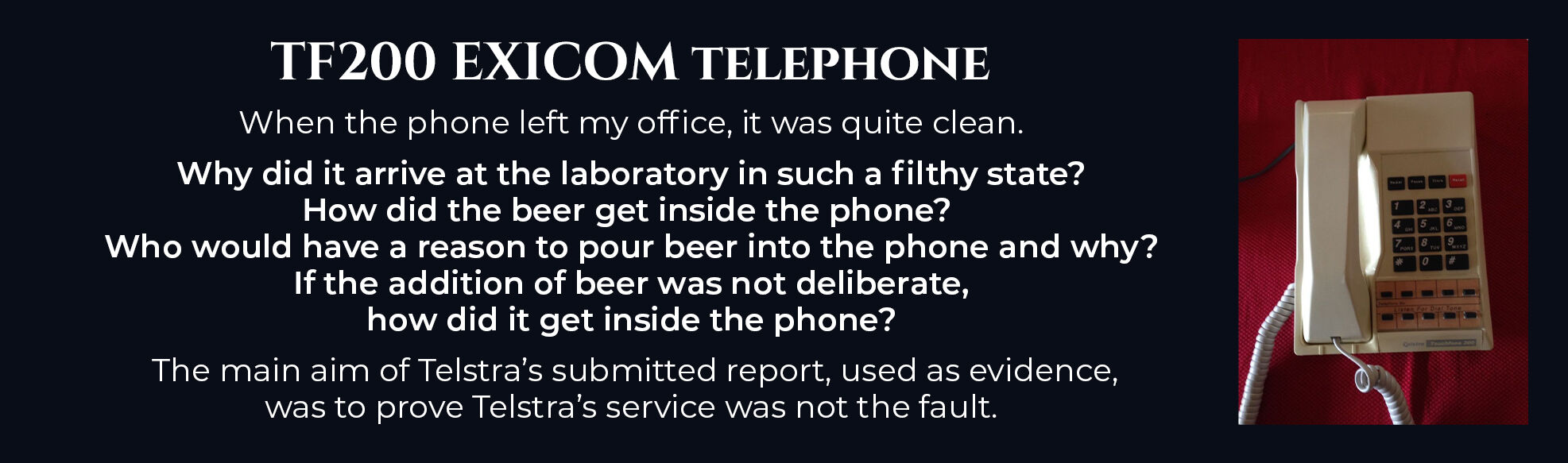
Photographs contained within Telstra's report presented another mystery. The laboratory examination described the telephone as being heavily soiled externally and wet and sticky internally. Chemical analysis allegedly concluded that the internal residue was beer.
The implication was obvious. The report effectively portrayed me as a careless customer whose drinking habits caused the fault.
Yet Telstra's own FOI records acknowledged widespread TF200 lock-up problems occurring independently of any beer contamination. FOI Folio D01026/27 confirmed that moisture sensitivity was a known issue affecting thousands of EXICOM T200 telephones manufactured after Week 7 of 1993 (Tampering With Evidence File No 2). The same document recorded that one symptom of this defect was that a telephone line could remain open after a call had apparently ended, allowing one party to hear sounds in the other party's room.
That was precisely the behaviour Mr Mathieson and I had documented.
Even more troubling was the fact that Telstra did not destroy these known-problem telephones. Instead, thousands were redistributed into service where local technicians believed moisture exposure would be minimal.
FOI records further reveal that Portland technician Ross Anderson tested my TF200 at least eighteen times immediately after collection without reproducing the alleged fault (Tampering With Evidence File No/1-C). Additional records discuss possible heat and moisture factors, yet make no mention whatsoever of alcohol contamination.
The timeline then becomes critical.
After Mr Anderson completed his testing on 27 April 1994, the telephone did not arrive at Telstra's Melbourne laboratory until 6 May. Testing did not begin until 10 May. Therefore, for approximately thirteen days, the telephone remained outside my possession.
The first laboratory report stated:
"The suspect TF200 telephone when received was found to be very dirty around the keypad with what appeared to be a sticky substance, possibly coffee."
(Tampering With Evidence File No 3)
Yet photographs supplied under FOI show a very different story.
In one image, the note attached to the telephone remains clean and clearly visible. These photographs, reproduced in exhibits 3, 4, 5 and 6, strongly suggest that the condition described by laboratory staff did not match the condition of the telephone when it left my premises (Open Letter File No/37).
These discrepancies raise obvious questions.
Who dirtied the phone?
Who introduced the sticky substance?
How did beer allegedly enter the handset after it had been removed from my possession?
Most importantly, who benefited from transforming a network fault into a customer-caused fault?
As soon as I received the report, I asked the arbitrator to obtain the laboratory working notes so an independent forensic specialist could examine the testing process. I engaged forensic document examiner Paul Westwood, who agreed to review both the telephone and the laboratory records. Confidentiality undertakings were supplied. Despite these efforts, my request was effectively ignored.
Months later, after the arbitration had concluded, Telstra finally released documentation revealing an extraordinary fact.
There had not been one series of laboratory tests.
There had been two.
The first tests were conducted between 10 and 12 May 1994 and formed the basis of Telstra's arbitration defence. The second tests were conducted between 24 and 26 May 1994.
Those later tests fundamentally undermined the conclusions presented in the earlier report.
The second investigation proved that beer deliberately introduced into a TF200 handset dried completely within approximately forty-eight hours. Laboratory photographs, graphs and handwritten file notes demonstrated this clearly (Tampering With Evidence File No/5).
That finding created a devastating contradiction.
If my telephone was collected on 27 April and not examined until 10 May, any beer allegedly spilt before collection should have been completely dry long before testing commenced.
Yet the first report described the inside of the handset as still wet and sticky.
How was that possible?
The Telstra laboratory records provide no satisfactory explanation.

The more I examined the evidence, the more alarming the picture became. The issue was no longer simply about a faulty telephone. It had become a question of whether evidence submitted during a government-endorsed arbitration had been altered after it left my possession.
At the same time, Telstra sought to exploit another aspect of my life: my service with the Cape Bridgewater CFA. Instead of acknowledging that I had spent the previous night fighting a dangerous bushfire, Telstra's records suggested I was unavailable for testing because I was merely "tired." The implication was subtle but deliberate. It portrayed me as uncooperative rather than as a volunteer firefighter who had spent fourteen hours protecting his community.
That omission was every bit as misleading as the allegations surrounding the TF200 itself.
As set out throughout the Tampering With Evidence files, the available documentation points toward a disturbing conclusion. The telephone collected from my property appears to have been altered before laboratory testing commenced. The resulting report was then used to support Telstra's arbitration defence while expert review of the underlying material was repeatedly denied.
When I later provided statutory declarations from forensic examiner Paul Westwood and requested an investigation into what I believed was fraudulent evidence, both the arbitrator and Special Counsel declined to pursue the matter.
That refusal forms one of the most troubling chapters in the entire COT story, because if evidence can be altered after it is collected and then presented to an arbitration tribunal as genuine, the integrity of the entire process is called into question.
Please view these evidence files, as they clearly prove my case. Retaining the exhibit references Front Page Part One File No/23 through Tampering With Evidence File No/5 and the relevant image references , , and in the places where they naturally support the narrative further supports the claim did take place during my arbitration.
Tampering With Evidence File No 1-A to 1-C
Tampering With Evidence File No 2
Tampering With Evidence File No 3
Tampering With Evidence File No 4
Tampering With Evidence File No 5
Tampering With Evidence File No 6
Tampering With Evidence File No 7
Tampering With Evidence File No 8-A to 8-C
Tampering With Evidence File No 9
Tampering With Evidence File No/10
Tampering With Evidence File 11-A to 11-B
Tampering With Evidence File No/12-A to 12-E
"...I believe that it should be pointed out to Coopers & Lybrand that unless this report is withdrawn and revised their future in relation to Telecom may be irreparably damaged."
Tampering With Evidence File No 13
Tampering With Evidence File No 14
AXE Faulty Equipment
Aukus Deal
For most Australians, AUKUS is just another defence deal wrapped in political spin. For me, it is something far more familiar. I have lived inside the machinery of government secrecy. I have seen how institutions behave when they believe no one will ever hold them to account
Bad Bureaucrats
#Tampering with Evidence# Delve into the serious issue of malfeasance in public office, as Absent Justice uncovers the hidden aspects of misconduct and its impact. Explore the legal journey undertaken by the COT Cases to seek justice.
Ballarat Portland Tourism absentjustice.
Government records recognize that Alan Smith's persistent efforts have successfully addressed longstanding telephone faults that adversely affected Victoria's tourism.

Discrimination Murder of the Truth
#Discrimination# Corruption, misleading and deceptive conduct plagued the COT, leading to the government's sanctions, which endorsed the arbitrations. Learn the names of those who participated in these horrendous crimes that equally corrupted arbitrators who covered up these atrocities

Government Corruption - Gaslighting
Gaslighting, including misleading and deceiving the arbitrator by Telstra, plagued the government's endorsed arbitrations. Julian Assange uncovered these gaslighting techniques were about to be used against the COT cases before the arbitration began. No one listened, not even the COT Cas

Hacking Julian Assange
Corruption hinders the rule of law and democracy, results in human rights abuses and economic stagnation and permits organised crime to flourish.
Mr. Bates vs the Post Office,
I needed to find a situation similar to the failed Australian-endorsed COT arbitration, and I came across the ongoing British Post Office scandal in the UK in 2024
My Story Draft 1 to 36
This was not a misunderstanding or an error, but a deliberate atte
Open letter to Prime Minister
Corruption, misleading and deceptive conduct plagued the COT with the government's sanctions, which endorsed the arbitrations. Learn the names of those who participated in these horrendous crimes that equally corrupted arbitrators who covere

Read about our dealings with
Corruption, misleading and deceptive conduct plagued the COT with the government's sanctions, which endorsed the arbitrations. Learn the names of those who participated in these horrendous crimes that equally corrupted arbitrators who covered up these atrocities

WikiLeaks exposing the truth
Should a citizen be responsible for exposing crimes committed by public officials more than twenty-six years ago?
Chapter 7-Vietnam Vietcong
A criminal scheme devised by Telstra to minimize its losses to the detriment of those it had bastardized. Corruption in government is destroying our democracy we need to put an end to this criminal conduct.

“I am writing in reference to your article in last Friday’s Herald-Sun (2nd April 1993) about phone difficulties experienced by businesses.
I wish to confirm that I have had problems trying to contact Cape Bridgewater Holiday Camp over the past 2 years.
I also experienced problems while trying to organise our family camp for September this year. On numerous occasions I have rung from both this business number 053 424 675 and also my home number and received no response – a dead line.
I rang around the end of February (1993) and twice was subjected to a piercing noise similar to a fax. I reported this incident to Telstra who got the same noise when testing.”
Cathy Lindsey
“Only I know from personal experience that your story is true, otherwise I would find it difficult to believe. I was amazed and impressed with the thorough, detailed work you have done in your efforts to find justice”
Sister Burke
“A number of people seem to be experiencing some or all of the problems which you have outlined to me. …
“I trust that your meeting tomorrow with Senators Alston and Boswell is a profitable one.”
Hon David Hawker MP
“I am writing in reference to your article in last Friday’s Herald-Sun (2nd April 1993) about phone difficulties experienced by businesses.
I wish to confirm that I have had problems trying to contact Cape Bridgewater Holiday Camp over the past 2 years.
I also experienced problems while trying to organise our family camp for September this year. On numerous occasions I have rung from both this business number 053 424 675 and also my home number and received no response – a dead line.
I rang around the end of February (1993) and twice was subjected to a piercing noise similar to a fax. I reported this incident to Telstra who got the same noise when testing.”
Cathy Lindsey
“…the very large number of persons that had been forced into an arbitration process and have been obliged to settle as a result of the sheer weight that Telstra has brought to bear on them as a consequence where they have faced financial ruin if they did not settle…”
Senator Carr
“…your persistence to bring about improvements to Telecom’s country services. I regret that it was at such a high personal cost.”
The Hon David Hawker MP