"Beware The Pen Pusher Power - Bureaucrats need to take orders and not take charge”, which noted:“Now that the Prime Minister is considering a wider public service reshuffle in the wake of the foreign affairs department's head, Finances Adamson, becoming the next governor of South Australia, it's time to scrutinise the faceless bureaucrats who are often more powerful in practice than the elected politicians."
"Outside of the Canberra bubble, almost no one knows their names. But take it from me, these people matter."
"When ministers turn over with bewildering rapidity, or are not ‘take charge’ types, department secretaries, and the deputy secretaries below them, can easily become the de facto government of our country."
"Since the start of the 2013, across Labor and now Liberal governments, we’ve had five prime ministers, five treasurers, five attorneys-general, seven defence ministers, six education ministers, four health ministers and six trade Ministers.”
Peta Credlin's cautionary statement, “Beware of the pen pusher power—bureaucrats need to take orders and not take charge,” strikes a chord with me on many levels. She highlights the significant risks of unchecked bureaucratic authority, a point vividly illustrated by a troubling historical episode. During a critical moment, these bureaucrats made the controversial decision to prioritise the need to provide aid to a starving China, all while neglecting the lives of our courageous service personnel and their allies who were valiantly fighting in the treacherous jungles of North Vietnam. This stark contrast highlights the potential consequences of bureaucratic leaders who take control rather than follow directives intended to safeguard Australian lives.
“Now that the Prime Minister is considering a wider public service reshuffle in the wake of the foreign affairs department's head, Finances Adamson, becoming the next governor of South Australia, it's time to scrutinise the faceless bureaucrats who are often more powerful in practice than the elected politicians.”
Then she stripped away the last layer of comfort:
“Outside of the Canberra bubble, almost no one knows their names. But take it from me, these people matter.”
And finally, the line that should have jolted every Australian upright:
“When ministers turn over with bewildering rapidity, or are not ‘take charge’ types, department secretaries, and the deputy secretaries below them, can easily become the de facto government of our country.”
She backed her warning with numbers that read like a casualty list: five prime ministers, five treasurers, five attorneys‑general, seven defence ministers, six education ministers, four health ministers, six trade ministers. A political merry‑go‑round spinning so violently that the unelected power beneath it didn’t even need to break stride.
This wasn’t political theatre. It was a government insider finally admitting what many of us had known for decades: that Australia’s democracy has been quietly hollowed out from within. That the real power, the enduring power, sits not in the hands of the elected, but in the hands of those who never face the public, never face an election, and never face consequences.
Credlin’s warning came too late. It came far too late. By the time she wrote those words, the rot had already seeped through the country. Trust had thinned to a thread. Ordinary Australians were beginning to realise that the government they voted for wasn’t always the government that governed them. The machinery behind the curtain had grown bold, entrenched, and disturbingly comfortable.
All the main statements presented on this website, including those that are merely comments, are supported by at least one, and often three to five, pieces of evidence. However, I want to highlight a specific statement regarding what Neil Jepson, Barrister for the Major Fraud Group, said to me in the Chambers of the Supreme Court of Victoria. We were both called to provide evidence on behalf of Barrister Sue Owens, but I cannot support this statement with documents. Because my next statement relies solely on my word about what Mr Jepson said, I ask everyone who has read the comments on absentjustice.com to keep this in mind when considering his remarks; he has since passed away.
Mr Jepson’s remarks expose a deeply sinister reality: the evidence presented to the Major Fraud Group regarding Dr Gordon Hughes's duplicitous statements to Laurie James, the esteemed President of the Institute of Arbitrators Australia, is nothing short of shocking. Dr Hughes claimed he and his technical advisors had meticulously reviewed all 24,000 documents; however, they were never submitted for appropriate arbitration assessment.
The Major Fraud Group, along with Tony Morgon, the Chief Loss Assessor from GAB Robins—international assessors appointed by the Commonwealth Ombudsman—unearthed a disturbing truth: I did not submit these 24,000 FOI-released documents for arbitration because Telstra deliberately delayed them, leaving me insufficient time to review them thoroughly. In a further act of malice, Dr Hughes categorically denied me the opportunity to present a mini-report that I had painstakingly compiled from these documents.
Dr Hughes's actions amounted to a calculated misrepresentation of Laurie James during an official investigation, and his refusal to confront the lies—whether he or his advisors were responsible for them—constitutes a grave betrayal of trust that weighs heavily on all involved.
Mr Jepson also pointed out that the Major Fraud Group continues to investigate the dubious claims made by Arbitration Project Manager John Rundell regarding the Brighton Criminal Investigation Branch. Rundell pretended that they were preparing to interrogate me about alleged criminal damage to his property; however, no such inquiry ever materialised. If there had been any legitimate suspicion against me, the Major Fraud Group and Victoria Police would not have sought my expertise on the fraud allegations involving Sue Owens’ clients. This entire scenario reeks of complicity and corruption at multiple levels.
It is both tragic and infuriating that Mr Pinnock, the second appointed Telecommunications Industry Ombudsman, continues to operate with alarming impunity. He made outrageous accusations against Laurie James, alleging that I had written to him claiming I had called Dr Hughes’ wife at 2:00 AM. Yet no such letter exists in any official records. This assertion is not only patently false, but our thorough investigation has also confirmed that I neither penned such a letter nor made that fateful call.
It is utterly heartbreaking that I must navigate through life bearing the scars inflicted by these insidious lies. For over two decades, I have endured the consequences of this treacherous betrayal—living under the oppressive shadow cast by unscrupulous individuals: Dr Gordon Hughes, John Rundell, and John Pinnock. Their devious actions have not only concealed the truth but have also devastated the lives of my partner and me as we seek justice in a landscape rife with deception
The arbitrators and advisors involved in the Casualties of Telstra (COT) arbitration operated in an environment rife with corruption and malevolence. Three of the four principal figures were lawyers who engaged in a shocking array of illegal, scandalous, and unethical actions that undermined the foundations of natural justice. What was promised as government-endorsed arbitration for justice turned out to be a facade, hiding the arbitrators' and their advisors' blatant misconduct.
Unbeknownst to the initial three COT claimants—along with the fifteen other Australian citizens- a sinister connection existed between the COT spokesperson and the chief arbitrator, Dr Gordon Hughes. This spokesperson was a former business associate of Hughes, creating a web of favouritism that tainted the integrity of the entire process. Over the course of sixteen arbitrations, this corrupt relationship enabled the spokesperson to receive special treatment, exposing the dark underbelly of a supposed quest for justice → Chapter 3 - Conflict of
Call for Justice
My name is Alan Smith, and this is the story of my battle with a telecommunications giant and the Australian Government. Since 1992, this battle has unfolded through various institutions, including elected governments, government departments, regulatory bodies, the judiciary, and the telecommunications behemoth Telstra—or Telecom, as it was known at the time this story began. The quest for justice continues to this day.
My story began in 1987, when I decided that my life at sea—where I had spent the previous 20 years—was over. I needed a new, land-based occupation to carry me through to retirement and beyond. Of all the places I had visited around the world, I chose Australia as my home.
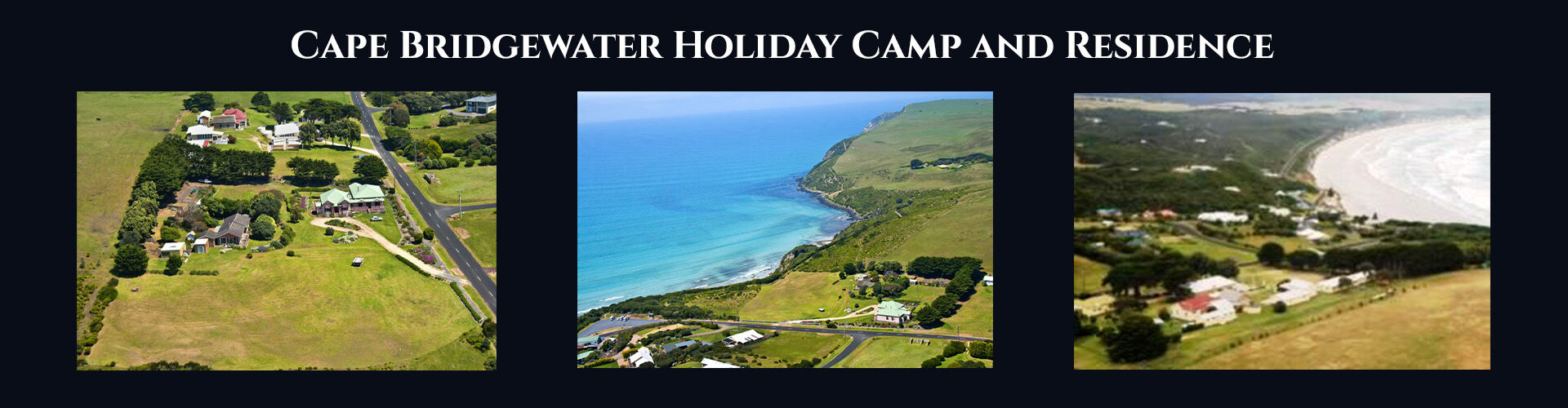
Hospitality was my calling, and I had always dreamed of running a school holiday camp. So imagine my delight when I saw the Cape Bridgewater Holiday Camp and Convention Centre advertised for sale in The Age. Nestled in rural Victoria, near the small maritime port of Portland, it seemed perfect. I conducted what I believed was thorough due diligence to ensure the business was sound—or at least, as thorough as I knew how to be at the time. Who would have thought I needed to check whether the phones worked?
Within a week of taking over the business, I knew I had a problem. Customers and suppliers were telling me they had tried to call but couldn’t get through. That’s right—I had a business to run, but the phone service was unreliable at best and completely absent at worst. Naturally, we lost business.
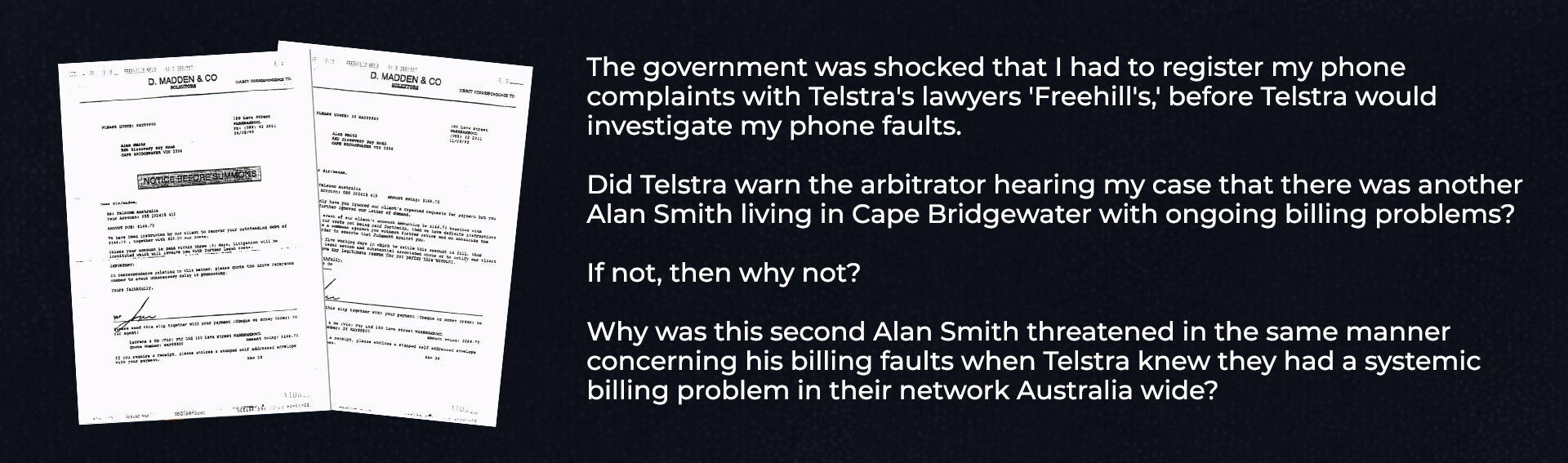
The Camp relied heavily on phone communication. It was our vital link to city dwellers eager to connect with our services. One of our most significant oversights—blinded by the charm of this coastal haven—was failing to investigate the existing telephone system. At the time, mobile coverage was virtually nonexistent, and businesses operated through traditional means—not online, and certainly not by email.
We soon discovered we were tethered to an antiquated telephone exchange, installed more than 30 years earlier and designed specifically for 'low-call-rate' areas. This outdated, unstaffed exchange had a pitiful capacity of just eight lines.
• My fight began simply: to secure a working phone service.• Despite compensation promises, the faults persisted. I sold my business in 2002, but the new owners suffered the same fate.• Other small business owners joined me—we became known as the Casualties of Telecom.• All we ever asked: acknowledgement, repair, and fair compensation. A working phone—was that too much?
During a typical week, the picturesque Cape Bridgewater was home to 66 residential families—not including those who used their coastal retreats to escape the bustle of city life. This created a significant challenge, especially considering many of these families had children.
The eight service lines struggled to support a growing census of 130 adults and children. By the time a modern Remote Control Module (RCM) was finally installed in August 1991, twelve children had been added, bringing the total population to 144. However, various weekend visitors often brought that figure to 150 or more.
The Hidden Cost of Cape Bridgewater’s Failing Lines
No wonder I was financially broken by the end of 1988—barely a year after taking over the business in late 1987. The reality was brutal: Cape Bridgewater’s telecommunications setup was catastrophically inadequate.
In stark terms, if just four of the 144 residences were making or receiving calls, only four lines remained for the other 140 residents. That’s not just poor planning—it’s a systemic failure. A network that couldn’t support even the most basic communication needs strangled my business. Every missed call was a missed opportunity. Every dropped connection was another nail in the coffin of a venture I had poured everything into.
We stepped into this complex landscape of limited connectivity and coastal beauty with ambition and optimism. The Camp was more than a business—it was a dream made real. A serene retreat where the stress of city life could dissolve into the ocean mist. However, as we quickly learned, dreams require infrastructure to thrive.
Our phone lines became both our lifeline and our most significant obstacle. Booking inquiries, supply orders, emergency calls—even simple conversations with clients—all had to pass through those eight fragile channels. During peak times, the lines were constantly engaged. Guests complained they couldn’t reach us. Suppliers missed confirmations. Opportunities slipped through our fingers like sand.
A Conspiracy of Silence: The Betrayal Behind the Arbitration
The March 1994 document (AUSTEL’s Adverse Findings) reveals a troubling reality: government officials tasked with investigating my ongoing telephone issues found my claims against Telstra valid. This was not merely an oversight; it indicates a deliberate pattern of misconduct that played out between Points 2 and 212.
It is chilling to consider that, had the arbitrator been furnished with this critical evidence, he would likely have awarded me far greater compensation for my substantial business losses. Instead, my claims were weakened because they lacked a proper log over the six-year period that AUSTEL deceptively used to formulate their findings, as outlined in AUSTEL’s Adverse Findings.
As of January 2026, Telstra and the government still have not released the promised documents, he said. Telstra would provide them at the meeting discussed below.
The Arbitrator & the Corruption of Arbitration in Australia
Introduction: A System Built on Betrayal.
Australia's arbitration system was sold to us as fair, transparent, and government-endorsed. In reality, it was anything but. The Institute of Arbitrators and Mediators Australia (IAMA) was supposed to be independent, yet it bent to political and corporate influence time and again. What should have safeguarded justice became a weapon of betrayal.
The COT Cases: Cracks in the System (1990s)
Back in the 1990s, the Casualties of Telstra (COT) cases exposed the rot. Telstra and government officials withheld documents, misled arbitrators, and left claimants fighting blind. Arbitrators ignored evidence that should have been central to their rulings. The result? Ordinary Australians were systematically disadvantaged while Telstra and its allies walked away untouched. Those cases proved one thing: when corporate power colludes with political silence, justice collapses.
The Telstra Briefcase Incident (1992–1993)
I saw this corruption firsthand. Two Telstra executives left an unlocked briefcase in my Cape Bridgewater office. Inside were documents that revealed Telstra’s board and management were orchestrating a campaign to mislead the public. They knew their copper wire network and Ericsson equipment were faulty. Overseas, they were ripping this equipment out of exchanges. Here in Australia, Telstra kept rolling it out, putting vulnerable customers at risk.
When I raised these issues, the arbitrator ruled that the faults didn't affect my business viability. That wasn’t negligence—it was complicity. Later, documents dated July–December 1992, released under the Freedom of Information Act, confirmed what I already knew: they had deliberately misled me about the reliability of my service for years.
Continuity of Corruption: 2000–2025
Some people believe this corruption was confined to the past and resolved in the 1990s. They’re wrong. Between 2020 and 2025, the same practices continued: altered court documents, perjury, and even allegations of criminal activity within government ranks. In both State and Federal Parliament, betrayal runs rampant. Colleagues are destroyed through malicious falsehoods, just as claimants were destroyed during the arbitrations. The corruption didn’t end—it mutated.
The Human Cost
This wasn’t just about faulty equipment. It was about lives. They dismissed my business, undermined my credibility, and jeopardised my livelihood. Customers were left exposed to dangerous infrastructure while Telstra and government officials escaped accountability. The human cost of this betrayal is immeasurable.
Conclusion: The Arbiitraitor’s Legacy
The arbitration system failed because it was never truly independent. Political and corporate influence corrupted it from the start. The COT Cases peeled back the layers, but the treachery has only deepened since. My role now is to document the truth, to ensure these betrayals are not forgotten, and to empower others to challenge the silence.
Reflections on Democracy and Accountability
My struggle was never just about me. It was about whether we can trust democratic systems to uphold transparency, fairness, and accountability. Canada’s handling of the Cape Bridgewater report, and Australia’s willingness to allow witnesses to be compromised, revealed a disturbing truth: when powerful interests are threatened, the rule of law bends. It delays. It ignores.
So I ask you, my readers: do we truly live under systems that protect the vulnerable and hold the powerful to account? Or are we expected to accept corruption disguised as process, silence masquerading as resolution?
For me, the answer is clear. The COT arbitrations were neither transparent nor unbiased. They were riddled with sinister machinations. And while I continue to fight for the return of my rightful documents, I also fight for something larger: the principle that truth must never be buried, and that democracy cannot survive if corruption is allowed to flourish unchallenged.:
Hacking-Julian Assange File No/27-A) and a subsequent letter from Fay Holthuyzen, assistant to the minister (see Hacking-Julian Assange File No/27-B), to Telstra’s corporate secretary, show that I was concerned that my faxes were being illegally intercepted.
Leading up to the signing of the COT Cases arbitration, on 21 April 1994, AUSTEL wrote to Telstra on 10 February 1994 stating:
“Yesterday we were called upon by officers of the Australian Federal Police in relation to the taping of the telephone services of COT Cases.
“Given the investigation now being conducted by that agency and the responsibilities imposed on AUSTEL by section 47 of the Telecommunications Act 1991, the nine tapes previously supplied by Telecom to AUSTEL were made available for the attention of the Commissioner of Police.” (See Illegal Interception File No/3)
An internal government memo, dated 25 February 1994, confirms that the minister advised me that the Australian Federal Police (AFP) would investigate my allegations of illegal phone/fax interception. (See Hacking-Julian Assange File No/28)
This internal memo, dated 25 February 1994, confirms that the then-Minister for Communications and the Arts wrote to advise that the Australian Federal Police (AFP) would investigate my allegations of illegal phone/fax interception. (AFP Evidence File No 4)
A System Built on Silence
📠 The Vanishing Faxes: A Calculated Disruption
Exhibits 646 and 647 (see ) clearly show that, in writing, Telstra admitted to the Australian Federal Police on 14 April 1994 that my private and business telephone conversations were listened to and recorded over several months, but only when a particular officer was on duty.
This particular Telstra technician, who was then based in Portland, not only monitored my phone conversations but also took the alarming step of sharing my personal and business information with an individual named "Micky." He provided Micky with my phone and fax numbers, which I had used to contact my telephone and fax service provider (please refer to Exhibit 518, FOI folio document K03273 - ).
To this day, this technician has not been held accountable or asked to clarify who authorised him to disclose my sensitive information to "Micky." I am perplexed why Dr Gordon Hughes did not raise any concerns with Telstra about this local technician’s actions. Specifically, why was he permitted to reveal my private and business details without any apparent oversight or justification?
The Treacherous Web of Bureaucratic Power
Bernard Collaery and Timor-Leste
Bernard Collaery, former Attorney-General of the ACT, casts a long shadow over the Timor-Leste negotiations. His role, intertwined with Australian bureaucrats, reflects a betrayal of trust and justice. At the heart of this scandal lies the interception of private telephone conversations during critical oil and gas negotiations in the Timor Sea. These resources, rightfully belonging to Timor-Leste, became bargaining chips manipulated by those who cloaked themselves in authority while undermining the sovereignty of a struggling nation
In February 1996, Mr. Kearney from AUSTEL delivered a decisive confirmation: my arbitration claims were valid (see Arbitrator File No/109). His conclusions were drawn from five volumes of evidence that Dr. Gordon Hughes, the arbitrator, had deliberately prevented his consultants from properly examining. Mr. Kearney’s investigation revealed that the faults in Telstra’s network were still present as late as 13 January 1995, long after Telstra claimed otherwise.
The report documented twenty‑three examples that exposed serious flaws in Telstra’s late submission to AUSTEL on 16 October 1995. Without my agreement for Mr. Kearney to undertake a twelve‑hour round trip from Melbourne to Cape Bridgewater to collect the overlooked evidence, AUSTEL would never have uncovered the deception embedded in Telstra’s submission.
This episode represents a blatant breach of process. AUSTEL allowed Telstra to secretly submit material without granting me my legal right of reply. Worse still, they concealed this act from me and later attempted to legitimise their actions by requesting a visit to my business on 19 December 1995. Faced with government officials' authority, how could I refuse? Their conduct was a façade of legitimacy masking corruption.
Mr. Kearney’s February 1996 findings, based on the evidence he collected directly from me, validated my arbitration claims. Yet this truth remained hidden for nearly nine years. The entire affair exposes the entrenched corruption within Australia’s bureaucratic system—where deceit, concealment, and betrayal are allowed to flourish under the guise of authority
Major Fraud Group - Victoria Police investigation
This understanding is precisely why the home page of absentjustice.com has evolved into a comprehensive resource containing over 25,000 words. By structuring the content into concise mini-stories, each with its own heading, I aim to present evidence from various perspectives. This multifaceted approach lets readers gather evidence that, when combined, offers a holistic understanding of the issues at hand. Each piece of evidence acts like a thread, weaving together the complex narrative of my experiences.
In addition, I am developing a new website, www.promoteyourstory.com.au, set to launch in the second week of December 2025. This site will host books linked to a range of mini-reports available at absentjustice.com and absentjustice.com.au. This connection will give readers of the principal book a robust repository of evidence, enabling deeper exploration of the material.
With immense respect for the invaluable insights I have gained from skilled detectives within the Major Fraud Group of Victoria Police, I am now in a position to demonstrate what I believe may be the most significant denial of natural justice witnessed in the context of several COT Cases arbitrations. My goal is to shine a light on these injustices and contribute to a broader understanding of the challenges those involved face.
AUSTEL COT Case's public report
Point 5.46 on page 95. '
AUSTEL’s attempts to obtain detailed information regarding performance standards, actual performance, maintenance requirements, and achievements related to telecommunications exchanges were met with significant obstruction. Instead of providing the necessary data, Telecom initially offered vague generalisations, revealing an unwillingness to cooperate. This narrow interpretation of AUSTEL's information request seemed deliberate, minimising the relevant data and intentionally prolonging the investigation process.
On November 21, 2007, I received a copy of AUSTEL's original draft findings from the Australian Communications and Media Authority (ACMA), dated March 2-3, 1994, concerning the telephone issues faced by the Cape Bridgewater Holiday Camp from 1988 to 1994, obtained under (FOI). I discuss these matters to illustrate the blatant difficulties AUSTEL, as the government regulator, faced in extracting documents from Telstra, a corporation wholly owned by the government at the time. The government's challenges should have been reason enough to suspend the arbitration process until all critical evidence was available for the parties to substantiate or refute the claims made in the COT Cases.
The government's inability to access essential documents to support the COT Cases' claims represents a serious breach of its statutory obligation. Allowing Warwick Smith (the administrator of the arbitrations) and Dr Gordon Hughes (the arbitrator) to force the COT Cases into arbitration without the necessary documentation is nothing short of treachery.
Point 43 on page 20 “As no fault report records remain in existence from Cape Bridgewater residents prior to this period, or these records have not been provided to AUSTEL, it is difficult to gauge the level of problems in the area.”
Point 48 on page 22 “AUSTEL has been hampered in assessing Telecom’s dealings with Mr Smith by Telecom’s failure to provide files relating to Mr Smith’s complaints.”
Point 71 on pages 28 and 29 “AUSTEL has not been provided with the documents on which the conclusion in this briefing summary were reached, such as fault reports from other Cape Bridgewater subscribers over this period or the details of the final selector fault. It would have been expected that these documents would have been retained on file as background to the summary. It can only be assumed that they are contained within the documentation not provided to AUSTEL.”
Point 140 on page 49 “It should be noted that AUSTEL’s investigation of matters relating to the RCM problem has been hampered by Telecom’s failure to make available to AUSTEL a file specifically relating to the Pairs Gains Support investigation of the RCM. The file was requested by AUSTEL on 9 February 1994.”
Point 160 on page 55 “It should be noted that it is hoped that a number of issues in regard to the Cape Bridgewater RCM will be clarified when Telecom provides the documentation requested by AUSTEL.”
Once AUSTEL was fully aware that Telstra was refusing AUSTEL relevant information that would allow the government communications regulator to prepare its official report for the minister after the regulator facilitated the arbitration and mediation processes that were to be based on information obtained from Telstra, it is evident that AUSTEL should never have allowed those processes to proceed. AUSTEL breached its duty of care to the COT cases by permitting the arbitrations/mediations to proceed. After all, if the government could not officially order Telstra to supply records to the minister, then what hope did the COT cases ever have of obtaining the same documents?
Absentjustice-Introduction File 495, dated 22 September 1994, is a traSeptember 22 an oral interview at the Commonwealth Ombudsman's Office with AUSTEL's representatives Bruce Matthews and John McMahon. On page 7 of this manuscript, the Commonwealth Ombudsman's officer, John Wynack, asked: "What was the date the report was issued, the AUSTEL report? And Mr Matthews replied:
"The final report was April – I can't remember the date in April, but April 1994. The draft report was produced in March 1994, and Telecom received their copy then.
Minimising Telstra's liability
It is important to note before AUSTEL did their investigation into my complaints, I provided them with a comprehensive log of my phone complaints, which my claim advisors Plummer and Pullinger later also to Dr Gordon Hughes (the arbitrator hearing my case Alan Smith v s Telstra) on 15 June 1994 as an interim June 15rbitration submission (see File - 7 to 9-A - AS-CAV Exhibit 1 to 47 and File 108 - AS-CAV Exhibit 92 to 127).
I believe you are taking the most appropriate course of action
I have never received a written response from BCI, but the Canadian government ministers’ office wrote back on 7 July 1995, noting:
"In view of the facts of this situation, as I understand them, I believe you are taking the most appropriate course of action in contacting BCI directly with respect to the alleged errors in their test report, should you feel that they could assist you in your case."