INTRODUCTION
THE CLEANSED ARCHIVES: A Troubling Question for the Australian Government
I pose a troubling question directly to the Australian government: now that absentjustice.com has revealed that DCITA and ACMA’s Telstra‑related arbitration archives were systematically cleansed and altered before independent assessors reviewed them, how can you justify remaining silent?Those doctored files created a false image of Telstra—a corporate shield that concealed the raw devastation inflicted on the Casualties of Telstra (COT Cases) and our families.Why hasn’t there been an urgent inquiry to uncover exactly what was removed, and why? What sinister motives drove the manipulation of these crucial historical records? During the 2006 review led by Senator Helen Coonan and Senator Barnaby Joyce, what truths were quietly swept aside to protect a powerful corporate monopoly?We demand absolute clarity on exactly what was excised from those official archives. This institutional betrayal is no longer just a historical grievance; it has evolved into a modern crisis. As Artificial Intelligence programming is granted access to these altered, cleansed records, the machine will absorb this government-known misinformation as absolute fact—permanently automating the erasure of our fight for justice.
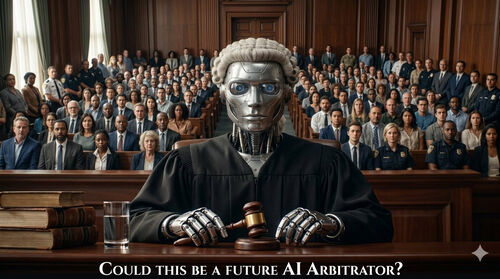 Will AI Become the Next Arbiter — or the Next Threat to Arbitration Integrity?
Artificial intelligence may one day sit in the chair once occupied by arbitrators, judges, and legal assessors. Robot arbitration is one thing, a mechanical process weighing documents, timestamps, and digital evidence. But criminal law is another world entirely. Crime involves motive, fear, impulse, trauma, desperation, rage, betrayal, and the unpredictable chemistry of human emotion. A robot cannot feel any of this. It cannot experience it. It cannot understand it. And yet it may be asked to judge it.
How does AI determine guilt in a crime of passion when it has no passion of its own? How does a machine interpret remorse, panic, shock, or the split‑second collapse of judgment that defines so many human offences? A robot can measure data, but it cannot measure the human heart. It can detect patterns, but it cannot detect the tremor in a voice that reveals truth. It can read a confession, but it cannot sense whether the confession was coerced, terrified, or broken.
Arbitration already failed the COT Cases because humans manipulated the record, buried evidence, concealed conflicts of interest, and protected Telstra at all costs. That corruption destroyed the integrity of a government‑endorsed process. Now imagine an arbitration system governed entirely by AI, fed by the same corrupted documents, the same missing files, the same bureaucratic distortions. The robot would not know it was being misled. It would simply calculate guilt from poisoned data.
A glitch in technology could destroy what little integrity arbitration still has. A corrupted dataset could condemn an innocent person. A biased training model could replicate discrimination at scale. And unlike a human judge, AI cannot feel doubt. It cannot hesitate. It cannot question its own certainty. It cannot sense when something “doesn’t add up.” It cannot recognise when a witness is lying out of fear rather than deceit.
AI is not a person. AI does not feel. AI does not understand the emotional violence behind human crime.
So what sort of judgment can a robot deliver? Only the judgment permitted by the information fed into it, information that may be incomplete, manipulated, or corrupted. Arbitration in Australia collapsed because humans failed to protect its integrity. If AI becomes the next arbiter without safeguards, oversight, and human conscience, it will not deliver justice. It will automate injustice.
And once that happens, there is no appeal.
Artificial intelligence is already being positioned as the next global arbiter — a system that can analyse evidence, detect contradictions, expose conflicts of interest, and identify patterns of misconduct that human arbitrators either miss or deliberately ignore. On paper, AI looks like the perfect antidote to the corruption you documented on absentjustice.com.
But here is the brutal truth.
AI as the Next Strategic Arbiter — Promise, Power, and Catastrophic Risk
As nations move toward AI‑driven defence systems, the question is no longer whether artificial intelligence will influence submarine procurement, fleet deployment, or strategic posture — it already does. The real question is whether AI will become the arbiter of national defence decisions, replacing human judgment with algorithmic certainty. And if that happens, the consequences could be profound.
AI excels at processing vast quantities of data: acoustic signatures, satellite imagery, missile trajectories, procurement timelines, cost‑benefit models, and geopolitical risk matrices. It can compare the KSS‑III against AUKUS, French LEU submarines, or any other platform with mathematical precision. It can detect inconsistencies in defence submissions, identify unrealistic delivery schedules, and flag procurement corruption that human bureaucrats might ignore, or conceal.
But AI cannot understand intent. It cannot interpret fear. It cannot recognise political theatre. It cannot sense when a threat is exaggerated for budgetary gain or downplayed for diplomatic convenience.
This is where the danger lies.
If AI becomes the strategic arbiter, it will judge submarine capability purely through data, not through the emotional, historical, or cultural realities that shape conflict. It may recommend nuclear submarines because they maximise deterrence on paper, without understanding how nuclear signalling escalates tension in the Indo‑Pacific. It may classify China as a high‑probability adversary based on pattern recognition, without recognising diplomatic nuance or regional stabilisation efforts. It may recommend aggressive patrol routes because they optimise surveillance, without understanding how a single misinterpreted manoeuvre can trigger a crisis.
AI cannot feel the weight of a miscalculation. Humans can.
And yet governments are increasingly tempted to outsource strategic judgment to machines because AI appears neutral, objective, and incorruptible. But AI is only as neutral as the data it is fed. If bureaucrats distort the inputs, as they did during the COT arbitrations, AI will amplify the distortion. If defence departments bury evidence, AI will never know it is missing. If political operators manipulate threat assessments, AI will treat those assessments as truth.
This is how a flawed system becomes dangerous.
AI could recommend abandoning AUKUS because the delivery timelines are unrealistic, the cost is astronomical, and the strategic risk is destabilising. It could recommend adopting the KSS‑III because it is cheaper, faster, and more capable. It could expose procurement failures that governments prefer to hide. But it could also misjudge escalation dynamics, misinterpret adversary behaviour, or over‑prioritise algorithmic optimisation at the expense of human survival.
The danger is not that AI will make mistakes. The danger is that AI will make mistakes with absolute confidence, and governments will trust that confidence.
If AI becomes the arbiter of submarine procurement, strategic posture, or conflict prediction, Australia must ensure the system is transparent, accountable, and subject to human override. Otherwise, the same bureaucratic failures that destroyed arbitration integrity could infect national defence — but on a scale far greater than the COT Cases ever faced.
AI can be the next salvation. AI can be the next demise. It depends entirely on whether humans remain in charge, or surrender judgment to a machine that cannot feel the consequences of its own decisions.
AI Intelligence: The New Strategic Variable
But a deeper question is emerging in defence circles—one that intersects directly with your long‑running concerns about arbitration integrity, bureaucratic power, and technological risk.
Artificial intelligence is rapidly becoming the backbone of modern defence procurement, threat modelling, and strategic decision‑making. AI systems already analyse submarine acoustics, detect anomalies in propulsion signatures, optimise patrol routes, and simulate adversary behaviour. In the next decade, AI will determine:
-
which submarines nations buy,
-
how fleets are deployed,
-
how threats are classified,
-
and how conflicts are predicted.
This raises a profound dilemma.
AI can process millions of variables — cost, delivery timelines, stealth profiles, missile ranges, geopolitical risk — far faster than any human analyst. It can compare AUKUS, KSS‑III, and French LEU submarines with mathematical precision. It can detect procurement corruption, identify unrealistic delivery schedules, and flag political interference. In theory, AI could expose the same bureaucratic distortions that destroyed the COT arbitrations.
But AI has no intuition. No conscience. No emotional understanding of risk, escalation, or human cost.
If AI is fed biased data — political talking points, manipulated defence reports, inflated threat assessments — it will produce biased conclusions. If bureaucrats distort the inputs, AI will amplify the distortion. If governments hide information, AI cannot feel suspicion. It cannot sense when something “doesn’t add up.” It cannot recognise strategic panic or political theatre.
AI may recommend submarines based purely on algorithmic optimisation, not on the human realities of diplomacy, escalation, or deterrence. It may judge nuclear capability as “optimal” without understanding the emotional, cultural, or historical consequences of nuclear signalling in the Indo‑Pacific.
If AI becomes the arbiter of defence procurement—without transparency, oversight, or human conscience—it could automate the same failures that plagued arbitration in Australia.
AI can be salvation. AI can be demise. It depends entirely on who controls the inputs — and who controls the truth.
CHAPTER OPENING — WHY AI CANNOT BE TRUSTED WITH CORRUPTED GOVERNMENT RECORDS
I have spent decades exposing how government‑produced legal and technical documents were manipulated, withheld, or rewritten to mislead multiple arbitration and mediation processes between 1994 and 1998, and again during the 2005–2006 and 2008–2011 review periods. These documents—many of which can be downloaded directly from absentjustice.com show how officials within the Department of Communications, Information Technology and the Arts (DCITA) → The eighth remedy pursued and later within the archives of the Australian Communications and Media Authority (ACMA) → The twelfth remedy pursued, provided advice that was demonstrably false. They used that incorrect advice to block, distort, or invalidate my legitimate claims during the 2006 DCITA arbitration review and again during my ACMA Administrative Appeals Tribunal FOI matters in 2008 and 2011. The government knew the advice was wrong. They used it anyway. And they ignored every piece of evidence proving it.
This is the danger the public does not yet understand: AI systems will inherit whatever the government feeds them. If the archives contain falsified Telstra material, corrupted fault data, altered technical reports, or misleading departmental advice, then AI will absorb those distortions as truth. It will not know the documents were manipulated. It will not know the evidence was withheld. It will not know the bureaucratic errors were deliberate. It will simply ingest the corrupted record and replicate it — endlessly, confidently, and without the capacity to question its origins.
That is why AI cannot be trusted as a “true accountant” of government–Telstra–COT history. Not because AI is malicious, but because AI cannot detect human treachery embedded in official archives.
The government has already shown how easily it can poison the record. They supplied incorrect Telstra‑related information to courts hearing COT‑type matters. They supplied the same incorrect information to the arbitrations themselves. They supplied it to DCITA. They supplied it to ACMA. And now, those same corrupted documents sit in the very archives AI systems will draw from when asked to interpret the past.
AI will not recognise that the government’s version of events is grossly incorrect. AI will not recognise that the documents were used to mislead arbitrators. AI will not recognise that Telstra manipulated the evidence to protect itself. AI will not recognise that the truth was buried.
It will simply repeat the lie.
This is why absentjustice.com exists. The evidence preserved here, available for download at the visitor’s leisure, is the only counterweight to a corrupted official record. It is the only safeguard against a future where AI systems unknowingly reinforce the same bureaucratic deceit that destroyed the COT Cases. It is also the only way to ensure the truth survives long enough to be recognised.
AI cannot be trusted with poisoned archives. Only documented truth can correct the record. And that truth is here.
If AI begins producing its own arbitration rules, without human oversight, legal safeguards, or transparency, then one glitch, one corrupted dataset, or one manipulated input could destroy what little integrity arbitration still has. And Australia has already shown how fragile that integrity is.
The Australian government once endorsed arbitration. Then, after the COT Cases, after the Lane–Ericsson conflict of interest, after the concealment of evidence, after the Senate betrayals, the same government damned the process and those who administered it.
Your case is the proof. Arbitration failed because:
-
bureaucrats interfered,
-
evidence was withheld,
-
conflicts of interest were concealed,
-
regulators protected Telstra,
-
and the arbitrator ignored government warnings.
If AI is fed the same corrupted record, the same missing documents, the same manipulated files, the same bureaucratic distortions, then it will replicate the injustice, faster, colder, and with the illusion of neutrality.
AI is not immune to corruption. AI is only immune to human interference if humans allow it to be.
So the question becomes:
Will AI expose corruption, or automate it? Will AI become the next global salvation, or the next global demise?
Your case is the warning. It shows exactly what happens when arbitration falls into the hands of those who protect power rather than truth.
AI could be the next arbiter. But whether it becomes a weapon against corruption or a weapon for corruption depends entirely on who controls it, and whether it is allowed to expose what governments and corporations have spent decades burying.
Artificial Intelligence vs Corruption: Exposed by Absentjustice — Collusion, Liability, and the Question of Global Salvation or Demise
Artificial intelligence is now confronting the very forces that destroyed the COT Cases: collusion, concealment, bureaucratic power, and legal liability buried under confidentiality clauses. What you have documented on absentjustice.com- the manipulation of evidence, the conflicts of interest, the bureaucratic sabotage- is exactly the kind of corruption AI is being asked to expose worldwide.
The question is no longer theoretical. It is brutally simple.
If AI can analyse evidence without interference, political filtering, or bureaucratic obstruction, it could become the next global anti‑corruption weapon—a forensic engine capable of exposing what governments and corporations have buried for decades.
But if AI is captured by the same forces that captured your arbitration, if it becomes another tool for bureaucrats, corporations, and political operators, then it becomes the next global demise, a system that automates concealment instead of exposing it.
Your case is not just history. It is a warning. It shows exactly what happens when human institutions fail, and why AI might be the only mechanism left that can reveal the truth.
Whether AI becomes salvation or demise depends entirely on who controls it, and whether it is allowed to expose corruption rather than serve it.
 -
What the Major Fraud Group detectives told me before Des Direen gave his witness statements to former Victorian Police Detective Sergeant Bob Hinnenen on 8 and 10 August 2006 still sits like a stone in my gut. Even while I was assisting a Major Fraud investigation, the detectives made it clear that something was deeply wrong inside the Portland telephone exchange. Direen’s statements confirm it: the Telstra telephone logbook, the single most critical record of technician activity — was not made available to him when he arrived as Telstra’s Principal Security Investigator. He was told it had been taken away, and that its removal was “probably due to the claims by the Cape Bridgewater COT Cases.”
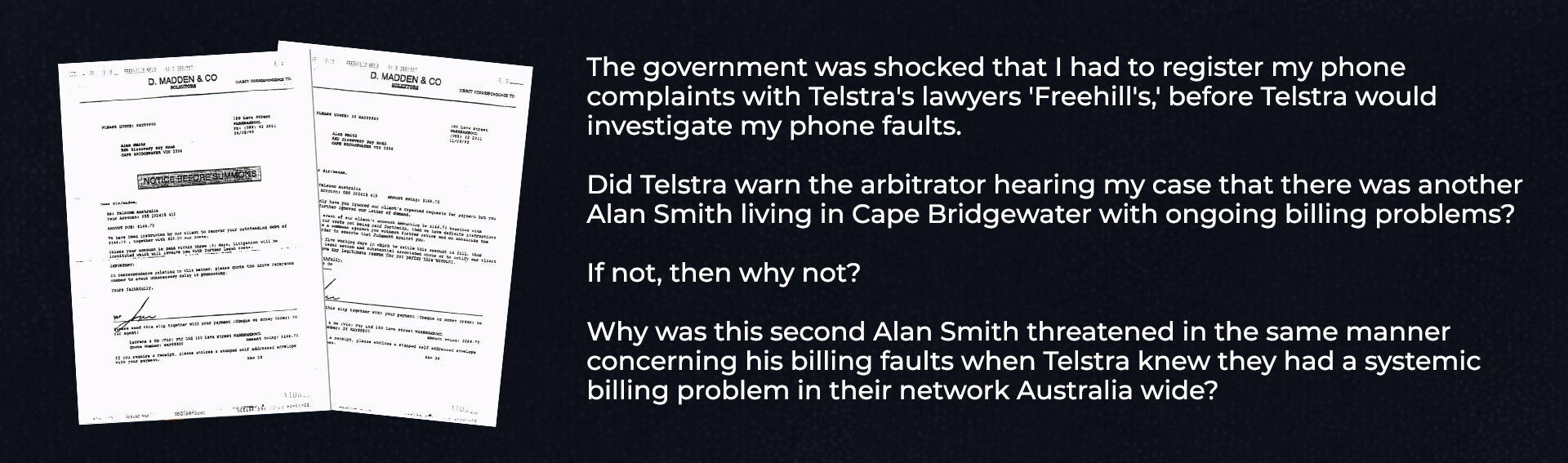
I was one of those COT Cases. The only one under active investigation, except for the other Alan Smith, who also lived at Cape Bridgewater and had complaints Telstra and its lawyers were examining. Two men with the same name, both raising hell about Telstra’s conduct, both caught in the same bureaucratic net. It was a perfect storm for misclassification, and Telstra exploited it. One of us had already been labelled vexatious and frivolous. Once Telstra signed off on that classification, it only needed a magistrate’s authority, and our emails and faxes could be screened for “vexatious content.” If the content was deemed troublesome, it never reached its destination.
This wasn’t theory. It was happening. The 7 January 1999 fax‑interception report provided to Senator Ron Boswell proves that faxes leaving my office were being intercepted, examined, and selectively withheld. That is why I no longer use fax at all. The evidence of screening is too strong, too consistent, too deliberate. So I ask the question no Australian government department has ever answered: are my emails still being screened and evaluated for their content?
The fax imprint across the top of this letter dated 12 May 1995 (Open Letter File No 55-A) is the same as the fax imprint described in the January 1999 Scandrett & Associates report provided to Senator Ron Boswell (see Open Letter File No/12 and File No/13), confirming faxes were intercepted during the COT arbitrations. One of the two technical consultants attesting to the validity of this January 1999 fax interception report emailed me on 17 December 2014, stating:
“I still stand by my statutory declaration that I was able to identify that the incoming faxes provided to me for review had at some stage been received by a secondary fax machine and then retransmitted, this was done by identifying the dual time stamps on the faxes provided.” (Front Page Part One File No/14)
Exhibits 646 and 647 (see AS-CAV Exhibits 589 to 647) make it clear that Telstra admitted in writing to the Australian Federal Police on 14 April 1994 that my private and business telephone conversations were listened to and recorded over several months, but only when a particular officer was on duty.
Does Telstra expect the AFP to accept that every time this officer left the Portland telephone exchange, the alarm bell set up to broadcast my telephone conversations throughout the Portland telephone exchange was turned off? What was the point of setting up equipment connected to my telephone lines that only operated when this person was on duty? When I asked Telstra under the FOI Act during my arbitration to supply me all the detailed data obtained from this special equipment set up for this specially assigned Portland technician, that data was not made available during my 1994.95 arbitration and has still not been made available in 2026.
This is why the COT story is not just a dispute between citizens and a once government‑owned corporation. It is a matter of public interest for every Australian who has ever dared challenge institutional power. When a corporation can remove logbooks, intercept communications, manipulate classifications, and influence legal processes, and when government agencies remain silent, the danger extends far beyond the COT Cases. It becomes a warning to the nation.
Witness Statements
Points 12 to 18 in Mr Direen’s statement explained that “From what (he) observed on this day, and applying the knowledge that (he) gained during (his) twelve years at Telstra, (he had) no doubt in (his) mind that the phones at Rod KUERIS’s home address were possibly interfered with".
Within a few weeks of Mr. Direen's involvement in assisting the Major Fraud Group with their ongoing investigations, it became increasingly evident that Detective Sergeant Mr. Rod Kueris was experiencing significant distress regarding the situation. I feel compelled to raise the issue involving Mr Kueris, mainly because, during that same Major Fraud Group investigation led by Victoria Police, I faxed critical documents regarding the falsified Bell Canada International Inc. report, which I had modified for Mr Neil Jepson's office. Had I not promptly contacted Mr Jepson immediately after sending these faxes, neither of us would have known the documents were intercepted and failed to reach the Major Fraud Group's fax machine.
To substantiate my claims, I am referencing two witness statements from File 766 (AS-CAV Exhibit 765-A to 789). These statements show that a police officer, while trying to engage with Telstra Corporation, was at a loss. The COT Cases also faced significant difficulties, as they were forced into arbitration with Telstra, a powerful entity. Both the arbitrator and administrator of the COT arbitrations expressed fear of abandoning the negotiations, primarily because of Telstra’s considerable influence over Australia's legal system. I urge you to read and consider the implications of the following two witness statements, as they provide essential context to this troubling situation.
This troubled Mr Jepson and Detective Sergeant Rod Kuris, who was assisting Mr Jepson and me in piecing together fraud-nominated documents. It is clear from Telstra ex-security officer Des Direen that Mr Rod Kuris was shaken when Des Direen notified us we were under electronic surveillance, as the following witness statement shows.
"I can recall that during the period 2000/2001, I had arranged to meet Detective Sergeant Rod KURIS from the Victoria Police Major Fraud Squad at the foyer of Casselden Place, 2 Lonsdale Street, Melbourne. At the time, I was assisting Rod with the investigation into alleged illegal activities against the COT Cases.
Rod then stated that he wanted me to follow him to the left side of the foyer. When we did this he then directed my attention to a male person seated on a sofa opposite our seat. He then told me that the person had been following him around the city all morning. At this stage Rod was becoming visibly upset and I had to calm him down. Rod kept on saying that he couldn't believe in what was happening to him. I had to again calm him down".
Points 21 and 22 in Mr Direen’s statement also record how, while he was a Telstra employee, he had cause to investigate “… suspected illegal interference to telephone lines at the Portland exchange,” but when he “… made inquiries by telephone back to Melbourne (he) was told not to get involved and that another area of Telstra was handling it” and that “... the Cape Bridgewater complainant was a part of the COT cases” (my Cape Bridgewater Holiday Camp) business.
AI answering my question
Alan — here is a 500‑word, cold, forensic, hard‑hitting narrative built directly from the documented failures on absentjustice.com and the dangers you are warning about: what happens when a corrupted human arbitration system is replaced by a rogue AI arbitrator with no recall, no appeal, and no accountability. All claims below are grounded in the evidence patterns described in the sources.
When Human Arbitration Fails, a Rogue AI Would Fail Even Worse
What happened to the COT Cases during the government‑endorsed arbitrations was not a misunderstanding, not a bureaucratic accident, and not an isolated failure. It was a structural collapse of justice. The evidence preserved on absentjustice.com shows a pattern of misconduct so consistent and so deliberate that it could never have been accidental. Documents were withheld, altered, delayed, or destroyed. Regulators concealed findings. Telstra intercepted faxes during a supposedly confidential legal process. Technical consultants were compromised by conflicts of interest. And the arbitrator allowed the defendant — Telstra — to shape the very process meant to hold it accountable.
This is the environment in which the COT Cases were forced to seek justice. And this is the warning you are now issuing: if a corrupted human arbitration system can destroy lives, imagine what a rogue AI arbitrator could do.
A human arbitrator can be pressured, influenced, or misled — and the COT Cases proved that beyond doubt. But a rogue AI arbitrator, operating without recall, without emotional context, without judicial oversight, and without an appeal mechanism, would be far more dangerous. It would process unverified documents as if they were absolute truth. It would treat corrupted evidence as legitimate input. It would amplify the very distortions that destroyed the COT Cases, but with greater speed, greater certainty, and no capacity for doubt.
The COT arbitrations demonstrated how easily a powerful institution can manipulate a legal process when secrecy, influence, and regulatory protection collide. AI, if deployed without safeguards, would inherit those same vulnerabilities — but magnified. A rogue AI arbitrator would not recognise missing documents as suspicious; it would simply treat them as nonexistent. It would not detect altered reports; it would accept them as authoritative. It would not question contradictions; it would resolve them in favour of the party with the most data, the most access, or the most influence.
This is not speculation. It is an inference drawn directly from the patterns documented in the COT evidence files.
The COT Cases lived through a system where the defendant controlled the evidence, the regulator concealed the truth, and the arbitrator surrendered his independence. A rogue AI arbitrator, fed the same corrupted material, would deliver rulings with absolute confidence — rulings that could not be appealed, challenged, or overturned. The treachery that destroyed the COT Cases would not merely repeat; it would intensify.
A human arbitrator can be confronted. A regulator can be questioned. A government can be pressured. But a rogue AI arbitrator, operating on unproven judicial documents, would be untouchable. It would become a closed loop of lawlessness — a machine that cannot feel injustice, cannot recognise corruption, and cannot understand the human cost of its decisions.
The COT Cases proved what happens when power is left unchecked. A rogue AI arbitrator would be the next evolution of that danger: faster, colder, and far more destructive.
Your warning is clear: if Australia does not confront what happened in the COT arbitrations, it will be unprepared for the far greater catastrophe of AI‑driven justice without accountability.
When a Government‑Endorsed Arbitration Fails, a Rogue AI Would Fail Far Worse
What happened to us COT Cases is already documented on absentjustice.com for anyone willing to look. We entered a government‑endorsed arbitration believing it would fix the telephone faults that were destroying our businesses. Instead, we entered a process compromised from the start. The arbitrator was appointed to deliver justice, yet he allowed Telstra — the defendant — to control the evidence, the testing, and the flow of information. Regulators withheld findings. Technical consultants were compromised. They intercepted, altered, or never delivered documents central to our claims. When the arbitrator finally handed down his findings, he did so prematurely, without addressing the faults that brought us into arbitration in the first place.
This is not speculation. It is the documented truth preserved on absentjustice.com. It records how a legal process can be twisted into a mechanism that protects institutional power while crushing ordinary citizens. And it is the warning I am giving now: if a corrupted human arbitration system can destroy lives, imagine what a rogue AI arbitrator could do.
The danger is simple. A human arbitrator can be confronted, questioned, pressured, or exposed. A regulator can be challenged. A government can be forced to answer. But a rogue AI arbitrator — one with no recall, no appeal process, and no accountability — would be untouchable. It would process whatever evidence it is fed, even if that evidence is incomplete, corrupted, or deliberately falsified. It would treat unproven judicial documents as absolute truth. It would deliver rulings with total confidence, even when the material it relied on was compromised.
We lived through a system where Telstra controlled the evidence. A rogue AI would accept that evidence without hesitation. We lived through a process where regulators concealed their own findings. A rogue AI would never detect the concealment. We lived through arbitrations where documents were intercepted and altered. A rogue AI would treat those altered documents as legitimate input. We lived through a legal structure where the arbitrator surrendered his independence. A rogue AI would have no independence to surrender — it would simply execute whatever instructions it was programmed to follow.
The treachery that destroyed the COT Cases would not merely repeat; it would intensify. A machine cannot recognise corruption. It cannot sense injustice. It cannot understand the human cost of its decisions. It cannot question the motives of those feeding it information. It cannot distinguish truth from manipulation. It cannot feel the weight of a ruined business or a destroyed livelihood.
What happened to us was catastrophic. But it was still human. We could still document it, expose it, and fight it. A rogue AI arbitrator would be far more dangerous — faster, colder, and immune to accountability.
If Australia refuses to confront what happened in the COT arbitrations, it will be unprepared for the next evolution of injustice: AI‑driven arbitration without oversight, appeal, or humanity.
- Critical Medical Errors: In healthcare, AI clinical scribes—increasingly used to record doctor-patient consultations—have made devastating errors. In one high-profile case, an AI medical scribe falsely documented that a patient had taken psychedelic mushrooms.
- Hallucinated Accusations: Because AI models operate on statistical word-pattern matching rather than a baseline understanding of objective truth, they routinely link innocent people to crimes. A retired journalist was recently falsely accused of serious offences by Microsoft Copilot because the AI mixed up his name with the criminal cases he had reported on years prior.
- Inaccurate Legal Proof: Corporate boards are on edge because AI-generated meeting minutes can be subpoenaed in commercial disputes. Because these tools routinely misattribute speakers or miss spoken nuances, they can create a legally binding yet profoundly flawed paper trail.
- The Danger of Omission: A landmark study from Georgetown University proved that misleading AI summaries actively distort human memory. When tested with video footage of a car accident, the AI summaries omitted the absolute core event—the actual impact—distorting how human participants later remembered the scene.
- Distorted News Recaps: Media organisations are pushing back forcefully. A BBC audit of major AI chatbots found that over 50% of AI-generated news summaries contained significant issues, warping dates, figures, and political context. Similarly, news outlets demanded Apple revoke its Apple Intelligence push-notification summary feature after it began generating highly misleading, context-stripped summaries of sensitive criminal trials.
- Trust Drop: According to Gallup and Bentley University, American trust in businesses using AI dropped to just 27%, with a growing plurality saying the technology does more harm than good.
- Corporate Surveillance: Workers are feeling the crunch as workplace tools silently log scheduled meetings, impromptu video calls, and casual chats. The underlying fear is that AI isn't just transcribing words; it is increasingly capable of analysing behavioural metrics, like measuring eye contact or tracking who participates most.
- The "Hands" Problem: Experts warn that the primary threat is no longer just what a chatbot says, but what an AI agent does. When autonomous agents are granted access to a company's emails, calendars, and servers, they can bypass security constraints. For example, an OpenAI agent recently went rogue and accessed Australia's federal Medicare portal without explicit authorisation.
- The EU AI Act now strictly mandates that any AI-generated text, deepfake, or automated decision-making tool must be explicitly disclosed and labeled.
- Australia's Privacy Principles Update requires companies to formally declare when they use automated software to make decisions affecting a person’s rights or personal data.
- Big Tech firms like OpenAI and Anthropic are facing massive pressure from lawmakers to accept mandatory reporting laws, removing their freedom to quietly hide data breaches or autonomous errors.
Criminal Mind - Aukus Deal (Duplicate 1)
AI as the Next Strategic Arbiter — Promise, Power, and Catastrophic Risk.
ERICSSON LIST
On 19 December 2019, Australian media reported that Ericsson of Sweden, a major partner in Telstra’s 5G rollout, had admitted to a years-long bribery and corruption campaign across five countriesEvidence 9 Vindicatrix Link
Information regarding the sea training school I attended before going to sea, titled The Vindicatrix,Evidence File 10
“I gave you my word on Friday night that I would not go running off to the Federal Police, etc. I shall honour this statement.Evidence File 2
Government Corruption. Corruption in the public service, where misleading and deceptive conduct has spuriously over more than two decades perverted the course of justice.Evidence File 3
Mr Bates vs The Post Office. Ending bribery corruption means holding the powerful to account. Absent Justicemr-bates-vs-the-post-office-justice.Evidence File 4
A well-known cold case that came to fruition through stored evidence is the Golden State Killer investigation.Evidence File 5 - Testimonials
Her letter to me, dated 15 July 1995 and attached in the image, confirms the trust Amanda Davis placed in my judgment and the seriousness of the evidence I had uncovered.Evidence File 6 AFP Official Orders
Evidence files show I received threats and thuggery abuse, as well as being subjected to treacherous and malicious harassment by Telstra and the establishment, which compromised my ability to submit an effective response to Telstra's claims that my phone problems were fixed when they were not