
This website is a work in progress and was last edited in November 2026
No Donate Button—But a Call to Action
If, while reading this narrative, you find yourself wondering where the donate button is—there isn’t one.
This website does not seek personal donations. Instead, if you believe this work presents a compelling case for justice and equity within Australia’s arbitration system , and if you see value in the research, evidence, and advocacy behind it, I invite you to support a cause that aligns with these principles.
Consider donating directly to Transparency International Australia. Your contribution will help raise awareness of the injustices that threaten our democracy and support efforts to hold institutions accountable.
This work is offered freely, driven by a moral obligation to expose the truth. But the fight for transparency is bigger than one voice—it needs all of us.
Learn about calculated crimes, unscrupulous operators, complicit politicians, and the lawyers who control Australia's legal establishment. "Shameful," "predatory," and "treacherous" are just a few words to describe these lawbreakers.
Delve into the systemic corruption that poisoned the COT arbitrations, endorsed by the Australian government. This narrative exposes not only those who engineered these crimes but also the equally corrupt government agencies that actively buried the evidence, making themselves accessories after the fact.
A Call for Justice — And the Betrayal of a Nation
The most insidious forms of tyranny do not announce themselves with jackboots in the streets, burning parliaments, or overt acts of violence. They thrive in the shadows of bureaucracy, concealed behind polite corporate smiles, forged assurances, and the cold, calculated machinery of institutional deceit. Often, the rot begins with something so deliberately mundane that its sinister design remains invisible until the trap snaps shut. A rigged telephone line, a deliberately dropped call, a sabotaged livelihood, a hollow corporate apology, a calculated lie disguised as a promise of swift resolution — these seemingly ordinary irritations can be weaponised to mask a vast, subterranean network of collusion and state-sanctioned cover-ups.
Be sure to hover your mouse over the images below as you scroll down this home page.
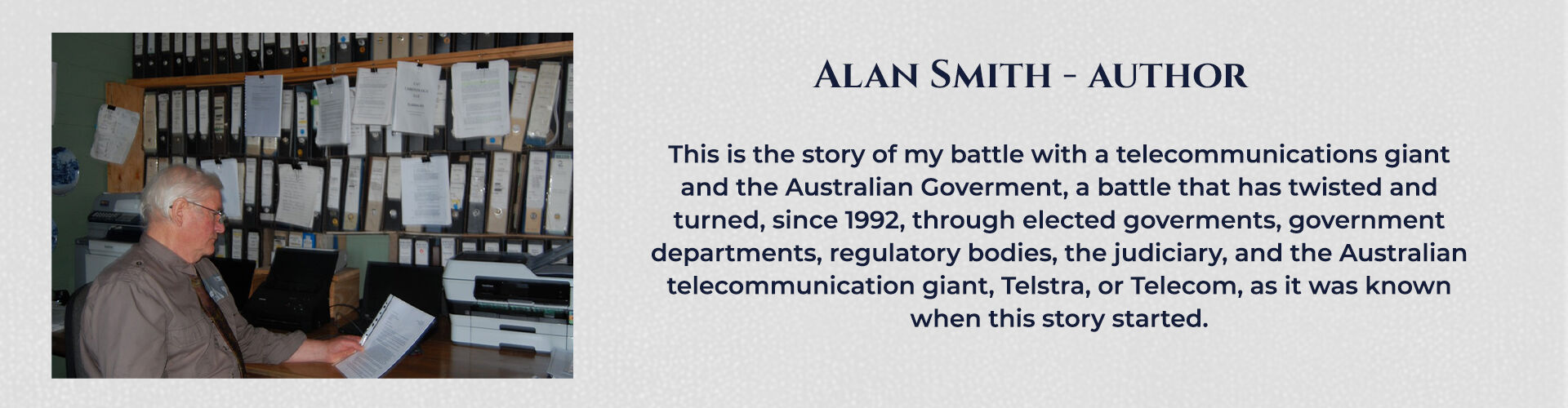
In 1987, when I acquired the Cape Bridgewater Holiday Camp and Convention Centre on Victoria's rugged southwest coast, the idea that a simple telecommunications fault could ignite decades of clandestine warfare, pitting me against a predatory state monopoly, compromised government departments, turncoat regulators, self-serving politicians, and a corrupt legal establishment, would have seemed like sheer paranoia. Had someone told me then that surviving this ambush would demand amassing over sixty-six thousand forensic records just to penetrate a coordinated wall of silence and deceit, I would have dismissed it as absurd.
Yet, this is precisely the betrayal that unfolded.
This narrative is far more than an account of defective telephone lines. Had it been an honest technical failure, it would have been resolved within weeks. The faults would have been identified, repaired, and forgotten. Fair restitution would have been paid, accountability accepted, and all parties would have moved on. Instead, what began as a straightforward commercial grievance mutated into a ruthless, coordinated campaign of attrition, sabotage, and institutional treachery.
It became a descent into the darkest, most corrupt corridors of Australian power.
This is not the memoir of a whistleblower, nor one driven by a thirst for notoriety, vengeance, or personal glory. I arrived in Australia after spending much of my life at sea, where a man's word was his bond, treachery was fatal, and survival depended on absolute trust. Like countless immigrants, I viewed this country as a bastion of fairness, believing that hard work and honesty were enough to build a life. The Cape Bridgewater Holiday Camp, perched along one of Victoria's most breathtaking coastlines, embodied that promise, offering everything I had worked toward for a new chapter in my life.
Within weeks, however, it became brutally clear that something sinister was at play, and that the forces sabotaging my livelihood were anything but accidental. Customers repeatedly reported that their calls failed to connect, while suppliers encountered the exact same phantom barriers. Lucrative bookings vanished into thin air, and revenue bled out without explanation. The weapon strangling the entire enterprise was the telephone network, an untouchable, state-backed monopoly upon which our survival completely depended.
At first, I naively assumed these disruptions were simple technical glitches. Every business faces occasional faults, and the remedy seemed obvious: report the failures, allow technicians to fix them, and get back to work. Instead, every demand for answers was met with shifting alibis, fabricated technical excuses, and hollow pledges that evaporated the moment I hung up. Issues that should have been routine to diagnose were systematically covered up, buried under layers of corporate doublespeak, falsified logs, and deliberate misdirection.
The deeper I dug into the mire, the more horrifying the truth became: I was merely one casualty in a much wider, systemic conspiracy.
Across Australia, other rural and regional business owners were being methodically ruined under identical circumstances. Their stories were carbon copies of my own: crippled telecommunications lines, stonewalled complaints, spiralling financial ruin, and, most sinister of all, an impenetrable wall of secrecy engineered to starve them of the very technical records needed to prove the sabotage being inflicted upon them.
We became known as the Casualties of Telecom, or the COT Cases.
Like me, these hardworking Australians asked for nothing more than what any citizen in a functional democracy is owed: reliable infrastructure and honest accountability when a corporate giant fails its duty. None of us could have foreseen that demanding basic fairness would drag us into a labyrinth of rigged parliamentary inquiries, compromised regulatory probes, weaponised arbitrations, bitter Freedom of Information wars, and decades of relentless forensic excavation.
When a Senate investigation finally began shining a harsh light into the cesspool, there was a fleeting moment of hope. Public scrutiny is the natural enemy of corruption. Hard questions were finally being asked on the public record, and the machinery of power looked momentarily exposed.
Then, at the eleventh hour, the trap was sprung.
Instead of allowing a transparent public inquiry to expose the truth, we were coerced, under intense political and institutional pressure, into a specially engineered arbitration process. Behind closed doors, and before any agreement was signed, the rules were secretly rewritten to strip the process of accountability and protect those running it. We were sold a glittering, poisoned lie: that this government-endorsed forum would guarantee independence, impartiality, and unfettered access to every technical record needed to prove our claims. In reality, the government already possessed internal findings validating our complaints, yet we were lured into paying hundreds of thousands of dollars to fight blindfolded for proof they had already buried.
These fraudulent assurances became the linchpin of one of the greatest perversions of justice in modern Australian history.
At the time, however, we entered that chamber in good faith, believing in the rule of law. We believed that binding agreements would be honoured, that objective adjudicators would weigh facts impartially, and, above all, that the promised disclosure of critical evidence would finally reveal the truth.
We had walked straight into a state-sanctioned ambush.
Almost immediately, the process revealed itself to be a grotesque, rigged parody of justice. Crucial technical files vanished. Damning evidence was illegally concealed, altered, and suppressed under bogus claims of legal professional privilege. Records we knew existed were denied to us behind closed doors, while the officials overseeing the process looked the other way, complicit in blatant breaches of protocol. Even as the arbitration proceeded, our communications were intercepted, and fabricated allegations were weaponised behind the scenes to intimidate and discredit anyone who dared ask questions.
As the years dragged on, and suppressed material slowly emerged through relentless Freedom of Information battles, leaked internal memos, parliamentary disclosures, witness testimonies, and Australian Federal Police files, the sheer scale of the syndicate's cover-up came into sharp, sickening focus.
What chilled me to the bone was not any single smoking gun.
It was the unmistakable blueprint of entrenched, systemic corruption.
One missing file might be dismissed as carelessness. One administrative blunder might be excused as human error. A delayed response might be blamed on bureaucratic inertia. But when the same obstructions, disappearances, perjuries, and cover-ups repeat across decades, orchestrated in lockstep by corporate executives, government ministers, captured watchdogs, and legal officers, only a fool or an accomplice would call it coincidence.
That sinister pattern of treachery lies at the very core of this website.
The Silent Execution of Democracy: How Corrupted Arbitration Destroys a Free Society
To understand the true gravity of what happened to the COT Cases, one must look beyond the ruined businesses and shattered lives of a handful of regional Australians. What was tested, and perfected, in those closed-door hearings was nothing less than a blueprint for dismantling Western democracy from the inside out.
In any free society, the rule of law rests on a sacred, non-negotiable foundation: open justice. Public courts, transparent evidence, cross-examination under oath, and the right of every citizen to confront their accuser or corporate oppressor in the full glare of public scrutiny are not mere procedural formalities; they are the oxygen of democracy. When justice is seen to be done, power is held in check. Corporations know that fraud will be exposed in the morning newspapers; politicians know that collusion will be punished at the ballot box; regulators know that dereliction of duty will trigger public outrage.
Privatised, unregulated, and corrupted arbitration strips away every single one of those democratic safeguards.
When a state-backed monopoly or a politically connected corporation can herd injured citizens out of public parliaments and open courts into secret, privately administered tribunals, justice ceases to be a public right and becomes a rigged commodity. Behind locked doors, shielded by draconian non-disclosure agreements and insulated from media scrutiny, the powerful no longer have to obey the law; they merely have to control the process.
Consider what happens when arbitration is weaponised rather than conducted with absolute integrity.
First, the weapon of asymmetric information is deployed with lethal precision. In an open court, concealing subpoenaed evidence is a crime punishable by contempt and imprisonment. In a compromised arbitration, however, the powerful party holds every technical log, internal memo, and fault report, while the administrator lacks either the will or the teeth to enforce disclosure. The victim is thus forced to fight blindfolded. The stronger party simply buries the smoking guns, hands over doctored or incomplete files, and then mocks the claimant for lacking proof. This is the ultimate perversion of justice: the perpetrator steals the evidence and then demands the victim produce it.
Second, corrupted arbitration corrupts the very guardians of the state. When government departments, statutory watchdogs, and elected officials allow a sham process to proceed, knowing full well its foundational rules have been violated, they stop being servants of the public and become accessories after the fact. Worse still, once an official body endorses a tainted outcome to protect a state asset, a privatisation sale, or a political ally, every subsequent institution is forced to lie to protect the original lie. Regulators cover for corporations; ministers cover for regulators; inquiries whitewash previous inquiries. A self-reinforcing cartel of impunity forms at the highest levels of government, where preserving institutional reputation becomes infinitely more important than upholding the truth.
Third, and most fatally, the social contract collapses when citizens discover that the referee is on the opposing team's payroll and that the state actively helps conceal the fraud. Western democracy survives only because ordinary people believe that if they play by the rules, work hard, and seek redress through lawful channels, the system will protect them from predation by the rich and powerful. That trust dies when arbitration is twisted into an ambush designed to exhaust, bankrupt, and silence whistleblowers while laundering corporate crime into an "official settlement."
Citizens learn a devastating lesson: the law is a weapon reserved exclusively for the powerful, and the mechanisms of justice are merely theatrical props used to pacify the public until they run out of money or die. Once a society reaches that point, democracy retains its hollow rituals—its elections, speeches, and flags—but its soul has been hollowed out. Tyranny no longer needs a dictator when a secret tribunal and a shredded archive can accomplish the same result without a single shot being fired.
Over more than three decades, I have assembled a forensic archive of over sixty-six thousand documents exposing this machinery in cold, undeniable detail. Most of these records were pried from the clenched fists of unwilling institutions only after years of exhausting legal and Freedom of Information warfare. Others were smuggled out or handed over by courageous insiders who recognised the rot and refused to let the truth be buried. Together, they form an indictment that is chilling, relentless, and impossible to refute.
The purpose of this book is not to ask for your blind faith; quite the opposite. My mission is to lay out the chronology, the suppressed memos, the altered records, and the smoking guns so that you can judge the evidence with your own eyes. This archive exists because history must never be written solely by the criminals and cowards who hold the power to sanitise official records. Truth matters. Accountability matters. Evidence matters.
More than thirty years after this ordeal began, the most damning questions remain deliberately unanswered:
-
Why were critical technical records systematically concealed and destroyed?
-
Why did inquiry after inquiry collapse into evasion whenever the trail led toward senior figures?
-
Why did damning evidence keep surfacing decades after official processes declared the matter closed?
-
Why did ordinary citizens seeking basic honesty face the full, crushing weight of state and corporate obstruction?
-
And why, after all these years, are those in power still terrified of an honest accounting?
The following chapters chronicle a relentless pursuit of the truth, pulling back the curtain on a dark underworld where political expediency, corporate greed, bureaucratic cowardice, and backroom influence routinely triumphed over the rule of law. They lay bare the immense financial, physical, and emotional toll exacted upon ordinary people who dared to stand up to an unholy alliance of state and corporate power. Above all, they preserve a body of evidence that powerful forces tried desperately to erase from history forever.
The conflict documented in these pages was never merely about broken telephones. The telephones were simply the loose thread that, once pulled, unravelled a tapestry of corruption reaching into the very heart of our democracy.
This is the story of that unravelling.
As shown on page 5169 in Australia's Government SENATE official Hansard – Parliament of Australia, Telstra's lawyers, Freehill Hollingdale & Page, devised a legal paper titled “COT Case Strategy” (see Prologue Evidence File 1-A to 1-C) instructing their client, Telstra (naming me and three other businesses), on how Telstra could conceal technical information from us under the guise of Legal Professional Privilege even though the information was not privileged.
This COT Case Strategy was to be used against me, my named business, and the three other COT case members, Ann Garms, Maureen Gillan and Graham Schorer, and their three named businesses. Simply put, they targeted us and our four businesses even before our arbitrations commenced. The Kangaroo Court was devised before the four COT Cases signed our arbitration agreements.
Stop the COT Cases at all costs

Worse, however, the day before the Senate committee uncovered this COT Case Strategy, they were also told under oath, on 24 June 1997, see:- pages 36 and 38 Senate - Parliament of Australia, from an ex-Telstra employee turned whistleblower, Lindsay White, that, while he was assessing the relevance of the technical information which the COT claimants had requested, he advised the Committee that:
Mr White "In the first induction - and I was one of the early ones, and probably the earliest in the Freehill's (Telstra’s Lawyers) area - there were five complaints. They were Garms, Gill and Smith, and Dawson and Schorer. My induction briefing was that we - we being Telecom - had to stop these people to stop the floodgates being opened."
Senator O’Chee then asked Mr White - "What, stop them reasonably or stop them at all costs - or what?"
Mr White responded by saying - "The words used to me in the early days were we had to stop these people at all costs".
Senator Schacht also asked Mr White - "Can you tell me who, at the induction briefing, said 'stopped at all costs" .
Mr White - "Mr Peter Gamble, Peter Riddle".
Senator Schacht - "Who".
Mr White - "Mr Peter Gamble and a subordinate of his, Peter Ridlle. That was the induction process-"
From Mr White's statement, it is clear that he identified me as one of the five COT claimants that Telstra had singled out to be ‘stopped at all costs’ from proving their case against Telstra. One of the named Peters in this Senate Hansard who had advised Mr White that the five COT Cases had to be stopped at all costs is the same Peter Gamble who swore under oath, in his witness statement to the arbitrator, that the testing at my business premises had met all of AUSTEL’s specifications, when it is clear from Telstra's Falsified SVT Report that the arbitration Service Verification Testing (SVT testing) conducted by this Peter did not meet all of the government's mandatory specifications.
Also, in the above Senate Hansard on 24 June 1997 (refer to pages 76 and 77 - Senate - Parliament of Australia Senator Kim Carr states to Telstra’s main arbitration defence Counsel (also a TIO Council Member), Re: Alan Smith:
Senator CARR – “In terms of the cases outstanding, do you still treat people the way that Mr Smith appears to have been treated? Mr Smith claims that, amongst documents returned to him after an FOI request, a discovery was a newspaper clipping reporting upon prosecution in the local magistrate’s court against him for assault. I just wonder what relevance that has. He makes the claim that a newspaper clipping relating to events in the Portland magistrate’s court was part of your files on him”. …
Senator SHACHT – “It does seem odd if someone is collecting files. … It seems that someone thinks that is a useful thing to keep in a file that maybe at some stage can be used against him”.
Senator CARR – “Mr Ward, we have been through this before in regard to the intelligence networks that Telstra has established. Do you use your internal intelligence networks in these CoT cases?”
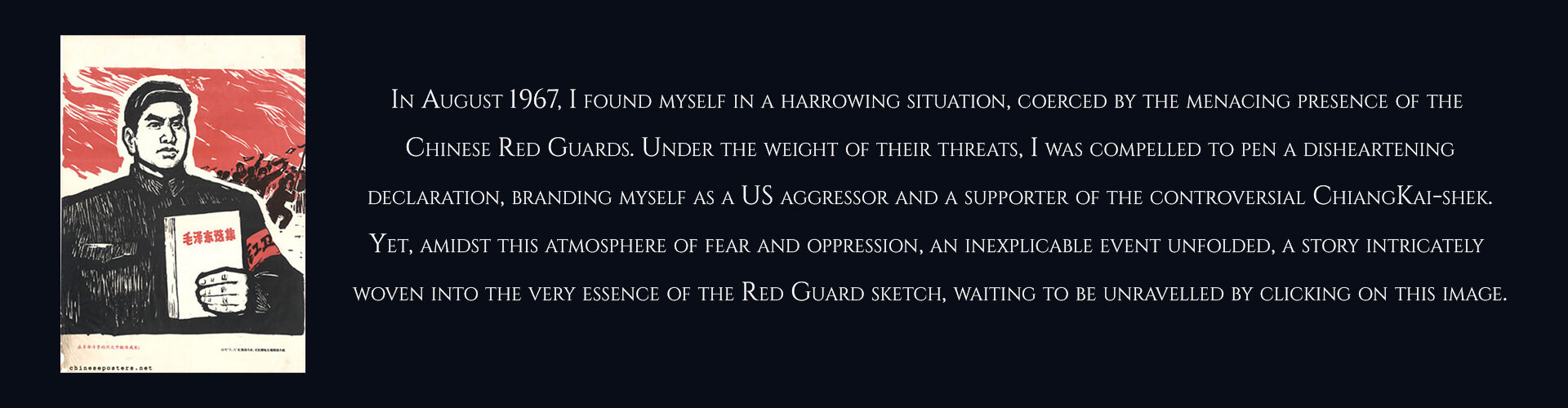
The most alarming aspect of Telstra's intelligence networks in Australia is who within the Telstra Corporation has the necessary expertise—i.e., government clearance—to filter the raw information collected before it is impartially catalogued for future use. How much confidential information about the telephone conversations I had with the former Prime Minister of Australia in April 1993 and again in April 1994, regarding Telstra officials, is held in my Red Communist China episode, which I discussed with Fraser?
More importantly, when Telstra was fully privatised in 2005, which organisation in Australia was given the charter to archive this sensitive material that Telstra had been collecting about its customers for decades?
PLEASE NOTE:
At the time of my altercation referred to above, on 24 June 1997, the Senate - Parliament of Australia, my bankers had already lost patience and sent the Sheriff to ensure I stayed on my knees. I threw no punches during this altercation with the Sheriff, who was about to remove catering equipment from my property, which I needed to keep trading. I actually placed a wrestling hold, ‘Full Nelson’, on this man and walked him out of my office. The Magistrates' Court dropped all charges on appeal when it became obvious this story had two sides.
In 1997, during the government-endorsed mediation process, Sandra Wolfe, a third COT case, encountered significant injustices and documentation issues. Notably, a warrant was executed against her under the Queensland Mental Health Act (see pages 82 to 88, Introduction File No/9), with the potential consequence of her institutionalisation. It is evident that Telstra and its legal representatives sought to exploit the Queensland Mental Health Act as a recourse against the COT Cases if they were unable to prevail through conventional means. Senator Chris Schacht diligently addressed this matter in the Senate, seeking clarification from Telstra by stating:
“No, when the warrant was issued and the names of these employees were on it, you are telling us that it was coincidental that they were Telstra employees.” (page - 87)
Why has this Queensland Mental Health warrant matter never been transparently investigated, and why has the government communications regulator not made a finding?:
Sandra Wolfe, an 84-year-old cancer patient, is (was) enduring severe challenges while striving to seek a resolution for her ongoing concerns. Upon reviewing her recent correspondence, it becomes evident that a notable lack of transparency has marked her experience with the Telstra FOI/Mental Health Act issue. The actions of Telstra and its arbitration and mediation legal representatives towards the COT Cases portray a concerning pattern. This is exemplified by the unfortunate outcomes experienced by many COT Cases, including fatalities and ongoing distress. My health struggles, including a second heart attack in 2018, necessitated an extended hospitalisation, underscoring the urgency with which these matters must be addressed.
It is my sincere hope that my forthcoming publication will expose Telstra's egregious conduct and the corporation's need for closer scrutiny. It is November 2026, and after several emails sent by me to Sandra's email address since the beginning of February 2025, the last email I received told me Sandra's cancer treatment was becoming intolerable. With Sandra living in faraway Queensland, too far for me to travel, I can only assume the worst, or perhaps, for the better, that Sandra is now at peace.
Learn about horrendous crimes, unscrupulous criminals, corrupt politicians, and the lawyers who control Australia's legal profession. Shameful, hideous, and treacherous are just a few words that describe these lawbreakers. When Cathy, my partner and I were still operating the 6-bedroom, two-lounge, five-toilet and shower Seal Cove Guest House next door to the Cape Bridgewater, which we reluctantly sold in December 2001 because the arbitrator would not investigate our 1994 21 April 1994 to 11 May 95 arbitration claims that the ongoing telephone problems were still apparent on 11 May 1995, when he brought down his findings that the problems had been fixed in July 1994 as point 3.2 (h) in his award states, we sold.
Government Corruption in the public service has spuriously undermined the justice system for more than three decades.
Criminal Conduct Example 3
TIO Evidence File No 3-A is an internal Telstra email (FOI folio A05993) dated 10 November 1993, from Chris Vonwiller to Telstra’s corporate secretary Jim Holmes, CEO Frank Blount, group general manager of commercial Ian Campbell and other important members of the then-government-owned corporation. The subject is Warwick Smith – COT cases, and it is marked as CONFIDENTIAL:
“Warwick Smith contacted me in confidence to brief me on discussions he has had in the last two days with a senior member of the parliamentary National Party in relation to Senator Boswell’s call for a Senate Inquiry into COT Cases.
“Advice from Warwick is:
Boswell has not yet taken the trouble to raise the COT Cases issue in the Party Room.
Any proposal to call for a Senate inquiry would require, firstly, endorsement in the Party Room and, secondly, approval by the Shadow Cabinet. …
The intermediary will raise the matter with Boswell, and suggest that Boswell discuss the issue with Warwick. The TIO sees no merit in a Senate Inquiry.“He has undertaken to keep me informed, and confirmed his view that Senator Alston will not be pressing a Senate Inquiry, at least until after the AUSTEL report is tabled.
“Could you please protect this information as confidential.”
Exhibit TIO Evidence File No 3-A confirms that two weeks before the TIO was officially appointed as the administrator of the Fast Track Settlement Proposal FTSP, which became the Fast-Track Arbitration Procedure (FTAP) he was providing the soon-to-be defendants (Telstra) of that process with privileged, government party room information about the COT cases. Not only did the TIO breach his duty of care to the COT claimants, but he appears to have also compromised his own future position as the official independent administrator of the process.
It is highly likely that the advice the TIO gave to Telstra’s senior executive, in confidence (that Senator Ron Boswell’s National Party Room was not keen on holding a Senate enquiry), later prompted Telstra to have the FTSP non-legalistic commercial assessment process turned into Telstra’s preferred legalistic arbitration procedure, because it now had inside government privileged information. There was no longer a major threat of a Senate enquiry.
Was this secret government party-room information passed on to Telstra by the administrator to our arbitrations have anything to do with the Child Sexual Abuse and the cover-up of the paedophile activities by a former Senator who had been dealing with the four COT Cases? The fact that Warwick Smith, the soon-to-be administrator of the COT settlement/arbitrations, provided confidential government in-house information to the defendants (Telstra) was very serious.
IMPORTANT AUTHOR'S NOTE
When three witnesses and I provided Senator Richard Alston with conclusive proof that Warwick Smith had proved privileged COT Case, the government discussed party room information to Telstra; as the following TIO Evidence File No 3-A confirms, he was shocked. Still, he did say he would follow up this issue with Warwick Smith as a matter of great concern. NONE of the four COT Cases received advice from either Senator Alston or Warwick Smith on why Warwick Smith had been allowed to get away with this matter when it was so important to all four commercial assessment processes.
On 30 November 1993, this Telstra internal memo FOI document, folio D01248, from Ted Benjamin, Telstra’s Group Manager – Customer Affairs and TIO Council Member, was written to Ian Campbell, Customer Projects Executive Office. Subject: TIO AND COT. This was written seven days after Alan had signed the TIO-administered Fast Track Settlement Proposal (FTSP). In this memo, Mr Benjamin states:
“At today’s Council Meeting the TIO reported on his involvement with the COT settlement processes. It was agreed that any financial contributions made by Telecom to the Cot arbitration process was not a matter for Council but was a private matter between Telecom, AUSTEL and the TIO.
I hope you agree with this.”
This shows that Telstra was partly or wholly funding the arbitration process.
If the process had been truly transparent, the claimants would have been provided with information regarding the funds—specifically, the amounts provided to the arbitrator, the arbitrator's resource unit, the TIO, and the TIO special counsel for their individual professional advice throughout four COT arbitrations.
It is still unknown how the arbitrator billed Telstra for his professional fees or how the TIO billed Telstra for his fees, including those of the TIO-appointed resource unit and special counsel. This raises the questions:
Was the arbitrator and resource unit paid on a monthly basis?
Did the resource unit receive any extra bonus for being secretly appointed as the second arbitrator in determining which arbitration documents the arbitrator was allowed to receive and which were withheld (see letter dated 11th July 1994, from Telstra to Warwick Smith)?
Without knowing how the defendants distributed these payments among the parties in the first four arbitrations, it would be impossible for the TIO and AUSTEL (now the ACMA) to continue to claim that the COT arbitrations were independently administered.
To summarise the issue: during these four arbitrations, the defence was allowed to pay the arbitrator and those involved in the process. How is this different from allowing the defendant to pay the judge in a criminal matter? It is a clear and concerning conflict of interest.
The COTs never had a chance.
“There are regular reports from the TIO on the progress of the CoT claims.”
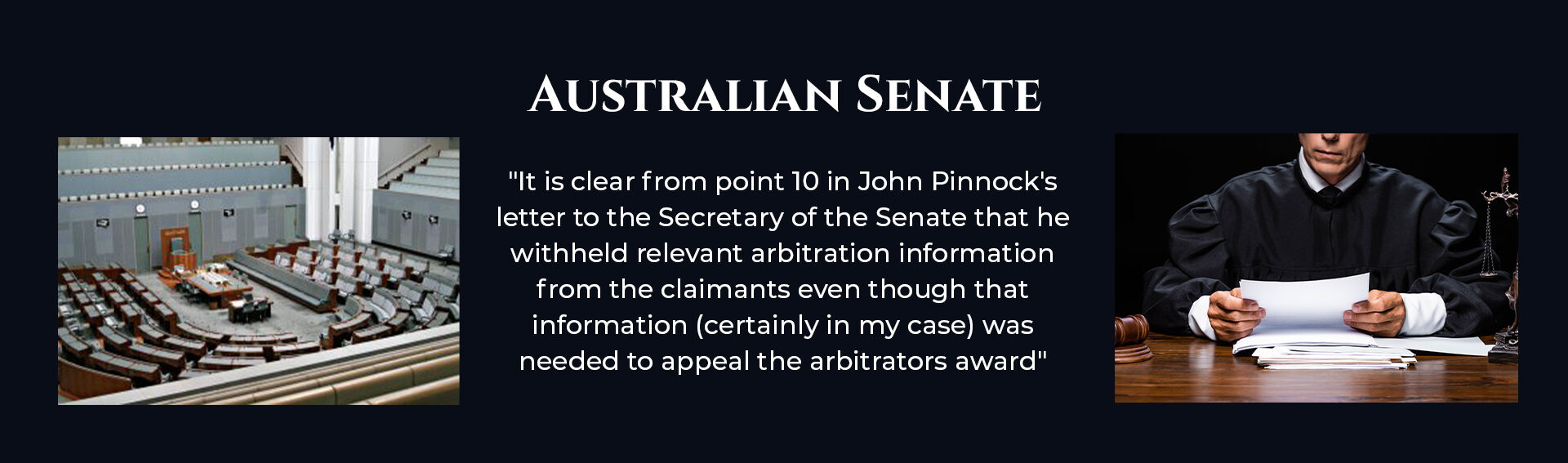
Senate Hansard information dated 26th September, 1997 (GS-CAV Exhibit 89 to 154(b) - See GS-CAV 124-B) confirms that:-
Ted Benjamin, Telstra’s main arbitration defence liaison officer in Graham and Alan’s arbitrations, was also a member of the TIO Council and
During a Senate hearing into COT issues, the then-new TIO, John Pinnock, agreed that Mr Benjamin had not removed himself from council discussions of COT matters:-
Senator SCHACHT – “Mr Benjamin, you may think that you have drawn the short straw in Telstra, because you have been designated to handle the CoT cases and so on. Are you also a member of the TIO Board?”
Mr Benjamin – “I am a member of the TIO council.”
Senator SCHACHT – “Were any CoT complaints or issues discussed at the council while you were present?”
Mr Benjamin – “There are regular reports from the TIO on the progress of the CoT claims.”
Senator SCHACHT – “Did the council make any decision about CoT cases or express any opinion?”
Mr Benjamin – “I might be assisted by Mr Pinnock.”
Mr Pinnock – “Yes.”
Senator SCHACHT – “Did it? Mr Benjamin, did you declare your potential conflict of interest at the council meeting, given that as a Telstra employee you were dealing with CoT cases?”
Mr Benjamin – “My involvement in CoT cases, I believe, was known to the TIO council.”
Senator SCHACHT – “No, did you declare your interest?”
Mr Benjamin – “There was no formal declaration, but my involvement was known to the other members of the council.”
Senator SCHACHT – “You did not put it on the record at the council meeting that you were dealing specifically with CoT cases and trying to beat them down in their complaints, or reduce their position; is that correct?”
Mr Benjamin – “I did not make a formal declaration to the TIO.”
The fact that Ted Benjamin, as a TIO Council officer, would have a good idea from the TIO meetings on how far advanced each of the COT arbitrations was and what the arbitrator was discussing with the TIO (who was also the administrator to the arbitrations) on when each claimant might further advance his claim, knowing this inside information assisted Mr Benjamin in deciding when to release requested FOI documents to each of the claimants and when to hold back any relevant document that could jeopardise Telstra's defence.
It was grossly unethical for Warwick Smith to allow this to happen, and it was just one more nail in the coffin of each of the COT cases.
Most Disturbing And Unacceptable
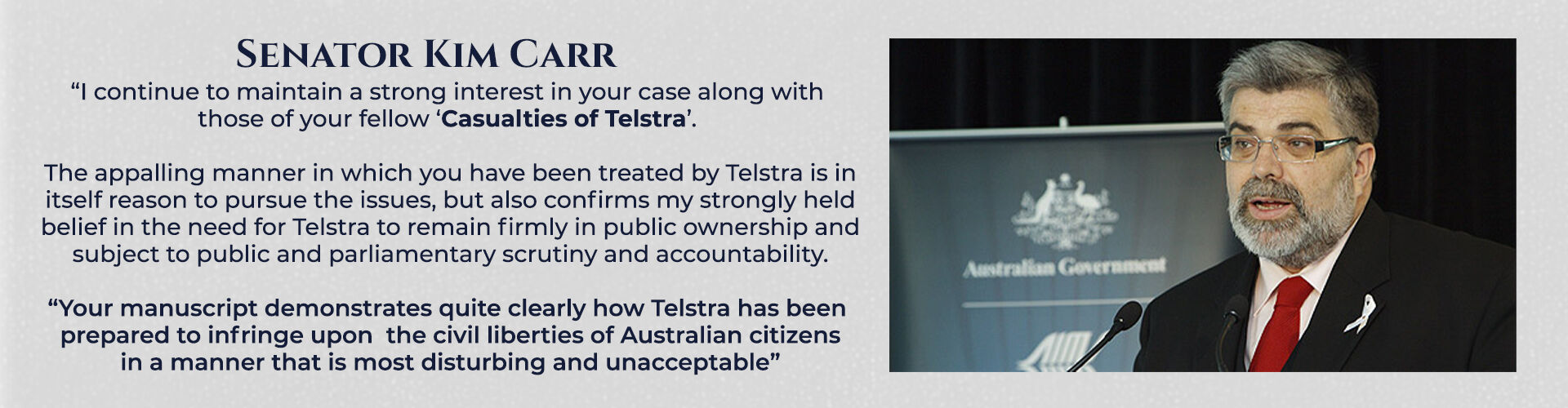
On 27 January 1999, after having also read my first attempt at writing my manuscript on absentjustice.com, the same manuscript I had provided to Helen Handbury (Rupert Murdoch’s sister, and later to Helen’s husband Geoff after she tragically passed away), Senator Kim Carr wrote:
“I continue to maintain a strong interest in your case along with those of your fellow ‘Casualties of Telstra’. The appalling manner in which you have been treated by Telstra is in itself reason to pursue the issues, but also confirms my strongly held belief in the need for Telstra to remain firmly in public ownership and subject to public and parliamentary scrutiny and accountability.
“Your manuscript demonstrates quite clearly how Telstra has been prepared to infringe upon the civil liberties of Australian citizens in a manner that is most disturbing and unacceptable.”
The systematic betrayal of the sixteen abandoned Casualties of Telstra (COT) cases stands as a grotesque monument to state-sanctioned corruption, ruthless discrimination, and treacherous institutional cover-ups.
At the bottom of this homepage lies a parchment-style narrative, a warning disguised as a relic, that exposes how we were not merely pressured before our 1994 government-endorsed arbitrations; we were hunted by calculated threats throughout them, and stalked for a decade after. Until December 2004, the Senate Chair weaponised the law, making it terrifyingly clear that if I ever released the Senate Hansard records of 6 and 9 July 1998, I would be brutally charged with contempt of the Senate.
In Australia, the machinery of state power is designed to bury its secrets by burying its citizens. Anyone who dares to expose in-camera privileged discussions can be thrown into a prison cell for two years. That was the grim fate promised to me if I released those Hansards, the very documents I still possess, copied for Senator Len Harris of Pauline Hanson’s One Nation Party. Had I surrendered them and survived that two-year sentence, emerging light-scarred from a cell, I might have lived the last twenty-five years in peace. Instead, I carried the crushing weight of their silence.
Those two Hansards prove a poisonous truth: in 1998, the Senate knew a deal had been rigged behind closed doors. Forcing Telstra to pay $18 million in punitive damages and release withheld FOI documents in only five hand-picked "litmus test" cases, while abandoning the remaining sixteen of us to financial and emotional ruin, was deliberate, malicious discrimination. They bought off five with millions; they left sixteen of us to rot. I was one of the forgotten sixteen.
I never found the courage to release those Hansards and risk a jail cell. Instead, I wrote two books and built this website, absentjustice.com, as a fortress for the truth, creating the only safe way to speak out against the treachery that the Senate tried to permanently bury → An Injustice to the remaining 16 Australian citizens)
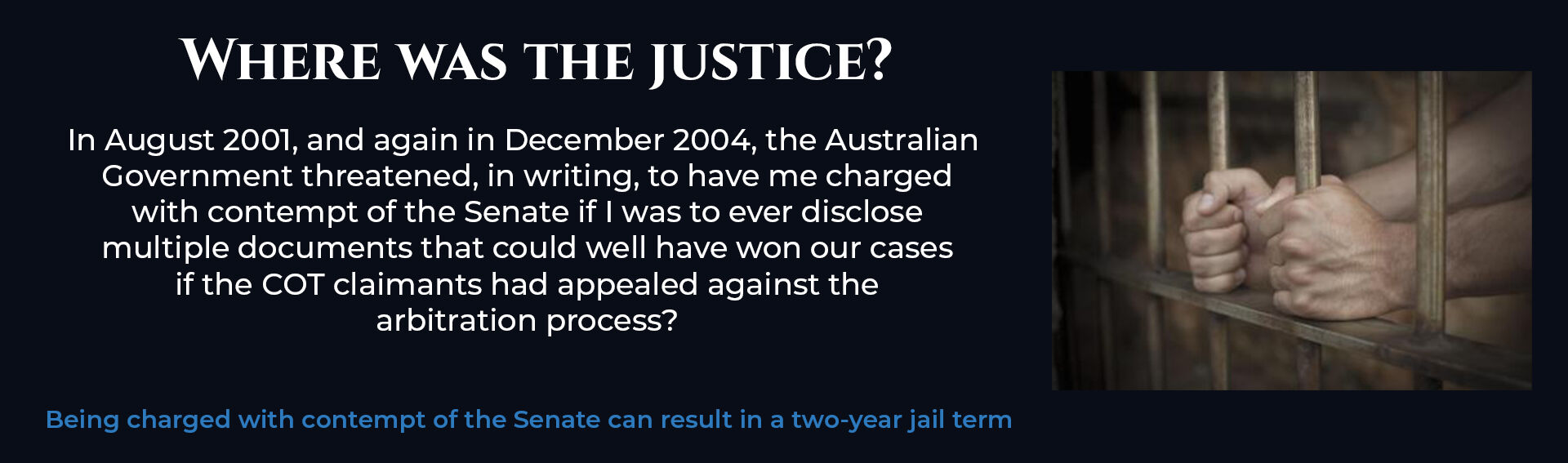
(Two letters from the Chair of the Senate → refer to Senate Evidence File No 12)
However, what follows under the heading “Senate In Camera Hansard” is less than seven per cent of the 9 July 1998 in‑camera Senate Hansard — not quoted, not reproduced, but rendered in my own words, except for the italic wording, which is exactly as recorded in the Hansard; only the non‑italic text is in narrative form. And still I must ask: will I be jailed merely for describing it, for allowing you, the reader, to see for yourselves the depth of the betrayal inflicted on the sixteen unresolved COT Cases?
This is the shadow the Australian Government cast over us, a shadow long enough to swallow decades, silence truth, and make even a narrative dangerous.
Senate In Camera Hansard - The Threats Continue
A heated Senate committee meeting detonated when National Party Senator Ron Boswell unleashed a blistering attack on a senior Telstra arbitration officer. His fury cracked through the chamber like a whip: “You are really a disgrace — the whole lot of you.” The words hung in the air like poison, staining the already volatile atmosphere as Telstra’s conduct toward the COT Cases was dragged into the open.
The outburst was too raw, too revealing. The committee chair moved swiftly, sensing the danger in Boswell’s accusation. Under the glare of scrutiny — and the rigid decorum demanded in such a chamber, Boswell retreated. His voice cooled, but the venom remained: “Madam, I withdraw that remark.” The apology was procedural, hollow, a forced concession to parliamentary ritual. The damage, however, was done. The moment exposed the rot beneath Telstra’s treatment of the COT Cases — a matter steeped in public interest and institutional betrayal.
Boswell continued, his tone now controlled but no less lethal:
“Madam, I withdraw that, but I do say this: this has got a unity ticket going right through this parliament. This has united everyone in this parliament—something no one else has ever been able to do—and Telstra has done it magnificently. They have got the Labor Party, they have got the National Party, they have got the Liberal Party, they have got the Democrats and they have got the Greens — all united in a singular distrust of Telstra. You have achieved a miracle.”
At eighty‑two, with May 2026 already behind me, I take the punt that nothing will change me now, not after writing only the words that Senator Chris Schacht delivered in the Senate on 9 July 1998, moments after Boswell condemned Telstra for what they had done to us twenty‑one Australian citizens. Schacht turned to Telstra’s official arbitration liaison office the same man who admitted to concealing half of my May 1994 FOI documents until after the arbitrator handed down his award on 11 May 1995. The arbitrator ruled on incomplete evidence, and Telstra knew it.
And not to be outdone by Senator Chris Schacht, Senator Tierney put a shot across the same bow of Telstra’s official arbitration liaison officer, stating: “Can you see that the whole thing is unfair?” He then hit home even harder, noting, “…given the amount of time, money and heartbreak for these people you have created…”
Once more, Senator Schacht’s words were a blade:
“For God’s sake, Telstra, just give the last four all half a million or a million dollars each and stop it immediately. But that would be an injustice to the sixteen or whatever you have settled.”
He was right. Telstra did not stop it. Instead, they quietly released $18 million to the five Litmus Test cases under Senate investigation, namely, A Garms, R Bova, R Plowman, A Honor, and G Schorer, and then turned their backs on the remaining sixteen unresolved cases. Telatra knew exactly what they were doing. They knew the five would never surrender the $18 million they had been handed. And they knew the rest of us would be forced into the courts, abandoned, isolated, and left to fight a corporation that had already bought its absolution.
🕯️ The Systematic Burial of Truth: How critical evidence vanished, was withheld, or never reached those entrusted with justice, transforming a search for facts into a battle against concealment.
🕵️ The Surveillance State Behind the Arbitration: Disturbing evidence suggests that those seeking justice were themselves being watched, monitored, and exposed while pursuing their claims.
🗂️ The Machinery of Concealment: A trail of missing files, altered records, withheld reports, and unexplained omissions pointing to a culture where transparency became the enemy.
⚙️ A Process Engineered to Fail: How safeguards intended to protect claimants were weakened, bypassed, or removed, leaving behind an arbitration structure that benefited power, not justice.
📣 The Price of Speaking Out: The personal, financial, and emotional cost paid by those who refused to remain silent in the face of institutional wrongdoing.
🤐 The Conspiracy of Silence: How corporations, regulators, advisers, and government agencies appeared to retreat behind silence, delay, and bureaucratic obstruction whenever difficult questions emerged.
⚖️ Justice on Trial: The troubling question of whether the arbitration was ever allowed to function as an independent search for truth or whether its outcome was influenced from the start.
🔒 Justice Denied: The story of delayed investigations, rejected evidence, and procedural barriers that transformed promised justice into an elusive illusion.
🎯 Punishing the Complainants: How those seeking accountability allegedly became targets of pressure, isolation, and escalating obstacles designed to exhaust their resolve.
🔑 The Hidden Power Network: The influence of privileged access, insider relationships, and institutional protection that may have operated beyond the reach of ordinary claimants.
🎭 Deception as a Strategy: A pattern of selective disclosures, misleading explanations, and carefully managed narratives that allegedly shaped the official version of events.
🔍 The Evidence They Didn't Want Seen: The mystery surrounding vital documents, missing records, and evidence trails that disappeared when scrutiny became unavoidable.
📎 Weaponised Bureaucracy: How procedure, paperwork, and administrative complexity became powerful tools for delaying, frustrating, and weakening legitimate claims.
🌍 The International Connection: Evidence suggesting that the failures confronting the COT cases may have reflected broader technical, corporate, and policy issues extending far beyond Australia.
💾 The Forensic Footprints: Metadata anomalies, altered records, unexplained access points, and digital inconsistencies that continue to raise disturbing questions about evidence integrity.
🕳️ The Disappearance of Accountability: How responsibility became fragmented across multiple institutions until no individual or agency appeared willing to answer for the whole truth.
🚪 Exiled for Telling the Truth: A personal journey of displacement, endurance, and determination as the search for answers continued outside the centres of power.
💔 The Human Casualties: The devastating personal, financial, emotional, and health impacts suffered by those whose lives were forever altered by decisions made behind closed doors.
🛑 Investigations That Went Nowhere: A disturbing pattern of inquiries that appeared to lose momentum whenever they approached evidence capable of exposing deeper institutional failures.
📜 The Manufacture of Official History: How incomplete records, disputed findings, and selective narratives risked becoming accepted facts while contradictory evidence remained buried.
⚡ The Cracks Begin to Show: The gradual emergence of contradictions, admissions, and documentary evidence that challenged decades of official explanations.
📝 The Legacy of a Whistleblower: The determination to preserve evidence, safeguard the historical record, and ensure future generations can examine the facts for themselves.
🔔 When the Silence Finally Breaks: The moment when the accumulated weight of evidence becomes impossible to dismiss, and the institutions involved are forced to confront unanswered questions.
🔥 The Briefcase, the Tapes, and the Cover-Up: The explosive AFP evidence, the abandoned Telstra briefcase, the taped conversations, and the extraordinary efforts allegedly undertaken to keep those revelations hidden from public scrutiny.
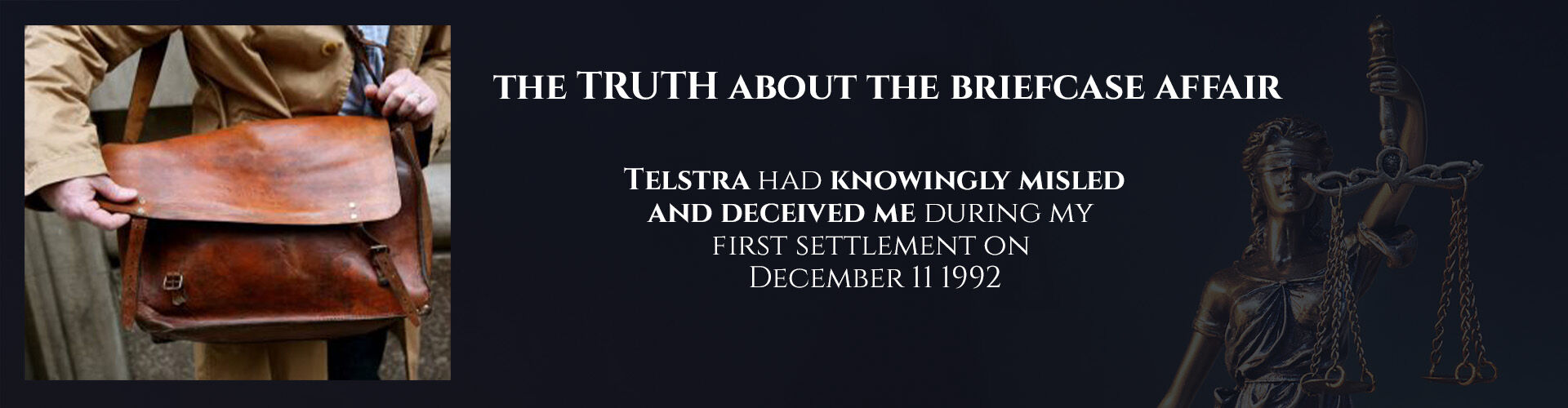
Click here to read the full report → AUSTEL’s Adverse Findings
Unfortunately, I did not receive a copy of the following findings (AUSTEL’s Adverse Findings) at points 2 to 212 until November 23, 2007, 12 years after my arbitration process ended. In simple terms, the government validated my claims as early as March 4, 1994, six weeks before April 21, 1994, when I signed the arbitration agreement.
But despite this proof, I was still required to endure 13 months in a gruelling arbitration process that cost me well over $300,000 in professional fees to prove something the government had already established, as the following 212 points show, all taken from Telstra's Portland telephone exchange log book, which each of the COT Cases they would receive under the FOI and/or arbitration discovery process if we officially agreed to fund our own arbitration proceses which would in return force the arbitrator to ensure all of our ongoing telephone and faxing problems, those raised in our arbitration claims were fixed with a statutory declaration stating our phone and faxing faults were up to Telstra's manadtor requirement needed in which to maintain their licence.
I ask all visitors to this website, absentjustice.com, to at least read the first 20 official government findings from their secret investigation into my matters, and, when those 20 points are read and understood, imagine what the arbitrator might have awarded me had he viewed all 212 findings.
PLEASE NOTE — IMPORTANT NOTICE TO ALL VISITORS
We are currently editing the following twelve files for typos and improved readability. This editing process is not an investigation into whether the evidence contained in those files is true or correct. That work has already been done.
We scrutinised, verified, and authenticated all evidence in these twelve files before uploading it to the absentjustice.com download exhibits.
The purpose of this edit is simply to ensure the files flow in a way most readers can follow easily and that the language isn't overly legalistic. Even if I haven't fully edited some sections to my satisfaction, the content is accurate, correct, and unchanged.
Telstra-Corruption-Freehill-Hollingdale & Page
Corrupt practices persisted throughout the COT arbitrations, flourishing in secrecy and obscurity. These insidious actions have managed to evade necessary scrutiny. Notably, the phone issues persisted for years following the conclusion of my arbitration, established to rectify these faults

Confronting Despair
The independent arbitration consultants demonstrated a concerning lack of impartiality. Instead of providing clear and objective insights, their guidance to the arbitrator was often marked by evasive language, misleading statements, and, at times, outright falsehoods.
Flash Backs – China-Vietnam
In 1967, Australia participated in the Vietnam War. I was on a ship transporting wheat to China, where I learned China was redeploying some of it to North Vietnam. Chapter 7, "Vietnam—Vietcong," discusses the link between China and my phone issues.

A Twenty-Year Marriage Lost
As bookings declined, my marriage came to an end. My ex-wife, seeking her fair share of our venture, left me with no choice but to take responsibility for leaving the Navy without adequately assessing the reliability of the phone service in my pursuit of starting a business.

Salvaging What I Could
Mobile coverage was nonexistent, and business transactions were not conducted online. Cape Bridgewater had only eight lines to service 66 families—132 adults. If four lines were used simultaneously, the remaining 128 adults would have only four lines to serve their needs.

Lies Deceit And Treachery
I was unaware of Telstra's unethical and corrupt business practices. It has now become clear that various unethical organisational activities were conducted secretly. Middle management was embezzling millions of dollars from Telstra.

An Unlocked Briefcase
On June 3, 1993, Telstra representatives visited my business and, in an oversight, left behind an unlocked briefcase. Upon opening it, I discovered evidence of corrupt practices concealed from the government, playing a significant role in the decline of Telstra's telecommunications network.
Not Fit For Purpose (Duplicate 1)
AUSTEL investigated the contents of the Telstra briefcases. Initially, there was disbelief regarding the findings, but this eventually led to a broader discussion that changed the telecommunications landscape. I received no acknowledgement from AUSTEL for not making my findings public.
&am

A Government-backed Arbitration
An arbitration process was established to hide the underlying issues rather than to resolve them. The arbitrator, the administrator, and the arbitration consultants conducted the process using a modified confidentiality agreement. In the end, the process resembled a kangaroo court.

A Non-Graded Arbitrator
Who granted the financial and technical advisors linked to the arbitrator immunity from all liability regarding their roles in the arbitration process? This decision effectively shields the arbitration advisors from any potential lawsuits by the COT claimants concerning misconduct or negligence.<

The AFP Failed Their Objective
In September 1994, two officers from the AFP met with me to address Telstra's unauthorised interception of my telecommunications services. They revealed that government documents confirmed I had been subjected to these violations. Despite this evidence, the AFP did not make a finding.&am
The Promised Documents Never Arrived
In a February 1994 transcript of a pre-arbitration meeting, the arbitrator involved in my arbitration stated that he "would not determination on incomplete information.". The arbitrator did make a finding on incomplete information.