

This website is a work in progress and was last edited in November 2026
No Donate Button—But a Call to Action
If, while reading this narrative, you find yourself wondering where the donate button is—there isn’t one.
This website does not seek personal donations. Instead, if you believe this work presents a compelling case for justice and equity within Australia’s arbitration system , and if you see value in the research, evidence, and advocacy behind it, I invite you to support a cause that aligns with these principles.
Consider donating directly to Transparency International Australia. Your contribution will help raise awareness of the injustices that threaten our democracy and support efforts to hold institutions accountable.
This work is offered freely, driven by a moral obligation to expose the truth. But the fight for transparency is bigger than one voice—it needs all of us.
Learn about calculated crimes, unscrupulous operators, complicit politicians, and the lawyers who control Australia's legal establishment. "Shameful," "predatory," and "treacherous" are just a few words to describe these lawbreakers.
Delve into the systemic corruption that poisoned the COT arbitrations, endorsed by the Australian government. This narrative exposes not only those who engineered these crimes but also the equally corrupt government agencies that actively buried the evidence, making themselves accessories after the fact.
It takes less than four minutes to spot a fraud or recognise the absolute truth. Though filmed four years ago in 2022, this 3.5-minute video now appears on the absentjustice.com homepage, so you can look the speaker in the eye, hear the raw account of the COT story, and judge its authenticity for yourself.
INTRODUCTION
Before exposing what unfolded during the COT arbitrations, readers must understand why the Australian Wheat Scandal belongs in this story. It is not a diversion—it is a stark precedent of what happens when political survival and bureaucratic self-interest override the welfare of ordinary citizens. What follows is not merely a dispute over faulty phone lines, but a reminder that segments of the Australian Establishment have repeatedly sacrificed their own people to evade accountability and protect larger political interests
A Pattern of Betrayal: From 1967 to the 1994 Telstra Arbitration

CHINA
45. Echoes of Betrayal: Wheat Sales to China
In 1967, while Australian conscripts fought and died in the jungles of Vietnam, government bureaucrats and politicians dismissed what my fellow seamen and I had witnessed in Communist China. For decades, officials labelled our testimony a lie, yet we risked everything to expose the truth.
Looking back on Australia's wheat sales to the People's Republic of China in 1967, the hypocrisy is undeniable. Decision-makers in Canberra allowed Australian grain, shipped under the banner of humanitarian relief, to be redeployed to fuel North Vietnam's war effort against Australian, New Zealand, and American troops. It is a stark reminder that betrayal does not always come from enemies abroad; sometimes, it is engineered by bureaucratic expediency at home.
I returned to Australia on September 18, 1967, having narrowly escaped China with my life. I was fundamentally changed from the young seaman who had sailed out in June. Over the decades that followed, I was treated no differently than other whistleblowers who dared to speak uncomfortable truths amid institutional cover-ups.
My anger, and that of my crewmates, was never directed at feeding starving civilians. None of us objected to genuine humanitarian aid. What ignited our fury was discovering that, despite formal warnings from my fellow crew members aboard the Hopepeak and me to the Commonwealth Police (now the AFP) and to the Hon. Malcolm Fraser, then Minister for the Army, on September 18, 1967, the wheat shipments continued.
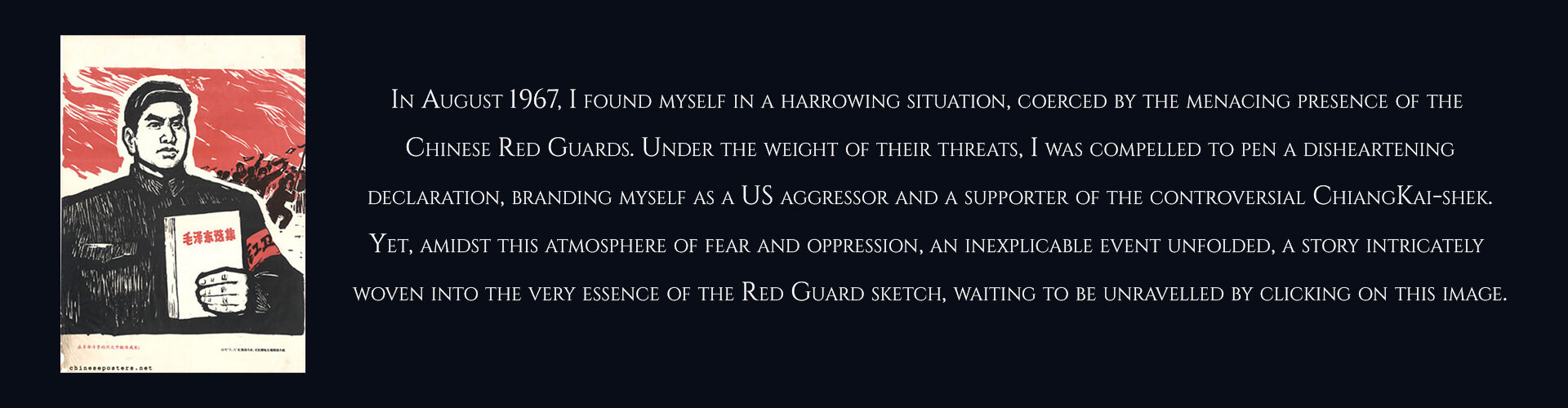
Murdered for Mao: The killings China ‘forgot’
The Letter, the Truth, and the Waiting
In August 1967, I found myself in a situation so surreal and perilous that it etched itself permanently into my memory. I was aboard a cargo ship docked in China, surrounded twenty-four hours a day by Red Guards spaced no more than thirty paces apart. After being coerced into writing a confession, declaring myself a U.S. aggressor and a supporter of Chiang Kai-shek, the Nationalist leader in Taiwan—the second steward, who handled the ship's correspondence, told me I had roughly two days before a response would arrive. Whatever the verdict, the head of the Red Guards himself would deliver it.
The second steward quietly suggested I write to my parents. I did. I poured myself into 22 foolscap pages, writing with the urgency of a man who believed he would not live to see the end of the week. I told my church-going parents that I was not the saintly young man they imagined. I confessed that the woman they had so often thanked in their letters, believing her to be my landlady, was, in fact, my lover. She was 42; I was 18 when we met. Between 1963 and 1967, she had been my anchor, my warmth, and my truth. I wrote about life at sea, the chaos and camaraderie, the loneliness and longing. I needed them to know who I truly was in case I was executed before I ever saw them again.
As the ship's cook and duty mess-room steward, I had a front-row seat to the daily realities on board. I often watched the crew eat their meals on deck, balancing plates on the handrails. The irony was unbearable: we were delivering grain to China on humanitarian grounds, yet food was routinely wasted while the people watching us were starving. Sausages, half-eaten steaks, and baked potatoes would slip from plates and tumble into the harbour. No seagulls swooped down to claim them; they had already been eaten. Even fish had grown scarce in the harbour. Starvation was not an abstract political concept; it was a physical presence in the eyes of the Red Guards watching us eat, and in the heavy silence that followed every wasted bite.
A Tray of Leftovers and a Silent Exchange
Following my arrest, I was placed under house arrest aboard the vessel. One day, I took a small metal tray from the galley and filled it, not with scraps, but with decent leftovers that would otherwise have gone into the stockpot or dry hash cakes. I carried it out onto the deck, set it on one of the long benches, patted my stomach to show I had eaten my fill, and walked away without a word.
Ten minutes later, I returned. The tray had been licked clean.
At the next meal, I repeated the gesture, this time leaving enough food for three or four Red Guards. No words. No eye contact. Just food. I continued this quiet ritual for two more days while waiting for the verdict on my letter. Gradually, something shifted. The Red Guard who had been waking me every hour to check on me stopped coming. The tension on deck thinned, just slightly. Whenever the crew was busy unloading wheat with grappling hooks wrapped in chicken wire, I would slip out with another tray.
To this day, I do not know what saved my life. It was certainly not the forced confession branding myself an American aggressor. Perhaps it was luck. Or perhaps it was that metal tray of food, offered without speech, expectation, or condition, a silent gesture that said: I see you. I know you are hungry. I know you are human.
At the heart of this crisis lay a brutal calculation by the Australian Government: weighing the lives of its conscripted soldiers in Vietnam against the economic and political imperatives of maintaining grain trade with China.
46. Historical Corroboration: Footnotes 83, 84, and 169
Decades later, academic research documented the exact events my crewmates and I witnessed. In June 2021, Tianxiao Zhu submitted a doctoral dissertation to the Faculty of the University of Minnesota (under adviser Christopher M. Isett) titled Secret Trails: Food and Trade in Late Maoist China, 1960–1978. Footnotes 83, 84, and 169 record the testimony of the Hopepeak crew and fellow seafarers:
Footnote 83: In September 1967, a group of British merchant seamen quit their ship, the Hopepeak, in Sydney and flew back to London. They told the London press they resigned due to the humiliating treatment they endured in Chinese ports, adding that Australian grain shipped to China was being sent straight on to North Vietnam. One seaman stated: "I have watched grain going off our ship on conveyor belts and straight into bags stamped North Vietnam. Our ship was being used to take grain from Australia to feed the North Vietnamese. It's disgusting."
Footnote 84: When questioned in Parliament about the seamen's claims, the Minister for Trade and Industry noted that while in Australia, the crew had spoken to the press only of intolerable maltreatment in Chinese ports and their fear of returning. Because the Vietnam allegations surfaced publicly after their arrival in London, the Minister dismissed the claims regarding North Vietnam as a probable "afterthought."
Footnote 169: "In Vancouver, nine sailors refused to work on a grain ship headed to China: two of them eventually returned to work, and the others were arrested. Just when the ship was about to sail, seven more left the ship, though three later returned to work. In Sydney, six Canadian sailors left their ship; they resigned and asked to be paid, but the Australian immigration office repatriated them. At that time, a grain ship usually had a crew of about 40 people. A British ship lost the Chief Officer and sixteen seamen, who told journalists that if the ship were going to communist countries, they would rather go to jail than work on the ship."
47. Canadian Seafarers and the Moral Stand
Hover your mouse over the Canadian flag image above as you scroll down the homepage to learn more about the stand taken by Canadian merchant seamen.
Despite facing arrest, loss of pay, and forced repatriation, Canadian and British merchant seamen upheld a clear ethical principle: shipping wheat to Communist China, knowing portions of it were being diverted to sustain North Vietnamese forces at war with Australian, New Zealand, and American troopswas morally indefensible.
Yet the Australian Government consciously chose to preserve its lucrative wheat trade with China. That grain was not merely an agricultural export; once redirected, it sustained enemy forces directly engaged in combat against Allied personnel. Examining the wheat agreements brokered with the People's Republic of China during the Menzies and Holt eras reveals how official denials and a campaign to discredit merchant seamen, including myself, obscured what was happening on the docks.
48. The Hopepeak Voyage: June to September 1967
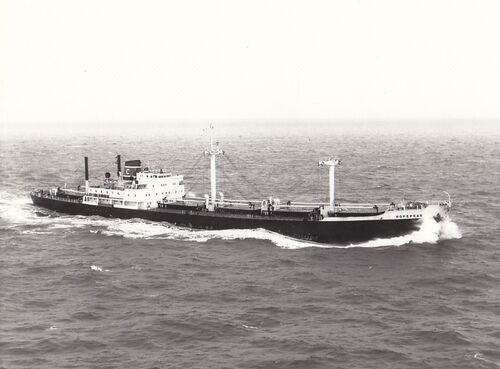 Serving aboard the Hopepeak between June and September 1967 turned political policy into a terrifying personal ordeal. I witnessed firsthand how Australian wheat shipments were entangled with the Vietnam conflict:
- Armed Detention: I was frog-marched off the Hopepeak under armed guard by Red Guards and accused of spying.
- Coerced Statements: I was forced to write confessions under the threat of execution.
- Police Intervention: Upon our return to Sydney on September 18, 1967, Commonwealth Police officers boarded the ship, confirming the gravity of what had occurred.
- Crew Refusal: Fearing for their lives, British crew members refused to sail the vessel back to China with another cargo of wheat.
Despite these firsthand warnings, the Australian Government allowed further shipments to proceed.
49. September 18, 1967: Appeal to Malcolm Fraser, Minister for the Army
On September 18, 1967, the very day we reached Sydney, I wrote to the Hon. Malcolm Fraser, then Minister for the Army, in a letter witnessed by a Commonwealth Police officer. My plea was straightforward: stop sending wheat to China while sending young Australians to fight and die in Vietnam.
The shipments continued regardless, met with official silence.
Decades later, in April 1993 and again in April 1994, I telephoned former Prime Minister Malcolm Fraser to remind him of that 1967 warning and the ordeal I had survived. By then, the historical consequences were beyond dispute:
- The wheat shipments had gone ahead despite eyewitness warnings.
- Australian conscripts had fought and died in Vietnam.
- Ministers and bureaucrats had chosen political convenience over lived testimony.
My calls were met with indifference, reflecting an enduring institutional unwillingness to confront the record.
50. The Political Warning: 1965
Vol. 87 No. 4462 (4 Sep 1965) - National Library of Australia https://nla.gov.au › nla.obj-702601569
The government could not claim ignorance of the strategic contradiction. Two years before my voyage, on September 4, 1965, Labor MP Kim Beazley Sr. published a stark warning in The Bulletin (Vol. 87, No. 4462, National Library of Australia: nla.obj-702601569). Citing a Department of External Affairs handbook titled Studies on Vietnam, which confirmed that the Viet Cong were armed with Chinese weapons, Beazley wrote:
"The Department of External Affairs has recently published an Information Handbook entitled 'Studies on Vietnam'. It establishes the fact that the Vietcong are equipped with Chinese arms and ammunition.
If it is right to ask Australian youth to risk everything in Vietnam, it is wrong to supply their enemies. The Communists in Asia will kill anyone who stands in their path, but at least they have a path.
Australian trade commissioners do not so readily see that our Chinese trade in war materials finances our own destruction. Nor do they see so clearly that the wheat trade does the same thing."
Beazley's warning was unambiguous: trading strategic commodities and wheat with China while fighting in Vietnam was morally indefensible and strategically reckless. Yet the government pressed ahead, prioritising export revenue over the warnings of both parliamentarians and the merchant seamen who witnessed the diversion firsthand.
As a young man of 25, after signing on board the British-manned ship Hopepeak, I found myself bound for Communist China in 1967 at the height of the Vietnam War—not Canada, as I had been promised. That voyage became a surreal nightmare when I uncovered what was happening in the cargo hold: the Australian wheat we had delivered to China on "humanitarian grounds" to feed a starving population was being redeployed straight to North Vietnam. There, in the dense jungles, that very wheat was sustaining communist forces engaged in killing and maiming Australian, New Zealand, and American troops.
For uncovering this diversion, I was marched off the Hopepeak under armed guard by Chinese Red Guards, facing almost certain charges of spying. What followed was a terrifying period of ship's arrest. Trapped under constant surveillance by Red Guards stationed thirty paces apart day and night, I was pressured into writing a forced confession describing myself as a United States aggressor and a supporter of Chiang Kai-shek. During that agonising wait—not knowing whether my forced letters to the People's Republic of China would save my life or end it—the second steward quietly suggested I write to my parents.
I followed his advice and wrote 22 foolscap pages, believing I might not survive the week. In that letter, I chose to speak with absolute honesty. I confessed that the woman they believed was my landlady was, in fact, my 42-year-old lover, who had been my primary source of stability between 1963 and 1967. I also wrote about the profound loneliness, confusion, and claustrophobic terror of my detention.
While under house arrest aboard the vessel, I witnessed severe local deprivation firsthand. From our galley, we routinely discarded half-eaten sausages, steaks, and baked potatoes into a sea devoid of seagulls or fish. Seeing the desperate hunger in the faces of the people watching us eat, I began filling a small metal tray with edible leftovers, placing it on a deck bench, patting my stomach to show I had eaten, and walking away. Within ten minutes, the tray was empty. I repeated this quiet gesture for two days. Suddenly, the Red Guard who had been waking me every single hour on the hour stopped. Perhaps a small, silent act of human compassion had briefly broken through the political madness of the Cultural Revolution.
On 18 September 1967, after the ship's Captain used the radio to alert Australia to my ordeal, we finally arrived home. I immediately reported my concerns to the Commonwealth Police and wrote a formal, handwritten letter to the Hon. Malcolm Fraser, then Minister for the Army, which I signed and which one of the visiting Commonwealth Police officers countersigned. The crew also made it explicitly clear to the Captain that they were terrified and entirely unwilling to make another trip to China with paid wheat.
That defining trauma became the hidden anchor of my entire absentjustice.com story. Decades later, during my 1993 and 1994 telecommunications dispute, I telephoned Malcolm Fraser to discuss that original 1967 letter and why its consequences were still shadowing my life. Under Freedom of Information (FOI) in 1994, I finally obtained the official records of those 1993–1994 telephone conversations with Mr Fraser to present to the Commonwealth Ombudsman, the arbitrator, and the Australian Federal Police (AFP).
To my horror, the released records were a farce. Although both documents were a page long, the government had completely redacted the substantive content of both conversations. Seeing those clean, state-sanctioned blackouts triggered a massive, visceral flashback to the terror I had suffered at the hands of the Chinese Red Guards.
This website preserves the primary documents, footnotes 83, 84, and 169 from Dr Tianxiao Zhu's University of Minnesota thesis (Secret Trails: Food and Trade in Late Maoist China, 1960–1978), and the accounts of the British and Canadian merchant seamen who later walked off their ships in protest. Together, they document a stark historical ledger: the Australian Government weighed the lives of its frontline soldiers against wartime trade with a communist regime.
Every exhibit, file, and supporting record in this decades-long archive is available on this website free of charge. Follow the file numbers below to examine the documentary trail firsthand.
When Document Starvation Becomes a Legal Strategy
When a state-backed monopoly formally adopts document starvation as a defensive legal strategy, the thin veneer of an independent, rules-based tribunal dissolves completely.
The Corporate Admission of Obstruction
When the Commonwealth Ombudsman formally investigated the withholding of discovery materials during my arbitration, Telstra's executive hierarchy offered a candid written admission. Confronted by the Director of Investigations, John Wynack, regarding why critical technical files, network logs, and engineering reports were being systematically withheld, Telstra stated that it was:
"...concerned at the publicity and significant diversion of Telecom resources caused by the recent release of certain information by Mr Smith and that the delay in release of documents was due to the need for Telecom to check all documents prior to release so that Telecom is alert to the possible use or misuse of sensitive information."
For the Casualties of Telstra (COT) arbitrations, this admission was a smoking gun. It was not an administrative excuse; it was a formal acknowledgement of a bad-faith campaign of evidence suppression. A multi-billion-dollar corporation, fully owned by Australian taxpayers, openly admitted it was using the FOI process to vet, stall, and block forensic evidence—terrified that proof of its defective infrastructure, including unauthorised call-intercept hardware, would enter the public domain.
The Ombudsman's Indictment
Commonwealth Ombudsman Philippa Smith saw straight through this tactic. She recognised that Telstra was using its institutional power to run a clandestine secondary clearance gate on legally requested documents, gauging how "sensitive" the data was before allowing it to reach the arbitration chamber.
In her final evaluation, the Ombudsman condemned this conduct, concluding that Telstra's decision to hold statutory arbitration rules hostage was unreasonable. She made it clear that a defendant cannot deny participants their legal rights, starve them of the documentation required to prove their financial losses, and demand silence and submissiveness as a condition for releasing records (see AS-CAV 64).
The trap was entirely Kafkaesque. As an Australian citizen, I was directed to fulfil my civic duty by providing the AFP with forensic evidence proving that Telstra was intercepting our private telephone lines, faxes, and legal strategies. I complied. Yet because I cooperated with federal investigators, the state-owned telecom monopoly retaliated by freezing my access to the technical records needed to build my claim, while the Telecommunications Industry Ombudsman (TIO) and the arbitrator stood by and allowed the standoff to continue.
Convergence of Past Whistleblowing and Commercial Warfare
During my 1994 arbitration, the boundary between my past whistleblowing and my present commercial dispute vanished. I made it clear to National Party Senator Ron Boswell—who was fighting relentlessly for the COT members—and to AFP Superintendent Detective Sergeant Jeffrey Penrose that I was being systematically victimised. The state-owned monopoly appeared to have absorbed my 1967 China wheat disclosure into its institutional memory, turning a commercial tribunal into an environment of covert intimidation designed to enforce my silence.
The Intelligence Pipeline: Exploiting the Over-Forty Singles Club
As I combed through the fragmented FOI documents Telstra reluctantly released, a disturbing picture emerged: the corporation had not merely intercepted my business lines; it had been mapping my commercial operations for years. Telstra held internal logs detailing my weekend "Over-Forty Singles Club"—a vital revenue stream I had built to keep the Cape Bridgewater Holiday Camp afloat while our phone network failed. Those records contained my female patrons' private names, phone numbers, and cross-strait travel patterns—raw data shared with external legal advisors.
When I presented evidence of this systemic interception to the AFP (documented in → Australian Federal Police Investigation File No/1), the corporate retaliation was swift and blunt.
The Rumble Ultimatum and Procedural Betrayal
By July 1994, the arbitration process had degenerated into coercion. Paul Rumble, Telstra's senior arbitration official, issued severe threats. Telstra was playing with a marked deck: in a breach of protocol, the arbitrator had leaked my confidential interim claim documents to Rumble five months before Telstra was legally permitted to view them. Armed with my complete legal strategy, Telstra executed a targeted campaign of document starvation.
Navigating this minefield required agonising precision. To buy breathing room and prevent the immediate disconnection of my telephone service, I was forced under extreme duress to write a literal hostage note on 4 July 1994:
"I gave you my word on Friday night that I would not go running off to the Federal Police etc, I shall honor this statement, and wait for your response to the following questions I ask of Telecom below." (File 85)
This capitulation was my only option. Days earlier, Telstra arbitration liaison officer Steve Black had delivered a blunt ultimatum over the phone: if I continued providing forensic evidence of network interception to the AFP, Telstra would permanently cut off my access to the technical documents I needed to prove my case. My lack of working telephone lines was weaponised as leverage.
When AFP investigators returned to Cape Bridgewater on 26 September 1994, they zeroed in on that forced letter. Page 12 of the official transcript recorded the investigator's sharp focus:
"The thing that I'm intrigued by is the statement here that you've given Mr Rumble your word that you would not go running off to the Federal Police etcetera."
At that moment, the façade of an independent tribunal collapsed. It was no longer an impartial adjudication; it was an ambush. By stripping me of the evidence the arbitrator needed to assess my losses, Telstra ensured my final submission would be judged on a poisoned, incomplete record.
The Senate Exposure
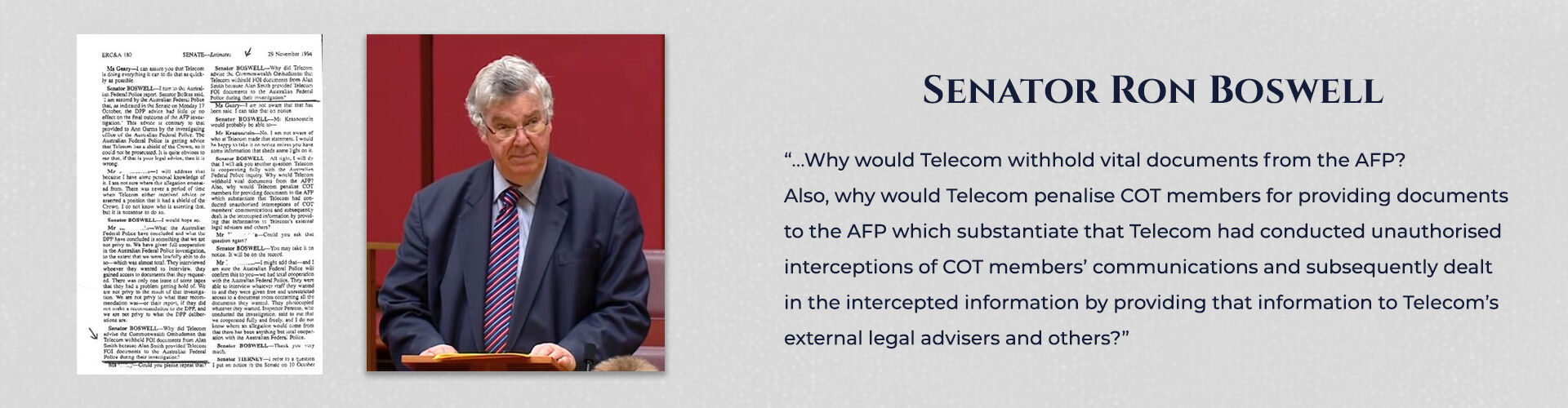
Faced with total inaction from an administrator who refused to intervene, I escalated the matter through Senator Ron Boswell. On 29 November 1994, Boswell stood in the Australian Senate and placed the issue squarely onto the Hansard record:
"Why did Telecom advise the Commonwealth Ombudsman that Telecom withheld FOI documents from Alan Smith because Alan Smith provided Telecom FOI documents to the Australian Federal Police during their investigation?"
Cutting through Telstra's corporate denials, Senator Boswell pressed further from the floor of Parliament:
"...Why would Telecom withhold vital documents from the AFP? Also, why would Telecom penalize COT members for providing documents to the AFP which substantiate that Telecom had conducted unauthorized interceptions of COT members' communications and subsequently dealt in the intercepted information by providing that information to Telecom's external legal advisers and others?" (Senate Evidence File No 31)
The Legacy of Unchecked Power
What remains most damning about this episode is the impunity that followed. Telstra was a government-owned corporation, and the arbitrator was bound by statutory rules. Yet the TIO, the Federal Government, and the tribunal stood idle while an Australian citizen assisting the Federal Police was pressured, financially ruined, and silenced. Neither the TIO nor the executive ever investigated the impact that document starvation had on my final arbitration award—leaving a permanent record of how far an entrenched bureaucracy will go to crush a whistleblower who knows too much.
Until the late 1990s, the Australian government, through its state-owned carrier Telecom (now Telstra), maintained an iron grip on the nation's telephone network. During this period, Telecom deliberately neglected its rural infrastructure, allowing it to fall into systemic disrepair and crippling regional businesses. When a group of us, known as the Casualties of Telecom (COT) Cases, sought accountability, we were drawn into a government-endorsed arbitration process. This process, however, was rigged from the outset—a state-sanctioned ambush designed to financially exhaust us rather than resolve a single faulty connection.
Victims were forced to spend hundreds of thousands of dollars just to participate, yet the arbitration delivered neither repairs nor justice. Instead, we faced calculated sabotage, covert criminal acts, and coordinated character assassinations aimed at destroying our credibility. Our livelihoods were systematically dismantled, millions of dollars were lost, and the psychological impact was devastating. Compounding this injustice, the perpetrators of this corruption were never held accountable. They remain in positions of power, actively suppressing the truth to protect their reputations.
When I launched my Cape Bridgewater holiday camp business in February 1988, the internet was unavailable in regional Australia. Telephone and fax lines were not merely tools; they were our sole connection to the outside world. Had email and digital commerce existed then, Telecom's network failures could not have been weaponised to exploit our isolation and destroy our businesses. Instead, our enterprise was suffocated in the dark.
Cape Bridgewater did not receive a functional mobile network until 2004, three years after I was forced to sell my ruined business. This delay was no accident. Had the government or Telstra rectified my sabotaged lines after my arbitration concluded, it would have exposed their "independent" process for what it truly was: a state-backed sham designed to silence victims and shield a corrupt monopoly.
A Call for Justice — And the Betrayal of a Nation
The most insidious forms of tyranny do not announce themselves with jackboots in the streets, burning parliaments, or overt acts of violence. They thrive in the shadows of bureaucracy, concealed behind polite corporate smiles, forged assurances, and the cold, calculated machinery of institutional deceit. Often, the rot begins with something so deliberately mundane that its sinister design remains invisible until the trap snaps shut. A rigged telephone line, a deliberately dropped call, a sabotaged livelihood, a hollow corporate apology, a calculated lie disguised as a promise of swift resolution — these seemingly ordinary irritations can be weaponised to mask a vast, subterranean network of collusion and state-sanctioned cover-ups.
Be sure to hover your mouse over the images below as you scroll down this home page.
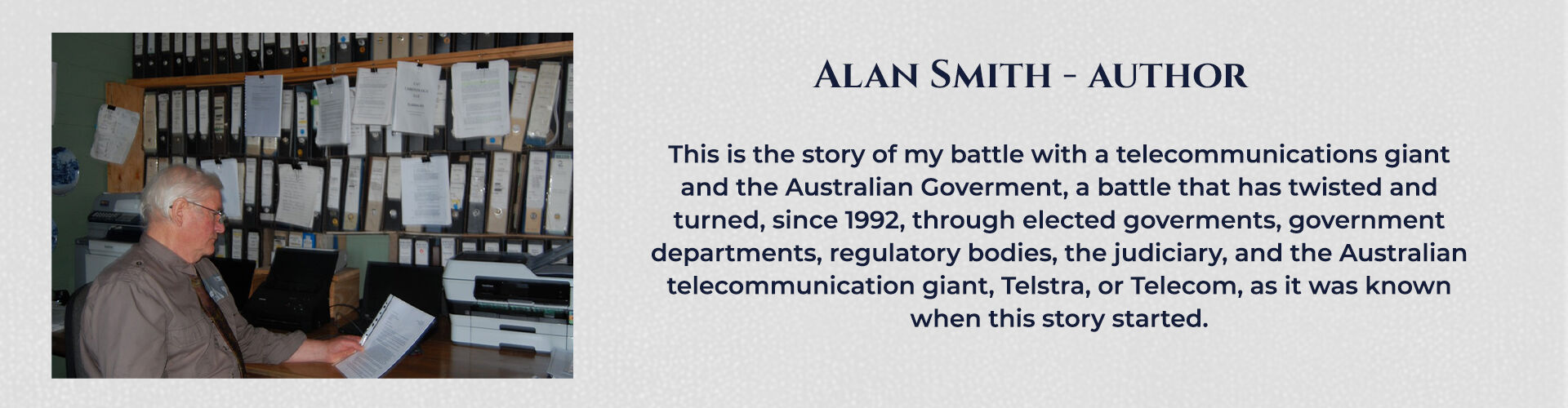
In 1987, when I acquired the Cape Bridgewater Holiday Camp and Convention Centre on Victoria's rugged southwest coast, the idea that a simple telecommunications fault could ignite decades of clandestine warfare, pitting me against a predatory state monopoly, compromised government departments, turncoat regulators, self-serving politicians, and a corrupt legal establishment, would have seemed like sheer paranoia. Had someone told me then that surviving this ambush would demand amassing over sixty-six thousand forensic records just to penetrate a coordinated wall of silence and deceit, I would have dismissed it as absurd.
Yet, this is precisely the betrayal that unfolded.
This narrative is far more than an account of defective telephone lines. Had it been an honest technical failure, it would have been resolved within weeks. The faults would have been identified, repaired, and forgotten. Fair restitution would have been paid, accountability accepted, and all parties would have moved on. Instead, what began as a straightforward commercial grievance mutated into a ruthless, coordinated campaign of attrition, sabotage, and institutional treachery.
It became a descent into the darkest, most corrupt corridors of Australian power.
This is not the memoir of a whistleblower, nor one driven by a thirst for notoriety, vengeance, or personal glory. I arrived in Australia after spending much of my life at sea, where a man's word was his bond, treachery was fatal, and survival depended on absolute trust. Like countless immigrants, I viewed this country as a bastion of fairness, believing that hard work and honesty were enough to build a life. The Cape Bridgewater Holiday Camp, perched along one of Victoria's most breathtaking coastlines, embodied that promise, offering everything I had worked toward for a new chapter in my life.
Within weeks, however, it became brutally clear that something sinister was at play, and that the forces sabotaging my livelihood were anything but accidental. Customers repeatedly reported that their calls failed to connect, while suppliers encountered the exact same phantom barriers. Lucrative bookings vanished into thin air, and revenue bled out without explanation. The weapon strangling the entire enterprise was the telephone network, an untouchable, state-backed monopoly upon which our survival completely depended.
At first, I naively assumed these disruptions were simple technical glitches. Every business faces occasional faults, and the remedy seemed obvious: report the failures, allow technicians to fix them, and get back to work. Instead, every demand for answers was met with shifting alibis, fabricated technical excuses, and hollow pledges that evaporated the moment I hung up. Issues that should have been routine to diagnose were systematically covered up, buried under layers of corporate doublespeak, falsified logs, and deliberate misdirection.
The deeper I dug into the mire, the more horrifying the truth became: I was merely one casualty in a much wider, systemic conspiracy.

Across Australia, other rural and regional business owners were being methodically ruined under identical circumstances. Their stories were carbon copies of my own: crippled telecommunications lines, stonewalled complaints, spiralling financial ruin, and, most sinister of all, an impenetrable wall of secrecy engineered to starve them of the very technical records needed to prove the sabotage being inflicted upon them.
We became known as the Casualties of Telecom, or the COT Cases.
Like me, these hardworking Australians asked for nothing more than what any citizen in a functional democracy is owed: reliable infrastructure and honest accountability when a corporate giant fails its duty. None of us could have foreseen that demanding basic fairness would drag us into a labyrinth of rigged parliamentary inquiries, compromised regulatory probes, weaponised arbitrations, bitter Freedom of Information wars, and decades of relentless forensic excavation.
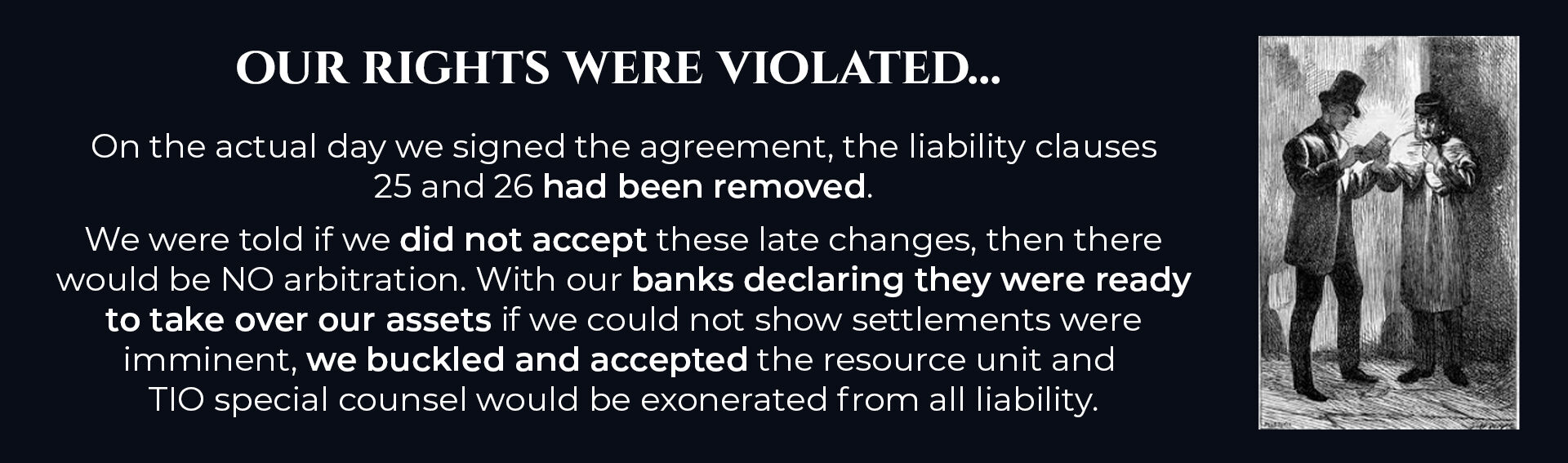
At the time, however, we entered that chamber in good faith, believing in the rule of law. We believed that binding agreements would be honoured, that objective adjudicators would weigh facts impartially, and, above all, that the promised disclosure of critical evidence would finally reveal the truth.
We had walked straight into a state-sanctioned ambush.
Almost immediately, the process revealed itself to be a grotesque, rigged parody of justice. Crucial technical files vanished. Damning evidence was illegally concealed, altered, and suppressed under bogus claims of legal professional privilege. Records we knew existed were denied to us behind closed doors, while the officials overseeing the process looked the other way, complicit in blatant breaches of protocol. Even as the arbitration proceeded, our communications were intercepted, and fabricated allegations were weaponised behind the scenes to intimidate and discredit anyone who dared ask questions.
As the years dragged on, and suppressed material slowly emerged through relentless Freedom of Information battles, leaked internal memos, parliamentary disclosures, witness testimonies, and Australian Federal Police files, the sheer scale of the syndicate's cover-up came into sharp, sickening focus.
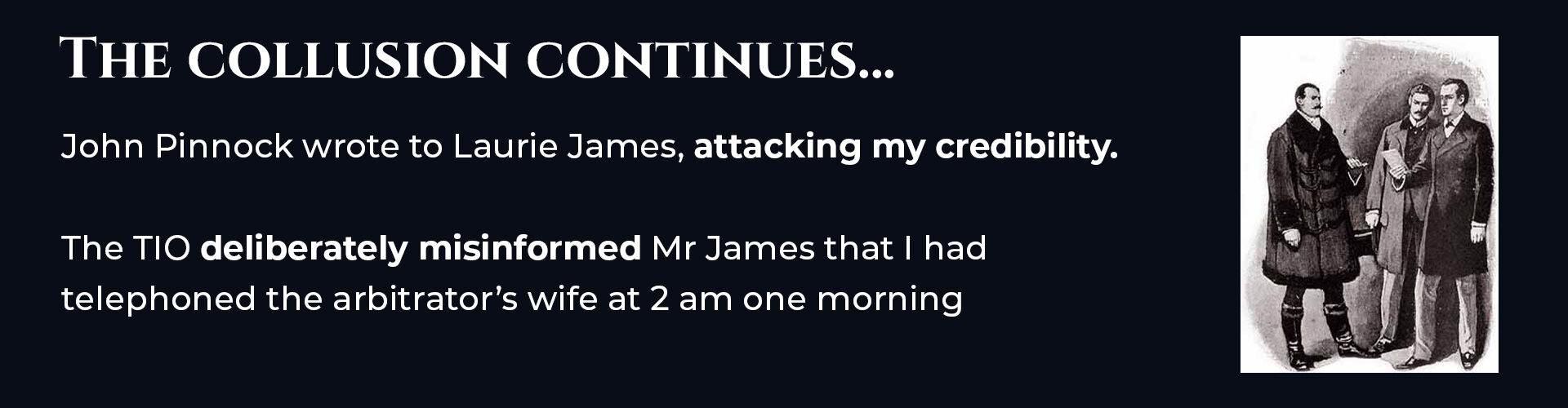
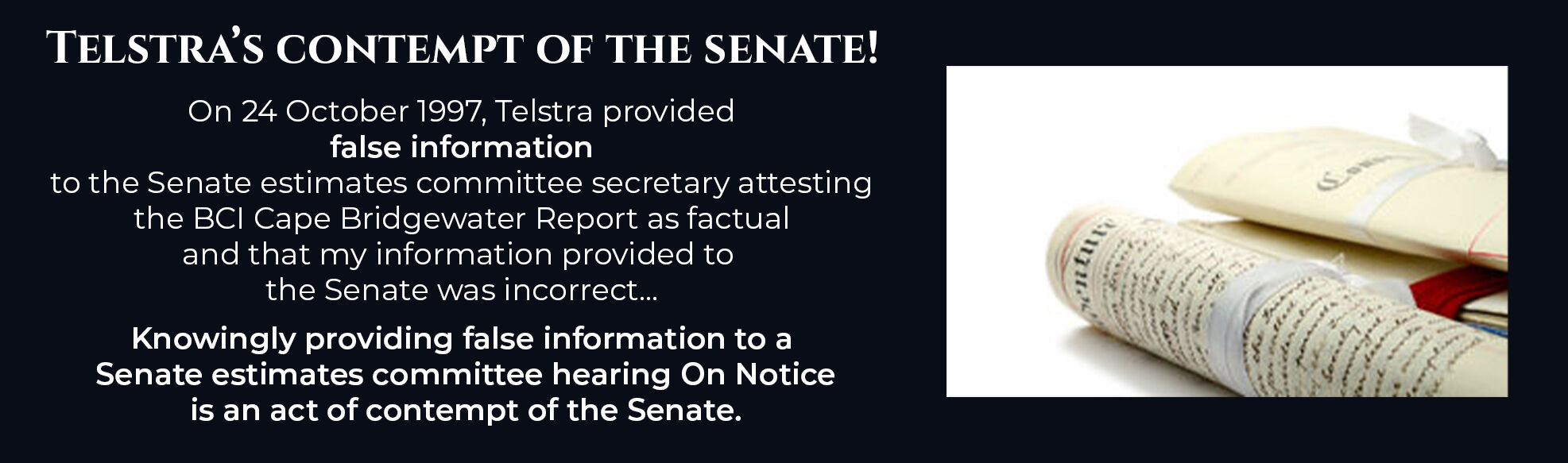
Telstra - Contempt of the Senate
On September 26, 1997, a noteworthy event unfolded at the Senate Estimates hearing, where two high-ranking Telstra executives conspicuously avoided questioning about the false testimony they gave under oath. This revelation, reported by absentjustice.com, raises serious concerns about accountability within the organisation.
As discussed in various sections of absentjustice.com, as well as above, the Canadian Government appeared concerned that an Australian arbitration process had used known impracticable Bell Canada International tests that could not have been transmitted. Because of this alarm raised by Canadian authorities, I have used it below to support another point that should not be missed concerning Telstra’s very crooked and corrupt arbitration defence.
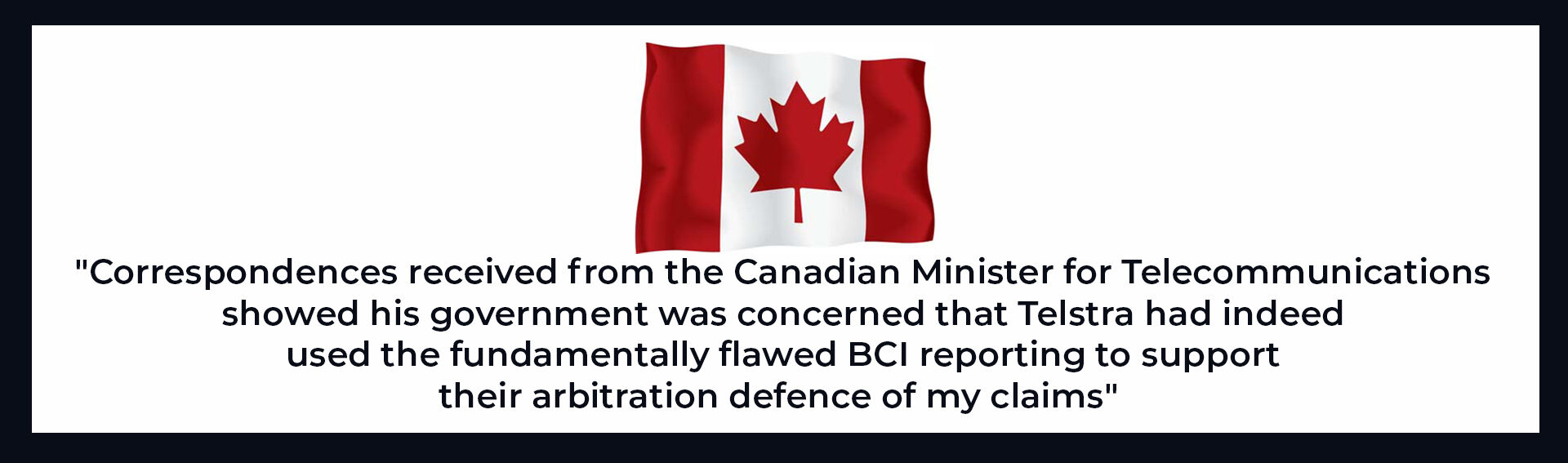
Telstra's Falsified BCI Report 2
I believe you are taking the most appropriate course of action
I have never received a written response from BCI, but the Canadian government ministers’ office wrote back on 7 July 1995, noting:
"In view of the facts of this situation, as I understand them, I believe you are taking the most appropriate course of action in contacting BCI directly with respect to the alleged errors in their test report, should you feel that they could assist you in your case."
"1. ...any explanation for the apparent discrepancy in the attestation of the witness statement of Ian Joblin .""2. ...were there any changes made to the Joblin statement originally sent to Dr Hughes compared to the signed statement?"
“I refer to your letter of 31 December 1996 in which you seek to access to various correspondence held by the TIO concerning the Fast Track Arbitration Procedure. … I do not propose to provide you with copies of any documents held by this office.” (See Open Letter File No 57-C)
“I note in your letter’s last page you suggest that the matter of the alteration of documents attached to statutory declarations should be dealt with by the relevant arbitrator. I do not concur. I would be grateful if you could advise why these matters should not be referred to the relevant police.”
To understand the true gravity of what happened to the COT Cases, one must look beyond the ruined businesses and shattered lives of a handful of regional Australians. What was tested, and perfected, in those closed-door hearings was nothing less than a blueprint for dismantling Western democracy from the inside out.
In any free society, the rule of law rests on a sacred, non-negotiable foundation: open justice. Public courts, transparent evidence, cross-examination under oath, and the right of every citizen to confront their accuser or corporate oppressor in the full glare of public scrutiny are not mere procedural formalities; they are the oxygen of democracy. When justice is seen to be done, power is held in check. Corporations know that fraud will be exposed in the morning newspapers; politicians know that collusion will be punished at the ballot box; regulators know that dereliction of duty will trigger public outrage.
Privatised, unregulated, and corrupted arbitration strips away every single one of those democratic safeguards.
When a state-backed monopoly or a politically connected corporation can herd injured citizens out of public parliaments and open courts into secret, privately administered tribunals, justice ceases to be a public right and becomes a rigged commodity. Behind locked doors, shielded by draconian non-disclosure agreements and insulated from media scrutiny, the powerful no longer have to obey the law; they merely have to control the process.
Consider what happens when arbitration is weaponised rather than conducted with absolute integrity.
First, the weapon of asymmetric information is deployed with lethal precision. In an open court, concealing subpoenaed evidence is a crime punishable by contempt and imprisonment. In a compromised arbitration, however, the powerful party holds every technical log, internal memo, and fault report, while the administrator lacks either the will or the teeth to enforce disclosure. The victim is thus forced to fight blindfolded. The stronger party simply buries the smoking guns, hands over doctored or incomplete files, and then mocks the claimant for lacking proof. This is the ultimate perversion of justice: the perpetrator steals the evidence and then demands the victim produce it.
Second, corrupted arbitration corrupts the very guardians of the state. When government departments, statutory watchdogs, and elected officials allow a sham process to proceed, knowing full well its foundational rules have been violated, they stop being servants of the public and become accessories after the fact. Worse still, once an official body endorses a tainted outcome to protect a state asset, a privatisation sale, or a political ally, every subsequent institution is forced to lie to protect the original lie. Regulators cover for corporations; ministers cover for regulators; inquiries whitewash previous inquiries. A self-reinforcing cartel of impunity forms at the highest levels of government, where preserving institutional reputation becomes infinitely more important than upholding the truth.
Third, and most fatally, the social contract collapses when citizens discover that the referee is on the opposing team's payroll and that the state actively helps conceal the fraud. Western democracy survives only because ordinary people believe that if they play by the rules, work hard, and seek redress through lawful channels, the system will protect them from predation by the rich and powerful. That trust dies when arbitration is twisted into an ambush designed to exhaust, bankrupt, and silence whistleblowers while laundering corporate crime into an "official settlement."
Citizens learn a devastating lesson: the law is a weapon reserved exclusively for the powerful, and the mechanisms of justice are merely theatrical props used to pacify the public until they run out of money or die. Once a society reaches that point, democracy retains its hollow rituals—its elections, speeches, and flags—but its soul has been hollowed out. Tyranny no longer needs a dictator when a secret tribunal and a shredded archive can accomplish the same result without a single shot being fired.
Over more than three decades, I have assembled a forensic archive of over sixty-six thousand documents exposing this machinery in cold, undeniable detail. Most of these records were pried from the clenched fists of unwilling institutions only after years of exhausting legal and Freedom of Information warfare. Others were smuggled out or handed over by courageous insiders who recognised the rot and refused to let the truth be buried. Together, they form an indictment that is chilling, relentless, and impossible to refute.
The purpose of this book is not to ask for your blind faith; quite the opposite. My mission is to lay out the chronology, the suppressed memos, the altered records, and the smoking guns so that you can judge the evidence with your own eyes. This archive exists because history must never be written solely by the criminals and cowards who hold the power to sanitise official records. Truth matters. Accountability matters. Evidence matters.
More than thirty years after this ordeal began, the most damning questions remain deliberately unanswered:
-
Why were critical technical records systematically concealed and destroyed?
-
Why did inquiry after inquiry collapse into evasion whenever the trail led toward senior figures?
-
Why did damning evidence keep surfacing decades after official processes declared the matter closed?
-
Why did ordinary citizens seeking basic honesty face the full, crushing weight of state and corporate obstruction?
-
And why, after all these years, are those in power still terrified of an honest accounting?
The following chapters chronicle a relentless pursuit of the truth, pulling back the curtain on a dark underworld where political expediency, corporate greed, bureaucratic cowardice, and backroom influence routinely triumphed over the rule of law. They lay bare the immense financial, physical, and emotional toll exacted upon ordinary people who dared to stand up to an unholy alliance of state and corporate power. Above all, they preserve a body of evidence that powerful forces tried desperately to erase from history forever.
The COT Case Strategy - Legal Advice
The conflict documented in these pages was never merely about broken telephones. The telephones were simply the loose thread that, once pulled, unravelled a tapestry of corruption reaching into the very heart of our democracy.
This is the story of that unravelling.
As shown on page 5169 in Australia's Government SENATE official Hansard – Parliament of Australia, Telstra's lawyers, Freehill Hollingdale & Page, devised a legal paper titled “COT Case Strategy” (see Prologue Evidence File 1-A to 1-C) instructing their client, Telstra (naming me and three other businesses), on how Telstra could conceal technical information from us under the guise of Legal Professional Privilege even though the information was not privileged.
This COT Case Strategy was to be used against me, my named business, and the three other COT case members, Ann Garms, Maureen Gillan and Graham Schorer, and their three named businesses. Simply put, they targeted us and our four businesses even before our arbitrations commenced. The Kangaroo Court was devised before the four COT Cases signed our arbitration agreements.
Stop the COT Cases at all costs
Worse, however, the day before the Senate committee uncovered this COT Case Strategy, they were also told under oath, on 24 June 1997, see:- pages 36 and 38 Senate - Parliament of Australia, from an ex-Telstra employee turned whistleblower, Lindsay White, that, while he was assessing the relevance of the technical information which the COT claimants had requested, he advised the Committee that:
Mr White "In the first induction - and I was one of the early ones, and probably the earliest in the Freehill's (Telstra’s Lawyers) area - there were five complaints. They were Garms, Gill and Smith, and Dawson and Schorer. My induction briefing was that we - we being Telecom - had to stop these people to stop the floodgates being opened."
Senator O’Chee then asked Mr White - "What, stop them reasonably or stop them at all costs - or what?"
Mr White responded by saying - "The words used to me in the early days were we had to stop these people at all costs".
Senator Schacht also asked Mr White - "Can you tell me who, at the induction briefing, said 'stopped at all costs" .
Mr White - "Mr Peter Gamble, Peter Riddle".
Senator Schacht - "Who".
Mr White - "Mr Peter Gamble and a subordinate of his, Peter Ridlle. That was the induction process-"
From Mr White's statement, it is clear that he identified me as one of the five COT claimants that Telstra had singled out to be ‘stopped at all costs’ from proving their case against Telstra. One of the named Peters in this Senate Hansard who had advised Mr White that the five COT Cases had to be stopped at all costs is the same Peter Gamble who swore under oath, in his witness statement to the arbitrator, that the testing at my business premises had met all of AUSTEL’s specifications, when it is clear from Telstra's Falsified SVT Report that the arbitration Service Verification Testing (SVT testing) conducted by this Peter did not meet all of the government's mandatory specifications.
Also, in the above Senate Hansard on 24 June 1997 (refer to pages 76 and 77 - Senate - Parliament of Australia Senator Kim Carr states to Telstra’s main arbitration defence Counsel (also a TIO Council Member), Re: Alan Smith:
Senator CARR – “In terms of the cases outstanding, do you still treat people the way that Mr Smith appears to have been treated? Mr Smith claims that, amongst documents returned to him after an FOI request, a discovery was a newspaper clipping reporting upon prosecution in the local magistrate’s court against him for assault. I just wonder what relevance that has. He makes the claim that a newspaper clipping relating to events in the Portland magistrate’s court was part of your files on him”. …
Senator SHACHT – “It does seem odd if someone is collecting files. … It seems that someone thinks that is a useful thing to keep in a file that maybe at some stage can be used against him”.
Senator CARR – “Mr Ward, we have been through this before in regard to the intelligence networks that Telstra has established. Do you use your internal intelligence networks in these CoT cases?”
The most alarming aspect of Telstra's intelligence networks in Australia is who within the Telstra Corporation has the necessary expertise—i.e., government clearance—to filter the raw information collected before it is impartially catalogued for future use. How much confidential information about the telephone conversations I had with the former Prime Minister of Australia in April 1993 and again in April 1994, regarding Telstra officials, is held in my Red Communist China episode, which I discussed with Fraser?
More importantly, when Telstra was fully privatised in 2005, which organisation in Australia was given the charter to archive this sensitive material that Telstra had been collecting about its customers for decades?
PLEASE NOTE:
At the time of my altercation referred to above, on 24 June 1997, the Senate - Parliament of Australia, my bankers had already lost patience and sent the Sheriff to ensure I stayed on my knees. I threw no punches during this altercation with the Sheriff, who was about to remove catering equipment from my property, which I needed to keep trading. I actually placed a wrestling hold, ‘Full Nelson’, on this man and walked him out of my office. The Magistrates' Court dropped all charges on appeal when it became obvious this story had two sides.
In 1997, during the government-endorsed mediation process, Sandra Wolfe, a third COT case, encountered significant injustices and documentation issues. Notably, a warrant was executed against her under the Queensland Mental Health Act (see pages 82 to 88, Introduction File No/9), with the potential consequence of her institutionalisation. It is evident that Telstra and its legal representatives sought to exploit the Queensland Mental Health Act as a recourse against the COT Cases if they were unable to prevail through conventional means. Senator Chris Schacht diligently addressed this matter in the Senate, seeking clarification from Telstra by stating:
“No, when the warrant was issued and the names of these employees were on it, you are telling us that it was coincidental that they were Telstra employees.” (page - 87)
Why has this Queensland Mental Health warrant matter never been transparently investigated, and why has the government communications regulator not made a finding?:
Sandra Wolfe, an 84-year-old cancer patient, is (was) enduring severe challenges while striving to seek a resolution for her ongoing concerns. Upon reviewing her recent correspondence, it becomes evident that a notable lack of transparency has marked her experience with the Telstra FOI/Mental Health Act issue. The actions of Telstra and its arbitration and mediation legal representatives towards the COT Cases portray a concerning pattern. This is exemplified by the unfortunate outcomes experienced by many COT Cases, including fatalities and ongoing distress. My health struggles, including a second heart attack in 2018, necessitated an extended hospitalisation, underscoring the urgency with which these matters must be addressed.
It is my sincere hope that my forthcoming publication will expose Telstra's egregious conduct and the corporation's need for closer scrutiny. It is November 2026, and after several emails sent by me to Sandra's email address since the beginning of February 2025, the last email I received told me Sandra's cancer treatment was becoming intolerable. With Sandra living in faraway Queensland, too far for me to travel, I can only assume the worst, or perhaps, for the better, that Sandra is now at peace.
Learn about horrendous crimes, unscrupulous criminals, corrupt politicians, and the lawyers who control Australia's legal profession. Shameful, hideous, and treacherous are just a few words that describe these lawbreakers. When Cathy, my partner and I were still operating the 6-bedroom, two-lounge, five-toilet and shower Seal Cove Guest House next door to the Cape Bridgewater, which we reluctantly sold in December 2001 because the arbitrator would not investigate our 1994 21 April 1994 to 11 May 95 arbitration claims that the ongoing telephone problems were still apparent on 11 May 1995, when he brought down his findings that the problems had been fixed in July 1994 as point 3.2 (h) in his award states, we sold.
Government Corruption in the public service has spuriously undermined the justice system for more than three decades.
Criminal Conduct Example 3
TIO Evidence File No 3-A is an internal Telstra email (FOI folio A05993) dated 10 November 1993, from Chris Vonwiller to Telstra’s corporate secretary Jim Holmes, CEO Frank Blount, group general manager of commercial Ian Campbell and other important members of the then-government-owned corporation. The subject is Warwick Smith – COT cases, and it is marked as CONFIDENTIAL:
“Warwick Smith contacted me in confidence to brief me on discussions he has had in the last two days with a senior member of the parliamentary National Party in relation to Senator Boswell’s call for a Senate Inquiry into COT Cases.
“Advice from Warwick is:
Boswell has not yet taken the trouble to raise the COT Cases issue in the Party Room.
Any proposal to call for a Senate inquiry would require, firstly, endorsement in the Party Room and, secondly, approval by the Shadow Cabinet. …
The intermediary will raise the matter with Boswell, and suggest that Boswell discuss the issue with Warwick. The TIO sees no merit in a Senate Inquiry.“He has undertaken to keep me informed, and confirmed his view that Senator Alston will not be pressing a Senate Inquiry, at least until after the AUSTEL report is tabled.
“Could you please protect this information as confidential.”
Exhibit TIO Evidence File No 3-A confirms that two weeks before the TIO was officially appointed as the administrator of the Fast Track Settlement Proposal FTSP, which became the Fast-Track Arbitration Procedure (FTAP) he was providing the soon-to-be defendants (Telstra) of that process with privileged, government party room information about the COT cases. Not only did the TIO breach his duty of care to the COT claimants, but he appears to have also compromised his own future position as the official independent administrator of the process.
It is highly likely that the advice the TIO gave to Telstra’s senior executive, in confidence (that Senator Ron Boswell’s National Party Room was not keen on holding a Senate enquiry), later prompted Telstra to have the FTSP non-legalistic commercial assessment process turned into Telstra’s preferred legalistic arbitration procedure, because it now had inside government privileged information. There was no longer a major threat of a Senate enquiry.
Was this secret government party-room information passed on to Telstra by the administrator to our arbitrations have anything to do with the Child Sexual Abuse and the cover-up of the paedophile activities by a former Senator who had been dealing with the four COT Cases? The fact that Warwick Smith, the soon-to-be administrator of the COT settlement/arbitrations, provided confidential government in-house information to the defendants (Telstra) was very serious.
IMPORTANT AUTHOR'S NOTE
When three witnesses and I provided Senator Richard Alston with conclusive proof that Warwick Smith had proved privileged COT Case, the government discussed party room information to Telstra; as the following TIO Evidence File No 3-A confirms, he was shocked. Still, he did say he would follow up this issue with Warwick Smith as a matter of great concern. NONE of the four COT Cases received advice from either Senator Alston or Warwick Smith on why Warwick Smith had been allowed to get away with this matter when it was so important to all four commercial assessment processes.
On 30 November 1993, this Telstra internal memo FOI document, folio D01248, from Ted Benjamin, Telstra’s Group Manager – Customer Affairs and TIO Council Member, was written to Ian Campbell, Customer Projects Executive Office. Subject: TIO AND COT. This was written seven days after Alan had signed the TIO-administered Fast Track Settlement Proposal (FTSP). In this memo, Mr Benjamin states:
“At today’s Council Meeting the TIO reported on his involvement with the COT settlement processes. It was agreed that any financial contributions made by Telecom to the Cot arbitration process was not a matter for Council but was a private matter between Telecom, AUSTEL and the TIO.
I hope you agree with this.”
This shows that Telstra was partly or wholly funding the arbitration process.
If the process had been truly transparent, the claimants would have been provided with information regarding the funds—specifically, the amounts provided to the arbitrator, the arbitrator's resource unit, the TIO, and the TIO special counsel for their individual professional advice throughout four COT arbitrations.
It is still unknown how the arbitrator billed Telstra for his professional fees or how the TIO billed Telstra for his fees, including those of the TIO-appointed resource unit and special counsel. This raises the questions:
Was the arbitrator and resource unit paid on a monthly basis?
Did the resource unit receive any extra bonus for being secretly appointed as the second arbitrator in determining which arbitration documents the arbitrator was allowed to receive and which were withheld (see letter dated 11th July 1994, from Telstra to Warwick Smith)?
Without knowing how the defendants distributed these payments among the parties in the first four arbitrations, it would be impossible for the TIO and AUSTEL (now the ACMA) to continue to claim that the COT arbitrations were independently administered.
To summarise the issue: during these four arbitrations, the defence was allowed to pay the arbitrator and those involved in the process. How is this different from allowing the defendant to pay the judge in a criminal matter? It is a clear and concerning conflict of interest.
The COTs never had a chance.
“There are regular reports from the TIO on the progress of the CoT claims.”
Senate Hansard information dated 26th September, 1997 (GS-CAV Exhibit 89 to 154(b) - See GS-CAV 124-B) confirms that:-
Ted Benjamin, Telstra’s main arbitration defence liaison officer in Graham and Alan’s arbitrations, was also a member of the TIO Council and
During a Senate hearing into COT issues, the then-new TIO, John Pinnock, agreed that Mr Benjamin had not removed himself from council discussions of COT matters:-
Senator SCHACHT – “Mr Benjamin, you may think that you have drawn the short straw in Telstra, because you have been designated to handle the CoT cases and so on. Are you also a member of the TIO Board?”
Mr Benjamin – “I am a member of the TIO council.”
Senator SCHACHT – “Were any CoT complaints or issues discussed at the council while you were present?”
Mr Benjamin – “There are regular reports from the TIO on the progress of the CoT claims.”
Senator SCHACHT – “Did the council make any decision about CoT cases or express any opinion?”
Mr Benjamin – “I might be assisted by Mr Pinnock.”
Mr Pinnock – “Yes.”
Senator SCHACHT – “Did it? Mr Benjamin, did you declare your potential conflict of interest at the council meeting, given that as a Telstra employee you were dealing with CoT cases?”
Mr Benjamin – “My involvement in CoT cases, I believe, was known to the TIO council.”
Senator SCHACHT – “No, did you declare your interest?”
Mr Benjamin – “There was no formal declaration, but my involvement was known to the other members of the council.”
Senator SCHACHT – “You did not put it on the record at the council meeting that you were dealing specifically with CoT cases and trying to beat them down in their complaints, or reduce their position; is that correct?”
Mr Benjamin – “I did not make a formal declaration to the TIO.”
The fact that Ted Benjamin, as a TIO Council officer, would have a good idea from the TIO meetings on how far advanced each of the COT arbitrations was and what the arbitrator was discussing with the TIO (who was also the administrator to the arbitrations) on when each claimant might further advance his claim, knowing this inside information assisted Mr Benjamin in deciding when to release requested FOI documents to each of the claimants and when to hold back any relevant document that could jeopardise Telstra's defence.
It was grossly unethical for Warwick Smith to allow this to happen, and it was just one more nail in the coffin of each of the COT cases.
Most Disturbing And Unacceptable
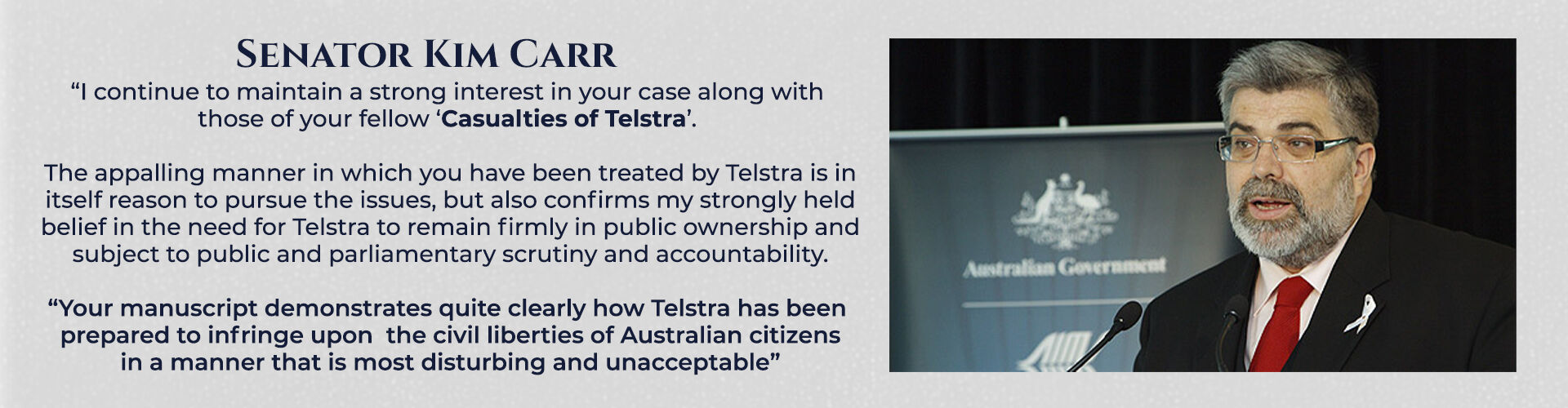
On 27 January 1999, after having also read my first attempt at writing my manuscript on absentjustice.com, the same manuscript I had provided to Helen Handbury (Rupert Murdoch’s sister, and later to Helen’s husband Geoff after she tragically passed away), Senator Kim Carr wrote:
“I continue to maintain a strong interest in your case along with those of your fellow ‘Casualties of Telstra’. The appalling manner in which you have been treated by Telstra is in itself reason to pursue the issues, but also confirms my strongly held belief in the need for Telstra to remain firmly in public ownership and subject to public and parliamentary scrutiny and accountability.
“Your manuscript demonstrates quite clearly how Telstra has been prepared to infringe upon the civil liberties of Australian citizens in a manner that is most disturbing and unacceptable.”
The systematic betrayal of the sixteen abandoned Casualties of Telstra (COT) cases stands as a grotesque monument to state-sanctioned corruption, ruthless discrimination, and treacherous institutional cover-ups.
At the bottom of this homepage lies a parchment-style narrative, a warning disguised as a relic, that exposes how we were not merely pressured before our 1994 government-endorsed arbitrations; we were hunted by calculated threats throughout them, and stalked for a decade after. Until December 2004, the Senate Chair weaponised the law, making it terrifyingly clear that if I ever released the Senate Hansard records of 6 and 9 July 1998, I would be brutally charged with contempt of the Senate.
In Australia, the machinery of state power is designed to bury its secrets by burying its citizens. Anyone who dares to expose in-camera privileged discussions can be thrown into a prison cell for two years. That was the grim fate promised to me if I released those Hansards, the very documents I still possess, copied for Senator Len Harris of Pauline Hanson’s One Nation Party. Had I surrendered them and survived that two-year sentence, emerging light-scarred from a cell, I might have lived the last twenty-five years in peace. Instead, I carried the crushing weight of their silence.
Those two Hansards prove a poisonous truth: in 1998, the Senate knew a deal had been rigged behind closed doors. Forcing Telstra to pay $18 million in punitive damages and release withheld FOI documents in only five hand-picked "litmus test" cases, while abandoning the remaining sixteen of us to financial and emotional ruin, was deliberate, malicious discrimination. They bought off five with millions; they left sixteen of us to rot. I was one of the forgotten sixteen.
I never found the courage to release those Hansards and risk a jail cell. Instead, I wrote two books and built this website, absentjustice.com, as a fortress for the truth, creating the only safe way to speak out against the treachery that the Senate tried to permanently bury → An Injustice to the remaining 16 Australian citizens)
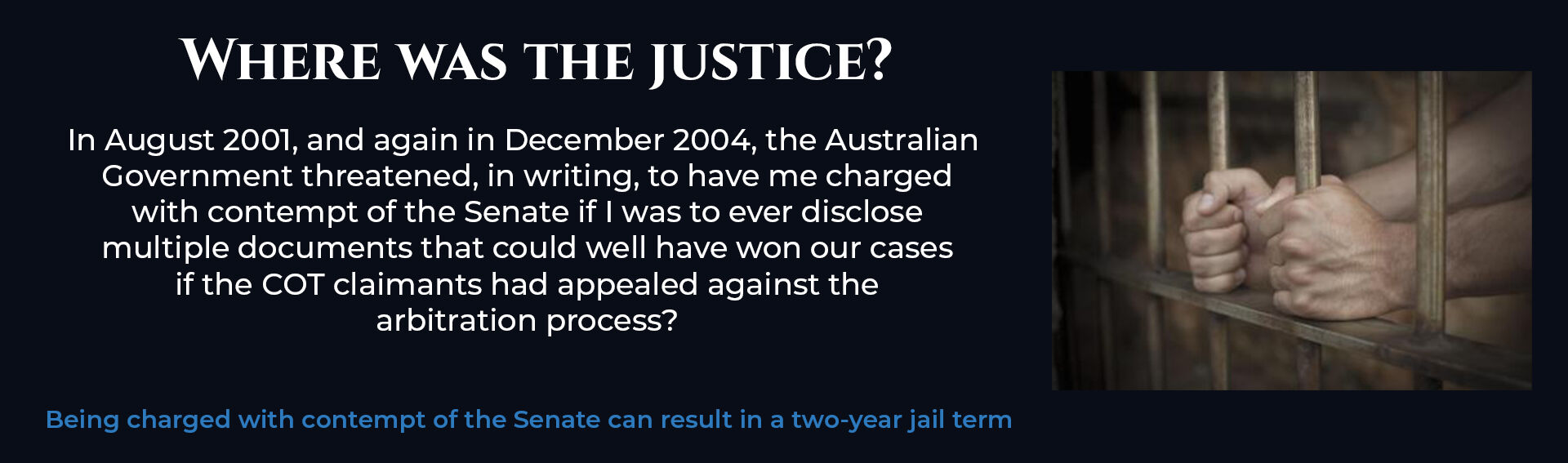
(Two letters from the Chair of the Senate → refer to Senate Evidence File No 12)
However, what follows under the heading “Senate In Camera Hansard” is less than seven per cent of the 9 July 1998 in‑camera Senate Hansard — not quoted, not reproduced, but rendered in my own words, except for the italic wording, which is exactly as recorded in the Hansard; only the non‑italic text is in narrative form. And still I must ask: will I be jailed merely for describing it, for allowing you, the reader, to see for yourselves the depth of the betrayal inflicted on the sixteen unresolved COT Cases?
This is the shadow the Australian Government cast over us, a shadow long enough to swallow decades, silence truth, and make even a narrative dangerous.
Senate In Camera Hansard - The Threats Continue
A heated Senate committee meeting detonated when National Party Senator Ron Boswell unleashed a blistering attack on a senior Telstra arbitration officer. His fury cracked through the chamber like a whip: “You are really a disgrace — the whole lot of you.” The words hung in the air like poison, staining the already volatile atmosphere as Telstra’s conduct toward the COT Cases was dragged into the open.
The outburst was too raw, too revealing. The committee chair moved swiftly, sensing the danger in Boswell’s accusation. Under the glare of scrutiny — and the rigid decorum demanded in such a chamber, Boswell retreated. His voice cooled, but the venom remained: “Madam, I withdraw that remark.” The apology was procedural, hollow, a forced concession to parliamentary ritual. The damage, however, was done. The moment exposed the rot beneath Telstra’s treatment of the COT Cases — a matter steeped in public interest and institutional betrayal.
Boswell continued, his tone now controlled but no less lethal:
“Madam, I withdraw that, but I do say this: this has got a unity ticket going right through this parliament. This has united everyone in this parliament—something no one else has ever been able to do—and Telstra has done it magnificently. They have got the Labor Party, they have got the National Party, they have got the Liberal Party, they have got the Democrats and they have got the Greens — all united in a singular distrust of Telstra. You have achieved a miracle.”
At eighty‑two, with May 2026 already behind me, I take the punt that nothing will change me now, not after writing only the words that Senator Chris Schacht delivered in the Senate on 9 July 1998, moments after Boswell condemned Telstra for what they had done to us twenty‑one Australian citizens. Schacht turned to Telstra’s official arbitration liaison office the same man who admitted to concealing half of my May 1994 FOI documents until after the arbitrator handed down his award on 11 May 1995. The arbitrator ruled on incomplete evidence, and Telstra knew it.
And, not to be outdone by Senator Chris Schacht, Senator Tierney fired a shot across the bow at Telstra’s official arbitration liaison officer, stating: “Can you see that the whole thing is unfair?” He then hit home even harder, noting, “…given the amount of time, money and heartbreak for these people you have created…”
Once more, Senator Schacht’s words were a blade:
“For God’s sake, Telstra, just give the last four all half a million or a million dollars each and stop it immediately. But that would be an injustice to the sixteen or whatever you have settled.”
He was right. Telstra did not stop it. Instead, they quietly released $18 million to the five Litmus Test cases under Senate investigation, namely, A Garms, R Bova, R Plowman, A Honor, and G Schorer, and then turned their backs on the remaining sixteen unresolved cases. Telatra knew exactly what they were doing. They knew the five would never surrender the $18 million they had been handed. And they knew the rest of us would be forced into court —abandoned, isolated, and left to fight a corporation that had already bought its absolution.
🕯️ The Systematic Burial of Truth: How critical evidence vanished, was withheld, or never reached those entrusted with justice, transforming a search for facts into a battle against concealment.
🕵️ The Surveillance State Behind the Arbitration: Disturbing evidence suggests that those seeking justice were themselves being watched, monitored, and exposed while pursuing their claims.
🗂️ The Machinery of Concealment: A trail of missing files, altered records, withheld reports, and unexplained omissions pointing to a culture where transparency became the enemy.
⚙️ A Process Engineered to Fail: How safeguards intended to protect claimants were weakened, bypassed, or removed, leaving behind an arbitration structure that benefited power, not justice.
📣 The Price of Speaking Out: The personal, financial, and emotional cost paid by those who refused to remain silent in the face of institutional wrongdoing.
🤐 The Conspiracy of Silence: How corporations, regulators, advisers, and government agencies appeared to retreat behind silence, delay, and bureaucratic obstruction whenever difficult questions emerged.
⚖️ Justice on Trial: The troubling question of whether the arbitration was ever allowed to function as an independent search for truth or whether its outcome was influenced from the start.
🔒 Justice Denied: The story of delayed investigations, rejected evidence, and procedural barriers that transformed promised justice into an elusive illusion.
🎯 Punishing the Complainants: How those seeking accountability allegedly became targets of pressure, isolation, and escalating obstacles designed to exhaust their resolve.
🔑 The Hidden Power Network: The influence of privileged access, insider relationships, and institutional protection that may have operated beyond the reach of ordinary claimants.
🎭 Deception as a Strategy: A pattern of selective disclosures, misleading explanations, and carefully managed narratives that allegedly shaped the official version of events.
🔍 The Evidence They Didn't Want Seen: The mystery surrounding vital documents, missing records, and evidence trails that disappeared when scrutiny became unavoidable.
📎 Weaponised Bureaucracy: How procedure, paperwork, and administrative complexity became powerful tools for delaying, frustrating, and weakening legitimate claims.
🌍 The International Connection: Evidence suggesting that the failures confronting the COT cases may have reflected broader technical, corporate, and policy issues extending far beyond Australia.
💾 The Forensic Footprints: Metadata anomalies, altered records, unexplained access points, and digital inconsistencies that continue to raise disturbing questions about evidence integrity.
🕳️ The Disappearance of Accountability: How responsibility became fragmented across multiple institutions until no individual or agency appeared willing to answer for the whole truth.
🚪 Exiled for Telling the Truth: A personal journey of displacement, endurance, and determination as the search for answers continued outside the centres of power.
💔 The Human Casualties: The devastating personal, financial, emotional, and health impacts suffered by those whose lives were forever altered by decisions made behind closed doors.
🛑 Investigations That Went Nowhere: A disturbing pattern of inquiries that appeared to lose momentum whenever they approached evidence capable of exposing deeper institutional failures.
📜 The Manufacture of Official History: How incomplete records, disputed findings, and selective narratives risked becoming accepted facts while contradictory evidence remained buried.
⚡ The Cracks Begin to Show: The gradual emergence of contradictions, admissions, and documentary evidence that challenged decades of official explanations.
📝 The Legacy of a Whistleblower: The determination to preserve evidence, safeguard the historical record, and ensure future generations can examine the facts for themselves.
🔔 When the Silence Finally Breaks: The moment when the accumulated weight of evidence becomes impossible to dismiss, and the institutions involved are forced to confront unanswered questions.
🔥 The Briefcase, the Tapes, and the Cover-Up: The explosive AFP evidence, the abandoned Telstra briefcase, the taped conversations, and the extraordinary efforts allegedly undertaken to keep those revelations hidden from public scrutiny.
Click here to read the full report → AUSTEL’s Adverse Findings
Unfortunately, I did not receive a copy of the following findings (AUSTEL’s Adverse Findings) at points 2 to 212 until November 23, 2007, 12 years after my arbitration process ended. In simple terms, the government validated my claims as early as March 4, 1994, six weeks before April 21, 1994, when I signed the arbitration agreement.
Despite already possessing this proof, AUSTEL (now ACMA), the government regulator, compelled me to undergo a gruelling 13-month arbitration process, at a personal cost exceeding $300,000 in professional fees, to substantiate facts the government had already established. As the subsequent 212 points confirm, every single finding was derived directly from Telstra's own Portland telephone exchange logbook.
Under the terms of the agreement, each of the COT Cases was promised access to these records through Freedom of Information (FOI) and arbitration discovery, provided we agreed to fund our own arbitration processes. In return, the arbitrator was mandated to ensure that all ongoing telephone and faxing faults raised in our claims were fully rectified, supported by a statutory declaration confirming our services met the mandatory standards Telstra needed to retain its carrier license.
Yet AUSTEL provided a copy of this government report to Telstra, the defendant, at least one month before my arbitration even commenced, while deliberately withholding points 2 to 212 from me until November 23, 2007—twelve years after the arbitration had concluded.
I urge every visitor to absentjustice.com to read at least the first 20 official findings from the government's secret investigation into my claims. Once you comprehend what those 20 points demonstrate, consider what the arbitrator would have been compelled to award me had he been provided with this report—the very document Telstra used to construct its defence, fully aware that the government had kept it hidden from me.
Concealing points 2 to 212 from a claimant while arming the state-owned defendant with the exact same report ahead of arbitration constitutes a blatant breach of the regulator's statutory obligation to treat Australian citizens equally under the law. Providing crucial government evidence exclusively to a government-owned corporation during an arbitration, while leaving the citizen to contend blindly, is gross discrimination of the worst possible kind.
Beware the Pen-Pusher Power: From the Hopepeak and the COT Cases to Robodebt
On May 23, 2021, Peta Credlin—former chief of staff to Australia's 28th Prime Minister, Tony Abbott, and a prominent media commentator—wrote a revealing column in the Herald Sun under the headline: "Beware the pen pusher power — Bureaucrats need to take orders and not take charge."
Credlin warned Australians to look closely at the unelected officials operating behind the scenes in Canberra:
"Now that the Prime Minister is considering a wider public service reshuffle in the wake of the foreign affairs department's head, Frances Adamson, becoming the next governor of South Australia, it's time to scrutinise the faceless bureaucrats who are often more powerful in practice than the elected politicians.
"Outside of the Canberra bubble, almost no one knows their names. But take it from me, these people matter.
"When ministers turn over with bewildering rapidity, or are not 'take charge' types, department secretaries, and the deputy secretaries below them, can easily become the de facto government of our country.
"Since the start of 2013, across Labor and now Liberal governments, we've had five prime ministers, five treasurers, five attorneys-general, seven defence ministers, six education ministers, four health ministers and six trade ministers."
Credlin backed her warning with numbers that read like a political casualty list—a revolving door spinning so fast that the permanent bureaucracy beneath it never had to break stride. It was a rare admission from a seasoned government insider of what many of us have fought to expose for decades: that Australia's democracy has been quietly hollowed out from within. Real, enduring power sits not with elected representatives who face the ballot box, but with faceless officials who never face the public and rarely face consequences.

An Unbroken Chain of Treachery: From the Hopepeak and the COT Arbitrations to Robodebt and the Post Office Scandals
The corruption that devastated the lives of the Casualties of Telstra (COT) during the 1994–1999 arbitrations was not an isolated miscarriage of justice. It was a blueprint—one now unfolding publicly on a monumental scale through the 2026 British Post Office scandal, the 2026 Australian Post Office scandal, and the Robodebt tragedy. Across continents and decades, the exact same institutional pathologies keep recurring: flawed technology defended as infallible, faceless bureaucrats burying damning evidence, powerful corporations shielded from accountability, and ordinary citizens crushed by a system engineered solely for self-preservation.
All of it is meticulously documented on absentjustice.com.
1. The Global Playbook: When Machines Lie, and Institutions Cover Up
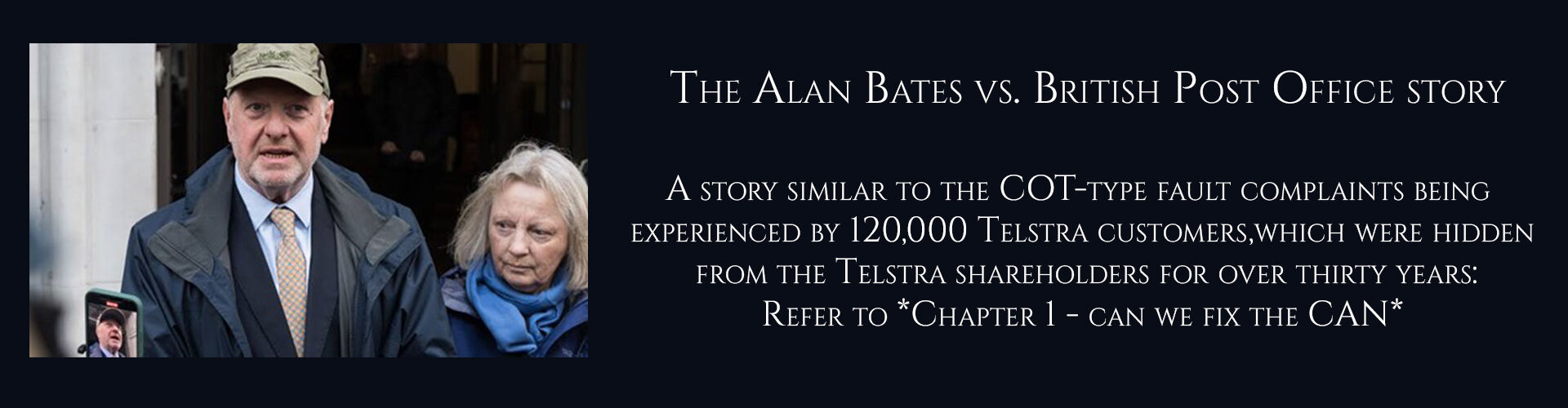
Readers can readily see how this machinery operates. By navigating to Mr Bates vs The Post Office on our homepage and opening the Australian Citizens — Press Release (Tuesday 13 October 2026), the pattern becomes undeniable.
In Britain, public servants inside the Post Office knew Fujitsu's Horizon accounting software was generating catastrophic errors (0:10). Yet for nearly two decades, they prosecuted, bankrupted, and imprisoned innocent sub-postmasters rather than admit their system was broken (3:52). The 2026 Australian Post Office scandal reveals the exact same reflex: citizens ruined by flawed systems while government agencies refuse to investigate.
To those of us who survived the 1994–1999 COT arbitrations, this betrayal is painfully familiar. Just as British officials concealed Horizon's defects, Telstra's arbitrator, Dr. Gordon Hughes, refused to give his own technical consultants the time needed to diagnose ongoing faults in Telstra's Ericsson billing software—faults demonstrated in this video: https://youtu.be/MyhjuR5g1Mc. When Telstra CEO Frank Blount finally admitted in 1999 that the corporation's billing software was substandard and systemic, it mirrored Fujitsu's quiet knowledge of Horizon's failures.
Today, as Artificial Intelligence is handed the same blind authority once afforded to flawed human-written code, the warning could not be sharper: when technology lies, institutions follow, and the public pays. (Watch the Australian Channel 7 trailer for Mr. Bates vs. The Post Office, which aired in February 2024 and captures the scale of this betrayal.)
2. Corporate Deception at Taxpayer Expense: The $400 Million Murdoch–Foxtel Deal
That same willingness to deceive the public—and bury the truth to protect corporate interests—defined Telstra's boardroom conduct during its cable rollout agreement with Rupert Murdoch and Foxtel. Despite knowing the network infrastructure could never be completed on time, the Telstra board guaranteed the deadline anyway, backing it with a $400 million default payment to Murdoch and Fox. When the rollout inevitably failed to meet its target, Australian taxpayers were forced to foot the $400 million bill to prop up Murdoch and Fox's enterprise.
This is not opinion, allegation, or interpretation. It is permanent Commonwealth record, confirmed in the Australian Government Secured Archive File → SENATE official Hansard – Parliament of Australia, (25 June 1997, page 5164, points 10 and 11):
10. Telstra's CEO and Board have known about this scam since 1992. They have had the time and the opportunity to change the policy and reduce the cost of labour so that cable roll-out commitments could be met and Telstra would be in good shape for the imminent share issue. Instead, they have done nothing but deceive their Minister, their appointed auditors and the owners of their stockÐ the Australian taxpayers. The result of their refusal to address the TA issue is that high labour costs were maintained and Telstra failed to meet its cable roll-out commitment to Foxtel. This will cost Telstra directly at least $400 million in compensation to News Corp and/or Foxtel and further major losses will be incurred when Telstra's stock is issued at a significantly lower price than would have been the case if Telstra had acted responsibly.
11. Telstra not only failed to act responsibly, it failed in its duty of care to its shareholders. So the real losers are the taxpayers and to an extent, the thousands of employees who will be sacked when Telstra reaches its roll-out targetÐcable past 4 million households, or 2.5 million households if it is assumed that Telstra's CEO accepts directives from the Minster.
Official Senate transcripts (points 10 and 11) detail how Telstra's leadership concealed its inability to meet cable rollout targets, forcing taxpayers to absorb a $400 million default payment to News Corp/Foxtel while leadership protected stock valuations and shifted losses onto the public and workforce.
3. From Shakedown on ABC TV to the Rigged COT Arbitrations
This playbook mirrors the COT arbitrations, where regulators like AUSTEL concealed evidence validating telephone fault complaints beforehand, allowing Telstra to weaponise the process while protecting corporate and institutional reputations.
4. Roots Stretching Back to 1965: The Hopepeak Cover-Up
This culture of deep-seated institutional secrecy stretches back decades to September 18, 1965, when the author arrived in Sydney aboard the Hopepeak after escaping near-execution in Communist China. During the Vietnam War, official trade decisions allowed Australian wheat shipped to China to be diverted to North Vietnamese forces (detailed in the China-Flash-Back-AFP Investigation -2), burying witness warnings under state secrecy.
The Imperative Behind AbsentJustice.com
From the Hopepeak in 1965 to the rigged COT arbitrations, the $400 million Murdoch–Foxtel payout, the Robodebt disgrace, and the Post Office Horizon scandals, an unbroken pattern emerges: when faceless bureaucracy supersedes accountability, ordinary citizens pay the price. All supporting evidence, memos, and Senate records remain archived on absentjustice.com to demand a full public reckoning.
PLEASE NOTE — IMPORTANT NOTICE TO ALL VISITORS
We are currently editing the following twelve files for typos and improved readability. This editing process is not an investigation into whether the evidence contained in those files is true or correct. That work has already been done.
We scrutinised, verified, and authenticated all evidence in these twelve files before uploading it to the absentjustice.com download exhibits.
The purpose of this edit is simply to ensure the files flow in a way most readers can follow easily and that the language isn't overly legalistic. Even if I haven't fully edited some sections to my satisfaction, the content is accurate, correct, and unchanged.
Telstra-Corruption-Freehill-Hollingdale & Page
Corrupt practices persisted throughout the COT arbitrations, flourishing in secrecy and obscurity. These insidious actions have managed to evade necessary scrutiny. Notably, the phone issues persisted for years following the conclusion of my arbitration, established to rectify these faults

Confronting Despair
The independent arbitration consultants demonstrated a concerning lack of impartiality. Instead of providing clear and objective insights, their guidance to the arbitrator was often marked by evasive language, misleading statements, and, at times, outright falsehoods.
Flash Backs – China-Vietnam
In 1967, Australia participated in the Vietnam War. I was on a ship transporting wheat to China, where I learned China was redeploying some of it to North Vietnam. Chapter 7, "Vietnam—Vietcong," discusses the link between China and my phone issues.

A Twenty-Year Marriage Lost
As bookings declined, my marriage came to an end. My ex-wife, seeking her fair share of our venture, left me with no choice but to take responsibility for leaving the Navy without adequately assessing the reliability of the phone service in my pursuit of starting a business.

Salvaging What I Could
Mobile coverage was nonexistent, and business transactions were not conducted online. Cape Bridgewater had only eight lines to service 66 families—132 adults. If four lines were used simultaneously, the remaining 128 adults would have only four lines to serve their needs.

Lies Deceit And Treachery
I was unaware of Telstra's unethical and corrupt business practices. It has now become clear that various unethical organisational activities were conducted secretly. Middle management was embezzling millions of dollars from Telstra.

An Unlocked Briefcase
On June 3, 1993, Telstra representatives visited my business and, in an oversight, left behind an unlocked briefcase. Upon opening it, I discovered evidence of corrupt practices concealed from the government, playing a significant role in the decline of Telstra's telecommunications network.
Not Fit For Purpose (Duplicate 1)
AUSTEL investigated the contents of the Telstra briefcases. Initially, there was disbelief regarding the findings, but this eventually led to a broader discussion that changed the telecommunications landscape. I received no acknowledgement from AUSTEL for not making my findings public.
&am

A Government-backed Arbitration
An arbitration process was established to hide the underlying issues rather than to resolve them. The arbitrator, the administrator, and the arbitration consultants conducted the process using a modified confidentiality agreement. In the end, the process resembled a kangaroo court.

A Non-Graded Arbitrator
Who granted the financial and technical advisors linked to the arbitrator immunity from all liability regarding their roles in the arbitration process? This decision effectively shields the arbitration advisors from any potential lawsuits by the COT claimants concerning misconduct or negligence.<

The AFP Failed Their Objective
In September 1994, two officers from the AFP met with me to address Telstra's unauthorised interception of my telecommunications services. They revealed that government documents confirmed I had been subjected to these violations. Despite this evidence, the AFP did not make a finding.&am
The Promised Documents Never Arrived
In a February 1994 transcript of a pre-arbitration meeting, the arbitrator involved in my arbitration stated that he "would not determination on incomplete information.". The arbitrator did make a finding on incomplete information.
Who We Are
Regrettably, since 1967, no comprehensive government inquiry has ever investigated the consequences faced by the British crew after their dismissal and repatriation to the United Kingdom. They were unable to reintegrate with the company that discharged them. Their story, like mine, was buried.
Pages 54 and 55 refer to footnotes 82-85 in a paper submitted by Tianxiao Zhu to The Faculty of the University of Minnesota, titled Secret Trails: Food and Trade in Late Maoist China, 1960-1978, etc. Requirements For The Degree of Doctor of Philosophy - Christopher M Isett, June 2021 wrote:

Read About Our Dealings With

Absent Justice Part 1, Part 2 and Part 3
Government Corruption. Corruption in the public service, where misleading and deceptive conduct has spuriously over more than two decades perverted the course of justice.

Senate Evidence
The criminal delinquency of those involved in the COT Cases corrupted arbitrations continued to practive their evil and crooked style of justice on other citizens who, like the Casualties of Telstra have had their lives ruined.

An Injustice to the remaining 16 Australian citizens
This type of skulduggery is treachery, a Judas kiss with dirty dealing and betrayal. This is dirty pool and crookedness and dishonest. This conduct fester’s corruption. It is as bad, if not worse than double-dealing and cheating those who trust the ground you walk on. Sheer Evil.<

China-Flash-Back-AFP Investigation -2
Read about the corruption within the government bureaucracy that is plaguing COT arbitrations. Learn who committed these horrendous crimes that equally corrupted lawyers and crooked arbitrators who covered up these crimes.
Telecommunications Industry Ombudsman
Corruption in government, including non-government self-regulators, undermines the credibility of that government. It erodes the trust of its citizens.

C A V Part 1, 2 and 3
Sadly, corruption and collusive practices are rife in the Australian ‘Establishment’ and this terrible situation prevents us from telling our story in a brief way. We had no alternative but to produce it the way we have here.
“…the very large number of persons that had been forced into an arbitration process and have been obliged to settle as a result of the sheer weight that Telstra has brought to bear on them as a consequence where they have faced financial ruin if they did not settle…”
Senator Carr
Government Corruption, Bribery and Extortion.
Australian Federal Police Investigations-1 and Rupert Murdoch -Telstra Scandal - Helen Handbury (Duplicate 1)
Who else in the Australian government was aware that Australian wheat intended for a starving communist China was being redirected to North Vietnam to feed the North Vietnamese soldiers before those soldiers marched into the jungles of North Vietnam to kill and maim Australian, New Zealand, and United States of America troops? Refer to Footnotes 82 to 85 FOOD AND TRADE IN LATE MAOIST CHINA,1960-1978, prepared by Tianxiao Zhu, who even reports the name of our ship, the Hopepeak and how the seaman feared for our lives if we were forced to return to China with another cargo of Australian wheat. Australian wheat was being redeployed to North Vietnam during the period when Australia, New Zealand, and the United States of America fought the Viet Cong in the jungles of North Vietnam.
During the 1960s, the Australian Liberal-Country Party Government engaged in misleading conduct in trade with Communist China, despite being aware that Australian merchant seamen had vehemently refused to transport Australian wheat to China. The grounds for such an objection were their apprehension that the grain would be redirected to North Vietnam during the Vietnam War between Australia, New Zealand, and the United States of America. The underlying inquiry is to ascertain the government's rationale for deliberately deceiving the general public and jeopardising the country's troops whose lives were being lost in the conflict in North Vietnam. Murdered for Mao: The killings China 'forgot'