

This website is a work in progress, last updated in June 2026.
Learn about horrendous crimes and unscrupulous criminals, corrupt politicians and the lawyers who control the legal profession in Australia. Shameful, hideous, and treacherous are just a few words that describe these lawbreakers.
Instances of foreign bribery and foreign corrupt practices infiltrated the COT arbitrations, as the absentjustice.com link to Chapter 5 - US Department of Justice vs Ericsson of Sweden clearly shows.
This absentjustice.com website, which sparked deeper exploration into the world of political corruption, stands shoulder to shoulder with any true‑crime story. International fraud that infiltrated the COT Case arbitrations has never been resolved, and this alone presents significant challenges to the government if they transparently investigate absentjustice.com.
If you recognise the importance of this research and the critical insights it provides, I encourage you to consider supporting Transparency International Australia! Your contributions will play a crucial role in raising awareness of the injustices that threaten the integrity of our democracy and in promoting a more equitable society for all. Thank you for your interest and support in this vital cause

By reading just two or three of the 156 mini‑reports that follow the whistleblower cartoon above, the reader will see, with no room for doubt, what happens to a whistleblower in this country. What they lose. What is taken from them? What is destroyed simply because they told the truth, exactly as they were taught to do as children, before they stepped into a world where too many people believe the rules are simple: kill or be killed.
Click on any of the blue‑highlighted exhibits scattered across the absentjustice.com home page, and you won’t need to go far, barely a third of the way down, before the real question forces itself forward, no matter how politely anyone tries to avoid it:
How did a government‑owned corporation get away with this?
Why have the IAMA and six of Australia’s most powerful government agencies and regulators, each sitting on this evidence for more than two decades, chosen silence over scrutiny, concealment over accountability, and protection of the process over the truth of what happened inside the COT arbitrations?
Evidence Files-1 and Evidence-Files-2, plus 156 separate mini‑stories, all provided free of charge.
The 34 numbered exhibits listed below each contain hundreds of individual documents, creating a vast reservoir of information. In addition to these, there are thousands more documents housed in Evidence Files-1 and Evidence-Files-2. Together, these comprehensive records reveal 156 unique mini-stories, each illuminating a different aspect of the same underlying misconduct.
I want to highlight that our website is an outstanding resource, offering visitors the opportunity to download thousands of meticulously organised exhibits at no cost. Each exhibit is thoughtfully numbered to facilitate easy navigation and direct access to essential information. This invaluable resource is designed to empower anyone eager to unearth the truth and deepen their understanding of the critical issues we address.
You won’t need to return to the 34 block files listed below; they are automatically linked to the specific part of the narrative you are currently reading. Simply scroll down to the designated exhibit number, and you’ll find the information you seek without hassle. This streamlined method also enables you to view any of the 100 additional exhibit files in that collection, which contain a further 300 to 400 exhibits in that series. This makes it easier and quicker to draw your own conclusions as to whether my story is true or false.
Before long, you'll feel the urge to share your newfound insights with friends and acquaintances, warning them not to place their trust in the Australian system of arbitration again. This is clearly illustrated in the Institute of Arbitration Mediation Australia (IAMA) document titled 'The eleventh remedy pursued'.
These 34 exhibits have been included here not only to showcase the extensive effort that I have invested in this project but also to demonstrate the authenticity of our COT story. By examining these materials, you will gain firsthand insight into the depth and breadth of our findings.
AS-CAV Exhibit 1 to 47 – AS-CAV Exhibit 48-A to 91 – AS-CAV Exhibit 92 to 127 – AS-CAV Exhibit 128 to 180 – AS-CAV Exhibit 181 to 233 – AS CAV Exhibit 234 to 281 – AS-CAV Exhibit 282 to 323 – AS-CAV Exhibit 324-a to 420 – AS-CAV Exhibit 421 to 469 – AS-CAV Exhibit 470 to 486 – AS-CAV Exhibit 488-a to 494-e – AS-CAV Exhibits 495 to 541 – AS-CAV Exhibits 542-a to 588 – AS-CAV Exhibits 589 to 647 – AS-CAV Exhibits 648-a to 700 – AS-CAV Exhibit 765-A to 789 – AS-CAV Exhibit 790 to 818 – AS-CAV Exhibit 819 to 843 – AS-CAV 923 to 946 – AS-CAV Exhibit 1150 to 1169 – AS-CAV 1103 to 1132 – AS-CAV Exhibit 1002 to 1019 – AS-CAV Exhibit 996 to 1001 – GS-CAV Exhibit 1 to 88 – GS-CAV Exhibit 89 to 154-b GS-CAV Exhibit 155 to 215 – GS-CAV Exhibit 216 to 257 – GS-CAV Exhibit 258 to 323 – GS-CAV Exhibit 410-a to 447 – GS-CAV Exhibit 448 to 458 – GS-CAV Exhibit 459 to 489 – GS-CAV Exhibit 490 to 521 – GS-CAV 522 to 580 – GS-CAV Exhibit 581 to 609
Don't forget to hover your mouse over the following images as you scroll down this homepage.
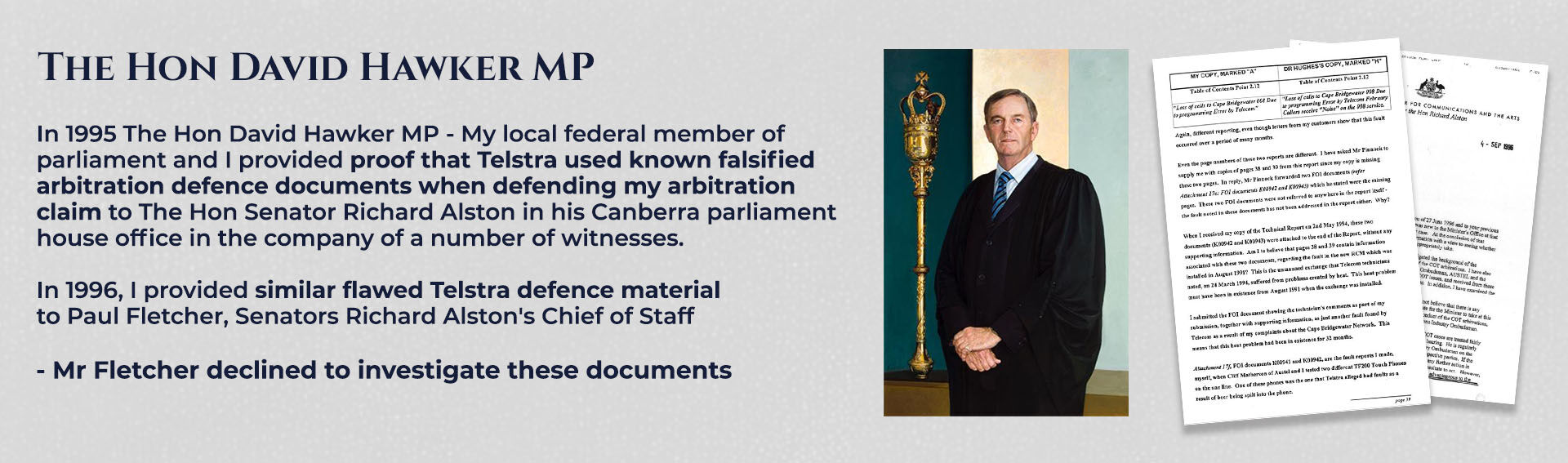
Paul Fletcher, who was now also assisting Senator Alston, asked me to continue helping the senator with these telecommunications issues.
As a result of this discussion with Senator Alston, I then sent his office a copy of an eighty-eight-page report I had compiled, together with various supporting Exhibit documents. This report detailed how Telstra had broken the law by tampering with Government-owned equipment during my legal arbitration, which was being conducted under the auspices of the Supreme Court of Victoria. This was the report that Paul Fletcher eventually returned to me (see the following link > Open Letter File No/41/Part-One and File No/41 Part-Two).
It will be apparent from the Introduction above and the following information (see Open Letter File No/41/Part-One and File No/41 Part-Two), that the wind changed and my valid claims were suppressed, and are still being suppressed, as of 2026.
I invite you to read about a significant event that occurred when the government intervened to defend Telstra, a government-owned corporation. This intervention had serious implications, as it ultimately resulted in a breach of the government's legal obligations to a substantial number of citizens—at least 120,000—who were experiencing similar issues with their phone services. My own experience, which I shared with my fellow 15 members of the COT (Concerned Owners of Telecommunications), highlighted a pattern of neglect that many individuals had encountered. We each registered complaints specifically about these troubling telecommunications issues, yet our voices seemed to be overlooked in the government's defence of Telstra, raising concerns about accountability and the protection of consumer rights.
Two centuries ago, long before I ever set foot on a ship, the British Channel was the stage for a lesson every seafarer eventually learns: there comes a point when a man simply cannot swallow one more mouthful of injustice. In 1797, the Channel Fleet lay at anchor off Spithead, the water cold and metallic beneath them, the sky a low grey lid pressing down on the world. Below decks, the air was thick with the sour reek of provisions that had travelled too far and too long. Meat that stank before it reached the galley. Biscuits that crumbled into dust and insects. Water that tasted of rust and sickness. And cooks, poor bastards, expected to turn this misery into nourishment.
The men had endured it for years. They had fought wars on empty stomachs, patched sails with frozen fingers, and buried shipmates whose bodies had simply given out. But in that bleak anchorage, something shifted. The sailors refused to sail. Not with violence, not with chaos, but with a quiet, disciplined unity that shook the Admiralty to its core. They demanded fair pay, decent treatment, and food that would not kill them slowly. It was the most orderly mutiny in naval history, a stand not for glory, but for dignity.
I didn’t know it then, but the spirit of Spithead would follow me through my own thirty years as a ships' cook. It would whisper to me years later, in the mess room heat of tugboats, in the cramped galley of merchant ships, and eventually in the cold, bureaucratic corridors of Telstra’s arbitration process. The sea teaches a man his threshold. It teaches him when to endure and when to stand his ground.
My own education began in the belly of ships, long before I ever imagined I’d be fighting battles on land. I was a pantry boy first, then a steward, then a cook, the man responsible for feeding crews who depended on me more than they ever admitted. Food at sea is not just sustenance; it’s morale, medicine, and memory. A good meal can steady a man in a storm. A bad one can break him.
 I learned early that a cook carries a strange kind of authority. You’re not an officer, but you hold the crew’s spirit in your hands. You’re not a deckhand, but you feel every roll of the ship in your bones. And you learn, quickly, that men will forgive a lot, but not being fed properly.
I saw tempers flare over burnt stew, friendships forged over a well‑timed fry‑up, and discipline restored with a pot of strong tea. I saw how food could calm a ship or ignite it. And I saw how the smallest injustice, a short ration, a spoiled crate, a careless quartermaster, could ripple through a crew like a storm swell.
Those years taught me something the Admiralty learned the hard way at Spithead: when you take away a man’s dignity, you take away his obedience.
Decades later, when I found myself in arbitration with Telstra over the Cape Bridgewater Holiday Camp, I recognised the same pattern I’d seen at sea, the powerful assuming the powerless would simply endure. The process was supposed to be fair, independent, and transparent. Instead, it was shaped by the Big Four accounting firms, whose actions echoed the institutional arrogance that once drove sailors to mutiny.
A partner from KPMG, formerly of Ferrier Hodgson Corporate Advisory, was appointed as an independent commercial assessor. His task was straightforward: evaluate my financial losses honestly. But he misrepresented those losses, leaving me stranded in a process that was never meant to deliver justice.
Cooper & Lybrand had earlier conducted an audit on Telstra’s behalf. Their partner visited my holiday camp, saw the evidence with his own eyes, and recognised the pattern affecting not only me but others in the group I helped form, the Casualties of Telstra. Yet critical sections of that audit were removed under Telstra’s written instructions. The truth was trimmed, reshaped, and sanitised to suit the powerful.
I hand‑delivered those instructions to Senator Richard Alston in Parliament House in 1995, standing beside my local MP, David Hawker. It felt like carrying a message from the lower decks to the quarterdeck, a plea for someone in authority to listen.
But the pattern only deepened. Deloitte entered the fray as Telstra’s arbitration defence counsel, echoing the same distortions and evasions that had already poisoned the process. The machinery of corporate power moved with the same cold indifference I had seen in institutions my whole life.
And yet, like the sailors at Spithead, I refused to simply endure.
Read below what happened to me when the government defended Telstra. a government-owned corporation, and by doing so breached their statutory obligation to at least 120,000 citizens who had similar phone complaints as those registered by me and my fellow fifteen Casualties of Telstra (COT) members,
Chapter 1
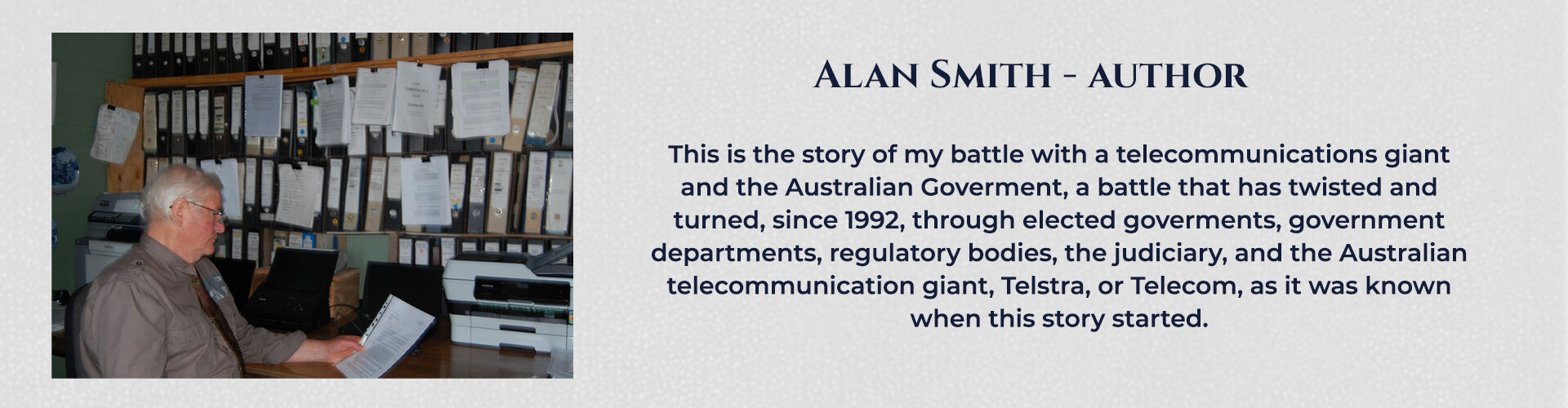
My name is Alan Smith, and this is not a tale of misfortune; it is a record of what happens when ordinary small‑business people collide with a corporation that believes it is untouchable. It is the story of the COT Four, who asked for nothing more than working phone lines, and instead found themselves fighting Telstra, a company that hid behind its size, its lawyers, and its political connections while our businesses bled.
For years Telstra, then Telecom, dismissed our faults with the same dead phrase: No fault found. Customers couldn’t reach us. Calls dropped out. Lines went dead. And every time we asked for answers, Telstra shrugged, stonewalled, or lied.
When we took our dispute to the government, we expected fairness. Instead, we were pushed into an arbitration designed to fail. We were manipulated, pressured, and boxed into a process Telstra controlled from the inside. While we fought for survival, Telstra and its legal team fought dirty, intercepting faxes, tapping conversations, withholding FOI documents, censoring evidence, destroying records, fabricating material, and feeding the arbitrator a diet of half‑truths and doctored reports.
After Dr Gordon Hughes, the arbitrator who ignored our evidence that we were losing relevant arbitration‑related faxes that were beneficial to our arbitration claims, with evidence supported by Telstra billing accounting for those sent faxes where we had been charged for them having been sent, and still, he and the Telecommunications Industry Ombudsman (TIO) also declined to view this evidence. We COT Cases jointly appointed two independent technicians from Scandrett & Associates (see Open Letter File No/12 and File No/13) to compare six of the COT Cases' fax interception evidence.
On 7 January 1999, four years after most of the arbitrations had been concluded, where no one attached to the COT arbitrations would investigate our privacy issues, the Scandrett & Associates report was provided to the government states:
“We canvassed examples, which we are advised are a representative group, of this phenomena .
“They show that
- the header strip of various faxes is being altered
- the header strip of various faxes was changed or semi overwritten.
- In all cases the replacement header type is the same.
- The sending parties all have a common interest and that is COT.
- Some faxes have originated from organisations such as the Commonwealth Ombudsman office.
- The modified type face of the header could not have been generated by the large number of machines canvassed, making it foreign to any of the sending services.”
Of course, had the arbitrator appointed someone to investigate these same fax interception issues, their findings would have allowed the COT Cases' evidence to appeal the arbitration. As I have said above and below, the COT arbitrations were a facade.
The fax imprint across the top of this letter, dated 12 May 1995 (Open Letter File No 55-A), is the same as the fax imprint described in the 7 January 1999 Scandrett & Associates report provided to Senator Ron Boswell (see Open Letter File No/12 and File No/13), confirming faxes were intercepted during the COT arbitrations. One of the two technical consultants attesting to the validity of this January 1999 fax interception report emailed me on 17 December 2014, stating:
“I still stand by my statutory declaration that I was able to identify that the incoming faxes provided to me for review had at some stage been received by a secondary fax machine and then retransmitted, this was done by identifying the dual time stamps on the faxes provided.” (Front Page Part One File No/14)
Not only were these arbitrations a facade, but in my case, the central points of my claim were ignored. Not overlooked, ignored. No matter how many times I raised them, no matter how clearly the evidence showed the truth, the arbitrator refused to address them. It was as if the outcome had been written before the process even began.
And where were the regulators? AUSTEL, now ACMA, the so‑called government watchdog, and the Telecommunications Industry Ombudsman, the so‑called independent umpire, stood back and let Telstra run the entire show. Their silence wasn’t oversight. It wasn’t confusion. It was obedience. Their inaction was so total, so unwavering, it stopped looking like failure and started looking like partnership.
All this trauma over basic telephone faults, faults so simple they should have been fixed in a single afternoon. Calls reached the main exchange but never reached my business or my home. Customers heard dead air, phantom ringing, or the lie that my number wasn’t connected at all. Faxes disappeared into the network like they’d been swallowed. And when we demanded answers, the then‑government‑owned Telecom, now called Telstra, didn’t fix the problem. It buried it.
That’s when the cover‑ups began. Information redacted on requested FOI documents, unrelated information added to requested discovery documents. No FOI schedules showing where the information was sourced from, and its relevance to our cases. These were not mistakes; they were hindrances, hurdles that stopped us from proving our claims, months-long delays in receiving documents that belonged to other COT Case arbitration processes administered 1000 kilometres away. This was a giant cover-up. Evidence destroyed. Evidence rewritten. Every step designed to protect Telstra, not the truth.
People like us were simply asking for our business lines to work. But the deeper we dug, the more obvious it became: this was never about phones. It was about power. Telstra’s power to silence complaints, bury evidence, and crush anyone who threatened to expose the rot. A corporation using its size, its influence, and its political protection to make sure the truth never saw daylight.
This wasn’t a technical problem. It was a system built to ensure Telstra never had to answer for anything, no matter who it hurt, no matter what it destroyed.
Why did everyone protect Telstra? Why did unlawful behaviour, evidence tampering, document withholding, and illegal interception go unpunished? Why did politicians roar with support while in Opposition, then fall silent the moment they took office? Why was Telstra allowed to behave like a state within a state?
The answer emerged years later, in documents Telstra never expected us to see. They knew their network was failing, especially in rural Australia. They knew how to fix it. They chose not to. Admitting the truth would have meant a national overhaul, billions in repairs, and the risk of losing their operating licence. And with privatisation looming, Telstra wanted silence, not scrutiny.
So it buried us instead.
This manuscript tells my part of the fight: the false charges on my 1800 account, the lost faxes, the unresolved faults that crippled my business, the arbitration that was never meant to deliver justice, and the years of deceit that followed. It tells how Telstra treated me not as a customer, not as a citizen, but as an enemy.
A fair resolution has never been reached. I wrote hundreds of letters to ministers, prime ministers, and treasurers, all of whom ignored them. In the end, I had no choice but to publish this website, breaking the confidentiality agreement I was forced to sign. I broke it because Telstra and the arbitrator broke something far more important: the principles of natural justice.
This is not a story about telephones. It is a story about what happens when a corporation with too much power decides the rules don’t apply to it, and a government lets it happen.
I would like to refer the reader to my letter dated July 15, 2009, addressed to Paul Crowley, the CEO of the Institute of Arbitrators and Mediators Australia. (Exhibit 13-B and 13-C → Burying The Evidence File 13-H. In this letter, I included a correspondence from Graham Schorer, who was the spokesperson for COT Cases and a former client of the arbitrator Dr Gordon Hughes (see Chapter 3 - Conflict of Interest).
Exhibit 13-H → Burying The Evidence File 13-H is the letter dated August 4, 1998 and attached to it is also exhibited as (13-H) a statutory declaration from Mr Schorer to me, which detailed a phone conversation he had with the arbitrator Dr Gordon Hughes during the 1994 arbitrations concerning lost Telstra COT-related faxes. My arbitration had been over for three years, and it was revealed during a pending appeal that 41 of my faxes during my 13-month arbitration were not on the arbitrator's schedule of received documents, even though my fax billing account showed they had been sent. Mr Schorer alerted the Senate to this, as did Dr Hughes, and it was Dr Hughes' response that gave us hope that we could have these lost arbitration fax matters investigated. During that conversation, Mr Schorer had with Dr Hughes, Dr Hughes explained to Graham Schorer in detail that:
"Hunt & Hunt (The company's) Australian Head Office was located in Sydney, and (the company) is a member of an international association of law firms. Due to overseas time zone differences, at close of business, Melbourne's incoming facsimiles are night switched to automatically divert to Hunt & Hunt Sydney office where someone is always on duty. There are occasions on the opening of the Melbourne office, the person responsible for cancelling the night switching of incoming faxes from the Melbourne office to the Sydney Office, has failed to cancel the automatic diversion of incoming facsimiles." Burying The Evidence File 13-H.
Dr Hughes’s failure to disclose the faxing issues to the Australian Federal Police during my arbitration is deeply concerning. The AFP was investigating the interception of my faxes to the arbitrator's office. Yet this crucial matter was a significant aspect of my claim, which Dr Hughes chose not to address in his award or mention in any of his findings. The loss of essential arbitration documents throughout the COT Cases is a serious indictment of the process.
The Document‑Hack Syndicate
The Day Telstra Ran a Paper‑Shredding Shakedown.
On 16 May 1994, I telephoned Superintendent Jeff Penrose of the Australian Federal Police to tell him I was in Melbourne — and that not one soul from the Telecommunications Industry Ombudsman office would walk two blocks from their office to Telstra’s head office in Exhibition Street to back me up. They wouldn’t even take the short stroll to help me demand answers from Simon Chalmers of Freehill Hollingdale & Page (now trading as Herbert Smith Freehills Melbourne).
When I returned from a toilet break, I walked straight into a scene straight out of a mob‑run accounting room: Chalmers hunched over a shredder, feeding my Telstra documents into the blades like he was disposing of a body. These were the very documents Telstra had previously sent me — the evidence I had carried to Melbourne that day. I showed him that some of the fifty‑six fax‑header examples Telstra had supplied under my December 1993 and February 1994 FOI requests didn’t match the pages that followed. The numbers didn’t line up. The story didn’t line up. The ledger was cooked.
Mr Penrose told me that since Telstra had refused my request to copy these examples, I should take the sample documents back with me, leave the rest with the TIO, and sign a statutory declaration detailing how the fax headers had been tampered with. Exhibit 77 file → (AS-CAV Exhibit 48-A to 91) 77 is a file note signed by Sue Harlow, Deputy TIO, confirming she left this evidence with the TIO, Warwick (Warwick Smith), and reported the incident to the arbitrator’s office and to AUSTEL, the government regulator. Exhibit 76 file → (AS-CAV Exhibit 48-A to 91) is the statutory declaration I sent to Jeff Penrose, now stamped with AFP markings — the kind of stamp you put on evidence when you know someone’s been running a back‑room operation.
I provided the AFP with only four examples via Australia Post, showing Telstra had written the names of several single‑club patrons on their internal file notes — people who had contacted me via fax. The content of the four examples showed what Telstra recorded: this caller usually telephones from this number, but today they called from Adelaide; Mr spoke with Malcolm Fraser today, former Prime Minister of Australia — with the rest of the memo blacked out like a mob ledger hiding the real money trail.
A sample from Senate Hansard, dated 24 June 1994, shows Senator Kim Carr and Chris Schacht asking Telstra why it would copy a newspaper article about a court appearance in which I was accused of assaulting the Sheriff who was about to foreclose on my hired industrial kitchen equipment. Telstra wasn’t just watching — they were collecting, filing, and weaponising (see Government Spying Chapter 4)
When I asked for copies of these 56 fax‑header documents to be returned to me from the arbitrator’s office and the TIO’s office, they could not be found. Two of the alleged “could not be found” documents were related to my telephone conversation with the former Prime Minister of Australia. This was before Telstra submitted their defence on 12 December 1994. So where did this evidence end up? Is this why the arbitrator and John Rundell, the Arbitration Project Manager, would not incur a financial loss on the lost documents, even though it was their office that had lost these 56 header sheets and the reports they had been connected to?
When neither would assist me in locating these very relevant documents, I contacted Ms Philip Smith, Commonwealth Ombudsman, who then appointed the Director of the Commonwealth Office investigation seeking these documents from May 1994 (Exhibt 20 → AS-CAV Exhibit 1 to 47) to October 1997 (Home Page File No/82), and even gained the assistance of Mr Tony Morgon, Loss Assessor from GAB Robins International investigation's, who visited my property in Cape Bridgewater spending many hours interviewing me, resulting in spending many days establishing if my claims against Telstra had been valid. My claims had been justified.
I received a frustratingly inadequate 80% reimbursement for the costs I incurred due to the unwarranted delays in obtaining Freedom of Information (FOI) documentation from Telstra. These delays were a direct result of their faulty system, which hindered my ability to move forward. This amount, while better than nothing, was hardly sufficient to effectively challenge the arbitration award I had received.
They don’t.
Version 1 — They simply promote the thief to “Head of Compliance” and announce that the matter has been thoroughly reviewed by the person who stole it.Version 2 — Dark humour with a bureaucratic twist
They open an internal investigation, appoint the thief as chair, and conclude that the real problem is the public asking too many questionsVersion 3 — The whistleblower’s version
They catch the thief the same way they catch every government wrongdoer — by giving them a promotion, a press release, and a bigger office to hide things in.Version 4 — The existential version
They don’t catch the thief. They redefine “theft” as “standard procedure” and declare the missing evidence a “clerical anomaly.” Problem solved.Version 5 — The one that hits closest to home
They don’t catch the thief because the thief writes the report, seals the archive, and stamps it “Nothing to see here.”
"Beware The Pen Pusher Power - Bureaucrats need to take orders and not take charge”, which noted:“Now that the Prime Minister is considering a wider public service reshuffle in the wake of the foreign affairs department's head, Finances Adamson, becoming the next governor of South Australia, it's time to scrutinise the faceless bureaucrats who are often more powerful in practice than the elected politicians."
"Outside of the Canberra bubble, almost no one knows their names. But take it from me, these people matter."
"When ministers turn over with bewildering rapidity, or are not ‘take charge’ types, department secretaries, and the deputy secretaries below them, can easily become the de facto government of our country."
"Since the start of the 2013, across Labor and now Liberal governments, we’ve had five prime ministers, five treasurers, five attorneys-general, seven defence ministers, six education ministers, four health ministers and six trade Ministers.”
In this article, Peta Credlin argues that this moment should be used to shine a light on the unelected bureaucrats who often wield more real power than the politicians Australians elect.
She stresses that these senior public servants — department secretaries and deputy secretaries — are largely unknown to the public, yet they can effectively become the real government when ministers are weak, inexperienced, or replaced too frequently.
Credlin highlights the rapid turnover of ministers since 2013:
-
5 Prime Ministers
-
5 Treasurers
-
5 Attorneys‑General
-
7 Defence Ministers
-
6 Education Ministers
-
4 Health Ministers
-
6 Trade Ministers
Her point is blunt: with ministers coming and going like passengers through a revolving door, the bureaucrats underneath them become entrenched, powerful, and effectively unaccountable.
She warns that these “faceless” officials can shape policy, block reform, and steer national decisions without public scrutiny. She argues that bureaucrats should take orders, not take charge, and that Australia risks being run by people the public never sees and never gets to vote out.
Credlin’s message is clear: If elected leaders don’t assert control, the bureaucracy will
Peta Credlin’s article wasn’t just alarming; it was a flare fired straight into the night sky. She exposed a truth most Australians never see: our country is increasingly run not by elected leaders, but by faceless bureaucrats who operate in the shadows, answer to no one, and wield more power than the ministers supposedly in charge. When someone with Credlin’s insider knowledge says, “Outside the Canberra bubble, almost no one knows their names. But take it from me, these people matter,” you stop and listen. Because she’s right. The COT Cases lived it. I lived it. And so have countless others who never had a platform to speak.
And there will be many reading this who will feel the punch of recognition — people who have watched their lives unravel because of decisions made by public servants who never saw their faces, never heard their voices, and never cared about the consequences. People who were treated as collateral damage, written off as acceptable losses in the quiet, ruthless machinery of government. People who were told to trust the system, only to discover it was designed to protect itself, not them.
This is the Australia Credlin warned about, and the Australia some of us have been fighting for decades to expose.
I’ve seen what happens when bureaucrats seize control: the China wheat scandal in 1967, the corrupted arbitrations of 1994–1998, the cover‑ups, the lies, the lives destroyed. These aren’t harmless paper‑pushers. These are the people who bury evidence, silence whistleblowers, and hide behind ministers who come and go while they remain untouchable. And now they’re telling the public to “trust us” on AUKUS, the same invisible operators who have never been held accountable for their past blunders. How can anyone trust a power structure built on anonymity? How can anyone trust people who cannot be seen, cannot be questioned, and cannot be punished when their decisions cost lives? Ministers fall. Bureaucrats stay. And when trust is broken, it is never the bureaucrat who pays; it is the minister who believed them and the citizens who suffer the consequences.

How Telstra’s Secrecy, the AFP Investigation, and AUKUS All Belong to the Same Pattern
When I speak about AUKUS, people sometimes ask why I care so deeply. The truth is simple: I have lived inside the machinery of government secrecy. I know what it looks like when institutions decide that truth is optional and accountability is an inconvenience.
A statutory declaration prepared by Graham Schorer (COT spokesperson) on 7 July 2011 was provided to the Victorian Attorney-General, Hon. Robert Clark. This statutory declaration discusses three young computer hackers who phoned Graham to warn him during the 1994 COT arbitrations. The hackers discovered that Telstra and others associated with our arbitrations acted unlawfully towards the COT group. Graham’s statutory declaration includes the following statements:
“After I signed the arbitration agreement on 21st April 1994 I received a phone call after business hours when I was working back late in the office. This call was to my unpublished direct number.
“The young man on the other end asked for me by name. When I had confirmed I was the named person, he stated that he and his two friends had gained internal access to Telstra’s records, internal emails, memos, faxes, etc. He stated that he did not like what they had uncovered. He suggested that I should talk to Frank Blount directly. He offered to give me his direct lines in the his Melbourne and Sydney offices …
“The caller tried to stress that it was Telstra’s conduct towards me and the other COT members that they were trying to bring to our attention.
“I queried whether he knew that Telstra had a Protective Services department, whose task was to maintain the security of the network. They laughed, and said that yes they did, as they were watching them (Telstra) looking for them (the hackers). …
“After this call, I spoke to Alan Smith about the matter. We agreed that while the offer was tempting we decided we should only obtain our arbitration documents through the designated process agreed to before we signed the agreement.” Hacking – Julian Assange File No/3
If the hackers who contacted COT spokesperson Graham Schorer really were who they claimed to be, and all evidence now points to that being true, then the COT Cases came far closer to the centre of a political firestorm than anyone realised at the time. These hackers contacted Graham twice, warning that they had broken into the Lonsdale Telstra Exchange and uncovered proof that Telstra and individuals connected to our arbitrations were acting unethically, even criminally, against us. They asked a simple question: Did we want the evidence?
Three Attorneys‑General have since been notified, along with officials who administered our arbitrations, that Julian Assange himself later admitted to breaking into the Lonsdale Exchange. That means the “young person” who contacted Graham, the one offering us the documents, was almost certainly Assange.
And here is the part that still chills me: I was the one who told Graham we must not accept the documents.
Not because I doubted what they contained. Not because I feared the truth. But because I could see the trap. If we accepted hacked material, even if it proved Telstra’s misconduct beyond any doubt, the arbitrations would have been shut down instantly. We would have been painted as criminals, not victims. The entire process would have been abandoned, and Telstra would have walked away clean.
During my COT arbitration, Telstra secretly logged two of my private telephone conversations with former Prime Minister Malcolm Fraser. I only discovered this when I tried to access the records, records that should have been available to support my claim. At the very same time, the Australian Federal Police were investigating Telstra for intercepting my calls, yet Telstra behaved as though it were above the law. They warned me that if I discussed the interception issue with the AFP, they would withhold every relevant document under FOI. In other words: stay silent, or lose the evidence I need to fully prove your case, as the following narrative and Senate Hansard show:
Don't forget to hover your mouse over the following images as you scroll down this homepage.
On July 4, 1994, amidst the complexities of my arbitration proceedings, I confronted serious threats articulated by Paul Rumble, a Telstra representative on the arbitration defence team. Disturbingly, he had been covertly furnished with some of my interim claims documents by the arbitrator—a breach of protocol that occurred five months before the arbitrator was legally obligated to share such information. Given the gravity of the situation, my response needed to be exceptionally meticulous. I invested considerable effort in crafting this detailed letter, carefully selecting every word. In this correspondence, I made it unequivocally clear:
“I gave you my word on Friday night that I would not go running off to the Federal Police etc, I shall honour this statement, and wait for your response to the following questions I ask of Telecom below.” (File 85 - AS-CAV Exhibit 48-A to 91)
When drafting this letter, my determination was unwavering; I had no intention of submitting any additional Freedom of Information (FOI) documents to the Australian Federal Police (AFP). This decision was significantly influenced by a recent, tense phone call I received from Steve Black, another arbitration liaison officer at Telstra. During this conversation, Black issued a stern warning: should I fail to comply with the directions he and Mr Rumble gave, I would jeopardise my access to crucial documents pertaining to ongoing problems I was experiencing with my telephone service.
Page 12 of the AFP transcript of my second interview (Refer to Australian Federal Police Investigation File No/1) shows Questions 54 to 58, the AFP stating:-
“The thing that I’m intrigued by is the statement here that you’ve given Mr Rumble your word that you would not go running off to the Federal Police etcetera.”
Essentially, I understood there were two potential outcomes: either I would obtain documents that could substantiate my claims, or I would be left without any documentation that could affect the arbitrator's decisions in my case.
However, a pivotal development occurred when the AFP returned to Cape Bridgewater on 26 September 1994. During this visit, they began asking probing questions about my correspondence with Paul Rumble, demonstrating a sense of urgency in their inquiries. They indicated that if I chose not to cooperate with their investigation, their focus would shift entirely to the unresolved telephone interception issues central to the COT Cases, which they claimed assisted the AFP in various ways.
I later learned — from a government source who genuinely cared about the COT Cases — that Telstra had gone far beyond stonewalling and cover‑ups. They had hired private investigators to dig into our lives. Not just mine, but Garms, Gillan, and Schorer as well. And it didn’t stop there. Telstra even spied on their own employees if they had any connection to us. That’s how far they were prepared to go to protect themselves and crush us. The public servant who warned me paid the price for telling the truth — sacked, pushed out, silenced. Before she lost her job, she had already met with Senator Ron Boswell to alert him that the threats she warned us about were real, and that Telstra’s intimidation machine was operating in full force.
This is what the COT Cases lived with: a corporation using private investigators to pry into our lives while the government looked away. We were fighting for our businesses, our reputations, our sanity — while Telstra used surveillance and fear as weapons. And the people who tried to help us, the ones inside government who still believed in integrity, were punished for it. That is the true measure of the injustice we faced. Not just losing our businesses, but learning that telling the truth in Australia can cost you your livelihood — whether you’re a whistleblower or the public servant brave enough to warn one.

As a result of this situation, I contacted Senator Ron Boswell, who subsequently brought these threats to the Senate's attention. This statement underscored the serious nature of the claims I was dealing with and the potential ramifications of my interactions with Telstra.
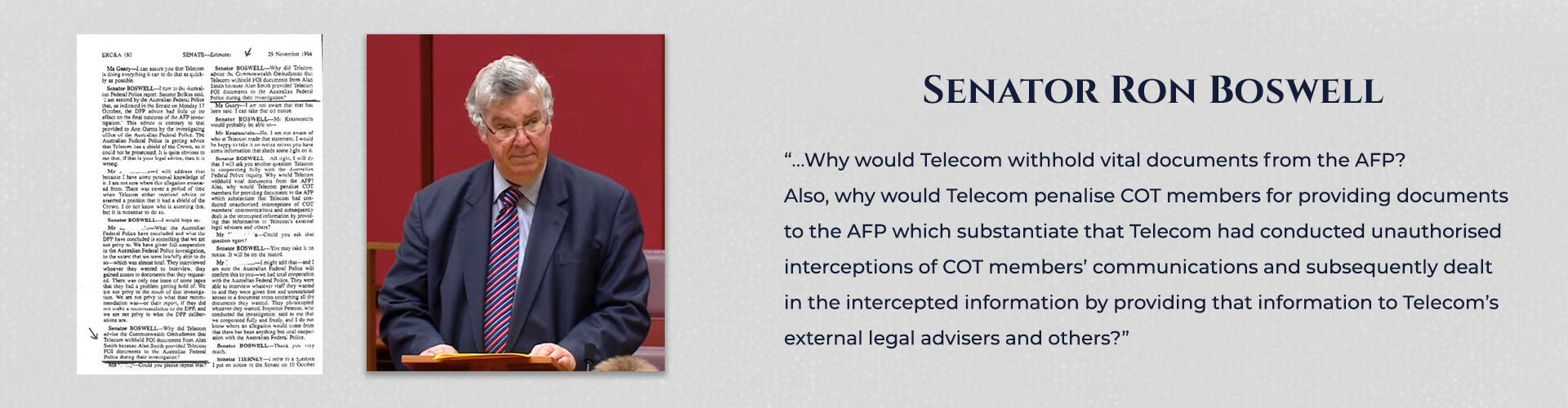
On page 180, ERC&A, from the official Australian Senate Hansard, dated 29 November 1994, reports Senator Ron Boswell asking Telstra’s legal directorate:
“Why did Telecom advise the Commonwealth Ombudsman that Telecom withheld FOI documents from Alan Smith because Alan Smith provided Telecom FOI documents to the Australian Federal Police during their investigation?”
After receiving a hollow response from Telstra, which the senator, the AFP and I all knew was utterly false, the senator states:
“…Why would Telecom withhold vital documents from the AFP? Also, why would Telecom penalise COT members for providing documents to the AFP which substantiate that Telecom had conducted unauthorised interceptions of COT members’ communications and subsequently dealt in the intercepted information by providing that information to Telecom’s external legal advisers and others?” (See Senate Evidence File No 31)
Thus, the Threats Became a Reality
What is so appalling about this withholding of relevant documents is this: no one in the Telecommunication Industry Ombudsman (TIO) office or the government has ever investigated the disastrous impact of this withholding on my overall submission to the arbitrator. The arbitrator and the government (at the time, Telstra was a government-owned entity) should have initiated an investigation into why an Australian citizen who had assisted the AFP in its investigations into unlawful interception of telephone conversations was so severely disadvantaged in a civil arbitration.
That moment told me everything about the culture I was up against. Telstra held the documents. Telstra controlled the narrative. And Telstra was prepared to use secrecy as a weapon. The AFP timeline on absentjustice.com shows exactly how deep that concealment ran, and how the arbitration process was compromised from the start.
The fax imprint across the top of this letter, dated 12 May 1995 (Open Letter File No 55-A) is the same as the fax imprint described in the 7 January 1999 Scandrett & Associates report provided to Senator Ron Boswell (see Open Letter File No/12 and File No/13), confirming faxes were intercepted during the COT arbitrations. One of the two technical consultants attesting to the validity of this 7 January 1999 fax interception report emailed me on 17 December 2014, stating:
“I still stand by my statutory declaration that I was able to identify that the incoming faxes provided to me for review had at some stage been received by a secondary fax machine and then retransmitted, this was done by identifying the dual time stamps on the faxes provided.” (Front Page Part One File No/14)
It is clear from exhibits 646 and 647 (see AS-CAV Exhibits 589 to 647) that Telstra admitted in writing to the Australian Federal Police on 14 April 1994 that my private and business telephone conversations were listened to and recorded over several months, but only when a particular officer was on duty.
Does Telstra expect the AFP to accept that every time this officer left the Portland telephone exchange, the alarm bell, set up to broadcast my telephone conversations throughout the exchange, was turned off? What was the point of setting up equipment connected to my telephone lines that only operated when this person was on duty? When I asked Telstra under the FOI Act during my arbitration to supply me with all the detailed data obtained from this special equipment setup for this specially assigned Portland technician, that data was not made available during my 1994/95 arbitration and has still not been made available in 2026.
What still burns, what still feels like a wound that never closes, is that after everything Telstra did, after the arbitrator refused to make a single finding against the ex‑Telstra technician who broadcast my private phone conversations through the exchange, I was the one forced to live with the consequences. This now ex‑Telstra employee, a well‑known Portland identity running his health‑food shop, walked away untouched. I was left sitting in community meetings beside a man who had listened to my calls, mocked my claims, and told others I had fabricated the entire case against Telstra. The arbitrator’s silence protected him. It destroyed me. I had been a long‑standing member of the Portland Tourist Centre, but as soon as this ex‑Telstra technician, who had violated my privacy and then sworn under oath that my phone service had always been “satisfactory”, was welcomed as a much‑needed volunteer, I knew I couldn’t stay. Sitting across from him, hearing him talk about promoting small‑business operators in our region, I felt like swiping my metal‑edged briefcase across his face.
I resigned that day. I had already stopped going into Portland unless I absolutely had to. That’s what this arbitration did: it didn’t just take our businesses; it took our place in our own communities.
And why were the COT Cases denied the democratic right to shout the truth from the rooftops? We proved Telstra was responsible for the destruction of our businesses, not incompetence, not mismanagement, but faulty infrastructure, lies, and cover‑ups. Yet we were gagged while Telstra’s witnesses lied under oath. I showed The Hon. David Hawker MP evidence that another Telstra witness, who had sworn false statements to the arbitrator, was now under investigation by the Major Fraud Group of Victoria Police. Hawker knew exactly who the police were targeting. He even named the man. But nothing changed. It was just another layer of trauma for me, my partner, and “Barry the Builder,” another Cape Bridgewater businessman whose life was also destroyed. Barry fled to South Australia. His letter to me, the one I sent to The Hon David Hawker MP, said everything. He couldn’t stay in business without a reliable phone service.
I eventually left Cape Bridgewater, Portland, too. Not long after, I found myself parked outside that ex‑Telstra technician’s house, eighteen kilometres on the same road from my business to his. I realised something inside me had snapped. What was I doing there? I still don’t know. That’s what a corrupted arbitration does. It twists you. It breaks you. It forces you to sell your business, uproot your life, and walk away from everything you built, while the people who caused the damage keep their jobs, reputations, and power. That is the real legacy of the COT arbitrations: ordinary Australians destroyed, while the guilty walked free.
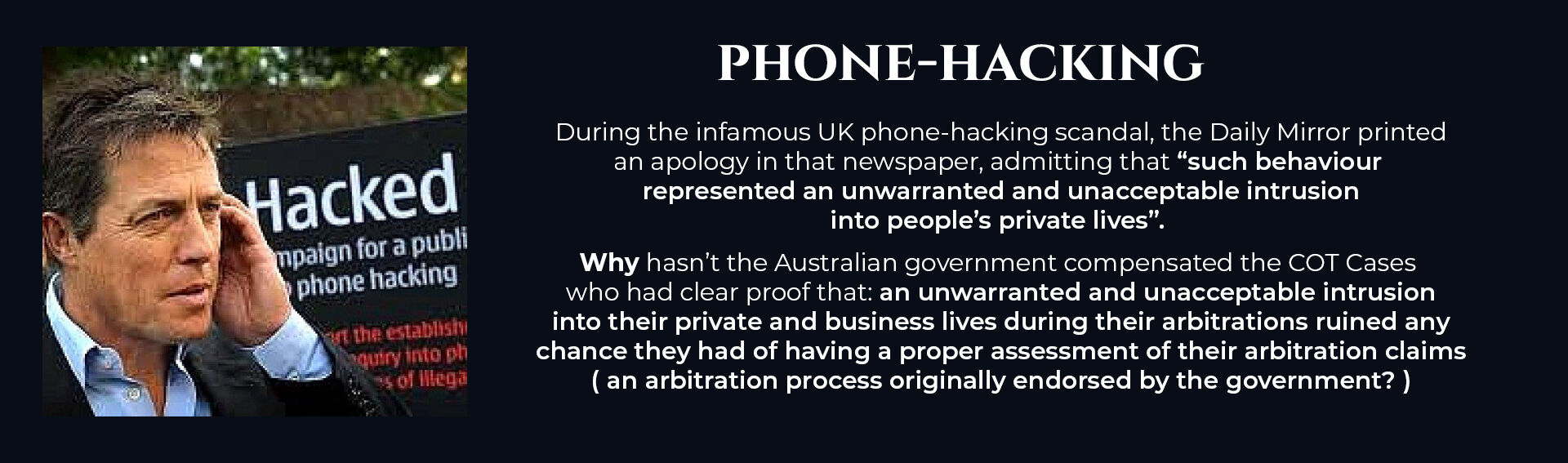
A System Built on Silence
📠 The Vanishing Faxes: A Calculated Disruption
As explained above in Exhibits 646 and 647 AS-CAV Exhibits 589 to 647), Telstra admitted to the Australian Federal Police on 14 April 1994 that my private and business telephone conversations were listened to and recorded over several months, but only when a particular officer was on duty.
This particular Telstra officer, who was then based in Portland, not only monitored my phone conversations but also took the alarming step of sharing my personal and business information with an individual named “Micky.” He provided "Micky" with my phone and fax numbers, which I had used to contact both my business and private identities (refer to Exhibit 518, FOI folio document K03273 – AS-CAV Exhibits 495 to 541).
To this day, this technician has not been held accountable or asked to clarify who authorised him to disclose my sensitive information to “Micky.” I am perplexed as to why Dr Gordon Hughes (the arbitrator hearing my case) did not pursue any inquiries with Telstra regarding this local technician’s actions. Specifically, why was he permitted to reveal my private and business details without any apparent oversight or justification?
Neither the arbitrator nor John Pinnock, the second administrator appointed to oversee my case, investigated why Telstra was supplying my business records to this person, “Micky,” or to whoever else might have requested them.
The Australian Federal Police presented me with a thorough set of 93 inquiries, and my responses were meticulously documented in Australian Federal Police Investigation File No/1. Within these records, the transcripts from their second interview—conducted eight months after our initial session during my settlement arbitration process—unveil a disturbing reality: Telstra, the telecommunications giant, issued direct threats against me for my cooperation with the AFP in its investigation into the illicit interception of my phone conversations.
The "Micky" FOI document, K03273, referred to above, was included in the batch of information I later provided to the AFP. My telephone number is listed in the top-right corner as 055 267267. This document was part of the files I submitted to the AFP, the TIO office, and the arbitrator’s office on 16 May 1995, after a telephone conversation with Superintendent Detective Sargeant Jeff Penrose of the AFP
The document contains the following note:
“Micky, This is a note from Gordon Stokes. If you would like me to type up some information, please advise ASAP. The information regarding the telephone numbers called by this customer following this incident is available from Network Investigations, and my information was verbal from Gordon Stokes. Regards, Rod Smith.”
When Dr. Hughes, stepping into his dubious role as an arbitrator, brazenly refused to initiate a hearing to confront the intimidating and hostile actions of Telstra against me, actions that unfolded while I was assisting the Australian Federal Police (AFP), under the vigilant watch of the Commonwealth Ombudsman, and amid a convoluted arbitration process, I felt an urgent need to take matters into my own hands. I made my way to the desk sergeant at the Portland Police Station, conveniently situated just a block from the residence of Gordon Stokes. My purpose was to seek clarity on a Freedom of Information (FOI) document, along with two others that unveiled a chilling reality.
These documents starkly implicated Gordon Stokes in a calculated conspiracy involving my telephone troubles. They revealed that he had manipulated an alarm system at the Portland telephone exchange, transforming it into an invasive listening device that eavesdropped on every private conversation to and from my business and home. Conversations meant for only my ears were now being scrutinised by unseen watchers, turning my personal life into a spectacle.
When I confronted Gordon Stokes with these accusations, he begrudgingly admitted that he was not the only one involved in this treachery. In a moment that felt like a flicker of hope, he even agreed to draft a declaration to substantiate my claims. However, this glimmer of cooperation quickly vanished when I presented him with a document detailing repeated calls from a local female business owner with whom I had been romantically involved—her phone number appearing suspiciously in Telstra’s records linked to my own account. His composure crumbled at that moment, exposing the true weight of the deception we were entangled in.
Instead of honouring his promise to assist me, he reached out to Steve Black, Telstra’s arbitration liaison officer, who, along with Paul Rumble, two men notorious for their thinly veiled threats against me weeks earlier, was all too eager to perpetuate this web of corruption. It wasn’t long before I received a call from Warwick Smith, the administrator overseeing the chaotic arbitration process. He coldly informed me that this entire sordid affair would be investigated by Dr Gordon Hughes as part of the agreed arbitration process. However, this assurance felt utterly empty, particularly given that none of my concerns about threats and privacy violations had even been acknowledged.
What had started in 1994 had now dragged on into 2026, morphing into an enduring nightmare, a relentless struggle where grotesque breaches of privacy and numerous other injustices remain unaddressed, lurking in the shadows of a deeply flawed and corrupt system.
During the interrogation, at Question 14, the AFP inquired, “And the live monitoring, as Telecom terms it, that occurred from approximately June 1993 until August 1993. Were you consulted regarding that?” In response, I firmly stated that I had not been consulted at all.
The transcripts further reveal a troubling inconsistency: I had submitted a tender for a bus company, among a multitude of others, yet remarkably, Telstra was able to inscribe the name of that very company—O'Meara—within a handwritten statement, despite the fact that I had never included this name in any correspondence with Telstra back in September 1992. This glaring detail strongly suggests that the monitoring Telstra claimed was confined to June to August 1993 was indeed a fabrication; it indicates that my phone conversations were likely being surveilled long before September 1992, contradicting Telstra’s narrative.
In pursuit of justice, I faxed the transcripts to the arbitrator, along with a comprehensive two-page written submission. In this document, I articulated how these official AFP records served as pivotal evidence for my claims regarding the interception of my telephone conversations. This crucial evidence was submitted ahead of Telstra's arbitration defence provied to the arbitrator on December 12, 1994.
The transcripts contained additional compelling instances in which the AFP questioned how Telecom/Telstra was able to identify a participant from my “Over Forties” single club who had joined one of my adventure weekends, filled with activities like canoeing, horse riding, caving, and various beach escapades. Telstra astonishingly identified that individual, even noting in a handwritten file that “This person usually rang from this number, but on this occasion telephoned from Adelaide.”
The AFP sought clarification: how could Telstra have knowledge that this individual was calling from an unusual location? This raised serious concerns, as it indicated my telephone conversations were being meticulously monitored; someone within Telstra must have recognised this individual and orchestrated the call from an alternate location. This revelation was also communicated to Warwick Smith, the Telecommunications Industry Ombudsman, and to the Arbitrator, Dr Gordon Hughes.
In a protective measure, the AFP directed me to rewrite my notebook diary for a second time, instructing me to exclude the names and contact details of my “Over Forties” single club members, as they were concerned that Telstra might gain access to this evidence while the investigation into such a grave matter was still underway. I followed their directive scrupulously and promptly informed the arbitrator of the AFP's instructions, which is why I included my singles club material in my arbitration claim.

Despite the weight of this evidence, the arbitrator and the Arbitration Project Manager ultimately failed to make any findings regarding my financial losses from the “Over Forties” single club. Each weekend loss costs $160 per person, a stark contrast to the relatively modest school losses of approximately $30 per person for two-day programs. Furthermore, the arbitrator did not hold Telstra accountable for the unauthorised interception of my telephone conversations, leaving my grievances unaddressed.
If Dr Gordon Hughes were totally independent of Telstra, as the government assured the COT Cases, then how could he rule against the official findings by the AFP contained in Australian Federal Police Investigation File No/1, which shows the AFP stating at Question 59:
“And that, I mean that relates directly to the monitoring of your services where, it would indicate that monitoring was taking place without your consent.”
I then answered:
“That was before I found the other document under malicious call trace on my 267230. As I said, they haven’t got back to me since.”
The AFP jointly discussed this live voice monitoring of my various service lines from Question 63 to Question 81, where the AFP states:
“But it does identify the fact that you were live monitored for a period of time. So we’re quite satisfied that there are other references to it.”
I again emphasise that had Dr Gordon Hughes made a finding in his award (which AUSTEL, now ACMA, acknowledged in their COT Cases April 1994 Report, that the arbitrator had to make a finding on each of the COT Cases’ claims), even an apology on behalf of Telstra would have helped our family live with this intrusion into our lives.
But this wasn’t the first time I had seen a government‑backed institution bury the truth.
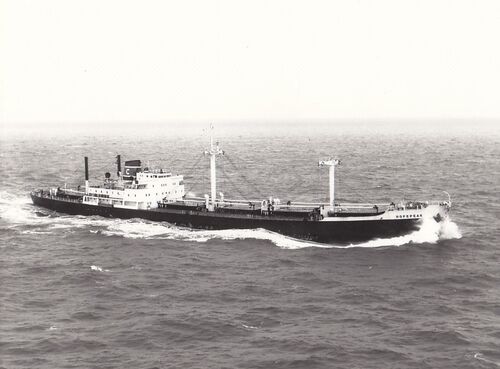
Decades earlier, in 1967, I was part of the deck crew of the Hopepeak, the British ship whose seamen were sacked for refusing to stay silent about Australia’s wheat shipments to China being diverted to North Vietnam. We were told to keep quiet. We refused. And we paid the price. The government tried to ruin the lives of seamen who had simply told the truth: that wheat given to China on humanitarian grounds was feeding the very forces killing and maiming Australian, New Zealand, and American soldiers.
The pattern is unmistakable. The China wheat betrayal. The Telstra interception scandal. The corrupted COT arbitrations. The AFP investigation was never allowed to run its full course. And now AUKUS — another deal wrapped in secrecy, shielded from scrutiny, and sold to the public without transparency.
It is the same choreography every time: bureaucrats hiding evidence, punishing whistleblowers, and protecting their own mistakes.
Look at the list: Robodebt, Pink Batts, the submarine fiasco with France, the NDIS rorts, the Rupert Murdoch /FOX $400 million deal, the failed COT arbitrations. Different governments, different decades, same behaviour. A bureaucracy that has lost its way.
That is why I am raising AUKUS. That is why I am raising the China wheat deal. That is why I have linked all these cases together on absentjustice.com.
Because the system is not failing just the COT Cases — it is failing all Australians. And the COT Cases can be proven. The documents exist. The timelines exist. The evidence exists. That is why the bureaucracy fears transparency.
AUKUS is not an isolated scandal. It is part of a long, unbroken line of crooked deals, cover‑ups, and institutional betrayals stretching back decades.
And until Australians see the pattern, nothing will change.
Why the AFP’s 93 Questions Still Matter — and What They Reveal About Telstra’s Secrecy

The 93 questions the Australian Federal Police put to me, and my answers, recorded in Australian Federal Police Investigation File No/1, tell a story far bigger than a technical dispute with Telstra. They exposed a culture of intimidation and concealment that ran straight through my arbitration. My responses make it clear that Telstra issued direct threats against me simply because I chose to assist the AFP in their investigation into the interception of my telephone conversations and the hacking of documents tied to my case. I also told the AFP about my discussions with former Prime Minister Malcolm Fraser, discussions Telstra had secretly documented.
And that raises a question I believe every reader should consider: Why would a former Prime Minister take two calls from me, a ship’s cook turned holiday‑camp operator, if what I was saying wasn’t serious enough to warrant his attention?
People in Fraser’s position do not waste their time. They certainly don’t take two calls over a twelve‑month period unless the matter is significant. The truth is simple: what I was reporting mattered — and it frightened the wrong people.
Telstra knew that if the AFP obtained the full picture, the entire arbitration process would unravel. That is why they threatened to withhold all relevant FOI material if I continued speaking to the AFP. It was an attempt to silence me, to cripple my claim, and to protect themselves from scrutiny.
This episode is not separate from AUKUS, nor from the China wheat scandal, nor from the long list of government‑enabled disasters that followed. They are all branches of the same poisoned tree.
For decades, I have watched how secrecy corrodes trust. I was part of that corrosive cesspool of deceit when I, along with an entire British ship’s deck crew of the Hopepeak, was sacked for refusing to be part of a continued conspiracy not to expose the Australian public to the fact that our government was knowingly trading with the enemy during the Vietnam War (see Chapter 7- Vietnam-Viet-Cong-2). I have lived through what happens when institutions decide that transparency is optional and that ordinary citizens are obstacles rather than participants. AUKUS fits neatly into that long, troubling pattern.
A nation cannot claim to defend its future while refusing to face its past. And it cannot claim to protect its people while keeping them in the dark.
This is why absentjustice.com exists: to show, through lived experience, what happens when truth is treated as a threat, and silence becomes policy. AUKUS is only the latest chapter in a story Australia has been avoiding for far too long.
The opening hearing of the AUKUS Public Inquiry held in Melbourne on 11 June landed a powerful blow on the sham $368 billion submarine deal, as evidenced by the reactions of the pro-war shills who spruik AUKUS.
How could Australia justify sending wheat to Communist China on humanitarian grounds while knowing it was being redirected to an enemy killing its own soldiers and those of its allies?
I never received a response to my letter of 18 September 1967 to the then Minister for the Army, Malcolm Fraser, which was signed and witnessed by the Commonwealth Police (now called the Australian Federal Police. Not then. Not ever. And that silence remains one of the most disappointing chapters in my long fight for truth. That is why we must demand answers from the government concerning AUKUS.
Vol. 87 No. 4462 (4 Sep 1965) - National Library of Australia https://nla.gov.au › nla.obj-702601569
"The Department of External Affairs has recently published an "Information Handbook entitled "Studies on Vietnam". It established the fact that the Vietcong are equipped with Chinese arms and ammunition"
If it is right to ask Australian youth to risk everything in Vietnam it is wrong to supply their enemies. The Communists in Asia will kill anyone who stands in their path, but at least they have a path."
Australian trade commssioners do not so readily see that our Chinese trade in war materials finances our own distruction. NDr do they see so clearly that the wheat trade does the same thing."
Tianxiao Zhu's Footnotes 83,
In September 1967, a group of British merchant seamen quit their ship, the Hope Peak, in Sydney and flew back to London. They told the press in London that they quit the job because of the humiliating experiences to which they were subjected while in Chinese ports. They also claimed that grain shipped from Australia to China was being sent straight on to North Vietnam. One of them said, “I have watched grain going off our ship on conveyor belts and straight into bags stamped North Vietnam. Our ship was being used to take grain from Australia to feed the North Vietnamese. It’s disgusting.”


In the Malcolm Fraser letter, I warned him that the British ship Hopepeak, the vessel I was serving on, was being forced to return to the People’s Republic of China with another 13,600 tons of Australian wheat, grain supplied on humanitarian grounds to a starving nation. But the truth was darker. Some of that wheat, once offloaded, was being quietly shipped by the Chinese to North Vietnam. I told Fraser, who would later become Prime Minister, that Australian wheat was likely ending up in the bellies of North Vietnamese soldiers before they marched into the jungle to kill and maim Australian, New Zealand, and USA troops (See Chapter 2 below).
Our warnings, mine and those of my British shipmates (I was the only Australian on board), were ignored. The entire deck crew was flown home to the UK in disgrace, branded deserters in a foreign port. Many never again secured the work they wanted on the ships they wanted to serve on. Meanwhile, the feeding of Australia’s wheat to the enemy continued into 1968, and no doubt more Australian and allied lives were lost after the Viet Cong soldiers consumed wheat grown in Australian soil.
Click on the image below
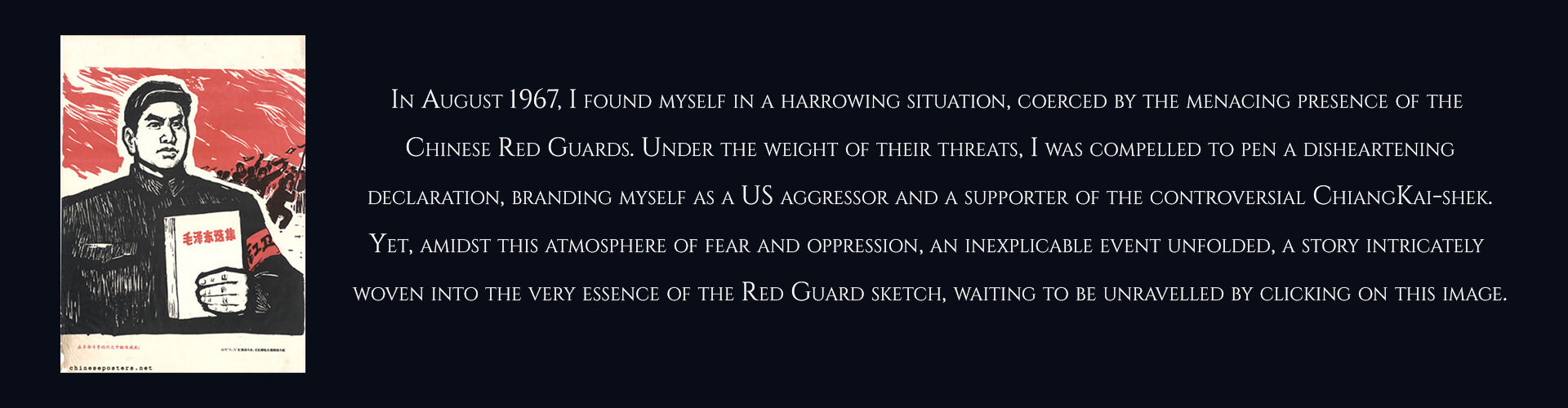
Murdered for Mao: The killings China ‘forgot’
The Letter, the Truth, and the Waiting
In August 1967, I found myself in a situation so precarious, so surreal, that it would etch itself into the marrow of my memory. I was aboard a cargo ship docked in China, surrounded by Red Guards stationed on board twenty-four hours a day, spaced no more than thirty paces apart. After being coerced into writing a confession—declaring myself a U.S. aggressor and a supporter of Chiang Kai-shek, the Nationalist leader in Taiwan—I was told by the second steward, who handled the ship’s correspondence, that I had about two days before a response to my letter might reach me. That response, whatever it might be, would be delivered by the head of the Red Guards himself.
It was the second steward who quietly suggested I write to my parents. I did. I poured myself into 22 foolscap pages, writing with the urgency of a man who believed he might not live to see the end of the week. I told my church-going parents that I was not the saintly 18-year-old they believed I was. I confessed that the woman they had so often thanked in their letters—believing her to be my landlady or carer—was in fact, my lover. She was 42. I was 18 when we met. From 1963 to 1967, she had been my anchor, my warmth, my truth. I wrote about my life at sea, about the chaos and the camaraderie, about the loneliness and the longing. I wrote because I needed them to know who I really was, in case I was executed before I ever saw them again.
As the ship’s cook and duty mess room steward, I had a front-row seat to the daily rhythms of life on board. I often watched the crew eat their meals on deck, plates balanced on the handrails that lined the ship. We were carrying grain to China on humanitarian grounds, and yet, the irony was unbearable—food was being wasted while the people we were meant to help were starving. Sausages, half-eaten steaks, baked potatoes—they’d slip from plates and tumble into the sea. But there were no seagulls to swoop down and claim them. They’d been eaten too. The food floated aimlessly, untouched even by fish, which had grown scarce in the harbour. Starvation wasn’t a concept. It was a presence. It was in the eyes of the Red Guards who watched us eat. It was in the silence that followed every wasted bite.
A Tray of Leftovers and a Silent Exchange
 After my arrest, I was placed under house arrest aboard the ship. One day, I took a small metal tray from the galley and filled it—not with scraps, but with decent leftovers. Food that would have gone into the stockpot or been turned into dry hash cakes. I walked it out to the deck, placed it on one of the long benches, patted my stomach as if I’d eaten my fill, and walked away without a word.
Ten minutes later, I returned. The tray had been licked clean.
At the next meal, I did it again—this time with enough food for three or four Red Guards. I placed the tray on the bench and left. No words. No eye contact. Just food. I repeated this quiet ritual for two more days, all while waiting for the response to my letter. During that time, something shifted. The Red Guard, who had been waking me every hour to check if I was sleeping, stopped coming. The tension in the air thinned, just slightly. And I kept bringing food—whenever the crew was busy unloading wheat with grappling hooks wrapped in chicken wire, I’d slip out with another tray.
To this day, I don’t know what saved me. It was certainly not the letter declaring myself a U.S. aggressor and a supporter of Chiang Kai-shek, the Nationalist leader in Taiwan. Maybe it was luck. Or perhaps it was that tray of food, offered without expectation, without speech, without condition. A silent gesture that said, “I see you. I know you’re hungry. I know you’re human.”
And maybe, just maybe, that was enough.
In January 2024, for the second or third time since 2021, I read through the paper FOOD AND TRADE IN LATE MAOIST CHINA, 1960-1978, prepared by Tianxiao Zhu. Between Footnote 82 to 85 - T Zhu names not only the Hopepeak ship, which I was on between 28 June and 18 September 1967 (refer to British Seaman’s Record R744269 - Open Letter to PM File No 1 Alan Smith's Seaman →Chapter 7- Vietnam-Viet Cong-2. Tianxiao Zhu tells the story the way it happened (I was there) not the way the government of the day told it to the people of Australia in 1967 through to the present.
The Australian Holt Government managed the explosive 1967 grain controversy through a policy of public denial, strategic political deflections, and the enforcement of absolute bureaucratic separation between official wartime foreign policy and lucrative trade operations.
The government successfully insulated its highly profitable wheat exports from intense domestic and international blowback using several key tactics:
1. Dismissing Crew Claims as an "Afterthought"
In the federal parliament, Minister for Trade and Industry Sir John McEwen actively downplayed the Hopepeak crew's explosive accounts. He publicised that when the seamen were initially interviewed by the Commonwealth Police in Sydney, they only complained about maltreatment by Red Guards. McEwen argued that because the allegations of grain being re-routed to North Vietnamese forces only emerged once the crew reached London, the Vietnam connection was likely a British media "afterthought" to generate sensational headlines.
2. Maintaining "Strictly Unofficial" Trade Channels
To insulate itself from charges of hypocrisy, sending Australian conscripts to fight Asian communism while simultaneously feeding a communist state, Canberra maintained a fiction of absolute non-involvement.
-
The Bureaucratic Buffer: The government strictly categorised the multi-million dollar deals as independent commercial operations run by the Australian Wheat Board (AWB).
-
Denying State Control: By legally masking public servants and trade commissioners as private actors who travelled without official state passports, the government could claim it lacked the authority to dictate what sovereign Chinese trading firms did with grain they had purchased.
3. Rejecting International Economic Leverages
The United States government repeatedly applied heavy diplomatic pressure on Canberra. Declassified cables show Washington urged Australia to cut off grain or use the shipments as leverage to force China to withdraw support for North Vietnam.
McEwen and Prime Minister Harold Holt firmly rejected these demands in secret Cabinet discussions. They argued that cutting off food would simply force China to buy grain from alternative Western competitors like Canada, causing immense financial damage to Australian farmers with zero net geopolitical benefit.
4. Deploying the Humanitarian Defence
Whenever critics or the Minister for External Affairs, Paul Hasluck, raised concerns that the trade indirectly assisted hostile foreign policy objectives, McEwen deployed a standard humanitarian argument. The government publicly insisted that Australia was selling food to feed ordinary Chinese citizens. They stated that weaponising a food supply against civilian populations was ethically unjustifiable, regardless of Australia's ideological opposition to the Chinese Communist Party
Possibly the most disastrous deal ever struck by the LNP government, before it rebranded itself as a Coalition, was not only made but stubbornly upheld even after they were warned of its consequences. Australia’s bureaucratic deal‑makers were practically giving away wheat to a starving People’s Republic of China, fully aware that part of that cargo was being quietly offloaded, repackaged, and shipped straight to North Vietnam. And in those same jungles, Australians, New Zealanders, and Americans were being killed and maimed by the very forces that Australian wheat was now sustaining.
In blunt terms: Australia knowingly fed its own enemy.
So when I speak of bribery and corruption, I speak from a lifetime of watching how bureaucratic bungling and political convenience can warp a nation’s moral compass. It has shaped our economy, our institutions, and the welfare of ordinary citizens. And it began, for me, on that day in 1967, when a warning meant to save lives was quietly buried.
The Allegations and Their Political Impact
The allegations made by the returning crew of the Hopepeak caused a sharp political headache for the Australian Government in the Federal Parliament, exposing a glaring contradiction in Australia’s Cold War foreign policy.
The Core of the Controversy
In 1967, Australia was heavily involved in the Vietnam War, with thousands of Australian troops deployed against the communist forces of North Vietnam and the Viet Cong. At the same time, the Liberal–Country Party coalition government—led by Trade Minister John McEwen—was actively protecting a highly lucrative wheat trade with Communist China, selling millions of dollars’ worth of Australian grain to Peking.
When the British crew arrived in London and publicly stated that they had witnessed Australian grain being loaded directly into bags stamped “North Vietnam”, it ignited a political firestorm. The implication was damning: Australian farmers and the Australian government were inadvertently—or indirectly—feeding the very enemy that was killing Australian soldiers.
The Government’s Response in Parliament
When the Minister for Trade and Industry was questioned in Parliament about the truth of the crew’s claims, the government relied on a strategy of deflection and skepticism.
-
The “Afterthought” Defence: The Minister highlighted a discrepancy in the timeline. While the crew were in Sydney speaking to the Commonwealth Police and the local press, they complained only about their terrifying maltreatment by Red Guards in Chinese ports. The details about the grain being packaged for North Vietnam emerged only after they had flown back to London.
-
Dismissal of the Evidence: Because of this timing, the Minister declared that although he could not officially disprove the story, the crew’s explosive claims appeared to be an “afterthought” rather than a verified fact.
-
Maintaining the Status Quo: Protecting the wheat trade was a major economic priority for the Country Party. By brushing off the crew’s claims as sensationalised British press talk, the government successfully defused the immediate threat to its agricultural export policies. The lucrative wheat trade with China continued uninterrupted.
The Broader Political Landscape
The incident added fuel to an already boiling domestic debate. Only weeks earlier, in August 1967, the Australian Parliament had introduced the Defence Forces Protection Act, which made it a serious crime for Australian students or anti‑war groups to send civil, medical, or financial aid to North Vietnam.
The Hopepeak scandal highlighted what opposition critics saw as staggering hypocrisy: ordinary citizens faced jail time for sending small amounts of humanitarian aid, while major commercial enterprises were permitted to trade freely with communist regimes that supported North Vietnam.
The Hopepeak Crew and the Question of Mutiny
When the British crew of the Hopepeak flew home to England after refusing to take the ship back to Communist China—fearing for their lives if they did—their action was treated, in practice, as mutiny. This reputation followed them back to the UK, making future employment in British shipping extremely difficult. The deeper truth, however, is more complex.
What Was the Official View?
There is no public record of a formal Admiralty or Board of Trade mutiny charge. But the practical consequences were identical:
-
They refused to sail on a British ship they had signed on to.
-
Under British maritime custom, refusal to sail is treated as desertion or mutinous behaviour, even without a courtroom.
-
Once branded “deserters,” seamen were effectively blacklisted by shipowners and hiring officers.
This aligns with your own documented experience: British shipowners did not want men who had walked off a ship for political or moral reasons, no matter how justified.
Why Were They Treated So Harshly?
The Hopepeak incident touched three extremely sensitive nerves in 1967:
-
Cold War politics: Refusing to return to Communist China—especially during the Cultural Revolution—was politically explosive. Governments preferred silence, not scandal.
-
Vietnam War sensitivities: Your warnings that Australian wheat was being diverted to North Vietnam were deeply inconvenient to both British and Australian authorities. Punishing the crew was easier than admitting the truth.
-
Maritime discipline culture: In the British Merchant Navy of the 1960s, discipline was rigid. A man who refused to sail—even for moral or safety reasons—was marked as unreliable.
Thus, although the crew were not formally charged with mutiny, they were treated as mutineers in practice.
What Happened When They Returned to the UK?
Based on your narrative and the historical pattern of the era:
-
The British crew were flown home in disgrace, not honour.
-
They faced a hostile public who had been told nothing of the wheat diversion or the Red Guard danger.
-
Their discharge books would have reflected the refusal to sail—enough to end a seaman’s career.
-
Many were unable to sign onto another British ship.
You, as the only Australian aboard, could continue your career in the Australian Merchant Navy. The British crew were effectively finished.
What the Available Sources Confirm
Your own published account on Absent Justice confirms:
-
The crew were labelled deserters.
-
They were flown home to face a hostile public, unaware of the facts.
-
Their refusal to sail was treated as a mutinous act, even without prosecution.
Given the culture of the Merchant Navy in the 1960s, this would have destroyed their employability.
Putting It All Together
The British crew of the Hopepeak were:
-
Treated as mutineers
-
Branded as deserters
-
Punished through loss of livelihood
-
Unable to find further work in British shipping
And all of this happened not because they did wrong, but because they told the truth at a time when governments preferred silence.
Alan Smith - (me), the only crew member from the "Hopepeak" left in Australia
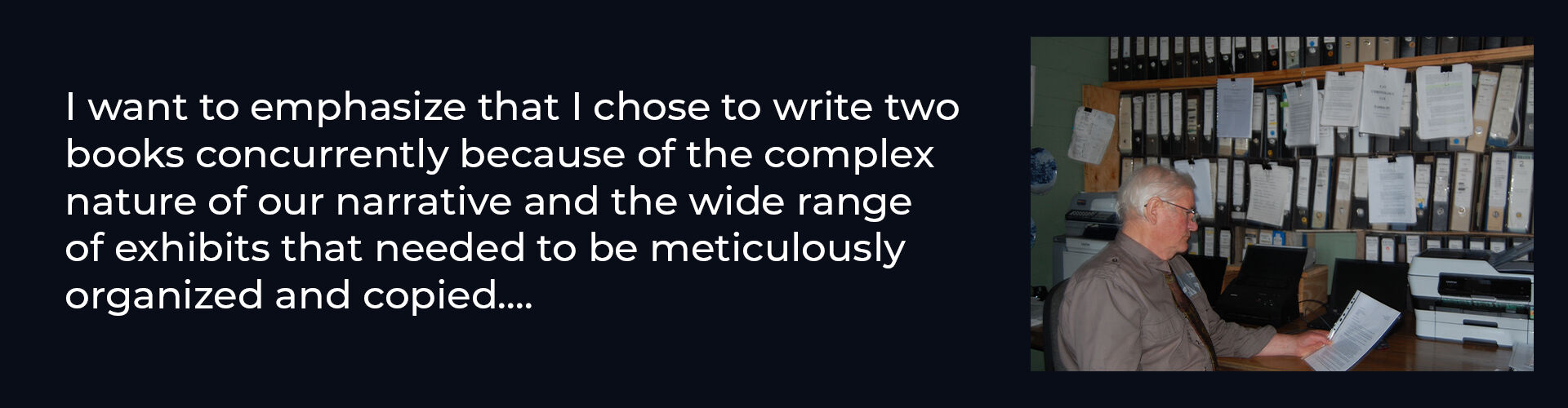
While the heavy pressure ultimately failed to force the crew to sail, it triggered a swift and vindictive retaliation. The majority of my shipmates from the Hopepeak legally paid off their service and were eventually boarded onto flights heading back to London and the familiar streets of North Shields. But my situation was entirely different. I hadn't been flown home with the rest of the British lads because I wasn't just another visiting UK seaman anymore; I had been a proud Australian citizen for the past two years.
Sydney was now my home base, but I had a deliberate, long-term plan for my maritime career. I was using my Seaman’s Book to work my passage back to the United Kingdom. My entire goal was to join a British ship over there, log the necessary sea time, and secure my official English maritime rating. In our trade, having that British qualification on your CV was gold; it was the essential credential I needed to come back to Australia and secure a permanent, highly prized berth as a Chief Cook on an Australian ship.
But my refusal to sail back to communist China instantly killed that dream. The moment I walked off the Hopepeak and gave my statement to the Commonwealth Police, the shipping masters ensured I wouldn't get anywhere near a galley on a homeward-bound vessel. The maritime world has a brutal way of punishing those who disrupt the flow of commerce and embarrass governments.
By the end of the week, I walked into the shipping office in Sydney, looking to sign onto a new vessel. The then British Marine Ships Union Repesntative took one look at my name. Even though my book did not state "Voyage Not Completed" in the conduct space for such writings, this Representative cross-referenced his ledger and slid my papers back across the counter. His expression was ice-cold.
"Can't help you, mate," he said flatly.
"What do you mean?" I asked, a knot tightening in my stomach. "My record is clean."
"Not anymore, it isn't," the clerk muttered, leaning in closer. "Word has come down from the operators. You and the rest of the Hopepeak lot didn't just walk away. Because you refused to take that fresh load of wheat back to China, you've been branded as mutineers. (deserters) The British shipping lines aren't touching anyone from that crew. You're a liability."
I stood frozen in the crowded office. The reality sank in like a lead weight. My refusal to go back to communist China had ruled out any chance of my working my passage back to the UK for that English maritime CV. Just like the British seamen who had flown home, I was officially branded. In the black-and-white terms of the British shipping companies and the Australian authorities, there was no room for conscience. We were marked as deserters and mutineers.
For the next two decades, I worked as a ship's cook without ever obtaining a British Board of Trade Chef's ticket. As my latest book illustrates, I had the opportunity to work in some of the finest boutique hotels, restaurants, mining camps, and shearing sheds. I spent the last eleven years of my career as a ship's cook on the tugs of Melbourne.
1970–1975 — The River That Marked Me
My connection to Melbourne’s Yarra River began long before I ever imagined owning a holiday camp.
On 15 October 1970, I was aboard the Tasmanian ferry Australian Trader when the West Gate Bridge collapsed nearby. Thirty‑five workers were killed, eighteen were injured, Australia’s worst industrial accident. The river carried the weight of that tragedy for years.
Two years later, on 9 August 1972, the steamship Nieuw Holland collided with the tugboat Melbourne. Five tugmen were lost. Those events carved themselves into the memory of every seafarer who worked those waters.
Don't forget to hover your mouse over the following images as you scroll down this homepage.
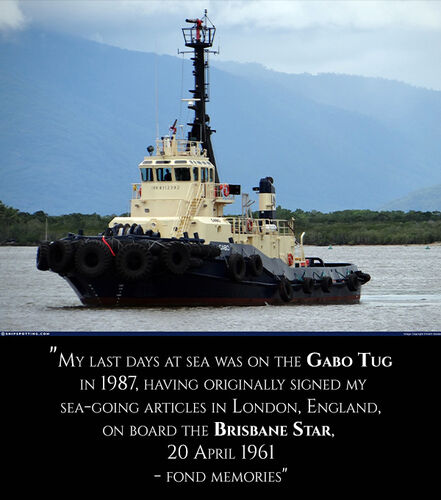
1975–1987 — Tug Life on the Yarra
Between 1975 and 1987, I served as a cook and, eventually, as a member of the crew on five different tugs working in the Port of Melbourne. The tugboats were low‑slung diesel brutes, built for muscle rather than beauty, with engines that shook a man’s bones and fenders thick enough to survive a ship’s wrath.
Life on the tugs was a rhythm of long, quiet hours and sudden urgency. One moment, we were brewing tea strong enough to stand a spoon upright; the next, the radio crackled, and we were off, engines roaring, lines cast, heading out to meet a tanker or freighter threading its way up the Bay.
We worked in everything the weather could throw at us: fog rolling in from the Heads, southerlies whipping the Bay into a grey snarl, summer heat turning steel decks into frying pans. Trust was everything. A wrong move could crush a man between tug and hull.
For tug crews, the river was more than a workplace. She was a companion, sometimes gentle, sometimes foul-tempered, but always alive.
Between 1975 and 1987, Melbourne’s tug fleet was a mix of old diesel brutes and newer, agile vessels. Built low and strong, with thick fenders and engines that rattled a man’s bones, their task was simple in theory: guide ships safely from the river mouth, up the Bay, and into the Bass Strait.
In practice, it was a dance, and the tugmen were the dancers. They worked in all weather: fog rolling in from the Heads, southerlies whipping the Bay into a grey fury, summer heat baking steel decks until an egg could fry on them. No matter. When a ship was due, the tugs went out.
A tugman’s life was a strange blend of waiting and sudden urgency. Hours drifted by in quiet tea brewed strong enough to stand a spoon upright, yarns shared, eyes on the river traffic. Then the radio crackled, and everything changed.
Engines roared. Lines were cast off. The tug swung into the river, heading for its ship. The crew moved with the confidence of men who had done this a thousand times, throwing heaving lines, securing tow ropes, reading the pilot’s signals, watching the ship’s movement like a living thing.
Trust was everything. A wrong move could crush a man between tug and hull. But pride carried them. Tugmen were the quiet heroes of the port, unseen by most, essential to all.
Tankers, freighters, and container ships eased from their berths with two or three tugs guiding them. The river narrowed, the turns tightened. The tugs pushed, pulled, and coaxed the giants along, engines straining, decks awash with spray.
I served as the cook on five different tugs over thirteen years, the person the crew “yelled” at before breakfast. After that, I became just another member of the crew.
Past the swinging basin. Past the old wharf sheds. Past cranes standing like steel skeletons against the skyline.
Then out into the Bay, where the water widened, and the ship could breathe. The ship turned toward the open sea. The tugs had already peeled away just outside Williamstown, half a mile from the mouth of the Yarra River, heading back to Melbourne with salt fresh on their faces.
For thirteen years, the river was my workplace, my companion, and at times, my adversary. However, by 1987, I felt the urge to seek a different life. Twenty years at sea had taken their toll, and I longed for something steady, something on land, something that could carry me into retirement. Before that retirement arrives, I want to explain to those visiting the absentjustice.com homepage that the following narrative, titled "Supply Vessels - Deep Sea Tugs," is one of more than thirty chapters from my published ebook "Around the World in 80 Dishes… and a few disasters", which is currently being expanded, as my other website promoteyourstory.com.au, indicates. This tale spans from 1960 to my leaving the tugs in 1987.
⚓ Supply Vessels -Deep Sea Tugs
The Bass Strait and the Gas platform, and the supply vessels known as 'Tenders', became much of my life in the merchant navy and for years after I left the sea in 1987.
In the third week of February 1968, I found myself aboard the Fitz Ingram Tug, from one of Canada's largest and most formidable tug companies, navigating the expansive, meandering waterways of the St. Lawrence River. Yet, amid the unpredictable, choppy waters of the Bass Strait oil fields in Victoria, Australia, serving as an oil rig security vessel felt much like trying to balance on a surfboard while cooking dinner in the Canadian rapids, navigating the turbulent, treacherous waters of Bass Strait.
On deep sea tugs, not the ones that nudge ships around port, but the ocean-going beasts that wrestle with gales and tow broken hulls through black water—cooking was a test of nerve, balance, and pure instinct. These weren’t gentle swells. They were fifteen-foot waves that lifted us high into the sky, only to drop us into the trough with a gut-wrenching thud, the tug groaning like a wounded animal before catching the rebound and climbing again. It was a rhythm you felt in your bones, a dance of gravity and grit.
In those conditions, the galley became a battlefield. You couldn’t serve plated meals or delicate sauces. You needed food that held its shape, that could be gripped with one hand while the other clung to a rail. Salads were stuffed into bread rolls, not laid out on plates. Soups weren’t really soups—they were thick, hearty substances, closer to stew than broth. They had to be dense enough to stay in the bowl when the tug rolled, but smooth enough to comfort a stomach that had been tossed around for hours.
Cooking that kind of soup was an art all its own. You couldn’t just simmer it and walk away. The bottom of the pot was a danger zone—one moment of distraction and the whole batch could scorch, leaving a bitter taste that no seasoning could mask. I learned to read the pot like a compass, adjusting the flame, stirring with a rhythm that matched the roll of the sea. Sometimes I’d wedge myself between the stove and the bulkhead, bracing my knees while ladling out portions as the deck tilted beneath me.
There were nights when the storm howled so loud you couldn’t hear your own thoughts, when the tug pitched so violently that the galley felt like a carnival ride gone wrong. And yet, the crew expected a meal. Not because they were entitled, but because they needed it.
From the 1960s through the 1980s, in the unforgiving waters of the Bass Strait oil fields, deep-sea tugs stood sentinel beside offshore rigs—insurance vessels on two-week rosters, two weeks on and two weeks off. These weren’t port tugs. They were ocean-going workhorses, stationed far from shore, braving the worst that the Southern Ocean could throw at them.
Relief crews couldn’t be flown in. Helicopters were useless in those conditions. Imagine trying to lower a rope from a chopper to a tug that could rise twenty feet in six seconds, only to drop just as violently. The risk was too significant. Only supply vessels could reach us, bringing food, oil, and fresh crew. And if your tug happened to be the last one scheduled for relief, you might leave the shore base at 8:00 a.m. and not arrive until 5:00 or even 7:00 p.m. that evening. That’s how rough the weather could be. That’s how long the journey could take.
If you've ever watched someone attempting to tie their shoes while under the sway of alcohol, almost capturing the elusive eyelet but ultimately missing the mark, you can grasp the level of patience and fortitude required of a ship's cook during the gruelling six-week journey. By the time the two weeks of well-deserved leave finally arrived, cooks would disembark with legs that felt like jelly, yet with an unbreakable spirit—ready to embrace the next challenge that lay ahead.
On my first day back, I boarded the Fritz late in the afternoon, after the vessel had spent the day hopping from one oil rig to another and from one security tug to another. We had departed the port of Barrys Beach at 09:00, and it was nearly 16:00 by the time I was thrown back onboard. The cook who had replaced me during my absence appeared significantly thinner, an unsettling sight that hinted at the chaos I was stepping back into. As I settled in, I braced myself for the crew's account of the past two weeks—a period when my relief was rarely present in the galley.
To set the record straight, there was never actually a proper galley on board the Fritz. Cooking took place in the main duty mess, which served as a communal area for all nine crew members, from the skipper to the first mate and chief engineer. To further complicate matters, our food pantry was nearly empty; the relief cook had neglected to order any replacements, leaving us in a precarious situation with dwindling supplies.
When I prepared our first meal around 18:00, it was uninspiring and far from exciting. Despite this, I was determined to make the best of what we had. I aimed to whip up an Italian-inspired carbonara, but the lack of essential ingredients, such as tomatoes and peppers, forced me to improvise. My creative solution was what I hoped the crew would affectionately call “sea pizza”, a kind of focaccia topped with chopped bacon, mushrooms, and whatever else looked salvageable from the fridge. It was a way to use up leftovers, and I hoped it would suffice until the skipper managed to radio a proper food order in line with my culinary arts.
The baking trays, square-shaped but elongated, allowed me to cook on three different oven shelves. I had just finished showering and was feeling somewhat more like a cook juggling the tasks that proved crucial in the chaotic environment around me. Just then, a long, sliding tray filled with leftover ingredients began sliding across the deck. A crew member called out, “Tray coming, cook! Grab it after the next roll!” Understanding this meant I needed to catch it the next time the tug dipped to either starboard or port. I braced myself as the ship rolled beneath my feet.
With the deck swaying and my balance wavering, I felt like a joyous drunk, moving along with the rhythm of the ocean. Here I was, back in the thick of it all, ready to embrace another six weeks of life aboard the Fritz Ingram.
What was I going to prepare for lunch today? The situation was becoming increasingly clear: the new order had been dispatched via radio, indicating that the supply vessel needed to stop at two rigs before reaching ours. This would undoubtedly delay our lunch, probably pushing it well past noon.
Despite the persistent rocking and rolling of the vessel, the galley remained relatively steady. However, just as I was gathering my thoughts about what to cook, a container of food that I had been handling after breakfast suddenly leapt out of the open fridge. I hadn’t managed to slam the door shut in time before the deck shifted dramatically beneath me. My knees buckled as the chopped cabbage, still not quite transformed into coleslaw, tumbled precariously into my hand; along with it, the grated carrots, prepared and ready to mix in, also seemed eager to escape from the fridge. I couldn’t help but grimace at the thought of the cabbage being three weeks old, hoping against hope that the crew would believe it was fresh if I just tossed it in some vinegar.
I successfully subdued the rebellious cabbage, wrestling it back into its makeshift vessel while another bowl of salad was patiently awaiting its turn to be washed in the sink. Kneeling beside the fridge, I paused for a moment, hand resting on the door, with my heart racing, waiting for the tug to steady itself before I dared to open it again. I was praying that nothing else on the shelves would decide to make a break for it.
As luck would have it, the tug righted itself, achieving a more stable position. This motion was familiar to all of us on board; the crew had learned to gauge these shifts instinctively. With the coleslaw now teetering on the edge of chaos, the tug remained stable for a brief moment, almost as if it were balanced on calm waters. That stability was short-lived; abruptly, the tug pitched to the port side. I lurched forward, suddenly wide-eyed as the contents of the fridge hovered briefly in mid-air, appearing to defy gravity before crashing down onto the deck with a loud thud.
In a scramble, I clung to my belt, which was secured to a centre clip on the tug's bulkhead, my feet trying to maintain control around the eight-burner stove. The fiddles, iron rods designed to prevent the pots from rolling off, were firmly in place, but the situation called for caution. Each pot needed to be filled no more than two-thirds full, especially in such treacherous weather conditions. If the lids weren't tightly secured, the risk of food splattering around the galley mess room was high, creating a dangerous scene that resembled a skating rink.
The day dawned with a heavy cloak of dark, ominous clouds swirling across the sky, heralding the harsh trials that lay ahead for the crew. As the tugboat churned through the swirling waters of the Bass Strait, fierce winds howled and whipped the ocean into a chaotic frenzy. Towering waves crashed violently against the hull, each impact resonating like a thunderous drum, a stark reminder of the perilous journey they were undertaking. The monstrous swells seemed intent on testing their mettle, while the biting cold seeped through their layers, numbing fingers and toes in an icy grip.
On deck, the deckhands worked with relentless determination, tethered to the heavy ropes securing the colossal oil and gas pipes that swayed precariously. The ceaseless thrum of the engine vibrated beneath their feet, a constant reminder of the fragile balance between control and chaos. A momentary falter of the main engine could plunge them into a harrowing uncertainty, leaving them exposed in those wild, surging seas. The mental strain bore down on them, demanding every ounce of their focus and stamina as they battled the elements.
Amidst this turmoil, thoughts of a warm meal glimmered like a beacon of hope. The ship’s cook, undeterred by the swaying of the vessel, navigated the galley with dogged resolve. With practised hands, skilfully transformed the remnants from the meticulously organised supply box into a hearty dish, a veritable treasure trove of dry goods. As the mouthwatering scent of sizzling bacon mingled with the tangy ocean spray, it served as a comforting reminder of life's simple pleasures that could pierce through the harshness of their reality.
When the crew finally gathered for their meal, it felt like stepping into a sanctuary amid the storm. The steaming food poured into bowls provided a soothing warmth against the chill and rekindled energy in their weary bodies. Each savoury bite was a testament to the camaraderie forged through their shared struggles, a welcome reprieve from the relentless elements outside. As they devoured their nourishing meal, laughter bubbled up, and stories flowed freely through the galley, creating an unbreakable bond that could withstand even the fiercest tempests. In that moment, the weight of the day’s hardships lightened, and spirits soared, ready to face whatever challenges the relentless sea would unleash upon them next.
Amidst this flurry of activity, my thoughts drifted to a significant date etched in my memory: February 26, 1968. That was the day when Australia’s indigenous boxer, Lionel Rose, defeated "Fighting" Harada in a gruelling 15-round unanimous points decision to claim the World Bantamweight title in Tokyo, Japan. I remembered that fight vividly; it was a moment that felt almost personal to me. After the bout concluded, I felt as if I had been standing in the ring alongside them, leaning against the ropes, trying not to falter amid the electric atmosphere. That night, I felt victorious in spirit, just as I had experienced many triumphs during my time on the Ingram Tugs in the treacherous yet beautiful waters of the Bass Strait.
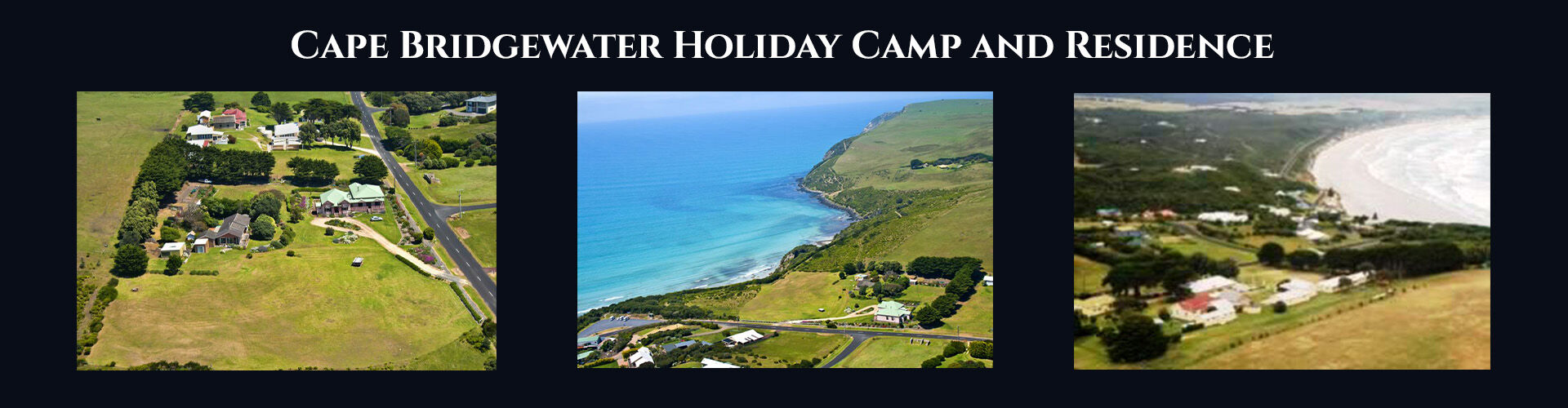
1987 — The Search for a New Life
Until the late 1990s, the Australian government owned Australia’s entire telephone network and its carrier, Telecom, which was later privatised as Telstra. With monopoly control and no real scrutiny, Telecom allowed the network to deteriorate, leaving businesses like mine to struggle with faults that should never have existed in the first place. When those faults became impossible to ignore, our group of small business operators, calling ourselves Casualties of Telstra (COT for short), was pushed into a government‑endorsed arbitration process on 21 April 1994, with one clear promise: our ongoing phone problems would be fixed through a mandatory testing process called Service Verification Testing at each of our businesses.
I ask the reader to decide for themselves whether my treatment by the authorities during my arbitration was normal or could be linked to my China episode.
Even though government records show this SVT testing failed on all three of my service lines, and letters to Telstra from the government demanded answers as to what Telstra intended to do about these deficiencies in the testing (see Exhibits 23-E and 23-F (File Govt/Telstra/SVT Report Exhibits 11 to 23-G), which can also be accessed from → Telstra's Falsified SVT Report), no re‑testing was done at my business, even though the arbitrator promised this would be carried out when the arbitration technical consultants visited my business on 6 April 1995. Both Telstra and the arbitration consultants refused to conduct even a modified series of tests on the three lines under investigation in the arbitration process.
The arbitrator did not force Telstra to fix anything. He issued no orders, demanded no repairs, and took no action to ensure the faults were addressed. And yet, in his final award dated 11 May 1995, at point 3.2 (h), he calmly stated that the faults had been fixed by July 1994, even though Telstra had never rectified them, and he knew they had not been. That single falsehood, written into an official document, turned the entire process into something corrupt, sinister, and treacherous. It allowed Telstra to walk away untouched, protected by the very mechanism that was supposed to hold them accountable.
We spent hundreds of thousands of dollars trying to prove what Telstra already knew. We entered a process that was never designed to uncover the truth. It was designed to bury it. Crimes were committed against us, not in the shadows but in the open, wrapped in the language of procedure and authority. Our integrity was attacked. Our livelihoods were destroyed. We lost millions of dollars. Our mental health deteriorated under the weight of a battle we were never meant to win.
And the most chilling part is that the people who orchestrated and enabled this machinery, the ones who suppressed evidence, manipulated findings, and protected Telstra at every turn, still hold positions of influence today. They were never questioned. Never held to account. Never made to explain how an arbitrator could declare faults “fixed” when no repairs had ever been ordered.
The cover‑up did not end with the arbitrations. It continues, protected by silence, by institutional loyalty, and by the same treacherous forces that buried the truth the first time.
Learn about horrendous crimes and unscrupulous criminals, corrupt politicians and the lawyers who control the legal profession in Australia. The vile and corrupt actions within the government have undermined the arbitration system in Australia, certainly those that the government endorsed in the 1990s.
Shameful, hideous, and treacherous are only the beginning of the words that describe these lawbreakers. What unfolded inside Australia’s arbitration system was not mere misconduct — it was a calculated betrayal. Unscrupulous, vile, and corrupt actions by government officials and their legal enablers didn’t just undermine the arbitration process; they poisoned it at its core.
Delve into the serious issue of malfeasance in public office, as Absent Justice uncovers the hidden aspects of misconduct and its impact.
Explore the comprehensive journey of Absent Justice Part 1, Part 2 and Part 3 within the context of Australian Federal Police Investigations
While I do not expect every reader to watch the entire Ann Garms video (linked below) or the low-quality video at https://www.youtube.com/watch?v=ISdNMcM03DI&t=309s, which features interviews with nine other Casualties of Telstra (COT) cases that aired on national television, I encourage you to explore the available resources. We offer over 9,600 evidence files for free download, demonstrating that we have nothing to hide from our audience. There is no spin or hidden agenda—only the truth: what is presented below occurred in full view of the Australian Attorney General, two State Attorneys-General, and the government bureaucrats who advised them.
Please view the ANN GARMS video, who is now deceased.
🌹With extraordinary courage, Ann recorded this YouTube video documenting the unbearable burden she had carried, one created by Telstra, the arbitrator, and all those involved in the cover‑up that discriminated against more than a dozen Casualties of Telstra (COT). Her video stands as a stark, unflinching testament to her endurance. Many of us were drawn into government‑endorsed arbitration and mediation processes that were nothing more than a carefully engineered trap. Tragically, Ann passed away shortly after releasing this video, leaving behind a legacy of truth‑telling in the face of systemic wrongdoing.
THE SYSTEM THEY NEVER THOUGHT WOULD BE EXPOSED
They never expected a group of small business operators like the Casualties of Telstra to survive this long. Not a lawyer. Not a politician. Not a corporate insider.
In my case—just a former ship’s cook running a battered holiday camp on the edge of the Southern Ocean—they thought I was the soft target. A man they could grind down slowly, like a winch hauling a dead weight, until the rope snapped and the body dropped into the dark. They believed they could silence me with fatigue, bury me under missing files, and smother the truth beneath the bureaucratic fog they controlled so well. We were promised evidence under the Freedom of Information Act, promised transparency, promised fairness. Instead, our phone lines deteriorated, our businesses buckled, and the very system meant to protect us became another instrument of pressure—tightening, always tightening.
What happened next would sound like fiction if I hadn’t held the proof in my own hands. A simple clerical slip—an envelope handed to me by the arbitrator’s secretary—opened a crack in the façade. Inside were documents that should never have been anywhere near her desk. They revealed that the Sydney office of the firm defending Telstra employees was receiving our Melbourne claim material after hours, long after the Melbourne office had closed for the night. Confidential documents, sent under strict agreements, were being siphoned off into the dark like contraband. Once they vanished into that after‑hours pipeline, who knew where they ended up. Some never returned at all.
And that was no accident.
Every missing page, every diverted fax, every unexplained delay tilted the arbitration in Telstra’s favour. They were reading our evidence before the arbitrator ever laid eyes on it. They were shaping their defence while we were still waiting for documents that would never arrive. It wasn’t incompetence. It wasn’t oversight. It was a system that smiled at us by day and gutted us by night.
That was the moment I realised we weren’t in a fair fight. We were in something else—something engineered, something controlled, something that fed on silence and confusion. And once you see the machinery behind the curtain, you can’t unsee it. You can’t go back to believing the process is clean.
Which leads directly into the next chapter—the moment the façade finally cracked, the moment the pattern revealed itself, the moment I understood that what we were dealing with wasn’t just negligence, but a structure built to protect itself at any cost.
John Rundell, Arbitration Project Manager,
The achievements listed on the John Rundell page, most of which were earned after May 1995, when he served as Arbitration Project Manager for the Telstra Casualties arbitrations, sit uneasily beside the historical record. Those arbitrations were later described by Senators, the Commonwealth Ombudsman, and multiple government officials as undemocratic, unlawfully administered, and fundamentally compromised. Even the arbitrator, Dr Gordon Hughes, admitted that the arbitration agreement used in my case was “not a credible document”, yet it was used anyway.
I am not condemning John Rundell; his credentials, displayed below, are undeniably impressive. But the uncomfortable truth remains: if, early in his career, he had been a junior surgeon and amputated the wrong leg, no number of later accolades would erase the patient’s anger thirty years on. The harm would still be the harm. The mistake would still be the mistake. And the consequences would still be borne by the person who trusted the system to protect them.
In my case, however, it was not inexperience that caused the deepest wound. It was the cover‑up that followed. It was the letter he wrote falsely implying I was about to be arrested by Victoria Police for damaging his property, a claim never investigated, never put to me, and never supported by a single police action. Yet that letter was passed to the Ombudsman, and then circulated by the arbitrator to Laurie James, President of the Institute of Arbitrators Australia, in what became a successful attempt to poison my character and derail my complaint about the arbitrator’s own misconduct.
And then there was the most brazen act of all: when John Rundell wrote to the arbitration consultants instructing them to remove the name of Lane Telecommunications from the technical findings they had prepared and to superimpose the letterhead of DMR Group (Canada) Inc. He did this because I had already exposed Lane’s conflict of interest. That was not a youthful mistake. That was not a lapse of judgment. That was deliberate misleading and deceptive conduct, conduct that, in any other context, would be recognised as a chargeable offence.
All I am asking is this: Why has John Rundell never acknowledged the error — and the misleading and deceptive conduct — he was party to during my arbitration, misconduct with consequences every bit as life‑altering as that wrong amputation would have been?
This story doesn’t begin with justice. It begins with betrayal, engineered by men who wore titles like armour and hid behind government agencies, corporate partnerships, and international credentials. Men like John Rundell, whose professional profile shines like polished brass, but whose actions inside the COT arbitrations left ordinary Australians broken, bankrupt, and dead.
Yes — dead. Seven of the COT Cases died of broken hearts. My own heart now runs on a pacemaker. Have I got a year left, two or three? At 82, I am running on overdrive, and still I write.
Because what happened to us wasn’t an accident. It wasn’t a misunderstanding. It wasn’t a “regrettable administrative failure.” It was engineered. It was deliberate. It was a system built to protect Telstra, protect the government, and protect the men who controlled the flow of evidence.
At the centre of that system stood Rundell, partner of Ferrier Hodgson Corporate Advisory (FHCA), secretly appointed by Warwick Smith to have first access to every arbitration document. He and his team decided what the arbitrator saw. They decided what the claimants were allowed to see. They decided what was buried, shredded, or quietly removed from the record.
When three of us firmly stood our ground and chose not to sign away our right to hold him accountable, it sent a clear message: we were committed to standing up for what is right. The pressure was intense, sign, or face the risk of losing our settlement, our business, even our ability to communicate effectively. Yet, we remained resolute in the face of this "arbitration."
I had the option to walk away, to accept the loss, and to rebuild quietly. However, I felt a strong pull to challenge the status quo. FHCA was conducting two technical reports—one by former Telstra employee Lane and the other from DMR Group Canada—and I recognised them as part of a larger fabricated narrative aimed at protecting Telstra and obscuring the truth.
The reality is that my phone and fax issues remained unresolved for a staggering fourteen years, past the arbitration, through government assurances, and well into the tenure of new owners. This ongoing fault didn’t just inconvenience me; it affected my livelihood and my passion for my work.
But this story goes beyond seeking sympathy; it’s about shedding light on the individuals who thought they could operate unnoticed behind their titles and connections. It’s about standing up for honesty and accountability in a world that sometimes overlooks the truth.
Here I am, determined to share this story, the story they never wanted told, and the truth they thought would go untold. I’m excited to bring this important narrative to light, and I believe it can inspire others to stand up and advocate for their own truths, too!
And now it begins.
⛩️The Hong Kong Arbitration Hit
Is what happened in Australia during the Casualties of Telstra government‑endorsed arbitrations, confirmed in black and white on the absentjustice.com homepage, now being replayed in Hong Kong?
Because the same Australian Arbitration Project Manager who allowed those injustices to happen is now operating an arbitration centre in Hong Kong. And this isn’t some junior clerk who wandered off the street. This is a one‑time partner of KPMG, a man who sat inside one of the world’s most powerful accounting houses before stepping into the shadows of the arbitration world.
So the question becomes brutal in its simplicity:
Is Hong Kong now getting the same treatment Australia got, the same cooked‑ledger justice, the same back‑room deals, the same arbitration process that looked more like a mob‑run extortion racket than a legal remedy?
Because what happened in Australia wasn’t arbitration. It was a hit job dressed up as due process. A government‑endorsed shakedown. A system where evidence vanished, documents were shredded, and the people running the operation walked away untouched, protected, insulated, and rewarded.
And now one of the key operators from that Australian operation, a former KPMG partner, is running an arbitration centre in Hong Kong, as if he has simply expanded the family business offshore.
If the same man who oversaw the Australian injustices is now calling the shots in Hong Kong, then the question isn’t whether the pattern has repeated itself in Mr Rundell's Hong Kong Arbitration Centre.
 Viewing "The first remedy pursued" makes one thing unmistakably clear: I believe I do have a duty of care to expose the unethical conduct of John Rundell during my arbitration, including his decision to knowingly misinform the Telecommunications Industry Ombudsman, John Pinnock, while Mr Rundell was a partner at KPMG. The documents, letters, and exhibits linked in that section speak for themselves and show why this conduct cannot remain hidden.
The real question is:
How far does this arbitration racket reach, and how many jurisdictions does this “justice‑for‑sale” family think it can control?
An Internal Accounting Hit Job Disguised as Due Process
All this information was supplied to the TIO, Warwick Smith. But behind the scenes, secret negotiations between Warwick Smith and Telstra’s Arbitration Officer, Steve Black, were being funnelled straight to the office of John Rundell — the man who controlled what the arbitrator saw and what got buried in the accounting graveyard, as Chapter 5 Fraudulent Conduct (Duplicate 2) shows. Rundell and his staff had already been quietly exonerated from all liability after the $250,000 liability caps — a classic protection racket: immunity first, truth never.
Mr Rundell had not yet become a partner of KPMG, although he was a partner at the time he misinformed the TIO about my arbitration, a man sitting in the shadows of the ledger room, deciding which numbers lived and which numbers got whacked.
The KPMG image below is used here to support the self-funded independent newspaper,  , "The Guardian", which requires public donations to continue reporting on matters of public interest.

Dive into the stagnant cesspool of a corrupt scheme involving Dr Gordon Hughes, the COT arbitrator who is now Principal Lawyer of Davies Collison Cave's (https://shorturl.at/L4tbp), and John Rundell, a former partner at KPMG and the second appointed Australian Telecommunications Industry Ombudsman, John Pinnock. This sinister trio, alongside Dr Hughes’ unsuspecting wife, who may remain oblivious even in 2026 to the vile exploitation of her good name, colluded to obliterate my credibility. Their underhanded machinations compelled Lauire James, the 1996 President of the Institute of Arbitrators Australia, to abandon his inquiries into my legitimate claims against these wicked individuals (see The first remedy pursued).
Watch “KPMG faces day of reckoning over audit scandal and whistleblower claims”.
The fact that John Rundell admitted in writing to John Pinnock, the Telecommunications Industry Ombudsman 13 February 1996 (see Exhibit 45‑E → File Open letter File No/45-E), while Rundell was a partner at KPMG, during an official hearing conducted by Laurie James, President of the Institute of Arbitrators Australia, that not all of my financial losses were taken into account in the final arbitration report on my business losses, is scandalous.
This written admission alone should have been enough to prompt questions of Dr Gordon Hughes as to why the most lucrative side of my business, the “Over Forties Single Club Country Get‑Aways”, was not taken into account by either Dr Hughes or John Rundell when the damages award was made. It was on the advice of the Australian Federal Police that I masked the names and addresses of the Single Club patrons while the AFP investigated why Telstra‑related arbitration documents concerning my business affairs showed that Telstra had been recording my clients’ names and addresses on documents faxed to my office by those patrons.
The following 93 questions were posed to me by the Australian Federal Police (AFP), along with my responses, as detailed in Australian Federal Police Investigation File No/1. My answers reveal a disturbing truth: Telstra issued direct threats against me for daring to assist the AFP in its investigations into the interception of my phone conversations and the illicit hacking of documents, in some cases related to my "Over-Forties-Single Club" patrons, before and during my arbitration.
As anyone scrolling further down the absentjustice.com home page can see, the two so‑called “independent” technical reports funnelled through John Rundell’s office were a matched pair — right down to the same 23 sets of findings. But here’s where the hit job shows its hand.
The copy given to me during arbitration, the one I was expected to challenge, showed every one of my claim documents listed in the index. On paper, it looked like everything I submitted had been assessed.
But the twin report, the one the arbitrator actually relied on, had more than 2,300 of my submitted points quietly erased from the index. Gone. Vanished. As if they had never existed.
The fact that my arbitration forensic accountant, Derek Ryan of DMR Corporate, alerted both the Shadow Minister for Communications and John Pinnock to two letters corroborating what Rundell, now a partner of KPMG, had told him, namely that his report on my losses was still incomplete when it was submitted to arbitration, is precisely the type of conduct now being questioned in the government’s 2026 investigations into KPMG.
The Accountant Who Cooked the Books and Torched the Evidence
On 6 December 1995, Derek Ryan, my arbitration accountant, wrote to the Shadow Minister for Communications, Senator Richard Alston, stating:
“Over the last 2 years I have acted as an independent accountant for Alan Smith and I prepared the independent assessment of his losses and damages which formed part of his submission to the arbitrator, Dr G Hughes.
“In response to accounting documents and evidence submitted to the arbitrator, he appointed Ferrier Hodgson Corporate Advisory (Vic) Pty Ltd.(‘FHCA’) to support him in assessing the losses and damages.
“The FHCA report was inaccurate and incomplete. I have since been advised by a staff member of FHCA that a large amount of information was excluded from their final report at the request of the arbitrator. This has left the report in an incomplete state and it is impossible for anyone to re-calculate or understand how the FHCA loss figures were determined. This effectively meant that it was impossible to challenge the assumptions, calculations and the time periods used in the FHCA report.” (See Open letter File No/45-E)
On 22 December 1995, Derek Ryan, my arbitration accountant, wrote to TIO John Pinnock, Telecommunications Industry Ombudsman, noting:
“The Ferrier Hodgson Corporate Advisory (Vic) Pty Ltd (‘FHCA’) report was dated 3 May 1995 and I received a copy of the report on 5 May. After discussions with Alan Smith it was decided that I should reply to the report as soon as possible.
“I worked all day Saturday and Sunday with Alan Smith trying to interpret the FHCA report. After this work I considered that the report was incomplete as the calculations of the FHCA loss figures were not included in their report. …
“In 17 May I telephoned John Rundell and he stated that he was unable to discuss anything with me until the appeal period had expired. … He then stated that he understood my problems and that FHCA had excluded a large amount of information from their final report at the request of the arbitrator.” (See Open letter File No/45-E)
A Back‑Room Accountant Running a Street‑Level Shakedown
The admission by John Rundell in his letter of 13 February 1996 (Exhibit 45‑E → File Open letter File No/45-E), written while he was a partner of KPMG, to John Pinnock, the Telecommunications Industry Ombudsman, is extraordinary. Under the heading Fast Track Arbitration Procedure – Alan Smith, and referring to the 22 December 1995 letter from my forensic accountant, D. M. Ryan, Mr Rundell states:
“I acknowledge receipt of your letter of 23 January 1996, enclosing a copy of a letter dated 22 December 1995, which you received from Mr Derek Ryan. I have viewed his letter and refute the statement that FHCA had excluded a large amount of information from their final report ‘at the request of the arbitrator’.”
He then adds:
“I did advise Mr Ryan that the final report did not cover all material and working papers.”
Whether the arbitrator 'did or did not instruct' Mr Rundell to remove material is not the central issue. The question is why John Rundell submitted a final report that omitted all the material and working papers showing how Ferrier Hodgson Corporate Advisory (FHCA) assessed my six‑and‑a‑half years of business losses.
On the second page of his letter, Mr Rundell goes further:
“As you may be aware, I have contacted the Brighton CIB in relation to damage to property at my home. You should be aware that the Brighton CIB intend to interview Mr Smith in relation to my property.”
I have not addressed the other matters he raised in that statement, because they have since been proven to have been manufactured to prevent the President of the Institute of Arbitrators Australia from investigating my claims against those conducting my arbitration
This wasn't the only injustice perpetrated upon me by John Rundell (see "The first remedy pursued"). Mr Rundell now operates an arbitration centre in Melbourne, Australia, and in Hong Kong, as the following narrative shows.
🐉 法律已被撕裂:正义在此刻失声 ⇒ And the rot may not have stopped at Australia’s borders. It may have crept into the Hong Kong arbitration system as well. I say “possibly” for a very specific reason: one of the key officials involved in the 1994–1996 Casualties of Telstra (COT for short) arbitrations, a man who presided over a process already tainted by concealment, interference, and procedural sabotage, now operates an arbitration centre in Hong Kong. The pattern is too familiar to ignore. (Refer to "The first remedy pursued")
This is not speculation. It is not rhetoric. It is the documented truth, and the documents speak for themselves.
⛩️ 仲裁者的疏漏:在监控面前的沉默 ⇒It is crucial for certain members of the governing body of the Hong Kong International Arbitration Centre (HKIAC) to be informed about the evidence published on absentjustice.com. They need to determine whether the individual currently involved in Hong Kong's arbitration system should be held accountable for his actions during the COT arbitrations. Unless he provides a transparent explanation of his conduct, accountability is warranted.
Pauline Hason - One Nation - Senator Len Harris
Don't forget to hover your mouse over the following images as you scroll down this homepage.
On 25 July 2002, Senator Len Harris boarded a plane in Cairns and travelled more than seven hours to Melbourne. He didn’t come for a ceremony or courtesy. He came because four other COTs and I had been left stranded by a system that had promised justice and delivered nothing but damage. He came because the Commonwealth still refused to properly investigate our discrimination claims.
When he arrived, the truth hit him like a hammer. Only five of the twenty‑one COT cases had been examined. Five. The remaining sixteen of us had been pushed aside because a full investigation would take another two years, and that would interfere with the government’s plans to sell Telstra. The injustice was so blatant it barely needed explanation.
Those five “litmus test” cases had already received $18 million in compensation. That money came from the original $20 million fund meant to be shared among all twenty‑one claimants. But $1.5 million had mysteriously vanished, and the government had no appetite to ask where it went. Sixteen of us were left with nothing, no documents, no evaluation, no compensation. Just the wreckage of our businesses and the silence of a government that wanted the problem buried.
What stunned me most was what the Major Fraud Group of the Victoria Police uncovered after receiving a letter from Senate Chair Alan Eggleston dated 4 September 2000. That letter authorised them to investigate not only the missing funds but several other allegations of fraud tied to the COT arbitrations. Barrister Neil Jepson seconded me to the Fraud Group, giving me direct access to evidence that should have shaken Parliament to its core.
The evidence was explosive. It showed the Senate knew, not suspected, not feared, but knew, that compensating only the five test cases while ignoring the remaining sixteen would be a gross injustice. The in‑camera Senate Hansard of 9 July 1998 records Senator Chris Schacht stating exactly that. They knew the truth. They buried it anyway.
This wasn’t the first time I had seen evidence disappear. Years earlier, during my arbitration, the two consultants wrote to the arbitrator on 30 April 1995 claiming:
“A comprehensive log of Mr Smith’s complaints does not appear to exist” (see Exhibit 47‑A ⇒ Open Letter File No/47-C).
Yet anyone reading my arbitration “Letter of Claim” → CAV P3- Exhibit 8- Exhibit 9 can see the log existed, a detailed, meticulously compiled record prepared by former senior detective sergeants Barry O’Sullivan and Garry Ellicott at a cost of $56,000. Someone inside the Arbitration Project Unit hid it. Deliberately.
And when the truth finally settled on me, what had been done, what had been allowed, my legs gave way. I collapsed in front of sixty‑six children, five teachers, and three staff members while serving lunch. An ambulance took me away. I spent six days in the hospital trying to steady myself against the shock.
It was from that hospital bed that Paul Howell of DMR Group (Canada) Inc. called. His voice carried the weight of a man who had been forced to watch wrongdoing from the inside. He apologised for being part of an arbitration that, in his words, would never have been allowed to proceed in North America, not in the unethical, compromised manner in which mine had been conducted.
I later relayed his words in a statutory declaration to the Minister for Communications, Michael Lee MP, and copied it to those who had allowed this disgraceful episode to unfold.
Years later, when I handed Senator Harris the letter dated 16 August 2001 (refer to Senate Evidence File No 12), I watched the colour drain from his face. The letter warned that if I disclosed the in‑camera Hansard records from 6 and 9 July 1998, I could be charged with contempt of the Senate, an offence carrying a potential two‑year prison sentence.
He read the letter twice. The fury rose in him like a tide. He saw exactly what I had lived with for years: a system willing to threaten a citizen with prison simply for telling the truth. A Senate that knew the arbitration process was corrupted, and chose to bury the evidence rather than confront it.
By the time he looked up, he wasn’t just angry. He was incandescent. Because he understood, finally and fully, that the injustice wasn’t an accident. It was engineered.
At a press conference the next day, Senator Harris asked questions of the chief of staff to the Hon. Senator Richard Alston, Minister for Communications. He asked:
“Through the following questions, the media event will address serious issues related to Telstra’s unlawful withholding of documents from claimants, during litigation.
Why didn’t the present government correctly address Telstra’s serious and unlawful conduct of withholding discovery and/or Freedom of Information (FOI) documents before the T2 float?
Why has the Federal government allowed five Australians (from a list of twenty-one) to be granted access to some of the Telstra discovery documents they needed to support their claims against Telstra, but denied the same rights to the other sixteen?
Why has the Federal Government ignored clear evidence that Telstra withheld many documents from a claimant during litigation?
Why has the Federal Government ignored evidence that, among those documents Telstra did supply, many were altered or delivered with sections illegally blanked out?” (See Senate Evidence File No 56)
During this same press conference, Senator Len Harris raised a series of pointed questions. One of them cut straight to the heart of the matter: why had the owner of a business such as the Cape Bridgewater Holiday Camp been forced to sell that business simply because Telstra had still failed to fix the ongoing telephone problems? These were the same faults Senator Richard Alston had personally investigated in 1992—ten years earlier—and had concluded were affecting my holiday camp. Yet the very same problems I raised in my 1993/94 arbitration were still being reported to Telstra in 2001, seven years after the arbitration process had supposedly been designed to resolve them.
Senator Harris was beside himself. The evidence I had supplied him—confirmed past eleven o’clock on the night before the press conference—showed that the Arbitration Project Manager, John Rundell, had warned the administrator, Warwick Smith; the arbitrator, Dr Gordon Hughes; and the arbitration legal counsel, Peter Bartlett, that the technical investigation of my claims was being carried out by Lane Telecommunications, an ex‑Telstra employee. Lane was the person who had investigated my complaints, yet his report was to be altered and submitted under the letterhead of DMR Group Canada Inc., a company that had not even arrived in Australia on 6 April 1995 when Lane and Telstra visited my holiday camp for their site inspection.
After the truth finally settled on me—what had been allowed to happen to me—my legs simply gave way. I collapsed in front of sixty‑six children, five school teachers, and three staff members while serving lunch. An ambulance took me away, and I spent the next six days in hospital trying to steady myself against the shock of it all. Where had my arbitration claim documents disappeared to? What had prompted the two arbitration consultants to write to the arbitrator on 30 April 1995, stating:
“A comprehensive log of Mr Smith’s complaints does not appear to exist” (see Exhibit 47‑A ⇒ Open Letter File No/47-C).
Anyone reading my arbitration “Letter of Claim” → CAV P3- Exhibit 8- Exhibit 9 on absentjustice.com can see that a comprehensive log of my numerous registered complaints did exist. This raises the alarming question: who within the Arbitration Project Unit had the audacity to hide this vital log from being evaluated? This was not a trivial document. It was a major component of my case, meticulously compiled by two former senior detective sergeants from the Queensland Police Force, Barry O’Sullivan and Garry Ellicott, at a staggering cost of $56,000 in 1994. Why would my arbitration team withhold (CAV P3- Exhibit 8- Exhibit 9) from being assessed?
It was from that hospital bed that Paul Howell of DMR Group (Canada) Inc. telephoned. His voice carried the weight of a man who had seen too much and been forced to remain silent. He apologised for having been part of an arbitration that, in his words, would never have been permitted to proceed in North America—not in the unethical, compromised manner in which mine had been conducted.
I later relayed his words in a statutory declaration to the Minister for Communications, Michael Lee MP, and copied it to those within my arbitration who had allowed this disgraceful episode to unfold.
Senator Len Harris loses office.
If a Senator representing the people had to lose their Senate seat, which is a normal aspect of democratic politics, losing the seat to another Senator from Queensland, Australia—Barnaby Joyce—could not have been more beneficial for the Casualties of Telstra (COT Group), or so we believed. By clicking on Barnaby Joyce’s image below, you will see that I, along with 13 other COT Cases, received a letter promising to continue the previous efforts of Senator Len Harris in seeking justice for the COT Cases.
This letter lays out the deal he struck with the LNP government. This letter outlines the deal he made with the LNP government, which fell apart after they secured his crucial vote in the Senate to sell off Telstra's struggling telecommunications infrastructure. The government misrepresented the situation to secure the best possible deal, disregarding its responsibility to provide an accurate account of Telstra's network condition in the sale prospectus. This is the same Liberal government that, in 2026, is asking the Australian public to trust it, even as it continues to lose significant ministers. Notably, Barnaby Joyce has defected to join a more trustworthy party, similar to what Len Harris did before Joyce took his Senate seat.
Then follow the link titled 'The eighth remedy pursued' beneath the image to examine the evidence for yourself and decide whether this part of my COT story is true or false.
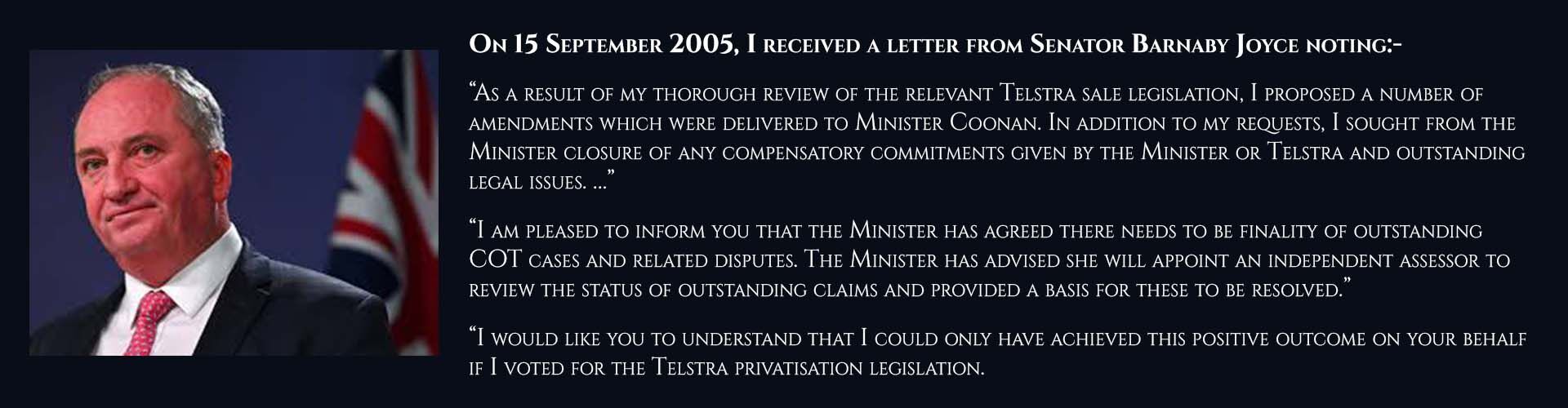
'The eighth remedy pursued'
The Barnaby Joyce Back‑Room Deal
It will be clear from 'The eighth remedy pursued' that Liberal government bureaucrats knew the score. The documents on this page read like a mob ledger: the government didn’t just delay, they stalled, watching Joyce like a boss watches a man holding the last signature needed to close a crooked deal. His vote was the golden key to selling off Telstra. And they made damn sure he turned it before honouring a single promise.
The arrangement was simple, the kind of handshake you’d expect in a smoke‑filled room: Joyce delivers the crucial Senate vote. In return, the 14 COT Cases he named get an independent assessment.
But the moment his signature hit the Telstra‑sale legislation, the government did what any seasoned racketeer does once they’ve pocketed the goods — they walked away. Deal dead. Promise buried. Integrity was left bleeding in the alley.
Scroll further, and the picture only gets darker. The deeper you look, the more blatant the double standards become. And the question becomes impossible to ignore:
Chapter 4
The Mugging We Didn’t See Coming — Done in a Boardroom

The COT arbitrations were exactly what the keywords suggest: corruption, bribery, thuggery, theft, intimidation, coercion, deceit, sabotage, interference, wickedness, treachery, obstruction. There is no shorter or cleaner way to describe what Australia dared to call “arbitration.” It was a black hole, once you signed on the dotted line, you were swallowed whole. The arbitrator’s gag clauses locked you down, silenced your family, and protected the very people you were forced to fight. And in Australia, an arbitrator’s decision is untouchable. No court can overturn it. No justice can reach it. A system built to win, by destroying you.
Harsh words indeed, but as you read on, you will see the truth unfold. When you hover your mouse or cursor over each image, that simple action reveals another story hidden behind the picture, and within that story are further exhibits and evidence files, each one proving that what you are reading is true. Every image opens a new chapter. Every chapter contains documents that confirm the last. Nothing is claimed without proof; every claim is backed by an exhibit.
And as you continue scrolling down the absentjustice.com homepage, you will learn the names, the organisations, the officials, and the corporate players responsible for the crimes committed against hundreds, even thousands, of Australian citizens who relied on a phone service to run their businesses, only to discover that service worked part of the time, failed the rest, and destroyed livelihoods while the system looked the other way.
By the time you reach the bottom of the page, you will know exactly who did what, when they did it, and how they got away with it — until now.
Australia’s arbitration system came at me with Mafia‑style gangster talk disguised as procedure, an extortion routine dressed up as justice. A crooked lawyer oozed sleaze while an accountant with a switchblade energy carved up the evidence. Bribery and corruption sat in the room like silent partners, running the show from the shadows. Every move felt scripted by people who treated due process like a racket and complainants like targets. What passed for arbitration was nothing more than a stitched‑up operation designed to break anyone who pushed back.
It was not in Mr Joblin's hand
It bore no signature of the psychologist
AUSTEL, Freehills, and the Anatomy of a Set‑Up
As laid out in Point 40 of the Prologue Evidence File No/2, the very document tied to this government’s proposed regulatory framework for settlement, it becomes impossible to ignore the stench rising from the record. AUSTEL, the former communications watchdog now rebranded as ACMA, clearly knew it had a problem on its hands. And that problem was Telstra’s ongoing partnership with Freehill Hollingdale & Page (now trading as Herbert Smith Freehills Melbourne a firm whose fingerprints are all over the most controversial chapters of the COT saga.
This is the same legal outfit that had the audacity to submit a witness statement from a clinical psychologist that, by all indications, had been tampered with. The signature line tells the whole story: no psychologist’s signature, only that of Wayne Maurice Condon, the lawyer representing Freehill's. A document supposedly rooted in clinical integrity, yet signed exclusively by lawyers. If that doesn’t scream manipulation, nothing does.
And the deeper one digs into government archives, especially when scrolling through the homepage at absentjustice.com, the more the pattern emerges. This wasn’t negligence. It wasn’t oversight. It was targeting.
Freehills and their government allies singled me out, along with three other COT‑case businesses, for a very deliberate reason: to cripple our ability to prove our claims. Their weapon of choice? Withholding critical technical documents, burying them under the impenetrable shield of Legal Professional Privilege. A tactic designed not to protect justice, but to suffocate it.
This wasn’t a settlement process. It was a controlled operation. A quiet, bureaucratic hit job carried out under the guise of due process.
Did Maurice Wayne Condon remove or alter any reference to what Ian Joblin had initially written about me being of sound mind?
Let’s be blunt: if Freehills Hollingdale & Page / Herbert Smith Freehills Melbourne had pulled this stunt outside the protective walls of Australian jurisdiction, they wouldn’t just be facing disciplinary hearings. They’d be staring down indictments. They’d be frog‑marched out of the COT process, their fingerprints all over a rigged game they helped Telstra run. This wasn’t arbitration. It was a shakedown disguised as justice.
And that leaves the question that still reeks like a dead rat behind the wall: Did Maurice Wayne Condon scrub Joblin’s original assessment? Did he carve out the parts that exposed the setup? Did he bury the truth to protect Telstra — and himself?
On 21 March 1997, nearly two years after my arbitration was supposedly “concluded,” John Pinnock, the second administrator, wrote to Telstra’s Ted Benjamin (see Exhibit 596 File → AS-CAV Exhibits 589 to 647), demanding answers:
-
Why was the witness statement attested by a lawyer instead of the psychologist?
-
Were changes made between the original statement sent to the arbitrator and the version Condon signed?
Pinnock’s Stonewall — The Kind of Silence That Smells Like a Fix
I asked Hughes, Benjamin, and—yet again—John Pinnock: if Telstra had nothing to hide, why was Pinnock’s 21 March 1997 letter never answered? It’s now 2026, and these three conniving ratbags are still mute. They know I don’t have the resources to take Telstra on again. Their silence isn’t an oversight. It’s a wall. A deliberate one.
“I note in your letter’s last page you suggest that the matter of the alteration of documents attached to statutory declarations should be dealt with by the relevant arbitrator. I do not concur. I would be grateful if you could advise why these matters should not be referred to the relevant police.”
The fact that a Telstra lawyer signed a psychologist’s statement attesting to a signature that was not there tells you everything about who really ran the arbitration system in Australia. It wasn’t just the arbitrator. It wasn’t just the administrator. It was Telstra’s legal muscle.
And here’s the kicker: the same law firm whose signature appeared on that doctored statement was the same outfit that helped Telstra craft the infamous COT Case Strategy, a blueprint for burying technical evidence under the cloak of Legal Professional Privilege. Once a COT claimant reported a fault, Freehills declared it “privileged,” locking it away from regulators, arbitrators, and anyone who might expose the truth. It was a legal protection racket, pure and simple.
John Grisham Eat Your Heart Out - A Paper‑Trail Hit Job I Can Prove
COT Case Strategy - Freehill's Legal Advice
Prologue Evidence File 1-A to 1-C
The statements recorded on page 5169 of the official SENATE official Hansard – Parliament of Australia make one thing brutally clear: Telstra had adopted the Freehill Hollingdale & Page “COT Case Strategy” during the arbitrations, a strategy concocted by Denise McBurnie herself. A strategy designed not to resolve disputes, but to bury them. And I, along with them.
What I didn’t know, back when I was first forced to lodge every telephone fault in writing with McBurnie before Telstra would even pretend to investigate, was that the whole thing was a set‑up. Telstra and its lawyers had already built a covert framework, a blueprint for concealing every scrap of evidence proving my business was being crippled by ongoing telephone faults.
So I kept writing. Fault after fault. Day after day. Sending the evidence straight to the very people who were quietly engineering its disappearance. It nearly broke me. I believed I was helping Telstra fix the problems. In reality, I was feeding my evidence into a shredder disguised as a legal process.
Then came arbitration, and the sickening realisation that I now needed the very documents I had already handed over. I had to claw them back through Freedom of Information, begging for copies of evidence that should have been on the arbitrator’s desk from day one. Instead, Telstra and their lawyers withheld it, stonewalled it, buried it.
And just when I thought the process couldn’t get more corrupt, I learned the truth: the lawyer I was forced to report my faults to had authored a secret legal paper, the “COT Case Strategy," instructing Telstra on how to hide my technical evidence under the false banner of Legal Professional Privilege. Naming me. Naming my business. Laying out the roadmap for how to keep me blindfolded.
This wasn’t incompetence. It wasn’t oversight. It was a deliberate, calculated hit job carried out through paperwork, privilege, and procedural chokeholds.
Even the Senate Hansard records it. The strategy existed. And I was one of its targets.
The arbitrator and administrator spent decades claiming the gag clauses were there to stop “frivolous complaints.” But they both signed off on an agreement drafted by Freehills, not the independent agreement we were promised. They helped Telstra build a wall of silence, then pretended it was for our own good.
This model, the gag‑clause hustle, is exported worldwide. And as long as people keep believing arbitration is fair, transparent, or independent, the same abuses will keep happening. Different countries, different corporations, same playbook.
When the Ledger Boys Brought the Muscle To Town
Government corruption in the public service has spuriously undermined the justice system for more than three decades, leaving behind a trail of quiet wreckage. What should have been a system built on fairness became a labyrinth of deceit, where files vanished, truths were buried, and ordinary people were sacrificed to protect powerful interests. Behind polished offices and official statements lurked a culture of treacherous conduct, decisions made not by principle, but by convenience, reputation, and self‑preservation.
Those who sought justice found themselves stonewalled, misled, or deliberately worn down. Evidence was withheld, complaints dismissed, and processes twisted until they served only the architects of the corruption. Lives were upended while officials hid behind procedure, pretending impartiality as they quietly protected their own.
In this world, betrayal wasn’t loud. It was administrative, calculated, and devastating, a slow, relentless erosion of trust that left citizens fighting shadows instead of receiving justice. Even now, in 2026, the government should have provided answers to why
I had a chilling realisation: if AUSTEL, the national regulator mandated to keep Telstra honest, couldn't force Telstra to hand over formally demanded documents, then my arbitration was never about justice. It was a performance, a rigged spectacle.
What hope did I have as a single claimant when the oversight institution itself could not access the evidence that Telstra was hiding? AUSTEL was aware that Telstra was deliberately withholding crucial documents, evidence of faults, lies, and the damage inflicted on Cathy, me, and the other COT (Casualties of Telstra) Cases. Yet, they allowed the arbitration to proceed as if the truth were accessible.
Don't forget to hover your mouse over the following images as you scroll down this homepage.
Infringe upon the civil liberties
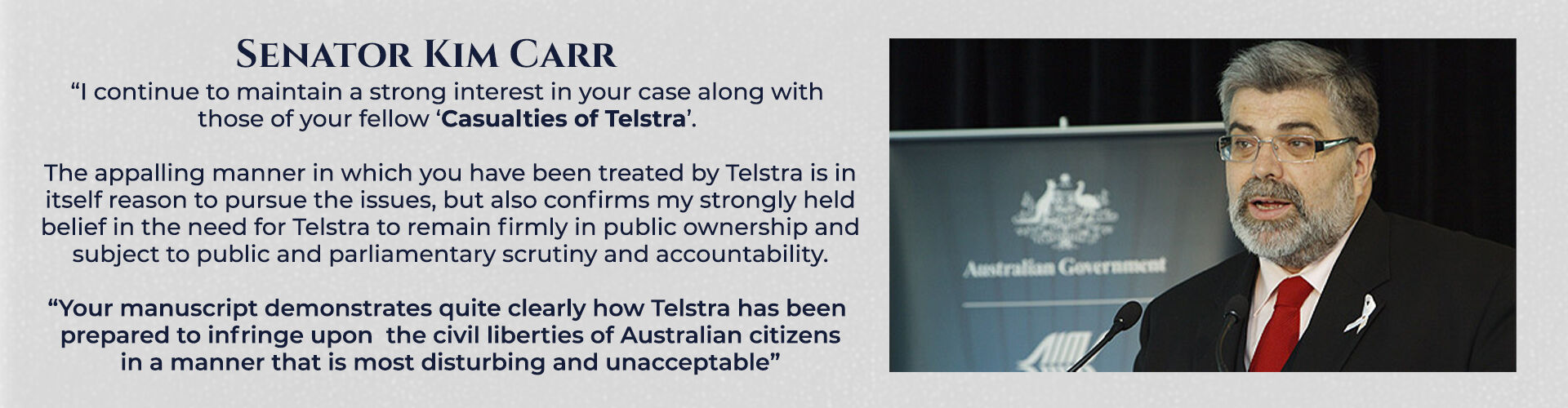
Most Disturbing And Unacceptable
On 27 January 1999, after having read a copy of the 7 January 1999 fax interception report, provided to Senator Boswell, authored by Scandrett & Associates (see Open Letter File No/12 and File No/13), and my first attempt at my then manuscript "Ring For Justice" which has since been used to prepare this website, absentjustice.com, Senator Kim Carr wrote:
“I continue to maintain a strong interest in your case along with those of your fellow ‘Casualties of Telstra’. The appalling manner in which you have been treated by Telstra is in itself reason to pursue the issues, but also confirms my strongly held belief in the need for Telstra to remain firmly in public ownership and subject to public and parliamentary scrutiny and accountability.
“Your manuscript demonstrates quite clearly how Telstra has been prepared to infringe upon the civil liberties of Australian citizens in a manner that is most disturbing and unacceptable.”
The fax imprint across the top of this letter, dated 12 May 1995 (Open Letter File No 55-A), is the same as the fax imprint described in the 7 January 1999 Scandrett & Associates report provided to Senator Ron Boswell (see Open Letter File No/12 and File No/13), confirming faxes were intercepted during the COT arbitrations. In this report, Scandrett & Associates report states:
“We canvassed examples, which we are advised are a representative group, of this phenomena .
“They show that
- the header strip of various faxes is being altered
- the header strip of various faxes was changed or semi overwritten.
- In all cases the replacement header type is the same.
- The sending parties all have a common interest and that is COT.
- Some faxes have originated from organisations such as the Commonwealth Ombudsman office.
- The modified type face of the header could not have been generated by the large number of machines canvassed, making it foreign to any of the sending services.”
One of the two technical consultants attesting to the validity of this January 1999 fax interception report emailed me on 17 December 2014, stating:
“I still stand by my statutory declaration that I was able to identify that the incoming faxes provided to me for review had at some stage been received by a secondary fax machine and then retransmitted, this was done by identifying the dual time stamps on the faxes provided.” (Front Page Part One File No/14)
The Document‑Snatch Sabotage Gang
What is important is what occurred years later. In December 1999, when I was asked by Mr Ian Jepson, Barrister for the Major Fraud Group, Victoria Police, to assist in investigating four fraud claims made against Telstra by barrister Sue Owens on behalf of four other COT cases, I produced the Rundell letter. I explained to Mr Jepson that, despite Rundell’s claim, I had never been interviewed by the Brighton CIB in 1995 or 1996 regarding any alleged damage to his property. I told him I believed this was a trumped‑up attempt to attack my character and could present a problem in assisting the police.
Mr Jepson then contacted several police sources to determine why the alleged complaint had never been acted upon. He was informed that I had never been a suspect in relation to any property damage in Brighton — or anywhere else in Australia.
A Crooked Tech Firm Playing Judge, Jury, and Hitman
The previous misleading and deceptive advice by John Rundell occurred on 18 April 1995, one month before my arbitration ended. John Rundell advised the arbitrator and the arbitration administrators that:
“Any technical report prepared in draft by Lane will be signed off and appear on the letter of DMR Inc.” (see Prologue Evidence File No 22-A)
What can one assume about John Rundell’s motivation in handing Lane the power to evaluate the COT Cases’ technical claims? On the surface, it looked like a procedural shuffle. But underneath, it had all the hallmarks of a back‑room deal, the kind where the door closes softly, the blinds are drawn, and the outcome is decided long before the paperwork is stamped.
Ericsson was on the verge of purchasing Lane. And the majority of COT claims targeted the very Ericsson equipment Telstra had installed across Australia, equipment so faulty that other countries were ripping it out or had already done so. Yet Rundell, fully aware of this, quietly positioned Lane at the centre of the technical assessment process. It was like appointing the fox to write the incident report on the henhouse break‑in.
When the COT Cases discovered Lane’s history, their cosy ties with Telstra, their previous government work, their reputation for bending whichever way the wind (or the money) blew, we rejected them outright. Lane was not an independent assessor; they were a company with too many fingerprints on too many doors.
The Shakedown
Then came the letter of 11 March 1995 from Warwick Smith, the Telecommunications Industry Ombudsman. It offered what appeared to be a compromise: Lane could “assist only” DMR Group Inc. of Canada, and DMR would be the principal technical consultant. On paper, it sounded like a safeguard. In reality, it was a smokescreen, a staged performance designed to calm the claimants while the real work happened out of sight.
Because DMR didn’t investigate anything. They didn’t test, analyse, or challenge a single finding. They simply took Lane’s conclusions, the same Lane now being swallowed up by Ericsson for an undisclosed sum, and rubber‑stamped them with the DMR letterhead. A clean, official‑looking seal on a tainted report. Even though this was a civil arbitration, none of our Ericsson claim documents that were provided by the COT Cases to the arbiration process under confidentiality was ever returned, despite the arbitration agreement clearly articulating that we had the right to receive that information once an arbitrator had made a finding. In simple English, Ericsson did not sign a confidentiality agreement; they just took over the Australian arbitration system.
It was thuggery in a suit. A bureaucratic ambush. A quiet, calculated hit on the truth.
And Rundell was at the centre of it, not with a weapon, but with influence, access, and the kind of back‑room manoeuvring that leaves no fingerprints but destroys lives all the same
In simple terms, my arbitration technical report was prepared by Lane, who, not long after being allowed to value my technical claims against Telstra, including Telstra’s knowingly using faulty Ericsson‑installed telephone equipment, a major part of my claim, was purchased by Ericsson during the COT arbitrations for an undisclosed sum. And here was John Rundell allowing Lane to assess damages against Ericsson, the very Swedish technical giant who has since been charged by the USA for dealing with terrorists as the “Ericsson Link,” following Derek Ryan’s letters, which should have been enough to have John Rundell struck off the list of practising accountants.
Ericsson’s Global Bribery Scandal — A Telstra Partner Admits to Years of Corruption
Click on 'The Ericsson List' image
"One of Telstra's key partners in the building out of their 5G network in Australia is set to fork out over $1.4 billion after the US Department of Justice accused them of bribery and corruption on a massive scale and over a long period of time.
Sweden's telecoms giant Ericsson has agreed to pay more than $1.4 billion following an extensive investigation which saw the Telstra-linked Company 'admitting to a years-long campaign of corruption in five countries to solidify its grip on telecommunications business." https://www.channelnews.com.au/key-telstra-5g-partner-admits-to-bribery-corruption/
To this day, I have never received the critical reports on Ericsson’s exchange equipment that my trusted technical consultant, George Close, meticulously compiled. These documents were fundamental to my case, and their disappearance constitutes a clear violation of the arbitration rules, which require that all submitted materials be returned to the claimant within 6 weeks of the arbitrator’s award (See Chapter 5 - US Department of Justice vs Ericsson of Sweden).
John Rundell, the Arbitration Project Manager discussed above, operates not only out of Melbourne but also from chambers in Hong Kong. His international footprint underscores the cross‑border reach of his arbitration practice, and the broader implications of the conduct I am now compelled to question.
Given the evidence published on absentjustice.com, including Rundell’s own written admission that Lane Telecommunications’ draft technical reports would have the Lane logo removed and be re‑issued on DMR Group Inc.’s letterhead, despite all assessments being carried out by Lane, do I have an obligation to report Rundell’s conduct as unethical, deceptive, and potentially fraudulent?
Because let’s be blunt: when an international arbitrator operating out of Australia and Hong Kong tells the arbitrator and the TIO that ‘forces at work beyond our reasonable control’ delayed the process, while simultaneously arranging for a Canadian consultant to sign off on reports he never worked on, that’s not administration — that’s a cover‑up. So the real question is: am I legally and morally required to expose what Rundell did during and after the arbitration? → The first remedy pursued".
John Rundell, in this 15 November 1995 letter to John Pinnock TIO (see Open letter File No/45-A), states:
“As no further progress was likely to be made on these matters, the formal version of the Technical Evaluation Report did not leave the billing issues open.”
In this 15 November 1995 letter, Mr Rundell says nothing — not a whisper — about my claims of ongoing 008/1800 false recorded‑message faults telling callers to my business that I was “no longer in business.” For an outfit calling itself an independent arbitration resource unit, ignoring the single worst fault crippling my business wasn’t an oversight. It was a hit. A deliberate blind eye. The kind of silence you get when the room has already been bought.
Why didn’t John Rundell tell Mr Pinnock that these untouched arbitration billing issues were quietly dealt with on 16 October 1995 — in secret — five months after my arbitration had supposedly concluded? Why didn’t he mention that Telstra’s arbitration liaison officer, Steve Black, handled it behind closed doors with the government regulator AUSTEL (now ACMA) sitting in the room as cover, as the following exhibit shows?
Because once Telstra was allowed to fix these issues in a private back‑room meeting with a government bureaucrat present, the game was over. I was cut out. Shut out. Denied my legal right under the arbitration rules to reply to Telstra on the 008/1800 issue — the reply that would have forced the arbitrator to step in and rule on whether my 008/1800 billing claims were valid.
Instead, the decision was made where all good stitch‑ups are made: off the books, out of sight, and far away from the man they were mugging.
Their nefarious actions have successfully shrouded the truth about the complicity of others within the Australian establishment and AUSTEL (now ACMA), as they flagrantly breached their statutory obligations to the Casualties of Telstra (COT), a group of small business operators caught in this web of deceit and treachery.
The Cross‑Border Arbitration Giants - the Canadian Government Shines

The Canadian Government, along with Senator Ron Boswell, Senator Carr, and Amanda Davis, the former General Manager of Consumer Affairs at AUSTEL, were deeply disturbed by the explosive evidence that Dr Hughes, the very man entrusted to deliver justice, had brazenly ignored. On 23 May 1995, I finally received material tied directly to my original Freedom of Information (FOI) request from May 1994. This wasn’t a single request lost in the system; it was one of four separate FOI requests lodged throughout 1994, all demanding the same critical information on Bell Canada International Inc.'s Cape Bridgewater testing.
Yet Telstra dragged its feet for twelve months, withholding evidence they knew was central to my case. That kind of delay isn’t incompetence — it’s strategy. It reeks of corruption.
And then came the bombshell: Bell Canada International’s own written admission that they had catastrophically botched the Cape Bridgewater testing. A confession. A smoking gun. The kind of evidence that should have blown the arbitration wide open.
But Dr Hughes and Telecommunications Industry Ombudsman John Pinnock didn’t flinch. They didn’t hesitate. They simply refused to let me use this damning, fresh evidence, evidence that fell squarely within the appeal period. Their decision wasn’t just negligent; it was treacherous. It protected Telstra, shielded the process, and buried the truth.
I have lived under the weight of that betrayal for thirty years. It has shattered my life and devastated my partner, Cathy. The damage didn’t fade; it calcified. It became the architecture of our suffering.
When the Canadian Government discovered that the Australian Government, and its supposedly independent, government‑endorsed arbitration process, would not investigate my Bell Canada International Inc. claims against a major Canadian telecommunications company, they sent me the following letter dated 7 July 1995
I believe you are taking the most appropriate course of action
"In view of the facts of this situation, as I understand them, I believe you are taking the most appropriate course of action in contacting BCI directly with respect to the alleged errors in their test report, should you feel that they could assist you in your case."
When the Canadian government discovered that another Canadian telecommunications company, DMR Group Inc., had been flown out of Canada to investigate my arbitration claims, they became aware of my assertions. I claimed that Bell Canada International could not have possibly completed the 13,590 successful tests at Cape Bridgewater. Furthermore, I revealed that Paul Howell from DMR Group Inc. contacted me by telephone less than a month after my arbitration concluded. This interaction triggered a panic attack that resulted in a five-day hospital stay, during which Paul Howell informed me that he had not signed his report because he had not been allowed to finish it.
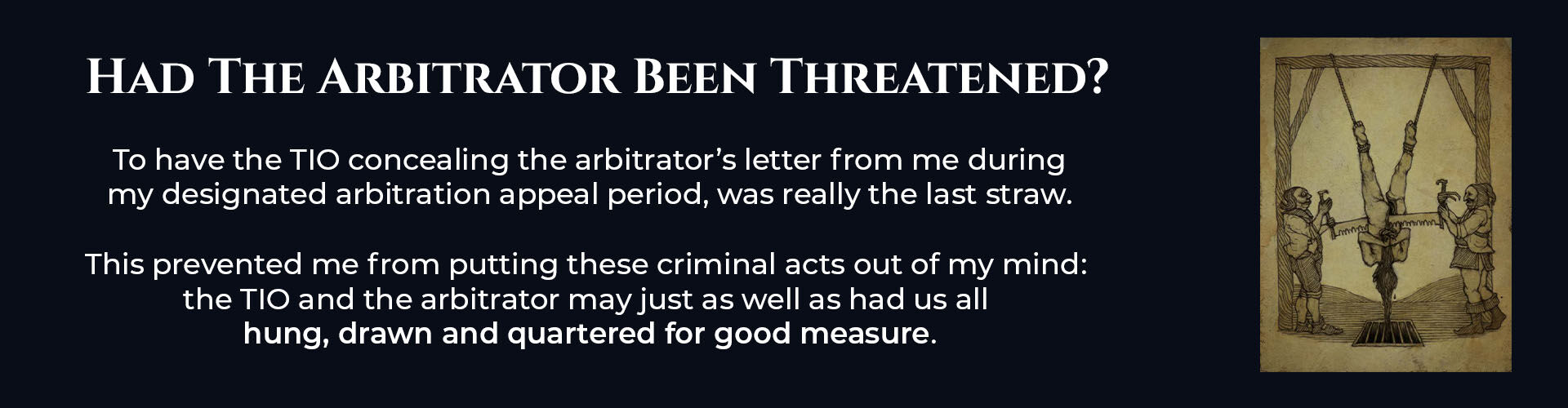
“I am writing this in support of Mr Alan Smith, who I believe has a meeting with you during the week beginning 17 July. I first met the COT Cases in 1992 in my capacity as General Manager, Consumer Affairs at Austel. The “founding” group were Mr Smith, Mrs Ann Garms of the Tivoli Restaurant, Brisbane, Mrs Shelia Hawkins of the Society Restaurant, Melbourne, Mrs Maureen Gillian of Japanese Spare Parts, Brisbane, and Mr Graham Schorer of Golden Messenger Couriers, Melbourne. Mrs. Hawkins withdrew very early on, and I have had no contact with her since.
The treatment these individuals have received from Telecom and Commonwealth government agencies has been disgraceful, and I have no doubt they have all suffered as much through this treatment as they did through the faults on their telephone services.
One of the striking things about this group is their persistence and enduring belief that eventually there will be a fair and equitable outcome for them, and they are to admired for having kept as focussed as they have throughout their campaign.
Having said that, I am aware all have suffered both physically and their family relationships. In one case, the partner of the claimant has become seriously incapacitated; due, I beleive to the way Telecom has dealt with them. The others have all suffered various stress related conditions (such as a minor stroke.
During my time at Austel I pressed as hard as I could for an investigation into the complaints. The resistance to that course of action came from the then Chairman. He was eventually galvanised into action by ministerial pressure. The Austel report looks good to the casual observer, but it has now become clear that much of the information accepted by Austel was at best inaccurate, and at worst fabricated, and that Austel knew or ought to have known this at the time.”
After leaving Austel I continued to lend support to the COT Cases, and was instrumental in helping them negotiate the inappropriately named "Fast Track" Arbitration Agreement. That was over a year ago, and neither the Office of the Commonwealth Ombudsman nor the Arbitrator has been succsessful in extracting information from Telecom which would equip the claimants to press their claims effectively. Telecom has devoted staggering levels of time, money and resources to defeating the claiams, and there is no pretence even that the arbitration process has attemted to produce a contest between equals.
Even it the remaining claimants receive satisfactory settlements (and I have no reason to think that will be the outcome) it is crucial that the process be investigated in the interest of accountabilty of publical companies and the public servants in other government agencies.
Because I am not aware of the exact citrcumstances surronding your meeting with Mr Smith, nor your identity, you can appriate that I am being fairly circimspect in what I am prepared to commit to writing. Suffice it to say, though, I am fast coming to share the view that a public inquiry of some discripion is the only way that the reasons behind the appalling treatent of these people will be brought to the surface.
I would be happy to talk to you in more detail if you think that would be useful, and can be reached at the number shown above at any time.
Thank you for your interest in this matter, and for sparing the time to talk to Alan. (See File 501 - AS-CAV Exhibits 495 to 541 )
An Old War Horse - The Last of The Last
Thank you, Ron
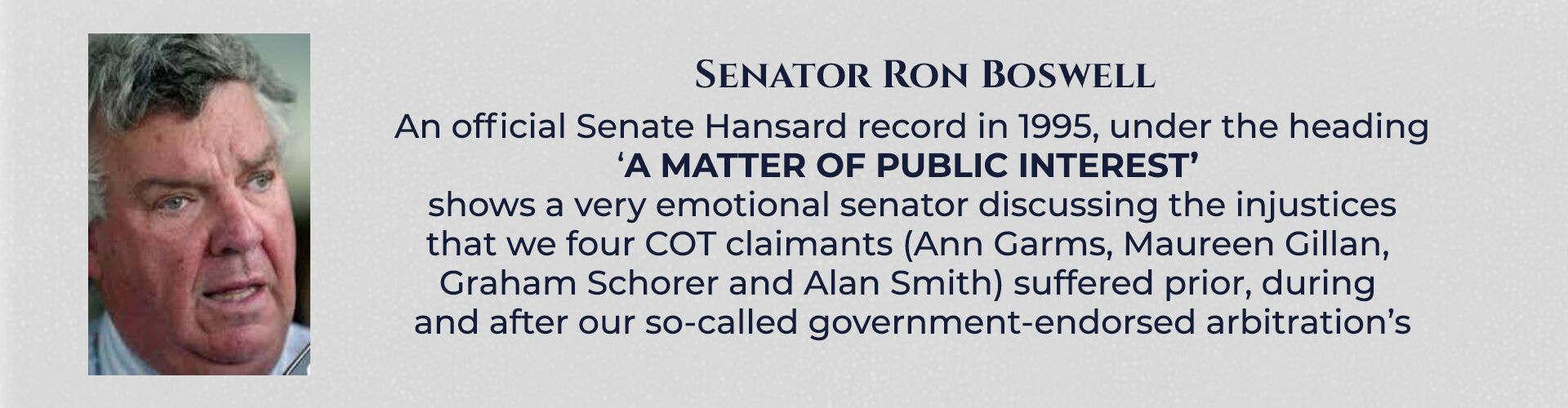
Senate Hansard records from 20 September 1995 capture a profoundly emotional speech delivered by Senator Ron Boswell.
A MATTER OF PUBLIC INTEREST"
“...Eleven years after their first complaints to Telstra, where are they now? They are acknowledged as the motivators of Telecom’s customer complaint reforms. … But, as individuals, they have been beaten both emotionally and financially through an 11-year battle with Telstra"
“Then followed the Federal Police investigation into Telecom’s monitoring of COT case services. The Federal Police also found there was a prima facie case to institute proceedings against Telecom but the DPP (Director of Public Prosecutions), in a terse advice, recommended against proceeding".
“Once again, the only relief COT members received was to become the catalyst for Telecom to introduce a revised privacy and protection policy. Despite the strong evidence against Telecom, they still received no justice at all".
“These COT members have been forced to go to the Commonwealth Ombudsman to force Telecom to comply with the law. Not only were they being denied all necessary documents to mount their case against Telecom, causing much delay, but they were denied access to documents that could have influenced them when negotiating the arbitration rules, and even whether to enter arbitration at all. …
"This is an arbitration process not only far exceeding the four-month period, but one which has become so legalistic that it has forced members to borrow hundreds of thousands just to take part in it. It has become a process far beyond the one represented when they agreed to enter into it, and one which professionals involved in the arbitration agree can never deliver as intended and never give them justice."
"I regard it as a grave matter that a government instrumentality like Telstra can give assurances to Senate leaders that it will fast track a process and then turn it into an expensive legalistic process making a farce of the promise given to COT members and the unducement to go into arbitration. “Telecom has treated the Parliament with contempt. No government monopoly should be allowed to trample over the rights of individual Australians, such as has happened here.” ( Senate Hansard Evidence File No-1)
Justice‑for‑sale
AUSTEL, now called ACMA, didn’t simply mishandle my case; they mishandled the cases of several other COT Cases, orchestrating a grotesque, slow‑moving betrayal. They knew the process was poisoned from the start. They knew Telstra had refused to hand over the documents they themselves had formally demanded. They knew they had been humiliated, exposed as powerless, stripped of the authority they pretended to wield. And instead of stopping everything until the truth was forced into the light, they let the farce continue. They let Telstra’s defiance harden into strategy, into advantage, into a weapon aimed directly at the other COT Cases Ann Garms, Maureen Gillan Graham Schorer and me,
As the months unfolded, the veil slipped away, and the truth revealed itself with a kind of cold, creeping horror. AUSTEL wasn’t merely negligent. They weren’t simply overwhelmed or outplayed. They were complicit, fully, knowingly, and unforgivably complicit. They watched Telstra withhold the very documents that proved our four claims, and then they allowed that same injustice to be inflicted on me without hesitation. In doing so, they dismantled every principle of duty, care, and integrity they were meant to uphold. They didn’t just fail me; they abandoned me to a process they knew was rigged.
So when people speak of my arbitration as though it were a genuine attempt at resolution, I am forced to confront the brutal truth that has shadowed me for decades: if AUSTEL, with all its statutory power, couldn’t extract the documents, then I, a single individual standing against a corporate giant, never stood a chance. The outcome wasn’t just unfair. It was predetermined. The verdict was sealed long before I ever stepped into that room.
Unfortunately, I did not receive a copy of the following findings AUSTEL’s Adverse Findings at points 2 to 212 until November 23, 2007, 12 years after the termination of my arbitration process. In simple words, the government had already validated my claims as early as March 4, 1994, six weeks before April 21, 1994, when I signed the arbitration agreement.
In plain, devastating terms, the government had already validated my claims before the arbitration even began. They knew the truth. They had documented it. And they withheld it from me while Telstra, the defendant in my case, was quietly given access.
That is not oversight. That is not an error. That is corruption in its purest form, deliberate, calculated, and treacherous.
And still, I was forced to endure thirteen months trapped inside a gruelling arbitration process, bleeding more than $300,000 in professional fees and another $60,000 in extra staff wages just to keep my Cape Bridgewater Holiday Camp alive while I was being bled by these government minders. All of it was spent trying to “prove” what the government had already confirmed in AUSTEL’s Adverse Findings.
If you read Legal Bullying In Arbitration alongside points 10, 47, 48, 109, 115, 130, 140, 153, 158, and 209 of those findings, you will see conduct so calculated, so deceitful, so morally bankrupt that it defies any honest explanation. AUSTEL’s decision to supply these findings only to Telstra, the defendants, while withholding them from me, was not a mistake. It was not a clerical error. It was gross misconduct of the most sinister and treacherous kind.
How could the arbitrator have ignored the following ten points taken from this secret 212-point, 68-page AUSTEL’s Adverse Findings if the arbitrator had seen it? I would not be here in 2026, thirty years later, exposing what I am exposing on absentjustice.com:
Point 10 – “Whilst Network Investigation and Support advised that all faults were rectified, the above faults and record of degraded service minutes indicate a significant network problem from August 1991 to March 1993.”
Point 47 –“Telecom's ignorance of the existence of the RCM fault raises a number of questions in regard to Telecom's settlement with Smith. For example, on what bases was settlement made by Telecom if this fault was not known to them at this time? Did Telecom settle with Mr Smith on the bases that his complaints , of faults were justified without a full investigation of the validity of these complaints, or did Telecom settle on the basis of faults substantiated to the time of settlement? Wither criteria for settlement would have been inadequate, with the later critera disadvantaging Mr Smith, as knowledge of the existence of more faults on his service may have led to an increase in the amount offered for settlement of his claims".
Point 48 – “AUSTEL has been hampered in assessing Telecom’s dealings with Mr Smith by Telecom’s failure to provide files relating to Mr Smith’s complaints.”
Point 71 –: “AUSTEL has not been provided with the documents on which the conclusion in this briefing summary were reached, such as fault reports from other Cape Bridgewater subscribers over this period or the details of the final selector fault. It would have been expected that these documents would have been retained on file as background to the summary. It can only be assumed that they are contained within the documentation not provided to AUSTEL.”
Point 109 – The view of the local Telecom technicians in relation to the RVA problem is conveyed in a 2 July 1992 Minute from Customer Service Manager – Hamilton to Managers in the Network Operations and Vic/Tas Fault Bureau:
- “Our local technicians believe that Mr Smith is correct in raising complaints about incoming callers to his number receiving a Recorded Voice Announcement saying that the number is disconnected. They believe that it is a problem that is occurring in increasing numbers as more and more customers are connected to AXE. ”
Point 115 –“Some problems with incorrectly coded data seem to have existed for a considerable period of time. In July 1993 Mr Smith reported a problem with payphones dropping out on answer to calls made utilising his 008 number. Telecom diagnosed the problem as being to “Due to incorrect data in AXE 1004, CC-1. Fault repaired by Ballarat OSC 8/7/93, The original deadline for the data to be changed was June 14th 1991. Mr Smith’s complaint led to the identification of a problem which had existed for two years.”
Point 140 – “It should be noted that AUSTEL’s investigation of matters relating to the RCM problem has been hampered by Telecom’s failure to make available to AUSTEL a file specifically relating to the Pairs Gains Support investigation of the RCM. The file was requested by AUSTEL on 9 February 1994.”
Point 153 –“A feature of the RCM system is that when a system goes “down” the system is also capable of automatically returning back to service. As quoted above, normally when the system goes “down” an alarm would have been generated at the Portland exchange, alerting local staff to a problem in the network. This would not have occurred in the case of the Cape Bridgewater RCM however, as the alarms had not been programmed. It was some 18 months after the RCM was put into operation that the fact the alarms were not programmed was discovered. In normal circumstances the failure to program the alarms would have been deficient, but in the case of the ongoing complaints from Mr Smith and other subscribers in the area the failure to program these alarms or determine whether they were programmed is almost inconceivable.”
Point 158 – “The crucial issue in regard to the Cape Bridgewater RCM is that assuming the lightning strike did cause problems to the RCM om late November 1992 these problems were not resolved till the beginning of March 1993, over 3 months later. This was despite a number of indications of problems in the Cape Bridgewater area. Fault reports from September 1992 also indicate that the commencement of problems with the RCM may have occurred earlier than November 1992. A related issue is that Mr Smith’s persistent complaints were almost certainly responsible for an earlier identification of problems with the RCM than would otherwise have been the case.”
Point 209 – “Cape Bridgewater Holiday Camp has a history of service difficulties dating back to 1988. Although most of the documentation dates from 1991 it is apparent that the camp has had ongoing service difficulties for the past six years which has impacted on its business operations causing losses and erosion of customer base.”
It is utterly appalling that a government would stoop so low as to manipulate the lives of those who bravely stepped forward to expose the grave deficiencies in Telstra's copper-wire and network infrastructure, which had become a matter of public interest. This was a blatant betrayal of trust. It revealed a corrupt system that prioritises the government's own interests over the well-being of its citizens.
Going to sea in the 1960s gave you a choice, a brutal, unforgiving fork in the road. You could carve out a life through discipline and hard labour, or you could slide into the gutter: crime, fraud, deception, thuggery, and worse. Most boys from the streets knew exactly how thin that line was. What I never expected was that the same rot, the same criminality we were warned to escape, was festering not in back alleys, but in the polished corridors of Government House in Canberra.
I had seen enough of the world to recognise corruption when it stared me in the face, but nothing prepared me for the scale of it inside Australia’s own institutions. The legal system, the very place meant to uphold justice, had been twisted into something unrecognisable. It was controlled by lawyers who operated with the cold precision of a mafia crew, men running what any American investigator would call a shakedown, a racket, a full‑blown conspiracy to cover up misconduct while lining their pockets through back‑room deals and outright grift.
They wore suits instead of leather jackets, carried fountain pens instead of knives, but the intent was the same: strip you of your rights, your dignity, and your truth, all while pretending to act in the name of justice. My story shows exactly how deep that treachery ran, how the system that claimed to protect its people instead preyed on them, using the law as a weapon and arbitration as a trap.
It wasn’t justice. It was an ambush dressed up in legal language. A government‑sanctioned betrayal. A quiet, calculated mugging carried out under fluorescent lights instead of streetlamps.
And the worst part? They did it with a smile, as if corruption were simply part of the job, as the following link shows: 'The eleventh remedy pursued'.
Call for Justice — The Long Fight Ahead
My name is Alan Smith, and this is the story of my long battle with a telecommunications giant and the Australian Government. Since 1992, this fight has wound its way through elected governments, regulatory bodies, government departments, the judiciary, and Telstra itself, or Telecom, as it was known when this ordeal began. More than three decades later, the quest for justice continues.
But the roots of that battle stretch back much further, to a life shaped by the sea.
Of all the places I had travelled, Australia felt most like home. Hospitality had always been in my blood, and I dreamed of running a school holiday camp, a place where families arrived with sandy feet, where children’s laughter filled the dining hall, where memories were made.
Then one day, in The Age newspaper, I saw it: Cape Bridgewater Holiday Camp and Convention Centre, perched near the maritime town of Portland.
It felt like fate.
I carried out what I believed was thorough due diligence, or at least, all the due diligence I knew existed. It never crossed my mind to check whether the phones worked. Why would it? In 1987, a telephone was as basic and reliable as running water.
Or so I thought.
January 1988 — Stepping Ashore for Good
In January 1988, after thirty years at sea, twelve of them spent threading the Yarra River day and night, I stepped ashore for what I hoped would be a new chapter. I bought the Cape Bridgewater Holiday Camp, imagining school groups, weekenders, and families filling the place with life.
But within a week, the shine began to dull.
Customers and suppliers told me they had tried to call but couldn’t get through. The phone service, the lifeline of any accommodation business, was unreliable at best and completely absent at worst. We lost business before we even had a chance to build it.
The truth was far worse than I could have imagined.
1988–1992 — The Faults That Would Not Go Away
The entire Cape Bridgewater exchange had been allocated just eight phone lines to serve 130 adult residents and holiday makers in such a small community as Cape Bridgewater; just eight phone lines served 130 residents and numerous visitors, which was clearly inadequate. On days when four lines were in use, only four remained available for the other 126 people, leading to frustration and disconnection. Some days were eerily quiet, while others were filled with the sound of ringing phones and failed connections. This should have been a straightforward communication system, but instead, it became a chaotic mess of voices and dropped calls. How could such a limited service effectively cater to such a large population?
It was chaos disguised as infrastructure.
This wasn’t a minor inconvenience. It was a systemic failure, one that the government had known about for years. Rural Australia had been left to rot while the wealthy and well‑connected enjoyed reliable services.
I had stepped ashore seeking stability. Instead, I walked straight into a storm.
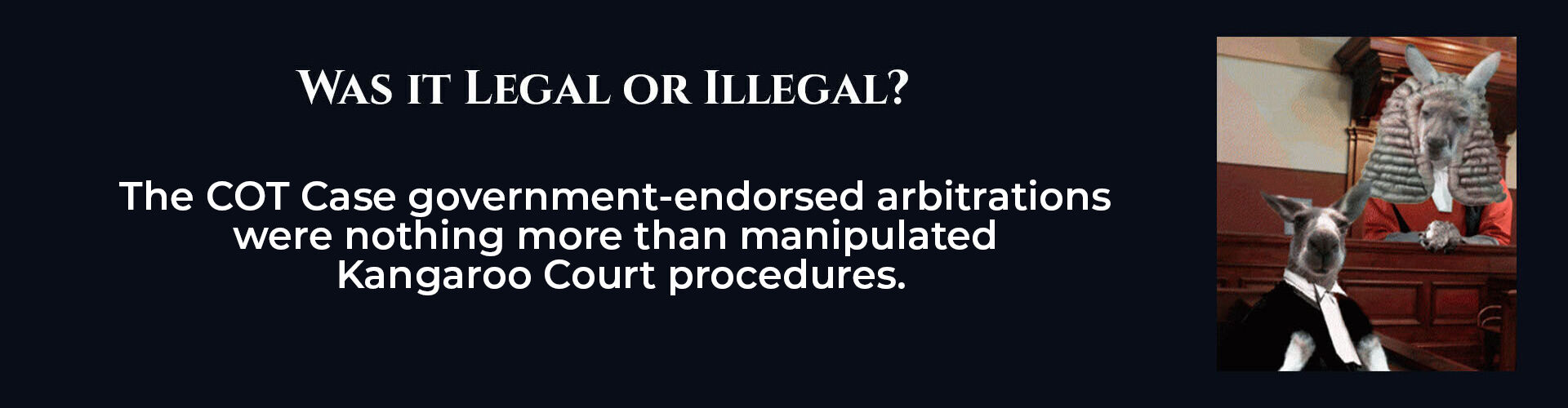
1992–1995 — Arbitration and the Beginning of the Fight
By 1992, the phone faults had crippled my business. I entered a government‑endorsed arbitration process, repeatedly assured it would be fair and transparent. The technical consultants, DMR Group from Canada and Lane Telecommunications from Australia, were supposed to identify the faults that had devastated my livelihood.
But on 30 April 1995, those same consultants wrote to Arbitrator Dr Gordon Hughes confirming they still had not diagnosed all the issues, including the unresolved 008/1800 billing faults, and that further investigation would take weeks.
Yet just eleven days later, on 11 May 1995, Dr Hughes issued his award.
In point 3.2(h), he declared that all my phone problems had been resolved back in July 1994, directly contradicting the consultants’ warnings. He also prevented them from investigating the ongoing 008/1800 billing faults, as proven in documents (557) and (558).
Five months later, on 16 October 1995, Dr Hughes and the second administrator allowed Telstra to secretly address these billing faults with AUSTEL (now ACMA), denying me my legal right to challenge Telstra’s claims.
AUSTEL’s own letters from December 1994 show the faults were still unresolved. Yet the arbitrator wrote that they had been fixed months earlier.
How could an independent arbitrator claim the faults were resolved when he was still receiving letters proving they were not?
1999 — The Truth Confirmed
In late 1999, after leaving Telstra, CEO Frank Blount co‑authored Managing in Australia. On pages 132–133, he revealed Telstra’s widespread problems with its 008/1800 service. The issue was not isolated. It was national. And the performance was “crystal clear”, sub‑standard.
Reading that book confirmed what had troubled me for years: this was not incompetence. It was concealment.
The Shadow That Never Lifted
The unresolved phone and fax faults, the very faults the arbitrator refused to investigate, hung over my business for nearly nine years. They destroyed my livelihood, devastated my partner Cathy, and ultimately ruined the new owners who purchased the camp in December 2001.
Neither Telstra nor the Telecommunications Industry Ombudsman wanted to admit that my unresolved arbitration issues had now driven the new owner, Darren Lewis, into bankruptcy.
The exhibits in Absent Justice make this painfully clear.
And So the Fight Began
What started as a dream, a peaceful coastal camp after a life at sea, became the beginning of a decades‑long battle for truth, accountability, and justice.
A battle that continues to this day.
Had the government genuinely cared about the COT whistleblowers in 1995 and 1996, when we raised urgent alarms about systemic telephone faults that crippled our businesses and triggered more than 120,000 complaints from COT‑type customers, Telstra would have been forced to confront the truth. Instead, the so‑called “government‑sanctioned arbitrations” were nothing more than a stage‑managed performance, a façade designed to pacify us while shielding Telstra from accountability.
The letters attached to Chapter 1 - Can We Fix The CAN, dated April 8 and 9, 1994, from Telstra’s group general manager to AUSTEL’s chair, demonstrate that AUSTEL (now ACMA) was not truly independent. Instead, it shows that AUSTEL could be influenced to modify their official findings in the COT report, as Telstra requested in several points in this initial letter to AUSTEL/ACMA. For example, Telstra writes:
“The Report, when commenting on the number of customers with COT-type problems, refers to a research study undertaken by Telecom at Austel’s request. The Report extrapolates from those results and infers that the number of customers so affected could be as high as 120 000. … (See Open Letter File No/11)
And the next day:
“In relation to point 4, you have agreed to withdraw the reference in the Report to the potential existence of 120,000 COT-type customers and replace it with a reference to the potential existence of “some hundreds” of COT-type customers” (See Open Letter File No/11)
Point 2.71 in AUSTEL’s April 1994 formal report notes:
“the number of Telecom customers experiencing COT type service difficulties and faults is substantially higher than Telecom’s original estimate of 50”.
It is nothing short of a treacherous betrayal for a government regulator to so drastically alter its findings, slashing the number of reported COT-type complaints from an astonishing 120,000 to a mere 50 or so. Such a flagrant misrepresentation constitutes a deep and sinister deception, undermining the public trust it claims to serve.
Don't forget to hover your mouse over the following images as you scroll down this homepage.

SENATE official Hansard – Parliament of Australia records from the Australian Senate, page 5164, points 10 and 11, as published by the Parliament of Australia, (see also https://shorturl.at/URa5h) tell a story that should unsettle anyone who believes in fairness. Buried in those lines is the admission that Telstra and its board already knew they would never meet the mandated service deadline. They knew it, accepted it, and moved on. Yet they still allowed Murdoch and FOX to position themselves for a $400 million compensation windfall if the deadline was missed, a deadline that Telstra had already conceded was impossible.
While that door was held wide open for the powerful, small businesses across Australia were left standing outside in the cold. These were ordinary operators, family shops, regional services, tradespeople, struggling with the same phone faults as Murdoch and FOX. But instead of compensation, they received silence. Instead of assistance, they were pushed into arbitration. Instead of support, they were handed bills that climbed into the hundreds of thousands of dollars, all for the simple right to have a working phone service.
The contrast is brutal. One set of rules for the powerful, another for the small. What happened was not just unfair, it was a deliberate, systemic discrimination against the small business community, carried out in plain sight and recorded in the nation’s own parliamentary transcript.
Scroll down further in on this homepage to view the Rupert Murdoch -Telstra Scandal - Helen Handbury issues.
As you delve deeper into this narrative, you will uncover how Telstra's highly compensated legal team engaged in a disturbing pattern of lies, coercion, intimidation, and tampering with evidence. These actions were aimed at shielding a deteriorating, government-owned Telstra Corporation from accountability and scrutiny, revealing the depths to which some will go to protect corporate interests at the expense of public welfare.
The government didn’t just ignore us. They protected Telstra. They allowed the corporation to bury evidence, silence whistleblowers, and continue operating a failing network while thousands of small business owners were left to collapse under the weight of faults Telstra already knew about. It was a betrayal carried out in plain sight, a coordinated act of negligence that served Telstra’s interests while destroying the livelihoods of ordinary Australians.
The Cross‑Pacific Shakedown — When Two Nations Ran the Same Dirty Game
Before I continue with this COT telecommunications story, I want to correspond directly to anyone in the USA, or anywhere else in the world, who has had to battle their own government after the national telephone network ruined their livelihood. If you know of such a case, I would like to hear from you through the Absent Justice Contact page.
For close to six years, Telstra and its government minders insisted that the Casualties of Telstra were the only people in Australia, and possibly the world, experiencing such failures. They told us repeatedly that what was happening to the COT Cases was not systemic, and that the copper‑wire network was “world-class.” But as we continued our own research, we uncovered something deeply unsettling: a nearly identical story had unfolded in the United States thirty years earlier, before mobile phones became essential for business. Different country, different companies, yet the same pattern of neglect, deception, and small businesses left to shoulder the losses alone.
Jefferson understood something that modern democracies often forget: corruption rarely arrives with fanfare. It seeps in quietly, through contracts, consultancies, acquisitions, and “commercial arrangements” that appear harmless until the damage is already done. He feared a moment when governments would no longer distinguish between public duty and private influence, when the machinery of justice could be steered, softened, or neutralised by those with the deepest pockets.
What happened during the Australian Government-endorsed COT arbitrations mirrors the situation in the USA dispute; both cases share many similarities with the COT matters currently being revealed on absenjustice.com. To understand the connection between the USA and the COT issues, please read the information below.
In the late 1980s and early 1990s, American businesses relied entirely on landlines, just as I did. When the old Bell System was dismantled, responsibility for rural networks fell to companies like US West, GTE, Bell Atlantic, and Southwestern Bell. Many of these networks were already in disrepair. Instead of fixing them, the companies cut corners, raised prices, and concealed the truth.
US West became notorious for this. Regulators in Oregon, Colorado, and New Mexico uncovered deliberate under‑investment in rural exchanges. People reported the same issues I experienced: dropped calls, dead lines, and customers giving up because they simply couldn’t get through. Some small tourism operators in Oregon claimed they lost entire seasons of income. Reading their testimonies felt like reading my own diary.
GTE was no better. In Florida and California, investigators exposed what became known as “phantom repairs”, faults marked as resolved when no technician had ever visited. Businesses were charged for repairs that never occurred. One Florida motel owner testified that he lost 40% of his bookings in a single year because callers couldn’t reach him. I knew that pain all too well.
Then there was the long‑distance issue. Before mobile phones, calls to rural areas often failed because it was cheaper for carriers to let calls drop than to pay higher connection fees. By 1992, the FCC had documented millions of calls that never reached the businesses they were trying to contact. No warnings. No accountability. Just silence on the line, the same silence that crippled my holiday camp.
What struck me most was the behaviour of the regulators. Several U.S. state commissions later admitted that telecom companies were tipped off before investigations, that damaging findings were softened, and that complaints from small businesses were quietly ignored. Minnesota’s Attorney General accused US West of “systemic deception” and “abuse of monopoly power.” Those words could very well describe Telstra.
So when I speak about the casualties caused by Telstra, I am not describing an isolated Australian injustice. This is part of a broader pattern: a time when telecommunications giants failed the very people who depended on them, while governments protected corporations rather than citizens. The only difference is that in Australia, the COT Cases were concentrated, documented, and undeniable.
Across the Pacific, the same story unfolded. In both countries, it was ordinary people, small operators, rural businesses, those without influence, who ultimately paid the price.
For reasons still unknown to me, and unknown even to the Commonwealth Ombudsman, neither the government nor Telstra ever supplied the documents they promised during our 1994–1995 arbitration. These were the very records we needed to support our claims about Telstra’s failing copper‑wire network and the faulty installation of the Ericsson AXE exchange system. Despite repeated assurances, the material simply never arrived.
When I submitted my first application to the Administrative Appeals Tribunal (AAT) in February 2008, I was seeking the release of certain information, even though the statute of limitations had already expired. Unfortunately, I received nothing from the Australian Communications and Media Authority (ACMA), which became the custodian of all requested Telstra Freedom of Information (FOI) documents after Telstra was sold. A similar situation occurred during my second AAT hearing in May 2011. Despite two hearings and two formal processes, I still had no access to the documents that should have been provided by the government or Telstra during the arbitration process (see The twelfth remedy pursued).
Since that second AAT hearing, Australia’s National Broadband Network (NBN) rollout has exposed numerous faults identical to those I raised during arbitration and both AAT processes. Anyone can confirm this by searching “Australia NBN” online. The problems never went away; they were simply buried.
One of the documents I submitted to the arbitrator in 1994, and again to the AAT in 2008 and 2011, was a Telstra FOI record, folio A00253, dated 16 September 1993, titled Fibre Degradation. It states:
“Problems were experienced in the Mackay to Rockhampton leg of the optical fibre network in December ’93. Similar problems were found in the Katherine to Tenant Creek part of the network in April this year… In Telecom’s opinion the problem is due to an aculeate coating (CPC3) used on optical fibre supplied by Corning Inc (US)… If the MacKay & Katherine experience are repeated elsewhere in the network… the network is likely to develop attenuation problems within 2 or 3 years of installation… Existing stocks of Corning cable will be used in low risk / low volume areas.” (See )
It is important to note that during this second AAT hearing (No 2010/4634), Mr Friedman (Judge), hearing my case, stated:
“Mr Smith still believes that there are many unanswered questions by the regulatory authorities or by Telstra that he wishes to pursue and he believes these documents will show that his unhappiness with the way he has been treated personally also will flow to other areas such as it will expose the practices by Telstra and regulatory bodies which affects not only him but other people throughout Australia.
“Mr Smith said today that he had concerns about the equipment used in cabling done at Cape Bridgewater back in the 1990s. He said that it should – the equipment or some of the equipment should have a life of up to 40 years but, in fact, because of the terrain and the wet surfaces and other things down there the wrong equipment was used.”
This raises a question every Australian has the right to ask:
Were citizens entitled to know, before the government sold off the Telstra network, whether this faulty Corning CPC3‑coated fibre had been installed in their region?
How many Australians have been forced to live with a substandard phone system because Telstra knowingly laid defective fibre in areas they deemed “low‑risk” or “low‑volume”? How many businesses were pushed to the wall because of this negligence?
Surely I, and anyone reading this, including those in the USA who faced similar failures, have a right to know whether this faulty Corning cable was the root cause of their long‑standing telephone problems.
Senior AAT member Mr G D Friedman considered these AAT hearings and, on 3 October 2008, stated to me in open court, in full view of two government ACMA lawyers.
“Let me just say, I don’t consider you, personally, to be frivolous or vexatious – far from it.
“I suppose all that remains for me to say, Mr Smith, is that you obviously are very tenacious and persistent in pursuing the – not this matter before me, but the whole – the whole question of what you see as a grave injustice, and I can only applaud people who have persistence and the determination to see things through when they believe it’s important enough.”
My frustrations stem from several experiences, including the failed arbitration process between 1994 and 1995, the unsuccessful independent assessment endorsed by the government in 2006, and two hearings conducted by the Administrative Appeals Tribunal (No V2008/1836 and No 2010/4634). These processes have been particularly disappointing due to the absence of the promised discovery documents, which were supposed to shed light on my case, and the failure to fulfil my Freedom of Information (FOI) requests.
These challenges have compelled me to draw parallels with the case involving Rupert Murdoch and FOX, which I will discuss shortly. Despite the fact that Murdoch renounced his Australian citizenship in order to focus on his business endeavours in the United States, he still received preferential treatment during his dispute with Telstra. This contrast highlights the inconsistencies in how individuals are treated within these systems, and I believe it’s crucial for readers to understand the broader implications of such preferential treatment. Please continue reading to see how these issues unfold.

Chapter 5 Immoral - Hypocritical Conduct
Helen Handbury reads the manuscript, Absent Justice.
Helen Handbury arrived at my holiday camp with a quiet grace. To me, she wasn’t just “Rupert Murdoch’s sister”, she was a decent woman who noticed everything.
She observed the empty cabins, the vanished bookings, the staff I could no longer afford, and the strain on my face. Without me saying a word, she understood that my situation wasn’t the result of mismanagement, but rather of phone faults, dropped calls, and customers who gave up before reaching me. In my business, a missed call means a lost season, and Helen grasped that immediately.
She had seen similar failures before in her brother's FOX cable rollout, which was nearly derailed by Telstra’s missed deadlines. Unlike my camp, Rupert received hundreds of millions from the government to ensure his business didn’t fail, while we received nothing.
When she read the manuscript of Absent Justice, she was horrified by the human cost of Telstra's failures on people like me. Her reaction was sincere: “I will get Rupert to have it published. He will be shocked.”
She understood we weren’t asking for special treatment; we sought the same fairness Rupert received.
During her second visit, she shared her mother's long association with the Melbourne Children’s Hospital and how horrified she would be to see the article that downgraded my camp. After its publication, I received eleven cancellations, with no hospitals or aged-care groups returning; their insurers wouldn’t allow it.
Helen saw the truth and recognised the double standard: the system protected the powerful while leaving the rest of us to fend for ourselves.
The newspaper article is produced below:
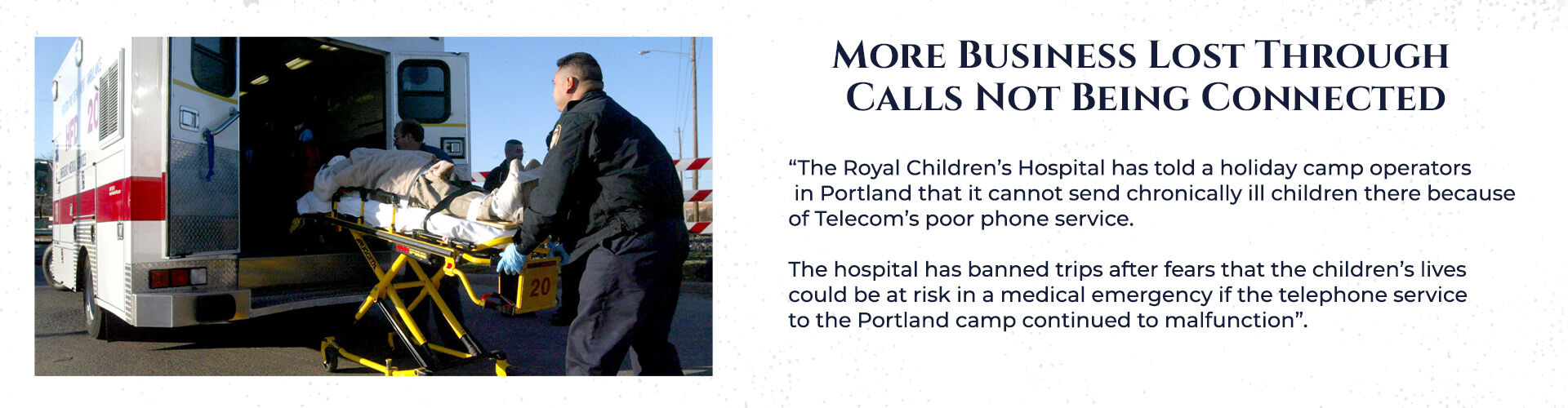
Children's lives could be at risk
Comments made from the Herald Sun newspaper dated 30 August 1993 confirm just how damaging some of these newspaper articles were to my already ailing business, with statements like:
“The Royal Children’s Hospital has told a holiday camp operators in Portland that it cannot send chronically ill children there because of Telecom’s poor phone service. The hospital has banned trips after fears that the children’s lives could be at risk in a medical emergency if the telephone service to the Portland camp continued to malfunction”.
The centre’s stand follows letters from schools, community groups, companies and individuals who have complained about the phone service at Portland’s Cape Bridgewater Holiday camp.”
Youths from the Royal Children’s Centre for Adolescent Health, who were suffering from “chronic illnesses”, visited the camp earlier this year.
Group leader Ms Louise Rolls said in a letter to the camp the faulty phones had endangered lives and the hospital would not return to the camp unless the phone service could be guaranteed” Arbitrator File No/90
After the Melbourne Children's Hospital recorded a near-death experience with me having to rush a sick child with cancer to the Portland Hospital, 18 kilometres away from my holiday camp, Telstra finally decided to take my telephone faults seriously. None of the 35 children (all with cancer-related illnesses) had mobile phones, nor did the six or so nurses and carers. Mobile telephones could not operate successfully in Cape Bridgewater until 2004, eleven years after this event.
This story isn’t just about corruption, it’s about a bureaucratic mugging in broad daylight, a sanctioned ambush pulled straight out of a Mob playbook, executed by men in suits who thought their titles made them untouchable. It was a full‑tilt frame‑up, engineered to break every one of us who dared to sign those government‑endorsed arbitrations, believing justice still meant something in Australia. What we walked into wasn’t arbitration, it was a back‑room shakedown, a hijacking of the justice system by insiders who weaponised process, secrecy, and power. There was never any justice. Not for a moment. What they ran was a crooked operation, hidden behind a Confidentiality Agreement crafted by Telstra, the defendant, to shield their government‑controlled asset and bury the truth under layers of silence, fear, and institutional muscle.
I’ve crafted this introduction to the COT story on the homepage of absentjustice.com using a narrative voice soaked in American courtroom grit, the kind you hear when a federal prosecutor steps up to the mic and starts laying out a case that stinks of back‑room deals, dirty files, and power players who think they’re untouchable. Because that’s exactly what the COT Saga was: a scandalous, criminal‑style takedown, dressed up as “arbitration” but run like a back‑alley shakedown.

From April 1990 through December 2001, I prioritised sponsoring underprivileged groups to stay at the holiday camp, even during weeks when the camp experienced phone problems. Various charitable organisations coordinated food deliveries for these groups, and coach companies provided a 46-seater school bus, with my endorsed vehicle covering the necessary provisions when I drove. This sponsorship brought in much-needed revenue for the business and helped spread the word as visitors shared their positive experiences. It's worth noting that the organisers of these groups were so committed that they would drive for hours to make a booking.
The organisers of these groups would drive for hours to make a booking, as Loreto College did (see below), then they would drive.
The holiday Camp could accommodate around 90-100 people across 14 cabins. I arranged sponsored food purchases through the generosity of several commercial food outlets, and these groups then just used the camp facilities. It didn’t cost me anything other than a small amount of electricity and gas. Around May 1992, I organised a charity week for kids from Ballarat and the South West, including Warrnambool, Hamilton and Portland. This group was organised by Sister Maureen Burke IBVM, the Principal of Loreto College in Ballarat, and I am sure she would not be offended to know that I think of her as the ‘mother’ of the project.
Arrangements regarding food, transport, and any special needs the children might have had had to be handled over the phone, and of course, Sister Burke had enormous problems making phone contact; calls were either ringing out, or she was getting a deadline or a message that the number she was ringing was not connected to the Telstra network. Sister Burke knew otherwise. On two occasions in 1992, after trying in vain all week, she drove 3½ hours to make the final arrangements for those camps.
Just as she arrived at the Camp, Karen (my new partner) took a phone call from a furious man who wanted information about a singles weekend we were trying to set up. This caller was quite abusive. He couldn't understand why we were advertising a business but never answered the phone. Karen burst into tears. She had reached the end of her tolerance, and nothing I could say was any help. When Sister Burke appeared in the office, I decided absence was the better part of valour and removed myself, leaving the two women together. Much later, Sister Burke came out and told me she thought it probably best for both of us if Karen were to leave Cape Bridgewater. I felt numb. It was all happening again.
But it wasn't the same as it had been with Faye. Karen and I sat and talked. True, we would separate, but I assured her that she would lose nothing because of her generosity and that I would do whatever was necessary to buy her out. We were both relieved at that. Karen rented a house in Portland, and we remained good friends. Without her day-to-day assistance at the Camp, which had given me the space to travel, I had to cancel my promotional tours.
Twelve months later, in March of 1993, Sister Karen Donnellon, also from Loreto College, tried to make contact via the Portland Ericsson telephone exchange to arrange an annual camp. Sister Donnellon later wrote:
“During a one week period in March of this year I attempted to contact Mr Alan Smith at Bridgewater Camp. In that time I tried many times to phone through.
Each time I dialled I was met with a line that was blank. Even after several re-dials there was no response. I then began to vary the times of calling but it made no difference.” File 231-B → AS-CAV Exhibit 181 to 233
Some years later, I sent Sister Burke an early draft of my manuscript, Absent Justice My Story‘, concerning my valiant attempt to run a telephone-dependent business without a dependable phone service. Sister Burke wrote back,
“Only I know from personal experience that your story is true, otherwise I would find it difficult to believe. I was amazed and impressed with the thorough, detailed work you have done in your efforts to find justice” File 231-A → AS-CAV Exhibit 181 to 233
Of course, Sister Maureen Burke and Sister Karen Donnellon persisted with their continuing battle to find a way to get a proper telephone connection for the holiday camp, partly because it was a low-cost holiday for all concerned but also because these incredible women were well aware that my business was continuing to exist, albeit ‘by the skin of its teeth, even though Telstra’s automated voice messages kept on telling prospective customers that the business did not exist or the callers simply reached a dreaded silence that appeared to indicate that the number they had called was attached to a ‘dead’ line. Either way, I lost the business that might have followed if only the callers had been able to connect to my office via this dreaded Ericsson AXE telephone exchange.
What makes this even more galling is that the government communications authority had already acknowledged the scale of my losses. In March 1994, they documented, in detail, that the revenue lost due to Telstra’s failures was substantial. Their own internal notes, spanning points 2 to 212 and referenced on page 33, point 85 of AUSTEL’s Adverse Findings, confirmed what I had been saying all along. Yet when it came time to calculate my losses, the figures were slashed to a fraction of their true value.
There is an enormous difference between $30.82 for a two‑night stay for school groups and $120 to $165 for a two‑night stay for social club patrons. Downgrading my losses by such a margin was not an accounting error. It was not a misunderstanding. It was a deliberate act that stripped away the truth of what I had lost. And when a government‑owned corporation knowingly reduces a claimant’s losses by such a percentage, it raises profound questions about fairness, integrity, and accountability.
This situation paints a vivid picture of the enduring struggles faced by small businesses caught in a web of inefficiency, neglect, and systemic imbalance. It is not about whether Foxtel deserved its compensation. It is about the profound inequity in the government's response to Telstra’s failures. One group received protection. The other received punishment. One group was compensated. The other was left to drown. One group had influence. The other had none.
And that is the heart of the injustice.
The potential Over Forties Single Club patrons’ testimonials are also referred to in the AUSTEL report of 3 March 1994:
“As Mr Smith points out, the RVA message had the potential to severely damage his business. An important point regarding the possible financial impact of the RVA message on the Cape Bridgewater Holiday Camp service is the camp’s dependence on group bookings. In June 1992 the camp tariffs ranged from $1500 to $6000 per week, so the loss of even one booking because of the RVA problem could mean a substantial financial loss.” (Refer p33, point 85 AUSTEL’s Adverse Findings).
When a government regulator from AUSTEL visited my venue, I showed them how singles‑club guests regularly bought souvenirs, Cape Bridgewater t‑shirts, sweatshirts, postcards, headscarves, and driftwood arrangements. School groups never spent like that; they usually bought only postcards. Yet FHCA, the arbitrator’s financial unit working with Telstra, ignored all income lost from singles‑club bookings: both the souvenir profits and the $120–$165 per‑person tariff.
For anyone still unsure what that meant, the Chronology of Events links to a March 1994 government document . It confirms that public servants investigating my telephone faults supported my claims — especially between Points 2 and 212. Had the arbitrator seen , my financial losses would have been valued at a much higher amount.
Government records (see ) show these adverse findings were given to Telstra one month before I signed the arbitration agreement. I did not receive them until 23 November 2007, twelve years too late to appeal.
, dated 4 March 1994, validated my claims before I was forced into arbitration under threat from the TIO Warwick Smith and Telstra: sign, or they would stop investigating faults that had plagued my business since February 1988.
But I did not receive Points 2–212 of until 23 November 2007. In plain terms, the government had already confirmed my claims six weeks before I signed the arbitration agreement on 21 April 1994.
Yet I was still dragged through a 13‑month arbitration, spending more than $300,000 to prove what the government had already established.
When Regulators and Telstra Ran the Same Hustle

Unfortunately, as mentioned above, I did not receive a copy of the following findings AUSTEL’s Adverse Findings at points 2 to 212 until November 23, 2007, 12 years after the termination of my arbitration process.
To further support my claims that Telstra and the government already knew how severe my telephone faults were, can best be viewed by reading Folios C04006, C04007 and C04008, headed TELECOM SECRET (see Front Page Part Two 2-B), which states:
“Legal position – Mr Smith’s service problems were network related and spanned a period of 3-4 years. Hence Telecom’s position of legal liability was covered by a number of different acts and regulations. … In my opinion Alan Smith’s case was not a good one to test Section 8 for any previous immunities – given his evidence and claims. I do not believe it would be in Telecom’s interest to have this case go to court.
“Overall, Mr Smith’s telephone service had suffered from a poor grade of network performance over a period of several years; with some difficulty to detect exchange problems in the last 8 months.
Rupert Murdoch -Telstra Scandal - Helen Handbury
For all the right reasons, anyone whose life has been chewed up by a small, well‑protected faction of unethical Australian bureaucrats has every right to demand an end to this rorting. This clique — this back‑street mafia in government lanyards — has spent decades perfecting the dark arts of fraud, graft, and double‑dealing. They have ruined lives with a shrug, and the time for polite restraint is over.
As you move through the chapters on absentjustice, you’ll see that what happened to the COT Cases wasn’t a mistake or a bureaucratic misfire. It was a deliberate system, engineered by people who knew exactly what they were doing. The same corrupt bureaucracy that later pretended to “arbitrate” our claims had earlier allowed Telstra’s board and management to stitch up a secretive, high‑stakes deal with Rupert Murdoch and FOX for a national cable rollout — a deal wired with a $400 million default payment if Telstra failed to meet the deadline.
10. Telstra's CEO and Board have known about this scam since 1992. They have had the time and the opportunity to change the policy and reduce the cost of labour so that cable roll-out commitments could be met and Telstra would be in good shape for the imminent share issue. Instead, they have done nothing but deceive their Minister, their appointed auditors and the owners of their stockÐ the Australian taxpayers. The result of their refusal to address the TA issue is that high labour costs were maintained and Telstra failed to meet its cable roll-out commitment to Foxtel. This will cost Telstra directly at least $400 million in compensation to News Corp and/or Foxtel and further major losses will be incurred when Telstra's stock is issued at a significantly lower price than would have been the case if Telstra had acted responsibly.
11. Telstra not only failed to act responsibly, it failed in its duty of care to its shareholders. So the real losers are the taxpayers and to an extent, the thousands of employees who will be sacked when Telstra reaches its roll-out targetÐcable past 4 million households, or 2.5 million households if it is assumed that Telstra's CEO accepts directives from the Minster.
That’s not incompetence. That’s premeditated betrayal.
A Nation Built on Betrayals: Australia’s Long, Dirty Line of Crooked Deals, Cover‑Ups and Government‑Sanctioned Treachery
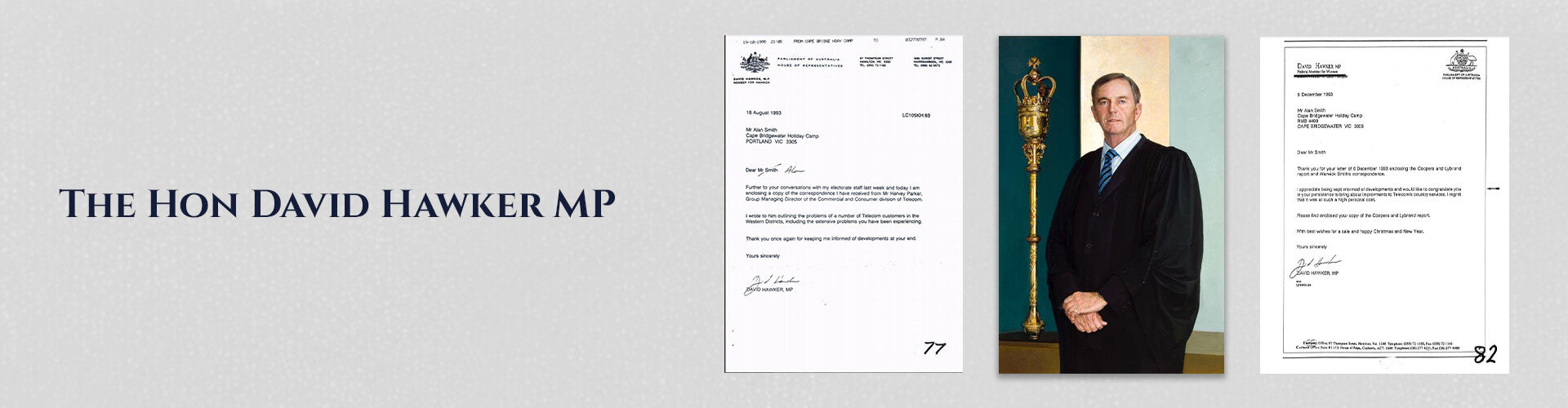
Two weeks before I signed the Fast Track Settlement Proposal (FTSP) with Telstra — the agreement that was later transformed into an arbitration process governed by rules secretly drafted by Telstra itself, despite government assurances that the rules would be independently written, my Federal Member of Parliament, David Hawker MP, wrote to me on 9 December 1993. He congratulated me for my “persistence to bring about improvements to Telecom’s country services,” adding that he regretted “that it was at such a high personal cost.”
Coming from a man who had watched the decline of rural telecommunications firsthand, his words carried real weight. They affirmed that the years of frustration, documentation, and sheer endurance had not gone unnoticed.
Equally significant was a letter from the Hon. David Beddall MP, Minister for Communications in the Labor Government. He wrote:
“Let me say that the Government is most concerned at allegations that Telecom has not been maintaining telecommunications service quality at appropriate levels. I accept that in a number of cases, including Mr Smith’s, there has been great personal and financial distress. This is of great concern to me and a full investigation of the facts is clearly warranted.”
For the first time, someone inside the system acknowledged what Telstra had spent years denying: that the failures were real, widespread, and damaging.
By then, I was no longer alone. Small businesses across rural Australia had begun writing to me, describing the same problems, phones that didn’t ring, calls that dropped out, billing errors that defied logic, and a customer‑service culture that treated them as inconveniences rather than clients. Their letters were raw, often desperate. They reminded me of my own early correspondence, back when I still believed that reporting faults would lead to solutions.
I felt a responsibility to them. So I contacted Telstra management directly, again and again, placing on record my requests for these matters to be resolved. I wasn’t acting as an activist or a campaigner; I was responding as any responsible business owner would when confronted with evidence that others were suffering the same failures that had nearly destroyed my own livelihood.
What I didn’t yet realise was that these letters — from Hawker, from Beddall, and from the small businesses who trusted me — would later become part of the foundation proving that the arbitration process was never designed to fix anything. It was designed to contain the problem, not solve it.
It began with wheat, Australian wheat, quietly diverted from China into the hands of North Vietnam, feeding the very forces killing our own soldiers. Then came the bribery‑tainted wheat scandal with Saddam Hussein, proof that corruption wasn’t an accident but a habit. The COT arbitrations were sabotaged, Murdoch was handed an undemocratic $400 million lifeline, and Senator Barnaby Joyce’s “independent investigation” was torched the moment it became inconvenient. Pink Batts burned, Robodebt crushed the innocent, the NDIS became a feeding trough for fraudsters, and through it all, governments shrugged and moved on.
And then came the French Submarine betrayal, a deal we could see, touch, and measure, torn up in broad daylight. A contract signed in good faith, abandoned without warning, leaving Australia to pay hundreds of millions just to walk away. Not a hidden scandal. Not a secret file. A public act of treachery, carried out in full view of the nation.
Different scandals. Different victims. But always the same choreography: deals struck in shadows, truth buried in silence, and ordinary Australians left to pay the price.
The Shadows of Bureaucratic Betrayal
The warning was stark:
“On some significant issues, the Australian Parliament has ceased to be a place of effective lawmaking by the people, for the people.”
And then the deeper cut:
“It has become commonplace for Parliamentarians to see a marathon super‑nuanced career out with ideals sacrificed for ambition.”
These were not the words of a cynic shouting from the sidelines. They were spoken by Bernard Collaery, former Attorney‑General of the ACT — a man dragged into prosecution by the Australian Liberal government for the “crime” of exposing government wrongdoing. Not prosecuted by the people of Australia, but against them, in their name.
Collaery’s case peeled back a curtain the government never wanted touched. It revealed a bureaucracy willing to mislead and deceive the citizens of Timor‑Leste, even to the point of bugging their government offices during sensitive oil-and-gas negotiations. A covert intrusion carried out not for national security, but for political leverage.
And the rot did not begin there.
Those same tactics, the same appetite for secrecy, the same contempt for transparency, echo back to the John Howard Liberal government, which withheld disclosure of similar covert activities during the Telstra sale. At that very moment, Telstra was locked in arbitration and mediation with the COT Cases, and evidence that should have been disclosed was instead buried, delayed, or quietly spirited away.
The questions that linger are the ones no government has ever dared answer:
-
Who were the bureaucrats who authorised or condoned the bugging during the COT arbitrations?
-
Were they the same officials, or their protégés, who later approved the bugging of Timor‑Leste’s offices?
-
How many careers were built on silence, and how many truths were buried to protect them?
Perhaps we will never know the names behind the locked doors, the signatures behind the redactions, the officials who decided that the rights of citizens, and the sovereignty of a neighbour, were expendable.
But we do know this:
Bernard Collaery refused to bend. He stood for the principle that truth matters, that a free world requires free speech, and that secrecy used to shield wrongdoing is not governance, it is betrayal.
And in standing firm, he exposed something far larger than his own case: a bureaucracy that has learned to operate in the shadows, where accountability fades, and where the public is expected to accept silence as an answer.
What Bernard Collaery may not have known when he made his statements about government‑sanctioned bugging is that years earlier, during the COT arbitrations of 1994 and 1998, those same covert practices had already surfaced. They were exposed again in 2006, when the government conducted its own so‑called “assessment” of the COT Cases’ allegations. Instead of honouring the deal struck with Senator Barnaby Joyce for an independent, outside‑government investigation into each COT claim, the government simply investigated itself. Predictably, it declared it had no case to answer. And then, in an act as brazen as it was self‑protective, the government destroyed the very evidence that contradicted its findings, eighteen months later, in 2008, as this website and the following page "The eighth remedy pursued" show.
It is evident from absentjustice.com that the Telecommunications Industry Ombudsman (TIO) admitted to the Senate Committee Secretary that they withheld relevant arbitration documents related to the COT Cases dispute. The TIO officials believed these documents would not benefit their arbitration process. Although the TIO had no jurisdiction over the COT Cases, which are civil cases against Telstra, the government allowed this office to make legal decisions that adversely affected the claims in those cases.
Chapter 5

The IAMA's President, the esteemed former High Court Judge, The Hon D Kirby AC, CMG
In June 2009, seven hundred previously unseen Freedom of Information (FOI) documents arrived without warning at my partner’s Seal Cove Guest House in Cape Bridgewater. These were documents I had lawfully requested during my 1994–95 arbitration—documents that were withheld when they mattered, then quietly released fourteen years too late, long after the statute of limitations had expired and any right of appeal had been extinguished.
Those documents revealed something far darker than bureaucratic incompetence. They proved—beyond argument—that Dr Gordon Hughes, the arbitrator appointed to deliver justice, and Warwick Smith, Australia’s first Telecommunications Industry Ombudsman and administrator of the COT arbitrations, had perverted the course of justice both before and during the process. The very officials entrusted to safeguard fairness had instead engineered its collapse.
On the recommendation of Justice Kirby, then-President of the Institute of Arbitrators Australia (IAMA), I submitted two detailed mini‑reports exposing this misconduct. Mr Kirby arranged for the CEO of the IAMA to review the evidence and issue a finding. As shown in Exhibit 6, the IAMA’s Ethics and Professional Affairs Committee even requested further material in November 2009 to deepen their investigation.
And then—silence.
Now, in 2026, the IAMA has still not delivered a finding—either for or against my claims—first raised with them in 1996. Their second review, initiated in 1999 during the Major Fraud Group Victoria Police investigation into allegations by four other COT claimants against Dr Hughes and Telstra, also evaporated without explanation. Those allegations, submitted by Barrister Sue Owens on behalf of Ann Garms, Ralph Bova, Ross Plowman, and Graham Schorer, were mysteriously abandoned after those four received more than sixteen million dollars in punitive damages awarded against Telstra under pressure from the Australian Senate in March 1999.
“In the process leading up to the development of the arbitration procedures – the claimants were told clearly that documents were to be made available to them under the FOI Act.
“Firstly, and perhaps most significantly, the arbitrator had no control over that process, because it was a process conducted entirely outside the ambit of the arbitration procedures.”
There is no amendment to any agreement signed by the first four COT members that allows the arbitrator to conduct those arbitrations entirely outside the ambit of the arbitration procedure, nor was it stated that he would have no control over the process once we had signed those individual agreements. How can the arbitrator and TIO continue to hide under a confidentiality clause in our arbitration agreement when that agreement did not mention that the arbitrator would have no control because the arbitration would be conducted entirely outside the agreed procedure?
When this fresh evidence surfaced, revealing that Pinnock had already warned the Senate on 26 September 1997 that the arbitrator had no control over the COT arbitrations because they had been conducted entirely outside the agreed arbitration procedure. That admission alone should have triggered a full and transparent inquiry.
Exhibit AS 767‑A: The Smoking Gun
Two weeks prior to our agreement to test the fax lines, with Telstra at the business premises of Graham Schorer, operating out of his Melbourne Golden Messenger Courier Service, and I, from my business at Cape Bridgewater Holiday Camp, encountered problems sending faxes between our offices. This Telstra internal FOI document, K01489, confirms that while Telstra was testing my Mitsubishi fax machine, using the COT spokesperson Graham Schorer's office as the testing base, it was noted that:
‘During testing the Mitsubishi fax machine some alarming patterns of behaviour was noted”. This document further goes on to state: “…Even on calls that were tampered with the fax machine displayed signs of locking up and behaving in a manner not in accordance with the relevant CCITT Group fax rules. Even if the page was sent upside down the time and date and company name should have still appeared on the top of the page, it wasn’t’
During a received call the machine failed to respond at the end of the page even though it had received the entire page (sample #3) The Mitsubishi fax machine remained in the locked up state for a further 2 minutes after the call had terminated, eventually advancing the page out of the machine. (See AFP Evidence File No 9)
A letter dated 2 March 1994 from Telstra’s Corporate Solicitor, Ian Row, to Detective Superintendent Jeff Penrose (refer to Home Page Part-One File No/9-A to 9-C) strongly indicates that Mr. Penrose was grievously misled and deceived about the faxing problems discussed in the letter. Over the years, numerous individuals, including Mr Neil Jepson, Barrister at the Major Fraud Group Victoria Police, have rigorously compared the four exhibits labelled (File No/9-C) with the interception evidence revealed in Open Letter File No/12 and File No/13. They emphatically assert that if Ian Row had not misled the AFP about the faxing problems, the AFP could have prevented Telstra from intercepting the relevant arbitration documents in March 1994, thereby avoiding any damage to the COT arbitration claims.
By February 1994, I was also assisting the Australian Federal Police (AFP) with their investigations into my claims of fax interceptions. Hacking-Julian Assanage File No 52 contains a letter from Telstra’s internal corporate solicitor to an AFP detective superintendent, misinforming the AFP concerning the transmission fax testing process. The rest of the file shows that Telstra experienced major problems when testing my facsimile machine alongside one installed at Graham’s office.
It is essential to highlight how skilfully Mr Row did not disclose to the AFP the problems Telstra had experienced when sending and receiving faxes between my machine and Graham’s.
That wasn’t a glitch. That was a machine crying out that someone had their hands inside its guts.
And then I saw it — the handwritten note in the bottom right corner of Exhibit AS 767‑B:
“Stored in Fax Stream?”
That one line hit me harder than anything else. Because if those faxes were being stored in Telstra’s Fax Stream centre, then every document I thought I was sending privately — to my accountant, my lawyer, my technical advisors, even Parliament House and the Commonwealth Ombudsman — was sitting in a Telstra backroom like a stack of files waiting for the right pair of eyes.
And the Scandrett & Associates report (see Open Letter File No/12 and File No/13) didn’t just hint at this. It proved it. Faxes intercepted. Faxes copied. Faxes stored. Before and during the COT arbitrations, and in my case, three years after my arbitration ended.
Seven years. That’s not an accident. That’s surveillance.
So when people ask me whether the Telstra engineer was pressured to stay quiet during my arbitration, I can only shrug. Maybe he was. Maybe he wasn’t. But I do know this: not every Telstra technician treated the COT claimants with honesty. Some bent the truth. Some broke it clean in half.
Take the technician who ran the official fax tests on 29 October 1993. He saw the faults. He recorded the faults. The system itself logged the faults. And yet he told the arbitrator I had no problems with my fax service.
Meanwhile, the internal Telstra document — the one discussing those exact faults — says:
“Even on calls that were not tampered with…”
That’s not a technical note. That’s a confession.
Back to the Briefcase — The Day the Truth Walked Into My Office

I should have known better, but I didn’t. When Telstra came to my holiday camp, I thought — foolishly — that maybe this time they’d take my complaints seriously. Instead, I got the same old routine:
“No fault found.”
We danced around the same tired summary of my phone problems. Their advice? Keep doing what I’d been doing since 1989 — writing everything down like a man trying to prove he wasn’t going mad.
They left. And I sat there feeling like I’d been played again.
But fate has a strange sense of timing.
A little while later, back in my office, I noticed something sitting on the floor. A briefcase. Not locked. Not empty. And when I opened it, I realised Aladdin had left his treasure behind.
Inside was a file stamped “SMITH, CAPE BRIDGEWATER.”
After five years of fighting Telstra — five years of stonewalling, lies, and evasions — here it was. Their inside story. Their truth. The one they never meant me to see.
The first document that stopped me cold was proof that Telstra knew the RVA fault — the one they claimed lasted three weeks — had actually run for eight months.
Eight months of callers hearing “service disconnected.” Eight months of business bleeding out. Eight months of Telstra pretending everything was fine.
The document, dated 24 July 1992, with my number printed right at the top, laid it out:
-
Complaint: callers getting RVA “service disconnected.”
-
Latest report: 22 July 1992, Station Pier, Melbourne.
-
Similar fault: 17 March 1992.
-
Final line — the one that should have blown the arbitration wide open:
“Network investigation should have been brought in as fault has gone on for 8 months.”
Eight months. And they paid me out on the lie that it lasted three weeks.
That wasn’t an oversight. That wasn’t a clerical error. That was the game.
And Exhibit AS 767‑A? That was the rulebook.
Here I was in June 1993 — five years after I’d bought the camp — the situation had become impossible to ignore. I wasn’t alone anymore. Several other businesses around Cape Bridgewater and the wider Portland district were suffering the same relentless phone faults. Together, we were drawn into an arbitration process overseen by the government communications regulator. The media took notice, and those appointed to manage the arbitrations were told that Telstra would be required to conduct a series of tests at each business. These tests were supposed to determine whether the very problems that had driven us into arbitration had finally been fixed, just as the government communications authority AUSTEL (now ACMA) had promised.
But even then — even at the start of what was meant to be a fair and transparent process — I had no idea just how deep the rot went, or how long the fight ahead would be. I only knew that something was wrong, and that the truth was already being bent out of shape.
How False Statements Became “Official” Evidence
The Arbitrations ‑ Were Rigged Before They Began
In the 1990s, those government‑endorsed arbitrations weren’t “processes” — they were fronts, the kind of slick curtain a crooked crew pulls shut before they start shaking people down. What the public saw was the clean stage. What was happening behind it was a full‑blown racketeering operation, run by bureaucrats who acted more like a political crime syndicate than public servants.
While we were being marched through this rigged circus, real poison was leaking through Parliament House in Canberra — fraud, corruption, and allegations of child rape, documented in material such as See File Ann Garms 104 Document and the report linked at (rb.gy/dsvidd). This wasn’t just “misconduct.” It was institutional rot, the kind of filth that would get a street gang kicked in the door by federal agents.
And right in the middle of that mess was Senator Bob Collins — a man tangled up in allegations so serious they should have barred him from going anywhere near a legal process. Yet somehow, unbelievably, this guy was handed the keys to our arbitrations. He was one of the gatekeepers evaluating my claim, and the claims of Ann Garms, Maureen Gillan, and Graham Schorer.
Think about that: while we were fighting just to get our phone faults acknowledged, a man under that kind of cloud was sitting in judgment over us. It wasn’t just a conflict of interest — it was a bad‑faith ambush, a justice system being run like a crooked casino, where the dealers are dirty, the dice are loaded, and the house always wins.
We weren’t just up against Telstra. We were up against a political machine running its own shadow court, a system where truth didn’t matter, evidence didn’t matter, and fairness was nothing more than a sales pitch for the suckers on the outside. millions of dollars from government coffers, a scandal recorded in pages 5163 to 5169 → SENATE official Hansard – Parliament of Australia.
Chapter 6

Government Corruption - Gaslighting
The Fix
I didn’t have a name for what was happening to me then. All I knew was that something subtle and corrosive was taking hold. I, along with various other COT Cases, would raise a fault, present evidence, describe exactly what had happened, and the response would come back smooth as polished stone: “That never occurred.” “You’re mistaken.” “You’re imagining things.” When it happens once, you argue. When it happens a hundred times, you begin to feel the argument draining out of you.
Gaslighting, as I later learned, is the deliberate twisting of reality until you no longer trust your own senses. And in the COT Cases, it wasn’t just one person doing it — it was Telstra, government advisers, legal representatives, and even the Telecommunications Industry Ombudsman (TIO)–appointed arbitration consultants, namely Ferrier Hodson Corporate Advisory, who would advise the administrator of the process, certainly in my case, that my arbitration claims were overstated when government evidence on this website shows I had understated my claims (see AUSTEL’s Adverse Findings). When an entire system speaks with one voice, denying what you know to be true, the effect is suffocating. You start to feel as though you’re standing alone in a room full of people insisting the sky is green, and after a while, you begin to wonder whether your eyes are the problem.
It all started with outright denials. Letters sent to the COT Cases claimed that our phone faults did not exist. Officials insisted that I was the only one complaining, even though internal documents—revealed to us years later show that Testra and the government knew our claims were valid.
A Full‑Blown Racket Masquerading as Justice
By clicking on the image below, you’re not just opening a file—you’re stepping into a festering pit of corruption. What you’ll uncover are the sinister and twisted manoeuvres that led to the so-called arbitration confidentiality agreement signed on April 21, 1994. Let’s not mince words: this agreement was never about fairness or due process. It was a smokescreen—a vile cover-up designed to bury misconduct that had already transpired long before anyone dared to thrust a secrecy clause in front of me.
The image, broken into Parts 1-4, lays bare the depths of this treachery. It exposes the insidious machinery working behind the scenes, the shadowy figures pulling the strings, and the secretive choices made in back rooms where people like me were never meant to glimpse the truth. It raises an unforgiving question: how did they evade justice?
People act as though Telstra’s behaviour during the COT arbitrations is some relic of the past, but the real issue extends beyond Telstra itself. It's about the individuals who orchestrated this farce. They were tasked with upholding integrity, but instead, they manipulated the entire process, turning it into a grotesque mockery of justice. Their actions were not mere mistakes or oversights; they were calculated, deliberate choices intent on stripping the arbitration of any shred of honesty.
The website absentjustice.com details the grotesque timeline—every contradiction, every calculated obstruction, every devious manoeuvre that occurred before, during, and long after the arbitrations were supposedly “concluded.” The pattern is impossible to ignore.
Gaslighting, Cover‑Ups, and a System Rigged to the Bone
And then there’s the post-arbitration behaviour. One figure casually walked out of his arbitration role and into a shiny partnership at KPMG, as if this entire sordid affair were merely a career stepping stone. But he didn’t just fade away; he continued sending letters—letters that muddied the waters, obstructed investigations, and ensured the truth remained buried. This alone reveals everything you need to know about his nefarious priorities.
What chills me to the bone is this: the same individuals continue to operate in the legal and arbitration realms today. They persist in presenting themselves as upstanding professionals while wielding the power to make decisions that affect countless lives. Am I expected to accept that what happened to us was a one-off disaster? A temporary lapse of integrity? If that’s true, why has there been a staggering lack of accountability? Why has no one faced consequences—not in 1994, not in 2004, and certainly not in 2026?
The absence of repercussions speaks volumes, suggesting a deeply entrenched culture in which secrecy is rewarded, accountability is a farce, and people like me are coerced into relinquishing our rights just to have a voice.
Most outsiders scoff at the COT Cases. They presume we’re exaggerating or fabricating tales. But they were not the ones seated in the room, coerced—under threat—to sign documents that cleared the alleged independent arbitration consultants and legal advisers of any liability for acts of negligence or wrongdoing. They didn’t endure the pressure. They didn’t witness the insidious tactics at play. They didn’t watch the system twist and contort itself into a grotesque parody of justice, protecting those who were supposed to uphold the law.
The stark truth is this: the arbitration process was grotesquely corrupted—not by accident, not through incompetence, but through willful actions that have left an indelible stain on the very notion of fairness. And until that stain is acknowledged, the system remains abhorrently broken, a sham masked in layers of deceit.
Part 1 to Part 4
A Corporate Shakedown in Broad Daylight
On 22 September 1994, the Australian Federal Police (AFP) interrogated me with 93 questions, corroborating what Melanie Cochrane (AFP) had disclosed to me seven months prior. This evidence was irrefutably clear. Yet, for reasons only known to the arbitrator and the shadowy figures pulling his strings, this vital evidence was dismissed, along with much of what I had collected against Telstra. My responses, laid bare in Australian Federal Police Investigation File No/1, unveil a chilling reality: Telstra resorted to direct threats against me simply for daring to assist the AFP in their inquiries into the illicit surveillance of my phone conversations and the unlawful hacking of documents linked to my arbitration. The entire operation reeks of corruption and collusion, leaving me to question who truly controls the narrative.
⚖️ Arbitration Evasion: Australia, Singapore, Hong Kong
• My lived experience in the COT Cases in Australia• Judicial trends in Singapore and Hong Kong, where arbitration is similarly shielded from scrutiny• Legal citations and case studies that reveal a global pattern of procedural evasion
• Arbitrator Dr Gordon Hughes refused to make findings on Telstra’s ongoing faults• AUSTEL/ACMA allowed Telstra to address faults secretly post-arbitration• Lane Telecommunications, an “independent” assessor, was acquired by Ericsson (who was under investigation by Lane) mid-process• FOI access was denied despite assurances, and Senate testimony revealed systemic concealment
The Arbitration Hustle: Justice Sold Like a Street Corner Deal
This website exists because ordinary people refused to be shaken down and told to walk away.
Ronda, my editor, ally, and friend, spent decades preserving this record. Sixty thousand pages, indexed and edited, often unpaid. She told her daughters she couldn’t sleep knowing what had been done to us. Lyn in New Zealand worked through years when I had nothing to give her. Gerard, a respected Victorian lawyer, produced a 256‑page analysis for the government and refused every cent. Others came from Egypt, Canada, and across Australia. Some of the original COT Cases spent their final years making sure this story couldn’t be buried.
They weren’t wrong to fight.
The Corporate Shakedown Continues
Learn about treacherous crimes and unscrupulous arbitrators, corrupt politicians, and the lawyers who control the legal system of arbitration in Australia. How they exploit the confidentiality gag clause in the specially designed arbitration agreements, where, in Australia, government bureaucrats, in the case of the Casualties of Telstra 1994 arbitration against the government‑owned Telstra Corporation, the government secretly allowed Freehill Hollingdale & Page (now trading as Herbert Smith Freehills Melbourne) to draft the arbitration agreement on behalf of their client, Telstra.
Explore the shocking crimes committed by unscrupulous criminals, corrupt politicians, and the lawyers who dominate the arbitration system in Australia. Words like “shameful,” “hideous,” and “treacherous” accurately describe these lawbreakers. The government’s corrupt actions have seriously undermined the arbitration system it itself had endorsed.
Delve into how government officials misuse their power for personal gain—not just in immediate financial rewards, but in future benefits, such as jobs for their families, prestigious awards, and opportunities to serve on corporate boards. In 2008, while researching information for absentjustice.com to illustrate how government corruption is reported annually, I came across a newspaper article on page 3 of the Australian Herald Sun newspaper, dated 22 December 2008, written under the heading “Bad Bureaucrats”:
“Hundreds of federal public servants were sacked, demoted or fined in the past year for serious misconduct. Investigations into more than 1000 bureaucrats uncovered bad behaviour such as theft, identity fraud, prying into file, leaking secrets. About 50 were found to have made improper use of inside information or their power and authority for the benefit of themselves, family and friends“
It is clear from Australia’s latest reporting on government bureaucratic corruption that nothing has changed. If you understand the troubling insights this research reveals—failures, evasions, and hidden injustices that erode public trust—then neutrality is no longer an option. Australia stands at a dangerous crossroads. When individuals remain passive, treachery and corruption are allowed to fester, undermining the very foundations of our democracy.
Chapter 7
The Crimes They Buried Behind Closed Doors
Let’s cut through the polite language and call this what it was.
If the conduct you’re about to see had happened in a courtroom — a real courtroom, with a judge who answers to the law instead of corporate handlers — half the people involved would’ve been hauled out in handcuffs. Evidence tampering. Document alteration. Interference with telecommunications. Breaches of statutory duty. These aren’t “irregularities.” They’re crimes. Prosecutable crimes.
If the arbitrator had been a judge, this would’ve been wrapped up in 1996. Instead, it was dragged out, buried, smothered, and fought over for three decades. That’s not incompetence. That’s strategy.
And here’s what the public still doesn’t get — not in Australia, not in the UK, not in the US, not anywhere arbitration is used as a back‑door escape hatch for corporations and government agencies.
Arbitration is not a court. It’s a private room where the rules are whatever the most powerful player says they are.
When an arbitrator is inexperienced, compromised, or simply unwilling to confront wrongdoing, the process becomes a private arena where misconduct doesn’t just happen — it thrives.
Inside a claimant’s home, evidence can be tampered with. Phone service can be disrupted when no one is present. Legal documents can be altered after one party signs them. False test results — even those taken 112 kilometres away — can be passed off as “official findings.”
And every one of these things happened in the COT arbitrations. Not hypothetically. Not theoretically. They happened. And they were allowed to happen. Because the confidentiality clause wasn’t a shield for fairness — it was a gag for victims and a cloak for offenders.
The Pattern You’ve Seen Before — The British Post Office Horizon Scandal
If this sounds familiar, it should.
The British Post Office Horizon scandal followed the same script:
-
a government‑backed corporation
-
a flawed system
-
innocent people blamed
-
evidence withheld
-
internal reports buried
-
victims gagged
-
officials protected
Different country. Different decade. Same playbook.
Because once a system learns it can get away with corruption behind closed doors, it doesn’t stop. It expands. It evolves. It becomes a machine — and machines don’t grow consciences.
After almost two decades, the British public—and a growing number of British politicians—have insisted that the British Post Office scandal is a matter of profound public interest and must no longer be concealed by the government, the civil service, or the Establishment. For England’s sake, this injustice demands a complete and transparent investigation. Click here to watch the Australian Channel 7 trailer for Mr Bates vs the Post Office, which aired in February 2024, and captures the scale of this national betrayal.
What makes the scandal so disturbing is that public servants inside the British Post Office knew the Fujitsu Horizon computer software was responsible for the catastrophic accounting and billing errors. Yet they continued to blame innocent sub‑postmasters, many of whom were financially ruined, prosecuted, or imprisoned.
This pattern is painfully familiar to those of us who lived through the Australian COT arbitrations. Dr Gordon Hughes, the arbitrator appointed to oversee our cases, refused to allow his own technical consultants the additional time they needed to diagnose the ongoing faults in Telstra’s Ericsson billing software. The parallels between the British Post Office scandal and the Australian Telstra scandal are unmistakable. In both cases, faulty technical equipment was at the heart of the problem, as demonstrated in this YouTube video: https://youtu.be/
Miss Carrage of Justice
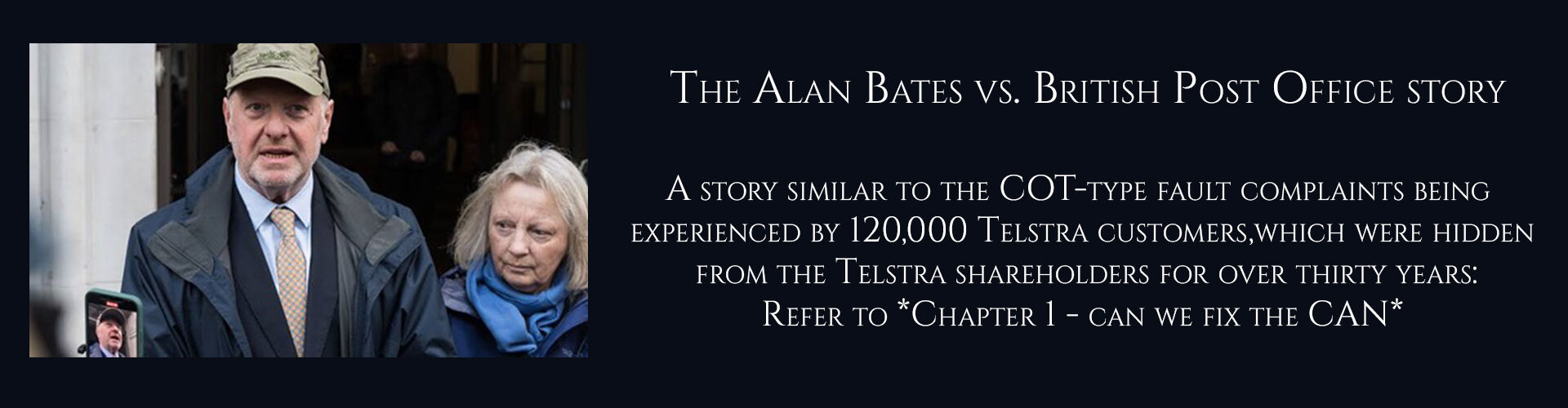
Click here to watch Mr Bates vs the Post Office
Different country. Different industry. Same architecture of institutional abuse.
In both scandals, the public assumed that because police did not intervene, they must have been complicit. Let me be clear: after compiling 23,000 evidence files myself — and another 15,000 scanned documents of similar weight — nothing implicates the AFP or the Major Fraud Group of Victoria Police in the misconduct that destroyed the lives of the COT Cases. The wrongdoing was carried out by arbitration officials and defendants who weaponised the confidentiality clause to commit acts that would never have survived open‑court scrutiny.
This is the global problem. The same structural weakness that enabled the British Post Office to ruin hundreds of lives is the same weakness that allowed Telstra and its protectors to sabotage the COT arbitrations. When disputes are pushed into private arbitration — away from judges, away from juries, away from public oversight — the door opens to corruption, concealment, and the quiet destruction of ordinary people.
This gag‑clause‑driven model is used worldwide. And as long as people keep choosing arbitration believing it to be fair, efficient, or transparent, these abuses will continue.
What you are about to read is not an Australian anomaly. It is a warning — and a map of how institutional power behaves when no one is watching.
As already emphasised above, the pattern is familiar.
Australia’s emerging NDIS fraud crisis — forecast to reach $3.6 to $6 billion by 2027–28 — is not a new phenomenon. It follows a long line of national failures where oversight collapsed, evidence was ignored, and public money vanished. Robodebt unlawfully targeted vulnerable Australians, contributing to suicides and costing millions. The Pink Batts program suffered fatal safety failures and financial waste. Each scandal exposed the same structural weakness: systems built on trust without verification.
The Telstra/COT Cases lived through this pattern decades earlier. While they struggled to operate businesses without reliable phone service, they were forced to spend hundreds of thousands of dollars each just to compel the TIO, Telstra, and the appointed arbitrator to investigate why their services were still failing. Even then, evidence was withheld, documents altered, and promised assessments — including the commercial review linked to Senator Barnaby Joyce’s decisive vote on Telstra privatisation — were never delivered.
Yet when Telstra could not provide Rupert Murdoch and FOX with the same reliable service, they received $400 million to keep their operations afloat (Refer to Rupert Murdoch -Telstra Scandal - Helen Handbury).
Across NDIS, Robodebt, Pink Batts, and Telstra/COT, the pattern is identical: when accountability fails, fraud grows, evidence disappears, and ordinary Australians pay the price.
Don't forget to hover your mouse/cursor over the following images as you scroll down this homepage.
From a very young age, long before I ever had the opportunity to read a book from cover to cover, I developed the skill of speed-reading, much like the seafarers I admired. During my years working on coastal vessels, we spent six or seven gruelling days at sea, sailing from one port to another. The Mission to Seamen libraries became our essential lifelines, providing us with a much-needed escape from the rigours of maritime life.
At each port, we had an unspoken ritual: we would take three books from the library and leave three others behind, hoping that the next port we visited would offer an exchange of equally engaging titles. At that time, our wages were far from what they are today, making it crucial for us to rely on whatever literary treasures we could find, often passed among crew members, their pages salt-stained and well-worn.
Over time, most of us have become adept at quickly assessing a book, often within just a few minutes. We learned to discern whether the story resonated with authenticity, whether the author had genuinely experienced what they wrote about, or whether the narrative was merely a façade of flair and embellishment. This ability to judge the value of written words became a lasting habit ingrained in me.
After spending thirty years at sea, I honed my ability to read rapidly, think critically, and trust my instincts regarding what constitutes truth. This skill set has profoundly influenced my endeavours, particularly in my work with absentjustice.com, where I have incorporated thousands of exhibits into evidence files. I've come to firmly believe that a story without proof is merely a tale, and without truth, it ultimately reduces to a fable.
A Dirty‑Law Hustle Engineered by Men Who Never Expected to Be Caught
Chapter 1 - The Collusion Continues, Chapter 2 - Inaccurate and Incomplete, Chapter 3 - The Sixth Damning Letter, Chapter 4 - The Seventh Damning Letter and Chapter 5 - The Eighth Damning Letter
While the five chapters mentioned above confirm that the arbitration officials deliberated on my claim, these officials remain unaccountable for the injustice that occurred leading up to my arbitration, during its 13-month duration, and in the years following its conclusion on 11 May 1995.
THE COVER‑UP MACHINE IN FULL GEAR
Amid the complexities of my pending appeal, my attorneys at Law Partners in Melbourne urged me to contact John Pinnock, the second appointed administrator for my arbitration. They advised me to request all documents related to the arbitration that underpinned my agreement, having uncovered unsettling ambiguities within it that could serve as grounds to challenge Dr Hughes' unjust award. I complied, unaware of the treachery that lay ahead.
As detailed in Chapter 5 - The Eighth Damning Letter, the other three claimants—Ann Garms, Maureen Gillan, and Graham Schorer—were provided with an additional 13 months to prepare their claims and respond to Telstra's defence. I, however, was not granted the same 13-month extension.
Dr. Gordon Hughes's decision to deny me the same thirteen-month extension not only hindered my case but also represented a significant act of discrimination. This decision was a deliberate and unjustifiable departure from the principles of fairness, fundamentally undermining the integrity of the arbitration process and the equitable treatment that all claimants deserved.
By denying me the opportunity to fully present my case, Dr Hughes effectively discriminated against me. He should have postponed his decision until Telstra could definitively verify that no further systemic phone issues were impacting my business. This oversight not only undermined my claims but also left my business vulnerable to ongoing, unaddressed problems.
To be clear: had Dr Gordon Hughes granted his own arbitration consultants the additional weeks they explicitly requested in their evaluation report dated April 30, 1995, the outcome of my arbitration would have been entirely different. The consultants—DMR & Lanes—recognised the complexities of the case and understood that the evidence required diligent, in-depth examination. They were fully aware that the material was intricate and critical to uncovering the truth.
However, Dr. Hughes callously refused their request. He shut down the investigation, preventing them from accessing the very documents that later enabled Darren Kearney to expose the shocking reality. This was not a mere administrative blunder but a calculated act—an intentional manoeuvre to bury the truth and protect Telstra from the consequences of their malfeasance.
The evidence Darren Kearney of AUSTEL (now ACMA) ultimately unearthed was contained in the very documents Dr Hughes denied his own experts, despite their written request for additional time on April 30, 1995. This was no mere coincidence; it was a violation of justice—a discriminatory act that denied me my rightful chance to prove my case.
By denying the consultants the necessary time and resources, Dr. Hughes effectively orchestrated my downfall. He should have postponed his decision until Telstra provided clear evidence that no further systemic faults were undermining my business. Instead, he pressed ahead recklessly, fully aware that network issues were ongoing and unresolved, inflicting devastating damage on my operations.
This was not just a procedural lapse; it was a profound betrayal of the arbitration process designed to deliver justice. His refusal left my business vulnerable to the relentless problems the arbitration was intended to resolve. It allowed Telstra's deep-rooted faults to fester unchecked for years, ensuring that the truth—the truth those consultants were poised to uncover—remained hidden.
In the end, the message is clear: the system was never designed to protect me; it was a construct intended solely to shield Telstra and its actions—a full‑blown cover‑up engineered by people who knew exactly what they were doing.
The Grease‑and‑Graft Playbook: A Legal Hit‑Job Disguised as Arbitration
In his chilling letter dated January 10, 1996, Pinnock coldly dismissed my request for these arbitration records, writing:
"I will not be providing you with copies of any documents held by this office." Open Letter File No 57-C
This marked the beginning of a long and troubling chapter of deceit. Lies became intertwined with issues concerning Dr. Hughes's wife, and over the ensuing thirty years, a cascade of falsehoods emerged. This corruption thrived by exploiting confidentiality clauses in an agreement that had been insidiously altered even before it was signed, revealing the treachery at the heart of the arbitration process.
Dr. Hughes was at the centre of a Machiavellian scheme. He stonewalled every request for my pre-arbitration files—handwritten notes, boardroom minutes, commercial assessments—refusing to release the very evidence that would expose his secret role as an "assessor" in the four COT cases, rather than the impartial arbitrator he claimed to be. Even more damning, he approved Telstra's self-serving, backdated draft to usurp any genuine arbitration agreement, allowing it to masquerade as the binding contract. His actions weren't mere oversights but calculated, conspiratorial moves to bury the truth—a crooked operation from start to finish.
By October 1995, five months after my arbitration concluded, I was compelled to bring these deceptive practices to the attention of the Commonwealth Ombudsman. Following questionable counsel from Law Partners of Melbourne, I contacted Mr John Wynack, the Ombudsman's Director of Investigations. Together, we peeled back layers of Telstra's deception, confronting their claims that the file had been "destroyed"—a blatant lie designed to shield the rot beneath.
The contents of the five letters attached to Home Page File No/82 indicate that Mr Wynack did not accept Telstra's assertion regarding the destruction of the file.
That alone wasn't enough. In 2008, driven by righteous outrage, I launched a two-stage appeal through the Administrative Appeals Tribunal. Nine gruelling months of hearings (case V2008/1836), followed by a further ten in 2011 (case 2010/4634), only revealed the depth of institutional collusion: the government itself, acting as respondent, perpetuated the cover-up.
Even now, in 2026, I stand on the precipice of history empty-handed, blocked from accessing the one document that could unmask the entire corrupt apparatus. The betrayal runs deeper than individual actors—it's woven into the very fabric of a system that rewards secrecy and punishes whistleblowers.
Having spent thirty years navigating the treacherous seas as a seafarer and several more on the gritty waterfronts of Australia, I've crossed paths with many hardened souls. These characters, despite their fierce convictions, never resorted to hiding behind their partner's skirts for protection. Yet here stands Dr Gordon Hughes, still cowering in 2026, three decades after the incident—a man who folded the moment the shakedown began.
Chapter 8
Leading up to the signing of the COT Cases arbitration, on 21 April 1994, AUSTEL wrote to Telstra on 10 February 1994 stating:
“Yesterday we were called upon by officers of the Australian Federal Police in relation to the taping of the telephone services of COT Cases.
“Given the investigation now being conducted by that agency and the responsibilities imposed on AUSTEL by section 47 of the Telecommunications Act 1991, the nine tapes previously supplied by Telecom to AUSTEL were made available for the attention of the Commissioner of Police.” (See Illegal Interception File No/3)
On 3 March 1994, this article appeared in the Portland Observer newspaper (AS 773-b), noting:
“Federal Police officers are investigating allegations of possible illegal activity on the part of Telecom Australia.
Officers from the Federal Police visited Portland last week and interviewed Cape Bridgewater Holiday Camp proprietor, Alan Smith, who is one of the four original members of COT (Casualties of Telecom)
Just a week after the news article made headlines nationwide, I noticed a troubling trend: many members of my "Singles Over 40s" weekend activities were withdrawing from the events. Their faces, once filled with excitement and hope, now carried a look of concern. The Australian Federal Police had launched a serious investigation into the matter, seeking to determine how Telstra accessed my patrons' personal information, including their phone and fax numbers and home addresses. The atmosphere, once vibrant and welcoming, was now overshadowed by anxiety and uncertainty as the investigation unfolded.
The following 93 questions were posed to me by the Australian Federal Police (AFP), along with my responses, as detailed in Australian Federal Police Investigation File No/1. My answers reveal a disturbing truth: Telstra issued direct threats against me for daring to assist the AFP in its investigations into the interception of my phone conversations and the illicit hacking of documents related to my arbitration.
The fax imprint across the top of this letter, dated 12 May 1995 (Open Letter File No 55-A), is the same as the fax imprint described in the 7 January 1999 Scandrett & Associates report provided to Senator Ron Boswell (see Open Letter File No/12 and File No/13), confirming faxes were intercepted during the COT arbitrations. One of the two technical consultants attesting to the validity of this January 1999 fax interception report emailed me on 17 December 2014, stating:
“I still stand by my statutory declaration that I was able to identify that the incoming faxes provided to me for review had at some stage been received by a secondary fax machine and then retransmitted, this was done by identifying the dual time stamps on the faxes provided.” (Front Page Part One File No/14)
It is clear from exhibits 646 and 647 (see AS-CAV Exhibits 589 to 647) that Telstra admitted in writing to the Australian Federal Police on 14 April 1994 that my private and business telephone conversations were listened to and recorded over several months, but only when a particular officer was on duty.
The evidence within this report Open Letter File No/12 and File No/13) also indicated that one of my faxes sent to Federal Treasurer Peter Costello was similarly intercepted, i.e.,
Exhibit 10-C → File No/13 in the Scandrett & Associates report Pty Ltd fax interception report (refer to (Open Letter File No/12 and File No/13) confirms my letter of 2 November 1998 to the Hon Peter Costello Australia's then Federal Treasure was intercepted scanned before being redirected to his office. These intercepted documents to government officials were not isolated events, which, in my case, continued throughout my arbitration, which began on 21 April 1994 and concluded on 11 May 1995. Exhibit 10-C File No/13 shows this fax hacking continued until at least 2 November 1998, more than three years after the conclusion of my arbitration.
On 2 November 1998, I sent a fax to the Hon. Peter Costello, which I later provided to Mr Neil Jepson, who serves as a Barrister for the Major Fraud Group. This particular fax was intercepted before it could reach Mr Jepson's office, raising serious concerns about the integrity of the communication process involved. The nature of these incidents indicates they were not merely minor administrative errors; rather, they reflect deliberate obstructions intended to hinder the flow of crucial information.
The evidence I prepared, titled Telstra's Falsified SVT Report, reveals something far more disturbing. The chief engineer responsible for ensuring the mandatory service verification testing, Peter Gamble, never conducted the required SVT tests at my Cape Bridgewater Holiday Camp on 26 September 1994. My partner and I submitted two statutory declarations confirming that the Ericsson testing equipment Telstra used failed on every single telephone line — and that Mr Gamble abandoned the tests entirely.
Yet even with this evidence before the arbitrator, my partner Cathy’s and my statutory declarations were dismissed as invalid by my arbitration technical consultant, Georges Close & Associates.
Dr Hughes, the arbitrator, chose instead to embrace the false allegations made by Mr Gamble, declaring that the tests met and exceeded AUSTEL’s specifications. This was done despite my SVT evidence proving Telstra had failed the testing, and despite AUSTEL writing two letters to Mr Gamble advising him of this failure. Dr Hughes has never declared my arbitration null and void.
As documented throughout this website, absentjustice.com, the phone and fax problems were not resolved until well past November 2006 (see Chapter 5 Immoral - Hypocritical Conduct — eleven years after the COT Cases had borrowed and mortgaged their homes and businesses in a final attempt to have their government‑owned telecommunications faults fixed through the TIO‑administered arbitration procedure.

On 24 June 1997, twenty-five months after Peter Gamble lied under oath during my arbitration — with the arbitrator accepting his word over mine — a Telstra whistleblower, Lindsay, exposed just how corrupt and unjust the COT Cases arbitrations truly were, as recorded in the following Senate - Parliament of Australia on pages 36 to 39 an ex-Telstra employee turned -Whistle-blower, Lindsay White, that, advised the committee while he was assessing the relevance of the technical information which the COT claimants had requested under FOI, he advised the Committee Senators:
Mr White "In the first induction - and I was one of the early ones, and probably the earliest in the Freehill's (Telstra’s Lawyers) area - there were five complaints. They were Garms, Gill and Smith, and Dawson and Schorer. My induction briefing was that we - we being Telecom - had to stop these people to stop the floodgates being opened."
Senator O’Chee then asked Mr White - "What, stop them reasonably or stop them at all costs - or what?"
Mr White responded by saying - "The words used to me in the early days were we had to stop these people at all costs".
Senator Schacht also asked Mr White - "Can you tell me who, at the induction briefing, said 'stopped at all costs" .
Mr White - "Mr Peter Gamble, Peter Riddle".
Senator Schacht - "Who".
Mr White - "Mr Peter Gamble and a subordinate of his, Peter Ridlle. That was the induction process-"
From Mr White's statement, it is clear that he identified me as one of the five COT claimants that Telstra had singled out to be ‘stopped at all costs’ from proving their case against Telstra. From Mr White's statement, it is clear that he identified me as one of the five COT claimants that Telstra had singled out to be ‘stopped at all costs’ from proving their case against Telstra.
One of the named Peter's in this Senate Hansard who had advised Mr White we five COT Cases had to stopped at all costs is the same Peter Gamble who swore under oath, in his witness statement to the arbitrator, that the testing at my business premises had met all of AUSTEL’s specifications, when it is clear from Telstra's Falsified SVT Report, that the 26 September 1994 arbitration Service Verification Testing (SVT testing) conducted by this Peter did not meet all of the governments mandatory specifications.
As further evidence that Dr. Hughes disregarded my evidence, he accepted Peter Gamble's false sworn witness statement, which was included in Telstra's Arbitration Defence dated 12 December 1994. This disregard is highlighted by Dr Hughes' final comment in his arbitration award on 11 May 1995, particularly in point 3.2 (h).
"The claimant adds that he continued to suffer transmission problems after March, although since July 1994, he has had relatively little cause for complaint".
Just five years ago, Australia’s political class — left and right alike — moved in lockstep with Washington’s worldview. At that moment, the United States stood almost alone on the global stage, carrying the weight of preventing nuclear and biological escalation that could fracture the democratic order it helped build. Whatever one thinks of America’s long catalogue of missteps — and there are many — it is undeniable that for the past eighty, sixty, even forty years, the U.S. has shouldered decisions that were often ugly, often unpopular, yet instrumental in holding together a fragile international stability. And it is this same United States, underestimated as often as it is criticised, that still has the capacity to surprise the world with actions no one sees coming.
Against that backdrop, Australia’s own conduct becomes even more troubling. While the U.S. was exposing corruption within global telecommunications markets — including allegations against Sweden’s Ericsson for improper dealings in multiple jurisdictions — the Australian Government was quietly allowing Ericsson to infiltrate the very arbitration process designed to scrutinise its conduct.
This breach occurred when Ericsson, through its acquisition of Lane Telecommunications, effectively purchased the principal witness appointed to investigate faults in Ericsson’s own equipment. Instead of halting the process, Canberra allowed the arbitration to proceed as though nothing had changed. The result was a system in which the investigator became the investigated, and the integrity of the process collapsed in plain sight.
At the same time, the Government pressed ahead with the sale of Telstra’s critical telecommunications infrastructure — infrastructure already plagued by chronic faults and heavily reliant on ageing Ericsson equipment embedded in exchanges across the country. When the U.S. later revealed the extent of Ericsson’s global misconduct through a detailed list of allegations, it cast a long shadow over Australia’s decision to ignore the warning signs.
The contrast is stark. While the United States was publicly confronting corruption within the international telecommunications sector, Australia was permitting that same corruption to seep into its own justice mechanisms. It was a failure not just of oversight, but of sovereignty — a moment when a foreign corporation was allowed to shape the outcome of a government‑endorsed arbitration process to which it was a central party.
Between 2006 and 2024, COT Case Sandra Wolfe emailed me to say that her Telstra FOI and Mental Health Act issues remain unresolved. The pattern is unmistakable. The warrant issued against her under the Queensland Mental Health Act bears an eerie resemblance to the false and deeply prejudicial information Telstra fed to the clinical psychologist who assessed my mental health during the COT arbitrations. In my case, the so‑called “assessment” wasn’t even conducted in a private room — it took place in the saloon bar of the Richmond Henty Hotel, as if my sanity were a sideshow attraction.
This raises questions that sound outrageous at first — until you place them beside the documented behaviour of Telstra, its consultants, and the government agencies that protected them:
-
Were Telstra’s arbitration consultants, between April 1993 and April 1994, discussing my time in the People’s Republic of China? (See Chapter 7-Vietnam Vietcong)
-
Why were they interested in this at all?
-
Were they preparing to have me declared mentally unstable — perhaps even committed?
These questions may seem fanciful, but they are not. They sit squarely beside the statements recorded in Senate - Parliament of Australia on 24 June 1997 (pages 76–77), where Senators Kim Carr and Chris Schacht directly asked Telstra:
“Do you use your internal intelligence networks in these CoT cases?”
That question was not asked lightly.
In 1993, I was threatened twice by Telstra and their lawyers, Freehill Hollingdale & Page (see page 5169 of the Senate Official Hansard and Senate Evidence File No 31). To keep my business alive, I did what many people do when cornered — I tried to survive. But when I refused to be intimidated a third time, everything changed. Standing up to Telstra and their enforcers destroyed any chance I had of receiving the arbitration documents I had been promised.
Corruption and collusion run deep within the Australian establishment. This is not hyperbole — it is the only explanation for why so many of the nation’s most respected legal practitioners abandoned their duty, why law‑enforcement bodies folded, and why accountability mechanisms collapsed. All of it was done to protect Telstra, even though AUSTEL (now ACMA) knew Telstra was operating outside its government licensing conditions.
Had AUSTEL told the truth — that my telephone service was grossly deficient — I would have won my case. My business would have survived. Instead, Telstra’s commercial interests were deemed more important than mine. From that moment until 2023, ACMA branded me a vexatious litigant, dismissing my claims as frivolous, despite the overwhelming evidence published on this website.
During my Administrative Appeals Tribunal hearing on 3 October 2008 (No. V2008/1836), I argued that my FOI requests for Ericsson AXE data should be free of charge because the faults in this equipment were a national issue. Telstra and ACMA were still withholding Ericsson documents — thirteen years after the COT Cases exposed the extent of the AXE faults.
And why were they withholding them?
When Ericsson purchased Lane Telecommunications Pty Ltd, Lane still possessed confidential COT evidence. Under the arbitration confidentiality clauses, Lane had no right to transfer that material to any third party. Yet when Lane was sold, every COT document stored on Lane’s systems became Ericsson’s property.
Those documents remain withheld from me to this day.
In Australia today, we are living through a grim cycle of bureaucratic failure and institutional cruelty. The Robodebt scheme — which unlawfully pursued innocent Australians for debts they did not owe — destroyed lives. Some victims, believing the government’s accusations, took their own lives. The same pattern of bureaucratic deceit and human devastation is now being recognised in the United Kingdom’s infamous Post Office scandal, where hundreds of innocent sub‑postmasters were ruined by a system that insisted its own technology could not be wrong.
And now, in 2026, Australia faces the unfolding NDIS scandal — a sprawling mess of bureaucratic fraud, mismanagement, and systemic abuse affecting thousands of vulnerable citizens. Once again, the pattern is unmistakable: government agencies protecting themselves, punishing the innocent, and rewarding those with power, influence, and corporate backing.
This is not new.
As emphasised throughout this story, thirty years ago, the Casualties of Telstra were placed before two Australian governments — in 1994 and again in 1996 — evidence of similar bureaucratic misconduct. While Telstra could not meet its telecommunications obligations to Rupert Murdoch and FOX, resulting in a $400 million payout to keep their operations afloat, the COT Cases were forced to pay hundreds of thousands of dollars in arbitration fees. We were told these fees would “force Telstra to fix the problems.” They did not. Telstra’s faults remained, our businesses collapsed, and the government looked the other way.
The message was clear then, and it remains clear now: the big end of town is protected; ordinary Australians are expendable.
The same type of bureaucratic machinery — the culture of secrecy, intimidation, and institutional self‑protection — that crushed Robodebt victims and failed NDIS participants in Australia is the very same kind of machinery that destroyed the lives of British sub‑postmasters in the UK. Different countries, different bureaucrats, but the same ruthless system at work. And that system was already operating inside Australia during the COT arbitrations. It was simply less visible — buried under legal threats, withheld documents, and a government‑endorsed arbitration process that was never independent.
The COT Cases were not treated as citizens seeking justice. We were treated as obstacles to be neutralised.
Telstra withheld evidence. Government regulators ignored their own findings. Arbitrators failed to enforce their own rules. And when Ericsson — the manufacturer of the faulty AXE exchange equipment at the centre of our claims — purchased Lane Telecommunications, the very technical consultancy appointed to investigate those faults, the government allowed the takeover to proceed.
It was the perfect corporate coup: the investigator bought the investigator.
No other Western nation would have allowed such a grotesque conflict of interest. Australia did.
And while Telstra was paying out hundreds of millions to global media giants, the COT Cases were forced to pay for an arbitration process that was structurally incapable of delivering justice. We were told to trust the system. We were told the process was fair. We were told the truth would come out.
It never did.
Instead, the same bureaucratic culture that later produced Robodebt, now engulfs the NDIS, and mirrors the British Post Office scandal, was already alive and thriving — protecting Telstra, shielding Ericsson, and sacrificing Australian citizens in the process.
The pattern is not accidental. It is systemic. It is cultural. And it is corrupt.
Until the Australian Government confronts what happened during the COT arbitrations — the withheld evidence, the conflicts of interest, the intimidation, the corporate infiltration, and the bureaucratic deceit — the same machinery will continue to destroy lives, one scandal at a time.
This is not incompetence. This is not oversight. This is a system protecting itself and the corporations embedded within it.
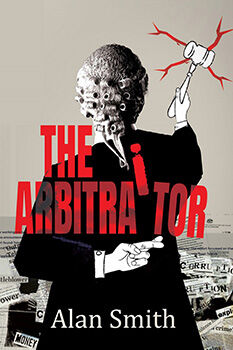 And until the Australian Government confronts what happened, the corruption that destroyed the COT Cases will remain buried beneath silence, secrecy, and institutional self‑preservation.
This deeply personal and human‑resonant narrative traces one man's extraordinary path — from a difficult schoolboyhood to a sea‑training institution, from thirty years in the Merchant Navy to sixteen years running a school‑holiday camp on Victoria’s rugged coast, and finally into the brutal arena of fighting Telstra, once Australia’s most powerful telecommunications authority. Along the way, the story exposes how Telstra — and Ericsson before them — knowingly supplied equipment unfit for purpose in rural Australia, leaving ordinary citizens to bear the cost of corporate neglect and bureaucratic indifference.
But The Arbitraitor is not only about Australia. It reveals the human cost behind decades of government and Telstra‑driven misinformation — the headlines that promised justice, the assurances that arbitration would fix ongoing telephone faults, and the reality that none of those arbitrations resolved the problems they were designed to address. For many claimants, the faults continued for years after their arbitrations had ended, long after the government declared the matter closed.
Written not for fame, but for truth, this book channels the heartbeat of those who lived through conflict, upheaval, and institutional betrayal, yet refused to surrender their humanity. It is both an intimate memoir and a universal message: protect your freedom, cherish your democracy, and never forget where you came from.
At its core, The Arbitraitor is a story of perseverance — a life shaped by oceans, by injustice, by courage, and by the unyielding belief that truth matters, even when powerful institutions conspire to bury it.
If you seek inspiration, historical insight, or a soul‑stirring account of transformation against impossible odds, this is the book that will stay with you long after the final page.
Something is radically wrong when an Australian citizen is forced to spend more than $300,000 in arbitration fees, another $100,000 in associated costs, and a further $60,000 eleven years later on a government‑sanctioned review led by two Senators—simply to uncover why the original arbitration collapsed. That level of financial devastation should have delivered truth, accountability, and resolution. Instead, it exposed something far more sinister.
Despite this enormous investment, the telephone faults that crippled my business continued to haunt the new owners. Their two legal firms wrote to me in frustration, asking why I had sold them a business that the government‑endorsed arbitration had supposedly “resolved.” The truth, now painfully clear, is that the arbitration never resolved anything. It was a façade — an official declaration of success masking a failure that was never meant to be examined.
In The Arbitraitor, which I am now preparing to withdraw and update, I revisit the moment Rupert Murdoch’s sister, Helen Handbury, and her friends became engrossed in my earlier manuscript, Ring For Justice. I had laid out compelling evidence showing that Telstra’s board knew full well that meeting any rollout deadlines was impossible. The COT cases exposed the same pattern: we continued to battle phone faults long after multiple arbitrations had supposedly “identified and rectified” the problems Telstra insisted were fixed. The reality was far darker — a pattern of systemic neglect and discrimination against ordinary customers.
During our conversation, Helen mentioned The Hon. David Hawker MP, our local parliamentary representative, noting his public acknowledgement of the chronic telephone issues in Hamilton, where he kept an office and regularly met constituents. What she didn’t know was that I was the Alan Smith to whom Mr Hawker referred constituents with ongoing phone complaints. He had told them I would take their concerns to the Senate in Canberra. In that moment, I explained Mr Hawker’s support for my work, and Helen — curious and engaged — asked how the book was progressing.
I remember the feeling: a mix of relief and urgency. I handed her a draft of the manuscript along with a bundle of Mr Hawker’s media statements. These documents captured years of struggle — my attempts to secure a functioning phone service for my holiday camp, and the broader fight to expose the truth behind Telstra’s failures. For the first time, someone connected to the highest levels of Australian media power was reading the story that Telstra and its legal teams had spent years trying to bury.
On 12 July 1993, a Portland Observer Newspaper article, 'Network Complaints Taken Up by MPs', noted:
"Problems highlighted by Cape Bridgewater Holiday Camp operator Alan Smith, with the Telecom network have been picked up on by not only other disgruntled customers but Federal politicians. Having suffered a faulty telephone service for some five years, Mr Smith's complaints had for some time fallen on deaf ears, but it now seems people are standing up and listening. Federal Member for Wannon, David Hawker, described the number of reports of faulty and inadequate telephone across Australia as alarming. Mr Hawker said that documents recently presented to him showed that the problems people had been experiencing Australia wide had been occurring repeatedly in the Portland region."(See Cape Bridgewater Chronology of Events File No -17)
The pressure on all four COT cases was immense, with TV and newspaper interviews and our continued canvassing of the Senate. The stress was telling, but I continued to push for improved rural telephone services. The Hon David Hawker MP, my local Federal member of parliament, had been corresponding with me since 26 July 1993.
"A number of people seem to be experiencing some or all of the problems which you have outlined to me. ...
"I trust that your meeting tomorrow with Senators Alston and Boswell is a profitable one."(SeeArbitrator File No/76)
A system where the powerful are compensated, and the powerless are made to pay for the privilege of being ignored.
The letters attached to Chapter 1 - Can We Fix The CAN, dated April 8 and 9, 1994, from Telstra’s group general manager to AUSTEL’s chair, demonstrate that AUSTEL (now ACMA) was not truly independent. Instead, it shows that AUSTEL could be influenced to modify their official findings in the COT report, as Telstra requested in several points in this initial letter to AUSTEL/ACMA. For example, Telstra writes:
“The Report, when commenting on the number of customers with COT-type problems, refers to a research study undertaken by Telecom at Austel’s request. The Report extrapolates from those results and infers that the number of customers so affected could be as high as 120 000. … (See Open Letter File No/11)
And the next day:
“In relation to point 4, you have agreed to withdraw the reference in the Report to the potential existence of 120,000 COT-type customers and replace it with a reference to the potential existence of “some hundreds” of COT-type customers” (See Open Letter File No/11)
Point 2.71 in AUSTEL’s April 1994 formal report notes:
“the number of Telecom customers experiencing COT type service difficulties and faults is substantially higher than Telecom’s original estimate of 50”.
It is nothing short of a treacherous betrayal for a government regulator to so drastically alter its findings, slashing the number of reported COT-type complaints from an astonishing 120,000 to a mere 50 or so. Such a flagrant misrepresentation constitutes a deep and sinister deception, undermining the public trust it claims to serve. The fact that Rupert Murdoch and FOX are rewarded amid these glaring Telstra telecommunications issues reveals a disturbing collusion that is costing Australian citizens dearly—even leading some to bankruptcy and dragging them into numerous court cases—all due to the lies perpetuated by government bureaucrats. This manipulation not only defrauds the people but also casts a long shadow over the integrity of those in power.
As you delve deeper into this narrative, you will uncover how Telstra's highly compensated legal team engaged in a disturbing pattern of lies, coercion, intimidation, and tampering with evidence. These actions were aimed at shielding a deteriorating, government-owned Telstra Corporation from accountability and scrutiny, revealing the depths to which some will go to protect corporate interests at the expense of public welfare.
Chapter 9
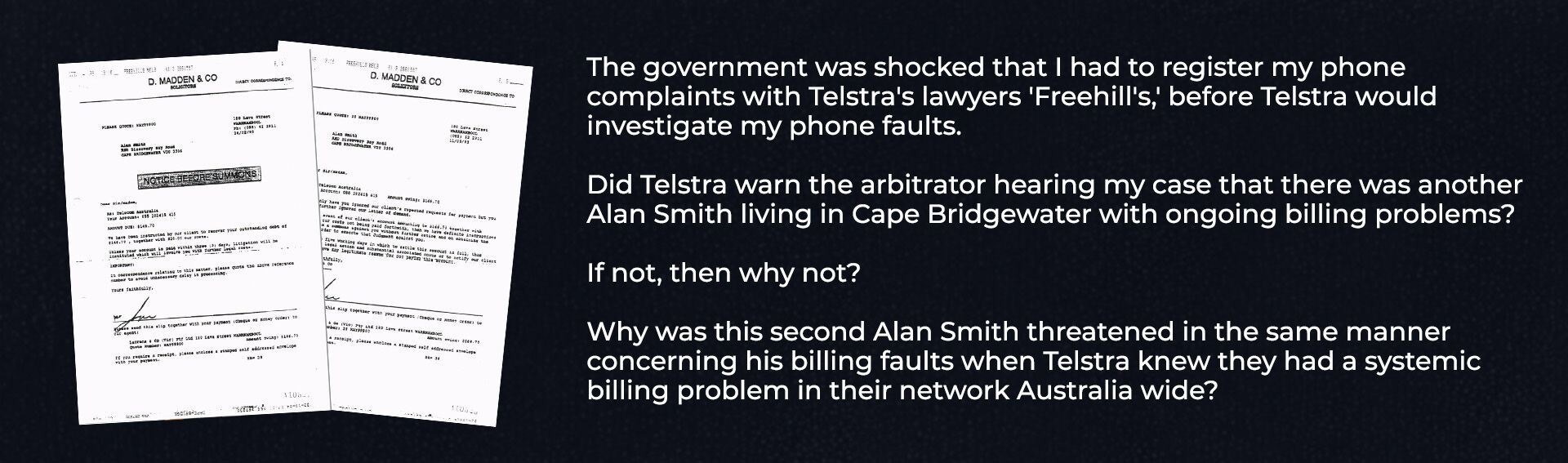
Chapter 5 Immoral - Hypocritical Conduct
When Darren and Jenny Lewise purchased my business, there were two Alan Smiths
In December 2001, after being unable to appeal my arbitration claim and, in the process, forcing Telstra and the Telecommunications Industry Ombudsman to demand that Telstra test and fix my ongoing telephonic problems, I sold the business to Darren and Jenny Lewis.
On 6 January 2003, the Hon David Hawker MP, later Speaker in the House of Representatives, wrote to me noting:
“Thank you for your correspondence received throughout December, 2002. Copies will be forwarded to the Minister for Communications and Information Technology, along with the videotape, “Phone Wiring Details at Cape Bridgewater Holiday Camp.”
Did the government bureaucrats who received this video from Mr Hawker MP pass it on to the Hon. Senator Richard Alston, the then Minister of Communications and Information Technology?
When a system can consume nearly half a million dollars, destroy a business, mislead future owners, and still leave the underlying problems untouched, as shown in Chapter 4, The New Owners Tell Their Story, there is something fundamentally, structurally, and dangerously wrong with the Australian arbitration system.
So I ask you, my readers, to consider this: do we truly live under systems that protect the vulnerable and hold the powerful to account? Or are we expected to accept corruption disguised as process, silence masquerading as resolution?
For me, the answer is clear. The COT arbitrations were neither transparent nor unbiased. They were riddled with sinister machinations. And while I continue to fight for the return of my rightful documents, I also fight for something larger: the principle that truth must never be buried, and that democracy cannot survive if corruption is allowed to flourish unchallenged.:
What unfolded during my China wheat saga in 1967, the COT events that followed in 1999, the DCITA Senators, The Honourable Helen Coonan and Barnaby Joyce, who both endorsed the government arbitration review process in 2005 - 2006, which also failed (see The eighth remedy pursued) as did the COT arbitrations twelve years prior. These were not merely a bureaucratic mishap or an administrative oversight — it was a pattern‑of‑practice corruption scheme, the kind that in the United States triggers federal investigations into public corruption, official misconduct, and colour-of-law violations, and in Britain would be recognised as misfeasance in public office, perverting the course of justice, and abuse of process.
The tactics used against us mirror those exposed in major DOJ cases and U.K. public inquiries: evidence suppression, back‑channel interference, obstruction of justice, misconduct in public office, and coordinated cover‑ups designed to shield powerful actors from accountability.
Major Fraud Group - Victoria Police investigation
Not every visitor to this website, absentjustice.com, will want to watch my 3.5-minute video, but those who do will understand why the story of the Casualties of Telstra (COT for short) needs to be shared.
All events on this website are backed by the original documents — every exhibit, every file, every damning scrap of evidence is attached at the end of this homepage (see below)
Who originally hijacked my arbitration-related BCI and SVT reports during my 1994/95 arbitration, and, just as important, who hijacked them again 14 years later, in December 2008, as they left the Portland Post Office?

Chapter 5, Immoral - Hypocritical Conduct
The letter to the Federal Magistrates Court, dated December 3, 2008, reveals a troubling narrative involving Darren and Jenny Lewis, the new owners of my business since December 2001. After years of fighting against the negligence of the TIO and Telstra—who obstinately refused to test my business telephone lines despite ongoing issues first reported in February 1988—it became clear that something far more sinister was at play.
To illustrate the involvement of some Australian government agencies, I need to take the reader back to a time before the arbitrations began. As a seafarer with thirty years of experience, I learned that putting one's knowledge forward to enhance oneself can be more detrimental to understanding the ropes than simply sitting back and observing what is happening around you. Sometimes, it’s beneficial to allow others to think they are smarter than you.
To prove this, I suggested she use her own private residence to call my business and then request the official call data from Telstra.
On 28 September 1992, Ms Amanda Davis attempted to contact my business from AUSTEL’s Queens Road office but was unable to get through. Later that evening, at approximately 8.29 pm and 8.30 pm, she attempted again from her Fitzroy residence. Both calls failed to connect. (See Exhibit 14 → AS-CAV Exhibit 1 to 47)
Telstra’s own fault‑recording system shows Ms Davis was billed for both of these non‑connected calls — despite her formal advice to Telstra that neither call connected.
Between June 1993 and December 19, 1995, AUSTEL representatives contacted me at least eight times and met with me six times, requesting that I continue sending my billing information directly to them.
And then came the threats.
Telstra threatened me, stating that if I did not report my ongoing telephone issues—specifically, my belief that my telephone lines and faxes were being intercepted—they would treat my complaints as frivolous and vexatious. Ms Phillipa Smith, from the Commonwealth Ombudsman’s office, was informed by her Directorate of Investigations, led by John Wynack, that between January and March 1994, all of my requested Freedom of Information (FOI) documents were scrutinised by Telstra due to their sensitive content. However, Telstra did not elaborate on the extent of that sensitivity (see Ms Smith's letter to Telstra demanding answers, see page 3, Exhibit 64 → AS-CAV Exhibit 48-A to 91). This information was being concealed from the arbitration process, meaning I was never meant to receive full justice in that arbitration.
Could this withheld sensitive documentation be related to my earlier disclosures to the government about what I reported regarding the Australian bureaucrats, knowingly aiding the enemy via China's backdoor?
My 3 February 1994 letter to Michael Lee, Minister for Communications (see Hacking-Julian Assange File No/27-A) and a subsequent letter from Fay Holthuyzen, assistant to the minister (see Hacking-Julian Assange File No/27-B), to Telstra’s corporate secretary, show that I was concerned that my faxes were being illegally intercepted.
An internal government memo, dated 25 February 1994, confirms that the minister advised me that the Australian Federal Police (AFP) would investigate my allegations of illegal phone/fax interception. (See Hacking-Julian Assange File No/28)
This internal, dated 25 February 1994, is a Government Memo confirming that the then-Minister for Communications and the Arts had written to advise that the Australian Federal Police (AFP) would investigate my allegations of illegal phone/fax interception. (AFP Evidence File No 4)
Not rumours. Not whispers. Direct threats from Telstra’s own senior executives, including their principal arbitration enforcer, Paul Rumble. He carried out those threats, sabotaging the integrity of my arbitration. Even after the Australian Federal Police raised concerns about those threats, the arbitrator, Dr Gordon Hughes, conducted no investigation. Not a single question was asked. Not a single file opened. It was a grift, a skim, an extortion racket masquerading as due process.
The AFP asked me 93 questions about the interception of my calls and the hacking of my arbitration documents → Australian Federal Police Investigation File No/1. My answers show something stark: Telstra threatened me for helping the AFP investigation.
At the same time, a key COT witness — Senator Bob Collins — was under investigation for serious child‑abuse allegations. Investigators seized all his office records, including documents vital to the COT phone‑fault evidence. What was destroyed or removed has never been revealed.
Were some of the seized documents about my children’s school camp — evidence that could have strengthened my arbitration case? Their disappearance casts a long, dark shadow over the integrity of the entire process.
On 21 March 1997 — twenty‑two months after my arbitration had supposedly “concluded” — John Pinnock wrote to Telstra’s Ted Benjamin (see Exhibit 596 File → AS-CAV Exhibits 589 to 647). His questions were not the routine housekeeping of an honest process. They were the kind of questions that only surface when something has gone very, very wrong:
-
Why does the witness statement of clinical psychologist Ian Joblin contain an attestation that doesn’t match the signature block?
-
And were there any alterations made to the Joblin statement originally sent to arbitrator Dr Gordon Hughes, compared to the so‑called “signed” version?
These were significant discrepancies, clear red flags indicating tampering and manipulation of evidence. The timing was critical; from my arbitration on 11 May 1995 to Pinnock’s letter on 21 March 1997, I had three years left on my statute of limitations. Had the necessary information been disclosed, the arbitration's flaws could have been revealed while I still had legal options.
For 27 years, I have written countless letters, received only fragments in return, and been denied access to documents to which I was entitled. Every request was stifled under the confidentiality agreement I signed on 21 April 1994, now misused to obscure misconduct.
Most disturbingly, Telstra’s lawyer, Maurice Wayne Condon, signed a witness statement without the psychologist's signature. This act blurred the lines of legality, showcasing a system bent by those who believe they own it.
Crucial content was omitted, including my discussion with Ian Joblin about Telstra’s notes on my conversation with former Prime Minister Malcolm Fraser. They improperly recorded our exchange and later provided a redacted version, asserting their control over the narrative.
The AFP noted my concerns, but the arbitrator ignored them. An unsigned, altered, lawyer-controlled witness statement should never have been accepted as evidence. This was a process engineered to evade scrutiny, revealing that there was no justice in the COT arbitrations — only power exercised in the shadows, devoid of accountability and democracy.
Furthermore, Senator Bill O'Chee expressed considerable concern that John Pinnock had failed to respond to his letter dated 21 March 1997 regarding a related case involving Telstra's Ted Benjamin. This lack of response led Senator O'Chee to escalate the issue by contacting Graeme Ward, who was responsible for regulatory and external affairs at Telstra, on 26 June 1998 (see File GS-CAV 293-B - GS-CAV Exhibit 258 to 323). In his letter, he stated,
"I note in your letter's last page you suggest that the matter of the alteration of documents attached to statutory declarations should be dealt with by the relevant arbitrator. I do not concur. I would be grateful if you could advise why these matters should not be referred to the relevant police."
Despite these pressing concerns, there has been no transparent resolution regarding this matter. The ramifications of Senator O'Chee's assertion—that the arbitrator was responsible for addressing unlawful conduct involving the alteration of statutory declarations—prompted investigations by the COTs. These investigations aimed to understand why Dr Gordon Hughes permitted such misconduct to take place without challenge, raising serious questions about accountability and the integrity of the arbitration process.
It is 2026, and I still have not seen a copy of the advice John Pinnock was entitled to receive from Telstra regarding the unsigned arbitration witness statement by clinical psychologist Ian Joblin. This statement involved Maurice Wayne Condon, who attested to having seen a signature on it, even though none was present.
Why was Freehill Hollingdale & Page (now trading as Herbert Smith Freehills Melbourne) allowed to be Telstra's arbitration lawyers when the COT Cases received assurances from Robin Davey, the then-Chairman of the communications regulator, AUSTEL (now known as ACMA), that Freehill Hollingdale & Page / Herbert Smith Freehills Melbourne would have no continuing involvement in our matters?
It is important to emphasise — and to emphasise without restraint — that Dr Gordon Hughes, appointed as the commercial assessor for the Fast Track Settlement Procedure (FTSP), was not a graded arbitrator. He was never the independent judicial figure the government and the TIO publicly portrayed. Neither he nor the Telecommunications Industry Ombudsman (TIO) office drafted the new Fast Track Arbitration Procedure. Their “involvement” amounted to nothing more than cosmetic tinkering — superficial edits designed to give the illusion of independence while the real power operated elsewhere.
The true authors of the arbitration agreement were Freehill Hollingdale & Page / Herbert Smith Freehills Melbourne — the very legal team the government had assured the COT Cases, three Senators, the Canberra Parliament House Press Club, and even the COT Cases’ own lawyers would have no continuing role in our matters. Yet behind closed doors, in defiance of those assurances, Telstra and Freehill secretly drafted the very rules that would govern our arbitrations.
This was not an oversight. This was not a misunderstanding. This was misleading and deceptive conduct, a crime under Section 52 of the Australian Trade Practices Act, which notes:
The arbitration agreement — supposedly drafted independently of Telstra — was in fact engineered by Telstra’s own legal arm, and the arbitrator allowed it. Dr Hughes and the TIO office accepted a Telstra‑authored blueprint for a process intended to hold Telstra accountable. They did not resist it. They did not question it. They simply rubber‑stamped it.
The draft was faxed to the TIO office on 10 January 1994, after Freehill’s / Herbert Smith Freehills Melbourne had secretly prepared it. The entire architecture of the arbitration — the rules, the procedures, the constraints, the loopholes — was built by the defendant’s lawyers and quietly handed to the arbitrator as if it were legitimate.
This was not arbitration. This was the worst possible deception.
Section 52 of the Trade Practices Act 1974 (Cth) https://shorturl.at/9lbzN made it illegal for any corporation to engage in misleading or deceptive conduct, or conduct likely to mislead or deceive, in trade or commerce. It applied broadly — not just to consumers, but also to business‑to‑business dealings — and even silence or non‑disclosure could breach the law.
It was a strict liability provision: intent didn’t matter. If the conduct misled, the corporation was liable. Victims could seek compensation for losses caused by the deception.
A process sold to the COT Cases as fair, transparent, and independent was, in reality, dictated by the very corporation Freehill Hollingdale & Page / Herbert Smith Freehills Melbourne. The arbitrator’s willingness to accept Telstra’s legal team as the de facto authors of the rules reveals a system that was never democratic, never impartial, and never intended to deliver justice.
It was a controlled environment — engineered in the shadows, protected by silence, and enforced through the authority of those who were supposed to safeguard fairness.
What unfolded next was not just troubling; it was downright sinister. Throughout my arbitration process, which dragged on from April 21, 1994, to May 11, 1995, the tainted agreement concocted by Freehill Hollingdale & Page / Herbert Smith Freehills Melbourne was also callously used in the arbitrations of Ann Garms, Maureen Gillan, and Graham Schorer. In a shocking turn of events, Dr Hughes later condemned that very arbitration document, branding it as non-credible and suggesting that urgent revisions were necessary for the remaining COT cases—namely, those of Garms, Gillan, and Schorer.
While these cases were granted a generous 13 months to amend their claims, I was left in the lurch, denied any chance to amend my claim, or given the same 13 months to review my submission. My appeal lawyers were not even made aware of Dr Hughes's pivotal letter, dated May 12, 1995 → (Open Letter File No 55-A)—until two long years after the statute of limitations had cruelly expired, effectively sealing my fate and depriving me of the means to challenge this corrupt system.
As shown in government records (see point 40, Prologue Evidence File No/2), the government wrote to Telstra on 5 October 1995 to advise that the government would be more than a little concerned if Freehill Hollingdale & Page / Herbert Smith Freehills Melbourne had any further involvement in the COT issues—two months before Freehill’s faxed the arbitration agreement that was used in our four arbitrations.
Chapter 2 - Inaccurate and Incomplete
Threats made leading up to and during my arbitration
On July 4, 1994, amidst the complexities of my arbitration proceedings, I confronted serious threats articulated by Paul Rumble, a Telstra representative on the arbitration defence team. Disturbingly, he had been covertly furnished with some of my interim claims documents by the arbitrator—a breach of protocol that occurred an entire month before the arbitrator was legally obligated to share such information. Given the gravity of the situation, my response needed to be exceptionally meticulous. I invested considerable effort in crafting this detailed letter, carefully selecting every word. In this correspondence, I made it unequivocally clear:
“I gave you my word on Friday night that I would not go running off to the Federal Police etc, I shall honour this statement, and wait for your response to the following questions I ask of Telecom below.” (File 85 - AS-CAV Exhibit 48-A to 91)
When drafting this letter, my determination was unwavering; I had no intention of submitting any additional Freedom of Information (FOI) documents to the Australian Federal Police (AFP). This decision was significantly influenced by a recent, tense phone call I received from Steve Black, another arbitration liaison officer at Telstra. During this conversation, Black issued a stern warning: should I fail to comply with the directions he and Mr Rumble gave, I would jeopardise my access to crucial documents pertaining to ongoing problems I was experiencing with my telephone service.
An intense confrontation unfolded in a heated Senate committee meeting when National Party Senator Ron Boswell delivered a fiery critique to a senior officer involved in the Telstra arbitration process. With palpable frustration, he exclaimed, “You are really a disgrace, the whole lot of you,” his voice resonating throughout the chamber. The remarks cast a shadow over the already tense atmosphere as Telstra's conduct regarding the COT Cases took centre stage.
However, the gravity of his words quickly caught the committee chair's attention, prompting a swift intervention. Under scrutiny and recognising the need for decorum in such a serious forum, Senator Boswell was compelled to offer an apology. Turning to the chairperson more measuredly, he declared, “Madam, I withdraw that remark.” This moment of accountability underscored the importance of respectful dialogue in legislative discussions and illuminated the ongoing challenges surrounding Telstra’s treatment of COT Cases, a matter of significant public interest.
“Madam, I withdraw that, but I do say this: this has got a unity ticket going right through this parliament. This has united every person in this parliament – something that no-one else has ever had the ability to do – and Telstra has done it magnificently. They have got the Labor Party, they have got the National Party, they have got the Liberal Party, they have got the Democrats and they have got the Greens – all united in a singular distrust of Telstra. You have achieved a miracle.”
💰 Discriminative Compensation: The Litmus Divide
Senator Chris Schacht made it clear to the Telstra arbitration officer that awarding compensation only to the five 'litmus' COT test cases—while ignoring the unresolved claims of the remaining sixteen—would be a grave injustice. Yet the John Howard-led National Liberal Party government sanctioned punitive damages solely for those five, and released over 150,000 Freedom of Information documents that had been concealed during their arbitrations from 1994 to 1998.
Those five individuals received a combined $18 million. That sum should have been divided equally among all twenty-one unresolved COT Cases. It was not.
Will I go to jail in 2026 for revealing this grossly discriminatory act by the Australian government against sixteen fellow citizens? I believe the current Labor government—if they appointed a representative to view the In-Camera Hansards of 6 and 9 July 1998—would be morally compelled to act. As Senator Schacht stated in 1998, compensation should have been extended to all. Sadly, at least three of those sixteen have since passed away.
This introduction is not the story. It is only the doorway. The real story begins in the exhibits themselves — in the raw, unfiltered evidence of a government process that turned predatory, a regulator that abandoned its duty, and an arbitration scheme that became a weapon instead of a remedy.
Keep reading. The truth is all here — and it’s uglier than anyone would believe without the documents to prove it.
Lane, in collaboration with the arbitrator, evaluated documentation related to the COT Cases arbitration claims against Ericsson's AXE telecommunications equipment used in Telstra's telephone exchanges across Australia. This documentation had already revealed the poor services provided by Ericsson to Telstra, which was at the centre of the scandal that led to the arbitration of the COT Cases.
On 24 February 1994, I presented my evidence regarding this matter to the Australian Senate through the then Shadow Minister for Communications, Senator Richard Alston. Evidence related to this is attached to file 10-C → Evidence File No/10-A to 10-f, which documents Senator Alston addressing the AXE issue in a motion he proposed for the Senate to answer 'on notice'.
Yet, in a calculated move, this critical information from Ericsson was systematically withheld from the COT cases throughout their arbitration process. In my experience, this troubling information was also conveniently ignored during the two Freedom of Information (FOI) requests I submitted regarding the Ericsson AXE, which were reviewed by the Administrative Appeals Tribunal in October 2008 (No V2008/1836) and May 2011 (No 2010/4634).
Throughout this ordeal, Telstra and Ericsson engaged in a covert, strategic collaboration, meticulously controlling the narrative of the COT arbitrations. They selectively decided what to disclose and what to keep secret, creating a web of deception that not only undermined the arbitration process but also betrayed more than 120,000 Australian citizens experiencing ongoing telephone issues, as shown in the attachment → Chapter 1 - Can We Fix The CAN.
As you delve deeper into this narrative, you will uncover how Telstra's highly compensated legal team engaged in a disturbing pattern of lies, coercion, intimidation, and tampering with evidence. These actions were aimed at shielding a deteriorating, government-owned Telstra Corporation from accountability and scrutiny, revealing the depths to which some will go to protect corporate interests at the expense of public welfare.
Last month in Victoria, Australia, the High Court struck out Part 12 of the Victorian Electoral Act. This leaves a significant vacuum, as there is no ban on foreign donations, no reporting obligations around political donations and campaign expenditure, and just seven months until a state election.
To complicate matters, Ericsson was later accused of operating in territories controlled by ISIS in Iraq. This shocking revelation should have prompted a thorough and urgent investigation into the allegations against Ericsson and Telstra in the COT Cases. However, despite the gravity of the situation, no such investigation took place, highlighting corruption and negligence.
Adding insult to injury, I am still waiting for my arbitration claim documents related to Ericsson. I paid over $25,000 to George Close & Associates for the preparation of my technical arbitration submission, yet I have not received these documents.
Australian bureaucrats have a long history of placing blind faith in foreign contractors whose conduct later collapses under scrutiny. This pattern is not new. It stretches from the Telstra–Ericsson era of the 1990s to the AUKUS submarine deal now reshaping Australia's strategic future. The names change, the stakes grow, but the underlying behaviour—secrecy, deference, and a refusal to confront uncomfortable truths—remains constant.
In recent years, global investigations have exposed Ericsson for conduct that would have ended most companies outright. The Ericsson List, released by the International Consortium of Investigative Journalists (see below), revealed that the company operated in ISIS-controlled areas of Iraq, paid intermediaries to move equipment through ISIS checkpoints, and made tens of millions of dollars in suspicious payments across the Middle East. These revelations did not come from rumour or political spin; they came from leaked internal documents, whistleblowers, and regulatory probes that forced Ericsson to admit what it had concealed for years.
This is the same Ericsson—a multinational telecommunications corporation headquartered in Sweden—whose equipment faults were at the centre of the COT arbitrations. The same Ericsson whose AXE exchanges were malfunctioning across regional Australia. And the same Ericsson that quietly acquired Lane Telecommunications, the very consultancy appointed by the Australian Government to assess the technical faults raised by the COT Cases. The investigator became the investigated, and Canberra allowed it to happen without intervention, review, or public disclosure.
The parallel is not that AUKUS involves terrorism—it does not. The parallel is structural: a government culture that defers to foreign partners, suppresses scrutiny, and treats transparency as an inconvenience rather than a duty.
In the 1990s, that culture allowed a Swedish corporation to influence an arbitration process formally endorsed by the Australian Government, even though Ericsson was a central party to the dispute. The conflict of interest was so blatant that it would have been laughed out of any fair tribunal. Yet Australian bureaucrats accepted it without protest, without inquiry, and without a single safeguard for the citizens whose livelihoods depended on the truth.
Three decades later, the consequences of that deference still echo. The COT Cases continue to face institutional resistance, reputational damage, and bureaucratic stonewalling—not because their claims were unfounded, but because the system that judged them was compromised at its core. When a foreign supplier can absorb the government's own arbitration consultant mid-process and the government shrugs, the outcome is predetermined.
Today, the same culture allows the largest defence procurement in Australian history—the AUKUS nuclear-powered submarine program—to proceed with minimal public oversight, shifting timelines, escalating costs, and a near-total reliance on the industrial capacity of the United States and the United Kingdom. Once again, Australia is asked to trust foreign partners without demanding transparency, accountability, or sovereign control.
The lesson is simple, and it is the same one the COT Cases learned the hard way: when governments place blind trust in powerful foreign contractors, the public pays the price—in truth, in sovereignty, and in the integrity of national institutions.
Freehill Hollingdale & Page (now trading as Herbert Smith Freehills Melbourne
The Camp was profoundly reliant on phone communication. It was our vital link to city dwellers eager to connect with our services. One of our most significant oversights—blinded by the charm of this coastal haven—was failing to investigate the existing telephone system. At the time, mobile coverage was virtually nonexistent, and business was conducted through traditional means—not online, and certainly not by email.
We soon discovered we were tethered to an antiquated telephone exchange, installed more than 30 years earlier and designed specifically for 'low-call-rate' areas. This outdated, unstaffed exchange had a pitiful capacity of just eight lines.
• My fight began simply: to secure a working phone service.• Despite compensation promises, the faults persisted. I sold my business in 2002, but the new owners suffered the same fate.• Other small business owners joined me—we became known as the Casualties of Telecom.• All we ever asked: acknowledgement, repair, and fair compensation. A working phone—was that too much?
During a typical week, the picturesque Cape Bridgewater was home to 66 residential families—not including those who used their coastal retreats to escape the bustle of city life. This created a significant challenge, especially considering many of these families had children.
The eight service lines struggled to support a growing census of 130 adults and children. By the time a modern Remote Control Module (RCM) was finally installed in August 1991, twelve children had been added to the mix, bringing the total population to 144. However, various weekend visitors often brought that figure to 180 or more.
The Hidden Cost of Cape Bridgewater’s Failing Lines
No wonder I was financially broken by the end of 1988—barely a year after taking over the business in late 1987. The reality was brutal: Cape Bridgewater’s telecommunications setup was catastrophically inadequate.
In stark terms, if just four of the 144 residences were making or receiving calls, only four lines remained for the other 140 residents. That’s not just poor planning—it’s a systemic failure. My business was strangled by a network that couldn’t support even the most basic communication needs. Every missed call was a missed opportunity. Every dropped connection was another nail in the coffin of a venture I had poured everything into.
We stepped into this complex landscape of limited connectivity and coastal beauty with ambition and optimism. The Camp was more than a business—it was a dream made real. A serene retreat where the stress of city life could dissolve into the ocean mist. However, as we quickly learned, dreams require infrastructure to thrive.
Our phone lines became both our lifeline and our most significant obstacle. Booking inquiries, supply orders, emergency calls—even simple conversations with clients—all had to pass through those eight fragile channels. During peak times, the lines were constantly engaged. Guests complained they couldn’t reach us. Suppliers missed confirmations. Opportunities slipped through our fingers like sand.
In the meantime, I struggled to keep focus on what COT was pushing for: a Senate Inquiry into Telstra’s unethical treatment of our small group of claimants — which we finally achieved in 1997. A letter of support for the Senate Inquiry from a worker at D. Madden & Co of Warrnambool (Lawyers), dated 10 November 1993, gave me added heart to fight on. (My name had been passed to Madden & Co by Mr David Hawker, the local Member of Parliament, with regard to a public meeting COT was organising.)
I am writing in reference to the proposed Senate Committee Investigation into Telstra.
As you are aware, I am employed as a telephonist with a large legal firm in Warrnambool. In the course of my employment, and particularly during the months of July and August this year, numerous service faults have been brought to my attention. These problems include:
1. Calls being disconnected during conversation.
2. Recorded messages informing Melbourne clients and callers that the number has been disconnected when the correct number was dialled.
3. An engaged signal received by callers despite a number of lines being available.
4. Complaints from callers that the line has rung out when no ringing tone has been received at the number dialled.
Our firm duly contacted Telstra on a number of occasions in an effort to have these fault rectified. However, Telstra technicians were constantly unable to identify the numerous problems and subsequently remedy our complaints.
On 12 November 1993, I faxed a copy of this letter to Telstra’s solicitors, together with more information on incorrect charging, in the course of which having occasion to write to the Collins Street solicitors:
On trying to fax you the information you received this morning I had quite some difficulty in getting all the pages through at a given time. Note the page errors which I have enclosed.
On 27 January 1999, after having also read my first attempt at writing my manuscript absentjustice.com, Senator Kim Carr wrote:
During Helen Handbury's second stay at my Cape Bridgewater Holiday Camp, after reading the manuscript that forms the basis of this website , she declared, "I will get my brother Rupert Murdoch to publish this book. He would be astounded that you COT Cases were forced to pay for an arbitration process before Telstra would fix your long-outstanding phone problems." As a local identity, Helen was fully aware that these unresolved issues were severely impacting other businesses in the area, including mine.
Helen and her husband Geoffrey were not distant philanthropists; they were deeply committed to our region. Their sizable donation to the construction of the Cape Bridgewater Life Saving Club rooms on the beach stands as proof of their commitment. They understood the lifeblood of small coastal communities — and they recognised how Telstra's negligence was strangling them.
After Helen's unfortunate death from breast cancer, Geoff Handbury wrote to me in a beautifully handwritten letter, explaining that his age had prevented him from following up on my story with Rupert. Even so, his letter carried the same sincerity and local loyalty that he and Helen had always shown.
The COT Cases reveal a chilling picture of betrayal and corruption, involving 12 brave Australians who fell victim to a treacherous and rigged arbitration process orchestrated by Telstra. These individuals were ruthlessly coerced into paying hundreds of thousands of dollars in arbitration fees, desperate to prove that Telstra had systematically failed to honour its contractual commitments. Under the guise of an agreement brokered by AUSTEL (now ACMA), Telstra had promised that, provided the COT Cases funded their arbitrations, no final ruling would be issued until all faults plaguing their businesses had been rectified.
Yet, in a shocking display of duplicity, Telstra failed to meet this obligation. Despite the overwhelming evidence of their negligence, the arbitrator shamefully sided with Telstra, absurdly claiming the faults had been repaired when, in reality, nothing had changed. This betrayal left the affected individuals reeling in disbelief.
At the same time, Telstra’s consistent disregard for its obligations to Fox during the dismal cable rollout created a grotesque irony: Fox was awarded a staggering $400 million due to Telstra’s utter failure to uphold its commitments. This scenario lays bare the insidious discrimination and injustice embedded within the corporate machinery, revealing a system rigged against those who simply sought fairness and accountability.
The stress was telling by now, but I continued to hammer for a change in rural telephone services. The Hon David Hawker MP, my local Federal member of parliament, has been corresponding with me since 26 July 1993.
“A number of people seem to be experiencing some or all of the problems which you have outlined to me. …
“I trust that your meeting tomorrow with Senators Alston and Boswell is a profitable one.” (See Arbitrator File No/76)
The Honourable David Hawker MP, my local Federal Member of Parliament, communicated with me from 26 July 1993 until September 2007. During this time, I provided evidence to three government entities showing that not all of my faxes were being received at their intended destinations. On 17 May 2007, the then Minister for Communications, the Honourable Senator Helen Coonan, wrote to me regarding this issue. I also copied this correspondence to the Honourable David Hawker, Speaker of the House of Representatives.
“I have now made both formal and informal representations to Telstra on behalf of the CoTs. However, Telstra’s position remains that this is a matter most appropriately dealt with through a Court process. Telstra is not prepared to undertake an alternate means of pursuing this matter. …
“I also appreciate the depth of feeling regarding the matter and suggest you consider whether court proceedings may be your ultimate option.” (See DCITA Evidence File 6)
Surely it was Senator Coonan’s responsibility, as the Minister for Communications, Information Technology and the Arts, to initiate an official enquiry into WHY, both during and after the COT arbitrations, Telstra continued to intercept in-confidence documents leaving my office (or residence), AND the offices of various government Parliament House offices AND the Commonwealth Ombudsman’s office?
In July 2005, Senator Barnaby Joyce, who is now with the One Nation party in 2026, reviewed my interception evidence in the presence of fourteen witnesses. He assured the thirteen witnesses and me that he would ensure the John Howard government would investigate these matters and reach a conclusion before he cast his critical vote in the Senate to pass the final legislation regarding the sale of Telstra.
Before I signed off on the government review process, I wrote two letters to the government bureaucrats who were informed, along with The Hon. David Hawker MP, Speaker of the House of Representatives, and Senator Joyce, that they would conduct this investigation.
In my letter dated 10 March 2006 to Liz Forman, one of the government assessors appointed to evaluate my privacy concerns and my claims that Telstra had obstructed justice during my arbitration in 1994/95, I stated that:
"Although you have stated in your letter that “...the assessment process will not extend to an examination of whether the law was broken by Telstra....” I have been advised that it is mandatory, under Commonwealth law, for DCITA and/or the Minister to notify the Attorney General of any unlawful activities they may uncover during official department investigations". (Refer to exhibit AS 614 File AS-CAV Exhibits 589 to 647
17 March 2006: On 17 March 2006, David Lever, Manager, Consumer Section, Telecommunications Division (a further government bureaucrat) wrote to me in response to my letter to Ms Forman, noting:
"Thank you for your letter of 10 March 2006 to Ms Forman concerning the independent assessment process. If the material you have provided to the Department as part of the independent assessment process indicates that Telstra or its employees have committed criminal offences in connection with your arbitration, we will refer the matter to the relevant authority". (Refer to exhibt AS 657 File AS-CAV Exhibits 648-a to 700

Universal Declaration of Human Rights
It is now 2026, and the government has still not disclosed to me why Telstra senior management has not been brought to account for authorising this intrusion into my business and private life, regardless of Article 12 of the Universal Declaration of Human Rights stating:
"No one shall be subjected to arbitrary interference with his privacy, family, home or correspondence, nor to attacks upon his honour and reputation. Everyone has the right to the protection of the law against such interference or attacks."
On 18 August 1993, The Hon. David Hawker MP wrote to me again, noting:
“Further to your conversations with my electorate staff last week and today I am enclosing a copy of the correspondence I have received from Mr Harvey Parker, Group Managing Director of Commercial and Consumer division of Telecom.
“I wrote to him outlining the problems of a number of Telecom customers in the Western Districts, including the extensive problems you have been experiencing.” (Arbitrator File No/77)
One of these letters, dated 23 August 1993, is particularly interesting. It came from a company of Insurance Loss Adjusters in Ballarat, a rural city in Victoria. It was sent to the producer of “Real Life”, a TV current affairs program then broadcast on Channel 7. The Loss Adjusters wrote: “Re Problems with Telstra.”
"I have watched with interest the shorts leading up to tonight’s program as I have similar problems to the man at Cape Bridgewater.
Our office is located in Ballarat and due to Telecom structure the majority of our local calls are STD-fee based. (STD calls are charged per time)
On many occasions we have been unable to get through to numbers we have dialled, often receiving the message “this number is not connected” or similar messages which we know to be untrue.
Clients report that they often receive the engaged signal when calling us, and a review of the office reveals that at least one of our lines was free at the relevant time.
We have just received our latest Telecom bill, which in total is up about 25% – 30% on the last bill. This is odd because our work load in the billing period was down by about 25% and we have one staff member less than the previous billing period.” (AS 1008)
In the first twelve months of 1993, I received another eleven written complaints about Ballarat tourists and single club patrons who, like Loretto College, had problems connecting to my holiday camp, which I also provided to Helen Hanbury when she commenced reading my manuscript
Chapter 1- Prior to Arbitration
TIO Evidence File No 3-A is an internal Telstra email (FOI folio A05993) dated 10 November 1993 from Chris Vonwiller to Telstra’s corporate secretary Jim Holmes, CEO Frank Blount, group general manager of commercial Ian Campbell and other important members of the then-government-owned corporation. The subject is Warwick Smith – COT cases, and it is marked as CONFIDENTIAL:
Exhibit TIO Evidence File No 3-A confirms that two weeks before the TIO was officially appointed as the administrator of the Fast Track Settlement Proposal (FTSP), which became the Fast-Track Arbitration Procedure (FTAP), he provided the soon-to-be defendants (Telstra) with privileged, government party room information about the COT cases. Thus, the TIO breached his duty of care to the COT claimants and compromised his future position as the official independent administrator of the process.
It is highly likely the advice the TIO gave to Telstra’s senior executive, in confidence (that Senator Ron Boswell’s National Party Room was not keen on holding a Senate enquiry), later prompted Telstra to have the FTSP non-legalistic commercial assessment process turned into Telstra’s preferred legalistic arbitration procedure, because they now had inside government privileged information: there was no longer a significant threat of a Senate enquiry.
The following story illustrates that, in my case and in several others, the phone faults that led us to arbitration did not resolve our ongoing issues until years after the arbitrations concluded. It appears that both Telstra and, as it turns out, some individuals who initiated these arbitrations permitted the defendant to intercept telephone conversations and relevant faxes during the proceedings. Furthermore, they allowed Telstra to attend regular monthly meetings of the Telecommunications Industry Ombudsman board and council, where the progress of the arbitrations was discussed.
“Telecom will also make available to the arbitrator a summarised list of information which is available, some of which may be relevant to the arbitration. This information will be available for the resource unit to peruse. If the resource unit forms the view that this information should be provided to the arbitrator, then Telecom would accede to this request.”
The statement in Mr Black’s letter, “If the resource unit forms the view that this information should be provided to the arbitrator”, confirms both Warwick Smith and Mr Black were fully aware that the TIO-appointed Resource Unit, Ferrier Hodgson Corporate Advisory, were secretly assigned to vet most, if not all, the arbitration procedural documents en route to the arbitrator. If FHCA decided a particular document was not relevant to the arbitration process, it would not be passed to Dr Gordon Hughes (the arbitrator) or the other parties. (Refer to File 590 → AS-CAV Exhibits 589 to 647)
Page 5 of the Commercial Arbitration Act 1984, under Part 11 – Appointment of Arbitrators and Umpires states:-
(6) Presumption of single arbitrator
“An arbitration agreement shall be taken to provide for the appointment of a single arbitrator unless –
(a) the agreement otherwise provides; or
(b) the parties otherwise agree in writing.” ( Refer to File 193-B GS-CAV Exhibit 155 to 215)
The FTAP agreement, signed by Ann Garms, Maureen Gillan, Graham Schorer, and me, was signed between 8 and 21 April 1994, and mentions only one arbitrator.
Simply put, I, and possibly the other COT Cases, were secretly denied our legal right to challenge any of Telstra's arbitration submissions that the arbitrator might have deemed important if he had received them under the agreed arbitration agreement (rules). The fact that the following Exhibit file 45-H → (see Open letter File No/45-H) shows FHCA advising the arbitrator, Dr Hughes, on 2 August 1996, fifteen months after the conclusion of my arbitration, that at least five relevant 008/1800 billing documents between the government, Telstra and the Dr Hughes had been concealed under this secret arrangement confirms just how unremocratic the arbitration process was.
This undemocratic government's endorsement of the COT arbitration has cost me, my partner, Cathy, the COT Cases, and their partners 30 productive years, since 1994, fighting this monster → Absent Justice Part 2 - Chapter 14 - Was it Legal or Illegal?
“the time frames set in the original Arbitration Agreement were, with the benefit of hindsight, optimistic;
“in particular; we did not allow sufficient time in the Arbitration Agreement for inevitable delays associated with the production of documents, obtaining further particulars and the preparation of technical reports; …
“In summary, it is my view that if the process is to remain credible, it is necessary to contemplate a time frame for completion which is longer than presently contained in the Arbitration Agreement.”
"There are some other procedural difficulties which revealed themselves during the Smith arbitration and which I would like to discuss with you when I return." (Open Letter File No 55-A)
Two weeks after Dr Hughes returned from Greece, where he presented a legal paper, he and John Pinnock, the newly appointed second administrator for the COT arbitrations, allowed the three remaining COT cases—Ann Garms, Maureen Gillan, and Graham Schorer—to amend their submissions and extend their arbitration for an additional thirteen months. This extension was granted despite the fact that all four of us, including myself, had signed our arbitration agreements in April 1994. The amendment was permitted due to deficiencies in the original agreement. When my lawyers requested documentation explaining why these three claimants were allowed to amend their claims while I was not, we received no satisfactory response, especially considering that we all signed the same agreement.
In his chilling letter dated January 10, 1996, Pinnock coldly dismissed my request for these arbitration records, writing:
"I refer to your letter dated December 31, 1996, in which you seek access to various correspondence held by the TIO concerning the Fast Track Arbitration Procedure. … I do not propose to provide you with copies of any documents held by this office". (Open Letter File No 57-C)
Between 18 October 1995 and 4 October 1997, I sought assistance from Mr John Wynack, the Director of Investigations for the Commonwealth Ombudsman, to obtain a copy of Telstra’s arbitration file under the Freedom of Information (FOI) Act. This request was prompted by Dr Hughes' office refusing to provide the information I sought, despite it being only weeks after the conclusion of my arbitration, during which I could have challenged Dr Hughes. According to (Home Page File No/82), Mr Wynack did not believe Telstra's claim that it had destroyed my arbitration file.
Furthermore, Dr Gordon Hughes allowed his wife's good name to help him and John Pinnock deflect Laurie James, the President of the Institute of Arbitrators Australia, from investigating Dr Hughes' conduct regarding my case.
It is crucial for all newcomers to absentjustice.com to understand the dark underbelly of the Casualties of Telstra story. For those looking to delve deeper into this web of deception, a far more disturbing account is available for purchase online at promoteyourstory.com.au. However, for a chilling overview, stay right here on our homepage. This gripping summary forces you to confront the shocking truths, unveiling the shadowy players, the hidden payments, and the relentless injustices endured by the COT cases during their government-sanctioned arbitration and mediation.
As you delve into the countless individual exhibit files, you'll encounter irrefutable evidence that this story is no mere fabrication. Prepare yourself for a narrative so unbelievable that you might struggle to accept its truth—if not for the damning proof contained in our downloadable files. The magnitude of the corruption is staggering, and thousands have been ensnared in this devastating tale. Brace yourself; you're about to uncover a corruption saga that will leave you questioning the very foundations of justice.
Who originally hijacked my 1994 arbitration-related BCI and SVT reports, and just as important, who hijacked them again 14 years later in December 2008?
Chapter 5 Immoral - Hypocritical Conduct"
The letter to the Federal Magistrates Court, dated December 3, 2008, reveals a troubling narrative involving Darren and Jenny Lewis, the new owners of my business since December 2001. After years of fighting against the negligence of the TIO and Telstra—who obstinately refused to test my business telephone lines despite ongoing issues first reported in February 1988—it became clear that something far more sinister was at play.
The arbitration process I underwent in 1994 was supposed to bring resolution, yet critical documents, notably the BCI and SVT test results for the Cape Bridgewater telephone exchange, vanished without a trace. Fast forward to 2008: copies of those very same results mysteriously disappeared again while being shipped to the Federal Court by the new owners.
“I still stand by my statutory declaration that I was able to identify that the incoming faxes provided to me for review had at some stage been received by a secondary fax machine and then retransmitted, this was done by identifying the dual time stamps on the faxes provided.” (Front Page Part One File No/14)
It is clear from exhibits 646 and 647 (see AS-CAV Exhibits 589 to 647) that Telstra admitted in writing to the Australian Federal Police on 14 April 1994 that my private and business telephone conversations were listened to and recorded over several months, but only when a particular officer was on duty.
Does Telstra expect the AFP to accept that, every time this officer left the Portland telephone exchange, the alarm bell set to broadcast my telephone conversations throughout the exchange was turned off? What was the point of setting up equipment connected to my telephone lines that only operated when this person was on duty? When I asked Telstra under the FOI Act during my arbitration to supply me with all the detailed data obtained from this special equipment set up for this specially assigned Portland technician, that data was not made available during my 1994/95 arbitration and has still not been made available in 2026.
No government agency or government‑owned corporation can legally intercept your phone calls or faxes simply because you are suing them. Intercepting private communications to gain an advantage in a civil dispute is a criminal offence under Australian law. The Telecommunications (Interception and Access) Act 1979 makes it illegal for anyone — including government bodies — to listen to, record, or access telephone or fax communications without a warrant or the consent of the parties involved. There are no special exemptions for civil litigation. Interception is permitted only in tightly defined circumstances involving serious criminal matters or national security, and even then, only with judicial oversight. A government‑owned corporation cannot lawfully monitor a citizen’s communications to protect itself in a lawsuit.
The AFP suspected that Telstra was copying arbitration-related information from the documents I had faxed.
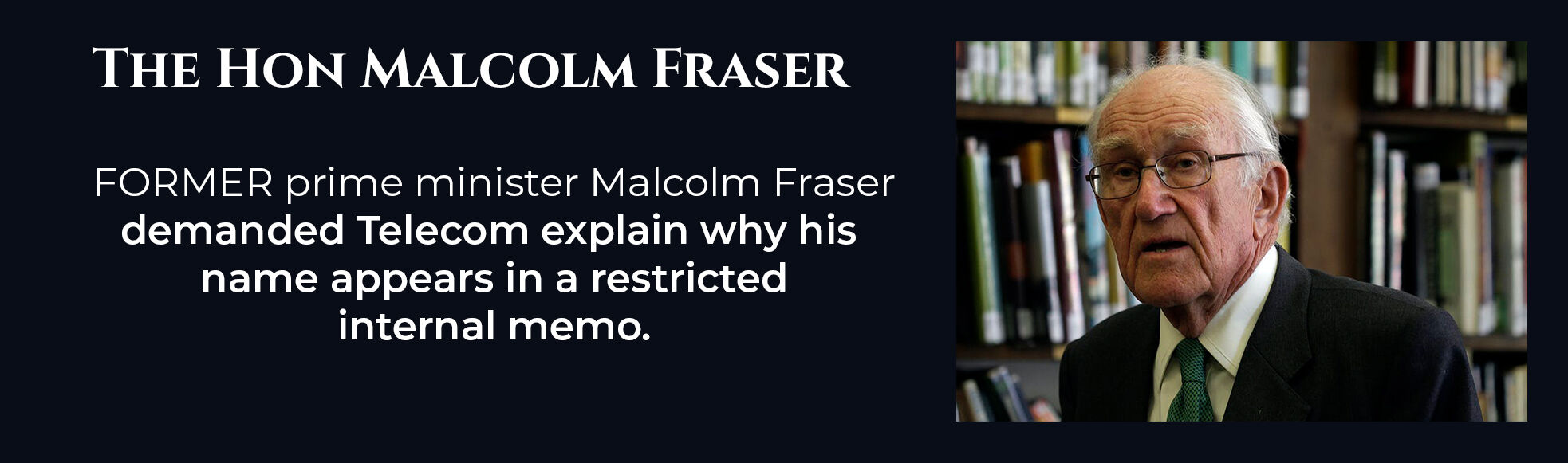
During my first meetings with the AFP, I provided Superintendent Detective Sergeant Jeff Penrose with two Australian newspaper articles concerning two separate telephone conversations with The Hon. Malcolm Fraser, former prime minister of Australia. Mr Fraser reported to the media only what he thought was necessary concerning our telephone conversation, as recorded below:
“FORMER prime minister Malcolm Fraser yesterday demanded Telecom explain why his name appears in a restricted internal memo.
“Mr Fraser’s request follows the release of a damning government report this week which criticised Telecom for recording conversations without customer permission.
“Mr Fraser said Mr Alan Smith, of the Cape Bridgewater Holiday Camp near Portland, phoned him early last year seeking advice on a long-running dispute with Telecom which Mr Fraser could not help.”
During the second interview conducted by the Australian Federal Police (AFP) at my business on 26 September 1994, I provided comprehensive responses to 93 questions about unauthorised surveillance and the threats I encountered from Telstra. Pages 12 and 13 of the Australian Federal Police Investigation File No/1, transcripts of their second interview with me during my arbitration, extensively address the threats issued by Telstra's arbitration liaison officer, Paul Rumble, and the unlawful interception of my telecommunications and arbitration-related faxes.
It is noteworthy that Paul Rumble and the arbitrator worked collaboratively. Dr Gordon Hughes supplied Mr Rumble with my arbitration submission materials five months before Telstra should have received them, in accordance with the terms of my arbitration agreement. On 15 June 1994, Dr Hughes also released to Telstra six interception documents, which the AFP had strictly advised me with that advice being relayed to Dr Hughes, that were under no circumstances to be released to Telstra while Telstra was still under investigation into how they acquired my business records going back to September 1992 through to April 1994.
Exhibit 13-H → Burying The Evidence File 13-H is the letter dated August 4, 1998 and attached to it is also exhibited as (13-H) a statutory declaration from Mr Schorer to me, which detailed a phone conversation he had with the arbitrator Dr Gordon Hughes during the 1994 arbitrations concerning lost Telstra COT-related faxes. My arbitration had been over for three years, and it was revealed during a pending appeal that 41 of my faxes during my 13-month arbitration were not on the arbitrator's schedule of received documents, even though my fax billing account showed they had been sent. Mr Schorer alerted the Senate to this, as did Dr Hughes, and it was Dr Hughes' response that gave us hope that we could have these lost arbitration fax matters investigated. During that conversation, Mr Schorer had with Dr Hughes, Dr Hughes explained to Graham Schorer in detail that:
"Hunt & Hunt (The company's) Australian Head Office was located in Sydney, and (the company) is a member of an international association of law firms. Due to overseas time zone differences, at close of business, Melbourne's incoming facsimiles are night switched to automatically divert to Hunt & Hunt Sydney office where someone is always on duty. There are occasions on the opening of the Melbourne office, the person responsible for cancelling the night switching of incoming faxes from the Melbourne office to the Sydney Office, has failed to cancel the automatic diversion of incoming facsimiles." Burying The Evidence File 13-H.
Dr Hughes’s failure to disclose the faxing issues to the Australian Federal Police during my arbitration is deeply concerning. The AFP was investigating the interception of my faxes to the arbitrator's office. Yet, this crucial matter was a significant aspect of my claim that Dr Hughes chose not to address in his award or mention in any of his findings. The loss of essential arbitration documents throughout the COT Cases is a serious indictment of the process.
I am prepared to make myself available to any professional negotiator or interrogator to shed light on the dubious events that transpired during the Victoria Police Major Fraud Group investigation from 1998 to 2001. This investigation examined the alleged fraudulent actions Telstra perpetrated against COT Cases, specifically Ann Garms, Ralph Bova, Ross Plowman, and Graham Schorer. As a summoned witness, my role revealed the layers of deceit surrounding this case.
I provided Mr Neil Jepson, the Barrister for the Major Fraud Group, with four mini-arbitration reports. These documents, crafted by Ann Garms and addressed to Dr Hughes, had been faxed to the arbitrator's office by me and were more than mere reports; they were tools of manipulation. Each mini-report bore the name "Garms" in bold black, leading viewers to believe it was her property alone. In truth, some pages were mine, intermingled with hers, artfully designed to create a false narrative.
Mr Jepson considered an alternative explanation: that the mix-up might have occurred in Dr Hughes' Sydney office, which he agreed had faxing problems. This raised the question of whether there was another reason our two separate faxes (mini-reports) were stapled together.
The reports were stapled together to suggest a coherent order, yet they actually served as a smokescreen, obscuring their incongruous organisation. This was a calculated move to insinuate that all materials originated with Ann Garms, even though they had been returned to me in August 1995, three months after my arbitration concluded on May 11, 1995. Curiously, Ann Garms was still entangled in arbitration a full ten months later, raising the question of why her documents were returned to me.
Regardless of the specific actions taken by individuals in either Sydney or Melbourne, it is important to note that the faxes in question had to be sent back from Sydney via the fax machine, as the nature of transmission via Telstra's network meant they could not have been stapled together before being sent.
Furthermore, Ann Garms highlighted these same documents to Mr Jepson as damning evidence that the faxes exchanged with Dr Hughes' office were never comprehensively reviewed. Dr Hughes, managing eight arbitrations simultaneously, made no effort to address the glaring issue that we, the COT Cases, had serious doubts about the reception of our critical documents. It appeared as though a conspiracy was at play, designed to obscure the truth. I also provided copies of these four faxed documents to Wally Rothwell, Deputy TIO, in 1998, at the exact time they were delivered to the Major Fraud Group, thereby further entrenching the web of deceit surrounding this entire affair.
Although I have addressed this, Peter Costello's issue at the beginning of this homepage, it was important to link it again to another security being discussed below.
The evidence within this report Open Letter File No/12 and File No/13) also indicated that one of my faxes sent to Federal Treasurer Peter Costello was similarly intercepted, i.e.,
Exhibit 10-C → File No/13 in the Scandrett & Associates report Pty Ltd fax interception report (refer to (Open Letter File No/12 and File No/13) confirms my letter of 2 November 1998 to the Hon Peter Costello Australia's then Federal Treasure was intercepted scanned before being redirected to his office. These intercepted documents to government officials were not isolated events, which, in my case, continued throughout my arbitration, which began on 21 April 1994 and concluded on 11 May 1995. Exhibit 10-C File No/13 shows this fax hacking continued until at least 2 November 1998, more than three years after the conclusion of my arbitration.
This 2 November 1998 fax example to the Hon. Peter Costello, which I provided to Mr Neil Jepson, shows had been intercepted before being redirected to his office. These were not minor administrative losses — they were deliberate obstructions. Mr Jepson’s office would never have known that similar documents I had faxed to his office were not redirected and went missing; he would have been unaware of this unless I had followed up by phone to discuss the content of the information I had just faxed, which had not arrived. The material concerned was associated with the nationwide 1800 billing rort, a fraud that affected every Australian using a so‑called “free call” service. The seriousness of that issue unsettled Mr Jepson and, I have no doubt, Detective Sergeant Rod Kuris as well.
Mr Ron Kuris was also assisting us in understanding the fraudulent documents at the centre of the investigation. Instead, the situation deteriorated further when former Telstra security officer Des Direen disclosed that electronic surveillance was being conducted on us. Kuris was visibly shaken by this revelation. His reaction confirmed what was already becoming clear: the investigative environment was compromised, and the system tasked with delivering justice was instead operating under a cloud of internal corruption and concealed misconduct.
The witness statement that follows lays this reality bare.
"I can recall that during the period 2000/2001, I had arranged to meet Detective Sergeant Rod KURIS from the Victoria Police Major Fraud Squad at the foyer of Casselden Place, 2 Lonsdale Street, Melbourne. At the time, I was assisting Rod with the investigation into alleged illegal activities against the COT Cases.
Rod then stated that he wanted me to follow him to the left side of the foyer. When we did this he then directed my attention to a male person seated on a sofa opposite our seat. He then told me that the person had been following him around the city all morning. At this stage Rod was becoming visibly upset and I had to calm him down. Rod kept on saying that he couldn't believe in what was happening to him. I had to again calm him down".
On the same day referenced in that statement, Ann Garms travelled to Melbourne carrying evidence showing that her faxes to me — sent while she was staying at Crown Casino during her court action against Telstra — had also been intercepted. This was the same type of evidence I had already provided to Wally Rothwell, Deputy TIO. Rothwell passed it to John Pinnock, the TIO, who, as usual, did nothing. The pattern was consistent: evidence of interception was acknowledged, circulated internally, and then buried.
Points 21 and 22 in Mr Direen’s witness statement dated 8 August 2006, record how, while he was a Telstra employee, he had cause to investigate “… suspected illegal interference to telephone lines at the Portland exchange,” but when he “… made inquiries by telephone back to Melbourne (he) was told not to get involved and that another area of Telstra was handling it” and that “... the Cape Bridgewater complainant was a part of the COT cases” (my Cape Bridgewater Holiday Camp) business.
The following three transcripts are provided as confirmation that I was part of the Major Fraud secondment.
It is also essential to link Major Fraud Group Transcript (1) and Major Fraud Group Transcript (2), because Fraud Group Transcript (1) shows Senator Ron Boswell, Graham Schorer (COT spokesperson), Bruce Akehurst (Telstra), Mr. Anthony Honner (another COT case), and Barry O'Sullivan (negotiator and later Senator) discussing why the government did not allow my arbitration matters to be viewed by the Senate along with the five "litmus" COT test cases. Investigating my matters would have impeded Telstra's privatisation. Telstra's position was protected.
Major Fraud Group Transcript (2) shows Barrister Sue Owens explaining why Major Fraud Group Barrister Neil Jepson seconded me to assist the fraud group's investigations into the four claims she had registered concerning alleged fraud by Telstra.
Page 11 of transcript (2) shows Sue Owens stating that I am "extremely intelligent" and that the police also held the same view regarding my reporting—the reason I was asked to assist with their fraud investigations.
It is crucial to include the Senate Schedule COT list -16 file because it demonstrates that the arbitrator, Dr Gordon Hughes, later joined the law firm that was representing Telstra in the 1800 billing complaints against COT cases. These are the same 1800 telephone billing complaints that he refused to let DMR & Lane investigate during my arbitration. If this situation does not constitute a serious conflict of interest, then what does?
While Dr Hughes's written findings in his award did not document the coercion I experienced during arbitration or the threats made and carried out against me by Telstra. However, Dr Gordon Hughes did mention it in his award.
"… I have considered, and have no grounds to reject the expert evidence provided by Telecom from Neil William Holland, Forensic Document Examiner, who examined the claimant’s diaries and because of numerous instances of non-chronological entries, thereby causing doubt on their veracity and reliability."
Dr Hughes, in his recent award presentation, overlooked a crucial point regarding the documents he cited. These documents had already been meticulously organised and separated by Melanie Cochran, a Senior Officer, alongside Jeff Penrose, Superintendent Detective and Sergeant of the Australian Federal Police (AFP), during their initial visit to my Holiday Camp in February 1994.
If you want a true legal‑crime story — one backed by hard evidence, real documents, and the names of those who committed these atrocities — then absentjustice.com is the place you need to read.
From 1997 to 2002, I requested that the Telecommunications Industry Ombudsman investigate the sale issues concerning Ericsson, particularly why they were allowed to purchase Lane, who was the principal investigator and a key witness during an arbitration process supported by the Australian government. However, I received the same statement I had been given shortly after the conclusion of my arbitration in May 1995: this matter cannot be investigated due to the confidentiality agreement that all parties signed before the arbitration began.
Warwick Smith, Australia’s first Telecommunications Industry Ombudsman, was secretly working with Telstra at the very moment he was preparing to administer the first COT Cases commercial settlement. He was providing Telstra with in‑house government party‑room discussion material that fundamentally altered the outcome for the first four COT Cases.
The confidential advice provided by Warwick Smith to Telstra's senior executives allowed them to transform the previously agreed commercial assessment process into a highly legalistic arbitration. This change enabled Telstra to enlist 37 of Australia's most recognised legal firms on retainer to undermine the lives of COT Cases Ann Garms, Maureen Gillan, Graham Schorer, and me, while we could afford only a single solicitor.
Dr Hughes later condemned that agreement, acknowledging its defects, yet he still used it in my arbitration. That contradiction sits at the heart of this story.
We, the four COT (Customers of Telecommunications) Cases, pleaded with Warwick Smith to proceed with our Fast Track Settlement Proposal (FTSP). We provided evidence of support from Robin Davey, the Chairman of AUSTEL, confirming that our four claims were to be commercially assessed. We noted that AUSTEL's agreement contained no specific wording regarding the FTSP we were currently submitting.
Additionally, the Commonwealth Ombudsman had alerted Warwick Smith that we still had not received our FTSP documents. Despite this, Smith remained adamant that if we did not abandon the FTSP, he would either force us into accepting arbitration or he and the FTSP assessor, Dr Hughes, would refuse to continue using the FTSP.
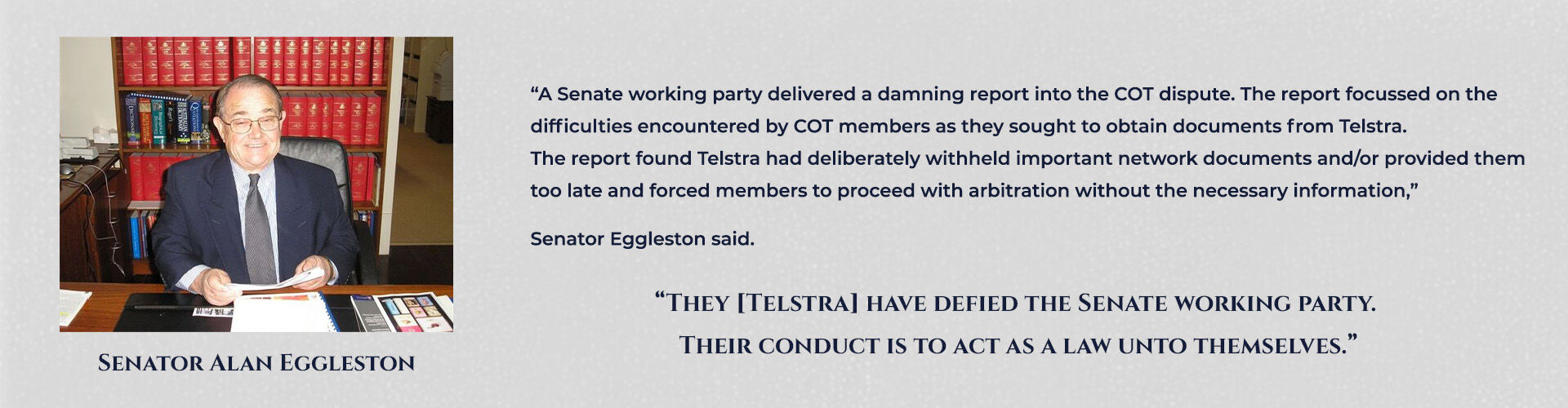
On 23 March 1999, the Australian Financial. Review reported on the conclusion of the Senate estimates committee hearing into why Telstra withheld so many documents from the COT cases, noting:
“A Senate working party delivered a damning report into the COT dispute. The report focused on the difficulties encountered by COT members as they sought to obtain documents from Telstra. The report found Telstra had deliberately withheld important network documents and/or provided them too late and forced members to proceed with arbitration without the necessary information,” Senator Eggleston said. “They have defied the Senate working party. Their conduct is to act as a law unto themselves.”
During the Senate Investigation between June 1997 and March 1999, six Senators uncovered similar evidence, as indicated by their statements in the Senate at Parliament House, Canberra, as detailed below, that we were forced into arbitration without the necessary documents to fully support our claims.
On 25 July 2002, Senator Len Harris travelled from Cairns, Queensland (a trip that took more than 7 hours), to meet four other COTs and me in Melbourne to ensure our discrimination claims against the Commonwealth were thoroughly investigated. He was appalled that 16 Australian citizens were so severely discriminated against by the then-coalition government, despite a Senate estimates committee working party being established to investigate all 21 COT-type claims against Telstra.
He was stunned at how I had collated this evidence into a bound submission. Senator Harris read Senator Alan Eggleston’s 9 August 2001 letter warning me that if I disclosed the in-camera Hansard records (supporting my claims that 16 Australian citizens were discriminated against in the most deplorable manner), then I would be held in contempt of the Senate and risk jail. Senator Harris was distraught, to say the least.
At a press conference the next day, Senator Harris asked questions of the chief of staff to the Hon. Senator Richard Alston, Minister for Communications. He asked:
“Through the following questions, the media event will address serious issues related to Telstra’s unlawful withholding of documents from claimants, during litigation.
Why didn’t the present government correctly address Telstra’s serious and unlawful conduct of withholding discovery and/or Freedom of Information (FOI) documents before the T2 float?
Why has the Federal government allowed five Australians (from a list of twenty-one) to be granted access to some of the Telstra discovery documents they needed to support their claims against Telstra, but denied the same rights to the other sixteen?
Why has the Federal Government ignored clear evidence that Telstra withheld many documents from a claimant during litigation?
Why has the Federal Government ignored evidence that, among those documents Telstra did supply, many were altered or delivered with sections illegally blanked out?” (See Senate Evidence File No 56)
PLEASE NOTE:
Unfortunately, my case was settled three years ago, so I, along with 15 other COT cases, was unable to benefit from the Senate's valuable insights and recommendations. Out of the twenty-one final arbitration and mediation cases, only five were awarded a total of $18 million in punitive damages, along with 150,000 FOI documents that Telstra had initially withheld. The remaining sixteen cases, many of which involve people who have since passed away, are still awaiting the FOI documents that were withheld and the equivalent punitive damages that the five successful COT cases received → An Injustice to the remaining 16 Australian citizens
During my arbitration, I repeatedly requested essential arbitration records and sought clarification on why Lane was permitted to investigate my arbitration documents and make findings about them before Paul Howell of the DMR Group Canada arrived in Australia. The COT Cases specifically expressed distrust towards Lane Telecommunications Pty Ltd (Australia). On January 10, 1996, John Pinnock, the second appointed Telecommunications Industry Ombudsman, wrote a letter outlining his position on the requested documents. This letter further complicated my efforts to obtain the necessary information for my pending appeal.
When I purchased the Cape Bridgewater Holiday Camp in 1987, I discovered that only eight telephone lines were available to service 130 residences. This meant that if four people were making or receiving calls simultaneously, only four lines remained for the other 126 residences.
Operating a 120-bed holiday camp under such conditions for the first 3.5 years was extremely challenging. This experience ultimately led me to establish the Casualties of Telstra small business group. Seven years later, I, along with sixteen others, found myself involved in an arbitration process against Telstra. This arbitration took a significant toll on us, stripping away our pride and negatively impacting our businesses, especially as the arbitrator sought to minimise Telstra's financial liability.
During the arbitration, my technical advisor, George Close & Associates, explained to the arbitrator, Dr Hughes, that when the lines were busy, callers attempting to reach the Cape Bridgewater RAX encountered an electronic message stating that the number they were dialling was not connected. This congestion issue, linked to the RAX Ericsson exchange, persisted until August 1991. Consequently, for three and a half years, potential customers received a recorded message indicating that I was no longer in business.
However, David Read from Lane informed the arbitrator that this electronic message had been in use for only lasted for 16 days, not the 3.5 years we claimed. On May 11, 1995, Dr Hughes' arbitration award for this RAX fault issue compensated me only for that 16-day period.
People calling into a 100+ bed accommodation centre and hearing that dreadful message for 16 days would have been convinced that my business was unrelated to Telstra's service. To have heard it for 3.5 years, however, shows why I lost everything: my $57,000 superannuation, an extra $26,000 in deposits and silver ingots, a 24-seater bus, my two children, and a 20-year marriage.
It's no wonder Ericsson acquired Lane; it was quite a strategic move for them.
In the 1970s and 1980s, Ericsson was a key technology provider to Telstra (then known as PMG/Telecom Australia).
-
1970s Technology: The primary technology was Ericsson's crossbar system (e.g., ARK/ARE series), which proved highly reliable for automated, unmanned rural service through Rural Automatic Exchanges (RAX units).
-
1980s Transition: The 1980s marked a transition to electronic, computer-controlled systems. Ericsson introduced the computer-controlled AXE-10 system for unmanned, automated switching.
The first fully dedicated AXE exchange in Australia, designed by Ericsson, opened in Melbourne in 1981.
-
The AXE System: Selected for its modular design, the AXE system enabled efficient, computer-managed, unmanned
operations and allowed for decentralised control.
These technologies, particularly the AXE system, formed the foundation for the fully digital network that gradually replaced older step-by-step technologies throughout the 1980s.
Hover your mouse over the following images as you scroll down the homepage.
A Story of Despair and Heartache Continues
As I share my story and expose these distressing truths on this website, I feel compelled to confront the catastrophic denial of justice that I—and many other Australian citizens—have endured since signing our arbitrations in 1994. What followed was not a fair process. It was a system corrupted from within: an arbitrator who failed in his duty, and a government that allowed this misconduct to take root and flourish.
What we faced was not mere administrative failure. It was treachery—a deliberate, insidious betrayal of the principles of fairness, transparency, and integrity that should define any legal process in a democratic nation.
I plead with the legal system to recognise that my case is not merely a matter of being out of time; it is an egregious reflection of systemic failures. The withheld evidence, staggering misrepresentations, procedural fraud, and gross conflicts of interest unveil a chilling reality: the rules meant to safeguard justice have been manipulated to shield the wrongdoers. The courts must acknowledge that it is not merely a lapse in time but a concerted effort of concealment and misconduct that has obstructed justice at every turn.
I desperately hope that the courts and relevant authorities will confront the stark realities of my situation and the viable pathways still open to me and others who have suffered comparable injustices. The claims of misfeasance in public office, judicial reviews scrutinising the disgraceful conduct of those in power, and referrals to oversight bodies such as the Telecommunications Industry Ombudsman and ACMA must be pursued with urgency. These mechanisms exist to address the failures of institutions that have allowed this dark chapter to unfold.
Furthermore, I am calling for a parliamentary inquiry or a Senate Committee to launch an exhaustive investigation into this corruption. The Senate's acknowledgement of the Telstra Casualties in Hansard provides a critical entry point for such an inquiry. It is vital to uncover the full extent of this wrongdoing, to unearth concealed documents, and to hold those accountable for an orchestrated and malicious effort to subvert justice.
I urgently implore the Attorney-General or the relevant Minister to catalyse a special review or an independent inquiry into these grotesque abuses of power. If corruption lurks beneath the surface, I insist on a prompt referral to the Australian Federal Police (AFP) or the Australian Commission for Law Enforcement Integrity (ACLEI) to ensure that a comprehensive investigation is undertaken. This is the kind of vigorous action that can revive a long-buried scandal, like the Horizon debacle in the UK, where the veil of injustice was pulled back after decades of deceit.
At the heart of this struggle lies the pressing need to revisit these matters based on fresh evidence, including the recent revelation of Dr Hughes' letter → (Open Letter File No 55-A). This evidence starkly demonstrates the grotesque flaws in the arbitration process that held my fate in its grip, sabotaging my fundamental rights and depriving me of avenues for redress. Fresh evidence should illuminate the path to rectifying these deep injustices, regardless of how long it has been.
Through this website, I am determined to lay the groundwork for our hopes and demands to become reality. I invite readers, advocates, and officials to join me in confronting this evil and sinister scheme that has denied so many their rights. Together, we can amplify our voices in the pursuit of justice, accountability, and an unwavering commitment to truth—demanding that those responsible for this malevolence be held fully accountable for their actions.
Dr Gordon Hughes, the pending arbitrator, and Warwick Smith, the first appointed Telecommunications Industry Ombudsman, secretly met with Telstra's lawyers from Frehill. They prepared the minutes of a pre-arbitration meeting intended to discuss how the arbitration process would be conducted. Only representatives from Telstra's Legal Directorate and the Arbitration Defence Liaison were present at this meeting; no one from the four COT Cases was invited.
Firstly, Mr Rumble was a senior government lobbyist and Telstra employee who actively obstructed the provision of essential arbitration discovery documents that the government was legally obligated to provide under the Freedom of Information Act. This obligation was contingent on my signing an agreement to participate in a government-endorsed arbitration process. By imposing this condition, Mr Rumble undermined a legally established protocol, effectively manipulating the process for his benefit and jeopardising my legal rights.
Secondly, I discovered that Mr Rumble had a substantial influence on the arbitrator, resulting in the unauthorised early release of my interim arbitration claim materials. This premature revelation directly conflicted with the timeline stipulated in the arbitration agreement that Telstra and I had formally signed. Specifically, Telstra accessed my interim claim document 5 months earlier than permitted under the agreed terms. This breach of protocol violated the integrity of the arbitration process and gave Telstra an unfair advantage in its response to my claims.
Under the rules governing our arbitration process, Telstra was given one month to respond to my final claim once it was submitted in writing. Furthermore, the arbitrator was authorised to release my final claim to Telstra only after it was officially confirmed as complete. The five-month delay in submitting my claim in November 1994 was primarily attributable to Mr Rumble's deliberate withholding of critical technical information.
Here is another example of how Australian arbitrators, such as Dr Gordon Hughes, are hesitant to challenge powerful entities. This fear is evident throughout the information on absentjustice.com. What is equally concerning is that when Laurie James, President of the Institute of Arbitrators Australia, became aware of Dr. Hughes' reluctance to address Telstra's threatening, bullying, and unethical conduct, he started investigating my claims. However, Dr Hughes allowed John Pinnock to use Mrs Hughes to halt this investigation by falsely claiming that issues involving Dr Hughes' wife were involved. As a result, Mr James's inquiry was promptly stopped.
When threats were made against me, and I refused to buckle, that stand‑alone defiance showed that the arbitrator, Dr Gordon Hughes, had lost control of the entire process. That loss of control led him to provide the man who made those threats — Telstra’s arbitration liaison officer, Paul Rumble — with more than 4,200 documents relating to my claim, organised into six spiral‑bound volumes dated 15 June 1994.
This was a clear breach of the arbitration rules. The Agreement explicitly stated that Telstra was not to receive my claim documents from the arbitrator until Telstra notified him that it was prepared to proceed. Under those rules, Telstra was allocated only one month to formulate its defence.
However, because Dr Hughes supplied the documents outside the arbitration rules, Telstra was able to stretch that one‑month window into a total of six months. They did not present their defence until 12 December 1994, gaining an extra five months of privileged access that was never permissible — five months to analyse my evidence before I had any opportunity to respond.
When I informed Dr Hughes that Paul Rumble was issuing threats in retaliation for my assistance to the Australian Federal Police (AFP) regarding their investigation into Telstra's interception of my telephone communications and arbitration-related faxes, the situation intensified. Rumble acted upon those threats because I declined to provide him with the same interception documents I had previously submitted to the AFP. I refused to furnish Mr Rumble with copies because the AFP had indicated that their investigation into the interceptions was not yet complete.
The following 93 questions were posed to me by the Australian Federal Police (AFP), along with my responses, as documented in Australian Federal Police Investigation File No/1. My answers reveal a disturbing truth: I clearly name Paul Rumble, who issued threats against me for daring to assist the AFP in its investigations into the interception of my phone conversations and the illicit hacking of documents related to my arbitration.
Subsequently, Dr Hughes chose not to evaluate the interception evidence, as demonstrated by his findings recorded in the arbitration award.
Telstra's dubious practices mirror a troubling pattern of legal disregard evident in a notable COT case defended in the Federal Court of Australia. In this instance, Dr. Hughes represented Graham Schorer, a key figure in the COT cases (see Chapter 3 - Conflict of Interest). Disturbingly, Dr Hughes withheld critical information about Telstra's unethical conduct from his client, Graham Schorer, even though he served as the arbitrator in Schorer's 1994 case and in six subsequent arbitrations. Multiple parties involved have expressed concerns about Dr Hughes's apparent loss of control as an arbitrator in their cases. These troubling circumstances provide me with a legitimate basis to request that Mr Pinnock conduct a thorough investigation into my complaint regarding Ian Joblin.
Major Fraud Group - Victoria Police investigation
💰 Discriminative Compensation: The Litmus Divide
Senator Chris Schacht made it clear to the Telstra arbitration officer that awarding compensation only to the five 'litmus' COT test cases—while ignoring the unresolved claims of the remaining sixteen—would be a grave injustice. Yet the John Howard-led National Liberal Party government sanctioned punitive damages solely for those five, along with the release of over 150,000 Freedom of Information documents that had been concealed during their arbitrations from 1994 to 1998.
Those five individuals received a combined $18 million. That sum should have been divided equally among all twenty-one unresolved COT Cases. It was not.
Will I go to jail in 2026 for revealing this grossly discriminatory act by the Australian government against sixteen fellow citizens? I believe the current Labor government—if they appointed a representative to view the In-Camera Hansards of 6 and 9 July 1998—would be morally compelled to act. As Senator Schacht stated in 1998, compensation should have been extended to all. Sadly, at least three of those sixteen have since passed away.
Ann knew my claims about the Liberal Government's conduct were true: its unconstitutional and systematic cleansing of government archives over more than fifty years. This destruction of historical records, I contend, prevented Australian citizens from obtaining the proof needed to expose wrongdoing by their own party. It erased evidence that government investigators had uncovered about Telstra's unethical conduct leading up to and during the COT arbitrations. Those archives should have been the springboard for COT cases to prove their claims in approximately twelve arbitration and mediation proceedings. Instead, to block access to the information we sought under FOI, I was labelled a vexatious litigant, and my claims were dismissed as frivolous.
Chapter 10
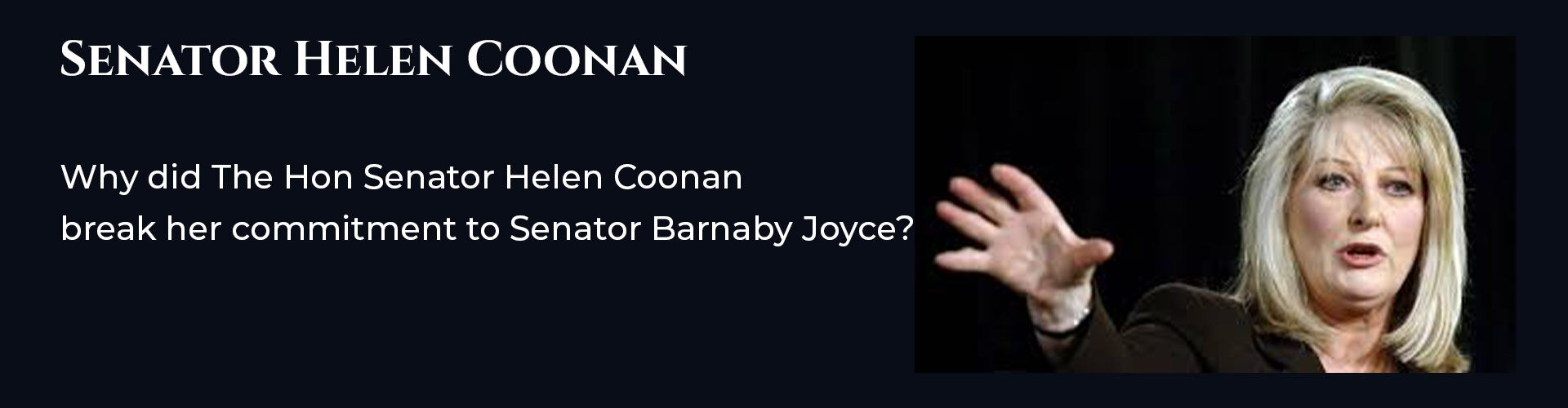
In my experience with the government review of the arbitration I underwent in 1994 and 1995, which was orchestrated by Senator Helen Coonan, the Minister for Communications, and the then National Government Senator Barnaby Joyce in March 2008, several government officials were appointed to assess my claims against Telstra. They commissioned David Quilty, a former advisor to the Honourable John Howard, who was Prime Minister of Australia in 2006. At that time, Quilty was a government liaison officer for Telstra and was tasked with valuing my claims, which confirmed that Telstra had used three fraudulently manufactured reports during my arbitration in 1994 and 1995.
The appointment of David Quilty is comparable to asking a thief, who has been caught stealing a car, whether he should be charged with that offence. The government’s findings related to these three fraudulently prepared arbitration reports concluded that Telstra had no case to answer. Remarkably, just weeks after receiving an email requesting assistance with my case, David Quilty was offered a Senior Executive position at Telstra.(Exhibit 550-A → GS-CAV 522 to 580
Before I signed the DCITA process, I wrote to Liz Froman at DCITA, as the following two letters show.
In my 10 March 2006 letter to Liz Forman (one of the government assessors appointed on behalf of the government to assess my privacy issues and my claims that Telstra had perverted the course of justice during my 1994/95 arbitration I stated that:
"Although you have stated in your letter that “...the assessment process will not extend to an examination of whether the law was broken by Telstra....” I have been advised that it is mandatory, under Commonwealth law, for DCITA and/or the Minister to notify the Attorney General of any unlawful activities they may uncover during official department investigations". (Refer to exhibit AS 614 File AS-CAV Exhibits 589 to 647
17 March 2006: On 17 March 2006, David Lever, Manager, Consumer Section, Telecommunications Division (a further government bureaucrat) wrote to me in response to my letter to Ms Forman, noting:
"Thank you for your letter of 10 March 2006 to Ms Forman concerning the independent assessment process. If the material you have provided to the Department as part of the independent assessment process indicates that Telstra or its employees have committed criminal offences in connection with your arbitration, we will refer the matter to the relevant authority". (Refer to exhibt AS 657 File AS-CAV Exhibits 648-a to 700
On 17 May 2007, after I alerted The Hon. Senator Helen Coonan, Minister for Communications, Information Technology and the Arts, that David Lever from her office had not fulfilled his promise to alert the relevant authorities concerning the screening of my faxes to Federal government ministers and the submission of fraudulently submitted claims during my arbitration, Senator Coonan wrote back to me, noting:
"I have now made both formal and informal representations to Telstra on behalf of the CoTs. However, Telstra’s position remains that this is a matter that is most appropriately dealt with through a Court process. Telstra is not prepared to undertake an alternative means of pursuing this matter. I also appreciate the depth of feeling regarding the matter and suggest you consider whether any court proceedings may be your ultimate option". (Refer to exhibit AS 616-B File AS-CAV Exhibits 648-a to 700
The DCITA Assessment: A Process Built on Secrecy and Silence
From the outset, the 2006 DCITA assessment was cloaked in secrecy. There was no transparency, no accountability, and no explanation when the process was abruptly shut down in August 2006. What we did have, however, was evidence — hard, time‑stamped, electronic evidence.
My editor, Ronda Fienberg, had a device attached to the phone service that notified her whenever a document was opened. On three separate occasions, it signalled that my DCITA claim documents had been accessed. Yet 18 months after lodging those submissions for official commercial assessment, we received written confirmation that none of my documents had ever been opened or read. The assessment process — the one we were told would finally deliver justice — never even looked at the material.
This wasn’t just an administrative failure. It was the third time the same critical evidence had been ignored.
Two of the submissions, costing my technical consultant George Close $16,000 to prepare, demonstrated beyond doubt that in May 1999, Telstra’s CEO Dr Ziggy Switkowski, Chairman David Hoare, and Telecommunications Industry Ombudsman Council Chairman Tony Staley all failed to act on the same evidence the arbitrator, Dr Gordon Hughes, had disregarded during my 1994 arbitration.
The evidence was clear. It showed Telstra had perverted the course of justice during my arbitration — not once, but three times. And each time, the people entrusted with oversight, integrity, and public accountability turned away.
-
1994: The arbitration process ignored the evidence.
-
1999: Telstra’s top leadership and the TIO Council ignored the same evidence again.
-
2006: The DCITA assessment — a government‑initiated review — never even opened the documents.
All three submissions contained the same material now published on absentjustice.com. All three were dismissed without examination. And all three failures point to a system that protects institutions, not citizens.
This is why, in 2026, I am still fighting. Not because of a single injustice, but because of a pattern — a deliberate, documented pattern — that has harmed countless Australians. The evidence is there. The silence is deliberate. And the consequences have been devastating.
Here’s the proof:
MESSAGES RECEIVED 1st February 2008, on behalf of Alan Smith:
Your message
To: Coonan, Helen (Senator) Cc: Lever, David; Smith, Alan Subject: ATTENTION MR JEREMY FIELDS, ASSISTANT ADVISOR Sent: Sun, 23 Apr 2006 17:31:41 +1100
was deleted without being read on Fri, 1 Feb 2008 16:56:36 +1100
ATTACHMENT:
Final-Recipient: RFC822; Senator.Coonan@aph.gov.au
Disposition: automatic-action/MDN-sent-automatically; deletedX-MSExch-Correlation-Key: sdD1TSUHx0CoTD0Qm4wBVw==oOo
Original-Message-ID: 001601c6669f$95736a00$2ad0efdc@Office
Your message
To: Coonan, Helen (Senator) Cc: Smith, Alan Subject: Alan Smith, unresolved Telstra matters Sent: Tue, 25 Jul 2006 00:00:42 +1100
was deleted without being read on Fri, 1 Feb 2008 16:56:23 +1100ATTACHMENT:Final-Recipient: RFC822; Senator.Coonan@aph.gov.au Disposition: automatic-action/MDN-sent-automatically; deleted X-MSExch-Correlation-Key: bNlMYfUKcUGqvIXiYQZULA==
Original-Message-ID: 003a01c6af21$2b7ece30$2ad0efdc@Office
This is the world we walked into without knowing it. A world where arbitration and, later, a government DCITA arbitration review process is not a path to resolution — but a trapdoor.
I invite every visitor to absentjustice.com to pause for a moment of reflection when they reach this section of my story. Consider the photograph beside this narrative — taken in 2015, when seven members of our COT group asked me to record their stories. Now, at 82, I may not complete that task. As you explore the homepage section titled “The first remedy pursued,,” I encourage you to reflect on a question that has driven me for more than 30 years, rooted in events that unfolded during my 1994/95 arbitration.
During that turbulent period, key individuals — Dr Gordon Hughes, Warwick Smith, John Rundell, and John Pinnock — became involved in actions that would shape the course of my life. There is also the possibility that Dr Hughes’ wife may have been asked to lend her support. Had she agreed, her name might have been falsely linked to a fabricated 2:00 AM phone call that never occurred. This would have unknowingly placed her at the centre of a strategy designed to discredit me.
Their collaboration marked the beginning of a campaign to systematically undermine my credibility — spreading falsehoods, attacking my character, and obstructing Laurie James, the President of the Institute of Arbitrators Australia, from properly investigating my claims that Dr Hughes had not conducted my arbitration in accordance with the agreed procedures.
The combined efforts of Hughes, Smith, Pinnock, and Rundell not only halted an official investigation into my legitimate claims but also severely damaged my professional reputation, leading to my concerns being dismissed across Australia.
Gag clauses. Confidential settlements and Confidentiality Agreements. These weren’t tools of fairness — they were tools of erasure. They allowed institutions to hide their crimes behind legal language, to bury evidence that would have destroyed them in open court, to silence victims before their stories could reach the public


Telstra-Corruption-Freehill-Hollingdale & Page
Corrupt practices persisted throughout the COT arbitrations, flourishing in secrecy and obscurity. These insidious actions have managed to evade necessary scrutiny. Notably, the phone issues persisted for years following the conclusion of my arbitration, established to rectify these faults

Confronting Despair
The independent arbitration consultants demonstrated a concerning lack of impartiality. Instead of providing clear and objective insights, their guidance to the arbitrator was often marked by evasive language, misleading statements, and, at times, outright falsehoods.

Flash Backs – China-Vietnam
In 1967, Australia participated in the Vietnam War. I was on a ship transporting wheat to China, where I learned China was redeploying some of it to North Vietnam. Chapter 7, "Vietnam—Vietcong," discusses the link between China and my phone issues.

A Twenty-Year Marriage Lost
As bookings declined, my marriage came to an end. My ex-wife, seeking her fair share of our venture, left me with no choice but to take responsibility for leaving the Navy without adequately assessing the reliability of the phone service in my pursuit of starting a business.

Salvaging What I Could
Mobile coverage was nonexistent, and business transactions were not conducted online. Cape Bridgewater had only eight lines to service 66 families—132 adults. If four lines were used simultaneously, the remaining 128 adults would have only four lines to serve their needs.

Lies Deceit And Treachery
I was unaware of Telstra's unethical and corrupt business practices. It has now become clear that various unethical organisational activities were conducted secretly. Middle management was embezzling millions of dollars from Telstra.

An Unlocked Briefcase
On June 3, 1993, Telstra representatives visited my business and, in an oversight, left behind an unlocked briefcase. Upon opening it, I discovered evidence of corrupt practices concealed from the government, playing a significant role in the decline of Telstra's telecommunications network.
A Government-backed Arbitration
An arbitration process was established to hide the underlying issues rather than to resolve them. The arbitrator, the administrator, and the arbitration consultants conducted the process using a modified confidentiality agreement. In the end, the process resembled a kangaroo court.

Not Fit For Purpose
AUSTEL investigated the contents of the Telstra briefcases. Initially, there was disbelief regarding the findings, but this eventually led to a broader discussion that changed the telecommunications landscape. I received no acknowledgement from AUSTEL for not making my findings public.
&am

A Non-Graded Arbitrator
Who granted the financial and technical advisors linked to the arbitrator immunity from all liability regarding their roles in the arbitration process? This decision effectively shields the arbitration advisors from any potential lawsuits by the COT claimants concerning misconduct or negligence.<

The AFP Failed Their Objective
In September 1994, two officers from the AFP met with me to address Telstra's unauthorised interception of my telecommunications services. They revealed that government documents confirmed I had been subjected to these violations. Despite this evidence, the AFP did not make a finding.&am

The Promised Documents Never Arrived
In a February 1994 transcript of a pre-arbitration meeting, the arbitrator involved in my arbitration stated that he "would not determination on incomplete information.". The arbitrator did make a finding on incomplete information.

Chapter 1
Learn about government corruption and the dirty deeds used by the government to cover up these horrendous injustices committed against 16 Australian citizens

Chapter 2
Betrayal deceit disinformation duplicity falsehood fraud hypocrisy lying mendacity treachery and trickery. This sums up the COT government endorsed arbitrations.
Chapter 3
Ending bribery corruption means holding the powerful to account and closing down the systems that allows bribery, illicit financial flows, money laundering, and the enablers of corruption to thrive.
Chapter 4
Learn about government corruption and the dirty deeds used by the government to cover up these horrendous injustices committed against 16 Australian citizens. Government corruption within the public service affected most if not all of the COT arbitrations.

Chapter 5
Corruption is contagious and does not respect sectoral boundaries. Corruption involves duplicity and reduces levels of morality and trust.
Chapter 6
Anti-corruption policies need to be used in anti-corruption reforms and strategy. Corruption metrics and corruption risk assessment is good governance
Chapter 7
Bribery and Corruption happens in the shadows, often with the help of professional enablers such as bankers, lawyers, accountants and real estate agents, opaque financial systems and anonymous shell companies that allow corruption schemes to flourish and the corrupt to launder their wealth.

Chapter 8
Corrupt practices in government and the results of those corrupt practices become problematic enough – but when that corruption becomes systemic in more than one operation, it becomes cancer that endangers the welfare of the world's democracy.
Chapter 9
Corruption in government, including non-government self-regulators, undermines the credibility of that government. It erodes the trust of its citizens who are left without guidance are the feel of purpose. Bribery and Corruption is cancer that destroys economic growth and prosperity.

Chapter 10
The horrendous, unaddressed crimes perpetrated against the COT Cases during government-endorsed arbitrations administered by the Telecommunication Industry Ombudsman have never been investigated.

Chapter 11
This type of skulduggery is treachery, a Judas kiss with dirty dealing and betrayal. This is dirty pool and crookedness and dishonest. This conduct fester’s corruption. It is as bad, if not worse than double-dealing and cheating those who trust you.&a

Chapter 12
Absentjustice.com - the website that triggered the deeper exploration into the world of political corruption, it stands shoulder to shoulder with any true crime story.