China-Flash-Back-AFP Investigation -2
It is important to highlight the facts that on 18 September 1967, the Commonwealth Police, then known as COMPOL, often initialled documents with "COMPOL" after the signature of the officer making their mark. This was the case when two COMPOL officers visited the Hopepeak ship, where I was a crew member at the time. These officers are now referred to as the Australian Federal Police (AFP).
It is on record that I fully cooperated with the COMPOL officers in September 1967, who reviewed my statement concerning my time in China. Later, in 1994 and 1995, I again assisted the AFP with their investigations into my Telstra-related phone and fax hacking episodes.
I have always discussed the AFP issues in the AFP segments, but I am now writing a book on this part of my COT story. I am introducing the China-Australian wheat saga as the spearhead of my story regarding the COMPOL/AFP issues, as this was when the AFP was genuinely horrified by what I told them and by the statement I made concerning my time in China.
This is why I am starting the AFP part of my COT story with episodes where they were human beings in shock, as most Australians were, when I told them of this China saga. It is important to highlight the facts that on 18 September 1967, the Commonwealth Police, then known as COMPOL, often initialled documents with "COMPOL" after the signature of the officer making their mark. This was the case when two COMPOL officers visited the Hopepeak ship, where I was a crew member at the time. These officers are now referred to as the Australian Federal Police (AFP).
It is on record that I fully cooperated with the COMPOL officers in September 1967, who reviewed my statement concerning my time in China. Later, in 1994 and 1995, I again assisted the AFP with their investigations into my Telstra-related phone and fax hacking episodes.
I have always discussed the AFP issues in the AFP segments, but I am now writing a book on this part of my COT story. I am introducing the China-Australian wheat saga as the spearhead of my story regarding the COMPOL/AFP issues, as this was when the AFP was genuinely horrified by what I told them and by the statement I made concerning my time in China.
This is why I am starting the AFP part of my COT story with episodes where they were human beings in shock, as most Australians were, when I told them of this China saga.
Echoes of Betrayal: Wheat Sales to China - and the Government bureaucrats who continued to tell Australia's politicians what several other seamen and I had witnessed in China was a lie. The following information shows we risked all to expose the truth.
The People's Republic of China
Murdered for Mao: The killings China ‘forgot’
The Letter, the Truth, and the Waiting
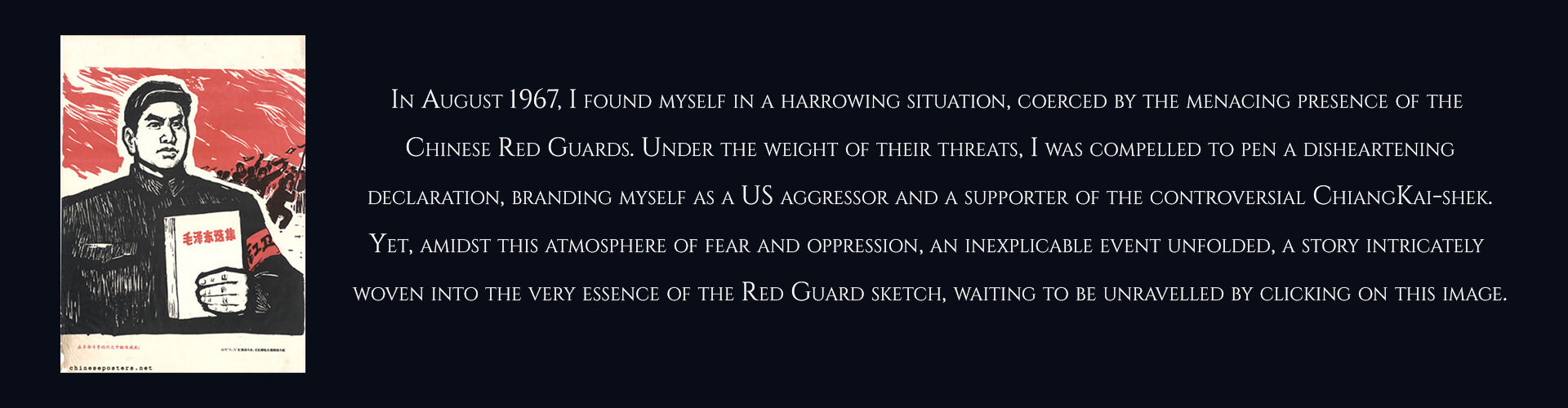
In August 1967, I found myself in a situation so precarious, so surreal, that it would etch itself into the marrow of my memory. I was aboard a cargo ship docked in China, surrounded by Red Guards stationed on board twenty-four hours a day, spaced no more than thirty paces apart. After being coerced into writing a confession—declaring myself a U.S. aggressor and a supporter of Chiang Kai-shek, the Nationalist leader in Taiwan—I was told by the second steward, who handled the ship’s correspondence, that I had about two days before a response to my letter might reach me. That response, whatever it might be, would be delivered by the head of the Red Guards himself.
It was the second steward who quietly suggested I write to my parents. I did. I poured myself into 22 foolscap pages, writing with the urgency of a man who believed he might not live to see the end of the week. I told my church-going parents that I was not the saintly 18-year-old they believed I was. I confessed that the woman they had so often thanked in their letters—believing her to be my landlady or carer—was in fact my lover. She was 42. I was 18 when we met. From 1963 to 1967, she had been my anchor, my warmth, my truth. I wrote about my life at sea, about the chaos and the camaraderie, about the loneliness and the longing. I wrote because I needed them to know who I really was, in case I was executed before I ever saw them again.
As the ship’s cook and duty mess room steward, I had a front-row seat to the daily rhythms of life on board. I often watched the crew eat their meals on deck, plates balanced on the handrails that lined the ship. We were carrying grain to China on humanitarian grounds, and yet, the irony was unbearable—food was being wasted while the people we were meant to help were starving. Sausages, half-eaten steaks, baked potatoes—they’d slip from plates and tumble into the sea. But there were no seagulls to swoop down and claim them. They’d been eaten too. The food floated aimlessly, untouched even by fish, which had grown scarce in the harbour. Starvation wasn’t a concept. It was a presence. It was in the eyes of the Red Guards who watched us eat. It was in the silence that followed every wasted bite.
A Tray of Leftovers and a Silent Exchange
After my arrest, I was placed under house arrest aboard the ship. One day, I took a small metal tray from the galley and filled it—not with scraps, but with decent leftovers. Food that would have gone into the stockpot or been turned into dry hash cakes. I walked it out to the deck, placed it on one of the long benches, patted my stomach as if I’d eaten my fill, and walked away without a word.
Ten minutes later, I returned. The tray had been licked clean.
At the next meal, I did it again—this time with enough food for three or four Red Guards. I placed the tray on the bench and left. No words. No eye contact. Just food. I repeated this quiet ritual for two more days, all while waiting for the response to my letter. During that time, something shifted. The Red Guard, who had been waking me every hour to check if I was sleeping, stopped coming. The tension in the air thinned, just slightly. And I kept bringing food—whenever the crew was busy unloading wheat with grappling hooks wrapped in chicken wire, I’d slip out with another tray.
To this day, I don’t know what saved me. It was certainly not the letter declaring myself a U.S. aggressor and a supporter of Chiang Kai-shek, the Nationalist leader in Taiwan. Maybe it was luck. Or perhaps it was that tray of food, offered without expectation, without speech, without condition. A silent gesture that said, “I see you. I know you’re hungry. I know you’re human.”
And maybe, just maybe, that was enough. British Seaman’s Record R744269 - Open Letter to PM File No 1 Alan Smith's Seaman. → Chapter 7- Vietnam-Vietcong-2
In essence, the Australian government faced an agonising moral dilemma — weighing the lives of its soldiers engaged in the conflict in North Vietnam against the desperate need to provide sustenance for an entire nation teetering on the brink of starvation. This heart-wrenching choice highlights the often-unseen complexities of international relations and humanitarian crises, revealing the painful calculations made in the pursuit of survival.
Footnote 83, 84 and 169 → in a paper submitted by Tianxiao Zhu to - The Faculty of the University of Minnesota titled Secret Trails: FOOD AND TRADE IN LATE MAOIST CHINA, 1960-1978, etc → Requirements For The Degree Of Doctor Of Philosophy - Christopher M Isett June 2021
Tianxiao Zhu's Footnotes 83, 84, 169:
In September 1967, a group of British merchant seamen quit their ship, the Hope Peak, in Sydney and flew back to London. They told the press in London that they quit the job because of the humiliating experiences to which they were subjected while in Chinese ports. They also claimed that grain shipped from Australia to China was being sent straight on to North Vietnam. One of them said, “I have watched grain going off our ship on conveyor belts and straight into bags stamped North Vietnam. Our ship was being used to take grain from Australia to feed the North Vietnamese. It’s disgusting.”
84. The Minister of Trade and Industry received an inquiry about the truth of the story in Parliament, to which the Minister pointed out that when they left Australia, the seamen only told the Australian press that they suffered such intolerable maltreatment in various Chinese ports that they were fearful about going back. But after they arrived in London, Vietnam was added to their story. Thus the Minister claimed that he did not know the facts and did not want to challenge this story, but it seemed to him that their claims about Vietnam seemed to be an “afterthought.”
169. "...In Vancouver, nine sailors refused to work on a grain ship headed to China: two of them eventually returned to work, and the others were arrested. Just when the ship was about to sail, seven more left the ship but three of them later returned to work. In Sydney, six Canadian sailors left their ship; they resigned and asked to be paid, but the Australian immigration office repatriated them. At that time, a grain ship usually had crew members of about 40 people. A British ship lost the Chief Officer and sixteen seamen, who told journalists that if the ship were going to the communist countries, they would rather go to jail than work on the ship."
The Canadian Government and Its Moral Code of Ethics
Hover your mouse over the following images as you scroll down the homepage.
By hovering your mouse over the Canadian flag image below, you can also learn about the strong ethical principles upheld by Canadian seamen. Despite facing significant challenges, they believed that sending wheat to Communist China — especially when that wheat was being redeployed to North Vietnam, a country at war with Australia, New Zealand, and the USA, where hundreds of troops were being killed or maimed — was immoral and unethical, and therefore should not have continued.
Yet the Australian Government made a conscious decision to maintain its trade relations with Communist China, despite knowing that a significant portion of Australia’s wheat was being diverted to North Vietnam. This wheat was not merely a trade commodity; it had the potential to sustain North Vietnamese soldiers who were directly engaged in combat against Australia and its allies during the conflict. The ramifications of this trade raised serious ethical questions about supporting a nation that was opposing Australian, New Zealand, and USA forces.
Examining this wheat agreement made with the People's Republic of China during the Menzies government in the mid‑1960s is essential. This controversial deal had significant implications that were obscured by a government campaign to discredit British and Canadian merchant seamen — including me. These brave individuals tried every conceivable legal way to expose this illicit diversion of wheat to North Vietnam.
• Frog‑marched off the ship under armed guard by Red Guards, accused of being a spy.• Forced to write letters under threat of execution.• Commonwealth Police met the ship in Sydney on 18 September 1967, confirming the seriousness of what had occurred.• British crew members refused to sail the ship back to China, fearing for their lives.
• Wheat shipments had gone ahead despite warnings.• Australian conscripts had fought and died in Vietnam.• Bureaucrats and ministers had ignored both political foresight and lived testimony.
• The Ericsson AXE Exchange Scandal — regulators ignored systemic telecommunications faults, leaving businesses crippled.• The corrupted COT arbitrations — bureaucrats allowed Telstra to run the process, conceal evidence, and destroy small businesses.• The Robodebt scandal — officials ignored legal advice and harmed vulnerable citizens.• The Home Insulation Program — rushed implementation led to deaths, fires, and wasted millions.
There is a striking and thought-provoking similarity between my narrative of the Chinese Cultural Revolution and the Canadian perspective on democracy, as well as the fundamental concepts of right and wrong that underpin them. This connection is compellingly illustrated in Tianxiao Zhu's meticulously crafted 2021 paper, developed as part of his PhD requirements at the University of Minnesota. During my extensive research for my first manuscript — which ultimately inspired the launch of the website absentjustice.com — I fortuitously discovered Zhu's insightful work. His paper sheds light on a significant trade that took place during the chaotic and turbulent period I was examining.
Among the many footnotes and references in his research, one stands out: the ship Hopepeak. This name resonates deeply with me, evoking memories tied to my own experiences. According to my British Seaman's Discharge Book, I served as a crew member during that harrowing era, navigating the treacherous waters of Red China. It was a time marked by widespread famine and profound suffering, creating a stark backdrop to the life-and-death decisions being made. Without the vital trade relationship with Australia during this perilous time, the starvation rates in China would have reached unimaginable levels.
In essence, the Australian government faced an agonising moral dilemma — weighing the lives of its soldiers engaged in the conflict in North Vietnam against the desperate need to provide sustenance for an entire nation teetering on the brink of starvation. This heart-wrenching choice highlights the often-unseen complexities of international relations and humanitarian crises, revealing the painful calculations made in the pursuit of survival.
Vol. 87 No. 4462 (4 Sep 1965) - National Library of Australia https://nla.gov.au › nla.obj-702601569
"The Department of External Affairs has recently published an "Information Handbook entitled "Studies on Vietnam". It established the fact that the Vietcong are equipped with Chinese arms and ammunition"
If it is right to ask Australian youth to risk everything in Vietnam it is wrong to supply their enemies. The Communists in Asia will kill anyone who stands in their path, but at least they have a path."
Australian trade commssioners do not so readily see that our Chinese trade in war materials finances our own distruction. NDr do they see so clearly that the wheat trade does the same thing."
• In Shanghai, I was frog‑marched off the ship under armed guard by Red Guards, accused of being a spy, and forced to write letters under threat of execution.• The Commonwealth Police met the ship in Sydney on 18 September 1967, confirming the seriousness of what had occurred.• British crew members refused to sail the ship back to China, fearing for their lives. A new crew had to be flown from the UK at the shipowner’s expense.• Despite these warnings, Australia continued to send wheat shipments, knowing some of that grain was being redeployed to North Vietnam.
• Wheat shipments had gone ahead despite warnings.• Australian conscripts had fought and died in Vietnam.• Bureaucrats and ministers had ignored both political foresight and lived testimony.
And just as in the Vietnam era, the consequences were borne not by the officials who engineered the failures, but by the citizens who trusted them. Ordinary Australians — small business owners, farmers, families, veterans — were left to navigate the fallout of decisions made behind closed doors by individuals who would never feel the impact of their own misconduct.
This is the legacy of bureaucratic betrayal: it repeats itself across generations unless it is confronted, exposed, and held to account.
PART 1
The Australian Federal Police

“COT Case Strategy”
As shown on page 5169 in Australia's Government SENATE official Hansard – Parliament of Australia Telstra's lawyers Freehill Hollingdale & Page devised a legal paper titled “COT Case Strategy” (see Prologue Evidence File 1-A to 1-C) instructing their client Telstra (naming me and three other businesses) on how Telstra could conceal technical information from us under the guise of Legal Professional Privilege even though the information was not privileged.
This COT Case Strategy was to be used against me, my named business, and the three other COT case members, Ann Garms, Maureen Gillan and Graham Schorer, and their three named businesses. Simply put, we and our four businesses were targeted even before our arbitrations commenced. The Kangaroo Court was devised before the four COT Cases signed our arbitration agreements.
It is paramount that the visitor reading absentjustice.com understands the significance of pages 5168 and 5169 at points 26, 27, 28, 29, 30, and 31 SENATE official Hansard – Parliament of Australia, which note:
26. A possible reason for the AFP’s lack of enthusiasm emerged the following year. In 1993 and 1994, the Federal Member for Wannon, Mr David Hawker asked a series of questions about public sector fraud relating to the years 1991-1993. On 28 August 1994, the Sunday Telegraph reported under the headline, "$6.5 million missing in PS fraud," "Workers in sensitive areas including ASIO, the National Crime Authority, Customs, the Family Court, and the Australian Federal Police were convicted of fraud according to information given to Parliament."
27. Apparently, the NSW police had a similar problem. According to Mr Saul, he was never interviewed by police, and only token efforts were made to access and seize motel records as evidence. Invariably it was found that moteliers (often former police officers) had been warned to expect a visit. Mr Saul states that a senior police officer within the Professional Responsibility Group of the NSW Police Force (then under the command of former NSW Assistant Commissioner Geoff Schuberg), told him there had been no serious investigation of travel allowance irregularities in NSW—information consistent with a report in the Telegraph Mirror on 19 April 1995, under the headline "Police criminals ‘staying on duty’."
28. In the course of evidence given to the Royal Commission into the NSW Police Force, Assistant Commissioner Schuberg admitted that three detectives from Tamworth who admitted to rorting their travel expenses were dealt with internally and fined rather than charged with fraud. Commissioner Wood asked: "This is a fraud, is it not, of the kind we have seen politicians and others go to jail for? You have people who are proven liars with criminal records who are still carrying out policing and giving evidence?" Assistant Commissioner Schuberg replied: "Yes, I do think it raises a problem." Legal professional privilege.
29. Whether Telstra was active behind-the-scenes in preventing a proper investigation by the police is not known. What is known is that, at the time, Telstra had representatives of two law firms on its Board—Mr Peter Redlich, a Senior Partner in Holding Redlich, who had been appointed for 5 years from 2 December 1991 and Ms Elizabeth Nosworthy, a partner in Freehill Hollingdale & Page who had also been appointed for 5 years from 2 December 1991.
- One of the notes to and forming part of Telstra’s financial statements for the 1993- 94 financial year indicates that during the year, the two law firms supplied legal advice to Telstra, totalling $2.7 million, an increase of almost 100 per cent over the previous year. Part of the advice from Freehill Hollingdale & Page was a strategy for "managing" the "Casualties of Telecom" (COT) cases.
30. The Freehill Hollingdale & Page strategy was set out in an issues paper of 11 pages, under cover of a letter dated 10 September 1993 to a Telstra Corporate Solicitor, Mr Ian Row from FH&P lawyer, Ms Denise McBurnie (see Prologue Evidence File 1-A to 1-C). The letter, headed "COT case strategy" and marked "Confidential," stated:
- "As requested, I now attach the issues paper which we have prepared in relation to Telecom’s management of ‘COT’ cases and customer complaints of that kind. The paper has been prepared by us together with input from Duesburys, drawing on our experience with a number of ‘COT’ cases. . . ."
31. The lawyer’s strategy was set out under four heads: "Profile of a ‘COT’ case" (based on the particulars of four businesses and their principals, named in the paper); "Problems and difficulties with ‘COT’ cases"; "Recommendations for the management of ‘COT’ cases; and "Referral of ‘COT’ cases to independent advisors and experts". The strategy was in essence that no-one should make any admissions and, lawyers should be involved in any dispute that may arise, from beginning to end. "There are numerous advantages to involving independent legal advisers and other experts at an early stage of a claim," wrote Ms McBride . Eleven purported advantages were listed.
Back then, Mr Redlich was, in most people's eyes, one of the finest lawyers in Australia at that time. He was also a stalwart within the Labor Party, a one-time friend of two Australian Prime Ministers (Gough Whitlam and Bob Hawke) and a long-time friend of Mark Dreyfus, Australia's Attorney General until at least 2024, so who would be the slightest bit interested in listening to my perspective in comparison to someone so highly qualified and with such vital friends?
And remember, the COT strategy was designed by Freehill Hollingdale & Page when Elizabeth Holsworthy (a partner at Freehill's) was also a member of the Telstra Board, along with Mr Redlich. The whole aim of that ‘COT Case Strategy’ was to stop us, the legitimate claimants against Telstra, from having any chance of winning our claims. Do you think my claim would have even the tiniest possibility of being heard under those circumstances?
While I am not condemning either Mr Redlich or Ms Holsworthy for any personal wrongdoing as Telstra Board members, what I am condemning is their condoning of the COT Cases Strategy designed to destroy any chance of the four COT Cases (which included me and my business), of a proper assessment of the ongoing telephone problems that were destroying our four businesses. I ask how any ordinary person could get past Telstra's powerful Board. After all, in comparison to these so-called highly qualified, revered Aussie citizens, I am just a one-time Ships’ Cook who purchased a holiday camp with a very unreliable phone service.
The fabricated BCI report (see Telstra’s Falsified BCI Report and BCI Telstra’s M.D.C Exhibits 1 to 46 is most relevant because Telstra's arbitration defence lawyers provided it to Ian Joblin, a forensic psychologist who was assigned by Freehill Hollingdale & Page to assess my mental state during my arbitration. It is linked to statements made in the following page 5169 SENATE official Hansard – Parliament of Australia concerning Telstra having adopted the Freehill Hollingdale & Page - COT Case Strategy during the COT arbitrations, which Denise McBurnie of Freehill Hollingdale & Page had spuriously prepared.
What I did not know, when I was first threatened by Telstra in July 1993 and again by Denise McBurnie in September 1993, that if I did not register my telephone problems in writing with Denise McBurnie, then Telstra would NOT investigate my ongoing telephone fault complaints is that this "COT Case Strategy" was a set up by Telstra and their lawyers to hide all proof that I genuinely did have ongoing telephone problems affecting the viability of my business.
The relentless demand to document every single telephone fault and report these trivial daily issues to Denise McBurnie before Telstra would even condescend to address them was maddening. Ian Joblin, the so-called "clinical psychologist" brought in by Telstra for arbitration, conducted his evaluation of my mental health on December 12, 1994, and made it clear just how twisted the system was. It was no wonder I was suffering from Post-Traumatic Stress Disorder (PTSD); the very act of having to funnel complaints through Telstra's legal labyrinth before they would deign to investigate was a recipe for depression, warping anyone’s thought processes. Mr Joblin, in a rare moment of truth, ensured that his findings were documented in the grim pages of the arbitration report prepared by Freehills Hollingdale & Page—his employers in this corrupt charade.
Later, when the second-appointed Telecommunications Industry Ombudsman (TIO) discovered that sections of Mr. Joblin's witness statement had not been signed when submitted to arbitration, he contacted Telstra's arbitration counsel, Ted Banjamin, on October 23, 1997. His inquiry? A thinly veiled demand for answers—what was hidden, what had been stolen from the record? The whole affair reeked of deceit and manipulation, leaving a bitter taste of corruption looming overhead.
I was unaware I would later need this evidence for an arbitration process. This arbitration process meant I had to retrieve from Telstra the exact documentation I had previously provided to this legal firm under Freedom of Information. Imagine the frustration of knowing that you had already provided the evidence supporting your case, but Telstra and their lawyers were now withholding it from you.
I have consistently articulated, over an extended period, the necessity and methodology behind transcribing fault complaint records from exercise books into diaries while upholding the accuracy of my chronology of fault events. I must note my repeated reminders to the arbitration project manager regarding soliciting these fault complaint notebooks during my oral arbitration hearing, as evidenced by the meeting transcripts. However, it is noteworthy that Telstra contested the submission of these records, and the arbitrator, without due examination, dismissed their relevance. Notably, Telstra omitted to disclose that Freehill Hollingdale & Page, from June 1993 to January 1994, refrained from documenting my phone complaints as reported by me and refused their release under FOI guidelines based on Legal Professional Privilege.
I posit that the acceptance of these notations from my exercise books as evidential, in conjunction with the retrieval of my fault complaints registered with Freehill Hollingdale & Page in the presence of Telstra's Forensic Documents Examiner, Mr. Holland, would have furnished substantial clarity and dispelled any suspicion of deceit. I acknowledge the potential scepticism concerning the narrative's veracity presented here, attributable to its seemingly incredulous nature.
The arbitrator's written findings in his award did not document the coercion I experienced during arbitration or the threats made and carried out against me by Telstra. He also failed to acknowledge that government solicitors and the Commonwealth Ombudsman had to be involved after Telstra refused to provide requested documents. These documents were promised to us if the commercial assessment process we had agreed to would be turned into an arbitration process. However, the arbitrator, Dr Gordon Hughes, did mention it in his award.
"… I have considered, and have no grounds to reject the expert evidence provided by Telecom from Neil William Holland, Forensic Document Examiner, who examined the claimant’s diaries and because of numerous instances of non-chronological entries, thereby causing doubt on their veracity and reliability."
It was not of Mr Joblin's hand
It bore no signature of the psychologist
As outlined in official government records, the government explicitly assured that the law firm Freehill Hollingdale & Page would not have any further involvement in the ongoing COT cases (refer to point 40 in the Prologue Evidence File No/2). It is important to note that this firm was responsible for providing Ian Joblin, a clinical psychologist, with a witness statement for the arbitrator. However, a significant issue arose: Maurice Wayne Condon, a Freehill Hollingdale & Page representative, only signed the witness statement, and notably lacked Mr. Joblin's signature.
During my arbitration proceedings 1994, I revealed to Mr. Joblin the troubling information that Telstra had been monitoring my daily activities since 1992. Furthermore, I presented Freedom of Information (FOI) documents indicating that Telstra had redacted key portions of the recorded conversations regarding my case. This disclosure visibly troubled Mr. Joblin, who realised that he had been misled by the legal representatives of Telstra, specifically those from Freehill Hollingdale & Page. I was able to provide compelling evidence that this law firm had supplied Mr. Joblin with a misleading report concerning my telecommunications issues before our interview. Mr. Joblin acknowledged that his findings would address these troubling concerns in light of this information. However, it is crucial to point out that despite the situation's gravity, no adverse findings were made against either Telstra or Freehill Hollingdale & Page.
Mr. Joblin insisted that he would note in his report to Freehill Hollingdale & Page the inappropriate nature of Telstra's treatment of me. He emphasised that their methods of assistance warranted careful review. Nevertheless, it is essential to highlight that no adverse findings were documented against Telstra or Freehill Hollingdale & Page.
A critical question remains: Did Maurice Wayne Condon intentionally remove or alter any references in Ian Joblin's initial assessment regarding my mental soundness? On March 21, 1997—twenty-two months following the conclusion of my arbitration—John Pinnock, the second appointed administrator for my case, formally reached out to Ted Benjamin at Telstra (refer to File 596 - AS-CAV Exhibits 589 to 647). He raised two crucial inquiries:
1. He requested an explanation for the apparent discrepancies in the attestation of Ian Joblin's witness statement.
2. He sought clarification on whether any modifications were made to the version of the Joblin statement initially submitted to Dr. Hughes, the arbitrator, compared to the signed version ultimately provided.
Maurice Wayne Condon, acting as Telstra's legal representative from Freehill Hollingdale & Page, signed the witness statement without securing the psychologist's signature, raising serious questions about the level of influence and power that Telstra's legal team wields over the arbitration process in Australia.
What is particularly shocking to numerous individuals who have scrutinized several other witness statements submitted by Telstra throughout various COT case arbitrations—including my own—is that, despite the Senate being informed of discrepancies concerning signatures in my case, the alteration of a medically diagnosed condition to imply that I was mentally disturbed constitutes an issue that transcends mere criminal misconduct. It raises profound ethical concerns. Maurice Wayne Condon's assertion that he witnessed a signature on the arbitration witness statement prepared by Ian Joblin, a qualified clinical psychologist, is rendered questionable by the absence of Joblin's signature on the affirmation in question. This discrepancy strongly suggests that a thorough investigation into the COT case's circumstances is warranted and essential.
Since then, the lawyer from Freehill Hollingdale & Page, whose signature was on the undersigned witness statement, has shocked several senators, including Senator Joyce. This lawyer was from the same law firm whose "COT Case Strategy" was set up by Telstra and its lawyers to hide all relevant technical proof that the COT Cases indeed did have ongoing telephone problems affecting the viability of their businesses.
Senator Bill O’Chee expressed serious concern over John Pinnock's failure to respond to his letter dated 21 March 1997 addressed to Ted Benjamin of Telstra. This lack of response, coupled with evidence from another COT Case suggesting that statutory declarations had been tampered with by Telstra or their legal representatives during arbitration, prompted Senator Bill O'Chee to write to Graeme Ward, Telstra's regulatory and external affairs, on 26 June 1998 (refer to File GS-CAV Exhibit 258 to 323 on 26 June 1998 from, stating.
“I note in your letter’s last page you suggest the matter of the alteration of documents attached to statutory declarations should be dealt with by the relevant arbitrator. I do not concur. I would be grateful if you could advise why these matters should not be referred to the relevant police."
There was no transparent outcome to this matter. What did occur from Senator O'Chee's statement regarding Telstra stating it was up to the relevant arbitrator to deal with the unlawful conduct of altering statutory declarations is that when an investigation by the COTs concerning why Dr Gordon Hughes allowed this type of conduct to occur unchallenged is that he as a partner of another large legal firm withheld vital Telstra documents from COT Case Graham Schorer when he was Dr Hughes client in a Federal Court Action against Telstra four years previous see Chapter 3 - Conflict of Interest shows,
It is June 2025, and I have still never seen a copy of the advice that John Pinnock was officially entitled to receive from Telstra regarding this unsigned arbitration witness statement by Ian Joblin, clinical psychologist - re Maurice Wayne Condon attesting to seeing the signature on the witness statement when it was not there at all.
Criminal Conduct Example 2
Clicking on the Senate caption below will bring up the YouTube story of Ann Garms (now deceased), who was also named in the Senate as one of the five COT Cases who had to be 'stopped at all costs' from proving her case. The sabotage document Ann Garms discusses in the YouTube below that was withheld from her by the government-owned Telstra corporation, costing more than a million dollars in arbitration and appeal costs, is now disclosed here as File 1122 and 1123 - AS-CAV 1103 to 1132. It may be for the best that Ann appears not to have seen this Telstra FOI document before she died.
This strategy was in place before we five signed our arbitration agreements

Stop the COT Cases at all cost
Worse, however, the day before the Senate committee uncovered this COT Case Strategy, they were also told under oath, on 24 June 1997 see:- pages 36 and 38 Senate - Parliament of Australia from an ex-Telstra employee turned -Whistle-blower, Lindsay White, that, while he was assessing the relevance of the technical information which the COT claimants had requested, he advised the Committee that:
Mr White "In the first induction - and I was one of the early ones, and probably the earliest in the Freehill's (Telstra’s Lawyers) area - there were five complaints. They were Garms, Gill and Smith, and Dawson and Schorer. My induction briefing was that we - we being Telecom - had to stop these people to stop the floodgates being opened."
Senator O’Chee then asked Mr White - "What, stop them reasonably or stop them at all costs - or what?"
Mr White responded by saying - "The words used to me in the early days were we had to stop these people at all costs".
Senator Schacht also asked Mr White - "Can you tell me who, at the induction briefing, said 'stopped at all costs" .
Mr White - "Mr Peter Gamble, Peter Riddle".
Senator Schacht - "Who".
Mr White - "Mr Peter Gamble and a subordinate of his, Peter Ridlle. That was the induction process-"
From Mr White's statement, it is clear that he identified me as one of the five COT claimants that Telstra had singled out to be ‘stopped at all costs’ from proving their against Telstra’. One of the named Peter's in this Senate Hansard who had advised Mr White we five COT Cases had to stopped at all costs is the same Peter Gamble who swore under oath, in his witness statement to the arbitrator, that the testing at my business premises had met all of AUSTEL’s specifications when it is clear from Telstra's Falsified SVT Report that the arbitration Service Verification Testing (SVT testing) conducted by this Peter did not meet all of the governments mandatory specifications.
Also, in the above Senate Hansard on 24 June 1997 (refer to pages 76 and 77 - Senate - Parliament of Australia Senator Kim Carr states to Telstra’s main arbitration defence Counsel (also a TIO Council Member) Re: Alan Smith:
Senator CARR – “In terms of the cases outstanding, do you still treat people the way that Mr Smith appears to have been treated? Mr Smith claims that, amongst documents returned to him after an FOI request, a discovery was a newspaper clipping reporting upon prosecution in the local magistrate’s court against him for assault. I just wonder what relevance that has. He makes the claim that a newspaper clipping relating to events in the Portland magistrate’s court was part of your files on him”. …
Senator SHACHT – “It does seem odd if someone is collecting files. … It seems that someone thinks that is a useful thing to keep in a file that maybe at some stage can be used against him”.
Senator CARR – “Mr Ward, we have been through this before in regard to the intelligence networks that Telstra has established. Do you use your internal intelligence networks in these CoT cases?”
The most alarming situation regarding the intelligence networks that Telstra has established in Australia is who within the Telstra Corporation has the correct expertise, i.e. government clearance, to filter the raw information collected before that information is impartially catalogued for future use? How much confidential information concerning the telephone conversations I had with the former Prime Minister of Australia in April 1993 and again in April 1994, regarding Telstra officials, holds my Red Communist China episode, which I discussed with Fraser?
More importantly, when Telstra was fully privatised in 2005, which organisation in Australia was given the charter to archive this sensitive material that Telstra had been collecting about their customers for decades?
PLEASE NOTE:
At the time of my altercation referred to in the above 24 June 1997 Senate - Parliament of Australia, my bankers had already lost patience and sent the Sheriff to ensure I stayed on my knees. I threw no punches during this altercation with the Sheriff, who was about to remove catering equipment from my property, which I needed to keep trading. I actually placed a wrestling hold, ‘Full Nelson’, on this man and walked him out of my office. All charges were dropped by the Magistrates Court on appeal when it became obvious that this story had two sides.
In 1997, during the government-endorsed mediation process, Sandra Wolfe, a third COT case, encountered significant injustices and documentation issues. Notably, a warrant was executed against her under the Queensland Mental Health Act (see pages 82 to 88, Introduction File No/9), with the potential consequence of her institutionalisation. It is evident that Telstra and its legal representatives sought to exploit the Queensland Mental Health Act as a recourse against the COT Cases in the event of their inability to prevail through conventional means. Senator Chris Schacht diligently addressed this matter in the Senate, seeking clarification from Telstra by stating:
“No, when the warrant was issued and the names of these employees were on it, you are telling us that it was coincidental that they were Telstra employees.” (page - 87)
Why has this Queensland Mental Health warrant matter never been transparently investigated and a finding made by the government communications regulator?:
Sandra Wolfe, an 84-year-old cancer patient, is enduring severe challenges while striving to seek resolution for her ongoing concerns. Upon reviewing her recent correspondence, it becomes evident that a notable lack of transparency has marked her experience with the Telstra FOI/Mental Health Act issue. The actions of Telstra and its arbitration and mediation legal representatives towards the COT Cases portray a concerning pattern. This is exemplified by the unfortunate outcomes experienced by many COT Cases, including fatalities and ongoing distress. My health struggles, including a second heart attack in 2018, necessitating an extended hospitalisation, underscore the urgency with which these matters must be addressed.
It is my sincere hope that my forthcoming publication will expose the egregious conduct of Telstra, a corporation that warrants closer scrutiny. It is June 2025, and after several emails sent by me to Sandra's email address since the beginning of February 2025, the last email I received told me Sandra's cancer treatment was becoming intolerable. With Sandra living in far away Queensland, too far for me to travel, I can only assume the worst, or perhaps for the better, with Sandra now at peace.
Criminal Conduct Example 3
TIO Evidence File No 3-A is an internal Telstra email (FOI folio A05993) dated 10 November 1993, from Chris Vonwiller to Telstra’s corporate secretary Jim Holmes, CEO Frank Blount, group general manager of commercial Ian Campbell and other important members of the then-government owned corporation. The subject is Warwick Smith – COT cases, and it is marked as CONFIDENTIAL:
“Warwick Smith contacted me in confidence to brief me on discussions he has had in the last two days with a senior member of the parliamentary National Party in relation to Senator Boswell’s call for a Senate Inquiry into COT Cases.
“Advice from Warwick is:
Boswell has not yet taken the trouble to raise the COT Cases issue in the Party Room.
Any proposal to call for a Senate inquiry would require, firstly, endorsement in the Party Room and, secondly, approval by the Shadow Cabinet. …
The intermediary will raise the matter with Boswell, and suggest that Boswell discuss the issue with Warwick. The TIO sees no merit in a Senate Inquiry.“He has undertaken to keep me informed, and confirmed his view that Senator Alston will not be pressing a Senate Inquiry, at least until after the AUSTEL report is tabled.
“Could you please protect this information as confidential.”
Exhibit TIO Evidence File No 3-A confirms that two weeks before the TIO was officially appointed as the administrator of the Fast Track Settlement Proposal FTSP, which became the Fast-Track Arbitration Procedure (FTAP) he was providing the soon-to-be defendants (Telstra) of that process with privileged, government party room information about the COT cases. Not only did the TIO breach his duty of care to the COT claimants, he appears to have also compromised his own future position as the official independent administrator of the process.
It is highly likely the advice the TIO gave to Telstra’s senior executive, in confidence (that Senator Ron Boswell’s National Party Room was not keen on holding a Senate enquiry), later prompted Telstra to have the FTSP non-legalistic commercial assessment process turned into Telstra’s preferred legalistic arbitration procedure, because they now had inside government privileged information. There was no longer a major threat of a Senate enquiry.
Was this secret government party-room information passed on to Telstra by the administrator to our arbitrations have anything to do with the Child Sexual Abuse and the cover-up of the paedophile activities by a former Senator who had been dealing with the four COT Cases? The fact that Warwick Smith, the soon-be administrator of the COT settlement/arbitrations, provided confidential government in-house information to the defendants (Telstra) was a very serious matter.
IMPORTANT AUTHORS NOTE
When three witnesses and I provided Senator Richard Alston conclusive proof that Warwick Smith had proved privileged COT Case government discussed party room information to Telstra, as the following TIO Evidence File No 3-A confirms, he was shocked. Still, he did say he would follow up this issue with Warwick Smith as a matter of great concern. NONE of the four COT Cases received advice from either Senator Alston or Wawrick Smith on why Warwick Smith had been allowed to get away with this matter when it was so important to all four commercial assessment processes,

On 30 November 1993, this Telstra internal memo FOI document folio D01248, from Ted Benjamin, Telstra’s Group Manager – Customer Affairs and TIO Council Member, writes to Ian Campbell, Customer Projects Executive Office. Subject: TIO AND COT. This was written seven days after Alan had signed the TIO-administered Fast Track Settlement Proposal (FTSP). In this memo, Mr Benjamin states:
“At today’s Council Meeting the TIO reported on his involvement with the COT settlement processes. It was agreed that any financial contributions made by Telecom to the Cot arbitration process was not a matter for Council but was a private matter between Telecom, AUSTEL and the TIO.
I hope you agree with this.”
This shows that Telstra was partly or wholly funding the arbitration process.
If the process had been truly transparent, then the claimants would have been provided with information regarding the funds—specifically, the amounts provided to the arbitrator, arbitrator's resource unit, TIO, and TIO special counsel for their individual professional advice throughout four COT arbitrations.
It is still unknown how the arbitrator billed Telstra for his professional fees or how the TIO billed Telstra for his fees, including those of the TIO-appointed resource unit and special counsel. This raises the questions:
Was the arbitrator and resource unit paid on a monthly basis?
Did the resource unit receive any extra bonus for being secretly appointed as the second arbitrator in determining what arbitration documents the arbitrator was allowed to receive and what was withheld (see letter dated 11th July 1994, from Telstra to Warwick Smith)?
Without knowing how the defendants distributed these payments to the parties involved in the first four arbitrations, it would be impossible for the TIO and AUSTEL (now the ACMA) to continue to state that the COT arbitrations were independently administered.
To summarise the issue: during these four arbitrations, the defence was allowed to pay the arbitrator and those involved in the process. How is this different from the defendant being allowed to pay the judge in a criminal matter? It is a clear and concerning conflict of interest.
The COTs never had a chance.
“There are regular reports from the TIO on the progress of the CoT claims.”
Senate Hansard information dated 26th September, 1997 (GS-CAV Exhibit 89 to 154(b) - See GS-CAV 124-B) confirms that:-
Ted Benjamin, Telstra’s main arbitration defence liaison officer in Graham and Alan’s arbitrations, was also a member of the TIO Council and
During a Senate hearing into COT issues, the then-new TIO, John Pinnock, agreed that Mr Benjamin had not removed himself from council discussions of COT matters:-
Senator SCHACHT – “Mr Benjamin, you may think that you have drawn the short straw in Telstra, because you have been designated to handle the CoT cases and so on. Are you also a member of the TIO Board?”
Mr Benjamin – “I am a member of the TIO council.”
Senator SCHACHT – “Were any CoT complaints or issues discussed at the council while you were present?”
Mr Benjamin – “There are regular reports from the TIO on the progress of the CoT claims.”
Senator SCHACHT – “Did the council make any decision about CoT cases or express any opinion?”
Mr Benjamin – “I might be assisted by Mr Pinnock.”
Mr Pinnock – “Yes.”
Senator SCHACHT – “Did it? Mr Benjamin, did you declare your potential conflict of interest at the council meeting, given that as a Telstra employee you were dealing with CoT cases?”
Mr Benjamin – “My involvement in CoT cases, I believe, was known to the TIO council.”
Senator SCHACHT – “No, did you declare your interest?”
Mr Benjamin – “There was no formal declaration, but my involvement was known to the other members of the council.”
Senator SCHACHT – “You did not put it on the record at the council meeting that you were dealing specifically with CoT cases and trying to beat them down in their complaints, or reduce their position; is that correct?”
Mr Benjamin – “I did not make a formal declaration to the TIO.”
The fact that Ted Benjamin, as a TIO Council officer, would have a good idea from the TIO meetings on how far advanced each of the COT arbitrations was and what the arbitrator was discussing with the TIO (who was also the administrator to the arbitrations) on when each claimant my further advance his claim knowing this inside information assisted Mr Benjamin when to release requested FOI documents to each of the claimants and when to hold back any relevant document that could jeopardise Telstra's defence.
It was grossly unethical for Warwick Smith to allow this to happen, and it was just one more nail in each of the COT cases' coffins.
PLEASE NOTE:
Example 1: if you are looking for a number, say AS 949, it will be in File AS 942 - AS-CAV 923 to 946. There are over 3,200 exhibits below that. If you follow the numbers discussed in our story, you can find them amongst these files. The truth is here at your leisure.
Example 2 : File 34-C - AS-CAV Exhibit 1 to 47
AS-CAV Exhibit 1 to 47 – AS-CAV Exhibit 48-A to 91 – AS-CAV Exhibit 92 to 127 – AS-CAV Exhibit 128 to 180 – AS-CAV Exhibit 181 to 233 – AS CAV Exhibit 234 to 281 – AS-CAV Exhibit 282 to 323 – AS-CAV Exhibit 324-a to 420 AS-CAV Exhibit 421 to 469 – AS-CAV Exhibit 470 to 486 – AS-CAV Exhibit 488-a to 494-e –AS-CAV Exhibits 495 to 541 – AS-CAV Exhibits 542-a to 588 – AS-CAV Exhibits 589 to 647 – AS-CAV Exhibits 648-a to 700 – AS-CAV Exhibit 765-A to 789 AS-CAV Exhibit 790 to 818 – AS-CAV Exhibit 819 to 843 – AS-CAV 923 to 946 – AS-CAV Exhibit 1150 to 1169 – AS-CAV 1103 to 1132 – AS-CAV Exhibit 1002 to 1019 – AS-CAV Exhibit 996 to 1001 – GS-CAV Exhibit 1 to 88 GS-CAV Exhibit 89 to 154-b – GS-CAV Exhibit 155 to 215 – GS-CAV Exhibit 216 to 257 – GS-CAV Exhibit 258 to 323 – GS-CAV Exhibit 410-a to 447 – GS-CAV Exhibit 448 to 458 – GS-CAV Exhibit 459 to 489 – GS-CAV Exhibit 490 to 521 GS-CAV 522 to 580 – GS-CAV Exhibit 581 to 609
© 2017 Absent Justice
The lawyer-run adversary system used in Britain and its former colonies, including the US, India, Canada, New Zealand, and Australia does not try to find the truth. It is the only system which conceals evidence
Evan Whitten

Chapter 1 - Hacked documents

Chapter 5 - US Department of Justice vs Ericsson of Sweden
Corruption is contagious and does not respect sectoral boundaries. Corruption involves duplicity and reduces levels of morality and trust.

Chapter 6 - US Securities Exchange - pink herring
Corruption is contagious and does not respect sectoral boundaries. Corruption involves duplicity and reduces levels of morality and trust.

Chapter 7- Vietnam-Viet-Cong-2
Corruption within the Australian establishment allowed Telstra to seduce the arbitrator assigned to the COT Cases which went on to minimised Telstra's losses.

Government Corrupt Illicit Fax Screening
Read about the corruption within the government bureaucracy that is plaguing COT arbitrations. Learn who committed these horrendous crimes that equally corrupted lawyers and crooked arbitrators who covered up these crimes.
Government Spying Chapter 4
Bribery, corruption, misleading and deceptive conduct plagued the COT cases government-endorsed arbitrations.