Ballarat Portland Tourism absentjustice.com
Doctored and falsified
Rotten - tainted
My 3 February 1994 letter to Michael Lee, Minister for Communications (see Hacking-Julian Assange File No/27-A) and a subsequent letter from Fay Holthuyzen, assistant to the minister (see Hacking-Julian Assange File No/27-B), to Telstra’s corporate secretary, show that I was concerned that my faxes were being illegally intercepted.
An internal government memo, dated 25 February 1994, confirms that the minister advised me that the Australian Federal Police (AFP) would investigate my illegal phone/fax interception allegations. (Hacking-Julian Assange File No/28)
AUSTEL (the then government communications authority) wrote to Telstra during the early part of the COT arbitrations on 10 February 1994, stating:
“Yesterday we were called upon by officers of the Australian Federal Police in relation to the taping of the telephone services of COT Cases.
“Given the investigation now being conducted by that agency and the responsibilities imposed on AUSTEL by section 47 of the Telecommunications Act 1991, the nine tapes previously supplied by Telecom to AUSTEL were made available for the attention of the Commissioner of Police.” (See Illegal Interception File No/3)
Question 81 in the following AFP transcripts, Australian Federal Police Investigation File No/1, confirms that the AFP told me that AUSTEL's John MacMahon had supplied the AFP evidence that my phones had been bugged over an extended period. Why did the arbitrator not award me in his official findings concerning this evidence after he was supplied with these AFP transcripts, which note:?
"... does identify the fact that, that you were live monitored for a period of time. See we're quite satisfied that, there are other references to it".
A letter dated 2 March 1994 from Telstra’s Corporate Solicitor, Ian Row, to Detective Superintendent Jeff Penrose (refer to Home Page Part-One File No/9-A to 9-C) strongly indicates that Mr Penrose was grievously misled and deceived about the faxing problems discussed in the letter. Over the years, numerous individuals, including Mr Neil Jepson, Barrister at the Major Fraud Group Victoria Police, have rigorously compared the four exhibits labelled (File No/9-C) with the interception evidence revealed in Open Letter File No/12 and File No/13. They emphatically assert that if Ian Row had not misled the AFP regarding the faxing problems, the AFP could have prevented Telstra from intercepting the relevant arbitration documents in March 1994, thus avoiding any damage to the COT arbitration claims.
Deliciousness and wickedness

Double-dealing duplicity
Furthermore, the arbitrator assigned in April 1994 was tasked with examining the same issues. It is alarming that despite the involvement of two supposedly highly trained entities—the AFP and the appointed arbitrator—no documented findings were submitted regarding the severe breaches of privacy rights experienced by the COT Cases. This is particularly perplexing given that the arbitration process was designed to address these concerns and incorporate the findings from the AFP’s investigation.
Question 81 in the AFP transcripts, Australian Federal Police Investigation File No/1, clearly confirms that the AFP informed me that AUSTEL's John MacMahon, the General Manager of Consumer Affairs and government communications authority, provided evidence to the AFP indicating that my phones had been bugged over an extended period. It's baffling why the arbitrator did not acknowledge this crucial evidence in his official findings, especially after being presented with these AFP transcripts. The transcripts explicitly state,
"... does identify the fact that, that you were live monitored for a period of time. See we're quite satisfied that, there are other references to it".
When the COT Cases formally requested an immediate and transparent investigation into the ramifications these fax interceptions had on the fairness and integrity of the arbitration process, which was intended to protect citizens' rights in government-endorsed arbitration, their calls went unanswered. This lack of action undermines the trust in these institutions and highlights a disturbing failure to protect the rights of individuals in a system meant to safeguard them.
Debauched, demoralized and broken
Shadiness, venality, degeneration
The Australian Federal Police Investigation File No/1 provides crucial insights into their observations regarding my communications with a bus company named O'Meara. In September 1992, I negotiated with O'Meara to arrange transportation for students and single club members travelling from Melbourne to my holiday camp in Cape Bridgewater. A Telstra file note from that time includes a handwritten annotation in the top-right corner, noting "Meara" as the bus company I was interacting with. It is essential to highlight that my letter has no formal identification. I simultaneously dealt with four other bus companies during this period regarding the same transportation tender.
The document's significance, dated September 9, 1992, became apparent to the AFP when they later examined a separate fax document from October 29, 1993. This second document was processed ten months after the O'Meara negotiations concluded. The attachment to the October 29, 1993, Telstra fault record indicates that faxes exchanged between my office and the office of the COT spokesperson—designated as a test station by Telstra due to my reported issues with fax communications—were documented and retained by Telstra after screening. (Additional details can be found in the attached evidence labelled File 9-C - Home Page Part-One File No/9-A to 9-C).
Given these circumstances, the AFP began to speculate about the possibility that the faxes of the COT Cases arbitration, specifically those exchanged with their advisors and various government ministers, may have been intercepted through this fax screening device. This concern raises critical questions about the security and confidentiality of sensitive communications at a pivotal stage of the arbitration process.
This Telstra internal FOI document, K01489, confirms that while Telstra was testing my Mitsubishi fax machine (using the COT spokesperson's office as the testing base), the noted:
‘During testing the Mitsubishi fax machine some alarming patterns of behaviour was noted”. This document further goes on to state: “…Even on calls that were tampered with the fax machine displayed signs of locking up and behaving in a manner not in accordance with the relevant CCITT Group fax rules. Even if the page was sent upside down the time and date and company name should have still appeared on the top of the page, it wasn’t’
During a received call the machine failed to respond at the end of the page even though it had received the entire page (sample #3) The Mitsubishi fax machine remained in the locked up state for a further 2 minutes after the call had terminated, eventually advancing the page out of the machine. (See See AFP Evidence File No 9)
A letter dated 2 March 1994 from Telstra’s Corporate Solicitor, Ian Row, to Detective Superintendent Jeff Penrose (refer to Home Page Part-One File No/9-A to 9-C) strongly indicates that Mr Penrose was grievously misled and deceived about the faxing problems discussed in the letter. Over the years, numerous individuals, including Mr Neil Jepson, Barrister at the Major Fraud Group Victoria Police, have rigorously compared the four exhibits labelled (File No/9-C) with the interception evidence revealed in Open Letter File No/12 and File No/13. They emphatically assert that if Ian Row had not misled the AFP regarding the faxing problems, the AFP could have prevented Telstra from intercepting the relevant arbitration documents in March 1994, thus avoiding any damage to the COT arbitration claims.

When these fax and phone interception issues were discussed in the presence of two Telstra executives, Steve Black and Ted Benjamin and two arbitration consultants, Sue Hodgkinson and John Rundell, with the transcripts of this oral arbitration showing Pia from the Legal Counsel overseeing my arbitration, Dr Gordon Hughes advised all parties including me if I submitted evidence to prove these privacy issues were genuine he would address them as part of my arbitration claim. Dr Hughes never commented anywhere in his 42-page findings that I had been subjected to this intrusion by Telstra.
Dr. Hughes chose not to investigate my claims regarding the interception of arbitration-related faxes, along with those of other COT Cases who raised similar concerns. If he had initiated such an investigation, it would have revealed significant issues that I brought to the IAMA's attention in 2009. Notably, the IAMA was supposed to pursue these matters but ultimately halted their investigation.
I must take the reader forward fourteen years to the following letter dated 30 July 2009. According to this letter dated 30 July 2009, from Graham Schorer (COT spokesperson) and ex-client of the arbitrator Dr Hughes (see Chapter 3 - Conflict of Interest) wrote to Paul Crowley, CEO Institute of Arbitrators Mediators Australia (IAMA), attaching a statutory declaration (see" Burying The Evidence File 13-H and a copy of a previous letter dated 4 August 1998 from Mr Schorer to me, detailing a phone conversation Mr Schorer had with the arbitrator (during the arbitrations in 1994) regarding lost Telstra COT related faxes. During that conversation, the arbitrator explained, in some detail, that:
"Hunt & Hunt (The company's) Australian Head Office was located in Sydney, and (the company) is a member of an international association of law firms. Due to overseas time zone differences, at close of business, Melbourne's incoming facsimiles are night switched to automatically divert to Hunt & Hunt Sydney office where someone is always on duty. There are occasions on the opening of the Melbourne office, the person responsible for cancelling the night switching of incoming faxes from the Melbourne office to the Sydney Office, has failed to cancel the automatic diversion of incoming facsimiles." Burying The Evidence File 13-H.
The fact that Dr Hughes did not officially disclose these faxing problems between his Sydney and Melbourne offices before he was appointed an arbitrator to seven arbitrations, all coordinated collectively over a twelve-month period, where COT claimants, two in Brisbane and five in Melbourne, often complained of the arbitrator's office not responding to faxes, is hinging on criminal negligence.

In April 1994, a young Julian Assange alerted Graham Schorer, a spokesperson for the COT Cases, that he and two friends had gained unauthorized access to Telstra's Lonsdale telephone exchange in Melbourne. They discovered alarming evidence of illegal activities undermining the arbitration process we were involved in. This raises an important question: did the hackers uncover misconduct by the four arbitration professionals, Telstra, or both? Notably, the electronic surveillance that invaded the private and professional lives of the COT Cases continued for three years, while the Australian Federal Police (AFP) and the arbitrator ignored the evidence we provided. This scenario highlights Telstra's considerable influence over the AFP during a government-sanctioned arbitration designed to investigate such abuses.
Fax Screening / Hacking Example Only
Interception of this 12 May 1995 letter by a secondary fax machine:
Whoever had access to Telstra’s network, and therefore the TIO’s office service lines, knew – during the designated appeal time of my arbitration – that my arbitration was conducted using a set of rules (arbitration agreement) that the arbitrator declared not credible. There are three fax identification lines across the top of the second page of this 12 May 1995 letter:
- The third line down from the top of the page (i.e. the bottom line) shows that the document was first faxed from the arbitrator’s office, on 12-5-95, at 2:41 pm to the Melbourne office of the TIO – 61 3 277 8797;
- The middle line indicates that it was faxed on the same day, one hour later, at 15:40, from the TIO’s fax number, followed by the words “TIO LTD”.
- The top line, however, begins with the words “Fax from” followed by the correct fax number for the TIO’s office (visible
Consider the order of the time stamps. The top line is the second sending of the document at 14:50, nine minutes after the fax from the arbitrator’s office; therefore, between the TIO’s office receiving the first fax, which was sent at 2.41 pm (14:41), and sending it on at 15:40, to his home, the fax was also re-sent at 14:50. In other words, the document sent nine minutes after the letter reached the TIO office was intercepted.
The fax imprint across the top of this letter is the same as the fax imprint described in the Scandrett & Associates report (see Open Letter File No/12 and File No/13), which states:
“We canvassed examples, which we are advised are a representative group, of this phenomena .
“They show that
- the header strip of various faxes is being altered
- the header strip of various faxes was changed or semi overwritten.
- In all cases the replacement header type is the same.
- The sending parties all have a common interest and that is COT.
- Some faxes have originated from organisations such as the Commonwealth Ombudsman office.
- The modified type face of the header could not have been generated by the large number of machines canvassed, making it foreign to any of the sending services.”
The fax imprint across the top of this letter dated 12 May 1995 (Open Letter File No 55-A) is the same as the fax imprint described in the January 1999 Scandrett & Associates report provided to Senator Ron Boswell (see Open Letter File No/12 and File No/13), confirming faxes were intercepted during the COT arbitrations. One of the two technical consultants attesting to the validity of this January 1999 fax interception report emailed me on 17 December 2014, stating:
“I still stand by my statutory declaration that I was able to identify that the incoming faxes provided to me for review had at some stage been received by a secondary fax machine and then retransmitted, this was done by identifying the dual time stamps on the faxes provided.” (Front Page Part One File No/14)
It is clear from exhibits 646 and 647 (see AS-CAV Exhibits 589 to 647) that Telstra admitted in writing to the Australian Federal Police on 14 April 1994 that my private and business telephone conversations were listened to and recorded over several months, but only when a particular officer was on duty.
Does Telstra expect the AFP to accept that every time this officer left the Portland telephone exchange, the alarm bell set up to broadcast my telephone conversations throughout the Portland telephone exchange was turned off every time this officer left the exchange? What was the point of setting up equipment connected to my telephone lines that only operated when this person was on duty? When I asked Telstra under the FOI Act during my arbitration to supply me all the detailed data obtained from this special equipment set up for this specially assigned Portland technician, that data was not made available during my 1994.95 arbitration and has still not been made available in 2024
 The hyperlink https://shorturl.at/5EALA and the https://shorturl.at/vFCzd the Kangaroo Court highlights a troubling trend of growing concern among both the Australian government and the media regarding the questionable operational practices used by the prominent "Big Four" accounting firms. The two segments of the Kangaroo Court presented on absentjustice.com serve as crucial reminders that the pressing concerns of corporate misconduct and governmental corruption remain relevant in 2024. These issues echo the struggles of the COT Cases, who faced intimidation and harassment from Telstra during critical arbitration discussions three decades ago. Despite their plight, the arbitrator and administrator failed to provide meaningful support.
It raises a critical question: How can the arbitrator and administrator credibly address unlawful actions by Telstra when they secretly eliminated the $250,000 liability caps outlined in clauses 25 and 26 of the arbitration agreements (Refer to Part 2 → Chapter 5 Fraudulent Conduct? Two government officials and the claimant’s legal team had thoroughly reviewed and approved these agreements, establishing a clear framework for the arbitration process showcased on absentjustice.com.
Moreover, how could they confront corruption issues involving Telstra while simultaneously allowing the Telecommunications Industry Office's arbitration special counsel to be completely exempt from any liability, as explicitly stated in the original arbitration agreement before any amendments?
Between 18 October 1995 and 4 October 1997, I worked with Mr John Wynack, Director of Investigations for the Commonwealth Ombudsman, to request a copy of Telstra's arbitration file under the Freedom of Information (FOI) Act. This file was crucial as it would reveal who was involved in altering clause 24 and removing clauses 25 and 26 from my arbitration agreement. Additionally, it would provide insight into when AUSTEL received the Portland/Cape Bridgewater logbook. Notably, Home Page File No/82 confirms that Mr. Wynack did not believe Telstra's claim about destroying the file.
I tried to obtain a copy of the arbitration file the Telecommunications Industry Ombudsman (TIO) held. As the process administrator, the TIO is unequivocally required to retain all documents relevant to the arbitration. This includes my formal request to the arbitrator. While drafting the arbitration rules, I insisted on accessing the Portland/Cape Bridgewater logbook and all correspondence among the involved parties. Obtaining this information was essential for my appeal attorneys at Law Partners of Melbourne, who were poised to leverage the negligent actions of DMR and Lane from Ferrier Hodgson Corporate Advisory. It is critical to highlight that both organisations submitted incomplete reports to the arbitration process while misrepresenting their final evaluation of my technical claims and final losses.
John Pinnock’s letter of 10 January 1996, in response to my request for arbitration records, states:
“I refer to your letter of 31 December 1996 in which you seek to access to various correspondence held by the TIO concerning the Fast Track Arbitration Procedure. …
“I do not propose to provide you with copies of any documents held by this office.” (See Open Letter File No 57-C)
The refusal by John Pinnock, the second appointed administrator of my arbitration process, to supply documents held by his office highlights even further the gross misconduct of those who administered the COT arbitrations and shows the need for accountability and transparency in a system that should have protected the interests of the aggrieved parties.
For more detailed information on these pressing issues, continue reading absentjustice.com.
--------------------
--------------------
This webpage, "Ballarat tourism absentjustice.com lost business", is a work in progress, last edited October 2024
The three extractions below, points 46, 109, and 115, are taken from government records AUSTEL’s Adverse Findings, dated March 1994, which confirm that, between Points 2 and 212, the government public servants who investigated my ongoing telephone problems found my claims against Telstra validated. This 212-point report indicates that in 1993, the Cape Bridgewater fault was reported concerning my ongoing telephone issues. This record reveals that numerous individuals in Ballarat who attempted to contact me over many years acknowledged my complaints and highlighted that addressing these concerns resolved not only my telephone problems but also the persistent issues affecting Ballarat Telstra subscribers for a minimum of two years.
Point 46 –“File evidence clearly indicates that Telecom at the time of settlement with Mr Smith had not taken appropriate action to identify possible problems with the RCM . It was not until a resurgence of complaints from Mr Smith in early 1993 that appropriate investigative action was undertaken on this potential cause In March 1993 a major fault was discovered in the digital remote customer multiplexer (RCM) providing telephone service to Cape Bridgewater holiday camp. This fault may have been existence for approximately 18 months. The Fault would have affected approximately one third of subscribers receiving a service of this RCM. Given the nature of Mr Smith’s business in comparison with the essentially domestic services surrounding subscribers, Mr Smith would have been more affected by this problem due to the greater volume of incoming traffic than his neighbours.”
Point 109 – The view of the local Telecom technicians in relation to the RVA problem is conveyed in a 2 July 1992 Minute from Customer Service Manager – Hamilton to Managers in the Network Operations and Vic/Tas Fault Bureau:
“Our local technicians believe that Mr Smith is correct in raising complaints about incoming callers to his number receiving a Recorded Voice Announcement saying that the number is disconnecte. They believe that it is a problem that is occurring in increasing numbers as more and more customers are connected to AXE. ”
By the middle of 1993, people had become interested in what they had heard about our battle. Several articles had appeared in my local newspaper, and interstate gossip about the COT group was growing. In June, Julian Cress from Channel Nine's 'Sixty Minutes' documentary television programme faxed me:
Just a note to let you know that I had some trouble getting through to you on the phone last Thursday. Pretty ironic, considering that I was trying to contact you to discuss your phone problems.
The problem occurred at about 11 am. On the 008 number I heard a recorded message advising me that 008 was not available from my phone and your direct line was constantly engaged.
Pretty ironic, all right!
A special feature in the Melbourne Age Newspaper gave my new 'Country Get-A-Ways' program a great write-up. It was marketing weekend holidays for over-40s singles in Victoria and South Australia: an outdoor canoe weekend, a walking and river cruise along the Glenelg River, a Saturday Dress-up Dinner Dance with a disco, a trip to the Coonawarra Wineries in South Australia, and a Saturday morning shopping tour to Mt Gambier. I began to feel things were looking up for the Camp.
It was too much to hope for that my telephone saga was ending. A fax arrived on 26 October 1993 from Cathine, a relative of the Age journalist who wrote the feature:
Alan, I have been trying to call you since midday. I have rung seven times to get an engaged signal. It is now 2.45 pm.
In response to my request for feedback between May and October of 1993, I received 36 letters from different individuals and more than 40 other complaints from people who had unsuccessfully tried to respond to my advertisements (File - 9-A AS-CAV Exhibit 1 to 47). The Hadden & District Community House wrote in April 1993:
Several times I have dialled 055 267 267 number and received no response — dead line. I have also experienced similar problems on your 008 number.
Our youth worker, Gladys Crittenden, experienced similar problems while organising our last year's family camp, over a six month period during 1991/1992.

From April 1990 through December 2001, I prioritised sponsoring underprivileged groups to stay at the holiday camp, even during the weeks when the camp was experiencing phone problems. Various charitable organizations coordinated food deliveries for these groups, and coach companies provided a 46-seater school bus, with my endorsed vehicle covering the necessary provisions when I drove. This sponsorship brought in much-needed revenue for the business and helped spread the word as those who visited shared their positive experiences. It's worth noting that the organizers of these groups were so committed that they would drive for hours to make a booking.
The organisers of these groups would drive for hours to make a booking as Loreto College did (see below), then a drive they did.
The holiday Camp could sleep around 90 to 100 persons in fourteen cabins. I arranged sponsored food purchases through the generosity of several commercial food outlets, and these groups then just used the camp facilities. It didn’t cost me anything other than a small amount of electricity and gas. Around May 1992, I organised a charity week for kids from Ballarat and the South West, including Warrnambool, Hamilton and Portland. This group was organised by Sister Maureen Burke IBVM, the Principal of Loreto College in Ballarat, and I am sure she would not be offended to know that I think of her as the ‘mother’ of the project.
Arrangements regarding food, transport, and any special needs the children might have had to be handled over the phone, and of course, Sister Burke had enormous problems making phone contact; calls were either ringing out, or she was getting a deadline or a message that the number she was ringing was not connected to the Telstra network. Sister Burke knew otherwise. On two occasions in 1992, after trying in vain all through one week, she drove the 3½ hours to make the final arrangements for those camps.
Just as she arrived at the Camp, Karen took a phone call from a furious man who wanted information about a singles weekend we were trying to set up. This caller was quite abusive. He couldn't understand why we were advertising a business but never answered the phone. Karen burst into tears. She had reached the end of her tolerance, and nothing I could say was any help. When Sister Burke appeared in the office, I decided absence was the better part of valour and removed myself, leaving the two women together. Much later, Sister Burke came out and told me she thought it probably best for both of us if Karen were to leave Cape Bridgewater. I felt numb. It was all happening again.
But it wasn't the same as it had been with Faye. Karen and I sat and talked. True, we would separate, but I assured her that she would lose nothing because of her generosity and that I would do whatever was necessary to buy her out. We were both relieved at that. Karen rented a house in Portland, and we remained good friends, though, without her day-to-day assistance at the Camp, which had given me space to travel around, I had to drop my promotional tours.
Twelve months later, in March of 1993, Sister Karen Donnellon, also from Loreto College, tried to make contact via the Portland Ericsson telephone exchange to arrange an annual camp. Sister Donnellon later wrote:
“During a one week period in March of this year I attempted to contact Mr Alan Smith at Bridgewater Camp. In that time I tried many times to phone through.
Each time I dialled I was met with a line that was blank. Even after several re-dials there was no response. I then began to vary the times of calling but it made no difference.” File 231-B → AS-CAV Exhibit 181 to 233
Some years later, I sent Sister Burke an early draft of my manuscript, Absent Justice My Story‘, concerning my valiant attempt to run a telephone-dependent business without a dependent phone service. Sister Burke wrote back,
“Only I know from personal experience that your story is true, otherwise I would find it difficult to believe. I was amazed and impressed with the thorough, detailed work you have done in your efforts to find justice” File 231-A → AS-CAV Exhibit 181 to 233
Of course, Sister Maureen Burke and Sister Karen Donnellon persisted with their continuing battle to find a way to get a proper telephone connection for the holiday camp, partly because it was a low-cost holiday for all concerned but also because these incredible women were well aware that my business was continuing to exist, albeit ‘by the skin of its teeth, even though Telstra’s automated voice messages kept on telling prospective customers that the business did not exist or the callers simply reached a dreaded silence that appeared to indicate that the number they had called was attached to a ‘dead’ line. Either way, I lost the business that may have followed if only the callers could have successfully connected to my office via this dreaded Ericsson AXE telephone exchange.
A letter dated 6 April 1993, from Cathy Lindsey, Coordinator of the Haddon & District Community House Ballarat (Victoria) to the Editor of Melbourne’s Herald-Sun newspaper, read:
“I am writing in reference to your article in last Friday’s Herald-Sun (2nd April 1993) about phone difficulties experienced by businesses.
I wish to confirm that I have had problems trying to contact Cape Bridgewater Holiday Camp over the past 2 years.
I also experienced problems while trying to organise our family camp for September this year. On numerous occasions I have rung from both this business number 053 424 675 and also my home number and received no response – a dead line.
I rang around the end of February (1993) and twice was subjected to a piercing noise similar to a fax. I reported this incident to Telstra who got the same noise when testing.” Evidence File 10 B
During this same period, 1992 and 1993, Cathy Lindsey, a professional associate of mine Cathy, signed a Statutory Declaration, dated 20 May 1994, explaining several sinister happenings when she attempted to collect mail on my behalf from the Ballarat Courier Newspaper office (File 22 Exhibit 1 to 47). This declaration leaves questions unanswered about who collected my mail and how they knew there was mail to be collected from the Ballarat Courier mail office. On both occasions, when a third person collected this mail, I telephoned Cathy, informing her that the Ballarat Courier had notified me that mail was waiting to be picked up.
On pages 12 and 13 of the transcript from the AFP inquiry into my allegations that Telstra unlawfully intercepted my telephone conversations, the AFP state at Q59 Australian Federal Police Investigation File No/1:-
“And that, I mean that relates directly to the monitoring of your service where, where it would indicate that monitoring was taking place without your consent?” File 23-A Exhibit 1 to 47
I also provided the AFP Telstra documents showing that Telstra was worried about my telephone complaint evidence. If it ever reached an Australian court, I had a 50% chance of proving that Telstra had systemic phone problems in their network. In simple terms, Telstra was operating outside of its license to operate a telephone service, charging its customers for a service not provided.
Astonishingly, one letter, dated 17 May 1993, was from a senior Telstra technical engineer, who wrote regarding his own experience of trying to ring me:
"On the 24/2/93 I received a phone call from a technician at Portland who stated he had been given a fault from (1100 fault dept.) indicating a customer in Ballarat had trouble calling your business 055 267 267. I then attempted to ring 055 267 267 myself, the ring was tripped after several bursts, i.e. ‘answered’ and I received a loud noise similar to a radio carrier noise and a very faint ‘Hello’."
At last, a second person inside Telstra acknowledged that I had a problem with the phone service! The engineer had even given me his name. Yet in the course of their defence of my arbitration claims, Telstra proffered a Witness Statement from this man (made in December 1994) that included no reference to this (see Summary of events/Chapter Two to Five)
On 9 June 1993. A TV news program was also a target for Telstra's executives to muzzle the media regarding the validity of the COT Cases claims and that of three single members from Ballarat who had spoken to Jason Cameron (Channel Nine TV reporter) regarding their failed effort to reach the Cape Bridgewater Holiday Camp by telephone from Skipton and Scarsdale. This Telstra internal email dated 16 June 1993 FOI folio A04646 (AS 956) reports:
"Good news re channel nine news. Haven’t checked all outlets but as it didn’t run on the main bulletin last night, we can be pretty certain that the story died the death. I wish I could figure which phase it was that convinced Jason Cameron not to proceed. Might have been one of Jim Holmes' pearls..."
Jim Holmes being the Telstra Corporate Secretary, the reader by now may well be asking themselves, what type of pearl had been cast by Jim Holmes? Were they pearls of wisdom, financial pearls, or a different kind of pearl that convinced a respected journalist to drop a story?
On 12 July 1993, a newspaper article from the Portland Observer Newspaper headed ‘Network Complaints Taken Up by MPs’ and notes:
“Problems highlighted by Cape Bridgewater Holiday Camp operator Alan Smith, with the Telecom network have been picked up on by not only other disgruntled customers but Federal politicians. Having suffered a faulty telephone service for some five years, Mr Smith’s complaints had for some time fallen on deaf ears, but it now seems people are standing up and listening. Federal Member for Wannon, David Hawker, described the number of reports of faulty and inadequate telephone across Australia as alarming. Mr Hawker said that documents recently presented to him showed that the problems people had been experiencing Australia wide had been occurring repeatedly in the Portland region.” (See Cape Bridgewater Chronology of Events File No -17)
The pressure on all four COT cases was immense, with TV and newspaper interviews and our continuing canvassing of the Senate. The stress was telling by now, but I continued to hammer for a change in rural telephone services. The Hon David Hawker MP, my local Federal member of parliament, had been corresponding with me since 26 July 1993.
“A number of people seem to be experiencing some or all of the problems which you have outlined to me. …
“I trust that your meeting tomorrow with Senators Alston and Boswell is a profitable one.” (See Arbitrator File No/76)
The Hon David Hawker MP, my local Federal Member of Parliament, corresponded with me from 26 July 1993.
On 18 August 1993, The Hon. David Hawker MP wrote to me again, noting:
“Further to your conversations with my electorate staff last week and today I am enclosing a copy of the correspondence I have received from Mr Harvey Parker, Group Managing Director of Commercial and Consumer division of Telecom.
“I wrote to him outlining the problems of a number of Telecom customers in the Western Districts, including the extensive problems you have been experiencing.” (Arbitrator File No/77)
One of these letters, dated 23 August 1993, is particularly interesting. It came from a company of Insurance Loss Adjusters in Ballarat, a rural city in Victoria. It was sent to the producer of “Real Life”, a TV current affairs program then broadcast on Channel 7. The Loss Adjusters wrote: “Re Problems with Telstra.”
"I have watched with interest the shorts leading up to tonight’s program as I have similar problems to the man at Cape Bridgewater.
Our office is located in Ballarat and due to Telecom structure the majority of our local calls are STD-fee based. (STD calls are charged per time)
On many occasions we have been unable to get through to numbers we have dialled, often receiving the message “this number is not connected” or similar messages which we know to be untrue.
Clients report that they often receive the engaged signal when calling us, and a review of the office reveals that at least one of our lines was free at the relevant time.
We have just received our latest Telecom bill, which in total is up about 25% – 30% on the last bill. This is odd because our work load in the billing period was down by about 25% and we have one staff member less than the previous billing period.” (AS 1008)
In the first twelve months of 1993, I received another eleven written complaints about Ballarat tourists and single club patrons who, like Loretto College, had problems connecting to my holiday camp.
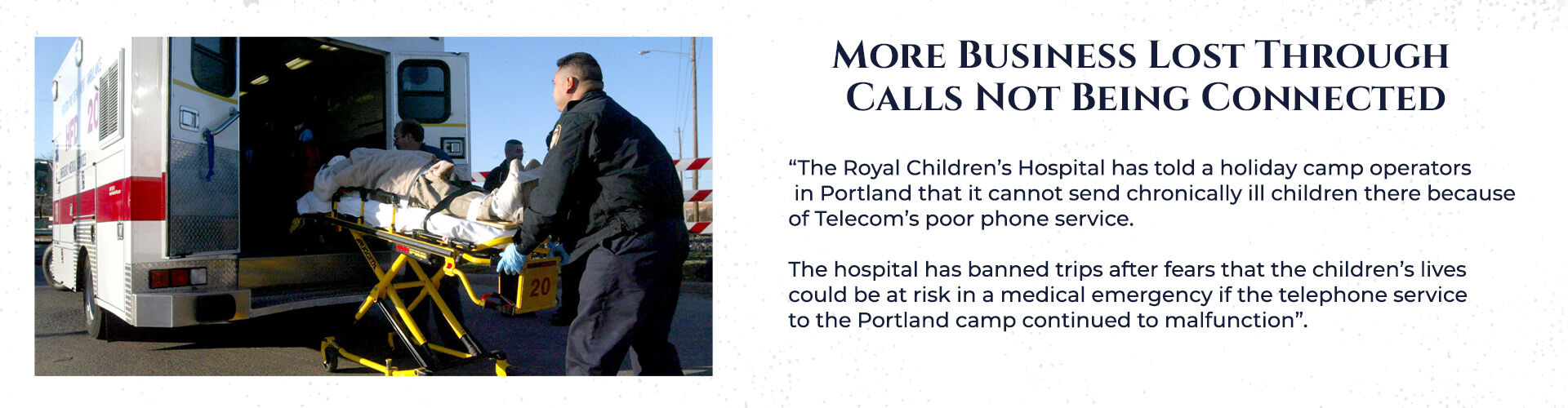
Children's lives could be at risk
Comments made from the Herald Sun newspaper dated 30 August 1993 confirm just how damaging some of these newspaper articles were to my already ailing business with statements like:
“The Royal Children’s Hospital has told a holiday camp operators in Portland that it cannot send chronically ill children there because of Telecom’s poor phone service. The hospital has banned trips after fears that the children’s lives could be at risk in a medical emergency if the telephone service to the Portland camp continued to malfunction”.
The centre’s stand follows letters from schools, community groups, companies and individuals who have complained about the phone service at Portland’s Cape Bridgewater Holiday camp.”
Youths from the Royal Children’s Centre for Adolescent Health, who were suffering from “chronic illnesses”, visited the camp earlier this year.
Group leader Ms Louise Rolls said in a letter to the camp the faulty phones had endangered lives and the hospital would not return to the camp unless the phone service could be guaranteed” Arbitrator File No/90
After the Melbourne Children's Hospital recorded a near-death experience with me having to rush a sick child with cancer to the Portland Hospital 18 kilometres away from my holiday camp, Telstra finally decided to take my telephone faults seriously. None of the 35 children (all with cancer-related illnesses) had mobile phones, or the six or so nurses and carers. Mobile telephones could not operate successfully in Cape Bridgewater until 2004, eleven years after this event.
After five years, it took almost a tragedy for Telstra to send someone with real technical experience to my business. Telstra's visit happened on 3 June 1993, six weeks after the Children's Hospital vowed never to revisit my camp until I could prove my camp was telephone fault-free. No hospital where convalescent is a good revenue spinner has ever visited my business, even after I sold it in December 2001.
In August 1993, Rita Espinoza from the Chilean Social Club wrote:
I tried to ring you in order to confirm our stay at your camp site. I found it impossible to get through. I tried to ring later but encountered the same signal on 10 August around 7 – 8.30 pm. I believe you have a problem with the exchange and strongly advise you contact Telstra.
Do you remember the same problem happened in April and May of this year?
I apologise but I have made arrangements with another camp.
Attempting to move on…but wait!
At the camp in Cape Bridgewater, I acquired a logo especially for the over-forties singles club, and his Community Groups, which I was calling “Country Get-A-Ways”, and he hit the road with a vengeance, marketing a range of different weekend holidays. I had organised an outdoor canoe weekend, a walking and river cruise along the Glenelg River, and a Saturday Dress-up Dinner Dance with a disco, as well as a trip to the Coonawarra Wineries and a Saturday morning shopping tour to Mt Gambier, both in South Australia. This meant I was able to market the holiday periods in both Victoria and South Australia.
Then it hit home: I got no response from Ballarat and the surrounding areas. I later learned from a Ballarat single club patron who was a member of the Ballarat Parents Without Partners social club that they had given up on receiving a response to their failed telephone calls.
Numerous testimonials from hopeful customers trying to book at my venue from 1988 to this period are well documented in AUSTEL’s Adverse Findings, dated March 1994. At points 9, 10 and 11 in their reporting notes:
"During the past five years Mr Smith has received many testimonials from other network users such as community groups, health and welfare agencies, school and individuals which have advise of continuing difficulties contacting the camp. These statements support Mr Smith's claims of service problems of Mr Smith.
An important point in relation to Mr Smith's service is that he is operating a business service in an area which is predominantly that of a residential and/or farming community. Therefore both the nature, volume and origin of calls received by Mr Smith is comparison with those of his neighbours would be markedly different…
Often calls to the Cape Bridgewater Holiday Camp would be from people previously unknown to Mr Smith, who in comparison to other callers to Cape Bridgewater would be less likely to initiate further contact should they have difficulty in contacting the Camp…"
So here it was, mid-1993, and still hardly any phone calls were getting through to Alan at the Camp. What he couldn’t know was that less than twelve months later, AUSTEL would discover that what Alan had been telling Telstra was the truth, but that AUSTEL would hide most of those truths from the relevant Ministers, from Alan and from the arbitrator.
All Alan knew was that his business was sinking fast and so he stepped up the marketing of the camp and the singles-club weekends; he visited numerous recognised social clubs around the Melbourne metropolitan area and spoke personally to the people in charge and in fact, over the next few weeks, he spoke to the Phoenix Social Club in Camberwell, the Australian Social Centre in Hartwell, Frenze-In-Deed in Mont Albert and Capers in Knox City, as well as visiting numerous other singles organisations in Ballarat and Warrnambool, both large country centres in Victoria.
Further newspaper advertising followed, with ads placed with the Leader Newspaper group in Melbourne. This local newspaper group covers twenty-three different metropolitan areas around Melbourne. Ads also went into the local newspapers for a number of large regional centres around Victoria and South Australia, including the Geelong Advertiser, the Warrnambool Standard, the Ballarat Courier News, the Horsham Wimmera Times, the Colac Local News, the Mt Gambier-Border Watch and others.
A testing situation
Late in 1993, Mrs Cullen from Daylesford Community House informed me that she had tried unsuccessfully to phone me on 17 August 1993 at 5.17, 5.18, 5.19 and 5.20 pm, each time reaching a deadline (File 35-A, 35-B and 35-C AS-CAV Exhibit 1 to 47). She had reported the fault to Telstra’s Fault Centre in Bendigo at 1100, speaking to an operator who identified herself as Tina. Tina then rang my 1800 number but couldn’t get through either. Telstra’s hand-written memo, dated 17/8/93, records the times that Mrs Cullen had tried to get through to my phone and reports Tina’s failed attempt to contact me.
So arbitration seemed the only solution.
5 October 1993: The draft of the COT Fast Track Settlement Proposal (FTSP) from AUSTEL’s Robin Davey states, at point 40:-
“Finally, if the attached letter (Attachment ‘D’) dated 7 July 1993 from Freehill, Hollingdale & Page to one of the COT Cases’ solicitors is indicative of the way that Freehill, Hollingdale & Page have approached the COT Cases in the past, I would be more than a little concerned if they were to have a continuing role.” (GS-CAV Exhibit 89 to 154(b) - See GS-CAV 110)
11 October, 1993: Telstra internal email H36291 confirms Telstra’s knowledge of the 1800 network billing problems Peter Zeagers to Nigel Beaman:-
“I am receiving a disturbing number of reports of instances where the 1800 prefix ‘does not work’ in the network.” (AS-CAV Exhibit 92 to 127 - See AS-CAV 122-D)
14 October, 1993: This internal Telstra email FOI folio R03331 discusses how to minimise the problems experienced by the COT claimants. It states:-
“We need to focus Austel’s attention as much as possible on the current rather than the past level of service delivered to Cot Cases. …”
“My view is that Telecom’s response to this issue should reflect the advice from Denise McBurnie, Freehill, Hollingdale & Page, Solicitors.” (GS-CAV Exhibit 89 to 154(b) - See GS-CAV 111)
19 October, 1993: This document from Denise McBurnie to Don Pinel titled Legal Professional Privilege/Commercial In Confidence. includes the following:-
“Duesbury & FHP continuing of evaluating claim – final report to Telecom will be privileged and will not be made available to ”
“Telecom preparing report for FHP analysing data available on services (ie. CCAS, Leopard, CABS and file notes) – this report will be privileged and will not be made available to (blank).” (GS-CAV Exhibit 89 to 154(b) - See GS-CAV 112)
It is clear from the above letters of 14th and 19th October 1993 that Telstra had no intention of listening to Robin Davey’s concerns about Freehills having a continuing role in the COT case issues.
On 9 December 1993, the Hon David Hawker MP wrote to congratulate me for my “persistence to bring about improvements to Telecom’s country services. I regret that it was at such a high personal cost.” (See Arbitrator File No/82)
This was very affirming, as was another letter dated 9 December 1993 and copied to me from the Hon David Beddall MP, Minister for Communications, in the Labor government, who wrote:
“Let me say that the Government is most concerned at allegations that Telecom has not been maintaining telecommunications service quality at appropriate levels. I accept that in a number of cases, including Mr Smith’s there has been great personal and financial distress. This is of great concern to me and a full investigation of the facts is clearly warranted.” (Arbitrator File No/82)
Even though I had been able to show the government prior to arbitration that Telstra was installing poor-quality infrastructure in the Cape Bridgewater network and the government regulator was allowing Telstra to test their own customers' complaints, even those who were to enter arbitration, no one bothered to investigate.
I have brought up the Ericsson AXE telephone exchange faults documents (see below) because, during a meeting with Hon. David Hawker, we discussed the impact of the AXE equipment installed in the telephone exchanges in his electorate, which seemed to be negatively affecting many businesses. I offered to continue supplying FOI documents received from Telstra to Mr Hawker, who would then pass them on to the Shadow Minister for Communications, Senator Richard Alston. I followed up by sending him (False Witness Statement File No 3-A), which he forwarded to Senator Alston. This document was subsequently raised in the Senate "On Notice" on 24 February 1994
Malfeasance
Ongoing Ericsson AXE telephone problems
A further Telstra documents, in this illusive briefcase dated 2 July 1992, concerning the Portland AXE telephone exchange states:
“Our local technicians believe that Mr Smith is correct in raising complaints about incoming callers to his number receiving a Recorded Voice Announcement saying that the number is disconnected.
“They believe that it is a problem that is occurring in increasing numbers as more and more customers are connected to AXE.” (See False Witness Statement File No 3-A)
It is confirmed from this other Telstra document that Telstra already knew my phone complaints were valid. This can best be viewed by reading Folios C04007 and C04008, headed TELECOM SECRET (see Front Page Part Two 2-B), states:
“Legal position – Mr Smith’s service problems were network related and spanned a period of 3-4 years. Hence Telecom’s position of legal liability was covered by a number of different acts and regulations. … In my opinion Alan Smith’s case was not a good one to test Section 8 for any previous immunities – given his evidence and claims. I do not believe it would be in Telecom’s interest to have this case go to court.
“Overall, Mr Smith’s telephone service had suffered from a poor grade of network performance over a period of several years; with some difficulty to detect exchange problems in the last 8 months.”
On 3 March 1994, this article appeared in the Portland Observer newspaper (AS 773-b), noting:
“Federal Police officers are investigating allegations of possible illegal activity on the part of Telecom Australia.
Officers from the Federal Police visited Portland last week and interviewed Cape Bridgewater Holiday Camp proprietor, Alan Smith, who is one of the four original members of COT (Casualties of Telecom).”
My 3 February 1994 letter to Michael Lee, Minister for Communications (see Hacking-Julian Assange File No/27-A) and a subsequent letter from Fay Holthuyzen, assistant to the minister (see Hacking-Julian Assange File No/27-B), to Telstra’s corporate secretary, show that I was concerned that my faxes were being illegally intercepted.
An internal government memo, dated 25 February 1994, confirms that the minister advised me that the Australian Federal Police (AFP) would investigate my illegal phone/fax interception allegations. (Hacking-Julian Assange File No/28)
AUSTEL (the then government communications authority) wrote to Telstra during the early part of the COT arbitrations on 10 February 1994, stating:
“Yesterday we were called upon by officers of the Australian Federal Police in relation to the taping of the telephone services of COT Cases.
“Given the investigation now being conducted by that agency and the responsibilities imposed on AUSTEL by section 47 of the Telecommunications Act 1991, the nine tapes previously supplied by Telecom to AUSTEL were made available for the attention of the Commissioner of Police.” (See Illegal Interception File No/3)
Question 81 in the following AFP transcripts, Australian Federal Police Investigation File No/1, confirms that the AFP told me that AUSTEL's John MacMahon had supplied the AFP evidence that my phones had been bugged over an extended period. Why did the arbitrator not award me in his official findings concerning this evidence after he was supplied with these AFP transcripts, which note:?
"... does identify the fact that, that you were live monitored for a period of time. See we're quite satisfied that, there are other references to it".
A letter dated 2 March 1994 from Telstra’s Corporate Solicitor, Ian Row, to Detective Superintendent Jeff Penrose (refer to Home Page Part-One File No/9-A to 9-C) strongly indicates that Mr Penrose was grievously misled and deceived about the faxing problems discussed in the letter. Over the years, numerous individuals, including Mr Neil Jepson, Barrister at the Major Fraud Group Victoria Police, have rigorously compared the four exhibits labelled (File No/9-C) with the interception evidence revealed in Open Letter File No/12 and File No/13. They emphatically assert that if Ian Row had not misled the AFP regarding the faxing problems, the AFP could have prevented Telstra from intercepting the relevant arbitration documents in March 1994, thus avoiding any damage to the COT arbitration claims.
In my case, as evidenced by the following two links, the arbitrator's failure to compel Telstra to address my ongoing telephone issues enabled Telstra to persist in ignoring the problems. This ultimately led to my reluctant decision to sell my Cape Bridgewater Holiday Camp and residence in December 2001 after enduring seven years of ongoing telephone problems after completing my arbitration on 11 May 1995. Subsequently, the new owners, Jenny and Darren Lewis, encountered the same phone faults, corroborated by the following two links. By December 2008, their bankruptcy declaration in the Melbourne Magistrates Court resulted in their eviction from the property in August 2009, leaving them broken. Chapter 4, The New Owners Tell Their Story, and Chapter 5, Immoral - hypocritical Conduct.
Upon discovering that the COT Cases had engaged the services of George Close and Associates to assist with their arbitration claims, Telstra took proactive measures. Specifically, they implemented a facsimile interception system at Mr. Close's residence and office. The objective was to intercept the FOI documents Mr Close was instructing his COT Case, clients, to access from Telstra, a critical component for the claimants' chances of success in their claim.
--------
--------
It is imperative to acknowledge the importance of WikiLeaks exposing the truth, particularly alongside the insightful observations made by journalist Karina Barrymore of the Melbourne Herald Sun on August 3, 2016, regarding the role of whistleblowers. Had the government taken seriously the concerns raised by the COT whistleblowers in 1995 and 1996 regarding their telephone faults—issues that were reportedly addressed during government-endorsed Telstra arbitrations—the substantial financial overruns of the National Broadband Network (NBN) could have been averted, resulting in savings of billions of dollars. Karina Barrymore's statement underscores this critical perspective effectively:
“Dobber, Snitch, Rat, Squealer. It’s insightful how the words used to describe a whistleblower are so negative.
“Yet being honest and speaking the truth is supposed to be cornerstone of our society. A cornerstone of our families, communities, corporate world and government.
“So why aren’t we applauding and raising up these people, instead of shutting them down and ruining their lives.
“These ‘truth tellers’ are shunned and rejected. Telling the truth often means they lose their jobs, their reputations are deliberately trashed, their finances suffer, their mental health fails and all these factors flow on to damage their family, social and professional relationships.
“The whistleblowers have done their job, spoken the truth, suffered the consequences, lived the hardship and financial burden. But our corporate leaders, our regulators, our governments have not done their job.”
Karina Barrymore’s statement accurately reflects a significant issue: the Australian Establishment, comprising former government ministers and senior members of two regulatory bodies, is mindful of the actions taken by Dr. Gordon Hughes, the arbitrator for the majority of the COT arbitrations, and Warwick Smith, the administrator for the same processes. They acted in concert with the defendants, opting to employ a pre-drafted arbitration agreement rather than an independently drafted agreement. Allowing Telstra’s lawyers to draft the agreement, telling the Australian government, the parliament house media journalist and the COT Cases lawyers the agreement had been drafted totally independently of Telstra when this was not the case is the reason why the COT Cases have been crying foul for the past thirty years.
He recommended thoroughly reviewing and revising the document to address its deficiencies before any subsequent arbitration proceedings took place. This letter, dated 12 May 1995 (attached as (Open Letter File No 55-A), is crucial because it identifies several significant flaws that undermine the agreement’s validity. It is exceedingly troubling that this vital information was not disclosed to me during the appeal period, especially considering its relevance to ensuring a fair and just arbitration process. The withholding of such critical evidence raises serious questions about the integrity of the proceedings and the fairness of the arbitration process to which I was subject.
Learn about horrendous crimes, unscrupulous criminals, corrupt politicians, and the lawyers who control the arbitration system in Australia. Visitors to this website have observed notable parallels between its content and an in-depth analysis of criminal behaviour, unscrupulous conduct, treacherous ill-doings, fraud and the perversion of the course of justice. Instances of foreign bribery, corrupt practices abroad, and kleptocracy represent significant issues that warrant our comprehensive attention. Absentjustice.com, the website that catalyzed an in-depth exploration into political corruption, holds a prominent position alongside established true crime narratives.
**Unconscionable Conduct: Chapter 1 - The Collusion Continues | Absent Justice.** This chapter thoroughly investigates the pervasive issue of political corruption and its significant ramifications, particularly concerning the Casualties of Telstra arbitrations. Bribery and corruption can manifest across various sectors, including business, government, the judiciary, media, and civil society. These unethical practices can potentially disrupt vital areas such as health care, education, infrastructure, and sports. The individuals implicated in these corrupt activities include politicians, government officials, public servants, business professionals, and members of the public.
Readers are encouraged to engage with Chapter 1 - The Collusion Continues and critically evaluate the ongoing unethical practices that have severely compromised the integrity of the Casualties of Telstra arbitrations. By the time John Pinnock, the second appointed administrator of these investigations, confirmed the validity of my claims against Dr Hughes (the arbitrator), which I had submitted to Laurie James, President of the Institute of Arbitrators Australia, it was unfortunately too late for the majority of the COT Cases. They had already endured significant hardships during their individual arbitration processes, a reality that is powerfully conveyed in this COT narrative.
MOST IMPORTANT
In a letter dated November 15, 1995 (see Forces at Work Part 3), John Rundell communicated to John Pinnock, the second Telecommunications Industry Ombudsman (TIO) and the administrator of my arbitration, that DMR & Lane, the technical consultants for the arbitration, did not leave the billing issues open in their final report, despite their knowledge of the contrary. This suggests that John Rundell intentionally misled and deceived John Pinnock as the Institute of Arbitrators Australia began to investigate my claims. This situation raises serious concerns, as it distorts the truth. This assertion is not just a simple mistake but a significant misrepresentation, particularly in light of the critical nature of the correspondence directed to Mr. Pinnock.
For those new to absentjustice.com, it’s crucial to understand that the DMR & Lane combined technical report is not the only fundamentally flawed document that the arbitrator submitted in the final arbitration process. Dr. Gordon Hughes, the arbitrator, and his Project Manager John Rundell—who now oversees an arbitration center in Melbourne and Hong Kong—colluded to submit final financial reports on my Telstra losses, fully aware of their glaring inaccuracies and incompleteness, as outlined in the evidence presented in Chapter 2 - Inaccurate and Incomplete.
This situation raises serious concerns for anyone contemplating arbitration in Australia or Hong Kong: will John Rundell conduct their arbitration in a biased way, similar to how he handled my case? The evidence speaks volumes against Mr. Rundell, leading us to question whether I am the only individual to have suffered through such a flawed arbitration process involving him. If that is the case, why was I specifically targeted? It is highly unlikely that I am the sole victim of Mr. Rundell’s misconduct, which suggests a troubling pattern that could affect many others in the future
Had Mr. Pinnock received accurate information from the outset, it is likely that he would have permitted me to amend this component of my claim, which was addressed outside the formal legal context of the arbitration process. This process did not afford me the legal right to challenge Telstra’s submission to AUSTEL on 16 October 1995. The misleading information provided by Mr. Rundell has significantly obstructed the opportunity for this crucial aspect of my claim to be thoroughly reviewed.
Records from AUSTEL (now ACMA) indicate that on 19 December 1995, following Telstra’s misleading actions during the aforementioned covert operation regarding the unaddressed arbitration billing documents, AUSTEL representative Darren Kearney undertook a twelve-hour round trip from Melbourne to my Cape Bridgwater Holiday Camp to collect copies of the arbitration claim documents that Dr. Gordon Hughes, the previous arbitrator of my claim, had not addressed. Refer to Absent Justice Part 2 - Chapter 14 - Was it Legal or Illegal?
Mr. Kearney was taken aback to discover from AUSTEL file evidence that Telecom/Telstra, at the time of my settlement, had not taken appropriate action to identify possible problems with the Release Control Manager. This oversight was the reason I was compelled into arbitration, despite the fact that it was Telstra's negligence that led to my predicament.
This situation underscores the necessity for transparency and a just resolution of these billing issues.
I was able to prove, and can still prove in 2024, that these unaddressed billing faults were a two-fold problem. The complications stem from two primary areas: unresponsive lines and instances where the telephones become inoperative, resulting in considerable billing inaccuracies. This oversight indicates that a vital component of my claim was never adequately investigated, leaving the associated deficiencies with my telephone lines and equipment unaddressed, which are integral to my case.
Had John Pinnock been made aware that the persistent billing issues had not been addressed as part of the agreed arbitration process, he would have had reasonable grounds to request that Telstra rectify these ongoing problems, which persisted for nine years following the conclusion of the arbitration. Please refer to the new owner's statement for further details → Chapter 4 The New Owners Tell Their Story.
TELSTRA - FILE - NOTES
Telstra’s file notes dated 16 October 2002: FOI folio 100264, concerns the new owner of my business, Mr Lewis’ was having ongoing phone problems and had contacted his local Member of Parliament
“Customer has contacted MP again re service as he is not receiving calls on message bank or *10#. Customer is aware previous owner of business also had problems with service . Customer said he was told by Telstra that there was a problem in his exchange.” ( AS-CAV Exhibit 282 to 323 - See AS-CAV 289)
18th October 2002: Telstra FOI folio 100266 re the Lewis phone problems says:-
“The TIO have now raised a Level 1 complaint on behalf of Mr & Mrs Lewis. The TIO have specifically mentioned in their correspondence that the TIO have previously investigated a number of complaints raised by Alan Smith the previous account holder for this service.” ( AS-CAV Exhibit 282 to 323 - See AS-CAV 290)
8th November 2002: This Portland Observer newspaper article is headed: “Holiday camp still plagued by phone and fax problems”, and says:-
“The telecommunications problems which plagued former Cape Bridgewater Holiday Camp operator Alan Smith continued to beset current owner Darren Lewis.” (GS-CAV Exhibit 410-a to 447 - See GS-CAV 414)
The above Telstra file notes clearly indicate that John Pinnock was fully aware of the ongoing arbitration billing issues that persisted even after the business was sold to Darren and Jenny Lewis, seven years after Dr. Hughes' involvement. On April 30, 1995, the arbitrator firmly rejected DMR & Lane's request for additional time to investigate these arbitration-related billing problems, underscoring the seriousness of the situation.
An example of the type of ongoing telephone fault complaints registered by the COT Cases with the government and then the COT arbitrator follows:
Additionally, the two letters dated April 8 and 9, 1994, from Telstra's General Manager to AUSTEL's Robin Davey were mishandled, reflecting a troubling disregard for public welfare.
The concealment of the number of individuals affected by these faults caused significant personal distress and led to widespread financial hardship. While households faced overcharging for phone calls, this was merely the surface issue; numerous businesses among the 120,000 COT-type customers experienced lost calls, ultimately contributing to bankruptcies, as evidenced by the twelve COT cases currently in arbitration. Acknowledging the seriousness of these issues and their profound effects on individuals and families is imperative.
The following letters, dated 8 and 9 April 1994, to AUSTEL’s chair from Telstra’s group general manager, suggest AUSTEL was far from truly independent but rather could be manipulated to alter their official findings in their COT reports, just as Telstra requests in many of the points in this first letter. For example, Telstra writes:
“The Report, when commenting on the number of customers with COT-type problems, refers to a research study undertaken by Telecom at Austel’s request. The Report extrapolates from those results and infers that the number of customers so affected could be as high as 120 000. … (See Open Letter File No/11)
And the next day:
“In relation to point 4, you have agreed to withdraw the reference in the Report to the potential existence of 120,000 COT-type customers and replace it with a reference to the potential existence of “some hundreds” of COT-type customers” (See Open Letter File No/11)
Point 2.71 in AUSTEL’s April 1994 formal report notes:
“the number of Telecom customers experiencing COT type service difficulties and faults is substantially higher than Telecom’s original estimate of 50”.
It is alarming that Telstra (the defendants) was able to pressure the government regulator to change its original findings in the formal 13 April 1994 AUSTEL report. The 120,000 other customers—ordinary Australian citizens who were experiencing COT-type problems—are not referred to in the Department of Communications Information Technology and the Arts (DCITA) report (see Senate Evidence File No 28). However, they used this to determine the validity of the COT claims.
For a government regulator to reduce their findings from 120.000 COT-type complaints to read just 50 or more COT-type customer complaints is one hell of a lie told to its citizens. Were the government's downplaying of the Ericsson AXE fault complaints part of the overall conspiracy, which involved purchasing Lane Telecommunications Pty Ltd, who often worked on government contracts?
The type of corroded copper wire that I, along with approximately 120,000 other COT-type Australian citizens, experienced reflects the serious shortcomings in the government's investigation of our claims. My concerns, including those related to the lack of action from the government regulator AUSTEL (now ACMA), were warranted, especially given that the arbitrator and Telstra did not address my billing claims during the arbitration process.
"Worst of the worst: Photos of Australia’s copper network | Delimiter.
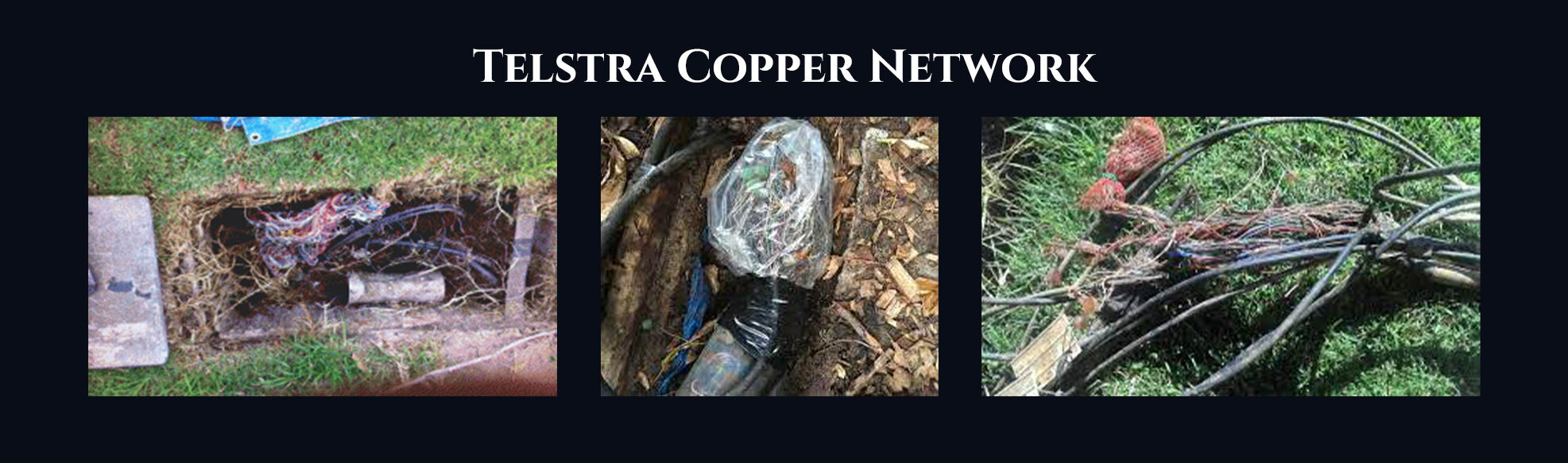
On Going telephone problems
23 June 2015: Had the arbitrator appointed to assess my arbitration claims correctly investigated ALL of my submitted evidence he would have had to value my claim as an ongoing problem NOT a past problem as his final award shows. It is clear from the following link dated > Unions raise doubts over Telstra's copper network; workers using ... that when reading in conjunction with Can We Fix The Can which was released in March 1994, these faults copper-wire network faults have been in existence for more than 24-years.
9 November 2017: Sadly, many Australians in rural Australia can only access a second-rate NBN. This didn’t have to be the case: had the Australian government ensured the arbitration process it endorsed to investigate the COT cases’ claims of ongoing telephone problems was conducted transparently, it could have used our evidence to start fixing the problems we uncovered in 1993/94. This news article https://theconversation.com/the-accc-investigation-into-the-nbn-will-be-useful-but-its-too-little-too-late-87095 and absentjustice.com/Introduction again shows that the COT Cases claims of ailing copperwire network was more than valid.
Almost two decades after this cover-up had been executed, with the government spin doctors successfully branding my claims as frivolous and me as a vexatious litigant, I have been left the government stopped financing the roll-out of the National Broadband Network (NBN), which still utilises part of the existing, seriously degraded copper network. In fact, the “… state of the copper network is considerably worse than expected, leading to extensive work beyond the node,” say leaked documents.
28 April 2018: This ABC news article regarding the NBN see >NBN boss blames Government's reliance on copper for slow ... needs to be read in conjunction with my own story because had these lies told under oath by so many Telstra employees had not occurred then the government would have been in a better position to evaluate just how bad the copper-wire Customer Access Network (CAN) really was just 4-years ago.
Sadly, many Australians who lived in rural areas up until 2017 could only access a second-rate NBN. This wouldn’t have been the case if the Australian Government had ensured the arbitration process they endorsed to investigate the COT cases’ claims of ongoing communication problems had been conducted lawfully.
During my second meeting with the AFP, I provided Superintendent Detective Sergeant Jeff Penrose with two Australian newspaper articles concerning two separate telephone conversations with The Hon. Malcolm Fraser, former prime minister of Australia; refer to page 12 Australian Federal Police Investigation File No/1. Mr Fraser reported to the media only what he thought was necessary concerning our telephone conversations.
There appears to be a significant connection between the formal warning I issued to Malcolm Fraser on 18 September 1967, during his tenure as Minister for the Army, and a concerning issue regarding Australia’s wheat supplies being shipped to China. During this time, several seamen and I discovered that this wheat, which was designated for humanitarian aid, was subsequently redirected by China to North Vietnam. This occurred when North Vietnam was actively engaged in hostilities against Australian, New Zealand, and American military forces. Is this the information Telstra redacted from the Freedom of Information documents provided during my arbitration in 1994? Refer to Chapter 7-Vietnam Vietcong
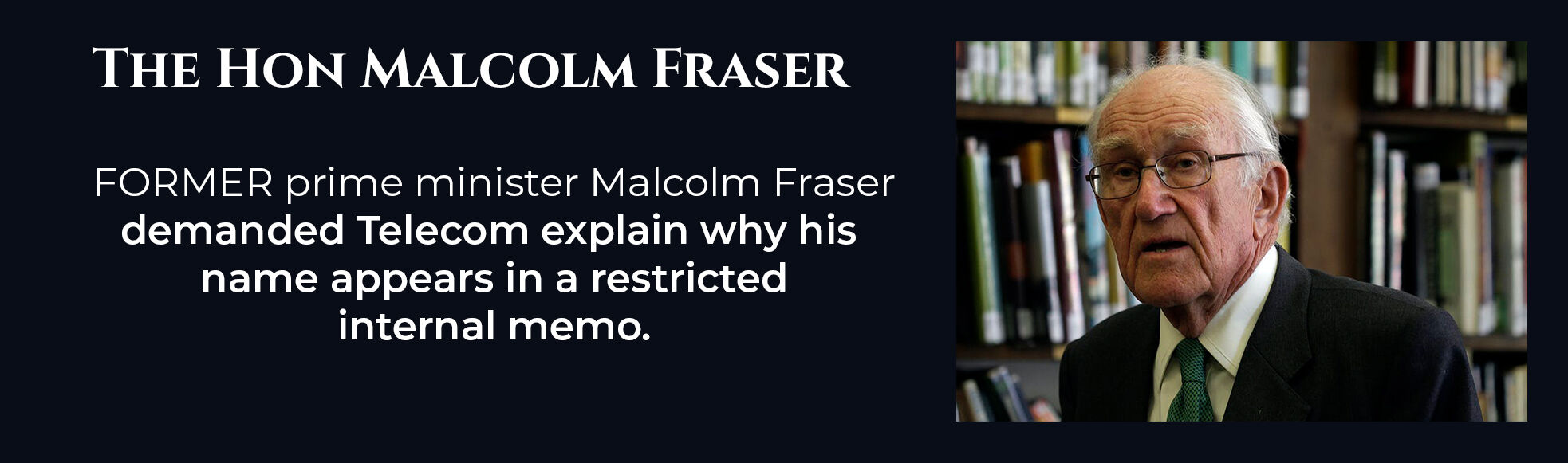
Why would Telstra Corporation, as the defendants in my arbitration, choose to redact specific information from file notes recorded by their employees during my telephone conversations with former Prime Minister Malcolm Fraser unless such information was potentially damaging? Upon receiving the documents requested through my Freedom of Information (FOI) request, I discovered evidence indicating that my telephone conversations had indeed been monitored. The file note pertaining to Malcolm Fraser was one of numerous concerning documents provided to me by Telstra. Furthermore, I submitted other similarly alarming documents to the Superintendent Detective Sergeant of the Australian Federal Police as they investigated the possibility that my arbitration-related faxes were being intercepted. Notably, the information contained within those documents was screened prior to being forwarded to my arbitration advisors and the Arbitrator, adding to the gravity of the matter.
The fax imprint across the top of this letter dated 12 May 1995 (Open Letter File No 55-A) is the same as the fax imprint described in the January 1999 Scandrett & Associates report provided to Senator Ron Boswell (see Open Letter File No/12 and File No/13), confirming faxes were intercepted during the COT arbitrations. One of the two technical consultants attesting to the validity of this January 1999 fax interception report emailed me on 17 December 2014, stating:
“I still stand by my statutory declaration that I was able to identify that the incoming faxes provided to me for review had at some stage been received by a secondary fax machine and then retransmitted, this was done by identifying the dual time stamps on the faxes provided.” (Front Page Part One File No/14)
The site examines the contributions of lesser-known whistleblowers who have facilitated meaningful, albeit understated, change while also highlighting the more prominent case of Julian Assange. During the initial four arbitrations, Assange communicated with Graham Schorer, a spokesperson for Casualties of Telstra, during which he alerted Mr Schorer to the unlawfulness of our arbitration proceedings and offered evidence to substantiate this claim.
Exhibit 10-C → File No/13 in the Scandrett & Associates report Pty Ltd fax interception report (refer to (Open Letter File No/12 and File No/13) confirms my letter of 2 November 1998 to the Hon Peter Costello Australia's then Federal Treasure was intercepted scanned before being redirected to his office. These intercepted documents to government officials were not isolated events, which, in my case, continued throughout my arbitration, which began on 21 April 1994 and concluded on 11 May 1995. Exhibit 10-C File No/13 shows this fax hacking continued until at least 2 November 1998, more than three years after the conclusion of my arbitration.
Graham Schorer's statutory declaration (refer to Hacking – Julian Assange File No/3) confirms our discussion regarding our group's appropriate course of action. This affirmation demonstrates our united decision to decline the request for documentation. I informed both Graham Schorer and Ann Gams, the third member of the COT Cases, that we could not risk the possibility of this being a trap set by Telstra and the government to pressure us into accepting documents inappropriately outside the established discovery and Freedom of Information (FOI) procedures. As a result, we decisively chose to refuse the request for documents.
The statements from six Australian Senators (see below) shed light on the critical findings of their thorough eighteen-month investigation into the conduct of the COT arbitrations, conducted between June 1997 and March 1999. Their inquiry concluded that Telstra had indeed acted as a law unto themselves during our arbitration process, thereby underscoring the gravity of this situation.
When Telstra realized I had assisted the Australian Federal Police in their inquiries into the electronic interception of my phone conversations and arbitration-related documents faxed to my technical consultant at George Close & Associates, they employed their formidable lobbyist and arbitration liaison officer Paul Rumble to threaten me with fierce determination. This is evident in the police transcripts from my second interview with the Australian Federal Police on September 26, 1994 (see page 12 Australian Federal Police Investigation File No/1).
The transcripts indicate that I identified Paul Rumble as a pivotal individual involved in these threats. I named Mr. Rumble for two primary reasons. First, he executed these threats and halted the provision of arbitration discovery documents, which the government had pledged to supply under the Freedom of Information Act (FOI), contingent upon my agreement to participate in their government-sanctioned arbitration. Second, I discovered that he had successfully influenced the arbitrator to release my interim claim materials five months prior to the timeline outlined in the arbitration agreement signed by both Telstra and myself. Consequently, Telstra had access to my claim significantly earlier than legally permitted. At the same time, I was afforded only one month to review the relevant materials as stipulated when signing for our arbitrations.
Threats Made
Threats Carried Out
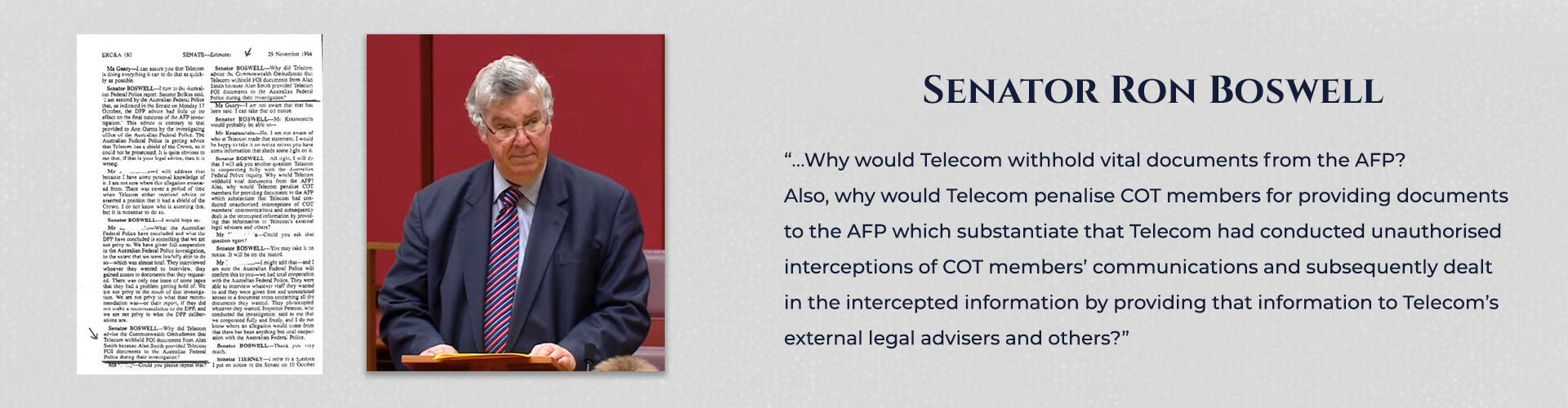
Threats were made against me by Telstra arbitration officials because I assisted the Australian Federal Police with their investigations into these phone and fax hacking issues. Refer to page 180 ERC&A, from the official Australian Senate Hansard, dated 29 November 1994, which reports Senator Ron Boswell asking Telstra’s legal directorate:
“Why did Telecom advise the Commonwealth Ombudsman that Telecom withheld FOI documents from Alan Smith because Alan Smith provided Telecom FOI documents to the Australian Federal Police during their investigation?”
After receiving a hollow response from Telstra, which the senator, the AFP and I all knew was utterly false, the senator states:
“…Why would Telecom withhold vital documents from the AFP? Also, why would Telecom penalise COT members for providing documents to the AFP which substantiate that Telecom had conducted unauthorised interceptions of COT members’ communications and subsequently dealt in the intercepted information by providing that information to Telecom’s external legal advisers and others?” (See Senate Evidence File No 31)
Thus, the threats became a reality. What is so appalling about this withholding of relevant documents is this - no one in the TIO office or government has ever investigated the disastrous impact the withholding of documents had had on my overall submission to the arbitrator. The arbitrator and the government (at the time, Telstra was a government-owned entity) should have initiated an investigation into why an Australian citizen, who had assisted the AFP in their investigations into unlawful interception of telephone conversations, was so severely disadvantaged during a civil arbitration.
Pages 12 and 13 of the Australian Federal Police Investigation File No/1 transcripts provide a comprehensive account establishing Paul Rumble as a significant figure linked to the threats I have encountered. This conclusion is based on two critical and interrelated factors that merit further elaboration.
Firstly, Mr. Rumble actively obstructed the provision of essential arbitration discovery documents, which the government was legally obligated to provide under the Freedom of Information Act. This obligation was contingent on my signing an agreement to participate in a government-endorsed arbitration process. By imposing this condition, Mr Rumble undermined a legally established protocol, effectively manipulating the process for his benefit and jeopardizing my legal rights.
Secondly, I uncovered that Mr. Rumble had a substantial influence over the arbitrator, resulting in the unauthorized early release of my arbitration interim claim materials. This premature revelation directly conflicted with the timeline stipulated in the arbitration agreement that both Telstra and I had formally signed. Specifically, Telstra gained access to my interim claim document five months earlier than what was permitted under the agreed-upon terms. This breach of protocol not only violated the integrity of the arbitration process but also provided Telstra with an unfair advantage in their response to my claims.
According to the rules governing our arbitration process, Telstra was allocated one month to respond to my claim once it had been submitted in writing as my final claim. Furthermore, the arbitrator was only authorized to release my final claim to Telstra once it was officially confirmed to be complete. The five-month delay in submitting my claim was primarily attributable to Mr. Rumble's deliberate withholding of critical technical information. This information was essential for my consultant, George Close, to effectively demonstrate that the issues with my phone remained unresolved. Mr. Rumble threatened to withhold this information because I was actively assisting the Australian Federal Police in their investigation into Telstra’s unlawful interception of my private phone conversations and faxes without a legal warrant.
As a result of these actions, I found myself constrained to a mere one month to formulate a comprehensive response to Telstra's defense, while they benefited from an extensive five-month preparation period to address my claim. This imbalance not only undermined the fairness of the arbitration process but also significantly impacted my ability to advocate effectively for my rights.
This harassment by Telstra and its internal security division continued for years. No one in government or the arbitration process would investigate the devastation these threats, harassment combined with corporate thuggery, had on the lives of the COT Case members.
The holiday camp I operated had historically relied on landline telephones as the sole means of communication, apart from incidental trade. Upon our initial appreciation for the property, we overlooked the obsolete telephone system prevalent at that time. Mobile network coverage was nonexistent during that period, and business transactions were not conducted via the Internet or email. The camp was connected to a roadside switching facility that routed calls to the central telephone exchange 20 kilometres away in Portland. This facility, which had been in place for over 30 years, was designed for low-call-rate areas and equipped with only eight lines to serve 66 families, totalling 132 adults and children.
Consequently, only four lines were available for the remaining 128 adults and their children. During peak periods—such as weekends and holidays—when visitor numbers surged at the seaside resort, demand for telecommunications services increased substantially, leading to recurring line congestion.
After three and a half years of operating with this outdated infrastructure, Telstra finally installed a new system. Regrettably, they neglected to connect it to the central telephone exchange in Portland for an additional twenty months. This unacceptable oversight is further documented in a government report dated March 1994, AUSTEL’s Adverse Findings, which identifies issues from points 2 to 212.
The findings in that report stem from the fault reports extracted from the Portland Telstra telephone exchange logbook. Unfortunately, as I previously mentioned, I was denied access to this logbook during my arbitration. By utilising that source, AUSTEL could only have reached such precise conclusions in the 69-page, 212-point report.
My business was connected to this outdated telephone exchange for the first 3½ years after I purchased it—3½ crucial years when I expected to establish the company on firm ground.
My Holiday Camp was surely situated in a pristine location
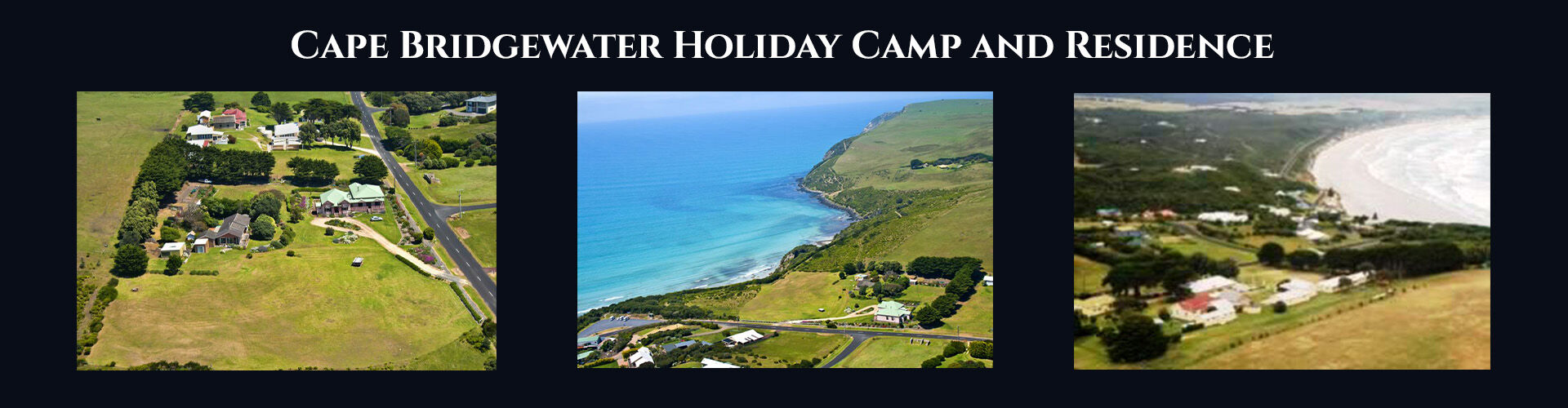
If only the telephones had been fit for purpose
On 15 July 1995, two months after the arbitrator's premature announcement of findings regarding my incomplete claim, Amanda Davis, the former General Manager of Consumer Affairs at AUSTEL (now known as ACMA), provided me with an open letter to be shared with individuals of my choosing. This action underscores the confidence she placed in my integrity and professional character:
“I am writing this in support of Mr Alan Smith, who I believe has a meeting with you during the week beginning 17 July. I first met the COT Cases in 1992 in my capacity as General Manager, Consumer Affairs at Austel. The “founding” group were Mr Smith, Mrs Ann Garms of the Tivoli Restaurant, Brisbane, Mrs Shelia Hawkins of the Society Restaurant, Melbourne, Mrs Maureen Gillian of Japanese Spare Parts, Brisbane, and Mr Graham Schorer of Golden Messenger Couriers, Melbourne. Mrs. Hawkins withdrew very early on, and I have had no contact with her since.
The treatment these individuals have received from Telecom and Commonwealth government agencies has been disgraceful, and I have no doubt they have all suffered as much through this treatment as they did through the faults on their telephone services.
One of the striking things about this group is their persistence and enduring belief that eventually there will be a fair and equitable outcome for them, and they are to admired for having kept as focussed as they have throughout their campaign.
Having said that, I am aware all have suffered both physically and their family relationships. In one case, the partner of the claimant has become seriously incapacitated; due, I beleive to the way Telecom has dealt with them. The others have al suffered various stress related conditions (such as a minor stroke.
During my time at Austel I pressed as hard as I could for an investigation into the complaints. The resistance to that course of action came from the then Chairman. He was eventually galvanised into action by ministerial pressure. The Austel report looks good to the casual observer, but it has now become clear that much of the information accepted by Austel was at best inaccurate, and at worst fabricated, and that Austel knew or ought to have known this at the time.”
After leaving Austel I continued to lend support to the COT Cases, and was instrumental in helping them negotiate the inappropriately named "Fast Track" Arbitration Agreement. That was over a year ago, and neither the Office of the Commonwealth Ombudsman nor the Arbitrator has been succsessful in extracting information from Telecom which would equip the claimants to press their claims effectively. Telecom has devoted staggering levels of time, money and resources to defeating the claiams, and there is no pretence even that the arbitration process has attemted to produce a contest between equals.
Even it the remaining claimants receive satisfactory settlements (and I have no reason to think that will be the outcome) it is crucial that the process be investigated in the interest of accountabilty of publical companies and the public servants in other government agencies.
Because I am not aware of the exact citrcumstances surronding your meeting with Mr Smith, nor your identity, you can appriate that I am being fairly circimspect in what I am prepared to commit to writing. Suffice it to say, though, I am fast coming to share the view that a public inquiry of some discripion is the only way that the reasons behind the appalling treatent of these people will be brought to the surface.
I would be happy to talk to you in more detail if you think that would be useful, and can be reached at the number shown above at any time.
Thank you for your interest in this matter, and for sparing the time to talk to Alan. (See File 501 - AS-CAV Exhibits 495 to 541 )
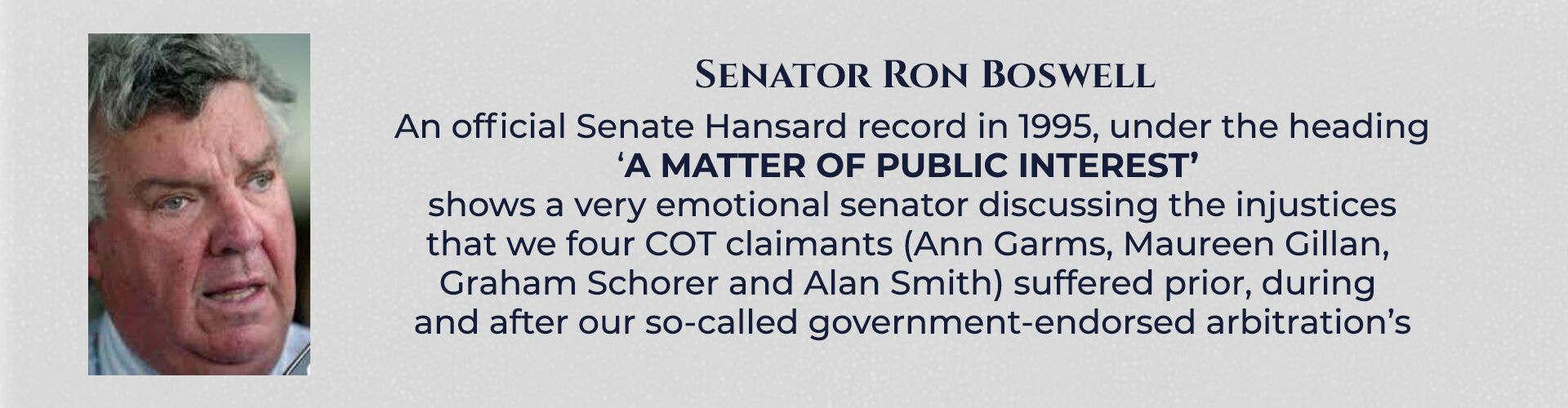
Four months after the arbitrator Dr Hughes prematurely brought down his findings on my matters, and fully aware I was denied all necessary documents to mount my case against Telecom/Telstra, an emotional Senator Ron Boswell discussed the injustices we four COT claimants (i.e., Ann Garms, Maureen Gillan, Graham Schorer and me) experienced prior and during our arbitrations (see Senate Evidence File No 1 20-9-95 Senate Hansard A Matter of Public Interest) in which the senator notes:
“Eleven years after their first complaints to Telstra, where are they now? They are acknowledged as the motivators of Telecom’s customer complaint reforms. … But, as individuals, they have been beaten both emotionally and financially through an 11-year battle with Telstra. …
“Then followed the Federal Police investigation into Telecom’s monitoring of COT case services. The Federal Police also found there was a prima facie case to institute proceedings against Telecom but the DPP , in a terse advice, recommended against proceeding. …
“Once again, the only relief COT members received was to become the catalyst for Telecom to introduce a revised privacy and protection policy. Despite the strong evidence against Telecom, they still received no justice at all. …
“These COT members have been forced to go to the Commonwealth Ombudsman to force Telecom to comply with the law. Not only were they being denied all necessary documents to mount their case against Telecom, causing much delay, but they were denied access to documents that could have influenced them when negotiating the arbitration rules, and even in whether to enter arbitration at all. …
“Telecom has treated the Parliament with contempt. No government monopoly should be allowed to trample over the rights of individual Australians, such as has happened here.”
Thus, the government was officially informed of the above concerning an arbitration process it endorsed and should have immediately appointed a review of the whole sordid affair. It never did.
Despite the financial precariousness of my Cape Bridgewater Holiday Camp, I had, from the start, sponsored the stays of underprivileged groups at the Camp. It was no vast loss to me: sponsored food was provided through the generosity of several commercial food outlets, and it cost me only a tiny amount of electricity and gas.
In May 1992, we held a charity week for kids from Ballarat and South-West Victoria, organised largely by Sister Maureen Burke, IBVM, Principal of Loreto College in Ballarat. Arrangements regarding food, transport, and any special needs the children might have had to be handled over the phone, and of course, Sister Burke had enormous problems making phone contact. The Calls were either ringing out, or she was getting a deadline — no sound at all. Finally, after trying in vain for one week, she decided to drive the 3½ hours to make the final arrangements.
Testimonials
Between April 1990 and when I sold the holiday camp in December 2001, I continued to partly sponsor underprivileged groups to stay at the camp during the weeks (that became years) when the phone problems continued to beset the holiday camp. At least some money was coming into the business. Those wanting a cheap holiday persisted by telephoning repetitively regardless of being told the camp was no longer connected to Telstra's network. These groups wanted a holiday, and if they had to drive for hours to make a booking as Loreto College did (see below), then a drive they did.
The holiday Camp could sleep around 90 to 100 persons in fourteen cabins. I arranged sponsored food purchases through the generosity of several commercial food outlets, and these groups then just used the camp facilities — it didn’t cost me anything other than a small amount of electricity and gas. Around May 1992, I organised a charity week for kids from Ballarat and the South West, including Warrnambool, Hamilton and Portland. Sister Maureen Burke IBVM organised this group, and I am sure she would not be offended to know that I think of her as the ‘mother’ of the project.
On one particular occasion in 1992, after trying in vain all through one week, she decided to drive the 3½ hours to make the final arrangements for those camps.
Just as she arrived at the Camp, Karen (my then-partner) took a phone call from a furious man who wanted information about a singles weekend we were trying to set up. This caller was quite abusive. He couldn't understand why we were advertising a business but never answered the phone. Karen burst into tears. She had reached the end of her tolerance, and nothing I could say was any help. When Sister Burke appeared in the office, I decided absence was the better part of valour and removed myself, leaving the two women together. Much later, Sister Burke came out and told me she thought it probably best for both of us if Karen were to leave Cape Bridgewater. I felt numb. It was all happening again.
Karen and I sat and talked. True, we would separate, but I assured her she would lose nothing because of her generosity and that I would do whatever was necessary to buy her out. We were both relieved at that. Karen rented a house in Portland, and we remained good friends, though, without her day-to-day assistance at the Camp, which had given me space to travel around, I had to drop my promotional tours.
Twelve months later, in March of 1993, Sister Karen Donnellon, also from Loreto College, tried to make contact via the Portland Ericsson telephone exchange to arrange an annual camp. Sister Donnellon later wrote:
“During a one week period in March of this year I attempted to contact Mr Alan Smith at Bridgewater Camp. In that time I tried many times to phone through.
Each time I dialled I was met with a line that was blank. Even after several re-dials there was no response. I then began to vary the times of calling but it made no difference.” File 231-B → AS-CAV Exhibit 181 to 233
Some years later, I sent Sister Burke an early draft of my manuscript, Absent Justice My Story‘, concerning my valiant attempt to run a telephone-dependent business without a dependent phone service. Sister Burke wrote back,
“Only I know from personal experience that your story is true, otherwise I would find it difficult to believe. I was amazed and impressed with the thorough, detailed work you have done in your efforts to find justice” File 231-A → AS-CAV Exhibit 181 to 233
Of course, Sister Maureen Burke and Sister Karen Donnellon persisted with their continuing battle to find a way to get a proper telephone connection for the holiday camp, partly because it was a low-cost holiday for all concerned but also because these wonderful women were well aware that my business was continuing to exist, albeit ‘by the skin of its teeth, even though Telstra’s automated voice messages kept on telling prospective customers that the business did not exist or, alternatively the callers simply reached a dreaded silence that appeared to indicate that the number they had called was attached to a ‘dead’ line. Either way, I lost the business that may well have followed if only the callers could have been successfully connected to my office via this dreaded Ericsson AXE Portland telephone exchange.
A letter dated 6 April 1993, from Cathy Lindsey, Coordinator of the Haddon & District Community House Ballarat (Victoria) to the Editor of Melbourne’s Herald-Sun newspaper, read:
“I am writing in reference to your article in last Friday’s Herald-Sun (2nd April 1993) about phone difficulties experienced by businesses.
I wish to confirm that I have had problems trying to contact Cape Bridgewater Holiday Camp over the past 2 years.
I also experienced problems while trying to organise our family camp for September this year. On numerous occasions I have rung from both this business number 053 424 675 and also my home number and received no response – a dead line.
I rang around the end of February (1993) and twice was subjected to a piercing noise similar to a fax. I reported this incident to Telstra who got the same noise when testing.” Evidence File 10 B
During this same period, 1992 and 1993, Cathy Lindsey, a professional associate of mine Cathy, signed a Statutory Declaration, dated 20 May 1994, explaining several sinister happenings when she attempted to collect mail on my behalf from the Ballarat Courier Newspaper office (File 22 Exhibit 1 to 47). This declaration leaves questions unanswered about who collected my mail and how they knew there was mail to be collected from the Ballarat Courier mail office. On both occasions, when a third person collected this mail, I telephoned Cathy, informing her that the Ballarat Courier had notified me that mail was waiting to be picked up.
On pages 12 and 13 of the transcript from the AFP inquiry into my allegations that Telstra unlawfully intercepted my telephone conversations, the AFP state at Q59 Australian Federal Police Investigation File No/1:-
“And that, I mean that relates directly to the monitoring of your service where, where it would indicate that monitoring was taking place without your consent?” File 23-A Exhibit 1 to 47
I also provided the AFP Telstra documents showing that Telstra was worried about my telephone complaint evidence. If it ever reached an Australian court, I had a 50% chance of proving that Telstra had systemic phone problems in their network. In simple terms, Telstra was operating outside of its license to operate a telephone service, charging its customers for a service not provided.
21st April 1993: Telstra internal email FOI folio C04094 from Greg Newbold to numerous Telstra executives and discussing “COT cases latest”, states:-
“Don, thank you for your swift and eloquent reply. I disagree with raising the issue of the courts. That carries an implied threat not only to COT cases but to all customers that they’ll end up as lawyer fodder. Certainly that can be a message to give face to face with customers and to hold in reserve if the complaints remain vexacious .” GS File 75 Exhibit 1 to 88
These Telstra executives forgot that Telstra was a publicly owned corporation. Therefore, those executives were responsible for ensuring the integrity of Telstra's working conditions, something Telstra has never even understood. Bribery and corruption, including misleading and deceptive conduct, destroyed the Australian economy while the powerful bureaucrats attempted to fight this fire with the talk of change. This bribery and corruption plagued the COT cases’ government-endorsed arbitrations.
Children's lives could be at risk
Comments made from the Herald Sun newspaper dated 30 August 1993 confirm just how damaging some of these newspaper articles were to my already ailing business with statements like:
“The Royal Children’s Hospital has told a holiday camp operators in Portland that it cannot send chronically ill children there because of Telecom’s poor phone service. The hospital has banned trips after fears that the children’s lives could be at risk in a medical emergency if the telephone service to the Portland camp continued to malfunction”.
The centre’s stand follows letters from schools, community groups, companies and individuals who have complained about the phone service at Portland’s Cape Bridgewater Holiday camp.”
Youths from the Royal Children’s Centre for Adolescent Health, who were suffering from “chronic illnesses”, visited the camp earlier this year.
Group leader Ms Louise Rolls said in a letter to the camp the faulty phones had endangered lives and the hospital would not return to the camp unless the phone service could be guaranteed” Arbitrator File No/90
After the Melbourne Children's Hospital recorded a near-death experience with me having to rush a sick child with cancer to the Portland Hospital 18 kilometres away from my holiday camp, Telstra finally decided to take my telephone faults seriously. None of the 35 children (all with cancer-related illnesses) had mobile phones, or the six or so nurses and carers. Mobile telephones could not operate successfully in Cape Bridgewater until 2004, eleven years after this event. My coin-operated gold phone was also plagued with phone problems, and it took several tries to ring out of the holiday camp. An ambulance arrived once we could ring through to the Hospital.
After five years, it took almost a tragedy for Telstra to send someone with real technical experience to my business. Telstra's visit happened on 3 June 1993, six weeks after the Children's Hospital vowed never to revisit my camp until I could prove my camp was telephone fault-free. No hospital where convalescent is a good revenue spinner has ever visited my business, even after I sold it in December 2001.
It was another fiasco that lasted until August 2009, when not-so-new owners of my business were walked off the holiday camp premises as bankrupts.
By the middle of 1993, people had become interested in what they had heard about our battle. Several articles had appeared in my local newspaper, and interstate gossip about the COT group was growing. In June, Julian Cress from Channel Nine's 'Sixty Minutes' documentary television programme faxed me:
Just a note to let you know that I had some trouble getting through to you on the phone last Thursday. Pretty ironic, considering that I was trying to contact you to discuss your phone problems.
The problem occurred at about 11 am. On the 008 number I heard a recorded message advising me that 008 was not available from my phone and your direct line was constantly engaged.
Pretty ironic, all right!
A special feature in the Melbourne Age Newspaper gave my new 'Country Get-A-Ways' program a great write-up. It was marketing weekend holidays for over-40s singles in Victoria and South Australia: an outdoor canoe weekend, a walking and river cruise along the Glenelg River, a Saturday Dress-up Dinner Dance with a disco, a trip to the Coonawarra Wineries in South Australia, and a Saturday morning shopping tour to Mt Gambier. I began to feel things were looking up for the Camp.
It was too much to hope for that my telephone saga was ending. A fax arrived on 26 October 1993 from Cathine, a relative of the Age journalist who wrote the feature:
Alan, I have been trying to call you since midday. I have rung seven times to get an engaged signal. It is now 2.45 pm.
In response to my request for feedback between May and October of 1993, I received 36 letters from different individuals and more than 40 other complaints from people who had unsuccessfully tried to respond to my advertisements (File - 9-A AS-CAV Exhibit 1 to 47). The Hadden & District Community House wrote in April 1993:
Several times I have dialled 055 267 267 number and received no response — dead line. I have also experienced similar problems on your 008 number.
Our youth worker, Gladys Crittenden, experienced similar problems while organising our last year's family camp, over a six month period during 1991/1992.
A letter dated 6 April 1993, from Cathy Lindsey, Coordinator of the Haddon & District Community House Ballarat (Victoria) to the Editor of Melbourne’s Herald-Sun newspaper, read:
“I am writing in reference to your article in last Friday’s Herald-Sun (2nd April 1993) about phone difficulties experienced by businesses.
I wish to confirm that I have had problems trying to contact Cape Bridgewater Holiday Camp over the past 2 years.
I also experienced problems while trying to organise our family camp for September this year. On numerous occasions I have rung from both this business number 053 424 675 and also my home number and received no response – a dead line.
I rang around the end of February (1993) and twice was subjected to a piercing noise similar to a fax. I reported this incident to Telstra who got the same noise when testing.” Evidence File 10 B
During this same period, 1992 and 1993, Cathy Lindsey, a professional associate of mine Cathy, signed a Statutory Declaration, dated 20 May 1994, explaining several sinister happenings when she attempted to collect mail on my behalf from the Ballarat Courier Newspaper office (File 22 Exhibit 1 to 47). This declaration leaves questions unanswered about who collected my mail and how they knew there was mail to be collected from the Ballarat Courier mail office. On both occasions, when a third person collected this mail, I telephoned Cathy, informing her that the Ballarat Courier had notified me that mail was waiting to be picked up.
On pages 12 and 13 of the transcript from the AFP inquiry into my allegations that Telstra unlawfully intercepted my telephone conversations, the AFP state at Q59 Australian Federal Police Investigation File No/1:-
“And that, I mean that relates directly to the monitoring of your service where, where it would indicate that monitoring was taking place without your consent?” File 23-A Exhibit 1 to 47
I also provided the AFP Telstra documents showing that Telstra was worried about my telephone complaint evidence. If it ever reached an Australian court, I had a 50% chance of proving that Telstra had systemic phone problems in their network. In simple terms, Telstra was operating outside of its license to operate a telephone service, charging its customers for a service not provided.
Astonishingly, one letter, dated 17 May 1993, was from a senior Telstra technical engineer, who wrote regarding his own experience of trying to ring me:
"On the 24/2/93 I received a phone call from a technician at Portland who stated he had been given a fault from (1100 fault dept.) indicating a customer in Ballarat had trouble calling your business 055 267 267. I then attempted to ring 055 267 267 myself, the ring was tripped after several bursts, i.e. ‘answered’ and I received a loud noise similar to a radio carrier noise and a very faint ‘Hello’."
At last, a second person inside Telstra acknowledged that I had a problem with the phone service! The engineer had even given me his name. Yet in the course of their defence of my arbitration claims, Telstra proffered a Witness Statement from this man (made in December 1994) that included no reference to this (see Summary of events/Chapter Two to Five)
On 9 June 1993. A TV news program was also a target for Telstra's executives to muzzle the media regarding the validity of the COT Cases claims and that of three single members from Ballarat who had spoken to Jason Cameron (Channel Nine TV reporter) regarding their failed effort to reach the Cape Bridgewater Holiday Camp by telephone from Skipton and Scarsdale. This Telstra internal email dated 16 June 1993 FOI folio A04646 (AS 956) reports:
"Good news re channel nine news. Haven’t checked all outlets but as it didn’t run on the main bulletin last night, we can be pretty certain that the story died the death. I wish I could figure which phase it was that convinced Jason Cameron not to proceed. Might have been one of Jim Holmes' pearls..."
Jim Holmes was the Telstra Corporate Secretary, so the readers may well be asking themselves, what type of pearl had been cast by Jim Holmes? Were they pearls of wisdom, financial pearls, or a different kind of pearl that convinced a respected journalist to drop a story?
On 12 July 1993, a newspaper article from the Portland Observer Newspaper headed ‘Network Complaints Taken Up by MPs’ and notes:
“Problems highlighted by Cape Bridgewater Holiday Camp operator Alan Smith, with the Telecom network have been picked up on by not only other disgruntled customers but Federal politicians. Having suffered a faulty telephone service for some five years, Mr Smith’s complaints had for some time fallen on deaf ears, but it now seems people are standing up and listening. Federal Member for Wannon, David Hawker, described the number of reports of faulty and inadequate telephone across Australia as alarming. Mr Hawker said that documents recently presented to him showed that the problems people had been experiencing Australia wide had been occurring repeatedly in the Portland region.” (See Cape Bridgewater Chronology of Events File No -17)
The pressure on all four COT cases was immense, with TV and newspaper interviews and our continuing canvassing of the Senate. The stress was telling by now, but I continued to hammer for a change in rural telephone services. The Hon David Hawker MP, my local Federal member of parliament, had been corresponding with me since 26 July 1993.
“A number of people seem to be experiencing some or all of the problems which you have outlined to me. …
“I trust that your meeting tomorrow with Senators Alston and Boswell is a profitable one.” (See Arbitrator File No/76)
The Hon David Hawker MP, my local Federal Member of Parliament, corresponded with me from 26 July 1993.
On 18 August 1993, The Hon. David Hawker MP wrote to me again, noting:
“Further to your conversations with my electorate staff last week and today I am enclosing a copy of the correspondence I have received from Mr Harvey Parker, Group Managing Director of Commercial and Consumer division of Telecom.
“I wrote to him outlining the problems of a number of Telecom customers in the Western Districts, including the extensive problems you have been experiencing.” (Arbitrator File No/77)
One of these letters, dated 23 August 1993, is particularly interesting. It came from a company of Insurance Loss Adjusters in Ballarat, a rural city in Victoria. It was sent to the producer of “Real Life”, a TV current affairs program then broadcast on Channel 7. The Loss Adjusters wrote: “Re Problems with Telstra.”
"I have watched with interest the shorts leading up to tonight’s program as I have similar problems to the man at Cape Bridgewater.
Our office is located in Ballarat and due to Telecom structure the majority of our local calls are STD-fee based. (STD calls are charged per time)
On many occasions we have been unable to get through to numbers we have dialled, often receiving the message “this number is not connected” or similar messages which we know to be untrue.
Clients report that they often receive the engaged signal when calling us, and a review of the office reveals that at least one of our lines was free at the relevant time.
We have just received our latest Telecom bill, which in total is up about 25% – 30% on the last bill. This is odd because our work load in the billing period was down by about 25% and we have one staff member less than the previous billing period.” (AS 1008)
In August 1993, Rita Espinoza from the Chilean Social Club wrote:
I tried to ring you in order to confirm our stay at your camp site. I found it impossible to get through. I tried to ring later but encountered the same signal on 10 August around 7 – 8.30 pm. I believe you have a problem with the exchange and strongly advise you contact Telstra.
Do you remember the same problem happened in April and May of this year?
I apologise but I have made arrangements with another camp.
Attempting to move on…but wait!
At the camp in Cape Bridgewater, I acquired a logo, especially for the over-forties singles club and his Community Groups, which I was calling “Country Get-A-Ways”, and he hit the road with a vengeance, marketing a range of different weekend holidays. I had organised an outdoor canoe weekend, a walking and river cruise along the Glenelg River, and a Saturday Dress-up Dinner Dance with a disco, as well as a trip to the Coonawarra Wineries and a Saturday morning shopping tour to Mt Gambier, both in South Australia. This meant I could market the holiday periods in Victoria and South Australia.
Then it hit home: I got no response from Ballarat and the surrounding areas. I later learned from a Ballarat single club patron who was a Ballarat Parents Without Partners social club member that they had given up on receiving a response to their failed telephone calls.
Numerous testimonials from hopeful customers trying to book at my venue from 1988 to this period are well documented in AUSTEL’s Adverse Findings, dated March 1994. At points 9, 10 and 11 in their reporting notes:
"During the past five years Mr Smith has received many testimonials from other network users such as community groups, health and welfare agencies, school and individuals which have advise of continuing difficulties contacting the camp. These statements support Mr Smith's claims of service problems of Mr Smith.
An important point in relation to Mr Smith's service is that he is operating a business service in an area which is predominantly that of a residential and/or farming community. Therefore both the nature, volume and origin of calls received by Mr Smith is comparison with those of his neighbours would be markedly different…
Often calls to the Cape Bridgewater Holiday Camp would be from people previously unknown to Mr Smith, who in comparison to other callers to Cape Bridgewater would be less likely to initiate further contact should they have difficulty in contacting the Camp…"
So here it was, mid-1993, and hardly any phone calls were getting to me at the Camp. I didn't know that less than twelve months later, AUSTEL would discover that what I had been telling Telstra was the truth but that AUSTEL would hide most of those truths from the relevant Ministers, me and the arbitrator.
All I knew was that my business was sinking fast, so I stepped up the marketing of the camp and the singles-club weekends; I visited numerous recognised social clubs around the Melbourne metropolitan area and spoke personally to the people in charge and, over the next few weeks, he spoke to the Phoenix Social Club in Camberwell, the Australian Social Centre in Hartwell, Frenze-In-Deed in Mont Albert and Capers in Knox City, as well as visiting numerous other singles organisations in Ballarat and Warrnambool, both large country centres in Victoria.
Further newspaper advertising followed, placing ads with the Leader Newspaper group in Melbourne. This local newspaper group covers twenty-three different metropolitan areas around Melbourne. Ads also went into the local newspapers for several large regional centres around Victoria and South Australia, including the Geelong Advertiser, the Warrnambool Standard, the Ballarat Courier News, the Horsham Wimmera Times, the Colac Local News, the Mt Gambier-Border Watch and others.
It is crucial to highlight Telstra's unethical and potentially criminal conduct, as evidenced by the Senate Hansard. As we delve deeper into this information, we uncover proof that Telstra tampered with my TF200 Exicom telephone, which was taken from my business on 28 April 1994 during my government-endorsed arbitration. Connecting the Senate statements with the TF 200 issues, it becomes undeniable to visitors of absentjustice.com that Telstra cannot be considered a trustworthy company. Continue reading to find out more.
Criminal Conduct Example

“COT Case Strategy”
Starting on page 5163, this link > SENATE official Hansard – Parliament of Australia, shows Telstra employees rorted millions upon millions of dollars from Telstra shareholders, i.e., the government and Australian citizens, who then owned Telstra. The pressure Senators Alston and Boswell applied for a Senate investigation into the Casualties of Telstra (COT cases) phone fiascos was one of the reasons Telstra agreed to settle the COT cases’ issues in a proposed Fast Track Settlement Proposal signed by Telstra and the four claimants in the third week of November 1993. It seemed Telstra could not afford a further investigation into its operation: NSW was not the only state where this rorting, and others, was taking place. Many people made threats against the COT cases because our persistence to gain fully functional phone systems was about to expose other unethical behaviour at Telstra, including at the management level. The fact that the Telstra CEO and board knew millions upon millions of dollars (again, see 5163 of SENATE official Hansard) were being unlawfully siphoned from the government coffers is unbelievable. Figures running into the billions have also been quoted.
Furthermore, although it is astonishing, page 5163 of > SENATE Official Hansard – Parliament of Australia shows that, even before COT members and several senators applied pressure, both Telstra’s CEO and all the members of the Telstra board had already known, for some time, about the millions of dollars that Telstra was unlawfully withdrawing from government coffers. Perhaps even more unbelievable is that the COT cases received no recognition, from either the government or Telstra, for our stand for honesty and truth; instead, we have been treated in the worst possible way, labelled as vexatious litigants and our lives have been ruined, simply because we believed that what we were doing would eventually benefit all Australians.
"As requested I now attach the issues paper which we have prepared in relation to Telecom’s management of ‘COT’ cases and customer complaints of that kind. The paper has been prepared by us together with input from Duesburys, drawing on our experience with a number of ‘COT’ cases. . . ."
The fact that my business, Cape Bridgewater Holiday Camp, and I are named in this Freehill Hollingdale & Page "COT Case Strategy" to be stopped from receiving discovery and/or FOI documents to stop me from obtaining my discovery and FOI documents further supports my claim that the Hon Anthony Albanese, Prime Minister of Australia needs to investigate my evidence
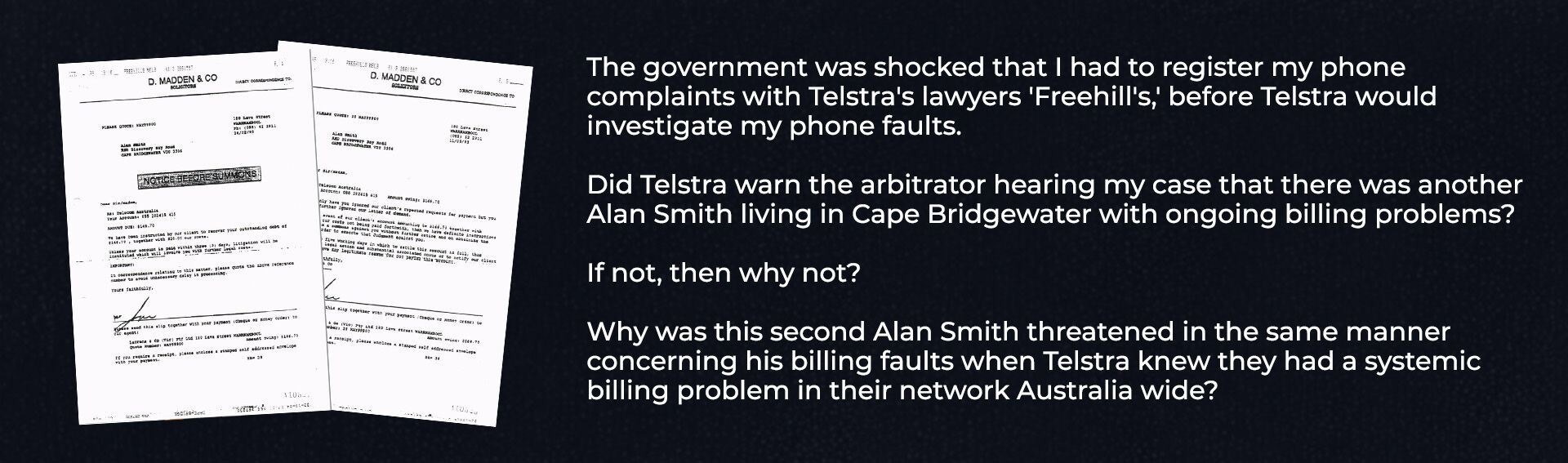
An investigation was not conducted to ascertain whether another individual named Alan Smith, residing in the Discovery Bay area of Cape Bridgewater, received some of my arbitration correspondence. Telstra's defence counsel, Freehill Hollingdale & Page, had been in communication with this other Alan Smith since at least 1992, as indicated by the fax footprint on both Notices of Summons documents that he received from D. Madden Lawyers in Warrnambool, which demanded payment for disputed telephone accounts.
I received analogous demand letters from Telstra despite the company's awareness of a systemic national billing issue that caused telephones to become inoperable. I submitted information pertaining to Alan Smith, which I obtained through the Freedom of Information Act, to illustrate to the arbitrator that he was similarly receiving letters of demand from Telstra and their legal representatives because, like myself, he contested charges for calls he did not make or for which he was not on the line for the entire billed duration.
The local Telstra switching exchanges in the Cape Bridgewater and Portland regions, including the principal Ericsson AXE Portland telephone exchange, experienced considerable disarray regarding telephone issues prior to and for several years following my arbitration. As evidenced in the TF200 EXICOM image below, Telstra even resorted to extreme measures to impede customers from substantiating their claims of significant operational problems. They allegedly introduced a sticky substance into the phones upon collection, asserting that customers had spilt beverages, which supposedly resulted in erroneous billing and device malfunctions. Furthermore, they claimed that the condition of the returned telephones (which were clean upon their return by customers) indicated customer negligence. How can one effectively engage with a corporation that employs such questionable tactics?
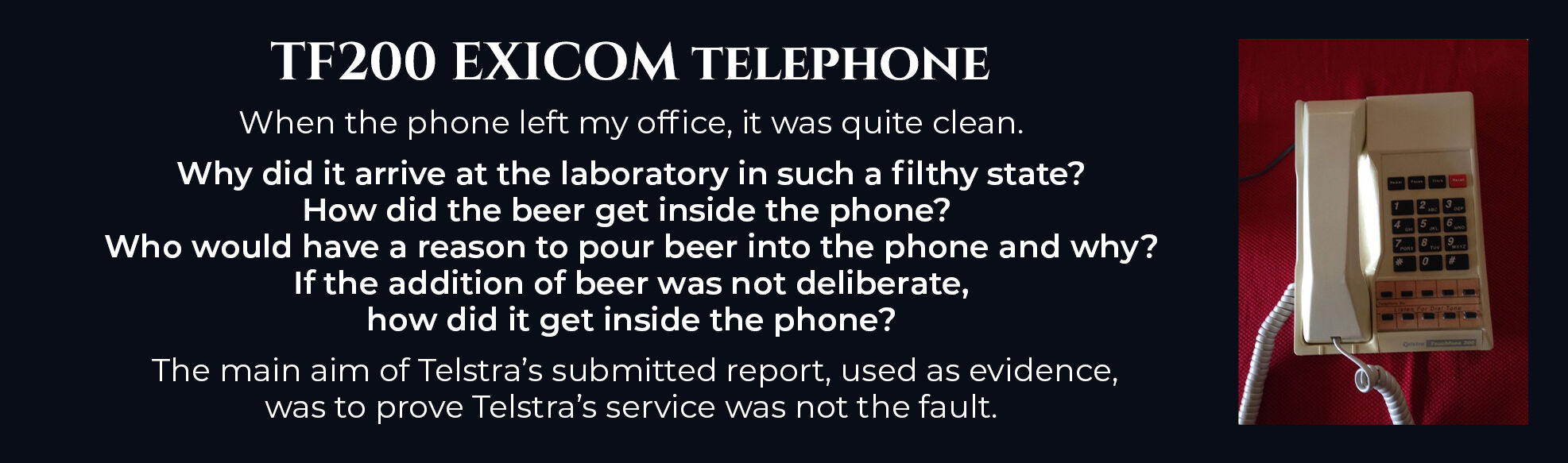
After Mr Anderson completed his testing on 27 April, the phone took nine days to reach Telstra’s laboratory. It arrived on 6 May, and laboratory testing did not commence for another four days. Ray Bell, the author of the TF 200 report, was adamant at point 1.3, under the heading Initial Inspection, that:
“The suspect TF200 telephone when received was found to be very dirty around the keypad with what appeared to be a sticky substance, possibly coffee.” (See Tampering With Evidence File No 3)
A second photo I received under FOI is a photo taken from the front of the same TF200 phone, confirming a note I placed on the phone was quite clean when it was received at Telstra. See Open Letter File No/37 exhibits 3, 4, 5 and 6.
This report raises several questions. When the phone left my office, it was quite clean. Why did it arrive at the laboratory in such a filthy state? How did the beer get inside the phone? Who would have a reason to pour beer into the phone and why? If the addition of beer was not deliberate, how did it get inside the phone? The main aim of Telstra’s submitted report, used as evidence, was to prove Telstra’s service was not at fault.
As soon as I read this beer-in-the-phone report, I requested the arbitrator, asking for a copy of all the laboratory technicians' handwritten notes so he could see how Telstra had arrived at their conclusion. I had appointed my forensic document researcher to look over the documents when I received them, and he provided me with his CV credentials and signed a confidentiality agreement stating he would not disclose his findings to anyone outside of the arbitration procedure. Although I passed all this information on to the arbitrator, the only response I received from the arbitrator and Telstra was a duplicate copy of the report I had already received as part of Telstra’s defence.
On 28 November 1995, six months after my arbitration ended, I received Telstra’s TF200 EXICOM report. This report confirms Telstra carried out two separate investigations of my EXICOM TF200 telephone, two weeks apart and the second test report, dated between 24 and 26 May 1994, proved that the first one, the report provided to the arbitrator, was not an accurate account of the testing process at all, but a total fabrication. Photos and graphs by Telstra laboratory staff proved wet beer introduced into the TF200 phone dried out entirely in 48 hours. As mentioned above, Telstra collected my phone from my business on 27 April 1994, but it was not tested until 10 May – a gap of 14 days. Various pages (see Tampering With Evidence File No/5) confirm that, even though Telstra knew its second investigation proved the first arbitration report, dated between 10 and 12 May 1994, was more than fundamentally flawed, it still submitted the first flawed report to the arbitrator as Telstra’s true findings.
The marked Telstra FOI documents folio A64535 to A64562 (see Tampering With Evidence File No/5), are clear evidence that Telstra did do two separate TF200 tests on my collected phone two weeks apart. FOI folio A64535 confirms with this handwritten Telstra laboratory file note, dated 26 May 1994, that when wet beer was poured into a TF200 phone, the wet substance dried up within 48 hours. The air vents within the phone itself allowed for the beer to escape. In other words, how could my TF200, collected on 27 April 1994, have been wet inside the phone on 10 May 1994 when it was tested at Telstra’s laboratories?

Another disturbing side to this tapering with arbitration evidence by Telstra is that I volunteered for the Cape Bridgewater Country Fire Authority (CFA) for many years before this tampering occurred. The following chapters show that during my arbitration Telstra twisted the reason I could not be present for the testing of my TF200 telephone at my premises on a scheduled meeting on the morning of 27 April 1994. Telstra only reported in their file notes (later submitted to the arbitrator) that I refused to allow Telstra to test the phones because I was tired. There was no mention in these file notes that I advised the fault response unit that I had been fighting an out-of-control fire for 14 hours or that my sore eyes made it impossible to observe such testing by Telstra. I fought the fire the previous evening from 6 pm to 9 am the following morning.
It is clear from our Tampering With Evidence page that not only did Telstra set out to discredit me by implying I was just too tired to have my TF200 phone tested, but after Telstra removed the phone, it was tampered with before it arrived at Telstra’s Melbourne laboratories: someone from Telstra poured beer into the phone. In its arbitration defence report, Telstra then alleged that sticky beer was the cause of the phone’s ongoing lock-up problems, not the Cape Bridgewater network. This wicked deed and the threats I received from Telstra during my arbitration are a testament that my claims should have been investigated years ago. So, even though I carried out my civic duties as an Australian citizen, over and beyond, by supplying vital evidence to the AFP and fighting out-of-control fires, I was still penalised on both occasions during my arbitration.
Even worse, this Telstra FOI folio D01026/27 (Tampering With Evidence File No 2) confirms Telstra knew there were lock-up problems in moisture-prone areas affecting the EXICOM T200s manufactured after week seven of 1993. This document confirms that one of the known lock-up side effects of this problem was that, while the line was in locked-up mode, the line remained open so one party could hear the room noise of the locked-up party after the call was supposedly terminated. Document D01026 confirms that instead of destroying these faulty EXICOM TF200 phones, Telstra allowed their technical staff to re-deploy some 45,000 phones back into service in areas where local technicians believed moisture was not a problem.
A testing situation
Late in 1993, Mrs Cullen from Daylesford Community House informed me that she had tried unsuccessfully to phone me on 17 August 1993 at 5.17, 5.18, 5.19 and 5.20 pm, each time reaching a deadline (File 35-A, 35-B and 35-C AS-CAV Exhibit 1 to 47). She had reported the fault to Telstra’s Fault Centre in Bendigo at 1100, speaking to an operator who identified herself as Tina. Tina then rang my 1800 number but couldn’t get through either. Telstra’s hand-written memo, dated 17/8/93, records the times that Mrs Cullen had tried to get through to my phone and reports Tina’s failed attempt to contact me.
So arbitration seemed the only solution.
5 October 1993: The draft of the COT Fast Track Settlement Proposal (FTSP) from AUSTEL’s Robin Davey states, at point 40:-
“Finally, if the attached letter (Attachment ‘D’) dated 7 July 1993 from Freehill, Hollingdale & Page to one of the COT Cases’ solicitors is indicative of the way that Freehill, Hollingdale & Page have approached the COT Cases in the past, I would be more than a little concerned if they were to have a continuing role.” (GS-CAV Exhibit 89 to 154(b) - See GS-CAV 110)
11 October, 1993: Telstra internal email H36291 confirms Telstra’s knowledge of the 1800 network billing problems Peter Zeagers to Nigel Beaman:-
“I am receiving a disturbing number of reports of instances where the 1800 prefix ‘does not work’ in the network.” (AS-CAV Exhibit 92 to 127 - See AS-CAV 122-D)
14 October 1993: This internal Telstra email FOI folio R03331 discusses how to minimise the problems experienced by the COT claimants. It states:-
“We need to focus Austel’s attention as much as possible on the current rather than the past level of service delivered to Cot Cases. …”
“My view is that Telecom’s response to this issue should reflect the advice from Denise McBurnie, Freehill, Hollingdale & Page, Solicitors.” (GS-CAV Exhibit 89 to 154(b) - See GS-CAV 111)
19 October 1993: This document from Denise McBurnie to Don Pinel titled Legal Professional Privilege/Commercial In Confidence. includes the following:-
“Duesbury & FHP continuing of evaluating claim – final report to Telecom will be privileged and will not be made available to ”
“Telecom preparing report for FHP analysing data available on services (ie. CCAS, Leopard, CABS and file notes) – this report will be privileged and will not be made available to (blank).” (GS-CAV Exhibit 89 to 154(b) - See GS-CAV 112)
It is clear from the above letters of 14th and 19th October 1993 that Telstra had no intention of listening to Robin Davey’s concerns about Freehills having a continuing role in the COT case issues.
On 9 December 1993, the Hon David Hawker MP wrote to congratulate me for my “persistence to bring about improvements to Telecom’s country services. I regret that it was at such a high personal cost.” (See Arbitrator File No/82)
This was very affirming, as was another letter dated 9 December 1993 and copied to me from the Hon David Beddall MP, Minister for Communications, in the Labor government, who wrote:
“Let me say that the Government is most concerned at allegations that Telecom has not been maintaining telecommunications service quality at appropriate levels. I accept that in a number of cases, including Mr Smith’s there has been great personal and financial distress. This is of great concern to me and a full investigation of the facts is clearly warranted.” (Arbitrator File No/82)
Even though I had been able to show the government before arbitration that Telstra was installing poor-quality infrastructure in the Cape Bridgewater network and the government regulator was allowing Telstra to test their own customers' complaints, even those who were to enter arbitration, no one bothered to investigate.
I have brought up the Ericsson AXE telephone exchange faults documents (see below) because, during a meeting with Hon. David Hawker, we discussed the impact of the AXE equipment installed in the telephone exchanges in his electorate, which seemed to be negatively affecting many businesses. I offered to continue supplying FOI documents received from Telstra to Mr Hawker, who would then pass them on to the Shadow Minister for Communications, Senator Richard Alston. I followed up by sending him (False Witness Statement File No 3-A), which he forwarded to Senator Alston. This document was subsequently raised in the Senate "On Notice" on 24 February 1994
Malfeasance
Ongoing Ericsson AXE telephone problems
A further Telstra documents, in this illusive briefcase dated 2 July 1992, concerning the Portland AXE telephone exchange states:
“Our local technicians believe that Mr Smith is correct in raising complaints about incoming callers to his number receiving a Recorded Voice Announcement saying that the number is disconnected.
“They believe that it is a problem that is occurring in increasing numbers as more and more customers are connected to AXE.” (See False Witness Statement File No 3-A)
It is confirmed from this other Telstra document that Telstra already knew my phone complaints were valid. This can best be viewed by reading Folios C04007 and C04008, headed TELECOM SECRET (see Front Page Part Two 2-B), states:
“Legal position – Mr Smith’s service problems were network related and spanned a period of 3-4 years. Hence Telecom’s position of legal liability was covered by a number of different acts and regulations. … In my opinion Alan Smith’s case was not a good one to test Section 8 for any previous immunities – given his evidence and claims. I do not believe it would be in Telecom’s interest to have this case go to court.
“Overall, Mr Smith’s telephone service had suffered from a poor grade of network performance over a period of several years; with some difficulty to detect exchange problems in the last 8 months.”
On 3 March 1994, this article appeared in the Portland Observer newspaper (AS 773-b), noting:
“Federal Police officers are investigating allegations of possible illegal activity on the part of Telecom Australia.
Officers from the Federal Police visited Portland last week and interviewed Cape Bridgewater Holiday Camp proprietor, Alan Smith, who is one of the four original members of COT (Casualties of Telecom).”
My 3 February 1994 letter to Michael Lee, Minister for Communications (see Hacking-Julian Assange File No/27-A) and a subsequent letter from Fay Holthuyzen, assistant to the minister (see Hacking-Julian Assange File No/27-B), to Telstra’s corporate secretary, show that I was concerned that my faxes were being illegally intercepted.
An internal government memo, dated 25 February 1994, confirms that the minister advised me that the Australian Federal Police (AFP) would investigate my illegal phone/fax interception allegations. (Hacking-Julian Assange File No/28)
AUSTEL (the then government communications authority) wrote to Telstra during the early part of the COT arbitrations on 10 February 1994, stating:
“Yesterday we were called upon by officers of the Australian Federal Police in relation to the taping of the telephone services of COT Cases.
“Given the investigation now being conducted by that agency and the responsibilities imposed on AUSTEL by section 47 of the Telecommunications Act 1991, the nine tapes previously supplied by Telecom to AUSTEL were made available for the attention of the Commissioner of Police.” (See Illegal Interception File No/3)
Question 81 in the following AFP transcripts, Australian Federal Police Investigation File No/1, confirms that the AFP told me that AUSTEL's John MacMahon had supplied the AFP evidence that my phones had been bugged over an extended period. Why did the arbitrator not award me in his official findings concerning this evidence after he was supplied with these AFP transcripts, which note:?
"... does identify the fact that, that you were live monitored for a period of time. See we're quite satisfied that, there are other references to it".
A letter dated 2 March 1994 from Telstra’s Corporate Solicitor, Ian Row, to Detective Superintendent Jeff Penrose (refer to Home Page Part-One File No/9-A to 9-C) strongly indicates that Mr Penrose was grievously misled and deceived about the faxing problems discussed in the letter. Over the years, numerous individuals, including Mr Neil Jepson, Barrister at the Major Fraud Group Victoria Police, have rigorously compared the four exhibits labelled (File No/9-C) with the interception evidence revealed in Open Letter File No/12 and File No/13. They emphatically assert that if Ian Row had not misled the AFP regarding the faxing problems, the AFP could have prevented Telstra from intercepting the relevant arbitration documents in March 1994, thus avoiding any damage to the COT arbitration claims.
In my case, as evidenced by the following two links, the arbitrator's failure to compel Telstra to address my ongoing telephone issues enabled Telstra to persist in ignoring the problems. This ultimately led to my reluctant decision to sell my Cape Bridgewater Holiday Camp and residence in December 2001 after enduring seven years of ongoing telephone problems after completing my arbitration on 11 May 1995. Subsequently, the new owners, Jenny and Darren Lewis, encountered the same phone faults, corroborated by the following two links. By December 2008, their bankruptcy declaration in the Melbourne Magistrates Court resulted in their eviction from the property in August 2009, leaving them broken. Chapter 4, The New Owners Tell Their Story, and Chapter 5, Immoral - hypocritical Conduct.
Upon discovering that the COT Cases had engaged the services of George Close and Associates to assist with their arbitration claims, Telstra took proactive measures. Specifically, they implemented a facsimile interception system at Mr. Close's residence and office. The objective was to intercept the FOI documents Mr Close was instructing his COT Case clients to access from Telstra, a critical component for the claimants' chances of success in their claim.
Infringe upon the civil liberties.
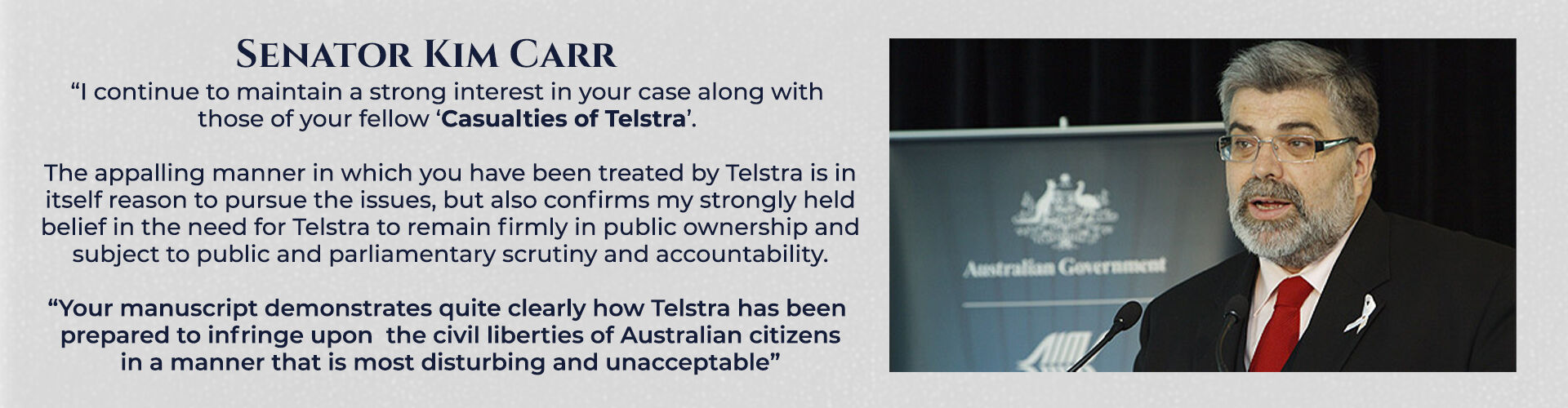
Most Disturbing And Unacceptable
On 27 January 1999, after having also read my first attempt at writing my manuscript absentjustice.com, the same manuscript I provided Sister Maureen Burke IBVM and Helen Handbury, Senator Kim Carr wrote:
“I continue to maintain a strong interest in your case along with those of your fellow ‘Casualties of Telstra’. The appalling manner in which you have been treated by Telstra is in itself reason to pursue the issues, but also confirms my strongly held belief in the need for Telstra to remain firmly in public ownership and subject to public and parliamentary scrutiny and accountability.
“Your manuscript demonstrates quite clearly how Telstra has been prepared to infringe upon the civil liberties of Australian citizens in a manner that is most disturbing and unacceptable.”
PLEASE NOTE:
Frank Blount, the CEO who managed the COT arbitrations for Telstra, acknowledges in his 2000 co-produced book that systemic billing problems plagued Telstra. Yet, remarkably, Telstra's defence against my billing claims was only addressed in a secretive meeting with the government on October 16, 1995—five months after my arbitration concluded. Refer to Chapter 14 - Was it Legal or Illegal? This covert handling of arbitration claims, where defence documents were utilized without allowing me my legal right to respond, is simply unacceptable and unheard of in most if not all, Western nations that rely on arbitration for dispute resolution.
The following link https://www.qbd.com.au › managing-in-Australia › fran› makes it clear that Frank Blount, former CEO of Telstra, took a pivotal step after his departure by co-publishing a manuscript in 1999 titled *Managing in Australia*. In this work, he uncovers significant issues that Telstra had concealed from its 1800 customers, particularly in relation to the systemic billing problems highlighted by the COT arbitrator appointed by the government. Notably, on pages 132 and 133, the author decisively addresses these critical concerns.
- “Blount was shocked, but his anxiety level continued to rise when he discovered this wasn’t an isolated problem.
- The picture that emerged made it crystal clear that performance was sub-standard.” (See File 122-i - CAV Exhibit 92 to 127)
It is crucial to emphasize the significance of the four letters dated 17 August 2017, 6 October 2017, 9 October 2017, and 10 October 2017, authored by COT Case Ann Garms shortly before her passing. These letters were addressed to The Hon. Malcolm Turnbull MP, Prime Minister of Australia, and Senator the Hon. Mathias Cormann (See File Ann Garms 104 Document).
On 1 June 2021, Mathias Cormann officially assumed office as the Secretary-General of the OECD in Paris, France. Similarly to Australia's former Prime Minister Malcolm Turnbull, he possesses comprehensive knowledge about the legitimacy of the COT Cases claims. During the period when Ann Garms sent the four attached letters, I also engaged in direct communication with The Hon. Malcolm Turnbull, MP, during his tenure as Minister for Communications and Prime Minister of Australia.
On my behalf, a lawyer from Hamilton presented a comprehensive timeline of events to The Hon. Mathias Cormann, Minister for Finance, regarding the issues detailed on absentjustice.com. This was formalized in a statutory declaration dated 26 July 2019, which we both witnessed. The brief version of that Chronology of Events is now firmly established on the Absent Justice Part 1, Part 2 and Part 3 webpage.
On March 23, 1999, the Australian Financial Review conducted a thorough investigation into the conduct of twenty-one arbitration and mediation processes, including my own, which had been finalized almost five years prior. The findings of their investigation prompted the Senate Estimates Committee to issue a statement.
“A Senate working party delivered a damning report into the COT dispute. The report focused on the difficulties encountered by COT members as they sought to obtain documents from Telstra. The report found Telstra had deliberately withheld important network documents and/or provided them too late and forced members to proceed with arbitration without the necessary information,” Senator Eggleston said. “They have defied the Senate working party. Their conduct is to act as a law unto themselves.”
The following six senators formally recorded how they believed that Telstra had 'acted as a law unto themselves' leading up to and throughout the COT arbitrations; however, where were Dr Gordon Hughes (the arbitrator) and Warwick Smith (the administrator of the arbitrations) when this disgraceful conduct towards the COT Cases was being carried out?
Eggleston, Sen Alan – Bishop, Sen Mark – Boswell, Sen Ronald – Carr, Sen Kim – Schacht, Sen Chris, Alston and Sen Richard) .
On November 21, 2007, I received a significant document from the Australian Communications and Media Authority (ACMA) under the provisions of the Freedom of Information (FOI) Act. This document contained AUSTEL’s original draft findings, dated March 2-3, 1994, regarding the telephone challenges experienced at the Cape Bridgewater Holiday Camp from 1988 to 1994—twelve years after the conclusion of my arbitration and thirteen years after my initial request for this information.
The report elucidates the considerable obstacles faced by AUSTEL, as the government regulator, in obtaining essential documents from Telstra, a corporation fully owned by the government at that time. Given the regulatory difficulties experienced, it would have been prudent to suspend the arbitration process until all necessary evidence was made available. Such evidence is crucial for all parties to effectively substantiate or refute the claims associated with each Claim of Ordinary Telephone (COT) case.
The government's inability to access pivotal documents compromised the integrity of the arbitration process, yet claimants were still expected to expend substantial financial resources in attempts to acquire documents from Telstra—documents that even the regulator found challenging to obtain. This fundamental oversight constitutes a breach of the statutory obligations owed to the COT cases and permitted Warwick Smith (the administrator of the arbitrations) and Dr. Gordon Hughes (the arbitrator) to compel the COT claimants into arbitration without the requisite documentation to support their assertions.
As a result of not receiving critical records during our respective arbitrations, we, the COT claimants, were unable to convincingly demonstrate to the arbitrator that our telephone faults persisted. Below, I outline specific areas within the AUSTEL draft report where access to Telstra's records concerning the service provided to me proved challenging.
Point 43 on page 20 “As no fault report records remain in existence from Cape Bridgewater residents prior to this period, or these records have not been provided to AUSTEL, it is difficult to gauge the level of problems in the area.”
Point 48 on page 22 “AUSTEL has been hampered in assessing Telecom’s dealings with Mr Smith by Telecom’s failure to provide files relating to Mr Smith’s complaints.”
Point 71 on pages 28 and 29 “AUSTEL has not been provided with the documents on which the conclusion in this briefing summary were reached, such as fault reports from other Cape Bridgewater subscribers over this period or the details of the final selector fault. It would have been expected that these documents would have been retained on file as background to the summary. It can only be assumed that they are contained within the documentation not provided to AUSTEL.”
Point 140 on page 49 “It should be noted that AUSTEL’s investigation of matters relating to the RCM problem has been hampered by Telecom’s failure to make available to AUSTEL a file specifically relating to the Pairs Gains Support investigation of the RCM. The file was requested by AUSTEL on 9 February 1994.”
Point 160 on page 55 “It should be noted that it is hoped that a number of issues in regard to the Cape Bridgewater RCM will be clarified when Telecom provides the documentation requested by AUSTEL.”
I wish to reiterate an important matter: Once AUSTEL became fully aware that Telstra was withholding pertinent information, it became evident that AUSTEL should not have permitted the arbitration and mediation processes to continue. This information was essential for the government communications regulator to prepare its official report for the minister, particularly since these processes were intended to be based on information that Telstra had declined to provide.
By allowing the arbitrations and mediations to proceed, AUSTEL neglected its duty of care toward the COT cases. If the government could not formally mandate that Telstra furnish the necessary records to the minister, what prospects did the COT cases possess in obtaining similar documents?
The document dated 22 September 1994 is a transcript from an oral interview conducted at the Commonwealth Ombudsman’s Office with AUSTEL representatives Bruce Matthews and John McMahon. On page 7 of this manuscript, the Commonwealth Ombudsman’s officer, John Wynack, posed the following question:
"What was the date the report was issued, the AUSTEL report?"
And Mr Matthews replied:
"The final report was April – I can’t remember the date in April, but April 1994. The draft report was produced in March 1994, and Telecom received their copy then".
The actions undertaken by AUSTEL constitute a significant abuse of process. AUSTEL permitted me to initiate arbitration and legal proceedings against Telstra without providing the requisite documents necessary to substantiate my claim. Furthermore, I incurred expenses exceeding $300,000 in arbitration fees to establish a case that the government had already substantiated against Telstra, utilizing extracts from Telstra's Portland telephone exchange logbook. Notably, both the government and Telstra declined to supply this logbook during the discovery process and under the Freedom of Information Act. This situation raises serious concerns regarding AUSTEL’s breach of its statutory obligations to me as a citizen of Australia.
As clearly documented on my website, absentjustice.com, I have devoted the past thirty years to pursuing the issues related to AUSTEL and ACMA for this very reason.

The document , dated March 1994, unequivocally confirms that the government public servants who investigated my ongoing telephone issues validated my claims against Telstra between Points 2 and 212. It's clear that had the arbitrator reviewed AUSTEL’s Adverse Findings, the award for my financial business losses would have been significantly higher than what was ultimately granted.
The ongoing loss of business and revenue is undeniable. As highlighted in point 153 of AUSTEL’s Adverse Findings, it’s evident from the statement issued by the government technical consultants who compiled the 68-page, 212-point report that, despite the installation of the new RCM facility at Cape Bridgewater by Telstra, there was a significant oversight for eighteen months Telstra failed to program the alarm system in the RCM, which should have notified the Portland technicians—18 kilometres away—of any faults affecting one, two, or even three of the 132 residents relying on this roadside box for connectivity to the outside world.
Point 153 –“A feature of the RCM system is that when a system goes “down” the system is also capable of automatically returning back to service. As quoted above, normally when the system goes “down” an alarm would have been generated at the Portland exchange, alerting local staff to a problem in the network. This would not have occurred in the case of the Cape Bridgewater RCM however, as the alarms had not been programmed. It was some 18 months after the RCM was put into operation that the fact the alarms were not programmed was discovered. In normal circumstances the failure to program the alarms would have been deficient, but in the case of the ongoing complaints from Mr Smith and other subscribers in the area the failure to program these alarms or determine whether they were programmed is almost inconceivable.”
To aid newcomers to this website, absentjustice, I have highlighted twelve significant findings from the government's investigation see (AUSTEL’s Adverse Findings, which are marked in red below. These findings were derived from the Telstra Portland/Cape Bridgewater telephone exchange logbook, which Telstra withheld from me during my arbitration process. This concealment hindered my ability to comprehensively demonstrate my claims, particularly those that continued to adversely affect my business during the arbitration. Those who compare the highlighted twelve points with the findings in (AUSTEL’s Adverse Findings will recognize their alignment. I encourage individuals interested in further examination of these transcriptions to download (AUSTEL’s Adverse Findings. Your understanding of this matter is essential.
The government only released this 68-page, 212-point report to me on November 2oo7, twelve years after the completion of my arbitration on May 11, 1995.
Point 23 – “It is difficult to discern exactly who had responsibility for Mr Smith’s problems at the time, and how information on his problems was disseminated within Telecom. Information imparted by the Portland officer on 10 February 1993 of suspected problems in the RCM “caused by a lighting (sic) strike to a bearer in late November” led to a specialist examination of the RCM on March 1993. Serious problems were identified by this examination.”
Point 25 – "It should also be noted that during the period of time covered by this chronology of significance events it is clear
- Telecom had conducted extensive testing
- Cape Bridgewater Holiday Camp frequestly reported problems with the quality of telephone service
- both the camp and Telecom were receiving confirmation of reported from other network users
- major faults were identified more through persitense reporting of probles by customer than through testing of the network
- customers in the Cape Bridgewater area also complaining of similar problems
Point 32 – "Telecom's communications with Mr Smith in the months prior to settlement uniformaly argued that the Cape Bridgewater Holiday Camp was at an acceptable level and that Telecom was capable of rapidly rectifying faults as they occured."
Point 42 – “Some important questions are raised by the possible existence of a cable problem affecting the Cape Bridgewater Holiday Camp service. Foremost of these questions is why was the test call program conducted during July and August 1992 did not lead to the discovery of the cable problem. Another important question is exactly how the cable problem would have manifested in terms of service difficulties to the subscriber.”
Point 44 – “Given the range of faults being experienced by Mr Smith and other subscribers in Cape Bridgewater, it is clear that Telecom should have initiated more comprehensive action than the test call program. It appears that there was expensive reliance on the results of the test program and insufficient analysis of other data identifying problems. Again, this deficiency demonstrated Telecom’s lack of a comprehensive and co-ordinated approach to resolution of Mr Smith’s problems.”
Point 46 –“File evidence clearly indicates that Telecom at the time of settlement with Mr Smith had not taken appropriate action to identify possible problems with the RCM . It was not until a resurgence of complaints from Mr Smith in early 1993 that appropriate investigative action was undertaken on this potential cause In March 1993 a major fault was discovered in the digital remote customer multiplexer (RCM) providing telephone service to Cape Bridgewater holiday camp. This fault may have been existence for approximately 18 months. The Fault would have affected approximately one third of subscribers receiving a service of this RCM. Given the nature of Mr Smith’s business in comparison with the essentially domestic services surrounding subscribers, Mr Smith would have been more affected by this problem due to the greater volume of incoming traffic than his neighbours.”
Point 47 –“Telecom's ignorance of the existence of the RCM fault raises a number of questions in regard to Telecom's settlement with Smith. For example, on what bases was settlement made by Telecom if this fault was not known to them at this time? Did Telecom settle with Mr Smith on the bases that his complaints , of faults were justified without a full investigation of the validity of these complaints, or did Telecom settle on the basis of faults substantiated to the time of settlement? Wither criteria for settlement would have been inadequate, with the later critera disadvantaging Mr Smith, as knowledge of the existence of more faults on his service may have led to an increase in the amount offered for settlement of his claims".
Point 109 – The view of the local Telecom technicians in relation to the RVA problem is conveyed in a 2 July 1992 Minute from Customer Service Manager – Hamilton to Managers in the Network Operations and Vic/Tas Fault Bureau:
- “Our local technicians believe that Mr Smith is correct in raising complaints about incoming callers to his number receiving a Recorded Voice Announcement saying that the number is disconnecte. They believe that it is a problem that is occurring in increasing numbers as more and more customers are connected to AXE. (AXE – Portland telephone exchange)”
Point 115 –“Some problems with incorrectly coded data seem to have existed for a considerable period of time. In July 1993 Mr Smith reported a problem with payphones dropping out on answer to calls made utilising his 008 number. Telecom diagnosed the problem as being to “Due to incorrect data in AXE 1004, CC-1. Fault repaired by Ballarat OSC 8/7/93, The original deadline for the data to be changed was June 14th 1991. Mr Smith’s complaint led to the identification of a problem which had existed for two years.”
Point 158 – “The crucial issue in regard to the Cape Bridgewater RCM is that assuming the lightning strike did cause problems to the RCM om late November 1992 these problems were not resolved till the beginning of March 1993, over 3 months later. This was despite a number of indications of problems in the Cape Bridgewater area. Fault reports from September 1992 also indicate that the commencement of problems with the RCM may have occurred earlier than November 1992. A related issue is that Mr Smith’s persistent complaints were almost certainly responsible for an earlier identification of problems with the RCM than would otherwise have been the case.”
Point 169 –" Documentation reviewed indicates that other network users attached to the Cape Bridgewater exchange did report problems similar to those experienced by Cape Bridgewater Holiday Camp. It is also clear that problems identified in the area would have impacted on other network users as well as Cape Bridgewater Holiday Camp."
Point 209 – “Cape Bridgewater Holiday Camp has a history of service difficulties dating back to 1988. Although most of the documentation dates from 1991 it is apparent that the camp has had ongoing service difficulties for the past six years which has impacted on its business operations causing losses and erosion of customer base.”