
**Important Notice to Visitors of Criminal Mind - Absent Justice**As of April 4, 2026, we would like to inform our visitors that the images displayed on this website are organised in the sequence in which they will appear in the upcoming publication. However, additional content is currently in progress. We are creating detailed captions and a mini-narrative to accompany each image. This supplementary material is being meticulously edited to ensure clarity and relevance, and we anticipate its finalisation by the end of the second week of April.Given the complexity of the manuscript, which includes over 2,140 exhibits woven into a comprehensive 56,000-word narrative, this task requires careful attention to detail. As a result, the complete version of the manuscript will not be available for download on the website until April 21. We are committed to maintaining high standards in the presentation of our work.In the meantime, it is important to note that the storyline of Criminal Mind - Absent Justice is fully intact, with only the concluding sections of Chapters 12 and 13 pending completion.Aside from the ongoing edits and updates, you can read Criminal Mind - Absent Justice as a complete story. We appreciate your understanding and thank you for taking the time to read this introduction.
A Story of Despair and Heartache
The Appeal That Never Came
On December 13, 1995, Gene Volovich, my appeal lawyer from Law Partners Melbourne, delivered a devastating blow. Sitting across from me, he stated with certainty something I will never forget: he believed my appeal had no chance of success.
He wasn't guessing. Volovich had reviewed the documents and transcripts. He understood the rules and recognized they had been broken during the arbitration process.
Ten days later, I handed Volovich the complete set of evidence I had previously shown to Darren Kearney from AUSTEL. Kearney's five-hour drive from Melbourne to my Cape Bridgewater Holiday Camp spoke volumes. It suggested that, at least for a moment, the truth mattered to someone.
The October Betrayal
The core of the problem stemmed from AUSTEL's decision to allow Telstra to respond to my billing evidence outside the formal arbitration process. On October 16, 1995, Telstra was permitted to rewrite the narrative in private, with no arbitrator or claimant present.
Instead of clarifying the issues, Telstra misrepresented facts and distorted information, failing to disclose crucial details.
Later, AUSTEL officials contacted me, requesting a review of my claim materials. They were astounded, finding that the documents had not been adequately investigated. Dr. Gordon Hughes, the arbitrator, and his technical team had disregarded established procedures, a point already highlighted in AUSTEL's April 1994 COT Cases report. AUSTEL officials were incredulous that Hughes had repeated this error.
The Vanishing Findings
On December 19, after reviewing my materials, Mr. Kearney requested to take them back to Melbourne. He provided written assurances, promising findings and closure.
I am still waiting.
The Lawyer's Alarm Bells
In August 1997, Michael Brereton & Co. wrote to Senator Ron Boswell, confirming that I had a substantial case against Dr. Hughes. However, I was unable to secure legal representation, neither from them nor from any other firm. The system had worn me down, and the legal gatekeepers had effectively locked me out.
The Freehills Conflict
Back in January 1994, the COTs (Casualties of Telstra) were assured by Robin Davey, AUSTEL's Chairman, that Freehills would no longer be involved in our Fast Track Settlement Proposal.
Despite this assurance, Telstra reappointed Freehills as their defense lawyers for the FTAP (Fast Track Arbitration Process). Warwick Smith, the TIO (Telecommunications Industry Ombudsman), dismissed the conflict of interest, stating it was Telstra's prerogative.
Meanwhile, I continued to register fault complaints through Freehills, and I was
consistently denied access to technical data, facing continuous stonewalling.
An internal Telstra email (FOI folio C02840) confirmed their awareness of the situation:
They knew it was a conflict of interest, but they disregarded it.
The Witness Statement Farce
During arbitration, Telstra submitted witness statements signed only by Freehills, not by the actual witnesses. When I challenged this irregularity, the response was absurd. The statements were simply sent back to the witnesses for signature, with no investigation or accountability.
Gene Volovich was astonished. He couldn't believe I hadn't received any of the fault correspondence exchanged between Telstra, Freehills, and me. He suspected Telstra had deliberately appointed Freehills as my fault managers to shield all correspondence under Legal Professional Privilege.
The Arbitrator Who Wasn't
Dr. Hughes's failures went beyond simply ignoring the rules. He wasn't even a graded arbitrator, not registered with the Institute of Arbitrators Australia, and unqualified to oversee such a complex and consequential process.
And yet, he presided, ruled, and ultimately buried my case.
The Smoking Gun: FOI Folio A06796
A story of despair and
heartache:
On October 19, 1993, Denise McBurnie of Freehills sent a document, marked "Legal Professional Privilege In Confidence," to Telstra's Don Pinel. This document outlined how Telstra could shield technical fault data—data crucial to my case—under the guise of legal privilege.
It wasn't privilege; it was concealment.
"Duesbury & FHP continuing of evaluating (blank) claim - final report to Telecom will be privileged and will not be made available to (blank)."
Reflection: A System Built to Exhaust
My fight wasn't just for service; it was a battle through a maze designed to wear me down. Every letter to Freehills became another brick in a wall. Each delay, denial, and invocation of privilege formed part of a broader strategy: to keep the truth out of reach.
And yet, I
persisted—documenting, pushing forward. Because I believed that one day, someone would read these chapters, not just as history, but as a warning.
Exhibit AS 767-A: The Smoking Gun
Then came the document dated October 29, 1993—Telstra FOI folio K01489, Exhibit AS 767-A. It laid out the strategy in plain terms, revealing not only the use of privilege but the intent behind it.
This wasn't a misunderstanding; it was by design.
"During testing the Mitsubishi fax machine, some alarming patterns of behaviour were noted, these affecting both transmission and reception. Even on calls that were not tampered with the fax machine displayed signs of locking up and behaving in a manner not in accordance with the relevant CCITT Group 3 fax rules."
A handwritten note in the bottom right corner of Exhibit AS 767-B, which reads, "Stored in Fax Stream?" suggests that faxes intercepted via Telstra's testing process were stored in Telstra's Fax Stream service center. This would have allowed anyone with access to Telstra's fax stream center to read the documents at any time. The Scandrett & Associates report confirms that numerous COT arbitration documents were intercepted, including faxes to and from Parliament House, the Commonwealth Ombudsman's Office (COO), and the COTs themselves. In my case, this interception continued for seven years after the arbitration concluded. This means Telstra had access to confidential documents that claimants believed they were sending only to their accountants, lawyers, and/or technical advisors (as well as Parliament House and the COO). These documents could have included information the claimants wanted to keep from the defendants.
Was the engineer pressured to remain silent during my arbitration? I don't know. What is certain is that not all Telstra engineers or technicians handled COT complaints in good faith. Another Telstra technician, who encountered significant problems during his official fax testing process on October 29, 1993, nevertheless advised the arbitrator that I had no problems with that service, despite Telstra's own document noting these faults:
Back to the Briefcase

Ericsson AXE faulty telephone exchange equipment (1)
A story of Despair and
Heartache:
I should have known better. It was just another case of "No fault found." We spent considerable time dancing around a summary of my phone problems, and their best advice was to continue doing exactly what I had been doing since 1989: meticulously recording every fault. I could have wept. Finally, they left.
A little while later, back in my office, I discovered Aladdin had left behind his treasures; the Briefcase Saga was about to unfold.
Aladdin
The briefcase wasn't locked. I opened it, discovering it belonged to a Mr. Macintosh. There was no phone number, so I had to wait until business hours the next day to track him down. Inside, however, was a file titled "SMITH, CAPE BRIDGEWATER." After five grueling years fighting the evasive monolith of Telstra and being told various lies, here, possibly, was the truth from an insider's perspective.
The first thing that raised alarm bells was a document revealing Telstra knew the RVA fault they recorded in March 1992 had lasted at least eight months, not the three weeks on which they based their settlement payout. Dated 24/7/92 and bearing my phone number in the top right corner, the document referenced my complaint that callers received an RVA "service disconnected" message. The "latest report," dated 22/7/92, came from Station Pier in Melbourne, noting a "similar fault reported" on 17/03/92. The final sentence read: "Network investigation should have been brought in as fault has gone on for 8 months."
I copied this and other documents from the file on my fax machine and faxed them to Graham Schorer. The next morning, I telephoned the local Telstra office, and someone came to collect the briefcase.
The information in this document, dated July 24, 1992, proved that senior Telstra management had deceived and misled me during previous negotiations. It showed their guarantees that my phone system was up to network standard were made knowing it was nowhere near "up to standard."
Telstra's area general manager was fully aware at the time of my settlement on December 11, 1992, that she was providing incorrect information. This information influenced my judgment of the situation, placing me at a commercial disadvantage. The General Manager, Commercial Victoria/Tasmania, was also aware of this deception.
The use of misleading and deceptive conduct in a commercial settlement such as mine contravenes Section 52 of the Australian Trade Practices Act. Yet this deception has never been officially addressed by any regulatory body. Jumping ahead, even the arbitrator who handed down his award on my case in May 1995 failed to question Telstra's unethical behavior.
Previously Withheld Documents
I presented this new information to Austel, along with documents previously withheld from me during my 11 December 1992 settlement and found in the briefcase. On 9 June 1993, Austel's John MacMahon wrote to Telstra concerning my ongoing phone issues post-settlement and the briefcase documents' contents:
Further he claims that the Telecom documents contain network investigation findings which are distinctly different from the advice which Telecom has given to the customers concerned.
In Summary, these allegations, if true, would suggest that in the context of the settlement, Mr Smith was provided with a misleading description of the situation as the basis for making his decision. They would also suggest that the other complainants identified in the folders have knowingly been provided with inaccurate information.
I ask for your urgent comment on these allegations. You are asked to immediately provide AUSTEL with a copy of all the documentation, which was apparently inadvertently left at Mr Smith's premises for its inspection. This, together with your comment, will enable me to arrive at an appropriate recommendation for AUSTEL's consideration of any action it should take.
As to Mr Smith's claimed continuing service difficulties, please provide a statement as to whether Telecom believes that Mr Smith has been provided with a telephone service of normal network standard since the settlement. If not, you are asked to detail the problems which Telecom knows to exist, indicate how far beyond network standards they are and identify the cause/causes of these problems.
In light of Mr Smith's claims of continuing service difficulties, I will be seeking to determine with you a mechanism that will allow an objective measurement of any such difficulties to be made.
Presumably, Telstra did not comply with the request 'to immediately provide AUSTEL with a copy of all the available documentation which was apparently inadvertently left at Mr Smith's premises,' because on 3 August 1993, Austel's General Manager of Consumer Affairs again wrote to Telstra, requesting copies of all briefcase documents not yet forwarded to Austel.
I also sent Austel several Statutory Declarations explaining what I had seen in the briefcase, which Telstra had since retrieved.
The copies I made of just one-third of the documents contained enough information to convince AUSTEL that Ericsson and Telstra were fully aware that AXE Ericsson lock-up faults were a worldwide problem, affecting 15 to 50 percent of all calls made through this AXE exchange equipment. These lock-up flaws also affected the billing software.
A story of despair and heartache.
Since the installation of Ericsson AXE equipment—in my case, August 1991—thousands of Telstra customers across Australia had been wrongly billed, with these billing problems still occurring in 2002. While other countries were removing or had already removed this equipment from their exchanges (see File 10-B Evidence File No/10-A to 10-f ), Telstra continued to deny to the arbitrator that there were any issues with the equipment. These denials were lies told by Telstra to minimize their liability to the COT Cases (See Files 6 to 9 AXE Evidence File 1 to 9).
Was this the reason the Australian government permitted Ericsson to purchase Lane during the government-endorsed COT arbitration, while these arbitrations were still underway?
When COT arbitration documents demonstrated that the Ericsson AXElock-up call loss rate was between 15% and 50%, as shown in File 10-BEvidence File No/10-A to 10-f , AUSTEL launched an investigation into these AXE exchange faults. This investigation uncovered approximately 120,000 COT-type complaints nationwide. According to Exhibit (Introduction File No/8-A to 8-C), Telstra's Group General Manager (who also served as Telstra's main arbitration defense liaison officer) suggested to AUSTEL's Chairman, Robin Davey, that he alter the finding of 120,000 COT-type complaints to just one hundred. When the public AUSTEL COT Cases report was released on April 13, 1994, it stated that AUSTEL had identified upwards of 50 or more COT-type complaints across Australia.
Was this the major problem Julian Assange wanted to share with the COT Cases? He claimed the corruption was significant. How much greater would the impact have been if this had been exposed during the COT arbitrations?
In my case, none of the relevant arbitration claims raised against Ericsson, whose official arbitration records were numbered A56132, were investigated, including my Telstra's Falsified SVT Report.Why did Laneignore this evidence against Ericsson?
Even more concerning, when my arbitration claim documents were returned to me after the arbitration concluded, NONE of my Ericsson technical data was included.
I believe the Australian government should answer the following: How long was Lane Telecommunications Pty Ltd in contact with Ericsson before Ericsson purchased Lanes? Is there a connection between Lanes ignoring my Ericsson AXE claim documents and the purchase of Laneby Ericsson during the COT arbitration process?
Is there a sinister link between the government communications media regulator ACMA denying me access to the Ericsson AXE documentation, which I lawfully sought during my two government Administrative Appeal Tribunal hearings in 2008 and 2011 (see Chapter 9 - The ninth remedy pursued and Chapter 12 - The twelfth remedy pursued)?
A story of despair and heartache.
Telstra's 2019/2020 5G partnership with Ericsson is relevant to all Australian Telstra subscribers. These subscribers should also be aware of my claims against Telstra and Ericsson, which I believe are substantiated on my website, absentjustice.com (see Bribery and Corruption - Part 2).
It is important to highlight the Ericsson bribery and corruption issues raised by the US Departmentof Justice, which were discussed in Australian media reports on December 19, 2019.
On August 27, 1993, Telstra's Corporate Secretary, Jim Holmes, wrote to me regarding the contents of a briefcase:
Although there is nothing in these documents to cause Telstra any concern in respect of your case, the documents remain Telstra's property. They, therefore, are confidential to us ... I would appreciate it if you could return any documents from the briefcase still in your possession as soon as possible.
He conveniently omitted any reference to vital evidence withheld from me during compensation negotiations.
Flogging a Dead Horse
By mid-1993, public interest in our battle was growing. Several articles had appeared in my local newspaper, and interstate gossip about the COT group was spreading. In June, Julian Cress from Channel Nine's 'Sixty Minutes' faxed me:
Just a note to let you know that I had some trouble getting through to you on the phone last Thursday. Pretty ironic, considering that I was trying to contact you to discuss your phone problems.
The problem occurred at about 11 am. On the 008 number I heard a recorded message advising me that 008 was not available from my phone and your direct line was constantly engaged.
Indeed, quite ironic.
A special feature in the Melbourne Age gave my new 'Country Get-A-Ways' program a positive review. The program marketed weekend holidays for over-40s singles in Victoria and South Australia, including an outdoor canoe weekend, a walking and river cruise along the Glenelg River, a Saturday Dress-up Dinner Dance with a disco, and a trip to the Coonawarra Wineries in South Australia with a Saturday morning shopping tour to Mt Gambier. I began to feel optimistic about the Camp's prospects.
However, my telephone saga was far from over. A fax arrived on October 26, 1993, from Cathine, a relative of the Age journalist who wrote the feature:
Alan, I have been trying to call you since midday. I have rung seven times to get an engaged signal. It is now 2.45 pm.
A story of despair and heartache:
Cathine had been calling my 1800 free-call line. I was in my office that day, and no calls came through between 12:30 and 2:45. According to Telstra's data, however, there was a six-minute call at 12:01 and an eight-minute call at 12:18. This was incredibly frustrating, and the problem seemed endless. But I was determined to expose their lies and incompetence.
I intensified my marketing efforts for the Camp and singles weekends, personally visiting social clubs in metropolitan Melbourne, Ballarat, and Warrnambool. I followed up with advertisements in local newspapers throughout Melbourne and in many major regional centers in Victoria and South Australia. I also attempted to place ads for the Get-Away holidays in the 1993 White Pages, but the entries were never published. I complained to the Telecommunications Industry Ombudsman (TIO), who tried to get Telstra to explain why my advertisements were omitted from 18 major phone directories.
The Deputy TIO wrote in his letter to me of 29/3/96, that he believed his office would simply "be flogging a dead horse trying to extract more" from Telstra on this matter. (The TIO, in fact, is an industry body supervised by a board whose members are drawn from the leading communications companies in the country: Vodafone, Optus, and, of course, Telstra.)
A story of despair and heartache:
Between May and October 1993, I received numerous letters in response to my request for feedback, many detailing difficulties contacting the Camp by phone. These came from schools, clubs, and singles clubs. On May 6, 1993, Mr. Don MacDowall, the executive officer of the Camping Association of Victoria, wrote that 10,000 copies of their Resource Guide, in which I had placed an advertisement, had been directly mailed to schools and distributed. Mr. MacDowall noted that other advertisers with similar ads had experienced increased inquiries and bookings following the distribution of these guides. He believed that the malfunction of my phone system had "effectively deprived of similar gains in business." He also mentioned receiving complaints from people unable to reach me by phone. In total, I received 36 letters from individuals, as well as over 40 other complaints, from people who had unsuccessfully tried to respond to my advertisements.
The Hadden & District Community House wrote in April 1993:
Several times I have dialled 055 267 267 number and received no response— dead line. I have also experienced similar problems on your 008 number.
Our youth worker, Gladys Crittenden, experienced similar problems while organising our last year's family camp, over a six month period during 1991/1992.
In August 1993, Rita Espinoza from the Chilean Social Club wrote:
I tried to ring you in order to confirm our stay at your camp site. I found it impossible to get through. I tried to ring later but encountered the same signal on 10 August around 7 – 8.30 pm. I believe you have a problem with the exchange and strongly advise you contact Telstra.
Do you remember the same problem happened in April and May of this year?
I apologise but I have made arrangements with another camp.
A testing situation
Later in 1993, Mrs. Cullen from Daylesford Community House informed me that she had unsuccessfully tried to phone on August 17, 1993, at 5:17, 5:18, 5:19, and 5:20 pm, each time encountering a dead line. She reported the fault to Telstra's Fault Centre in Bendigo on 1100, speaking to an operator named Tina. Tina also attempted to call my 1800 number but was unable to connect. Telstra's handwritten memo, dated August 17, 1993, records the times Mrs. Cullen tried to reach me and documents Tina's unsuccessful attempt to contact me.
A story of despair and heartache:
My itemized 1800 account showed charges for all four of Mrs. Cullen's calls, even though she never reached me. I passed this information to John MacMahon at Austel. Soon after, Telstra arranged to test my line from various locations around Victoria and New South Wales. They notified Austel that approximately 100 test calls would be made to my 1800 free-call service on August 18, 1993.
That morning, I answered two calls from Telstra Commercial, one lasting six minutes and the other eleven, as they prepared for the day's test calls. Throughout the rest of the day, I answered another eight or nine calls from Telstra. Days later, my 1800 phone account arrived, listing charges for over 60 calls. I questioned Telstra about this, asking how I could be charged for so many unanswered calls and why I should pay for test calls. In retrospect, I should have also asked how more than 60 calls could have been answered in just 54 minutes, given that the statement showed calls coming through at a rate of up to three per minute.
On November 8, 1993, Telstra wrote to Austel's John MacMahon, stating that I had acknowledged answering a "large number of calls" and that all evidence suggested "someone at the premises answered the calls." Austel requested the name of the Telstra employee who supposedly made these successful calls to my business. I also requested this information, but Telstra never responded.
Then, on January 28, 1994, I received a letter from Telstra's solicitors mentioning "malicious call trace equipment" that Telstra had installed on my service—without my knowledge or consent—between May 26 and August 19, 1993. This was the first I had heard of it. They explained that this device caused a 90-second lock-up on my line after each answered call, preventing incoming calls for that duration.
This information further complicated the matter of Mrs. Cullen's four calls, for which I was charged within 28 seconds, and the 100 Telstra test calls. Even if I could answer calls that quickly, the malicious call tracing equipment, which was supposedly attached to my line at the time, would have imposed a 90-second delay between calls, making most of those calls impossible. Telstra management, unsurprisingly, offered no explanation.
What was really happening? It seemed to me that most of those 100 test calls were never made, and in fact, could not have been made.
A story of despair and heartache.
Late in 1994, I received two FOI documents, K03433 and K03434, pertaining to these calls. These documents listed 44 calls, numbered 8 through 63, to the Cape Bridgewater exchange. Nine of these calls were marked with either a tick or an arrow. Despite repeated inquiries, Telstra never explained the meaning of these marks. I presume a technician made them to indicate calls I received and answered. A note on K03434 stated:
Test calls unsuccessful. Did not hear STD pips on any calls to test no. The TCTDI would not work correctly on the CBWEX (Cape Bridgewater Exchange). I gave up tests.
Evidently, the technicians abandoned their testing procedure. A second series of tests, conducted in March 1994, fared little better. Telstra's fault data indicated only 50 of 100 test calls successfully connected. This information, however, was useless to me at the time, as it was withheld until September 1997. In 1994, I continued to hear the same refrain: "No fault found."
Only one official document acknowledged the inadequacy of Telstra's testing regime: the Austel Draft Report regarding the COT cases, dated 3 March 1994, which concluded:
Cape Bridgewater Holiday Camp has a history of services difficulties dating back to 1988. Although most of the documentation dates from 1991, it is apparent that the Camp has had ongoing service difficulties for the past six years, which has impacted on its business operations, causing losses and erosion of the customer base.
In view of the continuing nature of the fault reports and the level of testing undertaken by Telecom doubts are raised on the capability of the testing regime to locate the causes of faults being reported.
The Canadian government minister's office, in a letter dated 7 July 1995, responded to my concerns regarding the BCI report, stating:
"In view of the facts of this situation, as I understand them, I believe you are taking the most appropriate course of action in contacting BCI directly with respect to the alleged errors in their test report, should you feel that they could assist you in your case."
Furthermore, Exhibit 8, a letter from BCI to Telstra's Steve Black dated 11 August 1995, and Exhibit 36, a letter from BCI to Telstra's John Armstrong, are not on official BCI letterhead, unlike Exhibits 1 to 7, which are (see BCI Telstra's M.D.C Exhibits 1 to 46). Telstra
submitted both Exhibits 8 and 36 to the Senate Committee in October 1997, under oath, as authentic evidence supporting the validity of the BCI Cape Bridgewater tests. However, evidence presented on absentjustice.com and in Telstra's Falsified BCI Reportconfirms that this is not the case.
Telstra has relied on government ministers to ignore this fraud, and for over two decades, they have done so.
Simone Semmens of Telstra stated on Nationwide TV (see above) that the Bell Canada International Inc (BCI) test conducted at the COT Cases telephone exchanges servicing their business proved there were no systemic billing problems in Telstra's network. This statement contradicts the evidence on my website, absentjustice.com, and the public statement made by Frank Blount, Telstra's CEO during my arbitration. In his 2000 co-authored manuscript,
Managing in Australia(See File 122-i -CAV Exhibit 92 to 127), on pages 132 and 133, Blount reveals that Telstra did, in fact, have a systemic 1800 billingproblem affecting Australian consumers across the country. These were the same 1800 billing problems that the arbitrator, Dr. Gordon Hughes, prevented his technical consultants, DMR (Canada) and Lane (Australia), from investigating (see Chapter 1 - The collusion continues).
A story of despair and heartache.
Had Dr. Hughes granted DMR & Lane the additional weeks requested in their April 30, 1995, report to investigate the ongoing 1800 faults (seeChapter 1 - The collusion continues), they would have discovered what Frank Blount did. While Telstra misleading the arbitrator about these 1800 faults is concerning, misleading their 1800 customers is even more so.
Evidence confirming this can be found at Evidence-C A V Part 1, 2 and 3-Chapter 4 - Fast Track Arbitration Procedure. Frank Blount, Telstra's CEO, co-published a manuscript in 2000 entitled, Managing in Australia. On pages 132 and 133, the author/editor discusses these 1800 network faults, stating:
"Blount was shocked, but his anxiety level continued to rise when he discovered this wasn't an isolated problem.
The picture that emerged made it crystal clear that performance was sub-standard." (See File 122-i- CAV Exhibit 92 to 127)
Managing Australia by Frank Blount can still be purchased online: https://www.qbd.com.au › managing-in-australia ›
It is troubling that Telstra allowed Simone Semmens to state on national television that the Bell Canada International Inc (BCI) test proved there were no systemic billing problems in Telstra's network during the fouryears of the COT arbitrations. It is even more egregious considering other legal processes were underway concerning billing issues. This is a significant deception, especially after Senator Schacht advised Telstra's Mr. Benjamin of his concerns regarding Simone Semmens's statement implying Telstra's network was of world standard, when both Telstra and BCI knew otherwise.
Telstra's Mr. Benjamin's statement to Senator Schacht — "...I am not aware of that particular statement by Simone Semmens, but I think that would be a reasonable conclusion from the Bell Canada report," — is also misleading. I had already provided Mr. Benjamin (see AS-CAV Exhibit 181 to 233- AS-CAV 196, AS-CAV 188,AS-CAV 189,andAS-CAV 190-A) with proof that the Cape Bridgewater BCI tests were fundamentally flawed.
Senator Schacht further stated that major litigation running into hundreds of millions of dollars between various service providers involved complaints about the billing system. He questioned whether this indicated that Semmens might have been partly wrong.
Regardless, several of those business owners who made those complaints lost their court actions and their businesses.
FIVE YEARS ON
]
Telstra in contempt of the Senate
On March 23, 1999, almost five years after most of the arbitrations had concluded, the Australian Financial Review reported on the conclusion of the Senate estimates committee hearing. The hearing addressed why the COT Cases wereforced into a government-endorsed arbitration without the necessary documents to fully support their claims, describing it as:
a story of despair and heartache.
Senator Eggleston stated that a Senate working party's report on the COT dispute was highly critical of Telstra's conduct. The report highlighted the difficulties COT members faced in obtaining necessary documents from Telstra, concluding that Telstra deliberately withheld crucial network documents, provided them too late, or both. This forced COT members to proceed with arbitration without essential information. "They have defied the Senate working party," Senator Eggleston said. "Their conduct is to act as a law unto themselves."
It is doubtful that many countries governed by the rule of law, as Australia purports to be, would allow small-business operators to be forced into a government-endorsed arbitration while the defense (the government-owned corporation) concealed documents needed to support their claims. Three previously withheld documents confirm Telstra knew the Cape Bridgewater Bell Canada Internationals Inc (BCI) tests could not have occurred as described in the official BCI report, which Telstra used as part of its arbitration defense.
COT spokesperson Mr. Schorer raised the issue of these deficient Cape Bridgewater BCI tests with Senators Ron Boswell and Chris Schacht on my behalf. Pages 108-9 of the Senate Hansard (refer to Scrooge - exhibit 35) show that Telstra deflected the issue of the impracticable tests by claiming that my assertion that the report was fabricated was incorrect, stating that the only problem with the report was an incorrect date for one of the tests. The Senate then requested Telstra provide evidence of this error.
The 12 January 1998 letter to Sue Laver, which included the false BCI information, should be sufficient evidence to convince the Australian Government that Telstra can no longer deny knowledge of the falsified Cape Bridgewater BCI tests. On 14 April 1998, Telstra and the Senate estimates committee chair were again notified that the Cape Bridgewater BCI tests were impracticable. When will Telstra admit to its board that my claims are correct, that using the Cape Bridgewater BCI tests as arbitration defense documents was unlawful, and that providing the Senate with this known false information when answering questions on notice was grossly unethical?
In a letter, pages 23-8, Graham used the Cape Bridgewater statistics to provide clear evidence to Sue Laver and the chair of the Senate legislation committee that the information Telstra provided to questions raised by the Senate on notice in September and October 1997 was false (see Scrooge - exhibit 62-Part One and exhibit 62-Part-Two). Telstra was in contempt of the Senate. To date, no one within Telstra has been held accountable for providing false Cape Bridgewater BCI results to the Senate. Had Telstra not supplied this false information to the Senate, the Senate would have addressed all the BCI matters I now raise on absentjustice.com in 2021.
A story of despair and heartache:
The falsified Bell Canada International (BCI) report provides compelling evidence that Telstra's arbitration lawyers presented false information to their arbitration witness, a clinical psychologist, during my government-endorsed arbitration. This same falsified BCI information was later submitted to the Senate on notice, two years after the arbitration.
Ironically, two Telstra technicians, in separate witness statements dated December 8 and 12, 1994, described the testing equipment used for overall maintenance. They stated that the nearest telephone exchange capable of facilitating the TEKELEC CCS7 equipment, required for BCI's alleged Portland and Cape Bridgewater tests, was located in Warrnambool, 110 kilometers away. BCI claimed these tests were conducted via the Ericsson AXE exchanges trunked through the TEKELEC CCS7 equipment in Portland and Cape Bridgewater.
As demonstrated throughout absentjustice.com, including in theBrief Ericsson Introduction⟶, Ericsson telephone equipment demonstrably affected my telephone service (and therefore my business) in Cape Bridgewater. Despite this, Telstra was willing to lie and cheat during the arbitration defense of my claim, as well as during a Senate Estimates investigation into my Ericsson AXE BCI claims.
On January 12, 1998, during Senate Estimates Committee investigations into the Customer Owned Telecommunications (COT) Freedom of Information (FOI) issues, Graham Schorer provided Sue Laver (Telstra's corporate secretary at the time and in 2021) with documents. On page 12 of his letter, Schorer stated:
"Enclosed are the 168 listings extracted from Telstra's Directory of Network Products and Network Operations, plus CoT's written explanation, which alleges to prove that parts of the November 1993 Bell Canada International The report is fabricated or falsified."
Had Sue Laver advised the Senate of the merit of my complaints regarding the flawed BCI testing, the issues raised on absentjustice.com could have been resolved two decades ago.
Please review the Telstra's Falsified BCI Report and assess the authenticity of the BCI report, which Telstra used as a defense document during arbitration.
Supporting evidence for the report is available in BCI Telstra's M.D.C Exhibits 1 to 46.
On October 23, 1997, Senator Schacht's office, then Shadow Minister for Communications, faxed Senator Ron Boswell the proposed terms of reference for the Senate working party's investigation into the COT arbitration FOI issues. Sue Laver, Telstra's Corporate Secretary in 2001, was heavily involved in these Senate hearings on behalf of Telstra. The document outlines the two lists of unresolved COT cases with FOI issues slated for investigation. My name appears on the Schedule B list (see Arbitrator File No 67). Telstra's continued refusal to provide the promised discovery documents to these 16 COT claimants, initially requested four years prior, constituted a breach of the rule of law. Despite this, these 16 claimants received no assistance from the police, arbitrator, or government bureaucrats and were denied access to their documents, as documented on absentjustice.com.
A story of despair and heartache.
Exhibit 20-A, a letter dated 9 December 1993 from Cliff Mathieson of AUSTEL to Telstra's Manager of Business Commercial, states on page 3:
"...In summary, having regard to the above, I am of the opinion that the BCI report should not be made available to the assessor(s) nominated for the COT Cases without a copy of this letter being attached to it."
Had this letter, and the many others in BCI Telstra's M.D.C Exhibits 1 to 46, been provided to the senate as part of Telstra's response to questions concerning my claims that the BCI Cape Bridgewater tests were impracticable, the Senate might have demanded more information. This BCI 9 December 1993 letter is also discussed in the introduction toMy story-warts and all:
Following my arbitration, I alerted Mr. Tuckwell that Telstra had used these known corrupt Bell Canada International Inc (BCI) Cape Bridgewater tests to support their arbitration defence against my claims, without supplying AUSTEL's letter to the arbitrator (see Telstra's Falsified BCI Report).
"The tests to which you refer were neither arranged nor carried out by AUSTEL. Questions relating to the conduct of the test should be referred to those who carried them out or claim to have carried them out." File 186 -AS-CAV Exhibit 181 to 233
If Neil Tuckwell, acting on behalf of the government communications regulator, had demanded answers in 1995 as to why Telstra used known falsified BCI tests, this falsification of arbitration defence documents could have been addressed in 1995, rather than being actively covered up as of 2022.
I reiterate that by clicking on the following link, Telstra's Falsified BCI Report, you can assess the authenticity of the BCI report and/or my account, which demonstrates the Cape Bridgewater test was impracticable.
The evidence supporting my report (46 exhibits) is available at BCI Telstra's M.D.C Exhibits 1 to 46.
COT is partly vindicated by audit
Despite its shortcomings, Austel pressured Telstra to commission an audit of its fault handling procedures. Telstra engaged Coopers & Lybrand, an international audit company, to report on its handling of complaints like those raised by COT members. Coopers & Lybrand's report expressed serious concerns regarding the evidence we presented of Telstra's unethical management of our complaints.
Telstra did not receive the Coopers & Lybrand report well. The Group Managing Director of Telstra wrote to the Commercial Manager, as detailed in Chapter 6 Bad Bureaucrats:
... it should be pointed out to Coopers and Lybrand that unless this report is withdrawn and revised, that their future in relation to Telstra may be irreparably damaged****.
A story of despair and heartache
These were strong words from the most senior manager below the CEO of Telstra, which at the time held a monopoly over the Australian telecommunications industry. Austel presented the Coopers & Lybrand report to the Senate, albeit with significant alterations from the draft version. Despite these changes, Coopers & Lybrand's assessment of the COT Cases remained highly critical.
The following points are taken directly from the Coopers & Lybrand report:
2.20 Some customers were put under a degree of pressure to agree to sign settlements which, in our view, goes beyond normal accepted fair commercial practices.
2.22 Telstra placed an unreasonable burden on difficult network fault cases to provide evidence to substantiate claims where all telephone fault information that could reasonably determine loss should have been held by Telstra.
(2) Fault handling procedures were deficient in terms of escalation criteria and procedures, and there is evidence that in some cases at least, this delayed resolution of these cases.
3.5 We could find no evidence that faults discovered by Telstra staff which could affect customers were communicated to the staff at business service centres who have responsibility for responding to customers' fault reports.
We, the COT four, finally felt vindicated; we were no longer alone in asserting that Telstra had a case to answer.
A Fast Track (Commercial Assessment) Settlement Process
In summary, Senators Alston and Boswell had taken up the COT cases with Telstra and Austel in August 1993, warning that a full Senate Inquiry would be launched if the issues were not swiftly resolved. Telstra agreed to cooperate, and Austel was authorized to conduct an official investigation into our claims.
As a result of their investigation, Austel concluded that problems existed within the Telstra network and that the COT four had acted diligently in bringing these issues to the public's attention. It seemed that four Australian citizens, without any financial backing, had won a significant victory. It felt like a modern-day David and Goliath story.
Given our precarious financial situations, Austel's chairman, Robin Davey, recommended that Telstra appoint a commercial loss assessor to evaluate our claims. These claims had already been generally validated in Austel's report, The COT Cases: Austel's Findings and Recommendations, April 1994 (public report). All that remained was for an assessor to determine appropriate settlements based on a detailed quantification of our losses.
This 'Fast Track Settlement Process' was to be conducted strictly on non-legal lines. This meant we would not be burdened with providing exhaustive proof to support our assumptions, and we would be given the benefit of the doubt when quantifying our losses. This process was specifically deemed appropriate for our cases by Austel. Telstra was to grant us prompt and speedy access to any discovery documents needed to complete our claims as quickly as possible.
A story of despair and heartache:
Telstra agreed to rectify any phone faults before the assessor made a decision regarding payouts. After all, a commercial settlement would be of little value if the phone faults persisted. At last, we felt we were making progress. Robin Davey also assured us that costs incurred in preparing our claims would be considered as part of our losses, provided our claims were validated. However, he refused to confirm this assurance in writing, explaining that it could set an undesirable precedent.
Telstra was clearly concerned about setting precedents. On 18 November 1993, Telstra's Corporate Secretary wrote to Mr. Davey, stating:
... only the COT four are to be commercially assessed by an assessor.
For the sake of convenience I have enclosed an amended copy of the Fast Track Proposal which includes all amendments.
To facilitate its acceptance by all or any of the COT members I have signed it on behalf of the company. Please note that the offer of settlement by this means is open for acceptance until 5 pm Tuesday 23 November 1993 at which time it will lapse and be replaced by the arbitration process we expect to apply to all carriers following Austel recommendations flowing from this and other reviews.
Effectively, the four of us COT members were receiving special treatment by undergoing a commercial assessment instead of the standard arbitration process. Austel was, by this time, managing around a dozen other COT cases. We four were seemingly being 'rewarded' for our protracted suffering and business losses. However, this rush also placed us under pressure: we would lose the option of a commercial assessment if we did not sign by 23 November, a mere five days away. Our reliance on Telstra's goodwill for the necessary supporting documents compounded the problem, as their past behavior inspired no confidence. The lack of written assurance regarding compensation for preparatory and other expenses also deeply concerned us.
On 22 November, we sought advice from Senator Alston, Shadow Minister for Communications. His secretary, Fiona, sent him an internal memo titled 'Fast Track Proposal', outlining our concerns:
Garms and Schorer want losses in Clause 2(c) to include its definition, 'consequential loss arising from faults or problems' although Davey verbally claims that consequential losses is implied in the word 'losses' of which he has given a verbal guarantee he will not commit this guarantee to writing.
COT members are sceptical of Davey's guarantee given that he will not commit it to writing. On top of this, COT alleges that Telstra, in the past, has not honoured its verbal guarantees and so does not completely trust Davey.
The Committee of Tendering (COT) seeks your advice on whether it should demand that clause 2(c) include a broader definition of losses to encompass consequential losses.
A story of despair and
heartache:
COT requires your advice by tomorrow.
Senator Alston did not respond.
The following day, Graham, Ann, Maureen, and I signed the FTSP, trusting Robin Davey's verbal assurances that consequential losses would be included and that Telstra would honor their agreement to provide the necessary documents. I included a letter with the agreement, clearly stating my expectations:
By signing and returning this proposal, I am relying on the assurances of Robin Davey, Chairman of Austel, and John MacMahon, General Manager of Consumer Affairs, Austel, that this is a fair document. I was disappointed that Mr. Davey was unwilling to put his assurances in writing, but I am prepared to accept his word.
I would not sign this agreement if I thought it would prevent me from continuing my efforts to obtain satisfactory service for my business. It is clearly understood that nothing in this agreement prevents me from continuing to seek a satisfactory telephone service.
Despite nagging doubts, we felt a great sense of relief after sending off the agreement. The pressure on all four of us had been immense, with TV and newspaper interviews and our ongoing canvassing of the Senate. Furthermore, I never stopped advocating for change in rural telephone services, at least in Victoria.
In December 1993, David Hawker MP, my local federal member, wrote to congratulate me for my 'persistence in bringing about improvements to Telecom's country services' and regretted 'that it was at such a high personal cost.'
This was very affirming, as was a letter from the Hon. David Beddall MP, Minister for Communications in the Labor Government, which stated, in part:
The Government is most concerned about allegations that Telecom has not been maintaining telecommunications service quality at appropriate levels. I acknowledge that, in a number of cases, including Mr. Smith's, there has been great personal and financial distress. This is of great concern to me, and a full investigation of the facts is clearly warranted.
Subsequently, a number of small businesses in rural Australia began writing to me about their experiences with poor service from Telstra, detailing problems with their phones and various billing issues. On several occasions, I contacted Telstra management myself, formally requesting that these matters be resolved. I believe this was a responsible reaction to the letters I was receiving.
After I alleged that rural small-business owners and residents faced inequities in telephone services compared to their urban counterparts, rural subscribers wrote to TV stations and newspapers in support of my claims. For example, David M. Thomson & Associates, Insurance Loss Adjusters in Ballarat, wrote to the producer of Channel 7's 'Real Life', a current affairs program:
I have watched with interest the shorts leading up to tonight's program as I have similar problems to the man at Cape Bridgewater.
Their letter detailed a story of frustration:
Our office is located in Ballarat, and due to Telstra's structure, most of our local calls incur STD fees.
On many occasions, we have been unable to connect to numbers we have dialled, often receiving the message, "This number is not connected," or similar messages, which we know to be untrue.
Clients report frequently encountering an engaged signal when calling us, yet our office records indicate that at least one of our lines was free at the time.
We recently received our latest Telstra bill, which is about 25–30% higher than the last one. This is surprising because our workload during the billing period decreased by about 25%, and we have one less staff member than in the previous period.
Another example is a letter to the Editor of Melbourne'sHerald-Sun, which stated:
I am writing in reference to your article in last Friday's Herald-Sun (2nd April 1993) about phone difficulties experienced by businesses.
I wish to confirm that I have had problems trying to contact Cape Bridgewater Holiday Camp over the past 2 years.
I also experienced problems while trying to organise our family camp for September this year. On numerous occasions, I have rung from both this business number, 053 424 675, and also my home number and received no response – a dead line.
I rang around the end of February (1993) and twice was subjected to a piercing noise similar to a fax. I reported this incident to Telstra, who got the same noise when testing.
(Due to multiple reports concerning this 'piercing noise', Ray Morris from Telstra's Country Division arranged to switch my service to another system. Unfortunately, this did not resolve the issue.)
TV stations reported a surge in calls whenever they broadcast stories about phone faults, with people from across the country sharing their complaints about Telstra's service. This support from the media and the public significantly boosted our morale and energized our group's efforts to have these issues addressed in the Senate.
AUSTEL, the government communications regulator, investigated my ongoing telephone problems and compiled adverse findings (points 10-212). According to government records (see Absentjustice-Introduction File 495-551), these findings were provided to Telstra (the defendants) one month before Telstra and I signed our arbitration agreement. This gave Telstra the opportunity to conceal the AUSTEL documents before my arbitration began. I did not receive a copy of these findings until November 23, 2007, 12 years after my arbitration concluded.
Point 115 –
a story of despair and heartache
:
"Some problems with incorrectly coded data seem to have existed for a considerable period of time. In July 1993 Mr Smith reported a problem with payphones dropping out on answer to calls made utilizing his 008 number. Telecom diagnosed the problem as being "Due to incorrect data in AXE 1004, CC-1. Fault repaired by Ballarat OSC 8/7/93. The original deadline for the data to be changed was June 14th 1991. Mr Smith's complaint led to the identification of a problem which had existed for two years."
Point 130 –
"On April 1993 Mr Smith wrote to AUSTEL and referred to the absent resolution of the Answer NO Voice problem on his service. Mr Smith maintained that it was only his constant complaints that had led Telecom to uncover this condition affecting his service, which he maintained he had been informed was caused by "increased customer traffic through the exchange." On the evidence available to AUSTEL it appears that it was Mr Smith's persistence which led to the uncovering and resolving of his problem – to the benefit of all subscribers in his area".
Point 153 –
"A feature of the RCM system is that when a system goes "down" the system is also capable of automatically returning back to service. As quoted above, normally when the system goes "down" an alarm would have been generated at the Portland exchange, alerting local staff to a problem in the network. This would not have occurred in the case of the Cape Bridgewater RCM however, as the alarms had not been programmed. It was some 18 months after the RCM was put into operation that the fact the alarms were not programmed was discovered. In normal circumstances the failure to program the alarms would have been deficient, but in the case of the ongoing complaints from Mr Smith and other subscribers in the area the failure to program these alarms or determine whether they were programmed is almost inconceivable."
Spoliation of evidence – Wikipedia
By providing Telstra with a copy of AUSTEL's adverse findings in March 1994, AUSTEL assisted Telstra not only during my 1994/95 arbitration defense but also in 2006. In 2006, the government could only assess my claims based on a sanitized report prepared by AUSTEL, rather than AUSTEL's original adverse findings.
Muzzling the media
Despite receiving considerable media coverage, it appeared Telstra may have been pressuring journalists to suppress certain stories.
A Telstra internal memo from July, titled 'COT Cases Latest', stated:
I disagree with raising the issue of the courts. That carried an implied threat not only to COT cases but to all customers that they will end up as lawyer fodder. Certainly, that can be a message to give face to face to customers to hold in reserve if the complainants remain vexatious.
This raises the question: How many Telstra customers, like the COT Cases, found themselves entangled in legal battles after entering arbitration or mediation, ultimately leading to broken homes and destroyed businesses?
A television news program was also seemingly targeted. Another internal memo stated:
Good news re Channel —— News. Haven't checked all outlets but as it didn't run on the main bulletin last night, we can be pretty certain that the story died the death. I wish I could figure which phrase it was that convinced —— not to proceed. Might have been one of (name deleted) pearls.
The deleted name was Telstra's Corporate Secretary at the time. The identity of the TV station and reporter has been omitted here. One can only speculate what convinced a respected journalist to abandon the story.
It later came to light that the same area general manager who deliberately misled me during the 1992-93 settlement process was appointed as one of two Telstra staff members to 'deal with the media/politicians' regarding COT issues. This raised concerns about whether she would misinform the media as she had me.
Another Telstra memo from July 1993, titled 'Cot Wrap-Up', stated:
I think it should be acknowledged these customers are not going to become delighted. We are dealing with the long-term aggrieved and they will not lie down.
Further, I propose that we consider immediately targeting key reporters in the major papers and turn them on to some sexy 'Look at superbly built and maintained network' stories.
I advise that Clinton be targeted for some decent Telstra exclusive stories to get his mind out of the gutter.Prologue Evidence File No 24 to 39
This leaves the "long-term aggrieved" to wonder who "Clinton" was and why his mind was perceived to be in the gutter.
Finally, a document received long after my arbitration, Telstra FOI folio 101072 to 10123, titled "In-Service Test Performance for The Telecom Australia Public Switched Telephone Service (Telecom Confidential)," reveals:
"The performances tabulated below have been formulated to aid dispute investigation and resolution. The information contained herein is for internal Telstra Corporation use only and must not be released to any third party, particularly AUSTEL."****(refer 101072Arbitrator File No 63)
Had AUSTEL known this document contained the explicit instruction, "must not be released to any third party, particularly AUSTEL," perhaps its public servants would not have perjured themselves defending Telstra's arbitration claims. These claims asserted that all Service Verification Testing at my business on 29 September 1994 met AUSTEL's specifications. I believe this perjury occurred not only in their 2 February 1995 letter but also in the third COT cases quarterly report to the communications minister, the Hon Michael Lee MP. As confirmed in Main Evidence File No/2 and File No 3, Telstra did not carry out its arbitration Service Verification Testing (SVT) to AUSTEL's mandatory specifications at my premises.
A Story of Despair and Heartache
Throughout this narrative, and on my website, I address the government communications regulator's pre-arbitration warning to Telstra. The regulator expressed serious concerns about a specific legal firm's continued involvement in the COT settlement/arbitration process. I also question why the arbitration agreement faxed to the TIO's office on 10 January 1994 bore the abbreviated name of this same firm, despite assurances from the government that it would not have a continuing role.
This FOI document (refer toArbitrator File No/80), dated September 1993, was released by Telstra under FOI too late for use in my arbitration claim. Had it been available earlier, it might have persuaded the arbitrator to grant me more time to access documents from Telstra. The document, released post-arbitration, appears to relate to my ongoing telephone problems:
"All technical reports that relate to the customer's service are to be headed "Legal Professional Privilege", addressed to the Corporate Solicitor and forwarded through the dispute manager."
This Legal Professional Privilege designation seems connected to threats from Telstra, stating that they would only investigate my phone complaints if registered in writing with these same lawyers.
Chapter 5
Sold Out
TIO Evidence File No 3-A contains an internal Telstra email (FOI folio A05993) dated 10 November 1993. Sent by Chris Vonwiller to Telstra's corporate secretary Jim Holmes, CEO Frank Blount, group general manager of commercial Ian Campbell, and other key figures within the then government-owned corporation, the email concerns Warwick Smith and the COT cases and is marked CONFIDENTIAL:
"Warwick Smith contacted me in confidence to brief me on discussions he has had in the last two days with a senior member of the parliamentary National Party in relation to Senator Boswell's call for a Senate Inquiry into COT Cases.
"Advice from Warwick is:
Boswell has not yet taken the trouble to raise the COT Cases issue in the Party Room.
Any proposal to call for a Senate inquiry would require endorsement in the Party Room and approval by the Shadow Cabinet.
The intermediary would raise the matter with Boswell, suggesting Boswell discuss the issue with Warwick. The TIO saw no merit in a Senate Inquiry.
He undertook to keep me informed and confirmed his view that Senator Alston would not be pressing a Senate Inquiry, at least until after the AUSTEL report was tabled.
Please keep this information confidential.
A Story of Despair and
Heartache:
Exhibit TIO Evidence File No 3-Aconfirms that two weeks before the TIO was officially appointed as the administrator of the Fast Track Settlement Proposal (FTSP), which became the Fast-Track Arbitration Procedure (FTAP), he was providing Telstra, the soon-to-be defendant in that process, with privileged government party room information about the COT cases. The TIO not only breached his duty of care to the COT claimants but also appears to have compromised his own future position as the official independent administrator of the process.
It is highly likely that the confidential advice the TIO gave to Telstra's senior executive—that Senator Ron Boswell's National Party Room was not keen on holding a Senate enquiry—later prompted Telstra to transform the FTSP's non-legalistic commercial assessment process into their preferred legalistic arbitration procedure. They now had inside government privileged information indicating there was no longer a significant threat of a Senate enquiry.
Did this secret government party-room information, passed on to Telstra by the administrator of our arbitrations, have anything to do with the child sexual abuse and the cover-up of paedophile activities by a former Senator who had been dealing with the four COT Cases? The fact that Warwick Smith, the soon-to-be administrator of the COT settlement/arbitrations, provided confidential government in-house information to the defendants (Telstra) was a very serious matter.
On 17 January 1994, Warwick Smith, the Telecommunications Industry Ombudsman (TIO), distributed a media release announcing that Dr. Gordon Hughes would be the assessor for the four COT Fast Track Settlements processes. The TIO did not mention that, as I had feared, Telstra was not abiding by their agreement and was not supplying us with the discovery documents critical for establishing our cases. The TIO also failed to inform the Australian public in this media release that he had agreed to secretly assist Telstra by providing them with information about the COT Cases issues being discussed in the Coalition government Party Room.
Telstra and the TIO were treating us with sheer contempt, in full view of the TIO and the assessor. We were beginning to believe that no single person, and no organisation, anywhere in Australia, had the courage to instigate a judicial inquiry into the way Telstra steamrolled their way over legal process.
Despite Austel's chairman, Robin Davey, expressing his frustration to Telstra regarding their failure to provide the necessary documents, his efforts proved fruitless. In February 1994, Senator Ron Boswell questioned Telstra in the Senate, but again, no practical outcome was achieved. (Over the following years, various Senators repeatedly raised questions in the Senate about the failure to supply FOI documents. While their persistence eventually benefited some COT members, I was not among them.)
This is a story of despair and heartache.
Compounding the existing difficulties, a new problem emerged for the COT Four. The assessor, initially engaged to conduct a commercial assessment, was somehow persuaded (presumably by Telstra) to abandon that process in favor of an arbitration procedure mirroring Telstra's own. This shift guaranteed a protracted and legalistic process, far from the promised "fast track." Telstra was well aware that none of us possessed the financial resources to challenge their powerful legal team in such a setting. This was the antithesis of what we, the COT members, had wanted. We had agreed to a commercial assessment, and that was what we expected.
Graham Schorer, the COT spokesperson, contacted the TIO to explain the COT Four's rejection of the arbitration process. However, our concerns were dismissed. The TIO stated that he had dedicated too much time to his role as administrator of our FTSP, resulting in significant expenses for his office (expenses Telstra was slow to reimburse). He further stated that his office had no intention of incurring further expenses on our behalf. He informed Graham that if we refused to abandon our commercial agreement with Telstra, Telstra would exert every effort to force us into a position where we would have to take them to court to resolve our commercial losses.
Furthermore, the TIO threatened to resign as administrator if we pursued legal action to compel Telstra to honor the original commercial assessment agreement. He insisted that his resignation would effectively terminate the FTSP, leaving us with no option but to pursue individual legal action to resolve our claims.
The following excerpt from a Telstra internal memo, dated 30 November 1993 (FOI document folio D01248), reveals the extent of Telstra's involvement. The memo, written by Ted Benjamin, Telstra's Group Manager – Customer Affairs and TIO Council Member, to Ian Campbell, Customer Projects Executive Office, is titled "TIO AND COT." It was written seven days after Alan signed the TIO-administered Fast Track Settlement Proposal (FTSP). In this memo, Mr. Benjamin states:
"At today's Council Meeting the TIO reported on his involvement with the COT settlement processes. It was agreed that any financial contributions made by Telecom to the Cot arbitration process was not a matter for Council but was a private matter between Telecom, AUSTEL, and the TIO.
I hope you agree with this."
This demonstrates that Telstra was at least partially, if not fully, funding the arbitration process.
For true transparency, the claimants should have received detailed information about the funds allocated during the four COT arbitrations, specifically the amounts paid to the arbitrator, the Arbitrator's Resource Unit, the TIO, and the TIO's special counsel for their professional advice.
However, it remains unclear how the arbitrator billed Telstra for professional fees, or how the TIO billed Telstra for its own fees, as well as those of the TIO-appointed Resource Unit and special counsel. This raises critical questions:
Were the arbitrator and Resource Unit compensated on a monthly basis?
Did the Resource Unit receive additional bonuses for their undisclosed appointment as the second arbitrator, responsible for determining which arbitration documents the primary arbitrator could access (see Telstra's letter to Warwick Smith, dated 11 July 1994)?
Without full disclosure of how these payments were distributed by the defense to the involved parties in the initial four arbitrations, the TIO and AUSTEL (now ACMA) cannot credibly maintain that the COT arbitrations were administered independently.
In essence, during these four arbitrations, the defense was permitted to pay the arbitrator and other process participants. This arrangement is akin to a defendant in a criminal case paying the judge, representing a clear and deeply concerning conflict of interest.
Despite these concerns, Senator Richard Alston discussed the "Problem 1" document during a Senate Estimates hearing on 25 February 1994. Furthermore, another previously unseen document, dated 24 July 1992 and provided to Senator Alston in August 1993, includes my phone number and references my complaint regarding the "service disconnected" message received by callers. A subsequent document, dated 27 July 1992, details issues experienced by potential clients attempting to contact me from Station Pier in Melbourne (see Arbitrator File No 60).
Some of these handwritten records date back to October 1991 and include numerous fault complaints that I did not personally record. Telstra has never explained who authorized the withholding of the complainants' identities from me. Had I known who was unable to reach me, I could have provided them with an alternate contact number. Could the withholding of these names and the unavailability of my historical fault documents be linked to the Jim Holmes issues referenced in documents A01554, A06507, and A06508 (TIO Evidence File No 7-A to 7-C)?
The TIO betrayed us.
Our pleas to the TIO to continue with the original FTSP agreement were ignored. AUSTEL offered no assistance, leaving us with no alternative but to prepare for an arbitration process by April 1994. Our initial step was to familiarize ourselves with the rules of arbitration, unaware that Telstra's lawyers had drafted them.
A story of despair and heartache:
We were repeatedly assured, as were Austel and the Senate, that the arbitration agreement rules had been drafted specifically for this purpose, independently of Telstra, by the President of the Institute of Arbitrators of Australia. Despite the TIO's office apparently possessing a copy of these rules, our requests for one were denied, the TIO claiming it was 'irrelevant to our cause.' We asked the TIO multiple times, but to no avail. Instead, we were told to trust the arbitrator, and foolishly, we did. Exhausted, stressed, and desperate, we felt we had no other choice. Both individually and collectively, we were vulnerable to Telstra's overwhelming corporate power.
The rules included a confidentiality agreement that prohibited anyone involved from discussing the arbitration process. This meant that any criminal offenses committed by either party would be effectively shielded from investigation, enabling a cover-up. In my case, despite the TIO and the arbitrator being aware that Telstra had perverted the course of justice during my arbitration, this confidentiality clause has, to date, prevented any investigation into this unlawful conduct.
The Establishment
The Australian Establishment clearly viewed the arbitrator favorably, likely because they believed he was protecting the assets of the then government-owned telecommunications carrier, thereby safeguarding public funds and creating a beneficial outcome for all Australians. However, what the arbitrator, and the government, have consistently failed to acknowledge is that bending the law to protect Telstra and its shareholders constituted a breach of the rule of law. Telstra, the TIO (who also administered the arbitrations), and the arbitrator used their positions to mislead interested government ministers and the media, leading them to believe that once an award had been handed down, the services investigated during the arbitration process were operating efficiently and effectively. Whenever a claimant disputed this or fought back, Telstra, the TIO, and the arbitrator would relentlessly contest the accusations, aiming to exhaust and eventually wear down the claimant. As documented inBad Bureaucrats, for six years after my arbitration, no one investigated my complaints of ongoing, unaddressed arbitration faults. I reluctantly sold my business to the Lewis family in December 2001, and their subsequent seven-year, unsuccessful struggle to resolve these problems is a recurring theme throughout our
story—a story of despair and heartache.
To understand the events surrounding this statutory declaration, it's necessary to go back to before April 1994. At that time, the appointed commercial assessor, along with the first TIO and Telstra (the defendants), decided to transform the commercial assessment, FTSP, into a highly legalistic arbitration process. Telstra's lawyers controlled at least 33 of Australia's largest legal firms and most, if not all, of Australia's technical resource units (see Senate Hansard for 24 June and 26 September 1997). By using Telstra's drafted arbitration agreement, faxed to the TIO on 10 January 1994, Telstra gained a significant advantage in controlling the entire arbitration process. Later, Dr. Hughes, in his letter of 12 May 1995 (see Open Letter File No/56-A), alerted the TIO that they had been misled by Telstra into using an agreement that did not allow enough time for the:
"inevitable delays associated with the production of documents, obtaining further particulars and the preparation of technical reports".
The only ethical course of action for these two lawyers would have been to admit they misled and deceived the four COT cases, the claimant's lawyers, and many of Australia's government ministers, including the Canberra Parliament House press gallery, into believing the arbitration agreement was prepared independently of Telstra. They knew this was false. Instead, they chose to conceal their actions, a decision that has, in effect, stolen 22 years of our lives.
Prior to this, on 18 November 1993, the Chairman of Austel refused to confirm in writing his verbal assurance that consequential losses would be included in the FTSP, explaining that doing so could set a precedent. Telstra's Corporate Secretary had written to him on 18th November 1993 (FOI D01274 to D01276), stating that:
"(3) Telecom does not accept the COT Cases' grounds for reviewing the earlier settlements. However, on the basis of a denial of liability and without any legal obligation to do so and purely as a matter of good faith and business expediency, Telecom is prepared to agree to the above-mentioned review.
(4) This proposal constitutes and offer open to all or any of the COT Cases referred to in Clause (1) (a), which will lapse at 5 pm Tuesday 23 November 1993. This offer may be accepted by signature below and sending advice of such signature to AUSTEL or the Telstra Corporate Secretary before that time."
On23 November, Graham Schorer, Ann Garms, Maureen Gillan, and I signed the FTSP, trusting in the Regulator's verbal assurances that consequential losses would be included. These signed FTSP agreements were then forwarded to Telstra's corporate secretary. Alan included a letter with his agreement, clearly stating his expectations of the process:
"In signing and returning this proposal to you, I am relying on the assurances of Mr. Robin Davey, Chairman of Austel, and Mr. John MacMahon, General Manager, Consumer Affairs, Austel, that this is a fair document. I was disappointed that Mr. Davey was unwilling to put his assurances in writing but am nevertheless prepared to accept what he said."
What follows is:
A story of despair and heartache
I would not sign this agreement if I believed it would hinder my efforts to secure satisfactory service for my business. It is my understanding that nothing within this agreement prevents me from pursuing a resolution to obtain satisfactory telephone service.
A more precise chronology of events surrounding the Fast Track Settlement Proposal versus the Fast Track Arbitration Procedure, as well as information on who drafted the original FTAP, can be found by clicking onEvidence-C A V Part 1, 2 and 3-Chapter 3 - Fast Track Settlement Proposal.
Signing for arbitration, April 1994
On April 21, 1994, when we signed the documents to initiate the new arbitration procedure, we still had not seen the arbitration rules. We wanted to review the rules to understand the process and ensure they differed from Telstra's proposed rules. However, the TIO disregarded our concerns, and we signed the agreement without seeing the rules. We later discovered that the TIO's office had been supplied with a set of rules titled "Telstra Corporation- Limited 'Fast Track' Proposed Rules of Arbitration." It was clear why they had been withheld from us; the assurance we received regarding the drafting of the rules was false. Unsurprisingly, nobody seemed interested in addressing this deception.
At this time, my focus shifted to
preparing my case for arbitration. In April 1994, Austel released its report on the COT cases, and I used its findings and recommendations to support my claims. While I felt that Austel's findings regarding my case were less forceful than my original submissions, I later learned that Austel had toned down the report because Telstra threatened to file an injunction that would delay its release for years. To ensure the COT four could access the report's information for preparing our claims, Austel agreed to Telstra's demanded amendments. I was unaware of the "secret" draft mentioned at the end of Chapter Three until 2007.
Nevertheless, the Austel Report confirmed something significant. Despite Telstra's constant "No fault found" response, technicians' records revealed the truth. For instance, on occasions when I reported the phone ringing briefly and then disconnecting, officials denied the fault. However, the Austel report indicated otherwise:
"In the period February to April 1993, Telstra staff responding to complaints lodged by Mr. Smith of the Cape Bridgewater Holiday Camp recorded in their notes that there was a fault known to exist in AXE (digital) switching equipment which could give rise to a single burst of ring, followed by a busy tone to a caller and dial tone to the called party."
A story of despair and
heartache:
This is evidenced by comments from technicians on complaint forms:
"This problem occurs intermittently throughout the network, and although it is recognised, no single person or group appears to be responsible for resolving it."
"I believe this may be related to the AXE network problem, which results in only one ring burst and a busy tone for the calling party."
A New Fault
Even as I began compiling my claims, a new fault emerged: the "hang-up" fault. While Telstra refused to provide documentary evidence for my claims, I contacted their engineers to test this hang-up fault, inadvertently creating more evidentiary material that would likely be withheld.
Since August 1993, I had reported to Telstra that customers and friends had noticed unusual behavior on my direct line, which also served as a fax line. After I ended calls I had initiated, they could still hear me moving around the office if they were slow to hang up. Distracted by other ongoing issues, I hadn't initially focused on this, but now I needed to address it.
On April 26, 1994, I contacted Cliff Matherson, a senior engineer at Austel, who suggested a series of tests. First, I was to hang up and count aloud from one to ten while he listened from his end. He could hear me clearly through the number ten and suggested we repeat the test, counting even higher. Again, he could hear me throughout my counting. Next, he suggested swapping the phone connected to that line with the phone connected to my other line (both were identical Telstra Exicom model T200 phones). We repeated the test, with the same results. According to Mr. Matherson, and as was also apparent to me, this proved the fault was not in the phone itself, but somewhere within the Telstra network. He then suggested I contact Telstra, which I did.
I explained to the Telstra engineer that I could count to 15 or more after hanging up, and the person on the other end could hear me. I deliberately omitted that I had tested two different phones, knowing Telstra's tendency to initially blame the customer's equipment. I was curious to see their initial diagnosis.
After performing the same tests as the Telstra engineer, with matching results, he promised to send a technician to collect the phone the following day. However, an internal Telstra email from March 1994 reveals that their engineer was aware, even before these tests, that heat in the Cape Bridgewater exchange was causing the fault. This email, quoted below, further suggests Telstra was aware of phone faults in the exchange while I was preparing my claim for arbitration:
I am concerned to note that heat may be part of the problem. I had occasion earlier this year to get involved in another 'ongoing' case involving an RCM with a heat problem at Murrumbateman (just outside Canberra). I do note, that one of the symptoms from the Murrumbateman case was 'Not Receiving Ring,' something Alan Smith at Cape Bridgewater has been complaining about for some time.
Comparing my Telstra account with Telstra's data for the period shows that call hang-ups and incorrect charging occurred from at least August 1993 until the phone was removed on April 27, 1994. The phone itself, an Exicom manufactured in April 1993, later proved to be a significant element in this saga, a story I will recount later.
Preparational Costs
In May 1994, I finally received a large bundle of FOI documents from Telstra, originally requested in December 1993. This was five months past the 30-day deadline mandated by the FOI Act. Despite the Act's clear requirements, Telstra seemed immune to government oversight. Initially, I was hopeful, thinking, "Now we're getting somewhere." However, the documents lacked any numbering system, were not in chronological order, and many were unreadable due to excessive redaction. This would have frustrated even the most experienced lawyer. How could I effectively support my claim with such deficient material?
Assistance from a law student would have been invaluable. The sheer volume of documents was overwhelming, especially given the knowledge that Telstra's extensive legal team was poised to exploit any weakness in my claim.
I
consulted with the TIO and his legal counsel, expressing my lack of confidence and reiterating Robin Davey's belief that a non-legalistic hearing would be the fairest approach. The TIO could only offer the unhelpful advice to "Do the best you can," while his legal counsel assured me the process was fair.
This is a story of despair and heartache.
I eventually realized I had no choice but to seek professional help. I started by contacting a loss assessor in Mt Gambier, a firm that had previously assisted me with storm damage at the camp. The assessor remembered difficulty reaching me by phone in the past. After discussing my current situation, he determined my problems were outside his expertise. I then broadened my search to the Melbourne area, contacting four communications companies. Disappointingly, three never responded, and the fourth wished me luck, stating they didn't want to challenge Telstra.
Following this, I contacted George Close in Queensland. George possessed technical expertise in telecommunications and was already working on Ann Garms's case. He agreed to take on my case as well, believing that working together would provide greater insight into Telstra's operations. Once Telstra learned of George's involvement, they offered him a job, seemingly attempting to eliminate our support. However, George, at 70, refused, citing a conflict of interest and declining their offer.
I still needed help assembling the entire claim. I found Garry Ellicott, an ex-National Crime Authority detective working with a loss assessor company, Freemans, in Queensland. Derek Ryan, a forensic accountant, completed my team.
I felt cautiously optimistic. Government ministers, Austel, and even the auditors agreed that the COT cases were valid and Telstra was at fault. Despite this, we remained in a difficult position, facing financial hardship without any assistance. I was raising funds by selling camp equipment and borrowing from friends.
When I signed on for the FTSP in November 1993, it wasn't for a legal arbitration. The plan made no provision for the legal professionals needed to support our cases, either initially or after the plan was implemented. Had I known that professional fees would exceed $200,000, I would never have agreed to the arbitration, even under extreme duress.
Under surveillance - Chapter 2
Telstra email K01006, dated Thursday, April 7, 1994, at 2:05 pm, raises two key issues. First, the date falls during my involvement in a Regulator-designed commercial agreement with Telstra, making secret observations inappropriate. Second, the email refers to a period when I would be away from my business during the pending arbitration process. The email's author describes:
a story of despair and heartache
:
Mr. Alan Smith was absent from his premises from August 5, 1994, to August 8, 1994. In the past, his absences have coincided with documented complaints (typically received months later) involving NRR, etc. On April 6, 1994, at approximately 4:55 pm, I called the premises. The call was answered after 41 seconds.
On this occasion, I intend to document his absence and compile all available data for that period. This will allow us to be prepared for any subsequent issues.
Evidently, in April 1994, the writer knew of my planned absence in August of that year—four months in advance.
This document, along with others suggesting my private telephone conversations were being 'bugged,' was provided to the then-Minister for Communications, the TIO, and the Federal Police. Another FOI document, Folio 000605, clearly indicates that the writer knew when "...Smith is in Melbourne." I frequented Melbourne (see AFP Evidence File No 8) for promotional tours of single clubs, advertising our packaged two- and three-night outdoor activities: horse riding, canoeing, caving, and bush-walking. How could the writer possess this information unless someone had listened to my calls to determine my travel dates and which local staff member would be on duty at the camp? The AFP transcripts from my interview on September 26, 1994 (see AFP Evidence File No 1), reveal numerous instances where the AFP documented information on these FOI documents that could only have been obtained by Telstra listening in on my private telephone conversations. Telstra has never adequately explained how they acquired this information. Furthermore, this same individual has stated that he knew I had spoken to Malcolm Fraser, former Australian Prime Minister, on the phone, and when that conversation occurred (AFP Evidence File No 7). He claims I told him about this conversation, which is untrue. Again, Telstra has failed to provide a convincing explanation for their employee's knowledge of this information. Clearly, Telstra was still monitoring my private calls, even though I was involved in litigation with them and their lawyers.
While listening to private calls is reprehensible, the following information is even more incriminating. Page A133 of the official Senate Hansard records, dated February 25, 1994, documents the then-Shadow Minister for Communications questioning the Regulator's Chairman:
"Why did not Austel immediately refer COT's allegations of voice recording to the federal police instead of waiting for the minister to refer the matter to the Attorney-General and then on to the federal police?"
a story of despair and heartache
A letter dated 2 March 1994, from Telstra's Corporate Solicitor, Ian Row, to Detective Superintendent Jeff Penrose (see Home Page Part-One File No/9-A to 9-C), indicates that Mr. Penrose was misled regarding the faxing problems I was experiencing. Comparisons between exhibits numbered (File No/9-C) and the interception evidence revealed in Open Letter File No/12 and File No/13 have led many to conclude that had Ian Row not misled the AFP about my faxing issues, the AFP could have prevented Telstra from intercepting relevant arbitration documents in March 1994, before any damage occurred.
This document, along with others suggesting my private telephone conversations were being monitored, was supplied to the then-Minister for Communications, the TIO, and the Federal Police. Another FOI document, Folio 000605, shows the writer knew when "...Smith is in Melbourne." I used to travel to Melbourne (see AFP Evidence File No 8) for promotional tours to single clubs, advertising outdoor activities with two and three-night stays. This information could only have been obtained by monitoring my calls to determine my travel dates and which staff member would be on duty at the camp. The AFP transcripts of my interview on 26 September 1994 (see AFP Evidence File No 7) document many instances where Telstra must have listened to our private telephone conversations to gather the details included in these FOI documents. Open Letter File No/12 and File No/13 demonstrate that COT cases' faxes were intercepted during their arbitrations.
The section Australian Federal Police Investigations details how Dr. Hughes, the arbitrator, interrogated me for five hours in front of two of Telstra's arbitration defense officers. These questions were clearly aimed at discovering the progress of the Australian Federal Police investigation into whether my faxes were being intercepted, as requested by the then-Government Minister, Michael Lee MP. This type of interrogation was forbidden by the signed arbitration agreement.
In January 1999, the arbitration claimants provided the Australian government with a report confirming confidential, arbitration-related documents were secretly and illegally screened before reaching their intended recipients. In my case, despite the arbitrator's secretary advising the arbitration process that six of my faxed claim documents never reached the arbitrator's office, I was not allowed to resubmit this material for assessment. My fax account confirms that I dialed the correct fax number on all six occasions.
A story of despair and heartache:
In 1994, none of the Customer Owned Telecommunications (COT) cases, including mine, involved individuals on any terrorist list, nor were we ever suspects in crimes against Australian citizens. Why, then, did Telstra hack our confidential arbitration and Telstra-related documents? For example, 43 sets of my faxed correspondence to the arbitrator's office, some with attachments, are missing from the Arbitration Schedules of Material. Front Page Part One File No/1 shows that the arbitrator's secretary informed Tony Watson of Telstra's arbitration defense unit on May 23, 1994, that six of my claim documents never reached the arbitrator's fax machine. Yet, I was billed for these faxes. Despite this evidence, neither the arbitrator's office nor the Telecommunications Industry Ombudsman (TIO) allowed me to amend my claim to include these proven "not received" documents, preventing them from being valued in support of my claim.
I managed to bring Garry Ellicott to my camp for a few days in May 1994 to observe the phone situation. Based on his experience as a bodyguard for former US President Jimmy Carter during his Australian visit, Garry believed I was being watched, or rather, that my conversations were being monitored.
I had already experienced several instances of Telstra collecting my personal information: details of my incoming calls (who called, when, and from where), staff departures from my business, and even my movements. In April 1994, a Telstra fault reporting officer in Melbourne seemed to know my movements four months in advance. In an internal memo to a colleague, he wrote:
Mr Alan Smith is absent from his premises from 5/8/94 – 8/8/94. On other occasions when he has been absent there have been documented complaints received (usually months later) involving NRR etc ...I intend on this occasion to document his absence and file all data I can collect for the period. That way we should be prepared for anything that follows.
Telstra has never explained how this fault officer obtained this information, nor how he knew about my phone conversation with former Australian Prime Minister Malcolm Fraser, including when it occurred.
The officer claims I told him about the conversation, but this is untrue.
Around the time of the "briefcase saga," an unidentified Telstra technician offered to provide a list of phone numbers I had called. I had previously learned that this technician was listening to my private conversations. When confronted, he admitted to eavesdropping and informed me that he was not the only technician in Portland doing so.
A story of despair and heartache:
Early in our arbitrations, Graham Schorer, in his role as COT spokesperson, received two phone calls within a few days of each other. Both calls were from young people who claimed to have hacked into Telstra's email network. They told Graham they knew we were in arbitration with Telstra and wanted to alert him to documents they had found that confirmed unlawful actions were being taken against us by people close to both our arbitration and Telstra. On both occasions, they offered to send us this evidence.
Graham and I discussed the offer after the first call, but after the second, we declined. Although we were interested in what Graham had heard, we were concerned it might be a set-up by Telstra. We feared that accepting this evidence, however promising, could lead to our arbitrations being declared null and void.
Since then, Andrew Fowler and Suelette Dreyfus have published books referencing Julian Assange's hacking into Telstra's Lonsdale Telephone Exchange in Melbourne, which Graham's and my businesses were trunked through. Could it have been Julian Assange and his associates who contacted us? His well-known concerns about the COT cases not receiving due justice certainly align with his profile.
In hindsight, we likely should have accepted their offer. We might have been able to use that evidence against Telstra at the time, and perhaps we wouldn't be writing our story 20 years later.
More on this aspect of the COT story can be found on our website, absentjustice.com, on ourHacking - Julian Assangepage.
Between February and September 1994, I provided documents to the Australian Federal Police (AFP) that I had received under Freedom of Information (FOI). These documents showed that Telstra knew more about my private and business affairs than it should have. On June 3, 1990, while Telstra was claiming they had found no network faults affecting my businesses, "The Australian" newspaper published an article titled: Telecom 'spying' on its employees. This article supports pages 1 to 6 of the AFP transcripts (see Senate Evidence File No/ 44 Part 1 and File No/45 Part). The article stated:
"She said the accusations were contained in a statement by a former member of Telecom's Protective Services branch.
"Senator Jenkins said the man claimed:
He and other Telecom employees and private investigators hired by Telecom did secret surveillance on hundreds of compensation recipients. ...
He had been directed by his superior to use whatever methods to get the desired results, even when it was obvious the claimant was genuinely injured.
Claimants have had a 'C.CASS run' on their homes, which is a procedure where a computer can print out all numbers dialled on a home phone."(SeeHacking-Julian Assange File No/19)
Democrat Senator Jean Jenkins told the Senate last week Telecom's activities included bugging workers' homes.
A story of despair and
heartache:
In February 1994, the Australian Federal Police (AFP) visited my business in Cape Bridgewater to discuss my claims that recently obtained Freedom of Information (FOI) documents suggested Telstra had been monitoring my telephone conversations. The AFP was concerned about Telstra's practice of writing the names of individuals and businesses I had contacted on CCAS (Customer Call Accounting System) data records. These records, which compiled all incoming and outgoing calls to my business (see Hacking-Julian Assange File No 20), contained handwritten notes in the right-hand column. These notes included, alongside specific dates, the names of people I had called or faxed. For example, entries such as "31 January 1994, GM (Golden Messenger), AUSTEL, and the Ombudsman" appeared. In one instance, the name "Faye Smith" was noted when I called my ex-wife. This mirrored Senator Jenkins' earlier statements regarding Telstra's alleged secret surveillance of its own employees in 1990, suggesting Telstra employed similar tactics in January 1994, even while engaged in litigation with me.
The pressure on the four of us involved in the COT (Cable Optimisation Technology) cases was immense. We were constantly engaged in TV and newspaper interviews, as well as actively lobbying the Senate. The stress was significant, but I continued to push for improvements in rural telephone services. Unlike the other three COT cases, which were based in central Brisbane and Melbourne, my business was in a rural area. The Hon. David Hawker MP, my local Federal member of parliament, had been corresponding with me for some time, expressing concern that people in his electorate were being treated as second-class citizens. On July 26, 1993, Mr. Hawker wrote:
"A number of people seem to be experiencing some or all of the problems which you have outlined to me. ...
"I trust that your meeting tomorrow with Senators Alston and Boswell is a profitable one." (SeeArbitrator File No/76)
On August 18, 1993, The Hon. David Hawker wrote to me again, stating:
"Further to your conversations with my electorate staff last week and today I am enclosing a copy of the correspondence I have received from Mr. Harvey Parker, Group Managing Director of Commercial and Consumer division of Telecom.
"I wrote to him outlining the problems of a number of Telecom customers in the Western Districts, including the extensive problems you have been experiencing." (SeeArbitrator File No/77andArbitrator File No/82)
An internal, handwritten Telstra memo (see AFP Evidence File No 8) discusses two singles club clients of mine (I have redacted their names for privacy). The memo describes the constant engaged signal one of the clients experienced when trying to book a weekend during April and May 1993. AFP Evidence File No 8), dated June 17, 1993, records the personal phone numbers of these two women and confirms that Telstra was aware of when my office assistant left the business while I was away.
In my 26 September 1994 AFP interview, the transcript describes Telstra recording my phone and fax activity, including who I contacted and when. The AFP believed Telstra monitored these calls because the recorded individuals were associated with the COT issues. Pages 3-5 of that AFP transcript, along with other documents I provided between February and November 1994, demonstrate that Telstra had listened in on private conversations.
My telephone faults in early 1993 were so chronic and serious that Telstra threatened—in the first of two such instances—that I had to register my ongoing telephone/faxing problems with their external lawyers, or they would refuse to consider my complaints as genuine.
By July/August 1993, the communications regulator was becoming concerned about Telstra's approach to our complaints, particularly their persistent use of outside solicitors. In October 1993, while the regulator was negotiating with Telstra to establish a commercial settlement proposal for the COT members, the regulator's chairman made it clear to Telstra's commercial division that they would not be happy if Telstra's solicitors were involved in future COT matters. This request was ignored, and Telstra continued to insist that I register my complaints through their solicitors, even though I was already in litigation with Telstra.
This was a dirty and controlled fight.
Later, when Telstra submitted their defence for my arbitration, I discovered that Telstra's solicitors also served as their defence counsel. By this time, I could provide the arbitrator with clear evidence that Telstra had provided incorrect written statements to both the regulator and me regarding incidents between January and August 1993. However, the arbitrator refused to investigate this information.
One document I provided to the AFP in 1994 mentions a visit to Melbourne but does not specify Adelaide or any other location. From 1991 to 1993, I regularly visited both Melbourne and South Australia. Did Telstra even know where I stayed and with whom? It's important to remember that I was not suspected of any crime, let alone a serious one, nor was I a suspected terrorist. So why were the communications carrier and/or their government minders interested in my contacts and movements? When I showed AFP Evidence File No 8 to Margaret, my office assistant, she told me that she had not spoken to anyone about leaving the holiday camp (which occurred at 5:30 pm, as described in the Telstra memo). This section of our Hacking-Julian Assange page strongly suggests that my daily activities were monitored by someone and/or some organization with ready access to Telstra's network.
A story of despair and heartache.
After the AFP discussed a Telstra file note with me, it became clear that Telstra knew I was receiving regular phone calls from an Adelaide contact who typically called from his pizza restaurant. However, the note indicated that on one occasion, he had called from a different number. AFP transcripts suggest their concern that Telstra must have been monitoring all my telephone conversations, both regularly and over a considerable period, to have obtained this knowledge. I subsequently alerted AUSTEL to this situation. Documents I retained recorded eighty or more calls that should have connected to my business but were illegally diverted to another number. This was also happening to other businesses around Australia, and AUSTEL and the AFP could see that all the calls were being diverted to the same business.
Federal Police investigation
Other members of COT also experienced this 'voice monitoring'. In a Telstra internal memo relating to the Tivoli Theatre Restaurant, owned and run by Ann Garms in Brisbane, is the comment:
Tests looped ... maybe the bug has slipped off. Looks like a job for super sleuth Sherlock Kelly? (See exhibit 2 filePhone/fax bugging 1 to 8)
An ongoing Telstra fault record relating to the Tivoli Restaurant provides surprisingly interesting reading when it makes reference to the Federal Police investigation:
John Brereton (Fed Police) initially stated a particular person was paying money for 3 people + others in Telstra to manipulate some services ... Why was Federal police stopped from investigating the Tivoli Case ...
Why did John Brereton start to deny everything and then volunteer for service in New Guinea for 2 years ..."
Why did AA of Protective Services initially accede to my request to borrow a Bug scanning device for the 12th Night and Tivoli, then suddenly change heart (See exhibit 1 filePhone/fax bugging 1 to 8)
In January 1994, COT members informed the Minister of Communications about our suspicions of Telstra bugging, and events then unfolded rapidly. The Minister ordered an investigation by the Federal Police (AFP), and on 10 February 1994, Austel wrote to the Telstra Manager in charge of the COT arbitrations:
Yesterday we were called upon by officers of the Australian Federal Police in relation to the taping of the telephone services of COT cases****.
On 25 February, Senator Alston, then Shadow Minister for Communications, questioned Austel's Mr. Robin Davey in the Senate Estimates Committee hearing on COT issues:
Mr. Davey, why did not Austel immediately refer COT's allegations of voice recording to the Federal Police instead of waiting for the Minister to refer the matter to the Attorney General and then on to the Federal Police?
Regardless, when the AFP interviewed Austel, they were provided with documents proving that Telstra had listened in to my phone conversations.
A story of despair and heartache:
In February 1994, John MacMahon, General Manager of Consumer Affairs at Austel, acknowledged in a letter to Telstra that he had received nine audio tapes from the company. MacMahon noted that these tapes, related to the "taping of the telephone services of COT Cases," had been passed on to the Australian Federal Police (AFP). No warrant was ever issued by the Federal Court for this taping, nor were warrants issued in either of the Australian states where the taping occurred. This indicates that the taping was unlawful and took place during a legal resolution process involving the COT members.
Despite these investigations, no official findings regarding Telstra's surveillance or monitoring activities have ever been presented. At the time of writing, Telstra has not been held accountable, even for surveillance that occurred while the company was in arbitration with me. Had the AFP or the government pursued these questions, I would not still be seeking answers today.
During 1994, I was interviewed by the AFP on several occasions regarding this matter. Although they were unable to show me the documents and tapes Austel had provided, I felt that they were taking my problems with Telstra and my arbitration seriously. In one interview, I showed them a Freedom of Information (FOI) document indicating that the writer knew where a caller usually rang from, even though on this occasion, the caller was phoning from a different number, "somewhere near Adelaide." The police were concerned about how a caller could be identified when calling from a different number.
Constable (name deleted) of the AFP confirmed that Telstra had provided evidence of this "live monitoring," which had been ongoing for some time:
"... you were live monitored for a period of time. So we're quite satisfied that, that there are other references to it."
Senator Alston also submitted several questions on notice to the Senate Estimates Committee, to be answered by Telstra. The following questions are most pertinent to the COT claimants:
Could you guarantee that no Parliamentarians who have had dealings with 'COT' members have had their phone conversations bugged or taped by Telstra?
Who authorised this taping of 'COT' members phone conversations, and how many and which Telstra employees were involved in the voice recordings, transcribing the recordings, or analysing the tapes?
On what basis is Telstra denying copies of tapes to those customers which it has admitted to taping?
(A) How many customers has Telstra recorded as having had their phone conversations taped without knowledge or consent since 1990?
(B) Of these, how many were customers who had compensation claims, including ex-Telstra employees, against Telstra?
Despite extensive searches of FOI documents, I have never found answers to these questions.
A story of despair and heartache.
According to other FOI documents I presented to the Australian Federal Police, Telstra officials were keeping records of my phone calls, including the names of other organizations, clients, friends, and even my ex-wife. Despite informing the TIO of these developments, I never received a response.
An extraordinary intervention
In late March 1994, I received an unexpected phone call from Frank Blount, Telstra's CEO. He inquired about the cause of my ongoing telephone problems, presumably taking it upon himself to investigate my complaints. He was understanding, respectful, and courteous. I explained that I believed the Portland and Cape Bridgewater exchanges had been suffering from congestion for years. He promised to investigate my theory, a promise he kept.
The impact of his
intervention is evident in an internal Telstra email dated April 6, 1994, titled '_Cape Bridgewater COT Case':
Following previous lost call analysis of the Z route between Warrnambool node and Portland AXE–R (PORX) it was decided to increment this route from 30 to 60 CCTS ...
Could you please 'fast track' this project due to the sensitivity of the current COT case at Cape Bridgewater (off PORX).
Another email, dated April 7, 1994, followed:
At 4.55 pm on 6/4/94 I was informed by Network Ops that the route into the Portland exchange would be increased by 30%. The work was to be completed prior to midnight that day. This should alleviate any problems Mr Smith or anyone else in the area has been experiencing with congestion into the area for some time.
The addition of 30 circuits into Portland (increasing the route from 30 to 60 CCTS) effectively doubled the phone route into the Portland exchange. Regardless, the increased capacity was appreciated, as it finally allowed more 008/1800 customers to connect to my business.
It is important to remember that the loss of business income from my social and singles club was directly related to the ongoing problems with my 008/1800 free-call service. Many of the potential patrons, unable to get through to book, were calling from Ballarat, Melbourne, and South Australia.
On one occasion, AUSTEL investigated my long-standing complaint to Telstra regarding Ballarat's public telephone system, a problem that had persisted for over two years. AUSTEL's Adverse Findings (point115AUSTEL's Adverse Findings) state that my persistence in demanding a Telstra investigation, even though I was no longer living in Ballarat, was crucial. Without it, the fault in Telstra's public phone system would have continued to affect the Ballarat region long after the initial two years.
Break-ins and losses
In March 1994, Graham Schorer and another COT member experienced break-ins and the loss of business documents, increasing our vigilance. Although I found no evidence of a break-in at my premises, I noticed that two diaries covering 1987 to 1989 were missing. Consequently, I began removing my official business diaries from my office, transferring information from my wall calendar and unofficial notebooks to them weekly.
Also, in February 1994, the AFP visited my business in Cape Bridgewater to discuss my claims that recently received FOI documents suggested Telstra had been monitoring my telephone conversations. The AFP was concerned about handwritten notes on CCAS data records, which collated all incoming and outgoing calls to my business (see Hacking-Julian Assange File No 20). These notes included the names of people and businesses I had called, for example, "31 January 1994, GM (Golden Messenger), AUSTEL, and the Ombudsman." In one instance, the name "Faye Smith" appeared when I phoned my ex-wife. This mirrors Senator Jenkins' statements regarding Telstra's secret surveillance of their own employees in 1990, demonstrating Telstra using similar tactics in January 1994 while engaged in litigation with me.
The uncovering of Telstra employees stealing millions of dollars—not just from the COT Cases—by knowingly charging for calls not made or that had terminated prematurely, created immense pressure. TV and newspaper interviews, along with our continued lobbying of the Senate, added to the stress. Despite this, I continued to advocate for improvements in rural telephone services. The other three COT Cases businesses were located in central Brisbane and Melbourne.
a story of despair and heartache
A Telstra internal memo (see AFP Evidence File No 8), dated 17 June 1993, discusses issues experienced by two of my singles club clients (their names have been redacted for privacy). The memo describes a constant engaged signal one client encountered when attempting to book a weekend in April and May 1993. This memo also includes the personal phone numbers of both women and confirms Telstra was aware of when my office assistant left my employment while I was away.
My 26 September 1994 AFP interview transcript Australian Federal Police Investigation File No/1 indicates that Telstra recorded my incoming and outgoing phone and fax activity. The AFP believed Telstra monitored my communications because the recorded parties were associated with the COT issues. Pages 3-5 of this transcript, along with other documents I provided to the AFP between February and November 1994, demonstrate that Telstra had been intercepting private conversations.
Question 81 of the AFP transcript Australian Federal Police Investigation File No/1 confirms the AFP
informed me that AUSTEL's John MacMahon, of the Australian government communications regulator, had provided evidence of an extended period of phone bugging, noting that the supplied information:
".****.. does identify the fact that, that you were live monitored for a period of time. See we're quite satisfied that there are other references to it".
The telephone faults I experienced in early 1993 were so frequent and severe that Telstra threatened (in the first of two series of threats) to disregard my complaints unless I registered them with their external lawyers.
By July/August 1993, the communications regulator was becoming concerned about Telstra's handling of our complaints, particularly their repeated use of external solicitors. In October 1993, while negotiating a commercial settlement proposal for the COT members with Telstra, the regulator's chairman made it clear to Telstra's commercial division that they disapproved of Telstra's solicitors' involvement in future COT matters. This request was ignored, and Telstra continued to insist that I register my complaints through their solicitors, even though I was already in litigation with Telstra.
Later, when Telstra submitted their defence to my arbitration, I discovered that Telstra's solicitors were also acting as their defence counsel. By this point, I was able to provide the arbitrator with clear evidence that Telstra had provided incorrect written statements to both the regulator and myself regarding incidents occurring between January and August 1993. However, the arbitrator declined to investigate this information.
A story of despair and heartache:
A document I provided to the AFP in 1994 mentions a visit to Melbourne but doesn't specify Adelaide or any other location. From 1991 to 1993, I regularly visited both Melbourne and South Australia. Did Telstra know my accommodations and companions? It's important to remember that I wasn't suspected of any crime, let alone a serious one, nor was I a suspected terrorist. So, why were the communications carrier and/or their government overseers interested in my contacts and movements? When I showed AFP Evidence File No 8 to Margaret, my office assistant, she said she hadn't spoken to anyone about leaving the holiday camp, which aligns with the 5:30 pm departure time noted in the Telstra memo. This section of our Hacking-Julian Assange page strongly suggests that my daily activities were monitored by an individual or organization with ready access to Telstra's network.
The AFP's discussion of the Telstra file note revealed that Telstra knew I was receiving regular calls from someone in Adelaide, typically from his pizza restaurant. However, on this occasion, they noted that he had called from a different number. AFP transcripts indicate their concern that Telstra must have been monitoring ALL my telephone conversations, regularly and for an extended period, to obtain this knowledge. I reported this to AUSTEL because I had retained documents showing that eighty or more calls intended for my business were illegally diverted to another number. This was also happening to other businesses across Australia at the time, and both AUSTEL and the AFP could see that all those calls were being diverted to the same business.
During the February 1994 AFP hearing (before the break-ins and losseswere uncovered), Detective Superintendent Jeff Penrose of the AFP, after reviewing the information I presented, suggested that I copy information from my wall planner diaries, including handwritten client reports, into my diaries. He reasoned that, given my involvement in a commercial settlement process with Telstra and the assessor's need for booking and general camp information, this information would be relevant to both the AFP investigations and the appointed assessor.
Following the AFP's departure, I began transcribing client information and notes from the extensive wall planners into my diaries as a secondary backup.
In May 1994, my arbitration advisor, Garry Ellicott, visited me, and we spent five nights trying to decipher the pile of Telstra FOI discovery documents. During that visit, I discovered further losses: exercise books containing official booking records, several bank statements, and my bank pay-in books for 1992/93. I cannot account for these missing items and it's possible they disappeared in March, but I didn't notice at the time. Without these records, I struggled to produce complete and accurate financial statements for my forensic accountant, Derek Ryan. I was reduced to piecing together information from wall calendars and other unofficial sources, which I had begun copying after Jeff Penrose advised me to do so two months prior. When Garry returned to Queensland, I entrusted my work diaries to him for safekeeping.
The consequences of these events became clear weeks after my oral arbitration hearing in October 1994, when the arbitrator requested my annual diaries for assessment. Garry Ellicott sent them directly to the arbitrator's office. Soon after, Telstra submitted their defense against my claims. Then, two months later, in February 1995, Telstra informed the arbitrator of alleged discrepancies in my diaries, claiming I had added entries after the recorded calls and incidents occurred.
Over the years, I have explained how and why I had to copy fault complaint records from exercise books into the diaries, while maintaining that my chronology of fault events was accurate. I have since reminded both the arbitrator and the arbitration project manager that, during my oral hearing, I practically begged to submit these fault complaint notebooks, as the transcripts show. However, Telstra objected to their submission, and the arbitrator, without reviewing them, asserted their irrelevance.
Nevertheless, in his summary regarding these diaries, the arbitrator stated:
... I have considered, and have no grounds to reject the expert evidence provided by Telecom from Neil William Holland, Forensic Document Examiner, who examined the claimant's diaries and because of numerous instances of non-chronological entries, thereby causing doubt on their veracity and reliability.
I contend that if the arbitrator had admitted the notes taken from my exercise books as evidence and provided them to Telstra's Forensic Documents Examiner, Mr. Holland would have understood the true nature of the exercise books and realized there was no intent to deceive. Similarly, I understand some readers may be skeptical of my account, recognizing that parts of it may seem unbelievable.
A story of despair and heartache:
Senator Kim Beazley, as Minister for Communications in the early 1990s, expressed concern over Telstra's Protective Services Unit spying on its own technicians and employees, documenting their movements while on sick leave. Given this, it seemed reasonable to us COT members to believe we were also under surveillance.
For example, in July 1992, I requested a written guarantee from Telstra that my phone service met network standards. I sent this request without mentioning the name of the bus company that had requested the guarantee. However, in 1994, among documents received in response to an FOI request, I found a copy of my letter with the name "O'Meara" scrawled on it. This raised the question: was Telstra listening to my phone conversations? If so, this constituted spying, and it occurred in 1992, well before the arbitration process even began. These issues of individual privacy rights and corporate manipulation strike at the heart of Australian democracy.
Compiling a coherent claim proved extremely difficult due to the
story's complexity, its multiple layers, and the prolonged delays in accessing necessary information. My phone and fax lines became lifelines, connecting me to Garry Ellicott in Queensland.
On May 27, 1994, when Garry attempted to call my 1800 service, he twice encountered a recorded message stating that my number was disconnected before finally getting through. When Garry contacted Telstra's fault center to report these messages, the operator informed him that she could not register the fault unless the complaint came directly from the customer. Garry's response was understandably blunt: "How can the customer complain if he doesn't know I'm trying to reach him? How can he complain if he is not aware that his incoming callers believe he's no longer trading?" Upon receiving my telephone bill, I was, of course, charged for both failed calls.
Regarding these recorded announcements, the Austel report stated:
Monitoring equipment at the exchange will not identify this condition as the call will either not be received at the terminating exchange or it will be seen as a call existing from the exchange. Complementary equipment at the customer's premises will not record a call being received in either of the above circumstances.
After fighting for over six years, I remained trapped in a game of "catch-up tennis." Each new fault required an FOI request for Telstra data, with each request taking at least 30 days to process. No sooner had I faxed information about the previous month's faults to the arbitrator than more occurred, forcing me to wait another 30 days for copies of Telstra's records. Despite sharing my frustrations, no one seemed to care.
Hackers For Justice
A Man With A Conscience
A story of despair and heartache:
Andrew Fowler notes in his novel, The Most Dangerous Man In The World (page 15):
"The Lonsdale Telephone Exchange in the centre of Melbourne with its black marble facade, is an eye-catching building. In the late 1980s it was the gateway to other telephone exchanges and organisations linked to super computers around the world."
The information presented in Bad Bureaucrats - Taking on the Establishmentand Chapters 1 to 9Julian Assange Hacking relates to a discussion between Graham Schorer (a COT spokesperson) and a group of young hackers, now believed to be Julian Assange and his associates. These individuals contacted the COT group during the early stages of
the arbitrations, claiming to have breached the security of the Melbourne Lonsdale Telephone Exchange.
Prior to Andrew Fowler or Julian Assange's awareness of the Lonsdale Telephone Exchange, in June 1993, Telstra left an unlocked briefcase at my premises. The contents revealed both poor programming within the Lonsdale Telephone Exchange and known, significant faults affecting the Ericsson AXE telephone exchange equipment Telstra used.
On June 4th and 5th, 1993, I provided this evidence to AUSTEL (the government communications regulator at the time). Due to limited copying facilities, I did not retain extensive copies. While the facsimile machine was adequate for receiving faxes, it lacked advanced copying capabilities. Subsequently, AUSTEL's Melbourne office discovered that other countries were in the process of, or had already, removed the Ericsson AXE equipment. This raised the question: why was Telstra continuing to use equipment known to be
detrimental to businesses across Australia?
Further damaging information was provided to AUSTEL concerning the weaknesses in Telstra's Melbourne Lonsdale Exchange. This information demonstrated that 50% of telephone calls from Melbourne to my business in Cape Bridgewater (430 kilometers away) were routed through the Lonsdale Exchange. Telstra had apparently failed to program the first six digits (055 267) of the Cape Bridgewater telephone exchange into the system for at least eight months, resulting in callers receiving a recorded message stating that my business was no longer operating.
Consequently, when we were offered documents from an unknown source alleging that hackers had accessed Telstra's Melbourne Lonsdale Telephone Exchange (which we knew had links to the outside world), it raised concerns. The emails and faxes offered suggested that Telstra and other parties had placed the COT Cases under electronic surveillance during the arbitration process. We suspected a potential setup: was the Lonsdale Exchange being used as bait to entice us into accepting documents outside of the formal arbitration process? Therefore, we declined the offer.
A story of despair and heartache:
On July 7, 2011, Graham Schorer, a spokesperson for the Casualties of Telstra (COT) group, provided a statutory declaration to the Victorian Attorney-General, the Hon. Robert Clark. In this declaration, Schorer recounts how three young computer hackers contacted him during the 1994 COT arbitrations. According to Schorer, the hackers claimed to have discovered unlawful activities by Telstra and others involved in the arbitrations, directed towards the COT group. Schorer's statutory declaration includes the following details:
"After I signed the arbitration agreement on 21st April 1994, I received a phone call after business hours while I was working late in the office. The call was to my unpublished direct number.
"The young man on the other end asked for me by name. After I confirmed my identity, he stated that he and his two friends had gained internal access to Telstra's records, including internal emails, memos, and faxes. He said they were disturbed by what they had uncovered and suggested I speak directly with Frank Blount. He offered to provide Blount's direct lines in his Melbourne and Sydney offices.
"The caller emphasized that they were trying to bring Telstra's conduct towards me and the other COT members to our attention.
"When I asked if he was aware that Telstra had a Protective Services department responsible for network security, they laughed and said they were, and that they were watching Telstra looking for them (the hackers).
"Following this call, I discussed the matter with Alan Smith. While the offer was tempting, we decided that we should only obtain our arbitration documents through the designated process agreed to before we signed the agreement."
Chapter 6
Arbitration
Now, I'd like to introduce Cathy. We met in 1993 when she brought a group of underprivileged children from Ballarat to the camp. She was a very capable and compassionate coordinator in the field of family support. We remained in contact, and over the next year or so, she assisted me from Ballarat with various camp operations. In May 1994, she agreed to work at the camp while I focused on my arbitration. By the end of that year, we had become partners.
Her assistance came at a crucial time, as preparing for my arbitration brought new challenges. I discovered that documents I believed I had faxed to my advisors or the arbitrator had not been received. I was regularly contacting Austel's two nominated representatives with evidence of faxes that arrived at the receiver's end as blank pages, often with a small symbol at the top, either on the left or right side.
What follows is a story of despair and heartache:
Telstra, of course, charged me for these blank fax pages, billing me for the transmission time. They also continued to charge me for unconnected 1800 calls. Despite repeated written inquiries and legal challenges, Telstra never explained why these faxes arrived blank.
I
suspected my arbitrator wasn't receiving all my faxes. For instance, on May 23, 1994, Telstra claimed the arbitrator's fax machine was busy. But why wasn't my fax programmed to retry after encountering a busy signal? And why was I charged for a failed transmission? My phone bill that day showed charges for seven unconnected calls to the arbitrator's office. Where did those seven faxed claim documents end up? While the beneficiary of their disappearance seemed obvious, the arbitrator showed no interest in investigating.
Constant contact with my claim advisors in Queensland, Garry Ellicott and George Close, drove my Telstra bill to over $16,000 by May 1995. My home account added another $2,000. Meanwhile, Telstra had established a special office to handle the COT arbitrations, admitting in 1996 that these arbitrations had already cost them over $18 million. All this to fight a small group of small business owners seeking only Australian justice!
Simultaneously, we asked the Commonwealth Ombudsman to investigate Telstra's refusal to provide our discovery documents. The delays kept our advisors and researchers waiting, increasing our costs to participate in this so-called "fast-tracked" procedure. It seemed Telstra deliberately delayed supplying these documents, either to buy time to prepare their defense or to give their legal unit more time with the documents before our advisors saw them. To me, the entire arbitration felt orchestrated by Telstra to thwart any investigation into their dubious conduct. It was certainly a power imbalance, with the arbitrator consistently siding with them in numerous ways.
In June 1994, I requested and received a one-week extension from the arbitrator to prepare my claim. In contrast, Telstra was granted an additional 72 days. On June 15, 1994, when Graham Schorer and I delivered my interim claim documents to the arbitrator's office, a Telstra representative was present, and Telstra's defense counsel took possession of my documents. I questioned how the arbitrator could allow Telstra access to my interim claim documents when he knew I was still awaiting crucial discovery documents to finalize my submission. Furthermore, despite the arbitration rules stipulating that Telstra had only one month to prepare their defense, they did not present it until December 12, 1994, six months later.
On July 11, 1994, Steve Black of Telstra's arbitration resource unit, wrote to Warwick Smith, stating:
Telecom will also make available to the arbitrator a summarised list of information which is available, some of which may be relevant to the arbitration. This information will be available for the resource unit to peruse. If the resource unit forms the view that this information should be provided to the arbitrator, then Telecom would accede to this request.
The statement in Telstra's letter:
"if the resource unit forms the view that this information should be provided to the arbitrator."
Thisconfirms that both the TIO and Telstra were aware that the TIO-appointed resource unit was assigned to vet arbitration procedural documents before they reached the arbitrator.
If the resource unit deemed a document irrelevant, it would not be forwarded to the arbitrator or other parties. This arrangement may have facilitated other undisclosed dealings, which are further detailed on our website (see Telecommunication Industry Ombudsman/Chapter Four). Could this arrangement be linked to the crucial arbitration letter dated January 24, 1995, discussed later in this narrative? The TIO claims this letter did not exist, yet our exhibit file shows it did and was received at the arbitrator's office, as evidenced by the fax footprint from January 24, 1995.
The Telecommunications Industry Ombudsman (TIO) is an Australian National Telecommunications Industry Regulator. While seemingly beneficial, this Ombudsman is funded by the telecommunication carriers themselves, raising concerns about impartiality, especially when they are involved in an arbitration and their salaries are paid by the defendants in that arbitration.
It is also important to note that page 5 of the Commercial Arbitration Act 1984, under Part 11 – Appointment of Arbitrators and Umpires states:
(6) Presumption of single arbitrator
An arbitration agreement shall be taken to provide for the appointment of a single arbitrator unless –
(a) the agreement otherwise provides; or
(b) the parties otherwise agree in writing.A story of despair and heartache:
The arbitration agreement signed by the four COT Cases in April 1994 specifies only one arbitrator. No written agreement has ever been presented to them authorizing the second-appointed arbitrator to control the information seen by the first.
Ann Garms, Graham Schorer, and I discovered after our arbitrations concluded that Warwick Smith, with the approval of Telstra's arbitration defense officer Steve Black, had secretly authorized exonerated consultants to vet all arbitration material intended for the arbitrator, Dr. Gordon Hughes. These consultants were empowered to decide what information Dr. Hughes would see and what would be passed on to us three claimants.
Hiding behind a tainted confidentiality agreement - Section three
Although the 19th April 1994 Arbitration Agreement has been discussed elsewhere on absentjustice.com, it is important to connect it here to the instance when the arbitrator's secretary faxed a copy of the FTAP Agreement to lawyers Mr. Goldberg and William Hunt. Mr. Hunt sought a legal opinion on the agreement before Graham Schorer and I signed it on April 21, 1994. The version of the agreement faxed by the arbitrator's secretary included these three clauses on page 12:
Clause 24: Neither the Administrator nor the Arbitrator shall be liable to any party for any act or omission in connection with any arbitration conducted under these Rules save that the Arbitrator (but not the Administrator) shall be liable for any conscious or deliberate wrongdoing on the Arbitrator's own part.
Clause 25: The liability of Ferrier Hodgson and the partners and employees of Ferrier Hodgson for any act or omission in connection with any arbitration conducted under these rules (other than in relation to a breach of their confidentiality obligations) shall be limited to $250,000 jointly.
Clause 26: The liability of DMR Group Australia Pty Ltd and the directors and employees of DMR Group Australia Pty Ltd for any act or omission in connection with any arbitration conducted under these rules, other than in relation to a breach of their confidentiality obligations) shall be limited to $250,000 jointly.
However, in the agreement presented to the COT claimants for signing two days later, on April 21, 1994, clauses 25 and 26 were removed, and only a portion of their wording was incorporated into clause 24.
The final version of Clause 24 reads: "Neither the Administrator, the Arbitrator, the Special Counsel, a partner or employee of the legal firm of which the Special Counsel is a partner, a member of the Resources Unit, Ferrier Hodgson or a partner or employee of Ferrier Hodgson, DMR Group Australia Pty Ltd shall be liable to any party..."
A story of despair and heartache:
The revised Clause 24 differed significantly from the original three clauses, effectively shielding Peter Bartlett and Minter Ellison from liability for misconduct in their role as Legal Advisors. This removed any incentive for them to ensure a fair and just process for the COT claimants.
Furthermore, the altered Clause 24 removed the original $250,000 liability cap against FHCA and DMR, which had been included in the Arbitration Agreement faxed to Mr. Goldberg and William Hunt on April 19, 1994.
However, a letter from Telstra's Arbitration Liaison Officer to the TIO Special Counsel in June 1994 (the TIO Special Counsel had been exonerated from all liability for his part in the first four COT arbitrations) contained the new version of the arbitration agreement to be used for the subsequent 12 COT claimants. Point 11.2 of this new agreement stated:
"The liability of any independent expert resource unit used by the arbitrator, for any act or omission on their part in connection with the Arbitration, shall be limited to $250,000.00".
Therefore, a few months after the $250,000 liability caps were removed from my arbitration agreement, they were reinstated for the remaining 12 COT claimants. Why were we not informed of this reinstatement? Why were we not given the option to revert to the original agreement, as faxed to Alan Goldberg and William Hunt by the arbitrator's secretary and presented as the approved final agreement? Why were the three claimants (including myself) forced to proceed with an arbitration agreement that exonerated the Resource Unit from all liability, while the agreement used by 12 other COT claimants mandated that their arbitrations be conducted within the law? This discriminatory treatment of Graham Schorer, Ann Garms, and myself is undeniable. Exhibit Hacking-Julian Assange File No/42, the TIO's Standard Arbitration Rules used for other COT-type claims against Telstra Corporation, covers liability in Rule 31:
"The liability of any independent expert used by the Arbitrator is limited to $250,000 for any act or omission on their part in connection with the Arbitration".
This demonstrates that any Australian citizen entering a TIO-administered arbitration could sue an independent expert used by the arbitrator, up to $250,000, for any act or omission during the Arbitration. Graham Schorer and I were denied this entitlement, a discriminatory and potentially illegal act. The fact that Telstra, the defendant, could discuss the release of discovery documents or evidence with the TIO (the process administrator), even to the point of influencing whether documents were released to the arbitrator, illustrates Telstra's undue control over the arbitration process.
A story of despair and heartache:
If selectively removing the $250,000 liability caps from one section of the COT cases, instead of all, isn't criminal discrimination by the Australian Establishment, what is?
Maureen Gillan was the first of the four COT Cases to sign her arbitration agreement, with clauses 10.2.2, 24, 25, and 26 included. COT Cases Ann Garms, Graham Schorer, and I informed our legal advisors that Maureen Gillan had signed her agreement. Our lawyers then requested a copy of Maureen's signed agreement from the arbitrator's office. Upon receiving the faxed copy, our lawyers compared it to Maureen's original signed agreement, advising us to do the same.
I ultimately accepted the removal of clause 10.2.2 as a compromise, deciding it wasn't worth contesting.
However, the minutes of a secret meeting (seeChapter 5 Fraudulent conduct) attended by Steve Black (Telstra's arbitration officer), Telstra's Mr. Krasnostine (legal directorate), Dr. Hughes (the arbitrator), and Peter Bartlett (TIO Counsel), also detailed in Chapter 5 Fraudulent conduct, reveal discussions about altering the arbitration agreement without any claimant representation. Telstra's transcript of this meeting notes at point six:
"Mr. Bartlett stated that he was unhappy that Telecom did not appear prepared to allow his firm an exclusion from liability. ...
"Mr. Smith stated that he thought it was reasonable for the advisers to incur some liability, and that the only matter left to be negotiated on this issue was the quantum of the liability caps.
"Mr. Black said that he thought the liability caps proposed by Telecom in the amended rules were already reasonable." (See Open letter File No 54-A)
Warwick Smith's statement that "he thought it was reasonable for the advisers to incur some liability, and that the only matter left to be negotiated on this issue was the quantum of the liability caps" indicates that the liability caps were always intended to be included in our arbitration agreements, including the agreement Maureen Gillan signed.
Since my arbitration concluded, all parties involved—including Telstra, the arbitrator, Peter Bartlett, and TIO Warwick Smith—have cited the confidentiality agreement (attached to the altered agreement) as the reason for their refusal to discuss the secret alterations to clauses 24, 25, and 26, as well as the other unlawful conduct that plagued all the arbitrations.
This is a story of despair and heartache.
Document 866 contains a letter, dated April 12, 1994, from Dr. Hughes to a member of the TIO counsel. This letter addresses the issue that Maureen Gillan, one of the four COT cases, had already signed the arbitration agreement on April 8, 1994. This agreement was the version previously agreed upon by Senators Richard Alston and Boswell, all four COT cases, and their lawyers. However, John Rundell's arbitration resource unit now sought exoneration from all liability for any act or omission related to the remaining three arbitrations. Removing the $250,000 liability caps from the original agreement eliminated any incentive for the resource unit to act responsibly toward these three remaining claimants. As documents 868 and 869 demonstrate, the arbitration resource unit withheld crucial, relevant documents from my arbitration process, knowing they could not be sued for this unacceptable conduct.
Service Verification Testing, September 1994
On September 29, 1994, the scheduled date for my Service Verification Testing (SVT), , my partner and I each sent statutory declarations to the arbitrator, the TIO, AUSTEL, and Telstra. I continued to send letters regarding this flawed process until February 15, 1995 (see Bad Bureaucrats File No/15). Following my letters to the TIO and arbitrator on October 2 and 10, 1994, I contacted the TIO's office to request that DMR Australia Pty Ltd, the organization responsible for assessing technical matters, be called upon to fulfill its role in relation to the SVTs, as administrators of my arbitration. This request was denied.
A Telstra internal email, dated December 13, 1993, reveals that AUSTEL's deputy chair, Dr. Bob Horton, permitted Telstra to limit their mandatory parameter testing to only those customers Telstra deemed required testing:
"This E-Mail is to alert you to a possible regulatory interaction with the current work on 'COTS Cases' and ongoing work with AUSTEL on network performance.
"As you know, a Ministerial Direction gave AUSTEL power to set end-to-end network performance standards. ...
"The AUSTEL staff member leading the group originally wanted a very wide list of mandatory parameters but after discussion with Bob Horton and a presentation to the Standards Advisory Committee by , AUSTEL have agreed to limit the scope of the initial work to the few parameters our customer surveys had shown as being of most concern."****(SeeArbitrator File No/72)
Dr. Horton was AUSTEL's acting chair at the time. The detrimental impact of this situation becomes clear when linking this limitation of mandatory testing with another Telstra internal email, dated November 15, 1993, which states:
"Parameters for Cape Bridgewater RCM have been obtained, but I don't believe them – I am attempting to check them. Some of the people supplying this information live in 'old Telecom'!" (See Arbitrator File No/73)
a story of despair and heartache
The following excerpt comes from the transcript of a September 22, 1994, oral interview conducted at the Commonwealth Ombudsman's Office with AUSTEL representatives Bruce Matthews and John McMahon. On page 7, John Wynack asks, "What was the date the report was issued, the AUSTEL report?"
An AUSTEL representative replies,"The final report was April – I can't remember the date in April, but April 1994. The draft report was produced in March 1994, and Telecom received their copy at that time." (As demonstrated throughout this website, See Falsification Reports File No/4)
This statement confirms that Telstra received a copy of AUSTEL's draft findings. However, NONE of the information that enabled AUSTEL, the government communications regulator, to reach its adverse findings against Telstra, was ever made available to the COT claimants during arbitration. Moreover, the version received in 2007 was not the draft version viewed during the lock-up meeting.
NOTE:
Meanwhile, on September 29, 1994, Telstra's Chief Engineer brought Service Verification Testing (SVT) equipment to the camp, tasked with proving that the phone problems had been resolved. From the outset, the engineer encountered significant difficulties getting the equipment to function on any of the three separate lines. Despite this, the testing proceeded.
Because incoming calls could not reach the camp, Telstra technicians at the exchange generated calls for testing purposes. Consequently, any results obtained were meaningless, as incoming calls were not being received. On October 2 and 10, complaints regarding these deficiencies in the verification testing were sent to Telstra, with copies to the arbitrator, the TIO, and AUSTEL. These statutory declarations received no response.
Six weeks later, AUSTEL responded by writing to Telstra and expressing concerns about the SVT testing process conducted on September 29, stating that the testing did not meet AUSTEL's mandatory specifications. Telstra's own CCAS data for that day confirms that none of the tests carried out on the three lines met AUSTEL's requirements.
Despite this, Telstra presented the test results in its arbitration defense, concluding that the services were now at network standard. The engineer even provided a sworn statement asserting that the tests had met all of AUSTEL's requirements, when in fact, they did not.
This blatant, intentional misrepresentation—surely unethical, and likely illegal—was not discovered until 2002, seven years later, well outside the statute of limitations.
A story of despair and heartache.
Had the arbitrator known about the deficiencies Austel identified in the SVT testing—specifically, that the testing could not have produced the required success rate—the arbitrator would have been obligated to rule in my favor. Telstra's failure to provide a level playing field for my business, operating on the same terms as my competitors, constituted a breach of its license agreement.
Austel, however, seemed to disregard its letter of November 16. In its February 1995 quarterly report to the Minister for Communications and the Arts on the COT Cases, Austel withheld its true findings, stating simply:
All six of the telephone services subjected to the Services Verification Tests have met or exceeded the requirements established.
What prompted Austel's change of heart?
My oral hearing was scheduled for October 11, 1994, following the submission of interim claim documents. The purpose of this hearing was to determine what additional information each party needed to provide to aid the arbitration process, including the documents I needed to access from Telstra and vice versa. I also requested that Telstra's delayed and inadequate provision of FOI documents be addressed.
The arbitration rules permitted me legal representation if Telstra also had legal representation. However, finding a lawyer who wouldn't be intimidated by a corporation as large as Telstra seemed impossible. At the time, at least 43 of Australia's largest law firms were on Telstra's payroll in some capacity, making them unavailable to any COT member.
In August, five months into the arbitration process, the TIO, acting as administrator, informed me that the arbitrator was a senior partner in a law firm that also worked for Telstra. I protested, arguing this represented a conflict of interest. The TIO assured me this was standard practice and merely required my written acknowledgment that I had been informed. Five months too late, what choice did I have? I felt compelled to continue with the arbitration and attend the oral hearing.
The arbitrator had advised me that Telstra would not have legal representation at the oral hearing, which came as a relief. I attended, believing it would be a relatively even playing field. How wrong I was. Two of Telstra's top executives, both with legal training, sat on the other side of the table. I felt like David facing Goliath. How could I have been so naive?
A story of despair and heartache.
During the hearing, I presented four fault logbooks, which contained, among other details, the contact information of over-40s singles clients who had been unable to reach my business by phone. I requested that these logbooks be accepted as evidence. I explained that I had not submitted them earlier because the information had been given in confidence, and I trusted that submitting them directly to the arbitrator would ensure its security. These logbooks conclusively demonstrated that I had lost business calls as a direct result of the faulty phone service. They also detailed my missed opportunity to establish a singles club, which would have provided additional income and helped sustain the camp.
Telstra argued that the information was irrelevant and should be rejected. The arbitrator agreed, and I was not permitted to submit the logbooks. At that point, I realized that the arbitrator was not acting impartially, and likely had not been from the start.
The FOI issue was not addressed at all during the oral hearing. The arbitrator was responsible for facilitating the timely provision of requested documents, and despite my repeated requests for his assistance, none were fulfilled; I suspect he never even passed them on. However, he did direct me to provide approximately 40 additional documents, attachments, and further particulars requested by Telstra through the same discovery process. I complied fully, at my own expense, but received none of the relevant documents I had requested in return. Something was clearly amiss with the entire process.
I had been fighting for justice for more than six years, a costly and losing battle, simply because I wanted to establish a business in a rural hamlet that Telstra's senior board saw no benefit in upgrading. The oral hearing made me realize I was truly alone in this fight: the arbitrator could not be relied upon to be independent. I warned the other COT members of the potential challenges they might face, realizing we had been deceived. The TIO's office had assured us—and the Senate—that this would be a non-legalistic process. They were taking me to the cleaners.
In the two months leading up to Telstra's defense submission, I continued to sift through all my materials, desperately searching for anything that might strengthen my case, hoping to finally find the elusive discovery documents I needed.
Interim submission
A story of despair and heartache:
In my interim claim, I included a list of 183 separate faults reported between late 1989 and early 1994. This list included the names and addresses of the individuals who lodged these complaints with me. Additionally, I submitted copies of 42 fault reports logged by Telstra's fault centers during an eight-month period (January to August 1993). I also provided over 70 letters from individuals describing their difficulties in reaching me by phone over the years, including letters from Telstra employees who felt compelled to report what they knew about my phone problems.
Despite this substantial evidence, the arbitrator's "independent" technical resource unit claimed in their report that "... a comprehensive log of Mr. Smith's complaints does not appear to exist." Senator Barry O'Sullivan (Queensland National Party), current as of 2015, can verify that this material was submitted by his partner at the time, Garry Ellicott. What happened to it?
The list of letters of support submitted was also missing from the resource unit's list of received documents, presumably meaning the arbitrator never saw them either. This was devastating. What happened to them? (See Prologue/Chapter One)
The AFP and Mr. Rumble
In February 1994, the Federal Police interviewed me in Cape Bridgewater regarding Telstra's interception of phone conversations of COT case members. The evidence we COT members had compiled convinced Austel and the Minister of Communications that Telstra needed to answer for these actions. Under the Telecommunications Act 1991, Telstra was obligated to provide Austel (the regulator) with any data related to the interception of telephone conversations with the four COT cases. Telstra supplied nine audio tapes, which Austel then passed on to the AFP.
The Federal Police requested all documentary evidence I could provide regarding Telstra's interception of my fax or telephone conversations, and I supplied copies of several FOI documents. This decision would have serious repercussions.
At the end of June 1994, Telstra's main "thug" (whom we'll call "dog") contacted me regarding my complaints about the slow delivery of FOI documents required to prepare my arbitration claim. I had complained to the Commonwealth Ombudsman, who was now pressuring Telstra. The "dog" shocked me by stating that the delay was due to Telstra needing to "vet" the requested documents for "sensitive material" because I had shared them with the Federal Police. This was absurd for two reasons: first, the slow delivery had been ongoing since my initial FOI request; and second, it was my civic, if not legal, duty to cooperate with any police investigation. A telecommunications corporation should certainly have no jurisdiction over such matters.
a story of despair and heartache
That wasn't all. The "dog" then threatened to withhold further documents if I continued providing them to the AFP. I understood this as a clear attempt to obstruct my arbitration claim by denying me critical FOI documents. I assured him I would comply, and a few days later, I confirmed this in writing:
I gave my word on Friday night that I would not go running off to the Federal Police etc., I shall honour this statement and wait for your response to the following questions I ask of Telecom below.
I had no intention of further assisting the AFP with FOI documents. When they visited me again in September 1994, I showed them a copy of my letter to the "dog." The AFP found this very interesting, as noted in their interview transcript:
**The thing that I'm intrigued by is the statement here that you've given 'the dog' your word that you would not go running off to the Federal Police, etcetera.**Question 57, p. 12Australian Federal Police Investigation File No/1
However, in July, I did inform the arbitrator that Telstra had threatened to withhold documents because I had supplied them to the AFP to aid their investigation into the illegal interception of my phone conversations. The arbitrator neither responded to my letter nor commented when the issue was later raised in parliament.
Threats Carried Out
On November 29, 1994, Senator Ron Boswell questioned Telstra's Legal Directorate:
Why did Telecom advise the Commonwealth Ombudsman that Telecom withheld FOI documents from Alan Smith because Alan Smith provided Telecom FOI documents to the Australian Federal Police during their investigations?
Why would Telecom withhold vital documents from the AFP? Also, why would Telecom penalise COT members for providing documents to the AFP which substantiate that Telecom had conducted unauthorised interceptions of COT members' communications and subsequently dealt in the intercepted information by providing that information to Telecom's external legal advisers and others?
The fact that Telstra's Legal Directorate had no answer for these questions was perhaps understandable. However, the arbitrator's inability to even question why I should be penalized for assisting an official police investigation was not. His silence, months before the award was handed down, signaled that my complaints of ongoing telephone and faxing problems would not be addressed favorably.
But the arbitrator wasn't the only one who failed me and the course of justice. No one in the TIO office, Austel, or the government was willing to investigate
either the document withholding or the earlier threats made by Telstra management before arbitration: that they would not investigate my phone complaints unless I first raised them in writing with Telstra's outside lawyers.
This is a story of despair and heartache.
Why didn't the arbitrator consider these threats a serious breach of my civil liberties as an Australian citizen?
Why weren't these threats addressed in the arbitrator's written findings?
Chapter 7
Telstra's Defence
Telstra's response to my claim arrived on December 12th as a bound document entitled 'Telstra's Legal Submission (1994)'. I felt sickened even before opening it. I still hadn't received most of the FOI documents I had requested, yet they were responding based on barely half of my submission.
But that was the least of their offenses. Here begins the infamous story of the sticky beer in the phone.
In Chapter Five, I described how Mr. Mathieson of Austel helped me test two different Exicom model TF200 phones on one line to determine if the 'lock-up' fault I was experiencing was caused by the phone or the line. These 'lock-ups' allowed people on the other end of the line to hear what was happening in my office after I had hung up. After the tests, Mr. Mathieson was adamant that we had proven the fault was in the line because it occurred with both phones. I later acquired documents showing Telstra knew this fault often occurred in moisture-prone areas like Cape Bridgewater.
However, my copy of Telstra's Legal Submission included a 29-page report titled 'T200'. This document argued that the 'lock-up' problem with my phone/fax had been caused by spilled beer found inside the phone's casing.
For the record, the phone was removed from my office on April 27, 1994, but not received into Telstra's laboratories until May 10, 1994. According to the supplied photographs, the outside of the phone was very dirty, and according to the technicians, the inside was 'wet and sticky'. Analysis of the substance showed it was beer, and the conclusion was that the 'beer' had caused the 'hook switch' to lock up. So, my drinking habits were supposedly the cause of my phone problems. The technicians were apparently unaware that Mr. Mathieson and I had tested two different phones on that line and found the same fault.
Moreover, the phone was quite clean when it left my office—so how did it arrive at the laboratories in such a filthy state? If the 'beer' wasn't deliberately introduced, how did it get inside the phone? I certainly didn't spill it, accidentally or otherwise.
A story of despair and heartache:
I requested a copy of the laboratory technician's notes from the arbitrator, hoping to understand how they reached their conclusions, especially since I had engaged my own forensic document researcher to analyze the documents. Instead, I received another copy of the original report, a frustrating example of the double standard applied to COT claimants versus Telstra. Just weeks prior, the arbitrator had granted Telstra's forensic document researcher access to my personal diaries.
The anger I felt was immense. I needed to expose Telstra's elaborate "beer-in-the-phone" charade. I was convinced they fabricated the evidence, but I lacked definitive proof. Despite reaching out to various parties—Senators, the arbitrator, and the arbitrator's secretary—no one seemed interested in investigating.
Telstra even attributed my ongoing fax problems to the supposed "beer-in-the-phone." In response, I sought access to Telstra's technical analysis data from the periods when my fax issues were most severe. This data revealed that the "lock-up" fault had been occurring in the network system since at least August 1993. I then questioned the arbitrator, asking how beer could possibly remain wet and sticky inside my phone from August 1993 to May 1994.
Actually, this data wasn't even critical to proving my case. Telstra had replaced my original phone with a new one, and unsurprisingly, their own data showed that the lock-up problem persisted even after the supposedly contaminated phone was removed. It remained an issue when I sold the business in 2001.
Regarding Telstra's claim that the phone was "very dirty," it was fortunate that I had attached a white label to the front, instructing staff to use that specific phone, just before the technician took it for testing. The phone was perfectly clean, as evidenced by Telstra's own photo taken upon its arrival at their laboratory. They had failed to maintain their deception. The discrepancy between the two photos provided by Telstra (reproduced here as Main Evidence File No/17 and Arbitrator File No/30) is obvious, even without a forensic document specialist. Yet, I could not find anyone willing to challenge Telstra on what appeared to be evidence tampering in a legal proceeding, a criminal offense.
I had repeatedly and urgently requested the Exicom/TF200 laboratory testing results for my arbitration, but they were not provided by March 1995. Consequently, I approached Paul Westwood of Forensic Document Services to investigate my suspicion that Telstra's TF200 report was fraudulent. However, the arbitrator refused to appoint him, and the matter remained unresolved until November 1995, six months after my arbitration was declared final, when the "beer in the phone" saga resurfaced once again.
A story of despair and heartache.
Freedom of Information documents revealed that Telstra conducted two investigations into my TF200 phone. The second investigation (24–26 May 1994) occurred just two weeks after the first (10–12 May), and it demonstrated that the initial report—the one provided to the arbitrator—was completely fabricated. Someone within Telstra, realizing the first report was somehow flawed, authorized the second investigation.
This second report, handwritten by Telstra laboratory staff, included graphs and photographs. It showed that beer introduced into the TF200 phone dried out completely within 48 hours. However, my phone, described as "wet and sticky" in the first report, wasn't tested until 14 days after it was taken from my office. It would have been impossible for the phone to remain "wet and sticky" after two days, let alone two weeks.
The tests proved the fault was in Telstra's network.
On 26 April 1994, I contacted Cliff Mathieson at AUSTEL, the government communications regulatory department, to discuss the persistent hang-up fault. Mr. Mathieson proposed a series of tests on the phone line. His plan involved me hanging up and counting aloud from one to ten while he listened. The initial test confirmed that he could hear me count to ten without interruption. He then suggested we repeat the test, counting even higher. The result remained the same: he could hear me clearly throughout the range. He then instructed me to swap the phone with one connected to a different line. We repeated the counting test with the swapped phone, achieving identical results. It became clear to both of us that the fault wasn't in the phone itself, but rather within the Telstra network. Mr. Mathieson suggested I bring this issue to the attention of Peter Gamble, Telstra's chief engineer, given my ongoing arbitration. Lindsay White, a Telstra whistleblower, identified Peter Gamble during a Senate estimates committee hearing as the individual who stated that he and Telstra had to prevent the initial COT five claimants (myself included) from proving their claims at all costs (see Senate Hansard ERC&A 36, Front Page Part One File No/23 dated 24 June 1997).
A story of despair and heartache:
Unaware of the orders to stop the five COT cases "at all cost," I reconnected the phones to their original lines and called Mr. Gamble, without mentioning that Mr. Mathieson and I had already tested two phones on the 055 267230 line. Mr. Gamble and I then performed similar tests on the 055 267230 line. Afterward, Mr. Gamble said he would arrange for someone to collect the phone the following day for testing. FOI K00941, dated 26 March 1994, indicates that someone (name redacted) believed this lock-up fault stemmed from a problem in the RCM exchange at Cape Bridgewater (see Tampering With Evidence File No 1-A to 1-C). Document K00940, dated the day of the tests with Mr. Mathieson and Mr. Gamble, suggests Mr. Gamble thought heat in the exchange caused the problem (see File No-B), where document folio R37911 states:
"This T200 is an EXICOM, and the other T200 is an ALCATEL. We thought that this may be a design 'fault???' with the EXICOM, so Ross tried a new EXICOM from his car, and it worked perfectly, that is, released the line immediately on hanging up. We decided to leave the new EXICOM, and the old phone was marked and tagged..."(see File No 1-C).
On 27 April 1994, Telstra collected my TF200 EXICOM telephone, which they claimed was faulty. Documents I later obtained under FOI revealed that Telstra knew this telephone fault often occurred in moisture-prone areas like Cape Bridgewater and that the local exchange had heat problems. When I received my copy of Telstra's 12 December 1994 defense of my government-endorsed arbitration process, it included a 29-page report titled TF200, which stated that Telstra's laboratory testing showed the lock-up problem with my service lines was due to my actual TF200 phone.
Six years after my arbitration was supposed to have resolved this issue, I discovered the lock-up problem persisted, despite Telstra's claim to have investigated it on 27 April 1994. At that time, they disconnected the EXICOM TF200 phone from the fax machine and replaced it with another EXICOM TF200, which remained connected to the fax machine until August 2001, when Telstra and I retested the 55 267230 lines and confirmed that the lock-up issue was still present.
Photographs included in Telstra's report showed the outside of the phone was very dirty. The laboratory technicians reported that the inside was wet and sticky, and analysis of the substance revealed it was beer. The conclusion was that beer caused the hookswitch to lock up, implying that my drinking habits caused my phone problems. However, the laboratory technicians seemed unaware that the government communications regulatory department and I had already tested two different phones on that line and found the same fault.
A story of despair and heartache.
Telstra FOI folio D01026/27 (Tampering With Evidence File No 2) confirms that Telstra was aware of lock-up issues in moisture-prone areas affecting EXICOM T200 phones manufactured after week seven of 1993. This document also indicates that one side effect of this lock-up was that the line would remain open, even after the call was supposedly terminated, allowing one party to hear the room noise of the party whose phone had locked up. Instead of destroying these faulty phones, Telstra, according to document D01026, redeployed approximately 45,000 of them back into service, tasking their technical staff to place them in areas where local technicians believed moisture was not a significant problem.
During my government-endorsed arbitration, I received Telstra document R37911 via FOI. This document reveals that Ross Anderson, a Telstra technician from Portland, tested the TF200 EXICOM fax phone at least 18 times the day after retrieving it, and the lock-up fault did not occur once. Telstra FOI document K00942/3 Tampering With Evidence File No/1-C suggests that the lock-up problem could have been related to heat, moisture, or a combination of both. The document makes no mention of alcohol spillage as a potential cause.
Who poured the sticky beer into the EXICOM TF200 telephone?
Lies and more lies from Telstra
After Mr. Anderson's testing on April 27th, the phone took nine days to reach Telstra's laboratory, arriving on May 6th. Testing did not begin for another four days. In the TF200 report, Ray Bell stated under the heading "Initial Inspection, at point 1.3:
"The suspect TF200 telephone when received was found to be very dirty around the keypad with what appeared to be a sticky substance, possibly coffee."(See Tampering With Evidence File No 3)
However, a second photo I received via FOI, taken from the front of the same TF200 phone, confirms that a note I placed on the phone was quite clean when it arrived at Telstra (see Open Letter File No/37 exhibits 3, 4, 5, and 6).
This discrepancy raises several questions. The phone was clean when it left my office. Why was it filthy when it arrived at the laboratory? How did beer get inside the phone? Who would have a reason to pour beer into the phone, and why? If the beer was not deliberately added, how did it get inside? The primary purpose of Telstra's report, which was submitted as evidence, was to prove that Telstra's service was not at fault.
A story of despair and heartache
Upon reading the "beer-in-the-phone" report, I immediately requested from the arbitrator a copy of the laboratory technician's handwritten notes to understand how Telstra reached its conclusion. I planned to have my own forensic document researcher examine these notes. He provided his CV and signed a confidentiality agreement, promising not to disclose his findings outside the arbitration process. Despite forwarding all of this information to the arbitrator, the only response from both the arbitrator and Telstra was a duplicate of the original report included in Telstra's defense.
Six months after my arbitration ended, on November 28, 1995, I received Telstra's arbitration TF200 EXICOM report. This report confirmed that Telstra conducted two separate investigations of my EXICOM TF200 telephone, two weeks apart. The secondtest report, dated between May 24 and 26, 1994, demonstrated that the first report, which was provided to the arbitrator, was a complete fabrication and did not accurately represent the testing process. Photos and graphs from Telstra laboratory staff proved that wet beer introduced into the TF200 phone dried completely within 48 hours. As mentioned, Telstra collected my phone from my business on April 27, 1994, but didn't test it until May 10—a 14-day gap. Various pages (see Tampering With Evidence File No/5) confirm that Telstra knew its second investigation proved the first arbitration report, dated between May 10 and 12, 1994, was fundamentally flawed. Yet, Telstra still submitted this flawed report to the arbitrator as its true findings.
The marked Telstra FOI documents, folio A64535 to A64562 (see Tampering With Evidence File No/5), clearly show that Telstra performed two separate TF200 tests on my phone two weeks apart. FOI folio A64535 includes a handwritten Telstra laboratory file note, dated May 26, 1994, confirming that wet beer poured into a TF200 phone dried within 48 hours, escaping through the phone's air vents. Given that my TF200 phone was collected on April 27, 1994, how could it have been wet inside on May 10, 1994, when Telstra tested it in their laboratories?
My eyes were sore from fighting an out-of-control fire
Lies and more lies from Telstra
A story of despair and heartache:
Telstra's manipulation of arbitration evidence takes on an even more troubling dimension when considering my volunteer work with the Cape Bridgewater Country Fire Authority (CFA) for many years prior to these events. As the following chapters will illustrate, Telstra misrepresented the reason I was unable to attend the scheduled testing of my TF200 telephone on the morning of April 27, 1994. Their file notes, later presented to the arbitrator, only stated that I refused the test because I was tired. They omitted the crucial detail that I had informed the fault response unit I had been battling an out-of-control fire for 14 hours, from 6 pm the previous evening until 9 am that morning, and that my eyes were too sore to observe the testing.
As detailed on our Tampering With Evidence page, Telstra not only attempted to discredit me by implying I was simply too tired to cooperate with the TF200 phone test, but also tampered with the phone itself after its removal. Someone at Telstra poured beer into it before it arrived at their Melbourne laboratories. Subsequently, Telstra claimed in their arbitration defense report that sticky beer, not the Cape Bridgewater network, was the cause of the phone's persistent lock-up issues. This act, coupled with the threats I received from Telstra during arbitration, underscores the need for a thorough investigation of my claims years ago. Despite fulfilling my civic duty as an Australian citizen, providing crucial evidence to the AFP, and fighting dangerous fires, I was penalized during my arbitration.
Adding another layer to this narrative is the absurdity of Telstra's claim that I spilled beer into my telephone. How could I have done so, as their arbitration defense documents state, when I was actively fighting a fire? Certainly, I would not have been permitted to drive the CFA truck or assist my fellow firefighters while intoxicated. This episode offers a glimpse into the appalling conduct the COT Cases endured while fighting for reliable phone service.
A story of despair and heartache.
As if the unaddressed deceit and secret plotting of the past twenty-four years weren't enough, consider the senior Telstra engineer who removed my tampered-with TF200 phone. He then ensured it was held in his office from April 27, 1994, until it finally reached Telstra's laboratories on May 6, 1994. Examining this engineer is crucial because he was also Telstra's Chief Arbitration Engineer. In his Witness Statement of December 12, 1994, he swore under oath that the Service Verification Testing (SVT) process during my arbitration met all mandatory government requirements. Yet, the CCAS data for that day shows no SVT processes conducted at all, neither concerning my phone lines, according to government specifications, nor any specifications whatsoever. Furthermore, this same Telstra engineer was identified by an ex-Telstra employee, Lindsey White, during a Senate Committee hearing on June 24, 1997 (see pages 36 and 38 Senate – Parliament of Australia), as the person who told Mr. White that I was one of the Five COT Cases who had to be stopped at all costs from proving our arbitration claims. Astonishingly, this engineer also visited my business on April 6, 1995, with the TIO-appointed arbitration resource unit but refused to conduct any suggested tests on the service line, at my business, that this tampered-with TF200 had been connected to.
Pages 5163 to 5169 SENATE official Hansard – Parliament of Australia prove beyond any doubt that systemic criminal conduct existed within the Telstra Corporation before and during our arbitrations.
After the four COT cases signed our arbitration agreement, neither AUSTEL, the government communications regulator, nor the Telecommunication Industry Ombudsman (administrator of our arbitrations) warned us that our arbitration fax and phone interception issues would be broadcast to the media and discussed in parliament.
Let me be clear: AUSTEL (now the Australian Communication and Media Authority – ACMA) was, and still is, promoted as Australia's independent communications regulator. I believed they would reveal the truth, not just for me but for all Telstra customers. However, that did not happen. Not one bureaucrat from AUSTEL/ACMA spoke up then, and none have commented on the COTs' situation since.
A story of despair and heartache:
If even one bureaucrat from AUSTEL/ACMA had been forthright about the cause of my ongoing telephone problems, as they should have been, I believe I would still own and operate my beloved Cape Bridgewater Holiday Camp. All it would have taken was one brave and honest individual to enable me to appeal the arbitrator's appalling findings, which claimed there was nothing wrong with the phone system connected to my business, either then or at any time.
Beyond the "beer in the phone" deception, Telstra's defense unit and their technicians made many other misleading statements under oath, which were then included in their Legal Submission. Most disturbing were the signed Statutory Declarations from some of the local technicians, who knew from experience that Telstra's network system into the local exchange was substandard. Despite this knowledge, they insisted in these legal documents that everything (except for minor, everyday faults) had been fine during the period covered by my claim.
One local technician even stated that he knew of no other business in the Cape Bridgewater area that reported the type and number of phone problems I had. He even mentioned a stock farm agent friend who had supposedly never had phone problems in Cape Bridgewater. However, when I checked Telstra's own fault data, this very friend had, in fact, complained seven times in a matter of weeks in early 1994, including complaints about his fax line.
Furthermore, three other local technicians stated under oath that back in 1988, when I moved to the area, the old RAX exchange at Cape Bridgewater had five incoming and five outgoing lines, implying that any ensuing congestion would not have significantly affected my service during business hours. In reality, the exchange had only four lines in and four lines out, and Telstra's archives show that congestion was a problem between the Cape Bridgewater and Portland exchanges.
If these three technicians truly believed their story, it raises serious questions about their competence. Surely someone should have noticed there were only eight final selectors!
My reply to Telstra's defense, January 1995
Around this time, I happened to see the American movie Class Action, which tells the story of a pharmaceutical company that knowingly continued to sell a drug with dangerous side effects. When a chemist preparing a report for the company discovered a flaw in the drug production, the company chose to "lose" the report rather than spend the money to correct the problem—business as usual. What struck me was how the pharmaceutical company overwhelmed the lawyer representing the patients with thousands of documents at the last minute, making it incredibly difficult to find a key report in time. According to the movie, this tactic of "burying" important documents is called "dumping."
A story of despair and heartache:
Just before Christmas, eleven days after I submitted my legal defense, Telstra "dumped" approximately 24,000 discovery documents on me. These were the documents I had been waiting for to complete my submission, but the relevant material was buried within masses of irrelevant information.
This was clearly a ploy. Telstra likely believed that by supplying the documents after my initial submission, they could avoid defending them, especially since I only had two weeks to reply to Telstra's defense.
The Christmas season is always the busiest for bookings. Fortunately, Cathy had moved into the camp house by this time. Without her help, I never would have survived. Christmas passed in a blur, and I still had thousands of discovery documents to sort through—a miserable task.
On January 6th, I sent the arbitrator a list of procedural documents needed to support my response, requesting that he obtain them from Telstra. However, the deadline arrived, and I still had not received them. I had to file my response without the documents and felt lost, unsure of where to turn for help. I was repeatedly met with the same tactics: stonewalling and silence. (The documents I requested eventually surfaced two years later.)
However, the arbitrator did respond to my inquiry about the Bell Canada report. In his reply on January 23, 1995, he stated:
"Telecom does not consider it has any further information of relevance in its possession." He asked me to respond to this within 24 hours to "be certain that there is no confusion between the parties as to the documentation which is being sought."
I responded within 24 hours, requesting all raw data Telstra possessed concerning the BCI testing at Cape Bridgewater. I heard nothing further—no data, no response of any kind.
My fax account confirms that my response left my office and was transmitted to the arbitrator's fax machine. Twelve months after the arbitration concluded, I learned that Telstra had not received this response. Then, on June 28, 1995, I learned that the arbitrator, apparently, had not received the fax either. The newly appointed TIO wrote to me:
"Dr. Hughes provided you with a copy of this submission on January 23, 1995, noting that Telecom did not consider it had any further information of relevance in its possession." (The arbitrator) "then invited you, within twenty-four hours to respond to Telecom's submission. Our files do not indicate that you took the matter any further."
The extent of this deception is astonishing. What happened to my fax? I had almost resigned myself to believing it was lost. However, in August 1995, three months after my arbitration, a copy of the letter I sent to Dr. Hughes, complete with the fax header '24-01-1995 – 15:12 – FROM CAPE BRIDGE HDAY CAMP TO 036148730', was included in a document bundle from the arbitrator's office. This confirmed that the arbitrator's office did, in fact, receive it, as Front Page Part One File No/2-A to 2-E demonstrates.
Despite this undeniable proof, the TIO's office has refused to explain why this crucial BCI letter was never addressed. Had it been, the arbitration outcome might have been drastically different.
A visit by FHCA: The Independent Arbitration Financial Accountants
In February 1995, representatives from the financial arbitration unit (hereafter referred to as FHCA) visited to assess my financial losses stemming from the phone service failures. A Telstra representative arrived separately, delayed by adverse landing conditions at the local airport. FHCA was supposed to provide a list of interviewees and locations visited during their Cape Bridgewater trip; I was led to believe such a list was given to Telstra, but I never received a copy.
Arbitration rules stipulated that neither the resource unit, the technical advisory unit, nor FHCA were permitted to meet with Telstra or me in isolation. The two-hour gap between FHCA's arrival and the Telstra representative's, however, left little choice but to allow FHCA's unsupervised inspection of the area. When the Telstra representative finally arrived, FHCA's bias became clear: my statements were consistently ignored or contradicted, suggesting pre-conceived notions about the case. The dismissive way they treated my business in front of the Telstra representative foreshadowed the outcome.
Mindful of the rule prohibiting FHCA and Telstra from meeting without my presence, I offered to host lunch at the camp. This offer was declined, and they adjourned to the Kiosk by the beach, violating arbitration rules. Powerless to intervene, I could only watch as they returned later and left together for Melbourne.
Throughout 1995, I struggled to organize the influx of FOI documents, still arriving late in the process. I understood that the arbitrator was no longer accepting supporting material. However, I was still being charged for calls that never connected and hoped for another oral hearing. I contacted the arbitrator to request access to the technical resource unit, seeking assistance in presenting this ongoing problem's evidence, explaining that I could no longer afford my own technical advisor.
A story of despair and heartache:
The arbitrator informed me that the Technical Resource Unit would soon visit Cape Bridgewater, at which time we could discuss my material's presentation. However, before that visit, DMR Australia withdrew from the process. Consequently, the TIO's office commissioned a new technical unit, LS Telecommunications, headed by a man with 20 years of experience at Telstra. DMR Australia's withdrawal stemmed from Telstra offering them lucrative contracts, creating a conflict of interest. This raised two questions: Did Telstra deliberately engineer this conflict of interest? And, how could DMR break a signed contract?
As noted in the Prologue, the Ericsson v. Lanes Telecommunications ownership issue significantly impacted most, if not all, COT arbitrations, necessitating further emphasis here.
A TIO letter dated 16 July 1997, to William Hunt, Graham Schorer's solicitor, stated that Lane was involved in several arbitrations and noted the change of ownership was "of concern":
The first area of concern is that some of the equipment under examination in the arbitrations is provided by Ericsson....
The second area of concern is that Ericsson has a pecuniary interest in Telstra. Ericsson makes a large percentage of its equipment sales to Telstra which is one of its major clients.
It is my view that Ericsson's ownership of Lane puts Lane in a position of potential conflict of interest should it continue to act as Technical Advisor to the Resource Unit. ...
The effect of a potential conflict of interest is that Lane should cease to act as the Technical Advisor with effect from a date shall be determined.****(See exhibit GS 296-a fileGS-CAV 258 to 323)
Equally alarming is the question of how long Lane was in contact with Ericsson before the acquisition. Could Lane's neglect of my Ericsson AXE claim documents be linked to Ericsson's purchase of Lanes during the COT arbitration process?
In Chapter Seven of the AUSTEL COT Cases Report (April 1994), AUSTEL reported that my business and other COT businesses suffered significant network issues related to Ericsson AXE equipment. Specifically, point 7:40 addresses my AXE Ericsson problems, noting:
"AUSTEL recently became aware that Telecom (Telstra) had prepared an internal document on the subject of this AXE fault and on 21 March 1994 sought a copy from Telstra."****(See Exhibit 9 -AXE Evidence File 1 to 9)
A story of despair and heartache.
I wanted Lane to investigate the Ericsson AXE problems at Cape Bridgewater. Only Lane, and perhaps the arbitrator and Telstra, might be able to explain why these serious issues were never discussed. My claim documents clearly showed that the Ericsson NEAT testing equipment Telstra used at Cape Bridgewater produced readings that were impracticable. However, this evidence, which I considered crucial, was never addressed during my arbitration.
Ann, Graham, and I informed the TIO that we did not want our claims assessed by a former Telstra employee. Consequently, DMR Group Canada was brought in to lead the assessment process, with Lane assisting. However, contrary to the TIO's written agreement, Lid conducted 99.5% of the assessments. Once again, the COT Cases had been misled by the TIO.
John Pinnock, the second appointed administrator to the COT arbitrations, made a significant statement to the Senate Estimates Committee on 26 September 1997 (see page 96 of the COMMONWEALTH OF AUSTRALIA - Parliament of Australia
):
Lane Telecommunications, which is one part of the technical component of the resource unit, has withdrawn from the process as a result of a conflict or perceived conflict of interest after being purchased from Pacific Star by Ericsson Australia, the major supplier of equipment to Telstra, including equipment whose performance is central to some of the claim.
Why did Mr. Pinnock use the wording "perceived conflict of interest" in his Senate statement when he had previously written to the COT Cases' lawyer stating it was his "view that Ericsson's ownership of Lane puts Lane in a position of potential conflict of interest should it continue to act as Technical Advisor to the Resource Unit?"
Senator Richard Alston, then Shadow Minister for Communications, had also raised concerns about Ericsson's AXE equipment. A month before I entered arbitration, he submitted a question on notice in the Senate on my behalf (see point 25, exhibit 4-B, in fileMisleading and Deceptive Conduct File 4-A to 4-L).
The government should have stopped the sale of Lane. Exhibits 4-E and 4-D in Misleading and Deceptive Conduct File 4-A to 4-L reveal that Ericsson believed problems with its AXE equipment could cause between 15 and 50 percent call losses in some exchanges, a damning admission.
Although it requires jumping ahead two years to 24 June 1997, it is important to revisit a Senate segment to examine statements made on pages 36 and 38 of the official Senate - Parliament of Australia/Hansard records. Lindsay White, a former Telstra employee and then-whistleblower, testified under oath that while assessing the relevance of technical information requested by the COT claimants, he found:
A story of despair and heartache
During the initial induction—and I was among the first, likely the earliest, in the Freehill's (Telstra's Lawyers) area—there were five complaints: Garms, Gill, Smith, Dawson, and Schorer. My induction briefing made it clear that Telecom needed to stop these people to prevent the floodgates from opening.
Senator O'Chee then questioned Mr. White: "What, stop them reasonably or stop them at all costs—or what?"
Mr. White replied, "The words used to me in the early days were, we had to stop these people at all costs."
Senator Schacht further asked Mr. White, "Can you tell me who, at the induction briefing, said 'stopped at all costs'?" (See Front Page Part One File No/6)
Mr. White identified, "Mr. Peter Gamble and a subordinate of his, Peter Riddle. That was the introduction process."
From Mr. White's statement, it's evident that I was one of the five COT claimants Telstra targeted to be 'stopped at all costs'from proving my claim against Telstra. One of the Peters named in this Senate Hansard is the same Peter Gamble who submitted a false witness statement to the arbitrator regarding the failed SVT testing at my premises on September 29, 1994. This is the same Peter Gamble who, on April 6, 1995, arrived at my Cape Bridgewater holiday camp, where we met a representative from Lane at the airport.
The three of us inspected the exchanges at Cape Bridgewater and Portland, discussing matters with the local technician (the one whose stock farm agent friend supposedly never experienced phone problems, despite Telstra documents indicating otherwise).
While the Lane representative was in Cape Bridgewater, I attempted to address the incorrect billing issues. However, the arbitrator had apparently instructed Lane not to assess any new claim material. This angered me, as the arbitrator had assured me that any new information discovered among FOI documents could be presented to the technical resource unit upon their arrival at the camp. I had diligently prepared my evidence, working night after night, only to find that this new information clearly supported my allegations. My frustration reached a point where I excused myself to dry heave in my residence adjacent to the holiday camp.
Neither the Telstra official, Peter, nor the Lane representative was willing to comment on this evidence during my arbitration, despite assurances that the matter would be addressed. They departed shortly thereafter, together and without me, a direct violation of arbitration rules. Who knows what private conversations may have transpired between them? At this point, I was convinced that the arbitration was a sham, solely intended to silence me and prevent the floodgates from opening. The Ericsson problem was that serious.
A story of despair and heartache.
After they left, I had an idea. The Commonwealth Ombudsman's Office had consistently supported my allegations regarding Telstra's delayed provision of discovery documents. Throughout this ordeal, they had repeatedly demonstrated impartiality and a commitment to natural justice.
Knowing that the Commonwealth Ombudsman's Office was preparing a report on Telstra's delayed provision of COT's discovery documents under the FOI Act, I suspected they retained copies of all communications between us. Therefore, I requested they use my 1800 number for all calls to me, anticipating they would document these calls related to my complaints. My hypothesis was that the Commonwealth Ombudsman's Office's call records would not align with my 1800 account.
Two years later, on 28 February 1997, the Commonwealth Ombudsman's Office submitted a document to Telstra's Corporate Customer Affairs Office, detailing all communications between my office and theirs, as part of their report. This report documented all faxes sent and received, and all calls made to and from my office—a total of 43 calls to my 1800 account.
Bingo! Over the same period, Telstra charged me for 92 calls from the Ombudsman on my 1800 account. The Commonwealth Ombudsman's Office confirmed these discrepancies in their investigation.
This turned out to be a sound idea, although it did not advance my case. At the time of writing, Telstra has neither refunded me for these incorrect charges nor attempted to explain the discrepancy. The TIO's office has also failed to investigate this matter. However, the Commonwealth Ombudsman's data demonstrated that incorrect charging on both my 1800 line and my fax line (always in Telstra's favor) persisted for at least 18 months after the arbitrator issued my "award." As this incorrect charging was an issue raised during arbitration, and it was neither addressed nor included in the "award," I believe the arbitration process remains incomplete. I have written to the TIO's office about this matter several times, without success.
The following statement made by Telstra in FOI folio A00354 reveals senior management's concern about the poor state of their rural network:
"I understand there is a new tariff filing to be lodged today with new performance parameters one which commits to 98% call completion at the individual customer level.
"Given my experience with customer disputes and the BCI study, this is a cause for concern. We will not meet this figure in many exchanges around Australia particularly in country areas."
A further Telstra FOI document folio P03022 is an internal email dated 23 September noting:
a story of despair and heartache
In light of the current climate, Telecom must exercise extreme caution in its correspondence with CoT customers. To ensure appropriate handling of these communications, I have engaged to participate in this matter on an "as required" basis. All correspondence from CoT (and near CoT) customers should be channelled through . This individual will then coordinate either the drafting of a reply from Telecom or a direct response from acting as our agent.(Arbitrator File No/81)
The email continues:
Please ensure that all correspondence related to customers who are, or have the potential to become, serious complainants is processed through , with initial acknowledgement provided by the Region.
Chapter 8
My Award
The arbitrator was scheduled to deliver his award on May 11, 1995. However, prior to this date, the DMR/Lanes report on the technical losses and the FHCA financial report were released. The negative content of both documents prepared me for a disappointing final outcome.
DMR/Lanes Report
Discrepancies exist between the arbitrator's and my versions of the Lane's prepared technical consultant's report, titled Resource Unit Technical Evaluation Report. Mr Alan Smith. CBHC. 30 April 1995. The second paragraph on page one of my version consists of a single, short sentence: "It is complete and final as it is," (see Arbitrator File No/27). However, the second paragraph on the equivalent page (page two) of the arbitrator's report, also dated April 30, 1995, states:
"There is, however, an addendum which we may find it necessary to add during the next few weeks on billing, i.e. possible discrepancies in Smith's Telecom bills."(SeeArbitrator File No/28)
The arbitrator's version contains more information than mine. The reference to my ongoing billing problems indicates that additional weeks were required to complete the investigation. However, the arbitrator did NOT grant this additional time.
My page two of this report (see Open Letter File No/47-A to 47-D) makes no mention of my billing claim document. In contrast, page three of the arbitrator's version notes:
"One issue in the Cape Bridgewater case remains open, and we shall attempt to resolve it in the next few weeks, namely Mr Smith's complaints about billing problems.
"Otherwise, the Technician Report on Cape Bridgewater is complete."****(SeeOpen Letter File No/47-A to 47-D)
How is it possible for two seemingly identical technical reports, both dated April 30, 1995, containing the same 23 technical assessments, and purportedly prepared by the same consultants, to have one version stating that the "... case remains open, and we shall attempt to resolve it in the next few weeks," while the other makes no mention of the case remaining open or requiring additional time for completion?
a story of despair and heartache
Both technical reports stated, "A comprehensive log of Mr. Smith's complaints does not appear to exist." However, such a log did exist, as did documentation of my own Bell Canada/Cape Bridgewater and Service Verification Testing (SVT) process at Cape Bridgewater, as demonstrated elsewhere on this website. Had the technical consultants been provided with this comprehensive log of fault complaints for assessment, they would have been compelled to overrule the arbitrator's decision to deny their request for additional weeks to investigate my ongoing billing faults.
On May 2nd, I received the TIO technical report, dated April 30, 1995, concerning my business's phone faults during the claim period. Shockingly, this report omitted more than half of my claim documents. Despite repeated inquiries, the TIO refused to investigate why both the arbitrator and the TIO consultants permitted so much of my claim material to be excluded or authorized a supposedly independent technical resource unit to disregard claim documents in a legal procedure.
All issues of incorrect charging were ignored, as were the ongoing problems of lost faxes and phone faults that persisted throughout the arbitration process, continuing to negatively impact my business. The report also failed to address the issue of 'lost' incoming calls for which I was charged but never received.
The report did offer some concessions. The TIO consultants acknowledged that they had not assessed all of my claim documents. Furthermore, they found a number of my claims to be substantiated and ruled against Telstra on several issues, though not to the extent reasonably expected based on the totality of my claim documents. As an example, I cite material related to my gold phone, taken from a section covering the telephone exchange, referred to as RCM 1, to which my coin-operated gold phone was connected for most of the time. (The DMR/Lanes report drew on Telstra's own data and records.)
2.2 There were consistent problems with the RCM system. Mr. Smith's services were carried on RCM No. 1 until February 1994. This system had a track record of problems, and the RCM system components were the subject of several design corrections (Work Specifications). These issues were likely to cause a range of problems (as reported) over the period August 1991 to February 1993 (a period of 18 months) when Mr. Smith's services were transferred off RCM 1 and service improved. Specific problems caused are covered in later paragraphs (ref: 2.8, 2.9, 2.21).
ASSESSMENT – Service was less than reasonable.
2.8 RCM 1 failure due to lightning damage. Lightning damage to communications equipment would be expected from time to time in this area. Reasonable service relates to the time taken to return the service to normal. A reasonable expectation would be repair within less than the 4 days actually taken.
ASSESSMENT – Service was less than reasonable.
A story of despair and heartache:
9 Evidence indicated service problems on RCM 1, prompting Telecom to relocate CBHC services to RCM 2 and 3. Subsequent examination of the RCM equipment by Melbourne staff revealed significant error accumulation on the transmission equipment counters, particularly on RCM 1. These error levels ceased accumulating after corrective measures were implemented.
ASSESSMENT – Service was less than reasonable.
The report then summarizes the situation:
Intermittent issues with the gold phone led to its removal from RCM 1 eleven days after a potential cause (lightning strike damage to RCM 1). Although the specific equipment fault remained unidentified at the time of removal, testing was ongoing. This action and timeframe appear reasonable under the circumstances.
ASSESSMENT – A reasonable level of service was provided.
While paragraph 2.8 deemed a four-day repair timeframe unreasonable, the summary concludes that eleven days was reasonable. Furthermore, the "11 days" is inaccurate. The lightning strike occurred in November 1992, and the fault wasn't resolved until late January 1993, resulting in nearly three months of service disruption, not eleven days.
Beyond these details, the report contains four paragraphs addressing the gold phone, each initially assessing the service as less than reasonable. Yet, the final summary assessment is positive. This is illogical and unfair, especially considering the acknowledgement in paragraph 2.2 that RCM 1 "had a track record of problems." My claim included over six years of documented customer complaints about the gold phone, recorded in diary notes and letters, which, notably, were not assessed.
I challenged DMR/Lane's assessment of my gold phone and provided both Telstra and the TIO's office with conclusive evidence, including Telstra's own documentation, demonstrating ongoing issues. Despite this, in December 1995, I refused to pay the gold phone account until its faults were acknowledged. Telstra responded by disconnecting the phone.
FHCA (the arbitration financial consultants) submitted a doctored report
FHCA's financial report was equally problematic. It was incomplete, lacking detailed workings, which resulted in an undervaluation of my actual losses by as much as 300 percent in some areas. This incompleteness made it difficult to challenge, as there was little substantive information to analyze. The logical errors were glaringly obvious.
For example, the FHCA report acknowledged that my business catered to social clubs in addition to school groups:
"An analysis of the clientele of Cape Bridgewater Holiday Camp shows that only 53% were in fact schools."
A story of despair and heartache:
The FHCA based its calculation of business losses on the lower end of my revenue base, using the $30 per two-night rate for school groups rather than the $120 to $160 charged for fully catered social club patrons (who constituted 47% of my business). Given the approximately fifty-fifty split between school and other groups, this approach underestimated my losses by at least 300%.
My forensic accountant, Derek Ryan, was shocked by the FHCA's handling of the arbitration procedure and detailed its failings, including specific errors, in a 39-page report to the arbitrator. For example:
"The FHCA report does not include any detailed workings, so we have endeavoured to recalculate the FHCA figures given their assumptions and the base figures which were included in our report dated 21 June 1994.
Our recalculated figures are still higher than the FHCA figures, and we are unable to determine the reason for this."
"We believe that the FHCA report contains many inaccuracies and is simply wrong in the main area of loss quantification. The main calculation of loss has been considerably understated by an error in logic.
The error of logic appears to arise from the fact that FHCA reduce the total bed capacity by the night utilisation of 48% (to give available bed capacity), and FHCA then apply the bed occupancy rates to the available bed capacity. It is incorrect to reduce the total bed capacity by both of these factors."
Receiving no response from the arbitrator, Derek contacted the FHCA project manager of my claim, who explained that he had been instructed by the arbitrator to exclude a large amount of information from the final report. This revealed that the supposedly independent arbitrator had forced the supposedly independent financial assessors to manipulate their report. Derek expressed his professional disappointment with the FHCA to Senator Richard Alston, Minister for Communications, and the new TIO, arguing that their incomplete report hindered his ability to formulate a response or challenge their findings.
Six years later, and too late to make a difference, the TIO's office provided me with a copy of a letter from the FHCA project manager to the TIO, dated 13 February 1996. This letter confirmed that the FHCA financial report was incomplete: "I did advise Mr. Ryan that the final report did not cover all material and working notes." I doubt the TIO ever informed Senator Alston of this admission.
Instead of providing this letter to me within the statute of limitations period, which would have allowed me to appeal the arbitrator's award, Mr. Pinnock of the TIO concealed it until 2002 – after the statute of limitations had expired.
A story of despair and heartache.
Between October 18, 1995, and October 4, 1997, with the assistance of Mr. John Wynack, director of investigations for the Commonwealth Ombudsman, I sought a copy of Telstra's arbitration file on my matters under FOI. Home Page File No/82confirms Mr. Wynack did not believe Telstra's claim that it had destroyed the file. I also attempted to access the same arbitration file from the TIO, which, as the administrator of my arbitration, was legally required to retain a copy for at least six years (until 2002). In response to my request, Mr. Pinnock, the administrator of my arbitration, stated in a letter dated January 10, 1997:
I refer to your letter of 31 December 1996 in which you seek to access to various correspondence held by the TIO concerning the Fast Track Arbitration Procedure. ...
I do not propose to provide you with copies of any documents held by this office. (SeeOpen Letter File No 57-C)
By the time of the February 1996 letter, it was clear that the TIO arbitration resource unit and the arbitrator had collaborated with Telstra to ensure that my singles club (my second business) was not assessed as a separate business loss. They also failed to consider the higher revenue loss associated with my singles club, valuing my losses only at the lower tariff I charged for school groups. However, I sought more substantial evidence, perhaps the actual working notes that had been removed from the FHCA report under the instruction of Dr. Hughes (see Open letter File No/45-E). These notes would have detailed the information about my singles club that I provided to FHCA in February 1995. This material was never returned to me after my arbitration concluded. The losses associated with my singles club patronage (which the arbitrator never considered) are further discussed on the Front Page Part Twopage.
The Award, May 1995
On May 11, 1995, the arbitrator delivered his award. While he found in my favor on several points, these were based solely on old fault reports. He failed to address the ongoing problems that I had consistently reported to him, which he was obligated to address under the terms of Austel's COT Cases Report. The award seemed to assume that I no longer experienced any issues with my phone service and that all problems had been resolved to a satisfactory standard. I find it incomprehensible how he reached this conclusion.
The award granted me slightly over ten percent of my claim. After accounting for all the expenses I incurred to bring the phone problems to the attention of Austel and the Senate, as well as submitting my claim to the arbitrator, I was left with approximately four percent.
A story of despair and heartache:
My claim was not inflated. Barry O'Sullivan, another accountant from Freemans—who was once the treasurer of the LNP in Queensland and is now a senator—valued my claim at an almost identical amount.
While I am restricted from disclosing the specific award amount, I can discuss certain aspects. The arbitrator stated that, in determining the award, he "had to take into account the decrease in tourism" in my area as a potential factor contributing to the camp's business losses. This was an outrageous assertion, as he attributed my business losses to a decrease in tourism, contradicting all objective evidence, which indicated an increase.
The FHCA Report itself documented an increase in tourism
to the Portland region, from 1,396,000 in 1991/92 to 1,565,000 in 1993/94. These figures, which I included in my claim documents, were corroborated by data from the Department of Conservation and the Environment and the Victorian Tourism Domestic Monitor. Therefore, on what basis did the arbitrator conclude there had been a decrease in tourism in the area?
Furthermore, the arbitrator
based his award on the faulty loss calculations presented in the FHCA Report.
The arbitrator also appeared to accept Telstra's defence claims as undisputed fact. He stated, under the heading 'Faults Caused By Claimant':
(c) Telstra nevertheless maintains that most reported faults were attributable to mis-operation by the claimant or by his callers or to normal wear and tear on the equipment they were using.
_(d) In this regard I have noted for example, the Statutory Declaration_by ——,a senior technical officer (grade 1) who concluded that specific fault allegations involving the claimant's answering machine, cordless phone, and facsimile machine could only be attributable to operator error. I have also noted a statement by ——,****senior Telstra technician officer grade 2, to the effect that reported facsimile machine faults were attributable to customer error.
My claim documents clearly demonstrated that the faults that plagued my business throughout the arbitration (1994–95) and for years afterward were NOT due to operator error. The arbitrator treated my assertions and Telstra's assertions with a clear bias. While he could not definitively know who was being truthful and had to rely on the presented material, he should not have assumed, without investigation, that I was the unreliable party. This is particularly egregious, considering my repeated complaints about Telstra's deceptive and underhanded tactics.
A story of despair and heartache:
I knew Telstra was lying. Although I lacked definitive proof during my arbitration, many documents cited in this book demonstrate that Telstra knowingly presented false information in its defense. Even as evidence emerged, it was dismissed by the arbitrator, the Telecommunications Industry Ombudsman (TIO), and sometimes even the Australian Telecommunications Authority (Austel). They were uninterested, despite it being their responsibility to investigate.
For the record, Telstra's own archival material contradicts a technical officer's assertions made under Statutory Declaration, point (d) above. The following internal fault record, pertaining to my fax line (the technician's name has been redacted due to Freedom of Information (FOI) stipulations), states:
... rang to advise me had found several problems with the RCM system Mr Smith was previously connected to. The major problem was caused by faulty termination of resistors on the bearer block protection another problem was caused by non modified channel cards, a full report will be submitted by Len in the next week****.
Both the engineer to whom the memo was addressed and the National Facsimile Support Centre encountered difficulties sending faxes to my business. It appears the technical officer committed perjury during a legal arbitration process.
Whether the TIO believed this perjured information is irrelevant. As the administrator of my arbitration, the TIO had a duty of care to equally consider my claims and concerns, which I believe he failed to do. While I initially lacked readily available evidence during the arbitration, I brought it to the TIO's attention once obtained (months or years later through delayed FOI documents), urging him to investigate. Therefore, he had no excuse for being unaware of the unlawful conduct and should have initiated his own investigation into these matters.
I felt shattered but had to persevere; I had customers to serve. However, six days later, I collapsed in front of a group of approximately sixty campers, children, and staff. An ambulance transported me to the hospital, where a heart attack was initially suspected. After five days, the final diagnosis was stress.
On my first day home, the FHCA project manager called. He acknowledged that the situation had not unfolded as I had hoped. He urged me to move forward, focus on my life, and prove what I was capable of achieving.
A story of despair and heartache:
I still wonder who "them" was and why he had rung. By then, my appeal time had elapsed. Had he heard about my collapse and suffered a pang of conscience? During the call, he also said that the executive manager handling my case with DMR would be calling me, and he did.
The Canadian DMR manager said something to this effect: "I was sorry to hear you had been ill, and I hope you get better soon. This has been the worst process I have ever been a part of. This sort of situation would never have happened in North America."
I was so stunned by this statement that I later forwarded a signed Statutory Declaration of my memory of it to various government ministers. I wrote to DMR in Canada for clarification but received no response. These tantalizing possibilities led nowhere, and I was clutching at straws. After so many years and such a high cost, it was hard to let go in the face of such a disappointing and unjust result.
On 23 May 1995, another 700 or so FOI discovery documents arrived. Why now? What was Telstra's game? I could have used the material twelve months prior to support my claim, or even ten days before to support an appeal against the award. Now, the only way I could use them was to take the matter to the Supreme Court of Victoria, an alternative that was entirely beyond my financial means, as Telstra well knew.
Mr. Benjamin's letter regarding the late-released FOI documents further confirms that the COT Cases never stood a chance of receiving the justice the government assured us we would have if we went into arbitration with Telstra. This letter came from Telstra's Ted Benjamin, who was also Telstra's arbitration defense liaison officer and a TIO Council member. I didn't uncover this conflict of interest until the Senate exposed it during an official COT case FOI investigation conducted between September 1997 and March 1999. In fact, the official Senate Hansard, available on my website, shows Mr. Benjamin admitting he had never disclosed his conflict of interest as Telstra's official arbitration officer when the TIO office discussed COT arbitration matters at their monthly meetings.
Mr. Benjamin also failed to advise the 26 September 1997 Senate FOI investigation that he had waited twelve months in my case before releasing the FOI documents that would have supported many unaddressed issues raised in my arbitration. On opening this evidence, I remember thinking that if only I had received these relevant documents during my arbitration, or even four weeks prior during my designated arbitration appeal period, I would have been able to successfully appeal part of the arbitrators' award.
A story of despair and heartache.
Upon reviewing this evidence, I immediately realized that if I had received these crucial documents during my arbitration, or even within the four-week appeal period, I could have successfully challenged a portion of the arbitrator's decision.
Unfortunately, this was not the case. In a cover letter dated 24 May 1995, Mr. Benjamin wrote under the heading "Your FOI requestof May 1994":
"Further documents have recently come to light that fall within your FOI request of May 1994.
Copies of these documents are enclosed. At this time a table has not been prepared giving decisions in relation to these documents as it was considered by Telecom more important you receive copies of the documents now." (Refer to exhibit AS 183 FileAS-CAV 181 to 233)
These documents revealed that Telstra was fully aware of a national network billing software problem. Was this the reason Telstra withheld these critical billing records throughout my claim?
Chapter 9
Aftermath
One of the unresolved issues in my arbitration award was Telstra's incorrect charging. Five months after the award, Austel representatives visited Cape Bridgewater to examine the six bound volumes of evidence that I had compiled to support my case, which the arbitrator had not addressed. The Austel representatives appeared astonished by the sheer volume and detail of the evidence. (Indeed, in the years leading up to the arbitration, I had consistently provided Austel with evidence of Telstra's incorrect billing.) They ultimately took the volumes with them.
Austel allowed Telstra to respond to the material without a mediator present, such as the arbitrator, and I was not given an opportunity to reply. I was not even officially informed of Telstra's response; I only learned of it by chance in 2001 through an FOI document. The letter Telstra sent to Austel in October 1995, defending itself against my claims, was filled with falsehoods. Had I been given the chance to compare their data with mine, I could have proven this. However, I was denied this opportunity, and Telstra's version was accepted without further investigation. How could this be considered justice? I was denied my legal right to challenge the claims, and the faulty billings continued.
A story of despair and heartache.
The daily operation of the camp was almost beyond me. Cathy handled the work almost entirely on her own. My years of marketing and promotional expertise were useless; I had no energy to draw upon and, perhaps more importantly, I no longer believed anything good could come of it. Despondency consumed me as I stewed over my situation. How could this be happening to me, in Australia, in the 1990s? Wasn't this supposed to be a democracy? It felt like something out of Kafka.
I decided I had to act. I began by requesting the return of all my claim documents, as stipulated by the arbitration rules. After weeks of waiting, my anger growing, I drove to Melbourne in August 1995 to collect them myself. I don't know why I expected my request to be met then; in truth, I was looking for a fight. As expected, my documents were not ready. The arbitrator's secretary, Caroline, informed me that the arbitrator was unavailable.
My politeness evaporated. I demanded she retrieve my documents immediately, reminding her that I had submitted my request three months prior. "I am not leaving this office without those documents," I shouted. "Call the police if you want to, I don't care. You have my property, and I want it back now." Finally, a young man appeared, pushing a trolley piled high with boxes. He asked me to sort out my claim documents. I simply took everything.
It was a revelation. Among the documents were some I had never seen before, and they were, to say the least, very interesting. The arbitration rules dictated that any information provided by one party must be automatically circulated to the other party and to the TIO's legal counsel. However, among the material I retrieved from the arbitrator's office that day was an envelope filled with documents and loose papers, none of which had ever been sent to me.
One letter, from Telstra to the arbitrator, included three attachments: letters exchanged between Austel and Telstra between October and December 1994. Telstra wrote:
You will note from the correspondence that Austel has requested Telstra to provide information relating to charging discrepancies reported by Mr Smith for short duration calls on his 008 service. These issues form part of the subject matter of Mr Smith's claim under the Fast Track Arbitration Procedure.
The simplest way forward may be for Mr Smith and Telstra and yourself to all confirm in writing that this information can be provided to Austel if this meets with your approval****_._
If this was the appropriate course of action, why had I received no indication of it from the arbitrator? I had received no correspondence from him on this matter at all.
A story of despair and heartache
In its letter of December 1, 1994, Austel noted that other Telstra customers in the Portland area had also reported incorrect charges on their 008 services. Austel reiterated this concern in their letter of December 8:
A major consideration in Austel's pursuit of the issue raised by Mr. Smith was the likelihood that these problems, if proved to exist, would almost certainly affect a number of other Telstra customers.
The arbitrator, in direct violation of protocol, failed to forward these letters to me during the arbitration. Furthermore, as previously mentioned, his award contained no findings regarding the substantial evidence of incorrect charging presented in my claim documents.
Telstra informed the arbitrator and Austel in a letter dated November 11, 1994, that it would address these incorrect charging issues in its defense. The fact that Telstra failed to do so, and that the arbitrator permitted this omission, leads me to believe that a conspiracy existed between the arbitrator and Telstra. This belief was further reinforced by other incriminating documents I inadvertently discovered.
DMR/Lanes (the arbitration technical consultants) Submit Their Incomplete Report
Although I have previously discussed the discrepancies between the two versions of the DMR/Lanes report, it is crucial to revisit them:
Among the documents I received by mistake from the arbitrator's office was an alternate version of the DMR/Lanes technical report for my business. The second paragraph on the title page of the version I received in April 1995 consists of a single, terse sentence:'********It is complete and final as it is.' However, the equivalent paragraph in the arbitrator's copy contains the following additional statement: '********There is, however, an addendum which we may find it necessary to add during the next few weeks on billing, i.e., possible discrepancies in Smith's Telecom bills.'
Similarly, in the arbitrator's copy (on page 3), the fourth and fifth paragraphs state:
One issue in the Cape Bridgewater case remains open, and we shall attempt to resolve it in the next few weeks, namely, Mr. Smith's complaints about billing problems.
Otherwise, the Technical Report on Cape Bridgewater is complete.
This information is absent from my version of the report. Did the arbitrator and DMR/Lanes expect me to forget about the billing issues if they were not explicitly reminded? Discovering that DMR/Lanes intended to address the billing issues but inexplicably omitted this from the final version of their report only strengthened my conviction that I was the victim of a conspiracy during this arbitration.
It was also within this cache of documents, under the heading 'Cape Bridgewater Documentation', that I found the astonishing statement mentioned earlier: 'A comprehensive log of Mr. Smith's complaints does not appear to exist.'
A story of despair and heartache
Were they toying with me? I certainly felt like they were! At times, my life felt like a never-ending catalogue of complaints. Even Austel seemed overwhelmed by the sheer volume of my evidence. I worried my supporting documents would simply be tossed into some bureaucratic "too-hard basket," and I was fed up. Did these government employees, secure in their positions, have any real understanding of what we COT claimants were going through, or what this meant to us?
The most disturbing aspect of these additions to the two conflicting DMR & Lane 30 April 1995 reports is the identical nature of all 23 technical findings in each. Furthermore, when these two reports are compared to the Lane 6 April 1995 report, the findings are, again, the same. This suggests that Lane not only produced almost all of the findings in all three reports, but also conveniently failed to address my ongoing billing issues. The two DMR & Lane 30 April 1995 reports undeniably state at point 3:
About 200 fault reports were made over December 1992 to October 1994. Specific assessment of these reports other than covered above, has not been attempted.
Both reports detail the investigation of 23 faults; however, none of these faults were registered in the arbitrator's award (findings). Given that my claim covered a six-and-a-half-year period from April 1988 to December 1994, this indicates that DMR & Lane assessed less than two years' worth of faults. To avoid arguing about which faults were assessed in which year, I reiterate, as I have on my webpage and in this book: Did Lane only assess less than a third of the registered faults because assessing ALL of my faults—over 600 in six and a half years (a figure agreed upon by the government regulator)—would reveal that my case was among the worst of all the COT Cases? Was it because assessing that many faults would have forced Lane to acknowledge the Ericsson equipment was riddled with problems? It seems the easiest solution was to acquire Lane and all their computer files containing COT Cases complaints, thereby eliminating any record of the true problems the government would soon inherit with the rollout of the National Broadband Network (NBN).
Dr. Hughes wrote to the TIO on 23 January 1996, noting:
"I enclose copy letters dated 18 and 19 January 1996 from the Institute of Arbitrators Australia. I would like to discuss a number of matters which arise from these letters, including:
(a) the cost of responding to the allegations;
(b) the implications to the arbitration procedure if I make a full and frank disclosure of the facts to Mr James.".****(SeeOpen letter File No/45-D)
A story of despair and heartache:
As confirmed in Chapter Three on our Prologue page (see below), Dr. Hughes not only failed to review the 24,000documents with his resource unit, but he also denied my request for additional time to submit two reports (into arbitration). These reports were compiled from the late-received 24,000 FOI documents, which, as previously stated, were mistakenly shipped to Portland airport—1,200 miles in the wrong direction—instead of Brisbane airport. Dr. Hughes's misleading statements to Laurie James have caused me significant harm, and will continue to do so until they are properly investigated.
The majority of these 24,000 FOI documents (approximately 17,000) were sent to Queensland after Graham Schorer, a COT spokesperson, picked them up from my office and couriered them to COT Cases Ann Garms and Maureen Gillan in Brisbane. While all the documents were labelled Ann Garms, four manila folders were stamped Gillan. Given that these documents were never submitted to arbitration, how could Dr. Hughes (the arbitrator in my case) and his arbitration resource unit have reviewed them?
Had Dr. Hughes bypassed John Pinnock and fully disclosed the facts surrounding my claims, the issues I address on absentjustice.com could have been resolved in 1996. By reviewing Open Letter File No/51-A to 51-G and Chapters One to Four on ourProloguepage, you can determine for yourself who is being truthful about these 24,000 allegedly reviewed documents.
Despite the arbitration agreement's restrictive timeframes, which hindered the late submission of information like my singles club material, Dr. Hughes granted the other three COT cases (Ann Garms, Maureen Gillan, and Graham Schorer) over 13 months more than he allowed me for submitting late-received materials. Why didn't Dr. Hughes disclose this discrepancy to Laurie James, especially since all four of us signed the same arbitration agreement in April 1994?
Adding insult to injury, I continued to receive hundreds, even thousands, of discovery documents months after the arbitrator's decision. Some of these documents, requested years earlier, would have significantly bolstered my claim, but by then, they were, of course, useless.
The continued arrival of
these documents made it impossible for me to simply move on. I became increasingly convinced that I was the victim of deliberate sabotage, extending beyond incidents like the 'beer in the phone' episode. I questioned why the arbitrator never addressed the numerous lost faxes I reported, both before and during the arbitration process. Some of these faxes contained crucial evidence that inexplicably vanished within Telstra's network while en route to the arbitrator's office for assessment by the resource unit and Telstra's defense unit.
A story of despair and heartache:
Why did the arbitrator seemingly ignore Telstra's attempt to discredit me by attributing my fax problems to alcohol? It should have been obvious that Telstra wanted to conceal the faulty line from the resource unit, fearing they would discover that Telstra's lines were the root cause of the issues.
In 2001, six years after the arbitration, the TIO's office sent me a letter Dr. Hughes wrote to Warwick Smith on May 12, 1995 (see Open Letter File No 55-A). In this letter, the arbitrator deemed the arbitration agreement an 'incredible' process. Had Warwick Smith shared this letter with me at the time, I could have challenged the arbitrator's findings. How could an appeal judge rule against the arbitrator's own advice to the administrator—advice stating that the agreement's rules 'had not allowed sufficient time for delays associated with the production of documents, obtaining further particulars, and the preparation of technical reports'? Receiving this crucial evidence so late was incredibly frustrating.
However, my story must also explore the possibility that this May 12, 1995, letter was intercepted en route to my business, as the following information suggests.
[image|] does not exist
The Senate Hansard records from September 20, 1995, document Senator Ron Boswell's passionate discussion of the injustices experienced by the four COT claimants (Ann Garms, Maureen Gillan, Graham Schorer, and myself) during our government-endorsed arbitrations, as detailed in the previous chapter. Crucially, Senator Boswell stated the following regarding the TIO and its annual report:
"I regard it as a grave matter that a government instrumentality like Telstra can give assurances to Senate leaders that it will fast track a process and then turn it into an expensive legalistic process, making a farce of the promise given to COT members and the inducement to go into arbitration. The process has failed these people and can never give them justice – a point confirmed by professionals deeply involved in the arbitration process itself and by the TIO's annual report, where conclusion is described as 'if that is ever achievable'."(See Senate Hansard Evidence File No-1)
Senator Boswell's statement—"a point confirmed by professionals deeply involved in the arbitration process itself and by the TIO's annual report, where conclusion is described as 'if that is ever achievable',"—demonstrates that the TIO had already condemned the arbitration process by September 20, 1995, the date of this Senate Hansard. Given this, why did Mr. Pinnock (TIO) and Dr. Hughes, eight months later, seemingly conspire to mislead and deceive Laurie James regarding the validity of my claims, which were properly registered with the president of the Institute of Arbitrators Australia?
A story of despair and heartache.
It is devastating to know that the very person with the power to investigate these lies chose not to. Equally disturbing is that the new owners of my business, who purchased my holiday camp in December 2001, inherited the same phone problems I had experienced since 1987. Despite their complaints to the Communications Minister's office, my local Federal Member of Parliament, and Mr. Pinnock from early January 2002 to September 2006 (seeBad Bureaucrats/Chapter One and Chapter Four), no one re-investigated the issues from my arbitration. This failure prevented the arbitrator from granting his arbitration resource unit the additional weeks they claimed were necessary to complete their findings (seeChapter 1 - The collusion continues).
Why did Dr. Gordon Hughes, the arbitrator for the first four arbitrations, deliver his award on my claims, fully aware that:
"...the time frames set in the original Arbitration Agreement were, with the benefit of hindsight, optimistic;
"in particular; we did not allow sufficient time in the Arbitration Agreement for inevitable delays associated with the production of documents, obtaining further particulars and the preparation of technical reports...
"In summary, it is my view that if the process is to remain credible, it is necessary to contemplate a time frame for completion which is longer than presently contained in the Arbitration Agreement." (seeOpen Letter File No 55-A).
Why did the arbitrator amend the arbitration agreement for the remaining three COT cases, granting those claimants thirteen additional months to access their documents from Telstra, the defendant in all four arbitrations, while denying me the same extension?
The fax imprint on this letter (Open Letter File No 55-A) matches the imprint described in the Scandrett & Associates report (see Open Letter File No/12 and File No/13), confirming that faxes were intercepted during the COT arbitrations. The Telecommunication Industry Ombudsman (TIO) and the Federal Attorney-General have yet to answer this crucial question:
Was this letter actually faxed to my office by the TIO to assist me in any pending appeal process? If not, why was such a vital document deliberately withheld from me during my designated appeal period?
Had I received a copy of this letter, which declared the agreement used in my arbitration process as not credible, I would have undoubtedly appealed the arbitrator's award. After all, how could an appeal judge argue against the arbitrator's own admission that the agreement was flawed, especially since he proceeded to use it anyway?
A story of despair and heartache.
How could Dr. Hughes contemplate, let alone include in his 12 May letter, the statement: "...as far as I could observe, both Telecom and Smith co-operated in the Smith arbitration," when he and the Senate had already been warned that Telstra was threatening to withhold further relevant documents? This threat was made simply because I agreed to assist the Australian Federal Police with their investigations into Telstra's unauthorized interception of my phone conversations and faxes. Even worse, Telstra carried out those threats. Furthermore, the arbitrator and Warwick Smith received advice on 18 April 1995 (see above) stating clearly that "forces at work" had 'derailed' my arbitration. Dr. Hughes' 12 May statement suggests he was choosing to protect those 'forces at work', regardless of the serious problems that created for me.
Interception of the 12 May 1995 Letter via a Secondary Fax Machine:
Someone with access to Telstra's network, and therefore the TIO's office service lines, knew during my arbitration's designated appeal time that the arbitrator had declared the arbitration agreement not credible. The second page of the 12 May 1995 letter displays three fax identification lines:
The bottom line shows the document was first faxed from the arbitrator's office on 12-5-95 at 2:41 pm to the Melbourne office of the TIO – 61 3 277 8797.
The middle line indicates it was faxed on the same day, one hour later, at 15:40, from the TIO's fax number, followed by the words "TIO LTD".
The top line begins with "Fax from" followed by the correct fax number for the TIO's office.
Considering the timestamps, the top line indicates a second sending of the document at 14:50, nine minutes after the initial fax from the arbitrator's office. This suggests that between the TIO's office receiving the first fax at 2:41 pm (14:41) and sending it on at 15:40, the fax was resent at 14:50. In other words, nine minutes after the letter reached the TIO office, it was intercepted.
Had I received a copy of this letter declaring the agreement used in my arbitration process not credible, I would have appealed the arbitrator's award. How could an appeal judge argue against the arbitrator's own findings that the agreement was not credible, even though he used it anyway?
The interception of this 12 May 1995 letter by a secondary fax machine is discussed in more depth on ourAustralian Federal Police Investigations page.
And at worst, fabricated.
a story of despair and heartache
On July 15, 1995, two months after the arbitrator prematurely issued his findings on my claim, Ms. Amanda Davis, AUSTEL's former General Manager of Consumer Affairs, provided me with an open letter. Ms. Davis was aware that the arbitration process had not addressed my claims regarding the impracticality of using CCS7 in the BCI testing at Cape Bridgewater. In her letter, she stated:
"I am writing this in support of Mr. Alan Smith, who I believe has a meeting with you during the week beginning July 17. I first met the COT Cases in 1992 in my capacity as General Manager, Consumer Affairs at Austel. The "founding" group were Mr. Smith, Mrs. Ann Garms of the Tivoli Restaurant, Brisbane, Mrs. Shelia Hawkins of the Society Restaurant, Melbourne, Mrs. Maureen Gillian of Japanese Spare Parts, Brisbane, and Mr. Graham Schorer of Golden Messenger Couriers, Melbourne. Mrs. Hawkins withdrew very early on, and I have had no contact with her since.
The treatment these individuals have received from Telecom and Commonwealth government agencies has been disgraceful, and I have no doubt they have all suffered as much through this treatment as they did through the faults on their telephone services.
One of the striking things about this group is their persistence and enduring belief that eventually there will be a fair and equitable outcome for them, and they are to be admired for having kept as focussed as they have throughout their campaign.
Having said that, I am aware all have suffered both physically and in their family relationships. In one case, the partner of the claimant has become seriously incapacitated, due, I believe, to the way Telecom has dealt with them. The others have all suffered various stress-related conditions (such as a minor stroke).
During my time at Austel, I pressed as hard as I could for an investigation into the complaints. The resistance to that course of action came from the then Chairman. He was eventually galvanised into action by ministerial pressure. The Austel report looks good to the casual observer, but it has now become clear that much of the information accepted by Austel was at best inaccurate, and at worst fabricated, and that Austel knew or ought to have known this at the time."
After leaving Austel, I continued to lend support to the COT Cases and was instrumental in helping them negotiate the inappropriately named "Fast Track" Arbitration Agreement. That was over a year ago, and neither the Office of the Commonwealth Ombudsman nor the Arbitrator has been successful in extracting information from Telecom which would equip the claimants to press their claims effectively. Telecom has devoted staggering levels of time, money, and resources to defeating the claims, and there is no pretense even that the arbitration process has attempted to produce a contest between equals.
A story of despair and heartache.
Even if the remaining claimants receive satisfactory settlements—an outcome I consider unlikely—investigating the process remains crucial for ensuring the accountability of public companies and government agencies.
Given my lack of knowledge regarding the specific circumstances of your meeting with Mr. Smith, and your identity, I trust you understand my cautious approach in this written communication. However, I increasingly believe that a public inquiry is the only way to uncover the reasons behind the appalling treatment of these individuals.
I am available to
discuss this matter in more detail at your convenience. You can reach me at the number above.
Thank you for your interest and for taking the time to speak with Alan.
Playing Politics
My local federal MP, David Hawker, had been a supporter of both myself and the issue of rural telecommunication services since 1992. In 1995, before the Liberal government gained power, he arranged for some of the COT members to meet with Senator Richard Alston, the then Shadow Minister for Communications, in his Canberra office.
Senator Alston had taken an early interest in the COT cases. During this meeting, he expressed support for my claims regarding unethical conduct by parties involved in administering my arbitration. This included my allegations that Telstra had been eavesdropping on my private phone calls during the arbitration process. Senator Alston, like the COT Four, had been under the impression that the arbitration would be a non-legalistic, expedited process. He voiced concern that Freedom of Information (FOI) documents revealed Telstra's knowing use of flawed and fabricated test results to defend against my claim, and that they had allowed the flawed BCI Addendum Report on Cape Bridgewater, dated 10 November 1993, to remain in the public domain.
Following the Coalition's victory in 1996, Senator Alston became the Honourable Senator Richard Alston, Minister for Communications and the Arts. Subsequently, his office requested a comprehensive report detailing my claims and allegations against Telstra, as well as any allegations concerning the conduct of the arbitration. I compiled the requested report, which included an 82-page chronological listing of events bound into a book, along with a separate volume of indexed attachments. Copies of this report were sent to both Senator Alston and the Commonwealth Ombudsman's office.
A story of despair and heartache:
Despite Senator Alston's appointment to a position that enabled him to launch a full inquiry into the issues raised by the COT cases, the matter stalled after a letter of acknowledgement in September 1996.
The Exicom T200 and beer-in-the-phone reprise
Another FOI document, received too late to be used in my arbitration, revealed Telstra's awareness of moisture-related problems with the Exicom T200, which caused the exact billing faults I experienced. My arbitrator and Telstra had refused to address these faults. This internal memo suggests Telstra redeployed known faulty phones to unsuspecting customers in areas of "lower moisture risk." Although undated, other information places the memo around 1993–94.
Given the phone's susceptibility to moisture, I cannot understand why Telstra believed it suitable for a coastal area like Cape Bridgewater. Nor can I understand why, upon my initial billing complaints, Telstra didn't simply acknowledge the phone's unsuitability. Such a simple admission would have prevented considerable trouble.
I wonder how many unsuspecting Telstra customers in moisture-rich environments—fish and chip shops, bakeries, industrial kitchens, or heated swimming pools—are still using these faulty T200 phones. How many are being incorrectly charged for calls they didn't make, as I was for so long?
I also question the legality of redeploying known faulty products, especially since the Telstra Corporation appears exempt from Trade Practices regulations that other Australian businesses must follow.
After so many disappointments, I was elated to receive, in November 1995, six months after the arbitrator's award, the laboratory reports I mentioned in Chapter Seven. These reports detailed Telstra's tests on my T200 fax/phone to determine how long beer would remain wet inside the casing. It was incredibly exciting to read that Telstra laboratory staff had proven that beer could not have remained wet and sticky for 14 days—the time elapsed between the phone leaving my premises and arriving at the laboratory.
A story of despair and heartache:
Dusk had already fallen when, in a moment of urgency, I called the arbitrator's residence. His wife answered, informing me that he was overseas and wouldn't be back for several days. Unprepared and suspecting that the arbitrator might have discussed aspects of my case with her, I worried she might be alarmed if she knew who was calling and thought I intended to cause trouble. Impulsively, I gave her the name of the FHCA project manager, someone I knew the arbitrator would recognize. My phone records show this 28-second call was made at 8:02 pm on November 28, 1995.
Later, I excitedly told the TIO about my discovery and my attempt to contact the arbitrator with the news. I explained why I'd given Mrs. Hughes the FHCA project manager's name instead of my own, hoping to avoid alarming her. I then asked the TIO what he intended to do with this evidence that Telstra had fabricated the "beer in the phone" story. He responded tersely that my arbitration had concluded and he would not involve his office in any further investigation, advising me to take the matter to the Supreme Court of Victoria if I wished to pursue it.
The Institute of Arbitrators
Since the TIO refused to act, I needed to find another avenue to address Dr. Hughes's unethical conduct as the arbitrator. On January 15, 1996, I submitted my complaints to Laurie James, President of the Institute of Arbitrators Australia.
My complaints centered on the arbitrator's failure to operate within the bounds of the Arbitration Act. I presented evidence that the TIO and Telstra had met privately, excluding COT representatives, during the arbitration's planning stages. Furthermore, the arbitrator and his resource unit had also met privately with Telstra before we signed the arbitration agreement. These meetings violated arbitration rules, and the content of those discussions remains unknown. However, we can reasonably assume they were not beneficial to the COT members.
A story of despair and heartache:
Furthermore, when the TIO and his legal counsel pressured the COT Four to abandon the commercial process (the FTSP) and agree to arbitration (the FTAP), we were not informed that the appointed arbitrator was uncertified by the Institute of Arbitrators. I learned from Mr. Nosworthy, President of IAMA in 2001, that Dr. Hughes was not a graded arbitrator during my arbitration. In fact, Dr. Hughes sat for his grading examination while engaged with the COT cases but failed. Therefore, he was technically unqualified to handle any arbitration, especially one as complex and far-reaching as ours. Despite relaying this information to Senator Alston and the TIO, no action was taken. I remain unconvinced as to why an unqualified arbitrator was selected to oversee such a significant process and why he was allowed to continue after failing his examination.
Mr. James acted swiftly. On January 23, 1996, Dr. Hughes wrote to John Pinnock (the new TIO) under the heading "Institute of Arbitrators – Complaint by Alan Smith," stating:
I enclose copy letters dated 18 and 19 January 1996 from the Institute of Arbitrators. I would like to discuss a number of matters which arise from these letters, including
the cost of responding to the allegations
the implications to the arbitration process if I make a full and frank disclosure of the facts to Mr. James.
I would be very interested to know what that "full and frank disclosure" might have entailed. However, I only received a copy of this letter in 2001, preventing me from inquiring at the time. What followed was both shocking and upsetting.
In February 1996, I received a letter from the President of the Institute of Arbitrators, Mr. Laurie James, which included a copy of a letter he had received from the TIO. The TIO's letter claimed that my complaints about the arbitrator were unfounded, presenting a very different version of the events I have described. The TIO falsely stated that I had called the arbitrator's home at 2:00 a.m. and that I had given a false name.
This implication that I might be unstable or a threat due to calling someone at 2:00 a.m. seemed like a gratuitous attempt to discredit me. Why else would the TIO try to distort an innocent incident into something scandalous? The TIO is supposed to be impartial. He must have known that his correspondence would cast doubt on my character. If he was willing to do this in my arbitration, what about the ongoing arbitrations for other COT members? Who was he truly supporting—the Australian public or the telecommunications carriers?
A story of despair and heartache:
The TIO had also forwarded a copy of this letter to the arbitrator, presumably prompting him to seek his wife's account of the incident. While I believe she would have corroborated my claim of a polite 8 pm call, I couldn't dismiss the possibility that the arbitrator and the TIO had colluded to fabricate the 2 am version.
Regardless, Mr. James's reluctance to pursue my complaint meant the TIO achieved its objective.
This was the outcome after I believed I had uncovered irrefutable evidence: confirmation that someone within Telstra had tampered with my Exicom T200 phone and that Telstra staff had committed perjury in Statutory Declarations to support their implausible "beer-in-the-phone" story.
Instead of launching a review, the person responsible for addressing these issues chose to discredit me. This was not an isolated incident. The following illustrates the depths to which both the TIO and the arbitrator stooped.
In 2001, five years after the event, I obtained a copy of a letter dated 13 February 1996, written by John Rundell of the Technical Resource Unit to Mr. Pinnock (TIO), through an FOI request. This letter sheds light on the fate of my complaint to the Institute of Arbitrators and reveals the second serious attempt to discredit me.
In the letter, Mr. Rundell admits that the FHCA financial report was incomplete ('... the final report did not cover all material and working notes'). However, he then makes the astonishing assertion that the Victoria Police Brighton CIB was about to question me regarding criminal damage to his property.
Despite letters held by the TIO's office confirming that the Victoria Police Brighton CIB never considered me a suspect in any crime, John Rundell's letter to the TIO implied that I was about to be charged with criminal damage. Furthermore, these false allegations were forwarded to a third party, Dr. Hughes (the arbitrator), who then included a copy of the letter in his response to Mr. Laurie James, President of the Institute of Arbitrators Australia, who was investigating my complaints.
At the very least, this constitutes significant defamation of character and likely prejudiced Mr. James against my case. I was unaware of this letter at the time. Since discovering this defamation, I have repeatedly complained to the TIO and relevant government ministers. Unsurprisingly, these complaints have yielded no apology or retraction.
Senate Estimates
A story of despair and heartache:
The arbitration process was heavily skewed in Telstra's favor. By June 1997, Telstra had spent over $18 million defending itself against the COT claimants. Given our reliance on Telstra's own documents to support our claims, and the fact that the individual responsible for distributing those documents also sat on the TIO council, our chances of success were slim.
During a Senate question time on June 24, 1997, Telstra faced scrutiny regarding delays in providing FOI documents to the COTs. By then, the Commonwealth Ombudsman had concluded her investigation into Telstra's handling of discovery documents for Ann Garms, Graham Schorer, and myself, ruling against Telstra. This led to a Senate review of Graham and Ann's cases, but mine was excluded. The reason for this exclusion has never been clarified, although it's been suggested that my ongoing phone issues presented a complex problem that authorities preferred to avoid addressing publicly.
At the same Senate meeting, Senator Chris Schacht, the Shadow Minister for Communications, highlighted the disparity between Telstra's $18 million in legal fees and the $1.74 million collectively received by the COT claimants:
The thing that really is annoying is that the lawyers got millions, you paid them millions to go through all of this process and the claimants got $1.7 million — we know who won this case.
... you went through a process of hanging people out to dry for a long time.
Senator Carr then questioned Telstra's Graeme Ward:
I have a document here, headed up 'TELSTRA SECRET', which suggests that some time ago you were being advised that Mr Smith was likely to secure a substantial payment through a legal arbitration process. Is it not the case that probably it would have been in your commercial interest to have settled long before you did?
Ted Benjamin, the Telstra executive in charge of the COT arbitrations and the supply of FOI discovery documents, and also a member of the TIO council, responded to Senator Carr:
We could not reach a final settlement with Mr Smith before the matter went to arbitration. It was then taken over by Austel in its investigation into what became the COT Report.
This response skillfully evaded the question, leaving the issue unresolved.
From September 1997 to January 1999, a Senate Estimates Committee investigated whether Telstra deliberately withheld FOI documents. By this point, there were 21 COT cases, and five, including those of Ann Garms and Graham Schorer, were selected for examination. The premise was that if deliberate obstruction by Telstra, compromising the arbitrations, could be proven in these five cases, it would be assumed to apply to all remaining COT cases.
a story of despair and heartache
On September 26th, Mr. Pinnock, the Telecommunications Industry Ombudsman (TIO), appeared before the Senate Estimates Committee to address concerns regarding the arbitration process. In a surprising statement, he asserted:
... the arbitrator had no control over that process, because it was a process conducted entirely outside the ambit of the arbitration procedures.
This declaration marked a significant shift from the TIO's previous stance and seemingly validated my long-held claims.
The subsequent 20-month Senate investigation confirmed that Telstra had deliberately withheld Freedom of Information (FOI) documents, to the detriment of the Casualties of Telstra (COT) claimants. Although this finding applied to the five test cases, the decision to extend the benefits to the remaining COT cases was overturned. Consequently, the five test cases received a total award of several million dollars, while the other sixteen claimants received nothing.
Following the conclusion of the Senate investigation on March 23, 1999, Senator Alan Eggleston, the Committee Chairman, issued a press release, stating:
A Senate working party delivered a damning report into the COT dispute. The report focussed on the difficulties encountered by COT members as they sought to obtain documents from Telstra. The report found Telstra had deliberately withheld important network documents and/or provided them too late and forced members to proceed with arbitration without the necessary information. Senator Eggleston said: 'They have defied the Senate working party. Their conduct is to act as a law unto themselves.'
However, the TIO Board and Council concealed two critical issues from the Senate Estimates Committee: (1) They were aware that the TIO-appointed Resource Unit also obstructed the COT claimants' access to relevant documents during the arbitration process, and (2) the TIO and Telstra permitted this obstruction by allowing the Resource Unit to determine which documents were relevant for the arbitrator and which should be withheld.
Most Disturbing And Unacceptable
On January 27, 1999, Senator Kim Carr wrote the following after reading my first manuscript of absentjustice.com, which was also provided to the Prime Minister of Australia, John Howard:
"I continue to maintain a strong interest in your case along with those of your fellow 'Casualties of Telstra'. The appalling manner in which you have been treated by Telstra is in itself reason to pursue the issues, but also confirms my strongly held belief in the need for Telstra to remain firmly in public ownership and subject to public and parliamentary scrutiny and accountability.
"Your manuscript demonstrates quite clearly how Telstra has been prepared to infringe upon the civil liberties of Australian citizens in a manner that is most disturbing and unacceptable."
Their future in relation to Telecom may be irreparably damaged
A story of despair and heartache.
As my Federal Member of Parliament, The Hon David Hawker MP was instrumental in advocating for improved phone service in the Wannon electorate, where my business was located. I provided him with a copy of the same manuscript previously discussed with Senator Kim Carr. Mr. Hawker MP had also presented similar evidence to Senator Richard Alston in the John Howard government, both before and after their victory in March 1996.
On my behalf, Mr. Hawker MP, also a Liberal politician in the John Howard Government, submitted a report (see Open Letter File No/41/Part-One and File No/41 Part-Two). This report irrefutably demonstrates that my government-endorsed arbitration process was not conducted according to the arbitration procedures that Senator Richard Alston and his coalition colleagues had been assured would be followed.
Reviewing Open Letter File No/41/Part-One and File No/41 Part-Two reveals that the attached exhibits and evidence indicate that a proper investigation by Paul Fletcher, former Minister for Communications, Urban Infrastructure, Cities and the Arts, in the 2022 Morrison government, in June 1996, would have resolved most, if not all, of the issues I have been pursuing ever since.
I reiteratethat this report Open Letter File No/41/Part-One and File No/41 Part-Two has never been acted upon, despite Paul Fletcher, the current 2023 Shadow Minister for Government Services and the Digital Economy, Shadow Minister for Science and the Arts, and the Manager of Opposition Business, initially requesting that I provide it to him and Senator Richard Alston in June 1996.
On 26 September 1997, following the conclusion of most of the COT arbitrations, including mine, John Pinnock, the Telecommunications Industry Ombudsman (and the second-appointed administrator to the COT arbitrations), informed a Senate Estimates Committee (see Prologue Evidence File No 22-D) that:
"...In the process leading up to the development of the arbitration procedures—and I was not a party to that, but I know enough about it to be able to say this—the claimants were told clearly that documents were to be made available to them under the FOI Act."
"****Firstly, and perhaps most significantly, the arbitrator had no control over that process because it was a process conducted entirely outside of the ambit of the arbitration procedures."
]
Telstra defied the Senate working party.
On 23 March 1999, after most of the COT arbitrations had concluded, and business lives were ruined due to the hundreds of thousands of dollars spent on legal fees to fight Telstra and a corrupt arbitrator, the Australian Financial Review reported on the conclusion of the Senate estimates committee hearing into why Telstra withheld so many documents from the COT cases, describing it as:
a story of despair and heartache
:
A Senate working party released a damning report on the COT dispute, focusing on the difficulties COT members faced obtaining documents from Telstra. Senator Eggleston stated the report found Telstra had deliberately withheld crucial network documents, provided them too late, and forced members to proceed with arbitration without the necessary information. "They have defied the Senate working party," Senator Eggleston said. "Their conduct is to act as a law unto themselves."
It is remarkable that six senators formally recorded their belief that Telstra had "acted as a law unto themselves" throughout the COT arbitrations. The LNP government was aware that not only should the "litmus-test" cases receive their requested documents, but so should the other 16 Australian citizens involved in the same government-endorsed arbitration process (Refer toAustralian Federal Police Investigations-1 / An Injustice to the remaining 16 Australian citizens).
Corruption in government is destroying Australia's democracy, as illustrated in this Four Corners KPMG YouTube video.
Placing your mouse/cursor on thefollowing six named Senatorswill show you that all of the COT Cases arbitrations should have been transparently investigated by an arbitrator whose fees and the fees of his covertly exonerated technical and financial consultants were paid by the government and not the Telstra Corporation who were the defendants in all of the arbitrations.
Eggleston, Sen Alan – Bishop, Sen Mark – Boswell, Sen Ronald – Carr, Sen Kim – Schacht, Sen Chris, Alston and Sen Richard
The Senate's intervention to halt this unlawful conduct only benefited the five "litmus" COT cases (four) that had not yet reached arbitration. The remaining 16 COTs had already completed their government-endorsed processes, but without the bulk of their FOI requests/evidence. Because the Senate did not assist the remaining 16 in obtaining their FOI requests, they were unable to secure settlements that reflected their actual losses. Why were these 16 cases, which had undergone a disputable arbitration process, not even considered? This constitutes appalling discrimination by the LNP government. Furthermore, past and current government bureaucrats have the audacity to downplay Julian Assange's efforts on behalf of the COT cases, his fellow Australian citizens.
Why didn't the Australian government pressure Telstra to compensate all 21 COT Cases, not just the five where Telstra withheld or destroyed requested arbitration documents? As this Google link indicates (see What are the risks of hiding evidence during legal discovery?), there are significant risks associated with concealing evidence during legal discovery.
I reiterate: why were only 5 of the COT Cases provided with their previously withheld arbitration documents, while the remaining 16 COT Cases were not? Those five "litmus test" cases also received millions in punitive damages for enduring such a flawed arbitration, while the other 16 COT Cases received no compensation.
Telstra's Unlawful Withholding Of Documents: A Story of Despair and Heartache
Elected as a One Nation senator for Queensland on 2 July 1999, Senator Len Harris, whose home was 2,977 kilometres from Melbourne, travelled from Cairns to Melbourne on 25 July 2002 (a trip of over seven hours). His purpose was to meet with me and four other COT claimants in an effort to ensure our claims of discrimination by the Commonwealth were fully investigated.
The following day, at a press conference, Senator Harris directed these questions to the chief of staff for the Hon Senator Richard Alston, Minister for Communications:
"Through the following questions, the media event will address serious issues related to Telstra's unlawful withholding of documents from claimants, during litigation.
Why didn't the present government correctly address Telstra's serious and unlawful conduct of withholding discovery and/or Freedom of Information (FOI) documents before the T2 float?
Why has the Federal government allowed five Australians (from a list of twenty-one) to be granted access to some of the Telstra discovery documents they needed to support their claims against Telstra, but denied the same rights to the other sixteen?
Why has the Federal Government ignored clear evidence that Telstra withheld many documents from a claimant during litigation?
Why has the Federal Government ignored evidence that, among those documents Telstra did supply, many were altered or delivered with sections illegally blanked out?****(SeeSenate Evidence File No 56).
Senator Harris was concerned thata fair resolution of those sixteen COT cases had never been resolved (see "In the office provided for me, that because much of the FOI documentation was so blanked out that it was hard to match the correct correspondence to the Telecom Header Sheets in question.
The moment I brought to their attention the irregularities regarding the two faxes in question there was an immediate urgency to terminate my presence and I was asked to leave at 40.40 pm.")
This prompted me to phone Detective Superintendent Jeff Penrose of the Australian Federal Police and describe the situation. Mr Penrose responded that,
"... it is illegal to destroy documents during a discovery process,"' and explained that my attendance at Telstra's office qualified as an official 'discovery process'.
Chapter 10
And the Faults Continue
The issues drag on. Is the strategy to wait for me to give up? My faxing problems persist. While there is recourse through the courier company if documents sent by courier are lost, there seems to be no recourse if documents sent by fax through Telstra's network go missing.
The Missing Faxes
A story of despair:
In June 1998, I requested statements from five businesses regarding fax issues they experienced with me. Hawker's Secretarial Service in Portland responded, stating, "...being the only secretarial service in Portland, my fax machine is a valuable tool in my office, and to date I have never experienced problems with any of my other clients." These statements were then submitted to the TIO's office. However, my concern extended beyond the ongoing technical problems to the loss of business resulting from them.
On July 1, 1998, I
contacted the Deputy TIO, Mr. Wally Rothwell, regarding faxes that were either "lost" during my arbitration or delivered but illegible. I had been attempting to resolve this issue since the arbitration's commencement.
I also sent Mr. Rothwell copies of faxes that the arbitrator's office had returned to me after the arbitration concluded. These faxes had originally arrived at the arbitrator's office incomplete (as half-pages or blank pages). Similarly, bank statements I faxed to Ferrier Hodgson arrived devoid of detail. I questioned the TIO how FHCA could accurately assess my financial situation when crucial documents arrived blank. Predictably, the TIO did not respond.
On July 30, 1998, the Australian Federal Police informed me that they could not assist in locating my missing faxes. On August 18, 1998, the Attorney General's office echoed this sentiment. If neither the Federal Police nor the Attorney General's office are concerned about the loss of legal documents transmitted via fax, who can provide assistance?
Furthermore, I wrote to both the TIO and the Minister for Communications, requesting that they instruct the arbitrator's office and the TIO's legal counsel to provide me with copies of the "missing" claim documents, as stipulated by the rules of the arbitration agreement that Telstra and I had both signed.
Specifically, points 6, 7.2, and 25 of the FTAP rules state:
6. A copy of all documents and correspondence forwarded by the Arbitrator to a party or by a party to the Arbitrator shall be forwarded to the Special Counsel. A copy of all documents and correspondence forwarded by a party to the Arbitrator shall be forwarded by the Arbitrator to the Special Counsel and the other party.
7.2 The Claimant shall within 4 weeks of receipt of written notice from the Administrator pursuant to Clause 5 that he has received completed and signed Request for Arbitration forms send to Telecom and to the Arbitrator in duplicate, its Statement of Claim and any written evidence and submissions ('the Claim Documents') in support of that claim.
25 Within 6 week of publication of the Arbitrator's award, all documents received under this Procedure by the parties, the Administrator, the Resource Unit and/or the Arbitrator and all copies thereof, shall be returned to the party who lodged such documents.
A story of despair and heartache:
According to FTAP rules, Telstra and the TIO's legal counsel should have received copies of everything I sent to the arbitrator, regardless of whether I sent it by mail or fax. Furthermore, the TIO was obligated to instruct Telstra or their legal counsel to provide me with any "missing" documents. Therefore, I can only conclude that the TIO is aware that most of my claim documents never reached Telstra's defense unit or legal counsel. This would explain why the TIO hasn't directed them to return the documents to me. The actions of the TIO have done little to reassure me, or other members of COT, about the office's impartiality in mediating between us and Telstra.
For example, on February 26, 1999, I sent three faxes to COT member Graham Schorer. While the first and third faxes arrived as intended, the second did not. Graham's fax journal confirms receipt of the two faxes, marked with an arrow. However, my Telstra account shows that I was charged for all three long-distance transmissions. Had I not called Graham to discuss the missing document, we might never have realized that it had been lost in transmission. While one might dismiss such an incident as a minor system error, this has happened repeatedly, including during the months I was lodging my claim with the arbitrator back in 1994.
This raises the question of how many similar incidents have gone unnoticed over the years. How many individuals or businesses have unknowingly paid their Telstra bills for faxes that never reached their intended recipients?
Still trying to get my original claims addressed
On February 17, 1998, I sent the TIO a bound submission detailing Telstra's continued incorrect charging. This submission began with my arbitration case and included copies of relevant pages from the oral hearing transcript conducted on October 11, 1994, with Telstra, the arbitrator, a TIO representative, and myself present. These documents demonstrated that my claim documents regarding incorrect charging were accepted into the arbitration procedure. The submission included several pages explaining the significance of the material, so many that, as recorded on page 94 of the transcript, the arbitrator stated during the hearing, "I don't think we need any further examples."
Despite this overwhelming evidence, the TIO maintained that the problem only surfaced "at a late stage of the arbitration process." It seemed reluctant to impartially present my case on its own merits. On a positive note, the TIO did respond by asking Telstra if they agreed "that this matter was not addressed" in my arbitration. I was incredulous. Of course it wasn't addressed! As of this writing, I still await Telstra's response, though I'm not optimistic. I suspect that a judgment against Telstra for routinely overcharging customers would set a precedent they are keen to avoid. I bear the consequences, while Telstra evades the issue at all costs, supported by the TIO, Austel, and the government.
In 1998, I also submitted the transcript of the 1994 oral hearing to the TIO and the Minister for Justice, highlighting how the arbitrator, at that time, agreed to address Telstra's alleged tapping of my phone lines and monitoring of my private calls during the arbitration. The transcript reads:
Arbitrator to Smith: '... effectively any reference in your claim documents to date regarding unlawful phone tapping will be treated by me and the resource unit as unsubstantiated and therefore not relevant for the purpose of determining whether you're entitled to compensation.'
Me:'No, I will leave it in the claim because —'
Arbitrator: 'You understand if you leave it in your claim, Telecom is entitled to ask what is the basis for this allegation?'
Me:'Right, Okay, yes, all right.'
Arbitrator:'So you want to leave the allegation in?
Me: 'I will leave the allegation in.'
However, these claims were ignored, not only in my award but also by the TIO and the Minister.
If Telstra was permitted to eavesdrop on businesses while under government ownership, what will happen in a fully privatized environment, free from government oversight? Even now, how many other businesses are being monitored? How many overseas investors are being 'bugged' without their knowledge? How many businesses facing a takeover have their private information leaked to those who might profit from it? How many faxes are copied and sent to unintended recipients?
An article in the Melbourne Age on October 10, 1998, discussed electronic security and reported that anyone with access to Telstra's network could monitor faxes and retain copies without the sender's knowledge. The article also mentioned that telephone operators can eavesdrop on calls and that Telstra can access all calls, supposedly under strict controls.
This is a story of despair and heartache.
After three more years of telephone complaints following my award—including line-locks, dead lines, missing faxes, and 1800 billing problems—Telstra finally sent two representatives to meet with me at Cape Bridgewater on January 14, 1998. By then, I had compiled substantial evidence, largely from Telstra's own data and my itemized accounts. The Telstra representatives explained they were in contact with the TIO's office regarding my complaint that the arbitration had failed to address several issues raised in my original Letter of Claim. They deemed my evidence sound and took it with them, noting in their meeting summary:
... Mr Smith produced various printouts of CCAS data in comparison with his Telstra accounts. In many instances the calls add up however, in some cases there appeared to be differences in the duration of the call time. I note that the examples given by Mr Smith at the meeting spanned the period of the Arbitration and after the conclusion of the Arbitration.
Senator Alston wrote to David Hawker, my Member of Parliament, on February 27 and again on May 29, 1998, stating that Telstra was reviewing the documentation to resolve my concerns. I felt hopeful.
However, in a letter dated June 9, 1998, the Deputy TIO mentioned an upcoming meeting with the arbitrator to "clarify whether he did consider the 1800 issue during the arbitration." I was incredulous. It was unequivocally clear that these issues had been excluded. A letter dated November 15, 1995, from the TIO-appointed Arbitration Project Manager to the TIO, explicitly stated that NONE of the billing issues, including the 1800 issues, had been investigated during my arbitration. Furthermore, on October 3, 1995, Austel had written to Telstra, copying the TIO, questioning why the billing issues I raised during my arbitration had NOT been addressed.
In July 1998, seven letters between the TIO office and me revealed that many claim documents—which my Telstra account confirmed were faxed to the arbitrator's office in 1994–95—had either not arrived or were damaged upon arrival. Yet, on August 25, 1998, Mr. Pinnock (TIO) wrote to me:
The only issues that I am considering, as the former Administrator of your arbitration, are the alleged overcharging for your 1800 service and matters pertaining to your Gold Phone service, and whether they were considered in the final award.
Notably absent was any mention of my complaints regarding lost faxes, or any explanation for their exclusion. I wondered if there was a hidden reason for this omission, particularly since my submission clearly emphasized the importance of the lost fax issue. Moreover, he failed to address even the issues he claimed to be considering.
A story of despair and heartache.
In June 1996, I informed the Telecommunications Industry Ombudsman (TIO) that four letters pertaining to 1800 billing claims, which were addressed to the arbitrator, had not been provided to me during my arbitration proceedings. On August 2, 1996, the Resource Unit responded to my letter, admitting to both the TIO and the arbitrator that they had withheld these letters. In 2002, I received a copy of my original letter to the TIO, dated June 26, 1996, on which the TIO had added a handwritten note stating:
'These are quite serious allegations. We need to respond to specific letters Smith says weren't forwarded or received and provide answers on each.'
Since 1996, I have sent approximately sixty to seventy letters to the TIO, requesting that they investigate these "serious allegations"—which are, in fact, not allegations but the truth. The TIO has consistently refused, advising me that if I remain dissatisfied, I am free to pursue legal action against them and the arbitrator, knowing full well that I lack the financial resources to do so.
I consider this to be criminal collusion. Furthermore, as I have previously demonstrated, Austel and the TIO permitted Telstra to secretly address these same four 1800 billing documents in October 1995, five months after my arbitration concluded. Did the TIO and the defendants conspire to conceal these billing documents from the arbitrator and me? And if so, why? Was it to allow Telstra to address them outside the arbitration process, thereby undermining my legal right to challenge Telstra's defense of these documents?
Telstra's CEO at the time, Frank Blount, acknowledged the extent of the 1800 billing issues in his 1999 book, Managing in Australia. According to the book, not only the billing but also most aspects of the 1800 "product's" performance were "sub-standard," a revelation that reportedly "shocked" Blount.
Telstra management was undoubtedly aware of these issues four years earlier, when they knowingly provided the government regulator with grossly inaccurate information during my arbitration. Moreover, the Resource Unit's technical consultants refused to investigate the evidence concerning my 1800 line.
Enough is Enough
In June 2001, I decided to sell the business, and in December of that year, Darren Lewis took ownership. My wife, Cathy, and I retained the property next door. I had hoped that the problems with Telstra stemmed from a personal vendetta against me and that they would cease once I was no longer involved. Unfortunately, this was not the case.
Beginning in March 2002, Darren Lewis sent numerous letters to the TIO, reporting fax-related issues similar to those I had experienced. Mr. Lewis received support from the Hon. David Hawker, who wrote to him in October 2002:
Given the serious communications problems encountered by the former proprietor of your business (Mr. Alan Smith), I intend to make representations on your behalf directly to the Federal Minister for Communications and Information Technology.
A story of despair and heartache.
In November 2002, the Channel 9 Sunday Program featured the camp in a story about various COT cases and Telstra. Following the broadcast, I received a letter from Barry Sullivan:
After viewing the Sunday programme, I realize the similarities between the problems your business and others experienced with Telstra ten years ago and the difficulties our building business encountered when we lived at Bridgewater. Between the late 1980s and early 1990s, we had considerable problems with our phone service. These issues negatively impacted our building business to such an extent that our work dried up.
I hadn't encountered Barry Sullivan's case during my arbitration. In fact, Austel had passed information to Telstra regarding other Cape Bridgewater residents experiencing ongoing telephone problems similar to mine, but this information was withheld from me (and presumably the arbitrator) during the proceedings. By the new millennium, the issue had become widely known. On August 8, 2003, the Portland Observer published an article headlined 'Plans afoot to attract tourists':
The Cape Bridgewater Tourist Association is planning a major swimming event each New Year's Day in a bid to attract tourists to the area. At their meeting on Tuesday, association members also expressed continuing problems with the telecommunications into the area.
One operator, Denis Carr, said he had been told Telstra was rectifying the problem.
I doubt he was holding his breath.
Meanwhile, Darren Lewis's situation wasn't improving. In November 2002, thePortland Observer noted:
The telecommunications problems which plagued former Cape Bridgewater Holiday Camp operator Alan Smith have continued to beset current owner Darren Lewis. Mr Smith is a founding member of the Casualties of Telstra. Mr Lewis said this week he had experienced several problems with the phone and fax service since taking over the Cape Bridgewater Holiday Camp last year.
'Telstra admits there is a fault and they are trying hard to solve it,' he said.
However, in January 2003, Darren Lewis was compelled to write to the TIO, John Pinnock:
As well as speaking to David Hawker's representative this morning, I also had a disturbing discussion with Tony Watson, the Telstra fault technician assigned to my case. Mr. Watson informed me (in a roundabout way) that he is reluctant to supply me with any more information in relation to our phone faults because he knows I am in contact with Alan Smith, the previous owner of the business.
Was Telstra afraid I might try to reopen my arbitration? Or was Mr. Watson still harboring a grudge from something that was supposedly resolved in my arbitration nine years prior? Regardless, it's outrageous that Darren Lewis had to endure such treatment—treatment that is essentially endorsed by a government unwilling to confront Telstra.
Back to the politicians
A story of despair and heartache:
In 2002, Senator Len Harris of Queensland attempted to initiate a government investigation into the injustices surrounding the COT arbitration cases, seeking to secure justice for the sixteen COT claimants who had been excluded following the Senate Inquiry. Although the government advised Senator Harris that they would review the cases he raised, no investigation ever materialized. Three years later, newly elected National Party Senator Barnaby Joyce, who had just replaced Senator Harris, revived the issue. Both Senators, despite representing different parties, shared a strong conviction regarding the denial of natural justice in the COT cases and were determined to rectify it.
In July 2005, Senator Joyce agreed to support the sale of Telstra in the Senate, but only on the condition that the unresolved arbitration issues of the COT cases were officially and appropriately addressed. However, after Senator Joyce cast his crucial vote, Minister for Communication Helen Coonan reneged on her commitment, leaving the COT claimants unsupported once again. Senator Joyce, feeling betrayed, spent a year demanding the justice he believed he had secured, but his efforts were in vain.
In March 2006, Minister Coonan did concede to a government process involving a commercial assessment by public servants. Of the fourteen COT cases then outstanding, only two, including mine, agreed to participate. The other twelve harbored no expectation that their claims would be assessed with genuine independence.
To support my assertion that my arbitration had failed to resolve my phone and faxing problems, the Hon. David Hawker, then Speaker in the House of Representatives, submitted a statutory declaration by Darren Lewis, the new owner of the business:
After Telstra rewired the business, including disconnecting a Telstra-installed faulty phone alarm bell, we were informed Telstra had found other problems and believed whoever had installed the wiring had done an unprofessional job. Internal Telstra documentation provided to me by Alan Smith confirmed Telstra themselves had done the wiring. Jenny and I noticed that although our incoming call rate had more than doubled once this wiring had taken place Telstra was still unable to provide a satisfactory reason as to why we were still having problems.
Telstra informed us we had what is commonly known in technical words as a line in lock-up rendering our business phone useless until the fault is fixed. It was then that the local technician informed me that as strange as it might seem he believed that because our business was on optical fibre and so close to the Beach Kiosk (junction box) this could very well be part of the problem ... It was on this note that the technician informed me that although it was a backward step he was going to investigate the possibility of moving the business off the optical fibre and back onto the old copper wiring****._
...a story of despair and heartache.
Despite this strong confirmation of my case, Senator Coonan responded to my representation to Telstra on May 17, 2007, stating:
Telstra is not prepared to undertake an alternative means of pursuing this matter. I also appreciate the depth of feeling regarding the matter and suggest you consider whether any court proceedings may be your ultimate option.
Telstra's power seems impregnable, leaving me to wonder at its reach.
The Sad Fate of Darren Lewis
On January 28, 2003, TIO officer Gillian McKenzie wrote to Telstra, stating:
"Mr. & Mrs. Lewis claim in their correspondence attached:
That they purchased the Cape Bridgewater Coastal Camp in December 2001 and have since experienced a number of unresolved issues with their telephone service.
That a Telstra technician, Mr. Tony Watson, is currently assigned to his case but appears unwilling to discuss the issues with Mr. Lewis due to his contact with the previous camp owner, Mr. Alan Smith." (SeeHome-Page File No/76andD-Lewis File 1-I)
Was there a more sinister motive behind the Telstra technician's refusal to assist Darren Lewis with the ongoing phone/fax problems? These were the same problems that Telstra and the arbitrator assigned to my case had failed to investigate transparently nine years prior. Why, in 2002/2003, was this Telstra technician still holding a grudge related to my 1994/1995 arbitration? Specifically, why was he now refusing to help Mr. Lewis with the ongoing phone and facsimile problems that should have been addressed during my arbitration?
Darren Lewis, frustrated with the Telstra
employee's inaction, photographed the wiring running from Telstra's pit to his residence and office—the same office I occupied from 1988.
While preparing to install a heating system under the house as part of renovation plans, Mr. Lewis accidentally severed a Telstra cable, buried only half a shovel deep, in a waterlogged area. An overflowing downpipe from the main accommodation block had been saturating the inadequately buried Telstra cabling (see photos taken by Mr. Lewis).
AUSTEL records indicate the Telstra cable was installed in 1991. The photos show that the faulty installation led to the cable becoming waterlogged. Yet, on April 6, 1995, during my arbitration, my request to Telstra and the arbitration's technical consultants to test all three of my service lines and inspect the Telstra pit outside the office—to ensure the Customer Access Network (CAN) met the proper network standard—was denied.
A story of despair and heartache:
Mr. Lewis's 22 photos starkly illustrated the poor workmanship of Telstra's cable installation. The open pipe was filled with water, which had run down to the u-bend. After Telstra installed new cabling, Darren reported to the TIO that incoming calls had increased by over 100%, a claim confirmed by CCAS data.
Why, then, was my arbitration focused elsewhere? Shouldn't the TIO and its appointed technical consultants have investigated the persistent telephone problems I was experiencing? It appears the arbitration was structured to shield Telstra from the wider issues plaguing their aging copper wire network. The arbitrator, it seems, merely needed to provide a compensatory award, effectively concealing the underlying problems, a pattern that has persisted for over two decades.
On 1 September 2004, Darren Lewis, who purchased my holiday camp in December 2001, wrote to our local MP, David Hawker, stating:
"I must also reiterate my thanks for the pressure you put on Telstra in late 2002 – I believed it was this that finally forced them to re-wire the kiosk at the camp and disconnect the faulty telephone alarm bell which local Telstra employees believed could have been causing some of the problems with incoming calls. Although the incoming calls increased dramatically once the re-wiring had been done, the trauma of the first year we were here has not gone away."
Telstra waited until ten months after I sold the business to investigate the ongoing telephone and faxing issues I raised during arbitration, and a full six years after the arbitration concluded. Is this not a clear case of discrimination? Did Telstra collude with the arbitrator to focus solely on old, anecdotal faults, deliberately ignoring ongoing problems in the rural network that, if acknowledged, could have opened Telstra to further lawsuits from rural customers?
When I showed the Hon. David Hawker MP that the arbitrator had only addressed historical issues, neglecting the ongoing problems affecting both myself and other Cape Bridgewater customers, he arranged a meeting at Parliament House in Canberra with Senator Alston, the then-Minister for Communications. The senator's staff agreed to investigate a 60-page report, complete with attachments, that I provided. However, the report was eventually returned without the attachments, accompanied by a letter from Paul Fletcher, refusing to address its contents. This same Paul Fletcher is now the Hon. Senator Paul Fletcher, who from 2014 to 2016, assisted the present Prime Minister of Australia with the problems associated with Telstra's ailing copper wire network, the very issue hindering the NBN rollout.
A story of despair and heartache.
On26 May 2019, Paul Fletcher was appointed Australia's Minister for Communications and the Arts (seeMedia Release: Fletcher 'deeply honoured' to be appointed Minister for Communications, Cybersafety and the Arts).
With the appointment of the new Minister for Communications, it is hoped that The Hon Paul Fletcher will review the evidence previously provided to Senator Alston in September 1995, updated in June 1996, and the more recent information available on absentjustice.com, especially considering the findings of numerous senators that the COT arbitrations were not conducted lawfully.
Had the TIO allowed its appointed arbitration technical consultants to properly investigate the COT cases, the corroded copper wire network could have been uncovered and investigated in 1994, rather than in 2012, potentially saving current Telstra shareholders from bearing the financial burden. This situation explains why The Hon David Hawker expressed his frustration upon learning that Darren Lewis was still experiencing phone problems in November 2006, as evidenced in Main Evidence File No 3.
Two photos taken by Darren Lewis were provided to Senator Len Harris, illustrating the shallow depth at which the cabling was running: 50 meters along a trench less than half a shovel deep.
Following this, a professional video production company was engaged to produce a video showcasing the condition of the actual wall sockets with the casing removed. Copies of this video are still available; however, attempts to transfer it to CD in April 2016 revealed that the quality was insufficient for internet use.
In December 2002, after the video was produced by Noel Waugh (Video Production of Portland), a copy was sent to the office of Senator Richard Alston, the then-Minister for Communications. Unfortunately, like many government bureaucrats, the staff in Senator Alston's office did not grasp the video's relevance to the ongoing issues, nor did they recognize it as evidence of the incompetence of some Telstra employees, particularly in rural areas. Ultimately, it was Telstra's incompetence, combined with a lack of concern for suffering telephone customers, especially those with telephone-dependent businesses, that led to the ruin of numerous small business operators.
If the arbitration had been conducted according to the Commercial Arbitration Act 1984 and ALL of the ongoing telephone and faxing claim documents had been investigated, Darren and Jenny Lewis (as the new owners of the business) would not have suffered. The forced sale of the business was a direct result of the TIO and Telstra failing to transparently investigate the claims. Both the TIO and Telstra failed to disclose their investigation conducted on 14 January 1998, after the arbitration, which indicated that the phone problems were likely to persist.
A story of despair and heartache.
If the TIO conducted an internal investigation into my claims of illegal interception of COT faxes, only to conclude that the faxes were lost due to network faults (the very network being investigated by the arbitrator), their failure to address my interception claims was deplorable. This is because, regardless of whether the missing documents were intercepted or lost due to network faults, critical claim documents relevant to the COT claims were not assessed during the arbitration process, despite the Federal Labor Government's endorsement of these arbitrations.
(see Bad Bureaucrats File No/11 – Part One and File No/11 – Part Two)
Copper Wire was not compatible
On 4 September 2006, The Hon David Hawker MP, Speaker in the House of Representatives, forwarded Darren Lewis's letter to the Hon Senator Helen Coonan, Minister for Communications, Information Technology and the Arts, along with a two-page statutory declaration, noting:
"Letters from us to our local Federal Member of Parliament, the Hon David Hawker, Speaker in the House of Representatives, led to Telstra visiting our business to investigate these continuing problems.
"After Telstra rewired the business, including disconnecting a Telstra-installed faulty phone alarm bell, we were informed Telstra had found other problems and believed whoever had installed the wiring had done an unprofessional job.
"Internal Telstra documentation provided to me by Allan Smith confirmed Telstra themselves had done the wiring.
"Jenny and I noticed that although our incoming-call rate had more than doubled once this wiring had taken place Telstra was still unable to provide a satisfactory reason as to why we were still having problems. ...
"The technicians then in a hookup consultation with outside office guru's did a fault graph reading on our 55 267267 line with the outcome that their office technical staff stated words to the affect the reading was impossible (couldn't be correct). It was then that the local technician became quite annoyed when the technical guru insinuated that the equipment the local tech was using must be faulty. The local tech then informed the technical guru that there was nothing wrong with the equipment at all."(SeeMain Evidence File No 13)
Most, if not all, of the COT cases suffered from sleep disorders and stress for years due to their battles with Telstra's senior management, who consistently denied any phone problems affecting their businesses. These denials, made by Telstra employees like Tony Watson, occurred after the COT Cases had spent hundreds of thousands of dollars in arbitration fees, based on government promises that the issues would be resolved through government-endorsed processes, causing significant harm.
A story of despair and heartache:
I also provided Ms. Howard with a letter, dated March 21, 1999, addressed to Casualties of Telstra, C/- The Small Business Show, Channel Nine. This letter alluded to the suicides of others who had suffered at the hands of Telstra:
"I watched your show on Sunday morning carrying the piece on Telstra. I was interested to hear of Telstra's lies under oath, destruction of evidence, etc, etc.
"I started a lawsuit 2½ years ago against Telstra for breach of contract during their cable TV rollout. They have placed every obstacle in our way and dragged the case out to try to bleed us dry. They sent dozens of contracting companies such as mine to the wall by manipulating markets and breaching contracts. Only 3 companies have had the resources to fight them. Unfortunately two company owners have allegedly committed suicide due to the loss of their homes and families as a consequence of Telstra's actions, although this would be difficult to prove.
"As a direct consequence I have lost my home, separated from my wife, lost hundreds of thousands of dollars and a twenty year old business and fought a very dirty legal battle. My other partners have had to sell or re mortgage homes and one has retired without any of the security he should have had from ownng a business for over twenty years."(SeeHome Evidence File No/7)
Additionally, I provided a letter I received, dated November 8, 2002, from a man in South Australia, who wrote:
"I am writing to you following viewing the Channel 9 Sunday Program on 3/11/02. After viewing the Sunday program, I realised the similarities you business and others had with Telstra some ten years ago with the similarities our building business had, when we lived at Bridgewater. ...
"During this period of time I was on a call talking to a councilor . She believed that the conversation we were having was being bugged, or listened into, and we immediately ceased the call. ...
"Our phone problem had such a negative effect on our building business over a period of time that our work dried up and or business shut down."****(SeeHome Evidence File No/15)
These letters paint a picture of despair and heartache.
Darren's concern that his phone conversations might also be illegally monitored arose when he found my accreditation file in the camp office. I had inadvertently left it there when handing over the camp to him. The file contained Australian Federal Police/Telstra intercept documents, including a notification from Telstra to the AFP, dated 14 April 1994. This document stated that Telstra had installed equipment in the Portland exchange, causing a bell to ring whenever I received an incoming call, thus enabling the person on duty to listen in. After reviewing these documents, Ms. Howard created a Risk Management Plan for Darren (AS-CAV Exhibits 589 to 647- See Exhibit AS 629). This plan included a warning that if Darren experienced suicidal thoughts, he should share them not only with his wife but also with me and Portland Health.
The situation remained unresolved in 2002/2003. Nine years after my arbitration process, Telstra still hadn't fixed my original telephone problems and continued to obscure the Lewises' ongoing telephone issues. Investigating these problems transparently would have exposed the deceptive and undemocratic nature of my arbitration process. The Lewises' lives, like mine and my partner's, were considered insignificant as long as Telstra's network deception remained protected at all costs (see alsoChapter 4 The New Owners Tell Their Story and Chapter 5 Immoral - hypocritical conduct).
I am sure that many politicians from both sides of the house recognize that Absent Justice My Story is not a website that attacks the government with baseless accusations. Established in January 2015, twenty years after I exhausted every possible avenue to prove my claims, the website details how none of my ongoing billing faults, raised with the government in 1993 and 1994 by my then Federal Member of Parliament, the Hon. David Hawker MP, and Shadow Minister for Communications, the Hon. Richard Alston, were addressed during my government-endorsed arbitration in 1994. I have consistently maintained, as have many government ministers from both sides of the House, that the first four COT case arbitrations were intended to resolve the COT cases' telephone problems and award damages if the claimant substantiated their claims. The arbitrator, Dr. Hughes, determined that Telstra's phone service was indeed deficient throughout the duration of my claim.
A story of despair and heartache.
However, Telecommunications Industry Ombudsman (TIO) records show that AUSTEL warned the TIO on October 3, 1995—five months after Dr. Hughes rendered his award—that none of my ongoing billing telephone faults raised in arbitration had been investigated or addressed during the arbitration process. Despite this warning, and further advice on November 15, 1995, from TIO arbitration project manager John Rundell confirming that the arbitrator had not addressed any of my billing faults, the TIO (the administrator of my arbitration) took no transparent action to investigate why these ongoing billing problems remained unresolved.
Telecommunications Industry Ombudsman
FOI folio I00271 and I00265
Telstra Freedom of Information (FOI) documents folioI00271 and I00265 (see Our Saga File N0 3-A to 3-C) serve as evidence that the TIO knew my billing faults persisted for years after the arbitration. I can provide, upon request, government records demonstrating that the TIO misled government ministers over many years regarding the validity of my claim. Telstra FOI document folio I00271 (File N0 3-A), dated October 24, 2002, supports that the TIO was fully aware of the ongoing telephone and faxing problems experienced by Darren and Jenny Lewis after they purchased my business. This document states:
"The TIO have now raised a level 1 complaint on behalf of Mr. & Mrs. Lewis. The TIO have specifically mentioned in their correspondence that the TIO have previously investigated a number of complaints raised by the previous account holder for this service in which similar issues were raised."
The redaction of my name does not obscure the fact that I was the previous account holder for that telephone service.
The second Telstra FOI folio, I00265 (File N0 3-B), dated October 24, 2002, states:
"David Hawker MP has written to Senator Alston on 10 October and included a 3 October letter from Darren and Jenny Lewis. This 3 October letter has been cc'd to the TIO but doesn't seem to have made its way into Telstra yet. Will follow in Cicero and respond accordingly. Hopefully, the TIO will become involved and that will take the Minister and Member out of the equation."
I highlight FOI folio I00265 to illustrate how easily valid claims can be concealed from government ministers if the TIO intervenes. The statement above indicates that these ongoing faults at Darren and Jenny Lewis' business would remain hidden if the then Minister (Senator Richard Alston) and the Member (The Hon. David Hawker) were kept "out of the equation."
Numerous other documents on my website demonstrate that various government ministers, including Senator Richard Alston and The Hon. David Hawker MP, were misled regarding the validity of my claims that the arbitration failed to address my ongoing telephone and faxing problems, which ultimately forced me to sell my holiday camp.
A story of despair and heartache:
Darren first suspected his phone conversations might also be illegally monitored when he found my accreditation file in the camp office. I had inadvertently left it there when handing the camp over to him. The file contained Australian Federal Police (AFP)/Telstra intercept documents, including one dated 14 April 1994, from Telstra to the AFP. This document notified the AFP that Telstra had installed equipment in the Portland exchange that would cause a bell to ring whenever I received an incoming call, alerting the person on duty to listen in on the conversation. I provided this Risk Management Plan (AS-CAV Exhibits 589 to 647- See exhibit AS 629) to the Australian Government and the Administrative Appeals Tribunal during my 2008 Freedom of Information hearing – No V2008/1836.
About six weeks after Ms. Howard's visit, Darren told me he was considering selling the camp but was concerned about disclosing the ongoing telephone problems to prospective buyers. He acknowledged that when I sold him the business, I genuinely believed Telstra would resolve the issues once I was no longer involved, an expectation he had shared. However, he now felt obligated to reveal the persistent nature of these problems to any potential buyers.
The Portland Coastal Real Estate Agency recorded two offers for the camp: $1,300,000 in April 2007 and $1,200,000 in June. Darren subsequently withdrew the property from the market. In July 2007, Brian Hodge, a technical expert with 29 years of prior experience at Telstra, inspected the property and provided Darren with a report indicating that the faults were worsening.
BCI and SVT reports - Section One
Who Highjacked the BCI and SVT Reports
The government and the Telecommunications Industry Ombudsman never discussed the following Federal Magistrates Court letter from Darren Lewis, dated3 December 2008, nor its relevance to the apparent hijacking of several arbitration documents from 1994 to 1995 (i.e., their failure to reach the arbitrator's office). This letter, when considered alongside my 2008 Administrative Appeals Tribunal submissions during October 2008 and 2011 (see Chapter 9 - The ninth remedy pursued and Chapter 12 - The twelfth remedy pursued), strongly suggests that Telstra had a mole within Australia Post. My letter to the Hon. David Hawker MP on 29 October 2001 details how crucial arbitration mail never reached the arbitrator. Letters attached to this website, absentjustice.com, and Chapter 4 - Government spying and Australian Federal Police Investigations, corroborate my earlier claims that emails sent during my arbitration never arrived at the arbitrator's office.
My letter to the Hon David Hawker MP (File 274 - AS-CAV Exhibit 282 to 323) indicates that even Portland Australia Post staff were aware of potential security issues with mail leaving their office. Given this, the potential for mail interception casts doubt on the delivery of my arbitration documents to the arbitrator in 1994 and 1995. Similarly, the new owners of my business sent Telstra-related documents to the Federal Magistrate Court, but the risk of non-delivery raises concerns about their receipt. A letter from Darren and Jenny Lewis (the new owners) dated December 3, 2008, further highlights these concerns, suggesting a lack of transparent government investigation. Darren Lewis's statement to the Federal Magistrates
Court, made during bankruptcy proceedings related to overdue taxes in late 2008, illustrates this:
In 2008, Darren Lewis wrote to the Federal Magistrates Court stating:
I was advised by Ms McCormick that the Federal Magistrates Court had only received on 5th December 2008 an affidavit prepared by Alan Smith dated 2 December 2008. PLEASE NOTE: I originally enclosed with Alan Smith's affidavit in the (envelope) overnight mail the following documents:
Two 29 page transparent s/comb bound report titled SVT & BCI – Federal Magistrates Court File No (P) MLG1229/2008 prepared by Alan Smith in support of my claims that I had inherited the ongoing telephone problems and faults when I purchased the Cape Bridgewater Holiday Camp
Two s/comb transparent bound documents titled Exhibits 1 to 34
Two s/comb transparent bound documents titled Exhibits 35 to 71 (the attached 71 Exhibits was enclosed in support of Alan Smith's 29 page report);
Three CD Disks which incorporated all of the submitted material.
"On learning from Ms McCormick that the information discussed above in points 1 to 4 had not been received by the Federal Magistrates Court I again had a stress attack seizure, a problem I have been suffering with for quite some time due to the predicament I now find myself in and the disbelief that once again my mail has been intercepted. I have attached herewith dated 3rd December 2008, a copy of the Australia Post overnight mail receipt docket numbers SV0750627 and SV0750626 confirming the total cost to send the above aforementioned information was $21.80. I am sure Australia Post would confirm that a large amount of documents would have been enclosed in these two envelopes when they left Portland.****(SeeMy Story Evidence File 12-A to 12-B)
Australia Post retains and stamps overnight parcel receipts as proof of postage payment. The fact that the parcels did not arrive at their destination with all the enclosed information suggests that those documents were lost between the Portland Post Office and the Magistrates Court.
a story of despair and heartache
As I have reported throughout this webpage, numerous Telstra COT-related arbitration documents, including those lost en route to the Federal Magistrates Court in December 2008, were also lost during 1994-95 en route to the arbitrator hearing my case.
As Darren's letter shows, I assisted him in preparing his bankruptcy appeal against the Australian Taxation Office (for back taxes) by providing evidence that the Telstra Corporation knowingly submitted two false and fundamentally flawed Cape Bridgewater reports to the arbitrator during my arbitration. This was done to deliberately mislead the arbitrator into believing that there were noongoing phone problems affecting my business.
I offer two Telstra FOI documents, folio I00271 and I00265 (seeOur Saga File N0 3-A to 3-C), as evidence that the TIO knew my ongoing billing faults continued for years after my arbitration. Government records also show that the TIO misled and deceived government ministers over many years regarding the validity of my claim. Telstra FOI document folio I00271 (File N0 3-A),dated 24 October 2002, supports the claim that the TIO was fully aware of the ongoing telephone and faxing problems experienced by Darren and Jenny Lewis after they purchased my business. This document, folio I00271, states:
"The TIO have now raised a level 1 complaint on behalf of Mr & Mrs Lewis. The TIOhasspecifically mentioned in their correspondence that the TIOhaspreviously investigated a number of complaints raised by , the previous account holder for this service, in which similar issues were raised."
The blanking out of my name does not conceal the fact that I was the previous account holder of that telephone service.
The second Telstra FOI folio, I00265 (File N0 3-B), dated 24 October 2002, states:
"David Hawker MP has written to Senator Alston on 10 October and included a 3 October letter from Darren and Jenny Lewis. This 3 October letter has been cc'd to the TIO but does not seem to have made its way into Telstra yet.I willfollow in Cicero and respond accordingly. Hopefully, the TIO will become involved, and that will take the Minister and Member out of the equation."
I highlight FOI folio I00265 because it exemplifies how valid claims against Telstra could easily be hidden from the relevant government Minister if the TIO became involved.
The above statement makes it clear that these ongoing faults at Darren and Jenny Lewis' business would remain hidden if the then-Minister (Senator Richard Alston) and the Member (The Hon. David Hawker) were kept "out of the equation."
These were the same ongoing telephone faults that the arbitrator failed to investigate during my arbitration.
A story of despair and heartache:
In August 2009, Darren and Jenny Lewis were evicted from their property due to a bankruptcy court order. The camp was subsequently sold for less than $600,000, a significant loss considering a local real estate broker had valued it at $1.2 million just two years prior (see Cape Bridgewater Eco-Tourism Venture).
Chapter 11
Summing Up the Years
Driven by a refusal to accept defeat, I continued for several years after my "award" to challenge the unresolved issues in my arbitration. However, my efforts to address these issues were consistently unsuccessful.
During this time, the COT members and I sent updated information supporting our claims to various ministers, officials, politicians, and senators, including Warrick Smith, Richard Alston, and Amanda Vanstone. I repeatedly provided documented proof that my arbitration had not adhered to the principles of natural justice. In 2014, I also briefed the Hon. Tony Abbott, Prime Minister, and the Hon. Malcolm Turnbull, Minister for Communications.
I twice appealed to the Administrative Appeals Tribunal to obtain documents promised for my arbitration, but with limited success.
Furthermore, I lodged three complaints with the Institute of Arbitrators. The first complaint was described in Chapter 9. In 2001, the Institute agreed to investigate new evidence, during which Mr. Nosworthy revealed that the arbitrator had been unqualified during my arbitration. Despite this revelation, the Institute concluded that there was no case to answer. Finally, in July 2009, the Institute of Arbitrators Mediators Australia (IAMA) agreed to investigate further new evidence. This included the TIO's statement at the Senate Estimates Committee that the "process conducted entirely outside the ambit of the arbitration procedure" (See page 99 COMMONWEALTH OF AUSTRALIA - Parliament of Australia).
Institute of Arbitrators Mediators Australia
In October 2009, I provided the IAMA with additional evidence from forensic technical consultants, confirming that someone with access to Telstra's network had been screening and intercepting claim documents related to at least four separate COT arbitrations. This evidence indicated that for at least seven years after my arbitration concluded, my faxed documents were being screened and intercepted before reaching their intended destinations. Although the arbitrator had agreed to address the issue of interception, he ultimately failed to do so. He was legally obligated to provide findings on all materials presented, yet he made no mention of interception whatsoever. Despite the clear relevance of this matter, the IAMA's response to my supporting documentation was unenthusiastic:
Presently, IAMA does not require this further documentation to be sent. However, the investigating persons will be notified of these documents and may request them at a later date****...
No one ever requested them.
A story of despair and heartache:
I began to wonder if I was alone in recognizing the enormity of this interception of confidential arbitration documents. Was I the only one concerned about how many other Australian arbitration processes might be subject to this type of hacking, with documents secretly and illegally screened before reaching their intended destination?
However, I am not alone. On December 17, 2014, one of the forensic technical consultants who attested to the validity of the report's findings wrote to me:
I still stand by my statutory declaration that I was able to identify that the incoming faxes provided to me for review had at some stage been received by a secondary fax machine and then retransmitted. This was done by identifying the dual time stamps on the faxes.
The IAMA Ethics and Professional Affairs Committee last contacted me in 2014. Despite agreeing to investigate, they have steadfastly refused to release any findings, despite my repeated requests.
When I
complained to the TIO, his response was dismissive: "Your arbitration is over."
A positive development did arise from the AFP investigation into the COT cases. Although I was unable to directly benefit, the AFP's report to the Minister, confirming the interception of COT claimants' phone conversations, led to amendments in the Telecommunications Interception Act in 1995, aimed at protecting users' privacy.
So, while my arbitration is indeed over, I remain hopeful for justice from a system that promised it to us.
We COT members feel betrayed by every government office we have approached for help. We face a stonewalling Telstra and an uncooperative TIO. It is as if we are insignificant, our problems inconsequential. We may receive responses from the relevant minister or department, but there is no follow-up, no meaningful action. Only the Commonwealth Ombudsman has consistently fulfilled its role in accordance with the principles of law and justice. Ministers are helpful while in Opposition, but once in government, we are once again unwelcome.
This is a story of despair and heartache.
Looking back on the years since the 'award' was decided, I often considered giving up. However, I couldn't ignore the significant omissions, oversights, and dismissals within the 'award' itself. The very foundation of the 'award' rested on blatant fabrications, easily disproven. For example, it claimed tourism numbers in my region had declined during the period of my claim, while all statistics indicated an increase. Furthermore, the chairman of Austel had promised that consequential losses would be included in any awards, a promise that was never fulfilled. After the considerable financial investment in preparing my case, and the subsequent business losses that forced me to re-mortgage my property three times just to continue fighting for public and ministerial attention on these issues, how could I simply walk away?
Had Telstra addressed the issues of lost faxes and eavesdropping, or had the arbitrator done so, I likely would have accepted the award, albeit reluctantly. Had the arbitrator addressed the incorrect charging, I would have accepted. Even if the arbitrator had raised the issue of Telstra using falsified and impracticable documents in their defense, I wouldn't have questioned his integrity. Had he been appropriately qualified, I would have had more confidence in his judgment. However, for the many reasons outlined in this book, the arbitrator was far from impartial and therefore could not be considered an independent adjudicator in my arbitration. My claims on all these critical issues were effectively silenced through their deliberate omission.
Conflict of Interest
No author should present a partial account of factual events, omitting relevant information that might reflect negatively on another party involved. A complete and factual representation of the COT arbitrations, encompassing both positive and negative aspects, is essential.
Therefore, I must address a significant conflict of interest that undeniably influenced the outcome of the initial four arbitrations. I felt it was best to leave this issue to last.
Exposing the conflict of interest between Graham Schorer (Golden Messenger) and Dr. Gordon Hughes has been the most difficult decision I've faced since I began sharing the COT story. The fact that Telstra, as the defendant in these four arbitrations, allowed this conflict of interest to persist before the four complainants signed the arbitration agreement in April 1994 suggests that they perceived it as advantageous to their defense. I only discovered this conflict of interest in 2008, after Graham Schorer requested in August 2006 that I write several reports concerning the COT story.
A Story of Despair and Heartache:
After I explained to Graham/Golden how his conflict of interest with the arbitrator had unfairly benefited him, unlike the other COT Cases, he expressed remorse. He acknowledged that Dr. Hughes's conduct was highly questionable and that the Senate, had it known about this conflict during their 1997-1999 Freedom of Information investigations, would likely have launched a full Senate hearing. Graham wanted to atone for his actions by submitting my reports to the Senate, believing that providing them to senators he knew in Canberra would ease his conscience. This act, he hoped, would be his redemption, driven by his shame for having personally benefited from his past association with Dr. Hughes while the other COT Cases did not.
Years into my research on Graham's involvement in the COT arbitrations, I discovered that Dr. Gordon Hughes had assisted Graham/Golden with his Golden Messenger business and served as his Federal Court lawyer during his 1990-1993 court action against Telstra. This was the same Dr. Hughes who, in 1994, was appointed by the TIO to assess the very technical issues at the heart of all four COT claims against Telstra, as an arbitrator.
When I asked Graham why he had concealed this conflict of interest from me before the arbitration and before commissioning me to write the COT story, he offered the document exhibit GS 565, file GS-CAV 459 to 489, as a compromise, contingent on my continuing with the project.
For the second time in just days, Graham confided in me his guilt for not disclosing the conflict of interest during the Senate's investigation into his Freedom of Information (FOI) matters, which resulted in a $3.6 million award. He felt culpable as the COT spokesperson for not doing more for the remaining sixteen COT Cases who faced similar FOI problems with Telstra during their separate legal battles. His commissioning me to expose this entire saga, I believe, was his way of atoning for his inaction as the COT spokesperson.
A story of despair and heartache.
It is crucial to examine this conflict-of-interest issue not only from Graham's perspective but also from the perspective of the other COT claimants. Dr. Hughes had previously served as Graham's legal advisor in both his business ventures and his Federal Court Telstra matters. If, as Graham alleges, Dr. Hughes knew about the concealment of important documents in the Graham/Golden litigation against Telstra in the Federal Court from 1990 to 1992, then Ann Garms, Maureen Gillan, and I, as the other three COT Cases, should have been informed. While Telstra and the Establishment's success in concealing documents during a Federal Court action is concerning, the apparent involvement of Dr. Hughes and/or members of his legal firm in this concealment casts a significant shadow over the COT Four arbitration just three years later. During that arbitration, Telstra concealed similar documents from all four COT Cases, with Dr. Hughes serving as the arbitrator.
Adding to the concern for the other two COT Cases and myself is that Dr. Hughes allowed Graham/Golden three or more additional years to access documents from Telstra, exceeding the time granted to us three COT claimants, despite this being contrary to official arbitration rules. The fact that Dr. Hughes granted me only one extra week to access my documents from Telstra underscores how this conflict of interest tainted the entire arbitration process.
Before endorsing Dr. Gordon Hughes as the independent arbitrator, AUSTEL (now AMA), the government communications regulator, had a duty of care to inform the COT Cases in writing that Dr. Hughes was not an experienced arbitrator and had not been graded by the Institute of Arbitrators Australia to handle arbitrations as complex as the COT Four processes. AUSTEL failed to do so. Was this fact ever communicated to us?
Furthermore, Dr. Hughes himself failed in his duty of care as a pending arbitrator to Ann Garms, Maureen Gillan, and me by not disclosing in writing, as required by the Victorian Arbitration Act, his conflict of interest with the fourth claimant, Graham/Golden. To further compound the COT Cases' future grievances, Graham Schorer, in his capacity as COT spokesperson, failed to disclose to us three other COT Cases (refer exhibit GS 565 file GS-CAV 459 to 489) that we should not send arbitration-related faxes to Dr. Hughes' Melbourne office after business hours, as they might not reach their intended destination.
A story of despair and heartache.
Front Page Part One File No/1 reveals that on 23 May 1994, the arbitrator's secretary informed Tony Watson of Telstra's arbitration defence unit that six of my claim documents had not reached the arbitrator's fax machine, yet my Telstra account was charged for those faxes. Why was this discrepancy never investigated? Neither the arbitrator's office nor the TIO's office allowed me to amend my claim so that the missing documents could be assessed as part of the arbitration process.
Furthermore, why did Dr. Hughes, the arbitrator in my case, fail to inform me, as he did Graham Schorer (refer to exhibit GS 565, file GS-CAV 459 to 489), that my 23 May 1994 faxed claim documents might be in his Sydney office? Was Dr. Hughes concerned that revealing this faxing issue within his offices would halt the arbitration process in my favor? Was he worried that admitting the possibility that my lost faxes ended up in one of his offices would disqualify him from remaining the arbitrator for the COT arbitrations?
If Graham, as the COT spokesperson, had disclosed this information to the COT Cases before we signed our arbitration agreement, we would have been within our rights to demand that Dr. Hughes implement an efficient faxing system for our arbitrations.
Additionally, we could have used the faxing problems between Dr. Hughes' Melbourne and Sydney offices to support any arbitration appeal within the period stipulated in our arbitration agreement.
It is crucial to connect these unaddressed lost arbitration faxes to both my case and that of Ann Garms (now deceased), as we both experienced the loss of numerous faxed arbitration-related documents.
Ann Garms, another COT Case member, spent over $600,000.00 on her unsuccessful arbitration appeal in the Supreme Court of Victoria against Dr. Hughes. Had she and her lawyers been aware of Dr. Hughes' admission to Graham Schorer before our four arbitrations began, she might have achieved a more favorable outcome.
Please visit our website for more stories of injustices experienced by other Australian citizens who simply seek the truth regarding their struggles against the bureaucratic failings of the Australian justice system.
A story of despair and heartache.
AS-CAV Documents:
The matters discussed on absentjustice.com are presented in the public interest and are therefore made in accordance with the Victorian Defamation Act 2005 Defamation-division 1 Defamation and the general law (see www.legislation.vic.gov.au/Domino/Web-Note).
Using this appendix as the conclusion to our COT story has allowed me to incorporate two important issues without disrupting the story's flow.
On 26 July 2008, thirteen years after the arbitrator disallowed his technical consultants the extra weeks they advised him were needed to fully address all of my arbitration claims, these same unaddressed issues were again raised during my first 2008 Administrative Appeals Tribunal (AAT) Freedom of Information (FOI) hearing (No V2008/1836). I provided Mr. G.D. Friedman, Senior AAT Member hearing my case, evidence showing that the government communications regulator, either deliberately or through a lack of understanding of the law, provided Telstra (the defendant in my arbitration) with an advantage. This crippled my ability to conclusively prove to the arbitrator that the phone problems raised in my claim were still affecting the viability of my business endeavors.
On 26 September 2008, in my correspondence to Ms. Regina Perton, Administrative Appeals Tribunal, I noted:
"I am sure you are aware that the Trade Practices Act directs companies to withdraw faulty goods or services immediately upon becoming aware of problems related to those goods and/or services and, at the same time, to bring the problems to the notice of their customers and the Australian public in general. Failure to follow these directions constitutes a breach of the Trade Practices Act.
ACMA knows that, on at least two occasions, Telstra used the regulator to 'rubber stamp' two technical reports that Telstra knew were more than just flawed, and which were then provided to the arbitrator during my arbitration. ACMA has not published their knowledge of this matter."
A story of despair and heartache:
On October 16, 1995, the regulator allowed Telstra to address one of the billing issues from my arbitration outside of the formal arbitration process. Because my arbitration with Telstra was a private matter, the regulator's action was beyond its authority. This effectively denied my legal right under the Commercial Arbitration Act 1984 to challenge false information that Telstra knew to be misleading. (AS 1107)
Transcripts from my Melbourne Administrative Appeals Tribunal (AAT) hearings (Respondents: ACMA) on October 3, 2008 (No V2008/1836) show that I argued my Freedom of Information (FOI) applications to the Australian Communications and Media Authority (ACMA) should be provided in the public interest and, therefore, free of charge. This was because Telstra and AUSTEL (now ACMA) had withheld the requested information from me during my government-endorsed arbitration process.
Senior AAT Member Mr. G. D. Friedman presided over this 2008 hearing. It is now evident that Mr. Friedman was unaware that the Government solicitors (AGS) and ACMA based their AAT defense against my claims on inaccurate archival documents from the Department of Communications, Information Technology and the Arts (DCITA), including the sanitized public AUSTEL COT report released in April 1994. These documents omitted the true (and very adverse) findings that AUSTEL had originally reached regarding Telstra's dealings with me (refer to AUSTEL's Adverse Findings).
On October 3, 2008, during my case against ACMA (No V2008/1836), Mr. G.D. Friedman stated in the public gallery:
"Let me just say, I don't consider you, personally, to be frivolous or vexatious – far from it. Yes.
I suppose all that remains for me to say, Mr. Smith, is that you obviously are very tenacious and persistent in pursuing - not this matter before me, but the whole - the whole question of what you see as a grave injustice, and I can only applaud people who have persistence and the determination to see things through when they believe it's important enough."
During my second AAT hearing (No 2010/4634), which concluded on May 26, 2011, I raised the issue of Ericsson equipment, including their NEAT testing equipment used at the unmanned RCM Cape Bridgewater switching exchange before and during my arbitration, in addition to their AXE Portland telephone equipment. I argued before ACMA and the AAT that Telstra knowingly used this faulty Ericsson equipment, which often recorded incorrect and impracticable test results, to conceal the problems that my business and other Telstra subscribers were experiencing in our region.
Over the many months that both parties submitted evidence, I provided conclusive proof, using government records (specifically AUSTEL/ACMA's own findings from their April 1994 COT Cases Report), that revealed the extent of these Ericsson faults.
A story of despair and heartache:
I also proved conclusively that the findings in AUSTEL's April 1994 COT report (page 157) regarding the Ericsson testing process were grossly impracticable. AUSTEL had unknowingly used this flawed process to support their findings in the report. Telstra submitted this report to Dr. Hughes, the arbitrator, as evidence that their testing at Cape Bridgewater in 1993 and 1994 met AUSTEL's specifications, which was not the case.
Despite providing this evidence to ACMA and the AAT in 2011, ACMA has not provided me with the Ericsson AXE report. AUSTEL acknowledged in their April 1994 COT report (point 7.40) that ongoing AXE faults could have caused problems for my business, stating:
"AUSTEL recently became aware that Telecom had prepared an internal document on the subject of this ACXE fault and in 21 March 1994 sought a copy from Telecom."
Neither Telstra nor the government has ever released this AXE report to me under FOI, even after the significant personal expense of two AAT hearings.
At the final oral hearing on 26 May 2011, Mr. G.D. Friedman, Senior AAT Member, noted:
"Mr. Smith still believes that there are many unanswered questions by the regulatory authorities or by Telstra that he wishes to pursue, and he believes these documents will show that his unhappiness with the way he has been treated personally also will flow to other areas, such as it will expose the practices by Telstra and regulatory bodies which affect not only him but other people throughout Australia."
"Mr. Smith said today that he had concerns about the equipment used in cabling done at Cape Bridgewater back in the 1990s. He said that it should - the equipment or some of the equipment - should have a life of up to 40 years but, in fact, because of the terrain and the wet surfaces and other things down there the wrong equipment was used."
During the second AAT hearing, I reiterated the telephone problems that had affected my business from 1988 to 1995, before, during and after my arbitration. I stressed that the arbitrator had failed to investigate why these phone problems continued to affect the viability of my business for eleven years after the arbitration concluded.
Also during this hearing, I raised the 2006 statutory declaration from the new owners of my business regarding issues with the optical fiber (seeMain Evidence File No 13: https://www.absentjustice.com/wp-content/uploads/2015/10/Main-Evidence-File-No-13-Darren-Lewis-Stat-Dec-dated-4-September-2006.pdf) and Telstra's recommendation to move them off the fiber network and back to copper wires.
A story of despair and heartache.
To support my claims that optical fibre had been used in moisture-prone locations like Cape Bridgewater (similar to that reported by Darren and Jenny Lewis), I submitted Telstra FOI folio A00253 (refer toBad Bureaucrats File No/16), a document dated 16 September 1993 and titled "Fibre Degradation." This document states:
"Problems were experienced in the Mackay to Rockhampton leg of the optical fibre network in December 1993. Similar problems were found in the Katherine to Tenant Creek part of the network in April this year. The probable cause of the problem was only identified in late July, early August. In Telecom's opinion the problem is due to an aculeate coating (CPC3) used on optical fibre supplied by corning Inc US. Optical fibre cable is supposed to have a 40 year workable life. If the MacKay & Katherine experience are repeated elsewhere in the network, in the northern part of Australia, the network is likely to develop attenuation problems within 2 or 3 years of installation. The network will have major QOS problems whilst the CPC3 delaminates from the optical fibre. There are no firm estimates on how long this may take.
Existing stocks of Corning cable will be used in low risk / low volume areas."
Before the Telstra network was sold off, were Australian citizens entitled to know if optical fibre with CPC3 coating, supplied to Telecom/Telstra by Corning Inc (USA), had been installed in their area? How many Australians have been forced to endure a subpar phone system due to Telstra's installation of known poor optical fibre? How many businesses failed due to Telstra's negligence in knowingly laying their existing stocks of Corning cable in what they considered low-risk/low-volume areas?
As detailed in chapters one to three of our Tampering with Evidence page, Telstra also redeployed approximately 450,000 faulty TF200 telephones to locations where they believed moisture was minimal. It is unlikely that the decision-makers regarding these installations had any meteorological training. Furthermore, upon the sale of Telstra, neither Telstra nor the government advised these TF200 customers that phone problems were no longer their responsibility.
We contend that any Regulator or agent of the Federal/Crown who knew of these unlawful acts and events by Telstra during the AUSTEL facilitated COT arbitration procedure, and specifically concealed them by failing to report them to the appropriate law enforcement agencies, would be acting unlawfully, engaging in prima facie abuse of office, and obstructing justice.
A story of despair and heartache:
The events described in this publication are supported by copies of original documents. Additional documents are being prepared to further demonstrate government corruption within the Australian arbitration system between April 1994 and March 1999.


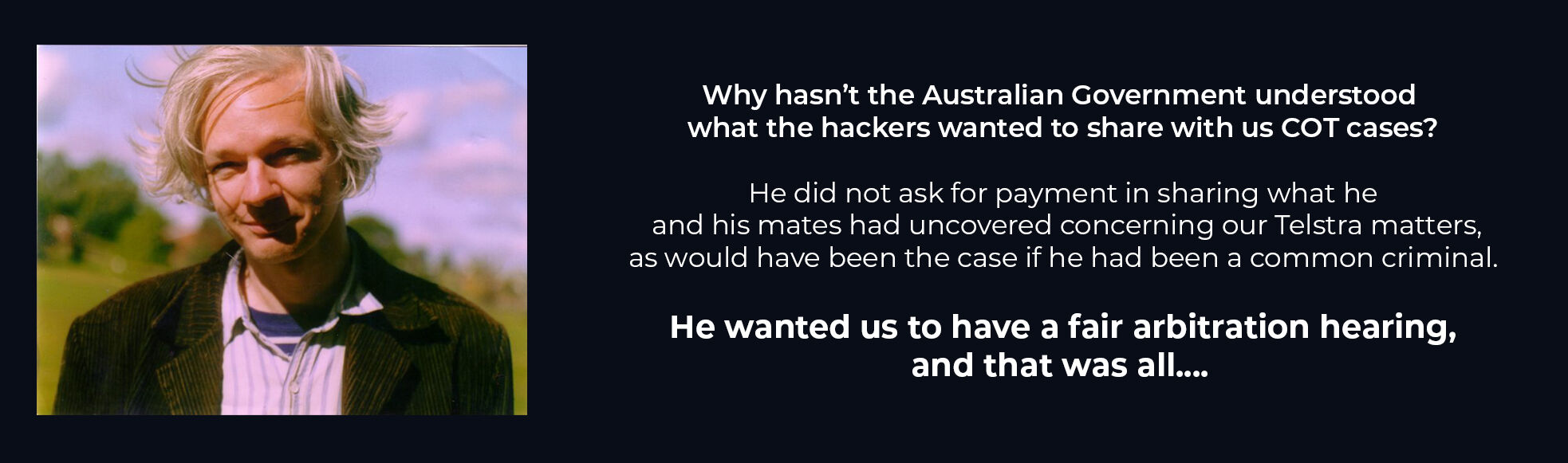

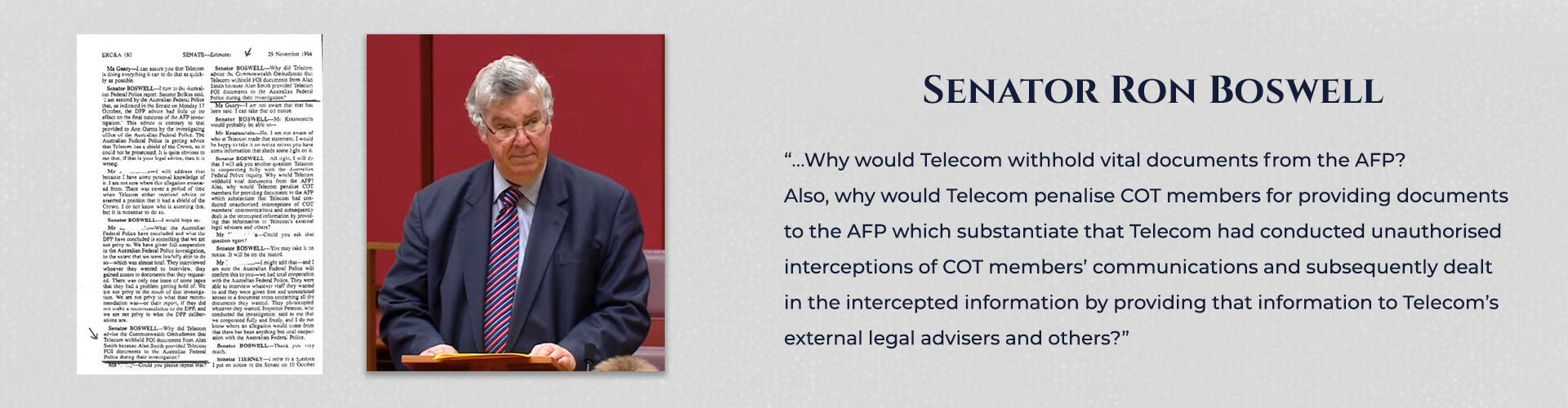

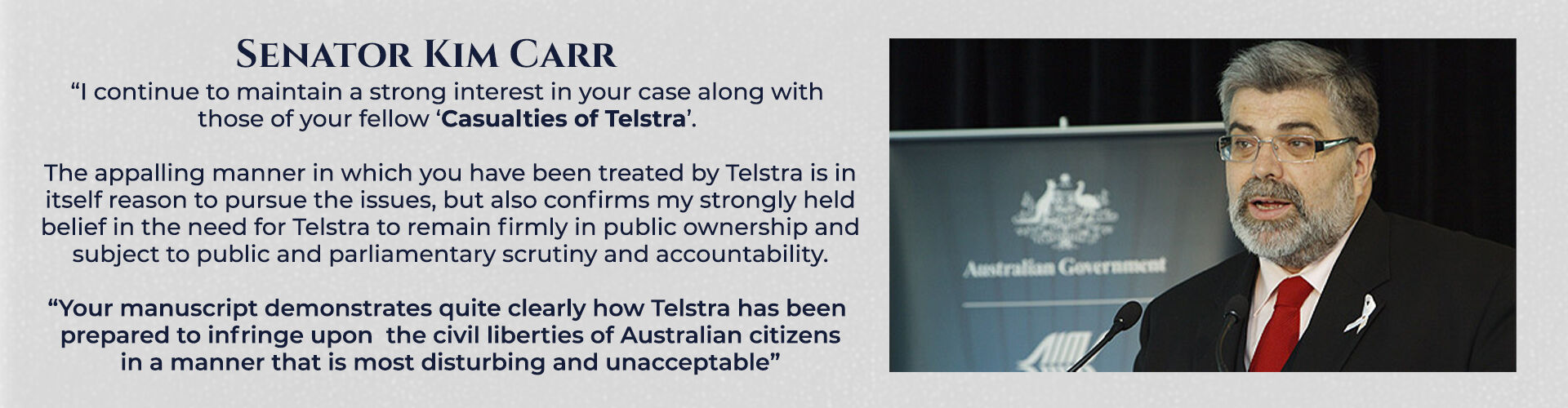
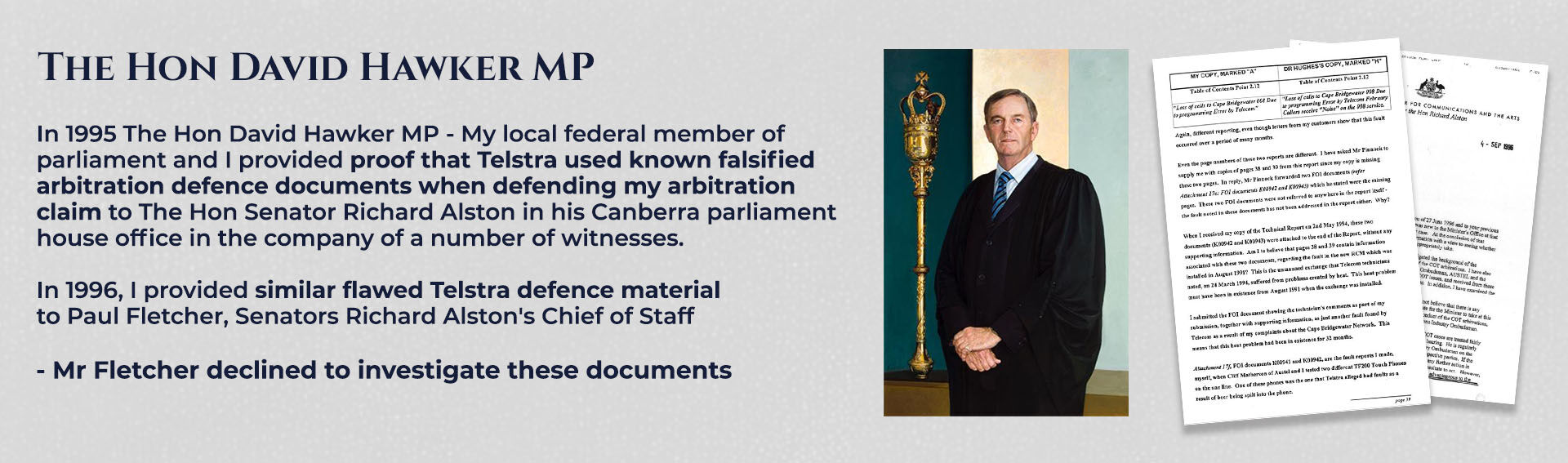



Evidence File 2
Government Corruption. Corruption in the public service, where misleading and deceptive conduct has spuriously over more than two decades perverted the course of justice.Evidence File 3
Mr Bates vs The Post Office. Ending bribery corruption means holding the powerful to account. Absent Justicemr-bates-vs-the-post-office-justice.
Evidence File 4
A well-known cold case that came to fruition through stored evidence is the Golden State Killer investigation.Evidence File 5 - Testimonials
Her letter to me, dated 15 July 1995 and attached in the image, confirms the trust Amanda Davis placed in my judgment and the seriousness of the evidence I had uncovered.Evidence File 6 AFP Official Orders
Evidence files show I received threats and thuggery abuse, as well as being subjected to treacherous and malicious harassment by Telstra and the establishment, which compromised my ability to submit an effective response to Telstra's claims that my phone problems were fixed when they were not
Evidence File 7
I was fifteen—too young to shave, too stubborn to be scared—when I stepped onto my first ship and straight into a world that did not care how old I was. I had pictured adventure: roaring shanties and moonlit beaches.Evidence File 8 Sea Shanty
Oh, I signed aboard as a galley lad, With a skillet, a knife, and a grin, Through thirty years of gales and storms, Where the sea decides who’ll win. From Fremantle’s heat to the cold North Sea, through ports where the wild winds blow, I learned my trade on a rolling deck and sea.

“I am writing in reference to your article in last Friday’s Herald-Sun (2nd April 1993) about phone difficulties experienced by businesses.
I wish to confirm that I have had problems trying to contact Cape Bridgewater Holiday Camp over the past 2 years.
I also experienced problems while trying to organise our family camp for September this year. On numerous occasions I have rung from both this business number 053 424 675 and also my home number and received no response – a dead line.
I rang around the end of February (1993) and twice was subjected to a piercing noise similar to a fax. I reported this incident to Telstra who got the same noise when testing.”
Cathy Lindsey
“Only I know from personal experience that your story is true, otherwise I would find it difficult to believe. I was amazed and impressed with the thorough, detailed work you have done in your efforts to find justice”
Sister Burke
“…your persistence to bring about improvements to Telecom’s country services. I regret that it was at such a high personal cost.”
The Hon David Hawker MP
“I am writing in reference to your article in last Friday’s Herald-Sun (2nd April 1993) about phone difficulties experienced by businesses.
I wish to confirm that I have had problems trying to contact Cape Bridgewater Holiday Camp over the past 2 years.
I also experienced problems while trying to organise our family camp for September this year. On numerous occasions I have rung from both this business number 053 424 675 and also my home number and received no response – a dead line.
I rang around the end of February (1993) and twice was subjected to a piercing noise similar to a fax. I reported this incident to Telstra who got the same noise when testing.”
Cathy Lindsey
“Only I know from personal experience that your story is true, otherwise I would find it difficult to believe. I was amazed and impressed with the thorough, detailed work you have done in your efforts to find justice”
Sister Burke
“…your persistence to bring about improvements to Telecom’s country services. I regret that it was at such a high personal cost.”
Hon David Hawker