Menu
  • Home
  • Evidence File 1
    • Evidence File 2
    • Evidence File 3
    • Evidence File 4
    • Evidence File 5 - Testimonials
    • Evidence File 6 AFP Official Orders
  • Rupert Murdoch -Telstra Scandal - Helen Handbury
    • Major Fraud Group Victoria Police
      • Not Fit For Purpose
    • Chapter 1
    • Chapter 2
    • Chapter 3
    • Chapter 4
    • Chapter 5
    • Chapter 6
    • Chapter 7
    • Chapter 8
    • Chapter 9
    • Chapter 10
    • Chapter 11
    • Chapter 12
    • Summary of Events
    • Sub Story Warts and All
      • Not Fiit For Purpose
  • Corruption Bribery Fraud Distortion Thuggery
    • Chapter 1 - The Collusion Continues
    • Chapter 2 - Inaccurate and Incomplete
    • Chapter 3
    • Chapter 4
    • Chapter 5
    • Evidence File-1
      • Evidence-File-2
    • My YouTube Video
    • Organized Crime and Corruption - Absent Justice
  • Australian Federal Police Investigations
    • Absent Justice Part 1, Part 2 and Part 3
      • Introduction to Absent Justice Part 1, 2 and 3
      • Forced to proceed with arbitration
      • Chapter 6 - Clandestine meeting
    • Telstra's Falsified BCI Report 2
    • Telstra's Falsified SVT Report
    • Senate Evidence
    • An Injustice to the remaining 16 Australian citizens
      • COT Case Strategy
    • AFP Investigation -2
      • Chapter 7- Vietnam-Viet-Cong-2
      • Government Corrupt Illicit Fax Screening
      • Government Spying Chapter 4
      • Rupert Murdoch - Cable Roll Out
    • Telecommunications Industry Ombudsman
      • Chapter 7 TIO Lies Fraud Deception
    • C A V Part 1, 2 and 3
    • Blowing The Whistle
    • Kangaroo Court - Absent Justice
    • Spurious and Unscrupulous Conduct
    • The first Remedy pursued
    • The second remedy pursued
    • The third remedy pursued
    • The fourth remedy pursued
    • The fifth remedy pursued
    • The sixth remedy pursued
    • The seventh remedy pursued
    • The eighth remedy pursued
    • The ninth remedy pursued
    • The tenth remedy pursued
    • The eleventh remedy pursued
    • The twelfth remedy pursued
  • Tampering with Evidence
    • Bad Bureaucrats
    • Ballarat Tourism-absentjustice.com
    • Discrimination
    • Government Corruption - Gaslighting
    • Hacking Julian Assange
    • Mr. Bates vs the Post Office,
    • Open letter to Prime Minister
    • Read about our dealings with
    • WikiLeaks exposing the truth
      • Truth About Julian Assange
    • Chapter 7-Vietnam Vietcong
  • ACMA-Manipulating the regulator
    • Absent Justice - Preface
    • Chronology of Events
    • Clinical Psychologist Bell Canada
    • Malfeasance in public office
      • Criminal Intent
    • Taking on the Establishment
      • Chapter 1 - Can We Fix The CAN
      • Chapter 2 - Bell Canada International Inc
      • Chapter 3 Betrayal - Breach of Trust
      • Chapter 4 The New Owners Tell Their Story
      • Chapter 5 Immoral - Hypocritical Conduct
    • Who was controlling the arbitrations?
    • Withholding Evidence
    • Legal Bullying In Arbitration
      • Chapter 1 irregular and untrustworthy
      • Chapter 2 Defective administration
      • Chapter 3 Dishonestly using corrupt government influence
      • Chapter 4 Distorted and unlawful.
    • The Briefcase
      • Chapter 1 Fraudulent Conduct Falsified Reporting
      • Chapter 4 Falsified Reporting Continues
      • Chapter 5 Fraudulent Conduct
  • Absent Justice Contact
My Bag

Your bag is currently empty.

info@absentjustice.com
Absent Justice
  • Home
  • Evidence File 1
    • Evidence File 2
    • Evidence File 3
    • Evidence File 4
    • Evidence File 5 - Testimonials
    • Evidence File 6 AFP Official Orders
  • Rupert Murdoch -Telstra Scandal - Helen Handbury
    • Major Fraud Group Victoria Police
      • Not Fit For Purpose
    • Chapter 1
    • Chapter 2
    • Chapter 3
    • Chapter 4
    • Chapter 5
    • Chapter 6
    • Chapter 7
    • Chapter 8
    • Chapter 9
    • Chapter 10
    • Chapter 11
    • Chapter 12
    • Summary of Events
    • Sub Story Warts and All
      • Not Fiit For Purpose
  • Corruption Bribery Fraud Distortion Thuggery
    • Chapter 1 - The Collusion Continues
    • Chapter 2 - Inaccurate and Incomplete
    • Chapter 3
    • Chapter 4
    • Chapter 5
    • Evidence File-1
      • Evidence-File-2
    • My YouTube Video
    • Organized Crime and Corruption - Absent Justice
  • Australian Federal Police Investigations
    • Absent Justice Part 1, Part 2 and Part 3
      • Introduction to Absent Justice Part 1, 2 and 3
      • Forced to proceed with arbitration
      • Chapter 6 - Clandestine meeting
    • Telstra's Falsified BCI Report 2
    • Telstra's Falsified SVT Report
    • Senate Evidence
    • An Injustice to the remaining 16 Australian citizens
      • COT Case Strategy
    • AFP Investigation -2
      • Chapter 7- Vietnam-Viet-Cong-2
      • Government Corrupt Illicit Fax Screening
      • Government Spying Chapter 4
      • Rupert Murdoch - Cable Roll Out
    • Telecommunications Industry Ombudsman
      • Chapter 7 TIO Lies Fraud Deception
    • C A V Part 1, 2 and 3
    • Blowing The Whistle
    • Kangaroo Court - Absent Justice
    • Spurious and Unscrupulous Conduct
    • The first Remedy pursued
    • The second remedy pursued
    • The third remedy pursued
    • The fourth remedy pursued
    • The fifth remedy pursued
    • The sixth remedy pursued
    • The seventh remedy pursued
    • The eighth remedy pursued
    • The ninth remedy pursued
    • The tenth remedy pursued
    • The eleventh remedy pursued
    • The twelfth remedy pursued
  • Tampering with Evidence
    • Bad Bureaucrats
    • Ballarat Tourism-absentjustice.com
    • Discrimination
    • Government Corruption - Gaslighting
    • Hacking Julian Assange
    • Mr. Bates vs the Post Office,
    • Open letter to Prime Minister
    • Read about our dealings with
    • WikiLeaks exposing the truth
      • Truth About Julian Assange
    • Chapter 7-Vietnam Vietcong
  • ACMA-Manipulating the regulator
    • Absent Justice - Preface
    • Chronology of Events
    • Clinical Psychologist Bell Canada
    • Malfeasance in public office
      • Criminal Intent
    • Taking on the Establishment
      • Chapter 1 - Can We Fix The CAN
      • Chapter 2 - Bell Canada International Inc
      • Chapter 3 Betrayal - Breach of Trust
      • Chapter 4 The New Owners Tell Their Story
      • Chapter 5 Immoral - Hypocritical Conduct
    • Who was controlling the arbitrations?
    • Withholding Evidence
    • Legal Bullying In Arbitration
      • Chapter 1 irregular and untrustworthy
      • Chapter 2 Defective administration
      • Chapter 3 Dishonestly using corrupt government influence
      • Chapter 4 Distorted and unlawful.
    • The Briefcase
      • Chapter 1 Fraudulent Conduct Falsified Reporting
      • Chapter 4 Falsified Reporting Continues
      • Chapter 5 Fraudulent Conduct
  • Absent Justice Contact
Menu
  1. Home
  2. Australian Federal Police Investigations-1
  3. Blowing The Whistle

Blowing The Whistle


On 15 July 1995, two months after the arbitrator's premature announcement of findings regarding my incomplete claim, Amanda Davis, the former General Manager of Consumer Affairs at AUSTEL (now known as ACMA), provided me with an open letter to be shared with individuals of my choosing. This action underscores the confidence she placed in my integrity and professional character:

“I am writing this in support of Mr Alan Smith, who I believe has a meeting with you during the week beginning 17 July.  I first met the COT Cases in 1992 in my capacity as General Manager, Consumer Affairs at Austel. The “founding” group were Mr Smith, Mrs Ann Garms of the Tivoli Restaurant, Brisbane, Mrs Shelia Hawkins of the Society Restaurant, Melbourne, Mrs Maureen Gillian of Japanese Spare Parts, Brisbane, and Mr Graham Schorer of Golden Messenger Couriers, Melbourne. Mrs. Hawkins withdrew very early on, and I have had no contact with her since.

The treatment these individuals have received from Telecom and Commonwealth government agencies has been disgraceful, and I have no doubt they have all suffered as much through this treatment as they did through the faults on their telephone services.

One of the striking things about this group is their persistence and enduring belief that eventually there will be a fair and equitable outcome for them, and they are to admired for having kept as focussed as they have throughout their campaign.

Having said that, I am aware all have suffered both physically and their family relationships. In one case, the partner of the claimant has become seriously incapacitated; due, I beleive to the way Telecom has dealt with them. The others have al suffered various stress related conditions (such as a minor stroke.

During my time at Austel I pressed as hard as I could for an investigation into the complaints. The resistance to that course of action came from the then Chairman. He was eventually galvanised into action by ministerial pressure. The Austel report looks good to the casual observer, but it has now become clear that much of the information accepted by Austel was at best inaccurate, and at worst fabricated, and that Austel knew or ought to have known this at the time.” 

After leaving Austel I continued to lend support to the COT Cases, and was instrumental in helping them negotiate the inappropriately named "Fast Track" Arbitration Agreement. That was over a year ago, and neither the Office of the Commonwealth Ombudsman nor the Arbitrator has been succsessful in extracting information from Telecom which would equip the claimants to press their claims effectively. Telecom has devoted staggering levels of time, money and resources to defeating the claiams, and there is no pretence even that the arbitration process has attemted to produce a contest between equals.

Even it the remaining claimants receive satisfactory settlements (and I have no reason to think that will be the outcome) it is crucial that the process be investigated in the interest of accountabilty of publical companies and the public servants in other government agencies. 

Because I am not aware of the exact citrcumstances surronding your meeting with Mr Smith, nor your identity, you can appriate that I am being  fairly circimspect in what I am prepared to commit to writing. Suffice it to say, though, I am fast coming to share the view that a public inquiry of some discripion is the only way that the reasons behind the appalling treatent of these people will be brought to the surface.

I would be happy to talk to you in more detail if you think that would be useful, and can be reached at the number shown above at any time. 

Thank you for your interest in this matter, and for sparing the time to talk to Alan. (See File 501 -  AS-CAV Exhibits 495 to 541 )
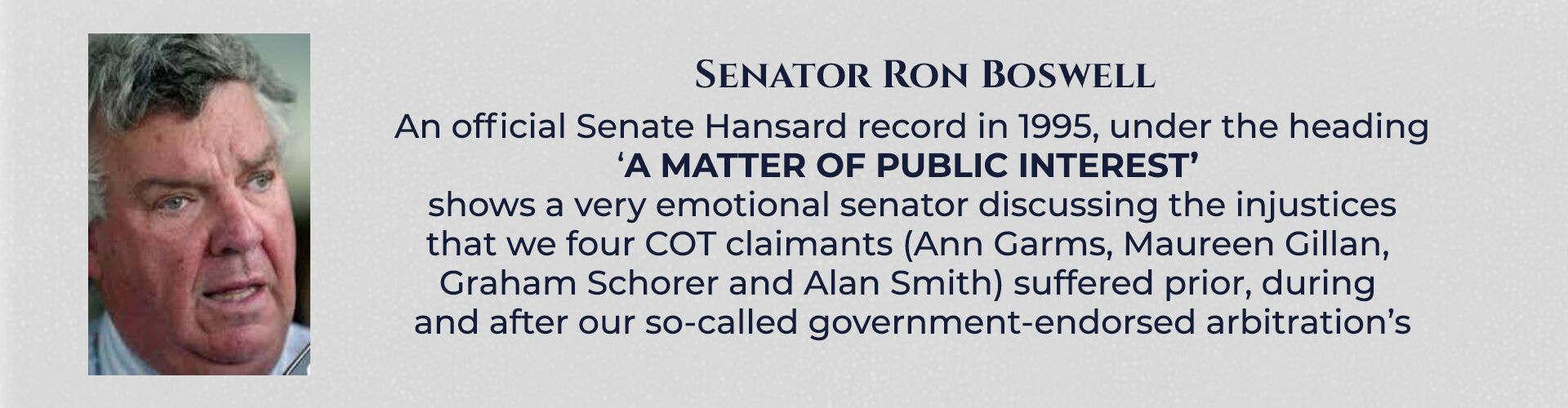
Absent Justice - Senator Ron Boswell

Four months after the arbitrator Dr Hughes prematurely brought down his findings on my matters, and fully aware I was denied all necessary documents to mount my case against Telecom/Telstra, an emotional Senator Ron Boswell discussed the injustices we four COT claimants (i.e., Ann Garms, Maureen Gillan, Graham Schorer and me) experienced prior and during our arbitrations (see Senate Evidence File No 1 20-9-95 Senate Hansard A Matter of Public Interest) in which the senator notes:

“Eleven years after their first complaints to Telstra, where are they now? They are acknowledged as the motivators of Telecom’s customer complaint reforms. … But, as individuals, they have been beaten both emotionally and financially through an 11-year battle with Telstra. …

“Then followed the Federal Police investigation into Telecom’s monitoring of COT case services. The Federal Police also found there was a prima facie case to institute proceedings against Telecom but the DPP , in a terse advice, recommended against proceeding. …

“Once again, the only relief COT members received was to become the catalyst for Telecom to introduce a revised privacy and protection policy. Despite the strong evidence against Telecom, they still received no justice at all. …

“These COT members have been forced to go to the Commonwealth Ombudsman to force Telecom to comply with the law. Not only were they being denied all necessary documents to mount their case against Telecom, causing much delay, but they were denied access to documents that could have influenced them when negotiating the arbitration rules, and even in whether to enter arbitration at all. …

“Telecom has treated the Parliament with contempt. No government monopoly should be allowed to trample over the rights of individual Australians, such as has happened here.” (See Senate Hansard Evidence File No-1)


Karina Barrymore, the journalist at the Melbourne Herald Sun, wrote on 3 August 2016

 
WHEN THE FIGHT BECOMES YOUR PURPOSE
There comes a point in a long struggle when you stop asking why you are still fighting and start understanding what the fight has made you. It doesn’t happen in a single moment. It happens slowly, quietly, in the background of your life — in the way you wake up, in the way you think, in the way you carry yourself. The battle becomes part of your identity, not because you wanted it, but because it shaped you in ways you could never have imagined.
 
By the time I reached this stage, the arbitration was years behind me, but the consequences were still unfolding. The truth had become my responsibility, the evidence my inheritance, and the silence of the institutions my constant reminder that justice — if it was ever going to come — would not come from them.
It would have to come from me.
 
The Shift from Survival to Purpose
In the early years, everything I did was about survival — surviving the lies, the gaslighting, the financial ruin, the collapse of my business, the isolation, the endless bureaucratic stonewalling. But somewhere along the way, the fight changed shape. It stopped being about what had been taken from me and became about what I refused to let be taken from others.
 
I realised that my story — painful as it was — had value beyond my own suffering. It was a warning. A blueprint. A record of what happens when a corporation becomes more powerful than the truth, when a regulator becomes more loyal to the entity it is meant to police than to the public it is meant to protect, when a government chooses convenience over accountability.
My story was no longer just mine.
 
It belonged to every Casualty of Telstra, ordinary Australian citizens who had been silenced by this terrible giant, Telstra. It belonged to every person who had been dismissed. Every person who had been told, “There’s nothing wrong with your service,” when the evidence said otherwise. And once I understood that, the fight became something else entirely. It became a purpose.
 
The Realisation That No One Is Coming to Save You
There is a moment in every long battle when you finally accept that no cavalry is coming. No minister will step in. No regulator will suddenly grow a conscience. No journalist will magically uncover the truth you’ve been shouting for years. No legal system will correct its own failures. You are on your own.
 
It’s a sobering realisation, but it’s also liberating. Because once you stop waiting for someone else to fix what was broken, you start doing the work yourself — not because you think you will win, but because you know the truth deserves to be told. That was the moment I stopped hoping for rescue and started building my own platform, my own archive, my own voice. That was the moment Absent Justice stopped being a website and became a mission.
 
The People Who Tried to Stop the Story
When you carry a truth that powerful institutions want buried, you learn quickly who fears it. You learn it in the way people avoid your calls. In the way officials speak in rehearsed lines. In the way documents go missing. In the way FOI requests come back with pages blacked out. In the way politicians suddenly “don’t recall” conversations you remember vividly. You learn it in the way Telstra behaved — confident, dismissive, certain that their version of events would prevail simply because they had the power to enforce it.
 
You learn it in the way AUSTEL folded — a regulator that should have been the shield for the public, but instead became the shield for Telstra. You learn it in the way the arbitrators hid behind legal language, pretending neutrality while allowing evidence to be withheld, altered, or ignored. And you learn it in the way the government stayed silent — not because they didn’t know, but because acknowledging the truth would have meant acknowledging their own complicity. These were not passive failures. They were active choices.
 
Choices that shaped the lives of twenty‑one Australians, each of whom knew at least two other small business operators suffering the same phone faults. Those operators knew others. And so on. The network of casualties grew exponentially. We were no longer talking about a handful of complainants. We were talking about thousands of Australian small business owners who lost their livelihoods or were forced to sell their businesses because the government was now covering up a systemic problem. And I refused to let those choices be forgotten.
 
The Cost of Becoming the Messenger
People often assume that exposing the truth brings relief. It doesn’t. It brings consequences. You lose friends. You lose allies. You lose the comfort of being someone who doesn’t know what they know. You become the person others avoid because your story makes them uncomfortable. You become the reminder of what happens when systems fail. You become the witness no one wants in the room. And yet, despite all of that, you keep going — because the alternative is to let the truth die. I learned to live with the cost. I learned to live with the isolation. I learned to live with the knowledge that telling the truth often means standing alone. But I also learned something else: Standing alone is still standing.
 
The Quiet Power of Persistence
Persistence is not dramatic. It is not loud. It is not glamorous. It is the act of showing up again and again, long after everyone else has stopped. It is the act of refusing to let the truth be buried. It is the act of continuing the fight even when the outcome is uncertain. Persistence is what kept Absent Justice alive. Persistence is what kept the evidence intact. Persistence is what kept the story from being rewritten by those who had the most to hide. And persistence is what brought me to Part IX — the part of the journey where the fight is no longer about what happened, but about what must never happen again.
 
The Purpose That Emerged From the Ruins
By the time I reached this stage, I understood something I had never understood before: The fight was never just about me. It was about the system that failed all of us. It was about the truth that deserved to be preserved. It was about the future that deserved protection. My purpose became clear:
To ensure that what happened to me — and to thousands of others — would not be erased, forgotten, or repeated.
That purpose gave me strength.
It gave me direction.
It gave me a reason to keep going when everything else had been taken.
And that purpose is what carries me into the next chapter.
 
PART X — THE MOMENT THE SYSTEM BLINKED
There comes a time in every long fight when the system you’ve been pushing against finally shows a crack. It doesn’t crumble. It doesn’t collapse. It doesn’t confess. But it blinks — just long enough for you to see that your persistence has landed a blow.  
 
For years, I had been dismissed as a nuisance, a troublemaker, a man who “wouldn’t let go.” Telstra had written me off. The government had written me off. The arbitrators had written me off. They believed that time would wear me down, that exhaustion would silence me, that the weight of the truth would eventually crush the man carrying it.
But they underestimated something fundamental:
 
The inadequate and severely lacking telephone service had already drained my finances. The truth I wanted to expose, which these government bureaucrats failed to understand—having never stepped outside their government bubble—is that I had something to gain that they had never experienced: self-esteem and the determination to survive during tough times. I possessed what most small business owners have: self-determination. 
 
The First Signs of Movement. It didn’t happen with a headline. It didn’t happen with a ministerial apology. It didn’t happen with a sudden burst of integrity from the institutions that had failed us. It happened quietly.
 
A document that had been withheld suddenly appeared in a FOI release.
A bureaucrat who once stonewalled me slipped and acknowledged something they shouldn’t have.
A journalist who had ignored me for years finally asked for a meeting.
A former Telstra technician reached out, saying, “I think it’s time someone knew what really happened.”
 
These were small things — tiny fractures in a wall that had stood for decades. But to someone who had been pushing against that wall alone, they were seismic. Because cracks mean pressure. Cracks mean strain. Cracks mean the truth is no longer contained. And cracks mean the system is afraid.
 
The Power of Being Proven Right — Slowly, Reluctantly, and Without Credit
There is a strange kind of vindication that comes when the very institutions that dismissed you begin to quietly confirm your claims — not publicly, not honourably, but through their own internal contradictions. A technical report that once “did not exist” suddenly appears in a Senate archive. A Telstra memo that was “never written” shows up in a bundle of documents released to someone else. A regulator’s internal briefing contradicts their public statements. A government department quietly updates its records without explanation.
 
They never admit wrongdoing. They never apologise. They never acknowledge the damage done. But the truth leaks out anyway — through the cracks, through the paperwork, through the people who can no longer carry the weight of silence. And every leak is a victory. Not for me personally, but for the record. For the truth. or the thousands who were told they were imagining things.
 
The System’s Greatest Fear — A Citizen Who Doesn’t Go Away
Governments and corporations are built on one assumption:
that ordinary people will eventually give up. They rely on fatigue. They rely on confusion. They rely on the complexity of bureaucracy. They rely on the belief that no one will keep fighting once the cost becomes too high.
 
But I didn’t go away. I didn’t fold. I didn’t disappear into the silence they had prepared for me. And that — more than any document, any letter, any technical report — is what frightened them. Because a citizen who refuses to go away is a citizen who cannot be controlled. A citizen who refuses to go away exposes the cracks. A citizen who refuses to go away is a citizen who forces the truth into the light. And once the truth is in the light, the system loses its power to rewrite it.
 
The Moment I Realised the Fight Was Bigger Than Telstra
For years, I believed my battle was with Telstra — with their lies, their manipulation, their technical failures, their abuse of power. But as the cracks widened, I began to see the truth:
Telstra was only the beginning. The real fight was with the machinery that protected Telstra. The regulators who surrendered their independence. The arbitrators who hid behind procedure.
The ministers who chose silence over accountability. The bureaucrats who buried evidence.
 
The government that allowed a national scandal to be sanitised into a footnote. This wasn’t a Telstra problem. It was an Australian problem. A systemic problem. A cultural problem — the culture of “don’t rock the boat,” the culture of “protect the institution,” the culture of “the public doesn’t need to know.” And once I understood that, the fight expanded. It became not just about what had happened to me, but about what had been allowed to happen to all of us.
 
The Responsibility of the One Who Sees the Whole Picture
When you are the only person who has read every document, every memo, every technical report, every FOI release, every Senate transcript, every internal briefing, every contradiction — you become the one who sees the whole picture. Not because you wanted to. Not because you sought it out. But because no one else bothered to look. And once you see the whole picture, you cannot unsee it.
 
You cannot pretend the system works.
You cannot pretend the regulators are independent.
You cannot pretend the arbitration was fair.
You cannot pretend the government acted in good faith.
You cannot pretend the casualties were few.
You become the keeper of a truth that the nation was never meant to know.
And with that truth comes responsibility — not chosen, but inherited. And that is where the story now turns.
 

The Logbook

Mutiny on The Bounty - Absent Justice

In 1789, the British Royal Navy's HMS Bounty departed from the prominent port of Portsmouth, England, with a significant objective: to transport the exotic breadfruit tree from the South Pacific to the British Isles. This initiative aimed to provide a new food source that could enhance the agricultural prospects of British colonies in the Caribbean. However, on April 28, 1787, the vessel became the site of a dramatic mutiny in the isolated and tumultuous waters of the South Pacific Ocean. This critical event not only altered the ship’s original mission but also incited considerable historical interest, resulting in the production of three notable films inspired by the detailed accounts documented in the ship's logbook. This essential record, meticulously maintained by Captain William Bligh prior to the mutiny, serves as a historical reference that preserves the intricate realities of the events, in contrast to the various interpretations offered in cinematic portrayals.

In a parallel context, the disputes arising from the Certificates of Title (COT) could have had a different trajectory if the involved parties had been granted access to the telephone exchange logbooks that they were assured would be provided before the commencement of official arbitration. These logbooks contained vital information relevant to their businesses, which could have illuminated the underlying factors contributing to their financial losses. Access to this data might have unveiled essential truths, facilitating a more just resolution.

For me, the attainment of genuine justice remains a challenging prospect. The full disclosure of the Portland and Cape Bridgewater logbooks is essential for the public to engage in a thorough examination of the evidence and to gain an accurate understanding of the entire situation. Such transparency is crucial to ensuring that all relevant aspects of this matter are appropriately addressed.

A covert copy of the extracts from the Portland and Cape Bridgewater logbooks was utilized by the government communications regulator AUSTEL, now known as ACMA, and is attached here as AUSTEL’s Adverse Findings, dated March 1994, confirming that between Points 2 to 212, the government public servants who investigated my ongoing telephone problems found my claims against Telstra validated. This document reveals a much more comprehensive narrative than the one presented by the arbitrator, which was based solely on the limited material provided by Telstra during the arbitration process.

Those who examine Evidence One will find that the extracts from the Portland and Cape Bridgewater logbooks were indeed provided to Dr. Gordon Hughes as promised when the COT Cases signed our agreement. If Dr. Hughes had considered this crucial supplemental information, he likely would have awarded me an amount three to four times greater than the sum he determined on May 11, 1995. The significance of these logbooks cannot be overstated, as they contain vital information that could have dramatically influenced the outcome of the arbitration.

Six months before the arbitrations commenced, four of the sixteen claimants, including myself, submitted a request under the Freedom of Information Act (1984) to access the telephone exchange logbooks from our local exchanges. We were informed that the logbook would be made available to the appointed arbitrator after signing our arbitration agreements. However, this logbook was never provided to the claimants or the arbitrator.

This document was essential for the claimants to demonstrate to the arbitrator that their telephone issues remained unresolved. As a result, the arbitrator could dismiss a claim as settled until Telstra, the defendant in each case, could unequivocally prove that no further issues were affecting their telephone services.

In my particular case, even the Australian Commonwealth Ombudsman sought access to this same logbook from the then-CEO of Telstra. Regrettably, the Ombudsman’s request yielded no response. If the Commonwealth Ombudsman, an entity tasked with overseeing investigations for a fully funded government agency, was unable to secure the crucial and relevant documents from the entire arbitration process on my behalf, what hope did I—or any of the other claimants—have in effectively substantiating our claims against Telstra? The inability to access these vital pieces of evidence raises serious questions about the fairness of the process and the prospects for justice in our cases.

Having devoted twenty-eight years to the British Australian Merchant Navy, I have gained a profound understanding of the importance of meticulously maintained records within the ship's logbook. These records document the daily operations of the vessel and the activities of the crew, serving as a critical resource not only for the current voyage but also for future reference.

This understanding prompted me to advise the COT Cases to request access to their local telephone exchange logbook. Should their request be denied, I recommend pursuing access through the arbitrator and, if necessary, escalating the matter to the Commonwealth.

The content of this logbook is fundamental to the resolution of their cases, as it contains a comprehensive record of every fault complaint submitted by Telstra customers.

It is imperative to highlight that the logbook from the Portland/Cape Bridgewater telephone exchange was not provided to me, the arbitrator, or the Commonwealth Ombudsman (see File 114 - AS-CAV Exhibit 92 to 127), which raises significant concerns regarding why was it not provided? What was Telstra afarid of it exposing?

On September 22, 1994, a critical transcript emerged from an oral interview at the Commonwealth Ombudsman's Office, featuring AUSTEL, Bruce Matthews, and John McMahon representatives. During this session, Commonwealth Ombudsman officer John Wynack inquired about the release date of the AUSTEL report. (see Absentjustice-Introduction File 495, Mr. Matthews stated,

"The final report was released in April; I can’t recall the exact date, but it was April 1994. The draft report was produced in March 1994, and Telecom received its copy then.”

The FOI ACMA release of AUSTEL’s Adverse Findings clearly shows that I only received my copy of the AUSTEL report in November 2007—thirteen years after Telstra obtained theirs in March 1994. AUSTEL's conduct represents a significant abuse of process. They allowed me to engage in arbitration and legal actions against Telstra while deliberately withholding crucial documents essential for supporting my claims. This situation is profoundly concerning.

Moreover, I incurred expenses exceeding $300,000 in arbitration fees as I sought to prove a case that the government had already substantiated against Telstra, relying on extracts from Telstra's Portland telephone exchange logbook. This is the same logbook that was denied to me during discovery. Consequently, AUSTEL has neglected its statutory responsibilities to me as a citizen of Australia, fully cognizant that without access to that logbook or the AUSTEL report, I was unable to adequately prove my claims—an outcome that ultimately materialized.

Had I access to this logbook during my arbitration appeal

Absent Justice - Missing Complaints

I would have proven my phone problems were still ongoing.

However, between 18 October 1995 and 4 October 1997, with the assistance of Mr John Wynack, Director of Investigations on behalf of the Commonwealth Ombudsman, I sought, under Freedom of Information (FOI Act) from Telstra, a copy of their arbitration file, which would have shown who had been involved in stopping me at all cost in proving my claims and why only AUSTEL received a copy of the Portland/Cape Bridgewater but not my arbitration team. Home Page File No/82 confirms Mr Wynack did not believe Telstra’s claim that it destroyed the file. 

I also tried to access a copy of the same arbitration file held by the Telecommunications Industry Ombudsman (TIO), who, under the rules of the arbitration agreement, had to receive every single arbitration document as the process administrator, including receiving my request to the arbitrator asking him to access the Portland/Cape Bridgewater logbook. As the administrator of my arbitration under law, the TIO had to retain a copy of those documents for at least six years, until 2002. 

John Pinnock’s letter of 10 January 1996, in response to my request for these arbitration records, states:

“I refer to your letter of 31 December 1996 in which you seek to access to various correspondence held by the TIO concerning the Fast Track Arbitration Procedure. …

“I do not propose to provide you with copies of any documents held by this office.” (See Open Letter File No 57-C)

Points 21 and 22 in Mr Direen’s statement also record how, while he was a Telstra Principal Security Officer, he had cause to investigate “… suspected illegal interference to telephone lines at the Portland exchange,” but when he “… made inquiries by telephone back to Melbourne (he) was told not to get involved and that another area of Telstra was handling it” and that “... the Cape Bridgewater complainant was a part of the COT cases”  (my Cape Bridgewater Holiday Camp business) refer to (File 766 - AS-CAV Exhibit 765-A to 789).

One of the key individuals under investigation by Mr. Des Direen, the Principal Investigator, is Gordon Stokes, a former employee of Telstra. Stokes is referenced in a vital memo from Telstra and allegedly shared my business telephone and fax contacts with a person named Micky (mentioned below in the AFP segment), raising significant concerns about the breach of my privacy. 
 
Moreover, Stokes is implicated in setting up a clandestine recording device, a matter documented in correspondence from Telstra to the Australian Federal Police. This situation is troubling, as the logbook that recorded critical details regarding the installation of the listening device—including the date it was set up and the individual who authorized it—was never presented during the arbitration process. 
 
The absence of this logbook concealed essential information from both myself and the arbitrator, effectively undermining my privacy claims. This omission was particularly detrimental, as it could have bolstered my case and clarified the serious violations that occurred, which were integral to my overall arbitration claims.

In our desperate fight for justice, COT members had no choice but to bear the financial burden of hiring our own arbitration consultants to sift through the tangled mess of our ongoing telephone issues. It was an exhausting and costly process that felt almost Sisyphean, as Telstra remained obstinately defiant, refusing to admit to any faults in their service. 


History – Casualties of Telecom (COT)

I am Alan Smith. This is my story and the stories of other business owners who have had significant issues with Telecom, now Telstra. We became known by the acronym COT—Casualties of Telecom.

A government-endorsed arbitration process was set up for the business owners to rectify their communication problems and fix the faulty telephone services. However, it turned into an uneven battle between the COT cases and the government-backed Telecom, which we, the four claimants, could not win. Our ongoing telephone and fax problems were compounded as our costs and losses increased because our deficient services were not repaired, nor were our concerns directly addressed as they should have been.

Our integrity was attacked, business reputations undermined, and crimes committed against us to ruin our livelihoods as Telecom sought to avoid responsibility for their own ineptitude and mismanagement by directing blame onto these small businesses that had been severely disadvantaged and destroyed by the lack of communication services between business owners and potential clients.

We, the COT claimants, lost millions of dollars, our mental health declined, and our livelihoods collapsed in ruins.  Yet, those in government - the architects of this injustice, this corruption and who had perpetuated these crimes against ordinary citizens -  are still in positions of power today.  Our stories are still covered and buried in bureaucratic red tape.

These are our stories, which are significant today, as the cover-up has continued to the present day. The stories reveal how, through technology development, large organisations have been allowed to disadvantage their clients, cover up corrupt operation practices and mismanagement, and avoid any responsibility for their failure to act in the interests of a client base or deliver the services they had promised. It is a story of vast government corruption, injustices, and criminal behaviour worthy of a Sicilian mafia organisation.


Absent Justice - The Godfather


What instigated the alarming and threatening communications I received from Telstra, and why did the company choose to act on those threats despite my decision to disregard them? 

In November 1994, I escalated these menacing threats to Senator Ron Boswell, drawing attention to the Australian Federal Police's (AFP) concerns. I highlighted that both the administrator of my arbitration, Warwick Smith, and the arbitrator, Dr. Gordon Hughes, had opted not to investigate these threats. I provided the Senator with evidence demonstrating that over 56 mini-reports attached to 56 fax header sheets had been manipulated. Some reports were altered, and others included extraneous, unrelated information. This is detailed in file 76 - AS-CAV Exhibit 48-A to 91,  my statutory declaration dated May 16, 1994. This declaration has been stamped as PROTECTED by the Australian Federal Police. It confirms that Superintendent Detective Sergeant Jeff Penrose of the AFP advised me to inform the arbitrator and administrator about what I had uncovered regarding my arbitration.
 
File 77 - AS-CAV Exhibit 48-A to 91 shows that the Deputy Telecommunications Industry Ombudsman, Sue Harlow, acknowledged receipt of the evidence I hand-delivered to her office. This evidence reveals that the manipulation of the 56 fax header sheets rendered the reports indecipherable. In light of these concerning findings, Senator Boswell raised these unresolved issues during a Senate session on November 29, 1994, bringing them to public attention.
 
Moreover, I must question why the confidentiality agreement that governs the terms of my arbitration seems to deliberately obscure these threats, burying them beneath layers of secrecy embedded within the arbitration contract. This situation raises critical questions about how widespread confidentiality agreements are in government-sanctioned arbitrations against ordinary citizens, effectively shrouding potential wrongdoings perpetrated against them throughout the arbitration process.
 
Could the unsettling revelations surrounding allegations of pedophilia within Parliament House, Canberra—surfacing during the COT arbitrations—be the very reason I was denied access to vital government documents pertaining to the arbitration of the COT cases? Additionally, is there a connection between the manipulation of those 50-plus reports and the unfolding pedophilia activities at Parliament House? The denial of access to these crucial documents appears particularly troubling, especially given that the Senator overseeing these claims against Telstra was concurrently facing allegations of child rape. The convergence of these grave issues raises serious doubts about the integrity of the arbitration process and the protections afforded to those who are caught in its web.

Intimidating threats issued by Telstra

Absent Justice - Privacy

Do not disclose this sensitive information to Telstra.

During my first visit to the holiday camp in February 1994, AFP Senior Constable Melanie Cochrane gave me crucial advice. She recommended that from then on, I should refrain from supplying the arbitration process with any documented names, addresses, or telecommunications details of my single club patrons. This was to be done unless the arbitrator provided official written confirmation that my correspondence would be sent to Telstra after the AFP had concluded their investigation into Telstra's unauthorised interception of my telecommunication services. The AFP still examined how Telstra obtained sensitive private and business information related to my operations.

My members from the single club—a significant revenue source for my holiday camp—have communicated their concerns regarding the reliability of my security protocols, primarily related to the faxes being sent and received. This concern has been heightened by recent media reports indicating the potential bugging of my business phone lines. Below are two of those media reports for your reference

While the intimidating threats issued by Telstra and the unsettling fact that these actions took place under the watchful eyes of the arbitrator and the Telecommunications Industry Ombudsman during the COT arbitrations have been extensively examined and brought to light throughout this website, what indeed weighs heavily on my mind—and the minds of many others involved in COT Cases—is the grim reality of serious threats that were never thoroughly investigated. This alarming neglect has left us grappling with the disheartening truth that a democratically elected government has, disturbingly, allowed these grave threats to go unaddressed. As a result, those who became targets of such intimidation have experienced profound and lasting impacts on their lives, leading to an enduring sense of injustice and despair that permeates our daily existence.

On July 4, 1994, amidst the complexities of my arbitration proceedings, I confronted serious threats articulated by Paul Rumble, a Telstra representative on the arbitration defence team. Disturbingly, he had been covertly furnished with some of my interim claims documents by the arbitrator—a breach of protocol that occurred an entire month before the arbitrator was legally obligated to share such information. Given the gravity of the situation, my response needed to be exceptionally meticulous. I poured considerable effort into crafting this detailed letter, carefully choosing every word. In this correspondence, I made it unequivocally clear:

“I gave you my word on Friday night that I would not go running off to the Federal Police etc, I shall honour this statement, and wait for your response to the following questions I ask of Telecom below.” (File 85 - AS-CAV Exhibit 48-A to 91)

When drafting this letter, my determination was unwavering; I had no plans to submit any additional Freedom of Information (FOI) documents to the Australian Federal Police (AFP). This decision was significantly influenced by a recent, tense phone call I received from Steve Black, another arbitration liaison officer at Telstra. During this conversation, Black issued a stern warning: should I fail to comply with the directions he and Mr Rumble gave, I would jeopardize my access to crucial documents pertaining to ongoing problems I was experiencing with my telephone service.

Page 12 of the AFP transcript of my second interview (Refer to Australian Federal Police Investigation File No/1) shows Questions 54 to 58, the AFP stating:-

“The thing that I’m intrigued by is the statement here that you’ve given Mr Rumble your word that you would not go running off to the Federal Police etcetera.”

Essentially, I understood that there were two potential outcomes: either I would obtain documents that could substantiate my claims, or I would be left without any documentation that could impact the arbitrator's decisions regarding my case.

However, a pivotal development occurred when the AFP returned to Cape Bridgewater on September 26, 1994. During this visit, they began to pose probing questions regarding my correspondence with Paul Rumble, demonstrating a sense of urgency in their inquiries. They indicated that if I chose not to cooperate with their investigation, their focus would shift entirely to the unresolved telephone interception issues central to the COT Cases, which they claimed assisted the AFP in various ways. I was alarmed by these statements and contacted Senator Ron Boswell, National Party 'Whip' in the Senate.

As a result of this situation, I contacted Senator Ron Boswell, who subsequently brought these threats to the Senate. This statement underscored the serious nature of the claims I was dealing with and the potential ramifications of my interactions with Telstra.

Threats made and carried out.

Absent Justice - My Story - Senator Ron Boswell

Telstra at its worst  

On page 180, ERC&A, from the official Australian Senate Hansard, dated 29 November 1994, reports Senator Ron Boswell asking Telstra’s legal directorate:

“Why did Telecom advise the Commonwealth Ombudsman that Telecom withheld FOI documents from Alan Smith because Alan Smith provided Telecom FOI documents to the Australian Federal Police during their investigation?”

After receiving a hollow response from Telstra, which the senator, the AFP and I all knew was utterly false, the senator states:

“…Why would Telecom withhold vital documents from the AFP? Also, why would Telecom penalise COT members for providing documents to the AFP which substantiate that Telecom had conducted unauthorised interceptions of COT members’ communications and subsequently dealt in the intercepted information by providing that information to Telecom’s external legal advisers and others?” (See Senate Evidence File No 31)

Thus, the threats became a reality. What is so appalling about this withholding of relevant documents is this: no one in the TIO office or government has ever investigated the disastrous impact the withholding of documents had on my overall submission to the arbitrator. The arbitrator and the government (at the time, Telstra was a government-owned entity) should have initiated an investigation into why an Australian citizen, who had assisted the AFP in their investigations into unlawful interception of telephone conversations, was so severely disadvantaged during a civil arbitration.

Pages 12 and 13 of the Australian Federal Police Investigation File No/1 transcripts provide a comprehensive account establishing Paul Rumble as a significant figure linked to the threats I have encountered. This conclusion is based on two critical and interrelated factors that merit further elaboration.

Firstly, Mr. Rumble actively obstructed the provision of essential arbitration discovery documents, which the government was legally obligated to provide under the Freedom of Information Act. This obligation was contingent on my signing an agreement to participate in a government-endorsed arbitration process. By imposing this condition, Mr Rumble undermined a legally established protocol, effectively manipulating the process for his benefit and jeopardising my legal rights.

Secondly, I discovered that Mr. Rumble had substantial influence over the arbitrator, resulting in the unauthorised early release of my arbitration interim claim materials. This premature revelation directly conflicted with the timeline stipulated in the arbitration agreement that both Telstra and I had formally signed. Specifically, Telstra gained access to my interim claim document five months earlier than permitted under the agreed-upon terms. This breach of protocol violated the integrity of the arbitration process and gave Telstra an unfair advantage in responding to my claims.

According to the rules governing our arbitration process, Telstra was allocated one month to respond to my claim once it had been submitted in writing as my final claim. Furthermore, the arbitrator was only authorised to release my final claim to Telstra once it was officially confirmed to be complete. The five-month delay in submitting my claim in November 1994 was primarily attributable to Mr. Rumble's deliberate withholding of critical technical information. This information was essential for my consultant, George Close, to effectively demonstrate that the issues with my phone remained unresolved. Mr Rumble threatened to withhold this information because I was actively assisting the Australian Federal Police in investigating Telstra’s unlawful interception of my private phone conversations and faxes without a legal warrant.

As a result of these actions, I found myself constrained to a mere one month to formulate a comprehensive response to Telstra's defence. At the same time, they benefited from an extensive five-month preparation period to address my claim. This imbalance undermined the arbitration process's fairness and significantly impacted my ability to advocate effectively for my rights.

Did Mr. Rumble inadvertently stumble upon sensitive information concerning my phone and interception issues documented in my interim claim, which I had previously provided to the AFP as they had requested? The Australian Federal Police (AFP) had exclusive jurisdiction over this information, and Mr. Rumble was not authorized to access it until my claim was officially certified. Essentially, when Dr. Gordon Hughes prematurely released this confidential material to Paul Rumble a full five months before he was legally obligated to do so under the Fast Track Arbitration Agreement, he not only violated the terms of that agreement but also significantly obstructed the investigations being conducted by the AFP during that crucial five-month period. Given these circumstances, why has the Australian government overlooked my legitimate claims against Dr. Hughes?


Please continue to explore the captivating journey of our COT story by hovering your cursor over the stunning images displayed on this homepage. As you scroll through the narrative, each image reveals a deeper layer of our story, illuminating the experiences and moments that define us.


Absent Justice - Bell Canada International

I believe you are taking the most appropriate course of action

The Canadian government ministers’ office wrote back on 7 July 1995, noting:

"In view of the facts of this situation, as I understand them, I believe you are taking the most appropriate course of action in contacting BCI directly with respect to the alleged errors in their test report, should you feel that they could assist you in your case."   

On June 29, 1995, the Canadian government raised serious concerns regarding the accuracy of test results provided by Telstra's legal representatives, Freehill Hollingdale & Page (now operating as Herbert Smith Freehills in Melbourne). These contentious test results from Bell Canada International Inc. were submitted for review to Mr. Ian Joblin, a clinical psychologist, who was set to travel to Portland for an assessment of my mental health amid ongoing arbitration proceedings.

According to Bell Canada, they conducted 13,590 test calls into the telephone exchange that serviced my business, boasting an impressive success rate of 99.8%, which they claimed surpassed the global standard. However, scrutiny revealed a critical flaw: the CCS7 equipment referenced in their report was incompatible with the Cape Bridgewater exchange or the local Portland exchange responsible for routing calls to Cape Bridgewater. The nearest exchanges equipped to handle CCS7 technology were located in Warrnambool, Victoria, 112 kilometres away.
 
Given these discrepancies, a perplexing question emerges: where exactly did those 13,590 test calls terminate? 

DMR Group Inc. Canada was brought into the arbitration process in March 1995 by the arbitration administrators, ten months after it was learned the original arbitration consultants had admitted they had a gigantic conflict of interest, regardless of their having signed the arbitration confidentiality papers in April 1994. At the time, Telstra had 47 of the most prestigious legal firms in Australia and just about all of the recognised telecommunications in Victoria on retainer. I had to source a technical consultant, George Close & Associates, who lived in Buderim in Queensland, 1000 kilometres away.

In the 1980s and 1990s, taking a stand against Telstra was an unthinkable move for any reputable professional. The sheer power that Telstra wielded in the telecommunications sector meant that defying them could lead to immediate and devastating consequences, such as the abrupt termination of contracts that businesses had relied on for years. As you immerse yourself in the following story, you will discover that Telstra's approach was not just about issuing threats; they were unflinching in their resolve and acted on those threats with alarming certainty. 

After conducting an exhaustive review of the compelling evidence surrounding DMR Group Inc. (Canada), I have arrived at a deeply troubling realisation. Paul Howell, a highly regarded Principal Technical Arbitration Consultant, was dispatched from Canada with a specific mandate: to investigate the serious technical grievances I raised against Telstra between 1994 and 1995. My complaints stemmed from alarming and deceptive practices that Telstra engaged in, particularly their troubling reliance on falsified testing results provided by Bell Canada International Inc. (BCI) at the Cape Bridgewater Telstra facility. These misleading results led the arbitrator down a misguided path, resulting in a conclusion contradicting my lived experiences, leading him to dismiss my claims of ongoing telephone faults.

What amplifies the distressing nature of this situation is the unsettling realisation that the government communications authority was aware of Telstra's flawed testing methodologies. These methods were manifestly inadequate for identifying the recurring systemic issues I had consistently reported. This troubling information is painstakingly documented in their report dated March 1994, where specific points—particularly AUSTEL’s Adverse Findings at 210, 211, and 212—stand out for their glaring exposure of a profound disregard for the validity of the tests.


Canadian Flag 2


Deepening this narrative of frustration is the painful understanding that neither DMR Group Inc. Canada nor Lane Telecommunications possesses any obligation to take action in investigating or resolving the persistent telephone faults that have plagued my service for years. Point 2.23 of their report starkly highlights the unsettling reality that the failure to investigate these ongoing issues has left them unresolved and exposed, i.e.;  

“Continued reports of 008 faults up to the present. As the level of disruption to overall CBHC  service is not clear, and fault causes have not been diagnosed, a reasonable expectation that these faults would remain ‘open’,”  (see Exhibit 45-c -File No/45-A)

Page two of this report (provided as the final report) Open Letter File No/47-A to 47-D shows no mention of my billing claim document being discussed in my version. However, page three in the arbitrator’s version notes:

“One issue in the Cape Bridgewater case remains open, and we shall attempt to resolve it in the next few weeks, namely Mr Smith’s complaints about billing problems.

“Otherwise, the Technician Report on Cape Bridgewater is complete.” (See Open Letter File No/47-A to 47-D)

The arbitration DMR & Lane technical evaluation report, dated April 30, paints a grim and unflattering portrait of the process, suggesting that Howell's journey from Canada was merely a procedural formality that endorsed a deeply flawed report. This report not only contributed to the downfall of my business but also wreaked havoc on my personal and professional life. This disturbing scenario raises profound and unsettling questions about the ethical integrity and accountability within the Canadian telecommunications industry.

In the wake of my first heart attack, I returned home after several days in the hospital to recuperate. Upon my return, I received a phone call from Paul Howell, DMR Group Inc. Canada, who expressed his sincere wishes for my speedy recovery. He candidly remarked that it was the worst arbitration process he had ever been involved in, noting that no arbitration would have permitted such an appalling approach had it occurred in North America. Disturbed by his account, I sent a statutory declaration to the then Minister of Communications, Michael Lee MP, detailing what Mr. Howell had disclosed. Once again, a Canadian national had courageously shone a light on the troubling events that had transpired, even though the government owned the Telstra Corporation.

This Telstra internal email, FOI folio C04094, shows how Telstra executive use their corporate power against legitimate complaints, even though Telstra was government-owned:-

“Don, thank you for your swift and eloquent reply.  I disagree with raising the issue of the courts.  That carries an implied threat not only to COT cases but to all customers that they’ll end up as lawyer fodder.  Certainly that can be a message to give face to face with customers and to hold in reserve if the complaints remain vexacious .” GS File 75 Exhibit 1 to 88

The two internal documents from Telstra, specifically FOI Folio False Witness Statement File No 3-A and (Front Page Part Two 2-B), serve as a crucial repository of information that vividly illustrates the corporation's awareness of my strong and valid claims against them. These documents lay bare the depth of Telstra's knowledge regarding the significant issues I faced, establishing a clear picture of their recognition of the validity of my concerns.

“Our local technicians believe that Mr Smith is correct in raising complaints about incoming callers to his number receiving a Recorded Voice Announcement saying that the number is disconnected.

“They believe that it is a problem that is occurring in increasing numbers as more and more customers are connected to AXE.” (See False Witness Statement File No 3-A)

To further support my claims that Telstra already knew how severe my Ericsson Portland AXE telephone faults were, can best be viewed by reading Folios C04006, C04007 and C04008, headed TELECOM SECRET (see Front Page Part Two 2-B), which states:

“Legal position – Mr Smith’s service problems were network related and spanned a period of 3-4 years. Hence Telecom’s position of legal liability was covered by a number of different acts and regulations. … In my opinion Alan Smith’s case was not a good one to test Section 8 for any previous immunities – given his evidence and claims. I do not believe it would be in Telecom’s interest to have this case go to court.

“Overall, Mr Smith’s telephone service had suffered from a poor grade of network performance over a period of several years; with some difficulty to detect exchange problems in the last 8 months.”

In an unexpected turn, when it came time to address my arbitration claims, Telstra opted to defend itself using three separate technical reports. Rather than providing transparent insight, these reports were steeped in misleading data and appeared meticulously designed to confuse and deceive the arbitrator. These materials' intentional vagueness and inaccuracies raised serious questions about Telstra's commitment to honest representation.
 
Furthermore, Telstra orchestrated a concerted effort by allowing nine of its technicians to submit witness statements, each extolling the virtues of its telecommunications network. These statements painted an overly flattering portrait of a system purportedly instrumental in effectively servicing my business. The technicians conveyed an image of reliability and quality that belied my firsthand experience.
 
However, the stark reality is that the documents, as mentioned above, reveal a different story altogether. They conclusively demonstrate that Telstra was not only aware of the legitimacy of my claims but also bore witness to a troubling history of inadequate service. The evidence contained within FOI Folio False Witness Statement File No 3-A and (Front Page Part Two 2-B)  paints a compelling picture of a corporation engaged in a pattern of negligence, which they publicly attempted to deny, thereby exacerbating an already critical situation. This drastic disconnect between their public assertions and the documented reality underscores the validity of my claims and the extensive and troubling failures in the service I received over the years.

How can one present an accurate and compelling narrative about the events that unfolded during various Australian Government-endorsed arbitrations without including supporting exhibits to substantiate those claims? We find ourselves in this predicament due to the pervasive corruption that seems to seep through the very fabric of the government bureaucracy. How can the author convincingly demonstrate—without the looming threat of legal repercussions—that public servants were complicit in providing private and sensitive information to the then-government-owned telecommunications carrier (the defendants), all while deliberately concealing the same crucial documents from the claimants and their fellow Australian citizens?

If the arbitrator had accessed the Cape Bridgewater/Portland telephone exchange logbook, which I had not received under the Freedom of Information (FOI) request and which he did not request during the arbitration discovery process—despite his promise to do so if we accepted him as the arbitrator instead of his role as the government-appointed assessor—I could have demonstrated that my telephone problems were still ongoing. The fact that we, the COT Cases, were promised that we would receive our requested documents when we were forced into arbitration, yet did not receive them, highlights the unethical and unconscionable behaviour of both the arbitrator and the administrator of the arbitration process.

On 26 September 1997, at the beginning of the Senate Committee hearing that prompted the Senate to start their investigation, the second appointed Telecommunications Industry Ombudsman, John Pinnock, who took over from Warwick Smith formally addressed a Senate estimates committee refer to page 99 COMMONWEALTH OF AUSTRALIA - Parliament of Australia and Prologue Evidence File No 22-D). He noted:

“In the process leading up to the development of the arbitration procedures – the claimants were told clearly that documents were to be made available to them under the FOI Act.

“Firstly, and perhaps most significantly, the arbitrator had no control over that process, because it was a process conducted entirely outside the ambit of the arbitration procedures.”

No amendment is attached to any agreement, signed by the first four COT members, allowing the arbitrator to conduct those particular arbitrations entirely outside the ambit of the arbitration procedure, nor was it stated that he would have no control over the process once we had signed those individual agreements. How can the arbitrator and TIO continue to hide under the tainted, altered confidentiality agreement when that agreement did not mention that the arbitrator would have no control over the arbitration because the process would be conducted 'entirely' outside the agreed procedures?

Infringe upon the civil liberties.

Absent Justice - Senator Kim Carr

Most Disturbing And Unacceptable 

On 27 January 1999, after having also read my first attempt at writing my manuscript, absentjustice.com, the same manuscript I provided to Helen Handbury, Sister of Rupert Murdoch, (Refer to Rupert Murdoch -Telstra Scandal - Helen Handbury) Senator Kim Carr, who wrote:

“I continue to maintain a strong interest in your case along with those of your fellow ‘Casualties of Telstra’. The appalling manner in which you have been treated by Telstra is in itself reason to pursue the issues, but also confirms my strongly held belief in the need for Telstra to remain firmly in public ownership and subject to public and parliamentary scrutiny and accountability.

“Your manuscript demonstrates quite clearly how Telstra has been prepared to infringe upon the civil liberties of Australian citizens in a manner that is most disturbing and unacceptable.” 

Absent Justice - Senator Kim Carr

Senator Kim Carr criticised the handling of the COT arbitrations on 11 March 1999, as the following Hansard link shows. Addressing the government’s lack of power, he said:

“What I do make a comment on is the question of civil liberties and the rights of citizens to approach this parliament and seek redress for their grievances when corporate power, particularly in a publicly owned corporation, has been abused. And there can be no question that that is what is at the heart of this issue.”

And when addressing Telstra’s conduct, he stated:

“But we also know, in the way in which telephone lines were tapped, in the way in which there have been various abuses of this parliament by Telstra—and misleading and deceptive conduct to this parliament itself, similar to the way they have treated citizens—that there has of course been quite a deliberate campaign within Telstra management to undermine attempts to resolve this question in a reasonable way. We have now seen $24 million of moneys being used to crush these people. It has gone on long enough, and simply we cannot allow it to continue. The attempt made last year, in terms of the annual report, when Telstra erroneously suggested that these matters—the CoT cases—had been settled demonstrates that this process of deceptive conduct has continued for far too long.” (See parlinfo.aph.gov.au/parlInfo/search/displaychamberhansards1999-03-11)

Absent Justice - My Story - Parliament House Canberra

Senator Schacht was even more vocal:

“I rise to speak to this statement tabled today from the working party of the Senate Environment Communications, Information Technology and the Arts Legislation Committee—a committee I served on in the last parliament—that dealt with the bulk of this issue of the CoT cases. In my time in this parliament, I have never seen a more sorry episode involving a public instrumentality and the way it treated citizens in Australia. I agree with all the strong points made by my colleagues on both sides who have spoken before me on this debate. What was interesting about the Senate committee investigating this matter over the last couple of years was that it was absolutely tripartisan—whether you were Labor, Liberal or National Party, we all agreed that something was rotten inside Telstra in the way it handled the so-called CoT cases for so long.

The outcome here today is sad. There is no victory for citizens who have been harshly dealt with by Telstra.”

Absent Justice - Senator Len Harris  One Nation

On 25 July 2002, Senator Len Harris travelled from Cairns in Queensland (a trip that took more than seven hours) to meet four other COTs and me in Melbourne to ensure our discrimination claims against the Commonwealth were thoroughly investigated. He was appalled that 16 Australian citizens were so severely discriminated against by the then-coalition government, despite a Senate estimates committee working party being established to investigate all 21 COT-type claims against Telstra.

He was stunned at how I had collated this evidence into a bound submission. Senator Harris read Senator Alan Eggleston’s 9 August 2001 letter warning me that if I disclosed the in-camera Hansard records (supporting my claims that 16 Australian citizens were discriminated against in the most deplorable manner), then I would be held in contempt of the Senate and risk jail. Senator Harris was distraught, to say the least.

At a press conference the next day, Senator Harris aimed questions at the chief of staff to the Hon. Senator Richard Alston, Minister for Communications. He asked:

“Through the following questions, the media event will address serious issues related to Telstra’s unlawful withholding of documents from claimants, during litigation.

Why didn’t the present government correctly address Telstra’s serious and unlawful conduct of withholding discovery and/or Freedom of Information (FOI) documents before the T2 float?

Why has the Federal government allowed five Australians (from a list of twenty-one) to be granted access to some of the Telstra discovery documents they needed to support their claims against Telstra, but denied the same rights to the other sixteen?

Why has the Federal Government ignored clear evidence that Telstra withheld many documents from a claimant during litigation?

Why has the Federal Government ignored evidence that, among those documents Telstra did supply, many were altered or delivered with sections illegally blanked out?” (See Senate Evidence File No 56)

Also, during this same press conference, Senator Len Harris asked many other questions, including why should an owner of a business such as the holiday camp at Cape Bridgewater be forced to sell that business because Telstra had still been unable to fix the ongoing telephone problems that Senator Richard Alston himself had investigated in 1992, ten years previous and concluded were affecting Mr Smith's holiday camp. The telephone problems Mr Smith raised in his 1993/94 arbitration were still being raised with Telstra in 2001, seven years after the arbitration process had failed to rectify those problems.


TODAY

Over the past seven years, I have compiled a website and manuscript in which all main events, as quoted on the website, and details recorded in the manuscript are supported by copies of the original documents (confirmation data) linked in the text.

For example: Threats Carried Out During Arbitration, Chapter 12 - The twelfth remedy pursued, Government Corruption Contact, Government Tampering with Evidence, Price Waterhouse Coopers Deloitte, and Government Corrupt Illicit Fax Screening. Click on these links, and you will automatically open a PDF of the exhibit document and be able to follow the related file numbers discussed on our various pages that validate the claims made. Without these original documents, most people will struggle to believe that the Casualties of Telstra (COT) claimants actually lived through these appalling events. 

The website details accurate accounts of events and personal experiences during my arbitration. The actual record of events differs from those recorded in government archives concerning the COT story, which you may already know. 

We were a group of small Australian business owners who had blindly put our faith and trust in a minority group of Australian bureaucrats. These very persons,  we later discovered, had secretly worked with the government-owned telecommunications carrier Telecom (now Telstra Corporation) to deliberately conceal from its customers and the arbitrator just how deficient the telephone system in Australia was in the 1990s. Two Canadian telecommunication consultants were flown from Canada to Australia to investigate our four claims - one in October 1993, the other in April 1995, and they also became involved in concealing how badly Australia’s telephone network was.   

PROLOGUE 

The Government refused to supply the documents they promised would be provided - Why? 

The following letters from Ann Garms, part of the COT Cases documentation dated 1994, illuminate a troubling chapter in Australia’s history. Could the potential exposure of pedophilia in Parliament House in Canberra, the shocking rape of at least one First Nation (Aboriginal) child, allegedly orchestrated by Senator ob Collins in his parliamentary office (rb.gy/dsvidd), be the reason we, the COT Cases, did not receive the promised documents? Ann Garms' letters also reveal the intricate gaslighting techniques government officials employ. These tactics were designed to undermine the COT Cases and discredit the legitimate claims of those affected, ensuring their stories stayed out of public awareness.

It is essential to clarify that my intention is not to compare the suffering experienced by the COT Cases, who faced the heartbreaking loss of their businesses and endured profound feelings of worthlessness, to the horrific trauma that the children from First Nation experienced at the hands of at least one government minister. The cover-up of egregious acts committed against these vulnerable children, who should have been protected as visitors to Parliament House in Canberra, is a critical issue. At the time these horrific incidents unfolded, we, the COT Cases, were unaware of the crimes committed against these children. We focused on obtaining the promised documents supporting our arbitration claims from the same office where these crimes occurred.

What I want to emphasise is that when the government concealed documents revealing crimes committed against children in Senator Bob Collins' office, they also withheld relevant documents that the COT Cases were entitled to from the minister's office. This office handled the telephone complaints related to the COT Cases. The government bureaucrats seemed afraid to provide information that might expose these abuses, along with the technical documents sought by the COT Cases.

Simply put, this underscores the lengths the government will go to protect a minister and a once-owned telecommunications corporation at all costs.
 
Don't forget to click on the kangaroo image and learn more about this terrible story → → →
 
 
Kangaroo Court - Absent Justice It is crucial to emphasise the significance of the four letters dated 17 August 2017, 6 October 2017, 9 October 2017, and 10 October 2017, authored by COT Case Ann Garms shortly before her passing. These letters were addressed to The Hon. Malcolm Turnbull MP, Prime Minister of Australia, and Senator the Hon. Mathias Cormann (See File Ann Garms 104 Document). On 1 June 2021, Mathias Cormann officially assumed office as the Secretary-General of the OECD in Paris, France. Similarly to Australia's former Prime Minister Malcolm Turnbull, he possesses comprehensive knowledge about the legitimacy of the COT Cases claims. (rb.gy/dsvidd)

The AFP transcripts of 10 February 1994, Pages 37, 38 and 39, AFP evidence file GS 18 show Ex-AUSTEL's General Manager of Consumer Affairs telling Superintendent Jeffrey Penrose and Detective Sergeant Cochrane, of the AFP, of the AFP that it was best they ask me what was in the briefcase that was inadvertently left at my promises. This was the information that no one considered at the time to be of value, and it was only after the AFP viewed it, reading it in conjunction with FOI documents released to me months later, that the combination showed Telstra employees were using their surveillance collected information in profile building against its customers.

It is therefore essential I raise the AFP transcripts of 10 February 1994, where it is shown Superintendent Jeffrey Penrose and Detective Sergeant Cochrane, Grahm Schorer (COT spokesperson) and Amanda Davis, Ex-government official, discussed the briefcase that Telstra had inadvertently left at my business which had the names of several people in it who like Mr Schorer and myself had our telephone conversations listened to and tapped. Pages 37, 38 and 39 in the transcripts of that AFP interview AFP evidence file GS 18 show that Mr Schorer advised the AFP that ex-Telstra employee Mr Marr provided this telephone interception (phone monitoring evidence) to Senator Bob Collins.

Interception of this 12 May 1995 letter by a secondary fax machine:

Whoever had access to Telstra’s network, and therefore the TIO’s office service lines, knew, during the designated appeal time of my arbitration, that my arbitration was conducted using a set of rules (arbitration agreement) that the arbitrator declared not credible. There are three fax identification lines across the top of the second page of this 12 May 1995 letter:

  1. The third line down from the top of the page (i.e. the bottom line) shows that the document was first faxed from the arbitrator’s office, on 12-5-95, at 2:41 pm to the Melbourne office of the TIO – 61 3 277 8797;
  2. The middle line indicates that it was faxed on the same day, one hour later, at 15:40, from the TIO’s fax number, followed by the words “TIO LTD”.
  3. The top line, however, begins with the words “Fax from” followed by the correct fax number for the TIO’s office (visible

Consider the order of the time stamps. The top line is the second sending of the document at 14:50, nine minutes after the fax from the arbitrator’s office; therefore, between the TIO’s office receiving the first fax, which was sent at 2.41 pm (14:41), and sending it on at 15:40, to his home, the fax was also re-sent at 14:50. In other words, the document sent nine minutes after the letter reached the TIO office was intercepted.

The fax imprint across the top of this letter is the same as the fax imprint described in the Scandrett & Associates report (see Open Letter File No/12 and File No/13), which states:

“We canvassed examples, which we are advised are a representative group, of this phenomena .

“They show that

  • the header strip of various faxes is being altered
  • the header strip of various faxes was changed or semi overwritten.
  • In all cases the replacement header type is the same.
  • The sending parties all have a common interest and that is COT.
  • Some faxes have originated from organisations such as the Commonwealth Ombudsman office.
  • The modified type face of the header could not have been generated by the large number of machines canvassed, making it foreign to any of the sending services.”

The fax imprint prominently displayed at the top of this letter, dated May 12, 1995 (refer to Open Letter File No 55-A), was sent to the administrator of my arbitration, Warwick Smith, also the Telecommunication Industry Ombudsman. This correspondence sharply criticised the arbitration agreement covertly formulated by Freehill Hollingdale & Page on behalf of Telstra, which is now trading as Herbert Smith Freehills Melbourne. Dr. Gordon Hughes, the arbitrator, highlighted significant deficiencies within the arbitration rules and, in his own words, deemed the agreement not credible. Nevertheless, he still used it in my arbitration, underscoring the discriminatory nature of his decisions. Notably, he granted the other remaining I COT Cases—Ann Garms, Maureen Gilland, and Graham Schorer—more than thirteen months each to prepare their claims and access vital documents from Telstra than he had allowed me.

These same fax imprints are referenced in the comprehensive January 7, 1999, Scandrett & Associates fax interception report delivered to Senator Ron Boswell. This report confirmed the interception of faxes during the contentious COT arbitrations, which occurred between Parliament House in Canberra and the business premises involved with the COT Cases (see Open Letter File No/12 and File No/13). The exact number of faxes exchanged with Senator Collins' office during the period when he addressed matters related to the COT Cases—and the troubling allegations of misconduct involving children in his office—may remain forever unknown.
 
On December 17, 2014, one of the two technical consultants who attested to the authenticity of the January 1999 fax interception report contacted me via email, stating:

“I still stand by my statutory declaration that I was able to identify that the incoming faxes provided to me for review had at some stage been received by a secondary fax machine and then retransmitted, this was done by identifying the dual time stamps on the faxes provided.” (Front Page Part One File No/14)

It is evident to anyone reading documents Open Letter File No/12 and File No/13) that COT Cases involved arbitration-related documents sent to and from Parliament House in Canberra, which were screened (intercepted) before being redirected to their intended destinations. I provided evidence to the arbitrator during the arbitration and the administrator afterwards, indicating that 41 sets of multiple documents faxed from my office between May 1994 and May 1995 to the arbitrator's fax line are not included in the schedule of documents received by the arbitrator. However, my fax account shows Telstra billed me for those non-delivered faxes. In October 2008 and again in 2011, Case No V2008/1836 and No 2010/4634, Chris Chapman, Chairman of the Government-controlled Australian Communications and Media Authority (ACMA), along with the entire ACMA board, declined to request those arbitration schedules and documents Open Letter File No/12 and File No/13) during my Administrative Appeals Tribunal hearing, where ACMA was the respondent → Chapter 12 - The twelfth remedy pursued
 
The Senate Hansard records in the report on Threats Carried Out During Arbitration prove that Telstra threatened to withhold all future arbitration-related documents during my arbitration process. This threat arose from my previous submission of freedom of information (FOI) documents obtained from Telstra to the Australian Federal Police (AFP). My submission aided the AFP in investigating phone and fax hacking related to the COT Cases arbitration. Some of these documents were either faxed to Parliament House in Canberra or received from there.
 
In a March 25, 1994 letter, Ms. Philippa Smith wrote to Telstra's CEO, Frank Blount, indicating that sensitive documents in my case—and possibly others—were either withheld or heavily censored before being provided. I must emphasise: How were we, the COT Cases, expected to fully substantiate our claims against Telstra when we were denied access to crucial information regarding our arbitration claims?

On March 25, 1994, I, Ms. Philippa Smith, Commonwealth Ombudsman, wrote to Telstra's CEO, Frank Blount, clearly stating that Telstra had meticulously scrutinised FOI documents requested by COT Cases Ann Garms and Alan Smith. This was in response to my disclosure of sensitive information to the media. 

It is important to note that Telstra failed to disclose to the Commonwealth Ombudsman that I released sensitive documents to the Australian Federal Police to aid their investigations into Telstra's unauthorised interceptions of my telephone conversations and arbitration-related faxed documents.  Ms Philippa then stated that Telstra informed Mr Wynack, Director of the Commonwealth Ombudsman, that Telstra expected the vetting of the documents to take only a couple of days. (See 2-B - page 3  Home Page – Part One File No/2-B).

The correspondence from Ms. Smith, the Commonwealth Ombudsman, validates that Telstra examined sensitive freedom of information documents before they were provided to the COT Cases in their arbitration proceedings. Nevertheless, as elaborated below, the correspondence neglects to elucidate Telstra's course of action regarding the sensitive information it was vetting.

In my case, what happened to the information that Telstra decided was detrimental to them? Why did I pay $300.000 in professional arbitration fees if the arbitrator was not being supplied with the documents that were detrimental to Telstra? 


INTRODUCTION 2

In my Introduction to the website, I have used the 23 May 2021 Herald Sun article "Beware The Pen Pusher Power - Bureaucrats by Petra Credlin – Barrister, Solicitor and one time Chief of Staff to a former Australian Prime Minister The Hon Tony Abbott to support my claims that the government needs to investigate why certain bureaucrats with AUSTEL (now ACMA) concealed their true findings with regard to their investigations into my ongoing phone problems.  and not the findings provided to the then Minister Michael Lee MP and the arbitrator.  

On 23 May 2021, Peta Credlin, now a high-profile Australian media guru and TV host, wrote a fascinating article in the Herald Sun newspaper under the heading:  "Beware The Pen Pusher Power - Bureaucrats need to take orders and not take charge”, which noted:

“Now that the Prime Minister is considering a wider public service reshuffle in the wake of the foreign affairs department's head, Finances Adamson, becoming the next governor of South Australia, it's time to scrutinise the faceless bureaucrats who are often more powerful in practice than the elected politicians.

Outside of the Canberra bubble, almost no one knows their names. But take it from me, these people matter.

When ministers turn over with bewildering rapidity, or are not ‘take charge’ types, department secretaries, and the deputy secretaries below them, can easily become the de facto government of our country.  

Since the start of 2013, across Labour and now Liberal governments, we’ve had five prime ministers, five treasurers, five attorneys-general, seven defence ministers, six education ministers, four health ministers and six trade ministers.”

I found this article very relevant to matters raised by the COT Cases and their dealings with 'the faceless bureaucrats who are often more powerful in practice than the elected politicians.'  Peta Credlin has hit the nail squarely on the head in this article. I can relate to the information she reveals and link it to the many bureaucrats and politicians I have met since this debacle began – i.e., before, during, and after my government-endorsed arbitration (see absentjustice.com).  These people have continued to ignore the evidence now attached to this website.

I have, therefore, decided to use Peta Credlin's article to open this post using the word ‘democracy’ to spearhead this story:

The website and book are true accounts (not those recorded in government archives concerning the COT story one, which you may be aware of). A group of small Australian business owners blindly put their faith and trust in a minority group of Australian bureaucrats who, we later discovered, had secretly worked with the then government-owned telecommunications carrier (the Telstra Corporation) to conceal deliberately, from its customers and the arbitrator, just how bad the telephone system really was in Australia, back in the1990s. Two separate Canadian telecommunication consultants flew from Canada to Australia to investigate our four claims, one in October 1993              

It was during those arbitrations that three young computer hackers, later confirmed as Julian Assange contacted the COT spokesperson to advise him they had hacked into Telstra’s telecommunications network and uncovered how we, the arbitration claimants, were being crucified by those conducting the arbitrations, and did we want copies of this evidence (see WikiLeaks exposing the truth)

We declined the offer because we thought it might have been set up by Telstra or the government, unaware that the hackers were telling us the truth.)

BCI and SVT Reports - Section One

Absent Justice -  Cape Bridgewater Holiday Camp and Residence

Telstra's Falsified BCI Report 2 and Telstra's Falsified SVT Report

This phone saga began in late 1987 when my wife Faye (of twenty years) and I bought a holiday camp accommodation business perched high above Cape Bridgewater, near Portland on the southwest coast in country Victoria. The Cape Bridgewater Holiday Camp had been run as a school camp, and our intention was to broaden its appeal and turn it into a venue for social clubs, family groups, and schools.

A business such as this at the time was a phone-dependent concern.  Phone access was the preferred method for potential and existing customers to contact us for bookings. Our big mistake when we fell in love with the place was failing to examine the reliability of the telephone and communication systems for customer service. In the days before the internet, there was no mobile coverage, and business was not done via the web or by email.  The business was connected to a phone exchange installed more than 30 years before and explicitly designed for ‘low-call-rate’ areas. This antiquated, unstaffed telephone exchange had only eight (8) lines to service (66 families), equating to 132 adults plus children, so if four of those adults or their teenage children were dialling out of Cape Bridgewater or were taking a call into their residence in Cape Bridgewater, that left only four free lines for the remaining 128 adults and their children. 

In blissful ignorance, we sold our home in Melbourne, and I used my early retirement benefits to raise money for what we expected to be a new and exciting venture.

Yes, that's right. My wife and I ran a 'holiday camp' business, and the phone service was, at best, unreliable and, at worst, just not there. Of course, we lost business, as the following government findings show. 

Other independent businesspeople similarly affected by poor telecommunications have joined me on my journey. We are known as the Casualties of Telecom, or the COT cases. All we wanted and still want is for Telecom/Telstra to admit to our various problems due to their poor service, fix them, and then pay compensation for our losses.  A working phone is essential to business operations for contact with customers. Is it too much to ask a government-owned telecommunications provider to give the required service for those dependent on such to run a profitable business?

We initially asked for a full Senate investigation into Telecom in general and these issues of lack of service. We were offered an arbitration process as an alternative. It seemed a good way to resolve the problem, so we accepted this alternative. At this early stage, we honestly expected that the technical problems that prevented our phones from working would be resolved.

Unfortunately, our expectations of a fair process were not met. Suspicions that something was amiss about the arbitration process started almost immediately. We had been promised that the Telecom documents we needed to make our case would be available if we entered an arbitration process. Despite that promise, they have never been made available, and until today, we still do not have access to those documents. We were further troubled when we discovered that our fax lines were illegally tapped during the arbitration process. 

Records and transcripts from Australian Federal Police Investigation File No/1, their second interview with me on 26 September 1994, show that the AFP found Telstra had been listening to my business and private telephone conversations without gaining a magistrate's court order or written authorisation.

And so, my battle against Telstra, the government communications regulator and arbitrator, began. On the way, I have received some compensation for business losses and many assurances that the problems are now resolved. It was not resolved on the day I sold the business, six years after the arbitrator had ignored my evidence, and subsequently, the phone problems had worsened. The new owners have suffered a similar fate to me (see Chapter 4 The New Owners Tell Their Story)

An example of the type of corroded copper retwork > Worst of the worst: Photos of Australia’s copper network | Delimiter

Absent Justice - Telstra Copper Network

In the world of political and media misinformation surrounding the NBN, one crucial issue has yet to be fully addressed: “Did Australia’s copper network meet the original mandatory government regulatory requirements as per the prospectus, continuation required before it was sold off to its new shareholders when it was privatised?”

 If this question is answered honestly, it would directly affect billions of dollars in Commonwealth spending.

23 June 2015: Had the arbitrator appointed to assess my arbitration claims correctly investigated ALL of my submitted evidence, it would have validated my claim as an ongoing problem, NOT a past problem, as his final award shows. It is clear from the following link dated > Unions raise doubts over Telstra's copper network; workers using ... that when reading in conjunction with Can We Fix The Can, which was released in March 1994, these copper-wire network faults have existed for more than 24 years.

9 November 2017: Sadly, many Australians in rural Australia can only access a second-rate NBN. This didn’t have to be the case: had the Australian government ensured the arbitration process it endorsed to investigate the COT cases’ claims of ongoing telephone problems been conducted transparently, it could have used our evidence to start fixing the problems we uncovered in 1993/94. This news article https://theconversation.com/the-accc-investigation-into-the-nbn-will-be-useful-but-its-too-little-too-late-87095, again, shows that the COT Cases claims of copperwire ailing network were more than valid.  

28 April 2018: This ABC news article dated 28 April 2018 regarding the NBN see >NBN boss blames Government's reliance on copper for slow ... needs to be read in conjunction with my own story going back 20 1988 through to 2025, because had the arbitration lies told under oath by so many Telstra employees had not occurred then the government would have been in a better position to evaluate just how bad the copper-wire Customer Access Network (CAN) was just 7-years ago.

In January 2025, the latest pre-election 2025 announcement, Anthony Albanese, Prime Minister of Australia, said only a Labour government would "finish the NBN" and "keep the NBN in public hands". Credit: The Nightly

Labor will inject $3bn in equity into the national broadband network, as Anthony Albanese warns against letting the critical Coalition control the necessary infrastructure.

In his latest pre-election announcement, the Prime Minister on Monday said only a Labor government would "finish the NBN" and "keep the NBN in public hands".

The equity injection will fund the upgrade of Australia's remaining national fibre to the node network, which the Government claims will deliver higher internet speeds for more than 600,000 premises by 2030.

Mr Albanese claimed the alternative was for the coalition to sell the NBN off "to the highest bidder".

Take yourself back to the last time the coalition sought government; they said that they would stop the rollout of fibre because it was all about (according to Tony Abbott, Australia's previous prime minister) downloading videos and movies. They didn't understand that the NBN is about productivity, driving the economy, creating jobs," the PM said.

It's about how we live our lives. It is about telehealth and education services. It is absolutely critical to the way that a modern economy and a modern society function. refer to https://shorturl.at/68hD6.

Regrettably, many Australians, including myself, in 1993 and 1994, found ourselves entangled in settlement, arbitration, and mediation agreements. Driven by desperation, we each invested hundreds of thousands of dollars in professional fees to address our grievances. My arbitration alone cost me over $300,000 to prepare, an amount I could scarcely afford. The process was frustrating and drawn-out; the arbitrator or mediator (the assessor) would not rule in our favour until Telstra could demonstrate that they had resolved the ongoing issues with our telephone and fax services. In my specific situation, despite a written report from the arbitrator's technical resource unit DMR & Lane dated April 30, 1995, stating that they still had not identified the root causes of my ongoing telephone problems, Dr. Gordon Hughes, the arbitrator—who is now the Principal Partner at Daves Collinson Cave—issued his final decision on May 11, 1995. In this ruling, he asserted that my telephone and faxing problems and faults had been rectified by July 1994, disregarding what DMR & Lane had advised him at point 2.23 of their findings, as shown below:

Two Alan Smiths (not related) were living in Cape Bridgewater.

Absent Justice

No one apparently investigated whether the other Alan Smith, living in the Discovery Bay area of Cape Bridgewater, had received some of my arbitration mail.

I submitted some of Alan Smith's billing information, which I had received under FOI, to explain to the arbitrator that Alan Smith was also receiving threats from Telstra and their lawyers because, like me, he refuted the billing accounts supplied by Telstra and their lawyers.

The following "COT Case Strategy" (discussed below Prologue Evidence File 1-A to 1-C) confirms Telstra made threats that if I did not register my phone complaints in writing with their lawyers, Freehill Hollingdale & Page, then Telstra would not investigate my phone complaints which in most cases, then became a billing complaint. Telstra's billing software could not determine if the line had jammed in this case. This meant the phone would lock up the phone service. The billing software could not determine whether this was a fault or whether someone on the line was talking for a long time. 

AUSTEL (the communications regulator) will acknowledge that this locking fault existed from 1992 until at least 1997. The Telstra corporation made millions upon millions of dollars of revenue while these locking-up faults existed. I also provided this evidence to Professor Alan Fels of Australian Consumer Affairs. I was called back into that office when the then ACA, now ACCC, realised what a minefield I had uncovered.

However, Blowing the Whistle in Australia is costly. It still costs the COT Cases their health and well-being in 2025. Telstra's CEO Frank Blount, who discussed these billing issues with me in March 1994, was allowed to publish his co/co-produced book Managing in Australia, - https://www.qbd.com.au › managing-in-australia › fran, which admits the 1800 billing problem was a major network fault (see File 122-i - CAV Exhibit 92 to 127).

Yet Frank Blount, Telstra's most important man at the time of my arbitration, still allowed Telstra to submit NINE witness statements attesting to my claims as totally unfounded when he knew otherwise.

The other Alan Smith, who was also suffering major billing faults in the Cape Bridgewater Telstra service line, as the two letters show in the above image, was receiving threats from a debt collector to pay up. If you look closely at these two threatening letters, you will see the fax imprint of Freehill Hollingdale & Page was the same Freehill Hollongdale & Page who Telstra forced me to write to each time, I had a telephone problem—the same Freehill's who was Telstra's arbitration lawyers to the COT arbitrations and the authors of the "COT Case Strategy" - Prologue Evidence File 1-A to 1-C.

After the arbitrator would not allow his arbitration technical advisors, DMR & Lane, to investigate or diagnose the reason for these ongoing billing faults (refer to Chapter 1 - The Collusion Continues; therefore, these were not addressed - 200 plus documented fault complaints.  AUSTEL (the government communications regulator) allowed Telstra to covertly address these billing issues on 16 October 1995 (Five Months) after the completion of my arbitration without advising me of this secret arrangement, which meant I was not allowed my legal arbitration right of reply.

On 19 December 1995, when AUSTEL realised that Telstra had once again misled and deceived the government concerning my billing evidence, Darren Kearney from AUSTEL came to Cape Bridgewater and collected five lever arch volumes of the previous unaddressed billing evidence.  Dr Gordon Hughes (the arbitrator) would not allow DMR & Lane to assess it. 

It is a significant concern that from the many documents in the absentjustice.com downloaded evidence files, Darren Kearney from AUSTEL prepared his own report using my collected evidence, and this supported my arbitration claims as correct. And yet, the government still has not compensated me correctly.  The arbitrator would have had to have done this if he had allowed DMR & Lane their official arbitration request.   

I reiterate, Blowing the Whistle in Australia is a costly process.    

Newcomers to our story may wonder why we begin by showing what Karina Barrymore, a journalist at the Melbourne Herald Sun, wrote in August 2016 about whistleblowers. Had the government truly listened to the COT whistleblowers in 1995 and 1996 regarding their telephone faults, which were supposed to have been fixed during their government-endorsed Telstra arbitrations, perhaps the long-running NBN blowout would not have gone billions of dollars over budget. Sadly, Karina Barrymore’s statement below is right on target:

“Dobber, Snitch, Rat, Squealer. It’s insightful how the words used to describe a whistle blower are so negative. 

“Yet being honest and speaking the truth is supposed to be cornerstone of our society. A cornerstone of our families, communities, corporate world and government.

“So why aren’t we applauding and raising up these people, instead of shutting them down and ruining their lives.

“These ‘truth tellers’ are shunned and rejected. Telling the truth often means they lose their jobs, their reputations are deliberately trashed, their finances suffer, their mental health fails and all these factors flow on to damage their family, social and professional relationships.

“The whistleblowers have done their job, spoken the truth, suffered the consequences, lived the hardship and financial burden. But our corporate leaders, our regulators, our governments have not done their job.”

Karina Barrymore’s statement is right on target. When we compare it with Peta Credlin's statement above under the heading "Beware The Pen Pusher Power—Bureaucrats," both these talented journalists are discussing the same Australian Establishment, which includes ex-government ministers and ex-senior members of two government regulators. 

This Establishment included the COT arbitrator Gordon Hughes, who was an academic, not the graded arbitrator Telstra promised would be provided, if the COT cases abandoned their already signed and operating commercial assessment process. The person who gave these assurances was Warwick Smith, the first appointed Telecommunications Industry Ombudsman. 

Dr Gordon Hughes -the arbitrator, and Warwick Smith - the arbitration administrator, acted with the defendants (Telstra) and used Telstra's drafted arbitration agreement. This was in place of an agreed-upon, independently drafted arbitration agreement. NONE of the corporate leaders (the Australian Establishment), including our regulators and our government ministers, have courageously investigated why the defendants were allowed to dictate to Dr Hughes and Warwick Smith how the COT arbitrations would be conducted. The set out below (in my COT story) is only one of many examples of Dr Gordon Hughes and Warwick Smith acting in a manner that did not befit an arbitrator and/or an administrator.

We are telling this part of our COT story first, hoping that the reader will be compelled to go to the next part of our story.

Criminal Conduct Example 1

“COT Case Strategy” 

Absent Justice - Australian Senate

As shown on page 5169 in Australia's Government SENATE official Hansard – Parliament of Australia.

Telstra's lawyers Freehill Hollingdale & Page devised a legal paper titled “COT Case Strategy” (see Prologue Evidence File 1-A to 1-C), the purpose of which was to instruct their client Telstra on how to conceal damaging technical information from four businesses (including mine) under the guise of Legal Professional Privilege even though the information was not privileged. 

This COT Case Strategy was to be used against me, my named business, and the three other COT case members, Ann Garms, Maureen Gillan and Graham Schorer, and their three named businesses. Simply put, we and our four businesses were targeted even before our arbitrations commenced. The Kangaroo Court was devised before the four COT Cases signed our arbitration agreements. 

It is paramount you understand the significance of page 5169 at points 29, 30, and 31 SENATE official Hansard – Parliament of Australia, which note: 

29. Whether Telstra was active behind-the-scenes in preventing a proper investigation by the police is not known. What is known is that, at the time, Telstra had representatives of two law firms on its Board—Mr Peter Redlich, a Senior Partner in Holding Redlich, who had been appointed for 5 years from 2 December 1991 and Ms Elizabeth Nosworthy, a partner in Freehill Hollingdale & Page who had also been appointed for 5 years from 2 December 1991.  

One of the notes to and forming part of Telstra’s financial statements for the 1993- 94 financial year, indicates that during the year the two law firms supplied legal advice to Telstra totalling $2.7 million, an increase of almost 100 per cent over the previous year. Part of the advice from Freehill Hollingdale & Page was a strategy for "managing" the "Casualties of Telecom" (COT) cases.

30. The Freehill Hollingdale & Page strategy was set out in an issues paper of 11 pages, under cover of a letter dated 10 September 1993 to a Telstra Corporate Solicitor, Mr Ian Row from FH&P lawyer, Ms Denise McBurnie (see Prologue Evidence File 1-A to 1-C). 

 The letter, headed "COT case strategy" and marked "Confidential," stated: "As requested I now attach the issues paper which we have prepared in relation to Telecom’s management of ‘COT’ cases and customer complaints of that kind. The paper has been prepared by us together with input from Duesburys, drawing on our experience with a number of ‘COT’ cases. . . ."

31. The lawyer’s strategy was set out under four heads: "Profile of a ‘COT’ case" (based on the particulars of four businesses and their principals, named in the paper); "Problems and difficulties with ‘COT’ cases"; "Recommendations for the management of ‘COT’ cases; and "Referral of ‘COT’ cases to independent advisors and experts". The strategy was in essence, that no-one should make any admissions and, lawyers should be involved in any dispute that may arise, from beginning to end. "There are numerous advantages to involving independent legal advisers and other experts at an early stage of a claim," wrote Ms McBride . Eleven purported advantages were listed.

Back then, Mr Redlich was, in most people's eyes, one of the finest lawyers that Australia had ever known. He was also a stalwart within the Labor Party, a one-time friend of two Australian Prime Ministers (Gough Whitlam and Bob Hawke) and a long-time friend of Mark Dreyfus - Australia’s current Attorney General at the time.  Thus, against someone very highly qualified and with so many well-connected “friends”, who would be the slightest bit interested in listening to my perspective? His views carried the full weight of legal expertise and well-placed political connections.

And remember, the COT strategy was designed by Freehill Hollingdale & Page when Elizabeth Holsworthy (a partner at Freehill's) was also a member of the Telstra Board, along with Mr Redlich.  The whole aim of the ‘COT Strategy’ was to stop us, the legitimate claimants against Telstra, from having any chance of winning our claims.  Would our claims even have the smallest chance of being heard under these circumstances?

While I do not condemn either Mr Redlich or Ms Holsworthy for any personal wrongdoing as Telstra Board members and, indeed, I don’t believe that either of them could have possibly condoned such a strategy, what I am asking is how any ordinary person could ever get past Telstra's powerful Board. Compared to these so-called highly qualified, revered Aussie citizens, I am just a one-time Ships’ Cook who purchased a holiday camp with a very unreliable phone service.

The fabricated BCI report (see Telstra’s Falsified BCI Report and BCI Telstra’s M.D.C Exhibits 1 to 46 is relevant because Telstra's arbitration defence lawyers provided it to Ian Joblin a forensic psychologist, who was assigned by Freehill Hollingdale & Page to assess my mental state during my arbitration. It is linked to statements made on page 5169 of the SENATE official Hansard – Parliament of Australia, where it is apparent that Telstra had adopted the Freehill Hollingdale & Page - COT Case Strategy during the COT arbitrations, which Denise McBurnie of Freehill Hollingdale & Page had spuriously prepared. 

I was unaware that when I first had to register my telephone problems in writing with Denise McBurnie before Telstra would investigate those faults, is that this "COT Case Strategy" was a set up by Telstra and their lawyers. It was done to conceal all proof that I had ongoing telephone problems affecting the viability of my business. 

This continual writing up of individual telephone faults for these lawyers, Freehill Hollingdale & Page, to have Telstra investigate them was time-consuming, repetitive, and unnecessary to the point of insanity. Instead of keeping records of this fault evidence, I provided it to Telstra, believing this would assist them in locating the problems that my business was experiencing. 

I was unaware I would later need this evidence for an arbitration process. This arbitration process required me to retrieve from Telstra the same documentation I had previously provided to their legal firm under Freedom of Information. Imagine the frustration of knowing that you had already provided the evidence supporting your case, but Telstra and their lawyers were now withholding it from you.

If this wasn’t soul-destroying enough, imagine learning that the lawyer, with whom you were being forced to register your phone complaints, had devised a legal paper titled “COT Case Strategy” (see Prologue Evidence File 1-A to 1-C). Instructing their client, Telstra, how to conceal this type of technical information from me and other COT cases under the guise of Legal Professional Privilege, even though the information was not privileged. (see also page 5169  SENATE official Hansard – Parliament of Australia.

It was not of Mr Joblin's hand.

Absent Justice - The Firm

It bore no signature of the psychologist.

As shown in government records, the government assured the COT Cases (see point 40 Prologue Evidence File No/2) that Freehill Holingdale & Page would have no further involvement in the COT issues. The same legal firm that provided Ian Joblin, a clinical psychologist, 's witness statement to the arbitrator was only signed by Maurice Wayne Condon of Freehill's. The psychologist's signature was missing.

Did Maurice Wayne Condon remove or alter any reference to what Ian Joblin had written initially about me because I was of sound mind?

On 21 March 1997, twenty-two months after the conclusion of my arbitration, John Pinnock (the second appointed administrator to my arbitration), wrote to Telstra's Ted Benjamin (File 596- AS-CAV Exhibits 589 to 647) asking: 

1...any explanation for the apparent discrepancy in the attestation of the witness statement of Ian Joblin .

2...were there any changes made to the Joblin statement originally sent to Dr Hughes  compared to the signed statement?" 

It is June 2023; I have yet to see a copy of the advice that John Pinnock was officially entitled to receive from Telstra regarding this unsigned arbitration witness statement.

The fact that Telstra's lawyer, Maurice Wayne Condon of Freehills, signed the witness statement without the psychologist's signature indicates how much power Telstra lawyers have over the legal system of arbitration in Australia.

What has shocked most people who have read several other witness statements submitted by Telstra in various other COT Cases arbitration processes, including mine, is the following: although the senate was advised that signatures had also been fudged in different cases or altered as in mine - changing or altering a medically diagnosed condition to suggest I was mentally disturbed - is hinging on more than just criminal conduct. For Maurice Wayne Condon to have attested to seeing a signature on an arbitration witness statement prepared by Ian Joblin, a clinical psychologist, when Ian Joblin’s signature did not appear on this affirmation, is further proof the COT story must be investigated.  

What has since shocked several Senators, including Senator Barnaby Joyce, was that the lawyer from Freehill Hollingdale & Page whose signature was on the unsigned witness statement was from the same law firm whose "COT Case Strategy" was a set up by Telstra and their lawyers to hide all relevant technical proof that the COT Cases truly did have ongoing telephone problems affecting the viability of their businesses. 

Who hijacked the BCI and SVT Reports? 

Absent Justice - My Story

Major Fraud Group Victoria Police 

Cape Bridgewater holiday camp BCI and SVT documentation embedded in our COT story shows that during my arbitration, regardless of fax footprints appearing on arbitration-related documents faxed from my office to the arbitrator’s office, these documents were hijacked or somehow never received en route. In other words, they were stolen. A letter from John Pinnock (the second appointed administrator to the arbitrations) acknowledged that letters with these fax footprints did not arrive in time for the arbitrator’s official response.   

The 24 January 1995 letter was faxed to the arbitrators’ office. Is there a connection between the loss of my faxed arbitration documents and the TIO’s 28 June 1995 letter stating that his office has  no record on my 24 January 1995 letter requesting a copy of the Cape Bridgewater/Bell Canada information to be provided from Telstra through the arbitration process. This letter was received by the arbitrator. (see Front Page Part One File No/2-A to 2-E).

Why did the TIO advise me that records in his office did not record receiving my 24 January 1995 letter, i.e., “Our file does not indicate that you took the matter any further?” When my letter was returned to me eight years after the conclusion of my arbitration, the fax footprint on that letter indicated that the arbitrator’s fax machine had received it. 

This slight ambiguity intrigued both Sue Owns Barrister and Mr Neil Jepson Barrister and thus supported my claims that the BCI and SVT reports, which vanished during my arbitration, were the reason I was asked to prepare similar records of those that had been lost, which I did over three months.

During these three months, when I was preparing the new BCI and SVT, a fax interception report dated 7 January 1999 was designed by Scandrett & Associates (see Open Letter File No/12 and File No/13),

One of the two technical consultants attesting to the validity of this fax interception report, when he learned I was writing my COT story, emailed me on 17 December 2014, stating:

"I still stand by my statutory declaration that I was able to identify that the incoming faxes provided to me for review had at some stage been received by a secondary fax machine and then retransmitted; this was done by identifying the dual time stamps on the faxes provided." (Front Page Part One File No/14)

From Front Page Part One File No/1, it is clear that on 23 May 1994, six faxed claim documents from my office to the arbitrator's office have yet to reach their intended destination. Why, then, did Telstra still charge me for these non-connected faxes? When I asked the administrator if I could resubmit these non-received claim documents, a significant part of my overall claim, I was denied that request. This was although it was clear these documents were not the only claim documents to not reach the process for assessment.

An assessment process that cost me well over $300.000.00 in arbitration fees, and yet I was still denied my right to have this important material assessed on their merit o support my claim.

This exhibit is a signed witness statement prepared by a Telstra arbitration technical engineer who is claiming that his service verification testing of my telephone service lines at my Cape Bridgewater holiday camp, (the subject matter under review by an arbitrator), met all of the government's mandatory requirements when the government had already written to him on 8 October 1994 and to Telstra's arbitration liaison office on 16 November 1994 stating entirely the opposite stopped the arbitrator from investigating my claims that my telephone problems were still affecting my business endeavours.

What is so alarming about the BCI and SVT reports, which also alarmed the Major Fraud Group, is that they proved fraud occurred during my arbitration. What further shocked Mr Jepson of the Major Fraud Group is that they were illegally withheld from the arbitrator hearing my case. During their investigations into the BCI and SVT reports, the Major Fraud Group did not know in 1999 and 2000 that they were to be hijacked and stolen on the route to the Federal Magistrates Court in December 2008, eight years later, i.e., for a third time.

Those two reports I prepared were not the only ones that interested the Major Fraud Group, Victoria Police—see Government Tampering with Evidence below.

Tampering with evidence

Absent Justice - TF200 EXICOM telephone

Remember to hover your mouse/cursor over the images above and below to further the story of deception and wrongdoing during the Australian government-endorsed arbitrations.

It is this man's misleading and deceptive statements made under oath and what has since been reported about him by one of Telstra's own technical arbitration consultants to a Senate Committee hearing (see pages 36 and 38 See Front Page Part One File No/6) that has prompted me to continue to expose what the Telstra corporation has been prepared to do to the lives of good honest Australian citizens who only wanted a reliable phone service in which to operate their business compared to their fellow competitors. Even though Chapter 5, Bad Bureaucrats, is more of the same deficient Telstra service, it must be highlighted here.

When Mr Neil Jepson, Barrister from the Major Fraud Group Victoria Police, read the draft of my second requested report titled Telstra's Falsified BCI Report 2, Telstra's Falsified SVT Report and my evidence Telstra had tampered with evidence after it had left my business (see Government Tampering with Evidence) is the reason why I was seconded to help the Major Fraud Group with their eighteen-month investigation into claims by Barrister Sue Owens that Telstra had committed fraud against those four claimants namely, Ann Garms, Ralph Bova, Ross Plowman and Graham Schorer.   

The Ericsson List

The Ericsson List - Absent Justice

Is there a link between the information in The Ericsson List, prepared by the International Consortium of Investigative Journalists (ICIJ) regarding Ericsson, the investigation into their questionable conduct on many levels concerning their international business ethics, and their involvement during the COT arbitrations, where Ericsson's telecom equipment was the subject matter under investigation by the Australian government-appointed arbitrator? 

The following letter, dated 16 July 1997, was written by John Pinnock, the official administrator of the arbitrations, to William Hunt, lawyer to Graham Schorer (COT spokesperson) after several arbitrations had been concluded where no findings by the arbitrator were made concerning the ongoing telephone problems still being experienced by the COT Cases whose businesses were still connected to the Ericsson AXE telephone exchanges. In my case, my arbitration was concluded on 11 May 1995. Yet, Ericsson AXE problems continued to affect my business, as John Pinnock was fully aware of when he wrote the following statement:

“Lane is presently involved in arbitrations between Telstra and Bova, Dawson, Plowman and Schorer. The change of ownership of Lane is of concern in relation to Lane’s ongoing role in these arbitrations.

“The first area of concern is that some of the equipment under examination in the arbitrations is provided by Ericsson.…

“The second area of concern is that Ericsson has a pecuniary interest in Telstra. Ericsson makes a large percentage of its equipment sales to Telstra which is one of its major clients.

“It is my view that Ericsson’s ownership of Lane puts Lane in a position of potential conflict of interest should it continue to act as Technical Advisor to the Resource Unit. …

“The effect of a potential conflict of interest is that Lane should cease to act as the Technical Advisor with effect from a date shall be determined.” (See File 296-A - GS-CAV Exhibit 258 to 323)

On 20 August 1997, my lawyers Michael Brereton & Co Melbourne, faxed a three-page letter to Senator Ron Boswell in his parliament house office Canberra detailing where the arbitration process had failed me and that the telephone exchanges had not been tested as they should have (see File 231-C Exhibit AS-CAV Exhibit 181 to 233). I was in Senator Ron Boswell's office when this fax came through and provided both the Senator and his son Steven proof that even though Lane Telecommunications Pty Ltd was at my premises on 6 April 1995 to test my service lines in the company of Telstra's Peter Gamble, he refused to do so as did Peter Gamble. The first tests that Peter Gamble had done in the company of two witnesses on 29 September 1994 failed. AUSTEL acknowledged this failure, the government communications regulator, in their letter to Mr Gamble on 11 October 1994 and in a subsequent letter to Telstra's Steve Black on 16 November 1994 (copied to Peter Gamble), asking what Telstra intended to do about this failed arbitration service verification testing process.     

Refusal to test my phone service. 

Kangaroo - Court


Despite the arbitrator's involvement and his team of technical advisors, including DMR & Lane, and the experienced professionals from Ferrier Hodgson Corporate Advisory (the financial consultants), the investigation appeared deeply influenced by Telstra's interests. They overlooked the extensive evidence I provided, which detailed my ongoing telephone issues, and they dismissed the reality that these problems were not merely remnants of the past but were urgent and current. 

I had documented interference and complications that persisted in my telecommunications service, supported by complaints from the Australian Federal Police and my advisor, Garry Ellicott, a seasoned former Senior Detective Sergeant of the Queensland Police. Additionally, the government communications authority had raised concerns regarding these ongoing telephone problems, underscoring their seriousness. 

Despite this troubling backdrop, the arbitrator chose to turn a blind eye to these significant testimonies and pieces of evidence. This blatant disregard made it painfully clear that the arbitration process operated more like a Kangaroo Court—an institution crafted to shield Telstra from accountability and limit its financial repercussions. The stark reality is that in every completed arbitration and mediation session I observed, claimants were tragically awarded no more than 10% of their documented losses, with most receiving somewhere between 11% and 12% of their claims, highlighting a systemic bias that undermined the fairness and integrity of the entire process.

We must link the purchase of Lane Telecommunications Pty Ltd by Ericsson to the 24 June 1997 Senate Hansard pages 36 and 38 Senate – Parliament of Australia because the Peter Gamble mentioned in the following Senate Hansard is the same Peter Gamble who acknowledges the Ericsson AXE equipment was being removed or had been removed from telephone exchanges across the world. He was the same Peter Gamble who caused such pain and suffering to me and my partner when he submitted his Telstra's Falsified SVT Report to the arbitrator. This statement in Senate – Parliament of Australia must be emphasised because it clearly shows the Senate was told I and the other four named COT Cases were never meant to prove our arbitration claims.

No investigation as to why us five Australian citizens were so badly victimised during an official government endorsed arbitration process has still not been investigated: I again reiterate: an ex-Telstra employee turned Whistle-blower, Lindsay White, stated to a Senate Estimates Committee that, while he was assessing the relevance of the technical information which the COT claimants had requested, he advised the Committee that:

Mr White – “In the first induction – and I was one of the early ones, and probably the earliest in the Freehill’s (Telstra’s Lawyers) area – there were five complaints. They were Garms, Gill and Smith, and Dawson and Schorer. My induction briefing was that we – we being Telecom – had to stop these people to stop the floodgates being opened.”

Senator Schacht also asked Mr White – “Can you tell me who, at the induction briefing, said ‘stopped at all costs”

Mr White – “Mr Peter Gamble and a subordinate of his, Peter Riddle. That was the introduction process. (See Front Page Part One File No/6)

It is clear from Mr White’s statement that he identified me as one of the five COT claimants that Telstra had singled out to be ‘stopped at all costs’ from proving their case against Telstra. The named Peter Gamble, in this Senate Hansard, is the same Peter Gamble who swore under oath, in his arbitration witness statement to the arbitrator that the testing at my business premises had met all of AUSTEL’s specifications when it is clear from Telstra’s own Customer Call Analysis System (CCAS) data for 29 September 1994 show NONE of the mandatorily required 20-tests calls to each of my service lines 055 267 267, 055 267230 and 055 267260 were generated into my business and held open for the required period of 120-seconds for each completed call. In simple words, the SVT process at my business was not carried out according to the government communications regulatory mandatory specifications (see Telstra's Falsified SVT Report Telstra is fully aware that this named Peter Gamble (on page 38 of this Hansard) received advice from AUSTEL, on 11 October and 16 November 1994, regarding the Ericsson AXE / RCM Service Verification Tests (SVT) being grossly deficient. AUSTEL demanded that Telstra advise what it intended to do about this deficiency, see Front Page Part One File/No 24-A to 24-B

In response to AUSTEL’s 11 October and 16 November 1994 letters, Peter Gamble replied in his own letter dated 28 November 1994 letter stating:

“As agreed at one of our recent meetings and as confirmed in your letter of 16th November 1994, attached please find the detailed Call Delivery Test information for the following customers. …

“This information is supplied to Austel on a strict Telecom-in-Confidence basis for use in their Service Verification Test Review only and not for any other purpose. The information is not to be disclosed to any third party without the prior written consent of Telecom.” (Arbitrator File No/98)

By what legal authority could Peter Gamble insist what the government regulator could or could not disclose to a third party, in this case, a claimant whose business was about to be destroyed because Peter Gamble had not conducted the agreed to Service Verification Tests process at my premises using only the Ericsson faulty testing equipment instead of the agreed-to more updated SVT testing device (see Telstra’s Falsified SVT Report)?

Why was there no finding by the COT arbitrator that Telstra's use of the Ericsson AXE equipment that other countries worldwide were removing or had removed it from their exchanges (see File 10-B Evidence File No/10-A to 10-f). Why did the arbitrator ignor there was an ongoing problem at the COT Cases businesses where the Ericsson equipment was still being used?  Evidence File 1 to 9 show that the call losses where the Ericsson AXE equipment was being used were between 15% and 50%.

Had Peter Gamble and David Reid (Lane Telecommunication) carried out the agreed tests at the Ericsson AXE exchange to my business, they would have found my claims of ongoing telephone faults valid (refer to Chapter 4 The New Owners Tell Their Story


Ericsson should not have been allowed to purchase Lane while Lane was investigating Ericsson.


Absent Justice - Thomas Jefferson

It is essential to acknowledge the insight of Thomas Jefferson, who also stated,

"The end of democracy and the defeat of the American Revolution will occur when government falls into the hands of lending institutions and moneyed corporations."

This statement, made over 200 years ago in 1816, resonates deeply in contemporary society as we witness the growing influence of large corporations in the governance of the United States, Britain, Australia, and other once-democratic nations. This trend significantly restricts ordinary citizens' ability to engage in fair representation daily, particularly in the legal process of filing claims against high-ranking government officials, doctors, and even the judicial and arbitration systems.

In Australia, the actions of Dr. Gordon Hughes, the arbitrator for the Telstra Casualties arbitration, alongside administrator John Pinnock, raise critical concerns regarding the intersection of public service and private interests. Mr. Pinnock’s correspondence to Laurie James, President of the Institute of Arbitrators Australia, distressingly alleged that I had admitted to making a 2:00 AM phone call to Mrs. Hughes despite the absence of any such letter. This incident highlights the need for scrutiny regarding the influence of governmental officials on the judicial process.

Upon receiving this misconstrued communication from Mr. Pinnock on February 27, 1996, Mr. James was engaged in a preliminary investigation concerning my claims of unethical conduct concerning the COT arbitrations perpetrated by Dr. Hughes. Regrettably, the false statements in this correspondence, which portrayed my character unfavourably, prompted Mr James to terminate his investigation.

Therefore, it is essential to introduce here the bribery and corruption issues the US Department of Justice raised against Ericsson of Sweden on 19 December 2019, as recorded in the Australian media

One of Telstra's key partners in the building out of their 5G network in Australia is set to fork out over $1.4 billion after the US Department of Justice accused them of bribery and corruption on a massive scale and over a long period of time.

Sweden's telecoms giant Ericsson has agreed to pay more than $1.4 billion following an extensive investigation which saw the Telstra-linked Company 'admitting to a years-long campaign of corruption in five countries to solidify its grip on telecommunications business. (https://www.channelnews.com.au/key-telstra-5g-partner-admits-to-bribery-corruption/)

Ericsson, which the US Department of Justice has accused of bribery and corruption, is the same company whose telecommunication equipment was under investigation by the COT arbitrator. 

We must use the Ericsson link above as part of my ongoing attempt to have the Australian government impartially investigate my claims against Telstra and whether Ericsson should have been allowed to purchase Lane Telecommunications Pty Ltd during the period Lane was the official appointed arbitration technical consultant assigned to the COT arbitrator who himself had been assigned to value the COT cases claims against Telstra including the Ericsson manufactured telephone equipment installed in the telephone exchanges which serviced the COT Cases businesses.

I again ask the Australian governemnt, why was Ericsson, a Swedish multination telecom giant, allowed to purchase a small telecommunications consultancy company like Lane Telecommunications Pty Ltd during an Australian government-endorsed arbitration process where Lane was investigating the COT Cases claims against Ericsson? The company whose equipment was being investigated by an Australian arbitrator?

I took the false Bell Canada International Inc Cape Bridgewater testing results to Telstra, the Government Communications Regulator, Telecommunications Industry Ombudsman, Bell Canada International Inc (in Canada), as well as Telstra's lawyers Freehill Hollingdale & Page, who provided these fundamentally flawed test results to Ian Joblin Telstra's arbitration clinical psychologist before Mr Joblin viewed my mental health. No one would write a comment on these flawed Cape Bridgewater BCI tests.

Although Mr Joblin seemed unnerved when I showed him evidence that these 13,560 test calls could not have been generated into the Portland or Cape Bridgewater exchanges that serviced my business, he gave me the impression he would raise my concerns about the BCI report to Telstra.


Absent Justice - Bell Canada International

I believe you are taking the most appropriate course of action

The Canadian government ministers’ office wrote back on 7 July 1995, noting:

"In view of the facts of this situation, as I understand them, I believe you are taking the most appropriate course of action in contacting BCI directly with respect to the alleged errors in their test report, should you feel that they could assist you in your case."   

On June 29, 1995, the Canadian government raised serious concerns regarding the accuracy of test results provided by Telstra's legal representatives, Freehill Hollingdale & Page (now operating as Herbert Smith Freehills in Melbourne). These contentious test results from Bell Canada International Inc. were submitted for review to Mr. Ian Joblin, a clinical psychologist, who was set to travel to Portland for an assessment of my mental health amid ongoing arbitration proceedings.

According to Bell Canada, they conducted 15,590 test calls into the telephone exchange that serviced my business, boasting an impressive success rate of 99.8%, which they claimed surpassed the global standard. However, scrutiny revealed a critical flaw: the CCS7 equipment referenced in their report was incompatible with the Cape Bridgewater exchange or the local Portland exchange responsible for routing calls to Cape Bridgewater. The nearest exchanges equipped to handle CCS7 technology were located in Warrnambool, Victoria, 112 kilometres away.
 
Given these discrepancies, a perplexing question emerges: where exactly did those 13,590 test calls terminate? 


Absent Justice - Poor Copper Network


Below are three further examples where the unaddressed arbitration issues continued:

23 June 2015:  > Unions raise doubts over Telstra's copper network; workers using ... that when reading in conjunction with Can We Fix The Can, which was released in March 1994, these copper-wire network faults have existed for more than 24 years.

9 November 2017: Sadly, many Australians in rural Australia can only access a second-rate NBN. as shown in this news article  https://theconversation.com/the-accc-investigation-into-the-nbn-will-be-useful-but-its-too-little-too-late-87095 

28 April 2018: This ABC news article is more of the same  >NBN boss blames Government's reliance on copper for slow ... 

Sadly, as the above shows, many Australians living in rural areas can only access a second-rate NBN. This wouldn’t have been the case if the Australian Government had ensured the arbitration process they endorsed to investigate the COT cases’ claims of ongoing communication problems had been conducted lawfully.

The following three A Current Affair YouTube videos expose similar COT-type phone complaints raised by our COT group in 1994. Twenty-seven years after the COT Cases exposed these problems during a government-endorsed arbitration process that was supposed to have fixed them, Australia still has an inferior telecommunications NBN network.


A Current Affair - TONIGHT: Hold the phone! | Facebook

https://www.facebook.com › ACurrentAffair9 › videos › t...


PREVIEW
 
 
0:55
TONIGHT: Hold the phone! Had trouble with Telstra during the pandemic? So have these folk. #9ACA · 292. ·409 Comments·58 Shares.
Facebook · A Current Affair · 20 Aug 2020
Missing: FAULTS ‎| Must include: FAULTS
 

Sydney man fed up with bad reception erects his own phone ...

https://www.youtube.com › watch


PREVIEW
 
 
3:36
Sydney man fed up with bad reception erects his own phone tower | A Current Affair · http://9Soci.al/v6PJ50GjSKI · https://9now.app.link/ ...
YouTube · A Current Affair · 
Missing: FAULTS ‎| Must include: FAULTS
 

A Current Affair - YouTube

https://www.youtube.com › watch


PREVIEW
 
 
6:00
'Bermuda Triangle' of phone reception slammed as 'life or death' situation | A Current Affair · http://9Soci.al/v6PJ50GjSKI · https://9now.app.
YouTube · A Current Affair ·
Missing: FAULTS ‎| Must include: FAULTS


Contact Absent Justice


Absent Justice - TF200 EXICOM telephone


Quote Icon

“I am writing in reference to your article in last Friday’s Herald-Sun (2nd April 1993) about phone difficulties experienced by businesses.

I wish to confirm that I have had problems trying to contact Cape Bridgewater Holiday Camp over the past 2 years.

I also experienced problems while trying to organise our family camp for September this year. On numerous occasions I have rung from both this business number 053 424 675 and also my home number and received no response – a dead line.

I rang around the end of February (1993) and twice was subjected to a piercing noise similar to a fax. I reported this incident to Telstra who got the same noise when testing.”

Cathy Lindsey

“Only I know from personal experience that your story is true, otherwise I would find it difficult to believe. I was amazed and impressed with the thorough, detailed work you have done in your efforts to find justice”

Sister Burke

“…your persistence to bring about improvements to Telecom’s country services. I regret that it was at such a high personal cost.”

Hon David Hawker

“…your persistence to bring about improvements to Telecom’s country services. I regret that it was at such a high personal cost.”

The Hon David Hawker MP

“A number of people seem to be experiencing some or all of the problems which you have outlined to me. …

“I trust that your meeting tomorrow with Senators Alston and Boswell is a profitable one.”

Hon David Hawker MP

“…the very large number of persons that had been forced into an arbitration process and have been obliged to settle as a result of the sheer weight that Telstra has brought to bear on them as a consequence where they have faced financial ruin if they did not settle…”

Senator Carr

Were you denied justice in arbitration?

Would you like your story told on absentjustice.com?
 Contact Us
 Logo
  • Home
  • Evidence File 1
  • Rupert Murdoch -Telstra Scandal - Helen Handbury
  • Corruption Bribery Fraud Distortion in Arbitration
  • Australian Federal Police Investigations
© 2021 - 2026 Absent Justice   /   Design by UBC Web Design
  • Sitemap