Fraudulent Reporting: My letter to the current prime minister of Australia Anthony Albanese in July 2023, pleads with him not to grant the Australian Communications Media Authority (Open letter to Prime Minister (Recovered) with the extra
powers the government wants to provide this government funded organisation. I was able to show in that letter after viewing this website absentjustice.com it would be a grave mistake to award ACMA these extra powers. The government wanted to give these public extra powers with the aim to prevent deceptive news reporting and the spread of false information, as well as misleading journalism practices.
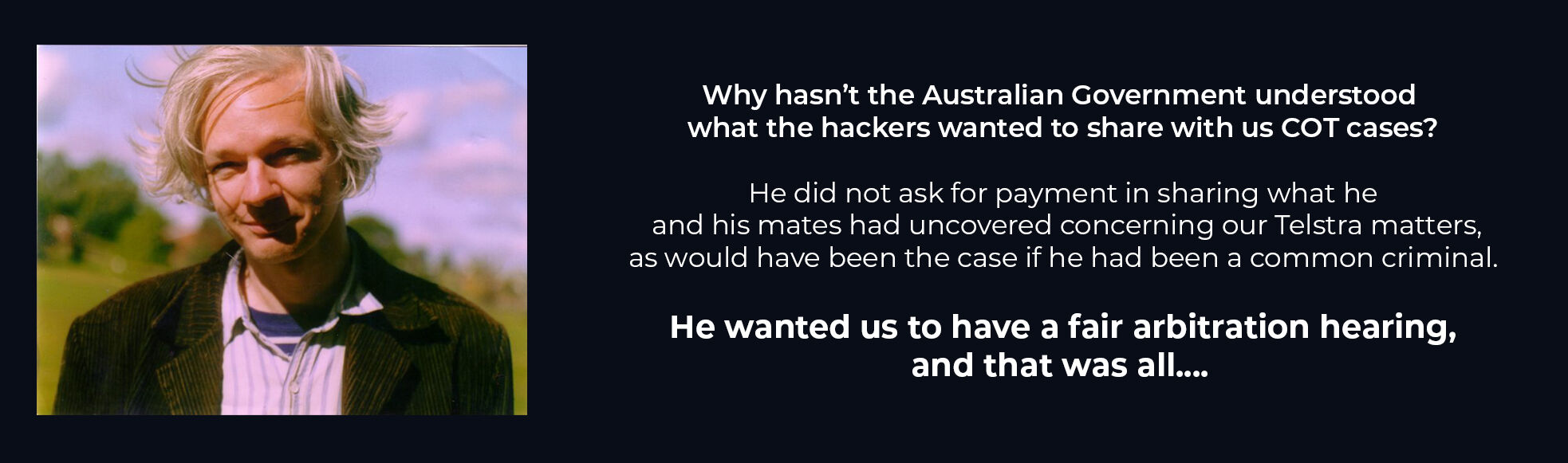
A young man (a boy) with a Conscience.
Julian Assange provided a vital link for the COT cases, but we did not know this during our arbitrations.
A statutory declaration prepared by Graham Schorer (COT spokesperson) on 7 July 2011 was provided to the Victorian Attorney-General, Hon. Robert Clark. This statutory declaration discusses three young computer hackers who phoned Graham to warn him during the 1994 COT arbitrations. The hackers discovered that Telstra and others associated with our arbitrations acted unlawfully towards the COT group. Graham’s statutory declaration includes the following statements:
“After I signed the arbitration agreement on 21st April 1994 I received a phone call after business hours when I was working back late in the office. This call was to my unpublished direct number.
“The young man on the other end asked for me by name. When I had confirmed I was the named person, he stated that he and his two friends had gained internal access to Telstra’s records, internal emails, memos, faxes, etc. He stated that he did not like what they had uncovered. He suggested that I should talk to Frank Blount directly. He offered to give me his direct lines in the his Melbourne and Sydney offices …
“The caller tried to stress that it was Telstra’s conduct towards me and the other COT members that they were trying to bring to our attention.
“I queried whether he knew that Telstra had a Protective Services department, whose task was to maintain the security of the network. They laughed, and said that yes they did, as they were watching them (Telstra) looking for them (the hackers). …
“After this call, I spoke to Alan Smith about the matter. We agreed that while the offer was tempting we decided we should only obtain our arbitration documents through the designated process agreed to before we signed the agreement.” (See Hacking – Julian Assange File No/3)
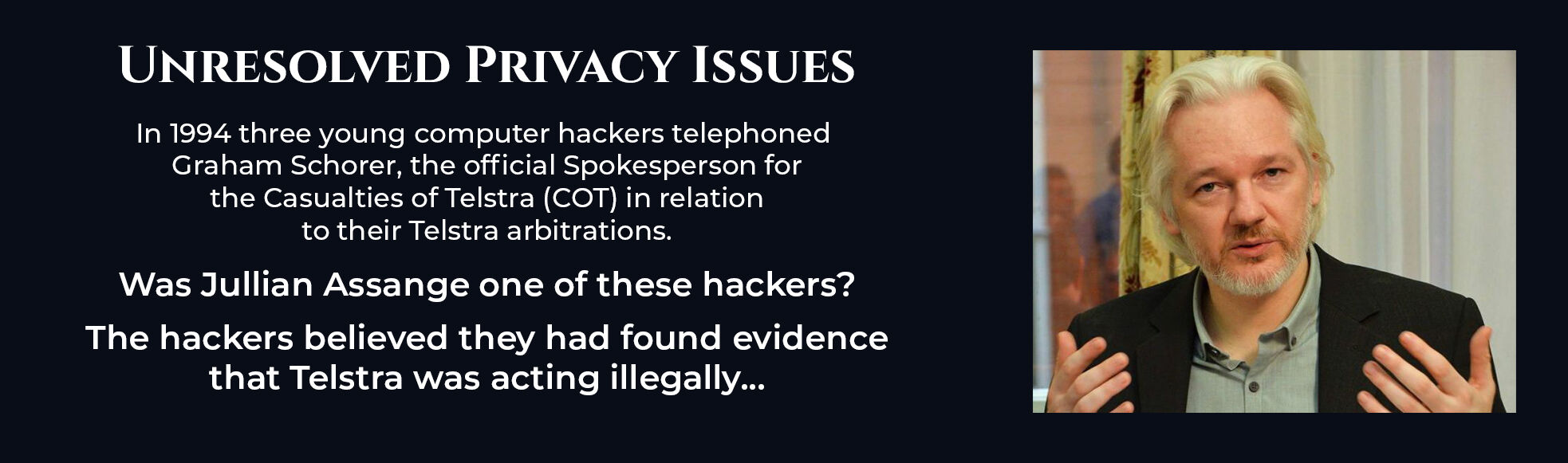
On the covering page of a joint 10-page letter dated 11 July 2011 to the Hon Robert McClelland, federal attorney-general and the Hon Robert Clark, Victorian attorney-general, I note:
“In 1994 three young computer hackers telephoned Graham Schorer, the official Spokesperson for the Casualties of Telstra (COT) in relation to their Telstra arbitrations.
- Was Jullian Assange one of these hackers?
- The hackers believed they had found evidence that Telstra was acting illegally.
- In other words, we were fools not to have accepted this arbitration file when it was offered to us by the hackers who conveyed to Graham Schorer a sense of the enormity of the deception and misconduct undertaken by Telstra against the COT Cases.” (AS-CAV Exhibit 790 to 818 Exhibit 817)
I also wrote to Hon. Robert Clark on 20 June 2012 to remind him that his office had already received a statutory declaration from Graham Schorer dated 7 July 2011. I also approached other government authorities and provided the Scandrett & Associates report (see Open Letter File No/12 and File No/13), which leaves no doubt that the hackers were right on target in their assessment of Telstra's electronic surveillance of the COT Cases.
If the hackers were Julian Assange, then he carried out a duty to expose what he believed was a crime. Significant law enforcement agencies and the media have been asking the Australian public to disclose incidents they believe constitute crimes, as doing so is in the public interest. When I reported similar crimes to the Australian Federal Police (Australian Federal Police Investigation File No/1), I was penalised after Telstra carried out its threats.
I have long believed that the hackers who infiltrated Telstra's Lonsdale telephone exchange in Melbourne harboured motives that transcended the mere breach of telecommunications infrastructure. This incident, compellingly documented by journalist Andrew Fowler in his piece "The Most Dangerous Man in the World" for ABC, is part of a larger narrative involving ethical misconduct regarding Telstra's treatment of the COT Cases, a group of individuals who claimed significant injustices in their dealings with the telecommunications giant.
I suspect that Julian Assange was intricately involved in this hacking operation, driven not just by a desire to unveil corporate malfeasance but also propelled by the deafening silence from the government, the Telecommunications Industry Ombudsman, and two Australian attorneys who seemed indifferent to the plight of those affected. The hackers reached out to Graham Schorer, the spokesperson for the COT Cases, on two separate occasions. This outreach appears to indicate their intention to share critical information directly related to the injustices encountered by those involved in the COT Cases, highlighting the urgency of their mission.
“COT Case Strategy”
As shown on page 5169 in Australia's Government SENATE official Hansard – Parliament of Australia Telstra's lawyers Freehill Hollingdale & Page devised a legal paper titled “COT Case Strategy” (see Prologue Evidence File 1-A to 1-C) instructing their client Telstra (naming me and three other businesses) on how Telstra could conceal technical information from us under the guise of Legal Professional Privilege even though the information was not privileged.
This COT Case Strategy was to be used against me, my named business, and the three other COT case members, Ann Garms, Maureen Gillan and Graham Schorer, and their three named businesses. Simply put, we and our four businesses were targeted by the then-wholly owned government telecommunications carrier, Telstra, even before our arbitrations commenced.
1. An explanation for the discrepancy in the attestation of Ian Joblin’s witness statement.2. Clarification on whether any changes were made to the original statement sent to arbitrator Dr Gordon Hughes compared to the signed version.
 Freehill Hollingdale & Page are now trading under the name of Herbert Smith Freehills Melbourne. Does that mean the Freehills part of Herbert Smith Freehills Melbourne no longer attests to a signature being on a legal document when it is not there? Why has Freehill Hollingdale & Page ever come forward and explain to why they signed a document during my arbitration attesting to its content and the signature of the person authoring the content when the author's signature was nowhere to be found?
Rebranding Doesn’t Erase Responsibility
Freehill Hollingdale & Page may now call themselves Herbert Smith Freehills Melbourne, but that rebranding doesn’t absolve them of the actions they took during my arbitration. A new name doesn’t rewrite history. It doesn’t erase the fact that one of their lawyers, Maurice Wayne Condon, signed a witness statement supposedly authored by Ian Joblin—a clinical psychologist—without Joblin’s signature appearing anywhere on the document.
What does this rebrand really mean? Does it imply that the “Freehills” designation no longer guarantees the validity of a signature on a legal document when it’s conspicuously absent? Because that’s precisely what happened in my case. They attested to the content and the author’s signature, knowing full well that the signature wasn’t there. That’s not a clerical error. That’s deliberate misrepresentation.
The Signature That Wasn’t There
When I saw that witness statement submitted to the arbitrator, signed only by Maurice Wayne Condon, I was stunned. It wasn’t in Ian Joblin’s handwriting. It bore no signature from the psychologist. Yet Telstra’s legal team proceeded as if it were legitimate. The government had assured us—the COT Cases—that Freehill Hollingdale & Page would have no further involvement in our matters. But here they were, submitting unsigned psychological assessments that could have falsely implied I was mentally unstable.
I have to ask: Did Maurice Wayne Condon remove or alter any reference to Joblin’s original assessment that I was of sound mind? Because if he did, that’s more than unethical—it’s criminal.
What Are They Trying to Hide?
To this day, Freehill Hollingdale & Page—now Herbert Smith Freehills Melbourne—have never come forward to explain their actions. Why haven’t they addressed the fact that they signed a document during my arbitration, claiming to attest to its content and the author’s signature, when no such signature existed?
What are they trying to hide
“I note in your letter’s last page you suggest the matter of the alteration of documents attached to statutory declarations should be dealt with by the relevant arbitrator. I do not concur. I would be grateful if you could advise why these matters should not be referred to the relevant police."
Senator Bill O’Chee didn’t accept the excuse that it was up to the arbitrator to deal with the alteration of statutory declarations. He wanted to know why these matters weren’t referred to the police.
There was no transparent outcome. No accountability. And when we investigated why Dr Gordon Hughes allowed this conduct to go unchallenged, we discovered he had previously withheld vital Telstra documents from another COT Case member, Graham Schorer, during a Federal Court action—while acting as Telstra’s legal representative → Chapter 3 - Conflict of Interest
This isn’t just about me. It’s about a system that allowed legal manipulation to silence the truth. And I won’t let that truth be buried under a new name.
Let us remember that it was the hackers who contacted the COT Cases first and not the other way around.
A young man (a boy) with a Conscience.
Julian Assange provided a vital link for the COT cases, but we did not know this during our arbitrations.
A statutory declaration prepared by Graham Schorer (COT spokesperson) on 7 July 2011 was provided to the Victorian Attorney-General, Hon. Robert Clark. This statutory declaration discusses three young computer hackers who phoned Graham to warn him during the 1994 COT arbitrations. The hackers discovered that Telstra and others associated with our arbitrations acted unlawfully towards the COT group. Graham’s statutory declaration includes the following statements:
“After I signed the arbitration agreement on 21st April 1994 I received a phone call after business hours when I was working back late in the office. This call was to my unpublished direct number.
“The young man on the other end asked for me by name. When I had confirmed I was the named person, he stated that he and his two friends had gained internal access to Telstra’s records, internal emails, memos, faxes, etc. He stated that he did not like what they had uncovered. He suggested that I should talk to Frank Blount directly. He offered to give me his direct lines in the his Melbourne and Sydney offices …
“The caller tried to stress that it was Telstra’s conduct towards me and the other COT members that they were trying to bring to our attention.
“I queried whether he knew that Telstra had a Protective Services department, whose task was to maintain the security of the network. They laughed, and said that yes they did, as they were watching them (Telstra) looking for them (the hackers). …
“After this call, I spoke to Alan Smith about the matter. We agreed that while the offer was tempting we decided we should only obtain our arbitration documents through the designated process agreed to before we signed the agreement.” (See Hacking – Julian Assange File No/3)
On the covering page of a joint 10-page letter dated 11 July 2011 to the Hon Robert McClelland, federal attorney-general and the Hon Robert Clark, Victorian attorney-general, I note:
“In 1994 three young computer hackers telephoned Graham Schorer, the official Spokesperson for the Casualties of Telstra (COT) in relation to their Telstra arbitrations.
- Was Jullian Assange one of these hackers?
- The hackers believed they had found evidence that Telstra was acting illegally.
- In other words, we were fools not to have accepted this arbitration file when it was offered to us by the hackers who conveyed to Graham Schorer a sense of the enormity of the deception and misconduct undertaken by Telstra against the COT Cases.” (AS-CAV Exhibit 790 to 818 Exhibit 817)
I also wrote to Hon. Robert Clark on 20 June 2012 to remind him that his office had already received a statutory declaration from Graham Schorer dated 7 July 2011. I also approached other government authorities and provided the Scandrett & Associates report (see Open Letter File No/12 and File No/13), which leaves no doubt that the hackers were right on target in their assessment of Telstra's electronic surveillance of the COT Cases.
If the hackers were Julian Assange, then he carried out a duty to expose what he believed was a crime. Significant law enforcement agencies and the media have been asking the Australian public to disclose incidents they believe constitute crimes, as doing so is in the public interest. When I reported similar crimes to the Australian Federal Police (Australian Federal Police Investigation File No/1), I was penalised after Telstra carried out its threats.