Chapter 7-Vietnam Vietcong
The People's Republic of China
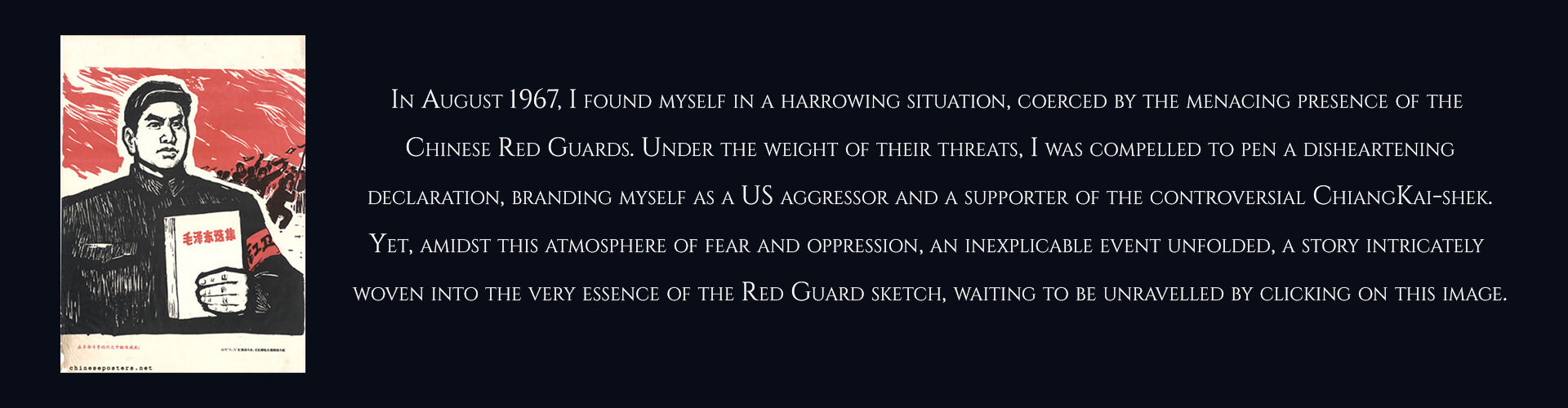
Murdered for Mao: The killings China ‘forgot’
The Letter, the Truth, and the Waiting
In August 1967, I found myself in a situation so precarious, so surreal, that it would etch itself into the marrow of my memory. I was aboard a cargo ship docked in China, surrounded by Red Guards stationed on board twenty-four hours a day, spaced no more than thirty paces apart. After being coerced into writing a confession—declaring myself a U.S. aggressor and a supporter of Chiang Kai-shek, the Nationalist leader in Taiwan—I was told by the second steward, who handled the ship’s correspondence, that I had about two days before a response to my letter might reach me. That response, whatever it might be, would be delivered by the head of the Red Guards himself.
It was the second steward who quietly suggested I write to my parents. I did. I poured myself into 22 foolscap pages, writing with the urgency of a man who believed he might not live to see the end of the week. I told my church-going parents that I was not the saintly 18-year-old they believed I was. I confessed that the woman they had so often thanked in their letters—believing her to be my landlady or carer—was in fact my lover. She was 42. I was 18 when we met. From 1963 to 1967, she had been my anchor, my warmth, my truth. I wrote about my life at sea, about the chaos and the camaraderie, about the loneliness and the longing. I wrote because I needed them to know who I really was, in case I was executed before I ever saw them again.
As the ship’s cook and duty mess room steward, I had a front-row seat to the daily rhythms of life on board. I often watched the crew eat their meals on deck, plates balanced on the handrails that lined the ship. We were carrying grain to China on humanitarian grounds, and yet, the irony was unbearable—food was being wasted while the people we were meant to help were starving. Sausages, half-eaten steaks, baked potatoes—they’d slip from plates and tumble into the sea. But there were no seagulls to swoop down and claim them. They’d been eaten too. The food floated aimlessly, untouched even by fish, which had grown scarce in the harbour. Starvation wasn’t a concept. It was a presence. It was in the eyes of the Red Guards who watched us eat. It was in the silence that followed every wasted bite.
A Tray of Leftovers and a Silent Exchange
After my arrest, I was placed under house arrest aboard the ship. One day, I took a small metal tray from the galley and filled it—not with scraps, but with decent leftovers. Food that would have gone into the stockpot or been turned into dry hash cakes. I walked it out to the deck, placed it on one of the long benches, patted my stomach as if I’d eaten my fill, and walked away without a word.
Ten minutes later, I returned. The tray had been licked clean.
At the next meal, I did it again—this time with enough food for three or four Red Guards. I placed the tray on the bench and left. No words. No eye contact. Just food. I repeated this quiet ritual for two more days, all while waiting for the response to my letter. During that time, something shifted. The Red Guard, who had been waking me every hour to check if I was sleeping, stopped coming. The tension in the air thinned, just slightly. And I kept bringing food—whenever the crew was busy unloading wheat with grappling hooks wrapped in chicken wire, I’d slip out with another tray.
To this day, I don’t know what saved me. It was certainly not the letter declaring myself a U.S. aggressor and a supporter of Chiang Kai-shek, the Nationalist leader in Taiwan. Maybe it was luck. Or perhaps it was that tray of food, offered without expectation, without speech, without condition. A silent gesture that said, “I see you. I know you’re hungry. I know you’re human.”
And maybe, just maybe, that was enough. British Seaman’s Record R744269 - Open Letter to PM File No 1 Alan Smith's Seaman. → Chapter 7- Vietnam-Vietcong-2
In essence, the Australian government faced an agonising moral dilemma — weighing the lives of its soldiers engaged in the conflict in North Vietnam against the desperate need to provide sustenance for an entire nation teetering on the brink of starvation. This heart-wrenching choice highlights the often-unseen complexities of international relations and humanitarian crises, revealing the painful calculations made in the pursuit of survival.
Footnote 83, 84 and 169 → in a paper submitted by Tianxiao Zhu to - The Faculty of the University of Minnesota titled Secret Trails: FOOD AND TRADE IN LATE MAOIST CHINA, 1960-1978, etc → Requirements For The Degree Of Doctor Of Philosophy - Christopher M Isett June 2021
Tianxiao Zhu's Footnotes 83, 84, 169:
In September 1967, a group of British merchant seamen quit their ship, the Hope Peak, in Sydney and flew back to London. They told the press in London that they quit the job because of the humiliating experiences to which they were subjected while in Chinese ports. They also claimed that grain shipped from Australia to China was being sent straight on to North Vietnam. One of them said, “I have watched grain going off our ship on conveyor belts and straight into bags stamped North Vietnam. Our ship was being used to take grain from Australia to feed the North Vietnamese. It’s disgusting.”
84. The Minister of Trade and Industry received an inquiry about the truth of the story in Parliament, to which the Minister pointed out that when they left Australia, the seamen only told the Australian press that they suffered such intolerable maltreatment in various Chinese ports that they were fearful about going back. But after they arrived in London, Vietnam was added to their story. Thus the Minister claimed that he did not know the facts and did not want to challenge this story, but it seemed to him that their claims about Vietnam seemed to be an “afterthought.”
169. "...In Vancouver, nine sailors refused to work on a grain ship headed to China: two of them eventually returned to work, and the others were arrested. Just when the ship was about to sail, seven more left the ship but three of them later returned to work. In Sydney, six Canadian sailors left their ship; they resigned and asked to be paid, but the Australian immigration office repatriated them. At that time, a grain ship usually had crew members of about 40 people. A British ship lost the Chief Officer and sixteen seamen, who told journalists that if the ship were going to the communist countries, they would rather go to jail than work on the ship."
The Canadian Government and Its Moral Code of Ethics
Hover your mouse over the following images as you scroll down the homepage.
By hovering your mouse over the Canadian flag image below, you can also learn about the strong ethical principles upheld by Canadian seamen. Despite facing significant challenges, they believed that sending wheat to Communist China — especially when that wheat was being redeployed to North Vietnam, a country at war with Australia, New Zealand, and the USA, where hundreds of troops were being killed or maimed — was immoral and unethical, and therefore should not have continued.
🚢 Hopepeak Crew: Silenced, Dismissed, Forgotten
It matters not that I could have been shot or imprisoned for spying. No government representative has ever asked me to explain what happened in China after I was arrested and falsely accused.
In my correspondence dated 18 September 1967, addressed to the Australian government, I expressed grave concerns about the mental distress endured by many crew members of the Hopepeak after we refused to return to Communist China. We had just delivered 13,600 tons of Australian wheat. The fear of being forced to sail again into a communist nation—knowing the wheat was destined for China and North Vietnam—hung over us, affecting our ability to find work on other vessels for years.
Regrettably, since 1967, no comprehensive government inquiry has ever investigated the consequences faced by the British crew after their dismissal and repatriation to the United Kingdom. They were unable to reintegrate with the company that discharged them. Their story, like mine, was buried.
This is Chapter 7-Vietnam Vietcong: The Viet Cong.
FOOD AND TRADE IN LATE MAOIST CHINA, 1960-1978
Pages 54 and 55 refer to footnotes 82 - 85 in a paper submitted by Tianxiao Zhu to - The Faculty of the University of Minnesota titled Secret Trails: Food and Trade In Late Maoist China, 1960-1978, etc → Requirements For The Degree Of Doctor Of Philosophy - Christopher M Isett June 2021 wrote:
In September 1967, a group of British merchant seamen quit their ship, the Hope Peak, in Sydney and flew back to London. They told the press in London that they quit the job because of the humiliating experiences to which they were subjected while in Chinese ports. They also claimed that grain shipped from Australia to China was being sent straight on to North Vietnam. One of them said, “I have watched grain going off our ship on conveyor belts and straight into bags stamped North Vietnam. Our ship was being used to take grain from Australia to feed the North Vietnamese. It’s disgusting.” 83 (my emphasis). The Minister of Trade and Industry received an inquiry about the truth of the story in Parliament, to which the Minister pointed out that when they left Australia, the seamen only told the Australian press that they suffered such intolerable maltreatment in various Chinese ports that they were fearful about going back. But after they arrived in London, Vietnam was added to their story. Thus the Minister claimed that he did not know the facts and did not want to challenge this story, but it seemed to him that their claims about Vietnam seemed to be an “afterthought.”84
📮 A Letter That Was Never Answered
In my letter dated 18 September 1967, addressed to The Hon. Malcolm Fraser and hand-delivered to the Commonwealth Police (now the Australian Federal Police), I reported a story strikingly similar to that of Tianxiao Zhu.
I advised Mr Fraser—then Minister of the Army—that the wheat dispatched to China was sent under the guise of humanitarian aid. Yet it was deeply troubling to learn that some of this same wheat was being redeployed to North Vietnam, a nation actively engaged in war against Australia, New Zealand, and the United States.
How could Australia justify sending wheat to Communist China on humanitarian grounds while knowing it was being redirected to an enemy killing its own soldiers and those of its allies?
I never received a response to that letter. Not then. Not ever. And that silence remains one of the most disappointing chapters in my long fight for truth.
Vol. 87 No. 4462 (4 Sep 1965) - National Library of Australia https://nla.gov.au › nla.obj-702601569
"The Department of External Affairs has recently published an "Information Handbook entitled "Studies on Vietnam". It established the fact that the Vietcong are equipped with Chinese arms and ammunition"
If it is right to ask Australian youth to risk everything in Vietnam it is wrong to supply their enemies. The Communists in Asia will kill anyone who stands in their path, but at least they have a path."
Australian trade commssioners do not so readily see that our Chinese trade in war materials finances our own distruction. NDr do they see so clearly that the wheat trade does the same thing."
The sacrifice

Feeding the enemy
1 July 2021 — The editorial in The Australian Financial Review of August 28, 1967, argues why Australia's position on wheat sales to China was rational https://shorturl.at/90OoP.
While the Financial Review might argue in this 1 July 2021 editorial that supplying wheat to a starving China saved millions of Chinese lives, one must also ask how many Australian, New Zealand and USA lives were lost after Australia's wheat fed the bellies of the North Vietnamese Vietcong guerrilla's before they marched into the jungle's of North Vietnam to kill and maim as many Australian, New Zealand and USA soldiers as they could.
I reported to the government that Australian wheat shipped on humanitarian grounds to the People's Republic of China was being redirected to another communist country under the cloak of humanitarian aid. This raises serious questions about the legitimacy of shipping food to a country under the guise of humanitarian assistance while that country is killing and maiming the soldiers of the country who are supplying this humanitarian aid.
In December 1967, Trade Minister Sir John McEwen became Australia's 18th Prime Minister. Other Australian Prime Ministers, namely John Howard, have more recently misled and deceived Australian citizens concerning the Iraq War. This misleading and deceiving of Australian citizens has hurt many Australians. The government's refusal to acknowledge what happened in China while delivering Australian wheat is a matter of public interest and should be addressed. I hope my website, absentjustice.com, will achieve this.
In early September 1967, members of the Hopeprak crew, including myself, took significant and urgent action after we observed the disturbing reshipping of Australian wheat destined for North Vietnam. Recognising the potential implications of this situation, we promptly notified the Seamen’s Union in Australia and the Labour government at the time. Our direct accounts of the events drew considerable attention from the Australian Senate, as once documented in the Senate Hansard on September 6, 1967 - https://shorturl.at/ovEW5, (but has since disappeared from Senate records)
This statement is significant to feature on the absentjustice.com website because it underscores Mr Aldermann, Primary Industry Minister ,'s assertion that the Australian Government appeared unconcerned about the ultimate destination of Australia’s wheat. Alarmingly, it was likely being sent to the North Vietnamese Vietcong, who were in direct conflict with Australian, New Zealand, and American forces during the Vietnam War. I feel compelled to share this statement to highlight the character and priorities of many of Australia's Liberal Coalition politicians. These politicians have consistently overlooked or dismissed the truth surrounding the COT (Contractor's Outrageous Treatment) issue, raising serious questions about their integrity and commitment to accountability.
This Hansard https://shorturl.at/ovEW5 shows Dr Patterson (a minister in opposition) asking Mr Aldermann, the Minister of Primary Industry.
"What guarantees has the Australian Government that Australian wheat being sent to mainland China is not forwarding China to North Vietnam
Mr Adermann, on behalf of the Liberal and Country Party government that had authorised this three-year wheat deal to China, answered Dr Patterson as follows:
"The Australian Government does not exercise control over the ultimate destination of goods purchased by foreign buyers"
I can only assume that Mr Alderman did not have a sibling fighting in North Vietnam when he made that statement on behalf of the Australian government.


When I began writing My Story – Warts and All and this website, I told the whole story – I didn’t leave any parts out to avoid embarrassing myself. To say all of my COT stories, I had to go back in time to show how the phone faults affected my well-being, and I needed to cover some details regarding an incident involving China.
FOOD AND TRADE IN LATE MAOIST CHINA, 1960-1978
In January 2024, for the second or third time since 2021, I read through the paper FOOD AND TRADE IN LATE MAOIST CHINA, 1960-1978, prepared by Tianxiao Zhu. Between Footnote 82 to 85 - T Zhu names not only the Hopepeak ship which I was on between 28 June and 18 September 1967 (refer to British Seaman’s Record R744269 - Open Letter to PM File No 1 Alan Smiths Seaman), he tells the story the way it happened (I was there) not the way the government of the day told it to the people of Australia in 1967 through to the present.
🚫 This Was No Afterthought
When Tianxiao Zhu referred to Sir John McEwen’s claim that the British crew of the Hopepeak feared returning to China as “an afterthought,” I knew that was a lie. McEwen knew the truth. Those seamen had watched me frog-marched off the ship under armed guard—twice—and they never expected to see me again. I only survived because my life wasn’t worth jeopardizing 13,600 tons of wheat still waiting in Australia for the Hopepeak’s return voyage to the People’s Republic of China.After the crew was flown back to England, I remained in Sydney. A new crew was flown out at the ship owner's expense. That wouldn’t have happened unless the original crew had proven they had real reason to fear going back.
🕵️♂️ The Truth Reached the Authorities
If the skipper hadn’t reported what happened to me and another crew member at the hands of the Red Guards, the Commonwealth Police wouldn’t have been waiting on the dock when we arrived back in Sydney on 18 September 1967. The police and media wanted answers: Why had an entire crew refused to sail to China? That kind of mutiny is unheard of. It was no afterthought—it was a stand for survival.✍️ Forced Confessions and Political Theater
I was interrogated, threatened, and forced to write letters of apology—two drafted with help from ship officers, and a third dictated by the Red Guards. That third letter branded me a “US aggressor” and supporter of Chiang Kai-shek. I told the skipper signing it was a death sentence. The Second Steward said I’d be dead if I didn’t.To appease the guards, I added a line: “I disliked America and its invasion of North Vietnam.” I delivered the letter myself, terrified. The Third Officer from Mauritius warned me: if I were shot, the wheat deal would collapse. That threat worked. I came back alive—but shaken.
📣 Propaganda and Paranoia
While docked in China, propaganda blared 24/7 from speakers on the quayside—in English, not Chinese. Red Guards manned a sentry box at the gangway. Shore leave was restricted to the Seaman’s Mission and a trinket shop. Fishing was banned. Our crew was treated harshly, possibly due to rumors that two Chinese girls had been shot as prostitutes on a sister ship. Their bodies left China with that vessel. Whether true or not, we were under constant surveillance.🧾 Political Cover-Up and Wheat for War
I wrote to Malcolm Fraser, then Minister of the Army, pleading for Australia to stop sending wheat to China aboard the Hopepeak. My pleas were ignored. The ship sailed with 13,600 tons of wheat. How much of that ended up feeding North Vietnamese soldiers before they marched into the jungle to kill Australians, New Zealanders, and Americans?Sir John McEwen couldn’t afford for the public to know that British seamen had refused to be complicit in that slaughter. They risked their careers—some had their discharge books stamped Voyage Not Completed, a mark that could bar them from future employment. McEwen twisted their bravery into something sordid.
📁 Telstra and the Ongoing Fight for Truth
File 114 ()—a letter from John Wynack to Telstra CEO Frank Blount—shows how desperate I became. Wynack made it clear: if my allegations were true, Telstra had deliberately blanked out information in FOI documents, including details of my conversation with a former Prime Minister. What did Telstra delete? What were they hiding?