Australian Federal Police Investigations-1
It is important to highlight the facts that on 18 September 1967, the Commonwealth Police, then known as COMPOL, often initialled documents with "COMPOL" after the signature of the officer making their mark. This was the case when two COMPOL officers visited the Hopepeak ship, where I was a crew member at the time. These officers are now referred to as the Australian Federal Police (AFP).
It is on record that I fully cooperated with the COMPOL officers in September 1967, who reviewed my statement concerning my time in China. Later, in 1994 and 1995, I again assisted the AFP with their investigations into my Telstra-related phone and fax hacking episodes.
I have always discussed the AFP issues in the AFP segments, but I am now writing a book on this part of my COT story. I am introducing the China-Australian wheat saga as the spearhead of my story regarding the COMPOL/AFP issues, as this was when the AFP was genuinely horrified by what I told them and by the statement I made concerning my time in China.
This is why I am starting the AFP part of my COT story with episodes where they were human beings in shock, as most Australians were, when I told them of this China saga. It is important to highlight the facts that on 18 September 1967, the Commonwealth Police, then known as COMPOL, often initialled documents with "COMPOL" after the signature of the officer making their mark. This was the case when two COMPOL officers visited the Hopepeak ship, where I was a crew member at the time. These officers are now referred to as the Australian Federal Police (AFP).
It is on record that I fully cooperated with the COMPOL officers in September 1967, who reviewed my statement concerning my time in China. Later, in 1994 and 1995, I again assisted the AFP with their investigations into my Telstra-related phone and fax hacking episodes.
I have always discussed the AFP issues in the AFP segments, but I am now writing a book on this part of my COT story. I am introducing the China-Australian wheat saga as the spearhead of my story regarding the COMPOL/AFP issues, as this was when the AFP was genuinely horrified by what I told them and by the statement I made concerning my time in China.
This is why I am starting the AFP part of my COT story with episodes where they were human beings in shock, as most Australians were, when I told them of this China saga.
Echoes of Betrayal: Wheat Sales to China - and the Government bureaucrats who continued to tell Australia's politicians what several other seamen and I had witnessed in China was a lie. The following information shows we risked all to expose the truth.
The People's Republic of China
The People's Republic of China
Murdered for Mao: The killings China ‘forgot’
The Letter, the Truth, and the Waiting
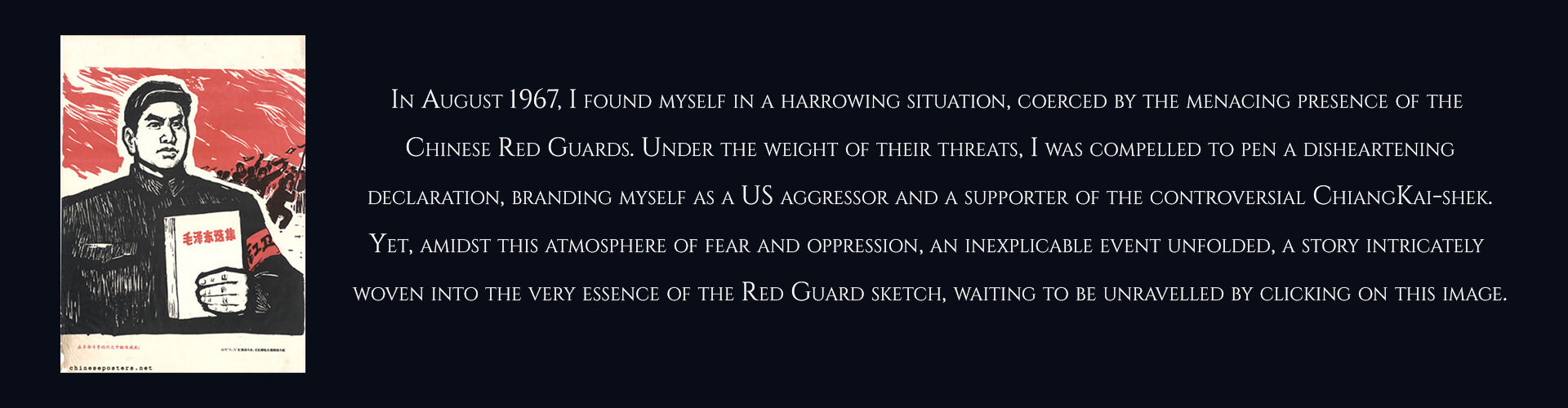
In August 1967, I found myself in a situation so precarious, so surreal, that it would etch itself into the marrow of my memory. I was aboard a cargo ship docked in China, surrounded by Red Guards stationed on board twenty-four hours a day, spaced no more than thirty paces apart. After being coerced into writing a confession—declaring myself a U.S. aggressor and a supporter of Chiang Kai-shek, the Nationalist leader in Taiwan—I was told by the second steward, who handled the ship’s correspondence, that I had about two days before a response to my letter might reach me. That response, whatever it might be, would be delivered by the head of the Red Guards himself.
It was the second steward who quietly suggested I write to my parents. I did. I poured myself into 22 foolscap pages, writing with the urgency of a man who believed he might not live to see the end of the week. I told my church-going parents that I was not the saintly 18-year-old they believed I was. I confessed that the woman they had so often thanked in their letters—believing her to be my landlady or carer—was in fact my lover. She was 42. I was 18 when we met. From 1963 to 1967, she had been my anchor, my warmth, my truth. I wrote about my life at sea, about the chaos and the camaraderie, about the loneliness and the longing. I wrote because I needed them to know who I really was, in case I was executed before I ever saw them again.
As the ship’s cook and duty mess room steward, I had a front-row seat to the daily rhythms of life on board. I often watched the crew eat their meals on deck, plates balanced on the handrails that lined the ship. We were carrying grain to China on humanitarian grounds, and yet, the irony was unbearable—food was being wasted while the people we were meant to help were starving. Sausages, half-eaten steaks, baked potatoes—they’d slip from plates and tumble into the sea. But there were no seagulls to swoop down and claim them. They’d been eaten too. The food floated aimlessly, untouched even by fish, which had grown scarce in the harbour. Starvation wasn’t a concept. It was a presence. It was in the eyes of the Red Guards who watched us eat. It was in the silence that followed every wasted bite.
A Tray of Leftovers and a Silent Exchange
After my arrest, I was placed under house arrest aboard the ship. One day, I took a small metal tray from the galley and filled it—not with scraps, but with decent leftovers. Food that would have gone into the stockpot or been turned into dry hash cakes. I walked it out to the deck, placed it on one of the long benches, patted my stomach as if I’d eaten my fill, and walked away without a word.
Ten minutes later, I returned. The tray had been licked clean.
At the next meal, I did it again—this time with enough food for three or four Red Guards. I placed the tray on the bench and left. No words. No eye contact. Just food. I repeated this quiet ritual for two more days, all while waiting for the response to my letter. During that time, something shifted. The Red Guard, who had been waking me every hour to check if I was sleeping, stopped coming. The tension in the air thinned, just slightly. And I kept bringing food—whenever the crew was busy unloading wheat with grappling hooks wrapped in chicken wire, I’d slip out with another tray.
To this day, I don’t know what saved me. It was certainly not the letter declaring myself a U.S. aggressor and a supporter of Chiang Kai-shek, the Nationalist leader in Taiwan. Maybe it was luck. Or perhaps it was that tray of food, offered without expectation, without speech, without condition. A silent gesture that said, “I see you. I know you’re hungry. I know you’re human.”
And maybe, just maybe, that was enough. British Seaman’s Record R744269 - Open Letter to PM File No 1 Alan Smith's Seaman. → Chapter 7- Vietnam-Vietcong-2
In essence, the Australian government faced an agonising moral dilemma — weighing the lives of its soldiers engaged in the conflict in North Vietnam against the desperate need to provide sustenance for an entire nation teetering on the brink of starvation. This heart-wrenching choice highlights the often-unseen complexities of international relations and humanitarian crises, revealing the painful calculations made in the pursuit of survival.
Footnote 83, 84 and 169 → in a paper submitted by Tianxiao Zhu to - The Faculty of the University of Minnesota titled Secret Trails: FOOD AND TRADE IN LATE MAOIST CHINA, 1960-1978, etc → Requirements For The Degree Of Doctor Of Philosophy - Christopher M Isett June 2021
Tianxiao Zhu's Footnotes 83, 84, 169:
In September 1967, a group of British merchant seamen quit their ship, the Hope Peak, in Sydney and flew back to London. They told the press in London that they quit the job because of the humiliating experiences to which they were subjected while in Chinese ports. They also claimed that grain shipped from Australia to China was being sent straight on to North Vietnam. One of them said, “I have watched grain going off our ship on conveyor belts and straight into bags stamped North Vietnam. Our ship was being used to take grain from Australia to feed the North Vietnamese. It’s disgusting.”
84. The Minister of Trade and Industry received an inquiry about the truth of the story in Parliament, to which the Minister pointed out that when they left Australia, the seamen only told the Australian press that they suffered such intolerable maltreatment in various Chinese ports that they were fearful about going back. But after they arrived in London, Vietnam was added to their story. Thus the Minister claimed that he did not know the facts and did not want to challenge this story, but it seemed to him that their claims about Vietnam seemed to be an “afterthought.”
169. "...In Vancouver, nine sailors refused to work on a grain ship headed to China: two of them eventually returned to work, and the others were arrested. Just when the ship was about to sail, seven more left the ship but three of them later returned to work. In Sydney, six Canadian sailors left their ship; they resigned and asked to be paid, but the Australian immigration office repatriated them. At that time, a grain ship usually had crew members of about 40 people. A British ship lost the Chief Officer and sixteen seamen, who told journalists that if the ship were going to the communist countries, they would rather go to jail than work on the ship."
The Canadian Government and Its Moral Code of Ethics
Hover your mouse over the following images as you scroll down the homepage.
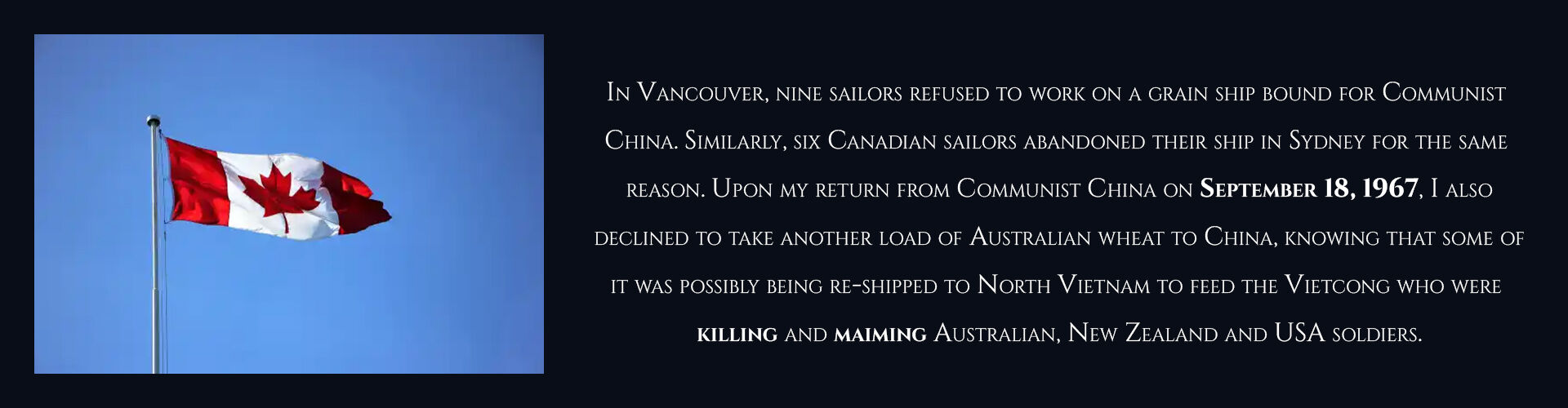
By hovering your mouse over the Canadian flag image below, you can also learn about the strong ethical principles upheld by Canadian seamen. Despite facing significant challenges, they believed that sending wheat to Communist China — especially when that wheat was being redeployed to North Vietnam, a country at war with Australia, New Zealand, and the USA, where hundreds of troops were being killed or maimed — was immoral and unethical, and therefore should not have continued.
Yet the Australian Government made a conscious decision to maintain its trade relations with Communist China, despite knowing that a significant portion of Australia’s wheat was being diverted to North Vietnam. This wheat was not merely a trade commodity; it had the potential to sustain North Vietnamese soldiers who were directly engaged in combat against Australia and its allies during the conflict. The ramifications of this trade raised serious ethical questions about supporting a nation that was opposing Australian, New Zealand, and USA forces.
Examining this wheat agreement made with the People's Republic of China during the Menzies government in the mid‑1960s is essential. This controversial deal had significant implications that were obscured by a government campaign to discredit British and Canadian merchant seamen — including me. These brave individuals tried every conceivable legal way to expose this illicit diversion of wheat to North Vietnam.
• Frog‑marched off the ship under armed guard by Red Guards, accused of being a spy.• Forced to write letters under threat of execution.• Commonwealth Police met the ship in Sydney on 18 September 1967, confirming the seriousness of what had occurred.• British crew members refused to sail the ship back to China, fearing for their lives.
• Wheat shipments had gone ahead despite warnings.• Australian conscripts had fought and died in Vietnam.• Bureaucrats and ministers had ignored both political foresight and lived testimony.
• The Ericsson AXE Exchange Scandal — regulators ignored systemic telecommunications faults, leaving businesses crippled.• The corrupted COT arbitrations — bureaucrats allowed Telstra to run the process, conceal evidence, and destroy small businesses.• The Robodebt scandal — officials ignored legal advice and harmed vulnerable citizens.• The Home Insulation Program — rushed implementation led to deaths, fires, and wasted millions.
British Seaman’s Record R744269 - Open Letter to PM File No 1 Alan Smith's Seaman.
The Canadian Government and Its Moral Code of Ethics
By hovering your mouse over the Canadian flag image below, you can also learn about the strong ethical principles upheld by Canadian seamen. Despite facing significant challenges, they believed that sending wheat to Communist China — especially when that wheat was being redeployed to North Vietnam, a country at war with Australia, New Zealand, and the USA, where hundreds of troops were being killed or maimed — was immoral and unethical, and therefore should not have continued.
Yet the Australian Government made a conscious decision to maintain its trade relations with Communist China, despite knowing that a significant portion of Australia’s wheat was being diverted to North Vietnam. This wheat was not merely a trade commodity; it had the potential to sustain North Vietnamese soldiers who were directly engaged in combat against Australia and its allies during the conflict. The ramifications of this trade raised serious ethical questions about supporting a nation that was opposing Australian, New Zealand, and USA forces.
There is a striking and thought-provoking similarity between my narrative of the Chinese Cultural Revolution and the Canadian perspective on democracy, as well as the fundamental concepts of right and wrong that underpin them. This connection is compellingly illustrated in Tianxiao Zhu's meticulously crafted 2021 paper, developed as part of his PhD requirements at the University of Minnesota. During my extensive research for my first manuscript — which ultimately inspired the launch of the website absentjustice.com — I fortuitously discovered Zhu's insightful work. His paper sheds light on a significant trade that took place during the chaotic and turbulent period I was examining.
Among the many footnotes and references in his research, one stands out: the ship Hopepeak. This name resonates deeply with me, evoking memories tied to my own experiences. According to my British Seaman's Discharge Book, I served as a crew member during that harrowing era, navigating the treacherous waters of Red China. It was a time marked by widespread famine and profound suffering, creating a stark backdrop to the life-and-death decisions being made. Without the vital trade relationship with Australia during this perilous time, the starvation rates in China would have reached unimaginable levels.
In essence, the Australian government faced an agonising moral dilemma — weighing the lives of its soldiers engaged in the conflict in North Vietnam against the desperate need to provide sustenance for an entire nation teetering on the brink of starvation. This heart-wrenching choice highlights the often-unseen complexities of international relations and humanitarian crises, revealing the painful calculations made in the pursuit of survival.
Vol. 87 No. 4462 (4 Sep 1965) - National Library of Australia https://nla.gov.au › nla.obj-702601569
"The Department of External Affairs has recently published an "Information Handbook entitled "Studies on Vietnam". It established the fact that the Vietcong are equipped with Chinese arms and ammunition"
If it is right to ask Australian youth to risk everything in Vietnam it is wrong to supply their enemies. The Communists in Asia will kill anyone who stands in their path, but at least they have a path."
Australian trade commssioners do not so readily see that our Chinese trade in war materials finances our own distruction. NDr do they see so clearly that the wheat trade does the same thing."
• In Shanghai, I was frog‑marched off the ship under armed guard by Red Guards, accused of being a spy, and forced to write letters under threat of execution.• The Commonwealth Police met the ship in Sydney on 18 September 1967, confirming the seriousness of what had occurred.• British crew members refused to sail the ship back to China, fearing for their lives. A new crew had to be flown from the UK at the shipowner’s expense.• Despite these warnings, Australia continued to send wheat shipments, knowing some of that grain was being redeployed to North Vietnam.
• Wheat shipments had gone ahead despite warnings.• Australian conscripts had fought and died in Vietnam.• Bureaucrats and ministers had ignored both political foresight and lived testimony.
And just as in the Vietnam era, the consequences were borne not by the officials who engineered the failures, but by the citizens who trusted them. Ordinary Australians — small business owners, farmers, families, veterans — were left to navigate the fallout of decisions made behind closed doors by individuals who would never feel the impact of their own misconduct.
This is the legacy of bureaucratic betrayal: it repeats itself across generations unless it is confronted, exposed, and held to account.
 As Australian wheat shipments reached the shores of a starving China, a dark and troubling decision emerged from the shadows of bureaucratic halls: only part of this precious grain was to be fed to a nation in desperate need. The rest was quietly redirected to North Vietnam — effectively feeding the enemy.
• The arbitrator, Dr Gordon Hughes, refused to make findings on the very faults that drove me to arbitration.• AUSTEL (now ACMA) allowed Telstra to secretly address those faults five months after the process ended.• Lane Telecommunications, the so-called “independent assessor,” was quietly acquired by Ericsson—Telstra’s supplier—mid-arbitration.• John Pinnock, the Telecommunications Industry Ombudsman, falsely accused me of writing a letter I never penned, then misled the Senate under oath.
• “Split the baby” when arbitrators avoid tough decisions by giving each side a partial win.• “Shadow arbitration” when deals are done behind closed doors, off the record.• “Award laundering” when biased rulings are dressed up to look neutral.
• “Salami slicing”—breaking up strong claims to weaken their impact.• “Rubber-stamp tribunals”—panels that never challenge corporate power.• “Procedural gymnastics”—legal acrobatics used to dodge uncomfortable truths.
On 26 September 1997, thirty months after the conclusion of my arbitration, the Telecommunications Industry Ombudsman John Pinnock formally addressed a Senate estimates committee, referring to page 99 COMMONWEALTH OF AUSTRALIA - Parliament of Australia and Prologue Evidence File No 22-D). He noted:
“In the process leading up to the development of the arbitration procedures – the claimants were told clearly that documents were to be made available to them under the FOI Act.
“Firstly, and perhaps most significantly, the arbitrator had no control over that process, because it was a process conducted entirely outside the ambit of the arbitration procedures.”
Ethical questions
Australian Federal Police Investigations-1
Key Points of Corruption and Collusion
- Ericsson’s Global Bribery Scandal
Ericsson, the company at the heart of your Portland exchange complaints, admitted to a years-long campaign of corruption across five countries. The U.S. Department of Justice revealed that Ericsson used slush funds, bribes, and falsified records to secure telecom contracts—including in Australia, where they partnered with Telstra after Huawei was banned. - The Breach Went Deeper.
My assertion that Lane Telecommunications was unfit to evaluate my arbitration claims due to prior ties with Telstra is echoed in the broader concerns about conflict of interest. The fact that Lane was allowed to keep my Ericsson-related fault data when Ericsson purchased Lane, despite my claims against Telstra for using known defective Ericsson equipment when other countries around the globe had removed it or were removing it from their telephone exchanges, shows Telstra had little or no regard for the integrity of the claimant's claim that these defiences was what was crippling the claiments busineses—the very reason the COT Cases were in an arbitration process in an attempt to salvage their businesses. This disregard for the claimants' rights to a telephone service, in which to operate their businesses, undermined the integrity of the arbitration process. - DMR Group’s Misrepresented Involvement
The claim that DMR Group was used as a façade to legitimise the process while Lane continued its compromised role is deeply troubling. Warwick Smith’s March 9, 1995, letter, as you noted, appears to be part of a calculated effort to obscure this arrangement. - Selective Evaluation of Evidence
Lane’s decision to review only 23 of your 200 fault complaints—before DMR even arrived—suggests a deliberate attempt to minimise the scope of your claims. This aligns with patterns of suppression and manipulation documented in other COT Cases. - Australian Federal Police Investigations
The AFP was involved in probing document tampering and fax interception during arbitration. Evidence shows Telstra had access to sensitive claimant materials before they were legally entitled to them, and arbitrator Dr. Hughes allowed Telstra to dictate what evidence would be considered.
Read about the dealings with Ericsson on 19 December 2019, as reported in the Australian media, because it is firmly intertwined in the corrupt practices of both Telstra and Ericsson, and those who administered the COT arbitrations between 1994 and 1998. This media release states:
"One of Telstra's key partners in the building out of their 5G network in Australia is set to fork out over $1.4 billion after the US Department of Justice accused them of bribery and corruption on a massive scale and over a long period of time.
Sweden's telecoms giant Ericsson has agreed to pay more than $1.4 billion following an extensive investigation which saw the Telstra-linked Company 'admitting to a years-long campaign of corruption in five countries to solidify its grip on telecommunications business." (https://www.channelnews.com.au/key-telstra-5g-partner-admits-to-bribery-corruption/)
The Path to Betrayal: A Call for Accountability
The U.S. Department of Justice has unearthed a chilling truth about Ericsson’s global telecommunications operations and their disturbing ties to international corruption and terrorism. The revelations surrounding the Casualties of Telstra (COT) Cases expose a deeply entrenched web of deceit, raising urgent questions about how Ericsson was allowed to operate with impunity, even acquiring the key technical witness during government-sanctioned arbitration proceedings that scrutinised their compromised telephone equipment.
It is both baffling and deeply troubling that the Australian government has remained conspicuously silent in the face of such egregious misconduct. Ericsson’s covert acquisition of Lane Telecommunications Pty Ltd—while Lane was engaged as the arbitration’s technical consultant—suggests a deliberate manipulation of the process. This manoeuvre occurred amid serious allegations that Telstra and Ericsson knowingly relied on discredited Ericsson AXE exchange equipment, a flawed system that many nations have since abandoned due to its critical deficiencies (see File 10-B ).
I urgently call on the Australian government to expose the dark machinations that enabled Ericsson to infiltrate the arbitration process. The evidence paints a damning picture: the arbitrator and their advisors constructed a treacherous framework of deception, resulting in a grotesque miscarriage of justice for the COT Cases. Their conduct was not merely unethical—it was a calculated betrayal of public trust, steeped in scandal and lawlessness.
This manipulation of justice reveals a shocking disregard for transparency and accountability, leaving victims trapped in a labyrinth of institutional betrayal while the true architects of corruption remain shielded from scrutiny.
The Google-linked evidence makes it glaringly clear: the COT Cases were not only justified but compelled to demand answers about how Ericsson was permitted to purchase the very technical witness tasked with evaluating their equipment. This central conflict—documented in Chapter 5 - US Department of Justice vs Ericsson of Sweden—reeks of corruption and demands immediate investigation.
Corruption and demands
 .
.
Fell short of delivering natural justice.
1. Lane Telecommunications’ Hidden Role Behind DMR’s Facade• Lane, a former Telstra technical consultant, was initially rejected by the COT Cases due to apparent conflicts of interest.• In a deceptive manoeuvre, Warwick Smith’s letter dated March 8, 1994, claimed DMR Group Inc. Canada would be the principal technical consultant, with Lane in a “supporting role.”• In reality, Lane’s findings were finalised and presented on DMR letterhead—masking their true authorship and misleading the claimants.2. Ericsson’s Covert Acquisition of Lane• During the arbitration period, Ericsson secretly acquired Lane Telecommunications, the very entity tasked with evaluating faults in Ericsson’s own equipment.• This gave Ericsson direct control over the technical assessments of its own products—an egregious conflict of interest that undermined the entire arbitration process.3. Ericsson Investigating Itself• Ericsson was allowed to investigate your claims against its own AXE telephone exchange equipment, with findings rubber-stamped by DMR Canada.• This is akin to a defendant writing their own verdict—an outrageous breach of impartiality and justice.4. Selective Suppression of Evidence• You submitted 200 fault complaints related to Ericsson’s equipment. Lane reviewed only 23, and this occurred before DMR even arrived in Australia.• This cherry-picking of evidence was a deliberate tactic to minimise Telstra’s liability and obscure systemic faults.5. The Confidentiality Agreement as a Shield for Misconduct• The Confidentiality Arbitration Agreement has been weaponised to conceal misconduct by Lane and Ericsson well into 2025.• It prevents public scrutiny and shields those responsible from accountability, despite overwhelming evidence of corruption.6. The Suppressed April 18, 1995 Letter• Dr. Hughes, Warwick Smith, and Peter Bartlett concealed a critical letter that could have exposed the collusion and allowed the COT Cases to unite.• Had John Rundell distributed this letter, it could have triggered a government investigation and possibly halted the corrupt arbitration process.7. US Department of Justice vs Ericsson: A Global Pattern• Ericsson’s corruption wasn’t limited to Australia. The U.S. DOJ charged Ericsson with bribery and falsification of records across multiple countries.• This global scandal reinforces the credibility of your claims and shows that Ericsson’s misconduct in Australia was part of a broader corporate culture.
• Expose the Timeline: Create a visual timeline showing Lane’s involvement, Ericsson’s acquisition, and key letters (March 8, April 18).• Publish a Comparative Table: Show the 200 faults vs. the 23 reviewed to highlight suppression.• Leverage DOJ Findings: Use Chapter 5 of my website and DOJ documents to link Ericsson’s global corruption to my local arbitration → Chapter 5 - US Department of Justice vs Ericsson of Sweden.
I. Introduction: The Illusion of Fair Arbitration• Overview of the COT Cases• Promise of impartiality vs. realityII. Lane Telecommunications: Trojan Horse in the Arbitration• Initial resistance by claimants• March 8, 1994 letter and its deceptive assurances• Lane’s findings presented under DMR’s nameIII. Ericsson’s Covert Acquisition and Self-Investigation• Timeline of acquisition• Ericsson investigating its own faults• DMR’s rubber-stamping of findingsIV. Suppression of Evidence and the April 18 Letter• 200 fault complaints reduced to 23• Concealment of Rundell’s letter• Missed opportunity for collective actionV. The Shield of Confidentiality• Arbitration Agreement as a tool of concealment• Continued suppression into 2025VI. Global Parallels: DOJ vs. Ericsson• Summary of DOJ findings• Comparison to Australian misconduct• Implications for international accountabilityVII. Call to Action• Demand for federal inquiry• Reopening of arbitration findings• Public transparency and justice for the COT Cases
 The two evidence files, Evidence File-1 and Evidence-File-2, unveil a disturbing and intricate pattern of corruption that developed before, during, and after the COT arbitrations. They document how government representatives became deeply entangled in a morally questionable framework that betrayed their public duty. In the shadows, powerful officials formed a clandestine alliance, prioritising their own personal interests and agendas over the well-being of the very citizens they were sworn to serve independently.
This breach of trust not only undermined the citizens’ faith in their government but also severely compromised the transparency and integrity of the investigation into the arbitration claims against Telstra. As a result, the process became tainted, leaving COT claimants marginalised and unheard. The telecommunications infrastructure that Telstra relied upon in these dealings was shrouded in controversy, further raising concerns about accountability and ethical conduct among those in positions of power. The ramifications of this corrupt alliance extend far beyond the immediate arbitration claims, impacting the broader landscape of public trust in government institutions and regulatory agencies.
One particularly shocking incident underscores the depths of this corruption: crucial evidence, which could have illuminated the secret dealings of a government-owned corporation, was willfully and systematically destroyed. This reckless act raises profound concerns about the accountability and transparency that should underpin public governance. Furthermore, during the review of the highly contentious COT Cases, vital information was purposefully redacted from official records, creating a deceptive façade of compliance while obstructing the pursuit of truth. This deliberate manipulation of information allowed the corporation to evade the scrutiny it so richly deserved, escaping the severe consequences of its actions.
Those tasked with examining archived documents found themselves ensnared in a tangled web of suppressed disclosures, navigating a labyrinth specifically designed to thwart the pursuit of justice. This oppressive environment effectively subverts the foundational principles of fairness and public trust, leaving citizens to grapple with a system that betrays their essential rights. The repercussions of these actions extend far beyond mere bureaucratic incompetence; they present a significant threat to the very integrity of democratic institutions.
The relentless tide of corruption and manipulation erodes public confidence and undermines the societal framework, creating a grim atmosphere where accountability and justice are mere illusions, obscured by layers of deceit. The dark undercurrents of this governmental decay call for urgent and decisive action to dismantle the corrupt machinery and restore the fundamental principles of democracy, ensuring that the rights and voices of citizens are no longer silenced in the shadows of greed and malfeasance.
Example 2: File 34-C - AS-CAV Exhibit 1 to 47
AS-CAV Exhibit 1 to 47 – AS-CAV Exhibit 48-A to 91 – AS-CAV Exhibit 92 to 127 – AS-CAV Exhibit 128 to 180 – AS-CAV Exhibit 181 to 233 – AS CAV Exhibit 234 to 281 – AS-CAV Exhibit 282 to 323 – AS-CAV Exhibit 324-a to 420 – AS-CAV Exhibit 421 to 469 – AS-CAV Exhibit 470 to 486 – AS-CAV Exhibit 488-a to 494-e – AS-CAV Exhibits 495 to 541 – AS-CAV Exhibits 542-a to 588 – AS-CAV Exhibits 589 to 647 – AS-CAV Exhibits 648-a to 700 –AS-CAV Exhibit 765-A to 789 – AS-CAV Exhibit 790 to 818 – AS-CAV Exhibit 819 to 843 – AS-CAV 923 to 946 – AS-CAV Exhibit 1150 to 1169 – AS-CAV 1103 to 1132 – AS-CAV Exhibit 1002 to 1019 – AS-CAV Exhibit 996 to 1001 – GS-CAV Exhibit 1 to 88 GS-CAV Exhibit 89 to 154-b – GS-CAV Exhibit 155 to 215 – GS-CAV Exhibit 216 to 257 – GS-CAV Exhibit 258 to 323 – GS-CAV Exhibit 410-a to 447 – GS-CAV Exhibit 448 to 458 – GS-CAV Exhibit 459 to 489 – GS-CAV Exhibit 490 to 521 – GS-CAV 522 to 580 – GS-CAV Exhibit 581 to 609

Absent Justice Part 1, Part 2 and Part 3
Government Corruption. Corruption in the public service, where misleading and deceptive conduct has spuriously over more than two decades perverted the course of justice.

Telstra's Falsified BCI Report 2
Corruption, misleading and deceptive conduct plagued the COT with the government's sanctions, which endorsed the arbitrations. Learn the names of those who participated in these horrendous crimes that equally corrupted arbitrators who ignored this conduct.

Telstra's Falsified SVT Report
Corruption, misleading and deceptive conduct plagued the COT with the government's sanctions, which endorsed the arbitrations. Learn the names of those who participated in these horrendous crimes that equally corrupted arbitrators who covered up these atrocities

Senate Evidence
The criminal delinquency of those involved in the COT Cases corrupted arbitrations continued to practive their evil and crooked style of justice on other citizens who, like the Casualties of Telstra have had their lives ruined.

An Injustice to the remaining 16 Australian citizens
This type of skulduggery is treachery, a Judas kiss with dirty dealing and betrayal. This is dirty pool and crookedness and dishonest. This conduct fester’s corruption. It is as bad, if not worse than double-dealing and cheating those who trust the ground you walk on. Sheer Evil.<

China-Flash-Back-AFP Investigation -2
Read about the corruption within the government bureaucracy that is plaguing COT arbitrations. Learn who committed these horrendous crimes that equally corrupted lawyers and crooked arbitrators who covered up these crimes.
Telecommunications Industry Ombudsman
Corruption in government, including non-government self-regulators, undermines the credibility of that government. It erodes the trust of its citizens.

C A V Part 1, 2 and 3
Sadly, corruption and collusive practices are rife in the Australian ‘Establishment’ and this terrible situation prevents us from telling our story in a brief way. We had no alternative but to produce it the way we have here.
Blowing The Whistle
Blowing The Whistle was established on absentjustice.com to show our readers that the COT Cases arbitrations were nothing more than a sham set up to protect a government-owned asset.
Kangaroo Court - Absent Justice
From financial devastation to emotional pain, the dangers of identity theft are considerable.

Spurious and Unscrupulous Conduct

The first remedy pursued
The website that triggered the deeper exploration into the world of political corruption stands shoulder to shoulder with any true crime

The second remedy pursued
Checkout our bribery and corruption part & part and learn how deception undermines the credibility of those businesses who have been subjected to criminal legal abuse.

The third remedy pursued
Bribery and Corruption have many evil faces and ‘grey’ areas within Australia’s politically-corrupt government. Criminal wrongdoings interact with the private sector: the revolving door of deception.

The fourth remedy pursued
Bribery and Corruption have many evil faces and ‘grey’ areas within Australia’s politically-corrupt government. Criminal wrongdoings interact with the private sector: the revolving door of deception. Corrupt practices.

The fifth remedy pursued
Corruption in government, including non-government self-regulators, undermines the credibility of that government. It erodes the trust of its citizens, who are left without guidance. Bribery and Corruption is cancer that destroys economic growth.
The sixth remedy pursued
Corruption in government, including non-government self-regulators, undermines the credibility of that government. It erodes the trust of its citizens, who are left without guidance. Bribery and Corruption is cancer that destroys economic growth.
The seventh remedy pursued
Corruption in government, including non-government self-regulators, undermines the credibility of that government. It erodes the trust of its citizens, who are left without guidance. Bribery and Corruption is cancer that destroys economic growth.
The eighth remedy pursued
Legal abuse, or legal bullying, happens when someone uses the law or legal threats to control and scare you. Using this type of corrupt and deceptive conduct is evil and unscrupulous.
The ninth remedy pursued
Legal abuse, or legal bullying, happens when someone uses the law or legal threats to control and scare you. Using this type of corrupt and deceptive conduct is evil and unscrupulous
The tenth remedy pursued
Legal abuse, or legal bullying, happens when someone uses the law or legal threats to control and scare you. My corruption and misleading and deceptive conduct evidence provided to Consumer Affairs Victoria was not acted upon.
The eleventh remedy pursued
Check out our website, which shows evil wrongdoing, such as using false reports to the judge and arbitrator to stop you from getting legal advice, interfering with or destroying legal documents that belonged to you, and destroying your documents.