The eighth remedy pursued
The Deal
The most disastrous deal ever struck by any government — a deal that treated its own citizens as little more than dart‑board targets — stands as a monument to failure. It was crafted not to heal old wounds but to drive the blade deeper, ensuring that past conflicts would fester rather than fade. Instead of offering reconciliation, it inflamed grievances that had already scarred generations, widening a rift of mistrust and animosity that may never fully close.
This ill‑conceived pact has become a bitter legacy, a stark reminder of how easily the pursuit of personal or political gain can descend into collective ruin. It shows, with painful clarity, what happens when those in power choose expedience over integrity, and self‑interest over the people they are sworn to serve.
Deleted Without Being Read: The DCITA Cover-Up
I hold two email receipts—dated 23 April and 25 July 2006—sent by my claims advisor, Ronda, to the Department of Communications, Information Technology and the Arts (DCITA). These aren’t just technical records. They’re evidence of a disturbing pattern of deception. They demonstrate how my legitimate claims were systematically undermined, ignored, and ultimately erased from the process intended to protect me.
These emails were part of a government-endorsed process—one that Senator Barnaby Joyce had publicly supported when he cast his critical vote for the privatisation of Telstra. Joyce had been assured that my claims would be assessed appropriately. That promise turned out to be hollow.
A Process Shrouded in Secrecy
From the beginning, the DCITA assessment was cloaked in secrecy. There was no transparency, no accountability. Then, in August 2006, the process was abruptly shut down—without explanation. Ronda Fienberg, my dedicated and loyal editor, received confirmation that her emails had been opened. But what’s truly chilling is that two critical items in my submission were never read. They vanished—deleted without being opened on 1 February 2008, more than 18 months after they were sent.
Here’s the proof:
MESSAGES RECEIVED 1st February 2008, on behalf of Alan Smith:
Your message
To: Coonan, Helen (Senator) Cc: Lever, David; Smith, Alan Subject: ATTENTION MR JEREMY FIELDS, ASSISTANT ADVISOR Sent: Sun, 23 Apr 2006 17:31:41 +1100
was deleted without being read on Fri, 1 Feb 2008 16:56:36 +1100
ATTACHMENT:
Final-Recipient: RFC822; Senator.Coonan@aph.gov.au
Disposition: automatic-action/MDN-sent-automatically; deletedX-MSExch-Correlation-Key: sdD1TSUHx0CoTD0Qm4wBVw==oOo
Original-Message-ID: 001601c6669f$95736a00$2ad0efdc@Office
Your message
To: Coonan, Helen (Senator) Cc: Smith, Alan Subject: Alan Smith, unresolved Telstra matters Sent: Tue, 25 Jul 2006 00:00:42 +1100
was deleted without being read on Fri, 1 Feb 2008 16:56:23 +1100ATTACHMENT:Final-Recipient: RFC822; Senator.Coonan@aph.gov.au Disposition: automatic-action/MDN-sent-automatically; deleted X-MSExch-Correlation-Key: bNlMYfUKcUGqvIXiYQZULA==
Original-Message-ID: 003a01c6af21$2b7ece30$2ad0efdc@Office
“Hundreds of federal public servants were sacked, demoted or fined in the past year for serious misconduct. Investigations into more than 1000 bureaucrats uncovered bad behaviour such as theft, identity fraud, prying into file, leaking secrets. About 50 were found to have made improper use of inside information or their power and authority for the benefit of themselves, family and friends“
Therefore, I have relied on page 3 of the Herald Sun (22 December 2008), published under the blunt and telling headline “Bad Bureaucrats,” because it is short‑worded, direct, and impossible to misinterpret. It stands as further proof that Australia’s government public servants have, at times, behaved as a law unto themselves and must be held accountable for their misconduct.
The scale alone is staggering.
In just twelve months—from December 2007 to December 2008—more than a thousand federal bureaucrats were investigated for serious wrongdoing. The newspaper reported that many were “sacked, demoted or fined… for serious misconduct,” including theft, identity fraud, unauthorised access to confidential files, and leaking protected information. It also noted that dozens had misused their authority or insider knowledge to benefit themselves, their families, or their friends.
What happened in 2007 and 2008 was not simply a lapse in standards; it was the re‑emergence of a bureaucratic culture that, at critical moments in our history, has placed political convenience and economic expediency above the lives and welfare of ordinary Australians. The misconduct of those officials — the theft, the misuse of authority, the prying into confidential files, the leaking of protected information — was not just a breach of procedure. It was a breach of trust, the same trust that had been shattered decades earlier when young Australians were sent into the killing fields of North Vietnam to solve a domestic wheat surplus.
This is the thread that runs through both eras: a bureaucracy willing to treat human beings as expendable variables in a ledger of political advantage. When officials forget that their authority exists solely to serve the public, they begin to operate as a class unto themselves — insulated, unaccountable, and increasingly indifferent to the consequences of their decisions.
And once that mindset takes hold, the damage spreads. It corrodes institutions from within. It normalises misconduct. It teaches the next generation of public servants that loyalty to the system matters more than loyalty to the truth. It creates an environment where wrongdoing is not the exception but the expectation, where silence is rewarded, and accountability is treated as a threat.
By 2008, the symptoms were impossible to ignore. A thousand breaches in a single year is not the work of a few “bad apples.” It is the predictable outcome of a system that has drifted so far from its founding principles that it no longer recognises the people it is meant to protect.
And just as in the Vietnam era, the consequences were borne not by the officials who engineered the failures, but by the citizens who trusted them. Ordinary Australians — small business owners, farmers, families, veterans — were left to navigate the fallout of decisions made behind closed doors by individuals who would never feel the impact of their own misconduct.
This is the legacy of bureaucratic betrayal: it repeats itself across generations unless it is confronted, exposed, and held to account.
• Cost to prepare (March–July 2006): $16,000.00• Real cost:• Betrayal of trust• Erasure of truth• Emotional toll of being silenced
• Faxed to the Telecommunications Industry Ombudsman (TIO)• Intercepted shortly after leaving their office• Delivered to an undisclosed location
“I still stand by my statutory declaration that I was able to identify that the incoming faxes provided to me for review had at some stage been received by a secondary fax machine and then retransmitted, this was done by identifying the dual time stamps on the faxes provided.” (Front Page Part One File No/14)
It was the withholding of the telephone exchange Logbooks from the Telstra exchanges that serviced the COT Cases business, including the Scandrett & Associates fax interception report Open Letter File No/12 and File No/13), which most of the COT Cases believe prompted Senator Joyce to ensure we COT Cases finally get the justice that was denied us during the COT arbitrations. The Hon. Barnaby Joyce remains a prominent member of the National Party government.
After this meeting, Senator Joyce made a historic agreement with the Australian government. If the government agreed to appoint an independent assessor to investigate these 14 COT cases, the Senator would provide the crucial vote needed by the government to pass the Telstra privatisation legislation in the Senate.
15 September 2005, Senator Barnaby Joyce writes to me:-
“As a result of my thorough review of the relevant Telstra sale legislation, I proposed a number of amendments which were delivered to Minister Coonan. In addition to my requests, I sought from the Minister closure of any compensatory commitments given by the Minister or Telstra and outstanding legal issues. …”
“I am pleased to inform you that the Minister has agreed there needs to be finality of outstanding COT cases and related disputes. The Minister has advised she will appoint an independent assessor to review the status of outstanding claims and provided a basis for these to be resolved.”
“I would like you to understand that I could only have achieved this positive outcome on your behalf if I voted for the Telstra privatisation legislation.” (Senate Evidence File No 20)
• Government public servants had investigated my ongoing telephone problems.• Their findings? My claims were credible.• Yet this logbook was withheld, despite being legally requested.
• Sabotaged the impartial arbitration assessments from 1994 to 1996• Deprived the 2006 DCITA assessors of the truth• Denied justice to those who placed their faith in the review process initiated by Senators Coonan and Joyce
“Key issues for consideration include:
- Analysis of Senator Joyce’s request, and Minister’s response
- What the Minister can and can’t do
- Whether there is any basis to re-open the investigations/appoint an independent assessor
- If so, who will that be?
- What powers does the Minister have to direct a person to do so (for example direct the TIO to revisit the cases?)
- Whether there were any compensatory commitments or warrants of compensation given by the Minister, the Department or Telstra.” (Refer to GS 420 File GS-CAV Exhibit 410-a to 447
Please note that the question of whether the Minister had the power to grant a Commercial Assessment was raised with Senator Joyce only after the Coalition Government secured his crucial vote for the complete privatisation of Telstra.
29 September 2005, David Lever, Department of Communications, Information Technology and the Arts, sends an internal email to some Department Personnel regarding an Independent Assessor:-
“Matt Stafford rang to say that the Minister wants a draft letter to Senator Joyce by Friday next week that:
- re-states what she said she would do in her last letter to him;
- demonstrates that processes are in place to meet her commitment;
- indicates the cases/persons who the independent assessment would cover, and
- asks Senator Joyce whether this should meet his needs. …”
“I suggest that we do all we can to restrict coverage to the 16 COTs that were considered by AUSTEL in its 1994 report as inclusion of any others without some justification, eg that they were mentioned in the Senate’s 1999 report on COTs, would risk irresistible pressure to extend to numerous others who have had disputes with Telstra over the past 10 years. …”
“I also suggested that there may be advantages in appointing ACMA as the independent assessor rather than a consultant to the Department. He has not opposed to this idea.”
(Refer to GS 421 File GS-CAV Exhibit 410-a to 447
Bullet point 2 above confirms there was a process in place to meet Senator Helen Coonan’s commitment given to Senator Joyce for his vote to allow the government to privatise Telstra. So why did the Minister’s Department not honour that commitment once Senator Joyce cast his vote? This misleading and deceptive, unconscionable conduct caused the COT Cases and their families immeasurable grief, trauma and heartache.
This internal email, dated 18 October 2005, to Senator Helen Coonan states:-
“Senator Joyce has written to you seeking urgent advice on your proposed approach to the conduct of independent assessments of various claims against Telstra by customers or former customers or contractors of Telstra.
We propose you ask the Australian Communications and Media Authority (ACMA) to conduct the assessments. …
There is significant risk for the Government if expectations in relation to compensation are created among claimants that cannot be met by the Government.” (Refer ro GS 422 File GS-CAV Exhibit 410-a to 447
Exhibit GS 423 is an unsigned Government memo from Senator Coonan’s office, received by the Cot cases during their FOI requests to the Minister’s office regarding this assessment process.
“According to Minister’s understanding, assessor to:
- review the status of all outstanding claims and
- provide a basis for any sustainable claims that have not been resolved through earlier processes to negotiate a possible settlement with Telstra”
“Possible Loopholes
‘sustainable claims not resolved through earlier processes’ – on the basis that information provided by the claimants raises no new issues, particularly regulatory issues that require addressing by the Minister or the ACA/ACMA.
If concerns relate to conduct of Telstra, then these should be raised with the Commonwealth Ombudsman?
If the CoTS have evidence of unlawful activities, these should be brought to the attention of the police or relevant law enforcement authorities.” Refer to GS 423 File GS-CAV Exhibit 410-a to 447 )
19 October 2005, David Lever, advisor to Senator Coonan, emails Departmental Personnel:-
“As discussed with Andrew yesterday, the minister has signed and sent a letter to Barnaby Joyce that deals with the above and local presence plan issues. We have not seen it but I made comments on the draft sent yesterday afternoon by matt, seeking to retain the tight constraints on the scope of the assessment, which he had relaxed.”
Simon Bryant responds:-
“I think Jodi maybe getting confused about what the assessment is meant to do (or at least what we are recommending) ie an assessment of process and what further resolution channels may be available to people. We are arguing strongly that the assessment should not be about the merits of each case.” (Refer to File 424 GS-CAV Exhibit 410-a to 447 )
My question here is:
- Who was Simon Bryant, to argue strongly “that the assessment should not be about the merits of each case”?
- How can an independent commercial assessment process be independent if those administering the process seek to retain tight constraints on the scope of the assessment process?
- Why did the Federal Government give Senator Joyce its commitment, in exchange for his vote to allow the Telstra privatisation bill to be passed? Then, as soon as they secured his vote, renege on that commitment?
It is essential to think about the statement made by Simon Bryant, that:
“I think Jodi maybe getting confused about what the assessment is meant to do (or at least what we are recommending), i.e. an assessment of process and what further resolution channels may be available to people. We are arguing strongly that the assessment should not be about the merits of each case.” (GS 424 File [document|1248] does not exist)
Shows how far these government bureaucrats went to discredit the merit of our claims.
2 December 2005: David Lever emails TIO John Pinnock:-
“Subject: independent assessment of claims against Telstra …
“Some of the former ‘COTs’ are among the 22 who will be asked if they wish to participate in the process. …
“The assessment will focus on process rather than the merits of claims, including whether all available dispute resolution mechanism have been used.” (GS 425)
This email from David Lever does not align with the promises made by Senator Helen Coonan to Senator Barnaby Joyce. The Hon David Hawker, Speaker in the House of Representatives, assists me in my independent assessment process.
As shown below, however, worse was to come. I received a copy of an email dated March 3, 2006, after completing my 2006 government-endorsed assessment process. This email was initially sent to a senior former government communications bureaucrat who served as a government liaison officer for Telstra, seeking his advice on how to proceed with assessing my 2006 claim (see Senate Evidence File No 18).
10 March 2006: The Hon David Hawker writes to me:-
“I wish to acknowledge receipt of your correspondence dated 23 February and 27 February along with your facsimile transmissions of 6 and 9 March. I will ensure this material, including the corrected version, is forwarded to Minister Coonan…” (Refer to GS 442 File GS-CAV Exhibit 410-a to 447 ).
In my 10 March 2006 letter to Liz Forman (one of the government assessors appointed on behalf of the government to assess my privacy issues and my claims Telstra had perverted the course of justice during my 1994/95 arbitration I stated that:
"Although you have stated in your letter that “...the assessment process will not extend to an examination of whether the law was broken by Telstra....” I have been advised that it is mandatory, under Commonwealth law, for DCITA and/or the Minister to notify the Attorney General of any unlawful activities they may uncover during official department investigations". (Refer to exhibit AS 614 File AS-CAV Exhibits 589 to 647
17 March 2006: On 17 March 2006, David Lever, Manager, Consumer Section, Telecommunications Division (a further government bureaucrat) wrote to me in response to my letter to Ms Forman, noting:
"Thank you for your letter of 10 March 2006 to Ms Forman concerning the independent assessment process. If the material you have provided to the Department as part of the independent assessment process indicates that Telstra or its employees have committed criminal offences in connection with your arbitration, we will refer the matter to the relevant authority". (Refer to exhibt AS 657 File AS-CAV Exhibits 648-a to 700
• Telstra's Falsified BCI Report• Telstra's Falsified SVT Report
• Telstra's Falsified BCI Report• Telstra's Falsified SVT Report• Tampering of Evidence
• Telstra's Falsified BCI Report• Telstra's Falsified SVT Report• Tampering of Evidence
• Some claims alleged continued fax interception by individuals with access to Telstra’s network after arbitration had concluded.• Supporting evidence, signed under oath by two renowned technical consultants, was submitted to DCITA in January 1999 and resubmitted in March 2006 (, ).
• Chief of Staff to the Minister for Communications, Senator Richard Alston• Advisor to Prime Minister John Howard• Senior Executive at Telstra, following the DCITA review
As Peta Credlin rightly pointed out in her May 2021 article, a high-profile Australian media guru and TV host, and former advisor to Tony Abbott, Australia's Prime Minister, wrote in her May article in the Herald Sun newspaper, under the heading: "Beware The Pen Pusher Power - Bureaucrats need to take orders and not take charge”, which noted:
“Now that the Prime Minister is considering a wider public service reshuffle in the wake of the foreign affairs department's head, Finances Adamson, becoming the next governor of South Australia, it's time to scrutinise the faceless bureaucrats who are often more powerful in practice than the elected politicians.
Outside of the Canberra bubble, almost no one knows their names. But take it from me, these people matter.
When ministers turn over with bewildering rapidity, or are not ‘take charge’ types, department secretaries, and the deputy secretaries below them, can easily become the de facto government of our country.
Since the start of the 2013, across Labor and now Liberal governments, we’ve had five prime ministers, five treasurers, five attorneys-general, seven defence ministers, six education ministers, four health ministers and six trade Ministers.”
19 April 2006: my letter to the Hon Senator Helen Coonan (Refer to exhibit AS 615-A File AS-CAV Exhibits 589 to 647
"In regard to my current claim, Mr Lever of DCITA had notified me that, if DCITA found I have proved that Telstra had carried out any unlawful acts during my arbitration, then the evidence would be provided to the relevant authority. Then in a later telephone conversation with Mr Lever, I was told that he had not found any evidence in my claim to show that Telstra had perverted the course of justice".
29 April 2006: my letter to the Hon David Hawker, Speaker in the House of Representatives, notes:
"Over the years however I have explained to you some of the problems I have encountered with faxes and emails that ‘go missing’ or arrive late or faulty. The apparent interference in my emails has now forced me to arrange for Ronda Fienberg, my Melbourne editing service to send emails out on my behalf, from her computer and email address, because emails often don’t arrive at their correct destination when I attempt to send them from my emails address.’
Please note the footnote in Alan’s letter from Ronda Fienberg states:
Mr Hawker, I feel obliged to add to the information Alan has provided here. I have run a small editing support business from my home since 1991 and first began assisting Alan in mid-1994. Until then I had never had a problem receiving or sending faxes for myself, or on behalf of my clients, to anywhere in the world, but I continually (still) have problems with Alan’s faxes which often come through with the words drawn out down the page and therefore unreadable, or with the page cut off half way down.
24 May 2006, Senator Coonan responds to Hon David Hawker MP:-
“Mr Smith has indicated that he would like the terms of reference for the assessment to be wider, requiring the Department to make judgements about the fairness of the arbitration process undertaken by Dr Gordon Hughes, under the administration of the Telecommunications Industry Ombudsman, in 1994. While this is understandable, it is not reasonable to expect the Department or indeed any other person at this point in time to make judgements about the circumstances surrounding Mr Smith’s arbitration. The terms of reference for the assessment are therefore more forward looking, aimed at identifying whether any further dispute resolution processes may be available to be pursued by claimants and Telstra in order to resolve their disputes.” (Refer to exhibit GS 445-b File GS-CAV Exhibit 410-a to 447 )
This statement by Senator Helen Coonan:-
Does not coincide with the commitment given by Senator Coonan’s advisor, David Lever, 17th March 200,6, to me, before I signed the agreement that:-“
If the material you have provided to the Department as part of the independent assessment process indicates that Telstra or its employees have committed criminal offences in connection with your arbitration, we will refer the matter to the relevant authority.” (Refer to exhibit AS 321 File AS-CAV Exhibit 282 to 323
Does not coincide with her commitment given to Senator Barnaby Joyce:-
“As a result of my thorough review of the relevant Telstra sale legislation, I proposed a number of amendments which were delivered to Minister Coonan. In addition to my requests, I sought from the Minister closure of any compensatory commitments given by the Minister or Telstra and outstanding legal issues. …”
“The Minister has advised she will appoint an independent assessor to review the status of outstanding claims and provide a basis for these to be resolved.”
“I would like you to understand that I could only have achieved this positive outcome on your behalf if I voted for the Telstra privatisation legislation.”
(GS 432)
The one crucial vote the Government needed to pass the Telstra privatisation – Senator Barnaby Joyce’s vote – was given based on a commitment that Senator Coonan had no intention of honouring – that an independent assessor would be appointed to assess the merits of each COT case’s claims.
27 March 2006, The Hon David Hawker writes to me:-
“A note to acknowledge receipt of your letters dated 24, 25, & 26 March pertaining to your request for an independent assessment. Thank you also for forwarding Darren Lewis’ letter of 25 March consenting to being interviewed under oath to support your claim that the phone and fax faults continued long after your arbitration.”
“Please be assured representations have been made today to the Minister for Communications and I have supplied Senator Coonan with copies of all above-mentioned letters.” (Refer to exhibit GS 443 File GS-CAV Exhibit 410-a to 447 )
17 July 2006: In this letter to Senator Helen Coonan, I note:
"I will not attempt to include all of the numerous other alarming incidents that have occurred in relation to my battle with Telstra, but you may be interested to know that when the Victoria Police Major Fraud Group were investigating my complaints between 1999 and 2001, I sent a number of faxes to the Police Barrister, Neil Jepson where on at least two occasions they did not reach his office even though Telstra included them on my subsequent bill, and my fax journal print-out shows they were sent successfully.
Documented evidence now included in my current submission to the DCITA independent assessment confirms that other faxes sent from my office between 1994 and 2002 were still being intercepted by unknown parties, before they arrived at their intended destination". (Refer to exhibit AS 615-B File AS-CAV Exhibits 589 to 647
31 August 2006: David Hawker MP wrote to me, noting:
Many thanks for keeping me informed. As requested, issues concerning privacy breaching have been raised with Senator Coonan’s office for your meeting with the Minister set for 6 September 2006". (Refer to exhibit AS 578 File AS-CAV Exhibits 542-a to 588
My privacy concerns were not addressed during this meeting. However, as shown below for the date of 17 May 2007, Senator Helen Coonan did write to me on this matter noting:
"...I also appreciate the depth of feeling regarding the matter and suggest you consider whether any court proceedings may be your ultimate option" (Refer to exhibit AS 616-B) File AS-CAV Exhibits 648-a to 700 )
4 September 2006, Darren Lewis (the new owner of my business) provided the Hon Senator Helen Coonan, Minister for Communications, Information Technology and the Arts, a two-page statutory declaration noting:
"After Telstra rewired the business including disconnecting a Telstra installed faulty phone alarm bell, we were informed Telstra had found other problems and believed who ever had installed the wiring had done an unprofessional job. Internal Telstra documentation provided to me by Allan Smith confirmed Telstra themselves had done the wiring.
Jenny and I noticed that although our incoming-call rate had more than doubled once this wiring had taken place Telstra was still unable to provide a satisfactory reason as to why we were still having problems". (Refer to exhibit AS 520) File AS-CAV Exhibits 648-a to 700 )
If the arbitrator had conducted my arbitration with the diligence and thoroughness required by the Commercial Arbitration Act 1984, and had taken the time to meticulously investigate all of my ongoing claims related to telephone and fax issues, Darren and Jenny Lewis would have been spared the profound heartache they endured after purchasing a business that relied heavily on telephone communications. Both John Pinnock from the Telecommunications Industry Ombudsman (TIO) and Telstra failed to disclose the critical findings of their investigations, conducted after my arbitration on January 14, 1998, which clearly indicated that the phone problems I had reported continued to impact Darren’s business. Had the TIO and Telstra been transparent and diligent in examining my valid claims, the Lewis family would likely have avoided the anguish they faced.
Darren Lewis: A Life Undone by Faults
Darren Lewis's situation is particularly distressing, especially considering he battled intense suicidal thoughts during one of the most traumatic periods of his life. He believed that the persistent issues with his phone and fax systems had directly led to the loss of two crucial bookings—one in late 2006 and another in early January 2007. Each of these lost reservations involved approximately 120 guests who would have stayed for six or seven nights during the bustling Christmas season.
The weight of these cancellations pressed heavily on him, compelling him to seek help from Portland Health Services. A critical document entitled "Risk Management Plan," dated February 23, 2007, and prepared by Portland Psychiatric Services, painted a vivid picture of the seriousness of Darren's mental state. The plan urged him to confide in his caring wife, Jenny, and their sympathetic neighbour, Alan Smith (ME), should he ever feel overwhelmed by despair.
Seal Cove and Portland Health
After a representative from Portland Health visited me at my partner's now-closed B&B, Seal Cove Guest House, and examined the compelling evidence revealing our business suffered from similar phone and fax issues—mirroring those faced by Darren and Jenny—it became apparent that local Telstra technicians had misled both us and the public.
They had submitted falsified test results to support their unfounded assertions that the Cape Bridgewater network was functioning adequately. In reality, they had lied under oath regarding the same network.
This growing body of evidence confirmed that Darren’s experiences with the phone and fax troubles were far from imagined; they were real, distressing challenges that profoundly impacted both his business and his personal life. Moreover, these enduring issues continued to plague my partner's Seal Cove Guest House. The representative from Portland Health recognised that Darren was grappling with legitimate problems, not delusional ones.
Exhibit AS 682: A Technician’s Admission
On October 1, 2006, Darren Lewis reached out to The Hon. David Hawker MP, Speaker of the House of Representatives (refer to exhibit AS 682 File ), noting:
"The technician, who comes from Colerain (also part of your electorate) advised me that he was aware that the problems I am experiencing now are the same problems experienced by the previous owner of the business (Alan Smith). When I asked him why this would be, he replied that the problems were caused because the wiring was so old that it was now totally incompatible with all the new technology (‘totally’ was his exact word).
I then described to him the latest fax problem – the one that I raised with you last Wednesday – when Alan Smith’s fax (intended for a destination in Melbourne) arrived at my business, cutting off my conversation with Cathy (Alan’s partner) as it came through".
3 November 2006: Senator Helen Coonan wrote to David Hawker, Speaker In the House of Representatives, stating:
"Thank you for your representation of 17 August 2006 on behalf of Mr Alan Smith regarding Mr Smith’s allegations that Telstra monitored his phone calls and emails during an arbitration process with Telstra. The interception of emails and monitoring of phone calls is an offence under the Telecommunications (Interception and Access) Act 1979. Mr Smith should consider his dispute through the dispute resolution bodies, including his State Office of Fair Trading, the Competition and Consumer Commission, the Australian Communications and Media Authority state, and the courts". (Refer to exhibit AS 616-B File AS-CAV Exhibits 648-a to 700
Following the advice given to me by Hon Senator Helen Coonan, I contacted Consumer Affairs Victoria (CAV) through his advisor, who also assisted him in preparing a claim to be provided to Peter Hiland, Barrister for CAV. From October 2007 through to late 2008, this advisor (whom I have not named in this story) was a very high-ranking police officer who had many discussions with Mr Hiland, who then assessed the various claims I provided. Altogether, some thirty relevant submissions were provided to the CAV during the period up to 2008. While I was seeking FOI documents for my 3 October 2008 Administrative Appeals Tribunal, it became evident that the CAV had stopped providing any assistance in these matters.
On 17 March 2006, David Lever, Manager, Consumer Section, Telecommunications Division (a further government bureaucrat) wrote to me in response to my letter to Ms Forman, noting:
"Thank you for your letter of 10 March 2006 to Ms Forman concerning the independent assessment process. If the material you have provided to the Department as part of the independent assessment process indicates that Telstra or its employees have committed criminal offences in connection with your arbitration, we will refer the matter to the relevant authority". (Refer to exhibt AS 657 File AS-CAV Exhibits 648-a to 700
On 17 May 2007, after I alerted The Hon. Senator Helen Coonan, Minister for Communications, Information Technology and the Arts, that David Lever from her office had not fulfilled his promise to alert the relevant authorities concerning the screening of my faxes to Federal government ministers and the submission of fraudulently submitted claims during my arbitration, Senator Coonan wrote back to me, noting:
"I have now made both formal and informal representations to Telstra on behalf of the CoTs. However, Telstra’s position remains that this is a matter that is most appropriately dealt with through a Court process. Telstra is not prepared to undertake an alternative means of pursuing this matter. I also appreciate the depth of feeling regarding the matter and suggest you consider whether any court proceedings may be your ultimate option". (Refer to exhibit AS 616-B File AS-CAV Exhibits 648-a to 700
• My office and residence• The offices of several Senators• The Commonwealth Ombudsman’s office
• Why was it deemed acceptable for an Australian citizen to be forced to take legal action against Telstra for unlawfully intercepting documents during a government-endorsed arbitration?• How could Telstra justify interpreting my faxes to government ministers three years after my arbitration had concluded?
• The Arbitration procedures failed the COT Cases• Allegations of fax interception was rampant during and after the COT arbitrations were concluded
• A nefarious effort to confuse stakeholders• Protection of vested interests• Backing from complicit public servants within the Australian government
• AUSTEL’s damaging findings were relayed to Telstra• One month before the arbitration agreement was signed• I remained unaware of this until November 23, 2007—twelve years after arbitration concluded
TIME LINE
The following text/narrative has been added below as a timeline of the wrongdoings by those who are linked in some way to not honouring Senator Barnaby Joyce's commitment he was given if he was to cast his crucial vote to agree to the third Telstra sale legislation.
Once Senator Joyce had cast that crucial vote, however (the one vote that was hanging in the balance), and had, therefore, made history for the Telstra Corporation and the Liberal-National Coalition Government, Senator Coonan reneged on her promise with a decisive back-flip, as many of the letters collected on this website so clearly show.
The Department of Communications, Information Technology and the Arts (DCITA) advised Senator Joyce that if any of the 14 named cases in his original submission (which I was one of the 14) would accept the department as the assessors of their unresolved Telstra related arbitration mediation claims as a compromise by the government then this offer to settle our cases was still an option.
Even worse was to come: although the senator stated the COT cases long-outstanding, unresolved issues were the reason he sold off Telstra, once he had cast his crucial vote, Senator Helen Coonan (then Minister for Communications, Information Technology and the Arts) and her advisors reneged on the deal!
Senator Joyce was very disheartened that the coalition government let down the COT cases once again. In an attempt to salvage something from this event, Senator Joyce agreed to the Department of Communications, Information Technology and the Arts (DCITA) assessing the claims of any of the 14 COTs who were interested in being involved. The COT chronology of events on absentjustice.com describes how, once the government secured Senator Joyce’s crucial privatisation vote, they did a back-flip and refused to appoint anyone other than their own government-employed assessors, rather than the independent assessor that was promised to Senator Joyce (see > Download PDF – Department of Communications).
On 3 March 2006, Senator Barnaby Joyce wrote to Ann Garms, COT chair, during the independent assessment process. He stated:
“I met with Senator Coonan yesterday morning to discuss the matter of the agreed Independent Assessment of your claims. …
“From my understanding of the CoTs evidence, the Department and the Telecommunications Industry Ombudsman have not acted in the best interests of the CoTs. It could be said they have not investigated valid submissions concerning the misconduct of Telstra and the evidence the dispute resolution processes you have all been subjected to over the last decade were flawed. …
“At the meeting yesterday I argued your cases strongly and informed the Minister that justice delayed is justice denied.” (See Bad-Bureaucrats-File-No/20)
I was advised by Senator Joyce, that although the DCITA was not his first choice of assessors (as his letter of 15 September 2005 confirmed) this alternative remedy to have my matters finally resolved should be considered.
Government communications advisor Nikki Vajrabukka, DCITA, sent an internal email to David Lever on 3 March 2006, advising that she had emailed David Quilty (then Telstra’s government liaison officer), asking Telstra to assist in addressing my March 2006 DCITA submission that described how Telstra knowingly submitted three fundamentally flawed reports as official defence documents. (See Home Page Part Two Evidence File No/12-C)
Sending this email is akin to asking a criminal whether they should be charged with crimes they have committed. It is also interesting to note that, before Mr Quilty moved to Telstra, he was chief of staff to the DCITA minister (then Senator Richard Alston) during the time I was providing the minister with damning evidence against Telstra and the unlawful way they were allowed to conduct their arbitration defence of the COT cases’ claims. In fact, I wrote to Philip Gaetjens (principal advisor to Peter Costello, who was then the Federal Treasurer) on 12 November 1997 and provided conclusive evidence of Telstra's perverted course of justice during my arbitration claims. On 3 December 1997, Mr Gaetjens passed my evidence on to Mr Quilty (in his position as Senator Alston’s chief of staff). How could the DCITA process remain independent if Mr Quilty was evaluating the claims against his new employer (Telstra)?
Some of those claims made by me in my March/April 2006 DCITA submission were that people with access to Telstra’s network intercepted my Telstra-related documents, as well as perverted the course of justice during my arbitration (see Open Letter File No/12 and File No/13 prove COT cases’ faxes were intercepted during their arbitrations. It is also clear from FrontPage Part One File No/1, File No/2-A to 2-E, File No/3, File No/4 and FrontPage Part One File No/5, that numerous documents faxed from my office to the arbitrator's office did not reach their intended destination.
This email from Nikki Vajrabukka, on 3 March 2006, seems to demonstrate that public officials live in a different world to the rest of Australia: a world where there is no meaning to the term “conflict of interest”, nor respect for fellow Australian citizens. The final DCITA assessment on my submission found in favour of Telstra, and, lo and behold, David Quilty ended up in a senior executive position at Telstra.
The Australian public has a right to know: Telstra’s unlawful conduct towards Australian citizens was proven. Yet, government ministers and officials concealed those crimes from the public under Parliamentary Privilege and wrote to the victim advising the best way to find justice is to personally take the huge Telstra Corporation to court, despite official government regulatory reports, and Senate Hansard records (See > Eggleston, Sen Alan - Bishop, Sen Mark - Boswell, Sen Ronald - Carr, Sen Kim - Schacht, Sen Chris and Alston, Sen Richard showing at least six senators also believed Telstra was then during the COT arbitrations a law unto themselves.
On 10 March 2006, after receiving this advice from Senator Joyce, I wrote to Liz Forman, acting general manager of DCITA, who was appointed to assess my government-endorsed DCITA claim as part of the promise given to Senator Joyce in return for his crucial vote for the privatisation of Telstra. In that letter, I stated that:
“Although you have stated in your letter that ‘…the assessment process will not extend to an examination of whether the law was broken by Telstra…’ I have been advised that it is mandatory, under Commonwealth law, for DCITA and/or the Minister to notify the Attorney General of any unlawful activities they may uncover during official department investigations.” (See Home Page Part Two Evidence File No/12-A)
On 17 March 2006, David Lever, manager, consumer section, telecommunications division, wrote to me noting:
“Thank you for your letter of 10 March 2006 to Ms Forman concerning the independent assessment process. …
“If the material you have provided to the Department as part of the independent assessment process indicates that Telstra or its employees have committed criminal offences in connection with your arbitration, we will refer the matter to the relevant authority.” (See Home Page Part Two Evidence File No/12-B)
When I received this letter from Mr Lever, I informed the Hon David Hawker MP, (my local member of parliament) who was also Speaker of the House of Representatives that I was now submitting my DCITA Letter of claim which showed Telstra had committed crimes against me on several occasions during my arbitration titled > Department of Communications Information Technology and the Arts (DCITA) letter of Claim March 2006.
On 19 April 2006, I wrote to the Hon Senator Helen Coonan, noting:
“In regard to my current claim, Mr Lever of DCITA had notified me that, if DCITA found I had proved that Telstra had carried out any unlawful acts during my arbitration, then the evidence would be provided to the relevant authority. Then, in a later telephone conversation with Mr Lever, I was told that he had not found any evidence in my claim to show that Telstra had perverted the course of justice.” (See Home Page Part Two Evidence File No/12-D)
On 6 September 2006, in Parliament House, Canberra, Senator Barnaby Joyce advised a number of the COT cases, including me, he would not give up until the government honoured their commitment to him to have our unresolved Telstra arbitration issues assessed independently.
Before you continue to read on, try to place yourself – as many COT cases have tried to do over the past decade –in the shoes of the then-rookie Senator Barnaby Joyce. He believed the deal he made with coalition minister Senator Helen.
Worse was to come, however. I received a copy of an email, dated 3 March 2006, sometime after the end of my April 2006 government-endorsed assessment process. This email was originally sent to a senior ex-government communications bureaucrat, who was a government liaison officer for Telstra, for his advice on how to assess my 2006 claim (see Senate Evidence File No 18).
Surely it was Senator Coonan’s responsibility, as the Minister for Communications, Information Technology and the Arts, to initiate an official enquiry into WHY, both during and after the COT arbitrations, Telstra continued to intercept in-confidence documents leaving my office (or residence), AND the offices of various senators AND the Commonwealth Ombudsman’s office? The Australian Federal Police were also reluctant to bring charges against Telstra during my 1994/1995 arbitration process. The Scandrett & Associates Pty Ltd report discusses this COT document fax-interception issue (see Open Letter File No/12 and File No/13).
On 3 November 2006, Senator Helen Coonan wrote to David Hawker, Speaker in the House of Representatives, stating:
“Thank you for your representation of 17 August 2006 on behalf of Mr Alan Smith regarding Mr Smith’s allegations that Telstra monitored his phone calls and emails during an arbitration process with Telstra. The interception of emails and monitoring of phone calls is an offence under the Telecommunications (Interception and Access) Act 1979. Mr Smith should consider his dispute through the dispute resolution bodies, including his State Office of Fair Trading, the Competition and Consumer Commission, the Australian Communications and Media Authority state, and the courts.”
Following the Hon Senator Helen Coonan’s advice, I contacted Consumer Affairs Victoria (CAV) through an advisor, who also assisted me in preparing a claim to be provided to a barrister for the CAV. From October 2007 through to late 2008, this unnamed advisor, a former very high-ranking Victorian police officer, had a number of discussions with this barrister, who then assessed our various claims.
The barrister appeared overjoyed that I was able to provide evidence that faxes leaving the Sir Owen Dixon Chambers (the legal hub of Melbourne) were intercepted before they reached their intended destination. The barrister was also thrilled to hear that neither the TIO nor Telstra ever returned to me the evidence I provided, confirming that faxes left the Crown casino complex arrived at my Cape Bridgewater business, even though they were not intended for me. Five years after the CAV came into possession of this evidence, it was returned to me in a state of disarray, which seemed to indicate that it had been investigated. Like the IAMA however, the CAV never provided a finding.
Following the Hon Senator Helen Coonan’s advice, I contacted all the government agencies nominated by the senator, including the TIO's office, but none agreed to investigate my claims.
It became evident that no one in Australia was prepared to tackle Telstra regarding its unethical conduct, prior to and during the COT arbitrations.
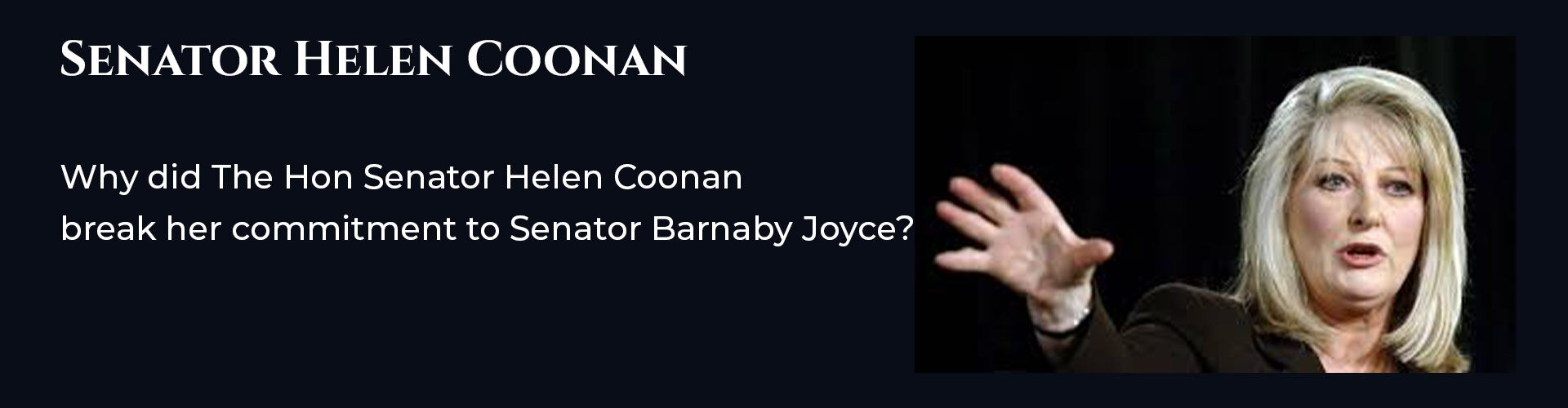
The Hon Senator Helen Coonan
On 17 May 2007, I received a letter from Senator Coonan, stating:
“I have now made both formal and informal representations to Telstra on behalf of the CoTs. However, Telstra’s position remains that this is a matter most appropriately dealt with through a Court process. Telstra is not prepared to undertake an alternate means of pursuing this matter. …
“I also appreciate the depth of feeling regarding the matter and suggest you consider whether court proceedings may be your ultimate option.” (See DCITA Evidence File 6)
Surely it was Senator Coonan’s responsibility, as the Minister for Communications, Information Technology and the Arts, to initiate an official enquiry into WHY, both during and after the COT arbitrations, Telstra continued to intercept in-confidence documents leaving my office (or residence), AND the offices of various senators AND the Commonwealth Ombudsman’s office? The Australian Federal Police were also reluctant to bring charges against Telstra during my 1994/1995 arbitration process.
As shown in the Scandrett & Associates Pty Ltd report (see Open Letter File No/12 and File No/13), a secondary fax machine was installed in Telstra’s network during the arbitration process, systematically intercepting numerous in-confidence COT-related documents. This illegal interception of legally confidential documents should have been investigated during the arbitration processes when these illegal acts were first discovered. Senator Coonan, writing to me on 17 May 2007 – 12 years after the AFP declined to help me, and suggesting I take Telstra to court in relation to the same issues, just provides even further evidence of the undemocratic and uncaring way in which the COT cases have been treated by their elected government ministers.
Perhaps it would be easier to go back to 1996, when certain DCITA bureaucrats became a law unto themselves.
In March 1996, the John Howard government won office and Senator Richard Alston became the new minister for communications. Paul Fletcher, who was now also assisting Senator Alston, asked me to continue helping the senator with my still unaddressed ongoing telephone problems that the Hon David Hawker MP, had also raised with the senator both on my behalf and on behalf of his constituents who like me were having the same type of ongoing phone problems.
As a result of my discussion with Senator Alston, I sent his office a copy of an 88-page report I had compiled, together with various supporting Exhibit documents. This report detailed how Telstra had broken the law by tampering with Government-owned equipment during my legal arbitration, which was being conducted under the auspices of the Supreme Court of Victoria. This was the report that Paul Fletcher eventually returned to me (see Open Letter File No/41/Part-One and File No/41 Part-Two).
The covering letter attached to my report, which Mr Paul Fletcher returned on 4 September 1996 (see Open Letter File No/41/Part) states:
"In addition, I have examined the material you sent me. On the basis of the information I have received, I do not believe that there is any action in relation to your case that would be appropriate for the Minister to take at this time. The Minister has no power to intervene in the conduct of the COT arbitrations. which are being administered by the Telecommunications Industry Ombudsman."
Ten years after Mr Fletcher had returned my June 1996 report, other bureaucrats in the Department of Communications Information Technology and the Arts (DCITA) began investigations into other areas of my claims and instead of the department investigating my claims a DCITA bureaucrat Nikki Vajrabukka, on 3 March 2006, sent this material straight to Telstra to ask if my claims were valid, which is a bit like a police officer asking a thief caught stealing a car if he should be charged for that theft! Interestingly, Paul Fletcher had previously worked at that DCITA too.
I have raised these DCITA decisions in this Second Investigation segment because, since Senator Alston requested my report in the presence of David Hawker, surely they would then both be informed of the outcome of Paul Fletcher’s investigations into that report. I know for a fact that Mr Hawker did not receive any information about my report because he told me, on two separate occasions, that he had not received any follow-up information at all, which further indicates that Senator Alston was never advised of the significance of that report either.
On 26 May 2019, Paul Fletcher became The Hon Paul Fletcher, Australia's Minister for Communications and the Arts (see https://www.paulfletcher.com.au/media-releases/media-release-fletcher-deeply-honoured-to-be-appointed-minister-for-communications a portfolio he is professionally equipped to handle.
In 2019 and 2020, via my then Federal Member of Parliament the Hon Dan Tehan MP, the Hon Paul Fletcher refused to reinvestigate this crime and other crimes that were committed against me by the Telstra Corporation. Exhibit Telstra's Falsified SVT Report shows that these crimes affected the outcome of my arbitration and my ability to run my business on a level playing field with my competitors. The Hon Dan Tehan is aware of the validity of my claims, as was his predecessor, the Hon David Hawker MP. That neither of them has the ability or power to get the government to investigate Telstra’s corporate thuggery clearly shows how corrupt Australia’s legal system is.
Perhaps even more unbelievable is that the COT cases received no recognition, from either the government or Telstra, for our stand for honesty and truth; instead, we have been treated in the worst possible way, labelled as vexatious litigants and our lives have been ruined, simply because we chose to demand a telephone system comparable to our fellow competitor.
On 26 September 1997, after most of the arbitrations were concluded, by the second-appointed administrator of the arbitrations, John Pinnock (see page 99 COMMONWEALTH OF AUSTRALIA - Parliament of Australia that:
“In the process leading up to the development of the arbitration procedures – and I was not a party to that, but know enough about it to be able to say this – the claimants were told clearly that documents were to be made available to them under the FOI Act. …
“For present purposes, though, it is enough to say that the process was always going to be problematic, chiefly for three reasons. Firstly, and perhaps most significantly, the arbitrator had no control over that process, because it was a process conducted entirely outside the ambit of the arbitration procedures.”
Why were the arbitrations not conducted under the agreed ambit of the arbitration procedures? How can arbitration be a just process when the arbitrator has no control over how it is conducted? When did Dr Gordon Hughes (the arbitrator) lose control over the arbitrations? Was it the first week, two months or even nine months into the process? And, just as importantly, who authorised him to conduct the process entirely outside of the ambit of the arbitration procedures?
There is NO amendment attached to any agreement, signed by the above-mentioned COT members, allowing the arbitrator to conduct their particular arbitrations entirely outside the ambit of the arbitration procedure – and neither was it stated that he would have no control over the process once we signed those individual agreements. How can the arbitrator and TIO continue to hide under a confidentiality clause contained in our arbitration agreement when that agreement did not mention the arbitrator would have no control because the arbitration would be conducted entirely outside of the agreed ambit of the procedures?