Chapter 4 Deception in the public service
For an arbitrator to have a conflict of interest, taking or allowing the defence to use threats that were later carried out, thereby allowing fraud and forgery to creep into the arbitration process, is more than just a breach of trust; it was unconscionable.
This letter, dated 20 January 1994, from Ms Philippa Smith, Commonwealth Ombudsman, to Telstra’s corporate secretary Jim Holmes, notes:
“I received complaints from three of the ‘COT Cases,’ Mr Graham Schorer, Mr Alan Smith and Ms Ann Garms, concerning TELECOM’s handling of their applications under the Freedom of Information Act (FOI Act) of 24 November 1993 and 21 December 1993 respectively. …
“All three assert that they require the information to support their submissions to the imminent review in accordance with the Fast Track Settlement Proposal (FTSP) agreed between TELECOM and AUSTEL, and endorsed by the then relevant Minister.” (Home Page – Part One File No/2-A to 2-E)
On 25 March 1994, Ms Philippa Smith wrote to Telstra’s CEO Frank Blount, stating:
“It was unreasonable for Telecom to require the participants to make further assurances while Telecom was considering the Agreement and thereby denying the participants the opportunity to consider the rules that Telecom wished to have included in the Agreement.” (Home Page – Part One File No/2-B)
Again, on 6 May 1994, Ms Philippa Smith wrote to Telstra’s CEO, Frank Blount, stating:
“I should be grateful if you would now respond to the outstanding matters raised in my letter of 25 March 1994 ie
- Comment on my views that:
- it was unreasonable for Telecom to impose a condition for release of certain documents that the participants make further assurances that they will participate in the FTSP; and
- it was unreasonable for Telecom to require the participants to make the assurances while Telecom was considering the agreement related to the FTSP (the Agreement) and thereby denying the participants the opportunity to consider the rules that Telecom wished to have included in the Agreement.” (Home Page – Part One File No/2-C)
Regardless of the government and the relevant minister endorsing COT arbitrations, as confirmed by Ms Philippa Smith, in her 20 January 1994 letter, and regardless of both the TIO and the government being aware the arbitrator had no control over the arbitrations (see Arbitrator File No/71), the government only assisted five of the 21 COT cases to resolve their long outstanding claims. (See the An Injustice to the Remaining 16 page in the menu bar.
Ambit of the Victorian Commercial Arbitration Act 1984
While the ambit of the Victorian Commercial Arbitration Act 1984 issue appears on the Senate Page / File No/71, it is important to raise it here, too, in our Home Page Part One.
On 24 January 1994, this letter to Dr Hughes (arbitrator) from Frank Shelton, the TIO special counsel, provides further proof that the first four arbitrations were to be conducted according to the “ambit of the Commercial Arbitration Act 1984”. Frank Shelton was also the president of the Institute of Arbitrators Australia when he advised the arbitrator:
“We discussed whether or not the Procedure should come within the ambit of the Victorian Commercial Arbitration Act 1984. We decided that it should.”
On page two, he adds:
“On balance, it was decided that it would be preferable to have the Procedure operating under the ambit of the Commercial Arbitration Act.
“You will note that I have amended the Procedure so that it is clear that you are conducting four separate arbitrations and will hand down four separate awards although you may combine some aspects of the four hearings.” (See Arbitrator File No/105)
The arbitrator failed to mention in my final award that my arbitration procedure was conducted outside the agreed ambit of the Commercial Arbitration Act 1984. He did not warn me before I signed the agreement that my arbitration would be conducted this way.
It was corrupt for the arbitrator and the TIO to allow our arbitrations to continue after discovering that they were being conducted outside the agreed and accepted ambit of the Victorian (Australia) Commercial Arbitration Act.
With iniquity, this decision has stood without investigation for 18 years despite the TIO confirming, to both a Senate estimates committee hearing and the communications minister’s office, on 26 September 1997, that the arbitrator had no control over the process because it was “conducted entirely outside the ambit of the arbitration procedures”. (See Arbitrator File No/71)
After conducting our arbitrations in such an unethical manner, the arbitrator wrote to the TIO on 12 May 1995 and declared the COT arbitration agreement not a credible document for the basis of my arbitration (see Open Letter File No 55-A). This letter, which condemned the agreement, was also deliberately concealed from me during my designated appeal period. Neither the arbitrator nor the TIO (the administrator) ever gave me an amended document during my arbitration.
The confidentiality clauses in my arbitration agreement, which appear to have been used since 22 June 1995 to stop a transparent investigation into the conduct of my arbitration, became null and void as soon as the arbitrator conducted my arbitration entirely outside the agreed ambit of the Victorian Commercial Arbitration Act 1984.
On 17 February 1994, during this official arbitration meeting, Graham Schorer (COT spokesperson) asked Dr Hughes to assure us that the agreement the COT claimants were pressured to sign was not Telstra’s proposed arbitration rules. Telstra’s own transcripts of this meeting (see Arbitrator File No/103) confirm that both the arbitrator and the TIO’s special counsel stated, “They had not received this document and had not read it and that it was irrelevant.”
However, Arbitrator File No/104 confirms the arbitrator was provided with a document called “Telstra Corporation Limited – ‘Fast Track’ Proposed Rules of Arbitration” before 18 January 1994, one month before this meeting.
In fact, Arbitrator File No/105, dated 24 January 1994, confirms that both the arbitrator and a TIO’s special counsel representative read Telstra’s proposed rules. And they used that document as the basis for the final arbitration agreement: the version presented to the first four COTs for signing next month. This was the version that we were assured had been drafted totally independently. During the first official arbitration meeting, before the COTs had signed their arbitration agreements and even before he was officially appointed, the arbitrator was already misleading and deceiving the claimants and all other interested parties.
This deception, regarding which version of the agreement we signed, was maintained throughout the various COT arbitrations. This agreement was NOT independently drafted by the special counsel but by Telstra, the defendants.
This letter, dated 23 February 1994, from Telstra’s arbitration liaison officer to the pending arbitrator notes:
“Telecom is of the view that Special Counsel and the Resource Unit should be accountable for any negligence on their part in relation to the arbitration process, given that these parties are acting in their capacity as experts. Therefore, this clause should not be amended so as to include an exclusion from liability for Special Counsel and the Resource Unit.” (See Arbitrator File No/3)
On July 4, 1994, during the complicated arbitration proceedings, I encountered significant threats from Paul Rumble, a representative from Telstra on the defence team. Alarmingly, the arbitrator had covertly provided Rumble with some of my interim claims documents—this was a clear breach of protocol and occurred five months before the arbitrator was legally required to share such information. As a result, Telstra had five months to distribute my claim documents to 37 of Australia’s most influential law firms, all of which had yearly retainers with Telstra. Consequently, the COT Cases were assigned to second-tier law firms that were hesitant to take on cases against the powerful firms representing Telstra.
To further secure Telstra, the legal firm Freehill Hollingdale & Page drafted the arbitration agreement and faxed it to Warwick Smith, Australia’s first Telecommunications Industry Ombudsman (TIO). This agreement was subsequently provided to the arbitrator before the end of January 1994, purportedly for the intended use in the arbitration. Though several government ministers, members of the Parliament House media press club, and the COT Cases lawyers were assured that this agreement was drafted independently of Telstra, this was not the case. Essentially, the defendants' lawyers were instructing Dr Gordon Hughes, the arbitrator who was soon to be appointed, on how to conduct the arbitration process.
When a whistleblower suggested that the first four COT Cases—Ann Gamrs, Maureen Gillan, Graham Schorer, and I—would face serious challenges from Dr. Hughes, the COT spokesperson confronted him during a pre-arbitration hearing on February 17, 1994. The spokesperson asked whether he had seen Telstra's Preferred Rules of Arbitration, noting that this was not the agreement we had accepted. Telstra’s minutes from that meeting confirm that Dr Hughes claimed he had not seen it, despite having already used parts of it to shape the arbitration agreement we were compelled to sign on April 21, 1994. This agreement included three additional changes that favoured the arbitration consultants at the expense of the claimants, as you will see as you follow this narrative.
The execution of these threats completely undermined my ability to present clear evidence that my phone malfunctions were part of a larger, more insidious issue, rather than isolated incidents. This ongoing struggle not only disrupted my business operations but also systematically damaged my credibility and reliability in the eyes of clients and partners. On July 4, 1994, I was already facing these profound challenges in my tumultuous arbitration proceedings, as Paul Rumble articulated.
I reiterate the threats made against me by Telstra in extenion a second look at how corrupt these arbitrations were.
PLEASE READ this different approach.
The execution of these threats effectively dismantled any opportunity I had to provide evidence that my phone malfunctions were part of a larger, systemic issue, rather than mere isolated incidents. This ongoing situation significantly hindered my ability to operate my business smoothly, as these persistent disruptions not only affected my communication capabilities but also undermined my credibility and reliability in the eyes of clients and partners.On July 4, 1994, amidst the complexities of my arbitration proceedings, I confronted serious threats articulated by Paul Rumble, a Telstra representative on the arbitration defence team. Disturbingly, he had been covertly furnished with some of my interim claims documents by the arbitrator—a breach of protocol that occurred an entire month before the arbitrator was legally obligated to share such information. Given the gravity of the situation, my response needed to be exceptionally meticulous. I invested considerable effort in crafting this detailed letter, carefully selecting every word. In this correspondence, I made it unequivocally clear:
“I gave you my word on Friday night that I would not go running off to the Federal Police etc, I shall honour this statement, and wait for your response to the following questions I ask of Telecom below.” (File 85 - AS-CAV Exhibit 48-A to 91)
When drafting this letter, my determination was unwavering; I had no intention of submitting any additional Freedom of Information (FOI) documents to the Australian Federal Police (AFP). This decision was significantly influenced by a recent, tense phone call I received from Steve Black, another arbitration liaison officer at Telstra. During this conversation, Black issued a stern warning: should I fail to comply with the directions he and Mr Rumble gave, I would jeopardise my access to crucial documents pertaining to ongoing problems I was experiencing with my telephone service.
Page 12 of the AFP transcript of my second interview (Refer to Australian Federal Police Investigation File No/1) shows Questions 54 to 58, the AFP stating:-
“The thing that I’m intrigued by is the statement here that you’ve given Mr Rumble your word that you would not go running off to the Federal Police etcetera.”
Essentially, I understood there were two potential outcomes: either I would obtain documents that could substantiate my claims, or I would be left without any documentation that could affect the arbitrator's decisions in my case.
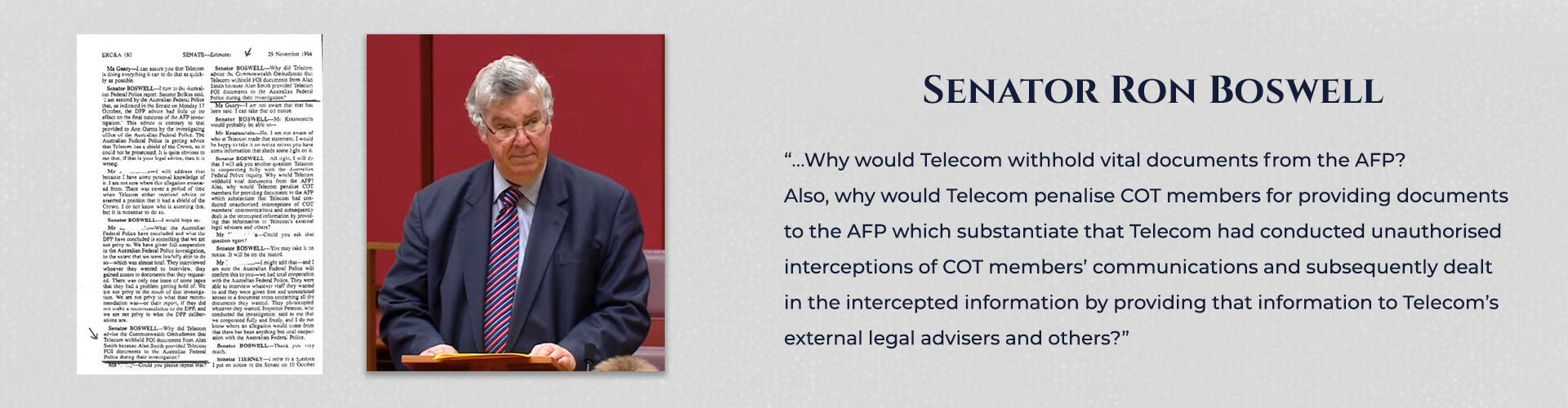
However, a pivotal development occurred when the AFP returned to Cape Bridgewater on 26 September 1994. During this visit, they began asking probing questions about my correspondence with Paul Rumble, demonstrating a sense of urgency in their inquiries. They indicated that if I chose not to cooperate with their investigation, their focus would shift entirely to the unresolved telephone interception issues central to the COT Cases, which they claimed assisted the AFP in various ways. I was alarmed by these statements and contacted Senator Ron Boswell, National Party 'Whip' in the Senate.
As a result, I contacted Senator Ron Boswell, who subsequently brought these threats to the Senate's attention. This statement underscored the serious nature of the claims I was dealing with and the potential ramifications of my interactions with Telstra.
On page 180, ERC&A, from the official Australian Senate Hansard, dated 29 November 1994, reports Senator Ron Boswell asking Telstra’s legal directorate:
“Why did Telecom advise the Commonwealth Ombudsman that Telecom withheld FOI documents from Alan Smith because Alan Smith provided Telecom FOI documents to the Australian Federal Police during their investigation?”
After receiving a hollow response from Telstra, which the senator, the AFP and I all knew was utterly false, the senator states:
“…Why would Telecom withhold vital documents from the AFP? Also, why would Telecom penalise COT members for providing documents to the AFP which substantiate that Telecom had conducted unauthorised interceptions of COT members’ communications and subsequently dealt in the intercepted information by providing that information to Telecom’s external legal advisers and others?” (See Senate Evidence File No 31)
Thus, the threats became a reality. What is so appalling about this withholding of relevant documents is this: no one in the TIO office or the government has ever investigated the disastrous impact of this withholding on my overall submission to the arbitrator. The arbitrator and the government (at the time, Telstra was a government-owned entity) should have initiated an investigation into why an Australian citizen who had assisted the AFP in its investigations into unlawful interception of telephone conversations was so severely disadvantaged in a civil arbitration.
Pages 12 and 13 of the Australian Federal Police Investigation File No/1 transcripts provide a comprehensive account that establishes Paul Rumble as a significant figure linked to the threats I have encountered. This conclusion is based on two critical and interrelated factors that merit further elaboration.