Chapter Three - Conflict of Interest
Conflict of Interest - Where do you draw the line?
Worse for the other two COT Cases and me is that Dr Hughes allowed Graham/Golden an extra three or more years longer to access their documents from Telstra, over and above what he allowed us, three COT claimants, even though the official arbitration rules did not permit this. Dr Hughes only allowed me one extra week to access my documents from Telstra, which shows how this conflict of interest tainted the whole arbitration process.
LOST ARBITRATION FAXES
I would like to refer the reader to my letter dated July 15, 2009, addressed to Paul Crowley, the CEO of the Institute of Arbitrators and Mediators Australia. (Exhibit 13-B and 13-C → Burying The Evidence File 13-H. In this letter, I included a correspondence from Graham Schorer, who was the spokesperson for COT Cases and a former client of the arbitrator Dr Gordon Hughes (see Chapter 3 - Conflict of Interest).
Exhibit 13-H → Burying The Evidence File 13-H is the letter dated August 4, 1998 and attached to it is also exhibited as (13-H) a statutory declaration from Mr Schorer to me, which detailed a phone conversation he had with the arbitrator Dr Gordon Hughes during the 1994 arbitrations concerning lost Telstra COT-related faxes. My arbitration had been over for three years, and it was revealed during a pending appeal that 41 of my faxes during my 13-month arbitration were not on the arbitrator's schedule of received documents, even though my fax billing account showed they had been sent. Mr Schorer alerted the Senate to this, as did Dr Hughes, and it was Dr Hughes' response that gave us hope that we could have these lost arbitration fax matters investigated. During that conversation, Mr Schorer had with Dr Hughes, Dr Hughes explained to Graham Schorer in detail that:
"Hunt & Hunt (The company's) Australian Head Office was located in Sydney, and (the company) is a member of an international association of law firms. Due to overseas time zone differences, at close of business, Melbourne's incoming facsimiles are night switched to automatically divert to Hunt & Hunt Sydney office where someone is always on duty. There are occasions on the opening of the Melbourne office, the person responsible for cancelling the night switching of incoming faxes from the Melbourne office to the Sydney Office, has failed to cancel the automatic diversion of incoming facsimiles." Burying The Evidence File 13-H.
Dr Hughes’s failure to disclose the faxing issues to the Australian Federal Police during my arbitration is deeply concerning. The AFP was investigating the interception of my faxes to the arbitrator's office. Yet, this crucial matter was a significant aspect of my claim that Dr Hughes chose not to address in his award or mention in any of his findings. The loss of essential arbitration documents throughout the COT Cases is a serious indictment of the process.
Even more troubling is that Dr Hughes was aware of the faxing problems between the Sydney and Melbourne offices before his appointment as an arbitrator in seven arbitrations, all coordinated within 12 months. During this time, COT claimants—two in Brisbane and five in Melbourne—frequently expressed frustration that the arbitrator's office was not responding to their faxes. This raises alarming questions about potential criminal negligence and the integrity of the arbitration process.
John Pinnock, the Telecommunications Industry Ombudsman and the second appointed administrator for my arbitration, acknowledged that 41 of my claim documents, which were also mini reports, had not been investigated by Dr Hughes. Despite Dr Hughes admitting that these documents might have been lost by his Sydney office, I was still denied the opportunity to have the 41 claim documents evaluated on their merits.
Forces
It is clear from Front Page Part One File No/1, that at least six documents faxed from my office to the arbitrators office did not reach his office even though this exhibt shows Telstra charged me for these six undelivered faxes. Front Page Part One File No/1 shows the arbitrator’s secretary advised Tony Watson (of Telstra’s arbitration defence unit) that on 23 May 1994, six of my claim documents did not reach the arbitrator's fax machine. Yet, I was charged on my Telstra account for those six faxes. Why was this matter not investigated?
No one from the arbitrator’s office or the TIO’s office allowed me to amend my claim so that the unreceived claim documents could be valued as part of my arbitration process.
Threats made during my arbitration
On July 4, 1994, amidst the complexities of my arbitration proceedings, I confronted serious threats articulated by Paul Rumble, a Telstra representative on the arbitration defence team. Disturbingly, he had been covertly furnished with some of my interim claims documents by the arbitrator—a breach of protocol that occurred an entire month before the arbitrator was legally obligated to share such information. Given the gravity of the situation, my response needed to be exceptionally meticulous. I invested considerable effort in crafting this detailed letter, carefully selecting every word. In this correspondence, I made it unequivocally clear:
“I gave you my word on Friday night that I would not go running off to the Federal Police etc, I shall honour this statement, and wait for your response to the following questions I ask of Telecom below.” (File 85 - AS-CAV Exhibit 48-A to 91)
When drafting this letter, my determination was unwavering; I had no intention of submitting any additional Freedom of Information (FOI) documents to the Australian Federal Police (AFP). This decision was significantly influenced by a recent, tense phone call I received from Steve Black, another arbitration liaison officer at Telstra. During this conversation, Black issued a stern warning: should I fail to comply with the directions he and Mr Rumble gave, I would jeopardise my access to crucial documents pertaining to ongoing problems I was experiencing with my telephone service.
Page 12 of the AFP transcript of my second interview (Refer to Australian Federal Police Investigation File No/1) shows Questions 54 to 58, the AFP stating:-
“The thing that I’m intrigued by is the statement here that you’ve given Mr Rumble your word that you would not go running off to the Federal Police etcetera.”
Essentially, I understood there were two potential outcomes: either I would obtain documents that could substantiate my claims, or I would be left without any documentation that could affect the arbitrator's decisions in my case.
However, a pivotal development occurred when the AFP returned to Cape Bridgewater on 26 September 1994. During this visit, they began asking probing questions about my correspondence with Paul Rumble, demonstrating a sense of urgency in their inquiries. They indicated that if I chose not to cooperate with their investigation, their focus would shift entirely to the unresolved telephone interception issues central to the COT Cases, which they claimed assisted the AFP in various ways. I was alarmed by these statements and contacted Senator Ron Boswell, National Party 'Whip' in the Senate.
As a result of this situation, I contacted Senator Ron Boswell, who subsequently brought these threats to the attention of the Senate. This statement underscored the serious nature of the claims I was dealing with and the potential ramifications of my interactions with Telstra.
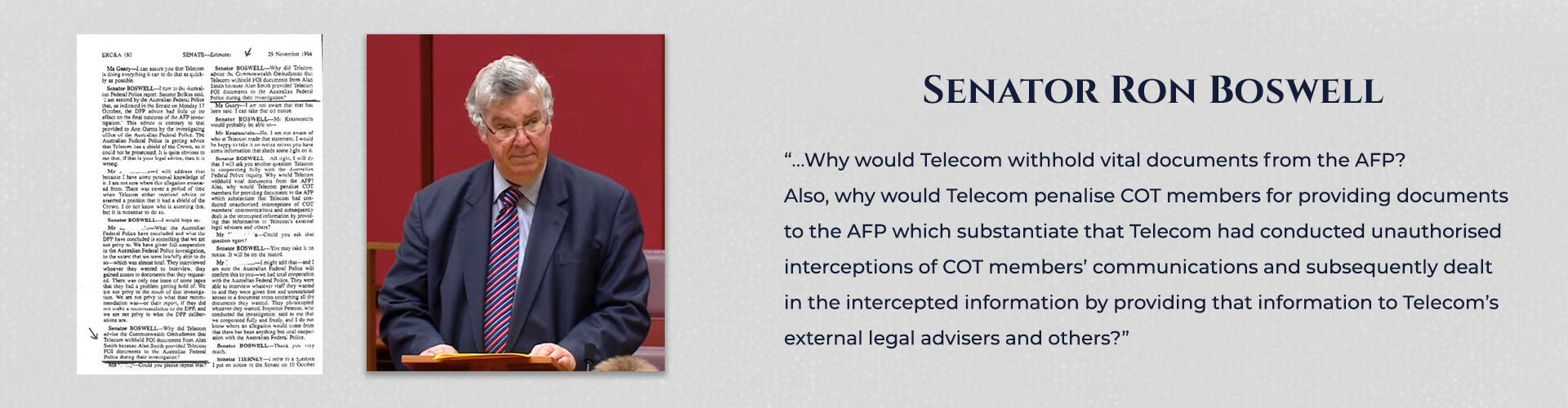
On page 180, ERC&A, from the official Australian Senate Hansard, dated 29 November 1994, reports Senator Ron Boswell asking Telstra’s legal directorate:
“Why did Telecom advise the Commonwealth Ombudsman that Telecom withheld FOI documents from Alan Smith because Alan Smith provided Telecom FOI documents to the Australian Federal Police during their investigation?”
After receiving a hollow response from Telstra, which the senator, the AFP and I all knew was utterly false, the senator states:
“…Why would Telecom withhold vital documents from the AFP? Also, why would Telecom penalise COT members for providing documents to the AFP which substantiate that Telecom had conducted unauthorised interceptions of COT members’ communications and subsequently dealt in the intercepted information by providing that information to Telecom’s external legal advisers and others?” (See Senate Evidence File No 31)
Thus, the threats became a reality. What is so appalling about this withholding of relevant documents is this: no one in the TIO office or the government has ever investigated the disastrous impact of this withholding on my overall submission to the arbitrator. The arbitrator and the government (at the time, Telstra was a government-owned entity) should have initiated an investigation into why an Australian citizen who had assisted the AFP in its investigations into unlawful interception of telephone conversations was so severely disadvantaged in a civil arbitration.
Pages 12 and 13 of the Australian Federal Police Investigation File No/1 transcripts provide a comprehensive account that establishes Paul Rumble as a significant figure linked to the threats I have encountered. This conclusion is based on two critical and interrelated factors that merit further elaboration.
Why didn’t Dr Hughes (as the arbitrator to my case) explain to me, as he did to Graham Schorer (refer Burying The Evidence File 13-H that my 23 May 1994 faxed claim documents might be in his Sydney office? Did Dr Hughes believe that exposing this faxing problem with his Sydney office would halt the arbitration process in my favour? Was Dr Hughes worried about exposing me to the flaws in his own two offices, given the possibility that this is where my other lost faxes ended up? Would this admission bring an end to his remaining as the arbitrator to the COT arbitrations?
I wrote to the arbitrator, expressing my belief that my lost faxes were connected to my failure to uphold the agreement I made with Telstra's Paul Rumble, which was not to assist the Australian Federal Police (AFP) in their investigations. In this letter, I clearly stated that I had received official advice from the government indicating that it was my duty to assist the AFP in their investigation of my claims related to government matters. When I informed Dr Hughes about the lost faxes, I did not receive any response from his office.
Firstly, had Graham Schorer (as the COT spokesperson) disclosed to the COT Cases before we signed our arbitration agreement, we would have been within our rights to demand Dr Hughes supply an efficient faxing system throughout our arbitrations.
Secondly, we could have used this faxing issue between Dr Hughes's Melbourne and Sydney offices to support any arbitration appeal within the time allowed under our arbitration agreement.
It is essential to link these unaddressed lost arbitration faxes to both my case and that of Ann Garms (now deceased), because it is well written between us, lost many faxed arbitration-related documents.
Ann Garms (one of the other COT Cases) spent over $600,000.00 in her arbitration appeal in the Supreme Court of Victoria against Dr Hughes. Ann might have had a more favourable outcome of this appeal, which she lost, had she and her lawyers known of Dr Hughes's admission to Graham Schorer before the commencement of our four arbitrations.
Graham Schorer's primary reasons for claiming that his Telstra Flexitel matter was still unresolved at the beginning and during a Senate hearing, even though he did ‘blindly’ accept a deed of release from the Telstra Corporation in April 1999, thereby ‘agreeing’ that all outstanding claims against Telstra had been resolved. Unfortunately, this meant that the arbitration agreement signed by Graham Schorer and Telstra did not allow the arbitrator to assess those Flexitel issues because they were matters that had been partly addressed by Mr Gordon Hughes when he assisted Graham Schorer's previous Federal Court action against Telstra in 1990. Graham Schorer had accepted a settlement about that case.
However, Graham Schorer alleges he was unaware that the Australian Government Solicitor had already found and documented how Telstra had misled and deceived him over several years. It is clear, though, that once Graham Schorer signed his arbitration agreement on 21 April 1994, the Flexitel previous settled claim was reopened in Telstra's defending documents. In simple terms, when Dr Gordon Hughes was sent an Interim Claim by Mr Schorer, which included Felexitel issues that had already been part of the previous Federal Court action handled by Dr Hughes, once again, Dr Hughes was assessing claims for a second time. The whole arbitration became a circus, and Dr Hughes handed down against Telstra over the three years of Mr Schorer's arbitration.
Could this be one of the reasons Telstra allowed the Flexitel issue to be reopened once the arbitration agreement had been signed, even though Telstra and Graham were not supposed to raise these Flexitel issues during Telstra's 1994/1996 arbitration defence of those claims because by doing so compromised Dr Hughes position as being an independent arbitrator?
Pages 27 to 29 in our GS June 2013 report discuss a 2 November 1990 fax from Trevor Hill of Telstra’s Corporate Solicitors Office to Telstra’s Peter Gamble regarding Telecom v Golden Messenger Federal Court Legal Proceedings, which notes, among other items:
(5) The Australian Government Solicitor, on behalf of Telecom, has written to the solicitors acting for Golden Messenger seeking their undertaking not to disclose to their client or others the contents of the report on the North Melb Exchange. To date, there has been no response. (Exhibit GS 448-A file GS-CAV 448 to 456):
Directly below this entry, the report then discusses an internal Telstra minute dated 7 November 1990 that Telstra’s Peter Gamble, Manager, Business Network Planning, sent to Mr F Jones, Executive General Manager, Telecom Business Services (FOI Folio 001801), noting that:
“it would appear that any concerns over the disclosure of the adverse report on the North Melbourne Exchange can now be set to rest as it will not be released until point (5) has been complied with”. Exhibit GS 43 file GS-CAV 1 to 88
These two documents, together with the Author’s Comment (4) on pages 27 to 28 of our GS June 2013 report, show that, regardless of whether Graham’s solicitors, Landers & Rogers, received a copy of the North Melbourne Telephone Exchange report during Graham Schorer's early Federal Court action, Mr Schorer is adamant that he did NOT see a copy of the letter from the Australian Government Solicitor (AGS) that is referred to in these faxes.
CONFLICT OF INTEREST - Dr Hughes and Graham Schorer (refer to document 567 file GS-CAV 522 to 580 ).
On 21 November 2012, Graham produced a letter of understanding that included:
“During the period that I retained Landers & Rogers, at no stage was I informed by Gordon Hughes or any other member of Landers & Rogers staff, that Telecom or the Australian Government Solicitor contacted them with information regarding the North Melbourne exchange.
“Furthermore, had I known that Gordon Hughes had concealed knowledge of such an important document from me, I would not have accepted his appointment as the arbitrator in my arbitration process” (refer to document 567 file GS-CAV 522 to 580 ).
This AGS letter is essential because when Dr Gordon Hughes was appointed as the official arbitrator to the COT arbitrations, he did not declare his conflict of interest regarding Graham Schorer's previous Federal Court action against Telstra.
It is as important to look at this conflict of interest issue from the perspective of the other COT claimants as it is to look at it from Graham Schorer's perspective because, as Graham Schorer's earlier legal advisor in both his business endeavours and his Federal Court / Telstra matters, Dr Hughes knew about the various discovery documents that Landers & Rogers did receive from the AGS after 24 July 1990, just as he knew about the incorrectly installed, faulty Flexitel telephone equipment at Graham’s business premises.
Dr Hughes may have thought he was helping Graham Schorer when he allowed an extra two (and, in one case, three) years for Graham to prepare his submission to arbitration, over and above what he allowed the other COT claimants, even though this extra time was not permitted in the official arbitration rules. In other words, it appears as though Dr Hughes allowed his integrity to be compromised, which therefore left him a sitting duck, so to speak, because Telstra may well have then used this conflict of interest to their advantage so that in the end, Dr Hughes lost control not just over Grahams’ arbitration but overall the other COT arbitrations as well.
John Pinnock (TIO) later confirmed, however, in his address to a Senate Estimates Committee on 26 September 1997, exhibit GS 490 file GS-CAV 490 to 521, that this was certainly NOT the case, noting:
“Firstly, and perhaps most significantly, the arbitrator had no control over the process, because it was a process conducted entirely outside of the ambit of the arbitration proceedings”.
The questions arising out of this official statement are:
- Did Dr Hughes lose control over the arbitrations – he was conducting (seven at least) because Telstra knew he had never declared his conflict of interest?
- Did the secret use of Ferrier Hodgson Corporate Advisory as the secondary arbitrator for Graham’s arbitration contribute to Dr Hughes losing control over the process?
- Could it be that when the TIO (the administrator of the arbitration process) became aware that Dr Hughes had lost control over the process, the TIO had a duty of care to immediately request leave from the Supreme Court to appoint a new arbitrator?
Could it be that one of the reasons Telstra accepted Dr Hughes’ previous association with Graham’s Telstra Federal Court action without raising it as a problem about his appointment as COT arbitrator was that they knew that this AGS letter had never surfaced after it was first sent to Lander's & Rogers? So, they knew it had to have been deliberately concealed from Graham during his Federal Court proceedings?
Directly below this entry, the report then discusses an internal Telstra minute dated 7 November 1990 that Telstra’s Peter Gamble, Manager, Business Network Planning, sent to Mr F Jones, Executive General Manager, Telecom Business Services (FOI Folio 001801), noting that:
“it would appear that any concerns over the disclosure of the adverse report on the North Melbourne Exchange can now be set to rest as it will not be released until point (5) has been complied with”. (Exhibit GS 43 file GS-CAV 1 to 88)
These two documents, together with the Author’s Comment below, show that, regardless of whether Graham’s solicitors, Landers & Rogers, received a copy of the North Melbourne Telephone Exchange report during Graham’s early Federal Court action, Graham is adamant that he did NOT see a copy of the letter from the Australian Government Solicitor (AGS) that is referred to in these faxes.
This AGS letter is essential because, when Dr Gordon Hughes was appointed as the official arbitrator in the COT arbitrations, he did not declare his conflict of interest arising from Graham’s previous Federal Court action against Telstra.
Next Page ⟶