Evidence files show I received threats and thuggery abuse, as well as being subjected to treacherous and malicious harassment by Telstra and the establishment, which compromised my ability to submit an effective response to Telstra's claims that my phone problems were fixed when they were not.
PART ONE
Evidence files show I received threats and thuggery abuse, as well as being subjected to treacherous and malicious harassment by Telstra and the establishment, which compromised my ability to submit an effective response to Telstra's claims that my phone problems were fixed when they were not
(AUSTEL’s Adverse Findings) → point 2 to 212 prove my case
I am using the following two witness statements (Exhibit 766 – ) because they prove that a police officer, when dealing with the COT Telstra issues, was left floundering — just as the COT Cases were when they were forced into arbitration by the arbitrator Dr Gordon Hughes and the administrator Warwick Smith, who was also the first appointed Telecommunicatins Industry Ombudsman who hd the role as administrator to the arbitrations. The arbitrator and the administrator of the COT arbitrations feared abandoning the process because of Telstra's power and influence over the Australian legal system.
Between February 1994 and March 1995, I was drawn into a web of deception while assisting the Australian Federal Police (AFP). On the night of March 21, 1995, I found myself summoned to the Senate, a stage for dark secrets and hidden agendas. The AFP had warned me—information deemed so damaging that it was deemed too dangerous to share with Telstra during my arbitration. This evidence included chilling threats I had received from Telstra, a ruthless entity retaliating against my cooperation with the AFP’s investigation into the egregious hacking of my arbitration-related documents (See Part Two below).
For reasons shrouded in shadows, no representative from the arbitrators' office deigned to explain why these threats went unchecked, nor why the harassment continued unabated. My attempts to amend my arbitration claim were met with a cold indifference that only deepened my fears. I was left to grapple with the treachery of a system that seemed more concerned with protecting Telstra than upholding justice. I, along with countless others who had been victimised by this insidious abuse, were cast aside during what was supposed to be a government-endorsed arbitration, revealing how deeply corruption can seep into the very foundations of authority and order.
Please read the following two witness statements.
Before you delve into yet another series of exposés that reveal uncomfortable truths, I want to assure you of my unwavering commitment. During the period highlighted by Des Direen — which coincided with the Victoria Police review of the COT Cases arbitration issues — I was officially seconded to the Major Fraud Group of Victoria Police. I worked under the guidance of their barrister, Mr Neil Jepson. He became interested in my case after examining the compelling evidence I had previously presented to Dr Gordon Hughes during my arbitration in 1994 and 1995.
Dr Hughes dismissed this evidence, concluding that there were no ongoing telephone issues affecting my business by July 1994, despite my submission of two fault reports that indicated otherwise. This evidence clearly demonstrated that Telstra had intentionally relied on three fraudulent reports. Alarmingly, despite the seriousness of these findings, Dr Hughes did not reach any adverse conclusions regarding this fraud.
The statement made by Dr Hughes concerning Neil William Holland, a Forensic Document Examiner, is especially relevant. The Major Fraud Group was familiar with Mr Holland’s work and respected his findings in cases other than mine. They strongly indicated that if Mr Holland had been fully informed about the circumstances surrounding my diaries — and the precise sequence in which they were presented, particularly since the AFP instructed me to remove certain sections — he would have condemned Telstra for the deliberate and misleading tactics used to extract professional statements from him on the company’s behalf. It is these types of corrupt actions by Telstra that have devastated the lives of those involved in the COT Cases.
This significant oversight prompted Mr Jepson to enlist my assistance for a deeper investigation. The police were examining serious allegations of fraud by Telstra, particularly concerning its defence in four separate arbitrations beyond my own case, spanning from 1994 to 1998. Our focus was on the complex and troubling details of the investigation, which unfolded between 1998 and 1999, revealing layers of deceit that the witness statement below shows we factual
"I can recall that during the period 2000/2001, I had arranged to meet Detective Sergeant Rod KURIS from the Victoria Police Major Fraud Squad at the foyer of Casselden Place, 2 Lonsdale Street, Melbourne. At the time, I was assisting Rod with the investigation into alleged illegal activities against the COT Cases.
Rod then stated that he wanted me to follow him to the left side of the foyer. When we did this he then directed my attention to a male person seated on a sofa opposite our seat. He then told me that the person had been following him around the city all morning. At this stage Rod was becoming visibly upset and I had to calm him down. Rod kept on saying that he couldn't believe in what was happening to him. I had to again calm him down".
Points 21 and 22 in Mr Direen’s statement also record how, while he was a Telstra employee, he had cause to investigate “… suspected illegal interference to telephone lines at the Portland exchange,” but when he “… made inquiries by telephone back to Melbourne (he) was told not to get involved and that another area of Telstra was handling it” and that “... the Cape Bridgewater complainant was a part of the COT cases” (my Cape Bridgewater Holiday Camp) business.
What has not been proven, even though both the arbitrator, Dr Gordon Hughes and the administrator to my arbitration, Warwick Smith, were aware that the Australian Federal Police was investigating the same phone/fax interception issues that Des Direen on behalf of Telstra was investigating at the Portland Telephone exchange, were real problems of great concern no stepped forward to confirm either one way of another transparently were my advance group booking enquires being redirected to another holiday camp operator or a booking agent on commission from holiday camp operators to bring business their way unaware that business they were now being advised of was poached from my intercepted telephone and faxes?
"… I have considered, and have no grounds to reject the expert evidence provided by Telecom from Neil William Holland, Forensic Document Examiner, who examined the claimant’s diaries and because of numerous instances of non-chronological entries, thereby causing doubt on their veracity and reliability."

On July 4, 1994, (Exhibit 45-c -File No/45-A), I confronted serious threats articulated by Paul Rumble, a Telstra representative on the arbitration defence team. Disturbingly, he had been covertly furnished with some of my interim claims documents by the arbitrator—a breach of protocol that occurred five months before the arbitrator should have provided this information. Given the gravity of the situation, my response needed to be exceptionally meticulous. It was at this early stage of my arbitration, less than three months in, that Dr Hughes had already broken the arbitration agreement's rules. In this correspondence, I made it unequivocally clear to Telstra's Paul Rumble:
“I gave you my word on Friday night that I would not go running off to the Federal Police etc, I shall honour this statement, and wait for your response to the following questions I ask of Telecom below.” (File 85 - AS-CAV Exhibit 48-A to 91)
When drafting this letter, my determination was unwavering; I had no intention of submitting any additional Freedom of Information (FOI) documents to the Australian Federal Police (AFP). This decision was significantly influenced by a recent, tense phone call I received from Steve Black, another arbitration liaison officer at Telstra. During this conversation, Black issued a stern warning: should I fail to comply with the directions he and Mr Rumble gave, I would jeopardise my access to crucial documents and risk ongoing problems with my telephone service.
No one involved in the arbitration process was aware of my near-death experience during a brief encounter with the Red Chinese Guards in China in August 1967, when I visited Shanghai and was branded a spy. During my arbitration from February to September 1994, I provided documents to the AFP, which I received under the Freedom of Information Act (FOI) in 1994. These documents referred to my discussions with Malcolm Fraser, the former Prime Minister of Australia. Superintendent Detective Sergeant Jeff Pernros likely documented the materials I had received, but a significant conversation I had with Malcolm Fraser months earlier was omitted from these documents. One document noted that the Minister for the Army had not been removed from office. Malcolm Fraser was the Minister for the Army when I was arrested in China in August 1967.
So, why was this period of my life included in Telstra's files during my 1994 arbitration?
Page 12 of the AFP transcript of my second interview (Refer to Australian Federal Police Investigation File No/1) shows Questions 54 to 58, the AFP stating:-
“The thing that I’m intrigued by is the statement here that you’ve given Mr Rumble your word that you would not go running off to the Federal Police etcetera.”
Essentially, I understood that there were two potential outcomes: either I would obtain documents that could substantiate my claims, or I would be left without any documentation that could affect the arbitrator's decision in my case.
However, a pivotal development occurred when the AFP returned to Cape Bridgewater on 26 September 1994. During this visit, they began asking probing questions about my correspondence with Paul Rumble, demonstrating urgency in their inquiries. They indicated that if I chose not to cooperate with their investigation, their focus would shift entirely to the unresolved telephone interception issues central to the COT Cases, which they claimed assisted the AFP in various ways. I was alarmed by these statements and contacted Senator Ron Boswell, National Party 'Whip' in the Senate.
Threats carried out
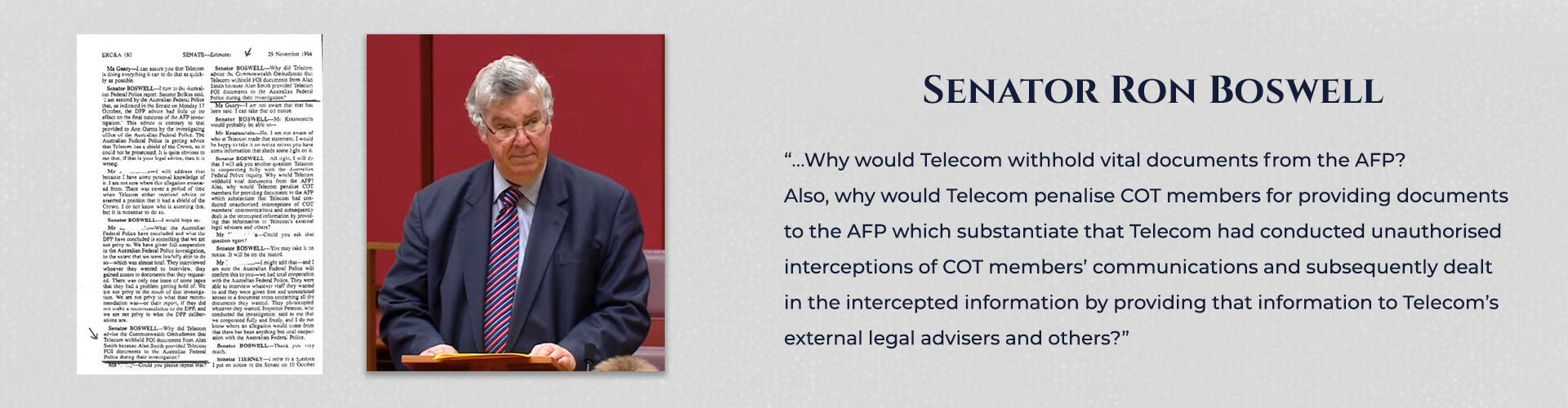
On page 180, ERC&A, from the official Australian Senate Hansard, dated 29 November 1994, reports Senator Ron Boswell asking Telstra’s legal directorate:
“Why did Telecom advise the Commonwealth Ombudsman that Telecom withheld FOI documents from Alan Smith because Alan Smith provided Telecom FOI documents to the Australian Federal Police during their investigation?”
After receiving a hollow response from Telstra, which the senator, the AFP and I all knew was utterly false, the senator states:
“…Why would Telecom withhold vital documents from the AFP? Also, why would Telecom penalise COT members for providing documents to the AFP which substantiate that Telecom had conducted unauthorised interceptions of COT members’ communications and subsequently dealt in the intercepted information by providing that information to Telecom’s external legal advisers and others?” (See Senate Evidence File No 31)
Thus, the Threats Became a Reality
What is so appalling about this withholding of relevant documents is this: no one in the Telecommunication Industry Ombudsman (TIO) office or the government has ever investigated the disastrous impact of this withholding on my overall submission to the arbitrator. The arbitrator and the government (at the time, Telstra was a government-owned entity) should have initiated an investigation into why an Australian citizen who had assisted the AFP in its investigations into unlawful interception of telephone conversations was so severely disadvantaged in a civil arbitration.
Why did Dr Hughes, the government-appointed arbitrator, fail to report these threats to the Supreme Court of Victoria, under whose auspices the arbitration was conducted, especially after Telstra implemented these threats?
Five years after being denied the documents I had originally been promised, my claim against Telstra—and their deliberate withholding of FOI documents—was finally validated by a Senate Committee hearing that ran from 24 June 1997 to March 1999.
It is now 2025, and the Australian Federal Police AFP has still not disclosed to me why Telstra senior management has not been brought to account for authorising this intrusion into my business and private life, regardless of Article 12 of the Universal Declaration of Human Rights stating:
"No one shall be subjected to arbitrary interference with his privacy, family, home or correspondence, nor to attacks upon his honour and reputation. Everyone has the right to the protection of the law against such interference or attacks."
PART THREE
Telstra’s FOI document (M34363) dated 4 February 1994 was not made available to the arbitrator or me during my arbitration, even though Telstra’s FOI numbering system (M followed by a number) indicates to Telstra and the TIO’s office that I was still reporting problems with my fax transmissions during my FTSP process (see Hacking-Julian Assange File No 24).
“I am writing to inform you that members of the group known as the Casualties of Telecom (COT) have contacted my Office regarding the Australian Federal Police enquiries into voice monitoring by Telstra of their telephones. Both Mr Graham Schorer and Mr Alan Smith of COT have informed my Office that they have information on Telstra’s activities in relation to these matters.” (This exhibit was not made avaialable to me during my arbitration)
On 8 February 1994, The Hon Michael Lee, Minister for Communications, wrote to the Hon Duncan Kerr, MP, Minister for Justice: (Note: this document is held in the Government archives.)
“I am writing to inform you that members of the group known as the Casualties of Telecom (COT) have contacted my Office regarding the Australian Federal Police inquires into voice monitoring by Telstra of their telephones.
Both Mr Graham Schorer and Mr Alan Smith of COT have informed my Office that they have information on Telstra’s activities in relation to these matters”.
‘Specification for Customer Premises Line Monitoring Equipment. 1.0 Note:
“The original direction from AUSTEL in relation to Difficult Fault cases required the installation of equipment to monitor a customer’s line at the customer’s premises as well as the exchange end. The equipment currently in operation in Telecom has some deficiencies in meeting this requirement. The Coopers & Lybrand Report recommended the development or purchase of such equipment. These recommendations are a fundamental foundation for a joint working party between AUSTEL and Telecom to develop the specifications for such equipment. The specifications should be finalised by December 1994”.
On 25 February 1994, when this letter to Telstra’s Corporate Secretary from Fay Holthuyzen, Assistant to the Minister for Communications, Michael Lee, (AS 772-a) is compared to the letter dated 3rd February 1994 Exhibit (AS 772-b) that I sent to the Minister’s office, it is clear that I was concerned that my faxes were being illegally intercepted.
On the same day, 25 February 1994, an internal Government Memo confirmed that the then-Minister for Communications and the Arts had written to advise that the Australian Federal Police (AFP) would investigate my allegations of illegal phone/fax interception. (AS 773)
On 3 March 1994, this article appeared in the Portland Observer newspaper (AS 773-b), noting:
“Federal Police officers are investigating allegations of possible illegal activity on the part of Telecom Australia.
Officers from the Federal Police visited Portland last week and interviewed Cape Bridgewater Holiday Camp proprietor, Alan Smith, who is one of the four original members of COT (Casualties of Telecom).”
Constable Melanie Cochrane stated I should not release the singles club members’ private information to Telstra and Superintendent Detective Penrose suggested I provide the private singles club information to the assessor under confidentiality and advise him the AFP was also investigating this same material that appears to have been hacked by Telstra.
Constable Cochrane also stated that as I had assured my singles club members their private information would not be disclosed without their consent, I also needed to discuss this with the assessor, Dr Hughes. I believe Superintendent Detective Penrose stated that the assessor would be aware that I could not disclose this private information via mainstream documents with Telstra while the AFP was investigating.
It was due to these types of facts, and Superintendent Detective Penrose’s advice, that I sought a clearance from the arbitrator to allow me to have this information accepted under confidentiality
Transcripts from my 11 October 1994 oral arbitration hearing confirm that Telstra advised the arbitrator they considered my singles club information irrelevant and therefore should not be accepted into the arbitration process. This evidence supported the claim that I had lost two businesses due to my ongoing telephone problems, namely the school camp bookings and the more lucrative singles club bookings. The transcripts, which I can supply the AFP if requested, show Dr Hughes was badgered into accepting Telstra’s insistence that my singles club material not be assessed during the arbitration process. Why did Dr Hughes allow Telstra to decide not to view my singles club evidence as a business loss, even though he had previously understood the advice given to me by Superintendent Detective Penrose and had agreed the singles club material could be submitted under confidentiality during the oral hearing? That he went back on his word.
Question 24, in the 20 September 1994 interrogatories, shows I answered the following question 24 by stating to Telstra and the arbitrator:
“This matter is currently under investigation by the Federal Police. In the interest of fair justice I believe that I should not further comment apart from what I have already stated that it is true that I was told this by Detective Superintendent Penrose. It the Australian Federal Police are prepared to disclose the details of their investigations and of their conversations with myself, then Telecom will be able to obtain the same”
On 11 October 1994, during this oral hearing, which lasted for close to five hours, nonstop, Telstra’s Mr Benjamin and Telstra’s other arbitration liaison officer, Steve Black, discussed, along with the arbitrator and me my claims regarding Telstra’s unauthorised interception issues, noting:
Ted Benjamin (Telstra): “In respect of Detective Superintendent Penrose.”
Steve Black (Telstra): “There has been an allegation that Detective Superintendent Penrose says that the Plummers’ telephone was allegedly unlawfully tapped” —
Me: “I believe Telecom is playing on words – the word “illegally tapped” – it’s like asking me – I’m not a —
Dr Hughes (Arbitrator): “Sorry, if I can interrupt both of you, the issue here is that your answers – your answer to question 24, you indicate that you were told something by Detective Superintendent Penrose.”
Me: “Yes:”
Dr Hughes (Arbitrator): “Is there any documentation to support that statement or is there any other light that you can shed upon that statement you have made in relation to Detective Penrose?”…
Me: “I have spoken to Detective Penrose on two occasions and he has stated that my phones had been listened to.”
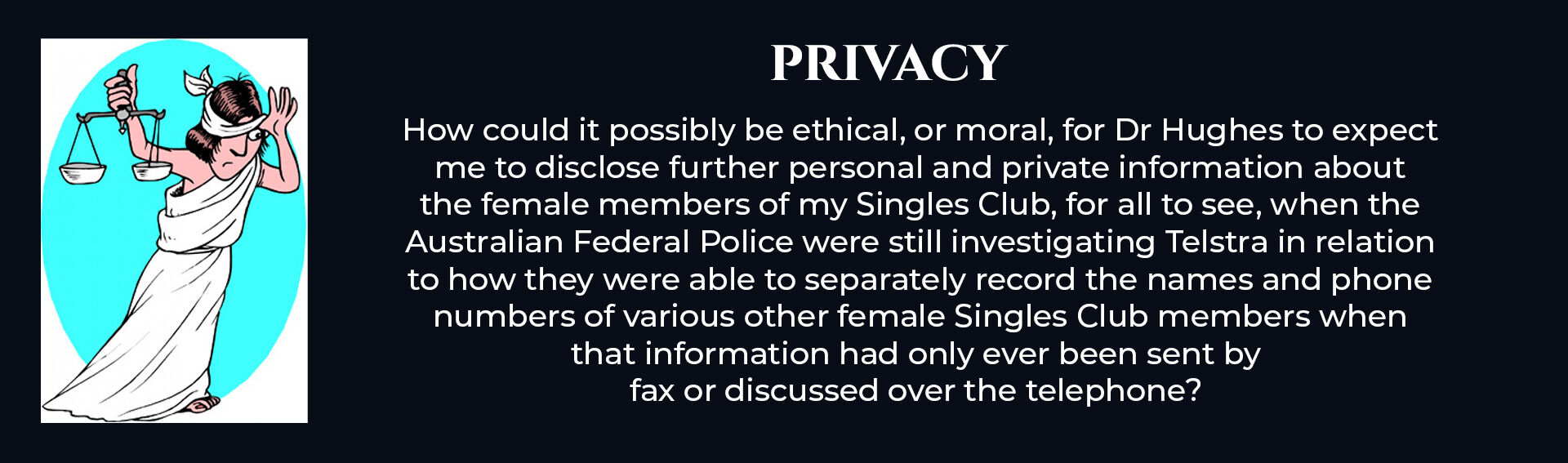
I raise my answer to question 24 regarding Telstra's interrogatories (Questions for better particulars) and the oral arbitration hearing because of the main question they raise: how could it possibly be ethical, or moral, for Dr Hughes to expect me to disclose at this meeting personal and private information about the female members of my Singles Club, for all to see when the Australian Federal Police (AFP) told this was not appropriate while they were still investigating Telstra about how Telstra was able to separately record the names and phone numbers of various female Singles Club members (which were of the Cape Bridgewater Holiday Camp, bush-walking, canoing, horse ridding (social club) which was another part of the revenue my holiday camp was losing due to the ongoing telephone problems. The AFP was trying to find out how Telstra had obtained this private information about this group, when that information had only ever been sent by those members by fax or discussed over the telephone.
It is interesting to note that NONE of my singles clubs lost revenue due to my ongoing proven telephone faults, which were never recorded by Dr Hughes (arbitrator) or Ferrier Hodgson Corporate Advisory (arbitration finacial unit) in their final findings for the Cape Bridgewater Holiday Camp.
PART FOUR
Infringe upon the civil liberties.
Most Disturbing And Unacceptable
On 27 January 1999, after having also read my first attempt at writing my manuscript, absentjustice.com, the same manuscript I provided to Helen Handbury, Sister to Rupert Murdoch, Rupert Murdoch -Telstra Scandal - Helen Handbury and Senator Kim Carr, who wrote:
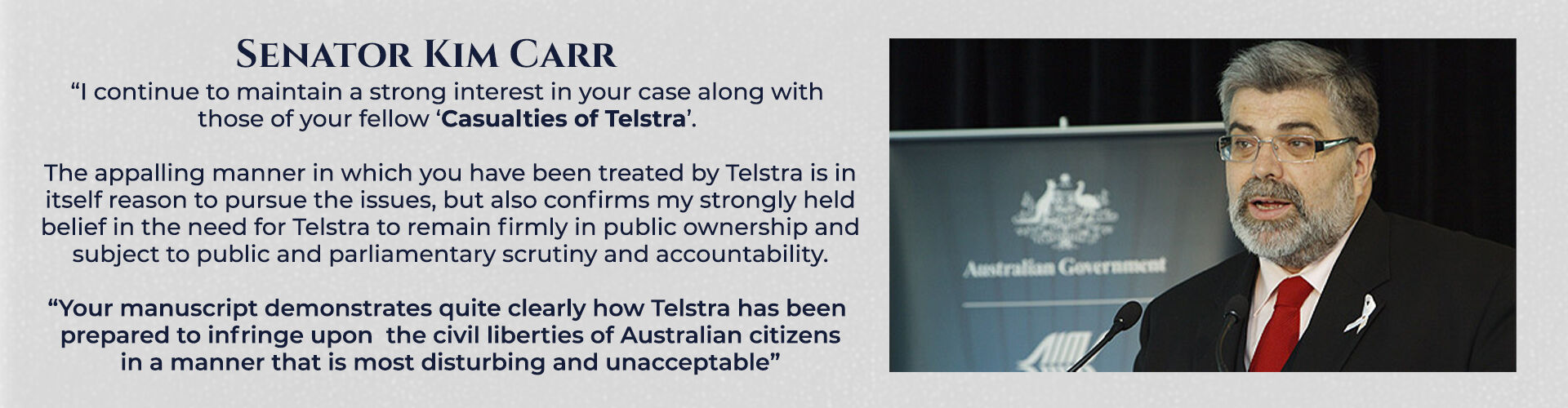
“I continue to maintain a strong interest in your case along with those of your fellow ‘Casualties of Telstra’. The appalling manner in which you have been treated by Telstra is in itself reason to pursue the issues, but also confirms my strongly held belief in the need for Telstra to remain firmly in public ownership and subject to public and parliamentary scrutiny and accountability.
“Your manuscript demonstrates quite clearly how Telstra has been prepared to infringe upon the civil liberties of Australian citizens in a manner that is most disturbing and unacceptable.”
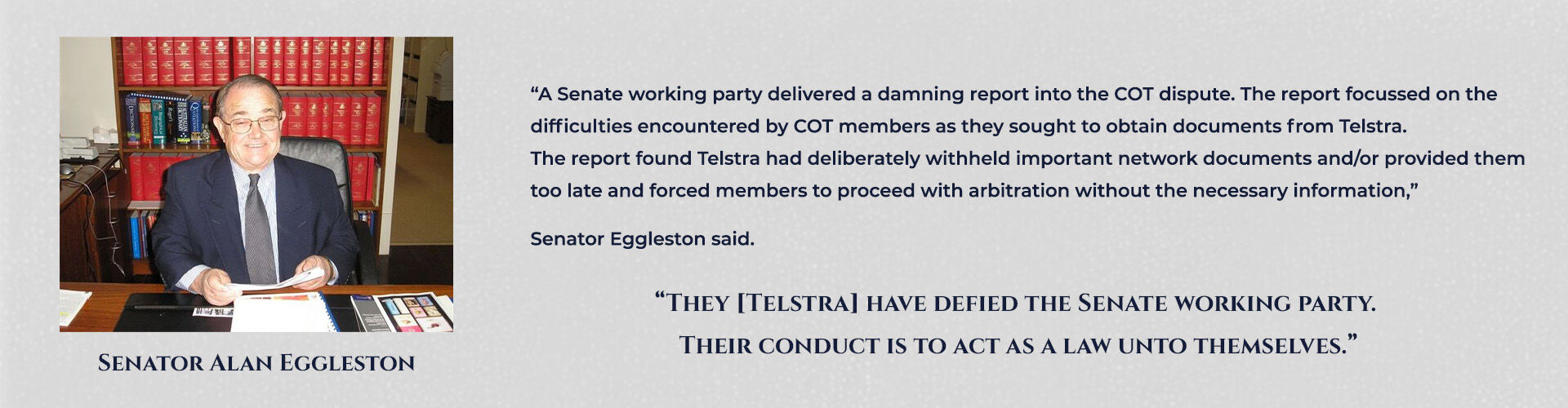
On 23 March 1999, after most of the COT arbitrations had been finalised and business lives ruined due to the hundreds of thousands of dollars in legal fees to fight Telstra and a very crooked arbitrator, the Australian Financial. Review reported on the conclusion of the Senate estimates committee hearing into why Telstra withheld so many documents from the COT cases:
“A Senate working party delivered a damning report into the COT dispute. The report focused on the difficulties encountered by COT members as they sought to obtain documents from Telstra. The report found Telstra had deliberately withheld important network documents and/or provided them too late and forced members to proceed with arbitration without the necessary information,” Senator Eggleston said. “They have defied the Senate working party. Their conduct is to act as a law unto themselves.”
Eggleston, Sen Alan – Bishop, Sen Mark – Boswell, Sen Ronald – Carr, Sen Kim – Schacht, Sen Chris, Alston and Sen Richard)
These six senators all formally record how those six senators believed that Telstra had ‘acted as a law unto themselves’ throughout all of the COT arbitrations, is incredible. The LNP government knew that not only should the litmus-test cases receive their requested documents but so should the other 16 Australian citizens who had been in the same government-endorsed arbitration process
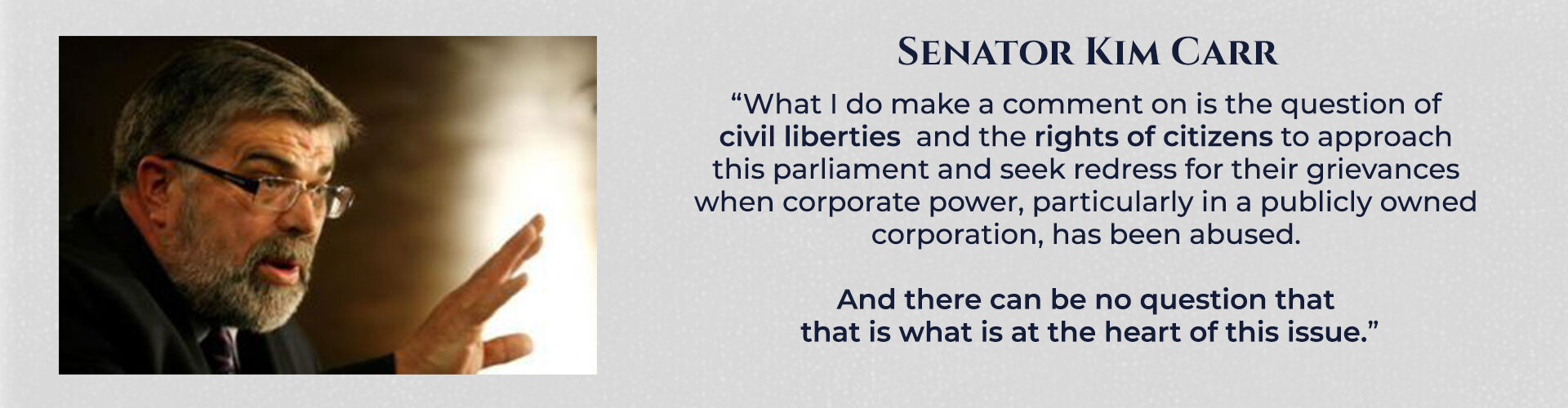
Senator Kim Carr criticised the handling of the COT arbitrations on 11 March 1999, as shown in the following Hansard link. Addressing the government’s lack of power, he said:
“What I do make a comment on is the question of civil liberties and the rights of citizens to approach this parliament and seek redress for their grievances when corporate power, particularly in a publicly owned corporation, has been abused. And there can be no question that that is what is at the heart of this issue.”
And when addressing Telstra’s conduct, he stated:
“But we also know, in the way in which telephone lines were tapped, in the way in which there have been various abuses of this parliament by Telstra—and misleading and deceptive conduct to this parliament itself, similar to the way they have treated citizens—that there has of course been quite a deliberate campaign within Telstra management to undermine attempts to resolve this question in a reasonable way. We have now seen $24 million of moneys being used to crush these people. It has gone on long enough, and simply we cannot allow it to continue. The attempt made last year, in terms of the annual report, when Telstra erroneously suggested that these matters—the CoT cases—had been settled demonstrates that this process of deceptive conduct has continued for far too long.” (See parlinfo.aph.gov.au/parlInfo/search/displaychamberhansards1999-03-11)
Senator Schacht was even more vocal:
“I rise to speak to this statement tabled today from the working party of the Senate Environment Communications, Information Technology and the Arts Legislation Committee—a committee I served on in the last parliament—that dealt with the bulk of this issue of the CoT cases. In my time in this parliament, I have never seen a more sorry episode involving a public instrumentality and the way it treated citizens in Australia. I agree with all the strong points made by my colleagues on both sides who have spoken before me on this debate. What was interesting about the Senate committee investigating this matter over the last couple of years was that it was absolutely tripartisan—whether you were Labor, Liberal or National Party, we all agreed that something was rotten inside Telstra in the way it handled the so-called CoT cases for so long.
The outcome here today is sad. There is no victory for citizens who have been harshly dealt with by Telstra.”
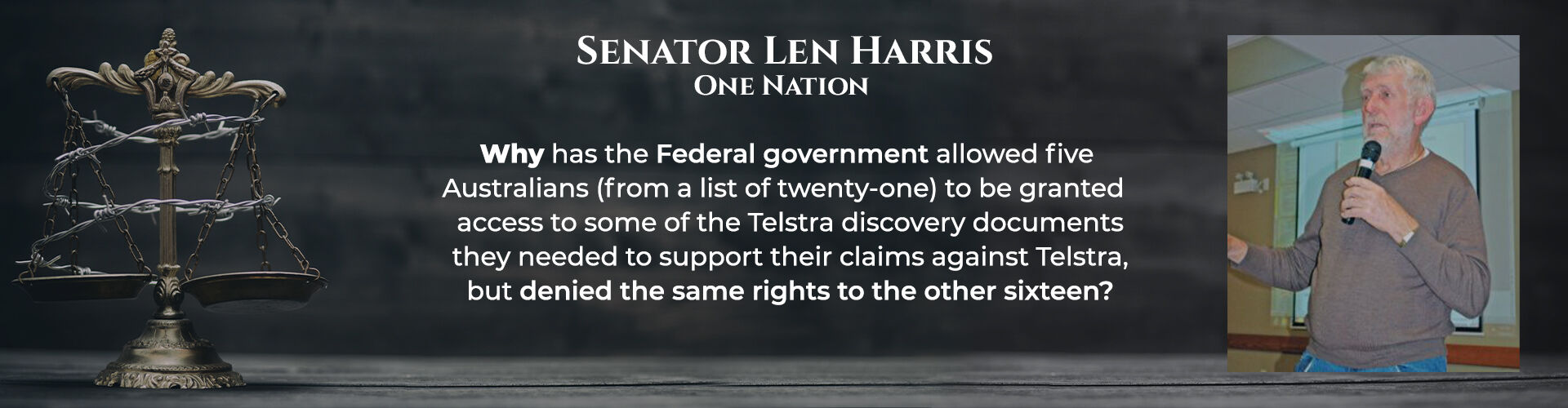
On 25 July 2002, Senator Len Harris travelled from Cairns in Queensland (a trip that took more than seven hours) to meet four other COTs and me in Melbourne to ensure our discrimination claims against the Commonwealth were thoroughly investigated. He was appalled that 16 Australian citizens were so severely discriminated against by the then-coalition government, despite a Senate estimates committee working party being established to investigate all 21 COT-type claims against Telstra.
He was stunned at how I had collated this evidence into a bound submission. Senator Harris read Senator Alan Eggleston’s 9 August 2001 letter warning me that if I disclosed the in-camera Hansard records (supporting my claims that 16 Australian citizens were discriminated against in the most deplorable manner), then I would be held in contempt of the Senate and risk jail. Senator Harris was distraught, to say the least.
At a press conference the next day, Senator Harris asked questions at the chief of staff to the Hon. Senator Richard Alston, Minister for Communications. He asked:
“Through the following questions, the media event will address serious issues related to Telstra’s unlawful withholding of documents from claimants, during litigation.
Why didn’t the present government correctly address Telstra’s serious and unlawful conduct of withholding discovery and/or Freedom of Information (FOI) documents before the T2 float?
Why has the Federal government allowed five Australians (from a list of twenty-one) to be granted access to some of the Telstra discovery documents they needed to support their claims against Telstra, but denied the same rights to the other sixteen?
Why has the Federal Government ignored clear evidence that Telstra withheld many documents from a claimant during litigation?
Why has the Federal Government ignored evidence that, among those documents Telstra did supply, many were altered or delivered with sections illegally blanked out?” (See Senate Evidence File No 56)