Australian Federal Police Investigations-1
My name is Alan Smith. I have been a member of Whistleblowers Australia, as well as other organisations that support those who risk everything to expose bribery, corruption, and wrongdoing within Australia’s so-called Establishment and legal profession, for over twenty years. However, titles have never been important to me. Committees, memberships, and labels all fall short. I have always preferred to be known simply and unapologetically as a truth teller.
This website is living proof of that commitment. It is not based on theory, rumour, or innuendo. It serves as a vault of hard evidence, thousands upon thousands of documents preserved exactly as they were created, available for anyone to view, read, or download. Nothing is hidden. Nothing is softened. Nothing is altered to suit anyone’s comfort.
Every visitor is invited to examine the material for themselves and decide, with their own eyes, whether this site reveals anything other than the truth. The record speaks. The documents convey their message clearly. And the truth, once revealed, does not retreat back into the shadows.
Echoes of Betrayal: Wheat Sales to China - and the Government bureaucrats who continued to tell Australia's politicians that what several other seamen and I had witnessed in China was a lie. The following information shows we risked all to expose the truth.
My return to Australia on 18 September 1967, after narrowly escaping being shot in China, marked a dividing line in my life. The man who left in June was not the man who came back. I returned carrying knowledge that no government wanted aired: that Australian wheat, sent to China under the banner of humanitarian aid, was being diverted to North Vietnam while their forces were killing and maiming Australian, New Zealand, and American troops. My crewmates and I witnessed it. We reported it. We warned the Commonwealth Police and The Hon. Malcolm Fraser, then Minister for the Army. And the shipments continued.
Whether that moment, that act of telling the truth, set the tone for how I would be treated over the next thirty years is a question only those inside government can answer. But the pattern is unmistakable. This website documents three decades of treatment so disgraceful it mirrors the fate of other whistleblowers who dared to expose what powerful institutions wanted buried. Horror, scandal, betrayal, the same ingredients appear again and again.
Our anger in 1967 was never directed at feeding starving civilians. None of us objected to humanitarian aid. What enraged us was the knowledge that our warnings were ignored, and that Australian wheat, sent under the banner of compassion, was being diverted straight into the supply chain of an army actively killing and maiming Australian, New Zealand, and American troops. We witnessed the diversion. We reported it. And the trade continued.
And the question that has followed me for decades is unavoidable: did my decision to expose this diversion, first to the Commonwealth Police, then to Malcolm Fraser, and later to anyone in government willing to listen, mark me as a problem to be contained? Did speaking the truth in 1967 set the tone for how I would be treated during my government‑endorsed arbitration thirty years later?
Because the pattern is unmistakable. The obstruction. The smearing. The refusal to return my arbitration documents. The redactions. The threats. The covert meetings. The manufactured allegations. The silence from every authority who should have intervened. It mirrors the fate of other whistleblowers who dared to expose what powerful institutions needed buried.
So I am left to ask, without hesitation and without apology: is this why I was treated so appallingly during my arbitration? Is this why, after three decades, I am still fighting for the justice I have never received?
That moment, the moment we spoke, sits like a fault line beneath everything that followed. The retaliation, the smearing, the obstruction, the thirty‑year campaign to discredit me: all of it fits a pattern familiar to anyone who has ever exposed a truth that powerful people needed hidden.
Whether my survival in China and my refusal to stay silent marked me as a problem to be contained is something history will decide. But the record is clear: from 1967 onward, the treatment I received was not accidental. It was systemic. And it was sustained.
The People's Republic of China
The People's Republic of China
Murdered for Mao: The killings China ‘forgot’
The Letter, the Truth, and the Waiting
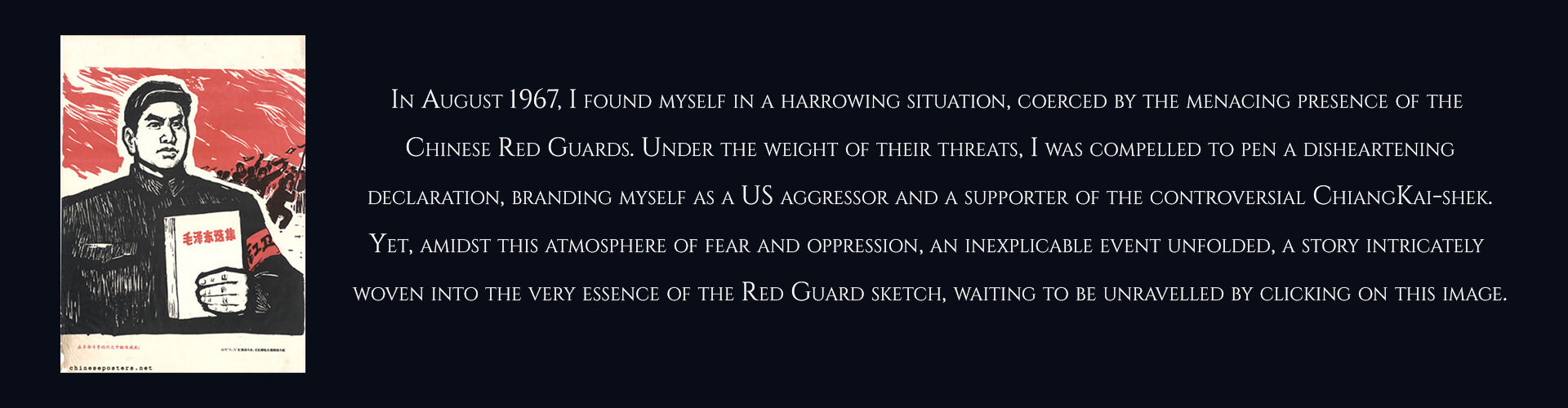
In August 1967, I found myself in a situation so precarious, so surreal, that it would etch itself into the marrow of my memory. I was aboard a cargo ship docked in China, surrounded by Red Guards stationed on board twenty-four hours a day, spaced no more than thirty paces apart. After being coerced into writing a confession—declaring myself a U.S. aggressor and a supporter of Chiang Kai-shek, the Nationalist leader in Taiwan—I was told by the second steward, who handled the ship’s correspondence, that I had about two days before a response to my letter might reach me. That response, whatever it might be, would be delivered by the head of the Red Guards himself.
It was the second steward who quietly suggested I write to my parents. I did. I poured myself into 22 foolscap pages, writing with the urgency of a man who believed he might not live to see the end of the week. I told my church-going parents that I was not the saintly 18-year-old they believed I was. I confessed that the woman they had so often thanked in their letters—believing her to be my landlady or carer—was in fact my lover. She was 42. I was 18 when we met. From 1963 to 1967, she had been my anchor, my warmth, my truth. I wrote about my life at sea, about the chaos and the camaraderie, about the loneliness and the longing. I wrote because I needed them to know who I really was, in case I was executed before I ever saw them again.
As the ship’s cook and duty mess room steward, I had a front-row seat to the daily rhythms of life on board. I often watched the crew eat their meals on deck, plates balanced on the handrails that lined the ship. We were carrying grain to China on humanitarian grounds, and yet, the irony was unbearable—food was being wasted while the people we were meant to help were starving. Sausages, half-eaten steaks, baked potatoes—they’d slip from plates and tumble into the sea. But there were no seagulls to swoop down and claim them. They’d been eaten too. The food floated aimlessly, untouched even by fish, which had grown scarce in the harbour. Starvation wasn’t a concept. It was a presence. It was in the eyes of the Red Guards who watched us eat. It was in the silence that followed every wasted bite.
A Tray of Leftovers and a Silent Exchange
After my arrest, I was placed under house arrest aboard the ship. One day, I took a small metal tray from the galley and filled it—not with scraps, but with decent leftovers. Food that would have gone into the stockpot or been turned into dry hash cakes. I walked it out to the deck, placed it on one of the long benches, patted my stomach as if I’d eaten my fill, and walked away without a word.
Ten minutes later, I returned. The tray had been licked clean.
At the next meal, I did it again—this time with enough food for three or four Red Guards. I placed the tray on the bench and left. No words. No eye contact. Just food. I repeated this quiet ritual for two more days, all while waiting for the response to my letter. During that time, something shifted. The Red Guard, who had been waking me every hour to check if I was sleeping, stopped coming. The tension in the air thinned, just slightly. And I kept bringing food—whenever the crew was busy unloading wheat with grappling hooks wrapped in chicken wire, I’d slip out with another tray.
To this day, I don’t know what saved me. It was certainly not the letter declaring myself a U.S. aggressor and a supporter of Chiang Kai-shek, the Nationalist leader in Taiwan. Maybe it was luck. Or perhaps it was that tray of food, offered without expectation, without speech, without condition. A silent gesture that said, “I see you. I know you’re hungry. I know you’re human.”
And maybe, just maybe, that was enough. British Seaman’s Record R744269 - Open Letter to PM File No 1 Alan Smith's Seaman. → Chapter 7- Vietnam-Vietcong-2
In essence, the Australian government faced an agonising moral dilemma — weighing the lives of its soldiers engaged in the conflict in North Vietnam against the desperate need to provide sustenance for an entire nation teetering on the brink of starvation. This heart-wrenching choice highlights the often-unseen complexities of international relations and humanitarian crises, revealing the painful calculations made in the pursuit of survival.
Footnote 83, 84 and 169 → in a paper submitted by Tianxiao Zhu to - The Faculty of the University of Minnesota titled Secret Trails: FOOD AND TRADE IN LATE MAOIST CHINA, 1960-1978, etc → Requirements For The Degree Of Doctor Of Philosophy - Christopher M Isett June 2021
Tianxiao Zhu's Footnotes 83, 84, 169:
In September 1967, a group of British merchant seamen quit their ship, the Hope Peak, in Sydney and flew back to London. They told the press in London that they quit the job because of the humiliating experiences to which they were subjected while in Chinese ports. They also claimed that grain shipped from Australia to China was being sent straight on to North Vietnam. One of them said, “I have watched grain going off our ship on conveyor belts and straight into bags stamped North Vietnam. Our ship was being used to take grain from Australia to feed the North Vietnamese. It’s disgusting.”
84. The Minister of Trade and Industry received an inquiry about the truth of the story in Parliament, to which the Minister pointed out that when they left Australia, the seamen only told the Australian press that they suffered such intolerable maltreatment in various Chinese ports that they were fearful about going back. But after they arrived in London, Vietnam was added to their story. Thus the Minister claimed that he did not know the facts and did not want to challenge this story, but it seemed to him that their claims about Vietnam seemed to be an “afterthought.”
169. "...In Vancouver, nine sailors refused to work on a grain ship headed to China: two of them eventually returned to work, and the others were arrested. Just when the ship was about to sail, seven more left the ship but three of them later returned to work. In Sydney, six Canadian sailors left their ship; they resigned and asked to be paid, but the Australian immigration office repatriated them. At that time, a grain ship usually had crew members of about 40 people. A British ship lost the Chief Officer and sixteen seamen, who told journalists that if the ship were going to the communist countries, they would rather go to jail than work on the ship."
The Canadian Government and Its Moral Code of Ethics
By hovering your mouse over the Canadian flag image below, you can also learn about the strong ethical principles upheld by Canadian seamen. Despite facing significant challenges, they believed that sending wheat to Communist China, especially when that wheat was being redeployed to North Vietnam, a country at war with Australia, New Zealand, and the USA, where hundreds of troops were being killed or maimed, was immoral and unethical, and therefore should not have been continued.
Yet the Australian Government made a conscious decision to maintain its trade relations with Communist China, despite knowing that a significant portion of Australia’s wheat was being diverted to North Vietnam. This wheat was not merely a trade commodity; it had the potential to sustain North Vietnamese soldiers who were directly engaged in combat against Australia and its allies during the conflict. The ramifications of this trade raised serious ethical questions about supporting a nation that opposed Australian, New Zealand, and US forces.
Examining this wheat agreement with the People's Republic of China, made during the Holt government in the mid‑1960s, is essential. This controversial deal had significant implications that were obscured by a government campaign to discredit British and Canadian merchant seamen, including me. These brave individuals tried every conceivable legal way to expose this illicit diversion of wheat to North Vietnam.
All events on this website are backed by the original documents, every exhibit, every file, every damning scrap of evidence. Click the links below to open the PDFs instantly. Follow the file numbers. Each section exposes another layer of the machinery that was supposed to deliver justice but instead protected corruption.
The 26 bracket‑numbered exhibits below each contain hundreds of documents. Evidence File-1 and Evidence-File-2 alone authenticate 156 separate mini‑stories — everyone a shard of the same rotten truth. Very few websites dare to expose corruption across multiple arbitrations with this level of transparency. Fewer still provide thousands of numbered exhibits for the public to download at no cost.
Keep reading. The unbelievable story begins the moment the exhibit numbers end, and the treachery speaks for itself.
Example 2: File 34-C -
AS-CAV Exhibit 1 to 47 – AS-CAV Exhibit 48-A to 91 – AS-CAV Exhibit 92 to 127 – AS-CAV Exhibit 128 to 180 – AS-CAV Exhibit 181 to 233 – AS CAV Exhibit 234 to 281 – AS-CAV Exhibit 282 to 323 – AS-CAV Exhibit 324-a to 420 – AS-CAV Exhibit 421 to 469 – AS-CAV Exhibit 470 to 486 – AS-CAV Exhibit 488-a to 494-e – AS-CAV Exhibits 495 to 541 – AS-CAV Exhibits 542-a to 588 – AS-CAV Exhibits 589 to 647 – AS-CAV Exhibits 648-a to 700 – AS-CAV Exhibit 765-A to 789 – AS-CAV Exhibit 790 to 818 – AS-CAV Exhibit 819 to 843 AS-CAV 923 to 946 – AS-CAV Exhibit 1150 to 1169 – AS-CAV 1103 to 1132 – AS-CAV Exhibit 1002 to 1019 – AS-CAV Exhibit 996 to 1001 – GS-CAV Exhibit 1 to 88 – GS-CAV Exhibit 89 to 154-b – GS-CAV Exhibit 155 to 215 – GS-CAV Exhibit 216 to 257 – GS-CAV Exhibit 258 to 323 GS-CAV Exhibit 410-a to 447 – GS-CAV Exhibit 448 to 458 – GS-CAV Exhibit 459 to 489 – GS-CAV Exhibit 490 to 521 – GS-CAV 522 to 580 – GS-CAV Exhibit 581 to 609

Absent Justice Part 1, Part 2 and Part 3
Government Corruption. Corruption in the public service, where misleading and deceptive conduct has spuriously over more than two decades perverted the course of justice.

Telstra's Falsified BCI Report 2
Corruption, misleading and deceptive conduct plagued the COT with the government's sanctions, which endorsed the arbitrations. Learn the names of those who participated in these horrendous crimes that equally corrupted arbitrators who ignored this conduct.

Telstra's Falsified SVT Report
Corruption, misleading and deceptive conduct plagued the COT with the government's sanctions, which endorsed the arbitrations. Learn the names of those who participated in these horrendous crimes that equally corrupted arbitrators who covered up these atrocities

Senate Evidence
The criminal delinquency of those involved in the COT Cases corrupted arbitrations continued to practive their evil and crooked style of justice on other citizens who, like the Casualties of Telstra have had their lives ruined.

An Injustice to the remaining 16 Australian citizens
This type of skulduggery is treachery, a Judas kiss with dirty dealing and betrayal. This is dirty pool and crookedness and dishonest. This conduct fester’s corruption. It is as bad, if not worse than double-dealing and cheating those who trust the ground you walk on. Sheer Evil.<

China-Flash-Back-AFP Investigation -2
Read about the corruption within the government bureaucracy that is plaguing COT arbitrations. Learn who committed these horrendous crimes that equally corrupted lawyers and crooked arbitrators who covered up these crimes.
Telecommunications Industry Ombudsman
Corruption in government, including non-government self-regulators, undermines the credibility of that government. It erodes the trust of its citizens.

C A V Part 1, 2 and 3
Sadly, corruption and collusive practices are rife in the Australian ‘Establishment’ and this terrible situation prevents us from telling our story in a brief way. We had no alternative but to produce it the way we have here.
Blowing The Whistle
Blowing The Whistle was established on absentjustice.com to show our readers that the COT Cases arbitrations were nothing more than a sham set up to protect a government-owned asset.
Kangaroo Court - Absent Justice
From financial devastation to emotional pain, the dangers of identity theft are considerable.

Spurious and Unscrupulous Conduct
The first remedy pursued
The website that triggered the deeper exploration into the world of political corruption stands shoulder to shoulder with any true crime
The second remedy pursued
Checkout our bribery and corruption part & part and learn how deception undermines the credibility of those businesses who have been subjected to criminal legal abuse.
The third remedy pursued
Bribery and Corruption have many evil faces and ‘grey’ areas within Australia’s politically-corrupt government. Criminal wrongdoings interact with the private sector: the revolving door of deception.

The fourth remedy pursued
Bribery and Corruption have many evil faces and ‘grey’ areas within Australia’s politically-corrupt government. Criminal wrongdoings interact with the private sector: the revolving door of deception. Corrupt practices.

The fifth remedy pursued
Corruption in government, including non-government self-regulators, undermines the credibility of that government. It erodes the trust of its citizens, who are left without guidance. Bribery and Corruption is cancer that destroys economic growth.
The sixth remedy pursued
Corruption in government, including non-government self-regulators, undermines the credibility of that government. It erodes the trust of its citizens, who are left without guidance. Bribery and Corruption is cancer that destroys economic growth.
The seventh remedy pursued
Corruption in government, including non-government self-regulators, undermines the credibility of that government. It erodes the trust of its citizens, who are left without guidance. Bribery and Corruption is cancer that destroys economic growth.
The eighth remedy pursued
Legal abuse, or legal bullying, happens when someone uses the law or legal threats to control and scare you. Using this type of corrupt and deceptive conduct is evil and unscrupulous.
The ninth remedy pursued
Legal abuse, or legal bullying, happens when someone uses the law or legal threats to control and scare you. Using this type of corrupt and deceptive conduct is evil and unscrupulous
The tenth remedy pursued
Legal abuse, or legal bullying, happens when someone uses the law or legal threats to control and scare you. My corruption and misleading and deceptive conduct evidence provided to Consumer Affairs Victoria was not acted upon.
The eleventh remedy pursued
Check out our website, which shows evil wrongdoing, such as using false reports to the judge and arbitrator to stop you from getting legal advice, interfering with or destroying legal documents that belonged to you, and destroying your documents.