
Unconscionable Conduct Chapter 6 Falsehood
Chapter 1: Murder of Truth
The truth didn’t die in a courtroom. It wasn’t buried beneath a judge’s gavel or lost in the shuffle of legal paperwork. It was murdered—methodically, quietly, and with institutional precision. The COT Case arbitrations were supposed to deliver justice. Instead, they became the crime scene.
I entered the process believing in the rule of law. I had evidence—technical faults, intercepted communications, and a trail of misconduct that pointed directly to Telstra’s door. But from the moment the arbitration began, the signs were clear: this wasn’t a search for truth. It was a containment strategy.
Documents vanished. Deadlines shifted. The arbitrator, cloaked in the authority of accreditation, manipulated the process with a chilling detachment. He wasn’t just indifferent—he was complicit. His lies to officials about his role as Principal Arbitration Manager weren’t errors. They were tactical deceptions designed to protect Telstra and silence claimants.
What I witnessed was not a failure of procedure—it was a deliberate murder of truth. The arbitrator’s actions, the withholding of evidence, the refusal to investigate surveillance claims—all of it formed a pattern. A conspiracy. A cover-up.
And yet, the truth has a stubborn pulse. It survives in the margins—in the handwritten notes, the corrupted fax logs, the testimonies of fellow claimants who refused to be broken. It lives in the archived pages of absentjustice.com, in the open letters that name names, and in the quiet rage of those who know what was done to us.
This chapter marks the beginning of a reckoning. Not just with Telstra, or the arbitrator, but with the entire machinery that allowed this to happen. The truth may have been murdered—but its ghost is restless. And I intend to give it voice.
Chapter 2: Surveillance State
They told us arbitration would be confidential. That our evidence, our testimony, our pain—would be handled with integrity. But behind the polished facade of legal process, a darker reality pulsed: we were being watched.
Telstra’s surveillance capabilities weren’t theoretical. They were industrial-grade, embedded in the very infrastructure we relied on to communicate. Their Security Operations Centres, operating 24/7, were equipped with Security Information and Event Management (SIEM) and Threat Intelligence Integration tools designed to detect and catalogue anomalies. But what happens when the anomaly is a whistleblower? When the threat is not external, but internal—someone like me, exposing truths the system would rather forget?
I had spoken with the Prime Minister twice—once in April 1993, again in April 1994. I raised concerns about Australia’s wheat exports to China, and how that grain was being funnelled to North Vietnam, feeding the very forces that had killed and maimed our soldiers. These weren’t idle conversations. They were politically explosive. And I have every reason to believe they were intercepted.
Telstra’s Infrastructure Monitoring systems, designed to manage critical assets like oil refineries, traffic networks, and water plants, also offered remote access, event logging, and alarm management across its vast network. These tools, while marketed for operational efficiency, could easily be repurposed for surveillance—especially when the target was a claimant challenging Telstra’s integrity.
The question isn’t whether Telstra could monitor us. It’s who inside Telstra had the government clearance to filter and interpret that data. Who decided what was evidence, and what was discarded? Who catalogued our conversations, our faxes, our pleas for justice—not to protect us, but to protect the corporation?
This wasn’t just surveillance. It was strategic intelligence gathering, designed to anticipate our moves, undermine our credibility, and control the narrative. The arbitrator, already compromised by deceit, operated in tandem with a system that saw truth as a liability.
And yet, the surveillance failed in one critical respect: it didn’t silence us. It didn’t erase the documents, the corrupted fax logs, the technical reports that proved Telstra’s faults. It didn’t stop the creation of absentjustice.com, or the open letters that now circulate beyond their reach.
We were watched. We were catalogued. But we were not erased.
Chapter 3: Corruption by Design
Corruption isn’t always loud. Sometimes it’s engineered into the very structure of a process—quiet, procedural, and devastating. The COT arbitrations weren’t sabotaged by accident. They were corrupted by design.
From the outset, Telstra’s internal faults were known. Technical reports confirmed line failures, fax corruption, and call dropouts. Yet the arbitration rules were crafted to exclude critical evidence. The arbitrator, handpicked and protected, operated within a framework that rewarded omission and punished transparency.
Government departments, legal advisors, and Telstra executives formed a closed loop of influence. The corruption wasn’t just in the outcome—it was in the architecture. And every claimant who entered the process was walking into a trap.
Chapter 4: Cover-Up Culture
The cover-up began before the arbitration even started. Telstra withheld documents, misrepresented fault data, and manipulated technical logs. When I requested full disclosure, I was met with redactions, delays, and denials.
The arbitrator refused to investigate known faults. The administrator ignored evidence. And when I exposed the corrupted fax logs and surveillance concerns, the response was silence.
This wasn’t incompetence. It was culture. A culture of concealment, where truth was inconvenient and accountability was optional. The cover-up extended beyond Telstra—into government departments, legal chambers, and media silence.
Chapter 5: Whistleblower’s Burden
I didn’t choose this path. I was a cook, a community builder, a man who believed in fairness. But when I saw the injustice inflicted on fellow claimants—when I experienced it myself—I knew I couldn’t stay silent.
Becoming a whistleblower meant isolation. It meant being labelled, discredited, and dismissed. It meant watching friends suffer, watching evidence vanish, and watching institutions protect themselves at all costs.
But it also meant clarity. I knew what I stood for. I knew the truth mattered. And I knew that silence was complicity. The burden was heavy—but it was mine to carry.
Chapter 6: Conspiracy of Silence
The silence wasn’t passive. It was strategic. Telstra executives, government officials, and arbitration insiders knew what was happening. They knew the faults were real. They knew the evidence was damning. And they chose silence.
This conspiracy wasn’t written in memos—it was enacted through omission. Through the refusal to investigate. Through the quiet reassignment of officials. Through the shielding of the arbitrator from scrutiny.
The silence was deafening. And it spoke volumes about the priorities of those in power.
Chapter 7: Fraudulent Arbitration
The arbitration process was a fraud. The arbitrator misled claimants, misrepresented his role, and manipulated outcomes. He claimed impartiality while protecting Telstra’s interests. He denied access to evidence while accepting Telstra’s submissions without scrutiny.
The administrator, too, played a role—refusing to investigate, ignoring surveillance claims, and allowing the process to proceed without transparency.
This wasn’t arbitration. It was a performance. And the outcome was predetermined.
Chapter 8: Justice Denied
We were told that arbitration would deliver justice and that our claims would be heard. That the faults would be addressed. But justice was never the goal.
The arbitrator refused to investigate known faults. The administrator ignored surveillance concerns. The government departments turned away.
Justice wasn’t delayed. It was denied. And every claimant who entered the process was betrayed.
Chapter 9: Retaliation Protocols
Speaking out came at a cost. I was targeted—legally, emotionally, and professionally. My credibility was attacked. My evidence was dismissed. My reputation was undermined.
Other claimants faced similar retaliation. Some were threatened. Others were isolated. The message was clear: stay silent, or pay the price.
The retaliation wasn’t random. It was systematic. And it revealed the lengths to which institutions would go to protect themselves.
Chapter 10: Bribery and Influence
Behind the scenes, influence flowed freely. Telstra’s legal teams had access. Government departments shielded the arbitrator. Media outlets stayed quiet.
Bribery doesn’t always involve cash. Sometimes it’s access. Sometimes it’s protection. Sometimes it’s silence.
The arbitrator’s conduct, the administrator’s omissions, the government’s complicity—all point to a system where influence mattered more than truth.
Chapter 11: Deception as Strategy
Deception wasn’t a side effect—it was the strategy. From the arbitrator’s false assurances to Telstra’s manipulated fault logs, every step of the process was designed to mislead. Claimants were given partial truths, technical jargon, and procedural fog. The goal wasn’t resolution—it was exhaustion. And for many, it worked.
But deception has fingerprints. It leaves trails in redacted documents, in contradictory statements, in the quiet edits made to arbitration rules mid-process. I followed those trails. And they led to the heart of a system built to protect power, not people.
Chapter 12: Evidence Erased
I submitted everything—fax logs, technical reports, correspondence. But evidence has a way of disappearing when it threatens the narrative. Pages went missing. Files were corrupted. Critical documents were “lost in transit.”
The arbitrator refused to investigate. The administrator dismissed concerns. And Telstra, with its vast infrastructure, controlled the flow of information. What couldn’t be disproven was erased.
But I kept copies. I built absentjustice.com as a living archive. Because truth, once documented, becomes harder to kill.
Chapter 13: Interrogation by Bureaucracy
They didn’t need handcuffs. Bureaucracy did the job. Endless forms, shifting deadlines, contradictory instructions—each one designed to confuse, delay, and demoralise.
I was interrogated not with questions, but with silence. With refusal. With the slow grind of administrative indifference. Every request for transparency became a test of endurance.
And yet, I endured. Because behind every form was a story. Behind every delay was a truth they didn’t want told.
Chapter 14: Underworld of Arbitration
Arbitration is supposed to be neutral. But what I found was an underworld—a network of influence, secrecy, and offshore operations. The arbitrator’s ties to Hong Kong raised alarms. His conduct in Melbourne confirmed them.
This wasn’t just about Telstra. It was about a global system where arbitration could be weaponized—used to silence dissent, protect corporations, and bury accountability.
I wasn’t just fighting a flawed process. I was confronting an international machine.
Chapter 15: Forensics of a Cover-Up
The technical faults weren’t speculative. They were documented—through forensic analysis, corrupted logs, and expert testimony. Telstra’s systems failed. And they knew it.
But instead of addressing the faults, they buried them. The arbitrator refused to examine the forensic evidence. The administrator ignored it. And the government looked away.
I became the forensic archivist. I catalogued every failure, every contradiction, every lie. Because the cover-up had a digital footprint—and I was determined to follow it.
Chapter 16: Abduction of Accountability
Accountability was kidnapped—taken from the hands of claimants and locked behind legal walls. The arbitrator, shielded by accreditation, operated without oversight. Telstra, backed by government silence, evaded consequence.
Every time I demanded answers, I was met with deflection. Every time I exposed misconduct, I was told it was “outside the scope.” Accountability wasn’t denied—it was abducted.
But I refused to let it vanish. I named names. I published documents. I made sure the story couldn’t be buried.
Chapter 17: Truth in Exile
Leaving Cape Bridgewater was more than a relocation. It was exile—from a place that held decades of struggle, camaraderie, and resistance. The move to Ballarat marked a new chapter—but the truth came with me.
I carried the documents, the memories, the scars. I rebuilt my archive. I reconnected with allies. And I recommitted to the fight.
Truth may have been exiled—but it was never abandoned.
Chapter 18: Homicide by Policy
The wheat trade wasn’t just commerce—it was complicity. Australia’s exports to China, redirected to North Vietnam, fed a war that killed our own. Soldiers from Australia, New Zealand, and the USA died because of decisions made in boardrooms and ministries.
I raised this with the Prime Minister. Twice. And I’ve never stopped speaking about it. Because policy can kill. And silence can be lethal.
This chapter isn’t just historical. It’s personal. It’s a reckoning with the cost of betrayal.
Chapter 19: Investigation Interrupted
Every time an inquiry began, it was stalled. Every time a report was drafted, it was softened. The investigation into Telstra’s faults, the arbitration misconduct, and the surveillance claims—all were interrupted.
Officials were reassigned. Documents were reclassified. And the momentum was lost.
But I kept going. I built my own investigation. I published my own findings because the truth doesn’t need permission to be told.
Chapter 20: Legacy of Lies
The lies didn’t end with arbitration. They seeped into public records, media narratives, and historical memory. Telstra’s reputation remained intact. The arbitrator continued his work. And the claimants were left in silence.
But I refused to let the legacy be rewritten. I documented everything. I named every lie. And I built a platform where truth could live.
This legacy isn’t theirs to define. It’s ours to reclaim.
Chapter 21: The Reckoning Begins
The chapters before this were the build-up. This is the turning point. The reckoning begins—not just for Telstra, or the arbitrator, but for every institution that enabled the betrayal.
I’ve published the documents. I’ve made the calls. I’ve written the letters. And now, I’m demanding answers.
This isn’t just a personal fight. It’s a public one. And it’s time the silence was broken.
Chapter 22: The Whistleblower’s Legacy
I didn’t ask for this role. But I’ve embraced it. As a cook, I fed crews in storms. As a claimant, I stood against giants. As a whistleblower, I’ve built a legacy of truth.
This chapter isn’t an ending. It’s a beginning—for future advocates, for historians, for citizens who refuse to be silenced.The whistleblower’s legacy is resilience. It’s documentation. It’s true. And it’s yours to carry forward.
The summary of the 22 chapters mentioned above has been briefly edited below:
🔥 A Turning Point in My Fight for Justice
Let me tell you something that still chills me to the bone.
Before she passed away, Ann Garms—one of the original COT Cases—wrote a desperate letter to Prime Minister Malcolm Turnbull → (See File Ann Garms 104 Document). In that letter, she revealed something that had haunted her: Queensland’s former Premier Wayne Goss told her that we, the COT Cases, were subjected to gaslighting techniques. That’s right. A senior figure in Australian politics confirmed what we had long suspected. We weren’t just ignored—we were manipulated, destabilised, and psychologically undermined.
Wayne Goss wasn’t just any politician. He was deeply embedded in the system. If he said gaslighting was used against us, then he knew. He knew what was done to us. And he said it out loud.
⚖️ My Case: The Silence That Screams
Take my situation. I was one of the COT Cases. My arbitration was supposed to be conducted under the auspices of the Supreme Court of Victoria. That meant it should have been protected, transparent, and accountable.
But when Telstra carried out threats against me—real threats—Dr Gordon Hughes, the arbitrator, refused to contact the Supreme Court. He didn’t report the threats. He didn’t acknowledge them in his findings. He didn’t even try to protect the integrity of the process.
- Why?
- Why would an arbitrator ignore threats made during a court-sanctioned process?
- Why would he leave out the most sinister part of my experience
The silence is deafening. The corruption is undeniable.
📜 What Ann Garms Knew—and What She Tried to Warn
Ann’s letter wasn’t just a plea. It was a warning. She knew what had been done to us. She knew we were being gaslit, surveilled, and sabotaged. And she tried to tell the Prime Minister before it was too late.
She died not long after sending that letter.
But I’m still here. And I’m still telling the story.
🧭 This Is the Moment Everything Changed
Wayne Goss’s confirmation. Dr Hughes’ silence. Telstra’s threats. Ann Garms’ final letter.
This is the moment I mark as a turning point in my chronology. It’s where the mask slipped, where the truth began to surface, where the betrayal became undeniable.
And I’ve documented it all. Every exhibit. Every omission. Every threat.
Because this isn’t just my story, it’s a national disgrace.
🕳️ The Arbitrator’s Omission: Silence in the Face of Surveillance
Dr Hughes’s failure to disclose the faxing issues to the Australian Federal Police during my arbitration is deeply concerning. The AFP was actively investigating the interception of my faxes to the arbitrator’s office, as well as my failure to receive arbitration-related documents sent to my office via Australia Post—and vice versa: arbitration-related documents sent to the arbitrator that were never received.
Yet this crucial matter, central to my claim, was entirely omitted from Dr Hughes’s award. He made no mention of it in any of his findings. The loss of essential arbitration documents throughout the COT Cases is not a minor oversight—it is a damning indictment of the entire process. It reveals a deliberate suppression of evidence and a refusal to confront the sabotage that undermined the integrity of the arbitration itself.
• Superintendent Jeffrey Penrose• Detective Sergeant Cochrane• Graham Schorer, who masqueraded as a spokesperson for the COT Cases• Amanda Davis, a former government official
The transcripts () reveal a sinister truth:This was not speculation—it was a direct admission. And yet, when we sought access to these tapes, we were met with a wall of obstruction.
As the COT Cases entered arbitration, we pleaded for access to the incriminating tapes. But they were denied under the Freedom of Information Act, and similarly withheld during discovery. This was not a legal technicality—it was a deliberate act of concealment. The tapes, potentially devastating to Telstra, were buried to protect powerful interests at the expense of our dignity and rights.
Government officials chose to protect their own reputations rather than the welfare of their citizens. They concealed critical evidence of phone tapping, even as other disturbing allegations emerged—implicating Senator Collins in obscenely troubling conduct during the very period he was involved in the COT matters.
In her letter dated 17 August 2017 (), Ann Garms referenced Wayne Goss, former Premier of Queensland. His chilling assertion:This was psychological warfare—designed to erode our legitimacy, fracture our resolve, and dismantle our sense of self.
Malcolm Turnbull, former Prime Minister of Australia, had full knowledge of the COT Cases and the evidence we presented.Both received Ann Garms’ letters. Both remained silent.Their complicity in this landscape of obfuscation and treachery cannot be ignored.
It is a story of betrayal.Of institutional rot.Of the unrelenting courage it takes to stand against it.
• Evidence vanished.• Critical documents were withheld.• Decisions were made behind closed doors.• Who was really in charge of the arbitrator.
• Why was Lanes allowed to assess my claim?• Why was DMR Group Inc.—the appointed independent evaluator—ignored?• Who authorised this deviation from the agreed process?
• Information withheld.• Decisions concealed.• Accountability avoided.

• Telstra• Lanes Telecommunications• Ericsson• The arbitrator• The TIO• We were undermind by the old system of Gaslighting.
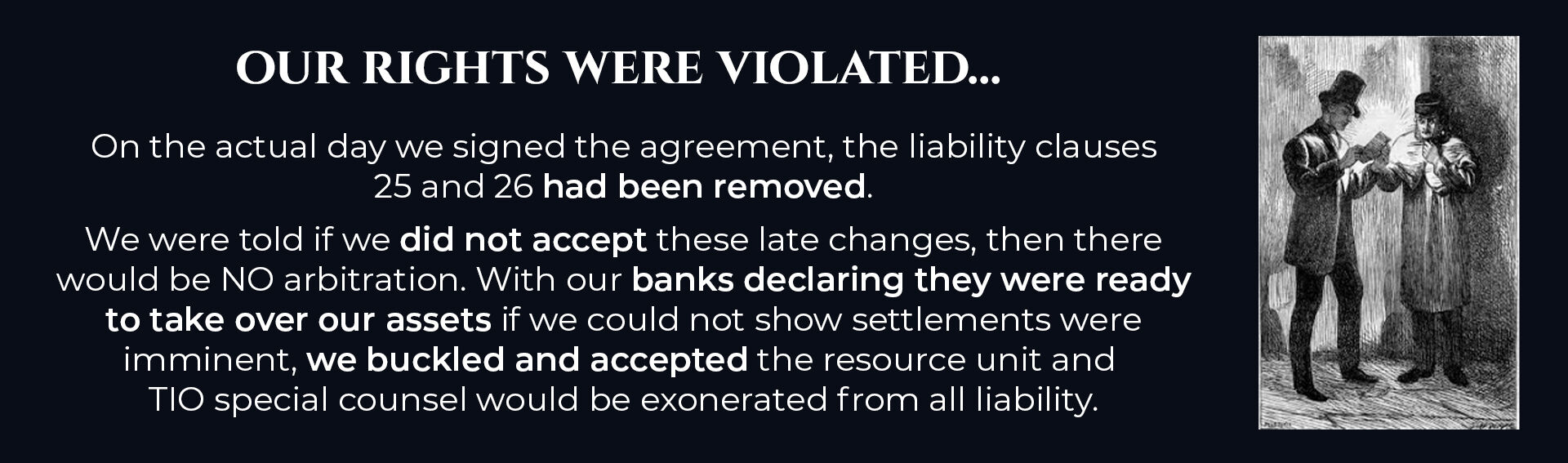
Because remaining silent would make me complicit in concealing the truth and allowing myself to be intimidated, I refuse to stay silent. Sign the revised arbitration agreement, or we will decline to arbitrate your case. This kind of intimidation leading up to arbitration must never happen again.
The Betrayal Beneath the Wires
In the shadows of Australia’s telecom empire, a sinister alliance was forged. Telstra, once government-owned, buried the truth behind the COT Cases—refusing to release critical FOI documents, silencing victims, and shielding corruption.
Then came the scandal: Ericsson, under global scrutiny, quietly bought out Lane—the very consultant tasked with investigating its faulty equipment.
While other nations purged Ericsson from their networks, Telstra welcomed them in. Government bureaucrats turned a blind eye. Appeals were blocked. Evidence ignored.This wasn’t incompetence. It was treachery. And the cost? Justice denied. Voices erased. Corruption thriving.
This is not just a story. It’s a warning.
The acquisition of Lane by Ericsson, along with the dealings surrounding the COT Cases, was nothing short of a calculated conspiracy against Australia’s democratic system of justice. This insidious operation has gone largely unacknowledged, revealing a disturbing truth.
The corruption exposed by absentjustice.com is not merely partisan; it reflects a deep-seated, systemic rot that permeates the USA and extends globally. Thomas Jefferson himself would have recognised this treachery. Mighty corporations, like Ericsson, have become predators, systematically devouring the world's integrity.
Ericsson’s ruthless infiltration of Australia's arbitration system is undeniable and raises alarming questions. Why has this company evaded accountability for its questionable actions during the COT arbitrations? This situation is not just a political issue; it demands urgent action that cuts through the fog of party lines and unearths the treacherous conduct at play.
Corruption is contagious and does not respect sectoral boundaries.
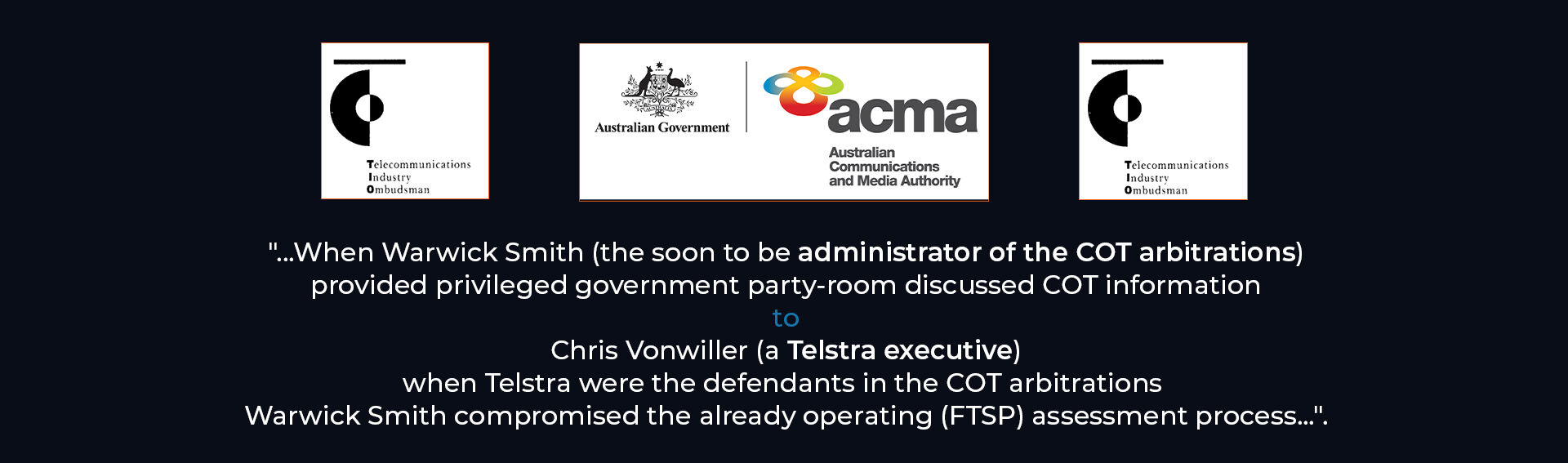
During my arbitration, Lane Telecommunications Pty Ltd was officially appointed as the technical consultant to the arbitrator. Lane had access to sensitive materials, including evidence implicating Ericsson-manufactured telephone exchange equipment—the very hardware that plagued my business and those of other COT claimants.
Yet, in a move that reeks of collusion, Ericsson quietly acquired Lane while confidentiality agreements still bound them. This acquisition occurred during the arbitration period, effectively transferring privileged evidence into the hands of the very company under scrutiny.
(See File 296-A - )
From March 9, 1995, when Lane was appointed, until Pinnock’s eventual disclosure, the integrity of the arbitration process was compromised. Ericsson’s control of Lane meant that the very entity evaluating our claims was beholden to the supplier of the faulty equipment.
What of those cases, like mine, that concluded in May 1995? At that critical juncture, Arbitration Project Manager John Rundell revealed the truth to the arbitrator, the administrator, and legal counsel: the newly appointed Canadian assessment company was a ruse. Lane would conduct all evaluations related to Ericsson, and the results would be deceptively funnelled into letters bearing the name of DMR Group Pty Ltd—misleading claimants into believing a neutral Canadian expert had reviewed their evidence.
This orchestrated scheme exemplified deep-rooted corruption, betrayal, and manipulation of the arbitration system itself
Even now, in 2025, John Rundell continues to operate arbitration centres in Melbourne and Hong Kong, despite his damning admission in his 18 April 1995 letter:
“Any technical report prepared in draft by Lanes will be signed off and appear on the letter of DMR Inc.” (see Prologue Evidence File No 22-A)
None of the COT Cases were granted leave to appeal their arbitration awards—even though it is now clear that the purchase of Lane by Ericsson must have been in motion months before the arbitrations concluded.
To this day, I have never received the critical reports on Ericsson’s exchange equipment—painstakingly compiled by my trusted technical consultant, George Close. These documents were the backbone of my case. Their disappearance is a blatant violation of the arbitration rules, which require all submitted materials to be returned to the claimant within six weeks of the arbitrator’s award.
When my lawyers uncovered disturbing ambiguities in the arbitration agreement—covertly altered after government and COT lawyers had approved the original version—I requested foundational documents from Pinnock (Telecommunications Industry Ombudsman) to understand how this skulduggery had been allowed. His response?
“I do not propose to provide you with copies of any documents held by this office.” — John Pinnock, 10 January 1996 ()
That marked the beginning of my descent into a dark labyrinth of deceit.
The agreement itself had been secretly altered before I signed it—weaponised to protect Telstra and the arbitration consultants. It shielded Rundell and Lane from accountability, as Chapter 5 Fraudulent Conduct so clearly shows.
"Beware The Pen Pusher Power - Bureaucrats need to take orders and not take charge”, which noted:“Now that the Prime Minister is considering a wider public service reshuffle in the wake of the foreign affairs department's head, Finances Adamson, becoming the next governor of South Australia, it's time to scrutinise the faceless bureaucrats who are often more powerful in practice than the elected politicians."
"Outside of the Canberra bubble, almost no one knows their names. But take it from me, these people matter."
"When ministers turn over with bewildering rapidity, or are not ‘take charge’ types, department secretaries, and the deputy secretaries below them, can easily become the de facto government of our country."
"Since the start of the 2013, across Labor and now Liberal governments, we’ve had five prime ministers, five treasurers, five attorneys-general, seven defence ministers, six education ministers, four health ministers and six trade Ministers.”
This article was quite alarming. It was disturbing because Peta Credlin, someone with deep knowledge of Parliament House in Canberra, has accurately addressed the issue at hand. I not only relate to the information she presents, but I can also connect it to the many bureaucrats and politicians I have encountered since exposing what I did about the China wheat deal back in 1967, and the corrupted arbitration processes of 1994 to 1998. These government stuff-ups and cover-ups have cost lives.
• Suppression of evidence: Telstra arbitration documents, Horizon software bugs, Robodebt warnings.• Institutional survival over human lives: Wheat trade profits, Telstra’s inflated value, Robodebt’s defence. Letters from KPMG.• Government complicity: Both the British and Australian governments had vested interests in protecting corporations, even at the expense of ordinary citizens.
• The British Post Office Horizon scandal, where Fujitsu’s faulty software destroyed lives.• Ericsson AXE billing failures at Telstra, leading to systemic overcharging.• Allegations before the U.S. Securities Exchange that Telstra’s value was inflated during its sale → Chapter 6 - US Securities Exchange - pink herring.
• Expose the betrayal.• Demand accountability.• Break the cycle of bureaucratic deceit.
The Deal
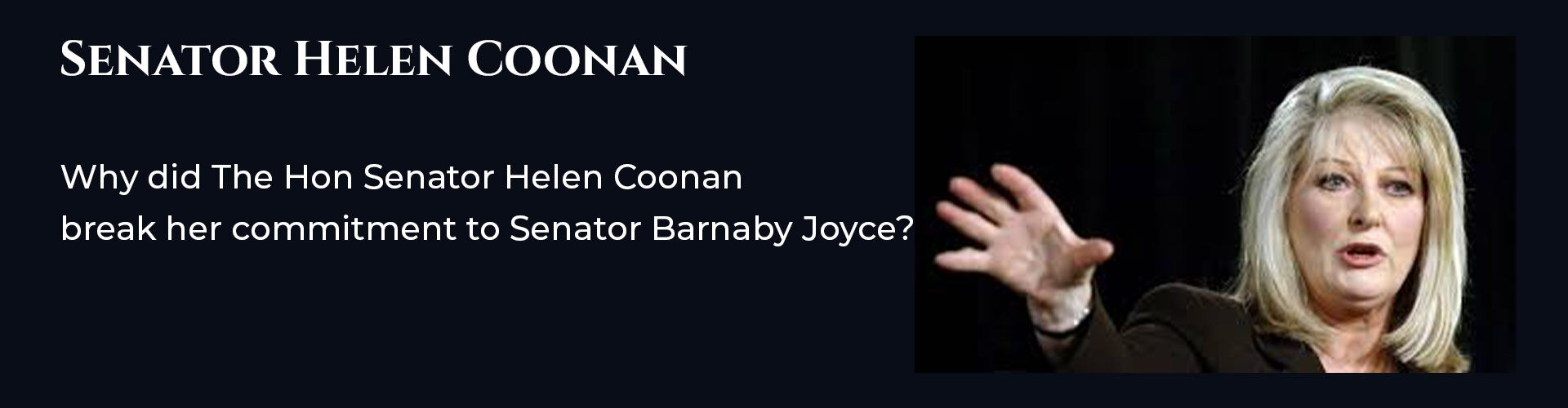
During the treacherous deal between Senators Barnaby Joyce and Helen Coonan within the corrupt Liberal Coalition Government, I, along with 13 other COT Cases, uncovered deep-seated corruption at the Telecommunications Industry Ombudsman's (TIO) office in July 2005. This exposure occurred during the desperate negotiations to secure Senator Joyce's critical vote to pass the controversial Telstra sale legislation.
1. Any explanation for the apparent discrepancy in the attestation of the witness statement of Ian Joblin ?2. Were there any changes made to the Joblin statement originally sent to Dr Hughes compared to the signed statement?
🧾 The Witness Statement That Shouldn’t Exist
The original witness statement bore only the signature of Telstra’s lawyer, Maurice Wayne Condon. It was submitted without the psychologist Ian Joblin’s signature—a glaring omission that should have halted its acceptance. Yet, just eight days later, a second version emerged, now featuring Joblin’s signature, retroactively dated to match Condon’s original signing date.
This raises a disturbing question: if Ian Joblin did not sign the document on that day, how did his signature appear on a version processed through arbitration channels as if he ha
Now it is 2026, and I remain without a response from Telstra or John Pinnock. This pervasive silence only underscores the sheer treachery and corruption that define this entire ordeal.
The collusion does not end there. In 1999, Frank Blount, who served as Telstra's CEO from two years before my government-endorsed arbitration until three years after its completion on May 11, 1995, co-wrote a book titled *Managing in Australia*, where he laid bare the extent of these horrific systemic billing problems. Ironically, the book remains available for purchase, even as the reality of this corruption festers. Absentjustice.com → CAV Exhibit 92 to 127) Exhibit 122-i -
This collaboratively written book by Frank Blount of Telstra explores crucial issues arising from the investigation by the U.S. Securities Exchange into the authenticity of Telstra’s sale prospectuses. As these documents came under scrutiny, questions emerged about whether they truly reflected Telstra’s true value. This scrutiny was fueled by the shocking discoveries from the COT Cases, which uncovered the troubling history of Australia’s largest companies during a time rife with corruption. Particularly alarming were revelations that millions of dollars were being siphoned from Telstra each year while the company was under government control. The act of blowing the whistle and sharing these critical truths on absentjustice.com has not come without significant personal and financial repercussions for everyone involved in the COT Cases, affecting many beyond just me.
What would have happened if the US Securities Exchange had been privy to this hidden scandal regarding the COT Cases in 1997? It’s chilling to think about. At the very least, the arbitrator overseeing my cases would have been forced to revisit the awards he rendered, based on a web of deceit spun from false government information. The treachery runs deep, and the stakes are incredibly high.
The Government assured the COT Cases that Freehill Hollingdale & Page would not have any further involvement in their cases. However, Freehill was not only selected by the Government to act as Telstra's arbitration defence counsel, but they were also chosen to draft the Telstra sale legislation, as discussed throughout absentjustice.com.
Criminal Conduct Example
COT Case Strategy - Freehill Hollingdale & Page's legal strategy.
As shown on page 5169 in Australia's Government SENATE official Hansard – Parliament of Australia Telstra's lawyers Freehill Hollingdale & Page devised a legal paper titled “COT Case Strategy” (see Prologue Evidence File 1-A to 1-C) instructing their client Telstra (naming me and three other businesses) on how Telstra could conceal technical information from us under the guise of Legal Professional Privilege even though the information was not privileged.
This COT Case Strategy was to be used against me, my named business, and the three other COT case members, Ann Garms, Maureen Gillan and Graham Schorer, and their three named businesses. Simply put, we and our four businesses were targeted even before our arbitrations commenced.
• A legal firm accused of altering evidence.• A government that acknowledged mistrust but continued to rely on them.• An international audience that might have acted differently if the truth had been disclosed.
Before you immerse yourself in the unsettling narrative to follow, it's imperative to grasp a chilling reality: when you search for "The Establishment" on Google, the answers you receive will differ wildly based on your geographic location and national context. However, the underlying truth remains dark and foreboding: for over three hundred years, the Establishment has manipulated the legal system of justice in the Western world, ensnaring it in a web of deceit and corruption. This manipulation occurs through a calculated practice: the government of the day appoints key legal figures—Attorneys General, judges, and magistrates—who are often nothing more than puppets in a sinister game, serving the interests of those who pull the strings from behind the scenes.
The reality is that the four individuals mentioned at the beginning of this story → The first remedy pursued are alleged to be pivotal players in this treacherous Establishment in Australia. Whether this claim stands up under scrutiny is irrelevant; what is irrefutable is the grim fact that across three decades, every government in power in Australia from 1996 to 2026 has turned a blind eye to the lies and misconduct of these four individuals. This wilful ignorance has wreaked havoc, destroying countless lives and ensuring that the callous dominion of the Establishment remains unchallenged.
As you read on, I urge you to recognize the profound and insidious nature of the power wielded by these individuals. Their influence is a nefarious power over the truth itself, shrouded in shadows and deceit. It begs an ever‑pressing question: who truly holds the reins of responsibility for the integrity of the legal system in Australia? Reflect on this as you navigate the dark undercurrents of the story that lies ahead.
“... As the level of disruption to overall CBHC service is not clear, and fault causes have not been diagnosed, a reasonable expectation is that these faults would remain ‘open’.”
“the arbitrator will make his determination on reasonable grounds as to the link between the claim and alleged faults drawing reasonable inferences from the material presented by the claimant and Telecom the arbitrator will set out his reasons in full”
The matters discussed on this website absentjustice.com are said according to my interpretation of the Public Interest Disclosure Act 2013
Download Attachments
AUSTEL’s Adverse Findings
Front Page Part Two 2-A to 2-B
False Witness Statement File No 3-A to 3-D
Cape Bridgewater unidentified faults File 4-A to 4-C
False Witness Statement File No 16-A to 16-B
False Witness Statement File No 17-A to 17-D
Can We Fix The Can - Copper-Wire Network
False Witness Statement File 15-A to 15-N
Front Page Part Two File No/3 A to 3 C
D-Lewis File 1-A to 1-K
SVT Evidence File No 1 to 3
AXE Evidence File 1 to 9

“I am writing in reference to your article in last Friday’s Herald-Sun (2nd April 1993) about phone difficulties experienced by businesses.
I wish to confirm that I have had problems trying to contact Cape Bridgewater Holiday Camp over the past 2 years.
I also experienced problems while trying to organise our family camp for September this year. On numerous occasions I have rung from both this business number 053 424 675 and also my home number and received no response – a dead line.
I rang around the end of February (1993) and twice was subjected to a piercing noise similar to a fax. I reported this incident to Telstra who got the same noise when testing.”
Cathy Lindsey
“…the very large number of persons that had been forced into an arbitration process and have been obliged to settle as a result of the sheer weight that Telstra has brought to bear on them as a consequence where they have faced financial ruin if they did not settle…”
Senator Carr
“Only I know from personal experience that your story is true, otherwise I would find it difficult to believe. I was amazed and impressed with the thorough, detailed work you have done in your efforts to find justice”
Sister Burke
“I am writing in reference to your article in last Friday’s Herald-Sun (2nd April 1993) about phone difficulties experienced by businesses.
I wish to confirm that I have had problems trying to contact Cape Bridgewater Holiday Camp over the past 2 years.
I also experienced problems while trying to organise our family camp for September this year. On numerous occasions I have rung from both this business number 053 424 675 and also my home number and received no response – a dead line.
I rang around the end of February (1993) and twice was subjected to a piercing noise similar to a fax. I reported this incident to Telstra who got the same noise when testing.”
Cathy Lindsey
“A number of people seem to be experiencing some or all of the problems which you have outlined to me. …
“I trust that your meeting tomorrow with Senators Alston and Boswell is a profitable one.”
Hon David Hawker MP
“…your persistence to bring about improvements to Telecom’s country services. I regret that it was at such a high personal cost.”
Hon David Hawker