This website is a work in progress, last edited in October 2026
- Document Starvation: Telstra unlawfully withheld over 150,000 critical engineering reports and fault logs during legal discovery.
- Surveillance and Espionage: The Australian Federal Police confirmed Telstra illegally intercepted and recorded private phone conversations and confidential faxes.
- Psychological Manipulation: Corporate executives deployed a ritualised "No Fault Found" narrative, gaslighting broken business owners into doubting their own sanity.
- Structural Discrimination: The federal government triaged justice, compensating a small "litmus test" group with millions while entirely abandoning the remaining sixteen citizens
- Destroyed Legacies: Pristine commercial assets, including the Cape Bridgewater Holiday Camp, were financially strangled and forced into liquidation at mere land value.
- Ruined Health: The relentless stress of fighting an untouchable predator triggered severe physiological trauma, resulting in chronic illness and heart attacks.
- Fractured Lives: The isolation of a decade-long psychological warfare broke families apart and dissolved decades-long marriages.
- Metastasized Injustice: The unresolved network faults did not stop with the original victims; they systematically drove subsequent property owners into bankruptcy.
Hover your mouse over the following images as you scroll down the homepage.
A Story of Despair and Heartache
As I share my story and expose these distressing truths on this website, I feel compelled to confront the catastrophic denial of justice that I—and many other Australian citizens—have endured since signing our arbitrations in 1994. What followed was not fair. It was a system corrupted from within: an arbitrator who failed in his duty, and a government that allowed this misconduct to take root and flourish.
What we faced was not mere administrative failure. It was treachery—a deliberate, insidious betrayal of the principles of fairness, transparency, and integrity that should define any legal process in a democratic nation.
I plead with the legal system to recognise that my case is not merely a matter of being out of time; it reflects egregious systemic failures. The withheld evidence, staggering misrepresentations, procedural fraud, and gross conflicts of interest unveil a chilling reality: the rules meant to safeguard justice have been manipulated to shield the wrongdoers. The courts must acknowledge that it is not merely a lapse in time but a concerted effort of concealment and misconduct that has obstructed justice at every turn.
I desperately hope that the courts and relevant authorities will confront the stark realities of my situation and the viable pathways still open to me and others who have suffered comparable injustices. The claims of misfeasance in public office, judicial reviews scrutinising the disgraceful conduct of those in power, and referrals to oversight bodies such as the Telecommunications Industry Ombudsman and ACMA must be pursued with urgency. These mechanisms exist to address the failures of institutions that have allowed this dark chapter to unfold.
Furthermore, I am calling for a parliamentary inquiry or a Senate Committee to launch an exhaustive investigation into this corruption. The Senate's acknowledgement of the Telstra Casualties in Hansard provides a critical entry point for such an inquiry. It is vital to uncover the full extent of this wrongdoing, to unearth concealed documents, and to hold those accountable for an orchestrated and malicious effort to subvert justice.
I urgently implore the Attorney-General or the relevant Minister to catalyse a special review or an independent inquiry into these grotesque abuses of power. If corruption lurks beneath the surface, I insist on a prompt referral to the Australian Federal Police (AFP) or the Australian Commission for Law Enforcement Integrity (ACLEI) to ensure a comprehensive investigation. This is the kind of vigorous action that can revive a long-buried scandal, like the Horizon debacle in the UK, where the veil of injustice was pulled back after decades of deceit.
At the heart of this struggle lies the pressing need to revisit these matters based on fresh evidence, including the recent revelation of Dr Hughes' letter → (Open Letter File No 55-A). This evidence starkly demonstrates the grotesque flaws in the arbitration process that held my fate in its grip, sabotaging my fundamental rights and depriving me of avenues for redress. New evidence should illuminate the path to rectifying these deep injustices, no matter how long it has been.
Through this website, I am determined to lay the groundwork for our hopes and demands to become reality. I invite readers, advocates, and officials to join me in confronting this evil and sinister scheme that has denied so many their rights. Together, we can amplify our voices in the pursuit of justice, accountability, and an unwavering commitment to truth—demanding that those responsible for this malevolence be held fully accountable for their actions.
Dr Gordon Hughes, the pending arbitrator, and Warwick Smith, the first appointed Telecommunications Industry Ombudsman, secretly met with Telstra's lawyers from Frehill. They prepared the minutes of a pre-arbitration meeting intended to discuss how the arbitration process would be conducted. Only representatives from Telstra's Legal Directorate and the Arbitration Defence Liaison attended this meeting; no one from the four COT Cases was invited.
On April 7 and 8, 1994, I received assurances from Robin Davey, the then-Chairman of the communications regulator, AUSTEL (now known as ACMA). He guaranteed us that if we decided to abandon our AUSTEL-facilitated Fast Track Settlement Proposal, which we had signed and was fully operational as of November 23, 1993, the government would ensure that Freehill Hollingdale & Page (now trading as Herbert Smith Freehills Melbourne) would not have any further involvement in the newly drafted Fast Track Arbitration Procedure. This promise was publicly announced in a media release that cascaded across Australia's airwaves, reaching listeners nationwide.
It is important to emphasise that Dr Gordon Hughes, appointed as the commercial assessor for the Fast Track Settlement Procedure (FTSP), was not a graded arbitrator. Neither he nor the Telecommunications Industry Ombudsman (TIO) office drafted the new Fast Track Arbitration Procedure. Instead, Dr Hughes and the TIO office only made minor, cosmetic changes to the agreement originally drafted by Freehill Hollingdale & Page.
What unfolded next was not just troubling; it was downright sinister. Throughout my arbitration process, which dragged on from April 21, 1994, to May 11, 1995, the tainted agreement concocted by Freehill Hollingdale & Page was also callously used in the arbitrations of Ann Garms, Maureen Gillan, and Graham Schorer. In a shocking turn of events, Dr Hughes later condemned that very arbitration document, branding it as non-credible and suggesting that urgent revisions were necessary for the remaining COT cases—namely, those of Garms, Gillan, and Schorer. While these cases were granted a generous 13 months to amend their claims, I was left in the lurch, denied any chance to amend my claim, or given the same 13 months to review my submission. My appeal lawyers were not even made aware of Dr Hughes's pivotal letter, dated May 12, 1995 → (Open Letter File No 55-A)—until two long years after the statute of limitations had cruelly expired, effectively sealing my fate and depriving me of the means to challenge this corrupt system.
These two Telstra documents show Telstra was not merely corrupt in its thinking — it was operating with a level of treachery that stripped away any pretence of good faith. Document Two makes it brutally clear: Telstra knew it had not disclosed all the faults still crippling my service at the time of my first settlement on 11 December 1992. They deliberately concealed those faults, then buried the evidence behind closed doors.
21 April 1993 — Telstra internal email, FOI folio C04094, Greg Newbold to multiple Telstra executives (“COT cases latest”):
“I disagree with raising the issue of the courts. That carries an implied threat not only to COT cases but to all customers that they’ll end up as lawyer fodder… Certainly that can be a message to give face to face with customers and to hold in reserve if the complaints remain vexacious .”→ (GS-CAV Exhibit 1 to 88 - See GS CAV 75)
This was Telstra’s mindset: threats held “in reserve,” intimidation treated as a legitimate tool, customers reduced to “lawyer fodder.” This wasn’t incompetence — it was strategy. It was Telstra’s internal culture laid bare.
17 June 1993 — Ms Rosanne Pittard’s memo, FOI folio K03281:
“Whilst I can respond to the details regarding the information provided to him at the time of settlement I cannot comment on the variation between what Mr Smith was told and the contents of the Network Investigation files.” - (GS-CAV Exhibit 1 to 88 - See GS-CAV 79)
There it is — the admission Telstra never intended the truth to reach me. They knew exactly what they had withheld. They knew the Network Investigation files contradicted what I had been told. And they knew the briefcase incident exposed that deception.
These documents are not slips or oversights. They prove a coordinated concealment, carried out while the TIO and Dr Gordon Hughes pretended Telstra was acting in good faith. They show Telstra was fully aware of the faults still affecting my service, fully aware of the lies told during settlement, and fully aware of the danger posed if those lies were ever uncovered.
This is not negligence. This is not misunderstanding. This is premeditated corruption, executed with precision and protected by the very bodies meant to hold Telstra accountable.
Threats carried out
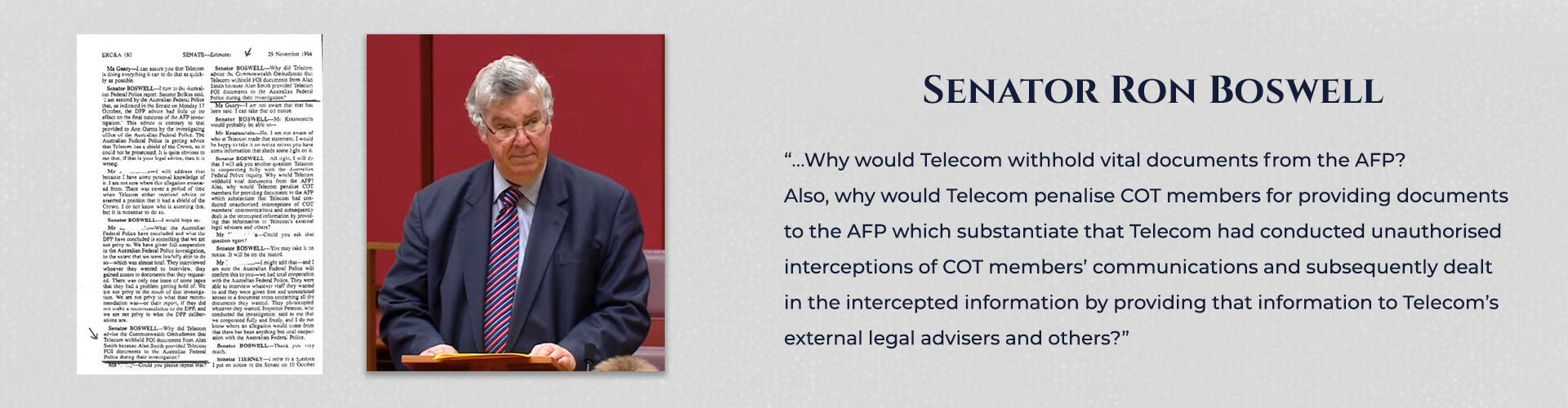
On page 180, ERC&A, from the official Australian Senate Hansard, dated 29 November 1994, reports Senator Ron Boswell asking Telstra’s legal directorate:
“Why did Telecom advise the Commonwealth Ombudsman that Telecom withheld FOI documents from Alan Smith because Alan Smith provided Telecom FOI documents to the Australian Federal Police during their investigation?”
After receiving a hollow response from Telstra, which the senator, the AFP and I all knew was utterly false, the senator states:
“…Why would Telecom withhold vital documents from the AFP? Also, why would Telecom penalise COT members for providing documents to the AFP which substantiate that Telecom had conducted unauthorised interceptions of COT members’ communications and subsequently dealt in the intercepted information by providing that information to Telecom’s external legal advisers and others?” (See Senate Evidence File No 31)
What is so appalling about this withholding of relevant documents is this: no one in the Telecommunication Industry Ombudsman (TIO) office or the government has ever investigated the disastrous impact of this withholding on my overall submission to the arbitrator. The arbitrator and the government (at the time, Telstra was a government-owned entity) should have initiated an investigation into why an Australian citizen who had assisted the AFP in its investigations into unlawful interception of telephone conversations was so severely disadvantaged in a civil arbitration.
When threats were made against me, and I refused to buckle, that stand‑alone defiance showed that the arbitrator, Dr Gordon Hughes, had lost control of the entire process. That loss of control led him to provide the man who made those threats — Telstra’s arbitration liaison officer, Paul Rumble — with more than 4,200 documents relating to my claim, organised into six spiral‑bound volumes dated 15 June 1994.
This was a clear breach of the arbitration rules. The Agreement explicitly stated that Telstra was not to receive my claim documents from the arbitrator until Telstra notified him that it was prepared to proceed. Under those rules, Telstra was allocated only one month to formulate its defence.
However, because Dr Hughes supplied the documents outside the arbitration rules, Telstra was able to stretch that one‑month window into a total of six months. They did not present their defence until 12 December 1994, gaining an extra five months of privileged access that was never permissible — five months to analyse my evidence before I had any opportunity to respond.
When I informed Dr Hughes that Paul Rumble was issuing threats in retaliation for my assistance to the Australian Federal Police (AFP) regarding their investigation into Telstra's interception of my telephone communications and arbitration-related faxes, the situation intensified. Rumble acted upon those threats because I declined to provide him with the same interception documents I had previously submitted to the AFP. I refused to furnish Mr Rumble with copies because the AFP had indicated that their investigation into the interceptions was not yet complete.
The following 93 questions were posed to me by the Australian Federal Police (AFP), along with my responses, as documented in Australian Federal Police Investigation File No/1. My answers reveal a disturbing truth, as I clearly name Paul Rumble, who directed threats against me for daring to assist the AFP in their investigations into the interception of my phone conversations and the illicit hacking of documents related to my arbitration.
Subsequently, Dr Hughes chose not to evaluate the interception evidence, as demonstrated by his findings recorded in the arbitration award.
On 26 September 1997, Telecommunications Industry Ombudsman John Pinnock formally addressed a Senate estimates committee (See page 99 COMMONWEALTH OF AUSTRALIA - Parliament of Australia and Prologue Evidence File No 22-D). He noted:
“In the process leading up to the development of the arbitration procedures – the claimants were told clearly that documents were to be made available to them under the FOI Act.
“Firstly, and perhaps most significantly, the arbitrator had no control over that process, because it was a process conducted entirely outside the ambit of the arbitration procedures.”
There is no amendment attached to any agreement, signed by the first four COT members, allowing the arbitrator to conduct those arbitrations entirely outside the ambit of the arbitration procedure, nor was it stated that he would have no control over the process once we had signed those individual agreements. How can the arbitrator and TIO continue to hide under a confidentiality clause in our arbitration agreement when that agreement did not mention that the arbitrator would have no control because the arbitration would be conducted entirely outside the agreed procedure?
Major Fraud Group - Victoria Police investigation
In June 1997, I was asked by Senator Ron Boswell to explain to a Senate Committee meeting what I believed was behind the threats made during my 1994 arbitration, by Telstra's arbitration defence liaison officer, Paul Rumble, as well as the devastation that these threats caused when Telstra carried out these threats and what made be belvie the reason the arbitrator Dr Hughes allowed these threats to materialise. My partner, Cathy, and I were to spend three days in Bangkok, which was to be a scheduled stopover packaged into the cost of the flight back to Australia.
After Ann Garms and Graham Schorer explained this to me, the strict message was do not stopover in Bangkok; do not leave the airport. What you are about to expose: Telstra's theft of money belonging to Australian citizens, the shonky deal made by Telstra's board regarding the $400.00 million Rupert Murdoch and Fox, and the lies given by John Pinniock TIO to the Institute of Arbitrators Australia about the gross misconduct by Dr Hughes, his disallowing the extra thirteen months in which to prepared your arbitration claim as he had allowed for the other three COT Cases will be enough to stop you giving evidence to the Senate. I laughed, but at the same time decided not to give evidence as I am now doing here on absentjustice.com.
Having suffered two heart attacks and living with a pacemaker, and now 82 years of age this coming week on 7 May 2025, bringing it on as the movies say.
An intense confrontation unfolded in a heated Senate committee meeting when National Party Senator Ron Boswell delivered a fiery critique to a senior officer involved in the Telstra arbitration process. With palpable frustration, he exclaimed, “You are really a disgrace, the whole lot of you,” his voice resonating throughout the chamber. The remarks cast a shadow over the already tense atmosphere as Telstra's conduct regarding the COT Cases took centre stage.
However, the gravity of his words quickly caught the committee chair's attention, prompting a swift intervention. Under scrutiny and recognising the need for decorum in such a serious forum, Senator Boswell was compelled to offer an apology. Turning to the chairperson more measuredly, he declared, “Madam, I withdraw that remark.” This moment of accountability underscored the importance of respectful dialogue in legislative discussions and illuminated the ongoing challenges surrounding Telstra’s treatment of COT Cases, a matter of significant public interest.
“Madam, I withdraw that, but I do say this: this has got a unity ticket going right through this parliament. This has united every person in this parliament – something that no-one else has ever had the ability to do – and Telstra has done it magnificently. They have got the Labor Party, they have got the National Party, they have got the Liberal Party, they have got the Democrats and they have got the Greens – all united in a singular distrust of Telstra. You have achieved a miracle.”
💰 Discriminative Compensation: The Litmus Divide
Senator Chris Schacht made it clear to the Telstra arbitration officer that awarding compensation only to the five 'litmus' COT test cases—while ignoring the unresolved claims of the remaining sixteen—would be a grave injustice. Yet the John Howard-led National Liberal Party government sanctioned punitive damages solely for those five, along with the release of over 150,000 Freedom of Information documents that had been concealed during their arbitrations from 1994 to 1998.
Those five individuals received a combined $18 million. That sum should have been divided equally among all twenty-one unresolved COT Cases. It was not.
Will I go to jail in 2025 for revealing this grossly discriminatory act by the Australian government against sixteen fellow citizens? I believe the current Labor government—if they appointed a representative to view the In-Camera Hansards of 6 and 9 July 1998—would be morally compelled to act. As Senator Schacht stated in 1998, compensation should have been extended to all. Sadly, at least three of those sixteen have since passed away.
Learn about horrendous crimes and unscrupulous criminals, corrupt politicians and the lawyers who control the legal profession in Australia. Shameful, hideous, and treacherous are just a few words that describe these lawbreakers.
Delve into the serious issue of malfeasance in public office, as Absent Justice uncovers the hidden aspects of misconduct and its impact.
Government Corruption in the public service has spuriously undermined the arbitration justice system for more than three decades.
Please view the ANN GARMS video, who is now deceased.
With extraordinary courage, Ann recorded a YouTube video documenting the unbearable burden she had carried—a burden created by Telstra, the arbitrator, and all those involved in the cover-up that victimised more than a dozen COT cases. Her video stands as a stark, unflinching testament to her endurance. Many of us were drawn into government-endorsed arbitration and mediation processes that were nothing more than a carefully engineered trap. Tragically, Ann passed away shortly after releasing her video, leaving behind a legacy of truth-telling in the face of systemic wrongdoing.
Ann knew my claims about the Liberal Government's conduct were true: its unconstitutional and systematic cleansing of government archives over more than fifty years. This destruction of historical records, I contend, prevented Australian citizens from obtaining the proof needed to expose wrongdoing by their own party. It erased evidence that government investigators had uncovered about Telstra's unethical conduct leading up to and during the COT arbitrations. Those archives should have been the springboard for COT cases to prove their claims in approximately twelve arbitration and mediation proceedings. Instead, to block access to the information we sought under FOI, I was labelled a vexatious litigant, and my claims were dismissed as frivolous.
What is the most powerful and tragic denial of justice you have ever encountered—whether it involves one innocent person or an entire group? One example is the story of Brian Banks, alongside another involving casualties linked to Telstra.
Brian Banks was a high‑school football star whose life collapsed after he was falsely accused of raping a sixteen‑year‑old girl. She later admitted the accusation was a lie, but only after he had already spent six years in prison. By then, the case against him had been dismissed, yet the damage was irreversible.
Before his imprisonment, Banks had a full scholarship to USC. When he was finally released, he had lost the athletic ability that once defined his future. He was later exonerated after secretly recording the woman admitting the incident never happened and that she feared retracting her claim because of the settlement money she had received.
She was ordered to repay $2.6 million to the Unified School District. Banks received only $150,000 for the years he lost.
Stories like this are not rare. Many lives have been destroyed because someone stayed silent long after knowing the truth. Four individuals connected to the COT story—Dr Gordon Hughes, Warwick Smith, John Pinnock, and John Rundell—illustrate this same pattern of harm. See “The first remedy pursued” for more.
The lengths to which arbitration administrators went were extraordinary, particularly John Pinnock, who served as both the Telecommunications Industry Ombudsman and the arbitration administrator. I became a victim of false allegations regarding the poor administration of arbitrations, reportedly conducted by Dr Gordon Hughes and, possibly, his wife. To this day, it remains unclear whether Mrs Hughes ever informed her husband that I had called her at 2:00 AM, or if the entire story was fabricated by Dr Hughes and John Pinnock, the second-appointed Telecommunications Industry Ombudsman.
The outcomes of the Claims of Telecommunications (COT) cases spanning more than twenty years starkly illustrate a troubling trend: the amounts awarded were significantly lower than the claims made against Telstra. This discrepancy highlights the profound effects of the government's systematic efforts to sanitise its archives concerning Telstra's conduct, which I argue occurred both prior to and during the arbitration process from 1994 to 1998, and again during the government-led review of Telstra's COT arbitration and mediation process between 2005 and 2006. This latter review coincided with a pivotal moment, as it was tied to Senator Barnaby Joyce's crucial vote needed in the Senate, which was essential for the government's plans to privatise Telstra.
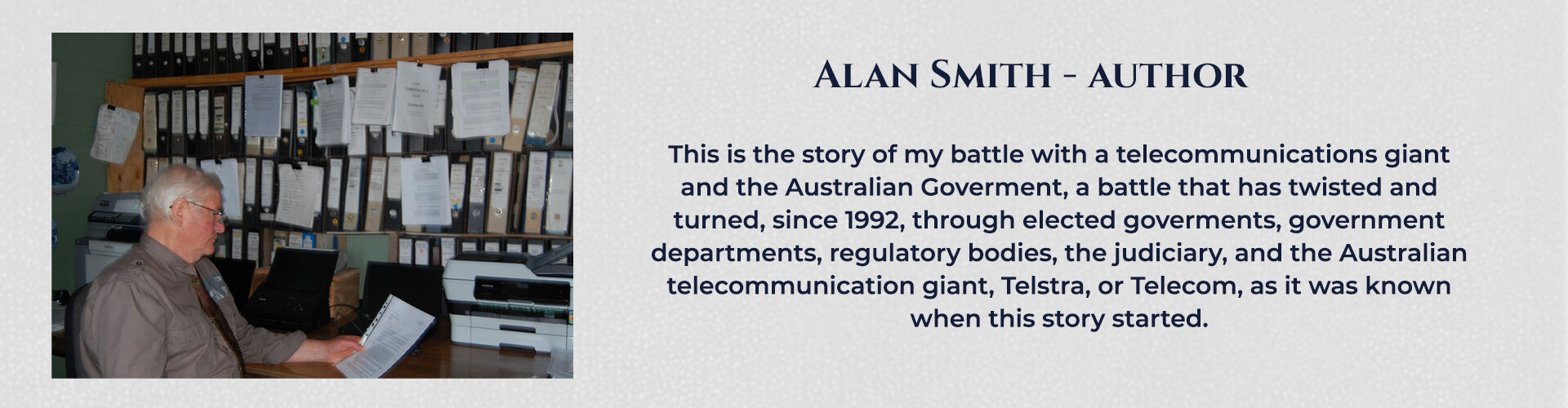
As you explore the homepage section titled "The first remedy pursued" I encourage you to ponder a profound question that has inspired me for the past 30 years, rooted in events that unfolded between 1994 and 1996.
During this turbulent time, key individuals, including Dr Gordon Hughes, Warwick Smith, John Rundell, and John Pinnock, along with the possibility of Dr Hughes' wife lending her support, became involved in actions that would have lasting consequences. If she agreed to assist her husband and John Pinnock—who served as the second-appointed Telecommunications Industry Ombudsman—they might have allowed her name to be falsely linked to an alleged phone conversation purportedly made to her at 2:00 AM. This call never actually took place. Their collaboration marked the beginning of a campaign to systematically undermine my credibility by spreading falsehoods and attacking my character. Their ultimate goal was to obstruct Laurie James, the President of the Institute of Arbitrators Australia, from thoroughly investigating my claims that Dr Hughes did not conduct my arbitration in accordance with the agreed-upon procedures that all parties had accepted.
The concerted efforts of Hughes, Smith, Pinnock, and Rundell not only stopped an official invesytigation into my valid claims it has affected my professional reputation where no one in Australia will consider my claims as valid.
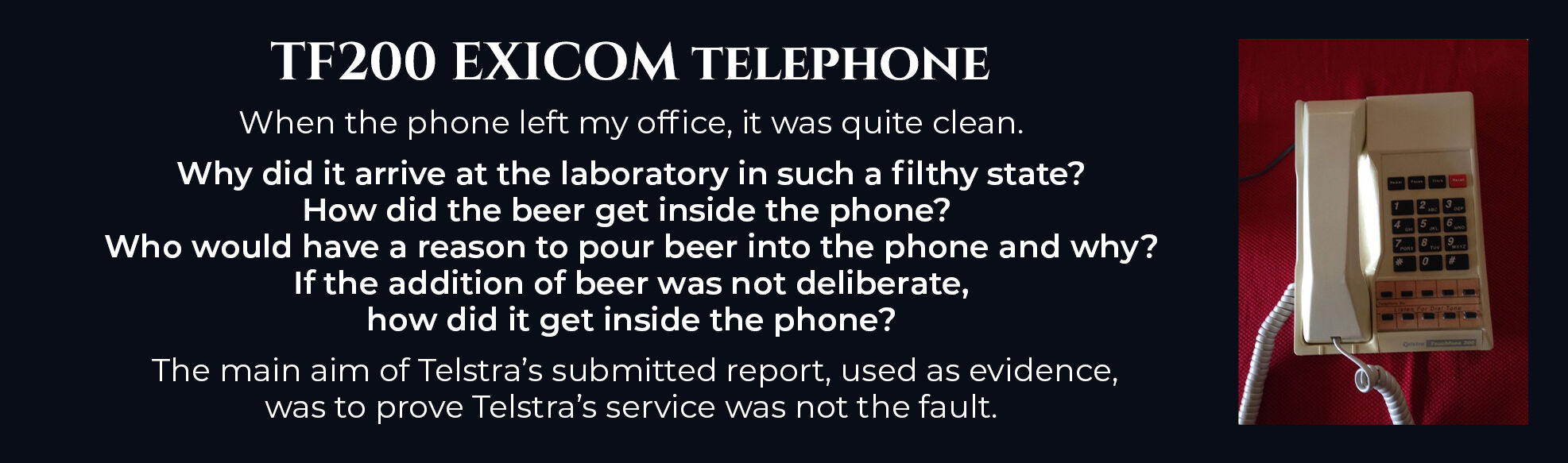
I find it difficult to believe that Mrs Hughes would continue to remain silent if she were ever confronted with the full body of evidence published on absentjustice.com — particularly the material on the “Tampering With My Telephone” page, which lays out, in detail, the technical anomalies, the documented interference, and the sequence of events that formed the basis of my claims. If she were ever to see that evidence in its entirety, she would be forced to confront a question that has lingered unresolved for decades: Was she misled, or was she used?
Perhaps in 2026, someone reading this will feel strongly enough to place that evidence before her — not out of malice, but out of a belief that she deserves to know the truth about the allegations surrounding her husband’s conduct during the COT arbitrations, and the role played by the Telecommunications Industry Ombudsman, John Pinnock. Whether she was ever told the full story remains unknown. What is known is that the allegation of a 2:00 AM phone call — a call I maintain never occurred — became a pivotal tool used to undermine my credibility at a critical moment.
From my perspective, any man who allows his wife to be drawn into a narrative she may not fully understand, or who uses her as a buffer while navigating allegations of professional misconduct, reveals something troubling about his character. When that same man is linked to decisions that coincided with the tampering of my telephone line after it left my business — tampering documented through technical reports, FOI material, and statutory declarations — the questions only deepen. And when those decisions intersect with the actions of the Telecommunications Industry Ombudsman, the pattern becomes impossible to ignore.
For thirty years, these unresolved issues have remained buried beneath layers of legal process, administrative silence, and government protection. The allegations have never been properly tested. The contradictions have never been reconciled. The individuals involved have never been required to account for the decisions they made or the consequences those decisions had on the lives and livelihoods of the COT Cases.
What is beyond dispute is the impact. Businesses collapsed. Families suffered. Reputations were damaged. And the truth — whatever its full extent — was never allowed to surface.
The Australian government’s handling of the COT arbitrations, combined with the withholding of FOI documents and the cleansing of archival records, created an environment where accountability became impossible. Whether through design or neglect, the effect was the same: those who raised legitimate concerns were left without the evidence required to prove their claims, while those in positions of authority were shielded from scrutiny.
It is within this context that the actions of Dr Hughes and John Pinnock must be viewed. Their decisions, their correspondence, and their handling of critical allegations shaped the trajectory of the arbitrations. For the COT Cases, those decisions were devastating. For the government, they were convenient. For the public, they remain largely unknown.
If Mrs Hughes were ever to see the full record — the documents, the timelines, the technical data, the FOI material, the contradictions in the Ombudsman’s correspondence — she might finally understand the scale of what occurred. She might recognise that the allegation involving her was not a trivial misunderstanding but a pivotal moment in a much larger story. And she might see that the silence surrounding these events has protected not only reputations, but an entire system that failed the very citizens it was meant to serve.
Whether she chooses to speak out is a matter for her alone. But the truth — the documented truth — is no longer hidden. It is available for anyone with the courage to look.
Before we delve into our COT story on absentjustice.com, I want to take a moment to address you, the reader. I warmly invite you to explore my new website, promoteyourstory.com.au. There, you will discover a heartfelt post dedicated to my dear friend and steadfast ally in the pursuit of truth—Ronda. She served as my editor and companion in this ongoing journey, and her passing earlier this year has left a profound impact on me. Join me in honouring her memory and the invaluable contributions she made to our cause.
Between August 1994 and 2021, Ronda worked beside me through every stage of this battle. What began as ordinary editing soon became something far greater. As the years passed and the books evolved into manuals, submissions, and government evidence files, Ronda continued her work without hesitation — and often without payment.
Her private words to her two daughters were simple and unwavering: she wanted my story, and the stories of the other four COT Cases, told. The injustices kept her awake at night; the scale of the wrongdoing disturbed her deeply. Yet she stayed, editing more than sixty thousand pages of arbitration documents — all of which she filed, indexed, and preserved in hard copy and on disk.
For the last eleven years, she refused full payment, believing the truth mattered more.
She was not alone.
Kangaroo Court - Absent Justice
Lyn, an editor based in Geraldine, New Zealand, has worked with me since 2007, consistently refusing full payment, even during periods when I had no money at all. Gerard, a distinguished lawyer from Hamilton, Victoria, contributed intermittently over a three‑year period, preparing a comprehensive 256‑page analysis for the Australian Government that detailed the failures within the COT arbitration process. He declined all payment, placing justice above financial reward.
Both Gerard and several original COT Cases have since passed away, yet their commitment remains embedded in this record. Seven attorneys on LinkedIn have publicly expressed strong criticisms of the COT story, and three have granted permission for their names to be used.
I remain profoundly grateful to all who have supported me with unwavering dedication. Elemary, a barrister from Egypt, reached out multiple times offering assistance. Mr Helm, a Canadian Government Minister for Communications, also offered support after I demonstrated that a fundamentally flawed report prepared by Bell Canada International Inc. had been wrongly accepted as authentic by arbitrator Dr Gordon Hughes.
Transcripts from the Administrative Appeals Tribunal (AAT) dated 8 October 2008 (No. V2008/1836) contain significant testimony from Graham Schorer, spokesperson for the COT Cases. Under oath, he informed two government attorneys and a senior AAT panel member that he and I were actively seeking access to a series of Freedom of Information documents that Telstra had withheld during the critical arbitration discovery process. Our aim was to assemble a comprehensive, factual narrative that could illuminate fewer than 16 similar cases and encourage the Senate to push for a full government investigation into the validity of our claims.
What was not disclosed to the attorneys or to the presiding judge, Mr G.D. Friedman, was a crucial fact: in March 1994, the government withheld the AUSTEL Adverse Findings from both itself and the arbitrator. These findings were instead provided to Telstra six weeks before I signed my arbitration agreement, enabling Telstra to prepare a defence against my claims regarding ongoing faults with my telephone and fax services.
I did not receive access to points 2 to 212 → AUSTEL’s Adverse Findings until November 2007—twelve years after the government first supplied them to Telstra. By then, they were effectively useless, arriving five years beyond the six‑year statute of limitations for appealing my award (Refer to Chronology of Events)
A careful examination of this sequence of events may lead any impartial observer to conclude that the government breached its obligations to me as an Australian citizen. This breach appears rooted in a discriminatory practice that favoured Telstra—a corporation wholly owned by the Australian Government, and therefore by the Australian people—during that critical period in March 1994.
Throughout the ten‑month AAT hearing, I submitted a 158‑page report and more than 1,760 exhibits, along with 23 letters and attachments to the ACMA board, demonstrating that Telstra had violated my human rights and that its leading arbitration engineer, Peter Gamble, had submitted known false documents to the arbitrator regarding the alleged successful service‑verification testing of my business telephone lines.
On 3 October 2008, senior government‑appointed Judge Mr G.D. Friedman acknowledged the thoroughness of my ten‑month AAT appeal in open court, in full view of two government ACMA attorneys, he noted:
“Let me just say, I don’t consider you, personally, to be frivolous or vexatious – far from it.
“I suppose all that remains for me to say, Mr Smith, is that you obviously are very tenacious and persistent in pursuing the – not this matter before me, but the whole – the whole question of what you see as a grave injustice, and I can only applaud people who have persistence and the determination to see things through when they believe it’s important enough.”
A Call to Those Who Can Carry This Forward
If you are in Australia and believe you can transform these meticulously prepared documents — the submissions, evidence files, and chronological records — into a legal, exposé-style, corruption-focused project, you are welcome to contact me.
The documents can be provided on the condition that, if they are used to generate commercial profit, a mutually agreed percentage will apply. The goal is simple: to ensure the truth is not lost.
At 82 years old, living with a pacemaker and having survived two heart attacks, I am realistic about time. By the time this project reaches its full potential, I may no longer be here, but the work must continue.
If you have ideas, skills, or a vision for what can be done with these documents, I invite you to share your thoughts through our Absent Justice Contact page
If the conduct you’re about to see had occurred in a courtroom, many of the individuals involved would have faced criminal charges. Evidence tampering. Document alteration. Unlawful interference with telecommunications. Breaches of statutory duty. All prosecutable. Had the arbitrator been a judge, these matters would have been resolved in 1996—not dragged out, buried, and fought over for 30 years.
And this is where the public still misunderstands what happened — not just in Australia, but in the UK, the US, and anywhere arbitration is used to sidestep judicial scrutiny.
Arbitration is not a court. When an arbitrator is inexperienced, compromised, or unwilling to confront wrongdoing, the process becomes a private arena where misconduct thrives. Evidence can be tampered with inside a claimant’s home. Phone services can be interfered with when no parties are present. Legal documents can be altered after one party signs them. False test results — even those taken 112 kilometres away from the business in question — can be presented as “official findings” and accepted without challenge.
Every one of these things happened in the COT arbitrations. Not hypothetically. Not theoretically. They happened — and they were allowed to happen — behind the shield of a confidentiality clause designed to protect offenders, not victims.
If this sounds familiar, it should. The British Post Office Horizon scandal followed the same pattern:
-
a government‑backed corporation
-
a flawed system
-
innocent people blamed
-
evidence withheld
-
internal reports buried
-
victims gagged
-
officials protected
After almost two decades, the British public—and a growing number of British politicians—have insisted that the British Post Office scandal is a matter of profound public interest and must no longer be concealed by the government, the civil service, or the Establishment. For England’s sake, this injustice demands a complete and transparent investigation. Click here to watch the Australian Channel 7 trailer for Mr Bates vs the Post Office, which aired in February 2024, and captures the scale of this national betrayal.
What makes the scandal so disturbing is that public servants inside the British Post Office knew the Fujitsu Horizon computer software was responsible for the catastrophic accounting and billing errors. Yet they continued to blame innocent sub‑postmasters, many of whom were financially ruined, prosecuted, or imprisoned.
This pattern is painfully familiar to those of us who lived through the Australian COT arbitrations. Dr Gordon Hughes, the arbitrator appointed to oversee our cases, refused to allow his own technical consultants the additional time they needed to diagnose the ongoing faults in Telstra’s Ericsson billing software. The parallels between the British Post Office scandal and the Australian Telstra scandal are unmistakable. In both cases, faulty technical equipment was at the heart of the problem, as demonstrated in this YouTube video: https://youtu.be/
Miss Carrage of Justice
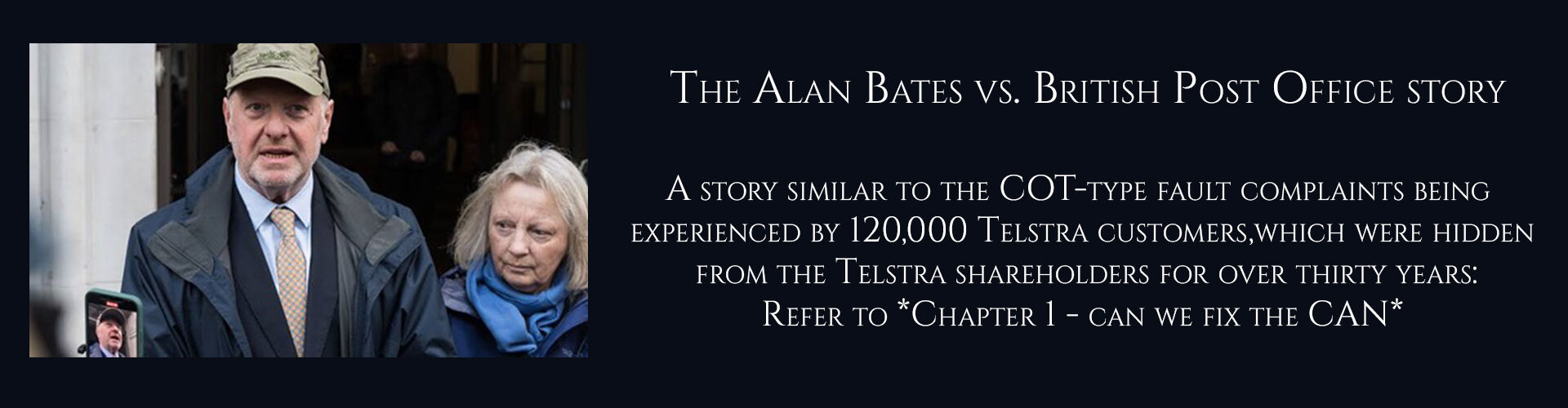
Click here to watch Mr Bates vs the Post Office
Different country. Different industry. Same architecture of institutional abuse.
In both scandals, the public assumed that because police did not intervene, they must have been complicit. Let me be clear: after compiling 23,000 evidence files myself — and another 15,000 scanned documents of similar weight — nothing implicates the AFP or the Major Fraud Group of Victoria Police in the misconduct that destroyed the lives of the COT Cases. The wrongdoing was carried out by arbitration officials and defendants who weaponised the confidentiality clause to commit acts that would never have survived open‑court scrutiny.
This is the global problem. The same structural weakness that enabled the British Post Office to ruin hundreds of lives is the same weakness that allowed Telstra and its protectors to sabotage the COT arbitrations. When disputes are pushed into private arbitration — away from judges, away from juries, away from public oversight — the door opens to corruption, concealment, and the quiet destruction of ordinary people.
This gag‑clause‑driven model is used worldwide. And as long as people keep choosing arbitration believing it to be fair, efficient, or transparent, these abuses will continue.
What you are about to read is not an Australian anomaly. It is a warning — and a map of how institutional power behaves when no one is watching.
The pattern is familiar.
Australia’s emerging NDIS fraud crisis — forecast to reach $3.6 to $6 billion by 2027–28 — is not a new phenomenon. It follows a long line of national failures where oversight collapsed, evidence was ignored, and public money vanished. Robodebt unlawfully targeted vulnerable Australians, contributing to suicides and costing millions. The Pink Batts program suffered fatal safety failures and financial waste. Each scandal exposed the same structural weakness: systems built on trust without verification.
The Telstra/COT Cases lived through this pattern decades earlier. While they struggled to operate businesses without a reliable phone service, they were forced to spend hundreds of thousands of dollars each just to compel the TIO, Telstra, and the appointed arbitrator to investigate why their services still failed. Even then, evidence was withheld, documents altered, and promised assessments — including the commercial review linked to Senator Barnaby Joyce’s decisive vote on Telstra privatisation — were never delivered.
Yet when Telstra could not provide Rupert Murdoch and FOX with the same reliable service, they received $400 million to keep their operations afloat (Refer to Rupert Murdoch -Telstra Scandal - Helen Handbury).
Across NDIS, Robodebt, Pink Batts, and Telstra/COT, the pattern is identical: when accountability fails, fraud grows, evidence disappears, and ordinary Australians pay the price.
What treacherous motives might drive a government official to conceal the truth from a government-appointed arbitrator?
Hovering your cursor or mouse over the Cape Bridgewater Holiday Camp image will take you to a document dated March 1994, referenced as . This government report confirms that the public servants investigating my ongoing telephone problems supported my claims against Telstra, particularly between Points 2 and 212. Had the arbitrator been provided with , it is clear he would have awarded me a significantly higher amount for my financial losses than he ultimately did.
Government records (see ) show that AUSTEL’s adverse findings were provided to Telstra—the defendants—one month before Telstra and I signed our arbitration agreement. I did not receive copies of these findings until 23 November 2007, twelve years after the conclusion of my arbitration. By then, the statute of limitations had expired, preventing me from using these government findings to appeal the arbitrator’s award.
, dated 4 March 1994, confirmed that my claims against Telstra were valid (see Points 2 to 212) before I was forced into arbitration under threat from the then Telecommunications Industry Ombudsman, Warwick Smith, and Telstra. I was told that unless I signed an arbitration agreement, Telstra and the TIO would refuse to investigate the telephone faults I had been reporting since February 1988, when I purchased the business.
I did not receive a copy of these findings—Points 2 to 212 of —until 23 November 2007, twelve years after my arbitration had ended. Put simply, the government had already validated my claims as early as 4 March 1994, six weeks before I signed the arbitration agreement on 21 April 1994.
And yet the unanswered questions remain. Even the answers I have received from government bureaucrats do not explain why, with all 212 points in this government report confirming that my seven‑year claim was valid, I was still required to endure 13 months in a gruelling arbitration process, spending well over $300,000 in professional fees to prove something the government had already established.
“On some significant issues, the Australian Parliament has ceased to be a place of effective lawmaking by the people, for the people”"It has become commonplace for Parliamentarians to see a marathon supernuanced career out with ideals sacrificed for ambition"
• Who were the government bureaucrats who condoned the bugging during the COT arbitrations?• Were they the same individuals—or perhaps their successors—who approved the bugging of Timor-Leste’s offices?
A Pattern That Goes Back Decades
The misuse of public money, the concealment of internal failures, and the protection of government‑owned corporations from scrutiny are not recent developments. They echo the same systemic behaviour that surrounded the Telstra arbitration processes in the 1990s and 2000s.
During that period:
-
Telstra was still majority‑owned by the Australian Government.
-
Serious faults in the national telecommunications network were concealed.
-
Evidence was withheld or altered during the COT arbitrations.
-
Claimants were denied the commercial assessment they were promised.
-
And a confidentiality clause was used to shield misconduct from public view.
This pattern continued well into the 2000s. In 2005–2006, when the government sought the final vote needed to privatise Telstra, Senator Barnaby Joyce was assured that the COT Cases would receive the commercial assessment they had been denied for more than a decade. That assessment never occurred. The promise evaporated the moment the privatisation vote was secured.
Why This Matters Today
The emerging NDIS fraud crisis is not an isolated failure. It is part of a long‑running national problem: when government‑controlled systems fail, the instinct is to protect the institution, not the public.
The Telstra/COT scandal showed how:
-
evidence could be withheld,
-
Internal reports could be buried,
-
victims could be silenced, and
-
public money could be misused without accountability.
The current NDIS revelations — involving billions of dollars forecast to be lost to fraud — demonstrate that the underlying culture has not changed. When oversight is weak, when systems rely on trust instead of verification, and when accountability mechanisms are bypassed or ignored, fraud grows in the dark.
The Broader Point
The story documented on absentjustice.com is not an historical footnote. It is a case study in how institutional failures, once normalised, replicate themselves across decades and across departments.
Whether it was:
-
Telstra in the 1990s,
-
the COT arbitrations through to 2006, or
-
The NDIS fraud forecasts being discussed today,
The pattern is the same: when systems lack transparency, the public pays the price.
My name is Alan Smith, and this is the story of a group of ordinary small‑business people who found themselves fighting one of the largest companies in the country. It is also the story of how, for years, Telstra refused to address the phone faults that crippled the businesses of the COT Four, dismissing every complaint with the same empty phrase: “No fault found.”
Until the late 1990s, the Australian government fully owned the national telephone network and its carrier, Telecom — now privatised and known as Telstra. Telecom held a monopoly and allowed the network to deteriorate. When four small business owners experienced severe communication failures, they filed arbitration claims against Telstra. Those arbitrations became a sham. The appointed arbitrator allowed Telstra to minimise the COT members’ losses and even permitted the carrier to run the arbitrations itself. Telstra committed serious crimes during the process, yet to this day neither the Australian government nor the Australian Federal Police has held Telstra, or the entities involved in this deceit, accountable.
Why is Telstra above the law?
As April 25 approaches each year, one story from my book "Around the World in 80 Dishes… and a few disasters" returns to me. We honour the fallen, yet we also face the truth of lives lost in wars that shaped generations.
I wasn’t conscripted, but many were. In the 1960s, British and Canadian seamen protested when they discovered their cargo for China was being reshipped to North Vietnam. They still carry the shame of unknowingly supplying the enemy.
In August 1967, my shipmates and I learned that part of our Australian wheat cargo was also bound for North Vietnam. It felt like a betrayal. The Liberal Government misled us; “humanitarian aid” hid the truth. The waterfront unions in Australia supported us, refusing to let the Hopepeak load for China. We believed we were feeding the starving, only to learn we were feeding the forces fighting our soldiers. (See Flash Backs – China-Vietnam.)
When we reached Sydney, the crew — myself included — walked off. The government had been warned, yet the ship owners pressed on. Each Anzac Day, the tragedy deepens: soldiers died while the wheat we carried helped sustain their enemy.
If you were on the Hopepeak with me, or know a surviving crew member, please contact me through the Absent Justice Contact page or via the worldwide Ships Nostalgia.
In May 2024, when I turned eighty, I finally sat down to write the story I had carried for decades — my thirty years at sea. The book is available as shown above, but its purpose reaches far beyond recipes, ports, and the humour that kept many of us afloat. It begins with the truth. My truth.
The introduction opens with the betrayal aboard the Hopepeak in 1967, when we discovered that Australian wheat sent under the banner of humanitarian aid was being diverted to North Vietnam. We believed we were feeding the hungry. Instead, we were unknowingly supplying a war. That moment shaped the rest of my life, and it belongs at the front of the book because it explains why I still write, still speak, and still refuse to let certain stories sink into silence.
 Attached to the image "Around the World in 80 Dishes… and a few disasters" to the left of this page, I include another maritime scandal — one that unfolded half a century later but echoes the same themes of secrecy, power, and the cost of looking the other way. The “Fat Leonard” affair, one of the most significant maritime crime cases in modern American history, exposed widespread corruption within the U.S. Navy’s Seventh Fleet. It led to major reforms, the loss of hundreds of millions of dollars, and the convictions of numerous high‑ranking officials. Different oceans, different decades, but the same pattern: decisions made far from the deck plates, with consequences carried by those who serve.
My intention is simple. I will use this book and my new website, promoteyourstory.com.au, to share true stories of corruption and failure in government decision‑making in Western nations such as the USA and Australia, and within the corridors of power that influence their navies. These stories matter because they show how easily truth can be buried, how quickly trust can be broken, and how vital it is that those who lived through these events continue to speak.
The sea‑going stories in my book are not just about my life at sea. They are about what the sea taught me — that honesty is a form of survival, and silence is a kind of sinking.
After nearly thirty years at sea as a ship’s cook, I needed new horizons during my leave periods, so I worked in mining camps and shearing sheds. This rewarding diversion provided the extra support a family man with two children needed, while serving as a dual‑purpose getaway. When I was invited to cook for a school camp for free, I embraced the opportunity to spend two weeks in the Victorian High Country with sixty eager kids. One camp led to another, and soon I was hooked.
When I purchased the Cape Bridgewater Holiday Camp in 1987, I discovered that only eight telephone lines serviced 130 residences. If four people were making or receiving calls, only four lines remained for the other 126 households. Operating a 120‑bed holiday camp under such conditions for the first three and a half years was extremely challenging. This experience led me to establish the Casualties of Telstra small‑business group. Seven years later, I — along with sixteen others — found myself in an arbitration process against Telstra. That arbitration took a heavy toll, stripping away our pride and damaging our businesses, especially as the arbitrator sought to minimise Telstra’s financial liability.
Welcome to AbsentJustice.com, a platform with an unwavering commitment to shedding light on the rampant criminality embedded within the arbitration process I faced while battling Telstra. This site offers a stark and revealing account of the systemic treachery, pervasive corruption, and the overwhelming silence that defined my exhaustive search for accountability and truth.
This arbitrator operated not as a neutral adjudicator but as a gatekeeper for corruption, enabling Telstra and its allies to evade accountability. His conduct was a chilling testament to how deeply entrenched and insidious corruption had become within the arbitration process. His decisions were not just flawed; they were weaponised tools of oppression designed to silence victims and protect the guilty.
Join me as we delve into the horrendous crimes committed by unscrupulous individuals, manipulative politicians, and lawyers who exert disproportionate influence over the Australian legal system. These entities operate within a fundamentally flawed framework, one that allows them to exploit their positions for personal gain. Words such as shameful, hideous, and treacherous fail to fully capture the scope of the wrongdoing committed by those who have betrayed the public's trust.
Uncover the disturbing instances of foreign bribery and the sinister, corrupt practices that have infiltrated COT arbitrations, as clearly illustrated on AbsentJustice.com's homepage. These revelations are not mere accusations; they expose a systemic failure of justice that has left an indelible mark on the lives of countless victims who have been silenced and marginalised.
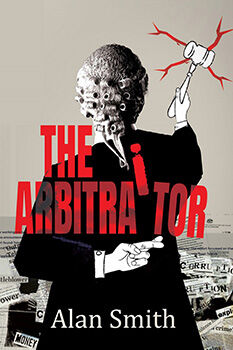 My battle with Telstra was not simply a personal crusade; it unmasked the very mechanisms of corporate and legal power that work tirelessly to shield wrongdoing behind layers upon layers of deceit and convoluted legalese. What was intended to be a fair arbitration process quickly devolved into a convoluted maze filled with manipulation, procrastination, and blatant denial. Throughout this painful ordeal, I confronted relentless institutional resistance, carefully crafted to suffocate dissent and protect corrupt interests at any cost.
Central to this corrupt machinery was the arbitrator, whose role was meant to be impartial and just. Instead, he became a sinister enforcer of the very corruption he was supposed to prevent. His actions were marked by blatant bias, deliberate obstruction, and a disturbing willingness to bend the rules to shield powerful interests. Time and again, he dismissed critical evidence, ignored procedural fairness, and facilitated delays that crushed any hope of genuine justice.
AbsentJustice.com serves not just as a record of my personal journey, but as a bold clarion call for all who believe in justice to unite against the entrenched systems that perpetuate injustice and fundamentally undermine democracy itself. Here, I present a meticulously documented evidentiary trail that amplifies the voices of those who have been marginalised and oppressed, while laying bare the ruthless tactics employed to obliterate truth and accountability. This narrative is steeped in brutal honesty, ensuring that every detail stands as an irrefutable testament to the chilling reality we collectively face.
This arduous journey has been fraught with emotional struggles and legal battles that have tested every fiber of my being. Yet, it has also illuminated the extraordinary power of storytelling as a formidable tool for advocacy and transformative change. By sharing this narrative, I aim to empower those ensnared in similar struggles, shed light on institutional wrongdoing, and foster a vibrant community that demands transparency and fervently pursues reform.
During our pre-arbitration hearing on February 17, 1994, arbitrator Dr Gordon Hughes made a confident pledge: he would not deliver a decision if the COT Cases couldn’t access the requested documents from Telstra. Yet, in a shocking betrayal, he chose to proceed with a ruling, ignoring the critical information that was withheld—this treachery is laid bare on this website.
In a calculated move, Dr Hughes and administrator Warwick Smith coerced the members into continuing the arbitration without the vital documentation, casting aside the very commitment he had made. To add insult to injury, they stripped away essential $250,000 liabiliy clauses 25 and 26 from the agreement, effectively shackling our ability to appeal the unjust awards. The maliciousness of these actions is further illustrated in the accompanying image, revealing a clear disregard for fairness and integrit situation took a turn for the worse when a deeply corrupt agreement was established, marking a significant turning point in the arbitration process. This agreement came into effect the moment the arbitration consultants were cleared of any liability concerning their anticipated roles in the ongoing arbitration proceedings. On July 11, 1994—just nine weeks into the forced arbitrations—a clandestine arrangement was forged between the defendant's arbitration liaison officer, Steve Black, and arbitration administrator Warwick Smith. It is important to note that Smith was already playing a pivotal role in assisting the Telstra board as they endeavoured to restructure the existing commercial assessment process into a complicated and highly legalistic arbitration agreement.
The agreement itself, painstakingly drafted by Telstra's legal counsel, Freehill Hollingdale & Page (now trading as Herbert Smith Freehills Melbourne), was segmented into three distinct sections that were disproportionately favourable to Telstra's interests. In a troubling breach of transparency, neither government officials nor claimants were informed that this document had not been formulated independently of Telstra's influence, despite prior assurances to the contrary.
This underhanded arrangement, labelled the third deal and dated July 11, 1994, granted the now-exonerated arbitration consultants unprecedented initial access to all critical arbitration documents—access granted before these documents were even submitted to the arbitrator and the claimants. This strategic positioning placed the arbitration consultants in a powerful and unique role, allowing them to either share essential information with the arbitrator or, conversely, withhold it depending on their interests (Refer to File 590 → AS-CAV Exhibits 589 to 647
Their understanding of the implications of this arrangement was heightened by the knowledge that their immunity from lawsuits had been bolstered; the previous $250,000 cap on liability for negligence had been conveniently lifted. What ultimately unfolded was far from a fair arbitration process; it was a calculated act of betrayal that severely undermined the integrity that once characterised the arbitration system in Australia, leading to its profound discrediting and a compromise of justice for the affected parties.
The fact that these $250,000 liability caps were written into the twelve remaining forthcoming arbitration agreements, without notifying us of these changes, shows how discriminately we three COT Cases, Ann Garms, Graham Schorer and I, were treated.
I have previously mentioned a letter from John Pinnock, dated January 10, 1996, which complicated my efforts to obtain the necessary information for my pending appeal. My appeal lawyers, Law Partners of Melbourne, would only provide pro bono assistance if I could provide details of when the alterations to the agreement and the confidentiality agreement were made, who authorised these changes, and the reasons for removing the $250 liability caps from my agreement. Additionally, they needed to know why these liability caps were reinstated in the remaining twelve TIO-administered arbitrations and why these reinstatements were kept confidential.

Chapter 7 TIO Lies Fraud Deception
If I could access this information, Law Partners could convince their legal backers that I had a viable case, and they would take a percentage as payment. However, as indicated below, Mr Pinnock refused to assist me as the following letter records:
“I refer to your letter of December 31, 1996, in which you seek access to various correspondence held by the TIO concerning the Fast Track Arbitration Procedure. …
“I do not propose to provide you with copies of any documents held by this office.” (See Open Letter File No 57-C)
They have defied the Senate working party.
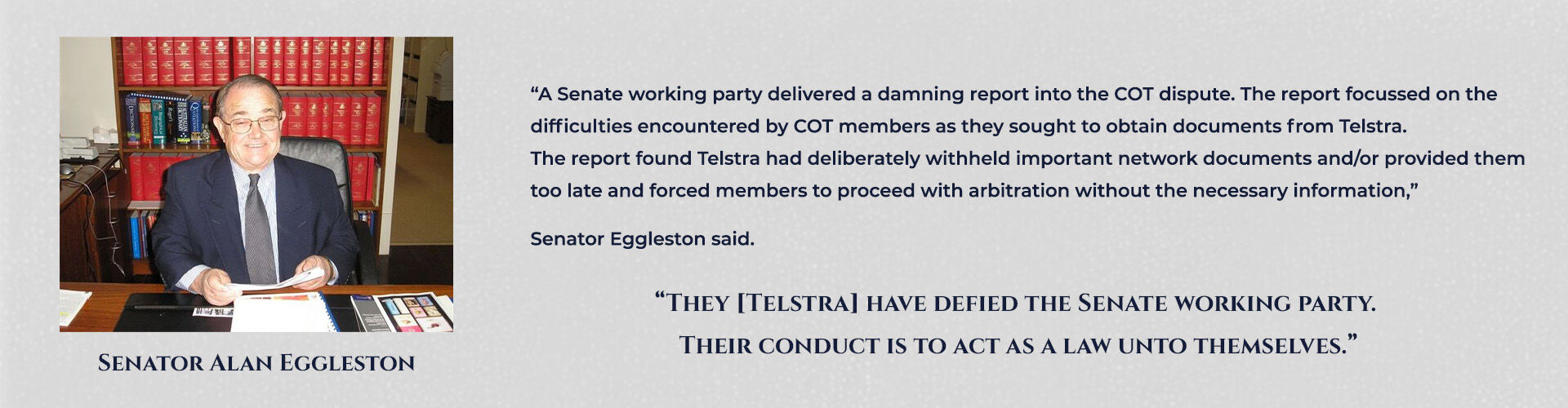
On 23 March 1999, after most COT arbitrations had been finalised and business lives ruined by hundreds of thousands of dollars in legal fees to fight Telstra and a crooked arbitrator, the Australian Financial. Review reported on the conclusion of the Senate estimates committee hearing into why Telstra withheld so many documents from the COT cases:
“A Senate working party delivered a damning report into the COT dispute. The report focused on the difficulties encountered by COT members as they sought to obtain documents from Telstra. The report found Telstra had deliberately withheld important network documents and/or provided them too late and forced members to proceed with arbitration without the necessary information,” Senator Eggleston said. “They have defied the Senate working party. Their conduct is to act as a law unto themselves.”
The following six senators all formally record that they believed Telstra had ‘acted as a law unto themselves’ throughout all the COT arbitrations, which is incredible.
Eggleston, Sen Alan – Bishop, Sen Mark – Boswell, Sen Ronald – Carr, Sen Kim – Schacht, Sen Chris, Alston and Sen Richard)
Being forced to sign an arbitration agreement without the necessary documents to prove your claim is a terrible situation, but being forced to sign it after it had been altered to protect only the TIO Legal Counsel and the arbitrator's arbitration resource unit shows how little regard the arbitrator and administrator had for the COT Cases.
Being forced to sign an arbitration agreement without the essential documentation to substantiate your claim places individuals in a profoundly troubling predicament. The situation becomes even more egregious when one is compelled to sign a version of the agreement that has been altered to safeguard only the interests of the TIO Legal Counsel and the arbitrator's arbitration resource unit. Such actions starkly illustrate the glaring disregard that both the arbitrator and the administrator have for the challenges faced by those involved in the COT Cases.
Adding to this troubling narrative, Rupert Murdoch, the powerful media mogul, along with FOX and their influential government allies, wielded considerable control over Telstra's board and its esteemed legal advisors. Evidence from Senate Hansard reveals that these individuals had their hands deeply entrenched in this public company's operations, allegedly orchestrating large-scale, billion-dollar fraudulent business deals designed to benefit "the big end of town." In stark contrast, small businesses like those represented by the COT Cases found themselves in a desperate struggle, forced to pay Telstra exorbitant fees to rectify inadequate telephone services. This arbitration process cost each claimant hundreds of thousands of dollars in professional fees.
Furthermore, it has been alleged that Murdoch and FOX were handsomely rewarded, receiving a staggering $400 million from Telstra, according to the Senate Hansard. At the time this controversial deal took shape, members of the Telstra board knew full well that the company would be unable to meet the critical deadline for delivering the necessary telephone services that Murdoch, FOX, and many other businesses across Australia relied on to thrive.
This troubling arrangement is particularly striking given that Murdoch, a non-Australian citizen, was able to conduct his business dealings from the USA. This unfolding saga is meticulously documented in the Senate Hansard from September 1997, specifically highlighted in points 11 and 12, shining a light on the intertwining of corporate interests and the manipulation of essential services.

Rupert Murdoch-Telstra Scandal - Helen Handbury
I emphasise that if we accept the premise outlined in points 10 and 11 on page 5164 of the official Hansard records of the SENATE official Hansard – Parliament of Australia, as published by the Parliament of Australia (see also https://shorturl.at/URa5h), and these records indicate that Telstra and its board were aware that the company would not meet the mandated rollout deadline, then serious concerns arise. Why were the COT Cases—business owners who have struggled for years due to widespread and systemic telecommunications problems caused by Telstra—forced to bear the burden of hundreds of thousands of dollars in professional arbitration fees? These business owners sought the help of an arbitrator to ensure that Telstra would finally address the ongoing phone problems that were damaging their businesses. If this situation does not qualify as severe discrimination, then what does?
10. Telstra's CEO and Board have known about this scam since 1992. They have had the time and the opportunity to change the policy and reduce the cost of labour so that cable roll-out commitments could be met and Telstra would be in good shape for the imminent share issue. Instead, they have done nothing but deceive their Minister, their appointed auditors and the owners of their stock—the Australian taxpayers. The result of their refusal to address the TA issue is that high labour costs were maintained and Telstra failed to meet its cable roll-out commitment to Foxtel. This will cost Telstra directly at least $400 million in compensation to News Corp and/or Foxtel and further major losses will be incurred when Telstra's stock is issued at a significantly lower price than would have been the case if Telstra had acted responsibly.
11. Telstra not only failed to act responsibly, it failed in its duty of care to its shareholders. So the real losers are the taxpayers and to an extent, the thousands of employees who will be sacked when Telstra reaches its roll-out target—cable past 4 million households, or 2.5 million households if it is assumed that Telstra's CEO accepts directives from the Minister.
I respectfully urge everyone who has reached this section of the absentjustice.com homepage to take a moment to read what several Senators expressed regarding the Rupert Murdoch-Fox deal, specifically points 10 and 11 of the official Senate hearing document. Understanding these statements will shed light on the significant difficulties faced by small business owners, like myself, when contending with the overwhelming influence of Australian government bureaucrats, Telstra's board members, and their legal representatives.
These parties entered into a deal with Rupert Murdoch and Fox, fully aware that the stipulated conditions were unattainable. Despite this knowledge, they sanctioned the allocation of $400 million in public funds to support the telephone services Murdoch and Fox needed to sustain their operations. This scenario parallels the COT Cases, which were forced into arbitration to compel Telstra to adhere to similar contractual obligations.
In simpler terms, Murdoch and Fox received compensation in the form of damages when Telstra was unable to meet the unrealistic conditions imposed on their agreement. On the flip side, when the COT Cases and ordinary citizens across Australia encountered comparable challenges, we, the Australian public, were left to bear the financial burden, incurring hundreds of thousands of dollars in arbitration fees in our efforts to fulfil the same requirements.
This situation exemplifies a profound injustice, regardless of how the government might attempt to portray it. The disparity in treatment between large corporate entities and individual citizens highlights a troubling inequity within the system, which warrants serious examination and reform.
These 120,000 COT-type Telstra customers, all with the same phone problems as Murdoch and FOX were experiencing, I ask the government again. Please read absentjustice.com and see for yourself that Murdoch and Fox should not have been given a different playing ground in which to run their business.
The letters attached below, dated April 8 and 9, 1994, were sent during a two-day period when eight COT cases were under government lockdown at the Melbourne offices of AUSTEL (now known as ACMA). This lockdown resembled a security process, with individuals being searched on leaving the premises for lunch breaks. During this period, 120 COT-type phone faults were documented, as discussed by Robin Davey, Chairman, and John MacMahon, General Manager of Consumer Affairs.
“The Report, when commenting on the number of customers with COT-type problems, refers to a research study undertaken by Telecom at Austel’s request. The Report extrapolates from those results and infers that the number of customers so affected could be as high as 120 000. … (See Open Letter File No/11)
And the next day:
“In relation to point 4, you have agreed to withdraw the reference in the Report to the potential existence of 120,000 COT-type customers and replace it with a reference to the potential existence of “some hundreds” of COT-type customers” (See Open Letter File No/11)
Point 2.71 in AUSTEL’s April 1994 formal report notes:
“the number of Telecom customers experiencing COT type service difficulties and faults is substantially higher than Telecom’s original estimate of 50”.
It is nothing short of a treacherous betrayal for a government regulator to so drastically alter its findings, slashing the number of reported COT-type complaints from an astonishing 120,000 to a mere 50 or so. Such a flagrant misrepresentation constitutes a deep and sinister deception, undermining the public trust it claims to serve. The fact that Rupert Murdoch and FOX are rewarded amid these glaring Telstra telecommunications issues reveals a disturbing collusion that is costing Australian citizens dearly—even leading some to bankruptcy and dragging them into numerous court cases—all due to the lies perpetuated by government bureaucrats. This manipulation not only defrauds the people but also casts a long shadow over the integrity of those in power.
As you delve deeper into this narrative, you will uncover how Telstra's highly compensated legal team engaged in a disturbing pattern of lies, coercion, intimidation, and evidence tampering. These actions were aimed at shielding a deteriorating, government-owned Telstra Corporation from accountability and scrutiny, revealing the depths to which some will go to protect corporate interests at the expense of public welfare.
https://www.promoteyourstory.com.au/
Threats carried out
On page 180, ERC&A, from the official Australian Senate Hansard, dated 29 November 1994, reports Senator Ron Boswell asking Telstra’s legal directorate:
“Why did Telecom advise the Commonwealth Ombudsman that Telecom withheld FOI documents from Alan Smith because Alan Smith provided Telecom FOI documents to the Australian Federal Police during their investigation?”
After receiving a hollow response from Telstra, which the senator, the AFP and I all knew was utterly false, the senator states:
“…Why would Telecom withhold vital documents from the AFP? Also, why would Telecom penalise COT members for providing documents to the AFP which substantiate that Telecom had conducted unauthorised interceptions of COT members’ communications and subsequently dealt in the intercepted information by providing that information to Telecom’s external legal advisers and others?” (See Senate Evidence File No 31)
Thus, the Threats Became a Reality
What is so appalling about this withholding of relevant documents is this: no one in the Telecommunication Industry Ombudsman (TIO) office or the government has ever investigated the disastrous impact of this withholding on my overall submission to the arbitrator. The arbitrator and the government (at the time, Telstra was a government-owned entity) should have initiated an investigation into why an Australian citizen who had assisted the AFP in its investigations into unlawful interception of telephone conversations was so severely disadvantaged in a civil arbitration
Hover your cursor over the images of the BBC television programs "Yes Minister" and "Yes Prime Minister" to uncover evidence suggesting that Australian Prime Minister Malcolm Turnbull, his Deputy Barnaby Joyce, Mr Dan Tehan MP, and two Telstra officials have deliberately ignored information since 2014. This information highlights a concerning collusion between government and corporate interests during sixteen government-endorsed arbitration and mediation processes.
Since at least 2005, three officials—The Hon Barnaby Joyce, The Hon Dan Tehan, and Ms Sue Laver—have been aware of crimes committed against fourteen Australian citizens, known as the Casualties of Telstra (COT). These crimes resulted in severe consequences for COT members, including stress-related fatalities such as heart attacks, strokes, and suicides attributed to these circumstances.
In 1994, Senators Richard Alston (Shadow Minister for Communications), Ron Boswell (National Party Whip in the Senate), and Vicky Bourne, along with representatives from the Parliament House Press Club, AUSTEL (the government's former Communications Authority, now ACMA), and the first appointed Australian Telecommunications Industry Ombudsman (TIO), assured COT members that their individual funding of arbitration and mediation processes against Telstra would empower appointed mediators and arbitrators to compel Telstra to resolve all ongoing telephone issues. Telstra had previously failed to address these issues for COT members, in some cases for more than a decade. The requirement for COT members to self-fund these processes was therefore presented as an integral component of the agreed-upon procedures.
Consequently, many individuals were compelled to mortgage their homes or sell assets to finance these government-endorsed processes. However, Telstra, the mediators, and the arbitrators ultimately failed to resolve the problems that led COT members to arbitration and mediation, leaving these issues unresolved to this day.
In July 2005, the Hon Senator Barnaby Joyce personally met with fourteen of these small business operators, referred to as the "Casualties of Telstra," in Brisbane, where he interviewed each of them as a group. Tears welled in his eyes as he listened to their stories. With a promise on his lips, he stated, "I will have the Australian government individually review each of your cases to ensure that the denial of justice can no longer continue."
As detailed in the following link, "The Deal → The eighth remedy pursued," then-Senator Barnaby Joyce himself became a victim of the cover-up orchestrated by the National Liberal Party (NLP) government. Not long after becoming Deputy Prime Minister, he showed little interest in this story or in the website documenting these issues.
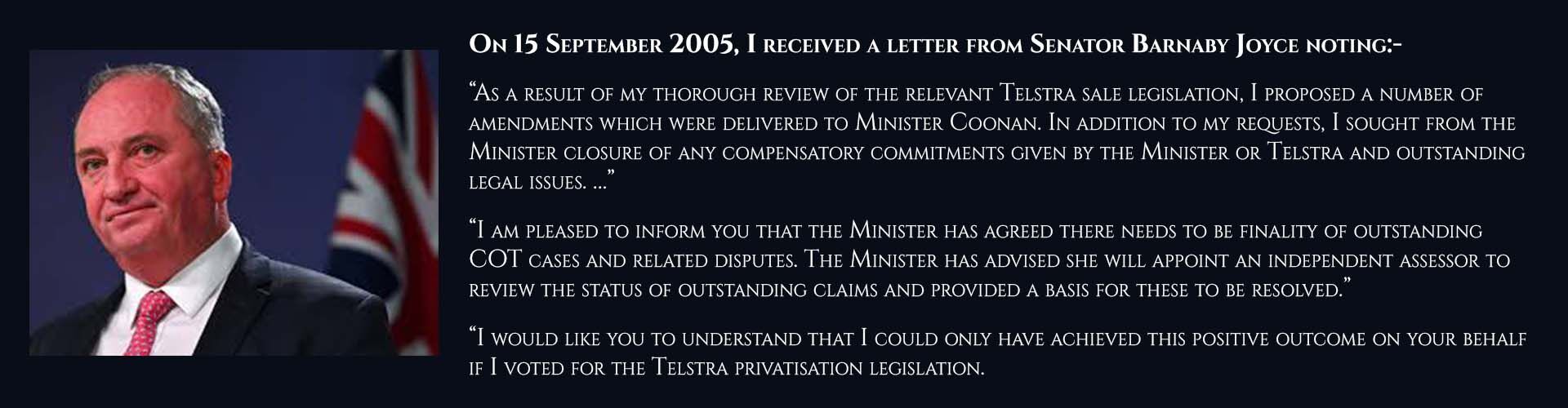
Below is part of a statement made by Senator Barnaby Joyce in his letter to me dated September 15, 2005:
"Dear Mr Smith,
Casualties of Telstra - Independant Assessement
As a result of my thorough review of the relevant Telstra sale legislation, I proposed a number of amendments which were delivered to Minister Coonan. In addition to my requests, I sought from the Minister closure of any compensatory commitments given by the Minister or Telstra and outstanding legal issues. …”
I am pleased to inform you that the Minister has agreed there needs to be finality of outstanding COT cases and related disputes. The Minister has advised she will appoint an independent assessor to review the status of outstanding claims and provided a basis for these to be resolved.
I would like you to understand that I could only have achieved this positive outcome on your behalf if I voted for the Telstra privatisation legislation.” (Senate Evidence File No 20)
It is deeply troubling that Telstra, the defendant, was able to exert pressure on the government regulator, compelling them to alter their original findings in the AUSTEL report dated April 13, 1994. Shockingly, the report completely ignores the plight of 120,000 ordinary Australian citizens suffering from COT-type problems. Instead, they manipulated this omission to undermine the validity of the COT claims.
Telstra's Falsified SVT Report
Before you read this unbelievable account, it is important to understand one crucial point: if the conduct you are about to read about had occurred in a courtroom, many individuals involved would have faced criminal charges. We are talking about evidence tampering, document alteration, unlawful interference with telecommunications services, and breaches of duty—all of which are prosecutable offences. Had the arbitrator been a judge, these matters would have been resolved in 1996 rather than dragged out until 2026.
What many people worldwide still fail to grasp is that arbitration is not the same as a court proceeding. When an arbitrator is inexperienced, compromised, or unwilling to confront wrongdoing, the arbitration process becomes a playground for legal abuse. Evidence can be tampered with right inside a claimant's home. Phone services can be interfered with even when no parties are present. Legal documents can be altered after one party has signed them. False test results—obtained over 112 kilometres away from the business in question—can be presented as "official findings" and accepted without scrutiny.
All of these actions occurred during the COT arbitration. In my case, the government communications regulator, AUSTEL (now ACMA), found that the Service Verification Testing (SVT) – the very reason for the arbitration at my business – was grossly deficient. AUSTEL even asked the defendants, Telstra, twice during my arbitration what they intended to do about the deficient tests conducted on my three service lines. Despite this, Dr Gordon Hughes, then the arbitrator (and now a principal lawyer at Davies Collison Cave Lawyers Melbourne → https://shorturl.at/L4tbp), allowed Telstra to submit, under oath, these fundamentally flawed SVT results. He refused to challenge this false witness statement, accepting it as genuine. The same arbitrator allowed these unlawful actions to occur under a confidentiality clause that effectively protected the offenders rather than the victims. By clicking on the following two links (Telstra’s Falsified BCI Report and BCI Telstra’s M.D.C Exhibits 1 to 46), you will discover that there is more to my story than what the Australian Government and Telstra are willing to acknowledge.
Because these crimes unfolded across various arbitration processes, some readers may be quick to assume that the police were involved. Let me be clear: after meticulously compiling a staggering 23,000 evidence files and diligently scanning another 15,000 documents of comparable weight, I found absolutely no evidence implicating the Australian Federal Police (AFP) or the Major Fraud Group of Victoria Police in the misconduct that irrevocably altered the lives of those involved in the COT Cases.
The actual wrongdoing was committed by the arbitration officials themselves. We, the individuals in the COT Cases, were forced to exonerate these officials of any negligence before we could sign our arbitration agreement. The unethical and unlawful behaviour of arbitration consultants and defendants was exploited by those overseeing the process, allowing them to weaponise the confidentiality clause. This misuse enabled further unconscionable acts—actions that would never have survived the scrutiny of an open court
Uncover the insidious instances of foreign bribery and nefarious corrupt practices that have infiltrated the COT arbitrations, as illustrated on the homepage of absenteejustice.com. This website ignites a relentless investigation into the world of political corruption, revealing a narrative as shocking as any true crime saga. It exposes the international fraud perpetrated against unsuspecting claimants entangled in government-endorsed arbitrations. The unscrupulous, corrupt actions within the government have not only undermined the integrity of the arbitration system in Australia but have done so knowingly, while shamelessly promoting it as a bastion of fairness—despite being acutely aware of its deceitful nature.
Lastly, a disturbing route to access our evidence exhibits can be found through the link titled "The first remedy pursued." This link reveals the twisted narrative behind our case. Alarmingly, the arbitrator, Dr Gordon Hughes, who presided over my arbitration, permitted the Telecommunications Industry Ombudsman to entangle Mrs Hughes in a thirty-year web of deceit. This corrupt scheme was deliberately orchestrated to shield the then-President of the Institute of Arbitrators Australia from investigating my legitimate claims against Dr Hughes—a clear illustration of the treachery that has plagued this entire ordeal.
This gag clause is used worldwide. As long as people continue to choose arbitration over court proceedings, believing it to be fair, efficient, or transparent, these abuses will continue. What you are about to read is not an Australian anomaly; it is a warning.
If you, the visitor, are wondering why the US Department link is overshadowing the previous narrative, it is crucial to address this before our COT story unfolds. Telstra's dealings with Ericsson prior to the COT arbitrations were highly questionable. The COT Cases revealed that the faulty Ericsson AXE telephone equipment installed by Telstra was the source of the claims against them. At that time, we, the COT claimants, even described Ericsson's actions as akin to terrorism. Senator Richard Alston raised the issue of the Ericsson AXE faults in the Senate on February 25, 1994.
Ericsson's extensive involvement in Australia's arbitration system is not just a matter of record; it raises significant and troubling questions about accountability and transparency. The company has managed to evade responsibility for its controversial actions during the Casualties of Telstra (COT) arbitrations, leading to growing scepticism about its practices. The situation transcends simple corporate governance; despite Lane, a key player in this scenario, aligning with the interests of the COT—comprised entirely of Australian citizens—there remains a critical opportunity for the company to make amends.
To this end, Lane could take a meaningful step toward redemption by disclosing the thousands of documents it acquired during the COT arbitration. These documents hold the potential to shed much-needed light on the proceedings and the decisions made therein. It is essential that this information be assessed based on its merits rather than being selectively shared with those it previously accused, who have thus far denied access to it for independent scrutiny.
Moreover, there is an urgent call to action for Lane's former partners to assist me now, something they failed to do when they ignored my Ericsson documents. By providing access to the previously submitted arbitration-related documents, they could play a pivotal role in advancing transparency and ensuring justice for the parties involved. This step is crucial to completing the work I am pursuing on absentjustice.com, where I aim to raise awareness of what Lane did when they sold out to Ericsson.
The statement in the image above notes: "Key details withheld, files locked in basements as Ericsson's impaired' US investigation." This situation raises serious questions about possible links between these concealed files and Ericsson's acquisition of critical Australian arbitration documents. Notably, Lane Telecommunications Pty Ltd, acquired by Ericsson during the arbitration proceedings, has failed to return essential documents obtained under confidentiality from the COT (Customer-Owned Telecommunications) cases during the overlapping arbitrations.
This raises a significant question: Why did the Australian government not take action to recover these important documents from Lane on behalf of the COT Cases? This question is particularly pressing given that the COT Cases were entirely unaware of Lane's impending acquisition by Ericsson, the very entity currently under scrutiny during the COT arbitrations.
PLEASE NOTE:
During my arbitration, Lane Telecommunications Pty Ltd was officially appointed as the technical consultant to the arbitrator. Lane had access to sensitive materials, including evidence implicating the Ericsson-manufactured telephone exchange equipment, which caused significant problems for my business and those of other COT claimants.
In a move suggestive of collusion, Ericsson quietly acquired Lane while confidentiality agreements were still in place. This acquisition occurred during the arbitration period, effectively transferring privileged evidence into the hands of the company under investigation in the COT arbitrations. No one disclosed the purchase price Ericsson paid for Lane, or why an international telecommunications company would acquire the very witness investigating it for fraud.
I repeatedly requested essential arbitration records and sought clarification on why Lane was permitted to investigate my arbitration documents and make findings about them before Paul Howell of the DMR Group Canada arrived in Australia. The COT Cases specifically expressed distrust towards Lane Telecommunications Pty Ltd (Australia). On January 10, 1996, John Pinnock, the second appointed Telecommunications Industry Ombudsman, wrote a letter outlining his position on the requested documents. This letter further complicated my efforts to obtain the necessary information for my pending appeal.
“I refer to your letter of December 31, 1996, in which you seek access to various correspondence held by the TIO concerning the Fast Track Arbitration Procedure. …
“I do not propose to provide you with copies of any documents held by this office.” (See Open Letter File No 57-C)
When I purchased the Cape Bridgewater Holiday Camp in 1987, I discovered that only eight telephone lines were available to service 130 residences. This meant that if four people were making or receiving calls simultaneously, only four lines remained for the other 126 residences.
Operating a 120-bed holiday camp under such conditions for the first 3.5 years was extremely challenging. This experience ultimately led me to establish the Casualties of Telstra small business group. Seven years later, I, along with sixteen others, found myself involved in an arbitration process against Telstra. This arbitration took a significant toll on us, stripping away our pride and negatively impacting our businesses, especially as the arbitrator sought to minimise Telstra's financial liability.
During the arbitration, my technical advisor, George Close & Associates, explained to the arbitrator, Dr Hughes, that when the lines were busy, callers attempting to reach the Cape Bridgewater RAX encountered an electronic message stating that the number they were dialling was not connected. This congestion issue, linked to the RAX Ericsson exchange, persisted until August 1991. Consequently, for three and a half years, potential customers received a recorded message indicating that I was no longer in business.
However, David Read from Lane informed the arbitrator that this electronic message had been in use for only lasted for 16 days, not the 3.5 years we claimed. On May 11, 1995, Dr Hughes' arbitration award for this RAX fault issue compensated me only for that 16-day period.
People calling into a 100+ bed accommodation centre and hearing that dreadful message for 16 days would have been convinced that my business was unrelated to Telstra's service. To have heard it for 3.5 years, however, shows why I lost everything: my $57,000 superannuation, an extra $26,000 in deposits and silver ingots, a 24-seater bus, my two children, and a 20-year marriage.
It's no wonder Ericsson acquired Lane; it was quite a strategic move for them.
PLEASE NOTE:
In the 1970s and 1980s, Ericsson was a key technology provider to Telstra (then known as PMG/Telecom Australia).
-
1970s Technology: The primary technology was Ericsson's crossbar system (e.g., ARK/ARE series), which proved highly reliable for automated, unmanned rural service through Rural Automatic Exchanges (RAX units).
-
1980s Transition: The 1980s marked a transition to electronic, computer-controlled systems. Ericsson introduced the computer-controlled AXE-10 system for unmanned, automated switching.
The first fully dedicated AXE exchange in Australia, designed by Ericsson, opened in Melbourne in 1981.
-
The AXE System: Selected for its modular design, the AXE system enabled efficient, computer-managed, unmanned
operations and allowed for decentralised control.
These technologies, particularly the AXE system, formed the foundation for the fully digital network that gradually replaced older step-by-step technologies throughout the 1980s.

When the Australian Federal Police (AFP) revealed it was probing the main figure in the COT arbitrations—former Minister for Communications, Senator Bob Collins—it raised alarming ethical questions. AUSTEL's Chairman, Robinn Davey, had warned Collins about the ongoing catastrophic failures of the Cape Bridgewater switch telephone system, which served my children's holiday camp. While I desperately sought evidence to support my case, information crucial for my arbitration technical expert was mysteriously unavailable. It was later revealed that this information had been withheld because Senator Collins was under investigation for the heinous crime of child rape within his parliamentary office in Canberra. This very office, where materials vital to substantiating my claim were stored, became a chamber of deceit and treachery.
Compounding these issues, we discovered that Dr Hughes' Sydney partnership—another arm of his legal firm—was secretly representing numerous Telstra employees. When we demanded answers regarding this glaring, undisclosed conflict of interest, the Telecommunications Industry Ombudsman (TIO) callously refused to reveal how long this collusion had been ongoing before Hughes was appointed as the supposedly independent arbitrator in our cases against Telstra.
The administrators of our arbitrations deliberately withheld vital information until after Hughes was appointed, revealing the extent of their deceit. When we sought transparency regarding the payments Telstra's Sydney clients made to Hughes's company, we were met with indifference; their response was that it was none of our concern.
Moreover, when we inquired about the timing of Ericsson Telecommunications of Sweden's impending purchase of the TIO-appointed arbitration consultants, we were dismissed again. This was particularly concerning given that Lane was tasked with investigating the COT arbitration claims against Ericsson, whose principal AXE telephone exchange equipment was installed by Telstra throughout Australia. This critical information was deliberately kept secret as part of a broader scheme of manipulation and betrayal.
Adding to this treachery, we were denied the return of our individual Ericsson AXE submission data after our arbitrations were deemed final, despite having paid thousands of dollars in technical fees. In my case, I paid $25,000 to George Closes and Associates. Nothing I requested—or that might have been beneficial to my claim—was ever provided, a situation mirrored for other COT claimants.
I believe the Australian government should answer the following questions: How long was Lane Telecommunications Pty Ltd in contact with Ericsson before Ericsson purchased Lane? Is there a connection between Lane ignoring my Ericsson AXE claim documents and the purchase of Laneby Ericsson during the COT arbitration process?
Telstra's 2019/2020 5G partnership with Ericsson is relevant to all Telstra subscribers in Australia. These subscribers should also be aware of my claims against Telstra and Ericsson, which I assert are substantiated on my website, absentjustice.com (see Bribery and Corruption - Part 2)
It is important to highlight the Ericsson bribery and corruption issues raised by the US Department of Justice, which were discussed in Australian media reports on December 19, 2019.
One of Telstra's key partners in the building out of their 5G network in Australia is set to fork out over $1.4 billion after the US Department of Justice accused them of bribery and corruption on a massive scale and over a long period of time.
Sweden's telecoms giant Ericsson has agreed to pay more than $1.4 billion following an extensive investigation which saw the Telstra-linked Company 'admitting to a years-long campaign of corruption in five countries to solidify its grip on telecommunications business. (https://www.channelnews.com.au/key-telstra-5g-partner-admits-to-bribery-corruption/)
Is there a sinister link between the government's communications regulator, ACMA, denying me access to the Ericsson AXE documentation, which I lawfully sought during my two Administrative Appeal Tribunal hearings in 2008 and 2011 (see Chapter 9 - The ninth remedy pursued and Chapter 12 - The twelfth remedy pursued)?
Stop the COT Cases at all costs.
Worse, however, the day before the Senate committee uncovered this COT Case Strategy, they were also told under oath, on 24 June 1997 see:- pages 36 to 39 Senate - Parliament of Australia from an ex-Telstra employee turned -Whistle-blower, Lindsay White, that, while he was assessing the relevance of the technical information which the COT claimants had requested, he advised the Committee that:
Mr White "In the first induction - and I was one of the early ones, and probably the earliest in the Freehill's (Telstra’s Lawyers) area - there were five complaints. They were Garms, Gill and Smith, and Dawson and Schorer. My induction briefing was that we - we being Telecom - had to stop these people to stop the floodgates being opened."
Senator O’Chee then asked Mr White - "What, stop them reasonably or stop them at all costs - or what?"
Mr White responded by saying - "The words used to me in the early days were we had to stop these people at all costs".
Senator Schacht also asked Mr White - "Can you tell me who, at the induction briefing, said 'stopped at all costs" .
Mr White - "Mr Peter Gamble, Peter Riddle".
Senator Schacht - "Who".
Mr White - "Mr Peter Gamble and a subordinate of his, Peter Ridlle. That was the induction process-"
From Mr White's statement, it is clear that he identified me as one of the five COT claimants that Telstra had singled out to be ‘stopped at all costs’ from proving their case against Telstra. From Mr White's statement, it is clear that he identified me as one of the five COT claimants that Telstra had singled out to be ‘stopped at all costs’ from proving their case against Telstra.
One of the named Peter's in this Senate Hansard who had advised Mr White we five COT Cases had to stopped at all costs is the same Peter who swore under oath, in his witness statement to the arbitrator, that the testing at my business premises had met all of AUSTEL’s specifications, when it is clear from Telstra's Falsified SVT Report, that the arbitration Service Verification Testing (SVT testing) conducted by this Peter did not meet all of the governments mandatory specifications.
When my Cathy and OI signed two individual statutory declarations attesting this, Peter had to abandon his service verification arbitration tests at my premises, and at the local switching exchage the very reason most if not all of the COT Cases went into arbitration and in my case the whole reason I paid more than $300,000 in arbitration fees so that the arbitration process would expose how defective Telstra testing regime was inadequate and had been for the last six years and therfire I knew the testing of my three service lines would be grossly deficient Dr Hughes still stated in his 11 May 1995 award at point 3.2 (h) there were no more faults afecting my business after July 1994.
When David Read, the arbitration consultant, visited to my business on 6 April 1994, in the company of this named Peter, both refused to conduct any tests through the Ericsson telephone exhange using the Ericsson testing equipment, and I officially notified Dr Hughes that David Read of Lane had refused along with this Peter to test the Ercsson equipment Dr Hughes did not inform me that Ericsson was soon to purchase Lane for an undisclosed sum of money.
As you scroll down this homepage, you'll discover that when the arbitrator, Dr. Gordon Hughes, learned that I had requested a second set of SVT tests—or something similar—because the first SVT process had failed, he assured me that these crucial tests would take place on April 6, 1995, during Telstra's and Lane's site visit to my holiday camp as part of the agreed arbitration process. However, when that day arrived, nothing occurred. Instead, Dr. Hughes and the arbitration consultants created a web of deceit. When confronted by the Institute of Arbitrators regarding the absence of the tests, they misleadingly provided the President of the Institute of Arbitrators Australia with a false narrative to cover up their betrayal. The concealment of the truth is significant, and their treachery is painful.
The Telstra engineer who refused to conduct the tests with Lane is the same Peter who performed the initial SVT test, which ultimately failed. He is also the same Peter mentioned in Senate Hansard, who informed Telstra whistleblower Lindsay White that we COT Cases had to be stopped at all costs from proving our claims.
Don't forget to hover your mouse over the following images as you scroll down the homepage.

Organized Crime and Corruption - Absent Justice
On June 3, 1993, a seemingly inconsequential event occurred that would expose a chilling pattern of deceit within Telstra, Australia’s largest telecommunications company. A representative named Mr Hew Mackintosh inadvertently left an unlocked briefcase at my Cape Bridgewater Holiday Camp in Victoria. What should have been a simple oversight revealed an alarming trove of information that Telstra had been deliberately withholding throughout the discovery process.
Upon inspecting the contents of the briefcase, I uncovered documents that pointed to a disturbing reality: my business was still grappling with severe service disruptions, even on the very day when General Manager Rosanne Pittard had assured me, in a brazen display of treachery, that there were no ongoing telephone faults plaguing our operations. Her handwritten notes to her division head further confirmed her duplicity, creating a clear pattern of misrepresentation designed to mislead me (see Folios C04008, headed TELECOM SECRET →Front Page Part Two 2-B), which states:
“Legal position – Mr Smith’s service problems were network related and spanned a period of 3-4 years. Hence Telecom’s position of legal liability was covered by a number of different acts and regulations. … In my opinion Alan Smith’s case was not a good one to test Section 8 for any previous immunities – given his evidence and claims. I do not believe it would be in Telecom’s interest to have this case go to court.
“Overall, Mr Smith’s telephone service had suffered from a poor grade of network performance over a period of several years; with some difficulty to detect exchange problems in the last 8 months.”
At clauses (points) 3.3 (a) and 7.14 (a) in the arbitrator's award, it is clear he does not take my claims that I was mislead and deceived in my 11 December 1992 settlement. In fact, at dot point 3 in clause 3.3 (a), the arbitrator states in part:
"the claimant has no entitlement to compensation in respect of the period prior to 11 December 1992"...
and at dot point 4 in clause 3.3 (a) states:
" a fault free telephone service is not guaranteed and is impossible to provide and, in any event, the level of service as tested was satisfactory during all relevant periods"...
The consequences of this betrayal were profound and far-reaching. In September 1992, I found myself misled, ultimately leading to a pressured settlement agreement that I reluctantly signed on December 11, 1992. Under immense duress, I accepted a commercial settlement that was, quite frankly, shockingly undervalued. This is clearly illustrated in Folios C04006, C04007, and C04008 →Front Page Part Two 2-B), which document the true extent of my situation.
At the time, I was operating under the comforting but misguided belief that the complex telephone issues I had been facing had been resolved. However, the reality was far different. The contents of those Folios, along with several other critical documents tucked away in that briefcase, revealed a stark and unsettling truth: Telstra had crafted a narrative that benefitted their own interests, manipulating information to lead me astray.
On that fateful day in December, I signed a confidentiality agreement that bound me to silence regarding any details of the settlement. Yet this agreement was built on a foundation of blatant lies and deliberate deceit, carefully orchestrated by Telstra, which promoted information it knew was undeniably false.
In 2009, during their third investigation into Dr Hughes’ conduct, the Institute of Arbitrators Mediator Australia (IAMA) was presented with the same crucial evidence documenting the misrepresentation and deception leading up to and during my 1992 settlement, as well as several other instances in which Dr Hughes agreed only with Telstra's version of events. Shockingly, the IAMA has so far dismissed this evidence outright, as did Dr Gordon Hughes, as further elaborated in The eleventh remedy pursued.
Throughout my journey, examples like Folios C04006, C04007, and C04008 are meticulously recorded on absentjustice.com and in my manuscript eBook titled "The Arbitrator," which is available for purchase online (See above). This work highlights a critical consideration for anyone contemplating participation in the arbitration process in Australia: it urges a deep examination of how Australian arbitrators perceive those in power compared to those in powerlessness. Is this truly the path to justice, or merely an illusion?
The COT Cases were unaware that when AUSTEL (now known as ACMA) endorsed the arbitrations, it also approved Warwick Smith, then the Telecommunications Industry Ombudsman, to act as the official administrator overseeing the process. What they didn't know was that Warwick Smith had secretly provided Telstra with privileged information from government discussions, thereby compromising the commercial assessment process underway for the first four COT Cases.
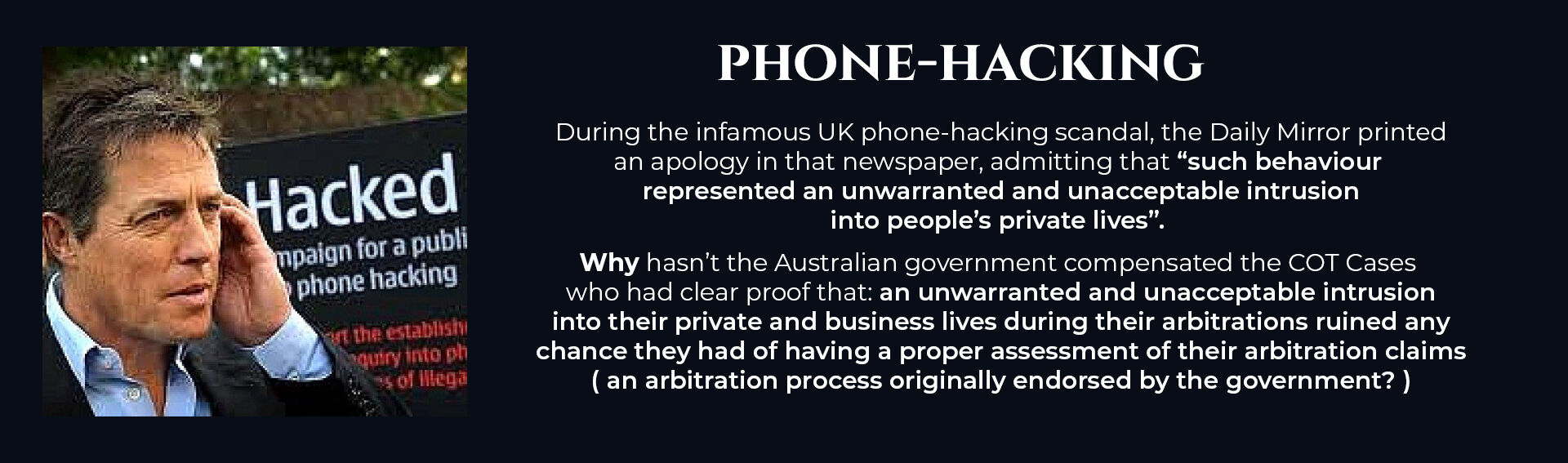
In the Sunday Herald Sun, dated January 24, 2026, British actor Liz Hurley revealed the harrowing impact of the phone-hacking scandal that ensnared her alongside Hugh Grant. Both actors find themselves grappling with the fallout of their conversations being surreptitiously monitored for an extended period during the infamous News of the World scandal orchestrated by Rupert Murdoch. The same issue reported that Prince Harry is haunted by trauma-related flashbacks, tormented by the knowledge that his own private conversations were similarly compromised.
During our COT arbitrations, the Australian Federal Police met with Ann Garms and me, revealing a shocking betrayal: Telstra had confessed to bugging our phone services without our consent, harking back to the government’s ominous warnings in 1994. This egregious invasion of privacy has condemned Ann Garms to a life of torment, rendering her unable to lead anything resembling a normal existence, even after receiving punitive damages. The spectre of constant electronic surveillance not only stirs anxiety but wreaks havoc on our mental health, leaving us in a state of paranoia about whether we are still being watched and whether our faxes and emails are still subject to Telstra's intrusive scrutiny.
The COT Cases, like Ann and me, are trapped in a nightmarish reality, haunted by the pervasive corruption of an entity that has thus far evaded accountability for its treacherous actions. The shadow of Telstra’s violations looms large, making it clear that we can never truly escape the darkness they have cast over our lives.
“We canvassed examples, which we are advised are a representative group, of this phenomenon .“They show that• the header strip of various faxes is being altered• the header strip of various faxes was changed or semi‑overwritten• in all cases the replacement header type is the same• the sending parties all have a common interest and that is COT• some faxes have originated from organisations such as the Commonwealth Ombudsman office• the modified typeface of the header could not have been generated by the large number of machines canvassed, making it foreign to any of the sending services.”
“I still stand by my statutory declaration that I was able to identify that the incoming faxes provided to me for review had at some stage been received by a secondary fax machine and then retransmitted. This was done by identifying the dual time stamps on the faxes provided.” (
• How could two separate investigations into Telstra for alleged unlawful conduct be conducted simultaneously by two different bodies—an arbitrator and the AFP? We have found no comparable situation in any other Western democracy.• While each of us struggled to keep our small businesses afloat, how were we expected to prepare complex submissions for the arbitrator while also assisting the AFP with their investigations?• Who authorised this situation to continue?(see ) Record this fact.
In February 1994, I had the invaluable opportunity to discuss with Melanie Cochrane, an officer from the Australian Federal Police (AFP), and Superintendent Detective Sergeant Jeff Penrose, also an AFP officer. During this meeting, I shared critical findings from internal Telstra memos obtained through a Freedom of Information (FOI) request. These documents contained historical notes prepared by an unidentified individual within Telstra, highlighting various matters that, together, painted a troubling narrative.
The memos provided insight into private matters regarding the phone and fax numbers associated with an individual named in these documents. They even included details such as the person’s nationality and noted peculiar communication patterns. For instance, one memo indicated that this individual typically contacted me from a specific phone number; however, on one particular occasion, they reached out from Adelaide, prompting further questions about the nature of these communications. The documents were shared with the AFP between February 1994—when they first visited my office—and again in September 1994. A number of these memos were cited in the 93 questions posed on 26 September 1994, which I have made available in the attached transcripts for thorough examination → Australian Federal Police Investigation File No/1.
During the period from 14 to 16 May 1994, I made a significant discovery while reviewing my first major FOI release at the Telstra offices in Melbourne. I uncovered 56 fax transmissions, each containing different headers, attached to reports that, alarmingly, did not align with their accompanying documents. This glaring inconsistency could not be overlooked. After I discussed these 56 varied and unrelated reports over the phone with Superintendent Detective Sergeant Jeff Penrose, he advised me to formalise my findings in a statutory declaration asserting the discrepancies in the fax headers and the attached reports. I took this advice seriously; I signed the declaration and promptly hand-delivered it to the Arbitrator’s office → Exhibit 76 (AS-CAV Exhibit 48-A to 91). A copy was also provided to Sue Harlow, who served as the Deputy Telecommunications Industry Ombudsman and acted as the Administrator of my arbitration. It was imperative that all relevant parties receive this crucial evidence, particularly because it corroborated issues raised in two mini-reports indicating that one of my major complaints against Telstra was systemic billing problems, and noted in this particular report that Australia was dealing with such problems dating back to the inception of my arbitration proceedings.
Documents related to the Telecommunications Industry Ombudsman (TIO) that I received a staggering seven years after the conclusion of my arbitration demonstrated that Sue Harlow recognised the receipt of this fax header material → Exhibit 77(AS-CAV Exhibit 48-A to 91). This acknowledgement was crucial, as it alerted Warwick Smith (the TIO and the principal administrator of my arbitration) that important arbitration materials had been duly submitted to the appropriate offices. I had previously submitted records of phone interceptions from 1992 to 1993 to the Arbitrator’s office after the memos had been forwarded to the AFP.
On the same day that I hand-delivered the 56 header pages and the corresponding reports to the Arbitrator's office, the same materials were also presented to Sue Harlow. The Golden Courier Services of North Melbourne was tasked with photocopying these relevant files three times and delivering them via one of their drivers.
If the Arbitrator continues to reject the delivery of these 56 tampered Telstra-related reports in 2026, I encourage the reader to consider why I would go to the significant length of undertaking a 12-hour round trip to Melbourne to provide this essential information to the Telecommunications Industry Ombudsman (TIO) at the direction of Superintendent Detective Sergeant Jeff Penrose, yet not present a second copy directly to the attention of the Arbitrator, the primary person evaluating my arbitration claims.
So, where are the 56 fax header reports that Golden Courier Services helped me compile for submission? Why is the receipt of this information not mentioned in the schedule of arbitration documents received by Dr Hughes? Why were these 56 reports not provided back to me after the conclusion of my arbitration? Why aren’t any of the topics I highlighted with the assistance of Golden Courier Services acknowledged?
Even more disturbing is an assertion made in Chapter 1 - The Collusion Continues. In the final evaluation report dated 30 April 1995, conducted by the TIO‑appointed DMR & Lane technical arbitration consultants regarding my reported telephone call losses, they made a notable—and rather troubling—claim: "A comprehensive log of Mr Smith's complaints does not appear to exist". This assertion is utterly at odds with reality, since two former Detective Sergeants from the Queensland Police—Garry Ellicott and Barry O'Sullivan (the latter eventually becoming Senator Barry O'Sullivan)—had formally couriered a comprehensive chronology of events. This substantial evidence consisted of a total of five bound volumes, which were submitted to the Arbitrator's office as part of my overall claim. The meticulous preparation of these volumes cost an astonishing $56,000 in 1994.
However, my Letter of Claim dated 7 June 1994, submitted to arbitration on 15 June 1995 (Refer to Open letter File Nos/46-A to 46-J), shows that Garry Ellicott and Barry O'Sullivan did submit a comprehensive log of my complaints.
Consequently, several pressing questions remain unanswered: Where are the 56 dubious Telstra fax headers that were stapled to the accompanying 56 reports? What has transpired with the five volumes of evidence that DMR & Lane claimed (did not appear to exist)? Therefore, this comprehensive log of my phone complaints was 'never valued' in the arbitration process. This entire process has ultimately cost me more than $300,000 to navigate, raising serious concerns about the integrity of the arbitration system. I sincerely hope this detailed introduction will inspire you to delve deeper into the nuances of how Australian arbitrations are conducted, particularly for those who find themselves outside the influential elite of the Australian establishment.
Chapter 1- Prior to Arbitration
As the truth began to surface, on April 21, 1994, the government communications authority launched an investigation into Telstra’s misleading statements and misrepresentations. The ensuing inquiry by AUSTEL resulted in a comprehensive 69-page report, which I later made accessible at absentjustice.com (see AUSTEL’s Adverse Findings). This report thoroughly validates my claims dating back to April 1988 through December 11, 1992, unmasking Telstra's falsehoods on the very day I accepted the settlement, revealing a concerted effort to conceal the gravity of the service issues I was suffering.
The arrogance of Dr Hughes, who believed he knew best, was evident throughout the arbitration proceedings. Even after we provided evidence that Telstra was not complying with the agreed process for delivering the necessary documents to support our ongoing phone problems, Dr Hughes continued to dismiss our concerns. How can we proceed until these faults are resolved?
 Despite the constraints of a Commercial Confidentiality Agreement, which was deliberately designed to suppress the truth, AUSTEL conducted its investigation without my involvement or knowledge. Even more egregiously, the findings of this critical investigation were provided exclusively to Telstra six weeks before any arbitration proceedings commenced, leaving me in the dark. The Telecommunications Industry Ombudsman (TIO) arbitration consultants, appointed by Warwick Smith, also received the findings, but they were bound by a confidential amendment allowing them to withhold any information they deemed irrelevant from both the arbitrator, Dr Gordon Hughes, and the claimants, including me. This revised Arbitration Agreement, effectively a gag clause, obstructed full disclosure, enabling the continuation of this systemic injustice and preventing many Australians from understanding the dark reality of these proceedings.
For those who entered arbitration with the TIO, the consequences were tragically severe. The emotional and psychological toll was immense, with many individuals facing devastating outcomes such as suicides, heart attacks, marital breakdowns, and strokes that rippled through families, leaving a trail of heartache and suffering in their wake.
On July 5, 1995, Amanda Davis, the former General Manager of Consumer Affairs at AUSTEL, provided an open letter identifying me as the person who would soon meet The Honourable David Hawker MP, the Federal Member of Parliament. We delivered this letter in person to the then Shadow Minister for Communications, Senator Richard Alston, in his office at Parliament House, Canberra.
The letter details numerous instances of gross misconduct that affected the initial four arbitrations involving Ann Garms, Graham Schorer, and me (see Evidence File 5 - Testimonials). Additionally, in Evidence File 5 - Testimonials, there is a three-page statement by Senator Ron Boswell, who also received the same letter. Under the heading "A Matter of Public Interest," an emotional Senator Boswell goes much further in his condemnation of what happened to the four COT Cases, as this exhibit clearly demonstrates.
A Story of Despair and Heartache.
Both Senators Ron Boswell and Richard Alston, along with several other Senators and Robin Davey, the Chairman of AUSTEL, were deliberately misled into believing that our arbitration agreement had been formulated by the Institute of Arbitrators Australia (IAA). In reality, the COT Cases were coerced into accepting Telstra's arbitration rules, unaware that they had not been drafted independently by Telstra. They were crafted without government oversight or the IAA's involvement.
Upon discovering this troubling information, I reached out to the IAA, which confirmed it had never been contacted by the government or anyone else, underscoring the serious risks involved.
It came to light that Dr. Hughes was aware that the arbitration agreement had been created by the defendants' lawyers, rendering it anything but independent. This blatant conflict of interest resulted in numerous deficiencies in the agreement that benefited Telstra while undermining the claimants.
Adding to the treachery, I later received a letter from Mr Ian Nosworthy, President of the IAMA, which revealed that Dr Hughes was not a graded arbitrator at the time of my arbitration. He received his grade only after I concluded my arbitration on May 11, 1995.
Dr. Gordon Hughes claimed in the introduction of my arbitration award that he crafted the arbitration agreement in collaboration with Frank Shelton from the TIO office—a blatant falsehood. This deliberate misrepresentation is not only unethical but also reveals a deep-seated corruption within the process. Shockingly, Dr. Hughes exonerated Frank Shelton from any accountability, even after we were pressured into accepting underhanded last-minute changes to the arbitration agreement rules. This entire situation casts a dark shadow over the legitimacy of the proceedings. Not long after the arbitration began, Frank Shelton was conveniently appointed as a County Court Judge, further entrenching the treachery at play.
Although we have discussed Chapter 5: Fraudulent Conduct elsewhere on this homepage, addressing it again emphasises its importance.
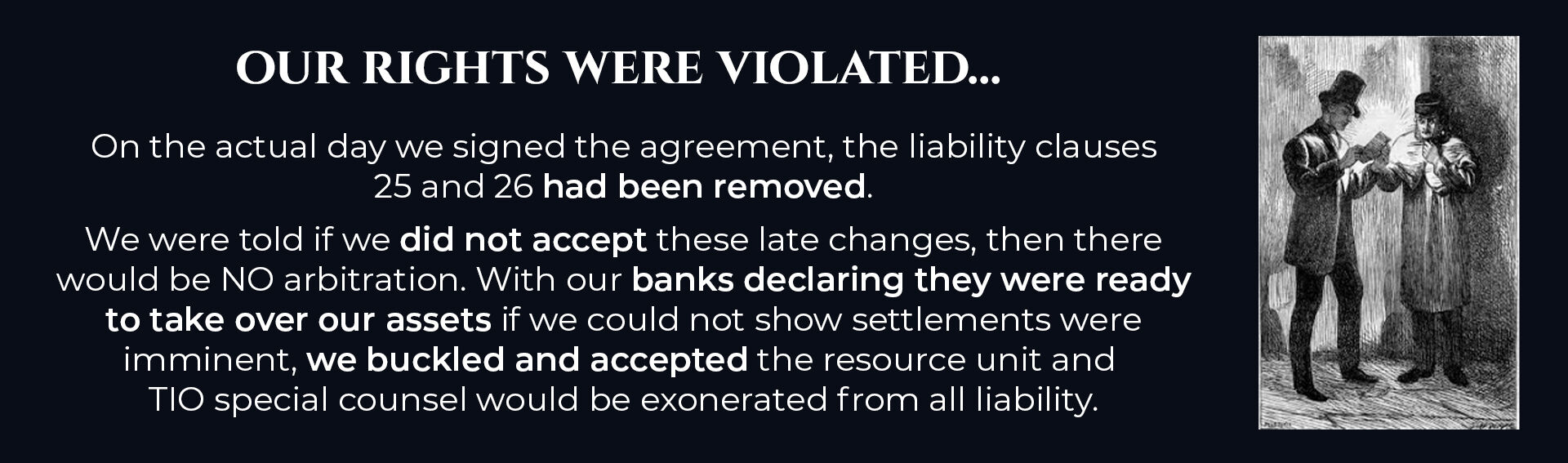
Ferrier Hodgson Corporate Advisory, which forced us to waive all liability by removing the $250,000 liability caps, needs to explain why it concealed so much relevant information from the arbitrator handling my case, Dr Gordon Hughes.
As I will elaborate in my forthcoming book, Ferrier Hodgson Corporate Advisory (FHCA) was assigned by the TIO the critical task of determining which information would be made accessible during the arbitration process. Alarmingly, FHCA issued a written acknowledgement on August 2, 1996—thirteen months after my arbitration concluded—confirming that they had withheld essential AUSTEL and Telstra-related information from Dr Gordon Hughes, the arbitrator. Despite this shocking admission of serious misconduct, no corrective action was ever taken.
Now, at 82 years of age, I remain undeterred in my pursuit of justice for the lives lost and damaged as a direct result of these corrupt COT arbitrations. My commitment to exposing this web of deceit and advocating for those impacted by it is unwavering. I implore you to reflect on the deep and lasting impact of this treacherous injustice that continues to affect numerous lives across Australia.
Criminal Mind - Absent Justice
Learn about horrific crimes, unscrupulous criminals, corrupt politicians, and the lawyers who wield influence in the legal profession in Australia. This story focuses on a group of small business operators living in remote Queensland, commonly referred to by Victorians as "the bush". We shared two main goals: to sustain our businesses, whether it was selling Japanese spare car and truck parts like Maureen Gillan of COT Case, or operating a theatre-style restaurant like Ann Garms of COT Case. I was involved with the Cape Bridgewater Holiday Camp while the ageing Graham Schorer managed over eighty courier vehicles to generate a profit.
Back in the 1980s and 1990s, businesses in Australia relied heavily on the telephone, as the internet, mobile phones, and email were not yet widely used. Without proper telephone service, earning an income was nearly impossible. As you read on, you will discover the strategies I used to overcome the challenges posed by inadequate phone service.
Our four businesses, along with over sixteen other small businesses that joined our COT group, drew the unwanted attention of Telstra's aggressive representatives. "Shameful," "hideous," and "treacherous" are just a few words that capture the actions of these lawbreakers.
1...any explanation for the apparent discrepancy in the attestation of the witness statement of Ian Joblin .
2...were there any changes made to the Joblin statement originally sent to Dr Hughes compared to the signed statement?"
The fact that Telstra's lawyer, Maurice Wayne Condon of Freehills, signed the witness statement without the psychologist's signature highlights the significant influence Telstra lawyers have over the arbitration legal system in Australia.
If you hover your mouse or cursor over the following TF200 telephone image, you will see how corrupt the Australian system of arbitration truly is. This Telstra internal email dated 21 April 1993, FOI folio C04094 from Greg Newbold to Don Pinel and several other Telstra executives: Subject “COT cases latest”, states:-
“Don, thank you for your swift and eloquent reply. I disagree with raising the issue of the courts. That carries an implied threat not only to COT cases but to all customers that they’ll end up as lawyer fodder. Certainly that can be a message to give face to face with customers and to hold in reserve if the complaints remain vexacious .” GS File 75 Exhibit 1 to 88
A similar internal memo FOI Folio R09507 to the same Don Pinel, from Telstra Corporate Secretary Jim Holmes, who the Telecommunications Industry Ombudsman (TIO), Warwick Smith, had allowed to sit in on regular TIO Board COT discussed meetings, states in part:
"I recall at the first meeting I attended, you forcefully expressed the desire to get the COT cases into court. One of the reasons I recalled was that the exercise was conducted by Freehill's in Sydney.
This involves the same Freehill Hollingdale & Page (now trading as Herbert Smith Freehills Melbourne) and the same Telstra Corporate Secretary, Jim Holmes. Since June 1993, they had been insisting that I register all my phone complaints and any evidence I had regarding phone bugging and fax hacking with Denise McBurnie, my case manager at Freehill. If I did not comply with these demands, Telstra and its internal security division indicated that they would treat my complaints as frivolous and regard my concerns as vexatious.
Major Fraud Group - Victoria Police investigation
Please note: The following highlighted section regarding the Canadian government has been addressed in detail elsewhere, including on the homepage below. However, since Dr. Goron Hughes (the arbitrator) did not address any of the three frauds listed here, and the Senate was involved despite the arbitration gag clause, it is important to highlight the seriousness of the issues raised in the Bell Canada International report. If my claims are substantiated, the Senate has requested that Telstra provide evidence to refute them. The Canadian government expressed concern that a Canadian telecommunications company might have engaged in fraud, or that an Australian company, such as Telstra, had transformed a Canadian technical report into a fraudulently prepared legal document.The Australian Senate believed that asking me to present my evidence to them effectively circumvented the gag clause. If I am proven correct, it would indicate that Telstra committed fraud during my arbitration. Additionally, there were four other COT cases in which Bell Canada International Inc. tested the telephone exchanges serving those arbitrations; it is possible that they also suffered from the same fraud that affected my arbitration.Therefore, it is crucial to incorporate the Canadian government's concern into our narrative at this early stage.
Telstra's Falsified BCI Report 2
The Canadian government minister's office, in a letter dated 7 July 1995, responded to my concerns regarding the BCI report, stating:
"In view of the facts of this situation, as I understand them, I believe you are taking the most appropriate course of action in contacting BCI directly with respect to the alleged errors in their test report, should you feel that they could assist you in your case."
Furthermore, Exhibit 8, a letter from BCI to Telstra's Steve Black dated 11 August 1995, and Exhibit 36, a letter from BCI to Telstra's John Armstrong, are not on official BCI letterhead, unlike Exhibits 1 to 7, which are (see BCI Telstra's M.D.C Exhibits 1 to 46). Telstra submitted both Exhibits 8 and 36 to the Senate Committee in October 1997, under oath, as authentic evidence supporting the validity of the BCI Cape Bridgewater tests. However, evidence presented on absentjustice.com and in Telstra's Falsified BCI Report confirms that this is not the case.
In May 1995, after being released from the Portland Hospital in Victoria, Australia, I prepared a statutory declaration addressed to the Hon. Michael Lee MP, who was the Minister for Communications at the time of my arbitration following my first of two heart attacks. In this sworn statement, I described a recent phone call from Canadian telecommunications expert Paul Howell of DMR Inc. Group. He had been flown from Canada to review my evidence against Ball Canada International.
Mr Howell acknowledged that my arbitration evidence was valid; however, he was not permitted to complete his findings or assess my 008 billing faults even though I was still complaining to both Dr Hughes and AUSTEL (the government communications authority) that these billing faults were systemic. As stated in Mr Howell's 30 April 1995 report to Dr Hughes, he notes:
“Continued reports of 008 faults up to the present. As the level of disruption to overall CBHC service is not clear, and fault causes have not been diagnosed, a reasonable expectation that these faults would remain ‘open’,” (Exhibit 45-c -File No/45-A)
He noted that this was the worst arbitration process he had ever participated in, and what happened to me in Australia would never have occurred in North America (refer to Exhibit 51-G, page 2, second and third paragraphs → Open Letter File No/51-A to 51-G).
This prompted me to reach out to the Canadian government, as I have a deep respect for Canadians’ integrity. I developed this respect during my 30 years as a seafarer while working on Ingram Tug Services' oil supply vessels in the Victorian Bass Strait oil fields in the late sixties and early seventies.
This environment of duplicity mirrors our experience four years earlier, when Superintendent Jeff Penrose of the AFP requested our assistance in their own investigation into Telstra's corrupt operations in 1994. The subsequent investigation by the Major Fraud Group in 1998 only highlighted the betrayal we faced. Mr Neil Jepson, the barrister for Victoria Police, was left floundering as he, too, uncovered the truth: we were ensnared in an ongoing struggle against Telstra’s relentless invasion of our privacy and the fraudulent activities that had previously derailed our 1994 arbitrations, continuing to wreak havoc in our lives until at least 2001.
I strongly encourage you to thoroughly review the two witness statements that we meticulously prepared and submitted to Senators Helen Coonan and Barnaby Joyce on September 6, 2006. For your reference, please see the attached evidence information labelled as Attachment 45.
The evidence within this report Open Letter File No/12 and File No/13) also indicated that one of my faxes sent to Federal Treasurer Peter Costello was similarly intercepted, i.e.,
Exhibit 10-C → File No/13 in the Scandrett & Associates report Pty Ltd fax interception report (refer to (Open Letter File No/12 and File No/13) confirms my letter of 2 November 1998 to the Hon Peter Costello Australia's then Federal Treasure was intercepted scanned before being redirected to his office. These intercepted documents to government officials were not isolated events, which, in my case, continued throughout my arbitration, which began on 21 April 1994 and concluded on 11 May 1995. Exhibit 10-C File No/13 shows this fax hacking continued until at least 2 November 1998, more than three years after the conclusion of my arbitration.
This 2 November 1998 fax example to the Hon. Peter Costello, which I provided to Mr Neil Jepson, shows had been intercepted before being redirected to his office. These were not minor administrative losses — they were deliberate obstructions. Mr Jepson’s office would never have known that similar documents I had faxed to his office were not redirected and went missing; he would have been unaware of this unless I had followed up by phone to discuss the content of the information I had just faxed, which had not arrived. The material concerned was associated with the nationwide 1800 billing rort, a fraud that affected every Australian using a so‑called “free call” service. The seriousness of that issue unsettled Mr Jepson and, I have no doubt, Detective Sergeant Rod Kuris as well.
Mr Ron Kuris was also assisting us in understanding the fraudulent documents at the centre of the investigation. Instead, the situation deteriorated further when former Telstra security officer Des Direen disclosed that electronic surveillance was being conducted on us. Kuris was visibly shaken by this revelation. His reaction confirmed what was already becoming clear: the investigative environment was compromised, and the system tasked with delivering justice was instead operating under a cloud of internal corruption and concealed misconduct.
The witness statement that follows lays this reality bare.
"I can recall that during the period 2000/2001, I had arranged to meet Detective Sergeant Rod KURIS from the Victoria Police Major Fraud Squad at the foyer of Casselden Place, 2 Lonsdale Street, Melbourne. At the time, I was assisting Rod with the investigation into alleged illegal activities against the COT Cases.
Rod then stated that he wanted me to follow him to the left side of the foyer. When we did this he then directed my attention to a male person seated on a sofa opposite our seat. He then told me that the person had been following him around the city all morning. At this stage Rod was becoming visibly upset and I had to calm him down. Rod kept on saying that he couldn't believe in what was happening to him. I had to again calm him down".
On the same day referenced in that statement, Ann Garms travelled to Melbourne carrying evidence showing that her faxes to me — sent while she was staying at Crown Casino during her court action against Telstra — had also been intercepted. This was the same type of evidence I had already provided to Wally Rothwell, Deputy TIO. Rothwell passed it to John Pinnock, the TIO, who, as usual, did nothing. The pattern was consistent: evidence of interception was acknowledged, circulated internally, and then buried.
Points 21 and 22 in Mr Direen’s witness statement dated 8 August 2006, record how, while he was a Telstra employee, he had cause to investigate “… suspected illegal interference to telephone lines at the Portland exchange,” but when he “… made inquiries by telephone back to Melbourne (he) was told not to get involved and that another area of Telstra was handling it” and that “... the Cape Bridgewater complainant was a part of the COT cases” (my Cape Bridgewater Holiday Camp) business.
The following three transcripts are provided as confirmation that I was part of the Major Fraud secondment.
It is also essential to link Major Fraud Group Transcript (1) and Major Fraud Group Transcript (2), because Fraud Group Transcript (1) shows Senator Ron Boswell, Graham Schorer (COT spokesperson), Bruce Akehurst (Telstra), Mr. Anthony Honner (another COT case), and Barry O'Sullivan (negotiator and later Senator) discussing why the government did not allow my arbitration matters to be viewed by the Senate along with the five "litmus" COT test cases. Investigating my matters would have impeded Telstra's privatisation. Telstra's position was protected.
Major Fraud Group Transcript (2) shows Barrister Sue Owens explaining why Major Fraud Group Barrister Neil Jepson seconded me to assist the fraud group's investigations into the four claims she had registered concerning alleged fraud by Telstra.
Page 11 of transcript (2) shows Sue Owens stating that I am "extremely intelligent" and that the police also held the same view regarding my reporting—the reason I was asked to assist with their fraud investigations.
It is crucial to include the Senate Schedule COT list -16 file because it demonstrates that the arbitrator, Dr Gordon Hughes, later joined the law firm that was representing Telstra in the 1800 billing complaints against COT cases. These are the same 1800 telephone billing complaints that he refused to let DMR & Lane investigate during my arbitration. If this situation does not constitute a serious conflict of interest, then what does?
It is also significant that the Senate Schedule COT list -16 file indicates that the Establishment was informed by the TIO that Lane had worked on numerous Australian contracts. Because of this, Lane should not have been permitted to investigate the COT Cases claim against the government-owned Telstra Corporation. As a result, the legal rights of the COT Cases claimants in our government-endorsed arbitrations were violated.
Concealing A Crime
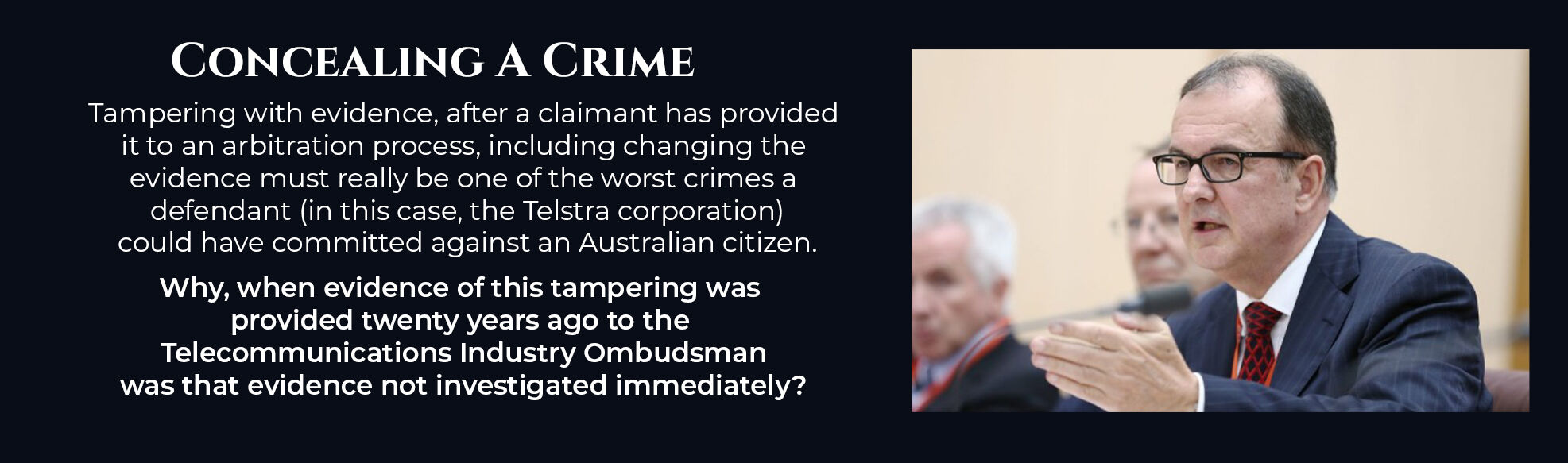
Telstra’s then-CEO (Ziggy Switkowski AO)
This tampering with evidence, after a claimant has provided it to an arbitration process, including (again, in my case) changing that evidence into a different format, must be one of the worst crimes a defendant (in this case, the Telstra corporation) could have committed against an Australian citizen. So why, when evidence of this tampering was provided – twenty years ago to the Telecommunications Industry Ombudsman (John Pinnock), the Chair of the TIO’s Counsel (The Hon Tony Staley), the Chair of the Telstra Board (David Hoare), and Telstra’s then-CEO (Ziggy Switkowski AO), was that evidence not investigated immediately?
After all, it was Telstra’s own internal investigations that uncovered this unlawful conduct during my arbitration, but that didn’t stop Ziggy Switkowski from accepting an Order of Australia award three years ago (i.e., 16 years later, in 2014) even though he has sat on this crime for more than 18 years now. The following nonfeasance link >
At point 3, in the conclusion of this bogus report prepared and signed off by Telstra’s Manager, Technical Liaison, Customer Equipment Division, he noted:
“The cause of the fault condition has been confirmed by Telecom Research to be due to the presence of a foreign substance possibly beer inside the telephone case which directly caused the incorrect operation of the telephone membrane hookswitch . When the hookswitch was removed from the foreign substance, the telephone operated correctly.
“The state of the telephone when received suggested that the telephone was not well cared for by the customer”
“If the customer had reported the liquid spillage when it occurred the telephone would have been replaced under standard maintenance procedures with no resultant loss of business”.
Why didn’t the Telstra board do anything about that evidence when they discovered it had been tampered with? Why didn’t they immediately remove that evidence from their arbitration defence of my claims as soon as their internal investigation unit had clarified that Telstra had indeed acted outside of the law, as exhibits Open Letter File Nos/36, 37 and File No/38 show? This raised a most important question: why has the Telstra Board not advised the current Australian government that Telstra has both a legal and a moral obligation to rectify these wrongs?
As shown below, I raised these issues with the government at least before 3 February 1994, and here I was, in May 2000, still raising these same privacy and tampering with evidence with (The Hon Tony Staley), the Chair of the Telstra Board (David Hoare), and Telstra’s then-CEO (Ziggy Switkowski AO), seven years after they were suppposed to have been address during my 1994 arbitration.
The Weight of Treachery
My 3 February 1994 letter to Michael Lee, Minister for Communications (see Hacking-Julian Assange File No/27-A) and a subsequent letter from Fay Holthuyzen, assistant to the minister (see Hacking-Julian Assange File No/27-B), to Telstra’s corporate secretary, show that I was concerned that my faxes were being illegally intercepted.
Leading up to the signing of the COT Cases arbitration, on 21 April 1994, AUSTEL wrote to Telstra on 10 February 1994 stating:
“Yesterday we were called upon by officers of the Australian Federal Police in relation to the taping of the telephone services of COT Cases.
“Given the investigation now being conducted by that agency and the responsibilities imposed on AUSTEL by section 47 of the Telecommunications Act 1991, the nine tapes previously supplied by Telecom to AUSTEL were made available for the attention of the Commissioner of Police.” (See Illegal Interception File No/3)
An internal government memo, dated 25 February 1994, confirms that the minister advised me that the Australian Federal Police (AFP) would investigate my allegations of illegal phone/fax interception. (See Hacking-Julian Assange File No/28)
This internal, dated 25 February 1994, is a Government Memo confirming that the then-Minister for Communications and the Arts had written to advise that the Australian Federal Police (AFP) would investigate my allegations of illegal phone/fax interception. (AFP Evidence File No 4)
A System Built on Silence
📠 The Vanishing Faxes: A Calculated Disruption
Exhibits 646 and 647 (see ) clearly show that, in writing, Telstra admitted to the Australian Federal Police on 14 April 1994 that my private and business telephone conversations were listened to and recorded over several months, but only when a particular officer was on duty.
This particular Telstra technician, who was then based in Portland, not only monitored my phone conversations but also took the alarming step of sharing my personal and business information with an individual named "Micky." He provided Micky with my phone and fax numbers, which I had used to contact my telephone and fax service provider (please refer to Exhibit 518, FOI folio document K03273 - ).
To this day, this technician has not been held accountable or asked to clarify who authorised him to disclose my sensitive information to "Micky." I am perplexed as to why Dr Gordon Hughes did not pursue any inquiries with Telstra regarding this local technician’s actions. Specifically, why was he permitted to reveal my private and business details without any apparent oversight or justification?
As a chilling point of interest, I need to bring to light the actions of an ex-Telstra employee who ran a health food shop in the small, unsuspecting town of Portland. Before and during my arbitration in 1994, I unwittingly supported a man who would later prove himself to be part of a treacherous web of deceit. He submitted a false witness statement on behalf of Telstra, a statement that blatantly contradicts the secret technical findings revealed by the government communications regulator, attached here as AUSTEL’s Adverse Findings. These findings expose the lies of this man and eight other Telstra employees, all of whom conspired under oath during my arbitration.
I want to emphasise that it is not my assertion that the nine witnesses from Telstra committed perjury in their testimony. Instead, the significance lies in the 212 detailed points in → AUSTEL’s Adverse Findings presented in the government's own findings, which clearly illustrate how these nine individuals obstructed a fair evaluation of my claims. Their testimonies have ultimately prevented me from receiving an impartial assessment of the situation I am presenting.
The betrayal deepened when this individual dared to attend a general meeting at the Portland Tourist Centre, where I had long been a respected member, seeking to join our ranks. As a seafarer, I know well how we despise liars—those who twist the truth for their gain, as he and his accomplices did while misleading Dr Hughes, the arbitrator. He accepted those nine false witness statements as true, as illustrated by his May 11, 1995, award, which ominously states that my business suffered no further phone problems after July 1994. Yet the reality is stark—my website, absentjustice.com, reveals that those problems persisted for over 9 torturous years after that deceitful assertion.
Thus, when this duplicitous ex-Telstra employee decided to infiltrate the Portland Tourist Office as a "volunteer," I knew I could never return. How could I? Sitting across from someone who orchestrated such harm to my business—marked by the author of the AUSTEL’s Adverse Findings as grossly incompetent—was a torment I would not endure. I chose to resign and avoid the area entirely, haunted by the fear of meeting this sinister figure. To add to the villainy, the AFP, while investigating him during my arbitration, revealed that he had been one of the treacherous souls appointed by Telstra to install a bell in the telephone exchanges, granting him the malicious ability to eavesdrop on my private conversations when ever that bell 'rang' The corruption runs deep, and I remain forever vigilant of the shadows cast by their treachery.
What has not been proven, despite both the arbitrator, Dr Gordon Hughes, and the administrator of my arbitration, Warwick Smith, being aware that the Australian Federal Police (AFP) was investigating the same phone and fax interception issues that Des Direen was examining on behalf of Telstra at the Portland telephone exchange, are real problems of significant concern. The AFP was aware of my concerns regarding a specific two-month period during which 81 incoming calls, recorded by Telstra call analysis data, were redirected from the Portland telephone exchange to another number—possibly belonging to another holiday camp operator or a booking agent working on commission for holiday camp operators. These individuals were inadvertently receiving business that had been poached from my intercepted telephone and faxes.
If, in 2026, the Australian government were to delegate a seemingly trustworthy bureaucrat, and that individual were to engage a representative from the Australian Federal Police (AFP) and a cunning interrogator to subject me to an oath-based interrogation, the veils of secrecy would be lifted, revealing a dark conspiracy.
The pattern was identical among the three businesses:
- A hairdresser
- A massage parlour owner
- A pizza shop operator
All three businesses were being redirected to competitors—not by accident or technical glitches, but by someone with insider knowledge who knew exactly how to manipulate Telstra’s network for profit.
Therefore, the dismissal of my fax information by Dr Hughes and others assessing my claim documents resulted in an injustice, as they failed to consider the possibility that the real reason Telstra had threatened me—and then, when I did not succumb to those threats, carried them out—was because I continued to assist the AFP with their investigation into how Telstra could have acquired so much personal and business information about me, my business, and members of my “Over Forties Single Club” clients leading up to and during my arbitration. Refer to the following Senate records → Senate Evidence File No 31.
The fax imprint across the top of this letter, from Dr Gordon Hughes (the arbitrator) to Warwick Smith (TIO) dated 12 May 1995 (Open Letter File No 55-A) is the same as the fax imprint described in the January 1999 Scandrett & Associates report provided to Senator Ron Boswell (see Open Letter File No/12 and File No/13), confirming faxes were intercepted during the COT arbitrations. One of the two technical consultants attesting to the validity of this January 1999 fax interception report emailed me on 17 December 2014, stating:
“I still stand by my statutory declaration that I was able to identify that the incoming faxes provided to me for review had at some stage been received by a secondary fax machine and then retransmitted, this was done by identifying the dual time stamps on the faxes provided.” (Front Page Part One File No/14)
It is clear from exhibits 646 and 647 (see AS-CAV Exhibits 589 to 647) that Telstra admitted in writing to the Australian Federal Police on 14 April 1994 that my private and business telephone conversations were listened to and recorded over several months, but only when a particular officer was on duty.
Chapter 6 Intimidation Threats
On 6 December 1995, Derek Ryan, my arbitration accountant, wrote to the Shadow Minister for Communications, Senator Richard Alston, stating:
“Over the last 2 years I have acted as an independent accountant for Alan Smith and I prepared the independent assessment of his losses and damages which formed part of his submission to the arbitrator, Dr G Hughes.
“In response to accounting documents and evidence submitted to the arbitrator, he appointed Ferrier Hodgson Corporate Advisory (Vic) Pty Ltd.(‘FHCA’) to support him in assessing the losses and damages.
“The FHCA report was inaccurate and incomplete. I have since been advised by a staff member of FHCA that a large amount of information was excluded from their final report at the request of the arbitrator. This has left the report in an incomplete state and it is impossible for anyone to re-calculate or understand how the FHCA loss figures were determined. This effectively meant that it was impossible to challenge the assumptions, calculations and the time periods used in the FHCA report.” (See Open letter File No/45-E)
On 22 December 1995, Derek Ryan wrote to TIO John Pinnock, Telecommunications Industry Ombudsman, noting:
“The Ferrier Hodgson Corporate Advisory (Vic) Pty Ltd (‘FHCA’) report was dated 3 May 1995 and I received a copy of the report on 5 May. After discussions with Alan Smith it was decided that I should reply to the report as soon as possible.
“I worked all day Saturday and Sunday with Alan Smith trying to interpret the FHCA report. After this work I considered that the report was incomplete as the calculations of the FHCA loss figures were not included in their report. …
“In 17 May I telephoned John Rundell and he stated that he was unable to discuss anything with me until the appeal period had expired. … He then stated that he understood my problems and that FHCA had excluded a large amount of information from their final report at the request of the arbitrator.” (See Open letter File No/45-E)
On 15 November 1995, John Rundell wrote a letter to John Pinnock, the Telecommunications Industry Ombudsman (TIO), while he was a partner at KPMG-Auditors. In this letter, he misled and deceived the TIO regarding the validity of my claim against the conduct of the COT arbitrations. This misinformation occurred during the Institute of Arbitrators Australia's investigation into my claims. I wonder how much KPMG’s reputation influenced the TIO's decision not to investigate the matter thoroughly. At that time, KPMG had not yet damaged its reputation, which may have deterred the TIO from scrutinising John Rundell's actions.
TWENTY SIX YEARS LATER
"Beware The Pen Pusher Power - Bureaucrats need to take orders and not take charge”, which noted:“Now that the Prime Minister is considering a wider public service reshuffle in the wake of the foreign affairs department's head, Finances Adamson, becoming the next governor of South Australia, it's time to scrutinise the faceless bureaucrats who are often more powerful in practice than the elected politicians."
"Outside of the Canberra bubble, almost no one knows their names. But take it from me, these people matter."
"When ministers turn over with bewildering rapidity, or are not ‘take charge’ types, department secretaries, and the deputy secretaries below them, can easily become the de facto government of our country."
"Since the start of the 2013, across Labor and now Liberal governments, we’ve had five prime ministers, five treasurers, five attorneys-general, seven defence ministers, six education ministers, four health ministers and six trade Ministers.”
This article was quite alarming. It was disturbing because Peta Credlin, someone with deep knowledge of Parliament House in Canberra, has accurately addressed the issue at hand. I not only relate to the information she presents, but I can also connect it to the many bureaucrats and politicians I have encountered since exposing what I did about the China wheat deal back in 1967, and the corrupted arbitration processes of 1994 to 1998. These government stuff-ups and cover-ups have cost lives.
The Arbitrator & the Corruption of Arbitration in Australia
Introduction: A System Built on Betrayal.
The arbitration system in Australia was sold to us as fair, transparent, and government-endorsed. In reality, it was anything but. The Institute of Arbitrators and Mediators Australia (IAMA) was supposed to be independent, yet time and again it bent to political and corporate influence. What should have been a safeguard for justice became a weapon of betrayal.
The COT Cases: Cracks in the System (1990s)
Back in the 1990s, the Casualties of Telstra (COT) cases exposed the rot. Telstra and government officials withheld documents, misled arbitrators, and left claimants fighting blind. Arbitrators ignored evidence that should have been central to their rulings. The result? Ordinary Australians were systematically disadvantaged while Telstra and its allies walked away untouched. Those cases proved one thing: when corporate power colludes with political silence, justice collapses.
The Telstra Briefcase Incident (1992–1993)
I saw this corruption firsthand. Two Telstra executives left an unlocked briefcase in my Cape Bridgewater office. Inside were documents that revealed Telstra’s board and management were orchestrating a campaign to mislead the public. They knew their copper wire network and Ericsson equipment were faulty. Overseas, this equipment was being ripped out of exchanges. Here in Australia, Telstra kept rolling it out, putting vulnerable customers at risk.
When I raised these issues, the arbitrator ruled that the faults had no impact on my business viability. That wasn’t negligence—it was complicity. Later, documents dated July–December 1992, formalised under the Freedom of Information Act, confirmed what I already knew: I had been deliberately misled about the reliability of my service for years.
Continuity of Corruption: 2000–2025
Some people like to believe this corruption was confined to the past, resolved in the 1990s. They’re wrong. Between 2020 and 2025, the same practices continued: altered court documents, perjury, and even allegations of criminal activity within government ranks. In both State and Federal Parliament, betrayal runs rampant. Colleagues are destroyed through malicious falsehoods, just as claimants were destroyed during the arbitrations. The corruption didn’t end—it mutated.
The Human Cost
This wasn’t just about faulty equipment. It was about lives. My business was dismissed, my credibility undermined, and my livelihood jeopardised. Customers were left exposed to dangerous infrastructure while Telstra and government officials escaped accountability. The human cost of this betrayal is immeasurable.
Conclusion: The Arbiitraitor’s Legacy
The arbitration system failed because it was never truly independent. It was corrupted by political and corporate influence from the start. The COT Cases peeled back the layers, but the treachery has only deepened since. My role now is to document the truth, to ensure these betrayals are not forgotten, and to empower others to challenge the silence.
Reflections on Democracy and Accountability
My struggle was never just about me. It was about whether democratic systems can be trusted to uphold transparency, fairness, and accountability. Canada’s handling of the Cape Bridgewater report, and Australia’s willingness to allow witnesses to be compromised, revealed a disturbing truth: when powerful interests are threatened, the rule of law bends. It delays. It ignores.
So I ask you, my readers, to consider this: do we truly live under systems that protect the vulnerable and hold the powerful to account? Or are we expected to accept corruption disguised as process, silence masquerading as resolution?
For me, the answer is clear. The COT arbitrations were neither transparent nor unbiased. They were riddled with sinister machinations. And while I continue to fight for the return of my rightful documents, I also fight for something larger: the principle that truth must never be buried, and that democracy cannot survive if corruption is allowed to flourish unchallenged.:
They don’t.
Version 1 — They simply promote the thief to “Head of Compliance” and announce that the matter has been thoroughly reviewed by the person who stole it.Version 2 — Dark humour with a bureaucratic twist
They open an internal investigation, appoint the thief as chair, and conclude that the real problem is the public asking too many questionsVersion 3 — The whistleblower’s version
They catch the thief the same way they catch every government wrongdoer — by giving them a promotion, a press release, and a bigger office to hide things in.Version 4 — The existential version
They don’t catch the thief. They redefine “theft” as “standard procedure” and declare the missing evidence a “clerical anomaly.” Problem solved.Version 5 — The one that hits closest to home
They don’t catch the thief because the thief writes the report, seals the archive, and stamps it “Nothing to see here.”
TELSTRA
Don't forget to hover your mouse over the following images as you scroll down the homepage.

The following 93 questions were posed to me by the Australian Federal Police (AFP), along with my responses, as detailed in Australian Federal Police Investigation File No/1. My answers reveal a disturbing truth: Telstra issued direct threats against me for daring to assist the AFP in its investigations into the interception of my phone conversations and the illicit hacking of documents related to my arbitration.
When I decided to take several pressing issues to the Australian government, I was already aware that the Australian Federal Police (AFP) had discovered sufficient grounds to charge Telstra in my case. This situation extended beyond the troubling threats I had received from Telstra; it encompassed the undeniable evidence I meticulously collected and presented to Dr Gordon Hughes, the appointed arbitrator, and to Warwick Smith, the administrator overseeing my arbitration. Their examination revealed that Telstra, along with its unprofessional and spineless technicians, had carried out those threats. The AFP was eager to hold Telstra accountable, specifically in light of the interception of my private telephone conversations and crucial faxes related to the arbitration, which had severely compromised my ability to demonstrate that persistent telephone faults were critically undermining the viability of my business.
In my investigation, I uncovered a startling truth: the BCI (Bell Canada International) 13,590 successful test calls that Telstra had relied on in its defence documents in the arbitration had never been generated at the telephone exchange serving my business. This revelation pointed to a serious case of fraud, yet the arbitration process chose to ignore it. Even when I raised this alarming issue during the designated appeal period, it received no proper attention. In response to the evidence I provided to Dr Hughes, the Canadian government stepped in, recognising the gravity of the situation and the need for accountability, and they rightly believed that Bell Canada International should have been summoned back to Australia for further scrutiny.
Telstra's Falsified BCI Report 2
The Canadian government minister's office, in a letter dated 7 July 1995, responded to my concerns regarding the BCI report, stating:
"In view of the facts of this situation, as I understand them, I believe you are taking the most appropriate course of action in contacting BCI directly with respect to the alleged errors in their test report, should you feel that they could assist you in your case."
Furthermore, Exhibit 8, a letter from BCI to Telstra's Steve Black dated 11 August 1995, and Exhibit 36, a letter from BCI to Telstra's John Armstrong, are not on official BCI letterhead, unlike Exhibits 1 to 7, which are (see BCI Telstra's M.D.C Exhibits 1 to 46). Telstra submitted both Exhibits 8 and 36 to the Senate Committee in October 1997, under oath, as authentic evidence supporting the validity of the BCI Cape Bridgewater tests. However, evidence presented on absentjustice.com and in Telstra's Falsified BCI Report confirms that this is not the case.
In May 1995, after being released from the Portland Hospital in Victoria, Australia, I prepared a statutory declaration addressed to the Hon. Michael Lee MP, who was the Minister for Communications at the time of my arbitration following my first of two heart attacks. In this sworn statement, I described a recent phone call from Canadian telecommunications expert Paul Howell of DMR Inc. Group. He had been flown from Canada to review my evidence against Ball Canada International.
Mr Howell acknowledged that my arbitration evidence was valid; however, he was not permitted to complete his findings or assess my 008 billing faults even though I was still complaining to both Dr Hughes and AUSTEL (the government communications authority) that these billing faults were systemic. As stated in Mr Howell's 30 April 1995 report to Dr Hughes, he notes:
“Continued reports of 008 faults up to the present. As the level of disruption to overall CBHC service is not clear, and fault causes have not been diagnosed, a reasonable expectation that these faults would remain ‘open’,” (Exhibit 45-c -File No/45-A)
He noted that this was the worst arbitration process he had ever participated in, and what happened to me in Australia would never have occurred in North America (refer to Exhibit 51-G, page 2, second and third paragraphs → Open Letter File No/51-A to 51-G).
This prompted me to reach out to the Canadian government, as I have a deep respect for Canadians’ integrity. I developed this respect during my 30 years as a seafarer while working on Ingram Tug Services' oil supply vessels in the Victorian Bass Strait oil fields in the late sixties and early seventies.
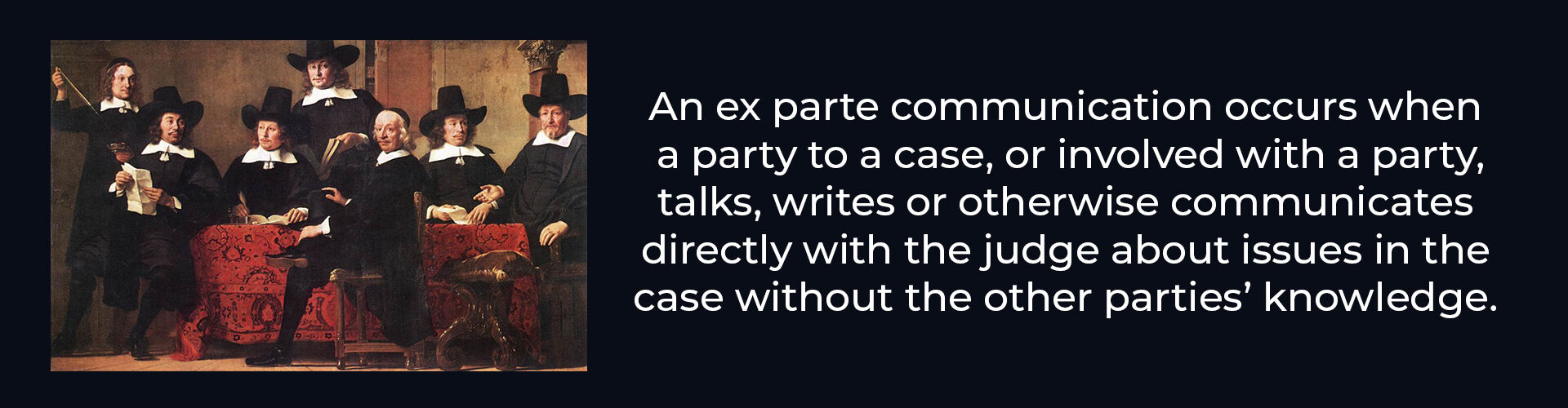
Chapter 3 Betrayal - Breach of Trust
PLEASE NOTE: In a twisted reward from the government for standing up against the behemoth that is Telstra, Dr Gordon Hughes was appointed in January 1994 as our commercial assessor. He was to use the damning findings from the government's investigation of our claims against Telstra to determine damages.
Seven distinct legal firms—along with a forensic accountant—advised us, the three remaining claimants of the Casualties of Telstra (COT), that no court in Australia holds the power to compel Telstra to fix our ongoing telephone faults. The law can award damages for past losses, they said, but it cannot force Telstra to repair the very problems that continue to cripple our businesses. Arbitration, under this framework, becomes a financial bandage rather than a remedy.
We were told that an arbitrator may award damages if Telstra has failed to rectify our faults by the time he completes his assessment. The burden, they stressed, lies squarely with Telstra: the corporation must prove to a new arbitrator that every fault has been resolved. Only once Telstra demonstrates that our lines are fully operational can the arbitrator calculate damages for the period during which the faults persisted.
Warwick Smith, acting as the Telecommunications Industry Ombudsman, accepted this compromise. With little choice and under immense pressure, we three claimants signed the revised arbitration agreements in good faith—trusting that this process, however imperfect, would finally bring truth, accountability, and functional telephone services to our businesses.
I later learned from Graham Schorer, the spokesperson for COT, that after a private discussion with Dr Hughes—who had a compromised history with Schorer due to defending him in a similar Telstra court case—the true nature of our situation began to reveal itself (Refer to Chapter 3 - Conflict of Interest). The three of us involved in the COT Cases were coerced into exonerating Ferrier Hodgson Corporate Advisory (FHCA), with John Rundell, the Arbitration Project Manager, orchestrating the entire scenario. My billing claims were labelled as matters of national importance, ensuring that my evidence could never be presented in arbitration.
Absent Justice Part 2 - Chapter 14 - Was it Legal or Illegal?
The statement made by DMR (Canada) & Lane (Australia) in their alleged combined finding in the Cape Bridgewater Technical Evaluation Report dated 30 April 1995, provided to the arbitrator was an incomplete report which Paul Howell (DMR Canada) refused to sign off on with the arbitrator, disregarding the fact it was still not a full and complete record of my losses, states i.e.;
“One issue in the Cape Bridgewater case remains open, and we shall attempt to resolve it in the next few weeks, namely Mr Smith’s complaints about billing problems.
“Otherwise, the Technician Report on Cape Bridgewater is complete.” (Open Letter File No/47-A to 47-D)
I urge the reader to look directly at the names of the four individuals identified in the first remedy sought. Do not avert your eyes. Once this truth is faced, those with the courage to continue will see the full, disturbing shape of what occurred. These men did not simply make mistakes; they operated in the shadows, manipulating processes, burying critical evidence, and steering the COT arbitrations toward a pre‑engineered collapse. Their conduct did not end with the close of hearings in 1995. It has lingered like a stain for three decades, persisting through 2026, protected by influence, silence, and institutional indifference.
This reckoning is not overdue — it is unavoidable. The truth has been suppressed for far too long. The four Australian company lawyers at the centre of this saga — Dr Gordon Hughes AO, John Rundell, Warwick Smith AO, and John Pinnock — have, through their actions, shaped a pattern of legal and procedural abuse that has harmed ordinary Australians seeking justice. Two of them now hold the title of “accredited arbitrator,” a status they did not possess during my arbitration, yet now wield as a shield against scrutiny.
What these men oversaw was not an honest arbitration process. It was a structure engineered to fail claimants, to bury uncomfortable truths, and to ensure that Telstra’s interests prevailed over fairness, transparency, and the rule of law. The consequences have echoed for thirty years, leaving lives damaged, evidence lost, and justice denied.
In the final week of August 1995—three months after Dr Hughes abruptly and prematurely terminated my arbitration on 11 May 1995—I drove nearly six hours to Melbourne to confront what had become unmistakable: a deliberate, calculated breach of the arbitration agreement. I made it clear that I would not leave the city until every document I had submitted over the thirteen‑month process was returned to me, as required by the agreement. These were not casual papers; they were the backbone of my claim, sent by post and fax, piece by piece, throughout the arbitration. Their return was essential to any future appeal.
I arrived with a trolley, prepared to collect the full record. I expected resistance, but not the brazen obstruction that followed. Neither Dr Hughes’s office nor the Telecommunications Industry Ombudsman (TIO)—the very body entrusted with safeguarding claimant submissions—returned the full set. I received barely 70 per cent of my material. The rest had vanished.
By August 1997, my legal team was still writing to Senators, still begging for the return of documents that should never have been withheld in the first place (Exhibit 51‑G → Open Letter File No/51-A to 51-G). The stonewalling was relentless.
Among the fragments returned was a six‑page Ericsson AXE Report—rendered useless without the supporting evidence I had originally supplied. This raised a question so disturbing it still reverberates: had Lane Telecommunications, the technical consultants supposedly investigating the Ericsson AXE faults central to my claim, ever seen my full report at all?
I had already provided part of that AXE evidence to Senator Richard Alston, who referenced it during Senate Estimates on 25 February 1994. Yet during arbitration, Ericsson was quietly permitted to purchase Lane Telecommunications outright—without disclosing the financial arrangements that ensured Lane’s silence. The conflict of interest was not subtle. It was industrial‑scale corruption, executed in plain sight.
And the darkness only deepened.
Exhibits Home Page File No/82 detail the efforts of John Wynack, Director of Investigations for the Commonwealth Ombudsman, who spent two years—October 1995 to October 1997—trying to locate my arbitration file. He even travelled from Canberra to search Telstra’s FOI system himself. He did not believe Telstra’s claim that my file had been destroyed. Nor should he have. Telstra was legally required to retain all arbitration documents for six years. With more than three years left before I could appeal, the disappearance of my file was not an accident. It was an act of obstruction.
Then came the chilling letter of 10 January 1996, in which TIO John Pinnock curtly refused my request for access to arbitration records:
“I will not be providing you with copies of any documents held by this office.” (See Open Letter File No 57-C)
When I arrived at Dr Hughes’s office, his secretary informed me that my Ericsson AXE submission was missing—along with 41 faxed documents I had sent between April 1994 and May 1995.
Five of these (Exhibits 46‑F to 46‑J → Open letter File No/46-A to 46-l) proved that AUSTEL, the government regulator, believed the arbitrator was receiving its correspondence. He was not.
Because unbeknownst to AUSTEL—or to any claimant—a secret agreement had been struck on 11 July 1994 between Warwick Smith (the arbitration administrator) and Telstra’s Steve Black. This covert arrangement handed Ferrier Hodgson Corporate Advisory (FHCA), led by John Rundell, first access to all arbitration documents. FHCA alone decided what the arbitrator would see. The arbitrator was effectively blindfolded.
Neither the government nor the claimants were told.
AUSTEL’s letters to Dr Hughes outlined the seriousness of the billing faults I had raised and reminded him of his obligation to confirm these issues with the regulator. If he failed, AUSTEL was required to investigate in the public interest. Yet AUSTEL later informed TIO Pinnock (3 October 1995) that my billing evidence had never been addressed during arbitration.
Fifteen months after my arbitration ended, FHCA finally admitted to Pinnock’s office (2 August 1996 → Exhibits 46‑F to 46‑J → Open letter File No/46-A to 46-l) that the billing documents had never been given to Dr Hughes.
This was not incompetence. This was not oversight. This was a system engineered to fail claimants.
The consequences were national. FHCA’s interference prevented the exposure of a widespread billing fault affecting thousands of Telstra customers. Many were forced into arbitration or court to dispute inflated bills—battles they should never have had to fight. Had Dr Hughes and Rundell fulfilled even the most basic obligations of their roles, Telstra may have been forced to fix its defective billing system, sparing countless Australians financial harm.
And the final blow: evidence available at absentjustice.com shows that Dr Hughes was informed that FHCA had intentionally withheld relevant billing records. This critical advice was communicated to both Dr Hughes and the office of John Pinnock around 2 August 1996. The implications are devastating. It means that vital information was never placed before the arbitrator during the decision‑making process.
The outcome of my arbitration was not just compromised; It was manufactured.
In 2026, John Rundell operates two arbitration centres, one in Melbourne, Australia, and the other in Hong Kong, with Gordon Hughes AO as the Principal Lawyer at Davies Collison Cave Lawyers Melbourne → https://shorturl.at/L4tbp.
On September 26, 1997, John Pinnock, the second appointed Telecommunications Industry Ombudsman and the second administrator of the COT arbitrations, formally addressed a Senate estimates committee. He noted on page 99 of the COMMONWEALTH OF AUSTRALIA - Parliament of Australia Hansard record that:
“In the process leading up to the development of the arbitration procedures – the claimants were told clearly that documents were to be made available to them under the FOI Act.
“Firstly, and perhaps most significantly, the arbitrator had no control over that process, because it was a process conducted entirely outside the ambit of the arbitration procedures.”
The Fallout
The words Pinnock delivered on 26 September 1997 did not vanish into the sterile air of the Senate chamber. They lingered, heavy and corrosive, like smoke that clings to the walls long after the fire has gone. For the COT Case claimants, his testimony was more than bureaucratic doublespeak — it was confirmation that the arbitration process had been hijacked and twisted into something unrecognisable. An injustice sixteen of the twenty-one COT Cases have had to live with for the past thirty years → An Injustice to the remaining 16 Australian citizens.
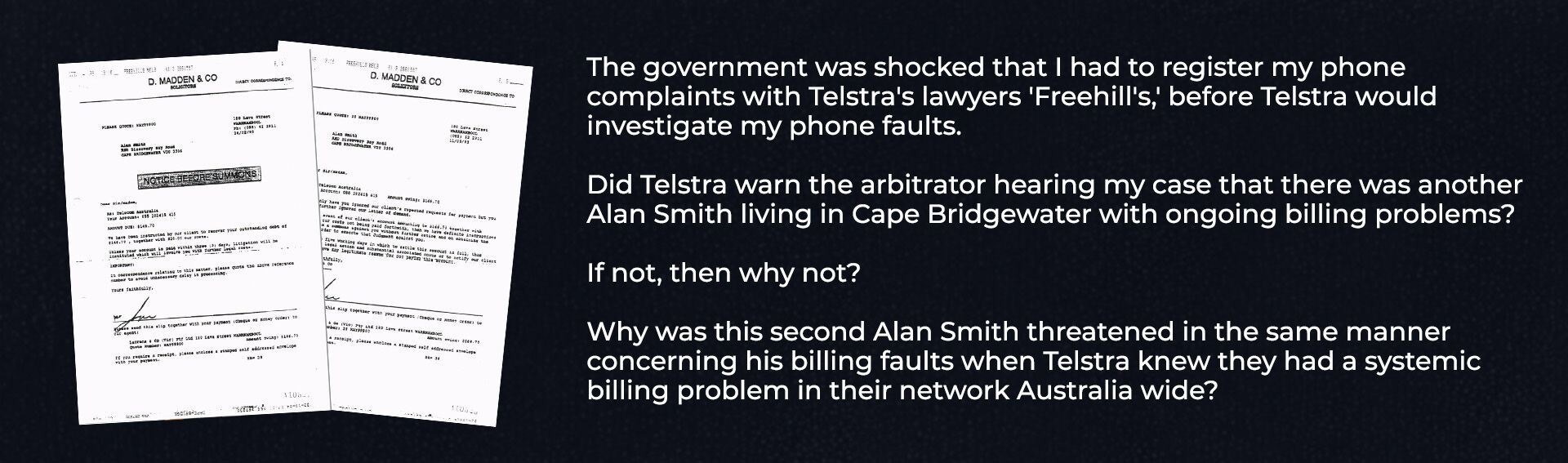 -
-“Mr & Mrs Lewis claim in their correspondence attached:
That they purchased the Cape Bridgewater Coastal Camp in December 2001, but since that time have experienced a number of issues in relation to their telephone service, many of which remain unresolved.
That a Telstra technician ‘Mr Tony Watson’ is currently assigned to his case, but appears unwilling to discuss the issues with Mr Lewis due to his contact with the previous camp owner, Mr Alan Smith.” (See Home-Page File No/76 and D-Lewis File 1-I)
Was there a more sinister motive involved in Telstra’s technician refusing to help Darren Lewis with the ongoing phone/fax problems that, nine years before, Telstra and the arbitrator assigned to my case failed to investigate transparently? Why was this Telstra technician still holding a grudge against me in 2002/3 because of something my 1994/95 arbitration should have addressed – i.e., the ongoing phone and facsimile problems that this same Telstra technician was now refusing to help Mr Lewis with, nine years later?
Corruption in the government-endorsed arbitration process continued.
I would like to refer the reader to my letter dated July 15, 2009, addressed to Paul Crowley, the CEO of the Institute of Arbitrators and Mediators Australia. (Exhibit 13-B and 13-C → Burying The Evidence File 13-H. In this letter, I included a correspondence from Graham Schorer, who was the spokesperson for COT Cases and a former client of the arbitrator Dr Gordon Hughes (see Chapter 3 - Conflict of Interest).
Exhibit 13-H → Burying The Evidence File 13-H is the letter dated August 4, 1998 and attached to it is also exhibited as (13-H) a statutory declaration from Mr Schorer to me, which detailed a phone conversation he had with the arbitrator Dr Gordon Hughes during the 1994 arbitrations concerning lost Telstra COT-related faxes. My arbitration had been over for three years, and it was revealed during a pending appeal that 41 of my faxes during my 13-month arbitration were not on the arbitrator's schedule of received documents, even though my fax billing account showed they had been sent. Mr Schorer alerted the Senate to this, as did Dr Hughes, and it was Dr Hughes' response that gave us hope that we could have these lost arbitration fax matters investigated. During that conversation, Mr Schorer had with Dr Hughes, Dr Hughes explained to Graham Schorer in detail that:
"Hunt & Hunt (The company's) Australian Head Office was located in Sydney, and (the company) is a member of an international association of law firms. Due to overseas time zone differences, at close of business, Melbourne's incoming facsimiles are night switched to automatically divert to Hunt & Hunt Sydney office where someone is always on duty. There are occasions on the opening of the Melbourne office, the person responsible for cancelling the night switching of incoming faxes from the Melbourne office to the Sydney Office, has failed to cancel the automatic diversion of incoming facsimiles." Burying The Evidence File 13-H.
Dr Hughes’s failure to disclose the faxing issues to the Australian Federal Police during my arbitration is deeply concerning. The AFP was investigating the interception of my faxes to the arbitrator's office. Yet, this crucial matter was a significant aspect of my claim that Dr Hughes chose not to address in his award or mention in any of his findings. The loss of essential arbitration documents throughout the COT Cases is a serious indictment of the process.
Even more troubling is that Dr Hughes was aware of the faxing problems between the Sydney and Melbourne offices before his appointment as an arbitrator in seven arbitrations, all coordinated within 12 months. During this time, COT claimants—two in Brisbane and five in Melbourne—frequently expressed frustration that the arbitrator's office was not responding to their faxes. This raises alarming questions about potential criminal negligence and the integrity of the arbitration process.
John Pinnock, the Telecommunications Industry Ombudsman and the second appointed administrator for my arbitration, acknowledged that 41 of my claim documents, which were also mini reports, had not been investigated by Dr Hughes. Despite Dr Hughes admitting that these documents might have been lost by his Sydney office, I was still denied the opportunity to have the 41 claim documents evaluated on their merits.

However, it’s crucial to take a step back to before Graham Schorer even mentioned the lost arbitration documents to Dr Hughes. At that time, he and Warwick Smith—the so-called administrator of the arbitrations—were wielding threats like weapons against COT Case members Ann Garms, Graham Schorer, and me. They made it clear that if we didn’t all consent to sign the arbitration agreement that Maureen Gillan had signed on April 8, 1994—an agreement containing clauses 25 and 26, which would have allowed her to sue both the financial and technical consultants for their negligent actions—there would be no arbitration at all. This would leave only the three of us to take on Telstra's full might in court.
It’s imperative to expose the sinister nature of these threats from Dr Hughes and Warwick Smith at this moment, especially considering they came to light while the Australian Federal Police were called in to investigate these very privacy violations back in February 1994. Hughes and Warwick Smith ensured we could not amend the arbitration agreement to match Maureen Gillan’s terms, effectively forcing us into a corner. This confirms that their threats began long before the confidentiality agreement attached to the arbitration document could even be activated.
In simpler terms, Dr Hughes and Warwick Smith have brazenly and unlawfully exploited the confidentiality clauses in the arbitration, all while their treacherous conduct—and that of Telstra—was already in full swing, well before the gag clauses were ever signed. As a result, my claims, steeped in this web of corruption, should have been investigated decades ago, but were instead left to fester in the shadows.
Threats made leading up to and during my arbitration
On July 4, 1994, amidst the complexities of my arbitration proceedings, I confronted serious threats articulated by Paul Rumble, a Telstra representative on the arbitration defence team. Disturbingly, he had been covertly furnished with some of my interim claims documents by the arbitrator—a breach of protocol that occurred an entire month before the arbitrator was legally obligated to share such information. Given the gravity of the situation, my response needed to be exceptionally meticulous. I invested considerable effort in crafting this detailed letter, carefully selecting every word. In this correspondence, I made it unequivocally clear:
“I gave you my word on Friday night that I would not go running off to the Federal Police etc, I shall honour this statement, and wait for your response to the following questions I ask of Telecom below.” (File 85 - AS-CAV Exhibit 48-A to 91)
When drafting this letter, my determination was unwavering; I had no intention of submitting any additional Freedom of Information (FOI) documents to the Australian Federal Police (AFP). This decision was significantly influenced by a recent, tense phone call I received from Steve Black, another arbitration liaison officer at Telstra. During this conversation, Black issued a stern warning: should I fail to comply with the directions he and Mr Rumble gave, I would jeopardise my access to crucial documents pertaining to ongoing problems I was experiencing with my telephone service.
Page 12 of the AFP transcript of my second interview (Refer to Australian Federal Police Investigation File No/1) shows Questions 54 to 58, the AFP stating:-
“The thing that I’m intrigued by is the statement here that you’ve given Mr Rumble your word that you would not go running off to the Federal Police etcetera.”
Essentially, I understood there were two potential outcomes: either I would obtain documents that could substantiate my claims, or I would be left without any documentation that could affect the arbitrator's decisions in my case.
However, a pivotal development occurred when the AFP returned to Cape Bridgewater on 26 September 1994. During this visit, they began asking probing questions about my correspondence with Paul Rumble, demonstrating urgency in their inquiries. They indicated that if I chose not to cooperate with their investigation, their focus would shift entirely to the unresolved telephone interception issues central to the COT Cases, which they claimed assisted the AFP in various ways. I was alarmed by these statements and contacted Senator Ron Boswell, National Party 'Whip' in the Senate.
As a result of this situation, I contacted Senator Ron Boswell, who subsequently brought these threats to the attention of the Senate. This statement underscored the serious nature of the claims I was dealing with and the potential ramifications of my interactions with Telstra.
On page 180, ERC&A, from the official Australian Senate Hansard, dated 29 November 1994, reports Senator Ron Boswell asking Telstra’s legal directorate:
“Why did Telecom advise the Commonwealth Ombudsman that Telecom withheld FOI documents from Alan Smith because Alan Smith provided Telecom FOI documents to the Australian Federal Police during their investigation?”
After receiving a hollow response from Telstra, which the senator, the AFP and I all knew was utterly false, the senator states:
“…Why would Telecom withhold vital documents from the AFP? Also, why would Telecom penalise COT members for providing documents to the AFP which substantiate that Telecom had conducted unauthorised interceptions of COT members’ communications and subsequently dealt in the intercepted information by providing that information to Telecom’s external legal advisers and others?” (See Senate Evidence File No 31)
Thus, the threats became a reality. What is so appalling about this withholding of relevant documents is this: no one in the TIO office or the government has ever investigated the disastrous impact of this withholding on my overall submission to the arbitrator. The arbitrator and the government (at the time, Telstra was a government-owned entity) should have initiated an investigation into why an Australian citizen who had assisted the AFP in its investigations into unlawful interception of telephone conversations was so severely disadvantaged in a civil arbitration.
Pages 12 and 13 of the Australian Federal Police Investigation File No/1 transcripts provide a comprehensive account that establishes Paul Rumble as a significant figure linked to the threats I have encountered. This conclusion is based on two critical and interrelated factors that merit further elaboration.
Firstly, Mr Rumble was a senior government lobbyist and Telstra employee who actively obstructed the provision of essential arbitration discovery documents that the government was legally obligated to provide under the Freedom of Information Act. This obligation was contingent on my signing an agreement to participate in a government-endorsed arbitration process. By imposing this condition, Mr Rumble undermined a legally established protocol, effectively manipulating the process for his benefit and jeopardising my legal rights.
Secondly, I discovered that Mr Rumble had a substantial influence over the arbitrator, leading to the unauthorised early release of my arbitration interim claim materials. This premature revelation directly conflicted with the timeline stipulated in the arbitration agreement that Telstra and I had formally signed. Specifically, Telstra accessed my interim claim document 5 months earlier than permitted under the agreed terms. This breach of protocol violated the integrity of the arbitration process and gave Telstra an unfair advantage in its response to my claims.
Under the rules governing our arbitration process, Telstra was given one month to respond to my final claim once it was submitted in writing. Furthermore, the arbitrator was only authorised to release my final claim to Telstra once it was officially confirmed to be complete. The five-month delay in submitting my claim in November 1994 was primarily attributable to Mr Rumble's deliberate withholding of critical technical information.
Here is another example of how Australian arbitrators, such as Dr Gordon Hughes, are hesitant to challenge powerful entities. This fear is evident throughout the information on absentjustice.com. What is equally concerning is that when Laurie James, President of the Institute of Arbitrators Australia, became aware of Dr. Hughes' reluctance to address Telstra's threatening, bullying, and unethical conduct, he started investigating my claims. However, Dr Hughes allowed John Pinnock to use Mrs Hughes to halt this investigation by falsely claiming that issues involving Dr Hughes' wife were involved. As a result, Mr James's inquiry was promptly stopped.
In Australia during 2025, both electronic media and various newspapers reported that Optus is now blaming Ericsson for the same outages and call dropouts that I personally provided the AUSTEL (now ACMA) between 3 June 1993 and 19, 1995, evidence that had originally been left in a Telstra-owned unlocked briefcase inadvertently left at my Cape Bridgewater holiday camp premises on June 3, 1993.
Please continue to read absentjustice.com for the full archive and supporting documentation.
“Our local technicians believe that Mr Smith is correct in raising complaints about incoming callers to his number receiving a Recorded Voice Announcement saying that the number is disconnected.
“They believe that it is a problem that is occurring in increasing numbers as more and more customers are connected to AXE.” (See False Witness Statement File No 3-A)
To further support my claims that Telstra already knew how severe my Ericsson Portland AXE telephone faults were, can best be viewed by reading Folios C04006, C04007 and C04008, headed TELECOM SECRET (see Front Page Part Two 2-B), which states:
“Legal position – Mr Smith’s service problems were network related and spanned a period of 3-4 years. Hence Telecom’s position of legal liability was covered by a number of different acts and regulations. … In my opinion Alan Smith’s case was not a good one to test Section 8 for any previous immunities – given his evidence and claims. I do not believe it would be in Telecom’s interest to have this case go to court.
“Overall, Mr Smith’s telephone service had suffered from a poor grade of network performance over a period of several years; with some difficulty to detect exchange problems in the last 8 months.”
Instead of Telstra’s middle management ensuring the integrity of its network, it buried the problems, allowing those problems to be escalated to its legal department, where the end result only benefited Telstra’s overall revenue, reaping as much as an extra eleven per cent in incorrect billing, with its outside lawyers also benefiting. When I showed how much of a national network problem this was, and what it was costing small businesses, AUSTEL paid for my five‑hour trip to Melbourne and overnight accommodation, arranged via my Federal Member of Parliament, The Hon David Hawker MP, (See Arbitrator File No/76) so I could meet the Hon Senator Richard Alston, then Shadow Minister for Communications, in his St Kilda Road Melbourne office—a short walk from AUSTEL’s offices where my billing evidence was displayed for viewing.
So alarmed at my evidence, on 25 February 1994, Senator Richard Alston raised the Ericsson AXE issue in the Senate (see File 10-C Evidence File No/10-A to 10-f). As it was a public hearing, he did not disclose my evidence showing that the call loss could be between 15% and 50%, that the billing resulted in incoming revenue of up to 11% that was not legally obtained, and that this had been happening at least since September 1992. Hiding Telstra’s wealth gained from incorrect billing has cost Australian small businesses billions of dollars, with their lawyers hiding this from the public.
Not Fit For Purpose

Previous withheld documents show corruption and collusion of the worst possible kind, as described below.
I took this new information to Austel (now called ACMA) and provided them with several documents that had previously been withheld from me during my 11 December 1992 settlement, which had been in the briefcase. On 9 June 1993, Austel's John MacMahon wrote to Telstra regarding my continuing phone faults after the settlement and the contents of the briefcase documents:
Further he claims that the Telecom documents contain network investigation findings which are distinctly different from the advice which Telecom has given to the customers concerned.
In Summary, these allegations, if true, would suggest that in the context of the settlement, Mr Smith was provided with a misleading description of the situation as the basis for making his decision. They would also suggest that the other complainants identified in the folders have knowingly been provided with inaccurate information.
I ask for your urgent comment on these allegations. You are asked to immediately provide AUSTEL with a copy of all the documentation, which was apparently inadvertently left at Mr Smith's premises for its inspection. This, together with your comment, will enable me to arrive at an appropriate recommendation for AUSTEL's consideration of any action it should take.
As to Mr Smith's claimed continuing service difficulties, please provide a statement as to whether Telecom believes that Mr Smith has been provided with a telephone service of normal network standard since the settlement. If not, you are asked to detail the problems which Telecom knows to exist, indicate how far beyond network standards they are and identify the cause/causes of these problems.
In light of Mr Smith's claims of continuing service difficulties, I will be seeking to determine with you a mechanism that will allow an objective measurement of any such difficulties to be made.
The image below is a sample of the type of telephone customer access network (the pit) that served Telstra's customers for many years.
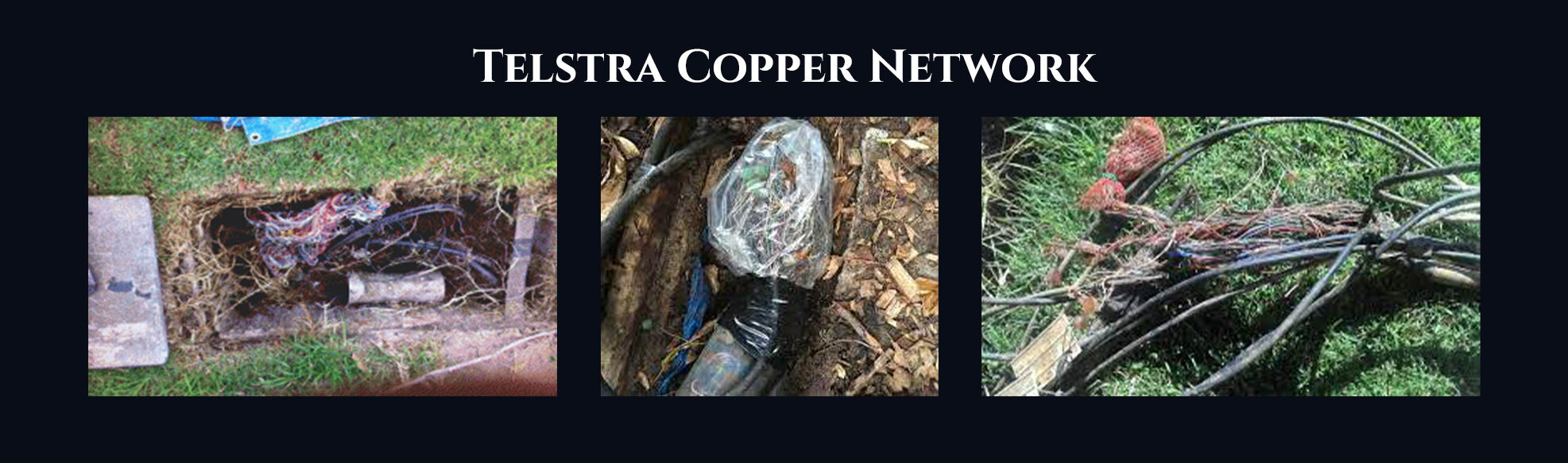
I can only presume that Telstra did not comply with the request 'to immediately provide AUSTEL with a copy of all the available documentation which was apparently inadvertently left at Mr Smith's premises,' on 3 August 1993. Austel's General Manager, Consumer Affairs, wrote to Telstra requesting copies of all documents in this briefcase that had not already been forwarded to Austel.
I sent off a number of Statutory Declarations to Austel explaining what I had seen in the briefcase. Telstra had returned and picked up the briefcase.
A significant portion, specifically one-third, of the documents I managed to obtain contained compelling evidence that indicated both Ericsson and Telstra were fully aware of the widespread nature of the AXE Ericsson lock-up telephone exchange faults. These faults were not isolated incidents; rather, they were a global issue that severely impacted between 15% and 50% of all calls routed through Telstra's AXE telephone exchange equipment. The consequences of these faults were far-reaching. They led to lock-ups that effectively jammed the system, preventing customers from receiving or making calls via Telstra’s Ericsson-installed AXE telephone service. As a result, many businesses relying on this exchange equipment faced a dual threat: not only were their communications disrupted, but their operational viability was also in jeopardy.
Moreover, these technical glitches also led to significant billing complications for Telstra customers, particularly for businesses using self-paid 008/1800 freecall services. These services are vital for long-distance customers trying to reach the business, and when calls fail due to system errors, it creates confusion and frustration for all parties involved.
In clear terms, the alarming decline of COT-type small business operators within Australia can be traced back to this unresolved software problem. Despite my repeated notifications to Telstra about the issues stemming from their software, the company remained largely unresponsive and reluctant to take action. Their stance was to demand that I formalise my complaint regarding the Ericsson AXE service through their legal representatives, Freehills Hollingdale & Page, specifically involving Denise McBurnie. Telstra made it clear that if I did not comply with this request, they would categorise my complaint as frivolous and vexatious, thereby allowing them to avoid any obligation to investigate the serious concerns I had raised.
After almost two decades, the British public—and a growing number of British politicians—have insisted that the British Post Office scandal is a matter of profound public interest and must no longer be concealed by the government, the civil service, or the Establishment. For England’s sake, this injustice demands a complete and transparent investigation. Click here to watch the Australian Channel 7 trailer for Mr Bates vs the Post Office, which aired in February 2024, and captures the scale of this national betrayal.
What makes the scandal so disturbing is that public servants inside the British Post Office knew the Fujitsu Horizon computer software was responsible for the catastrophic accounting and billing errors. Yet they continued to blame innocent sub‑postmasters, many of whom were financially ruined, prosecuted, or imprisoned.
This pattern is painfully familiar to those of us who lived through the Australian COT arbitrations. Dr Gordon Hughes, the arbitrator appointed to oversee our cases, refused to allow his own technical consultants the additional time they needed to diagnose the ongoing faults in Telstra’s Ericsson billing software. The parallels between the British Post Office scandal and the Australian Telstra scandal are unmistakable. In both cases, faulty technical equipment was at the heart of the problem, as demonstrated in this YouTube video: https://youtu.be/
Click here to watch Mr Bates vs the Post Office
In late 1999, Frank Blount—then recently departed CEO of Telstra—co‑authored a book titled Managing in Australia. In it, he openly acknowledged the very software billing problems that Telstra executives had denied under oath during my arbitration. On pages 132 and 133, the co‑author describes Telstra’s 1800‑service faults in blunt terms:
- “Blount was shocked, but his anxiety level continued to rise when he discovered this wasn’t an isolated problem.
- The picture that emerged made it crystal clear that performance was sub-standard.” (See File 122-i - CAV Exhibit 92 to 127)
https://www.qbd.com.au › managing-in-australia › fran... → (See File 122-i - CAV Exhibit 92 to 127).
This admission stands in stark contrast to the sworn statements made by nine Telstra executives during my arbitration, all of whom insisted that my business was not suffering from ongoing billing problems—despite Telstra’s board knowing otherwise.
Lying during litigation is not a trivial matter. It strikes at the heart of justice. In both the British Post Office case (a government‑owned institution) and the Telstra case (also government‑owned at the time), officials swore under oath that no software billing issues existed. These were not innocent mistakes. They were orchestrated falsehoods, engineered by bureaucrats whose duty was to protect citizens, not destroy them.
It is essential to expose the treachery of both the British and Australian governments—and the bureaucracies that enabled these injustices. Their complacency and complicity reveal the profound challenges faced by ordinary people when institutions designed to uphold justice instead choose to bury the truth. My Open Letter of 25 September 2025 explores this in greater detail.
Thousands upon thousands of Telstra customers Australia-wide had been wrongly billed since the installation of this Ericsson AXE equipment, which, in my case, had been installed in August 1991, with the problems still apparent in 2002. Other countries around the world were removing it from their exchanges (see File 10-B Evidence File No/10-A to 10-f), and Australia was still denying to the arbitrator that there had ever been a problem with that equipment. Lies told by Telstra so as to minimise their liability to the COT Cases. (See Files 6 to 9 AXE Evidence File 1 to 9)
Was this the real reason why the Australian government allowed Ericsson to purchase Lane during the government-endorsed COT arbitration while the arbitrations were still in progress?
The statement made by DMR (Canada) & Lane (Australia) in their alleged combined finding in the Cape Bridgewater Technical Evaluation Report dated 30 April 1995, provided to the arbitrator was an incomplete report which Paul Howell (DMR Canada) refused to sign off on with the arbitrator, disregarding the fact it was still not a full and complete record of my losses, states i.e.;
“One issue in the Cape Bridgewater case remains open, and we shall attempt to resolve it in the next few weeks, namely Mr Smith’s complaints about billing problems.
“Otherwise, the Technician Report on Cape Bridgewater is complete.” ( Open Letter File No/47-A to 47-D)
and
“Continued reports of 008 faults up to the present. As the level of disruption to overall CBHC service is not clear, and fault causes have not been diagnosed, a reasonable expectation that these faults would remain ‘open’,” (Exhibit 45-c -File No/45-A)
Arbitrator False Evidence File 1) I'm wondering if Lane Telecommunications Pty Ltd pressured DMR Group Inc (Canada) to refrain from diagnosing my ongoing Ericsson AXE telephone billing problems because Lane was already in negotiations with Ericsson to sell itself to the latter, which it eventually did in 1996 (Refer to → Chapter 5 - US Department of Justice vs Ericsson of Sweden).
“There is, however, an addendum which we may find it necessary to add during the next few weeks on billing, i.e. possible discrepancies in Smith’s Telecom bills.” (See Arbitrator File No/28)
The arbitrator’s version contains more information than mine. For example, the reference to my ongoing billing problems states that extra weeks are required to complete the investigation; however, the arbitrator did not provide the additional weeks.
Page two of this report (provided as the final report) Open Letter File No/47-A to 47-D shows no mention of my billing claim document being discussed in my version. However, page three in the arbitrator’s version notes:
“One issue in the Cape Bridgewater case remains open, and we shall attempt to resolve it in the next few weeks, namely Mr Smith’s complaints about billing problems.
“Otherwise, the Technician Report on Cape Bridgewater is complete.” (See Open Letter File No/47-A to 47-D)
It is curious how two technical reports, prepared by the same consultants and with the same 23 technical assessments, dated 30 April 1995, can have different versions. One version notes that the “… case remains open, and we shall attempt to resolve it in the next few weeks,” while the other does not mention that the case is still open and requires weeks to complete.
Clicking on the kangaroo image reveals a darker truth: the reason we, the concerned citizens, were denied access to the essential government FOI documents may be far more insidious than mere bureaucratic error. It suggests a deliberate effort to conceal damning evidence—a sinister plot that explains the perplexing difficulty in obtaining vital information: documents meant for public knowledge that were replaced with sordid, unrelated materials.
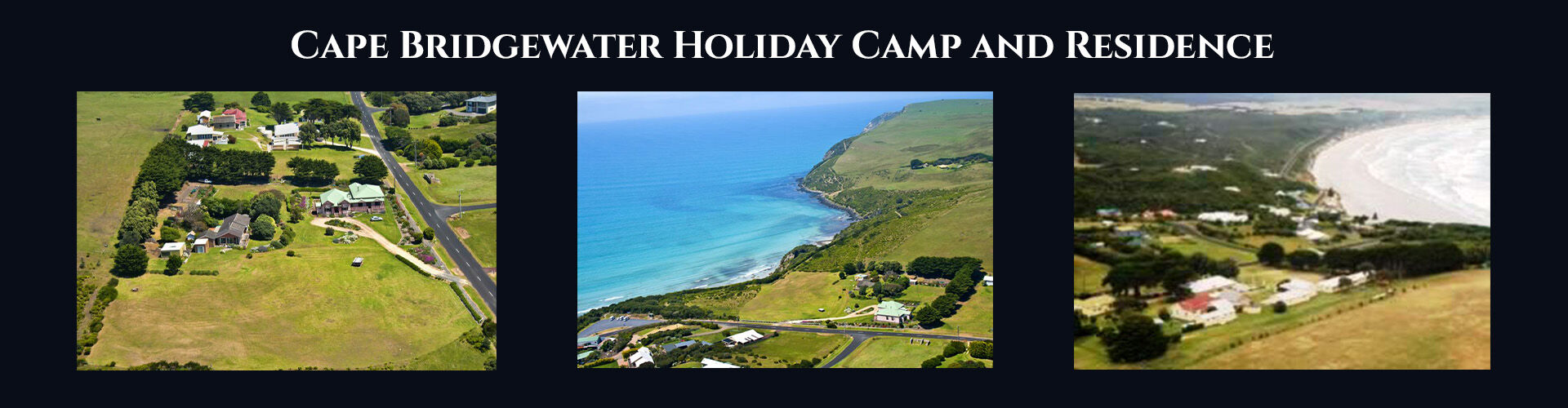
 I have raised here four letters, one dated 17 August 2017, 6 October 2017, 9 October 2017 and 10 October 2017, from COT Case Anne Garms, just before her death, to The Hon Malcolm Turnbull MP, Prime Minister of Australia and Senator the Hon Mathias Cormann (see See File Ann Garms 104 Document) where she exposes not only the raping of the first nation (aboriginal children) by Senator Collins in his parliament house Canberra office (rb.gy/dsvidd) Ann also discloses in her 6 October 2017 letter which is marked Doc B, to the Hon Malcolm Turnbull MP, Prime Minister of Australia, raises the fact that previous CEO during the COT arbitrations Frank Blount co-produced a book https://www.qbd.com.au › managing-in-australia › fran admitting Telstra did have significant billing problems in their network.
It was also essential to raise Ann Garms's letter here because Wayne Goss (Chair of Deloitte), who Ann referred to, had also been Premier of Queensland Therefore, Ann's statement that told her that during our arbitrations, Gaslighting methods were used against us fits in with the Gaslighting character assassination used against me in 1996, to stop Laurie James, the President of the Institute of Arbitrators Australia, from investigating my claims concerning the unethical way in which the four COT arbitrations had been conducted.
“I still stand by my statutory declaration that I was able to identify that the incoming faxes provided to me for review had at some stage been received by a secondary fax machine and then retransmitted, this was done by identifying the dual time stamps on the faxes provided.” (Front Page Part One File No/14)
It is clear from exhibits 646 and 647 (see AS-CAV Exhibits 589 to 647) that Telstra admitted in writing to the Australian Federal Police on 14 April 1994 that my private and business telephone conversations were listened to and recorded over several months, but only when a particular officer was on duty.
What recourse do you have when the very government systems designed to hold power accountable have been stealthily neutralised? When transparency is reduced to a mere facade of deceit? When are your FOI requests seen as nuisances to be delayed, diluted, or outright denied? When you are told that “no documents exist,” even though you physically possess them in your hands? When does the very essence of truth become a threat to be managed rather than honoured?
In February 1988, at the age of 47, I had dedicated three decades to navigating the world's oceans. During this period, I had established a life that included two decades of marriage and raising two exceptional teenage children. An opportunity arose, and I acquired the Cape Bridgewater School Camp, envisioning a new chapter for my family. However, after only 18 months, my wife, Faye, and I made the difficult decision to relinquish the holiday camp. A significant factor in our departure was the pervasive frustration caused by inadequate communication infrastructure; we were unable to make or receive telephone calls at our new residence or at the camp.
I chose to share this aspect of my narrative later, as I felt it was crucial to first establish a foundational understanding of my thirty years at sea before delving into my impulsive decision to purchase a business operating within a community of only 128 residents. This coastal hamlet faced significant limitations, with only eight telephone lines available. Consequently, if four residences were engaged in simultaneous calls, only four lines would remain accessible to the remaining 124 residents, creating a challenging communication environment.
I invite you to read the introduction, which details my extensive seafaring history and the lessons I acquired along the way. Understanding these experiences will illuminate why, at 82, I believe it is imperative to share the truth and realities of my life's journey.

Trading in the South China Sea, unaware our cargo was bound for North Vietnam to support those killing and maiming Australian, New Zealand, and USA troops.
I embarked on a voyage that marked the beginning of my COT story, a journey fraught with vivid episodes that revealed the depths of treachery and corruption just beneath the surface. The Commonwealth Police, now known as the Australian Federal Police, were blindsided—much like the unsuspecting public—when they boarded the vessel I was on, the Hopepeak. On that fateful day, September 18, 1967, I had the unsettling opportunity to share my harrowing experiences with them, alongside a journalist from Sydney. I recounted the grim realities of a starving communist China, a narrative I hold dear and have meticulously documented on my website, absentjustice.com.
What struck the officers most was not just the palpable danger I had faced, but an eerie understanding that something far greater—and far more sinister—was unfolding in the shadows, hidden from the public eye. They listened, tension hanging in the air, as I described the suffocating silence that cloaked the Chinese ports, the way officials deliberately avoided eye contact, and the chilling precision with which information was manipulated. It felt as if every movement on that ship was being scrutinised, every word weighed, and every gesture recorded by unseen, malevolent hands. The officers confessed they had only received fragments of information, as if an unseen puppet master wove a web of deception, desperate to bury the truth beneath layers of bureaucratic obscurity and plausible deniability. My account did more than surprise them; it chilled them to the bone. It suggested a betrayal that stretched far beyond the decks of the Hopepeak, reaching into the dark corridors of power where silence reigned, and truth was a dangerous liability.
My time on the Merchant Navy training ship, the "Vindicatrix," moored on the River Severn in Sharpness, taught me the importance of compassion.
⚓ Life at Sea: The Truth Behind the Romance
Don't forget to hover your mouse over the image below.
What I got instead was a galley the size of a coffin and a crew of madams who could have run the Royal Opera House with their demands.
My first voyage cured me of romance faster than a bucket of cold seawater down the back. The sea didn’t care about my daydreams. It heaved and rolled and slapped the hull like it was trying to shake us loose. And inside that steel box, I was juggling pots, pans, and personalities that made the weather look tame.
There I was, a greenhorn seaman, elbow‑deep in garlic and chaos, cooking for a troupe of diva‑madams who treated me like their personal chef. If I’d worn a frilly apron, I could’ve starred in The Galley and the Glamour Girls.
But the sea has a way of toughening you. Between the tantrums, the rolling decks, and the pots that slid across the stove every time the ship lurched, I learned to survive. I learned to chop onions fast enough to hide the tears. I learned to brace my legs against the swell while stirring a pot big enough to drown in. And I learned that sometimes the greatest adventures happen in the places you least expect—like a galley that smelled of onions, diesel, and desperation.
⚓ The 1960s–80s: A Different World Entirely
Back then, gay men at sea lived in the shadows—mocked, misunderstood, and only “interesting” when a lonely sailor had been too long away from home. I learned early to defend myself. A long‑neck brandy bottle with a manila rope through the neck became my makeshift handcuff and my best friend. Admirers sometimes mistook my steward’s uniform for an invitation. It wasn’t.
But here’s the truth most people never hear:
Some of the finest seafarers I ever sailed with were gay men. Loyal. Fierce. Hilarious. And when trouble brewed—whether in a bar ashore or on a dark deck at sea—they were the ones you wanted beside you.They could fight like alley cats. Pick one of our crew, and you’d better be ready for flying hairpins.
⚓ Europe, Nightclubs, and the Brotherhood of the Sea
After running from New Zealand to Europe—our holds packed with butter and wool—we’d step ashore in Hamburg, Bremerhaven, Rotterdam, Dunkirk, Antwerp, and London. The nights were wild. Music spilled from taverns. Laughter rolled across cobblestones. And my gay shipmates lit up every bar we entered.
They played pianos, strummed guitars, sang like angels or devils, depending on the hour, and earned us free beer with their performances. They made the loneliness bearable. They made the world feel less cold.
⚓ The Harshness No One Talks About
But life at sea wasn’t all music and mischief.
There were nights when the wind screamed like a living thing, and the ship rolled so hard you had to lash yourself to the rail to stay aboard. I remember standing in a gale, a rope looped over and under my wrist, hauling in a heaving line with another crewman. I was the cook—but at sea, titles mean nothing when the ocean decides to test you.
That’s the truth of it:
At sea, you are a team, or you are nothing.On one ship alone, we had two Irishmen, two West Africans, two Dutchmen, four British trawlermen, a Welshman, a Chinaman, two Romanians, and one gay man. It didn’t matter. Not one bit. When the sea rose, we rose together.
⚓ Dockside Lessons: No Place for the Faint‑Hearted
Life ashore in the 1960s was no gentler than life at sea. The ports were alive with noise—seagulls screaming, winches clattering, ships groaning under their loads. And the bars along the waterfront were their own battlegrounds.
One night, in a smoky, rowdy bar, a young lad barely out of childhood found himself cornered by a local tough who enjoyed picking on fresh faces. There were no “Mr Nice Guys” in those places. You either stood up or you were trampled.
A seasoned sailor saw what was happening and stepped in. The air thickened. Trouble came fast. And by the end of it, twenty‑six stitches were needed to close the night’s lesson.
That was the waterfront: raw, unforgiving, and honest in a way the world rarely is now. You learned to look after each other. You learned that mercy was a luxury. And you learned that loyalty mattered more than anything.
⚓ What the Sea Really Taught Me
Life aboard those ships was a balancing act between laughter and hardship. Between the madness of the galley and the terror of a storm. Between loneliness and the strange, fierce brotherhood that only sailors understand.
It taught me that respect is earned, not assumed.
That difference is strength, not weakness.
And that the sea—like life—doesn’t care who you are, only how you stand your ground.So read on.
Because the story you’re about to enter isn’t polished or pretty.
It’s real.
It’s rough.
It’s funny, brutal, and unforgettable.It’s life at sea.
British Seaman’s Record R744269 - Open Letter to PM File No 1 Alan Smith's Seaman. → → Chapter 7- Vietnam-Vietcong-2
Chapter 2: Surveillance State
They told us arbitration would be confidential. That our evidence, our testimony, our pain—would be handled with integrity. But behind the polished facade of legal process, a darker reality pulsed: we were being watched.
Telstra’s surveillance capabilities weren’t theoretical. They were industrial-grade, embedded in the very infrastructure we relied on to communicate. Their Security Operations Centres, operating 24/7, were equipped with Security Information and Event Management (SIEM) and Threat Intelligence Integration tools designed to detect and catalogue anomalies. But what happens when the anomaly is a whistleblower? When the threat is not external, but internal—someone like me, exposing truths the system would rather forget?
I had spoken with the Prime Minister twice—once in April 1993, again in April 1994. I raised concerns about Australia’s wheat exports to China, and how that grain was being funnelled to North Vietnam, feeding the very forces that had killed and maimed our soldiers. These weren’t idle conversations. They were politically explosive. And I have every reason to believe they were intercepted.
Telstra’s Infrastructure Monitoring systems, designed to manage critical assets like oil refineries, traffic networks, and water plants, also offered remote access, event logging, and alarm management across its vast network. These tools, while marketed for operational efficiency, could easily be repurposed for surveillance—especially when the target was a claimant challenging Telstra’s integrity.
The question isn’t whether Telstra could monitor us. It’s who inside Telstra had the government clearance to filter and interpret that data. Who decided what was evidence, and what was discarded? Who catalogued our conversations, our faxes, our pleas for justice—not to protect us, but to protect the corporation?
This wasn’t just surveillance. It was strategic intelligence gathering, designed to anticipate our moves, undermine our credibility, and control the narrative. The arbitrator, already compromised by deceit, operated in tandem with a system that saw truth as a liability.
And yet, the surveillance failed in one critical respect: it didn’t silence us. It didn’t erase the documents, the corrupted fax logs, the technical reports that proved Telstra’s faults. It didn’t stop the creation of absentjustice.com, or the open letters that now circulate beyond their reach.
We were watched. We were catalogued. But we were not erased.
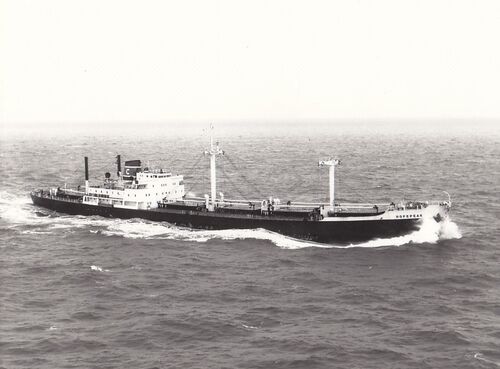
Echoes of Betrayal: Wheat Sales to China - and the Government bureaucrats who continued to tell Australia's politicians what several other seamen and I had witnessed in China was a lie. The following information shows we risked all to expose the truth.
The People's Republic of China
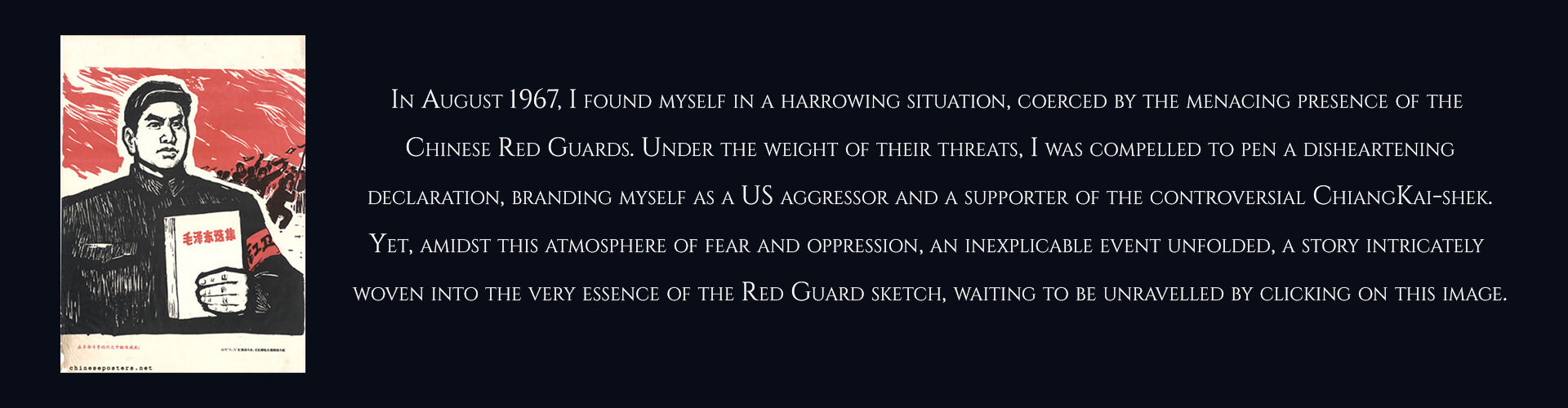
Murdered for Mao: The killings China ‘forgot’
The Letter, the Truth, and the Waiting
In August 1967, I found myself in a situation so precarious, so surreal, that it would etch itself into the marrow of my memory. I was aboard a cargo ship docked in China, surrounded by Red Guards stationed on board twenty-four hours a day, spaced no more than thirty paces apart. After being coerced into writing a confession—declaring myself a U.S. aggressor and a supporter of Chiang Kai-shek, the Nationalist leader in Taiwan—I was told by the second steward, who handled the ship’s correspondence, that I had about two days before a response to my letter might reach me. That response, whatever it might be, would be delivered by the head of the Red Guards himself.
It was the second steward who quietly suggested I write to my parents. I did. I poured myself into 22 foolscap pages, writing with the urgency of a man who believed he might not live to see the end of the week. I told my church-going parents that I was not the saintly 18-year-old they believed I was. I confessed that the woman they had so often thanked in their letters—believing her to be my landlady or carer—was in fact my lover. She was 42. I was 18 when we met. From 1963 to 1967, she had been my anchor, my warmth, my truth. I wrote about my life at sea, about the chaos and the camaraderie, about the loneliness and the longing. I wrote because I needed them to know who I really was, in case I was executed before I ever saw them again.
As the ship’s cook and duty mess room steward, I had a front-row seat to the daily rhythms of life on board. I often watched the crew eat their meals on deck, plates balanced on the handrails that lined the ship. We were carrying grain to China on humanitarian grounds, and yet, the irony was unbearable—food was being wasted while the people we were meant to help were starving. Sausages, half-eaten steaks, baked potatoes—they’d slip from plates and tumble into the sea. But there were no seagulls to swoop down and claim them. They’d been eaten too. The food floated aimlessly, untouched even by fish, which had grown scarce in the harbour. Starvation wasn’t a concept. It was a presence. It was in the eyes of the Red Guards who watched us eat. It was in the silence that followed every wasted bite.
A Tray of Leftovers and a Silent Exchange
After my arrest, I was placed under house arrest aboard the ship. One day, I took a small metal tray from the galley and filled it—not with scraps, but with decent leftovers. Food that would have gone into the stockpot or been turned into dry hash cakes. I walked it out to the deck, placed it on one of the long benches, patted my stomach as if I’d eaten my fill, and walked away without a word.
Ten minutes later, I returned. The tray had been licked clean.
At the next meal, I did it again—this time with enough food for three or four Red Guards. I placed the tray on the bench and left. No words. No eye contact. Just food. I repeated this quiet ritual for two more days, all while waiting for the response to my letter. During that time, something shifted. The Red Guard, who had been waking me every hour to check if I was sleeping, stopped coming. The tension in the air thinned, just slightly. And I kept bringing food—whenever the crew was busy unloading wheat with grappling hooks wrapped in chicken wire, I’d slip out with another tray.
To this day, I don’t know what saved me. It was certainly not the letter declaring myself a U.S. aggressor and a supporter of Chiang Kai-shek, the Nationalist leader in Taiwan. Maybe it was luck. Or perhaps it was that tray of food, offered without expectation, without speech, without condition. A silent gesture that said, “I see you. I know you’re hungry. I know you’re human.”
And maybe, just maybe, that was enough.
In essence, the Australian government faced an agonising moral dilemma — weighing the lives of its soldiers engaged in the conflict in North Vietnam against the desperate need to provide sustenance for an entire nation teetering on the brink of starvation. This heart-wrenching choice highlights the often-unseen complexities of international relations and humanitarian crises, revealing the painful calculations made in the pursuit of survival.
Footnote 83, 84 and 169 → in a paper submitted by Tianxiao Zhu to - The Faculty of the University of Minnesota titled Secret Trails: FOOD AND TRADE IN LATE MAOIST CHINA, 1960-1978, etc → Requirements For The Degree Of Doctor Of Philosophy - Christopher M Isett June 2021
Tianxiao Zhu's Footnotes 83, 84, 169:
In September 1967, a group of British merchant seamen quit their ship, the Hope Peak, in Sydney and flew back to London. They told the press in London that they quit the job because of the humiliating experiences to which they were subjected while in Chinese ports. They also claimed that grain shipped from Australia to China was being sent straight on to North Vietnam. One of them said, “I have watched grain going off our ship on conveyor belts and straight into bags stamped North Vietnam. Our ship was being used to take grain from Australia to feed the North Vietnamese. It’s disgusting.”
84. The Minister of Trade and Industry received an inquiry about the truth of the story in Parliament, to which the Minister pointed out that when they left Australia, the seamen only told the Australian press that they suffered such intolerable maltreatment in various Chinese ports that they were fearful about going back. But after they arrived in London, Vietnam was added to their story. Thus the Minister claimed that he did not know the facts and did not want to challenge this story, but it seemed to him that their claims about Vietnam seemed to be an “afterthought.”
169. "...In Vancouver, nine sailors refused to work on a grain ship headed to China: two of them eventually returned to work, and the others were arrested. Just when the ship was about to sail, seven more left the ship but three of them later returned to work. In Sydney, six Canadian sailors left their ship; they resigned and asked to be paid, but the Australian immigration office repatriated them. At that time, a grain ship usually had crew members of about 40 people. A British ship lost the Chief Officer and sixteen seamen, who told journalists that if the ship were going to the communist countries, they would rather go to jail than work on the ship."
The Canadian Government and Its Moral Code of Ethics
Hover your mouse over the following images as you scroll down the homepage.

By hovering your mouse over the Canadian flag image below, you can also learn about the strong ethical principles upheld by Canadian seamen. Despite facing significant challenges, they believed that sending wheat to Communist China — especially when that wheat was being redeployed to North Vietnam, a country at war with Australia, New Zealand, and the USA, where hundreds of troops were being killed or maimed — was immoral and unethical, and therefore should not have continued.
Yet the Australian Government made a conscious decision to maintain its trade relations with Communist China, despite knowing that a significant portion of Australia’s wheat was being diverted to North Vietnam. This wheat was not merely a trade commodity; it had the potential to sustain North Vietnamese soldiers who were directly engaged in combat against Australia and its allies during the conflict. The ramifications of this trade raised serious ethical questions about supporting a nation that opposed Australian, New Zealand, and US forces.
Examining this wheat agreement made with the People's Republic of China during the Menzies government in the mid‑1960s is essential. This controversial deal had significant implications that were obscured by a government campaign to discredit British and Canadian merchant seamen — including me. These brave individuals tried every conceivable legal way to expose this illicit diversion of wheat to North Vietnam.
• Frog‑marched off the ship under armed guard by Red Guards, accused of being a spy.• Forced to write letters under threat of execution.• Commonwealth Police met the ship in Sydney on 18 September 1967, confirming the seriousness of what had occurred.• British crew members refused to sail the ship back to China, fearing for their lives.
• Wheat shipments had gone ahead despite warnings.• Australian conscripts had fought and died in Vietnam.• Bureaucrats and ministers had ignored both political foresight and lived testimony.
Vol. 87 No. 4462 (4 Sep 1965) - National Library of Australia https://nla.gov.au › nla.obj-702601569
"The Department of External Affairs has recently published an "Information Handbook entitled "Studies on Vietnam". It established the fact that the Vietcong are equipped with Chinese arms and ammunition"
If it is right to ask Australian youth to risk everything in Vietnam it is wrong to supply their enemies. The Communists in Asia will kill anyone who stands in their path, but at least they have a path."
Australian trade commssioners do not so readily see that our Chinese trade in war materials finances our own distruction. NDr do they see so clearly that the wheat trade does the same thing."


It is vital to highlight that on September 18, 1967, the Commonwealth Police—then commonly known as COMPOL—had a unique practice of initialling documents with "COMPOL" following an officer’s signature. This signature protocol was observed when two officers from COMPOL conducted an official visit to the Hopepeak ship, where I was serving as a crew member. During their visit, I presented the officers with a letter I had meticulously crafted, addressed to The Hon Malcolm Fraser, who was the Minister for the Army. This particular letter, written on the same day, became the focus of discussions I later had with Mr Fraser in April 1993 and again in 1994. It contained crucial information that had been removed from official records, and its significance cannot be understated.
Moreover, John Wynack, the Director of Investigation at the Commonwealth Ombudsman, made considerable efforts over a two-year period to obtain access to this letter. However, he faced significant obstacles, as Telstra informed him in writing that my arbitration file had been destroyed. In response to this alarming revelation, Mr Wynack expressed his disbelief in correspondence to Telstra, reflecting his conviction that something was amiss in the handling of the evidence. The officers I encountered during this process are now recognised as part of the Australian Federal Police (AFP).
Home Page File No/82 confirms Mr Wynack did not believe Telstra’s claim that it destroyed the file.
It is on record that I fully cooperated with the COMPOL officers in September 1967, who reviewed my statement concerning my time in China. Later, in 1994 and 1995, I again assisted the AFP with their investigations into my Telstra-related phone and fax hacking episodes.
I have always discussed the AFP issues in the AFP segments, but I am now writing a book on this part of my COT story. I am introducing the China-Australian wheat saga as the spearhead of my story regarding the COMPOL/AFP issues, as this was when the AFP was genuinely horrified by what I told them and by the statement I made concerning my time in China.
This is why I am starting the AFP part of my COT story with episodes where they were human beings in shock, as most Australians were, when I told them of this China saga. It is important to note that on 18 September 1967, the Commonwealth Police, then known as COMPOL, often initialled documents with "COMPOL" after the officer's signature. This was the case when two COMPOL officers visited the Hopepeak ship, where I was a crew member at the time. These officers are now referred to as the Australian Federal Police (AFP).
It is on record that I fully cooperated with the COMPOL officers in September 1967, who reviewed my statement concerning my time in China. Later, in 1994 and 1995, I again assisted the AFP with their investigations into my Telstra-related phone and fax hacking episodes.
I have always discussed the AFP issues in the AFP segments, but I am now writing a book on this part of my COT story. I am introducing the China-Australian wheat saga as the spearhead of my story regarding the COMPOL/AFP issues, as this was when the AFP was genuinely horrified by what I told them and by the statement I made concerning my time in China.
It is essential to note that this firm is responsible for providing Ian Joblin, a clinical psychologist, with a witness statement for the arbitrator overseeing my case. However, a significant concern arose during this process: the witness statement was signed only by Maurice Wayne Condon, a representative of Freehill Hollingdale & Page, and it notably lacked the signature of Mr Joblin himself.
1. He requested an explanation for the apparent discrepancies in the attestation of Ian Joblin's witness statement.
2. He sought clarification on whether any modifications were made to the version of the Joblin statement initially submitted to Dr. Hughes, the arbitrator, compared to the signed version ultimately provided.
Maurice Wayne Condon, acting as Telstra's legal representative from Freehill Hollingdale & Page, signed the witness statement without securing the psychologist's signature, raising serious questions about the extent of Telstra's legal team's influence and power over the arbitration process in Australia.

Also, in the above Senate Hansard on 24 June 1997 (refer to pages 76 and 77 - Senate - Parliament of Australia Senator Kim Carr states to Telstra’s leading arbitration defence Counsel (also a TIO Council Member) Re: Alan Smith:
Senator CARR – “In terms of the cases outstanding, do you still treat people the way that Mr Smith appears to have been treated? Mr Smith claims that, amongst documents returned to him after an FOI request, a discovery was a newspaper clipping reporting upon prosecution in the local magistrate’s court against him for assault. I just wonder what relevance that has. He makes the claim that a newspaper clipping relating to events in the Portland magistrate’s court was part of your files on him”. …
Senator SHACHT – “It does seem odd if someone is collecting files. … It seems that someone thinks that is a useful thing to keep in a file that maybe at some stage can be used against him”.
Senator CARR – “Mr Ward, we have been through this before in regard to the intelligence networks that Telstra has established. Do you use your internal intelligence networks in these CoT cases?”
The most alarming aspect of Telstra's intelligence networks in Australia is who within the Telstra Corporation has the necessary expertise, i.e., government clearance, to filter the raw information collected before it is impartially catalogued for future use? How much confidence information is there in my telephone conversations with the former prime minister of Australia in April 1993 and again in April 1994 concerning my Red Communist China episode, which I discussed with Fraser, held by Telstra officials?
More importantly, when Telstra was fully privatised in 2005, which organisation in Australia was given the charter to archive this susceptible material which Telstra had been collecting about their customers for decades?
PLEASE NOTE:
At the time of my altercation referred to above, on 24 June 1997, the Senate - Parliament of Australia - my bankers had already lost patience and sent the Sheriff to ensure I stayed on my knees. I threw no punches during this altercation with the Sheriff, who was about to remove catering equipment from my property, which I needed to keep trading. I placed a wrestling hold, ‘Full Nelson’, on this man and walked him out of my office. All charges were dropped by the Magistrates' Court on appeal when it became apparent that this story had two sides.
🔄 From 1993 to 2025: The Echoes of a Whistleblower’s Warning
ACMA was the respondent in both my Freedom of Information and government document requests, and the matter was heard by the Administrative Appeals Tribunal between February and October 2008, and again from October 2010 to May 2011.
I was seeking Ericsson-related documentation that Telstra had retained—information that, after Ericsson acquired Lane, was reportedly used to assist Telstra’s arbitration defence against the COT Cases. We had alleged that Ericsson’s telephone exchange equipment was responsible for widespread call dropouts and outages.
To this day, I have not received the requested Ericsson data from the government ACMA.
Hovering your cursor or mouse over AUSTEL’s Adverse Findings confirms that government public servants investigating my ongoing telephone issues supported my claims against Telstra, particularly between Points 2 and 212. It is evident that if the arbitrator had been presented with AUSTEL’s Adverse Findings, he would have awarded me a significantly higher amount for my financial losses than he ultimately did.
Government records (see Absentjustice-Introduction File 495 to 551) show AUSTEL's adverse findings were provided to Telstra (the defendants) one month before Telstra and I signed our arbitration agreement. I did not receive a copy of these same findings until 23 November 2007, 12 years after the conclusion of my arbitration, which was outside the statute of limitations for me to use those government findings to appeal the arbitrator's award.
AUSTEL’s Adverse Findings, dated 4 March 1994, confirmed that my claims against Telstra were validated (see points 2 to 212) before I was forced into arbitration under threat of the then Telecommucations Industy Ombudsman (TIO) Warwick Smith and Telstra that unless I sign for arbitration then Telstra and the TIO would collectively decline to further investigate my telephone faults which I alleged had been apparanty since February 1988, when I purchased the business.
Unfortunately, I did not receive a copy of these findings AUSTEL’s Adverse Findings at points 2 to 212 until November 23, 2007, 12 years after the termination of my arbitration process. In simple words, the government had already validated my claims as early as March 4, 1994, six weeks before April 21, 1994, when I signed the arbitration agreement.
But despite this proof, I was still required to endure 13 months in a gruelling arbitration process that cost me well over $300,000 in professional fees to prove something the government had already established 6 weeks earlier.
On October 3, 2008, in a chilling moment that felt surreal, senior AAT member Judge G.D. Friedman confronted the haunting truths of my case during the AAT hearings. In the glaring light of the courtroom (Case No. V2008/1836), he declared, with the weight of the world on his shoulders, that the government had egregiously failed to provide me with the crucial documents necessary for them to form their findings in a covert report. This insidious report, crafted by AUSTEL (now ACMA) and handed over to Telstra in March 1994, had been a weapon used against me, aimed at dismantling my claims against the government-owned Telstra corporation.
“Let me just say, I don’t consider you, personally, to be frivolous or vexatious – far from it.
“I suppose all that remains for me to say, Mr Smith, is that you obviously are very tenacious and persistent in pursuing the – not this matter before me, but the whole – the whole question of what you see as a grave injustice, and I can only applaud people who have persistence and the determination to see things through when they believe it’s important enough.”
In 2025, both electronic media and various newspapers reported that Optus is now blaming Ericsson for the same outages and call dropouts that we COT Cases first exposed, beginning with the briefcase left open at my Cape Bridgewater premises on June 3, 1993.
Chapter 3: Corruption by Design
Corruption isn’t always loud. Sometimes it’s engineered into the very structure of a process—quiet, procedural, and devastating. The COT arbitrations weren’t sabotaged by accident. They were corrupted by design.
From the outset, Telstra’s internal faults were known. Technical reports confirmed line failures, fax corruption, and call dropouts. Yet the arbitration rules were crafted to exclude critical evidence. The arbitrator, handpicked and protected, operated within a framework that rewarded omission and punished transparency.
Government departments, legal advisors, and Telstra executives formed a closed loop of influence. The corruption wasn’t just in the outcome—it was in the architecture. And every claimant who entered the process was walking into a trap.
Our website grants access to over 56,000 arbitration files, many of which have been grotesquely tampered with by the defendant, Telstra, before entering the arbitration process. These files have been rendered indecipherable, deliberately designed to thwart any attempt at justice.
Witness the lengths to which the government will go to protect its own corrupt interests, ruthlessly allowing its citizens to suffer and remain voiceless in a labyrinth designed to entrap them in despair. The truth is chilling, and the betrayal runs deep.
A Story of Despair and Heartache
Within the convoluted five-volume arbitration dossier, I confronted Mr Kearney, the government investigator, with undeniable evidence that Dr Hughes had insidiously refused to grant his technical consultant the time needed to uncover extensive billing discrepancies. This obstruction likely forced Mr. Kearney into a rushed and precarious position, culminating in a hastily written report in February 1996. Regrettably, amidst this disquiet, the report validated my arbitration claims.
That summary report meticulously identified 23 examples of fabrications in Telstra's covert submission to AUSTEL on 16 October 1995, a mere five months after my arbitration concluded. AUSTEL, the government Communications Authority, revealed that the arbitrator had failed to scrutinise these glaring discrepancies, allowing Telstra to manipulate the narrative. This collusion exposed the staggering scale of the ongoing billing debacle and underscored the dire need for accountability in an environment where misconduct festers unchecked.
This subversive manipulation of the arbitration process by AUSTEL and Telstra—the defendants in my arbitration—was unethical and duplicitous. They orchestrated this conduct in secret, denying both the arbitrator and me the right to respond to Telstra's late submission of deceit to AUSTEL. The entire affair reeks of betrayal—of trust, justice, and the principles that should govern our systems.
The original arbitration claim information, which AUSTEL secretly allowed Telstra to submit on 16 October 1995, contradicted Mr Kearney's findings from data he collected from my business on 19 December 1995, and presented in February 1996. AUSTEL's decision to permit Telstra to address my arbitration billing claims in secret, without an arbitrator present, was inappropriate. This secretive manoeuvring by AUSTEL and Telstra significantly compromised my ability to make future complaints regarding ongoing telephone problems.
Absentjustice.com reveals that John Pinnock, the second-appointed arbitration administrator, continued to inform my Federal Member of Parliament, David Hawker MP, the Communications Minister, and Telstra, until I sold my business to Darren and Jenny Lewis in December 2001, that my ongoing telephone and faxing problems had been addressed and fixed as part of my 1994/95 arbitration.
How could problems still experienced in 2001 have been fixed in 1994/95?
Documentation in Files 221, 222, and 223 AS-CAV Exhibit 181 to 233 suggests that Paul Howell of DMR Group Inc., Canada, allegedly authored a cover letter claiming his technical report concerning the Cape Bridgewater Holiday Camp Evaluation of Call Losses and the non-addressed RVA billing faults, dated 30 April 1995, was complete (refer to File 223). However, John Pinnock, the Australian Telecommunications Industry Ombudsman, stated in correspondence dated 16 August 1996—sixteen months after the date on Paul Howell's cover letter—that the arbitrator (refer File 221) was not obligated to provide me with Paul Howell's cover letter during the arbitration process, despite my requests to present it to my technical advisors for an informed written response to the purportedly complete report.
In section 2:23 of his report, Paul Howell asserts that the report remained incomplete and required additional weeks to ascertain the reasons my business persistently experienced billing-related complaints (Refer to Chapter 1 - The Collusion Continues).
On 5 May 1995, the arbitrator denied my request for extra time to submit an addendum and did not explain why Paul Howell's technical report had not been formally endorsed as complete. Despite requests from both Paul Howell and his colleague at Lane Telecommunications for an extension, the arbitrator refused additional time. Consequently, I had to respond to Paul Howell's report without his signature indicating its completion (Refer to Arbitrator File No/48).
In my 1997 statutory declaration (File 222 - AS-CAV Exhibit 181 to 233), I recount a significant conversation with Paul Howell, who contacted me by telephone after my hospitalization for a suspected heart condition. Howell revealed that he had not finalised or signed off on his report because it was incomplete. This disclosure highlighted Howell's integrity and reflected the Canadian government's commitment to upholding the rule of law. The chief Canadian technical consultant evaluating my claims withheld endorsement of the report, citing Canada's commitment to this principle. Howell thoroughly explained his decision, clarifying the complexities of my situation. For more on the implications of the Paul Howell DMR and the Lane report, see Chapter 1 - The Collusion Continues.
Throughout this period, I documented my struggles in correspondence with Denise McBurnie. Despite assurances from Telstra and Ms. McBurnie that no systemic billing issues affected my 008/800 services, the reality was different and distressing. In late 1999, former Telstra CEO Frank Blount co-published "Managing in Australia" (https://www.qbd.com.au › managing-in-australia › fran), available online. Pages 132 and 133 candidly address the systemic issues within Telstra's 1800 service—the same challenges I faced.
Despite the gravity, when Freehill Hollingdale & Page endorsed Telstra's arbitration defence, they failed to accurately depict the prevailing circumstances regarding these systemic issues to the arbitrator. This occurred even though they had submitted nine witness statements supporting my position on December 12, 1994. Furthermore, on October 16, 1995—five months after my arbitration concluded—AUSTEL covertly permitted Telstra to address the systemic billing fault at issue in my arbitration. AUSTEL, not a party to my arbitration with Telstra, was unaware that the witness statements dated December 12, 1994, used by Telstra in this underhanded AUSTEL process, had been condemned by two senior Queensland detective sergeants as grossly inaccurate. This clandestine action enabled Telstra to rely on falsified arbitration witness statements, barring me from responding and denying the arbitrator the opportunity to adjudicate this vital aspect of my claim.
The Appeal That Never Came
On December 13, 1995, Gene Volovich, my appeal lawyer from Law Partners Melbourne, delivered a devastating blow. Sitting across from me, he stated with certainty something I will never forget: he believed my appeal had no chance of success.
He wasn't guessing. Volovich had reviewed the documents and transcripts. He understood the rules and recognised they had been broken during the arbitration process.
Ten days later, I handed Volovich the complete set of evidence I had previously shown to Darren Kearney from AUSTEL. Kearney's five-hour drive from Melbourne to my Cape Bridgewater Holiday Camp spoke volumes. It suggested that, at least for a moment, the truth mattered to someone.
The October Betrayal
The core of the problem stemmed from AUSTEL's decision to allow Telstra to respond to my billing evidence outside the formal arbitration process. On October 16, 1995, Telstra was permitted to rewrite the narrative in private, with no arbitrator or claimant present.
Instead of clarifying the issues, Telstra misrepresented facts and distorted information, failing to disclose crucial details.
Later, AUSTEL officials contacted me to request a review of my claim materials. They were astounded to find that the documents had not been adequately investigated. Dr. Gordon Hughes, the arbitrator, and his technical team had disregarded established procedures, a point already highlighted in AUSTEL's April 1994 COT Cases report. AUSTEL officials were incredulous that Hughes had repeated this error.
The Vanishing Findings
On December 19, after reviewing my materials, Mr Kearney requested that they be returned to Melbourne. He provided written assurances, promising findings and closure.
I am still waiting.
In August 1997, Michael Brereton & Co. wrote to Senator Ron Boswell, confirming that I had a substantial case against Dr Hughes. However, I was unable to secure legal representation, neither from them nor from any other firm. The system had worn me down, and the legal gatekeepers had effectively locked me out.
The Freehills Conflict
Back in January 1994, the COTs (Casualties of Telstra) were assured by Robin Davey, AUSTEL's Chairman, that Freehills would no longer be involved in our Fast Track Settlement Proposal.

Despite this assurance, Telstra reappointed Freehills as its defence counsel for the FTAP (Fast Track Arbitration Process). Warwick Smith, the TIO (Telecommunications Industry Ombudsman), dismissed the conflict of interest, stating it was Telstra's prerogative.
Meanwhile, I continued to register fault complaints through Freehills, and I was
consistently denied access to technical data, facing continuous stonewalling.
An internal Telstra email (FOI folio C02840) confirmed their awareness of the situation:
They knew it was a conflict of interest, but they disregarded it.
During arbitration, Telstra submitted witness statements signed only by Freehills, not by the actual witnesses. When I challenged this irregularity, the response was absurd. The statements were simply sent back to the witnesses for signature, with no investigation or accountability.
Gene Volovich was astonished. He couldn't believe I hadn't received any of the fault correspondence exchanged between Telstra, Freehills, and me. He suspected Telstra had deliberately appointed Freehills as my fault managers to shield all correspondence under Legal Professional Privilege.
The Arbitrator Who Wasn't
Dr Hughes's failures went beyond simple rule-breaking. He wasn't even a registered arbitrator, not even a graded one, and was unqualified to oversee such a complex and consequential process.
And yet, he presided, ruled, and ultimately buried my case.
On October 19, 1993, Denise McBurnie of Freehills sent a document, marked "Legal Professional Privilege In Confidence," to Telstra's Don Pinel. This document outlined how Telstra could shield technical fault data—data crucial to my case—from disclosure under the guise of legal privilege.
It wasn't privilege; it was concealment.
"Duesbury & FHP continuing of evaluating (blank) claim - final report to Telecom will be privileged and will not be made available to (blank)."
Reflection: A System Built to Exhaust
My fight wasn't just for service; it was a battle through a maze designed to wear me down. Every letter to Freehills became another brick in a wall. Each delay, denial, and invocation of privilege formed part of a broader strategy: to keep the truth out of reach.
And yet, I persisted—documenting, pushing forward. Because I believed that one day, someone would read these chapters, not just as history, but as a warning.
Exhibit AS 767-A: The Smoking Gun
Then came the document dated October 29, 1993—Telstra FOI folio K01489, Exhibit AS 767-A. It laid out the strategy in plain terms, revealing not only the use of privilege but also its intent.
This wasn't a misunderstanding; it was by design.
"During testing the Mitsubishi fax machine, some alarming patterns of behaviour were noted, these affecting both transmission and reception. Even on calls that were not tampered with the fax machine displayed signs of locking up and behaving in a manner not in accordance with the relevant CCITT Group 3 fax rules."
A handwritten note in the bottom right corner of Exhibit AS 767-B, which reads, "Stored in Fax Stream?" suggests that faxes intercepted via Telstra's testing process were stored in Telstra's Fax Stream service centre. This would have allowed anyone with access to Telstra's fax stream centre to read the documents at any time. The Scandrett & Associates report confirms that numerous COT arbitration documents were intercepted, including faxes to and from Parliament House, the Commonwealth Ombudsman's Office (COO), and the COTs themselves. In my case, this interception continued for seven years after the arbitration concluded. This means Telstra had access to confidential documents that claimants believed they were sending only to their accountants, lawyers, and/or technical advisors (as well as Parliament House and the COO). These documents could have included information that the claimants wanted to keep from the defendants.
Was the engineer pressured to remain silent during my arbitration? I don't know. What is certain is that not all Telstra engineers or technicians handled COT complaints in good faith. Another Telstra technician, who encountered significant problems during his official fax testing process on October 29, 1993, nevertheless advised the arbitrator that I had no problems with that service, despite Telstra's own document noting these faults:
Back to the Briefcase
Ericsson AXE faulty telephone exchange equipment (1)
I should have known better. It was just another case of "No fault found." We spent considerable time dancing around a summary of my phone problems, and their best advice was to continue doing exactly what I had been doing since 1989: meticulously recording every fault. I could have wept. Finally, they left.
A little while later, back in my office, I discovered Aladdin had left behind his treasures; the Briefcase Saga was about to unfold.
The briefcase wasn't locked. I opened it, discovering it belonged to a Mr Macintosh. There was no phone number, so I had to wait until business hours the next day to track him down. Inside, however, was a file titled "SMITH, CAPE BRIDGEWATER." After five gruelling years fighting the evasive monolith of Telstra and being told various lies, here, possibly, was the truth from an insider's perspective.
The first thing that raised alarm bells was a document revealing Telstra knew the RVA fault they recorded in March 1992 had lasted at least eight months, not the three weeks on which they based their settlement payout. Dated 24/7/92 and bearing my phone number in the top right corner, the document referenced my complaint that callers received an RVA "service disconnected" message. The "latest report," dated 22/7/92, came from Station Pier in Melbourne and noted a "similar fault reported" on 17/03/92. The final sentence read: "Network investigation should have been brought in as fault has gone on for 8 months."
I copied this and other documents from the file on my fax machine and faxed them to Graham Schorer. The next morning, I telephoned the local Telstra office, and someone came to collect the briefcase.
The information in this document, dated July 24, 1992, proved that senior Telstra management had deceived and misled me during previous negotiations. It showed their guarantees that my phone system was up to network standard were made knowing it was nowhere near "up to standard."
Telstra's area general manager was fully aware at the time of my settlement on December 11, 1992, that she was providing incorrect information. This information influenced my judgment of the situation, placing me at a commercial disadvantage. The General Manager, Commercial Victoria/Tasmania, was also aware of this deception.
The use of misleading or deceptive conduct in a commercial settlement, such as mine, contravenes Section 52 of the Australian Trade Practices Act. Yet this deception has never been officially addressed by any regulatory body. Jumping ahead, even the arbitrator who handed down his award on my case in May 1995 failed to question Telstra's unethical behaviour.
Previously Withheld Documents
I presented this new information to Austel, along with documents previously withheld from me during my 11 December 1992 settlement and found in the briefcase. On 9 June 1993, Austel's John MacMahon wrote to Telstra concerning my ongoing phone issues post-settlement and the briefcase documents' contents:
Presumably, Telstra did not comply with the request 'to immediately provide AUSTEL with a copy of all the available documentation which was apparently inadvertently left at Mr Smith's premises,' because on 3 August 1993, Austel's General Manager of Consumer Affairs again wrote to Telstra, requesting copies of all briefcase documents not yet forwarded to Austel.
I also sent Austel several Statutory Declarations explaining what I had seen in the briefcase, which Telstra had since retrieved.
The copies I made of just one-third of the documents contained enough information to convince AUSTEL that Ericsson and Telstra were fully aware that AXE Ericsson lock-up faults were a global problem, affecting 15 to 50 per cent of all calls made through this AXE exchange equipment. These lock-up flaws also affected the billing software.
A story of despair and heartache.
Since the installation of Ericsson AXE equipment—in my case, in August 1991—thousands of Telstra customers across Australia had been wrongly billed, and these billing problems persisted in 2002. While other countries were removing or had already removed this equipment from their exchanges (see File 10-B Evidence File No/10-A to 10-f ), Telstra continued to deny to the arbitrator that there were any issues with the equipment. These denials were lies told by Telstra to minimise its liability in the COT Cases (See Files 6 to 9, AXE Evidence File 1 to 9).
Was this the reason the Australian government permitted Ericsson to purchase Lane during the government-endorsed COT arbitration, while these arbitrations were still underway?
When COT arbitration documents demonstrated that the Ericsson AXE lock-up call loss rate was between 15% and 50%, as shown in File 10-B Evidence File No/10-A to 10-f , AUSTEL launched an investigation into these AXE exchange faults. This investigation uncovered approximately 120,000 COT-type complaints nationwide. According to Exhibit (Introduction File No/8-A to 8-C), Telstra's Group General Manager (who also served as Telstra's main arbitration defence liaison officer) suggested to AUSTEL's Chairman, Robin Davey, that he alter the finding of 120,000 COT-type complaints to just one hundred. When the public AUSTEL COT Cases report was released on April 13, 1994, it stated that AUSTEL had identified upwards of 50 or more COT-type complaints across Australia.
Was this the major problem Julian Assange wanted to share with the COT Cases? He claimed the corruption was significant. How much greater would the impact have been if this had been exposed during the COT arbitrations?
In my case, none of the relevant arbitration claims raised against Ericsson, whose official arbitration records were numbered A56132, were investigated, including my Telstra's Falsified SVT Report. Why did Lane ignore this evidence against Ericsson?
Even more concerning, when my arbitration claim documents were returned to me after the arbitration concluded, NONE of my Ericsson technical data was included.
Chapter 4: Cover-Up Culture
The cover-up began before the arbitration even started. Telstra withheld documents, misrepresented fault data, and manipulated technical logs. When I requested full disclosure, I was met with redactions, delays, and denials.
The arbitrator refused to investigate known faults. The administrator ignored evidence. And when I exposed the corrupted fax logs and surveillance concerns, the response was silence.
This wasn’t incompetence. It was culture. A culture of concealment, where truth was inconvenient and accountability was optional. The cover-up extended beyond Telstra—into government departments, legal chambers, and media silence.
On August 27, 1993, Telstra's Corporate Secretary, Jim Holmes, wrote to me regarding the contents of a briefcase:
Although there is nothing in these documents to cause Telstra any concern in respect of your case, the documents remain Telstra's property. They, therefore, are confidential to us ... I would appreciate it if you could return any documents from the briefcase still in your possession as soon as possible.
He conveniently omitted any reference to vital evidence withheld from me during compensation negotiations.
Flogging a Dead Horse
By mid-1993, public interest in our battle was growing. Several articles had appeared in my local newspaper, and interstate gossip about the COT group was spreading. In June, Julian Cress from Channel Nine's 'Sixty Minutes' faxed me:
Just a note to let you know that I had some trouble getting through to you on the phone last Thursday. Pretty ironic, considering that I was trying to contact you to discuss your phone problems.
The problem occurred at about 11 am. On the 008 number I heard a recorded message advising me that 008 was not available from my phone and your direct line was constantly engaged.
Indeed, quite ironic.
A special feature in the Melbourne Age gave my new 'Country Get-A-Ways' program a positive review. The program marketed weekend holidays for over-40s singles in Victoria and South Australia, including an outdoor canoe weekend, a walking and river cruise along the Glenelg River, a Saturday Dress-up Dinner Dance with a disco, and a trip to the Coonawarra Wineries in South Australia with a Saturday morning shopping tour to Mt Gambier. I began to feel optimistic about the Camp's prospects.
However, my telephone saga was far from over. A fax arrived on October 26, 1993, from Cathine, a relative of the Age journalist who wrote the feature:
Alan, I have been trying to call you since midday. I have rung seven times to get an engaged signal. It is now 2.45 pm.
A story of despair and heartache:
Cathine had been calling my 1800 free-call line. I was in my office that day, and no calls came through between 12:30 and 2:45. According to Telstra's data, however, there was a six-minute call at 12:01 and an eight-minute call at 12:18. This was incredibly frustrating, and the problem seemed endless. But I was determined to expose their lies and incompetence.
I intensified my marketing efforts for the Camp and singles weekends, personally visiting social clubs in metropolitan Melbourne, Ballarat, and Warrnambool. I followed up with advertisements in local newspapers throughout Melbourne and in many major regional centers in Victoria and South Australia. I also attempted to place ads for the Get-Away holidays in the 1993 White Pages, but the entries were never published. I complained to the Telecommunications Industry Ombudsman (TIO), who tried to get Telstra to explain why my advertisements were omitted from 18 major phone directories.
The Deputy TIO wrote in his letter to me of 29/3/96, that he believed his office would simply "be flogging a dead horse trying to extract more" from Telstra on this matter. (The TIO, in fact, is an industry body supervised by a board whose members are drawn from the leading communications companies in the country: Vodafone, Optus, and, of course, Telstra.)
A story of despair and heartache:
Between May and October 1993, I received numerous letters in response to my request for feedback, many detailing difficulties contacting the Camp by phone. These came from schools, clubs, and singles clubs. On May 6, 1993, Mr. Don MacDowall, the executive officer of the Camping Association of Victoria, wrote that 10,000 copies of their Resource Guide, in which I had placed an advertisement, had been directly mailed to schools and distributed. Mr. MacDowall noted that other advertisers with similar ads had experienced increased inquiries and bookings following the distribution of these guides. He believed that the malfunction of my phone system had "effectively deprived of similar gains in business." He also mentioned receiving complaints from people unable to reach me by phone. In total, I received 36 letters from individuals, as well as over 40 other complaints, from people who had unsuccessfully tried to respond to my advertisements.
The Hadden & District Community House wrote in April 1993:
Several times I have dialled 055 267 267 number and received no response— dead line. I have also experienced similar problems on your 008 number.
Our youth worker, Gladys Crittenden, experienced similar problems while organising our last year's family camp, over a six month period during 1991/1992.
In August 1993, Rita Espinoza from the Chilean Social Club wrote:
I tried to ring you in order to confirm our stay at your camp site. I found it impossible to get through. I tried to ring later but encountered the same signal on 10 August around 7 – 8.30 pm. I believe you have a problem with the exchange and strongly advise you contact Telstra.
Do you remember the same problem happened in April and May of this year?
I apologise but I have made arrangements with another camp.
A testing situation

Later in 1993, Mrs. Cullen from Daylesford Community House informed me that she had unsuccessfully tried to phone on August 17, 1993, at 5:17, 5:18, 5:19, and 5:20 pm, each time encountering a dead line. She reported the fault to Telstra's Fault Centre in Bendigo on 1100, speaking to an operator named Tina. Tina also attempted to call my 1800 number but was unable to connect. Telstra's handwritten memo, dated August 17, 1993, records the times Mrs. Cullen tried to reach me and documents Tina's unsuccessful attempt to contact me.
A story of despair and heartache:
My itemised 1800 account showed charges for all four of Mrs Cullen's calls, even though she never reached me. I passed this information to John MacMahon at Austel. Soon after, Telstra arranged to test my line from various locations around Victoria and New South Wales. They notified Austel that approximately 100 test calls would be made to my 1800 free-call service on August 18, 1993.
That morning, I answered two calls from Telstra Commercial, one lasting six minutes and the other eleven, as they prepared for the day's test calls. Throughout the rest of the day, I answered another eight or nine calls from Telstra. Days later, my 1800 phone account arrived, listing charges for over 60 calls. I questioned Telstra about this, asking how I could be charged for so many unanswered calls and why I should pay for test calls. In retrospect, I should also have asked how more than 60 calls could have been answered in just 54 minutes, given that the statement showed calls coming through at a rate of up to 3 per minute.
On November 8, 1993, Telstra wrote to Austel's John MacMahon, stating that I had acknowledged answering a "large number of calls" and that all evidence suggested "someone at the premises answered the calls." Austel requested the name of the Telstra employee who supposedly made these successful calls to my business. I also requested this information, but Telstra never responded.
Then, on January 28, 1994, I received a letter from Telstra's solicitors mentioning "malicious call trace equipment" that Telstra had installed on my service—without my knowledge or consent—between May 26 and August 19, 1993. This was the first I had heard of it. They explained that this device caused a 90-second lock-up on my line after each answered call, preventing incoming calls for that duration.
This information further complicated matters regarding Mrs Cullen's four calls, for which I was charged within 28 seconds, and the 100 Telstra test calls. Even if I could answer calls that quickly, the malicious call tracing equipment, which was supposedly attached to my line at the time, would have imposed a 90-second delay between calls, making most of those calls impossible. Telstra management, unsurprisingly, offered no explanation.
What was really happening? It seemed to me that most of those 100 test calls were never made and, in fact, could not have been.
A story of despair and heartache.
Late in 1994, I received two FOI documents, K03433 and K03434, pertaining to these calls. These documents listed 44 calls, numbered 8 through 63, to the Cape Bridgewater exchange. Nine of these calls were marked with either a tick or an arrow. Despite repeated inquiries, Telstra never explained the meaning of these marks. I presume a technician made them to indicate the calls I received and answered. A note on K03434 stated:
Test calls unsuccessful. Did not hear STD pips on any calls to test no. The TCTDI would not work correctly on the CBWEX (Cape Bridgewater Exchange). I gave up tests.
Evidently, the technicians abandoned their testing procedure. A second series of tests, conducted in March 1994, fared little better. Telstra's fault data indicated only 50 of 100 test calls successfully connected. This information, however, was useless to me at the time, as it was withheld until September 1997. In 1994, I kept hearing the same refrain: "No fault found."
Only one official document acknowledged the inadequacy of Telstra's testing regime: the Austel Draft Report regarding the COT cases, dated 3 March 1994, which concluded:
Cape Bridgewater Holiday Camp has a history of services difficulties dating back to 1988. Although most of the documentation dates from 1991, it is apparent that the Camp has had ongoing service difficulties for the past six years, which has impacted on its business operations, causing losses and erosion of the customer base.
In view of the continuing nature of the fault reports and the level of testing undertaken by Telecom doubts are raised on the capability of the testing regime to locate the causes of faults being reported.
This conclusion would have been a triumph for all COT members, including myself, had we known about it. However, this draft report, based on the evidence we provided to Austel, was withheld from COT members until 2007, long after it could have been of any use.
By law, this Draft Report should have been presented to the Minister for Communications; however, it was never tabled or made public. The following month, the "final," edited report was released, with significant alterations made at Telstra's insistence, including a general and sometimes specific watering down of findings and the deletion of this conclusion.
The details of this draft report and the ramifications of withholding it are discussed in depth later. For now, it is sufficient to say that access to its findings in March 1994 would likely have resolved my case quickly. Instead, like my fellow COT members, I was drawn into a legalistic process in which Telstra, with its teams of lawyers, held all the cards.
By now, the intimidation was unmistakable, a sinister pressure applied to break my resolve. Unethical decisions were dressed up as “process,” but the rot was obvious. This chapter shows how far they were willing to go to silence one man.
Towards a Settlement Proposal
Telstra management, aware of its financial advantage, appeared deliberately trying to force COT members into costly court battles. This suspicion was later confirmed by internal documents that surfaced years later.
For example, an internal Telstra memo to senior executives, dated 21 April 1993, discussed raising the issue of court with the COT members, stating:
That carries an implied threat not only to COT cases but to all customers that they'll end up as lawyer fodder. Certainly that can be a message to give face to face with customers and to hold in reserve if the complainants remain vexatious...
This strategy seemed designed to wear down claimants and discourage others from pursuing complaints. Reinforcing this interpretation, a Telstra email dated 28 September 1993, acknowledged the 'duress that the COT members are suffering' and continued:
... we can't afford to let anything get away ... our best option is still to force these cases down a legal structured path.
Evidently, once Telstra management deemed claimants 'vexatious', they would threaten legal action. This contrasted sharply with the public image Telstra cultivated as a benevolent, government-owned corporation acting in the public interest – a message relentlessly promoted through radio and television advertisements. Behind this facade, Telstra management was prepared to turn legitimate claimants into 'lawyer fodder' if they persisted.
Despite these challenges, I remained focused on COT's primary goal: a Senate Inquiry into Telstra's unethical treatment of our small group of claimants. We finally achieved this in 1997. A letter of support for the Senate Inquiry, dated 10 November 1993, from an employee at D. Madden & Co of Warrnambool (Lawyers), provided further encouragement. (Mr David Hawker, the local Member of Parliament, had provided my name to Madden & Co in relation to a public meeting COT was organising.) The letter stated:
I am writing in reference to the proposed Senate Committee Investigation into Telstra.
As you are aware, I am employed as a telephonist with a large legal firm in Warrnambool. In the course of my employment, and particularly during the months of July and August this year, numerous service faults have been brought to my attention. These problems include:
1. Calls being disconnected during conversation.
2. Recorded messages informing Melbourne clients and callers that the number has been disconnected when the correct number was dialled.
3. An engaged signal received by callers despite a number of lines being available.
4. Complaints from callers that the line has rung out when no ringing tone has been received at the number dialled.
A story of despair and heartache.
We contacted Telstra repeatedly to have these faults rectified. However, Telstra technicians consistently failed to identify the problems and resolve our complaints.
On November 12, 1993, I faxed a copy of this letter to Telstra's solicitors, along with additional information regarding incorrect charges. When I wrote to the Collins Street solicitors, I noted:
"I experienced considerable difficulty faxing you the information you received this morning, with pages failing to transmit completely. Please note the page errors I have enclosed."
By this point, Austel was concerned about Telstra's handling of our complaints, particularly their reliance on outside solicitors. In October 1993, Austel's chairman, Robin Davey, informed Ian Campbell of Telstra's Commercial division that Austel disapproved of using outside solicitors for future COT matters. However, this suggestion was ignored, and Telstra continued to insist that I register my complaints through their solicitors until January 28, 1994. Later, these same solicitors acted as Telstra's defense counsel during my arbitration.
In late 1993, the COT group actively lobbied on two fronts. First, we advocated for settlements in the form of a Commercial Assessment, a non-legalistic process designed to address the financial losses our businesses had incurred. The Labor government had endorsed this approach as the most appropriate path to justice in our cases.
Simultaneously, a Senate Inquiry seemed likely. Senators Richard Alston, the Shadow Minister for Communications, and Ron Boswell were particularly supportive of this. We informed Senator Alston's office that we had received reports from numerous other dissatisfied Telstra customers across Australia. These reports indicated that problems within the Telstra network were more widespread than Telstra was willing to admit to the government. We shared all of this information with Austel and Senator Alston.
Chapter 5: Whistleblower’s Burden
I didn’t choose this path. I was a cook, a community builder, a man who believed in fairness. But when I saw the injustice inflicted on fellow claimants—when I experienced it myself—I knew I couldn’t stay silent.
Becoming a whistleblower meant isolation. It meant being labelled, discredited, and dismissed. It meant watching friends suffer, watching evidence vanish, and watching institutions protect themselves at all costs.
But it also meant clarity. I knew what I stood for. I knew the truth mattered. And I knew that silence was complicity. The burden was heavy—but it was mine to carry.
The BCI report, November 1993
As an initial step toward a commercial settlement, Austel arranged for Bell Canada International Inc. (BCI), a technical telecommunications specialist from Ottawa, Canada, to review our claims. BCI conducted tests on phones connected to the businesses of various COT members. In my case, these tests were reportedly conducted between November 4 and 9, 1993, a period marked by particularly severe faults on my line.
A story of despair and heartache:

As the record shows (see below), the Canadian Government had long stood as a vigilant guardian of its nation’s reputation within the global telecommunications arena—a steady, dependable policeman protecting the integrity of Canada’s good name. It should have remained a shining light. It could have remained a shining light. Yet the moment Bell Canada International stepped into the COT Cases testing, that light dimmed.
Had BCI upheld the honesty Canada was known for, they might have been celebrated. Instead, once the truth of their conduct seeped through, the stain spread quickly. Give a dog a bad name, and soon the entire kennel is condemned. That is precisely what happened: the moment BCI helped bury the appalling state of the Australian Telstra network, the rot clung not only to them but to the very institutions that had trusted them.
What should have been a testament to Canadian integrity became a quiet tragedy—one in which a respected name chose concealment over candour and, in doing so, dragged its own legacy into the shadows.
BCI's report concluded that Telstra's network exceeded global performance standards and possessed "all the tools, skills, and procedures it needs to detect and locate troubles reported by COT customers." Based on over 15,950 test calls using artificial call-generating and answering equipment, BCI deemed the faults found during their Cape Bridgewater testing insignificant, unlikely to cause the problems reported by COT customers. In short, the lines into the Cape Bridgewater exchange were supposedly up to world standards.
However, BCI technicians, despite travelling across the globe to
assess the Cape Bridgewater issues, failed to test the line running to my business, located 18.5 kilometres from the Portland exchange (see Telstra's Falsified BCI Report).
In fact, their equipment proved incompatible with the Cape Bridgewater exchange, preventing them from testing the lines into it. Instead, they tested lines into a different, unrelated exchange. Consequently, any conclusions drawn had to be fabricated.
Unaware of this at the time, I witnessed Telstra being questioned about the validity of BCI's testing during Senate Estimates in October 1997. Telstra affirmed the testing's validity, providing supporting documentation that I have since demonstrated to be fabricated, particularly given BCI's equipment's incompatibility with the exchange. Was Telstra held accountable for this deception? No.
Austel also rejected the BCI report on several grounds. Cliff Matherson of Austel outlined these deficiencies in a three-page letter to Telstra's Commercial General Manager, concluding:
... the BCI report should not be made available to the Assessor(s) nominated for the COT cases without a copy of this letter being attached to i
Telstra refused to comply, as evidenced by their letter to Austel's Robin Davey:
T********he conclusion to be reasonably made from these events is that Austel publicly judges the BCI report 'Fails to live up to the expectations raised by the terms of reference.'
Reasonable inferences might be drawn about deficiencies in the competence, professional standing and integrity of BCI, and the competence and integrity of Telstra and myself in the conduct of the study and representation of the findings ...
Considering the above circumstances, Telstra cannot agree to attach a copy of Austel's letter of 9 December to the BCI report if the latter is made available to the assessors nominated for the COT cases.
In my arbitration, Telstra used the flawed BCI report to defend itself against my claims, but did not provide my arbitrator with a copy of Cliff Matherson's letter. Despite my bringing this to their attention, neither the Hon Richard Alston, Minister for Communication, nor the TIO addressed the ethical issues in this situation.
The nature of the relationship between BCI and Telstra remains unknown to me. However, letters exchanged between them in late 1994 acknowledged the problematic nature of the BCI tests, as reported in their Cape Bridgewater report of 10 November 1993. (I only gained access to these letters several years later.)
In a letter to Mr Kealey of Bell Canada, Telstra referred to tests conducted from the Richmond digital exchange to the Portland exchange test line. Section 15.23 of the BCI report deemed these tests "impracticable," at least in part because Telstra was simultaneously conducting "NEAT" testing to the same test line in Cape Bridgewater. The BCI test report indicates that almost all of their testing occurred between 8:00 AM and 10:00 PM from October 28th to November 8th.
Under these circumstances, neither set of tests could have yielded accurate results. As Telstra explained in a letter to Austel, each NEAT test takes up to 100 seconds, during which no other test can be performed. Furthermore, the BCI tests required a 15-second interval between calls to reset the system and prevent false engaged signals. A review of both Telstra and BCI test reports reveals that the listed calls could not have been completed within the given timeframe. The BCI report alone documents 1675 + 328 calls made to the Cape Bridgewater exchange test number from two Melbourne locations during this period. This suggests that the BCI testing did not occur as reported. Brian Hodge, a former senior Telstra technician of nearly 30 years who became a freelance telecommunications consultant, confirmed these conclusions in a 2007 technical report commissioned by COT, finding that the Bell Canada tests could not have been performed as stated for several technical reasons.
Whether the BCI report was deliberately falsified or whether its inaccuracies stemmed from confusion or incompetence is unclear. It is evident, however, that a climate of confusion permeated both BCI's and Telstra's reporting, extending even to Austel, as evidenced by the following excerpt from its COT Cases report:
A story of despair and heartacheTelstra's more recent assessment of the Cape Bridgewater RCM fault's impact on Mr. Smith's service contradicts both the contemporaneous report cited in paragraph 7.31 and Telstra's own GAPS record for September 1992. The GAPS record indicates a significantly higher complaint rate of "call drop out" and "no ring received" among customers reliant on the faulty plant compared to those connected to the rest of the Cape Bridgewater RCM.
In June 1994, I challenged Telstra to substantiate the accuracy of the BCI report, but received no response.
Two weeks after my arbitration concluded and the appeal period expired, I obtained FOI documents confirming my suspicions regarding the BCI testing. A letter from Telstra to Bell Canada, dated September 6, 1994, stated:
Specifically, the start and finish times for the test run from Richmond digital exchange (RCMX), test line 03 428 8974, to Portland exchange, Cape Bridgewater RCM (CBWR) number range, test line 055 267 211 (detailed in section 15.23 of the report) are impracticable. The number of calls made during the test run could not have been completed within the time span shown, and the test run would have clashed with other test runs performed within those times.
I believe this statement stemmed from my correspondence on the matter. An internal Telstra email (which I accessed years later), titled "Smith Query on BCI Tests," corroborates this:
Mr Smith is correct in the suggestion implied in his query that the test results recorded in the 'Addendum – Additional Tests' part of the BCI report to Telecom, 1 November 1993, are impracticable.
I contacted BCI in Canada three times regarding the errors in their test report, but received no reply.
Telstra was aware from the outset of the BCI report's unreliability, yet presented it to the Senate in 1993 to support their claim that the network into the Cape Bridgewater exchange met world standards. Telstra continued to mislead the Senate about the network's true condition for years (see Senate Hansard, COMMONWEALTH OF AUSTRALIA - Parliament of Australia). Furthermore, Austel, which had initially identified the BCI report's flaws, failed to publicly challenge Telstra's misuse of the report during the arbitrations.
Given BCI's reputation as a respected international communications company, an ordinary reader of the BCI report would likely conclude that Telstra's phone network was up to standard. The report indicated that thousands of test calls were made to the exchange, resulting in a 99.5% positive result for my phone line. This would lead a reader to believe that my claims were unfounded, even irrational.
A story of despair and heartache:
I have demonstrated that the alleged "thousands" of calls were never made and could not have been made. Telstra knowingly submitted a flawed document to support their defense, an act that constitutes perjury in a legal proceeding. Why, then, has Telstra not been held accountable?
For years, I have petitioned the Communications Minister and the TIO to withdraw the BCI report from Telstra's defence, but my pleas have been ignored. The TIO and various government ministers, despite being alerted to the report's serious flaws, have failed in their Duty of Care to ensure its removal from the public domain.
The Canadian government minister's office, in a letter dated 7 July 1995, responded to my concerns regarding the BCI report, stating:
"In view of the facts of this situation, as I understand them, I believe you are taking the most appropriate course of action in contacting BCI directly with respect to the alleged errors in their test report, should you feel that they could assist you in your case."
Furthermore, Exhibit 8, a letter from BCI to Telstra's Steve Black dated 11 August 1995, and Exhibit 36, a letter from BCI to Telstra's John Armstrong, are not on official BCI letterhead, unlike Exhibits 1 to 7, which are (see BCI Telstra's M.D.C Exhibits 1 to 46). Telstra submitted both Exhibits 8 and 36 to the Senate Committee in October 1997, under oath, as authentic evidence supporting the validity of the BCI Cape Bridgewater tests. However, evidence presented on absentjustice.com and in Telstra's Falsified BCI Report confirms that this is not the case.
Telstra has relied on government ministers to ignore this fraud, and for over two decades, they have done so.
Simone Semmens of Telstra stated on Nationwide TV (see above) that the Bell Canada International Inc (BCI) test conducted at the COT Cases telephone exchanges servicing their business proved there were no systemic billing problems in Telstra's network. This statement contradicts the evidence on my website, absentjustice.com, and the public statement made by Frank Blount, Telstra's CEO, during my arbitration. In his 2000 co-authored manuscript
Had Dr Hughes granted DMR & Lane the additional weeks requested in their April 30, 1995, report to investigate the ongoing 1800 faults (see Chapter 1 - The collusion continues), they would have discovered what Frank Blount did. While Telstra misleading the arbitrator about these 1800 faults is concerning, misleading their 1800 customers is even more so.
Evidence confirming this can be found at Evidence-C A V Part 1, 2 and 3-Chapter 4 - Fast Track Arbitration Procedure. Frank Blount, Telstra's CEO, co-published a 2000 manuscript entitled "Managing in Australia." On pages 132 and 133, the author/editor discusses these 1800 network faults, stating:
-
"Blount was shocked, but his anxiety level continued to rise when he discovered this wasn't an isolated problem.
-
The picture that emerged made it crystal clear that performance was sub-standard." (See File 122-i- CAV Exhibit 92 to 127)
Managing Australia by Frank Blount can still be purchased online: https://www.qbd.com.au › managing-in-australia ›
It is troubling that Telstra allowed Simone Semmens to state on national television that the Bell Canada International Inc (BCI) test proved there were no systemic billing problems in Telstra's network during the four years of the COT arbitrations. It is even more egregious, given that other legal processes were underway regarding billing issues. This is a significant deception, especially after Senator Schacht advised Telstra's Mr Benjamin of his concerns about Simone Semmens's statement implying Telstra's network was of world-standard, when both Telstra and BCI knew otherwise.
Telstra's Mr. Benjamin's statement to Senator Schacht — "...I am not aware of that particular statement by Simone Semmens, but I think that would be a reasonable conclusion from the Bell Canada report," — is also misleading. I had already provided Mr Benjamin (see AS-CAV Exhibit 181 to 233- AS-CAV 196, AS-CAV 188, AS-CAV 189, and AS-CAV 190-A) with proof that the Cape Bridgewater BCI tests were fundamentally flawed.
Senator Schacht further stated that major litigation running into hundreds of millions of dollars between various service providers involved complaints about the billing system. He questioned whether this indicated that Semmens might have been partly wrong.
Regardless, several of those business owners who made those complaints lost their court actions and their businesses.
It is doubtful that many countries governed by the rule of law, as Australia purports to be, would allow small-business operators to be forced into a government-endorsed arbitration while the defence (the government-owned corporation) concealed documents needed to support their claims. Three previously withheld documents confirm Telstra knew the Cape Bridgewater Bell Canada Internationals Inc (BCI) tests could not have occurred as described in the official BCI report, which Telstra used as part of its arbitration defence.
COT spokesperson Mr Schorer raised the issue of these deficient Cape Bridgewater BCI tests with Senators Ron Boswell and Chris Schacht on my behalf. Pages 108-9 of the Senate Hansard (refer to Scrooge - exhibit 35) show that Telstra deflected the issue of the impracticable tests by claiming that my assertion that the report was fabricated was incorrect, stating that the only problem with the report was an incorrect date for one of the tests. The Senate then requested Telstra provide evidence of this error.
The 12 January 1998 letter to Sue Laver, which included the false BCI information, should be sufficient evidence to convince the Australian Government that Telstra can no longer deny knowledge of the falsified Cape Bridgewater BCI tests. On 14 April 1998, Telstra and the Senate estimates committee chair were again notified that the Cape Bridgewater BCI tests were impracticable. When will Telstra admit to its board that my claims are correct, that using the Cape Bridgewater BCI tests as arbitration defense documents was unlawful, and that providing the Senate with this known false information when answering questions on notice was grossly unethical?
In a letter, pages 23-8, Graham used the Cape Bridgewater statistics to provide clear evidence to Sue Laver and the chair of the Senate legislation committee that the information Telstra provided to questions raised by the Senate on notice in September and October 1997 was false (see Scrooge - exhibit 62-Part One and exhibit 62-Part-Two). Telstra was in contempt of the Senate. To date, no one within Telstra has been held accountable for providing false Cape Bridgewater BCI results to the Senate. Had Telstra not supplied this false information to the Senate, the Senate would have addressed all the BCI matters I now raise on absentjustice.com in 2021.
A story of despair and heartache:
The falsified Bell Canada International (BCI) report provides compelling evidence that Telstra's arbitration lawyers presented false information to their arbitration witness, a clinical psychologist, during my government-endorsed arbitration. This same falsified BCI information was later submitted to the Senate on notice, two years after the arbitration.
Ironically, two Telstra technicians, in separate witness statements dated December 8 and 12, 1994, described the testing equipment used for overall maintenance. They stated that the nearest telephone exchange capable of supporting the TEKELEC CCS7 equipment required for BCI's alleged Portland and Cape Bridgewater tests was located in Warrnambool, 110 kilometres away. BCI claimed these tests were conducted via the Ericsson AXE exchanges trunked through the TEKELEC CCS7 equipment in Portland and Cape Bridgewater.
As demonstrated throughout absentjustice.com, including in the Brief Ericsson Introduction⟶, Ericsson telephone equipment demonstrably affected my telephone service (and therefore my business) in Cape Bridgewater. Despite this, Telstra was willing to lie and cheat during the arbitration defence of my claim, as well as during a Senate Estimates investigation into my Ericsson AXE BCI claims.
On January 12, 1998, during Senate Estimates Committee investigations into the Customer Owned Telecommunications (COT) Freedom of Information (FOI) issues, Graham Schorer provided Sue Laver (Telstra's corporate secretary at the time and in 2021) with documents. On page 12 of his letter, Schorer stated:
"Enclosed are the 168 listings extracted from Telstra's Directory of Network Products and Network Operations, plus CoT's written explanation, which alleges to prove that parts of the November 1993 Bell Canada International The report is fabricated or falsified."
Had Sue Laver advised the Senate of the merit of my complaints regarding the flawed BCI testing, the issues raised on absentjustice.com could have been resolved two decades ago.
Please review Telstra's Falsified BCI Report and assess its authenticity, which Telstra used as a defence document during arbitration.
Supporting evidence for the report is available in BCI Telstra's M.D.C Exhibits 1 to 46.
On October 23, 1997, Senator Schacht's office, then Shadow Minister for Communications, faxed Senator Ron Boswell the proposed terms of reference for the Senate working party's investigation into the COT arbitration FOI issues. Sue Laver, Telstra's Corporate Secretary in 2001, was heavily involved in these Senate hearings on Telstra's behalf. The document outlines the two lists of unresolved COT cases with FOI issues slated for investigation. My name appears on the Schedule B list (see Arbitrator File No 67). Telstra's continued refusal to provide the promised discovery documents to these 16 COT claimants, initially requested four years prior, constituted a breach of the rule of law. Despite this, these 16 claimants received no assistance from the police, arbitrator, or government bureaucrats and were denied access to their documents, as documented on absentjustice.com.
A story of despair and heartache.
Exhibit 20-A, a letter dated 9 December 1993 from Cliff Mathieson of AUSTEL to Telstra's Manager of Business Commercial, states on page 3:
"...In summary, having regard to the above, I am of the opinion that the BCI report should not be made available to the assessor(s) nominated for the COT Cases without a copy of this letter being attached to it."
Had this letter, and the many others in BCI Telstra's M.D.C Exhibits 1 to 46, been provided to the Senate as part of Telstra's response to questions concerning my claims that the BCI Cape Bridgewater tests were impracticable, the Senate might have demanded more information. This BCI 9 December 1993 letter is also discussed in the introduction toMy story-warts and all:
Following my arbitration, I alerted Mr. Tuckwell that Telstra had used these known corrupt Bell Canada International Inc (BCI) Cape Bridgewater tests to support their arbitration defence against my claims, without supplying AUSTEL's letter to the arbitrator (see Telstra's Falsified BCI Report).
"The tests to which you refer were neither arranged nor carried out by AUSTEL. Questions relating to the conduct of the test should be referred to those who carried them out or claim to have carried them out." File 186 -AS-CAV Exhibit 181 to 233
If Neil Tuckwell, acting on behalf of the government communications regulator, had demanded answers in 1995 as to why Telstra used known falsified BCI tests, this falsification of arbitration defence documents could have been addressed in 1995, rather than being actively covered up as of 2022.
I reiterate that by clicking on the following link, Telstra's Falsified BCI Report, you can assess the authenticity of the BCI report and/or my account, which demonstrates the Cape Bridgewater test was impracticable.
The evidence supporting my report (46 exhibits) is available at BCI Telstra's M.D.C Exhibits 1 to 46.
COT is partly vindicated by audit
Despite its shortcomings, Austel pressured Telstra to commission an audit of Telstra's fault-handling procedures. Telstra engaged Coopers & Lybrand, an international audit firm, to report on its handling of complaints, including those raised by COT members. Coopers & Lybrand's report expressed serious concerns regarding the evidence we presented of Telstra's unethical management of our complaints.
Telstra did not receive the Coopers & Lybrand report well. The Group Managing Director of Telstra wrote to the Commercial Manager, as detailed in Chapter 6 Bad Bureaucrats:
... it should be pointed out to Coopers and Lybrand that unless this report is withdrawn and revised, that their future in relation to Telstra may be irreparably damaged****.
A story of despair and heartache
These were strong words from the most senior manager below the CEO of Telstra, which at the time held a monopoly over the Australian telecommunications industry. Austel presented the Coopers & Lybrand report to the Senate, albeit with significant alterations from the draft version. Despite these changes, Coopers & Lybrand's assessment of the COT Cases remained highly critical.
The following points are taken directly from the Coopers & Lybrand report:
2.20 Some customers were put under a degree of pressure to agree to sign settlements which, in our view, goes beyond normal accepted fair commercial practices.
2.22 Telstra placed an unreasonable burden on difficult network fault cases to provide evidence to substantiate claims where all telephone fault information that could reasonably determine loss should have been held by Telstra.
(2) Fault handling procedures were deficient in terms of escalation criteria and procedures, and there is evidence that in some cases at least, this delayed resolution of these cases.
3.5 We could find no evidence that faults discovered by Telstra staff which could affect customers were communicated to the staff at business service centres who have responsibility for responding to customers' fault reports.
We, the COT four, finally felt vindicated; we were no longer alone in asserting that Telstra had a case to answer.
A Fast Track (Commercial Assessment) Settlement Process
In summary, Senators Alston and Boswell had taken up the COT cases with Telstra and Austel in August 1993, warning that a full Senate Inquiry would be launched if the issues were not swiftly resolved. Telstra agreed to cooperate, and Austel was authorised to conduct an official investigation into our claims.
As a result of their investigation, Austel concluded that problems existed within the Telstra network and that the COT four had acted diligently in bringing these issues to the public's attention. It seemed that four Australian citizens, without any financial backing, had won a significant victory. It felt like a modern-day David-and-Goliath story.
Given our precarious financial situation, Austel's chairman, Robin Davey, recommended that Telstra appoint a commercial loss assessor to evaluate our claims. These claims had already been generally validated in Austel's report, The COT Cases: Austel's Findings and Recommendations, April 1994 (public report). All that remained was for an assessor to determine appropriate settlements based on a detailed quantification of our losses.
This 'Fast Track Settlement Process' was to be conducted strictly on non-legal lines. This meant we would not be burdened with providing exhaustive proof to support our assumptions, and we would be given the benefit of the doubt when quantifying our losses. Austel specifically deemed this process appropriate for our cases. Telstra was to grant us prompt and speedy access to any discovery documents needed to complete our claims.
Telstra agreed to rectify any phone faults before the assessor made a decision regarding payouts. After all, a commercial settlement would be of little value if the phone faults persisted. At last, we felt we were making progress. Robin Davey also assured us that costs incurred in preparing our claims would be considered as part of our losses, provided our claims were validated. However, he refused to confirm this assurance in writing, explaining that it could set an undesirable precedent.
Telstra was clearly concerned about setting precedents. On 18 November 1993, Telstra's Corporate Secretary wrote to Mr Davey, stating:
... only the COT four are to be commercially assessed by an assessor.
For the sake of convenience I have enclosed an amended copy of the Fast Track Proposal which includes all amendments.
To facilitate its acceptance by all or any of the COT members I have signed it on behalf of the company. Please note that the offer of settlement by this means is open for acceptance until 5 pm Tuesday 23 November 1993 at which time it will lapse and be replaced by the arbitration process we expect to apply to all carriers following Austel recommendations flowing from this and other reviews.
Effectively, the four of us COT members were receiving special treatment by undergoing a commercial assessment instead of the standard arbitration process. Austel was, by this time, managing around a dozen other COT cases. We four were seemingly being 'rewarded' for our protracted suffering and business losses. However, this rush also put us under pressure: we would lose the option of a commercial assessment if we did not sign by 23 November, just five days away. Our reliance on Telstra's goodwill for the necessary supporting documents compounded the problem, as their past behaviour inspired no confidence. The lack of written assurance regarding compensation for preparatory and other expenses also deeply concerned us.
On 22 November, we sought advice from Senator Alston, Shadow Minister for Communications. His secretary, Fiona, sent him an internal memo titled 'Fast Track Proposal', outlining our concerns:
Garms and Schorer want losses in Clause 2(c) to include its definition, 'consequential loss arising from faults or problems' although Davey verbally claims that consequential losses is implied in the word 'losses' of which he has given a verbal guarantee he will not commit this guarantee to writing.
COT members are sceptical of Davey's guarantee given that he will not commit it to writing. On top of this, COT alleges that Telstra, in the past, has not honoured its verbal guarantees and so does not completely trust Davey.The Committee of Tendering (COT) seeks your advice on whether it should demand that clause 2(c) include a broader definition of losses to encompass consequential losses.
COT requires your advice by tomorrow.
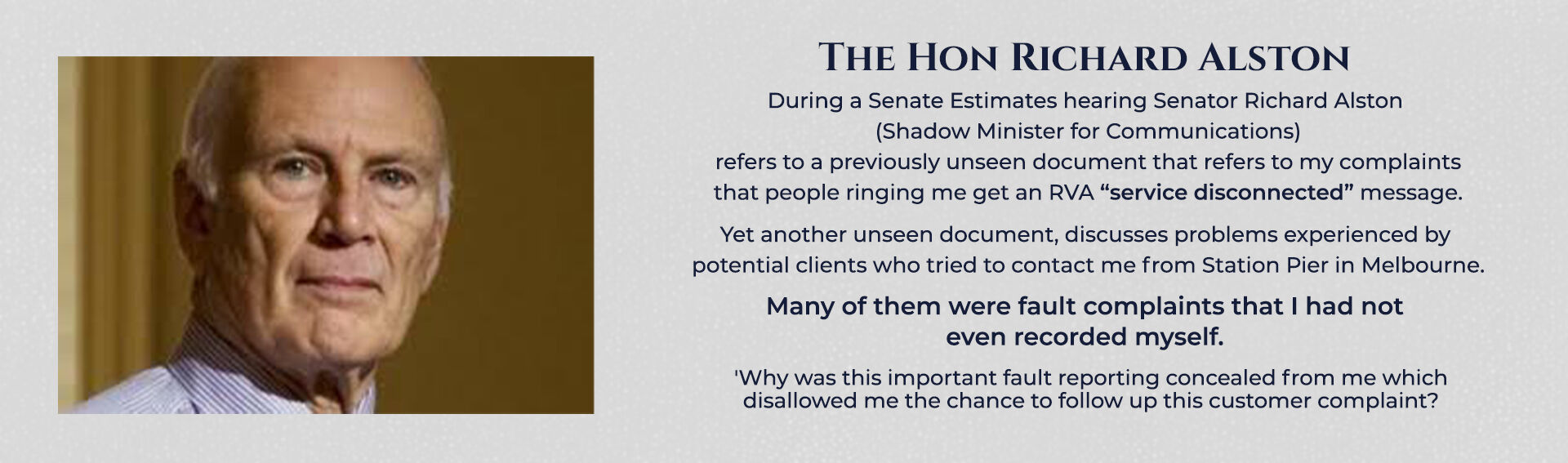
Senator Alston did not respond.
The following day, Graham, Ann, Maureen, and I signed the FTSP, trusting Robin Davey's verbal assurances that consequential losses would be included and that Telstra would honour their agreement to provide the necessary documents. I included a letter with the agreement, clearly stating my expectations:
By signing and returning this proposal, I am relying on the assurances of Robin Davey, Chairman of Austel, and John MacMahon, General Manager of Consumer Affairs, Austel, that this is a fair document. I was disappointed that Mr. Davey was unwilling to put his assurances in writing, but I am prepared to accept his word.
I would not sign this agreement if I thought it would prevent me from continuing my efforts to obtain satisfactory service for my business. It is clearly understood that nothing in this agreement prevents me from continuing to seek a satisfactory telephone service.
Despite nagging doubts, we felt a great sense of relief after sending the agreement off. The pressure on all four of us had been immense, with TV and newspaper interviews and our ongoing canvassing of the Senate. Furthermore, I never stopped advocating for change in rural telephone services, at least in Victoria.
In December 1993, David Hawker MP, my local federal member, wrote to congratulate me on my 'persistence in bringing about improvements to Telecom's country services' and to regret 'that it was at such a high personal cost.'
This was very affirming, as was a letter from the Hon. David Beddall MP, Minister for Communications in the Labor Government, which stated, in part:
The Government is most concerned about allegations that Telecom has not been maintaining telecommunications service quality at appropriate levels. I acknowledge that, in a number of cases, including Mr. Smith's, there has been great personal and financial distress. This is of great concern to me, and a full investigation of the facts is clearly warranted.
Subsequently, a number of small businesses in rural Australia began writing to me about their experiences with poor service from Telstra, detailing problems with their phones and various billing issues. On several occasions, I contacted Telstra management myself, formally requesting that these matters be resolved. I believe this was a responsible reaction to the letters I was receiving.
After I alleged that rural small-business owners and residents faced inequities in telephone services compared to their urban counterparts, rural subscribers wrote to TV stations and newspapers in support of my claims. For example, David M. Thomson & Associates, Insurance Loss Adjusters in Ballarat, wrote to the producer of Channel 7's 'Real Life', a current affairs program:
I have watched with interest the shorts leading up to tonight's program as I have similar problems to the man at Cape Bridgewater.
Their letter detailed a story of frustration:
Our office is located in Ballarat, and due to Telstra's structure, most of our local calls incur STD fees.
On many occasions, we have been unable to connect to numbers we have dialled, often receiving the message, "This number is not connected," or similar messages, which we know to be untrue.
Clients report frequently encountering an engaged signal when calling us, yet our office records indicate that at least one of our lines was free at the time.
We recently received our latest Telstra bill, which is about 25–30% higher than the last one. This is surprising because our workload during the billing period decreased by about 25%, and we have one less staff member than in the previous period.
Another example is a letter to the Editor of Melbourne's Herald-Sun, which stated:
I am writing in reference to your article in last Friday's Herald-Sun (2nd April 1993) about phone difficulties experienced by businesses.
I wish to confirm that I have had problems trying to contact Cape Bridgewater Holiday Camp over the past 2 years.
I also experienced problems while trying to organise our family camp for September this year. On numerous occasions, I have rung from both this business number, 053 424 675, and also my home number and received no response – a dead line.
I rang around the end of February (1993) and twice was subjected to a piercing noise similar to a fax. I reported this incident to Telstra, who got the same noise when testing.
(Due to multiple reports concerning this 'piercing noise', Ray Morris from Telstra's Country Division arranged to switch my service to another system. Unfortunately, this did not resolve the issue.)
TV stations reported a surge in calls whenever they broadcast stories about phone faults, with people from across the country sharing their complaints about Telstra's service. This support from the media and the public significantly boosted our morale and energised our group's efforts to have these issues addressed in the Senate.
AUSTEL, the government communications regulator, investigated my ongoing telephone problems and compiled adverse findings (points 10-212). According to government records (see Absentjustice-Introduction File 495-551), these findings were provided to Telstra (the defendants) one month before Telstra and I signed our arbitration agreement. This gave Telstra the opportunity to conceal the AUSTEL documents before my arbitration began. I did not receive a copy of these findings until November 23, 2007, 12 years after my arbitration concluded.
Point 115 –
"Some problems with incorrectly coded data seem to have existed for a considerable period of time. In July 1993 Mr Smith reported a problem with payphones dropping out on answer to calls made utilizing his 008 number. Telecom diagnosed the problem as being "Due to incorrect data in AXE 1004, CC-1. Fault repaired by Ballarat OSC 8/7/93. The original deadline for the data to be changed was June 14th 1991. Mr Smith's complaint led to the identification of a problem which had existed for two years."
Point 130 –
"On April 1993 Mr Smith wrote to AUSTEL and referred to the absent resolution of the Answer NO Voice problem on his service. Mr Smith maintained that it was only his constant complaints that had led Telecom to uncover this condition affecting his service, which he maintained he had been informed was caused by "increased customer traffic through the exchange." On the evidence available to AUSTEL it appears that it was Mr Smith's persistence which led to the uncovering and resolving of his problem – to the benefit of all subscribers in his area".
Point 153 –
"A feature of the RCM system is that when a system goes "down" the system is also capable of automatically returning back to service. As quoted above, normally when the system goes "down" an alarm would have been generated at the Portland exchange, alerting local staff to a problem in the network. This would not have occurred in the case of the Cape Bridgewater RCM however, as the alarms had not been programmed. It was some 18 months after the RCM was put into operation that the fact the alarms were not programmed was discovered. In normal circumstances the failure to program the alarms would have been deficient, but in the case of the ongoing complaints from Mr Smith and other subscribers in the area the failure to program these alarms or determine whether they were programmed is almost inconceivable."
Spoliation of evidence – Wikipedia
By providing Telstra with a copy of AUSTEL's adverse findings in March 1994, AUSTEL assisted Telstra not only during my 1994/95 arbitration defence but also in 2006. In 2006, the government could assess my claims only on a sanitised report prepared by AUSTEL, rather than on AUSTEL's original adverse findings.
Muzzling the media
Despite receiving considerable media coverage, it appeared Telstra may have been pressuring journalists to suppress certain stories.
A Telstra internal memo from July, titled 'COT Cases Latest', stated:
I disagree with raising the issue of the courts. That carried an implied threat not only to COT cases but to all customers that they will end up as lawyer fodder. Certainly, that can be a message to give face to face to customers to hold in reserve if the complainants remain vexatious.
This raises the question: How many Telstra customers, like the COT Cases, found themselves entangled in legal battles after entering arbitration or mediation, ultimately leading to broken homes and destroyed businesses?
A television news program was also seemingly targeted. Another internal memo stated:
Good news re Channel —— News. Haven't checked all outlets but as it didn't run on the main bulletin last night, we can be pretty certain that the story died the death. I wish I could figure which phrase it was that convinced —— not to proceed. Might have been one of (name deleted) pearls.
The deleted name was Telstra's Corporate Secretary at the time. The identity of the TV station and reporter has been omitted here. One can only speculate what convinced a respected journalist to abandon the story.
It later came to light that the same area general manager who deliberately misled me during the 1992-93 settlement process was appointed as one of two Telstra staff members to 'deal with the media/politicians' regarding COT issues. This raised concerns that she would misinform the media, as she had me.
Another Telstra memo from July 1993, titled 'Cot Wrap-Up', stated:
I think it should be acknowledged these customers are not going to become delighted. We are dealing with the long-term aggrieved and they will not lie down.
Further, I propose that we consider immediately targeting key reporters in the major papers and turn them on to some sexy 'Look at superbly built and maintained network' stories.
I advise that Clinton be targeted for some decent Telstra exclusive stories to get his mind out of the gutter. Prologue Evidence File No 24 to 39
This leaves the "long-term aggrieved" to wonder who "Clinton" was and why his mind was perceived to be in the gutter.
Finally, a document received long after my arbitration, Telstra FOI folio 101072 to 10123, titled "In-Service Test Performance for The Telecom Australia Public Switched Telephone Service (Telecom Confidential)," reveals:
"The performances tabulated below have been formulated to aid dispute investigation and resolution. The information contained herein is for internal Telstra Corporation use only and must not be released to any third party, particularly AUSTEL."****(refer 101072 Arbitrator File No 63)
Had AUSTEL known this document contained the explicit instruction, "must not be released to any third party, particularly AUSTEL," perhaps its public servants would not have perjured themselves defending Telstra's arbitration claims. These claims asserted that all Service Verification Testing at my business on 29 September 1994 met AUSTEL's specifications. I believe this perjury occurred not only in their 2 February 1995 letter but also in the third COT cases quarterly report to the communications minister, the Hon Michael Lee MP. As confirmed in Main Evidence File No/2 and File No 3, Telstra did not carry out its arbitration Service Verification Testing (SVT) to AUSTEL's mandatory specifications at my premises.
Throughout this narrative, and on my website, I address the government communications regulator's pre-arbitration warning to Telstra. The regulator expressed serious concerns about a specific legal firm's continued involvement in the COT settlement/arbitration process. I also question why the arbitration agreement faxed to the TIO's office on 10 January 1994 bore the abbreviated name of this same firm, despite assurances from the government that it would not have a continuing role.
This FOI document (refer to Arbitrator File No/80), dated September 1993, was released by Telstra under FOI, but was too late for use in my arbitration claim. Had it been available earlier, it might have persuaded the arbitrator to grant me more time to access Telstra's documents. The document, released post-arbitration, appears to relate to my ongoing telephone problems:
"All technical reports that relate to the customer's service are to be headed "Legal Professional Privilege", addressed to the Corporate Solicitor and forwarded through the dispute manager."
This Legal Professional Privilege designation seems connected to threats from Telstra, stating that they would only investigate my phone complaints if registered in writing with these same lawyers.
Chapter 5
Their thuggery became the operating system — not fairness, not law, not truth. Corruption was no longer hidden; it strutted openly, confident that I couldn’t fight back. This is where the machinery designed to destroy my holiday camp reveals itself.
TIO Evidence File No 3-A contains an internal Telstra email (FOI folio A05993) dated 10 November 1993. Sent by Chris Vonwiller to Telstra's corporate secretary Jim Holmes, CEO Frank Blount, group general manager of commercial Ian Campbell, and other key figures within the then government-owned corporation, the email concerns Warwick Smith and the COT cases and is marked CONFIDENTIAL:
"Warwick Smith contacted me in confidence to brief me on discussions he has had in the last two days with a senior member of the parliamentary National Party in relation to Senator Boswell's call for a Senate Inquiry into COT Cases.
"Advice from Warwick is:
Boswell has not yet taken the trouble to raise the COT Cases issue in the Party Room.
Any proposal to call for a Senate inquiry would require endorsement in the Party Room and approval by the Shadow Cabinet.
The intermediary would raise the matter with Boswell, suggesting Boswell discuss the issue with Warwick. The TIO saw no merit in a Senate Inquiry.
He undertook to keep me informed and confirmed his view that Senator Alston would not be pressing a Senate Inquiry, at least until after the AUSTEL report was tabled.
Please keep this information confidential.
A Story of Despair and Heartache:
Exhibit TIO Evidence File No 3-A confirms that two weeks before the TIO was officially appointed as the administrator of the Fast Track Settlement Proposal (FTSP), which became the Fast-Track Arbitration Procedure (FTAP), he was providing Telstra, the soon-to-be defendant in that process, with privileged government party room information about the COT cases. The TIO not only breached his duty of care to the COT claimants but also appears to have compromised his own future position as the official independent administrator of the process.
It is highly likely that the confidential advice the TIO gave to Telstra's senior executive—that Senator Ron Boswell's National Party Room was not keen on holding a Senate enquiry—later prompted Telstra to transform the FTSP's non-legalistic commercial assessment process into their preferred legalistic arbitration procedure. They now had privileged government information indicating that there was no longer a significant threat of a Senate enquiry.
Did this secret government party-room information, passed on to Telstra by the administrator of our arbitrations, have anything to do with the child sexual abuse and the cover-up of paedophile activities by a former Senator who had been dealing with the four COT Cases? The fact that Warwick Smith, the soon-to-be administrator of the COT settlement/arbitrations, provided confidential government in-house information to the defendants (Telstra) was a very serious matter.
On 17 January 1994, Warwick Smith, the Telecommunications Industry Ombudsman (TIO), distributed a media release announcing that Dr. Gordon Hughes would be the assessor for the four COT Fast Track Settlements processes. The TIO did not mention that, as I had feared, Telstra was not abiding by their agreement and was not supplying us with the discovery documents critical for establishing our cases. The TIO also failed to inform the Australian public in this media release that he had agreed to secretly assist Telstra by providing them with information about the COT Cases issues being discussed in the Coalition government Party Room.
Telstra and the TIO were treating us with sheer contempt, in full view of the TIO and the assessor. We were beginning to believe that no single person, and no organisation, anywhere in Australia, had the courage to instigate a judicial inquiry into the way Telstra steamrolled their way over legal process.
Despite Austel's chairman, Robin Davey, expressing his frustration to Telstra regarding their failure to provide the necessary documents, his efforts proved fruitless. In February 1994, Senator Ron Boswell questioned Telstra in the Senate, but, as before, no practical outcome was achieved. (Over the following years, various Senators repeatedly raised questions in the Senate about the failure to supply FOI documents. While their persistence eventually benefited some COT members, I was not among them.)
Compounding the existing difficulties, a new problem emerged for the COT Four. The assessor, initially engaged to conduct a commercial assessment, was somehow persuaded (presumably by Telstra) to abandon that process in favour of an arbitration procedure mirroring Telstra's own. This shift guaranteed a protracted and legalistic process, far from the promised "fast track." Telstra was well aware that none of us possessed the financial resources to challenge their powerful legal team in such a setting. This was the antithesis of what we, the COT members, had wanted. We had agreed to a commercial assessment, and that was what we expected.
Graham Schorer, the COT spokesperson, contacted the TIO to explain the COT Four's rejection of the arbitration process. However, our concerns were dismissed. The TIO stated that he had dedicated too much time to his role as administrator of our FTSP, resulting in significant expenses for his office (expenses Telstra was slow to reimburse). He further stated that his office had no intention of incurring further expenses on our behalf. He informed Graham that if we refused to abandon our commercial agreement with Telstra, Telstra would exert every effort to force us into a position where we would have to take them to court to resolve our commercial losses.
Furthermore, the TIO threatened to resign as administrator if we pursued legal action to compel Telstra to honour the original commercial assessment agreement. He insisted that his resignation would effectively terminate the FTSP, leaving us with no option but to pursue individual legal action to resolve our claims.
The following excerpt from a Telstra internal memo, dated 30 November 1993 (FOI document folio D01248), reveals the extent of Telstra's involvement. The memo, written by Ted Benjamin, Telstra's Group Manager – Customer Affairs and TIO Council Member, to Ian Campbell, Customer Projects Executive Office, is titled "TIO AND COT." It was written seven days after Alan signed the TIO-administered Fast Track Settlement Proposal (FTSP). In this memo, Mr Benjamin states:
"At today's Council Meeting the TIO reported on his involvement with the COT settlement processes. It was agreed that any financial contributions made by Telecom to the Cot arbitration process was not a matter for Council but was a private matter between Telecom, AUSTEL, and the TIO.
I hope you agree with this."
This demonstrates that Telstra was at least partially, if not fully, funding the arbitration process.
For true transparency, the claimants should have received detailed information about the funds allocated during the four COT arbitrations, specifically the amounts paid to the arbitrator, the Arbitrator's Resource Unit, the TIO, and the TIO's special counsel for their professional advice.
However, it remains unclear how the arbitrator billed Telstra for professional fees, or how the TIO billed Telstra for its own fees, as well as those of the TIO-appointed Resource Unit and special counsel. This raises critical questions:
-
Were the arbitrator and Resource Unit compensated on a monthly basis?
Did the Resource Unit receive additional bonuses for their undisclosed appointment as the second arbitrator, responsible for determining which arbitration documents the primary arbitrator could access (see Telstra's letter to Warwick Smith, dated 11 July 1994)?
Without full disclosure of how these payments were distributed by the defence to the involved parties in the initial four arbitrations, the TIO and AUSTEL (now ACMA) cannot credibly maintain that the COT arbitrations were administered independently.
In essence, during these four arbitrations, the defence was permitted to pay the arbitrator and other process participants. This arrangement is akin to a defendant in a criminal case paying the judge, representing a clear and deeply concerning conflict of interest.
Despite these concerns, Senator Richard Alston discussed the "Problem 1" document during a Senate Estimates hearing on 25 February 1994. Furthermore, another previously unseen document, dated 24 July 1992 and provided to Senator Alston in August 1993, includes my phone number and references my complaint about the "service disconnected" message callers received. A subsequent document, dated 27 July 1992, details issues experienced by potential clients attempting to contact me from Station Pier in Melbourne (see Arbitrator File No 60).
Some of these handwritten records date back to October 1991 and include numerous fault complaints that I did not personally record. Telstra has never explained who authorized the withholding of the complainants' identities from me. Had I known who was unable to reach me, I could have provided them with an alternate contact number. Could the withholding of these names and the unavailability of my historical fault documents be linked to the Jim Holmes issues referenced in documents A01554, A06507, and A06508 (TIO Evidence File No 7-A to 7-C)?
The TIO betrayed us.
Our pleas to the TIO to continue with the original FTSP agreement were ignored. AUSTEL offered no assistance, leaving us with no alternative but to prepare for an arbitration process by April 1994. Our initial step was to familiarise ourselves with the rules of arbitration, unaware that Telstra's lawyers had drafted them.
We were repeatedly assured, as were Austel and the Senate, that the arbitration agreement rules had been drafted specifically for this purpose, independently of Telstra, by the President of the Institute of Arbitrators of Australia. Despite the TIO's office apparently possessing a copy of these rules, our requests for one were denied, the TIO claiming it was 'irrelevant to our cause.' We asked the TIO multiple times, but to no avail. Instead, we were told to trust the arbitrator, and foolishly, we did. Exhausted, stressed, and desperate, we felt we had no other choice. Both individually and collectively, we were vulnerable to Telstra's overwhelming corporate power.
The rules included a confidentiality agreement that prohibited anyone involved from discussing the arbitration process. This meant that any criminal offences committed by either party would be effectively shielded from investigation, enabling a cover-up. In my case, despite the TIO and the arbitrator being aware that Telstra had perverted the course of justice during my arbitration, this confidentiality clause has, to date, prevented any investigation into this unlawful conduct.
The later revelation in the Senate that Telstra and their government minders had concealed the requested claim documents of the COT Cases highlights the ineffectiveness of the Establishment in searching for the FOI documents related to the COT Cases.
The Establishment
The Australian Establishment clearly viewed the arbitrator favourably, likely because they believed he was protecting the assets of the then government-owned telecommunications carrier, thereby safeguarding public funds and creating a beneficial outcome for all Australians. However, what the arbitrator and the government have consistently failed to acknowledge is that bending the law to protect Telstra and its shareholders constituted a breach of the rule of law. Telstra, the TIO (which also administered the arbitrations), and the arbitrator used their positions to mislead interested government ministers and the media, leading them to believe that, once an award had been handed down, the services investigated during the arbitration were operating efficiently and effectively.
Whenever a claimant disputed this or fought back, Telstra, the TIO, and the arbitrator would relentlessly contest the accusations, aiming to exhaust the claimant and eventually wear them down. As documented in Bad Bureaucrats, for six years after my arbitration, no one investigated my complaints of ongoing, unaddressed arbitration faults. I reluctantly sold my business to the Lewis family in December 2001, and their subsequent seven-year, unsuccessful struggle to resolve these problems is a recurring theme throughout our
story—a story of despair and heartache.
To understand the events surrounding this statutory declaration, it's necessary to go back to before April 1994. At that time, the appointed commercial assessor, along with the first TIO and Telstra (the defendants), decided to transform the commercial assessment, FTSP, into a highly legalistic arbitration process. Telstra's lawyers controlled at least 33 of Australia's largest legal firms and most, if not all, of Australia's technical resource units (see Senate Hansard for 24 June and 26 September 1997). By using Telstra's drafted arbitration agreement, faxed to the TIO on 10 January 1994, Telstra gained a significant advantage in controlling the entire arbitration process. Later, Dr. Hughes, in his letter of 12 May 1995 (see Open Letter File No/56-A), alerted the TIO that they had been misled by Telstra into using an agreement that did not allow enough time for the:
"inevitable delays associated with the production of documents, obtaining further particulars and the preparation of technical reports".
The only ethical course of action for these two lawyers would have been to admit they misled and deceived the four COT cases, the claimant's lawyers, and many of Australia's government ministers, including the Canberra Parliament House press gallery, into believing the arbitration agreement was prepared independently of Telstra. They knew this was false. Instead, they chose to conceal their actions, a decision that has, in effect, stolen 22 years of our lives.
Prior to this, on 18 November 1993, the Chairman of Austel refused to confirm in writing his verbal assurance that consequential losses would be included in the FTSP, explaining that doing so could set a precedent. Telstra's Corporate Secretary had written to him on 18th November 1993 (FOI D01274 to D01276), stating that:
"(3) Telecom does not accept the COT Cases' grounds for reviewing the earlier settlements. However, on the basis of a denial of liability and without any legal obligation to do so and purely as a matter of good faith and business expediency, Telecom is prepared to agree to the above-mentioned review.
(4) This proposal constitutes and offer open to all or any of the COT Cases referred to in Clause (1) (a), which will lapse at 5 pm Tuesday 23 November 1993. This offer may be accepted by signature below and sending advice of such signature to AUSTEL or the Telstra Corporate Secretary before that time."
On 23 November, Graham Schorer, Ann Garms, Maureen Gillan, and I signed the FTSP, trusting in the Regulator's verbal assurances that consequential losses would be included. These signed FTSP agreements were then forwarded to Telstra's corporate secretary. Alan included a letter with his agreement, clearly stating his expectations of the process:
"In signing and returning this proposal to you, I am relying on the assurances of Mr. Robin Davey, Chairman of Austel, and Mr. John MacMahon, General Manager, Consumer Affairs, Austel, that this is a fair document. I was disappointed that Mr. Davey was unwilling to put his assurances in writing but am nevertheless prepared to accept what he said."
What follows is:
I would not sign this agreement if I believed it would hinder my efforts to secure satisfactory service for my business. It is my understanding that nothing within this agreement prevents me from pursuing a resolution to obtain satisfactory telephone service.A more precise chronology of events surrounding the Fast Track Settlement Proposal versus the Fast Track Arbitration Procedure, as well as information on who drafted the original FTAP, can be found by clicking on Evidence-C A V Part 1, 2 and 3-Chapter 3 - Fast Track Settlement Proposal.
Signing for arbitration, April 1994
On April 21, 1994, when we signed the documents to initiate the new arbitration procedure, we still had not seen the arbitration rules. We wanted to review the rules to understand the process and ensure they differed from Telstra's proposed rules. However, the TIO disregarded our concerns, and we signed the agreement without seeing the rules. We later discovered that the TIO's office had been supplied with a set of rules titled "Telstra Corporation- Limited 'Fast Track' Proposed Rules of Arbitration." It was clear why they had been withheld from us; the assurance we received regarding the drafting of the rules was false. Unsurprisingly, nobody seemed interested in addressing this deception.
At this time, my focus shifted to
preparing my case for arbitration. In April 1994, Austel released its report on the COT cases, and I used its findings and recommendations to support my claims. While I felt that Austel's findings regarding my case were less forceful than my original submissions, I later learned that Austel had toned down the report because Telstra threatened to file an injunction that would delay its release for years. To ensure the COT four could access the report's information for preparing our claims, Austel agreed to the amendments Telstra demanded. I was unaware of the "secret" draft mentioned at the end of Chapter Three until 2007.
Nevertheless, the Austel Report confirmed a significant point. Despite Telstra's constant "No fault found" response, technicians' records revealed the truth. For instance, on occasions when I reported the phone ringing briefly and then disconnecting, officials denied the fault. However, the Austel report indicated otherwise:
"In the period February to April 1993, Telstra staff responding to complaints lodged by Mr. Smith of the Cape Bridgewater Holiday Camp recorded in their notes that there was a fault known to exist in AXE (digital) switching equipment which could give rise to a single burst of ring, followed by a busy tone to a caller and dial tone to the called party."
This is evidenced by comments from technicians on complaint forms:
"This problem occurs intermittently throughout the network, and although it is recognised, no single person or group appears to be responsible for resolving it."
"I believe this may be related to the AXE network problem, which results in only one ring burst and a busy tone for the calling party."
A New Fault
Even as I began compiling my claims, a new fault emerged: the "hang-up" fault. While Telstra refused to provide documentary evidence for my claims, I contacted their engineers to test the hang-up fault, inadvertently creating additional evidence that would likely be withheld.
Since August 1993, I had reported to Telstra that customers and friends had noticed unusual behavior on my direct line, which also served as a fax line. After I ended calls I had initiated, they could still hear me moving around the office if they were slow to hang up. Distracted by other ongoing issues, I hadn't initially focused on this, but now I needed to address it.
On April 26, 1994, I contacted Cliff Matherson, a senior engineer at Austel, who suggested a series of tests. First, I was to hang up and count aloud from one to ten while he listened from his end. He could hear me clearly through the number ten and suggested we repeat the test, counting even higher. Again, he could hear me throughout my counting. Next, he suggested swapping the phone on that line with the phone on my other line (both were identical Telstra Exicom T200 phones). We repeated the test, with the same results. According to Mr. Matherson, and as was also apparent to me, this proved the fault was not in the phone itself, but somewhere within the Telstra network. He then suggested I contact Telstra, which I did.
I explained to the Telstra engineer that I could count to 15 or more after hanging up, and the person on the other end could hear me. I deliberately omitted that I had tested two different phones, knowing Telstra's tendency to initially blame the customer's equipment. I was curious to see their initial diagnosis.
After performing the same tests as the Telstra engineer and obtaining matching results, he promised to send a technician to collect the phone the following day. However, an internal Telstra email from March 1994 reveals that their engineer was aware, even before these tests, that heat in the Cape Bridgewater exchange was causing the fault. This email, quoted below, further suggests Telstra was aware of phone faults in the exchange while I was preparing my claim for arbitration:
I am concerned to note that heat may be part of the problem. I had occasion earlier this year to get involved in another 'ongoing' case involving an RCM with a heat problem at Murrumbateman (just outside Canberra). I do note, that one of the symptoms from the Murrumbateman case was 'Not Receiving Ring,' something Alan Smith at Cape Bridgewater has been complaining about for some time.
Comparing my Telstra account with Telstra's data for the period shows that call hang-ups and incorrect charging occurred from at least August 1993 until the phone was removed on April 27, 1994. The phone itself, an Exicom manufactured in April 1993, later proved to be a significant element in this saga, a story I will recount later.
Preparational Costs
In May 1994, I finally received a large bundle of FOI documents from Telstra, which I had originally requested in December 1993. This was five months past the 30-day deadline mandated by the FOI Act. Despite the Act's clear requirements, Telstra seemed immune to government oversight. Initially, I was hopeful, thinking, "Now we're getting somewhere." However, the documents lacked any numbering system, were not in chronological order, and many were unreadable due to excessive redaction. This would have frustrated even the most experienced lawyer. How could I effectively support my claim with such deficient material?
Assistance from a law student would have been invaluable. The sheer volume of documents was overwhelming, especially given the knowledge that Telstra's extensive legal team was poised to exploit any weakness in my claim.
consulted with the TIO and his legal counsel, expressing my lack of confidence and reiterating Robin Davey's belief that a non-legalistic hearing would be the fairest approach. The TIO could only offer the unhelpful advice to "Do the best you can," while his legal counsel assured me the process was fair.
This is a story of despair and heartache.
I eventually realised I had no choice but to seek professional help. I started by contacting a loss assessor in Mt Gambier, a firm that had previously assisted me with storm damage at the camp. The assessor remembered difficulty reaching me by phone in the past. After discussing my current situation, he determined my problems were outside his expertise. I then broadened my search to the Melbourne area, contacting four communications companies. Disappointingly, three never responded, and the fourth wished me luck, stating they didn't want to challenge Telstra.
Following this, I contacted George Close in Queensland. George possessed technical expertise in telecommunications and was already working on Ann Garms's case. He agreed to take on my case as well, believing that working together would provide greater insight into Telstra's operations. Once Telstra learned of George's involvement, they offered him a job, seemingly attempting to eliminate our support. However, George, at 70, refused, citing a conflict of interest and declining their offer.
I still needed help assembling the entire claim. I found Garry Ellicott, an ex-National Crime Authority detective working with the loss-assessor company Freemans in Queensland. Derek Ryan, a forensic accountant, completed my team.
I felt cautiously optimistic. Government ministers, Austel, and even the auditors agreed that the COT cases were valid and Telstra was at fault. Despite this, we remained in a difficult position, facing financial hardship without any assistance. I was raising funds by selling camp equipment and borrowing from friends.
When I signed on for the FTSP in November 1993, it wasn't for a legal arbitration. The plan made no provision for the legal professionals needed to support our cases, either initially or after implementation. Had I known that professional fees would exceed $200,000, I would never have agreed to the arbitration, even under extreme duress.
Under Surveillance
Telstra email K01006, dated Thursday, April 7, 1994, at 2:05 pm, raises two key issues. First, the date falls during my involvement in a Regulator-designed commercial agreement with Telstra, making secret observations inappropriate. Second, the email refers to a period when I would be away from my business during the pending arbitration process. The email's author describes:
Mr. Alan Smith was absent from his premises from August 5, 1994, to August 8, 1994. In the past, his absences have coincided with documented complaints (typically received months later) involving NRR, etc. On April 6, 1994, at approximately 4:55 pm, I called the premises. The call was answered after 41 seconds.On this occasion, I intend to document his absence and compile all available data for that period. This will allow us to be prepared for any subsequent issues.
Evidently, in April 1994, the writer knew of my planned absence in August of that year—four months in advance.
This document, along with others suggesting my private telephone conversations were being 'bugged,' was provided to the then-Minister for Communications, the TIO, and the Federal Police. Another FOI document, Folio 000605, clearly indicates that the writer knew when "...Smith is in Melbourne." I visited Melbourne (see AFP Evidence File No 8) for promotional tours of individual clubs, advertising our packaged two- and three-night outdoor activities: horse riding, canoeing, caving, and bushwalking.
How could the writer possess this information unless someone had listened to my calls to determine my travel dates and which local staff member would be on duty at the camp? The AFP transcripts from my interview on September 26, 1994 (see AFP Evidence File No 1) reveal numerous instances in which the AFP documented information in these FOI documents that could only have been obtained by Telstra listening in on my private telephone conversations. Telstra has never adequately explained how they acquired this information.
Furthermore, this same individual stated that he knew I had spoken to Malcolm Fraser, the former Australian Prime Minister, by phone, and when that conversation occurred (AFP Evidence File No 7). He claims I told him about this conversation, which is untrue. Again, Telstra has failed to provide a convincing explanation for their employee's knowledge of this information. Clearly, Telstra was still monitoring my private calls, even though I was involved in litigation with them and their lawyers.
While listening to private calls is reprehensible, the following information is even more incriminating. Page A133 of the official Senate Hansard records, dated February 25, 1994, documents the then-Shadow Minister for Communications questioning the Regulator's Chairman:
"Why did not Austel immediately refer COT's allegations of voice recording to the federal police instead of waiting for the minister to refer the matter to the Attorney-General and then on to the federal police?"
A letter dated 2 March 1994, from Telstra's Corporate Solicitor, Ian Row, to Detective Superintendent Jeff Penrose (see Home Page Part-One File No/9-A to 9-C), indicates that Mr. Penrose was misled regarding the faxing problems I was experiencing. Comparisons between exhibits numbered (File No/9-C) and the interception evidence revealed in Open Letter File No/12 and File No/13 have led many to conclude that had Ian Row not misled the AFP about my faxing issues, the AFP could have prevented Telstra from intercepting relevant arbitration documents in March 1994, before any damage occurred.
This document, along with others suggesting my private telephone conversations were being monitored, was supplied to the then-Minister for Communications, the TIO, and the Federal Police. Another FOI document, Folio 000605, shows the writer knew when "...Smith is in Melbourne." I used to travel to Melbourne (see AFP Evidence File No 8) for promotional tours to single clubs, advertising outdoor activities with two and three-night stays. This information could only have been obtained by monitoring my calls to determine my travel dates and which staff member would be on duty at the camp. The AFP transcripts of my interview on 26 September 1994 (see AFP Evidence File No 7) document many instances where Telstra must have listened to our private telephone conversations to gather the details included in these FOI documents. Open Letter File No/12 and File No/13 demonstrate that COT cases' faxes were intercepted during their arbitrations.
The section "Australian Federal Police Investigations" details how Dr Hughes, the arbitrator, interrogated me for 5 hours in the presence of 2 of Telstra's arbitration defence officers. These questions were clearly aimed at discovering the progress of the Australian Federal Police investigation into whether my faxes were being intercepted, as requested by the then-Government Minister, Michael Lee MP. This type of interrogation was forbidden by the signed arbitration agreement.
In January 1999, the arbitration claimants provided the Australian government with a report confirming that confidential, arbitration-related documents were secretly and illegally screened before reaching their intended recipients. In my case, despite the arbitrator's secretary advising the arbitration process that six of my faxed claim documents never reached the arbitrator's office, I was not allowed to resubmit this material for assessment. My fax account confirms that I dialled the correct fax number on all six occasions.
In 1994, none of the Customer Owned Telecommunications (COT) cases, including mine, involved individuals on any terrorist list, nor were we ever suspects in crimes against Australian citizens. Why, then, did Telstra hack our confidential arbitration and Telstra-related documents? For example, 43 sets of my faxed correspondence to the arbitrator's office, some with attachments, are missing from the Arbitration Schedules of Material. Front Page Part One File No/1 shows that the arbitrator's secretary informed Tony Watson of Telstra's arbitration defence unit on May 23, 1994, that six of my claim documents never reached the arbitrator's fax machine. Yet, I was billed for these faxes. Despite this evidence, neither the arbitrator's office nor the Telecommunications Industry Ombudsman (TIO) allowed me to amend my claim to include these proven "not received" documents, preventing them from being valued in support of my claim.
I managed to bring Garry Ellicott to my camp for a few days in May 1994 to observe the phone situation. Based on his experience as a bodyguard for former US President Jimmy Carter during his Australian visit, Garry believed I was being watched, or rather, that my conversations were being monitored.
I had already experienced several instances of Telstra collecting my personal information: details of my incoming calls (who called, when, and from where), staff departures from my business, and even my movements. In April 1994, a Telstra fault reporting officer in Melbourne seemed to know my movements four months in advance. In an internal memo to a colleague, he wrote:
Mr Alan Smith is absent from his premises from 5/8/94 – 8/8/94. On other occasions when he has been absent there have been documented complaints received (usually months later) involving NRR etc ...I intend on this occasion to document his absence and file all data I can collect for the period. That way we should be prepared for anything that follows.
Telstra has never explained how this fault officer obtained this information, nor how he knew about my phone conversation with former Australian Prime Minister Malcolm Fraser, including when it occurred.
The officer claims I told him about the conversation, but this is untrue.
Around the time of the "briefcase saga," an unidentified Telstra technician offered to provide a list of phone numbers I had called. I had previously learned that this technician was listening to my private conversations. When confronted, he admitted to eavesdropping and informed me that he was not the only technician in Portland doing so.
A story of despair and heartache:
Early in our arbitrations, Graham Schorer, in his role as COT spokesperson, received two phone calls within a few days of each other. Both calls were from young people who claimed to have hacked into Telstra's email network. They told Graham they knew we were in arbitration with Telstra and wanted to alert him to documents they had found that confirmed unlawful actions were being taken against us by people close to both our arbitration and Telstra. On both occasions, they offered to send us this evidence.
Graham and I discussed the offer after the first call, but after the second, we declined. Although we were interested in what Graham had heard, we were concerned it might be a set-up by Telstra. We feared that accepting this evidence, however promising, could lead to our arbitrations being declared null and void.
Since then, Andrew Fowler and Suelette Dreyfus have published books referencing Julian Assange's hacking into Telstra's Lonsdale Telephone Exchange in Melbourne, through which Graham's and my businesses were trunked. Could it have been Julian Assange and his associates who contacted us? His well-known concerns about the COT cases not receiving due justice certainly align with his profile.
In hindsight, we likely should have accepted their offer. We might have been able to use that evidence against Telstra at the time, and perhaps we wouldn't be writing our story 20 years later.
More on this aspect of the COT story can be found on our website, absentjustice.com, on our Hacking - Julian Assange page.

Between February and September 1994, I provided documents to the Australian Federal Police (AFP) that I had obtained under the Freedom of Information (FOI) Act. These documents showed that Telstra knew more about my private and business affairs than it should have. On June 3, 1990, while Telstra claimed it had found no network faults affecting my businesses, "The Australian" newspaper published an article titled "Telecom 'spying' on its employees." This article supports pages 1 to 6 of the AFP transcripts (see Senate Evidence File No/ 44 Part 1 and File No/45 Part). The article stated:
"She said the accusations were contained in a statement by a former member of Telecom's Protective Services branch.
"Senator Jenkins said the man claimed:
He and other Telecom employees and private investigators hired by Telecom did secret surveillance on hundreds of compensation recipients. ...
He had been directed by his superior to use whatever methods to get the desired results, even when it was obvious the claimant was genuinely injured.
Claimants have had a 'C.CASS run' on their homes, which is a procedure where a computer can print out all numbers dialled on a home phone." (See Hacking-Julian Assange File No/19)
Democrat Senator Jean Jenkins told the Senate last week that Telecom's activities included bugging workers' homes.
In February 1994, the Australian Federal Police (AFP) visited my business in Cape Bridgewater to discuss my claims that recently obtained Freedom of Information (FOI) documents suggested Telstra had been monitoring my telephone conversations. The AFP was concerned about Telstra's practice of writing the names of individuals and businesses I had contacted on CCAS (Customer Call Accounting System) data records. These records, which compiled all incoming and outgoing calls to my business (see Hacking-Julian Assange File No 20), contained handwritten notes in the right-hand column. These notes included, alongside specific dates, the names of people I had called or faxed. For example, entries such as "31 January 1994, GM (Golden Messenger), AUSTEL, and the Ombudsman" appeared. In one instance, the name "Faye Smith" was noted when I called my ex-wife. This mirrored Senator Jenkins' earlier statements regarding Telstra's alleged secret surveillance of its own employees in 1990, suggesting Telstra employed similar tactics in January 1994, even while engaged in litigation with me.
Chapter 6 - Arbitration
🗂️ Senate Investigations and the BCI Deception
I am using the following witness two witness statements File 766 - AS-CAV Exhibit 765-A to 789), because they prove that at least one police officer, when dealing with the Telstra Corporation during the investigation which Mr Neil Jepson seconded me to assist the Victoria Police was left floundering as were the COT Cases when they were forced into arbitration with the same monster who the arbitrator and administrator of the COT arbitrations were afeared to abandon the COT arbitrations because of the power and influence Telstra has over the legal system in Australia. Please read the following two witness statements. The Major Fraud Group archive documents will be confirmed as faxes below my office, and Mr Jepson did not arrive, even though my Telstra fax account shows they were sent.
This troubled Mr Jepson, and Detective Sergeant Rod Kuris, who was assisting not Mr Jepson and me in piecing together fraud-nominated documents. It is clear from Telstra ex-security officer Des Direen that Mr Rod Kuris was shaken when Des Direen notified us that we were under electronic surveillance, as the following witness statement shows.
"I can recall that during the period 2000/2001, I had arranged to meet Detective Sergeant Rod KURIS from the Victoria Police Major Fraud Squad at the foyer of Casselden Place, 2 Lonsdale Street, Melbourne. At the time, I was assisting Rod with the investigation into alleged illegal activities against the COT Cases.
Rod then stated that he wanted me to follow him to the left side of the foyer. When we did this he then directed my attention to a male person seated on a sofa opposite our seat. He then told me that the person had been following him around the city all morning. At this stage Rod was becoming visibly upset and I had to calm him down. Rod kept on saying that he couldn't believe in what was happening to him. I had to again calm him down".
Points 21 and 22 in Mr Direen’s statement also record how, while he was a Telstra employee, he had cause to investigate “… suspected illegal interference to telephone lines at the Portland exchange,” but when he “… made inquiries by telephone back to Melbourne (he) was told not to get involved and that another area of Telstra was handling it” and that “... the Cape Bridgewater complainant was a part of the COT cases” (my Cape Bridgewater Holiday Camp) business.
What has not been proven, even though both the arbitrator, Dr Gordon Hughes and the administrator to my arbitration, Warwick Smith, were aware that the Australian Federal Police was investigating the same phone/fax interception issues that Des Direen on behalf of Telstra was investigating at the Portland Telephone exchange, were real problems of great concern no stepped forward to confirm either one way of another transparently were my advance group booking enquires being redirected to another holiday camp operator or a booking agent on commission from holiday camp operators to bring business their way unaware that business they were now being advised of was poached from my intercepted telephone and faxes?
Please note that the concluding Chapters 8 to 12 of the above home page are currently undergoing editing as of 07/04/2026. I am aiming to have these four chapters finalised by April 10, 2026.
Telstra-Corruption-Freehill-Hollingdale & Page
Corrupt practices persisted throughout the COT arbitrations, flourishing in secrecy and obscurity. These insidious actions have managed to evade necessary scrutiny. Notably, the phone issues persisted for years following the conclusion of my arbitration, established to rectify these faults

Confronting Despair
The independent arbitration consultants demonstrated a concerning lack of impartiality. Instead of providing clear and objective insights, their guidance to the arbitrator was often marked by evasive language, misleading statements, and, at times, outright falsehoods.

Flash Backs – China-Vietnam
In 1967, Australia participated in the Vietnam War. I was on a ship transporting wheat to China, where I learned China was redeploying some of it to North Vietnam. Chapter 7, "Vietnam—Vietcong," discusses the link between China and my phone issues.

A Twenty-Year Marriage Lost
As bookings declined, my marriage came to an end. My ex-wife, seeking her fair share of our venture, left me with no choice but to take responsibility for leaving the Navy without adequately assessing the reliability of the phone service in my pursuit of starting a business.

Salvaging What I Could
Mobile coverage was nonexistent, and business transactions were not conducted online. Cape Bridgewater had only eight lines to service 66 families—132 adults. If four lines were used simultaneously, the remaining 128 adults would have only four lines to serve their needs.

Lies Deceit And Treachery
I was unaware of Telstra's unethical and corrupt business practices. It has now become clear that various unethical organisational activities were conducted secretly. Middle management was embezzling millions of dollars from Telstra.

An Unlocked Briefcase
On June 3, 1993, Telstra representatives visited my business and, in an oversight, left behind an unlocked briefcase. Upon opening it, I discovered evidence of corrupt practices concealed from the government, playing a significant role in the decline of Telstra's telecommunications network.
Not Fit For Purpose (Duplicate 1)
AUSTEL investigated the contents of the Telstra briefcases. Initially, there was disbelief regarding the findings, but this eventually led to a broader discussion that changed the telecommunications landscape. I received no acknowledgement from AUSTEL for not making my findings public.
&am

A Government-backed Arbitration
An arbitration process was established to hide the underlying issues rather than to resolve them. The arbitrator, the administrator, and the arbitration consultants conducted the process using a modified confidentiality agreement. In the end, the process resembled a kangaroo court.

A Non-Graded Arbitrator
Who granted the financial and technical advisors linked to the arbitrator immunity from all liability regarding their roles in the arbitration process? This decision effectively shields the arbitration advisors from any potential lawsuits by the COT claimants concerning misconduct or negligence.<

The AFP Failed Their Objective
In September 1994, two officers from the AFP met with me to address Telstra's unauthorised interception of my telecommunications services. They revealed that government documents confirmed I had been subjected to these violations. Despite this evidence, the AFP did not make a finding.&am

The Promised Documents Never Arrived
In a February 1994 transcript of a pre-arbitration meeting, the arbitrator involved in my arbitration stated that he "would not determination on incomplete information.". The arbitrator did make a finding on incomplete information.